Steroid Control of Leg Development in Drosophila Craig









- Slides: 90
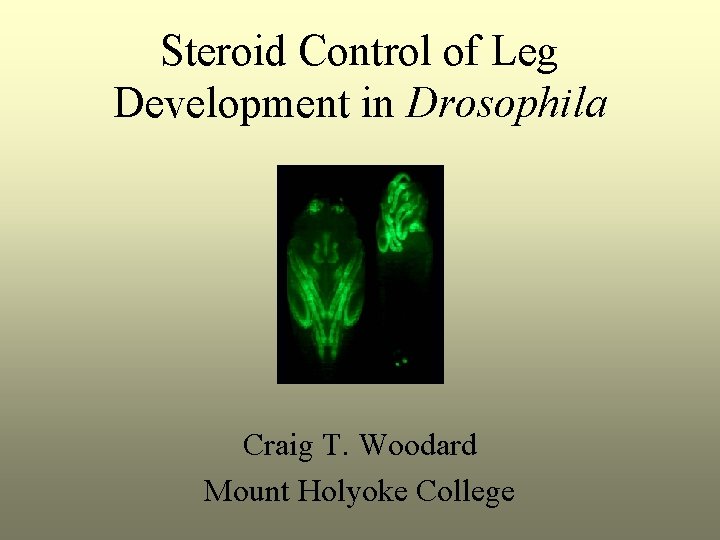
Steroid Control of Leg Development in Drosophila Craig T. Woodard Mount Holyoke College
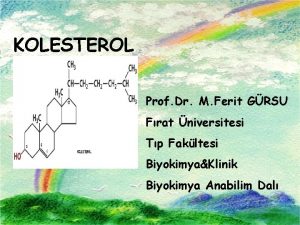
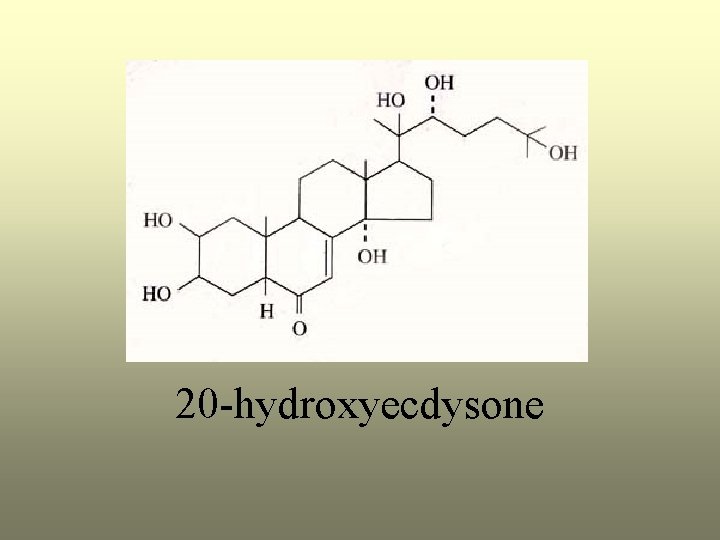
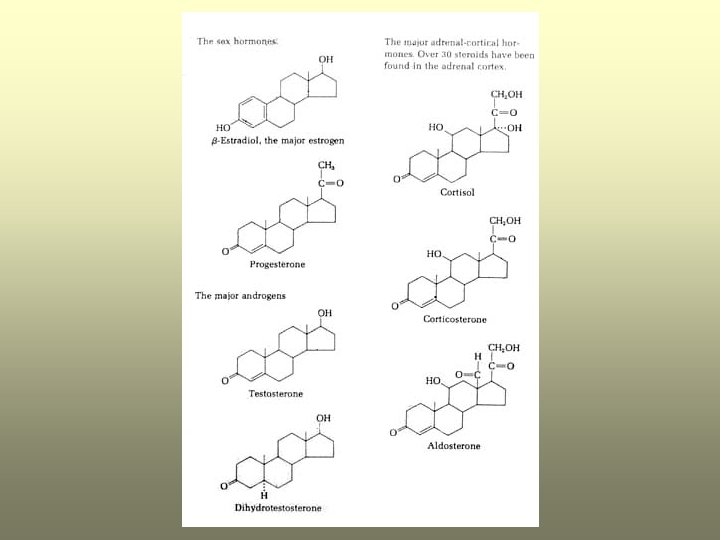
20 -hydroxyecdysone
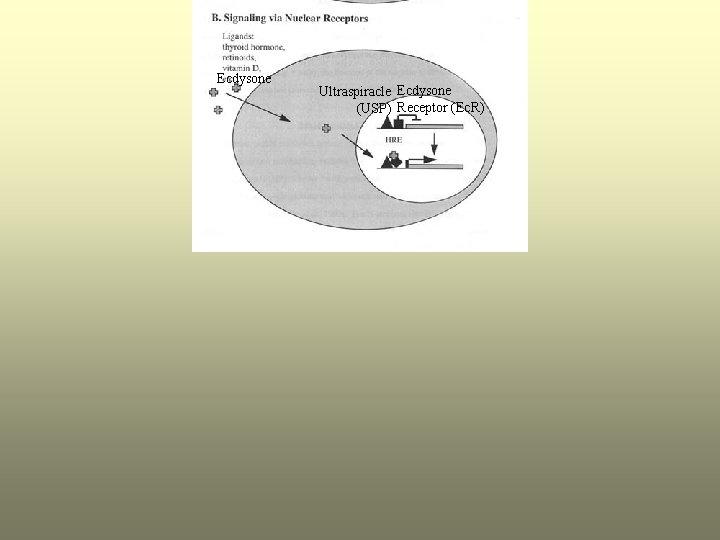
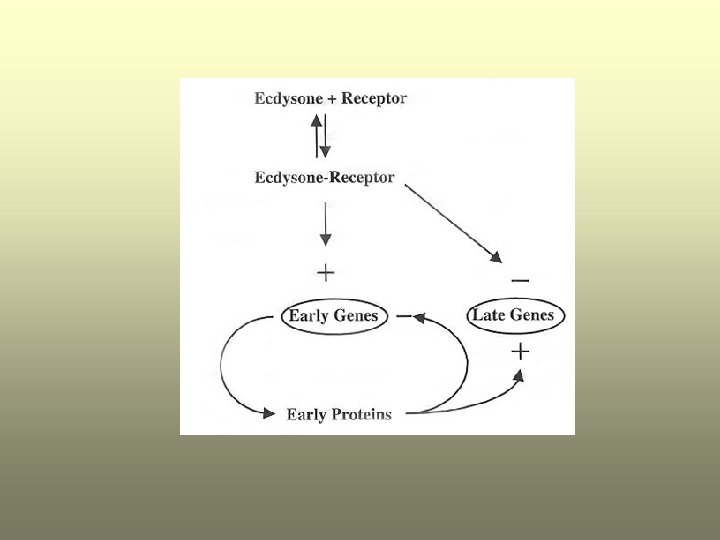
Ecdysone Ultraspiracle Ecdysone (USP) Receptor (Ec. R)
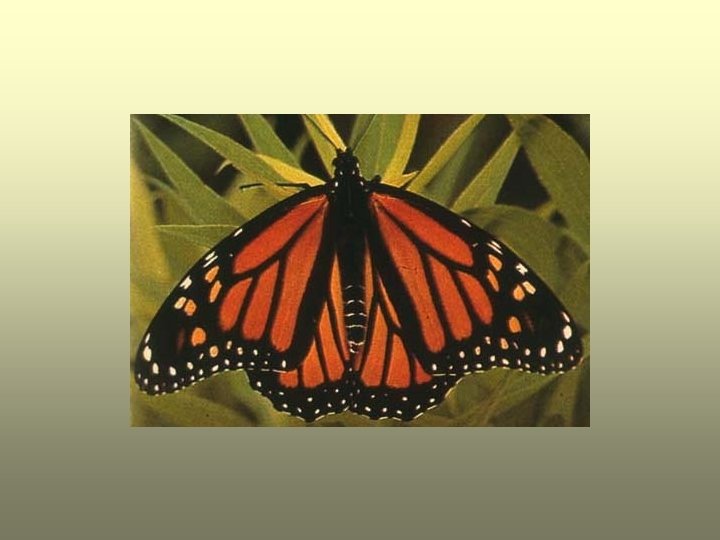
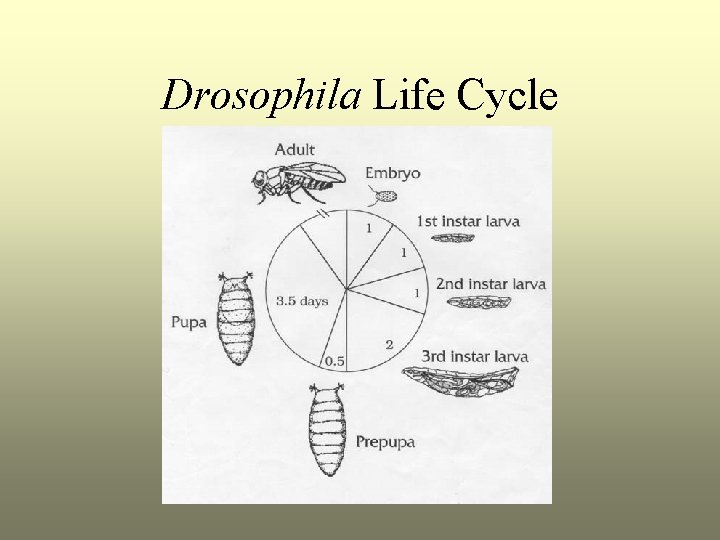
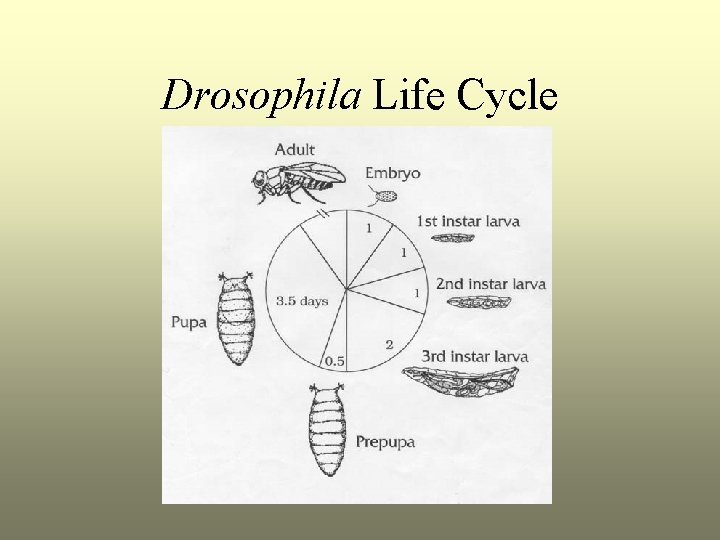
Drosophila Life Cycle
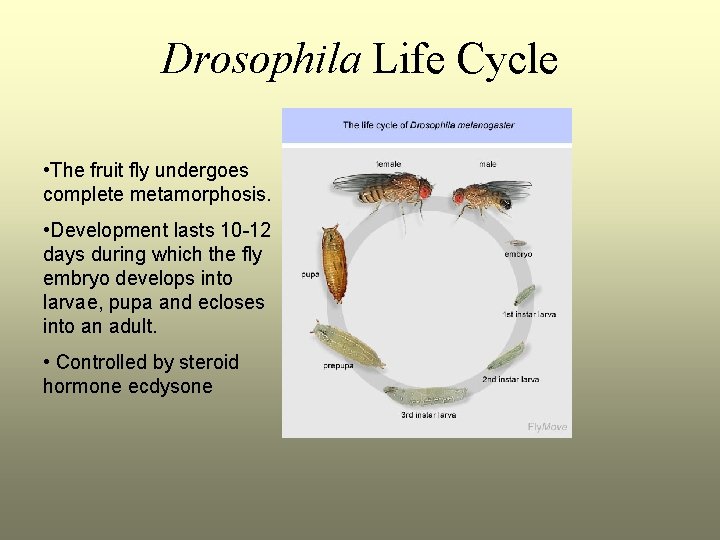
Drosophila Life Cycle • The fruit fly undergoes complete metamorphosis. • Development lasts 10 -12 days during which the fly embryo develops into larvae, pupa and ecloses into an adult. • Controlled by steroid hormone ecdysone
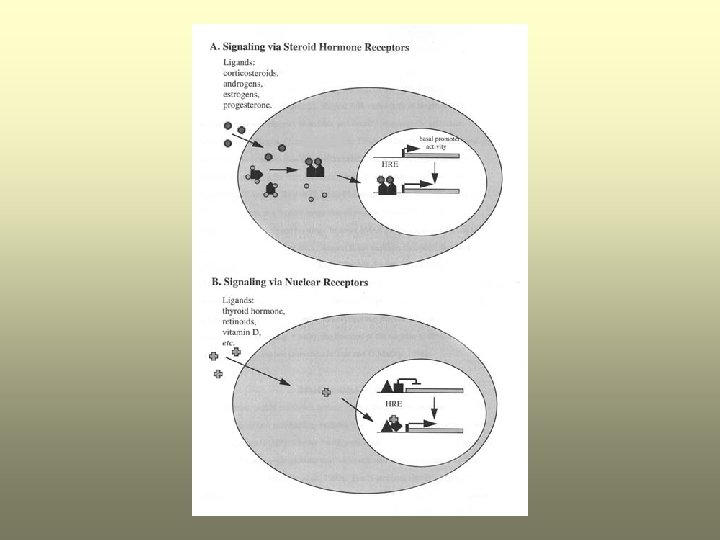
How can a single steroid hormone elicit different responses at different times in development?
Drosophila Life Cycle
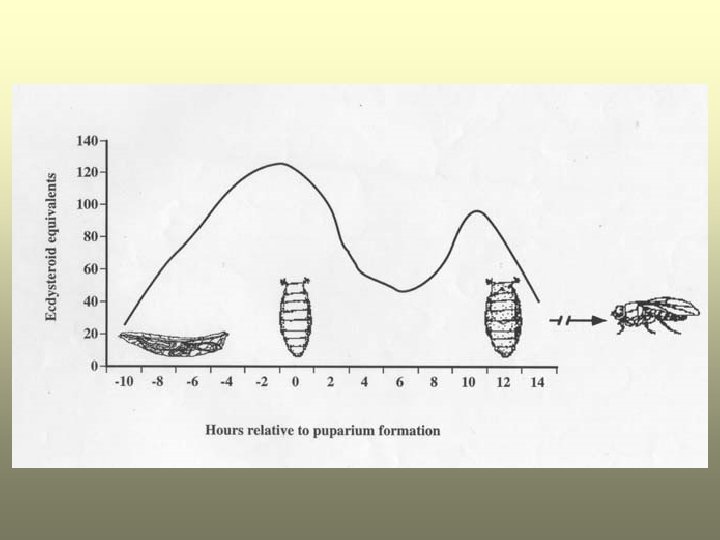
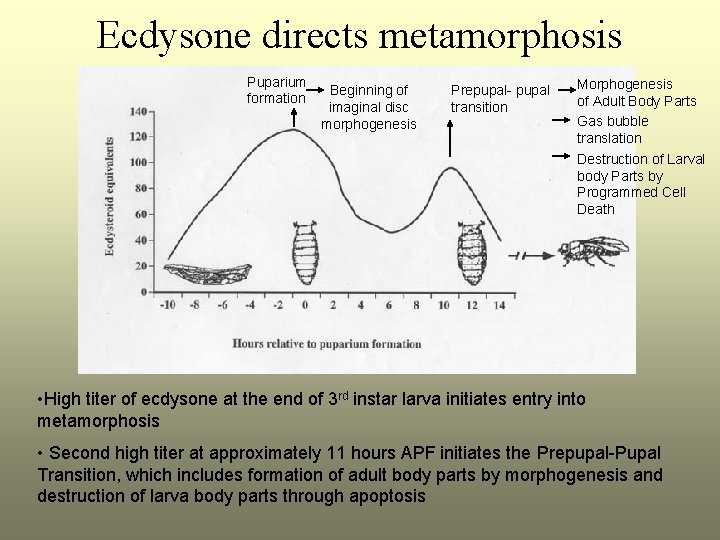
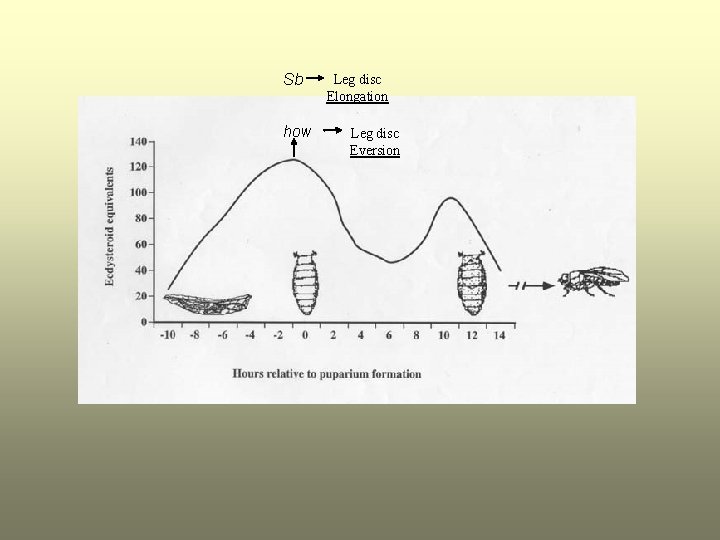
Ecdysone directs metamorphosis Puparium formation Beginning of imaginal disc morphogenesis Prepupal- pupal transition Morphogenesis of Adult Body Parts Gas bubble translation Destruction of Larval body Parts by Programmed Cell Death • High titer of ecdysone at the end of 3 rd instar larva initiates entry into metamorphosis • Second high titer at approximately 11 hours APF initiates the Prepupal-Pupal Transition, which includes formation of adult body parts by morphogenesis and destruction of larva body parts through apoptosis
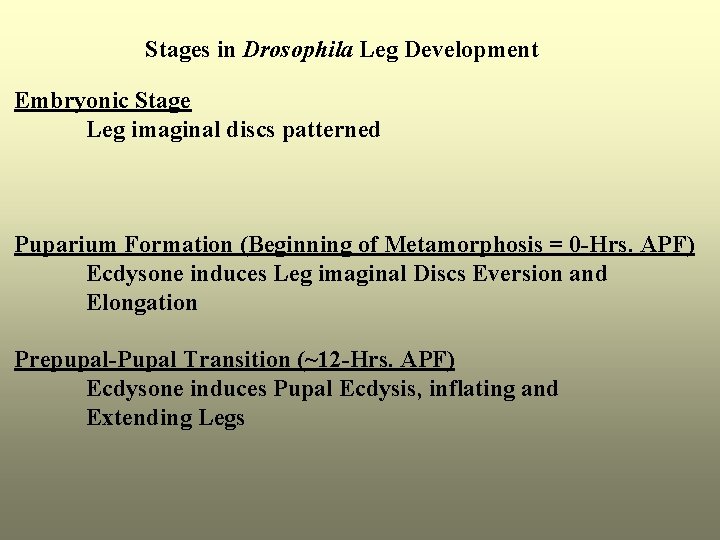
Stages in Drosophila Leg Development Embryonic Stage Leg imaginal discs patterned Puparium Formation (Beginning of Metamorphosis = 0 -Hrs. APF) Ecdysone induces Leg imaginal Discs Eversion and Elongation Prepupal-Pupal Transition (~12 -Hrs. APF) Ecdysone induces Pupal Ecdysis, inflating and Extending Legs
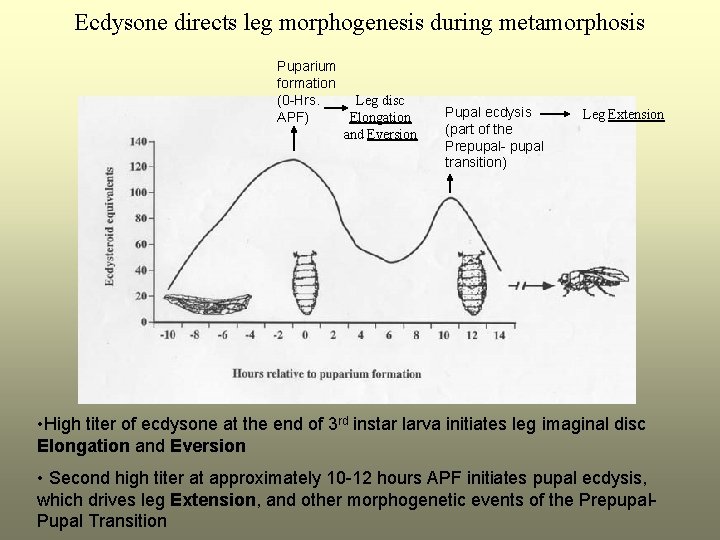
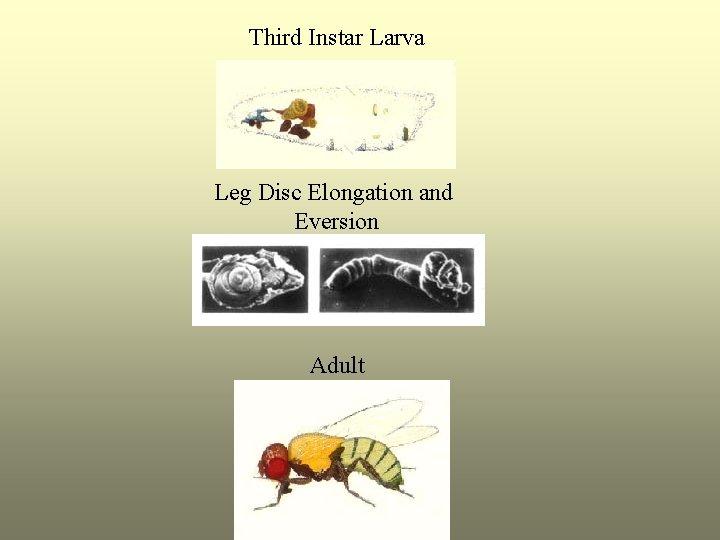
Ecdysone directs leg morphogenesis during metamorphosis Puparium formation (0 -Hrs. Leg disc APF) Elongation and Eversion Pupal ecdysis (part of the Prepupal- pupal transition) Leg Extension • High titer of ecdysone at the end of 3 rd instar larva initiates leg imaginal disc Elongation and Eversion • Second high titer at approximately 10 -12 hours APF initiates pupal ecdysis, which drives leg Extension, and other morphogenetic events of the Prepupal. Pupal Transition
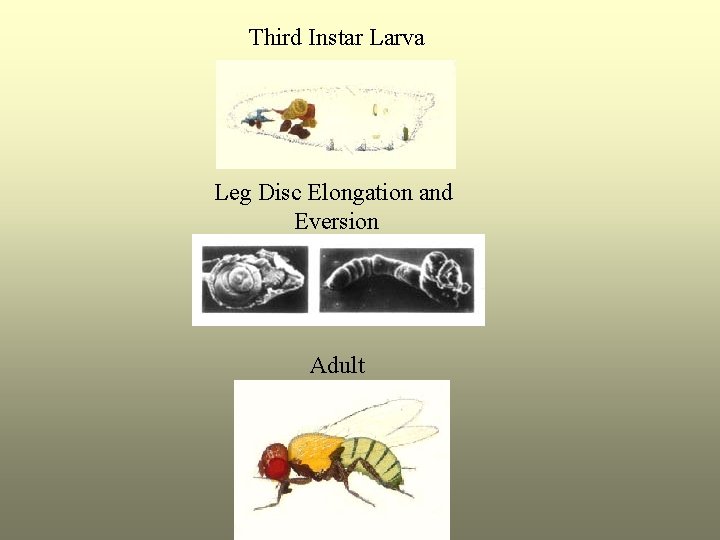
Third Instar Larva Leg Disc Elongation and Eversion Adult
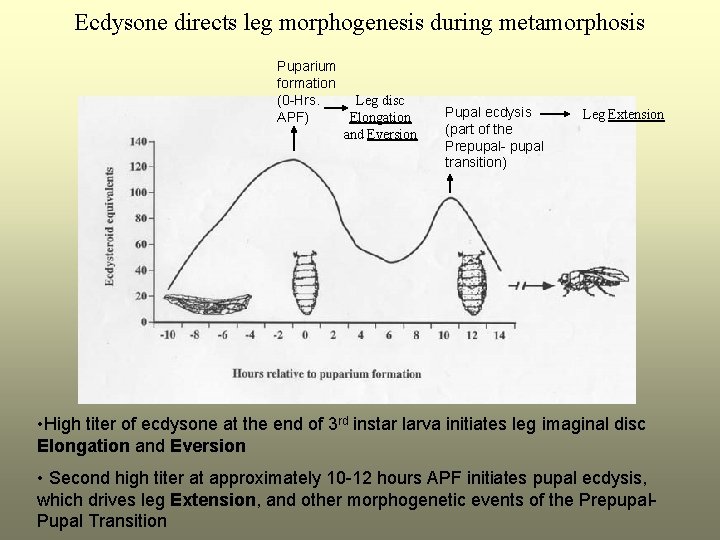
Ecdysone directs leg morphogenesis during metamorphosis Puparium formation (0 -Hrs. Leg disc APF) Elongation and Eversion Pupal ecdysis (part of the Prepupal- pupal transition) Leg Extension • High titer of ecdysone at the end of 3 rd instar larva initiates leg imaginal disc Elongation and Eversion • Second high titer at approximately 10 -12 hours APF initiates pupal ecdysis, which drives leg Extension, and other morphogenetic events of the Prepupal. Pupal Transition
Normal Leg Development
Third Instar Larva Leg Disc Elongation and Eversion Adult
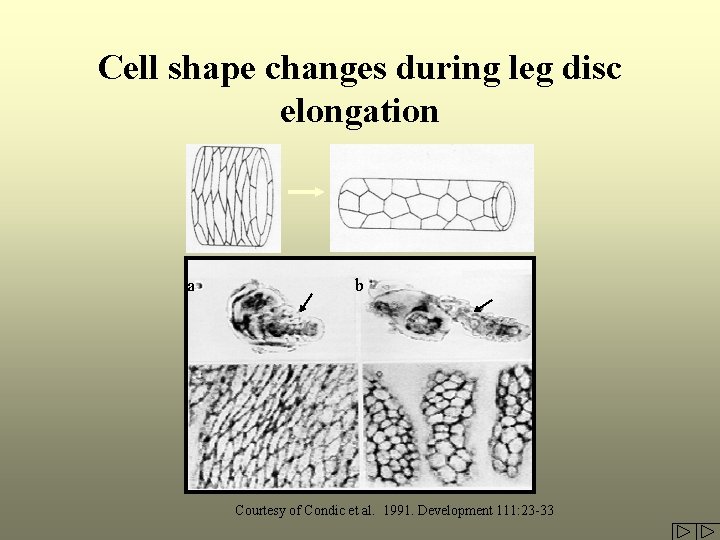
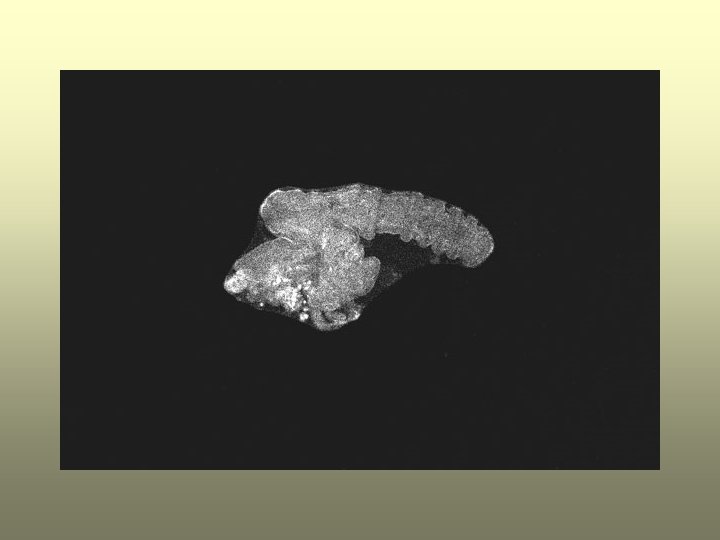
Cell shape changes during leg disc elongation a b Courtesy of Condic et al. 1991. Development 111: 23 -33
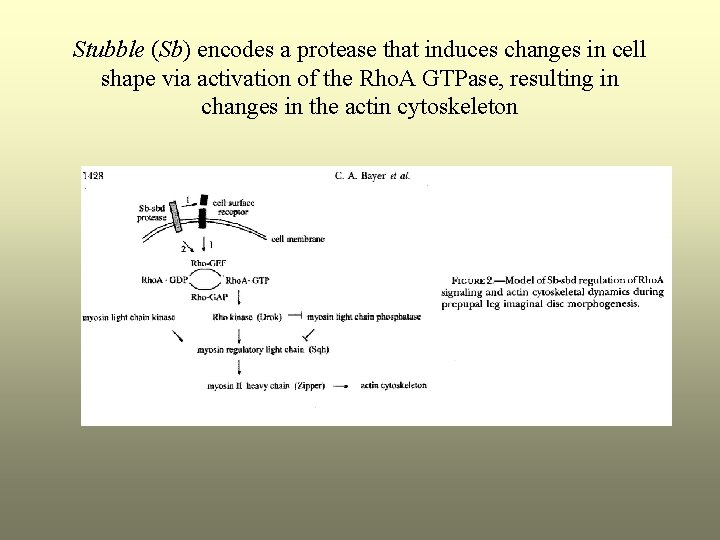
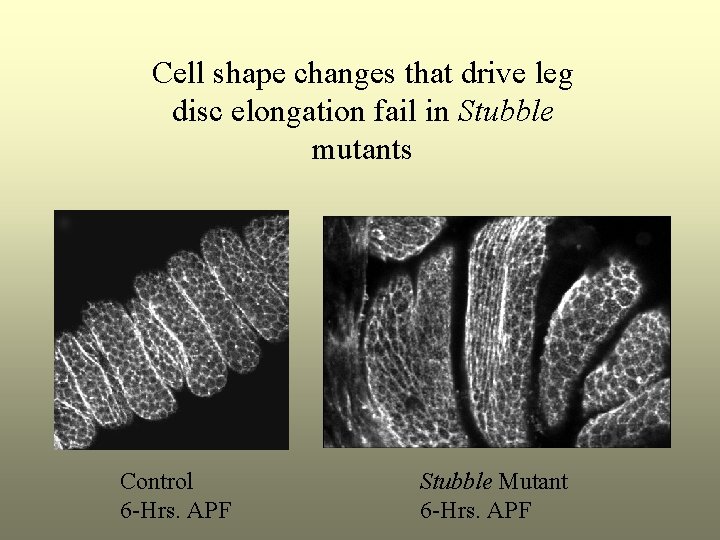
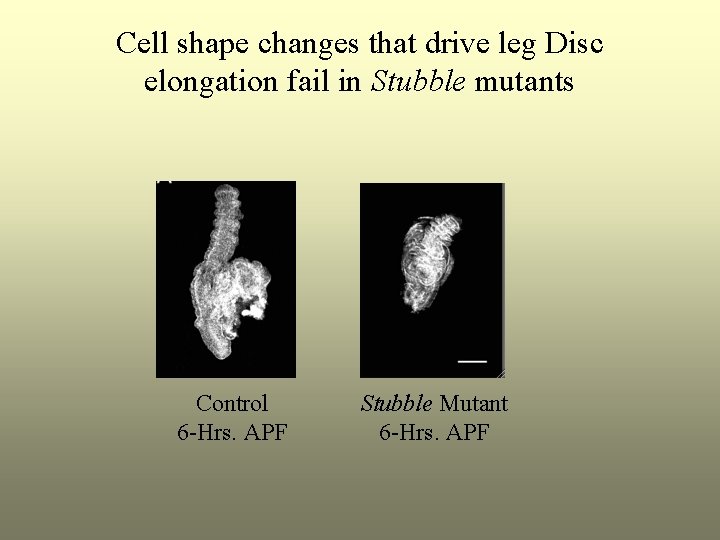
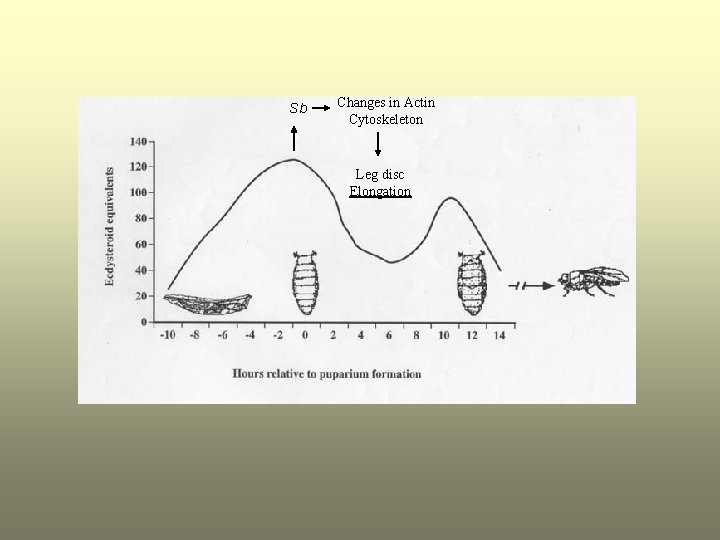
Stubble (Sb) encodes a protease that induces changes in cell shape via activation of the Rho. A GTPase, resulting in changes in the actin cytoskeleton
Cell shape changes that drive leg disc elongation fail in Stubble mutants Control 6 -Hrs. APF Stubble Mutant 6 -Hrs. APF
Cell shape changes that drive leg Disc elongation fail in Stubble mutants Control 6 -Hrs. APF Stubble Mutant 6 -Hrs. APF
Sb Changes in Actin Cytoskeleton Leg disc Elongation
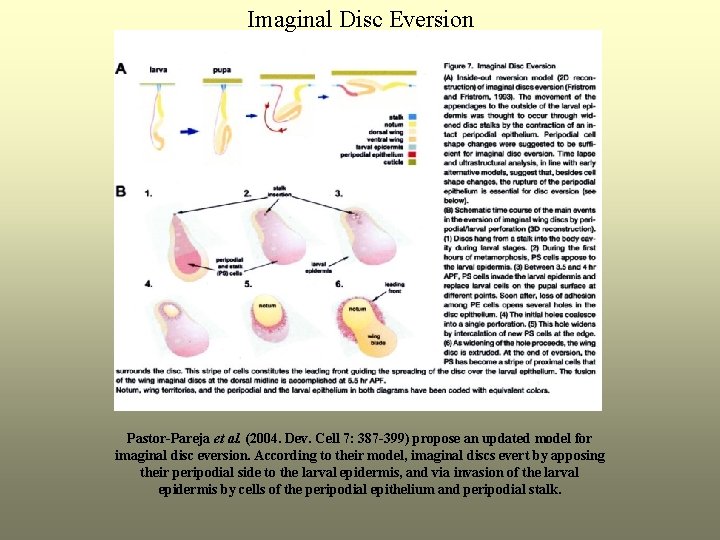
Imaginal Disc Eversion Pastor-Pareja et al. (2004. Dev. Cell 7: 387 -399) propose an updated model for imaginal disc eversion. According to their model, imaginal discs evert by apposing their peripodial side to the larval epidermis, and via invasion of the larval epidermis by cells of the peripodial epithelium and peripodial stalk.
Normal Leg Development
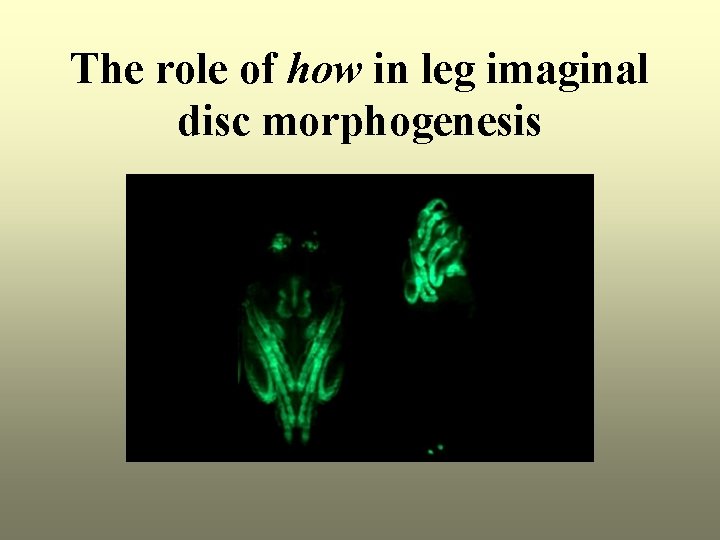
The role of how in leg imaginal disc morphogenesis
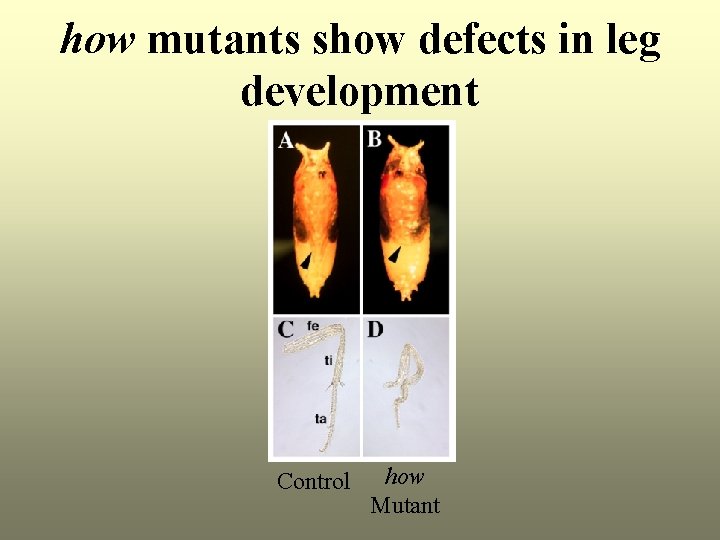
The Drosophila how gene has pleiotropic functions during metamorphosis • • • how (held-out-wings) also named how, struthio, qkr 93 F Encodes KH RNA binding protein Strong similarity to nematode GLD-1 and mouse QK 1 Required for tendon cell differentiation in embryos how mutants exhibit defects in muscle, muscle attachment, wing development and adult leg development
how mutants show defects in leg development Control how Mutant
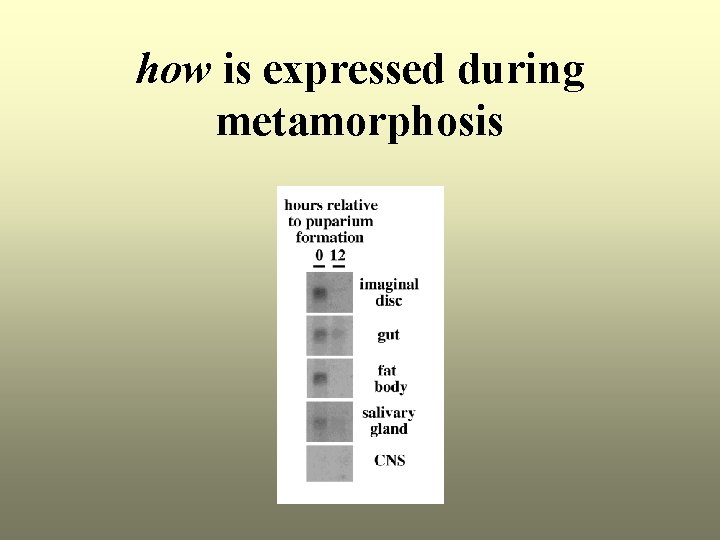
how is expressed during metamorphosis
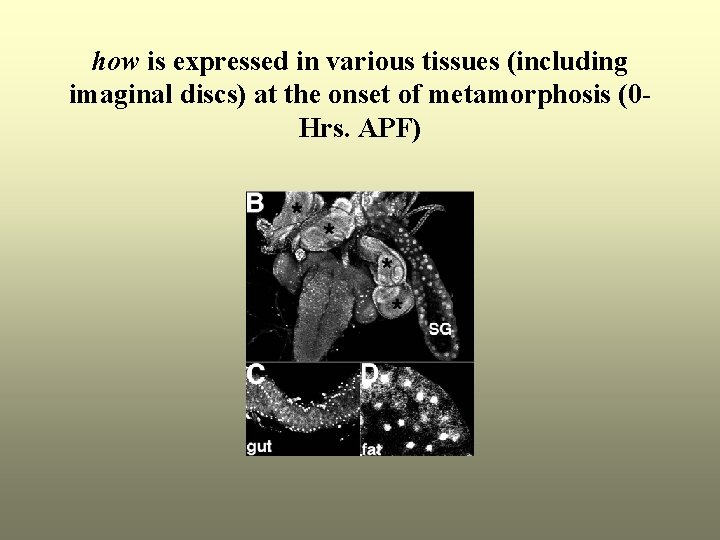
how is expressed in various tissues (including imaginal discs) at the onset of metamorphosis (0 Hrs. APF)
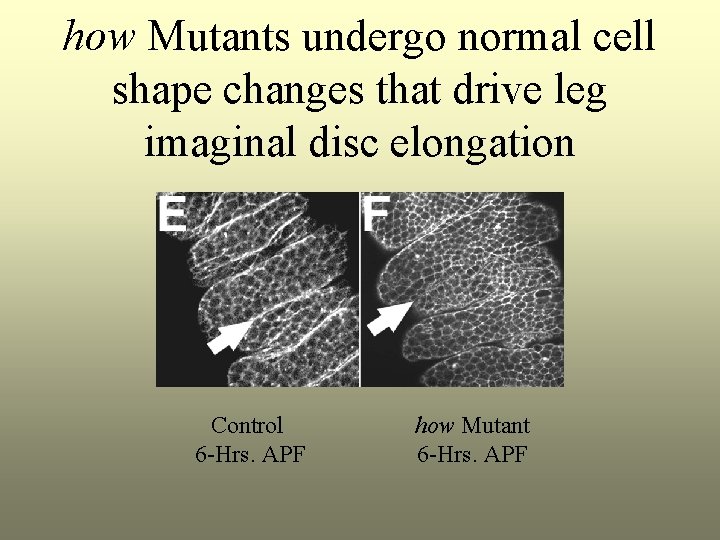
how Mutants undergo normal cell shape changes that drive leg imaginal disc elongation Control 6 -Hrs. APF how Mutant 6 -Hrs. APF
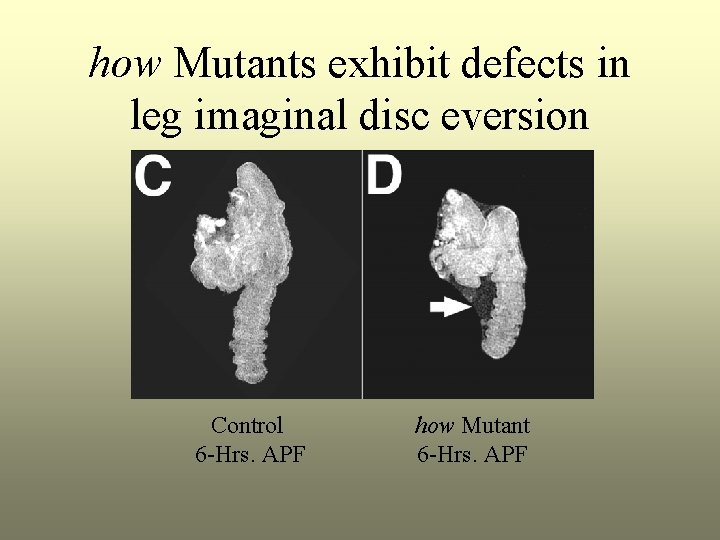
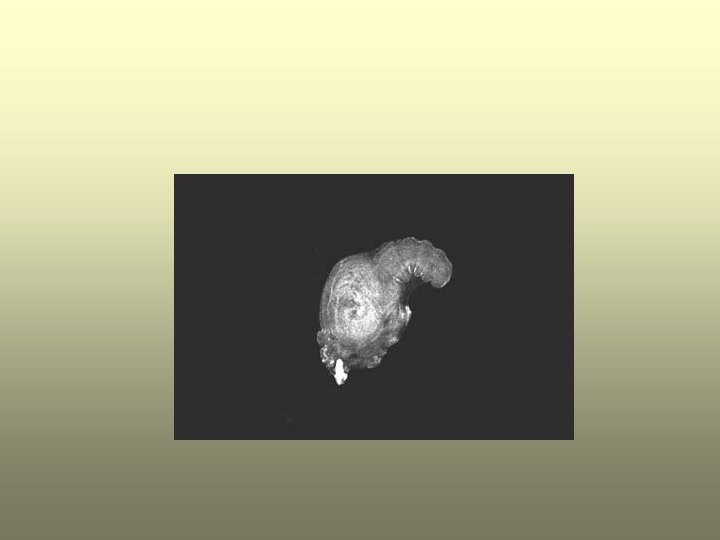
how Mutants exhibit defects in leg imaginal disc eversion Control 6 -Hrs. APF how Mutant 6 -Hrs. APF
Control how Mutant
how Mutant Control
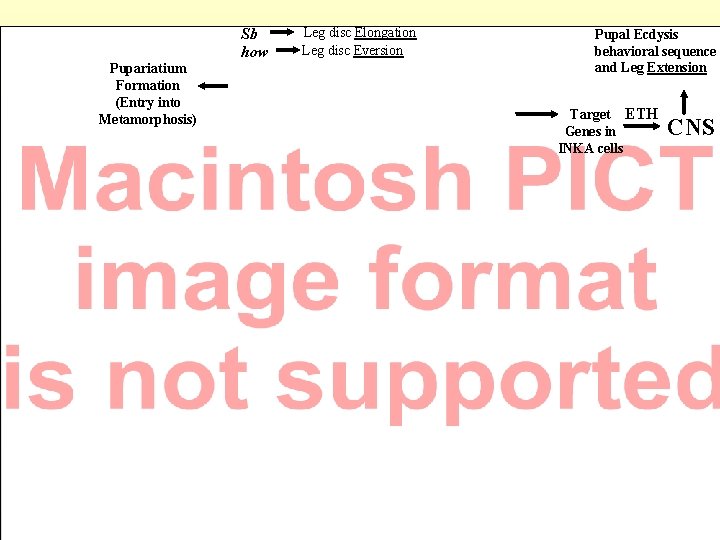
Sb how Leg disc Elongation Leg disc Eversion
Possible role for how in imaginal disc eversion According to the Pastor-Pareja et al. model, imaginal discs evert by apposing their peripodial side to the larval epidermis, and via invasion of the larval epidermis by cells of the peripodial epithelium and peripodial stalk. During this process, the Jun-N-Kinase (JNK) signaling pathway promotes the apposition of peripodial stalk and larval cells, determines the extent of PEMT and motility of the leading edge/peripodial stalk cells, and helps maintain adhesion between larval and imaginal tissue (Pastor-Pareja et al. , 2004). how may play a role in directing interactions between the imaginal disc cells, the cells of the peripodial epithelium and stalk, and larval epithelial cells during disc eversion. Perhaps how regulates expression of genes that play more direct roles in these cell-cell interactions.
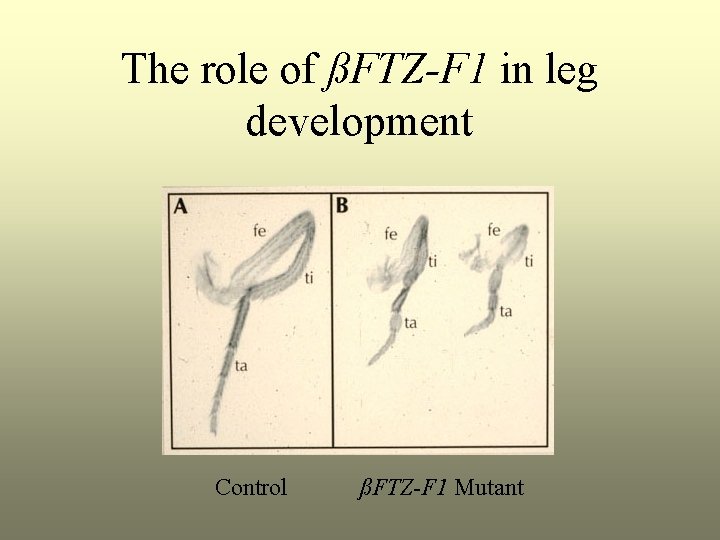
The role of ßFTZ-F 1 in leg development Control ßFTZ-F 1 Mutant
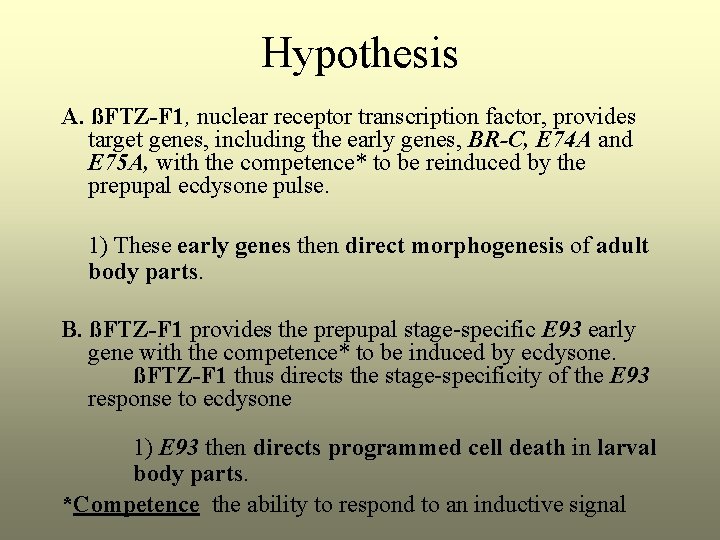
Hypothesis A. ßFTZ-F 1, nuclear receptor transcription factor, provides target genes, including the early genes, BR-C, E 74 A and E 75 A, with the competence* to be reinduced by the prepupal ecdysone pulse. 1) These early genes then direct morphogenesis of adult body parts. B. ßFTZ-F 1 provides the prepupal stage-specific E 93 early gene with the competence* to be induced by ecdysone. ßFTZ-F 1 thus directs the stage-specificity of the E 93 response to ecdysone 1) E 93 then directs programmed cell death in larval body parts. *Competence the ability to respond to an inductive signal
Pupariation (Entry into Metamorphosis) Morphogenesis of Adult Body Parts Destruction of Larval body Parts by Programmed Cell Death
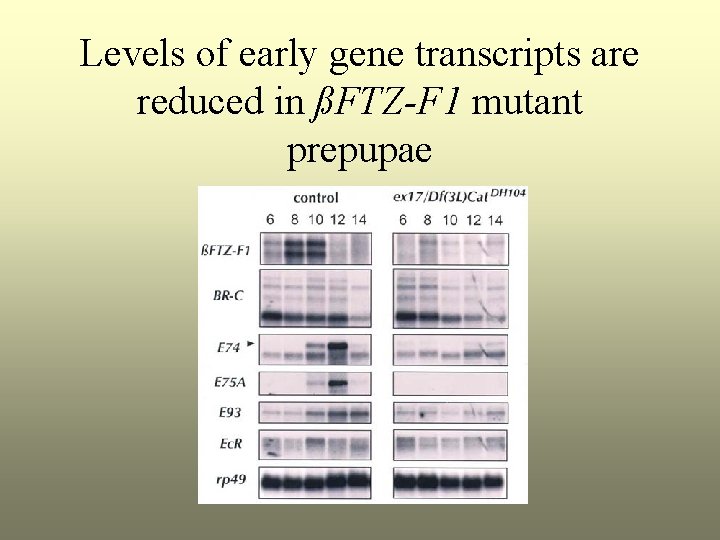
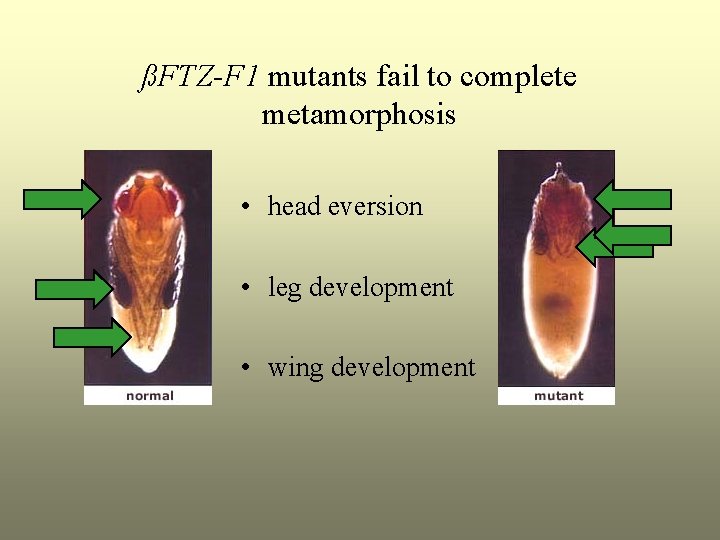
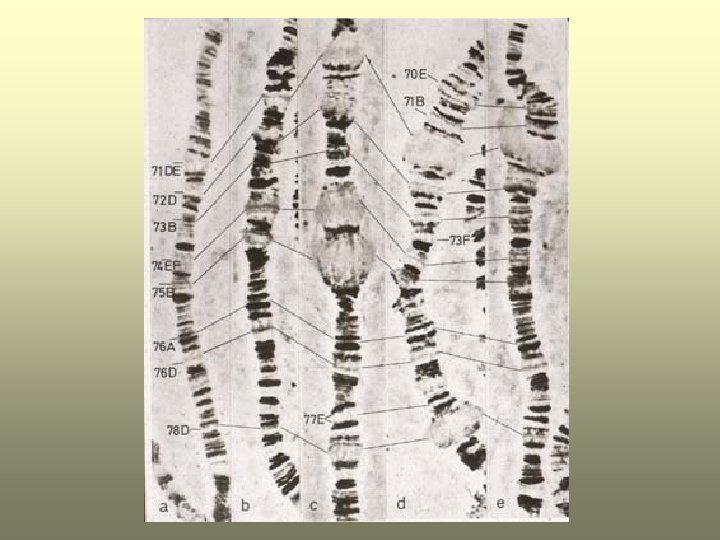
Evidence in Support of our Hypothesis • • • Staining with anti-ßFTZ-F 1 antibodies shows ßFTZ-F 1 protein bound to the 2 B 5, 74 EF, 75 B and 93 F puff loci in prepupal salivary gland polytene chromosomes. Ectopic expression of ßFTZ-F 1 provides E 93 with the competence to respond to the late larval ecdysone pulse. ßFTZ-F 1 protein binds E 93 genomic sequences. • • • Induction of BR-C, E 74 A and E 75 A transcripts by ecdysone is enhanced significantly by ectopic ßFTZ-F 1. A Loss-of-function mutation in ßFTZ-F 1 results in dramatic reductions in E 93, E 74 A, E 75 A, and BR-C transcripts at the end of the prepupal stage. A loss-of-function mutation in ßFTZ-F 1 results in pupal lethality with defects in larval salivary gland programmed cell death, head eversion, and leg extension.
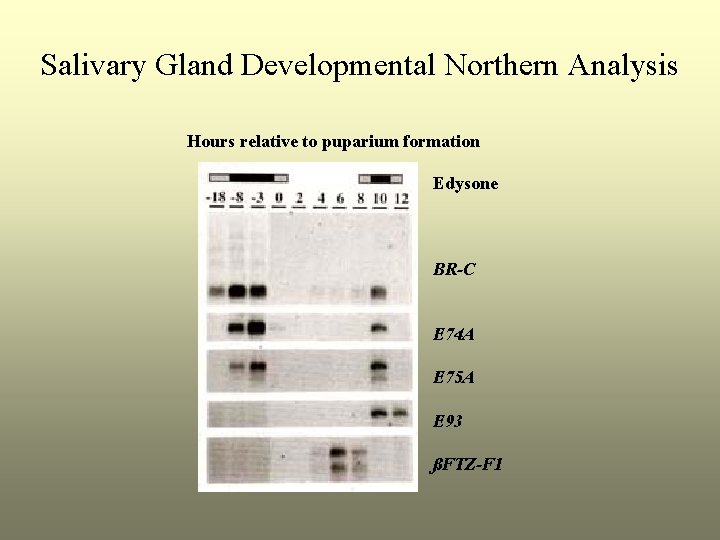
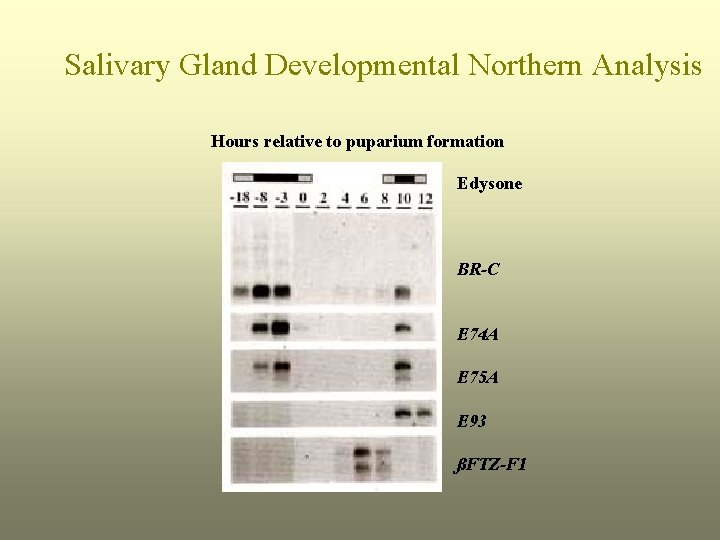
Salivary Gland Developmental Northern Analysis Hours relative to puparium formation Edysone BR-C E 74 A E 75 A E 93 ßFTZ-F 1
Levels of early gene transcripts are reduced in ßFTZ-F 1 mutant prepupae
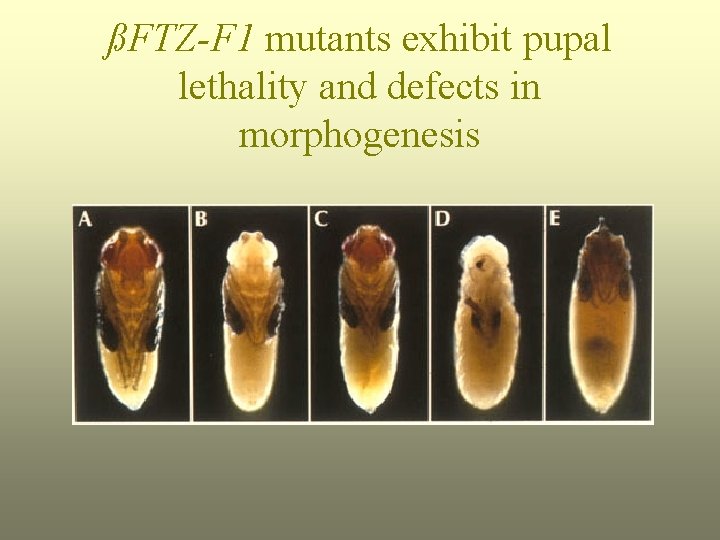
ßFTZ-F 1 mutants fail to complete metamorphosis • head eversion • leg development • wing development
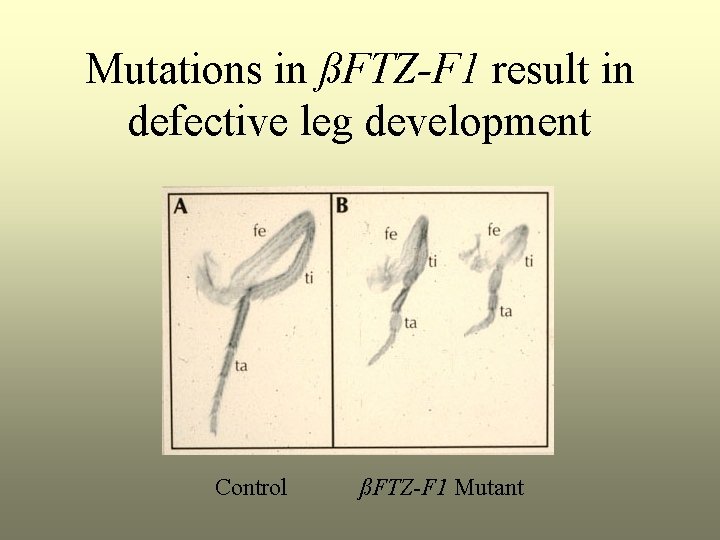
Mutations in ßFTZ-F 1 result in defective leg development Control ßFTZ-F 1 Mutant
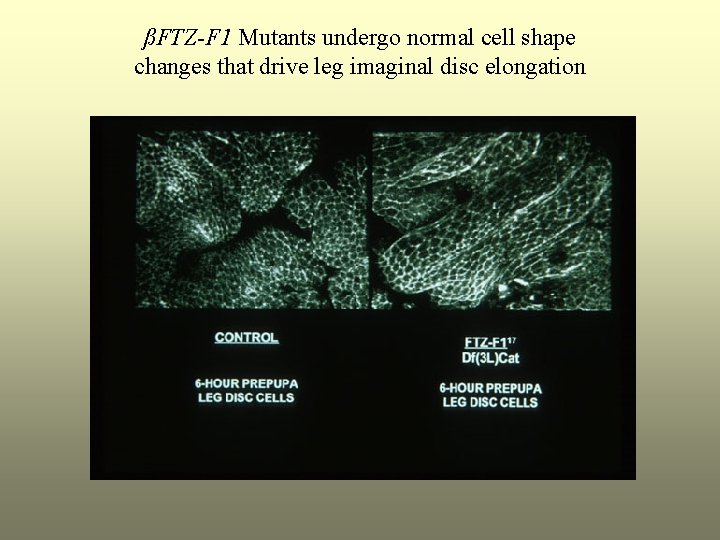
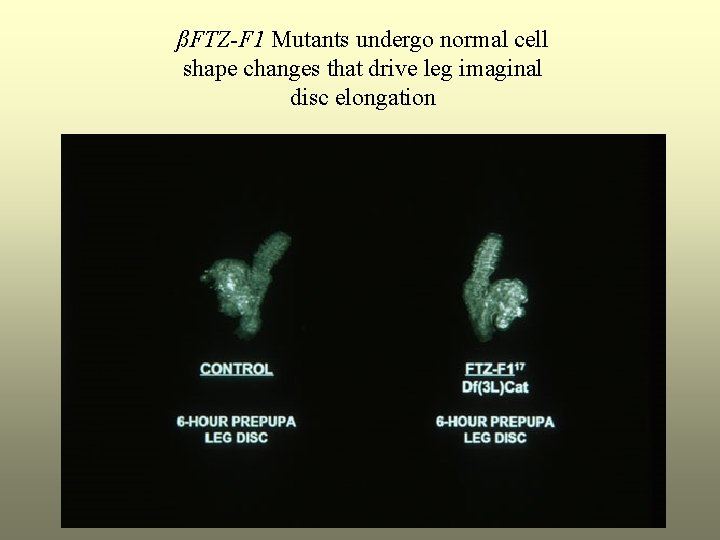
ßFTZ-F 1 Mutants undergo normal cell shape changes that drive leg imaginal disc elongation
ßFTZ-F 1 Mutants undergo normal cell shape changes that drive leg imaginal disc elongation
Leg extension fails at the prepupal-pupal transition in ßFTZ-F 1 mutants Control ßFTZ-F 1 Mutant
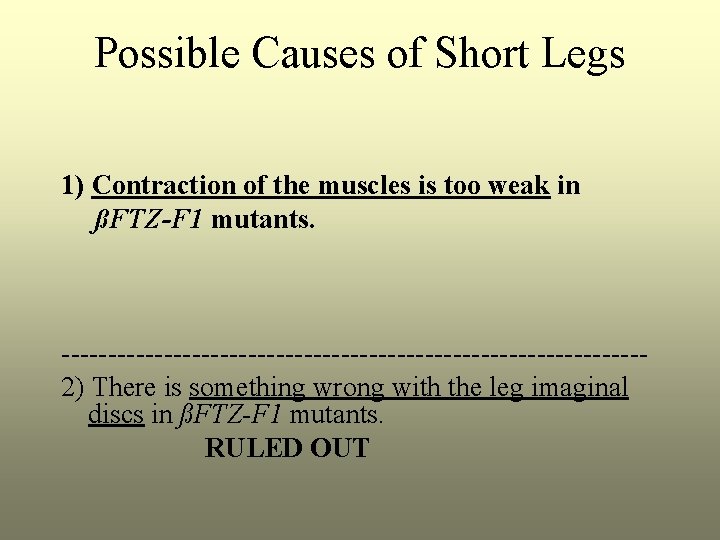
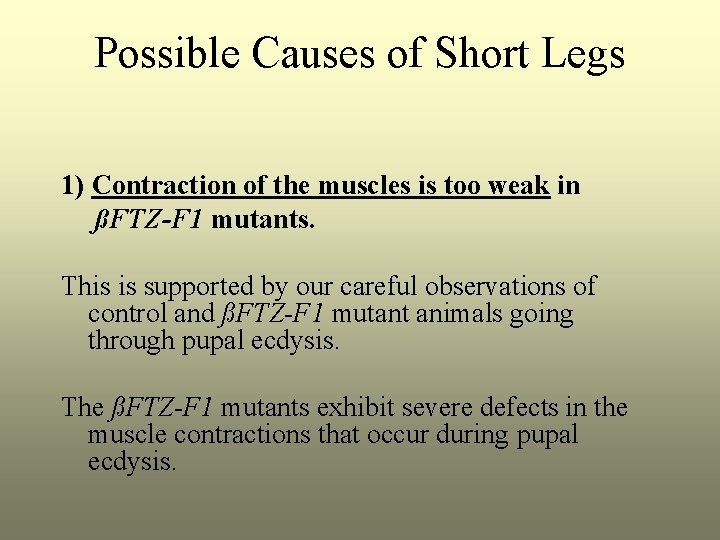
Possible Causes of Short Legs 1) Contraction of the muscles is too weak in ßFTZ-F 1 mutants. 2) There is something wrong with the leg imaginal discs in ßFTZ-F 1 mutants, which prevents them from extending.
Leg and wing length in ßFTZ-F 1 mutants can be rescued by reduced external pressure Significant Difference
Leg and wing length in ßFTZ-F 1 mutants can be rescued by reduced external pressure
Possible Causes of Short Legs 1) Contraction of the muscles is too weak in ßFTZ-F 1 mutants. -------------------------------2) There is something wrong with the leg imaginal discs in ßFTZ-F 1 mutants. RULED OUT
Possible Causes of Short Legs 1) Contraction of the muscles is too weak in ßFTZ-F 1 mutants. This is supported by our careful observations of control and ßFTZ-F 1 mutant animals going through pupal ecdysis. The ßFTZ-F 1 mutants exhibit severe defects in the muscle contractions that occur during pupal ecdysis.
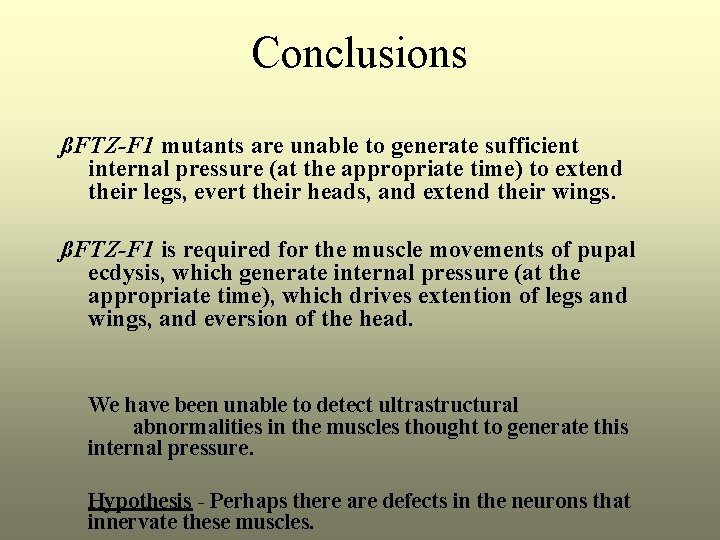
Conclusions ßFTZ-F 1 mutants are unable to generate sufficient internal pressure (at the appropriate time) to extend their legs, evert their heads, and extend their wings. ßFTZ-F 1 is required for the muscle movements of pupal ecdysis, which generate internal pressure (at the appropriate time), which drives extention of legs and wings, and eversion of the head. We have been unable to detect ultrastructural abnormalities in the muscles thought to generate this internal pressure. Hypothesis - Perhaps there are defects in the neurons that innervate these muscles.
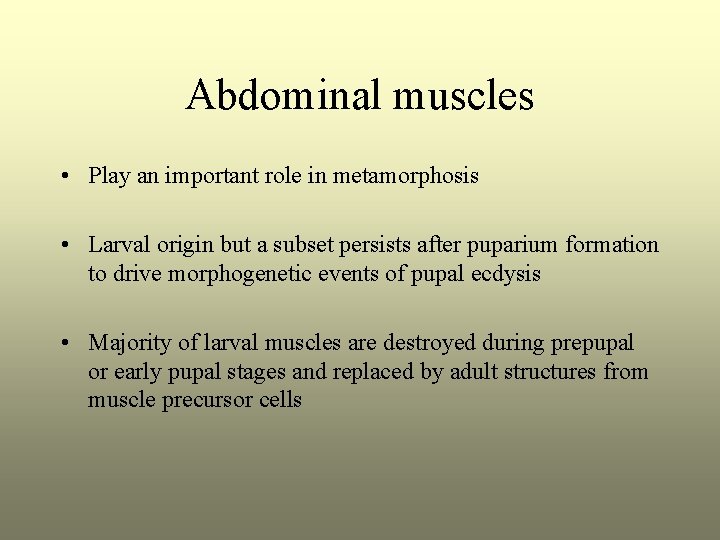
Abdominal muscles • Play an important role in metamorphosis • Larval origin but a subset persists after puparium formation to drive morphogenetic events of pupal ecdysis • Majority of larval muscles are destroyed during prepupal or early pupal stages and replaced by adult structures from muscle precursor cells
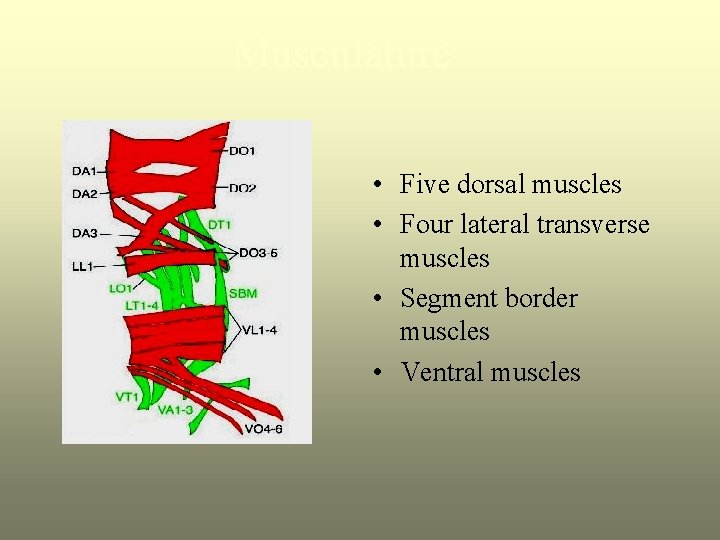
Musculature • Five dorsal muscles • Four lateral transverse muscles • Segment border muscles • Ventral muscles
Abdominal Muscle Activity • Contractions that occur during pupal ecdysis result in: - separation of the pupal cuticle from the puparium (pupal case) - shortening of the prepupal body - translocation of the mid-abdominal gas bubble - build up of hydrostatic pressure to aid head eversion, leg and wing extension
We have been unable to defects in muscle structure in ßFTZF 1 mutants (but we are still looking!)
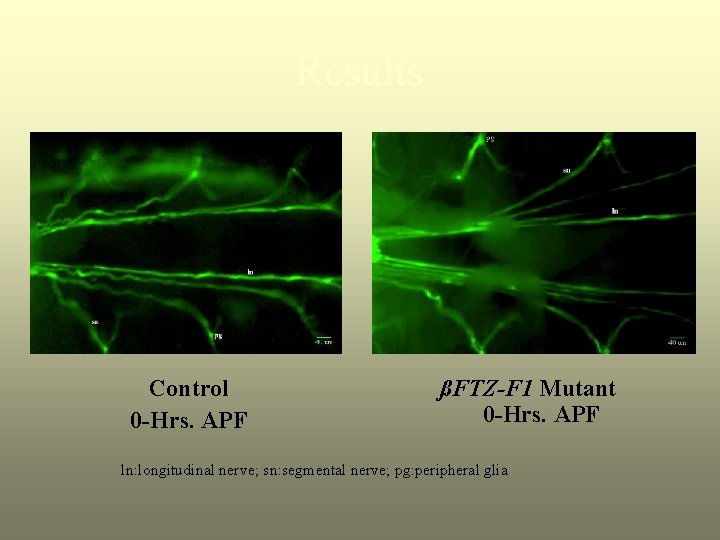
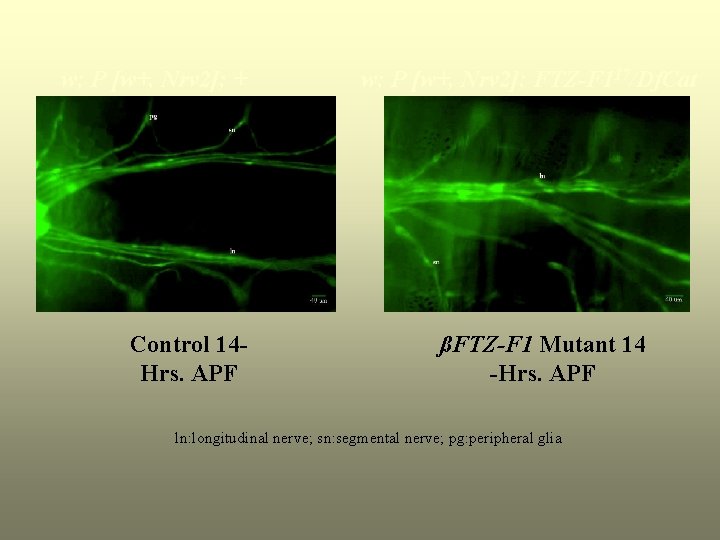
Testing the Hypotheses Hypothesis - There are defects in neurons that innervate the muscles. -Test by examining neurons, perhaps making use of animals expressing neuron-specific GFP.
Results Control 0 -Hrs. APF ßFTZ-F 1 Mutant 0 -Hrs. APF ln: longitudinal nerve; sn: segmental nerve; pg: peripheral glia
w; P [w+, Nrv 2]; + 14 hr Control 14 Hrs. APF w; P [w+, Nrv 2]; FTZ-F 117/Df. Cat 14 hr ßFTZ-F 1 Mutant 14 -Hrs. APF ln: longitudinal nerve; sn: segmental nerve; pg: peripheral glia
Wild-Type Control
ßFTZ-F 1 Mutant
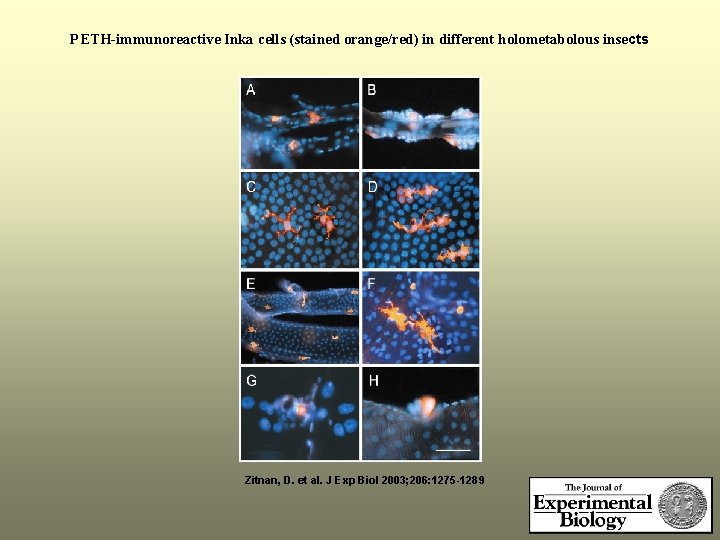
Recent findings by colleagues indicate that pupal ecdysis is induced by Ecdysis Triggering Hormone (ETH). ETH is a peptide hormone, released into the circulation by specific cells called the INKA cells of the epitracheal gland. ETH acts on the Central Nervous System, inducing the pupal ecdysis behavioral sequence.
PETH-immunoreactive Inka cells (stained orange/red) in different holometabolous insects Zitnan, D. et al. J Exp Biol 2003; 206: 1275 -1289
Sb how Pupariatium Formation (Entry into Metamorphosis) Leg disc Elongation Leg disc Eversion Pupal Ecdysis behavioral sequence and Leg Extension Target ETH Genes in INKA cells CNS
FUTURE DIRECTIONS how - We are examining expression patterns of genes in the JNK signaling pathway in how mutants vs. controls (Blanca Carbajal). ßFTZ-F 1 - We are examining the transcription of genes encoding neuropeptides in ßFTZ-F 1 mutants vs. controls (Melanie Ayerh and Kori Matsuura). - We are continuing to examine motor neurons and muscles in ßFTZF 1 mutants (Hyowon Choi). - We are attempting to decipher the molecular mechanism by which ßFTZ-F 1 provides target genes with the competence to respond to ecdysone (Antonina Kruppa).
FUTURE DIRECTIONS (cont. ) Other Genes - We are examining Tis-11 mutants, which have abnormal legs (Hyowon Choi). - Erika Power is examining genetic interactions between genes involved in leg development.
Acknowledgments • • Mount Holyoke College Tina M. Fortier Jennifer R. Mc. Cabe Priya Vasa Nicole Whyte Melanie Ayerh Monique Killins MANY other MHC independent research students! • • • University of Utah Carl Thummel Eric Baehrecke Julie Broadus Bart Endrizzi • • Special Thanks for Technical Assistance Samara Brown Rachel Fink Diane Kelly Stan Rachootin Marian Rice Marinko Sremac Lezek Bledzki • • Funding National Science Foundation Howard Hughes Medical Institute Mount Holyoke College Biology Dept. and Biochemistry Program
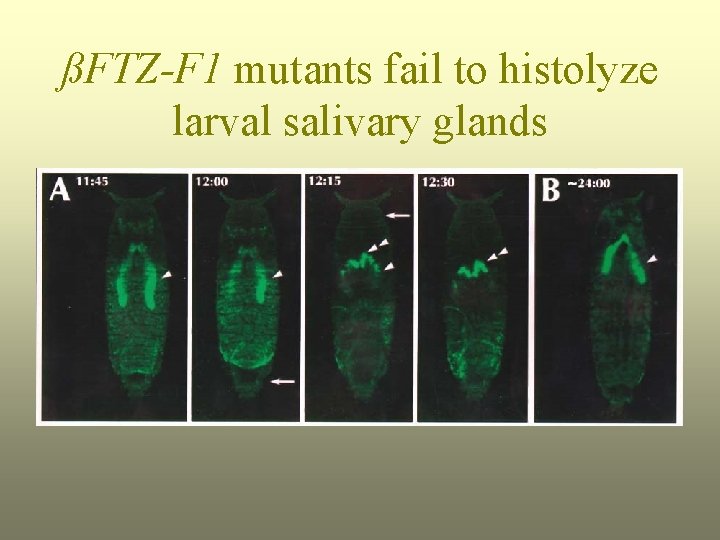
ßFTZ-F 1 mutants fail to histolyze larval salivary glands
ßFTZ-F 1 mutants exhibit pupal lethality and defects in morphogenesis
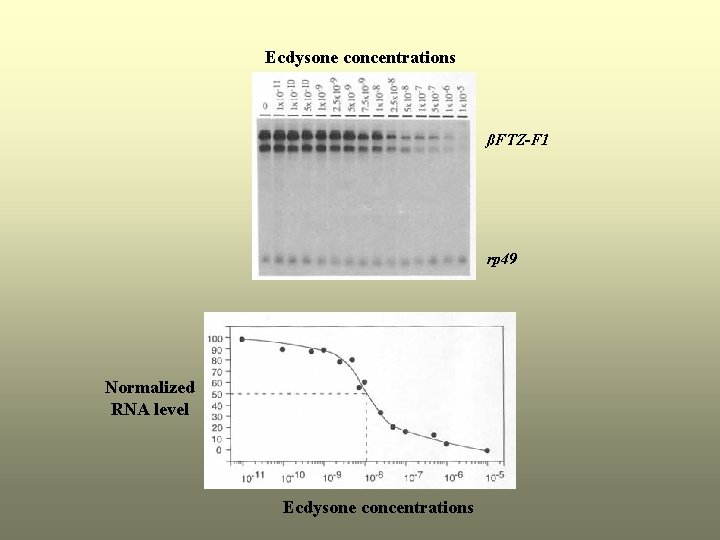
Ecdysone concentrations ßFTZ-F 1 rp 49 Normalized RNA level Ecdysone concentrations
Salivary Gland Developmental Northern Analysis Hours relative to puparium formation Edysone BR-C E 74 A E 75 A E 93 ßFTZ-F 1
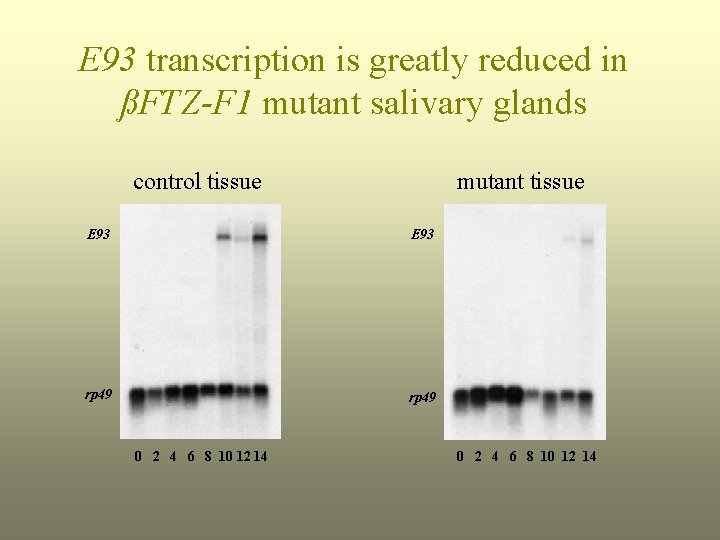
E 93 transcription is greatly reduced in ßFTZ-F 1 mutant salivary glands control tissue mutant tissue E 93 rp 49 0 2 4 6 8 10 12 14
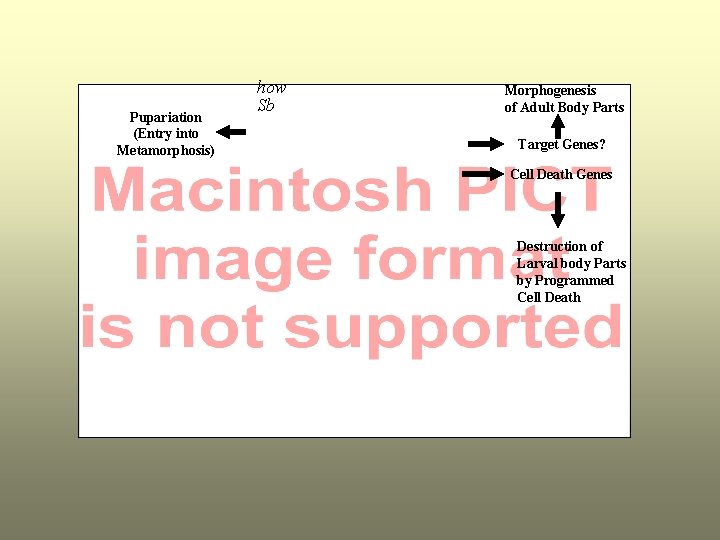
Pupariation (Entry into Metamorphosis) how Sb Morphogenesis of Adult Body Parts Target Genes? Cell Death Genes Destruction of Larval body Parts by Programmed Cell Death
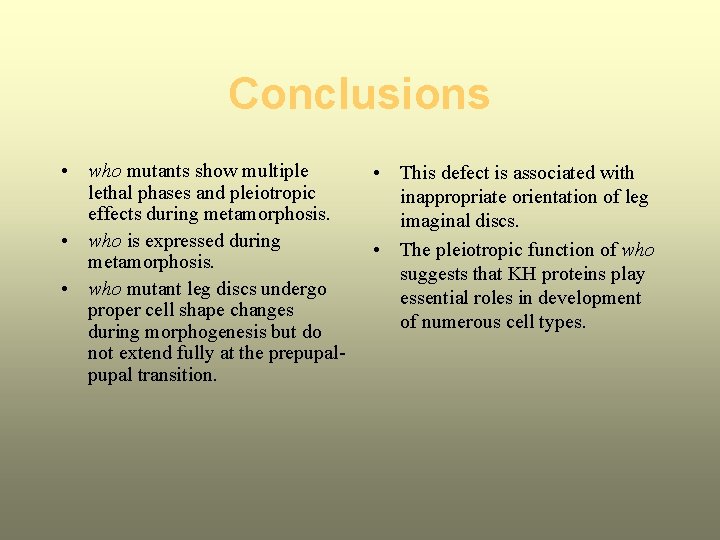
Conclusions • who mutants show multiple lethal phases and pleiotropic effects during metamorphosis. • who is expressed during metamorphosis. • who mutant leg discs undergo proper cell shape changes during morphogenesis but do not extend fully at the prepupal transition. • This defect is associated with inappropriate orientation of leg imaginal discs. • The pleiotropic function of who suggests that KH proteins play essential roles in development of numerous cell types.
Acknowledgments Mount Holyoke College Tina Fortier Craig Woodard University of Maryland Biotechnology Institute Runa Chatterjee Susan Klinedinst Eric Baehrecke