
Mineral Disclosure Best Practices Craig Waldie P Geo
Mineral Disclosure Best Practices Craig Waldie, P. Geo. , Senior Geologist, OSC November 13, 2013 Geology Matters 2013 - Halifax
Caution The views expressed in this presentation are the personal views of the presenting staff and do not necessarily represent the views of the Commission or other Commission staff. The presentation is provided for general information purposes only and does not constitute legal or technical advice. Information has been summarized and paraphrased for presentation purposes and examples have been provided for illustration purposes only. 2
Agenda Canadian regulatory overview Concept of materiality NI 43 -101 basics and the QP BCSC 2012 mining report ----- Break ----- Technical report basics OSC technical report review study Reviews by Commission staff 3

Canadian Regulatory Overview 4
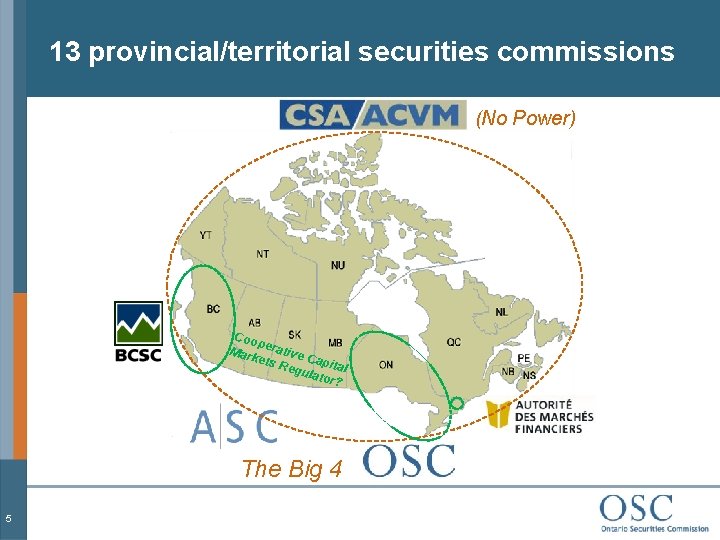
13 provincial/territorial securities commissions (No Power) Coo p Mark erative Ca ets R egul pital ator ? The Big 4 5
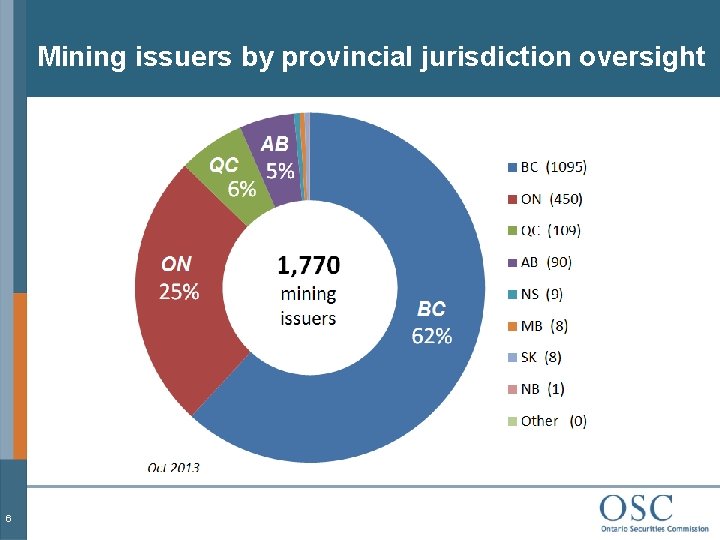
Mining issuers by provincial jurisdiction oversight 6
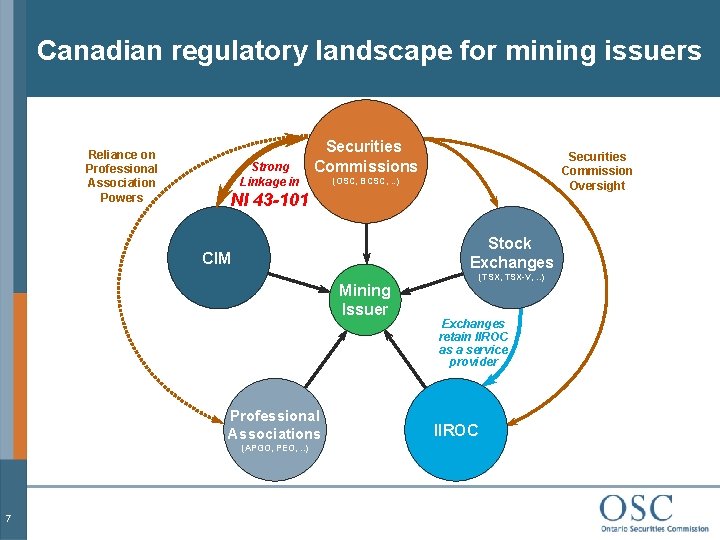
Canadian regulatory landscape for mining issuers Reliance on Professional Association Powers Strong Linkage in Securities Commissions (OSC, BCSC, . . ) NI 43 -101 Stock Exchanges CIM Mining Issuer Professional Associations (APGO, PEO, . . ) 7 Securities Commission Oversight (TSX, TSX-V, . . ) Exchanges retain IIROC as a service provider IIROC
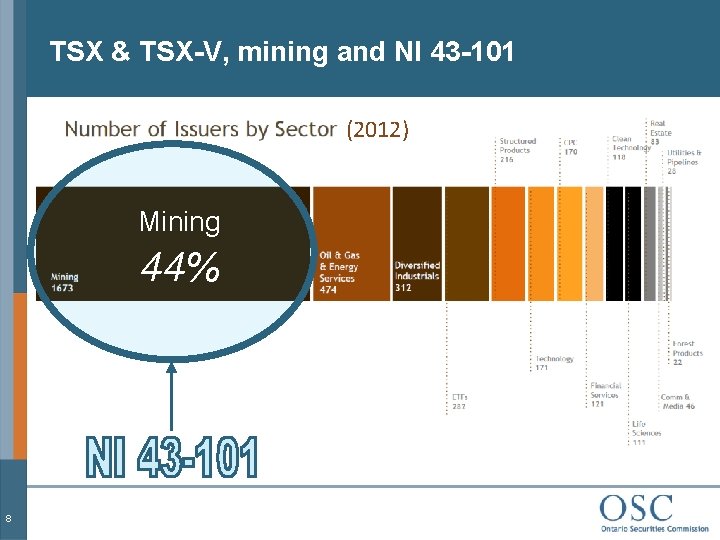
TSX & TSX-V, mining and NI 43 -101 (2012) Mining 44% 8
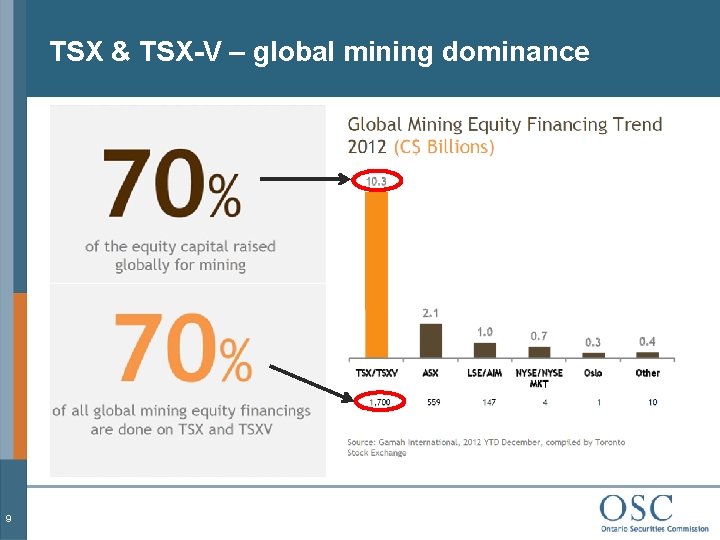
TSX & TSX-V – global mining dominance 9

Concept of Materiality 10
Materiality and timely disclosure Basic underpinning of securities legislation • • Rules protects investors from unfair and fraudulent practices Provides confidence in the markets Provides a level playing field for all companies Risk of insider trading and tipping increases without compliance Securities Commission mandate: “Protect investors from unfair, improper or fraudulent practices, and foster fair and efficient capital markets and confidence in capital markets” Make, monitor and enforce rules 11
Materiality – Definitions Ontario Securities Act: • Material Fact - “…a fact that would reasonably be expected to have a significant effect on the market price or value of the securities…” • Material Change - “…a change in the business, operations or capital of the issuer that would reasonably be expected to have a significant effect on the market price or value the securities of the issuer…” Stock Exchange Policy: • Material Information - “…a material fact and/or material change as defined by applicable Securities Laws and Exchange Policy. ” 12 12
Guiding principles for materiality No bright line test • Company specific and case-by-case determination Context specific • Materiality is generally related to certain facts and circumstances Impact on future prospects or profitability • Consider the impact of the event on the company's market price or value Err on the side of materiality • If in doubt, it is better to disclose 13
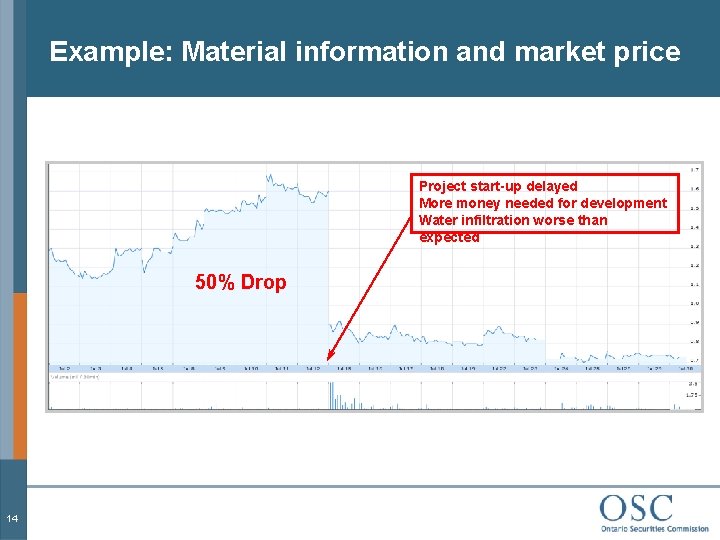
Example: Material information and market price Project start-up delayed More money needed for development Water infiltration worse than expected 50% Drop 14
NI 43 -101 Basics and the QP 15
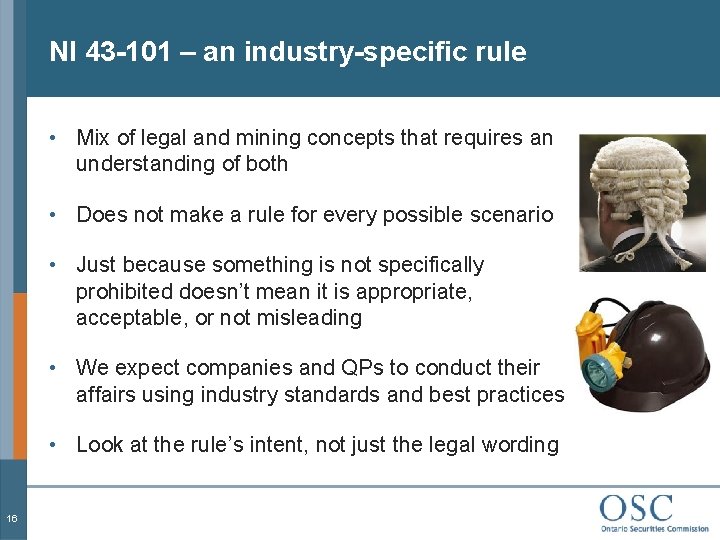
NI 43 -101 – an industry-specific rule • Mix of legal and mining concepts that requires an understanding of both • Does not make a rule for every possible scenario • Just because something is not specifically prohibited doesn’t mean it is appropriate, acceptable, or not misleading • We expect companies and QPs to conduct their affairs using industry standards and best practices • Look at the rule’s intent, not just the legal wording 16
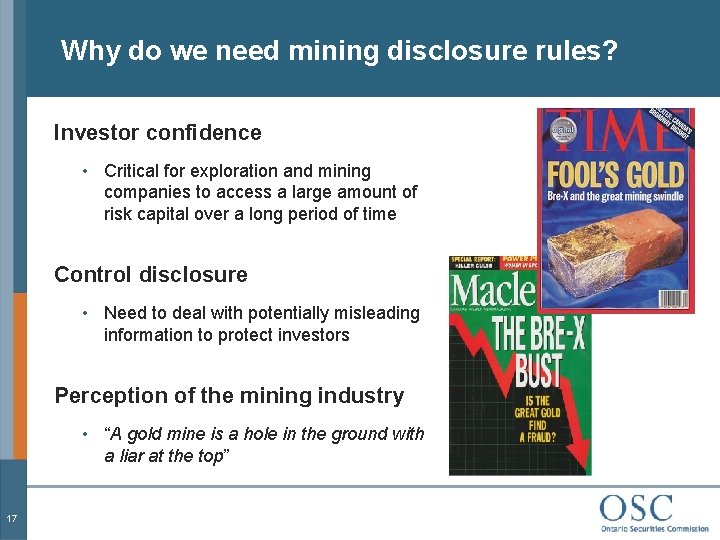
Why do we need mining disclosure rules? Investor confidence • Critical for exploration and mining companies to access a large amount of risk capital over a long period of time Control disclosure • Need to deal with potentially misleading information to protect investors Perception of the mining industry • “A gold mine is a hole in the ground with a liar at the top” 17
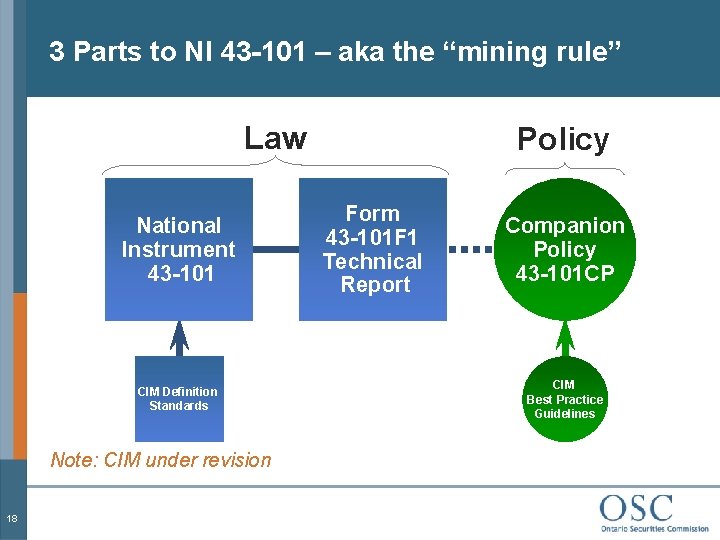
3 Parts to NI 43 -101 – aka the “mining rule” Law National Instrument 43 -101 CIM Definition Standards Note: CIM under revision 18 Policy Form 43 -101 F 1 Technical Report Companion Policy 43 -101 CP CIM Best Practice Guidelines
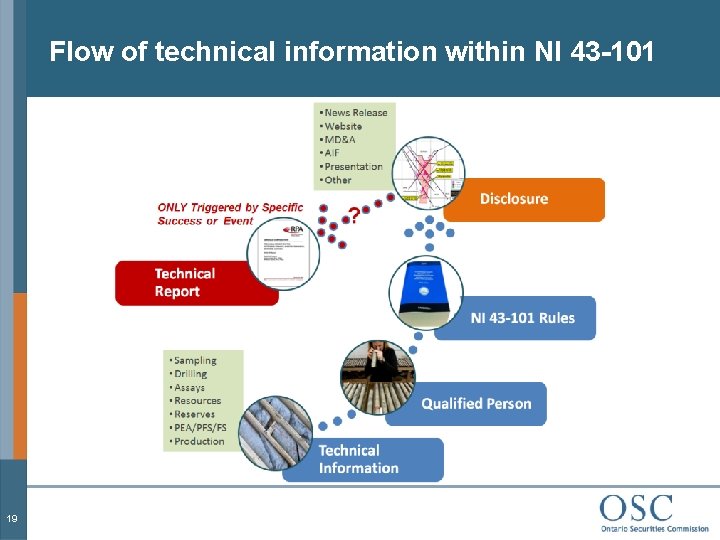
Flow of technical information within NI 43 -101 19
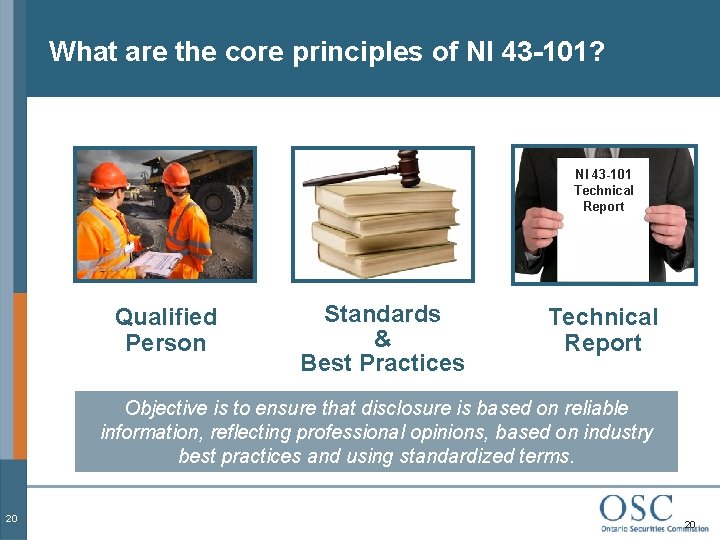
What are the core principles of NI 43 -101? NI 43 -101 Technical Report Qualified Person Standards & Best Practices Technical Report Objective is to ensure that disclosure is based on reliable information, reflecting professional opinions, based on industry best practices and using standardized terms. 20 20
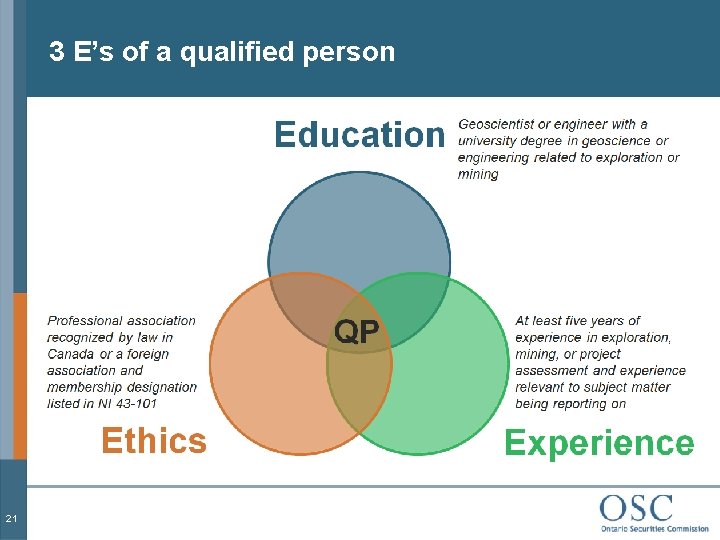
3 E’s of a qualified person 21
QP’s responsibility Comply with professional code of ethics • Perform work only in your area of competency and be honest, fair and objective Follow industry standards and best practices • CIM Standards and Best Practice Guidelines Apply reasonable reliance on others • Take whatever steps are necessary to ensure previous work is sound Conduct data verification • Reasonable level of due diligence and validation of technical information Review company’s disclosure • Helps from being misquoted 22
Company’s responsibility Disclosure • Company and its directors and officers are responsible for their disclosure Compliance • Must comply with securities laws and stock exchange policy Choose a QP • Company responsible for choosing an appropriate QP for the task Listen to the QP • Must properly use the QP’s advice and report • Allow the QP to review technical disclosure 23
CIM standards and best practice guidelines Standards • CIM Definition Standards for Mineral Resources and Mineral Reserves (2010) (revisions coming in late 2013) Guidelines • • CIM Estimation of Mineral Resources and Mineral Reserves Best Practice Guidelines (2003 -2012) CIM Best Practice Guidelines for Mineral Processing (2011) CIM Guidelines for Reporting of Diamond Exploration Results (2003) CIM Exploration Best Practice Guidelines (2000) Coal • 24 GSC Paper 88 -21: A Standardized Coal Resource/Reserve Reporting System for Canada (1988)

Bad Actors 25
John Paterson (Southwestern Resources) - Jan 2013 President, CEO and QP for Southwestern Resources • From May 2003 to Feb 2007 he issued 25 consecutive news releases which contained 433 inflated gold assays • Misrepresentation of assay data resulted in losses of $260 million • Sentenced to six years in prison for assay fraud BC Provincial Court “The purpose of NI 43 -101 is to ensure that information about mineral properties is reported in a reliable and consistent manner to investors and potential investors. The Qualified Person, who is governed by the professional and ethical standards of his or her calling, is charged with reviewing and making accurate and timely disclosure of all drilling assay results to actual and potential shareholders and to the capital markets. ” 26
Bernard Boily (Bear Lake Gold) - March 2013 VP Exploration and QP for Bear Lake Gold • Between Dec 2007 and Jul 2009 he altered 140 gold assay results received from the lab • Prepared and “signed-off” as the QP for several press releases which contained incorrect or inflated assay results • Changed drill logs and rearranged drill core • Modified the assay database which was delivered to independent QPs preparing an initial mineral resource estimate Settlement agreement sanctions: • Lifetime ban from acting as a QP • Lifetime ban from acting as a director and officer of any issuer • Administrative penalty of $750, 000 plus $50, 000 in costs 27
BCSC 2012 Mining Report 28
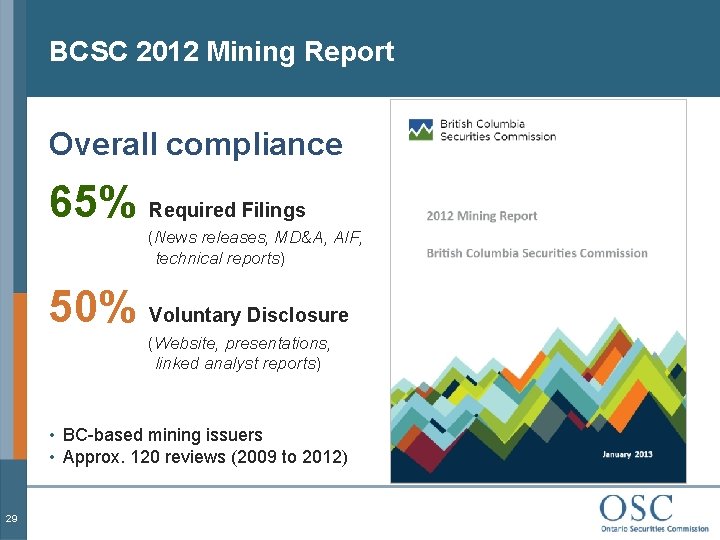
BCSC 2012 Mining Report Overall compliance 65% Required Filings (News releases, MD&A, AIF, technical reports) 50% Voluntary Disclosure (Website, presentations, linked analyst reports) • BC-based mining issuers • Approx. 120 reviews (2009 to 2012) 29

Naming the QP & Written Disclosure 30
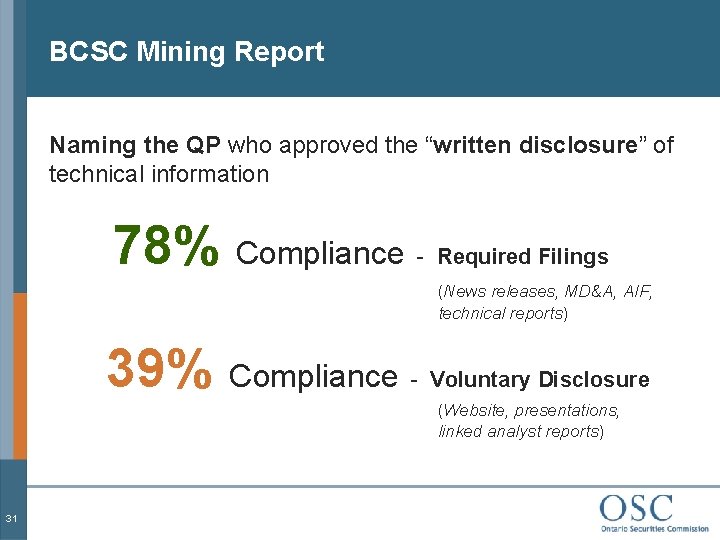
BCSC Mining Report Naming the QP who approved the “written disclosure” of technical information 78% Compliance - Required Filings (News releases, MD&A, AIF, technical reports) 39% Compliance - Voluntary Disclosure (Website, presentations, linked analyst reports) 31
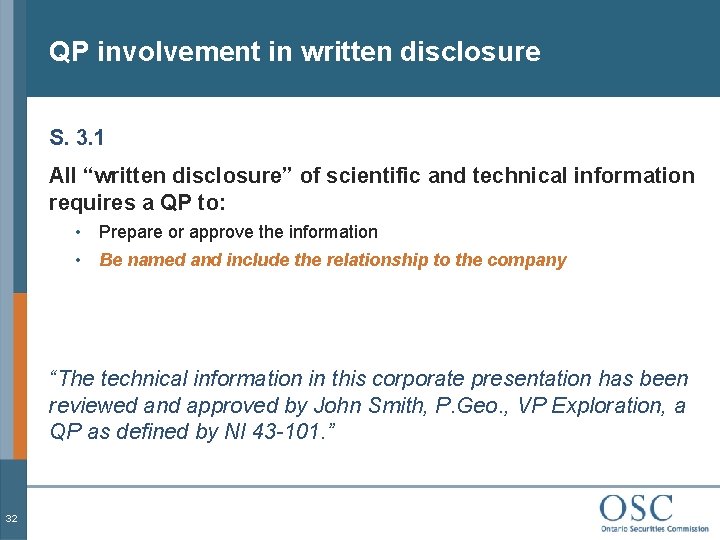
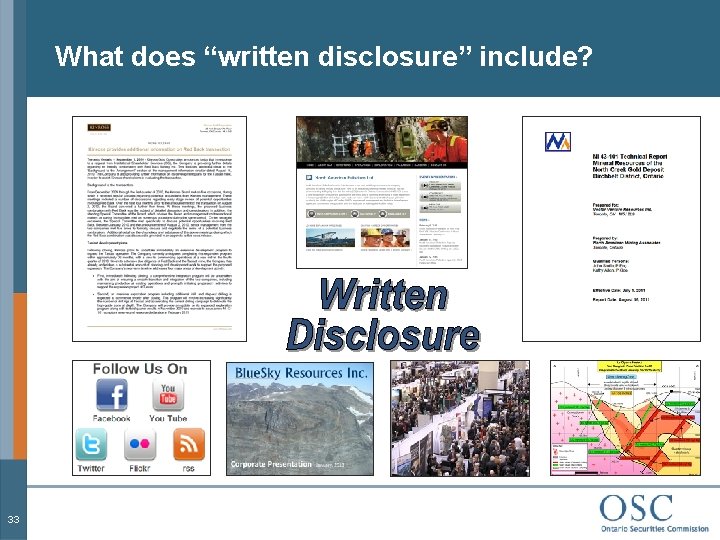
QP involvement in written disclosure S. 3. 1 All “written disclosure” of scientific and technical information requires a QP to: • Prepare or approve the information • Be named and include the relationship to the company “The technical information in this corporate presentation has been reviewed and approved by John Smith, P. Geo. , VP Exploration, a QP as defined by NI 43 -101. ” 32
What does “written disclosure” include? 33

Exploration Information 34
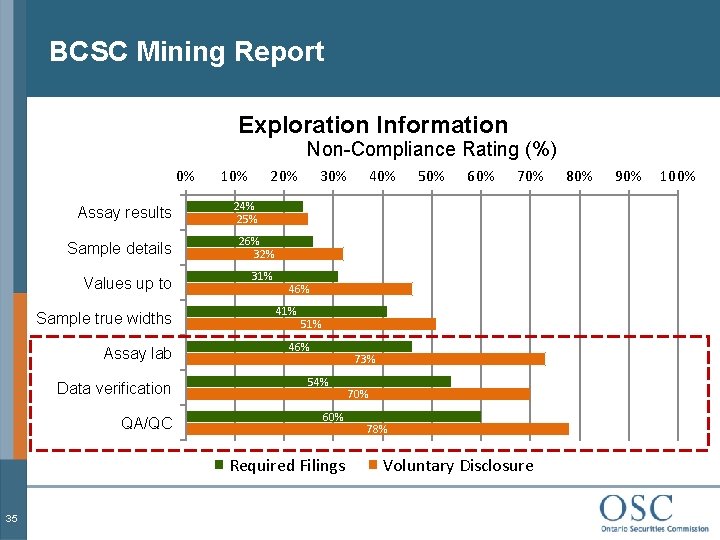
BCSC Mining Report Exploration Information Non-Compliance Rating (%) 0% Assay results 10% 26% 32% Values up to 31% Assay lab Data verification QA/QC 50% 60% 70% 46% 41% 51% 46% 73% 54% 60% Required Filings 35 40% 24% 25% Sample details Sample true widths 30% 78% Voluntary Disclosure 80% 90% 100%
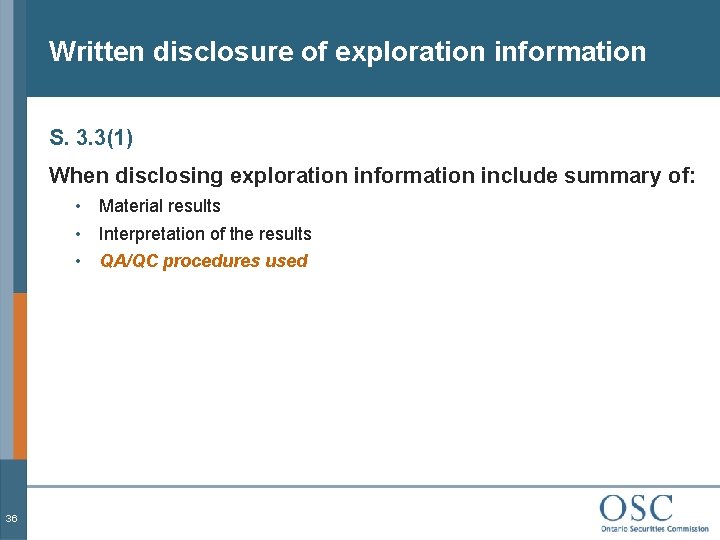
Written disclosure of exploration information S. 3. 3(1) When disclosing exploration information include summary of: • Material results • Interpretation of the results • QA/QC procedures used 36
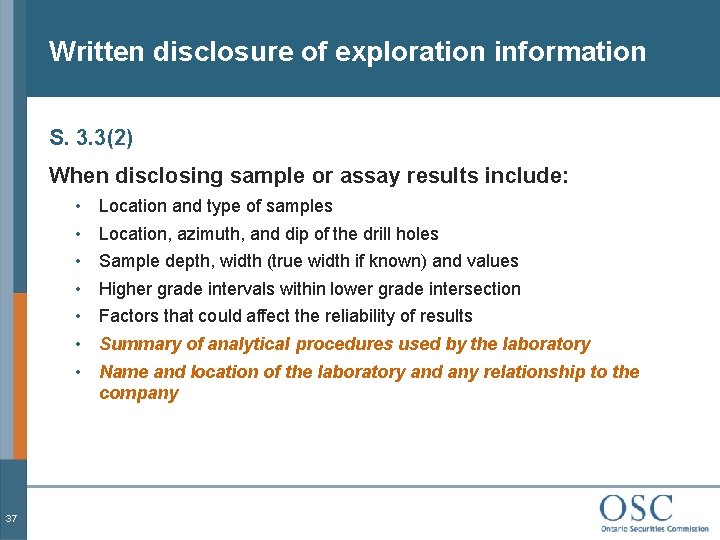
Written disclosure of exploration information S. 3. 3(2) When disclosing sample or assay results include: • • 37 Location and type of samples Location, azimuth, and dip of the drill holes Sample depth, width (true width if known) and values Higher grade intervals within lower grade intersection Factors that could affect the reliability of results Summary of analytical procedures used by the laboratory Name and location of the laboratory and any relationship to the company
Data verification of written disclosure S. 3. 2 When disclosing technical information include: • Statement whether a QP has verified the data • Description of how the data was verified • Explanation of any limitations or failure to verify the data “Data verification” is the process of confirming that data: • has been generated with proper procedures • has been accurately transcribed from the original source • is suitable to be used 38
Accommodation - written disclosure already filed S. 3. 5 Applies to • • • Data verification Exploration information and QA/QC Summary of analytical procedures and name of laboratory Effective date of resource and reserve estimate Key assumptions, parameters, methods for resource and reserve estimate Risks that may affect resource and reserve estimate Requirement • Reference the title and date of the previously filed document which includes the information 39
Exploration Targets Historical Estimates Restricted Disclosure 40
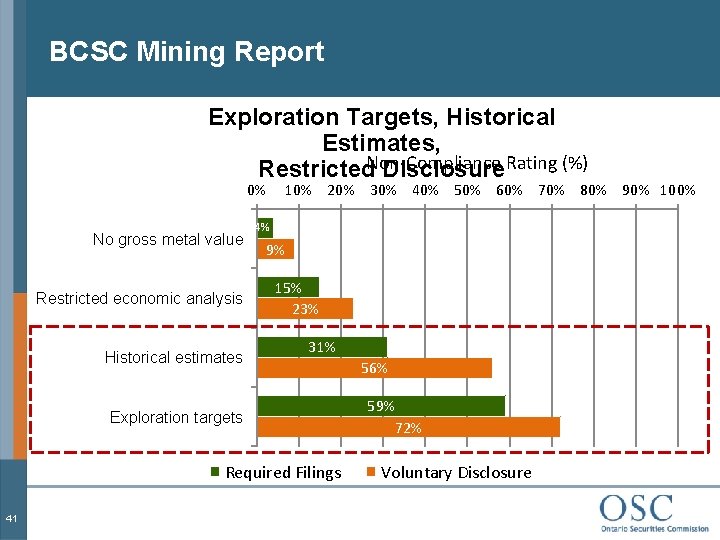
BCSC Mining Report Exploration Targets, Historical Estimates, Restricted. Non-Compliance Disclosure Rating (%) 0% No gross metal value Restricted economic analysis Historical estimates 10% 20% 30% 40% 50% 60% 70% 80% 90% 100% 4% 9% 15% 23% 31% Exploration targets Required Filings 41 56% 59% 72% Voluntary Disclosure
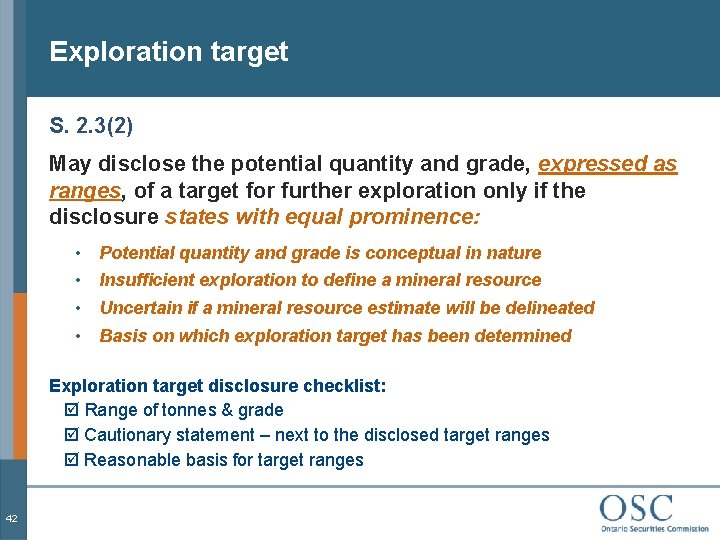
Exploration target S. 2. 3(2) May disclose the potential quantity and grade, expressed as ranges, of a target for further exploration only if the disclosure states with equal prominence: • • Potential quantity and grade is conceptual in nature Insufficient exploration to define a mineral resource Uncertain if a mineral resource estimate will be delineated Basis on which exploration target has been determined Exploration target disclosure checklist: Range of tonnes & grade Cautionary statement – next to the disclosed target ranges Reasonable basis for target ranges 42
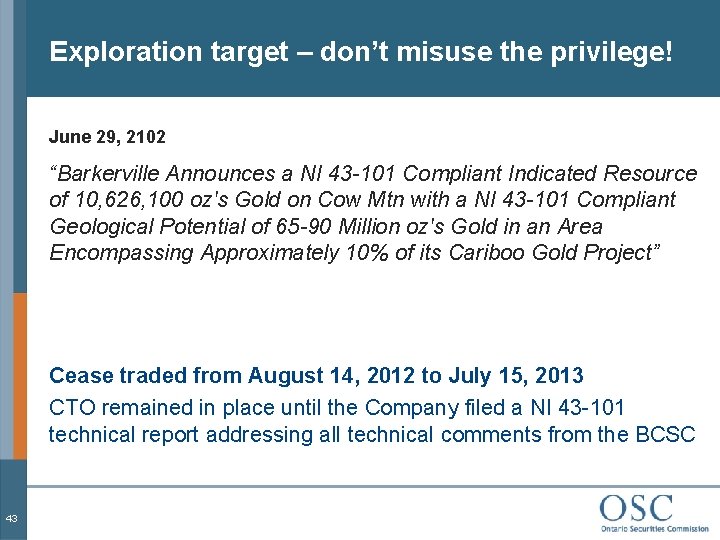
Exploration target – don’t misuse the privilege! June 29, 2102 “Barkerville Announces a NI 43 -101 Compliant Indicated Resource of 10, 626, 100 oz's Gold on Cow Mtn with a NI 43 -101 Compliant Geological Potential of 65 -90 Million oz's Gold in an Area Encompassing Approximately 10% of its Cariboo Gold Project” Cease traded from August 14, 2012 to July 15, 2013 CTO remained in place until the Company filed a NI 43 -101 technical report addressing all technical comments from the BCSC 43
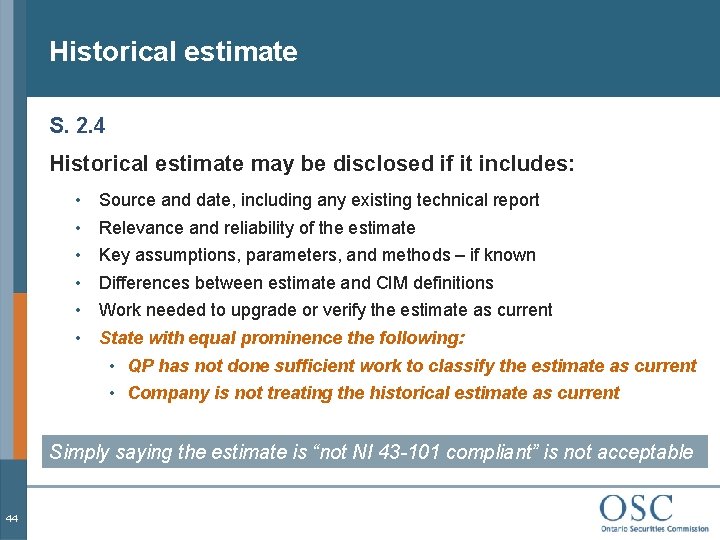
Historical estimate S. 2. 4 Historical estimate may be disclosed if it includes: • • • Source and date, including any existing technical report Relevance and reliability of the estimate Key assumptions, parameters, and methods – if known Differences between estimate and CIM definitions Work needed to upgrade or verify the estimate as current State with equal prominence the following: • QP has not done sufficient work to classify the estimate as current • Company is not treating the historical estimate as current Simply saying the estimate is “not NI 43 -101 compliant” is not acceptable 44

Mineral Resources & Mineral Reserves 45
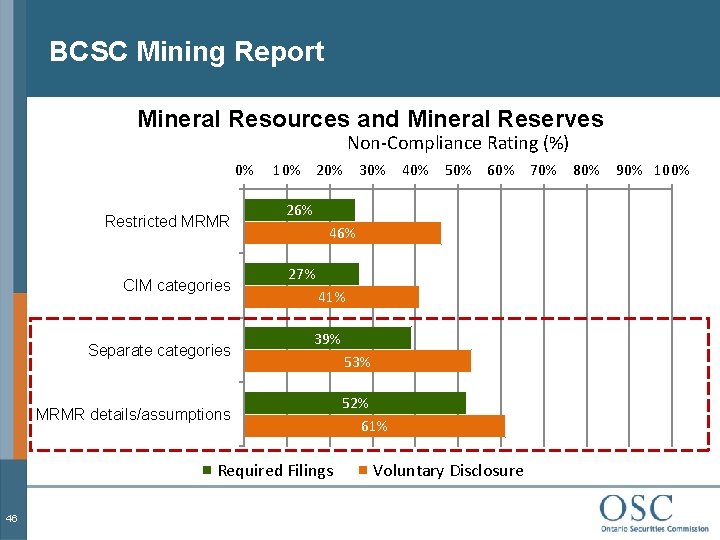
BCSC Mining Report Mineral Resources and Mineral Reserves Non-Compliance Rating (%) 0% Restricted MRMR CIM categories Separate categories 10% 20% 30% 40% 50% 60% 70% 80% 90% 100% 26% 46% 27% 41% 39% MRMR details/assumptions Required Filings 46 53% 52% 61% Voluntary Disclosure
“Must nots” regarding disclosure of estimates S. 2. 2 Must not disclose any information about a mineral resource or mineral reserve unless the disclosure • • 47 Uses only the five CIM categories (measured resource, proven reserve, etc. ) Reports each category separately Does not add inferred resources to other categories If the quantity of contained metal is disclosed, state the tonnes and grade for each category
Written disclosure of resources and reserves S. 3. 4 When disclosing mineral resources or reserves include: • • • 48 Effective date of each estimate Quantity and grade of each category Key assumptions, parameters, and methods used Any known risks that could materially affect potential development Statement that “mineral resources that are not mineral reserves and do not have demonstrated economic viability” if results of an economic analysis of resources is disclosed (such as in a PEA)
Key assumptions, parameters & methods Key assumptions • • Cut-off grade and basis for determination Mining and processing method Metallurgical recovery Metal prices Parameters • • Appropriate geological model for the deposit type Grade cutting factors and specific gravity Search distances and minimum samples per block Interpolation distances and directions Methods • Block model • Polygonal, cross-sectional, etc. How were “reasonable prospects of economic extraction” determined? 49

Economic Studies 50
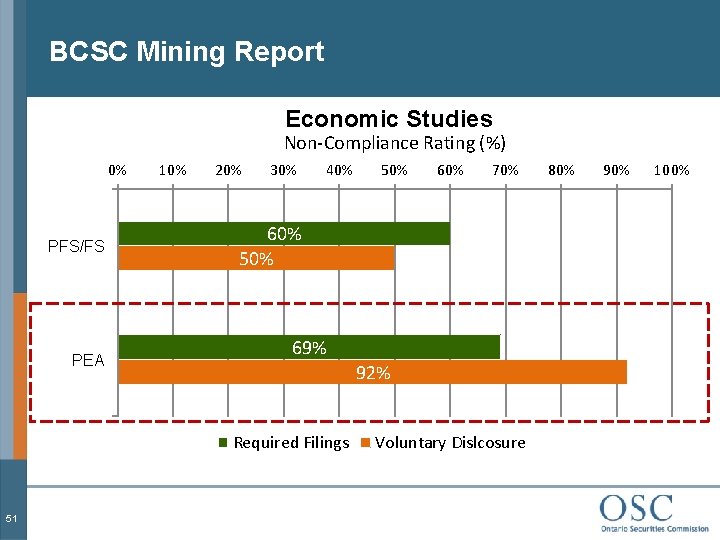
BCSC Mining Report Economic Studies Non-Compliance Rating (%) 0% PFS/FS PEA 10% 20% 30% 40% 60% 70% 60% 50% 69% 92% Required Filings 51 50% Voluntary Dislcosure 80% 90% 100%
Preliminary economic assessment (PEA) S. 2. 3(3) May disclose the results of a PEA that includes inferred resources if the disclosure states with equal prominence: • PEA is preliminary in nature • Includes inferred resources that are too speculative geologically to have the economic considerations applied to them • No certainty that the PEA will be realized Also: • States the basis and assumptions for the PEA • Describes the impact of the PEA on any pre-feasibility or feasibility study 52
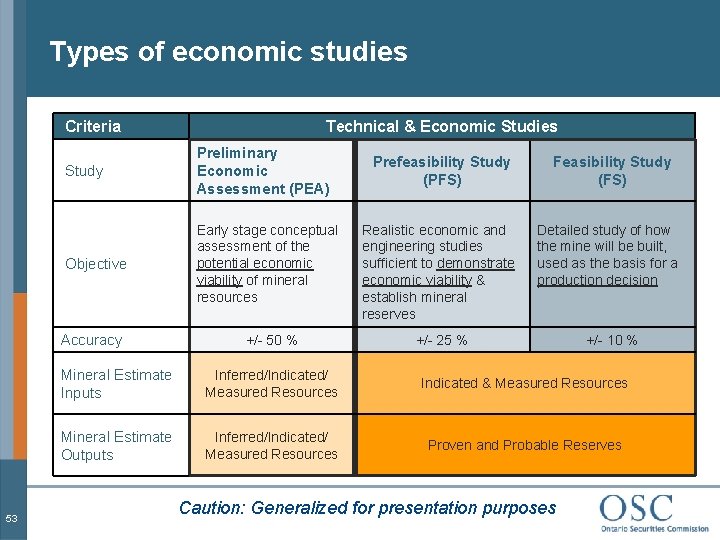
Types of economic studies Criteria Study Preliminary Economic Assessment (PEA) Objective Early stage conceptual assessment of the potential economic viability of mineral resources Accuracy 53 Technical & Economic Studies +/- 50 % Prefeasibility Study (PFS) Realistic economic and engineering studies sufficient to demonstrate economic viability & establish mineral reserves Feasibility Study (FS) Detailed study of how the mine will be built, used as the basis for a production decision +/- 25 % +/- 10 % Mineral Estimate Inputs Inferred/Indicated/ Measured Resources Indicated & Measured Resources Mineral Estimate Outputs Inferred/Indicated/ Measured Resources Proven and Probable Reserves Caution: Generalized for presentation purposes
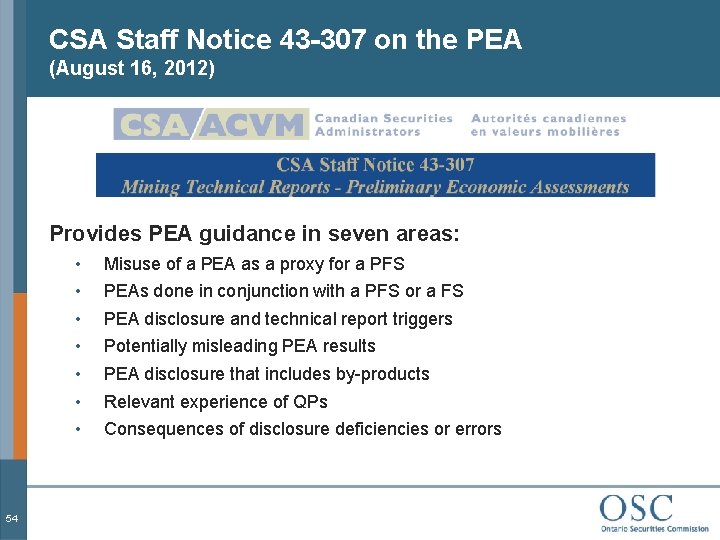
CSA Staff Notice 43 -307 on the PEA (August 16, 2012) Provides PEA guidance in seven areas: • • 54 Misuse of a PEA as a proxy for a PFS PEAs done in conjunction with a PFS or a FS PEA disclosure and technical report triggers Potentially misleading PEA results PEA disclosure that includes by-products Relevant experience of QPs Consequences of disclosure deficiencies or errors
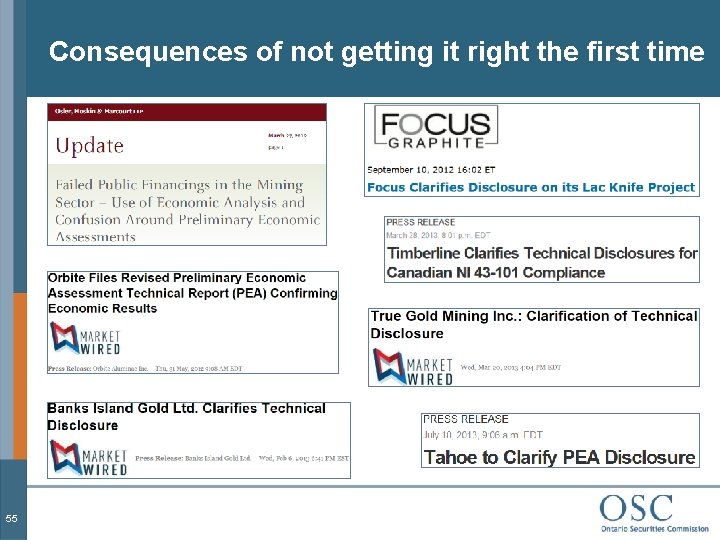
Consequences of not getting it right the first time 55
Technical Report Basics 56
Technical report Supports a mining company’s most important assets --its material mineral properties and the resources and reserves they contain 57
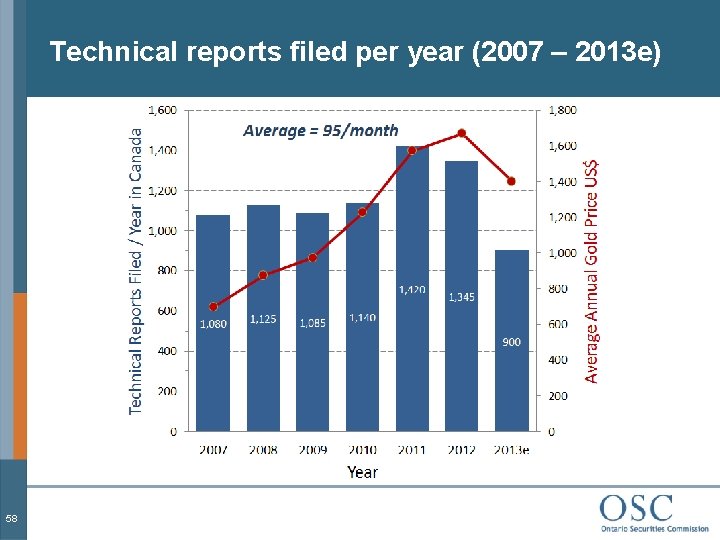
Technical reports filed per year (2007 – 2013 e) 58
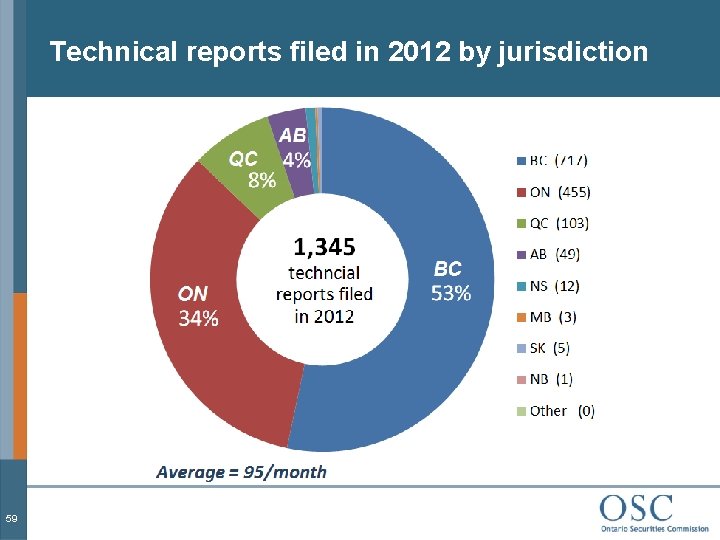
Technical reports filed in 2012 by jurisdiction 59
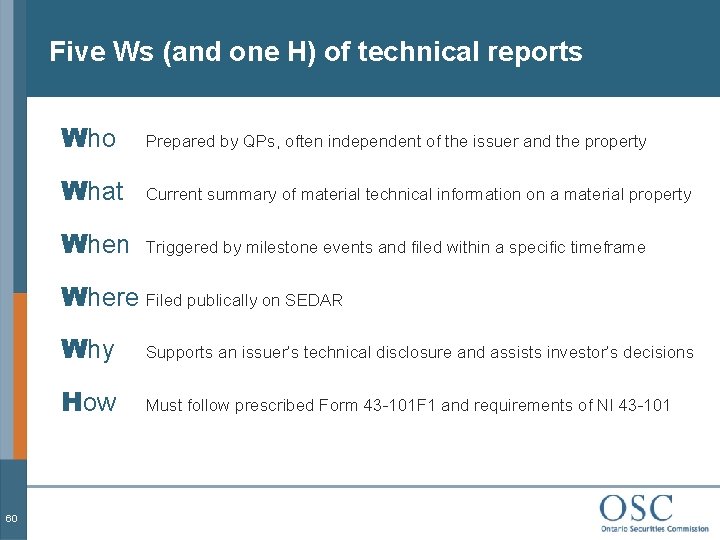
Five Ws (and one H) of technical reports Who Prepared by QPs, often independent of the issuer and the property What Current summary of material technical information on a material property When Triggered by milestone events and filed within a specific timeframe Where Filed publically on SEDAR 60 Why Supports an issuer’s technical disclosure and assists investor’s decisions How Must follow prescribed Form 43 -101 F 1 and requirements of NI 43 -101
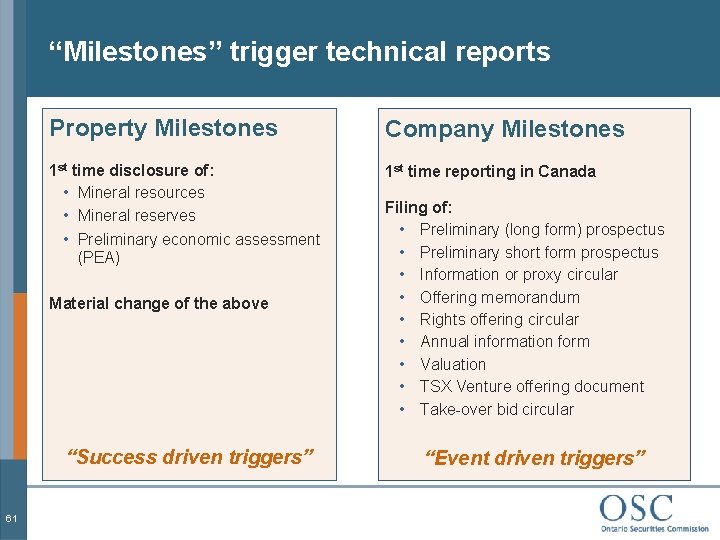
“Milestones” trigger technical reports Property Milestones Company Milestones 1 st time disclosure of: • Mineral resources • Mineral reserves 1 st time reporting in Canada • Preliminary economic assessment (PEA) Material change of the above “Success driven triggers” 61 Filing of: • Preliminary (long form) prospectus • Preliminary short form prospectus • Information or proxy circular • Offering memorandum • Rights offering circular • Annual information form • Valuation • TSX Venture offering document • Take-over bid circular “Event driven triggers”
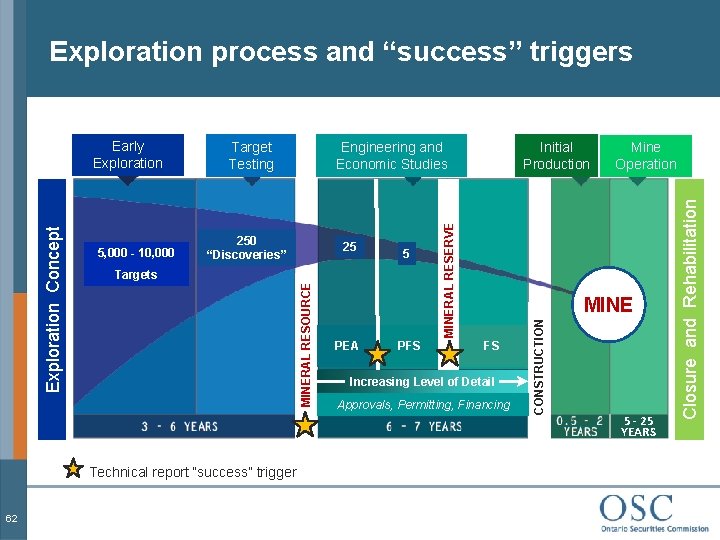
Exploration process and “success” triggers 62 5 Targets PEA PFS Mine Operation MINE FS Increasing Level of Detail Approvals, Permitting, Financing 5 - 25 YEARS Closure and Rehabilitation 25 CONSTRUCTION 250 “Discoveries” Technical report “success” trigger Initial Production Engineering and Economic Studies MINERAL RESERVE 5, 000 - 10, 000 Target Testing MINERAL RESOURCE Exploration Concept Early Exploration
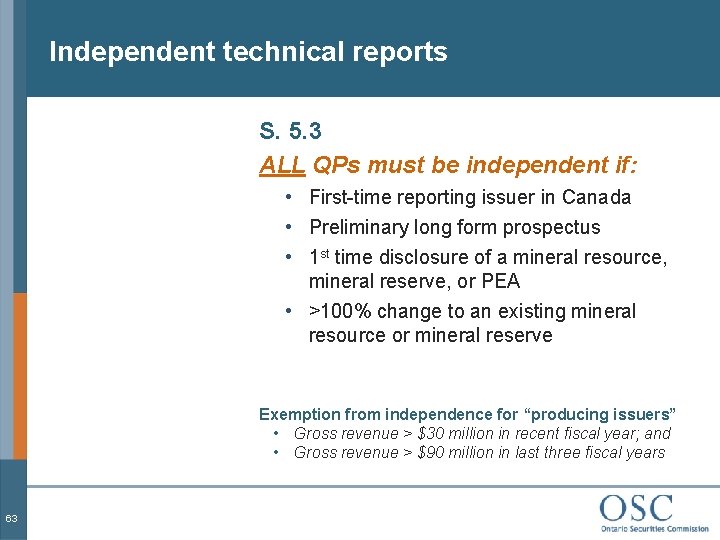
Independent technical reports S. 5. 3 ALL QPs must be independent if: • First-time reporting issuer in Canada • Preliminary long form prospectus • 1 st time disclosure of a mineral resource, mineral reserve, or PEA • >100% change to an existing mineral resource or mineral reserve Exemption from independence for “producing issuers” • Gross revenue > $30 million in recent fiscal year; and • Gross revenue > $90 million in last three fiscal years 63
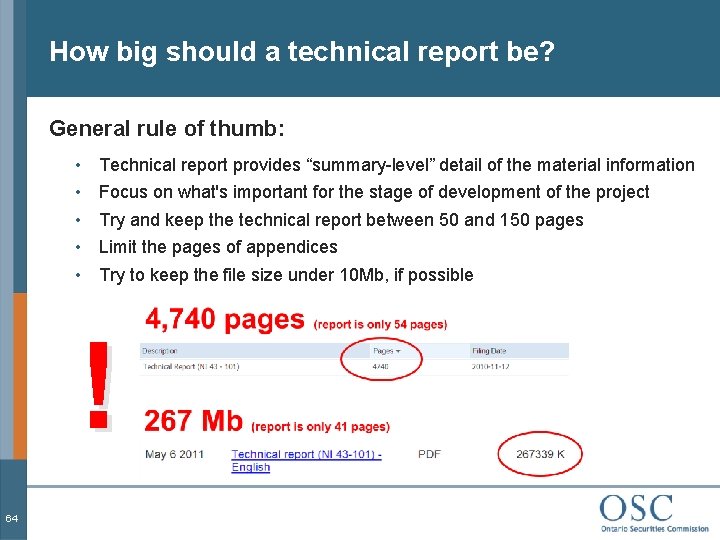
How big should a technical report be? General rule of thumb: • • • Technical report provides “summary-level” detail of the material information Focus on what's important for the stage of development of the project Try and keep the technical report between 50 and 150 pages Limit the pages of appendices Try to keep the file size under 10 Mb, if possible ! 64
Technical Report Review Study by OSC Staff Notice 43 -705 June 27, 2013 65
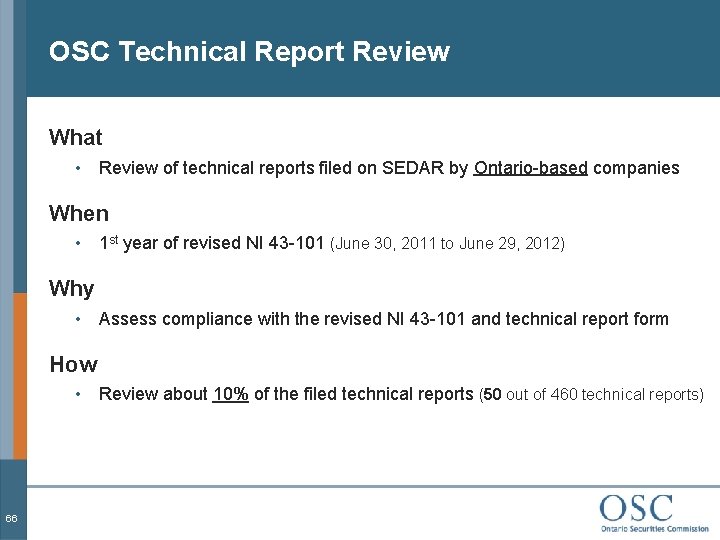
OSC Technical Report Review What • Review of technical reports filed on SEDAR by Ontario-based companies When • 1 st year of revised NI 43 -101 (June 30, 2011 to June 29, 2012) Why • Assess compliance with the revised NI 43 -101 and technical report form How • Review about 10% of the filed technical reports (50 out of 460 technical reports) 66
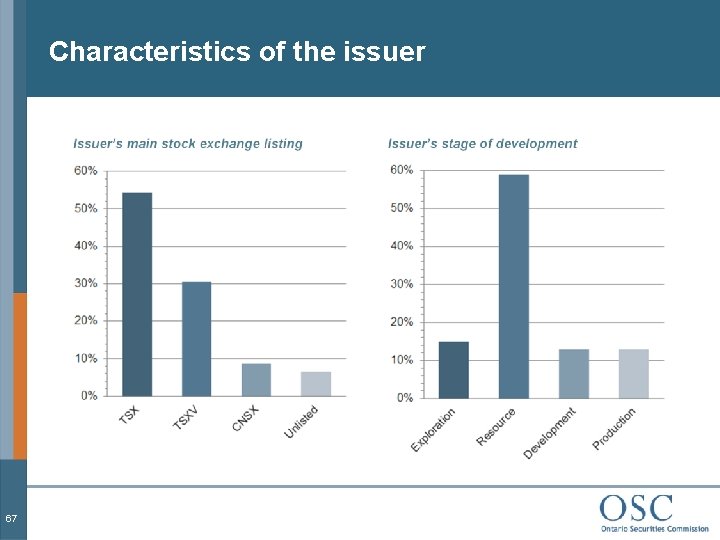
Characteristics of the issuer 67
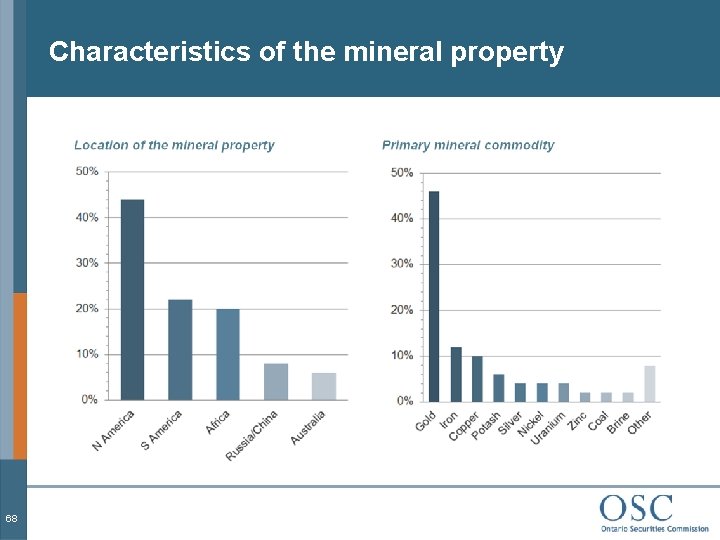
Characteristics of the mineral property 68
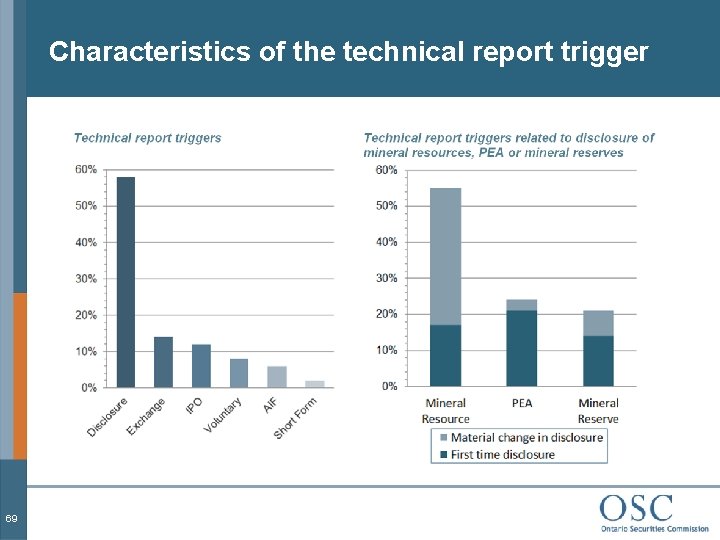
Characteristics of the technical report trigger 69
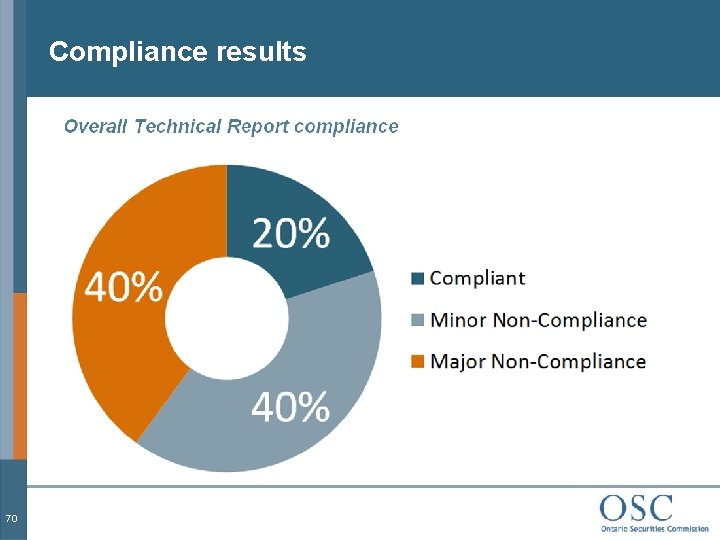
Compliance results 70
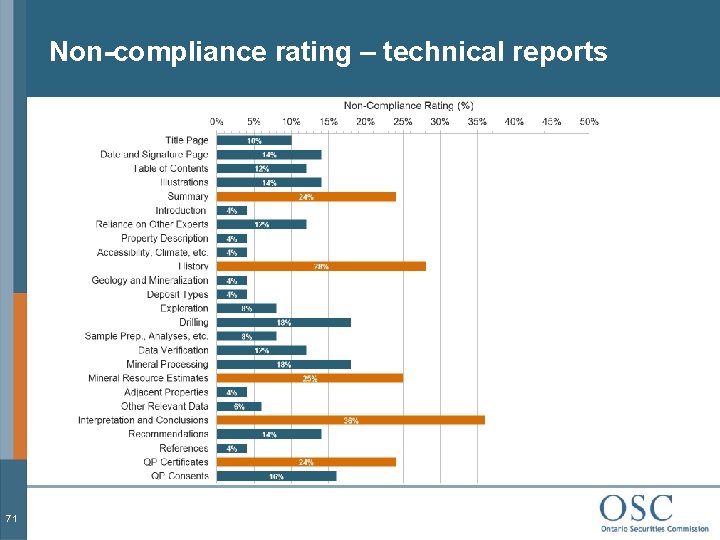
Non-compliance rating – technical reports 71
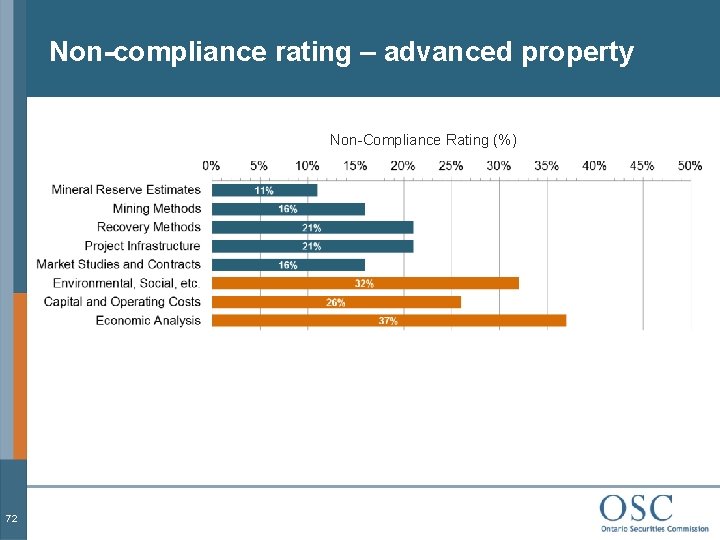
Non-compliance rating – advanced property Non-Compliance Rating (%) 72
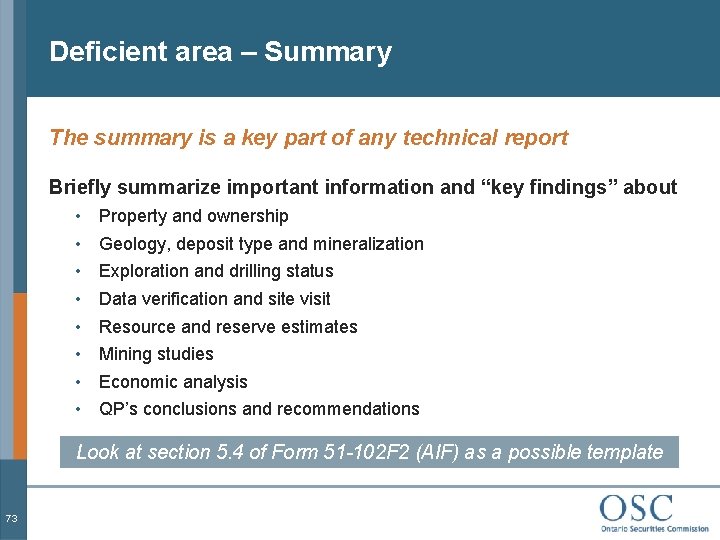
Deficient area – Summary The summary is a key part of any technical report Briefly summarize important information and “key findings” about • • Property and ownership Geology, deposit type and mineralization Exploration and drilling status Data verification and site visit Resource and reserve estimates Mining studies Economic analysis QP’s conclusions and recommendations Look at section 5. 4 of Form 51 -102 F 2 (AIF) as a possible template 73
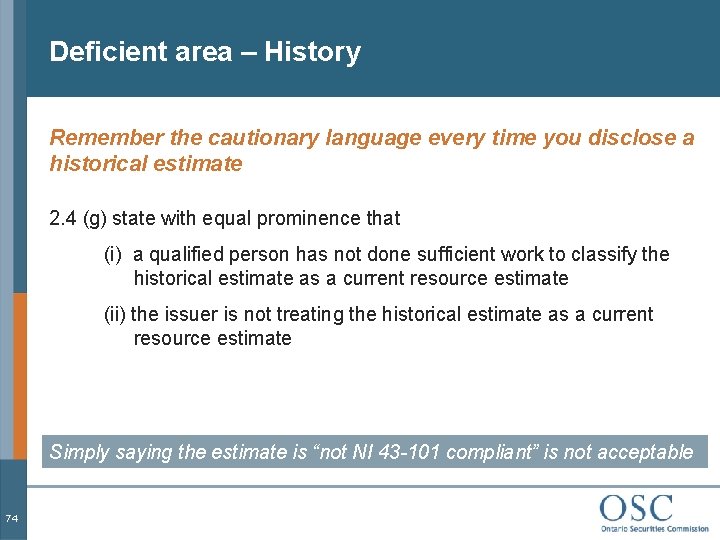
Deficient area – History Remember the cautionary language every time you disclose a historical estimate 2. 4 (g) state with equal prominence that (i) a qualified person has not done sufficient work to classify the historical estimate as a current resource estimate (ii) the issuer is not treating the historical estimate as a current resource estimate Simply saying the estimate is “not NI 43 -101 compliant” is not acceptable 74
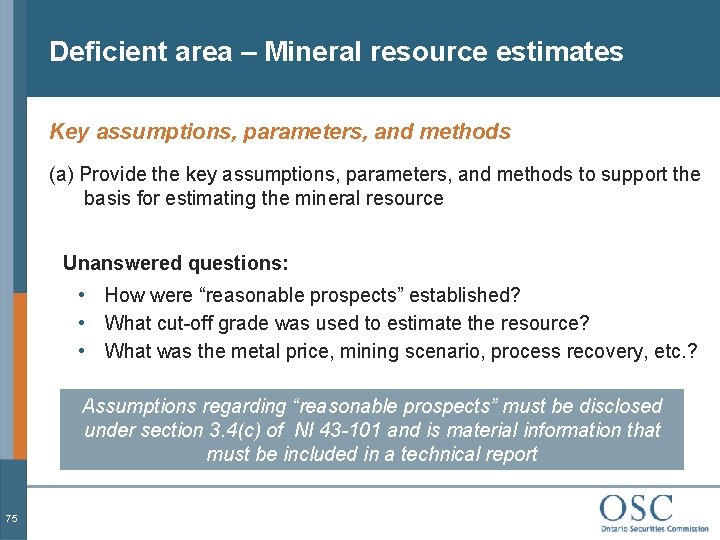
Deficient area – Mineral resource estimates Key assumptions, parameters, and methods (a) Provide the key assumptions, parameters, and methods to support the basis for estimating the mineral resource Unanswered questions: • How were “reasonable prospects” established? • What cut-off grade was used to estimate the resource? • What was the metal price, mining scenario, process recovery, etc. ? Assumptions regarding “reasonable prospects” must be disclosed under section 3. 4(c) of NI 43 -101 and is material information that must be included in a technical report 75
Deficient area – Environmental studies, permitting, and social impact “Social license” and mine closure (d) Social requirements for the project and status of negotiations with local communities (e) Mine closure requirements and reclamation costs Unanswered questions: • What about relocation of the village? • How is the company dealing with surface rights issues? • Is there an exploration agreement with the local First Nation? Social license and local “approval” is critical for moving projects forward 76
Deficient area – Capital and operating costs Components of cost estimates and their basis explained Provide a summary table of cost estimates with major components and explain and justify the basis for the cost estimates Unanswered questions: • What are the main components in the capital cost estimate? • How was the operating cost estimate determined? • What about the cost of the railway line? Provide more context to the estimated costs – not just a number 77
Deficient area – Economic analysis Taxes and sensitivity analysis (d) summary of the taxes, royalties, and government levies (e) sensitivity analysis using commodity price, grade, capital and operating costs, and the impact of the results Unanswered questions: • What are the applicable taxes and their impact on the economics? • What are the base case assumptions? • What about the impact of decreasing metal prices? Potentially misleading disclosure may include the following: • Reporting only “before-tax” economic outcomes • Reporting only “positive” price sensitivity analysis 78
Deficient area – Interpretation and conclusions Risks, uncertainties and potential impacts Discuss any significant risks and uncertainties, and their potential impacts, on the project's potential economic viability or continued viability Unanswered questions: • What about the ability to obtain water rights? • What about the proposed novel processing technology? • What about the impact of the civil war in the region? Consider a table showing the risks, mitigating factors and opportunities 79
Deficient area – QP certificate Follow the requirements as set out in s. 8. 1 of NI 43 -101 • Sign and date the certificate • Discuss your particular “relevant” experience • Each section of the technical report needs to have a QP taking responsibility Include all the required statements - Certificates are one of the first things checked by the regulator 80

Reviews by Commission Staff “Red Flags” 81
Technical reviews by the regulator Continuous disclosure (CD) reviews Typical documents examined • • 82 Website (all of it) News releases (past year) MD&A (past year) AIF (if filed) Technical reports (most recent ones) Social media sites (linked to the company) Bullboards and chat rooms (investor reaction)
Technical reviews by the regulator Prospectus reviews Typical documents examined • Prospectus • Technical information • Use of proceeds • Documents incorporated by reference into the prospectus • AIF, news releases, MD&A, etc. • Technical reports (most recent ones) • Website (all of it) 83

Red flags: sometimes the problems are obvious! 84
Disclosure red flags No QP named (3. 1) • Required for all written technical disclosure Missing location, azimuth, dip of drill holes (3. 3(2)(b)) • Provides context for drilling information Lack of information about true widths (3. 3(2)(c)) • Provide approximate true widths, or state unknown Wide zones without reporting high-grade intervals (3. 3(2)(d)) • e. g. 1. 0 g/t Au over 100 m – is this really representative of the zone? Overly promotional language (NP 51 -201) • e. g. world class, spectacular, bonanza, super deposit 85
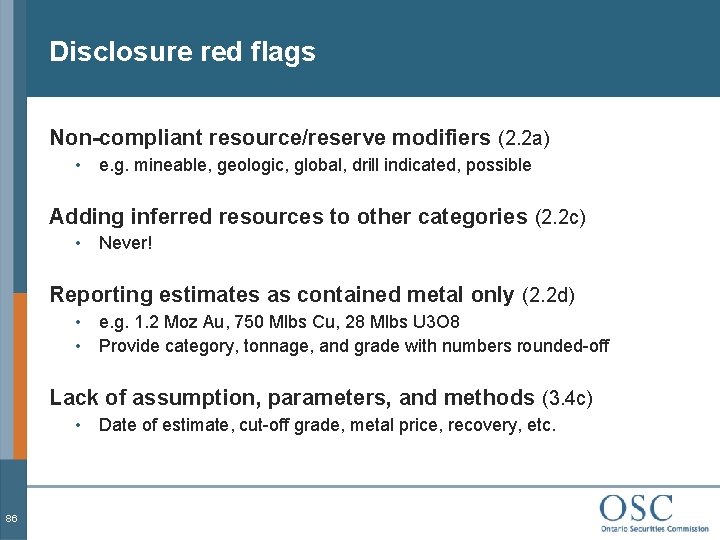
Disclosure red flags Non-compliant resource/reserve modifiers (2. 2 a) • e. g. mineable, geologic, global, drill indicated, possible Adding inferred resources to other categories (2. 2 c) • Never! Reporting estimates as contained metal only (2. 2 d) • e. g. 1. 2 Moz Au, 750 Mlbs Cu, 28 Mlbs U 3 O 8 • Provide category, tonnage, and grade with numbers rounded-off Lack of assumption, parameters, and methods (3. 4 c) • Date of estimate, cut-off grade, metal price, recovery, etc. 86
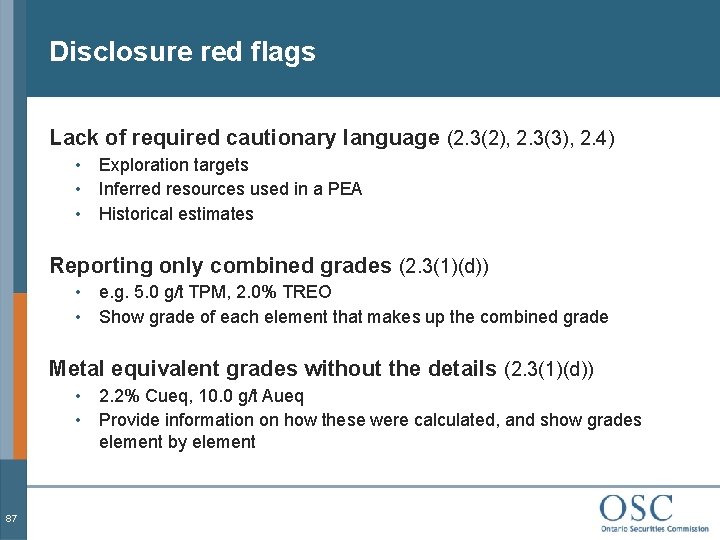
Disclosure red flags Lack of required cautionary language (2. 3(2), 2. 3(3), 2. 4) • Exploration targets • Inferred resources used in a PEA • Historical estimates Reporting only combined grades (2. 3(1)(d)) • e. g. 5. 0 g/t TPM, 2. 0% TREO • Show grade of each element that makes up the combined grade Metal equivalent grades without the details (2. 3(1)(d)) • 2. 2% Cueq, 10. 0 g/t Aueq • Provide information on how these were calculated, and show grades element by element 87
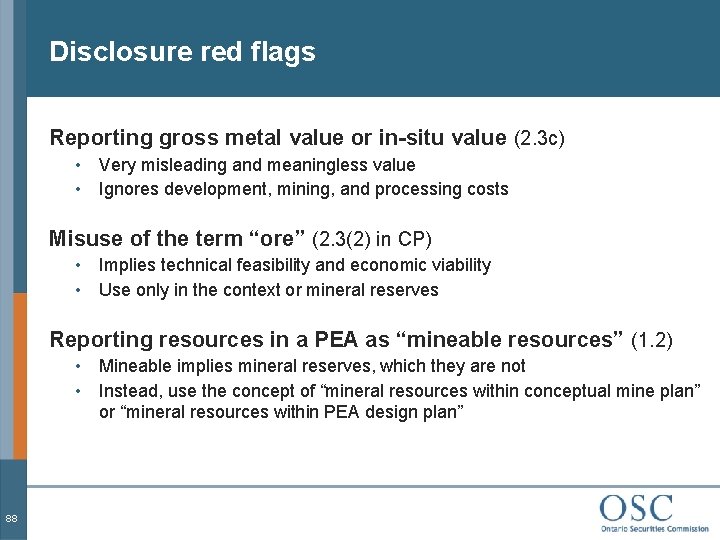
Disclosure red flags Reporting gross metal value or in-situ value (2. 3 c) • Very misleading and meaningless value • Ignores development, mining, and processing costs Misuse of the term “ore” (2. 3(2) in CP) • Implies technical feasibility and economic viability • Use only in the context or mineral reserves Reporting resources in a PEA as “mineable resources” (1. 2) • Mineable implies mineral reserves, which they are not • Instead, use the concept of “mineral resources within conceptual mine plan” or “mineral resources within PEA design plan” 88
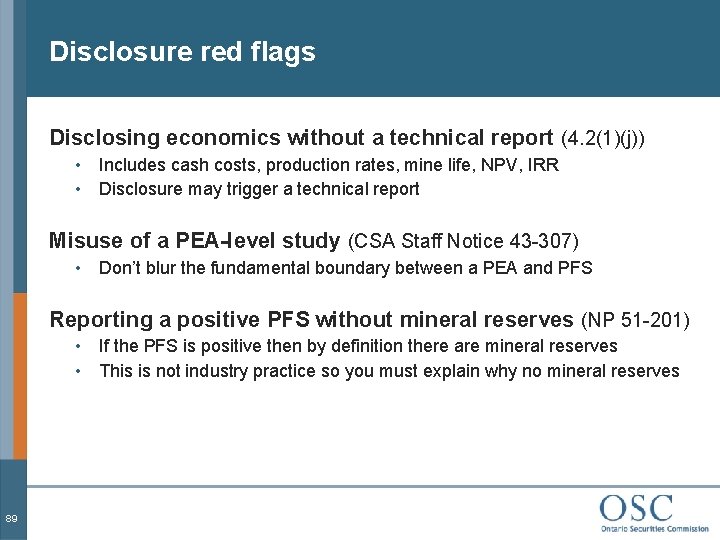
Disclosure red flags Disclosing economics without a technical report (4. 2(1)(j)) • Includes cash costs, production rates, mine life, NPV, IRR • Disclosure may trigger a technical report Misuse of a PEA-level study (CSA Staff Notice 43 -307) • Don’t blur the fundamental boundary between a PEA and PFS Reporting a positive PFS without mineral reserves (NP 51 -201) • If the PFS is positive then by definition there are mineral reserves • This is not industry practice so you must explain why no mineral reserves 89
So what if I don’t comply? NI 43 -101 is enforceable under the Securities Act Some of the possible outcomes: • • • 90 News release clarifying and/or retracting the disclosure Company placed on Refilings and Errors list Company placed on Default list (can’t raise new money) Cease Trade Order (trading stops) Enforcement order under the Act Class action lawsuit under civil liability provisions of the Act Professional liability and disciplinary action (QPs) Securities Act charges (5 years/ $5 million fine) Criminal Code charges (up to 14 years)
Key action items for mining companies • Understand your disclosure obligations • Be aware of CIM standards and best practices • Avoid the common mistakes • Review and discuss technical disclosure with your QP Don’t let this happen to you! • Missed deadlines • Public retraction and clarification • Withdrawn financings 91
Thank You! Craig Waldie Senior Geologist Jim Whyte Senior Geologist 416 -593 -8308 cwaldie@osc. gov. on. ca 416 -593 -2168 jwhyte@osc. gov. on. ca OSC NI 43 -101 N 43 - I 101 Graphic after IKEA 92
- Slides: 92