Chapter 24 The Origin of Species 2017 Pearson


- Slides: 59
Chapter 24 The Origin of Species © 2017 Pearson Education, Inc. Lecture Presentations by Nicole Tunbridge and Kathleen Fitzpatrick
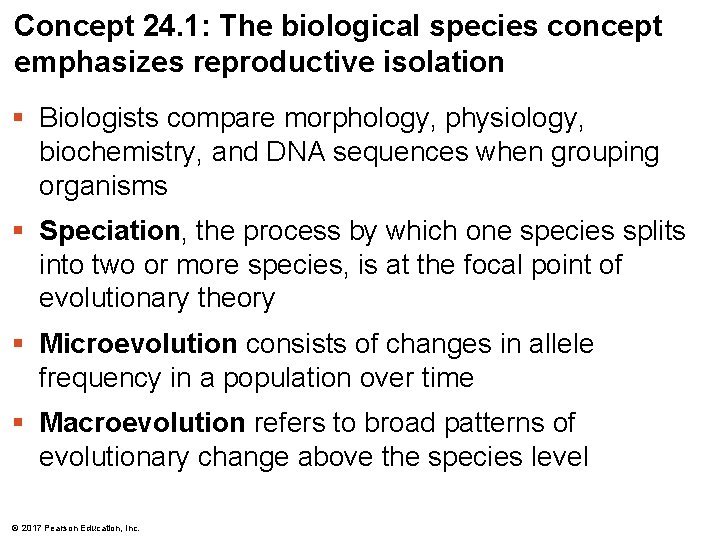
Concept 24. 1: The biological species concept emphasizes reproductive isolation § Biologists compare morphology, physiology, biochemistry, and DNA sequences when grouping organisms § Speciation, the process by which one species splits into two or more species, is at the focal point of evolutionary theory § Microevolution consists of changes in allele frequency in a population over time § Macroevolution refers to broad patterns of evolutionary change above the species level © 2017 Pearson Education, Inc.
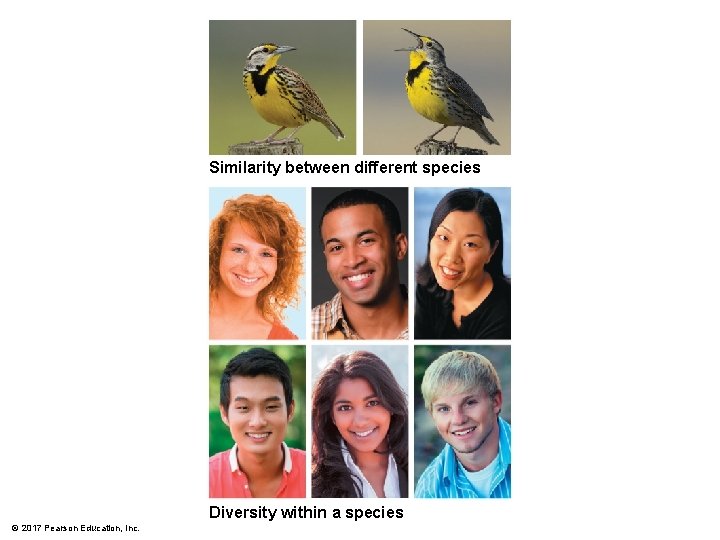
The Biological Species Concept § The biological species concept states that a species is a group of populations whose members have the potential to interbreed in nature and produce viable, fertile offspring; they do not breed successfully with members of other such groups § Gene flow between populations holds a species together genetically © 2017 Pearson Education, Inc.
Similarity between different species Diversity within a species © 2017 Pearson Education, Inc.
The Biological Species Concept § Reproductive isolation is the existence of biological factors (barriers) that impede two species from producing viable, fertile offspring § Hybrids are the offspring that result from mating between different species § Reproductive isolation can be classified by whether factors act before or after fertilization © 2017 Pearson Education, Inc.
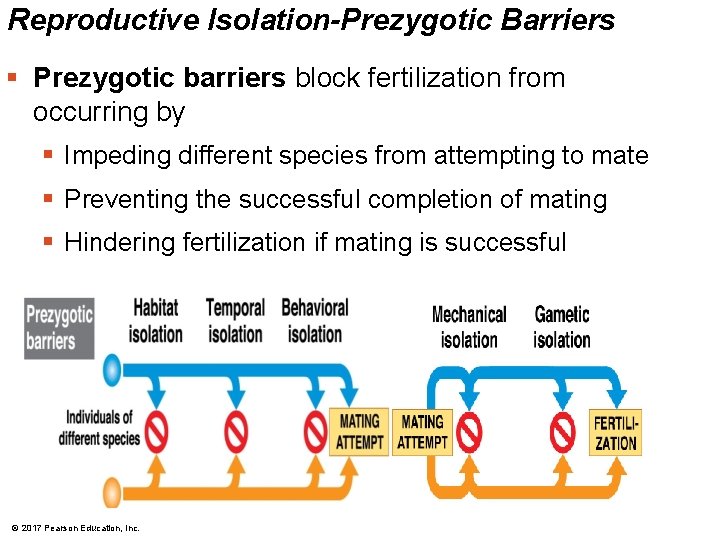
Reproductive Isolation-Prezygotic Barriers § Prezygotic barriers block fertilization from occurring by § Impeding different species from attempting to mate § Preventing the successful completion of mating § Hindering fertilization if mating is successful © 2017 Pearson Education, Inc.
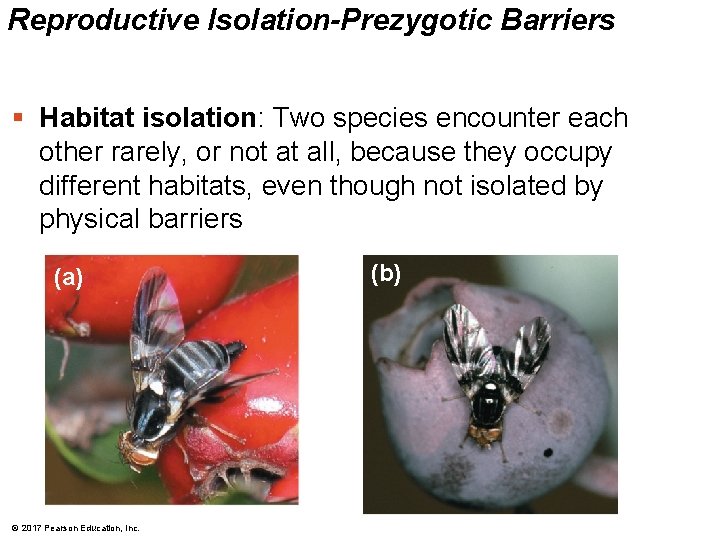
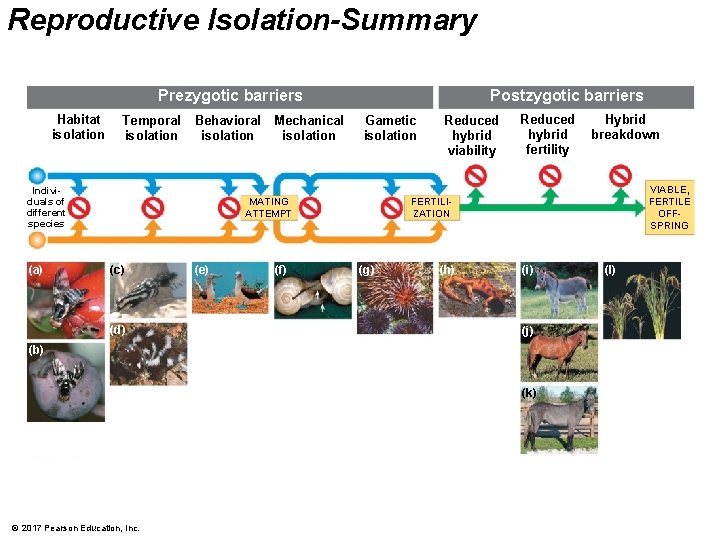
Reproductive Isolation-Prezygotic Barriers § Habitat isolation: Two species encounter each other rarely, or not at all, because they occupy different habitats, even though not isolated by physical barriers (a) © 2017 Pearson Education, Inc. (b)
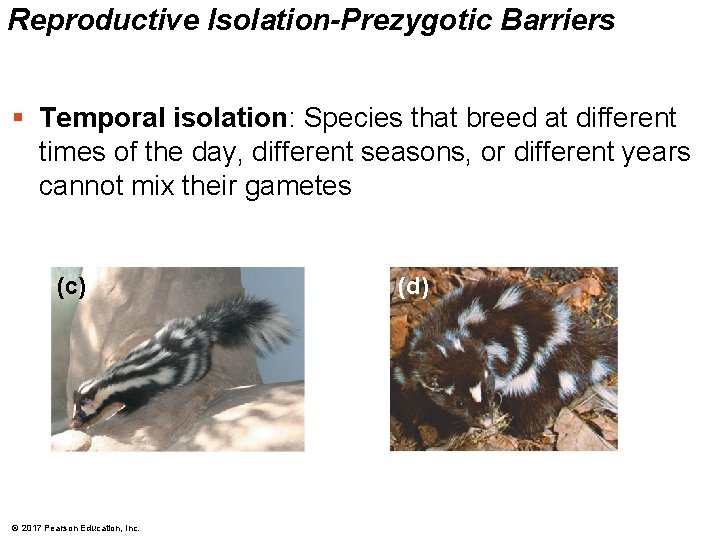
Reproductive Isolation-Prezygotic Barriers § Temporal isolation: Species that breed at different times of the day, different seasons, or different years cannot mix their gametes (c) © 2017 Pearson Education, Inc. (d)
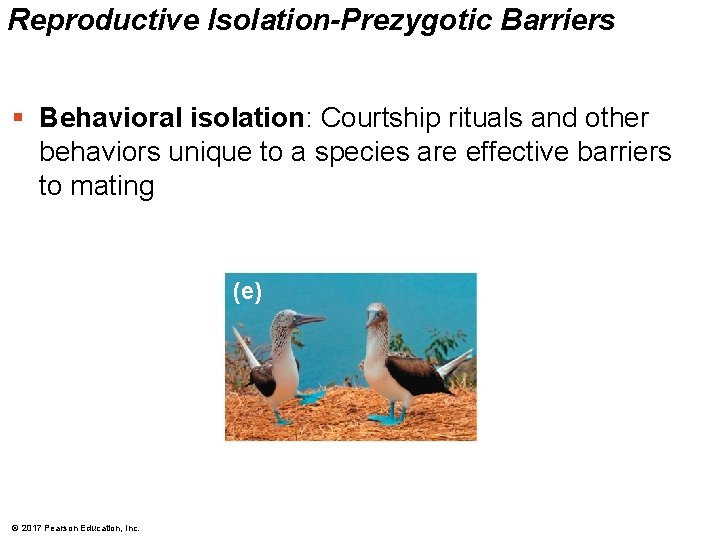
Reproductive Isolation-Prezygotic Barriers § Behavioral isolation: Courtship rituals and other behaviors unique to a species are effective barriers to mating (e) © 2017 Pearson Education, Inc.
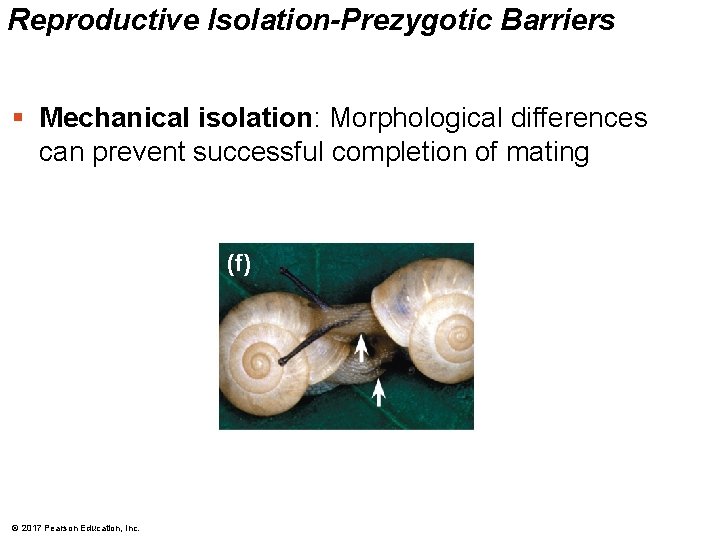
Reproductive Isolation-Prezygotic Barriers § Mechanical isolation: Morphological differences can prevent successful completion of mating (f) © 2017 Pearson Education, Inc.
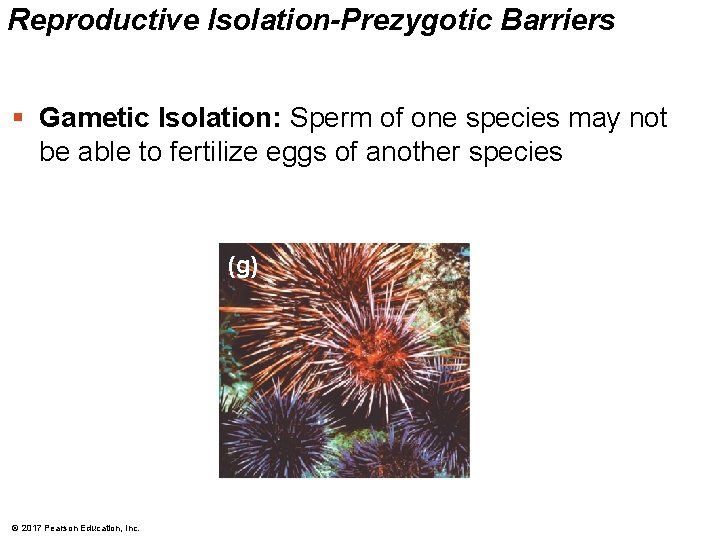
Reproductive Isolation-Prezygotic Barriers § Gametic Isolation: Sperm of one species may not be able to fertilize eggs of another species (g) © 2017 Pearson Education, Inc.
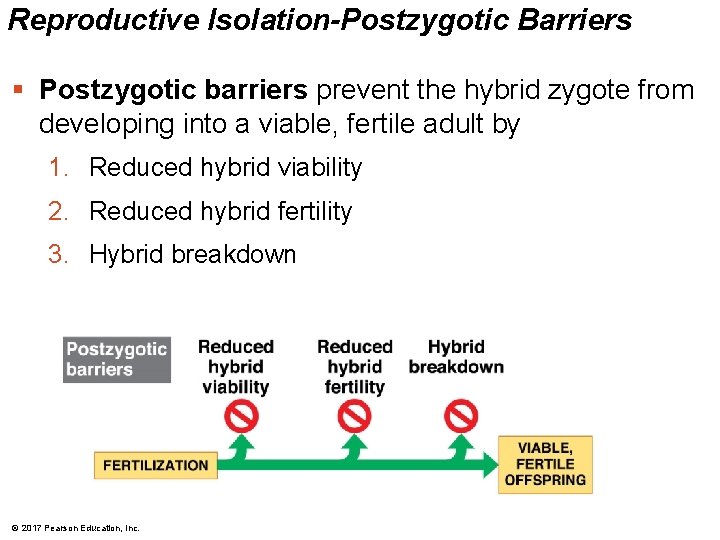
Reproductive Isolation-Postzygotic Barriers § Postzygotic barriers prevent the hybrid zygote from developing into a viable, fertile adult by 1. Reduced hybrid viability 2. Reduced hybrid fertility 3. Hybrid breakdown © 2017 Pearson Education, Inc.
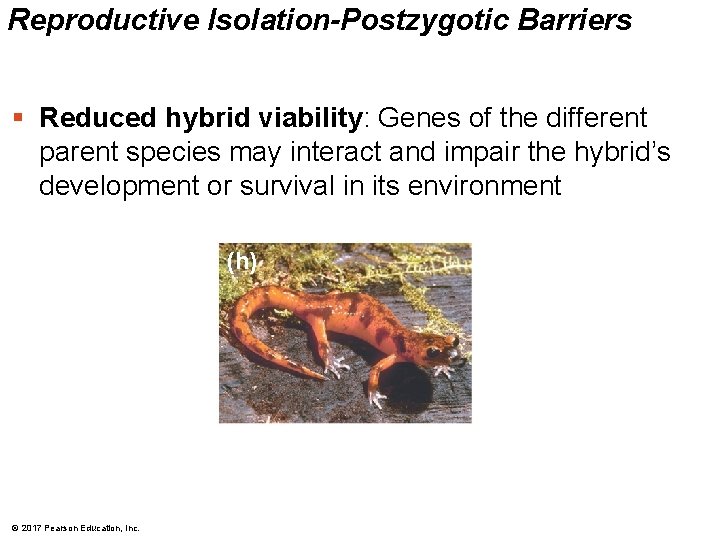
Reproductive Isolation-Postzygotic Barriers § Reduced hybrid viability: Genes of the different parent species may interact and impair the hybrid’s development or survival in its environment (h) © 2017 Pearson Education, Inc.
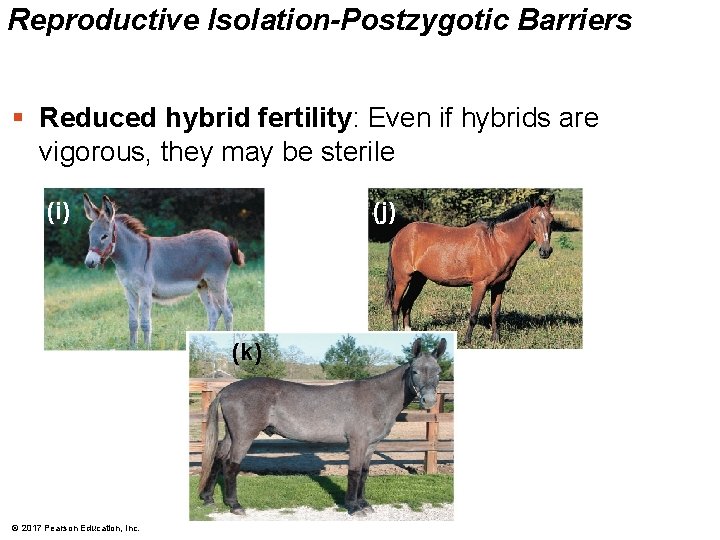
Reproductive Isolation-Postzygotic Barriers § Reduced hybrid fertility: Even if hybrids are vigorous, they may be sterile (j) (i) (k) © 2017 Pearson Education, Inc.
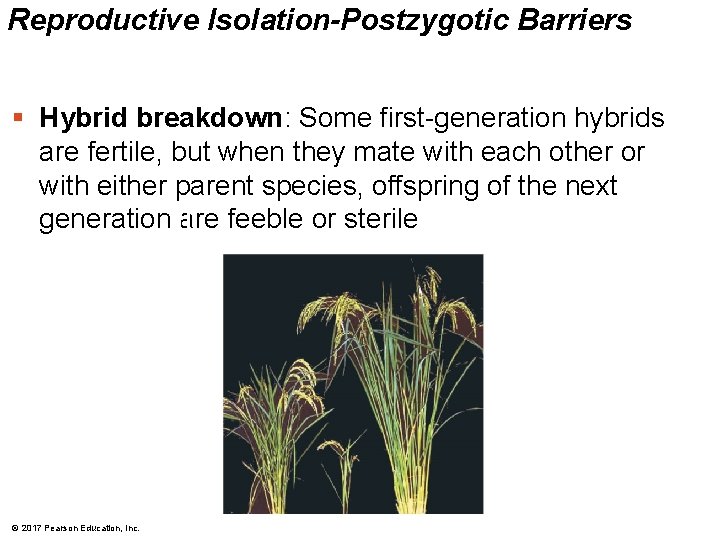
Reproductive Isolation-Postzygotic Barriers § Hybrid breakdown: Some first-generation hybrids are fertile, but when they mate with each other or with either parent species, offspring of the next generation (lare feeble or sterile ) © 2017 Pearson Education, Inc.
Reproductive Isolation-Summary Prezygotic barriers Habitat isolation Temporal isolation Behavioral Mechanical isolation Individuals of different species (a) Postzygotic barriers Gametic isolation MATING ATTEMPT (c) (d) (e) (f) Reduced hybrid viability Reduced hybrid fertility VIABLE, FERTILE OFFSPRING FERTILIZATION (g) (h) (i) (j) (b) (k) © 2017 Pearson Education, Inc. Hybrid breakdown (l)
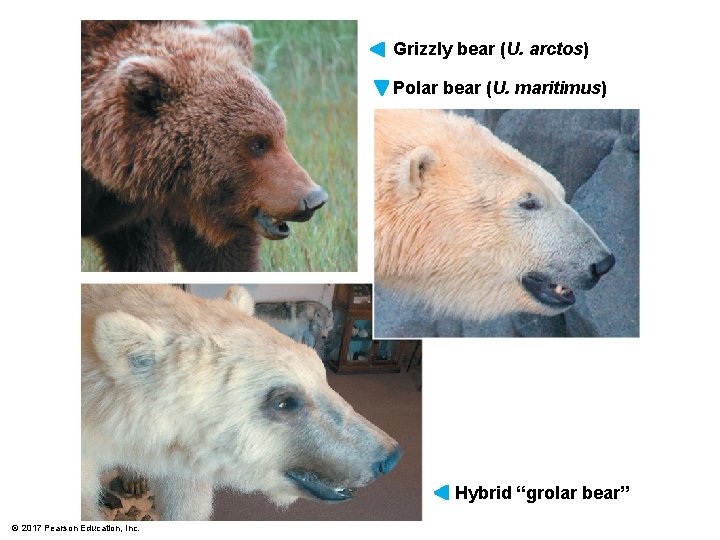
Limitations of the Biological Species Concept § The biological species concept cannot be applied to fossils or asexual organisms (including all prokaryotes) § The biological species concept emphasizes absence of gene flow § However, gene flow can occur between morphologically and ecologically distinct species § For example, grizzly bears and polar bears can mate to produce “grolar bears” © 2017 Pearson Education, Inc.
Grizzly bear (U. arctos) Polar bear (U. maritimus) Hybrid “grolar bear” © 2017 Pearson Education, Inc.
Other Definitions of Species § Other species concepts emphasize the unity within a species rather than the separateness of different species § The morphological species concept defines a species by structural features § It applies to sexual and asexual species but relies on subjective criteria © 2017 Pearson Education, Inc.
Other Definitions of Species § The ecological species concept defines a species in terms of its ecological niche § It applies to sexual and asexual species and emphasizes the role of disruptive selection § Many species definitions have been proposed; the usefulness of each depends on the situation and the research questions being asked © 2017 Pearson Education, Inc.
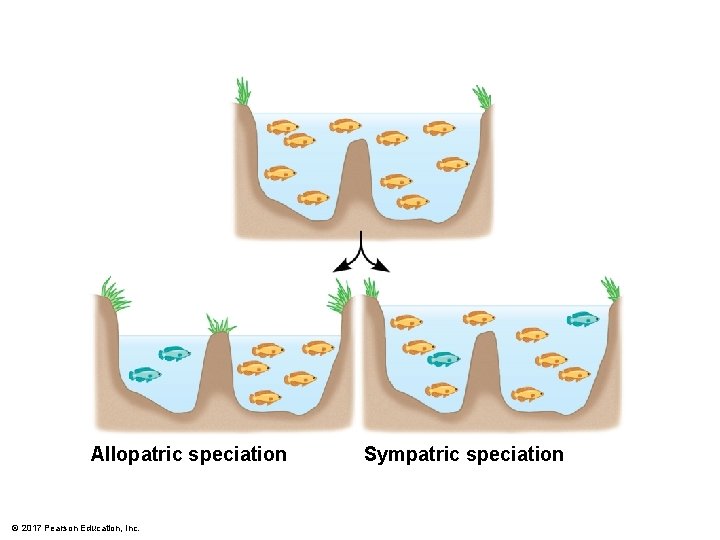
Concept 24. 2: Speciation can take place with or without geographic separation § Speciation can occur in two ways: 1. Allopatric speciation 2. Sympatric speciation © 2017 Pearson Education, Inc.
Allopatric speciation © 2017 Pearson Education, Inc. Sympatric speciation
1. Allopatric (“Other Country”) Speciation § In allopatric speciation, gene flow is interrupted or reduced when a population is divided into geographically isolated subpopulations § For example, the flightless cormorant of the Galápagos likely originated from a flying species on the mainland © 2017 Pearson Education, Inc.
The Process of Allopatric Speciation § The definition of barrier depends on the ability of a population to disperse § For example, a canyon may create a barrier for small rodents, but not birds, coyotes, or pollen § Separated populations may evolve independently through mutation, natural selection, and genetic drift § Reproductive isolation may arise as a by-product of genetic divergence © 2017 Pearson Education, Inc.
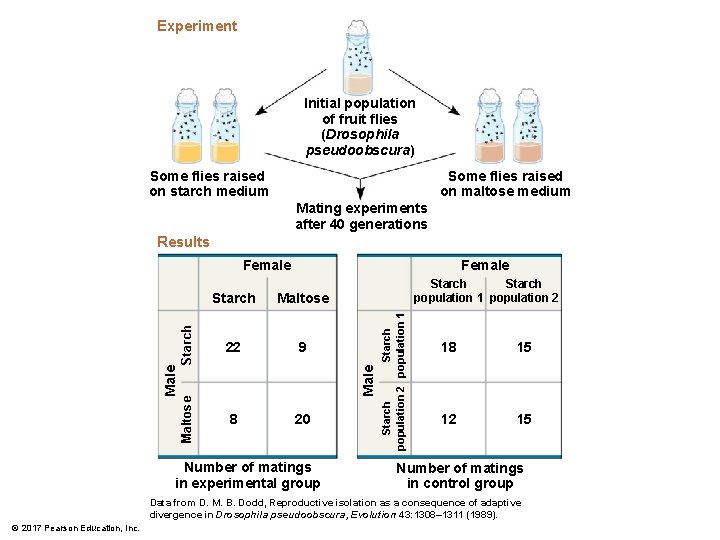
Evidence of Allopatric Speciation § Reproductive barriers can develop between experimentally isolated laboratory populations subjected to different environmental conditions § For example, fruit flies taken from the same source population and allowed to adapt to different diets over several generations tend to choose mates adapted to the same diet © 2017 Pearson Education, Inc.
Experiment Initial population of fruit flies (Drosophila pseudoobscura) Some flies raised on starch medium Some flies raised on maltose medium Mating experiments after 40 generations Results 22 9 8 20 Number of matings in experimental group Starch population 2 population 1 Maltose Starch population 1 population 2 Male Starch Female Maltose Male Female 18 15 12 15 Number of matings in control group Data from D. M. B. Dodd, Reproductive isolation as a consequence of adaptive divergence in Drosophila pseudoobscura, Evolution 43: 1308– 1311 (1989). © 2017 Pearson Education, Inc.
§ Regions with many geographic barriers typically have more species than do regions with fewer barriers § Reproductive isolation between populations generally increases as the distance between them increases § Reproductive barriers are intrinsic to the organisms themselves; physical separation alone is not a biological barrier © 2017 Pearson Education, Inc.
2. Sympatric (“Same Country”) Speciation § In sympatric speciation, speciation occurs in populations that live in the same geographic area § Sympatric speciation can occur if gene flow is reduced by factors including § Polyploidy § Sexual selection § Habitat differentiation © 2017 Pearson Education, Inc.
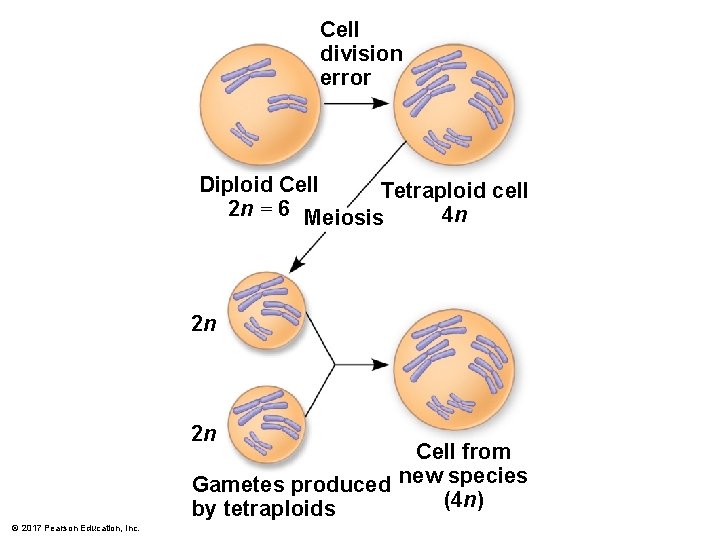
Polyploidy § Polyploidy is the presence of extra sets of chromosomes due to accidents during cell division § Polyploidy is much more common in plants than in animals § Polyploidy can produce new biological species in sympatry within a single generation © 2017 Pearson Education, Inc.
Polyploidy § An autopolyploid is an individual with more than two chromosome sets derived from a single species § The offspring resulting from mating between polyploids and diploids have reduced fertility © 2017 Pearson Education, Inc.
Cell division error Diploid Cell Tetraploid cell 2 n = 6 Meiosis 4 n 2 n 2 n Cell from Gametes produced new species (4 n) by tetraploids © 2017 Pearson Education, Inc.
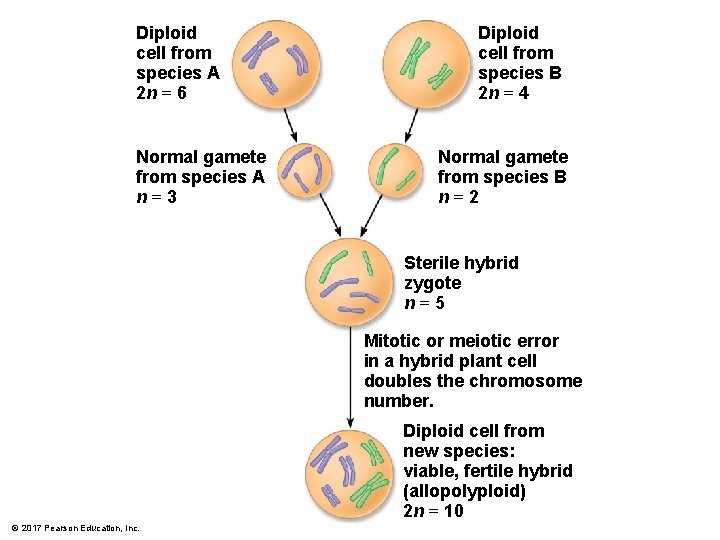
Polyploidy § An allopolyploid is a species with multiple sets of chromosomes derived from different species § Allopolyploids can successfully mate with each other, but cannot interbreed with either parent species © 2017 Pearson Education, Inc.
Diploid cell from species A 2 n = 6 Normal gamete from species A n=3 Diploid cell from species B 2 n = 4 Normal gamete from species B n=2 Sterile hybrid zygote n=5 Mitotic or meiotic error in a hybrid plant cell doubles the chromosome number. Diploid cell from new species: viable, fertile hybrid (allopolyploid) 2 n = 10 © 2017 Pearson Education, Inc.
Polyploidy § Many important crops (oats, cotton, potatoes, tobacco, and wheat) are polyploids § Plant geneticists can produce new polyploid agricultural species using chemicals to induce errors in cell division © 2017 Pearson Education, Inc.
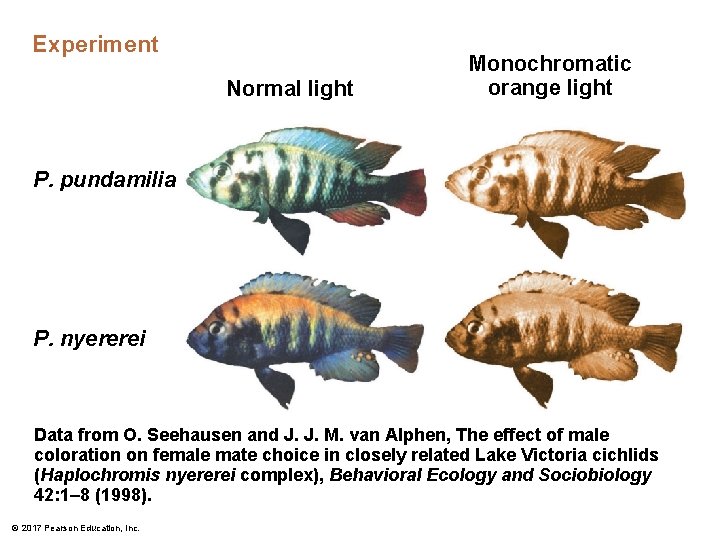
Sexual Selection § Sexual selection can drive sympatric speciation § Sexual selection for mates of different colors has likely contributed to speciation in cichlid fish in Lake Victoria © 2017 Pearson Education, Inc.
Experiment Normal light Monochromatic orange light P. pundamilia P. nyererei Data from O. Seehausen and J. J. M. van Alphen, The effect of male coloration on female mate choice in closely related Lake Victoria cichlids (Haplochromis nyererei complex), Behavioral Ecology and Sociobiology 42: 1– 8 (1998). © 2017 Pearson Education, Inc.
Habitat Differentiation § Sympatric speciation can also result from the appearance of new ecological niches § For example, populations of the North American maggot fly (Rhagoletis pomonella) can live on native hawthorn trees, as well as more recently introduced apple trees § Flies that use different host species experience both habitat and temporal isolation © 2017 Pearson Education, Inc.
Allopatric and Sympatric Speciation: A Review § In allopatric speciation, geographic isolation restricts gene flow between populations § Reproductive isolation may then arise as a byproduct of genetic changes resulting from divergent natural selection, genetic drift, or sexual selection § Even if contact is restored between populations, interbreeding is prevented © 2017 Pearson Education, Inc.
Allopatric and Sympatric Speciation: A Review § In sympatric speciation, a reproductive barrier isolates a subset of a population without geographic separation from the parent species § Sympatric speciation can result from polyploidy, natural selection, or sexual selection © 2017 Pearson Education, Inc.
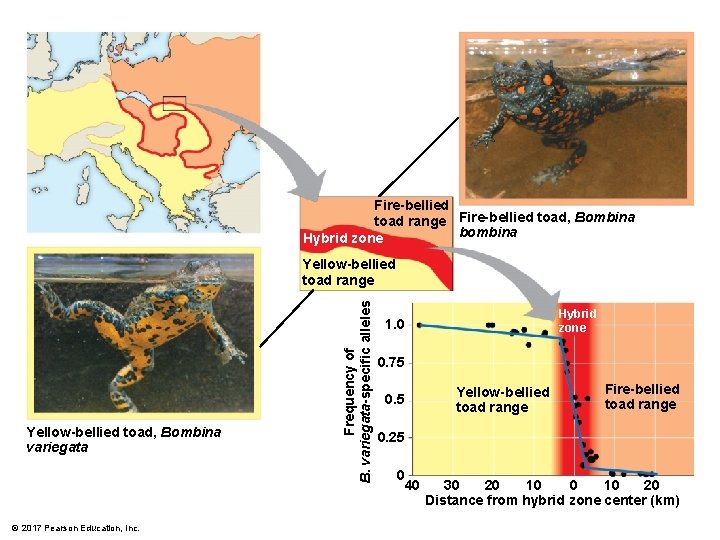
Concept 24. 3: Hybrid zones reveal factors that cause reproductive isolation § A hybrid zone is a region in which members of different species mate and produce hybrids § Hybrids are the result of mating between species with incomplete reproductive barriers § A hybrid zone can occur in a single band where adjacent species meet § For example, two species of toad in the genus Bombina interbreed in a long and narrow hybrid zone © 2017 Pearson Education, Inc.
Fire-bellied toad range Fire-bellied toad, Bombina bombina Hybrid zone Yellow-bellied toad, Bombina variegata © 2017 Pearson Education, Inc. Frequency of B. variegata-specific alleles Yellow-bellied toad range Hybrid zone 1. 0 0. 75 0. 5 Yellow-bellied toad range Fire-bellied toad range 0. 25 0 40 30 20 10 20 Distance from hybrid zone center (km)
§ Hybrids often have reduced fitness compared with parent species § The distribution of hybrid zones can be more complex if parent species are found in patches within the same region © 2017 Pearson Education, Inc.
Hybrid Zones and Environmental Change § Change in environmental conditions can result in the relocation of existing hybrid zones or the production of novel hybrid zones § Breeding between hybrids and parent species can result in the transfer of alleles from one parent species to the other § The transfer of novel alleles may help parent species cope with changing environments © 2017 Pearson Education, Inc.
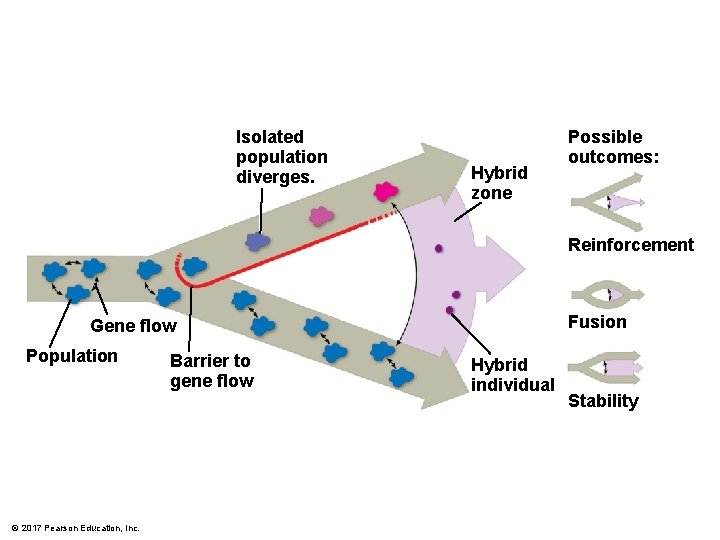
Hybrid Zones over Time § If hybrids do not become reproductively isolated from their parent species, then three alternate outcomes are possible: 1. Reinforcement 2. Fusion 3. Stability © 2017 Pearson Education, Inc.
Isolated population diverges. Hybrid zone Possible outcomes: Reinforcement Fusion Gene flow Population © 2017 Pearson Education, Inc. Barrier to gene flow Hybrid individual Stability
1. Reinforcement: Strengthening Reproductive Barriers § When hybrids are less fit than parent species, reinforcement of reproductive barriers may occur through strong selection for prezygotic barriers § Over time, the rate of hybridization decreases © 2017 Pearson Education, Inc.
1. Reinforcement: Strengthening Reproductive Barriers § Where reinforcement occurs, reproductive barriers should be stronger for sympatric than allopatric species § For example, female flycatchers in the genus Ficedula recognize and select mates of their own species when choosing between males from sympatric populations § Female flycatchers frequently make mistakes when selecting males from the more similar allopatric populations © 2017 Pearson Education, Inc.
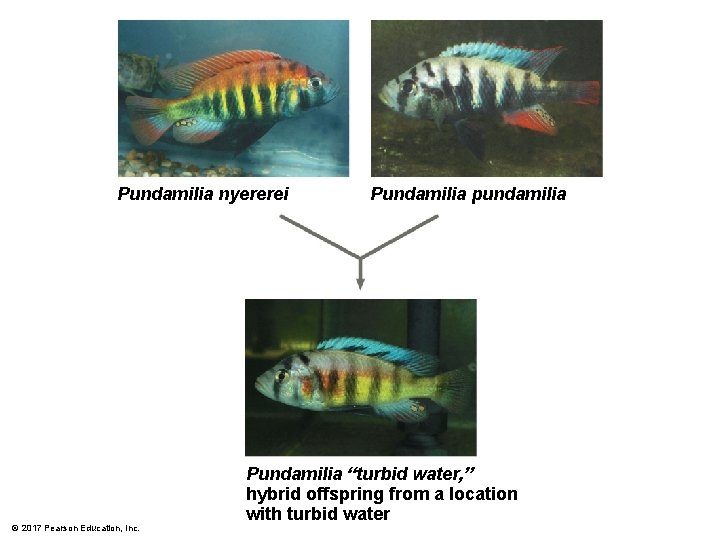
2. Fusion: Weakening Reproductive Barriers § If hybrids are as fit as parents, there can be substantial gene flow between species § If gene flow is great enough, reproductive barriers weaken and the parent species can fuse into a single species § For example, pollution in Lake Victoria has reduced the ability of female cichlids to distinguish males of different species from males of their own species © 2017 Pearson Education, Inc.
Pundamilia nyererei © 2017 Pearson Education, Inc. Pundamilia pundamilia Pundamilia “turbid water, ” hybrid offspring from a location with turbid water
3. Stability: Continued Formation of Hybrid Individuals § Extensive gene flow from outside the hybrid zone can overwhelm selection for increased reproductive isolation inside the hybrid zone § For example, parent species of Bombina routinely migrate into the narrow hybrid zone, resulting in ongoing hybridization © 2017 Pearson Education, Inc.
Concept 24. 4: Speciation can occur rapidly or slowly and can result from changes in few or many genes § Many questions remain concerning how long it takes for new species to form and how many genes need to differ between species § The rate of speciation can be studied using the fossil record, morphological data, or molecular data © 2017 Pearson Education, Inc.
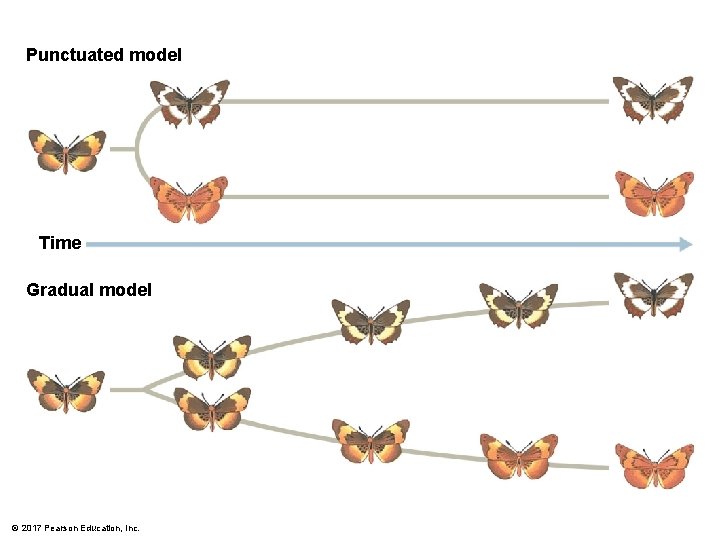
Patterns in the Fossil Record § The fossil record includes examples of species that appear suddenly, persist unchanged for some time, and then disappear § Punctuated equilibria describes these periods of apparent stasis punctuated by sudden change § The punctuated equilibrium model contrasts with a model of gradual change in a species over time © 2017 Pearson Education, Inc.
Punctuated model Time Gradual model © 2017 Pearson Education, Inc.
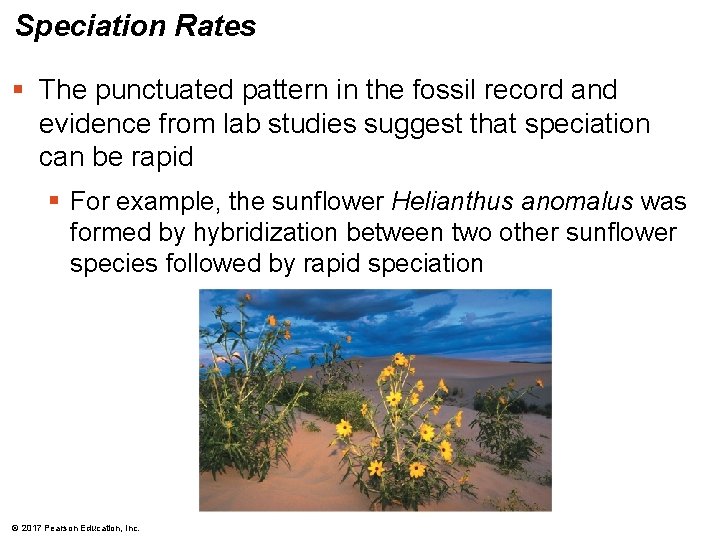
Speciation Rates § The punctuated pattern in the fossil record and evidence from lab studies suggest that speciation can be rapid § For example, the sunflower Helianthus anomalus was formed by hybridization between two other sunflower species followed by rapid speciation © 2017 Pearson Education, Inc.
§ The interval between speciation events can range from 4, 000 years (some cichlids) to 40 million years (some beetles), with an average of 6. 5 million years © 2017 Pearson Education, Inc.
Studying the Genetics of Speciation § A fundamental question of evolutionary biology persists: How many genes influence the formation of new species? § Depending on the species in question, speciation might require change in a single gene or many genes § For example, in Japanese Euhadra snails, the direction of shell spiral affects mating and is controlled by a single gene © 2017 Pearson Education, Inc.
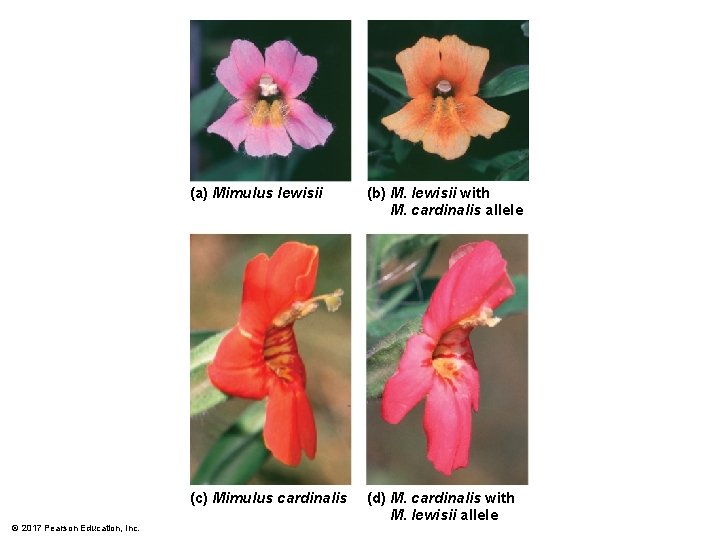
Studying the Genetics of Speciation § In monkey flowers (Mimulus), at least two loci affect flower color, which influences pollinator preference § Pollination that is dominated by either hummingbirds or bees can lead to reproductive isolation of the flowers § In other organisms, speciation can be influenced by larger numbers of genes and gene interactions © 2017 Pearson Education, Inc.
© 2017 Pearson Education, Inc. (a) Mimulus lewisii (b) M. lewisii with M. cardinalis allele (c) Mimulus cardinalis (d) M. cardinalis with M. lewisii allele
From Speciation to Macroevolution § Macroevolution is the cumulative effect of many speciation and extinction events © 2017 Pearson Education, Inc.