Presentation Plus Human Heritage A World History Copyright


- Slides: 87
Presentation Plus! Human Heritage: A World History Copyright © by The Mc. Graw-Hill Companies, Inc. Developed by FSCreations, Inc. , Cincinnati, Ohio 45202 Send all inquiries to: GLENCOE DIVISION Glencoe/Mc. Graw-Hill 8787 Orion Place Columbus, Ohio 43240 1
2
CHAPTER FOCUS SECTION 1 An Uneasy Peace SECTION 2 Communist Power SECTION 3 Developing Nations CHAPTER SUMMARY & STUDY GUIDE CHAPTER ASSESSMENT 3 Click a hyperlink to go to the corresponding section. Press the ESC key at any time to exit the presentation.
Overview • Chapter 38 discusses the cold war (1945– 1989) and its effect on world affairs. – Section 1 traces the growth of tensions between the United States and Soviet Union. – Section 2 describes changes in communism as practiced by the Soviet Union and China. – Section 3 summarizes the history of developing nations after World War II. 4 Click the mouse button or press the Space Bar to display the information.
Objectives After studying this chapter, you will be able to: • describe reasons for the cold war and cite examples of cold war crises. • discuss political and economic changes in the Soviet Union and China, especially in the 1980 s. • examine how developing nations in Africa, South Asia, and Latin America have struggled for political and economic independence. 5 Click the mouse button or press the Space Bar to display the information.
Read to Discover • How relationships between Western and Communist powers have changed since World War II • What changes have occurred in the Soviet Union • What life has been like in the People’s Republic of China • How countries in Africa, South Asia, and Latin America have struggled with political and economic problems 6 Click the mouse button or press the Space Bar to display the information. The Chapter Focus is on page 625 of your textbook.
Terms to Learn • cold war • satellite nations • glasnost • perestroika People to Know • Fidel Castro • Ho Chi Minh • Mao Zedong Places to Locate • Berlin • Tiananmen Square 7 Click the mouse button or press the Space Bar to display the information. Click the Speaker On button to listen to the words.
Why It’s Important Soon after World War II ended, a split occurred between the Soviet Union and other Allied Powers. At issue was the Soviet threat to spread communism beyond its borders. Gradually, a cold war, or state of hostility without fighting, developed. Tensions were so high that people feared the outbreak of the world’s first all-out nuclear war. 8 Click the Speaker On button to replay audio.
9
An Uneasy Peace • After World War II, Europe began its recovery, but tension between the United States and the Soviet Union grew over problems in Berlin, Korea, Cuba, and Vietnam. 10 Section 1 begins on page 625 of your textbook.
Western Europe • When World War II was ended, most of Western Europe was in ruins. • To help rebuild Western Europe, the United States started a loan program in 1948 named the Marshall Plan. • In 1957, six Western European nations– Belgium, France, Italy, Luxembourg, the Netherlands, and West Germany–formed an economic union called the European Common Market. 11 Click the mouse button or press the Space Bar to display the information.
The Start of the Cold War • Toward the end of World War II, the Soviet Union set up Communist governments in Bulgaria, Czechoslovakia, Hungary, Poland, and Romania. • By 1948, these countries were Soviet satellite nations, or countries controlled by a stronger neighboring country. • When Stalin, the Soviet leader, broke his promise that he would allow free elections in the Allied countries, the cold war began. 12 Click the mouse button or press the Space Bar to display the information.
Berlin • The first cold war crisis took place over Berlin when Great Britain, France, and the United States united their zones of Germany to encourage peace. • The Soviet Union disagreed and blockaded, or closed off, all land water traffic into Berlin. • In response, the United States and Great Britain began an airlift, or a system of carrying supplies by airplane into Berlin. 13 Click the mouse button or press the Space Bar to display the information.
Berlin (cont. ) • In May 1949, the Soviets lifted their blockade of Berlin and two separate governments were set up–democratic for West Germany, and Communist for East Germany. • In 1949, the United States joined with 11 other countries to form the North Atlantic Treaty Organization (NATO). • The Soviet Union and its satellites formed an organization called the Warsaw Pact. • The East German government built the Berlin Wall between East and West Berlin to stop East Germans from fleeing. 14 Click the mouse button or press the Space Bar to display the information.
Korea • After World War II, Korea was also geographically divided. • A Communist government was set up in North Korea and a non-Communist government was organized in South Korea. • In 1950 North Korea invaded South Korea. • In 1953, North Korea and South Korea signed a truce calling for the two countries and their governments to remain separate. 15 Click the mouse button or press the Space Bar to display the information.
Cuba • In 1959, Fidel Castro launched a successful revolution in Cuba against dictator Fulgencio Batista. • Castro made many promises to the Cubans, most of which were not kept. • Castro announced that his government would be Communist. • In 1961 Cuban refugees who had been trained in the United States invaded Cuba to force Castro out of power. • The invasion, in the Bay of Pigs, failed. 16 Click the mouse button or press the Space Bar to display the information.
Vietnam • In 1941, Vietnam was a French colony and part of a larger region known as French Indochina. • The Vietnamese were invaded by the French. • In 1954 the French were defeated and the country was temporarily divided into two parts–North and South Vietnam. • North Vietnam became a Communist country headed by Ho Chi Minh. • South Vietnam became a non-Communist country. 17 Click the mouse button or press the Space Bar to display the information.
Vietnam (cont. ) • A war for the control of the country erupted between South Vietnam and North Vietnam. • Guerrillas, known as the Vietcong, and the Soviet Union aided North Vietnam. • The United States sent combat troops to South Vietnam. More than 3. 3 million Americans fought in the Vietnam War with 58, 000 losing their lives, and almost $200 billion being spent. • The Vietnam War deeply divided the American people. 18 Click the mouse button or press the Space Bar to display the information.
The Space Race • Part of the cold war between the Soviet Union and the United States involved the race to explore space. • In 1957, the Soviets launched Sputnik I, the first spacecraft to circle the earth. • Four years later, Soviet astronaut Yuri Gagarin became the first human to circle the earth. • In 1969, American astronaut Neil Armstrong became the first person to walk on the moon. 19 Click the mouse button or press the Space Bar to display the information.
Section Assessment Why did Western European nations form the European Common Market? to establish an economic union 20 Click the mouse button or press the Space Bar to display the answer.
Section Assessment (cont. ) Why did East Germany build the Berlin Wall? The Berlin Wall was built to stop escapes into Western Europe. 21 Click the mouse button or press the Space Bar to display the answer.
Section Assessment (cont. ) Why did Castro have the support of the United States during his revolution? Why did he lose that support? He gained support from the United States because he promised reforms. He lost their support because Cuba became a Communist country. 22 Click the mouse button or press the Space Bar to display the answer.
Section Assessment (cont. ) Demonstrating Reasoned Judgment If you were living during the Vietnam War, would you have supported or opposed the war? Why? Answers will vary. 23 Click the mouse button or press the Space Bar to display the answer.
Section Assessment (cont. ) Draw a diagram like the one in your textbook on page 629, and use it to summarize the issues in the following cold war crises: Soviet blockade of Berlin, construction of the Berlin Wall, Korean War, Cuban Revolution, Vietnamese civil war, launch of Sputnik I. Answers will vary. 24 Click the mouse button or press the Space Bar to display the answer.
25
Communist Powers • After World War II, China became a Communist nation. • Later, however, both China and the Soviet Union made changes in the kind of communism they practiced. 26 Click the mouse button or press the Space Bar to display the information. Section 2 begins on page 631 of your textbook.
Revolution in China • The conditions that led to China's acceptance of communism developed over a long time. • In 1911 a revolt led by Sun Yat-sen overturned the government and formed the Nationalist party. • After Sun died in 1925, Chiang Kai-shek became the leader of the Nationalist party. • In 1927, the Chinese Communists attempted to gain control under the leader Mao Zedong. 27 Click the mouse button or press the Space Bar to display the information. Section 2 begins on page 631 of your textbook.
Revolution in China (cont. ) • On the island of Taiwan, Chiang set up a Nationalist government claiming it ruled China. • The Communists set up their own government on mainland China headed by Mao Zedong and called it the People's Republic of China. 28 Click the mouse button or press the Space Bar to display the information.
China Under Mao • Mao's main goal in 1953 was to make China a strong, modern country, using a series of plans to improve the country's economy. • Mao began to fear the Chinese had lost their revolutionary spirit, and in 1966, he carried out purges, or removals of undesirable members, of the Communist party and of the country's intellectuals, or scholars. 29 Click the mouse button or press the Space Bar to display the information.
China After Mao • After Mao died in 1976, Deng Xiaoping came into power in China. • Economic conditions improved, but political conditions remained the same with many unhappy people who wanted the same control over politics that they had over the economy. • In April of 1989, a peaceful demonstration took place in Tiananmen Square in Beijing in which one million Chinese people, mostly students, gathered and demanded democracy. 30 Click the mouse button or press the Space Bar to display the information.
Changes in the Soviet Union • Two groups of Communists existed in the Soviet Union after Stalin's rule–hard-liners, or people who stick to the rules regardless of the circumstances, and reformers. • Under reformer Mikhail Gorbachev’s policy of glasnost, or openness, the Soviet people could say and write what they thought without fear of being punished, and free elections were held. • Under the policy of perestroika, which means restructuring, Gorbachev changed the structure of the Soviet government and moved the economy toward capitalism. 31 Click the mouse button or press the Space Bar to display the information.
Section Assessment What was Mao Zedong’s main goal for China? His main goal was to rebuild China, making it modern. 32 Click the mouse button or press the Space Bar to display the answer.
Section Assessment (cont. ) Why did some people oppose the ideas of glasnost and perestroika? Some people thought Gorbachev was moving too quickly. 33 Click the mouse button or press the Space Bar to display the answer.
Section Assessment (cont. ) Predicting Consequences Based on recent changes, do you think China will become a democracy or remain under strict Communist control? Explain. Answers will vary. 34 Click the mouse button or press the Space Bar to display the answer.
Section Assessment (cont. ) Draw a diagram like the on page 633 of your textbook, and use it to compare the People’s Republic of China under Mao Zedong and Deng Xiaoping. Deng initiated economic reform. Both Deng and Mao exercised strict control of government under the Communist Party and use of the Red Army to suppress protests. 35 Click the mouse button or press the Space Bar to display the answer.
36
Developing Nations • Most of the countries in South Asia and Africa gained their independence after World War II, and the majority of countries in Latin America gained independence in the early 1800 s. • All of these countries are considered to be developing nations. 37 Click the mouse button or press the Space Bar to display the information. Section 3 begins on page 634 of your textbook.
India's Independence • India, originally under British rule, was one of the first colonial countries of Asia in which nationalism grew. • An Indian leader and lawyer named Mohandas Gandhi began a protest movement against British rule. • In 1947, Great Britain finally granted independence to its Indian colony, and it formed two countries. • During the partition, or dividing, of India, fighting broke out between Hindus and Muslims. 38 Click the mouse button or press the Space Bar to display the information.
India Since 1947 • After independence, India's leaders worked to set up a stable government and adopted a democratic constitution. • Under prime ministers Jawaharlal Nehru and Indira Gandhi democracy advanced. • The Indian government has worked to improve people's living conditions, encouraging industries. • About 70 percent of the Indian people, however, still make their living by farming. 39 Click the mouse button or press the Space Bar to display the information.
Malaysia • Malaysia is another developing Asian country that has gone through revolution and successfully built a cooperative government since World War II. • Muslims, Christians, Buddhists, and Hindus live together, giving Malaysia its cultural richness. • The three major ethnic groups of the country–Malays, Chinese, and Indians– cooperatively share power and resources. 40 Click the mouse button or press the Space Bar to display the information.
Independence in Africa • World War II helped African nationalism grow as many Africans served in the armies and returned to Africa wanting self-rule. • In 1960, called the “Year of Africa, ” 17 African countries became independent. • Today, most have one-party governments or are ruled by a military leader. • Many African countries–including Angola, Ethiopia, Mozambique, Nigeria, Rwanda, Somalia, Sudan, Zaire, and Zimbabwe have suffered from civil war since they became independent. 41 Click the mouse button or press the Space Bar to display the information.
Farming • About 70 percent of all African workers make their living from farming. • In the past, most farmers were subsistence farmers; they produced only enough food for their families. • Today much of the land is used to grow cash crops, or crops that are sold in regional or world markets. 42 Click the mouse button or press the Space Bar to display the information.
Farming (cont. ) • Large parts of Africa, however, are rich in energy resources of coal, natural gas, oil, and hydroelectric power. • The continent also has large mineral deposits, such as copper, tin, iron, manganese, gold, and diamonds. 43 Click the mouse button or press the Space Bar to display the information.
Ways of Life • Life has been changing in Africa since the 1960 s. • Most people still live in rural villages, belonging to extended families, made up of parents, children, and other close relatives who live together in one house. • In recent years, many Africans have left their home villages and moved to the cities in search of jobs and better housing and education. 44 Click the mouse button or press the Space Bar to display the information.
Foreign Influence in Latin America • Even after gaining independence, most Latin American countries remained under foreign control as Great Britain, France, Germany, and the United States organized businesses there. • Latin American nationalists, who wanted their countries to be free of outside influence, resented foreigners. 45 Click the mouse button or press the Space Bar to display the information.
Domestic Changes in Latin America • Since World War II, most Latin American countries have been trying to industrialize and have greatly increased their production of such goods as steel, chemicals, oil, and automobiles. • The Latin American economy depends on farming. • Peasants in several Latin American countries have started revolutions for land reform and have been opposed by the governments and wealthy landowners. 46 Click the mouse button or press the Space Bar to display the information.
Section Assessment How did Gahndi show his resistance to British rule? Gahndi showed his resistance through civil disobedience. 47 Click the mouse button or press the Space Bar to display the answer.
Section Assessment (cont. ) Why is 1960 called the “Year of Africa”? because many African nations became independent in that year 48 Click the mouse button or press the Space Bar to display the answer.
Section Assessment (cont. ) How does the hacienda system hold back economic progress in Latin America? Farm production might rise if campesinos owned their own land. 49 Click the mouse button or press the Space Bar to display the answer.
Section Assessment (cont. ) Drawing Conclusions How do you think civil wars have affected African nations in recent years? Civil wars empowered some African nations to develop their economies and governments. 50 Click the mouse button or press the Space Bar to display the answer.
Section Assessment (cont. ) Draw a diagram like the on page 642 of your textbook, and use it to show supporting details for this generalization: World War II helped spark the independence movement in Africa. Answers will vary. 51 Click the mouse button or press the Space Bar to display the answer.
52
Chapter Summary & Study Guide • After World War II ended, a cold war developed between the United States and the Soviet Union, with the first crisis taking place during the 1948 blockade of Berlin. • The cold war turned hot when North Korean soldiers invaded South Korea, and U. N. troops led by the United States intervened in the conflict. • The 1959 Cuban Revolution led by Fidel Castro brought a communist government to Cuba. 53 Click the mouse button or press the Space Bar to display the information.
Chapter Summary & Study Guide (cont. ) • Vietnam was the site of a war between the North Vietnamese and South Vietnamese that lasted until 1975. • Led by Mao Zedong, the Communists defeated Chinese Nationalists in 1949 and formed the People’s Republic of China. • Although Deng Xiaoping relaxed some of China’s economic policies, he limited political freedoms. 54 Click the mouse button or press the Space Bar to display the information.
Chapter Summary & Study Guide (cont. ) • Under Mikhail Gorbachev, the policies of glasnost and perestroika moved the Soviet Union toward capitalism and greater freedom. • Most of the developing nations of South Asia, Africa, and Latin America have struggled with their lack of industry and their dependence on cash crops. • Since independence, Indian leaders have tried to set up a stable government and improve living conditions for the poor. 55 Click the mouse button or press the Space Bar to display the information.
Chapter Summary & Study Guide (cont. ) • The nationalism triggered by World War II led African nations to seek independence. However, imperialism left these nations with numerous problems. 56
57
Understanding the Main Idea How did the United States propose to rebuild Western Europe following World War II? through the Marshall Plan 58 Click the mouse button or press the Space Bar to display the answer.
Understanding the Main Idea Why did the Soviet Union blockade Berlin in 1948? to try and force Western powers to leave the city 59 Click the mouse button or press the Space Bar to display the answer.
Understanding the Main Idea What changes did Castro make once he came to power in Cuba? Cubans who opposed him were jailed or executed. Castro announced his government would be communist. 60 Click the mouse button or press the Space Bar to display the answer.
Understanding the Main Idea Why did Mao Zedong order the Cultural Revolution? He began to worry that the Chinese people were losing their revolutionary spirit. 61 Click the mouse button or press the Space Bar to display the answer.
Understanding the Main Idea What were the demonstrators at Tiananmen Square demanding? democracy 62 Click the mouse button or press the Space Bar to display the answer.
Understanding the Main Idea What problems do most African nations face today? how to produce enough food, utilize natural resources, educate people, stop warring clans 63 Click the mouse button or press the Space Bar to display the answer.
Critical Thinking Why do you think Chinese leaders restricted political freedom? Explain your reasoning. They were afraid to give the people too much power. 64 Click the mouse button or press the Space Bar to display the answer.
Critical Thinking What do you think might have happened if the Soviet Union had not introduced the policies of glasnost and perestroika? They may have experienced slower economic growth and delayed independence. 65 Click the mouse button or press the Space Bar to display the answer.
Critical Thinking If you were the leader of a developing Latin American country, what actions would you take to industrialize your country? Answers will vary, but may include better use of resources and modernization. 66 Click the mouse button or press the Space Bar to display the answer.
Geography in History Human/Environmental Interaction Refer to the map tracing African independence on page 637 of your textbook. Note the locations of countries that gained their independence before 1945. Why might you expect revolutions for freedom to develop in coastal countries? Coastal areas are more accessible to outside influences and new ideas. 67 Click the mouse button or press the Space Bar to display the answer.
Choose one of the following countries and explain why it is considered a developing country: India, Brazil, Zimbabwe. 68
69
Explore online information about the topics introduced in this chapter. Click on the Connect button to launch your browser and go to the Human Heritage: A World History Web site. At this site, you will find interactive activities, current events information, and Web sites correlated with the chapters and units in the textbook. When you finish exploring, exit the browser program to return to this presentation. If you experience difficulty connecting to the Web site, manually launch your Web browser and go to http: //www. humanheritage. glencoe. com 70
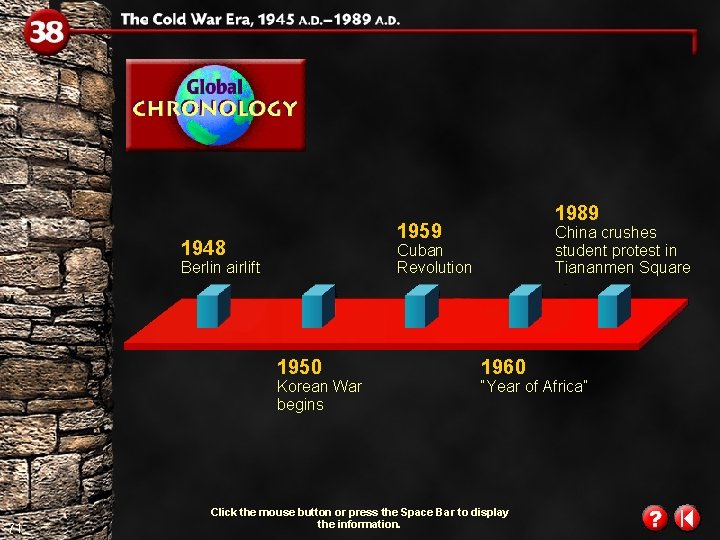
1959 1948 China crushes student protest in Tiananmen Square Cuban Revolution Berlin airlift 1950 Korean War begins 71 1989 1960 “Year of Africa” Click the mouse button or press the Space Bar to display the information.
Mohandas Gandhi 1869 -1948 Indian Leader Trained as a lawyer, Gandhi practiced law in South Africa where he opposed prejudice against black South Africans. When he returned to India in 1915, he gave up his law practice for a more spiritual life. Using nonviolent resistance, Gandhi led the fight for the independence of India, opposed the caste system, and called for acceptance of all religions. 72
The Iron Curtain In a speech at Fulton, Missouri, in 1946, former British Prime Minister Winston Churchill declared: “From Stettin in the Baltic to Triest in the Adriatic an iron curtain has descended across the continent of Europe. ” Thereafter people used the term iron curtain to refer to the invisible barrier that split Europe into democratic Western Europe and Soviet-dominated Eastern Europe. 73
NATO Growth Although the Warsaw pact ended in 1991, NATO continues to grow. In the late 1990 s, NATO members voted to invite several former soviet satellites– the Czech Republic, Hungary, and Poland–to join the organization. In addition, Russia and other members of the former Soviet Union, which dissolved in 1991, were accepted as partner nations. 74
Meaningful Names Once they won freedom, many African nations took new names with deep historical meaning. Zimbabwe, for example, refers to the 1, 000 -year-old city of Great Zimbabwe. Massive, protective stone walls gave the city its name, which means “stone enclosure. ” 75
Taiwan Tibet 76 Click a hyperlink to go to the corresponding section. Press the ESC key at any time to exit the presentation.
Taiwan was named Formosa, meaning “beautiful, ” by Portuguese explorers. In the 1600 s, the island was controlled by the Dutch and then the Spanish. Still later it was acquired by China, then Japan, then China again. China, which regards Taiwan as a province, has strongly resisted Taiwanese moves toward independence. 77
Tibet Human rights are an issue in Tibet, seized by China in 1951. Eight years later, Tibetans waged an unsuccessful rebellion against Chinese control. Since then, the Dalai Lama, the religious leader of Tibet, has led a worldwide movement in support of Tibetan rights from his home in India. In 1989, the Dalai Lama received the Nobel Peace Prize. 78
Using an Electronic Spreadsheet • People use electronic spreadsheets to manage numbers quickly and easily. • You can use a spreadsheet any time a problem involves numbers that you can arrange in rows and columns. • A spreadsheet is an electronic worksheet. • All spreadsheets follow a basic design of rows and columns. Continued on next slide. 79 Click the mouse button or press the Space Bar to display the information.
Using an Electronic Spreadsheet • Each column (vertical) is assigned a letter or a number. • Each row (horizontal) is assigned a number. • Each point where a column and row intersect is called a cell. Continued on next slide. 80 Click the mouse button or press the Space Bar to display the information.
Using an Electronic Spreadsheet • The cell’s position on the spreadsheet is labeled according to its corresponding column and row–Column A, Row 1 (A 1); Column B, Row 2 (B 2), etc. • Spreadsheets use standard formulas to calculate the numbers. • You create a mathematical equation that uses these standard formulas, and the computer does the calculations for you. Continued on next slide. 81 Click the mouse button or press the Space Bar to display the information.
Using an Electronic Spreadsheet Suppose you want to compare the number of births in the three most highly populated nations–China, India, and the United States–over the past five years. Use the steps on the following slides to create a spreadsheet that will provide this information. Continued on next slide. 82
Using an Electronic Spreadsheet 1. In cells B 1, C 1, and D 1 respectively, type the name of each of the three countries listed on the previous slide. In cell E 1, type the term total. 2. In cells A 2 -A 6, type each year, starting with the most recent year for which statistics are available. Continued on next slide. 83 Click the mouse button or press the Space Bar to display the information.
Using an Electronic Spreadsheet 3. In row 2, enter the number of births that occurred in each nation for the year listed in A 2. Repeat this process in rows 3 through 6. 4. Create a formula to calculate the number of children born for the first year on the spreadsheet. The formula for the equation tells what cells (2 B+2 C+2 D) to add together. Continued on next slide. 84 Click the mouse button or press the Space Bar to display the information.
Using an Electronic Spreadsheet 5. Copy the formula down in the cells for the other four years. 6. Use the process in steps 4 and 5 to create and copy a formula to calculate the total births for each of the three countries over a five-year period. 85 Click the mouse button or press the Space Bar to display the information.
End of Custom Shows WARNING! Do Not Remove This slide is intentionally blank and is set to auto-advance to end custom shows and return to the main presentation. 86
87