
World Heritage Concepts issues and challenges Maria GravariBarbas
World Heritage: Concepts, issues and challenges Maria Gravari-Barbas IREST / EIREST Chaire UNESCO Culture, Tourisme, Développement
World Heritage Convention Concerning the Protection of the World Cultural and Natural Heritage Adopted in November 1972 Came into force in December 1975 Currently 191 State Parties
1 Before the convention
Conventions related to Cultural Heritage BEFORE the WH convention • 1954: Convention for the Protection of Cultural Properties in the Event of Armed Conflict • 1970: Convention on the Means of Prohibiting and Preventing the Illicit Import, Export and Transfer of Ownership of Cultural Property • 1972: Convention on the Protection of the World Cultural and Natural Heritage
1954: Convention for the Protection of Cultural Properties in the Event of Armed Conflict The High Contracting Parties, “Being convinced that damage to cultural property belonging to any people whatsoever means damage to the cultural heritage of all mankind , since each people “makes its contribution to the culture of the world”; (…) Through this Convention, Unesco overthrew the idea previously developed for international protection of cultural properties. Thanks to the terms used in this convention, cultural properties must be protected in times of war for their own cultural value. Cultural goods have no commercial value, on the contrary, they are defined by their nature and their role as an element "of the cultural heritage of all mankind”.
The Hague convention represented a double breakthrough. It allowed to consider, for the international community, the existence of cultural property as "an integral part of the cultural heritage of humanity ". It thus offered a real protection for registered cultural property. It announces the evolution of the concept of cultural heritage where conservation depends on the interest of the international community.
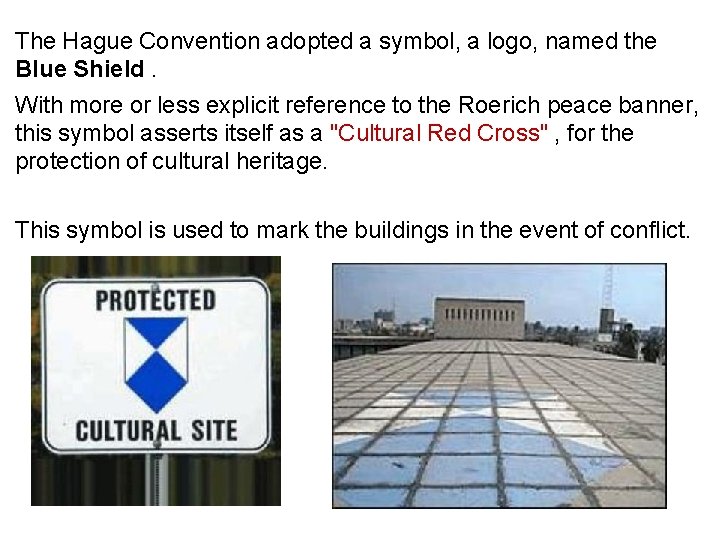
The Hague Convention adopted a symbol, a logo, named the Blue Shield. With more or less explicit reference to the Roerich peace banner, this symbol asserts itself as a "Cultural Red Cross" , for the protection of cultural heritage. This symbol is used to mark the buildings in the event of conflict.
A precursor: The international safeguarding campains The International Campaign to Save the Monuments of Nubia In 1959 the Egyptian and the Sudanese Governments requested UNESCO to assist their countries in the protection and rescue of the endangered monuments and sites. In 1960, the Director-General of UNESCO launched an appeal to the Member States for an International Campaign to Save the Monuments of Nubia.
1960 : Launch of the Nubian campaign in Egypt to move the great Temple of Abu Simbel and avoid its flooding by the Nile during the construction of the Aswan Dam. During this campaign, which lasted 20 years, 22 monuments and architectural elements have been removed.
This appeal resulted in the excavation and recording of hundreds of sites, the recovery of thousands of objects, and the salvage and relocation of a number of important temples to higher ground, the most famous of them the temple complexes of Abu Simbel and Philae. The campaign ended on 10 March 1980 as a complete and spectacular success.
Egypt donated four temples as tokens of its gratitude to countries which especially contributed to the success of the campaign: Debod to Spain, Taffa to the Netherlands, Dendur to the United States and Ellesyia to Italy.
The longest running international safeguarding campaign has been on-going since 1966 when UNESCO decided to launch a campaign to save the city after the disastrous floods of 1965, a task requiring time, a high degree of technical skill and, above all, money. The international synergy that arose from this project was an important source of inspiration to the founding efforts of the Convention.
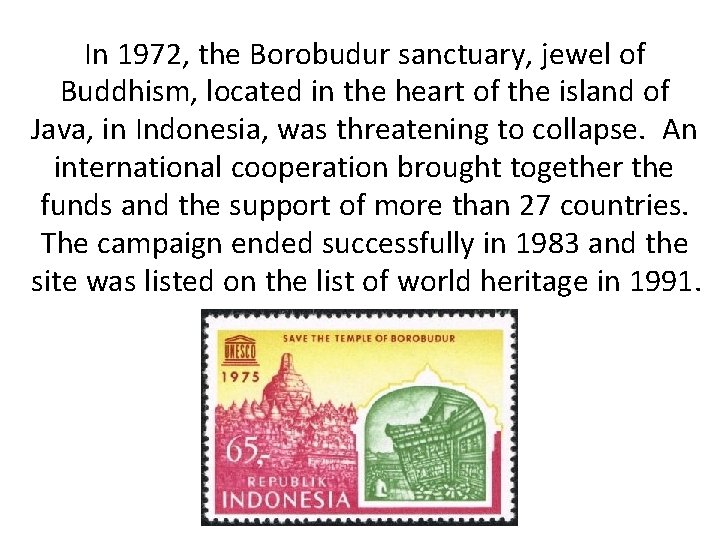
In 1972, the Borobudur sanctuary, jewel of Buddhism, located in the heart of the island of Java, in Indonesia, was threatening to collapse. An international cooperation brought together the funds and the support of more than 27 countries. The campaign ended successfully in 1983 and the site was listed on the list of world heritage in 1991.
From 1966, given the success of international campaigns, the Unesco thought to give a coherent framework to these safeguard actions and "put under an appropriate international regime (. . . ) a limited number of monuments forming part of the cultural heritage of humanity " A draft convention was being prepared at Unesco to protect the world cultural heritage.
2 Go beyond the international campaigns
The international Campaigns were successful but had inherent limits These spectacular actions have slowed down over the years by virtue of the lack of resources. During the 1980 s: 16 international safeguarding campaigns. During the 1990 s: 4 ( Hera t in Afghanistan / Tyr in Lebanon; ) Old bridge of Mostar ; Angkor ) During the 2000 s: 3 (Democratic Republic of the Congo, Ile de Pâques , Bamiyan and the Minaret of Jam in Afghanistan). Nearly 30 properties were saved by Unesco (whose actions have often been identified thanks to these spectacular campaigns).
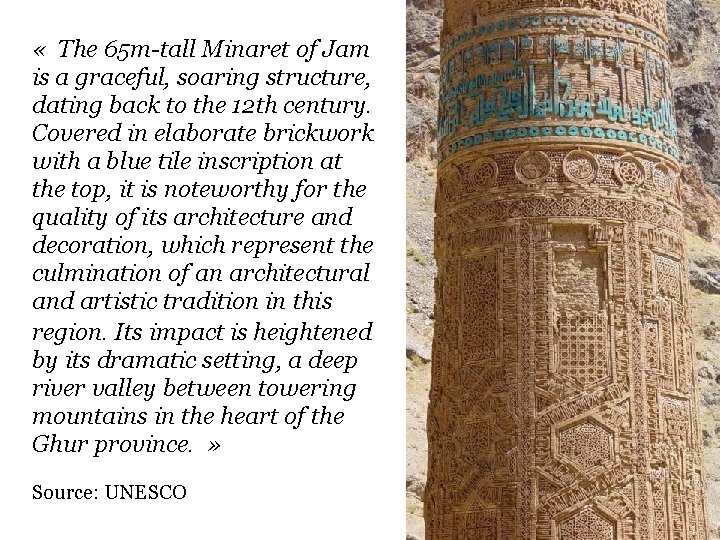
« The 65 m-tall Minaret of Jam is a graceful, soaring structure, dating back to the 12 th century. Covered in elaborate brickwork with a blue tile inscription at the top, it is noteworthy for the quality of its architecture and decoration, which represent the culmination of an architectural and artistic tradition in this region. Its impact is heightened by its dramatic setting, a deep river valley between towering mountains in the heart of the Ghur province. » Source: UNESCO
3 The World Heritage Convention
The limits of the international campaigns Lack of resources: In the 1950 s, Unesco monopolized its efforts in implementing important safeguard campaigns. Need to be supported by international experts. With regard to the museums, such a body existed, it was of ICCROM. Unesco should encourage the creation of a partner with the technical skills to bring out this concept of world heritage: Icomos was thus born in 1965. (Such an organization existed for natural areas because the IUCN was founded in 1948, under the impetus of the first Director General of Unesco, Julian Huxley).
The convention establishes a "World Heritage list" of properties that the World Heritage Committee considers as being properties having "outstanding universal value", according to established criteria: “ parts of the cultural and natural heritage are of outstanding interest and therefore need to be preserved as part of the world heritage of mankind as a whole. ”
Article 6, point 1 1. Whilst fully respecting the sovereignty of the States on whose territory the cultural and natural heritage (…) is situated, and without prejudice to property right provided by national legislation, the States Parties to this Convention recognize that such heritage constitutes a world heritage for whose protection it is the duty of the international community as a whole to co-operate.
The convention addresses both the cultural and natural heritage. (However, although associated in the same text, the dichotomy between nature and culture, between cultural properties inscription and inscription of natural properties, still remains).
The concept of « World Heritage » The idea is to protect a heritage of such value that its disappearance would affect the whole humanity. Both in a unitary conception of Heritage (the most exceptional works which witness of the human or natural geniouses) ( Unicum : élément intéressant parce que unique ou rare) …. and a plural conception Cultural diversity is a heritage to be protected. This is closer to an exemplary conception of world heritage, which should reflect all types of culture in their most outstanding dimension) ( Typicum : élément représentatif d’une série)
The Outstanding Universal Value To be included on the World Heritage list, sites must have an Outstanding Universal Value (OUV) and meet at least one of the ten criteria of selection. “The Guidelines for the implementation of the World Heritage Convention" define the criteria for the OUV. .
“The definition of ‘universal’ in the phrase ‘outstanding universal value’ requires comment. Some properties may not be recognized by all people, everywhere, to be of great importance and significance. Opinions may vary from one culture or period to another. As far as cultural property is concerned, the term ‘universal’ must be interpreted as referring to a property which is highly representative of the culture of which it forms part. ” (Draft version of the Operational Guidelines. In the first session of the Committee in 1977 dated October 1977 the Guidelines do not specifically define OUV)
The OUV definition according to the 2005 OG The “outstanding universal value” is defined in paragraphs 49 and 78 : 49. Outstanding universal value means cultural and/or natural significance which is so exceptional as to transcend national boundaries and to be of common importance for present and future generations of all humanity. As such, the permanent protection of this heritage is of the highest importance to the international community as a whole. The Committee defines the criteria for the inscription of properties on the World Heritage List. 78. To be deemed of outstanding universal value, a property must also meet the conditions of integrity and/or authenticity and must have an adequate protection and management system to ensure its safeguarding.
In order to meet the requirement of OUV, a property must meet at least one of the criteria, the conditions of authenticity and integrity, as well as the requirement of protection and management. In the previous versions of the OG, protection and management were certainly a requirement for listing, but not considered as part of OUV. As a result, from an independent qualification, OUV has become an administrative requirement.
Evolving approaches of the list The first twelve sites inscribed in 1978 constitute a world heritage representing "the best of the best" (Christina Cameron). During the first years of the Convention, there is a trend to register the most famous sites: *The Guizèh pyramids in Egypt, one of the 7 marvels of the antiquity *The Katmandu valley at Nepal , ancient crossroad of the Asiatic civilizations; *The historic center of Rome in Italy, center of the Roman Empire and then of the Christian World; *the Médina of Fès at Morocco, ancient capital of the Morocco Kingdom; *the Grand Canyon in the United States , one of the most spectacular at the world… This approach privileged the exceptional at the expense of the universal.
Strategic objectives, Orientations, and Operation guidelines In order to facilitate the implementation of the Convention, the Committee develops Strategic Objectives and Operation Guidelines. The Operational Guidelines for the Implementation of the World Heritage Convention aim to facilitate the implementation of the Convention concerning the Protection of the World Cultural and Natural Heritage
4 The criteria of inscription
Criteria and the text of the Convention are the primary tools of WH Criteria are regularly revised by the Committee of the WH to follow the evolution of the concept of World heritage.
Selection criteria (i) to; (ii) to exhibit an important interchange of human values , over a span of time or within a cultural area of the world, on developments in architecture or technology, monumental arts, town-planning or landscape design; (iii) to bear a unique or at least exceptional testimony to a cultural tradition or to a civilization which is living or which has disappeared; (iv) to be an outstanding example of a type of building, architectural or technological ensemble or landscape which illustrates (a) significant stage(s) in human history; (v) to be an outstanding example of a traditional human settlement, land-use, or seause which is representative of a culture (or cultures), or human interaction with the environment especially when it has become vulnerable under the impact of irreversible change; (vi) to be directly or tangibly associated with events or living traditions, with ideas, or with beliefs, with artistic and literary works of outstanding universal significance. (The Committee considers that this criterion should preferably be used in conjunction with other criteria);
(vii) to contain superlative natural phenomena or areas of exceptional natural beauty and aesthetic importance ; (viii) to be outstanding examples representing major stages of earth's history, including the record of life, significant on-going geological processes in the development of landforms, or significant geomorphic or physiographic features; (ix) to be outstanding examples representing significant on-going ecological and biological processes in the evolution and development of terrestrial, fresh water, coastal and marine ecosystems and communities of plants and animals; (x) to contain the most important and significant natural habitats for insitu conservation of biological diversity , including those containing threatened species of outstanding universal value from the point of view of science or conservation.
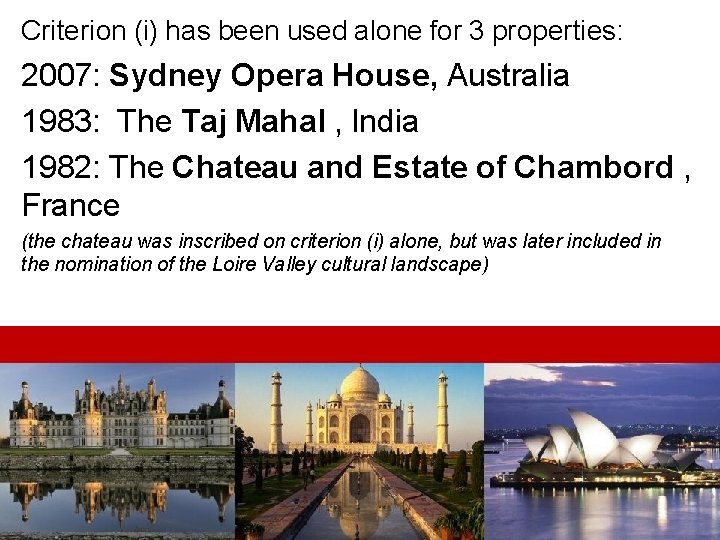
Criterion (i) has been used alone for 3 properties: 2007: Sydney Opera House, Australia 1983: The Taj Mahal , India 1982: The Chateau and Estate of Chambord , France (the chateau was inscribed on criterion (i) alone, but was later included in the nomination of the Loire Valley cultural landscape)
Criterion (vi) 1997: “Be directly or tangibly associated with events or living traditions, with ideas, or with beliefs, with artistic and literary works of outstanding universal significance (the Committee considered that this criterion should justify inclusion in the List only in exceptional circumstances and in conjunction with other criteria cultural or natural ). ” • 2005: “Be directly or tangibly associated with events or living traditions, with ideas, or with beliefs, with artistic and literary works of outstanding universal significance (The Committee considers that this criterion should preferably be used in conjunction with other criteria). ”
Criterion (vi) used alone 1978 L’Anse aux Meadows National Historic Park, Canada 1978 Island of Gorée, Senegal 1979 Auschwitz Birkenau; German Nazi Concentration, Poland 1979 Forts and Castles, Volta Greater Accra, Ghana 1979 Independence Hall, Philadelphia, USA 1981 Head-Smashed-In Buffalo Jump, Canada 1983 Rila Monastery, Bulgaria 1983 La Fortaleza and San Juan, Puerto Rico, USA 1996 Hiroshima Peace Memorial (Genbaku Dome), Japan 2005 Old Bridge Area of the Old City of Mostar, Bosnia/Herz. 2006 Aapravasi Ghat, Mauritius
Criterion (vi) can be seen as the link between the World Heritage Convention and the 2003 Convention for the Safeguarding of the Intangible Cultural Heritage. Source : Jukka Jokilehto, What is OUV? Defining the Outstanding Universal Value of Cultural World Heritage Properties, ICOMOS, 2008
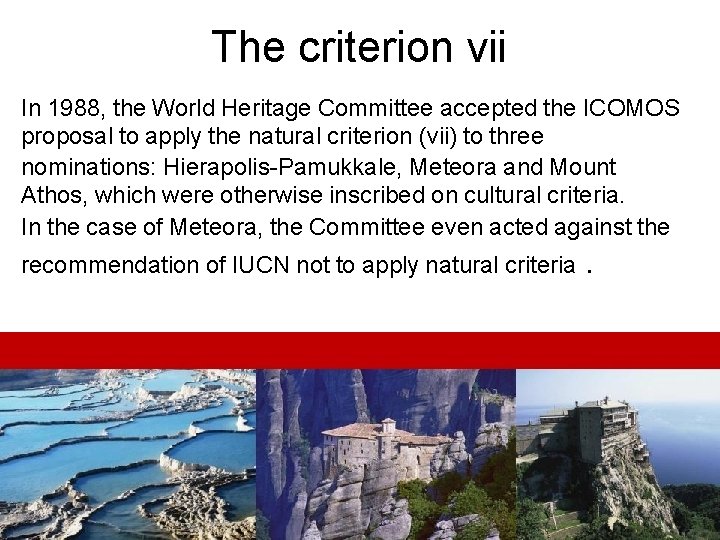
The criterion vii In 1988, the World Heritage Committee accepted the ICOMOS proposal to apply the natural criterion (vii) to three nominations: Hierapolis-Pamukkale, Meteora and Mount Athos, which were otherwise inscribed on cultural criteria. In the case of Meteora, the Committee even acted against the recommendation of IUCN not to apply natural criteria .
5 The WH Committee
The convention: A cultural and political success Adopted in November 1972 Came into force in December 1975 Signed by: 24 countries in 1976 49 in 1980 104 in 1990 150 in 2000 180 in 2005 187 in 2010 191 in 2015
The World Heritage Committee 15, then 21 membres. In 2015 : Algérie , Allemagne , Colombie , Croatie , Finlande , Inde , Jamaïque , Jap Kazakhstan , Liban , Malaisie , Pérou , Philippines , Pol and, Portugal , Qa Republic of Korea , Sénégal , Serbie , Turkey , Viet Nam Since 2017: Angola , Azerbaijan , Burkina Faso , Croatia , Cuba , Finland , Indonesia , Jamaica , Kazakhstan , Kuwait banon , Peru , Philippines , Poland , Portugal , Republic of Korea , Tunisia , Turkey , United Republic of Tanzania , Viet Nam , Zimbabwe
According to the World Heritage Convention, the mandate of a member of the Committee is for a period of six years , but most States parties voluntarily choose to be a member of the Committee for a period of four years , in order to give other States parties an opportunity to be part of the Committee.
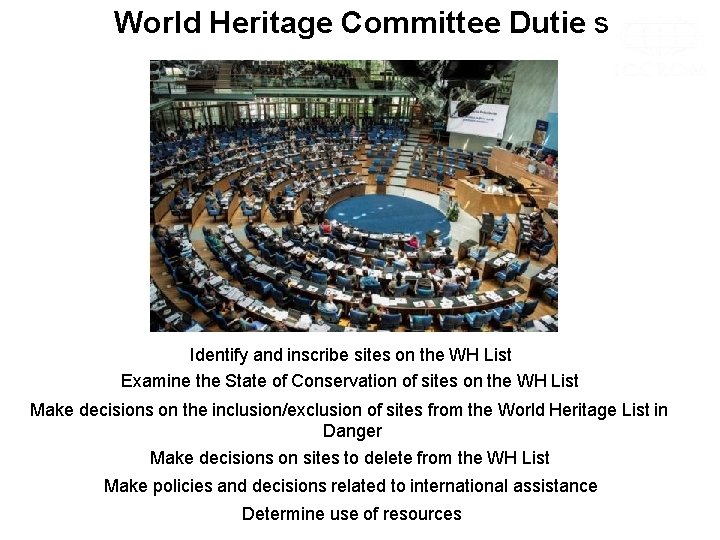
World Heritage Committee Dutie s Identify and inscribe sites on the WH List Examine the State of Conservation of sites on the WH List Make decisions on the inclusion/exclusion of sites from the World Heritage List in Danger Make decisions on sites to delete from the WH List Make policies and decisions related to international assistance Determine use of resources
The Advisory Bodies Advise on implementation of the Convention Assist in preparing documentation for Committee meetings Assist with development and implementation of the Global Strategy, Global Training Strategy, Periodic Reporting, and other activities Monitor State of Conservation of sites Evaluate International Assistance requests Evaluate properties nominated for the WH List (IUCN and ICOMOS) Priority partner for training (ICCROM) and support capacity building Attend meetings of the Committee
6 The WH Geographical and thematic distribution
Three main imbalances: 1. CULTURE vs NATURE World heritage is often synonymous with cultural heritage. 2. GEOGRAPHICAL imbalances There is a strong inequality between regions 3. Imbalanced Spiritualties There is an unequal representation of spiritualties. Religious goods belong mainly to the Christian religion (cathedrals, churches, monastic establishments). Properties representing other major world religions, (Judaism, Buddhism, or Hinduism) are more rare.
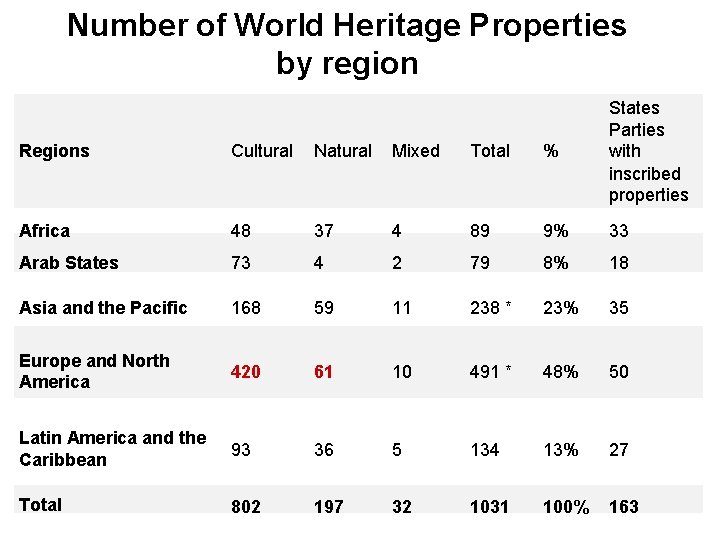
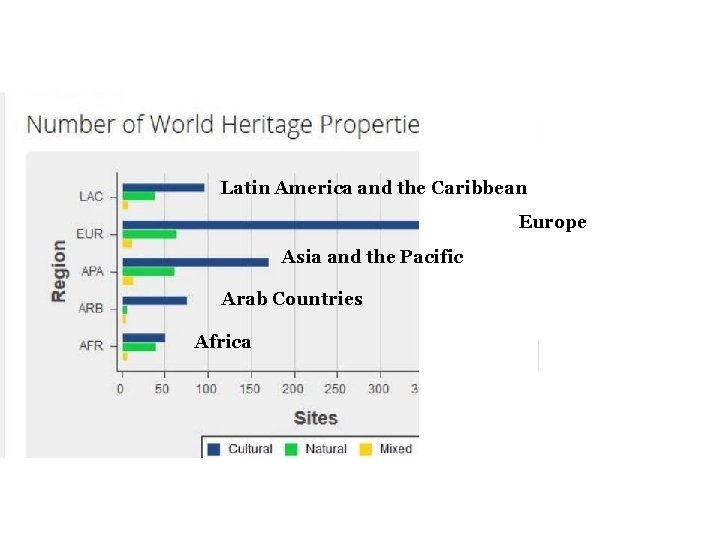
Number of World Heritage Properties by region Regions Cultural Natural Mixed Total % States Parties with inscribed properties Africa 48 37 4 89 9% 33 Arab States 73 4 2 79 8% 18 Asia and the Pacific 168 59 11 238 * 23% 35 Europe and North America 420 61 10 491 * 48% 50 Latin America and the Caribbean 93 36 5 134 13% 27 Total 802 197 32 1031 100% 163
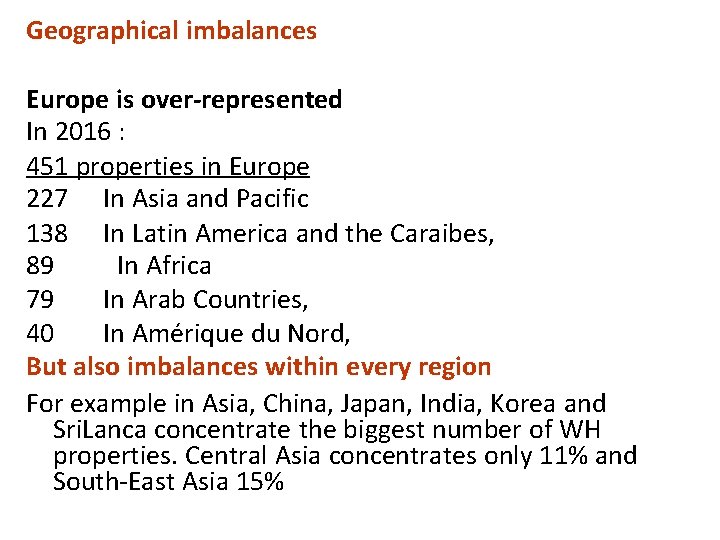
Geographical imbalances Europe is over-represented In 2016 : 451 properties in Europe 227 In Asia and Pacific 138 In Latin America and the Caraibes, 89 In Africa 79 In Arab Countries, 40 In Amérique du Nord, But also imbalances within every region For example in Asia, China, Japan, India, Korea and Sri. Lanca concentrate the biggest number of WH properties. Central Asia concentrates only 11% and South-East Asia 15%
Latin America and the Caribbean Europe Asia and the Pacific Arab Countries Africa
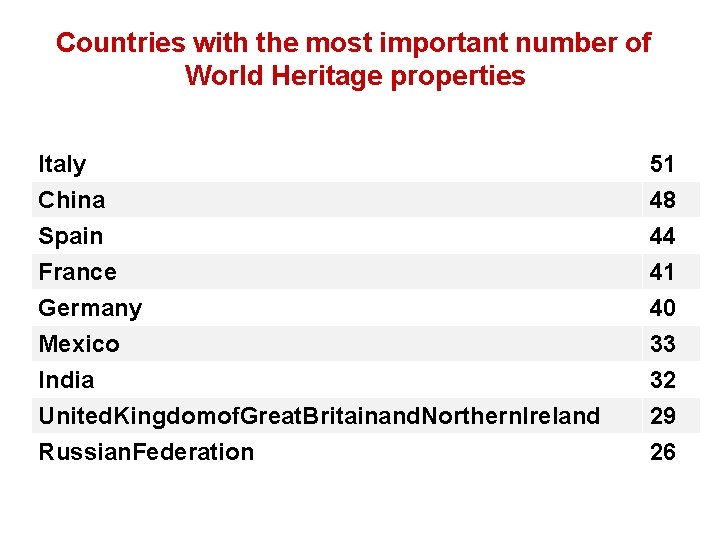
Countries with the most important number of World Heritage properties Italy China Spain France Germany Mexico India United. Kingdomof. Great. Britainand. Northern. Ireland Russian. Federation 51 48 44 41 40 33 32 29 26
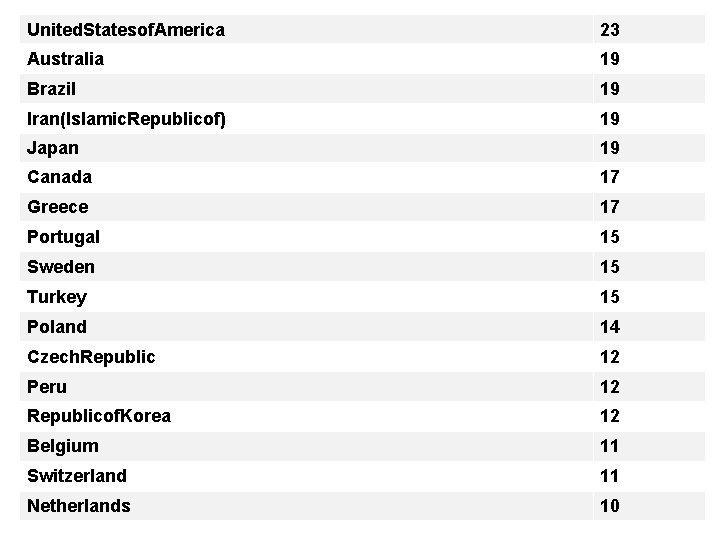
United. Statesof. America 23 Australia 19 Brazil 19 Iran(Islamic. Republicof) 19 Japan 19 Canada 17 Greece 17 Portugal 15 Sweden 15 Turkey 15 Poland 14 Czech. Republic 12 Peru 12 Republicof. Korea 12 Belgium 11 Switzerland 11 Netherlands 10
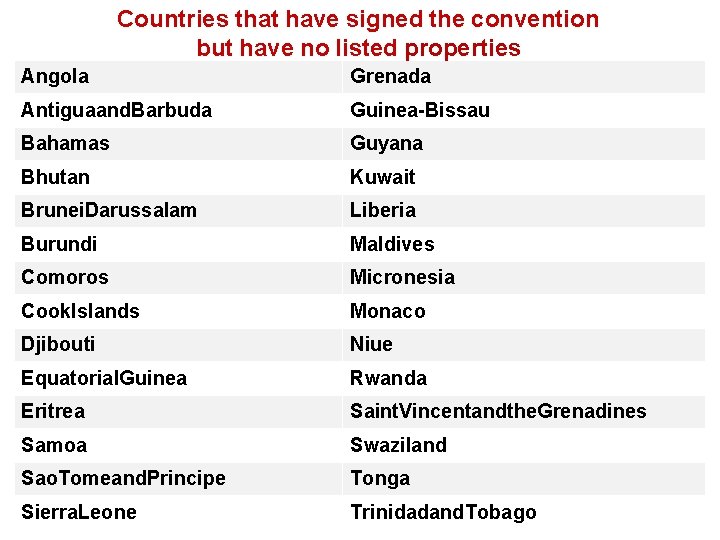
Countries that have signed the convention but have no listed properties Angola Grenada Antiguaand. Barbuda Guinea-Bissau Bahamas Guyana Bhutan Kuwait Brunei. Darussalam Liberia Burundi Maldives Comoros Micronesia Cook. Islands Monaco Djibouti Niue Equatorial. Guinea Rwanda Eritrea Saint. Vincentandthe. Grenadines Samoa Swaziland Sao. Tomeand. Principe Tonga Sierra. Leone Trinidadand. Tobago
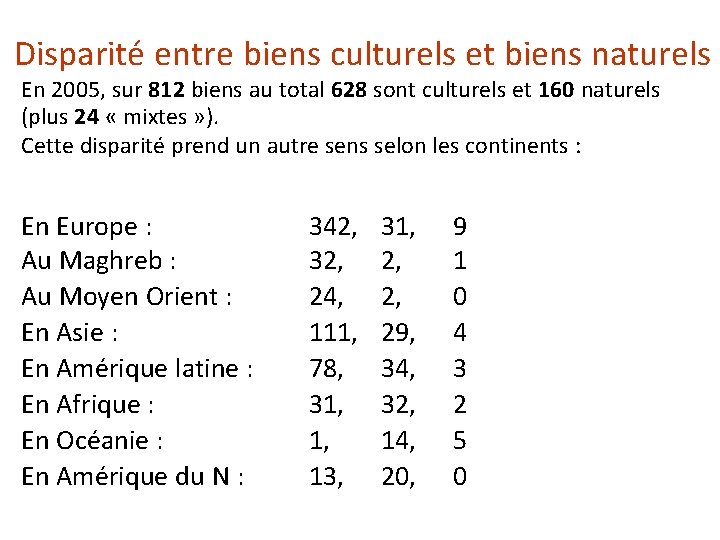
Disparité entre biens culturels et biens naturels En 2005, sur 812 biens au total 628 sont culturels et 160 naturels (plus 24 « mixtes » ). Cette disparité prend un autre sens selon les continents : En Europe : Au Maghreb : Au Moyen Orient : En Asie : En Amérique latine : En Afrique : En Océanie : En Amérique du N : 342, 32, 24, 111, 78, 31, 1, 13, 31, 2, 2, 29, 34, 32, 14, 20, 9 1 0 4 3 2 5 0
Other imbalances • Historic towns and religious buildings compared to other properties • Historical periods compared to prehistoric times and to the 20 th century • “Elitist” architecture compared to popular architecture • More generally, all “living" cultures - and especially "traditional" cultures - are underrepresented
7 The Budapest declaration
Budapest Declaration On World Heritage (2002 / 30 years) 1. We, the members of the World Heritage Committee, recognize the universality of the 1972 UNESCO World Heritage Convention and the consequent need to ensure that it applies to heritage in all its diversity, as an instrument for the sustainable development of all societies through dialogue and mutual understanding. 2. The properties on the World Heritage List are assets held in trust to pass on to generations of the future as their rightful inheritance.
3. In view of the increasing challenges to our shared heritage, we will: A) encourage countries that have not yet joined the Convention to do so at the earliest opportunity, as well as with other related international heritage protection instruments; B) invite States Parties to the Convention to identify and nominate cultural and natural heritage properties representing heritage in all its diversity, for inclusion on the World Heritage List; C) seek to ensure an appropriate and equitable balance between conservation, sustainability and development, so that World Heritage properties can be protected through appropriate activities contributing to the social and economic development and the quality of life of our communities; D) join to co-operate in the protection of heritage, recognizing that to harm such heritage is to harm, at the same time, the human spirit and the world's inheritance;
We, the World Heritage Committee, will co-operate and seek the assistance of all partners for the support of World Heritage. For this purpose, we invite all interested parties to co-operate and to promote the following objectives: strengthen the Credibility of the World Heritage List , as a representative and geographically balanced testimony of cultural and natural properties of outstanding universal value; ensure the effective Conservation of World Heritage properties ; promote the development of effective Capacity-building measures , including assistance for preparing the nomination of properties to the World Heritage List, for the understanding and implementation of the World Heritage Convention and related instruments; increase public awareness, involvement and support for World Heritage through Communication.
In 2007, a 5 th C was added A “fifth C” for “ Communities ” to the existing Strategic Objectives which were adopted as the. Budapest declaration on World Heritage by the World Heritage Committee at its 26 th session (Budapest, 2002): “To enhance the role of communities in the implementation of the World Heritage Convention. ”
The current Strategic Objectives (“ the 5 Cs ”) are : 1. Strengthen the Credibility of the World Heritage List; 2. Ensure the effective Conservation of World Heritage Properties; 3. Promote the development of effective Capacitybuilding in States Parties; 4. Increase public awareness, involvement and support for World Heritage through Communication. 5. Enhance the role of Communities in the implementation of the World Heritage Convention.
8 The WH list of properties in danger
A geography of conflict and poverty AFGANISTAN : Minaret et vestiges archéologiques de Djam Paysage culturel et vestiges archéologiques de la vallée de Bamiyan AZERBAIDJAN : Cité fortifiée de Bakou avec le palais des Chahs de Chirvan et la tour de la Vierge CHILI : Usines de salpêtre de Humberstone et de Santa Laura COTE d’IVOIRE : Réserve naturelle intégrale du mont Nimba et Parc national de la Comoé EGYPTE : Abou Mena EQUATEUR : Îles Galápagos ETHIOPIE : Parc national du Simien GUINEE : Réserve naturelle intégrale du mont Nimba INDE : Sanctuaire de faune de Manas IRAN : Bam et son paysage culturel IRAQ : Assour (Qal'at Cherqat) Ville archéologique de Samarra JEROUSALEM (site proposé par la Jordanie) Vieille ville de Jérusalem et ses remparts (1981 NIGER Réserves naturelles de l'Aïr et du Ténéré (1991) PAKISTAN ; Fort et jardins de Shalimar à Lahore PEROU Zone archéologique de Chan (1986 PHILIPPINES Rizières en terrasses des cordillères REPUBLIQUE CENTRAFRICAINE Parc national du Manovo-Gounda St Floris REPUBLIQUE DEMOCRATIQUE DU CONGO Parc national des Virunga Parc national de Kahuzi-Biega Parc national de la Garamba Parc national de la Salonga Réserve de faune à okapis SENEGAL: Parc national du Niokolo-Koba SERBIE : Monuments médiévaux au Kosovo TANZANIE Ruines de Kilwa Kisiwani et de Songo Mnara VENEZUELA : Coro et son port YEMEN : Ville historique de Zabid
List of World Heritage in Danger by Regions Cultur al Natural Mixed Africa Arab. States Asiaandthe Pacific 3 13 0 16 0 0 2 2 Europeand North. America 4 Latin. America andthe Caribbean Total % 33% 0 16 16 4 1 0 5 10% 5 2 0 7 15% 30 18 0 48 100% 33% 8%
Natural Sites inscribed (and removed) from the List of World Heritage in Danger 78
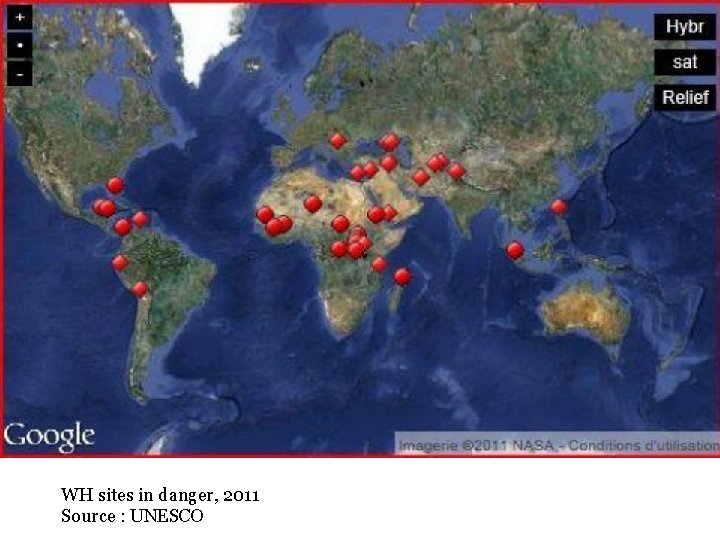
WH sites in danger, 2011 Source : UNESCO
DELISTING When all avenues for remedial action have been exhausted and the integrity and outstanding universal value of a site or property has been irreversibly compromised, the site is delisted. Two sites have been delisted: one natural and one cultural site. * The Arabian Oryx Sanctuary (Oman) * The Dresden Elbe Valley (Germany) 80
9 Dissonant heritage on the WH list
“Nomination of historic places, such as the Island of Gorée and Auschwitz, or famous battle fields, should remain extremely selective in order to emphasize the significance of those selected. Source : Jukka Jokilehto, What is OUV? Defining the Outstanding Universal Value of Cultural World Heritage Properties, ICOMOS, 2008
The UNESCO justification for the memorial’s inclusion on the World Heritage List states that the former camp complex “bears irrefutable evidence to one of the greatest crimes ever perpetrated against humanity. It is also a monument to the strength of the human spirit which in appalling conditions of adversity resisted the efforts of the German Nazi regime to suppress freedom and free thought and to wipe out whole races. The site is a key place of memory for the whole of humankind for the holocaust, racist policies and barbarism ; it is a place of our collective memory of this dark chapter in the history of humanity, of transmission to younger generations and a sign of warning of the many threats and tragic consequences of extreme ideologies and denial of human dignity”
Criterion (iii): The buildings of Robben Island bear eloquent witness to its sombre history. Criterion (vi): Robben Island its prison buildings symbolize the triumph of the human spirit, of freedom and of democracy over oppression.
Hiroshima Peace Memorial (Genbaku Dome) (1996): The Hiroshima Peace Memorial (Genbaku Dome) was the only structure left standing in the area where the first atomic bomb exploded on 6 August 1945. Through the efforts of many people, including those of the city of Hiroshima, it has been preserved in the same state as immediately after the bombing.
- Slides: 71