
Thomas Hardy 1840 1928 Performer Heritage Marina Spiazzi
- Slides: 20
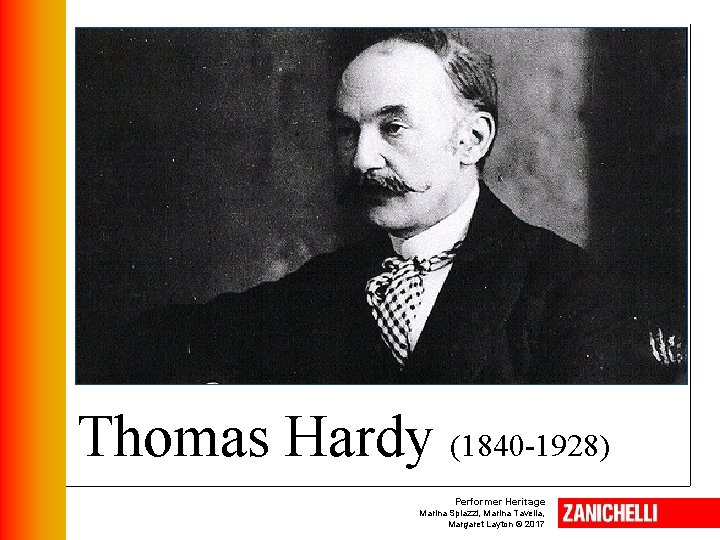
Thomas Hardy (1840 -1928) Performer Heritage Marina Spiazzi, Marina Tavella, Margaret Layton © 2017
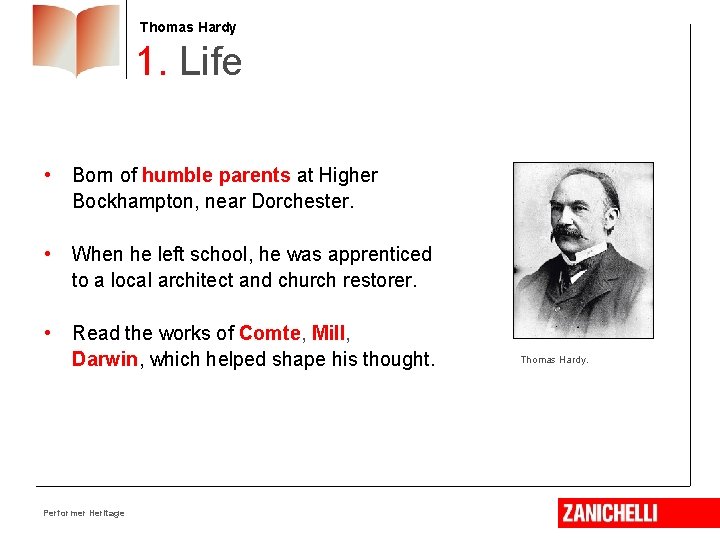
Thomas Hardy 1. Life • Born of humble parents at Higher Bockhampton, near Dorchester. • When he left school, he was apprenticed to a local architect and church restorer. • Read the works of Comte, Mill, Darwin, which helped shape his thought. Performer Heritage Thomas Hardy.
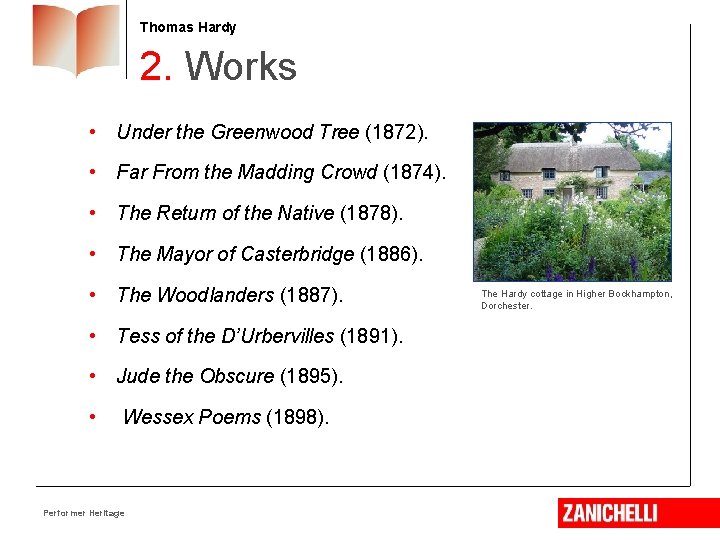
Thomas Hardy 2. Works • Under the Greenwood Tree (1872). • Far From the Madding Crowd (1874). • The Return of the Native (1878). • The Mayor of Casterbridge (1886). • The Woodlanders (1887). • Tess of the D’Urbervilles (1891). • Jude the Obscure (1895). • Wessex Poems (1898). Performer Heritage The Hardy cottage in Higher Bockhampton, Dorchester.
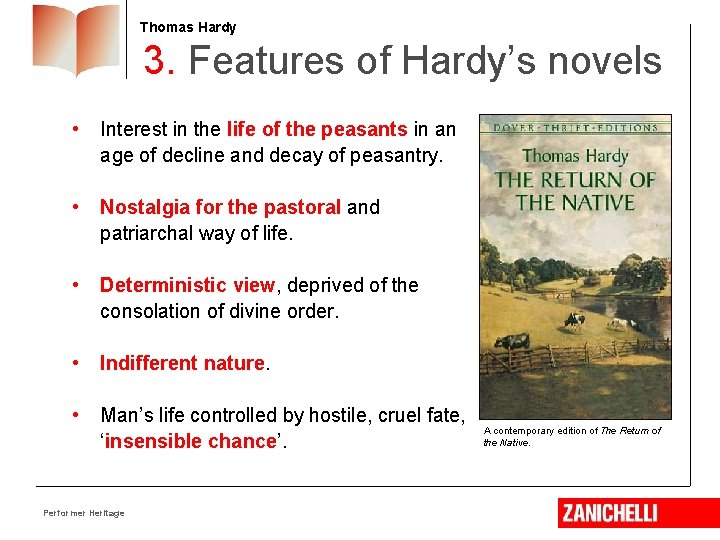
Thomas Hardy 3. Features of Hardy’s novels • Interest in the life of the peasants in an age of decline and decay of peasantry. • Nostalgia for the pastoral and patriarchal way of life. • Deterministic view, deprived of the consolation of divine order. • Indifferent nature. • Man’s life controlled by hostile, cruel fate, ‘insensible chance’. Performer Heritage A contemporary edition of The Return of the Native.
Thomas Hardy 4. Themes The difficulty of being alive place, environment and circumstances determine the individual existence. Indifferent to man’s destiny. Nature Sets the pattern of growth and decay. Criticism: he exposes the most conventional, moralistic, hypocritical aspects of Victorian society. Difficulty or failure of communication. Tragedy Performer Heritage
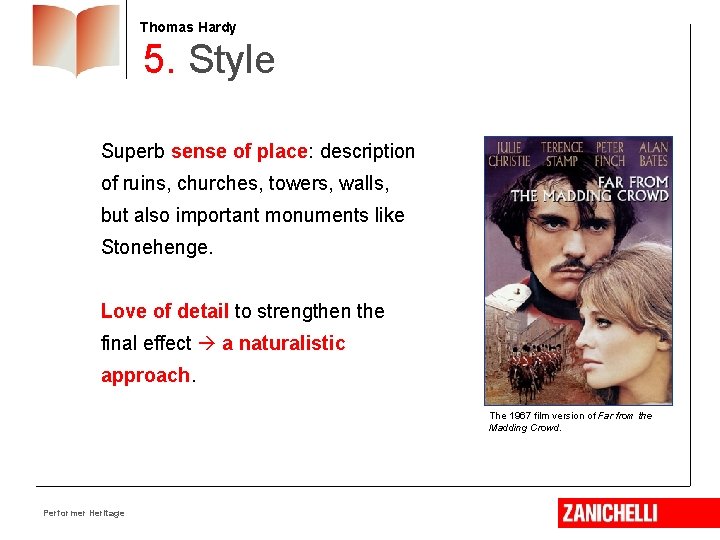
Thomas Hardy 5. Style Superb sense of place: description of ruins, churches, towers, walls, but also important monuments like Stonehenge. Love of detail to strengthen the final effect a naturalistic approach. The 1967 film version of Far from the Madding Crowd. Performer Heritage
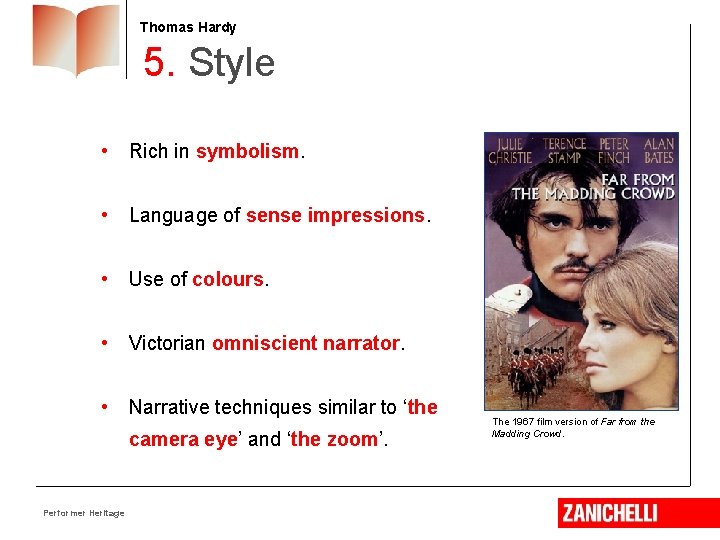
Thomas Hardy 5. Style • Rich in symbolism. • Language of sense impressions. • Use of colours. • Victorian omniscient narrator. • Narrative techniques similar to ‘the camera eye’ and ‘the zoom’. Performer Heritage The 1967 film version of Far from the Madding Crowd.
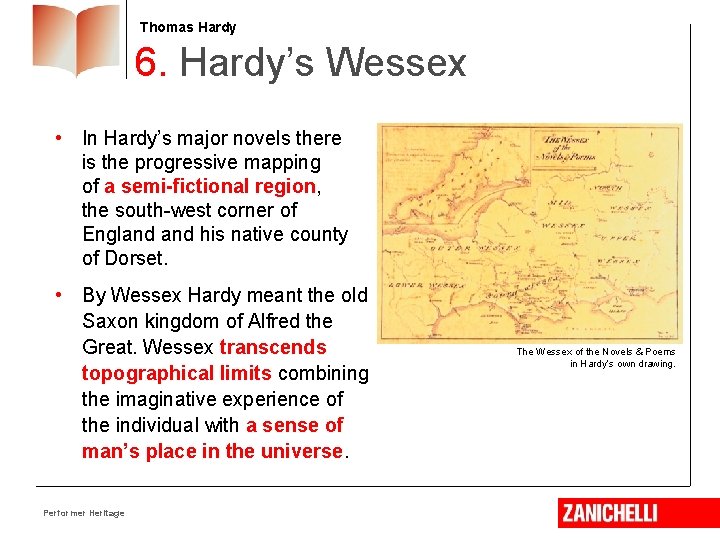
Thomas Hardy 6. Hardy’s Wessex • In Hardy’s major novels there is the progressive mapping of a semi-fictional region, the south-west corner of England his native county of Dorset. • By Wessex Hardy meant the old Saxon kingdom of Alfred the Great. Wessex transcends topographical limits combining the imaginative experience of the individual with a sense of man’s place in the universe. Performer Heritage The Wessex of the Novels & Poems in Hardy’s own drawing.
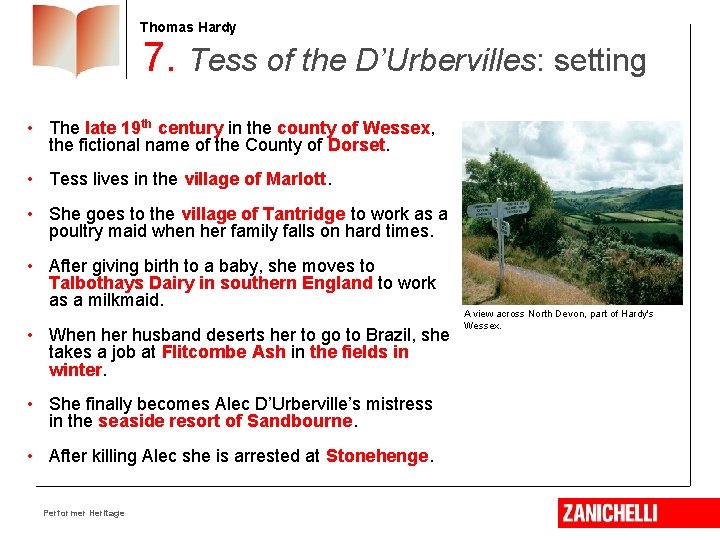
Thomas Hardy 7. Tess of the D’Urbervilles: setting • The late 19 th century in the county of Wessex, the fictional name of the County of Dorset. • Tess lives in the village of Marlott. • She goes to the village of Tantridge to work as a poultry maid when her family falls on hard times. • After giving birth to a baby, she moves to Talbothays Dairy in southern England to work as a milkmaid. • When her husband deserts her to go to Brazil, she takes a job at Flitcombe Ash in the fields in winter. • She finally becomes Alec D’Urberville’s mistress in the seaside resort of Sandbourne. • After killing Alec she is arrested at Stonehenge. Performer Heritage A view across North Devon, part of Hardy's Wessex.
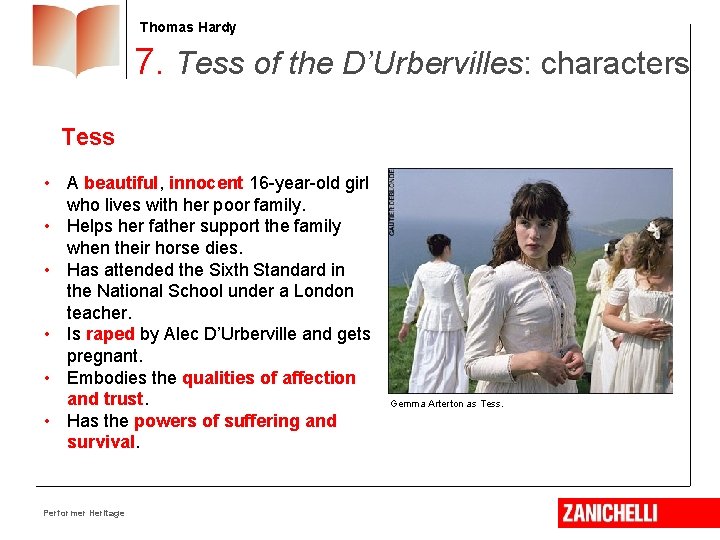
Thomas Hardy 7. Tess of the D’Urbervilles: characters Tess • A beautiful, innocent 16 -year-old girl who lives with her poor family. • Helps her father support the family when their horse dies. • Has attended the Sixth Standard in the National School under a London teacher. • Is raped by Alec D’Urberville and gets pregnant. • Embodies the qualities of affection and trust. • Has the powers of suffering and survival. Performer Heritage Gemma Arterton as Tess.
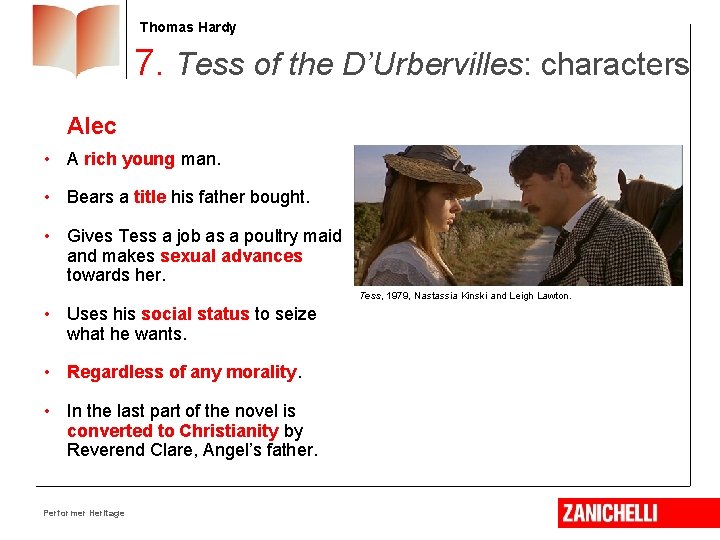
Thomas Hardy 7. Tess of the D’Urbervilles: characters Alec • A rich young man. • Bears a title his father bought. • Gives Tess a job as a poultry maid and makes sexual advances towards her. Tess, 1979, Nastassia Kinski and Leigh Lawton. • Uses his social status to seize what he wants. • Regardless of any morality. • In the last part of the novel is converted to Christianity by Reverend Clare, Angel’s father. Performer Heritage
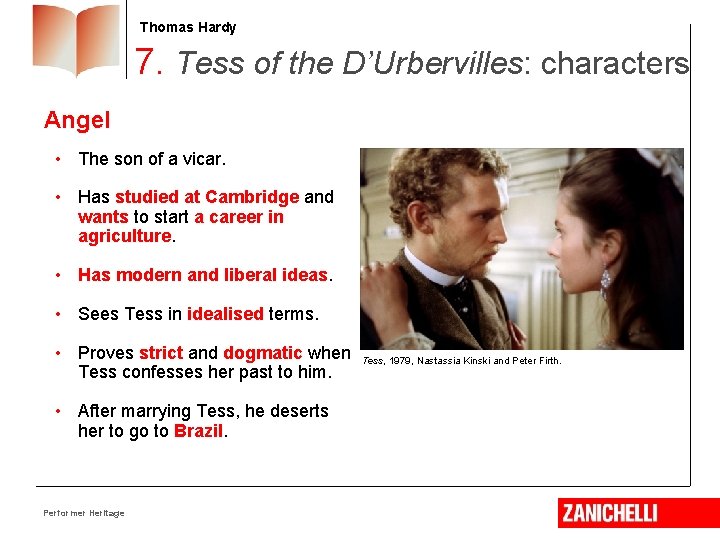
Thomas Hardy 7. Tess of the D’Urbervilles: characters Angel • The son of a vicar. • Has studied at Cambridge and wants to start a career in agriculture. • Has modern and liberal ideas. • Sees Tess in idealised terms. • Proves strict and dogmatic when Tess confesses her past to him. • After marrying Tess, he deserts her to go to Brazil. Performer Heritage Tess, 1979, Nastassia Kinski and Peter Firth.
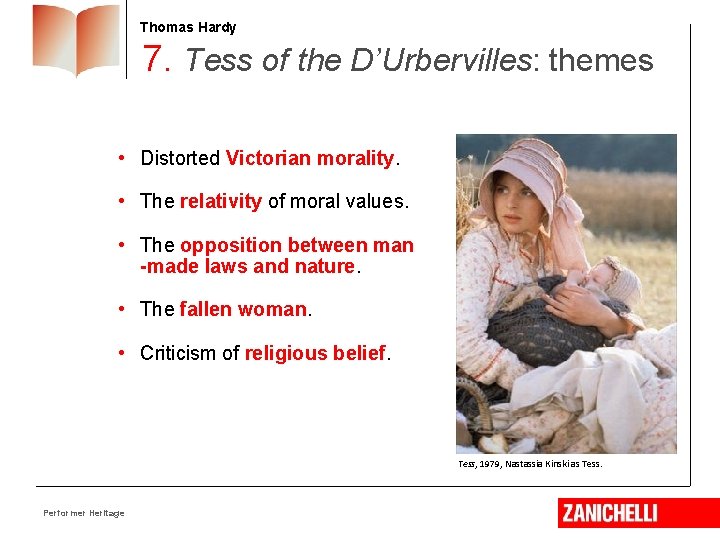
Thomas Hardy 7. Tess of the D’Urbervilles: themes • Distorted Victorian morality. • The relativity of moral values. • The opposition between man -made laws and nature. • The fallen woman. • Criticism of religious belief. Tess, 1979, Nastassia Kinski as Tess. Performer Heritage
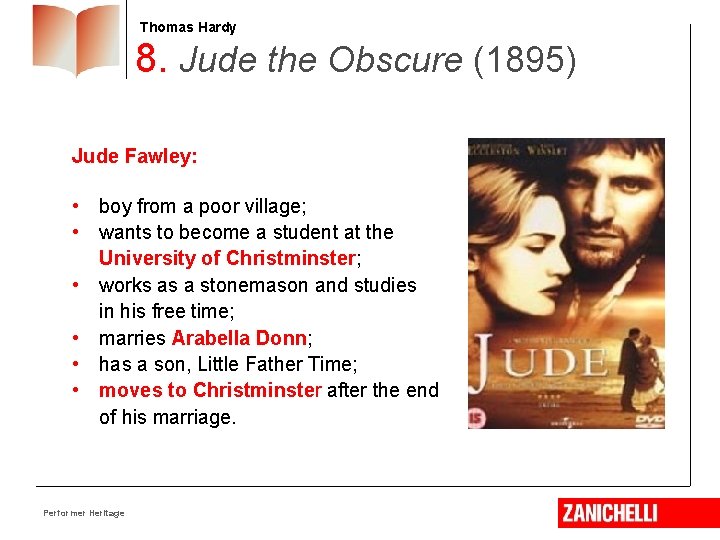
Thomas Hardy 8. Jude the Obscure (1895) Jude Fawley: • boy from a poor village; • wants to become a student at the University of Christminster; • works as a stonemason and studies in his free time; • marries Arabella Donn; • has a son, Little Father Time; • moves to Christminster after the end of his marriage. Performer Heritage
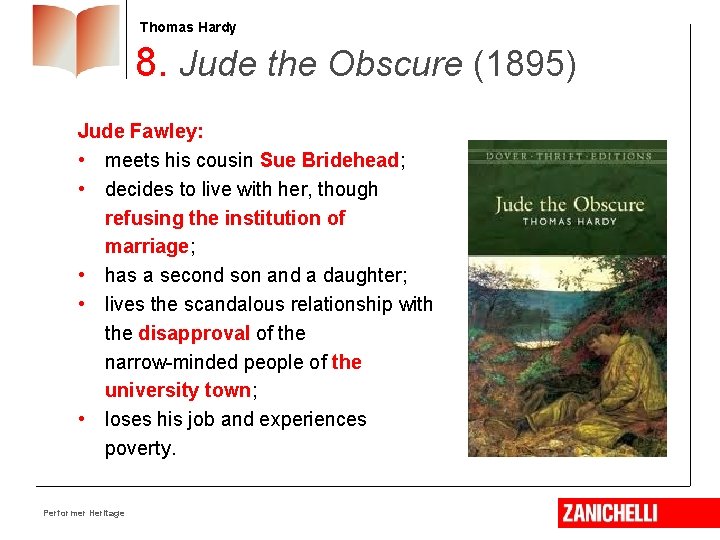
Thomas Hardy 8. Jude the Obscure (1895) Jude Fawley: • meets his cousin Sue Bridehead; • decides to live with her, though refusing the institution of marriage; ; • has a second son and a daughter; • lives the scandalous relationship with the disapproval of the narrow-minded people of the university town; • loses his job and experiences poverty. Performer Heritage
Thomas Hardy 8. Jude the Obscure: setting • Part I: Marygreen young Jude develops a passion for a university education. • Part II: Christminster Jude finds that access to university is impossible for a working-class man. • Part III: Melchester Jude aims to study for the church, in the hope of entering a theological college. • Part IV: Shaston Sue asks Phillotson for her freedom and returns to Jude. • Part V: Aldbrickham Sue and Jude finally agree to live together. • Part VI: Christbminster tragedy takes place. Performer Heritage
Thomas Hardy 9. Jude’s obscurity The novel follows the Victorian convention of placing an orphan at the centre of the story. But: • denies him the possibility to fulfill his hopes; • takes him from defeat to defeat. The tragedy of Jude is one of: • frustration; • loneliness; • uprooting. Jude is obscure because he does not ‘exist’ for others. Performer Heritage
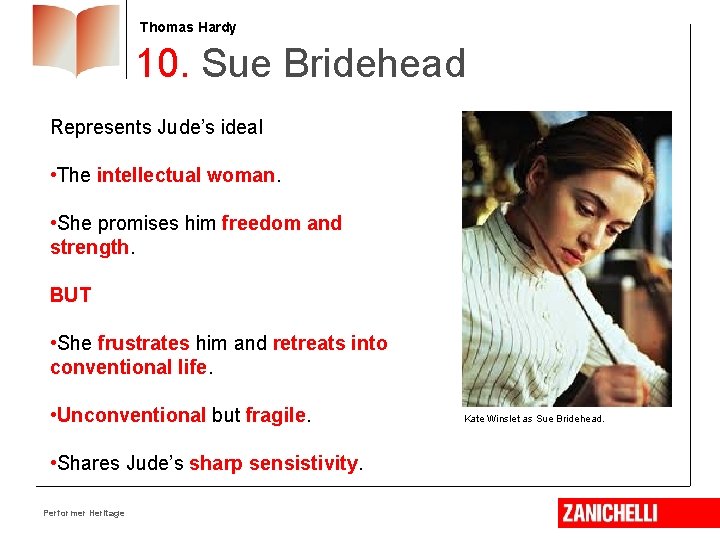
Thomas Hardy 10. Sue Bridehead Represents Jude’s ideal • The intellectual woman. • She promises him freedom and strength. BUT • She frustrates him and retreats into conventional life. • Unconventional but fragile. • Shares Jude’s sharp sensistivity. Performer Heritage Kate Winslet as Sue Bridehead.
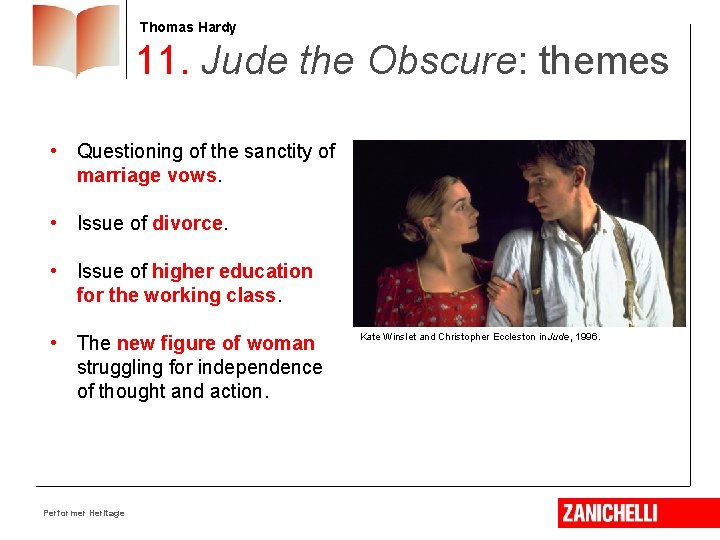
Thomas Hardy 11. Jude the Obscure: themes • Questioning of the sanctity of marriage vows. • Issue of divorce. • Issue of higher education for the working class. • The new figure of woman struggling for independence of thought and action. Performer Heritage Kate Winslet and Christopher Eccleston in Jude, 1996.
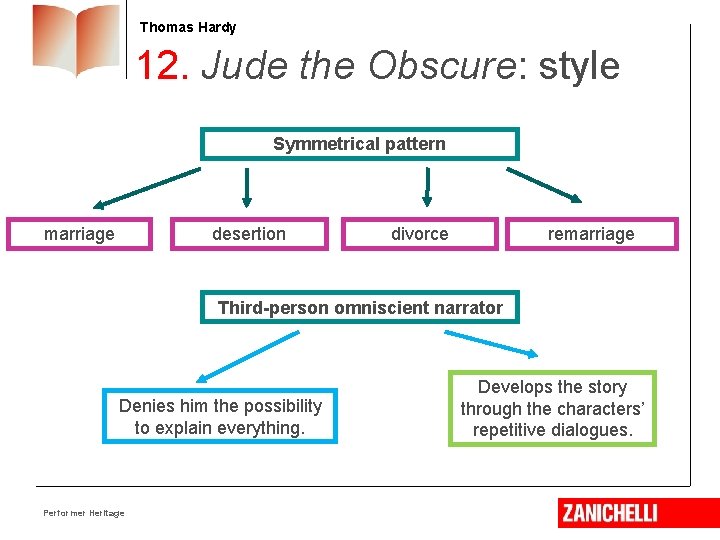
Thomas Hardy 12. Jude the Obscure: style Symmetrical pattern desertion marriage divorce remarriage Third-person omniscient narrator Denies him the possibility to explain everything. Performer Heritage Develops the story through the characters’ repetitive dialogues.