Geography Chapter 16 Human Geography of Russia and
- Slides: 32
Geography Chapter 16 Human Geography of Russia and the Republics: A Diverse Heritage Russia’s aggressive expansion between 1500 and 1900 created a vast nation with a diverse, and often turbulent, mix of peoples and cultures. Next Copyright © by Houghton Mifflin Harcourt Publishing Company
Geography Chapter 16 Human Geography of Russia and the Republics: A Diverse Heritage SECTION 1 Russia and the Western Republics SECTION 2 Transcaucasia SECTION 3 Central Asia Previous Copyright © by Houghton Mifflin Harcourt Publishing Company Next
Geography Chapter 16 Section-1 Russia and the Western Republics • From modest beginnings, Russia expanded to become the largest country in the world. • The rise and fall of the Soviet Union affected the world’s political geography. Previous Copyright © by Houghton Mifflin Harcourt Publishing Company Next
Geography Chapter 16 Section-1 1 Russia and the Western Republics A History of Expansion Russia and its Neighbors • Expansion adds variety of people, cultures, languages, religions − includes Belarus, Moldova, Ukraine to west − Baltic Republics—Estonia, Latvia, Lithuania Previous Copyright © by Houghton Mifflin Harcourt Publishing Company Continued… Next
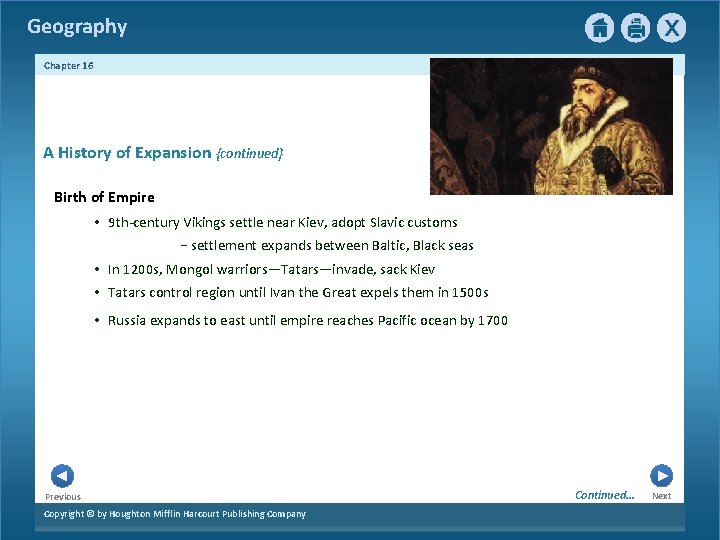
Geography Chapter 16 A History of Expansion {continued} Birth of Empire • 9 th-century Vikings settle near Kiev, adopt Slavic customs − settlement expands between Baltic, Black seas • In 1200 s, Mongol warriors—Tatars—invade, sack Kiev • Tatars control region until Ivan the Great expels them in 1500 s • Russia expands to east until empire reaches Pacific ocean by 1700 Previous Copyright © by Houghton Mifflin Harcourt Publishing Company Continued… Next
Geography Chapter 16 A History of Expansion {continued} Russia Lags Behind Western Europe • Rapid territorial growth is not matched by technological advancement • Czar—or emperor—Peter the Great (1682 -1725) modernizes Russia − moves capital from Moscow to St. Petersburg on Baltic sea West” − St. Petersburg provides sea access to Europe: “window to the • Russia is slow to industrialize, trailing Europe by half a century − eventual industrialization brings harsh working condition, low wages − peoples’ unrest and anger with czars grows Previous Copyright © by Houghton Mifflin Harcourt Publishing Company Continued… Next
Geography Chapter 16 1 A History of Expansion {continued} The Rise and Fall of the Soviet Union • Russian Revolution— 1917 revolt ends reign of the czars economy − V. I. Lenin’s Communist Party takes over government, • Communist Party organizes diverse peoples of Russian empire − forms Union of Soviet Socialist Republics (USSR) • Joseph Stalin takes over USSR, leads fight against Germany in WWII • Relations between USSR and WWII Allies (including U. S. , U. K. ) worsen − after war, pro-Soviet governments installed in Eastern Europe Previous Copyright © by Houghton Mifflin Harcourt Publishing Company Continued… Next
Geography Chapter 16 A History of Expansion {continued} The Rise and Fall of the Soviet Union • In 1940 s, tensions grow as U. S. fears worldwide Communist expansion − Cold War—U. S. -USSR conflict that never becomes open warfare • In 1980 s, Mikhail Gorbachev allows more economic, political freedom − leads to collapse of Soviet Union, end of Cold War in 1991 • Region divides into 15 independent republics • Russia is largest, most powerful republic chamber Federal Assembly Previous Copyright © by Houghton Mifflin Harcourt Publishing Company − has popularly elected president, two- Next
Geography Chapter 16 Building a Command Economy An Economic Dream • In 1917, Communists follow ideas of Karl Marx, German philosopher − feel capitalism is doomed because few are wealthy, many are poor − predict communism—shared property, wealth—will replace it Previous Copyright © by Houghton Mifflin Harcourt Publishing Company Continued… Next
Geography Chapter 16 Building a Command Economy {continued} A Harsh Reality • Soviet leaders adopt a command economy − central government makes major economic decisions − controls the wealth: land, mines, factories, banks, transportation − decides what products, crops are produced; sets prices • USSR increases industrialization, including farming − collective farms—large teams of laborers gathered to work together − thousands are moved to farms; by 1939, 90% of farms are collectives Previous Copyright © by Houghton Mifflin Harcourt Publishing Company Continued… Next
Geography Chapter 16 Building a Command Economy {continued} A Harsh Reality • Millions of citizens starve in famines caused, in part, by collectives • In reality, only a few individuals benefit from the economic changes • Stalin’s police punish any protest − some estimate Stalin causes 14 million deaths • In ’ 90 s, Russia tries to put economic control back in private hands Previous Copyright © by Houghton Mifflin Harcourt Publishing Company Next
Geography Chapter 16 A Rich Culture Ethnicity and Religion • Rich variety of ethnic groups due to centuries of expansion • Russia has greatest diversity; 80% are Russian − 70 other peoples live in Russia: Finnish, Turkic, Mongolian • Most Russians are Orthodox Christian (adopted in 900 s) − persecution caused many Jews to emigrate to Israel, U. S. Previous Copyright © by Houghton Mifflin Harcourt Publishing Company Continued… Next
Geography Chapter 16 1 A Rich Culture {continued} Artistic Genius • Orthodox art, architecture includes onion-shaped domes, icons • Cultural golden age begins after Peter opens communication to West • 1700– 1800 s writers include Aleksandr Pushkin, Feodor Dostoyevsky • Composers include Peter Tchaikovsky, Igor Stravinsky • Famous ballet companies include the Kirov and Bolshoi • Communist Party dictates official style of art called socialist realism − promotes Soviet ideals, shows citizens working for socialist society Previous Copyright © by Houghton Mifflin Harcourt Publishing Company Next
Geography Chapter 16 Tradition and Change in Russian Life A More Open Society • Since collapse of USSR, region is more open to outside influences • More social, cultural opportunities in Moscow, St. Petersburg − books, periodicals, movies, music, clothes, international foods • Native traditions, grain-based foods still survive − rye bread, kasha, vodka (from rye or wheat) Previous Copyright © by Houghton Mifflin Harcourt Publishing Company Continued… Next
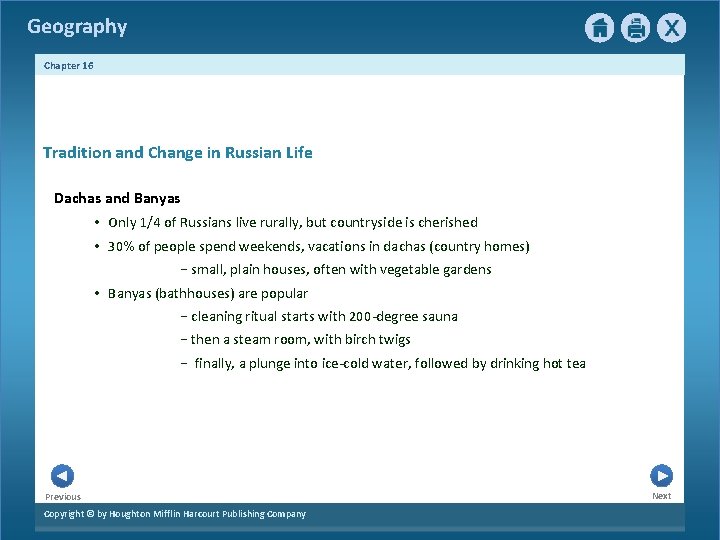
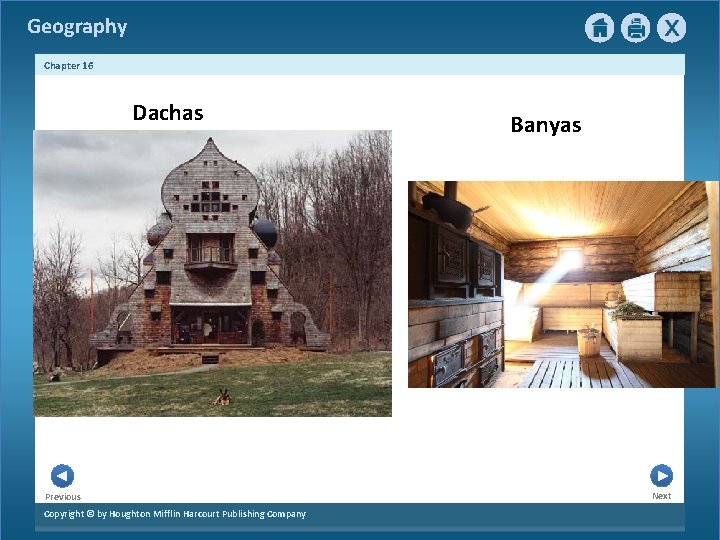
Geography Chapter 16 Tradition and Change in Russian Life Dachas and Banyas • Only 1/4 of Russians live rurally, but countryside is cherished • 30% of people spend weekends, vacations in dachas (country homes) − small, plain houses, often with vegetable gardens • Banyas (bathhouses) are popular − cleaning ritual starts with 200 -degree sauna − then a steam room, with birch twigs − finally, a plunge into ice-cold water, followed by drinking hot tea Previous Copyright © by Houghton Mifflin Harcourt Publishing Company Next
Geography Chapter 16 Dachas Previous Copyright © by Houghton Mifflin Harcourt Publishing Company Banyas Next
Geography Chapter 16 Section-2 Transcaucasia • Transcaucasia has been a gateway between Europe and Asia. • The Caspian Sea’s oil and gas reserves have given the region great economic potential. Previous Copyright © by Houghton Mifflin Harcourt Publishing Company Next
Geography Chapter 16 Section-2 Transcaucasia A Gateway of Migration A Variety of Cultures • Transcaucasia includes Armenia, Azerbaijan, Georgia • Area is historical migration route between Europe and Asia − trade routes near Black Sea lead to Mediterranean − routes from Caspian Sea lead to Far East • Due to routes, today more than 50 different peoples live in region • Variety of language families include Indo-European, Caucasian, Altaic − Arab geographers call area Jabal Al-Alsun—“Mountain of Language” Previous Copyright © by Houghton Mifflin Harcourt Publishing Company Continued… Next
Geography Chapter 16 A Gateway of Migration {continued} Migration Brings Religions • Most people are Christian, Muslim due to proximity to southwest Asia • Armenia and Georgia are among oldest Christian states in the world − Armenia’s King Tiridates III made his state Christian in A. D. 300 • Muslims invaded southern Caucasus in 600 s − today Azerbaijan is mostly Muslim Conflict • Ethnic tensions, in check under rigid Soviet rule, erupt after 1991 − Georgian civil war; Armenia and Azerbaijan’s territorial war Previous Copyright © by Houghton Mifflin Harcourt Publishing Company Next
Geography Chapter 16 A History of Outside Control Czarist and Soviet Rule • Russian Empire invades region in 1700 s − in 1763 Peter the Great’s armies take Baku, Azerbaijan’s capital − in 1801 Russia annexes Georgia − by 1828 Russians control Armenian territory, plain of Yerevan − Transcaucasia is part of Russian Empire by late 1870 s Previous Copyright © by Houghton Mifflin Harcourt Publishing Company Continued… Next
Geography Chapter 16 2 A History of Outside Control {continued} Czarist and Soviet Rule • Region is briefly independent after 1917 Revolution − by early 1920 s, region controlled by Red Army—Soviet military • Region suffers painful economic, political change under USSR − many die in famines triggered by farm collectivization − others perish due to their political beliefs • Independent after 1991, republics struggle to rebuild economies Previous Copyright © by Houghton Mifflin Harcourt Publishing Company Next
Geography Chapter 16 2 Economic Potential {continued} Agriculture and Industry • Despite mountains, have much agriculture − humid subtropical lowlands yield tea, fruits, grapes (Georgian wines) • Soviet-era factories still produce iron, chemicals, consumer goods • Azerbaijan is oil-rich; pipelines are needed across Armenia, Georgia Land of Flames • Azerbaijan means “land of flames” − named so because fires seem to magically erupt from Caspian − fires due to underground oil, gas deposits Previous Copyright © by Houghton Mifflin Harcourt Publishing Company Continued… Next
Geography Chapter 16 2 Economic Potential {continued} Dividing the Caspian Sea • After Soviet breakup, five countries have claims on oil-rich Caspian − Azerbaijan, Russia, Kazakhstan, Turkmenistan, Iran − ownership depends on whether it’s a lake or sea • If a sea, each country owns resources on its own section of sea bed • If a lake, all countries share most of the lake’s oil wealth equally • Azerbaijan has large offshore oil reserves, so it says it’s a sea • Russia has few offshore oil reserves, so it says it’s a lake Previous Copyright © by Houghton Mifflin Harcourt Publishing Company Next
Geography Chapter 16 Modern Life in Transcaucasia An Educated People • Soviet educational programs raised region’s literacy rate to 99% − population was mostly illiterate before 1917 − workers were educated in order to perform modern industrial tasks Hospitality • A supra is a Georgian dinner party (the word means “tablecloth”) − includes cold dishes, hot courses, fruit, dessert − diners make many toasts (short speeches) before drinking Previous Copyright © by Houghton Mifflin Harcourt Publishing Company Next
Geography Chapter 16 Section-3 Central Asia • Soviet officials drew borders in Central Asia that are making it difficult for the region’s new leaders to establish stability. • Central Asians have preserved many cultural traditions despite decades of colonization. Previous Copyright © by Houghton Mifflin Harcourt Publishing Company Next
Geography Chapter 16 Section-3 3 Central Asia A Historical Crossroads The Silk Road • Central Asia today is five independent republics − Kazakhstan, Kyrgyzstan, Tajikistan, Turkmenistan, Uzbekistan • Around 100 B. C. caravans begin crossing region on horses, camels − Silk Road—trade route from Mediterranean from China − caravans carry silk, gold, ivory, jade, spices, linens, perfumes − 4, 000 -mile journey through cities like Samarqand, Bukhoro • In 14 th century, cheaper sea routes replace use of Silk Road Previous Copyright © by Houghton Mifflin Harcourt Publishing Company Continued… Next
Geography Chapter 16 3 A Historical Crossroads {continued} The Great Game • In 1800 s, Britain, Russia compete to control area—the Great Game − Britain wants to protect its Indian colony from Russian expansion − young officers on both sides travel region in disguise − make maps, try to win local leaders over to their side • By 1900, Russia controls Central Asia − USSR controls region from 1920 s until 1991 Previous Copyright © by Houghton Mifflin Harcourt Publishing Company Next
Geography Chapter 16 An Uncertain Future Nuclear Testing • Semey (Semipalatinsk), Kazakhstan, used for nuclear testing site − from 1949 to 1989, 470 nuclear devices set off at “Polygon” • Residents’ exposure to radiation causes long-term health problems − rates of leukemia, thyroid cancer, birth defects rise Petroleum and Prosperity • Potential oil and gas wealth in Caspian, Kazakhstan, Turkmenistan − new “Great Game” as foreign nations compete for oil profits Previous Copyright © by Houghton Mifflin Harcourt Publishing Company Next
Geography Chapter 16 Cultures Divided and Conquered Soviets Form Nations • USSR made 5 nations out of Kazakhs, Kyrgyz, Tajiks, Turkmen, Uzbeks − drew borders to deliberately create ethnic minority groups − encouraged ethnic tensions to prevent opposition to Soviet rule • For example, today Uzbeks form 24% of Tajikistan − Uzbek cities Samarqand, Bukhoro have large Tajik populations Previous Copyright © by Houghton Mifflin Harcourt Publishing Company Continued… Next
Geography Chapter 16 Cultures Divided and Conquered {continued} Language and Religion • Most are Muslim, speak languages related to Turkish − many still speak Russian; former official language of USSR Previous Copyright © by Houghton Mifflin Harcourt Publishing Company Next
Geography Chapter 16 The Survival of Tradition Nomadic Heritage • Nomads—people with no permanent home, few possessions − move themselves and their animals with the seasons − seek food, water, grazing land • Soviets forced most of region’s nomads into collective farms • Some nomads remain in Central Asia’s grasslands Kyrgyzstan − in the summer, herders set up tents near Lake Song-Köl, Previous Copyright © by Houghton Mifflin Harcourt Publishing Company Continued… Next
Geography Chapter 16 The Survival of Tradition {continued} Yurts • Yurts—nomads’ light, portable tents made of felt with wood frames • Interiors decorated with woven reed mats, wooden saddles, daggers − hand-woven carpets are famous for designs, colors Preserving Traditions • As nomadic lifestyle fades, some Kyrgyzstan shepherds house tourists − tourists pay to experience nomadic lifestyles, traditions − shepherd’s families have new source of income Previous Copyright © by Houghton Mifflin Harcourt Publishing Company Next