
James Joyce and Dubliners Performer Heritage Marina Spiazzi
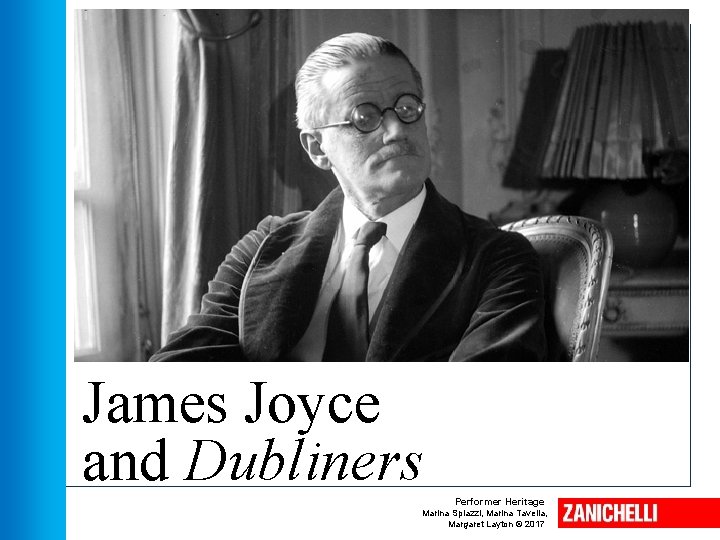
James Joyce and Dubliners Performer Heritage Marina Spiazzi, Marina Tavella, Margaret Layton © 2017

James Joyce and Dubliners 1. Life • 1882: born in Dublin, the eldest surviving child of ten children. • 1888 -1898: largely educated by the Jesuits, first at Clongowes Wood College and later Belvedere College. • 1899: studied Modern Languages at University College, Dublin. Performer Heritage
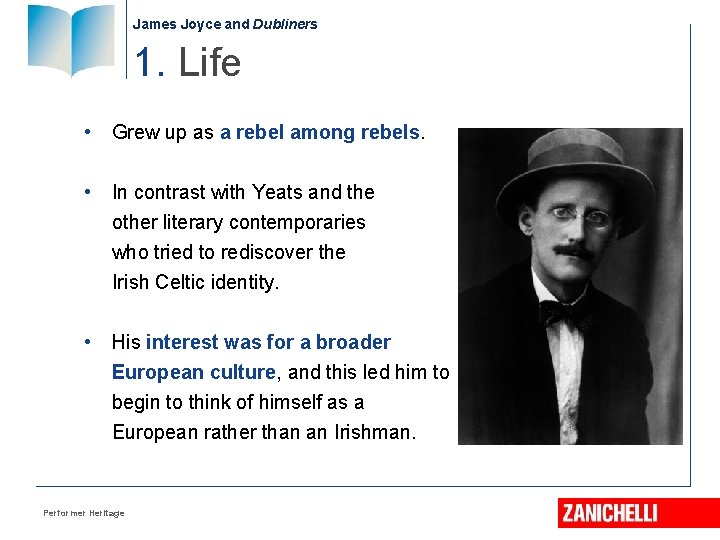
James Joyce and Dubliners 1. Life • Grew up as a rebel among rebels. • In contrast with Yeats and the other literary contemporaries who tried to rediscover the Irish Celtic identity. • His interest was for a broader European culture, and this led him to begin to think of himself as a European rather than an Irishman. Performer Heritage
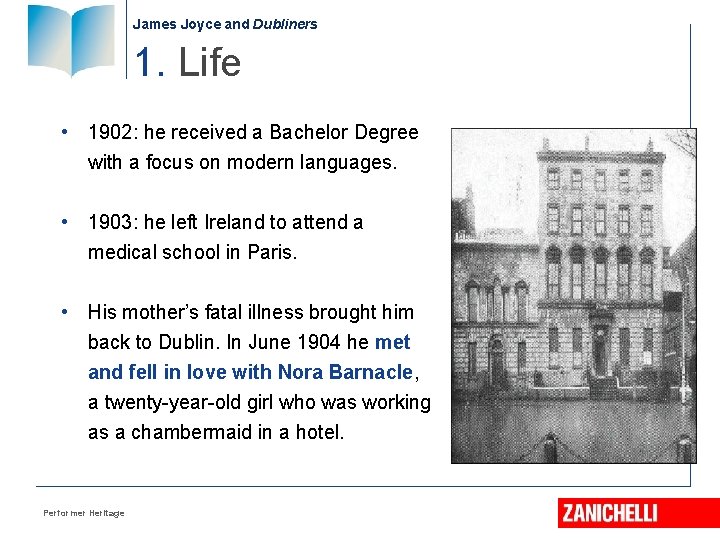
James Joyce and Dubliners 1. Life • 1902: he received a Bachelor Degree with a focus on modern languages. • 1903: he left Ireland to attend a medical school in Paris. • His mother’s fatal illness brought him back to Dublin. In June 1904 he met and fell in love with Nora Barnacle, a twenty-year-old girl who was working as a chambermaid in a hotel. Performer Heritage

James Joyce and Dubliners 1. Life • 1905: settled in Trieste with Nora Barnacle, whom he eventually married. Here he made friends with Italo Svevo. • 1905 -1907: His two children, Giorgio and Lucia, were born. • 1914: Dubliners was completed in 1905 but only published on the eve of the First World War. Nora Barnacle and the two children Giorgio and Lucia. Performer Heritage

James Joyce and Dubliners 1. Life • • • Performer Heritage 1915: Joyce moved to Zurich together with his family, since his position as a British national in Austrian-occupied Trieste left him no alternative. 1916: A Portrait of the Artist as a Young Man, his semiautobiographical novel, was published. 1917: received the first of several anonymous donations. Paris, 1924. The Joyce Family: James, Lucia, Giorgio, Nora.

James Joyce and Dubliners 1. Life • 1918: Ulysses began to appear in serial form in The Little Review. • 1920: moved to Paris. • 1922: the American-born bookseller Sylvia Beach agreed to publish Ulysses. This novel drew both praise and sharp criticism. Performer Heritage

James Joyce and Dubliners 1. Life • 1939: Finnegans Wake was published. • 1940: the Joyces returned to Zurich, the city that had first given them refuge during World War I. • Performer Heritage 1941: Joyce never saw the conclusion of World War II. Following an intestinal operation, he died at the age of 59. He is buried in Zurich.
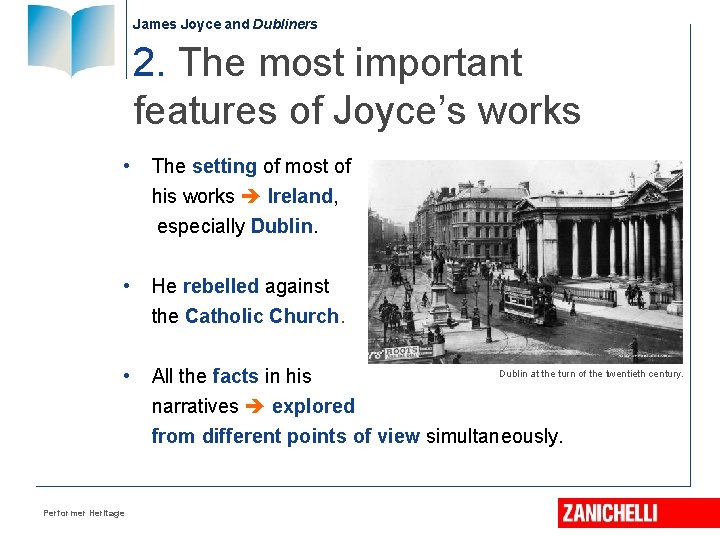
James Joyce and Dubliners 2. The most important features of Joyce’s works • The setting of most of his works Ireland, especially Dublin. • He rebelled against the Catholic Church. • All the facts in his narratives explored Dublin at the turn of the twentieth century. from different points of view simultaneously. Performer Heritage
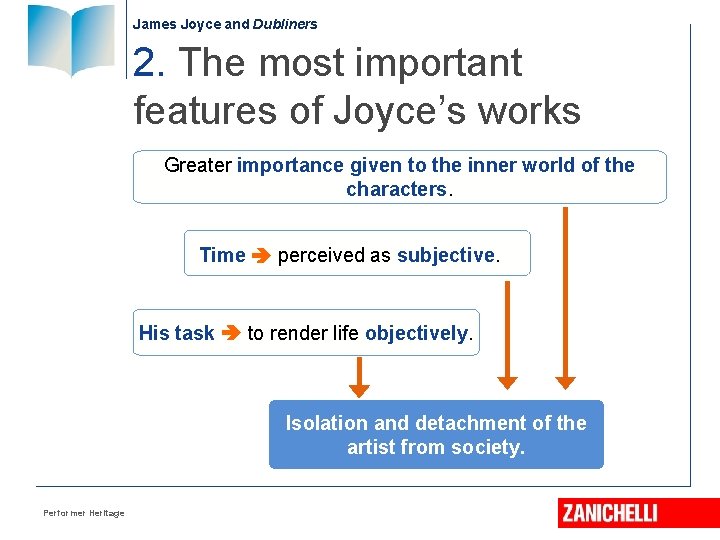
James Joyce and Dubliners 2. The most important features of Joyce’s works Greater importance given to the inner world of the characters. Time perceived as subjective. His task to render life objectively. Isolation and detachment of the artist from society. Performer Heritage
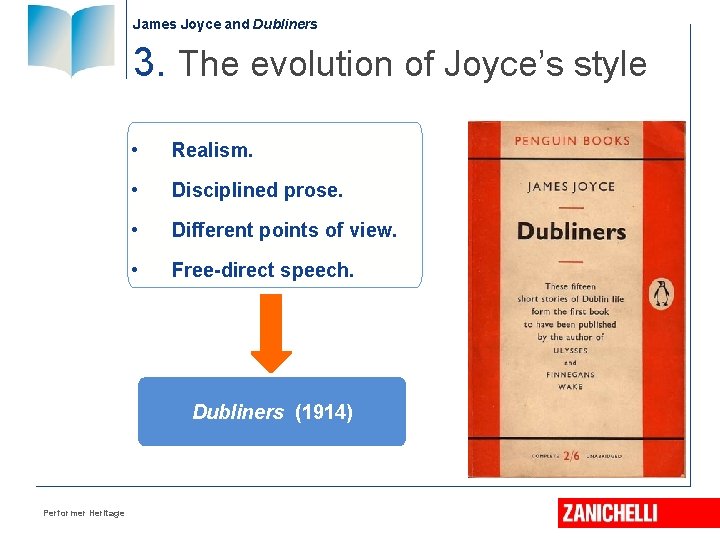
James Joyce and Dubliners 3. The evolution of Joyce’s style • Realism. • Disciplined prose. • Different points of view. • Free-direct speech. Dubliners (1914) Performer Heritage
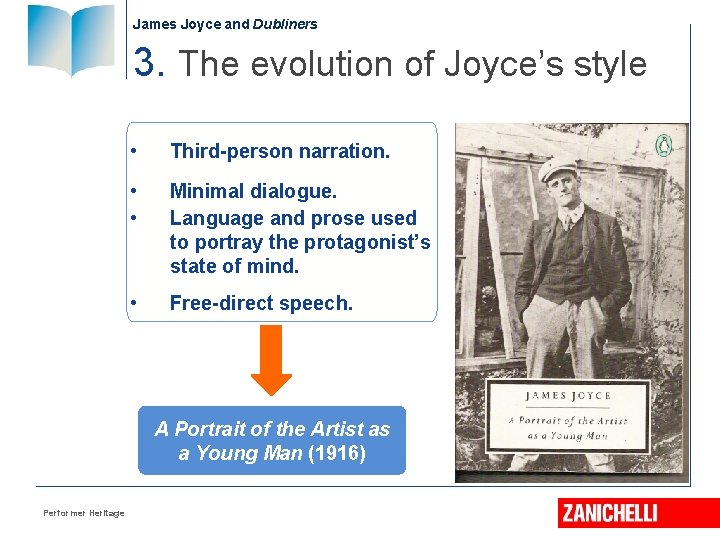
James Joyce and Dubliners 3. The evolution of Joyce’s style • Third-person narration. • • Minimal dialogue. Language and prose used to portray the protagonist’s state of mind. • Free-direct speech. A Portrait of the Artist as a Young Man (1916) Performer Heritage

James Joyce and Dubliners 3. The evolution of Joyce’s style • Interior monologue with two levels of narration. • Extreme interior monologue. Ulysses (1922) Performer Heritage
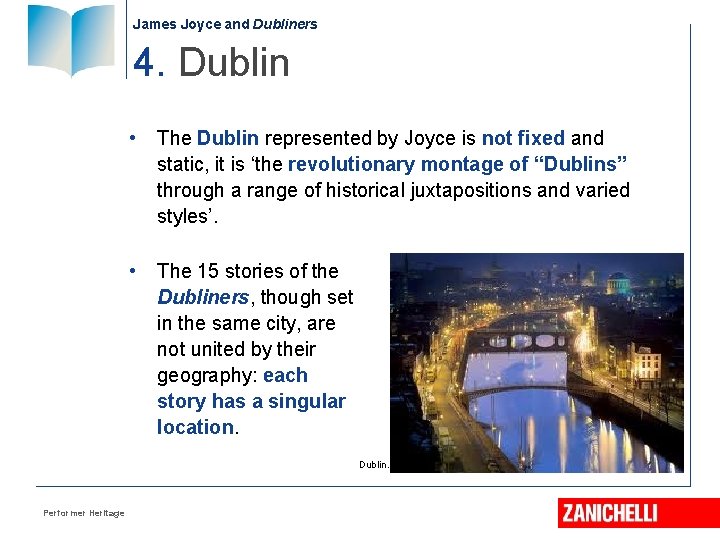
James Joyce and Dubliners 4. Dublin • The Dublin represented by Joyce is not fixed and static, it is ‘the revolutionary montage of “Dublins” through a range of historical juxtapositions and varied styles’. • The 15 stories of the Dubliners, though set in the same city, are not united by their geography: each story has a singular location. Dublin. Performer Heritage
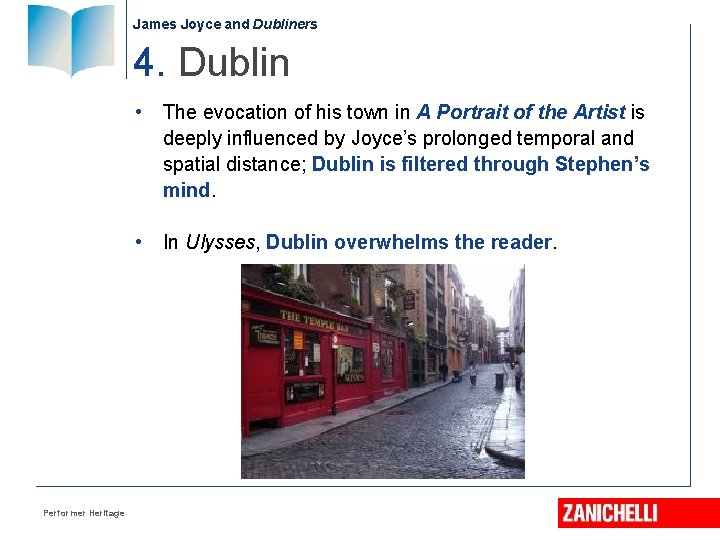
James Joyce and Dubliners 4. Dublin Performer Heritage • The evocation of his town in A Portrait of the Artist is deeply influenced by Joyce’s prolonged temporal and spatial distance; Dublin is filtered through Stephen’s mind. • In Ulysses, Dublin overwhelms the reader.
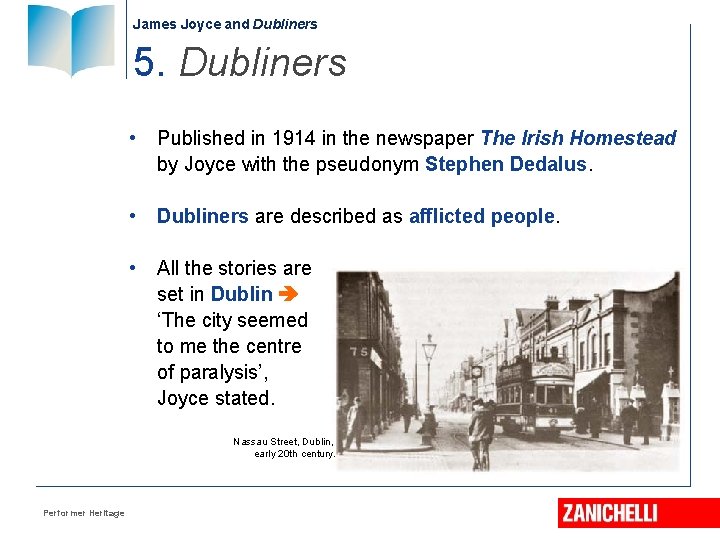
James Joyce and Dubliners 5. Dubliners • Published in 1914 in the newspaper The Irish Homestead by Joyce with the pseudonym Stephen Dedalus. • Dubliners are described as afflicted people. • All the stories are set in Dublin ‘The city seemed to me the centre of paralysis’, Joyce stated. Nassau Street, Dublin, early 20 th century. Performer Heritage

James Joyce and Dubliners 5. Dubliners: structure and style The Sisters An Encounter Araby Eveline A Little Cloud After the Race Counterparts A Mother Two Gallants Clay Grace The Boarding House Childhood Adolescence A Painful Case The Dead Mature life DUBLIN Paralysis / Escape Performer Heritage Ivy Day in the Committee Room Public life

James Joyce and Dubliners 5. Dubliners: narrative technique and themes • Naturalistic, concise, detailed descriptions. • Realism mixed with symbolism deeper meaning of external details. • Each story opens in medias res and is mostly told from the perspective of a character. • Use of free-direct speech and free-direct thought direct presentation of the character’s thoughts. Performer Heritage
James Joyce and Dubliners 5. Dubliners: narrative technique and themes • Different linguistic registers the language suits the age, the social class and the role of the characters. • Use of epiphany ‘the sudden spiritual manifestation’ of an interior reality. • Themes paralysis and escape. • Absence of a didactic and moral aim because of the impersonality of the artist. Performer Heritage

James Joyce and Dubliners 5. Dubliners: epiphany Joyce’s aim to take the reader beyond the usual aspects of life through epiphany. It is the special moment in which a trivial gesture, an external object or a banal situation or an episode lead the character to a sudden selfrealisation about himself / herself or about the reality surrounding him / her. Performer Heritage Understanding the epiphany in each story is the key to the story itself.
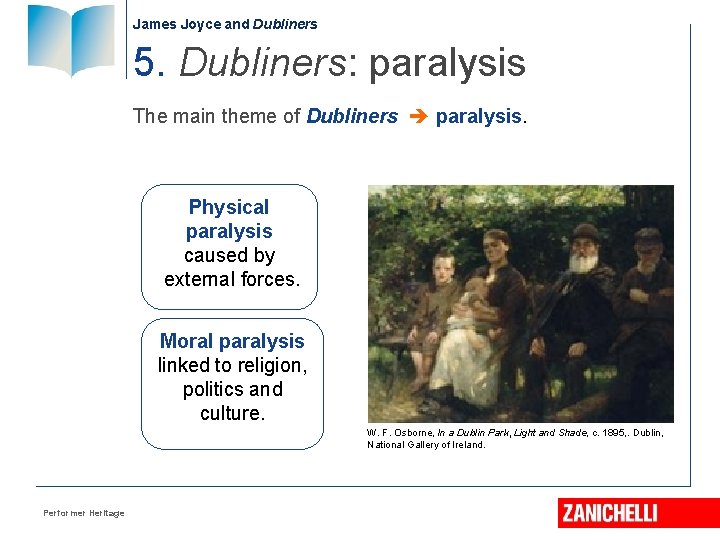
James Joyce and Dubliners 5. Dubliners: paralysis The main theme of Dubliners paralysis. Physical paralysis caused by external forces. Moral paralysis linked to religion, politics and culture. W. F. Osborne, In a Dublin Park, Light and Shade, c. 1895, . Dublin, National Gallery of Ireland. Performer Heritage

James Joyce and Dubliners 5. Dubliners: paralysis • The climax of the stories the coming to awareness by the characters of their own paralysis. J. B. Yeats, In the Tram, 1923, Dublin, National Gallery of Ireland. • Performer Heritage Alternative to paralysis escape which always leads to failure.

James Joyce and Dubliners 5. Dubliners: Eveline CHARACTERS • • • Performer Heritage Eveline passive, influenced by her family’s mentality. Her father a violent and strict man her fear. Her mother conservative her duty. Frank Eveline’s fiancé, a very kind, open-hearted and brave boy her unknown future. Antithesis between Eveline’s house and her new one in Buenos Aires Paralysis / Escape.

James Joyce and Dubliners 5. Dubliners: Eveline STRUCTURE AND STYLE • The story opens in medias res ‘She sat at the window watching the evening invade the avenue. ’ • Third-person narrator but Eveline’s point of view. • Subjective perception of time. Performer Heritage

James Joyce and Dubliners 5. Dubliners: Eveline STRUCTURE AND STYLE • Epiphany a street organ which reminds Eveline of the promise she made to her dying mother. • Symbolic words dust = decay, paralysis sea = action, escape Themes • struggle between one’s happiness and one’s responsibility; • dream vs reality; • action and inactivity; • paralysis and the failure to find a way out of it. Performer Heritage
James Joyce and Dubliners 5. The Dubliners: The Dead THE IMAGERY a series of symbolic antithesis: living light warmth present dead darkness cold past SYMBOLS the snow = a change in Gabriel, a desire to change. the falling snow = heaven or death reached by people at the end of their life. Gabriel’s journey to the west = better to pass boldly into that other world, in the full glory of some passion, than fade and wither with age. Performer Heritage
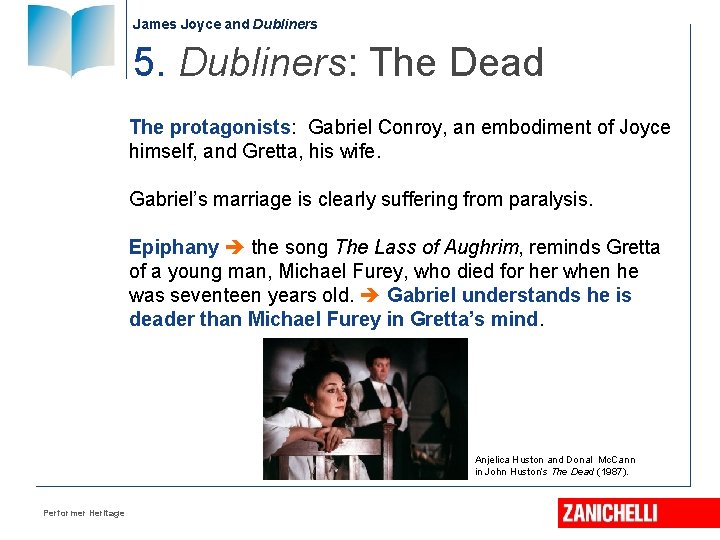
James Joyce and Dubliners 5. Dubliners: The Dead The protagonists: Gabriel Conroy, an embodiment of Joyce himself, and Gretta, his wife. Gabriel’s marriage is clearly suffering from paralysis. Epiphany the song The Lass of Aughrim, reminds Gretta of a young man, Michael Furey, who died for her when he was seventeen years old. Gabriel understands he is deader than Michael Furey in Gretta’s mind. Anjelica Huston and Donal Mc. Cann in John Huston’s The Dead (1987). Performer Heritage
- Slides: 27