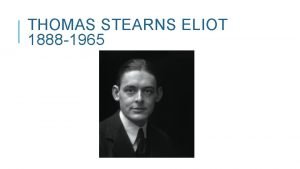
Thomas Stearns Eliot 1888 1965 Performer Heritage Marina


- Slides: 17
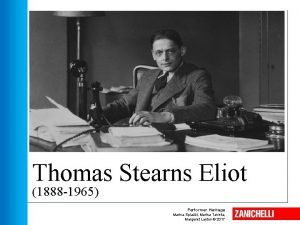
Thomas Stearns Eliot (1888 -1965) Performer Heritage Marina Spiazzi, Marina Tavella, Margaret Layton © 2017
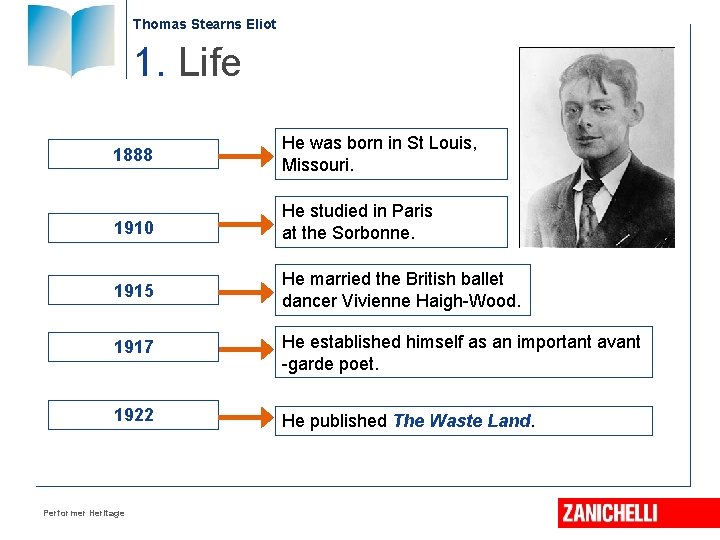
Thomas Stearns Eliot 1. Life 1888 He was born in St Louis, Missouri. 1910 He studied in Paris at the Sorbonne. 1915 He married the British ballet dancer Vivienne Haigh-Wood. 1917 He established himself as an important avant -garde poet. 1922 He published The Waste Land. Performer Heritage
Thomas Stearns Eliot 1. Life 1925 He became a director for the publishers Faber & Faber. 1927 He acquired British citizenship and converted to Anglicanism. 1930 For the next thirty years he was considered as the most dominant figure in poetry and literary criticism in the English-speaking world. 1948 He received the Nobel Prize for Literature. 1965 He died in London. Performer Heritage
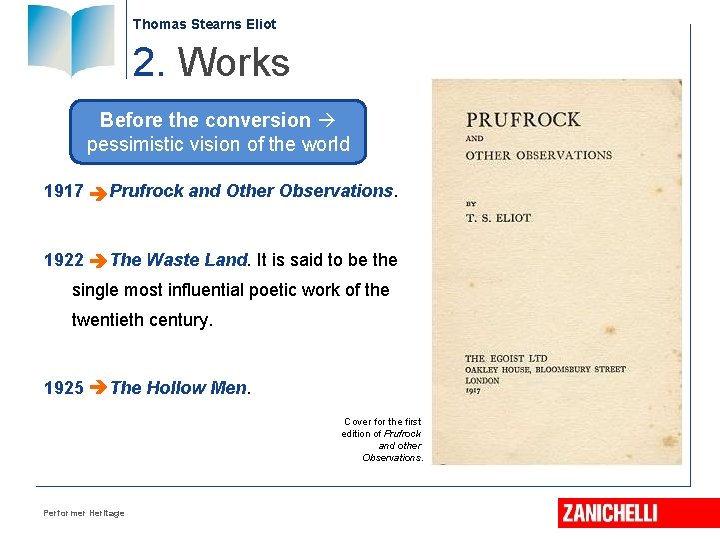
Thomas Stearns Eliot 2. Works Before the conversion pessimistic vision of the world 1917 Prufrock and Other Observations. 1922 The Waste Land. It is said to be the single most influential poetic work of the twentieth century. 1925 The Hollow Men. Cover for the first edition of Prufrock and other Observations. Performer Heritage
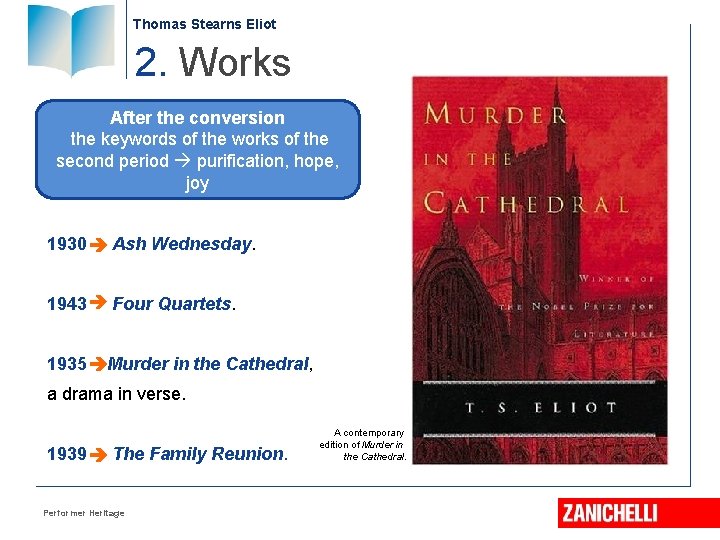
Thomas Stearns Eliot 2. Works After the conversion the keywords of the works of the second period purification, hope, joy 1930 Ash Wednesday. 1943 Four Quartets. 1935 Murder in the Cathedral, a drama in verse. 1939 The Family Reunion. Performer Heritage A contemporary edition of Murder in the Cathedral.
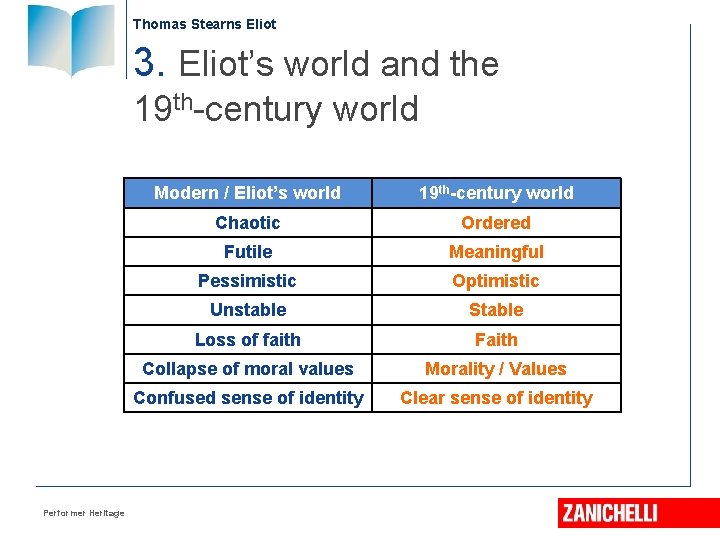
Thomas Stearns Eliot 3. Eliot’s world and the 19 th-century world Performer Heritage Modern / Eliot’s world 19 th-century world Chaotic Ordered Futile Meaningful Pessimistic Optimistic Unstable Stable Loss of faith Faith Collapse of moral values Morality / Values Confused sense of identity Clear sense of identity
Thomas Stearns Eliot 4. The impersonality of the artist Eliot shared with the modern novelist James Joyce the view of the importance for the artist to be impersonal and to separate ‘the man who suffers’ from ‘the mind which creates’. ‘The poet has not a personality to express, but a particular medium, which is only a medium and not a personality. ’ ‘The emotion of art is impersonal. ’ Performer Heritage
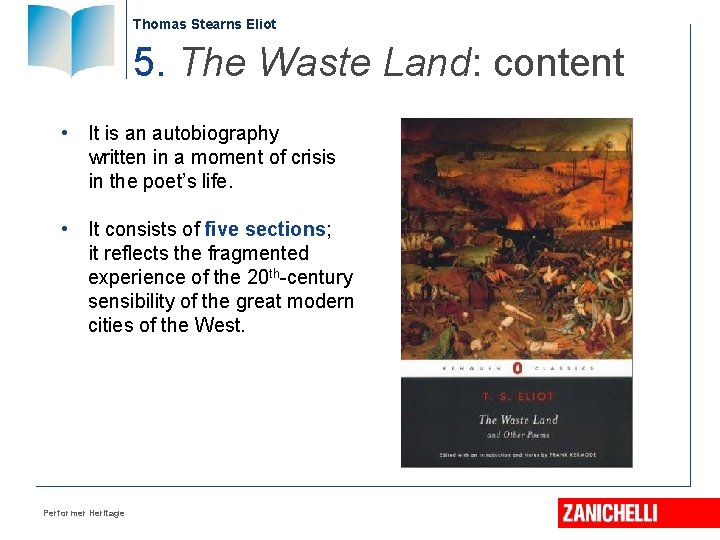
Thomas Stearns Eliot 5. The Waste Land: content • It is an autobiography written in a moment of crisis in the poet’s life. • It consists of five sections; it reflects the fragmented experience of the 20 th-century sensibility of the great modern cities of the West. Performer Heritage
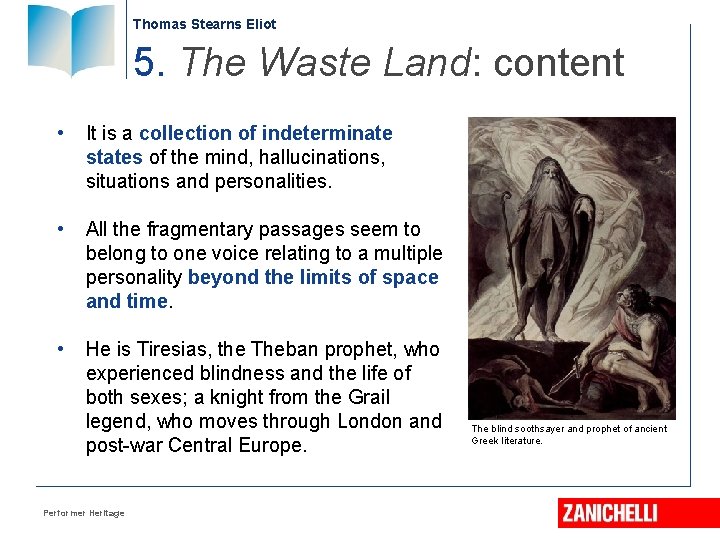
Thomas Stearns Eliot 5. The Waste Land: content • It is a collection of indeterminate states of the mind, hallucinations, situations and personalities. • All the fragmentary passages seem to belong to one voice relating to a multiple personality beyond the limits of space and time. • He is Tiresias, the Theban prophet, who experienced blindness and the life of both sexes; a knight from the Grail legend, who moves through London and post-war Central Europe. Performer Heritage The blind soothsayer and prophet of ancient Greek literature.
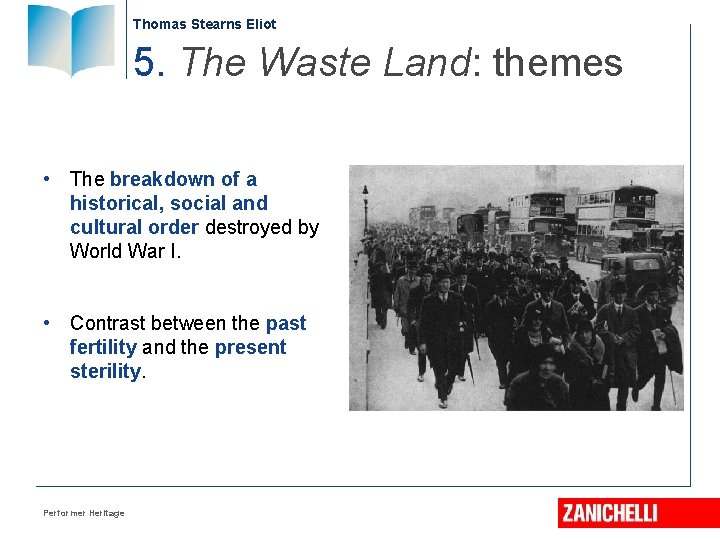
Thomas Stearns Eliot 5. The Waste Land: themes • The breakdown of a historical, social and cultural order destroyed by World War I. • Contrast between the past fertility and the present sterility. Performer Heritage
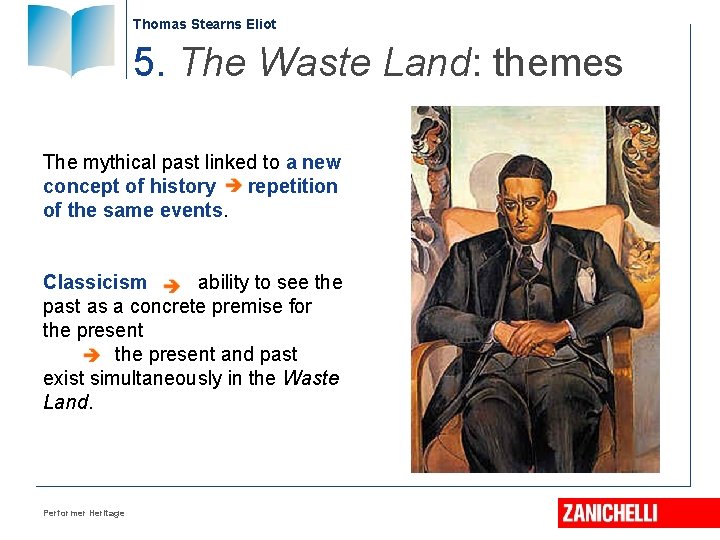
Thomas Stearns Eliot 5. The Waste Land: themes The mythical past linked to a new concept of history repetition of the same events. Classicism ability to see the past as a concrete premise for the present and past exist simultaneously in the Waste Land. Performer Heritage
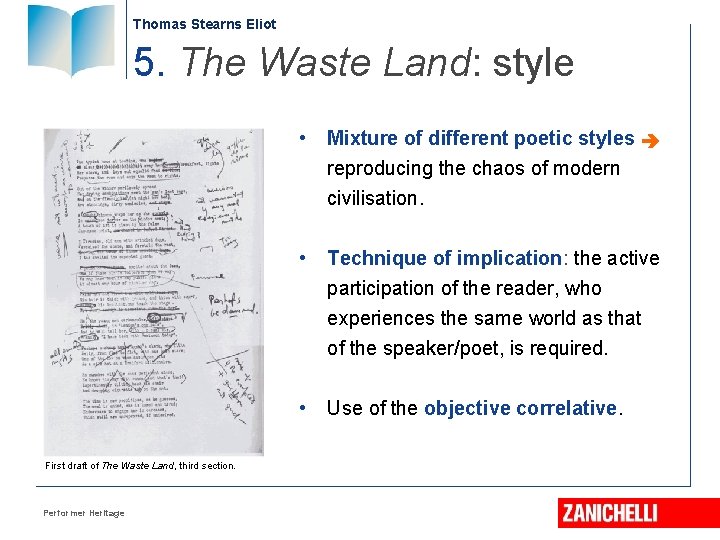
Thomas Stearns Eliot 5. The Waste Land: style First draft of The Waste Land, third section. Performer Heritage • Mixture of different poetic styles reproducing the chaos of modern civilisation. • Technique of implication: the active participation of the reader, who experiences the same world as that of the speaker/poet, is required. • Use of the objective correlative.
Thomas Stearns Eliot 5. The Waste Land: style For Eliot, the ‘objective correlative’ a pattern of objects, events, actions, or a situation that can serve effectively to awaken in the reader an emotional response without being a direct statement of that subjective emotion. Performer Heritage
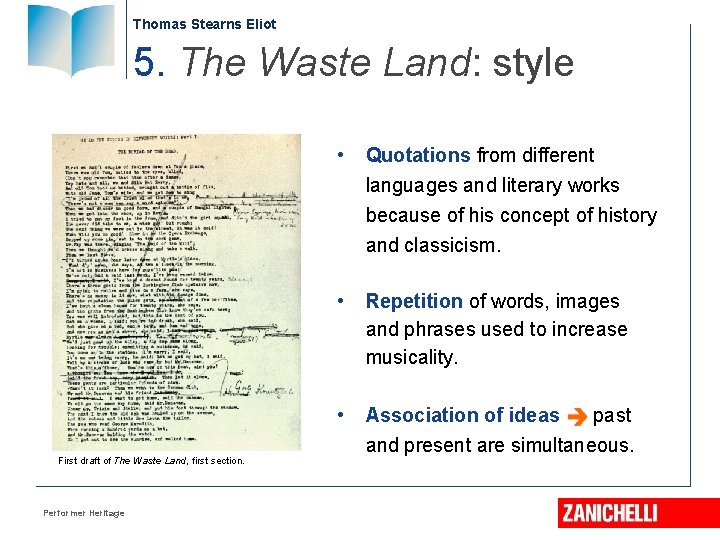
Thomas Stearns Eliot 5. The Waste Land: style First draft of The Waste Land, first section. Performer Heritage • Quotations from different languages and literary works because of his concept of history and classicism. • Repetition of words, images and phrases used to increase musicality. • Association of ideas past and present are simultaneous.
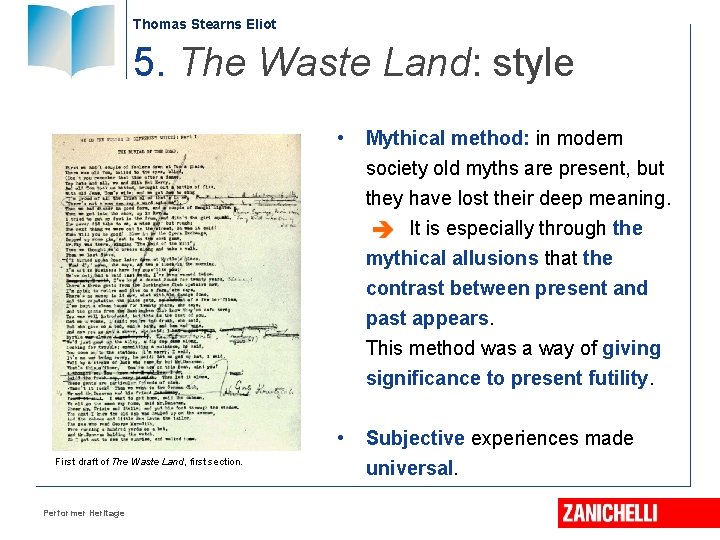
Thomas Stearns Eliot 5. The Waste Land: style • Mythical method: in modern society old myths are present, but they have lost their deep meaning. It is especially through the mythical allusions that the contrast between present and past appears. This method was a way of giving significance to present futility. • First draft of The Waste Land, first section. Performer Heritage Subjective experiences made universal.
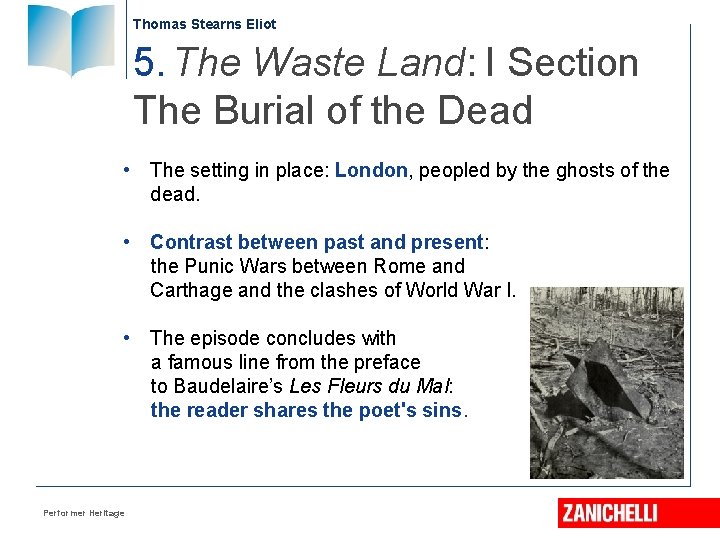
Thomas Stearns Eliot 5. The Waste Land: I Section The Burial of the Dead • The setting in place: London, peopled by the ghosts of the dead. • Contrast between past and present: the Punic Wars between Rome and Carthage and the clashes of World War I. • The episode concludes with a famous line from the preface to Baudelaire’s Les Fleurs du Mal: the reader shares the poet's sins. Performer Heritage
Thomas Stearns Eliot 5. The Waste Land: III Section The Fire Sermon • The speaker: Tiresias, a figure from classical mythology. He has both male and female features, he is blind but can foresee the future. • Tiresias observes a young typist, waiting for her lover, a dull and slightly arrogant clerk. • Main action: a loveless sexual encounter between this couple. • At the end the typist is glad the encounter is over and done. Performer Heritage