Postquantum cryptography Andreas Hlsing 19 12 2017 Secretkey




- Slides: 104
Post-quantum cryptography Andreas Hülsing 19. 12. 2017
Secret-key cryptography
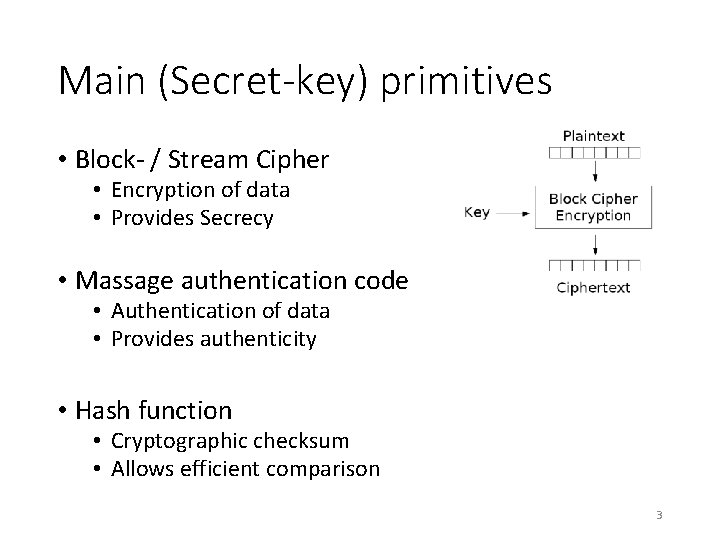
Main (Secret-key) primitives • Block- / Stream Cipher • Encryption of data • Provides Secrecy • Massage authentication code • Authentication of data • Provides authenticity • Hash function • Cryptographic checksum • Allows efficient comparison 3
Public-key cryptography
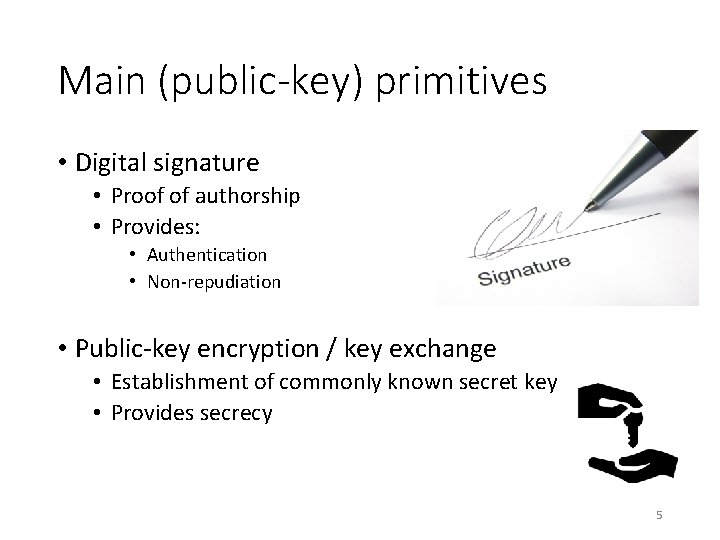
Main (public-key) primitives • Digital signature • Proof of authorship • Provides: • Authentication • Non-repudiation • Public-key encryption / key exchange • Establishment of commonly known secret key • Provides secrecy 5
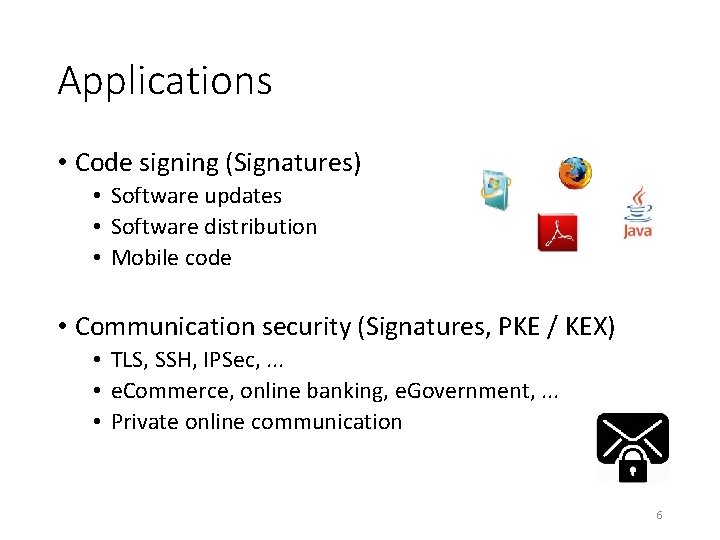
Applications • Code signing (Signatures) • Software updates • Software distribution • Mobile code • Communication security (Signatures, PKE / KEX) • TLS, SSH, IPSec, . . . • e. Commerce, online banking, e. Government, . . . • Private online communication 6
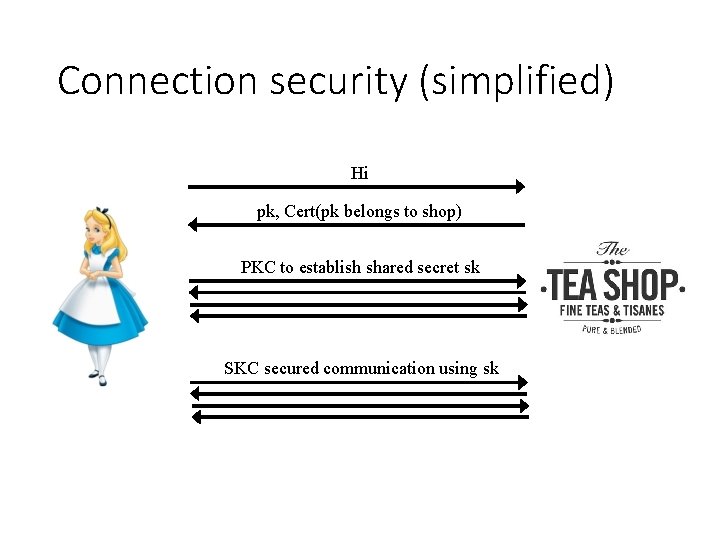
Connection security (simplified) Hi pk, Cert(pk belongs to shop) PKC to establish shared secret sk SKC secured communication using sk
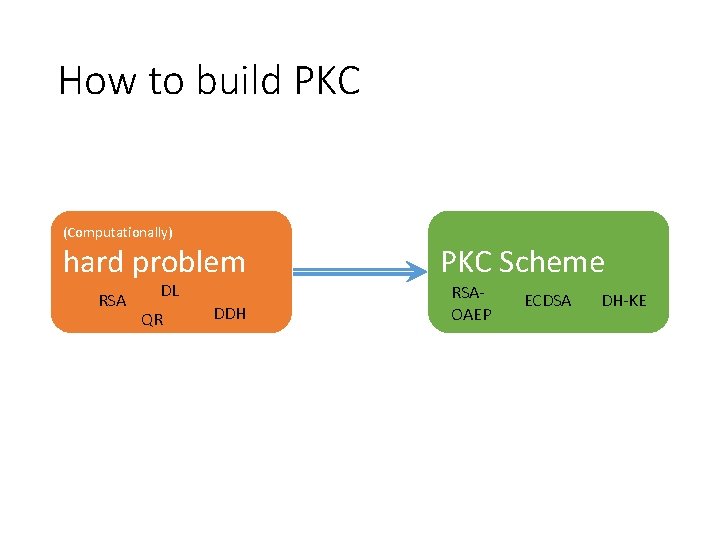
How to build PKC (Computationally) hard problem RSA DL QR DDH PKC Scheme RSAOAEP ECDSA DH-KE
Today‘s Crypto-Eco-System Public key cryptography: • Deployed schemes are based on RSA- and discrete logarithm problem (incl. ECC, DH. . . ). Secret key / Symmetric cryptography: • Wide range of different schemes. • Not based on „hard problems“, rather on „design principles“
What happens if the TWO problems are solved? • No (practical) secure communication • No online payment • No e-Commerce • No Internet privacy • No private online communication • with insurance company, public institutions, etc. • With private contacts (this includes Skype, whatsapp, etc. (although these are already questionable today. . )) • Everyone in same Wi. Fi network can listen to your connection
Quantum Computing
Quantum Computing “Quantum computing studies theoretical computation systems (quantum computers) that make direct use of quantum-mechanical phenomena, such as superposition and entanglement, to perform operations on data. ” -- Wikipedia
The Quantum Threat
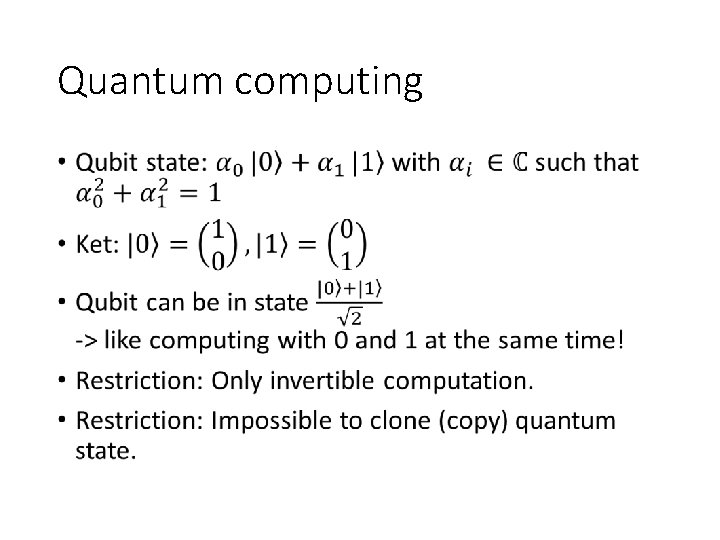
Quantum computing •
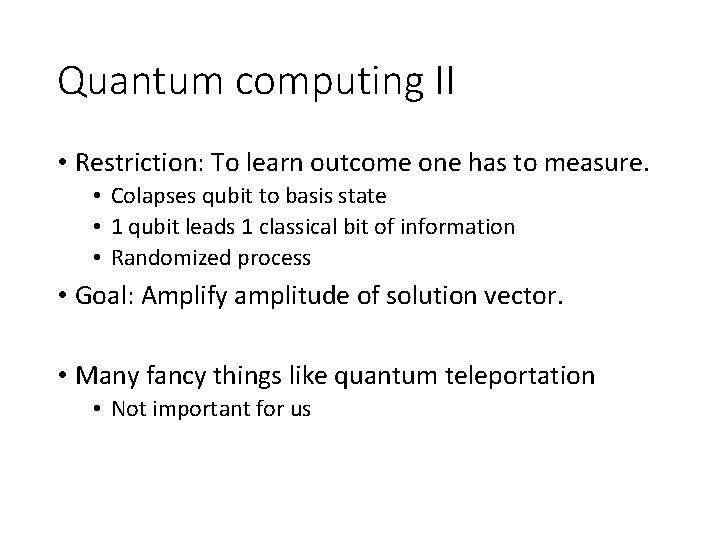
Quantum computing II • Restriction: To learn outcome one has to measure. • Colapses qubit to basis state • 1 qubit leads 1 classical bit of information • Randomized process • Goal: Amplify amplitude of solution vector. • Many fancy things like quantum teleportation • Not important for us
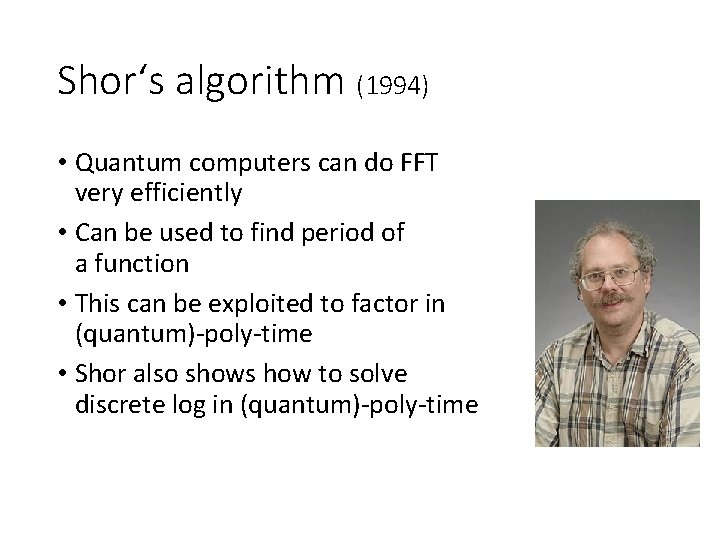
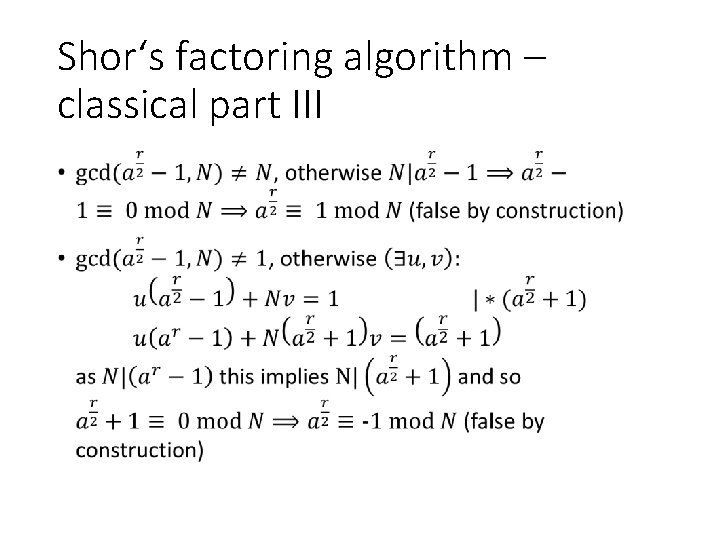
Shor‘s algorithm (1994) • Quantum computers can do FFT very efficiently • Can be used to find period of a function • This can be exploited to factor in (quantum)-poly-time • Shor also shows how to solve discrete log in (quantum)-poly-time
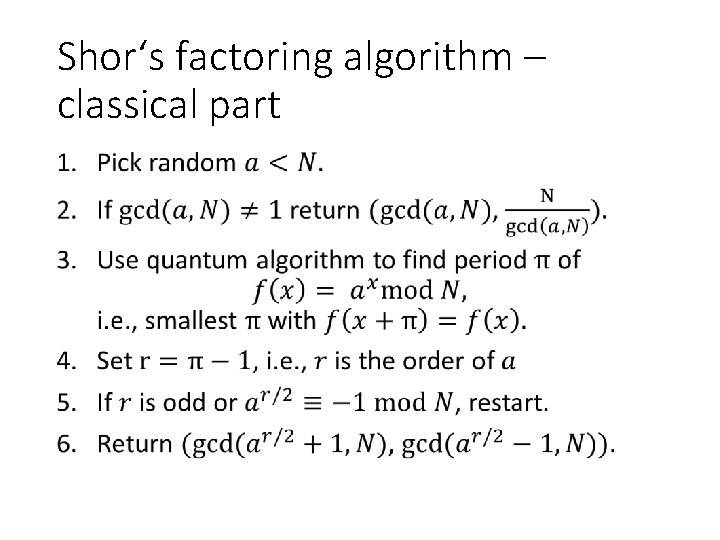
Shor‘s factoring algorithm – classical part •
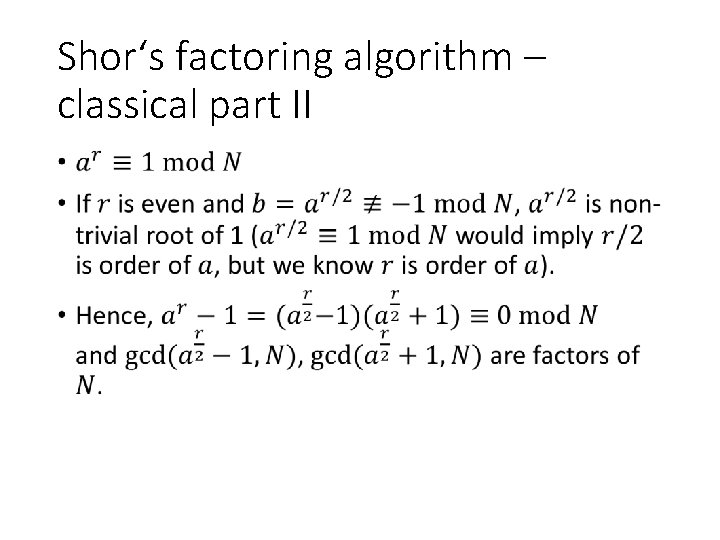
Shor‘s factoring algorithm – classical part II •
Shor‘s factoring algorithm – classical part III •
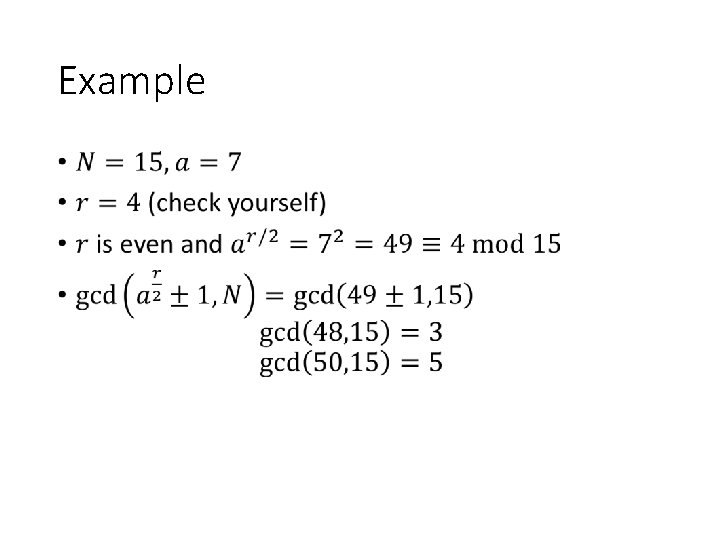
Example •
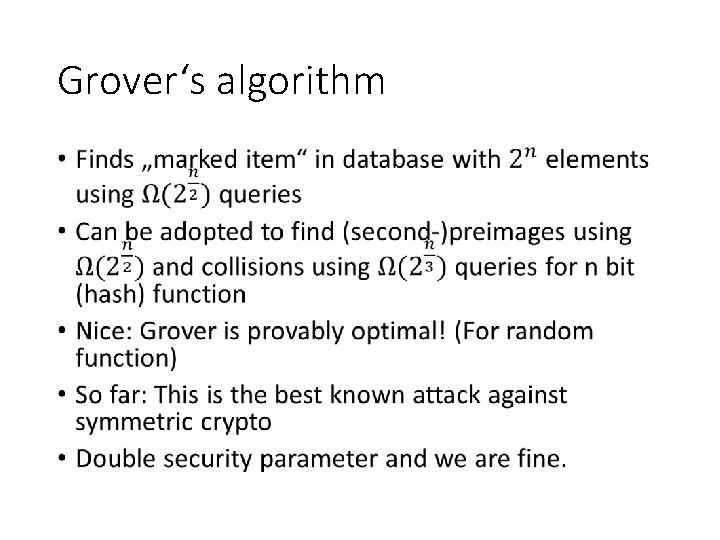
Grover‘s algorithm •
Why care today?
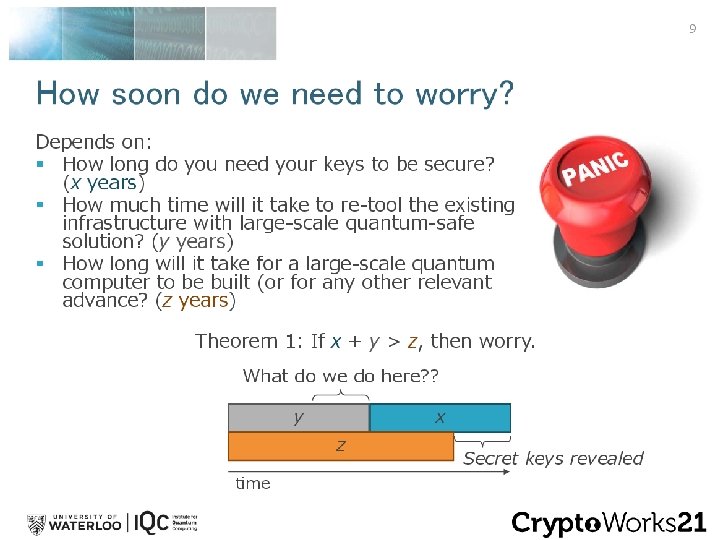
It‘s a question of risk assessment
Quantum Computing “Quantum computing studies theoretical computation systems (quantum computers) that make direct use of quantum-mechanical phenomena, such as superposition and entanglement, to perform operations on data. ” -- Wikipedia
Bad news I will not tell you when a quantum computer will be built!
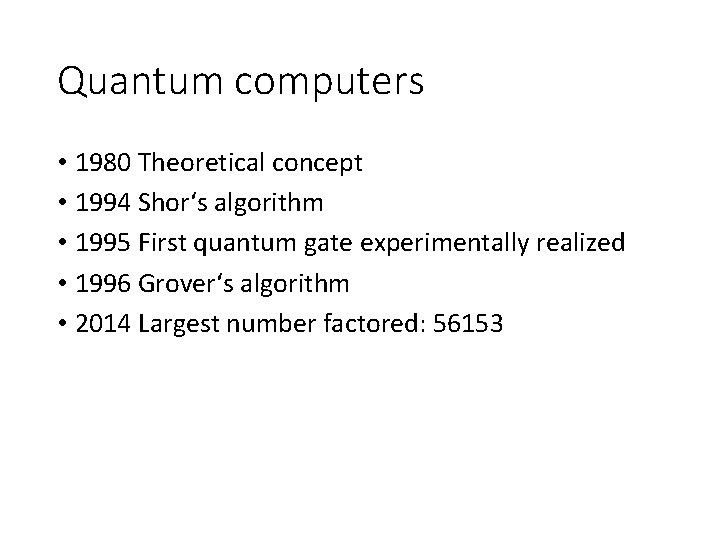
Quantum computers • 1980 Theoretical concept • 1994 Shor‘s algorithm • 1995 First quantum gate experimentally realized • 1996 Grover‘s algorithm • 2014 Largest number factored: 56153
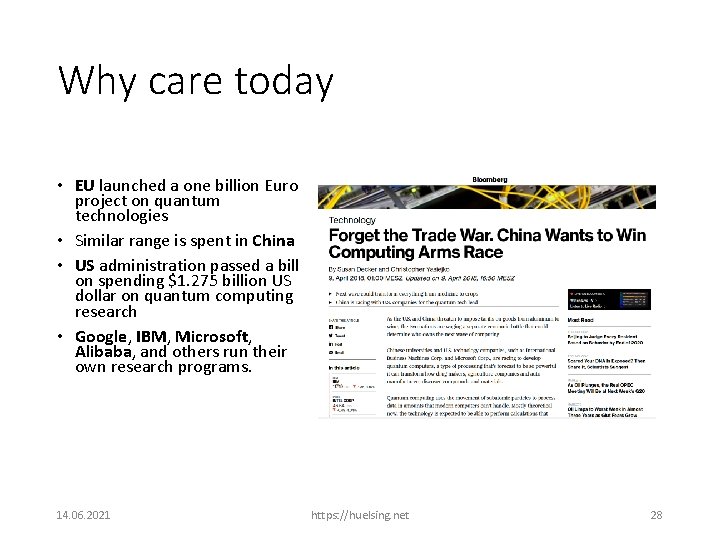
Why care today • EU launched a one billion Euro project on quantum technologies • Similar range is spent in China • US administration passed a bill on spending $1. 275 billion US dollar on quantum computing research • Google, IBM, Microsoft, Alibaba, and others run their own research programs. 14. 06. 2021 https: //huelsing. net 28
(Big) Players in quantum game
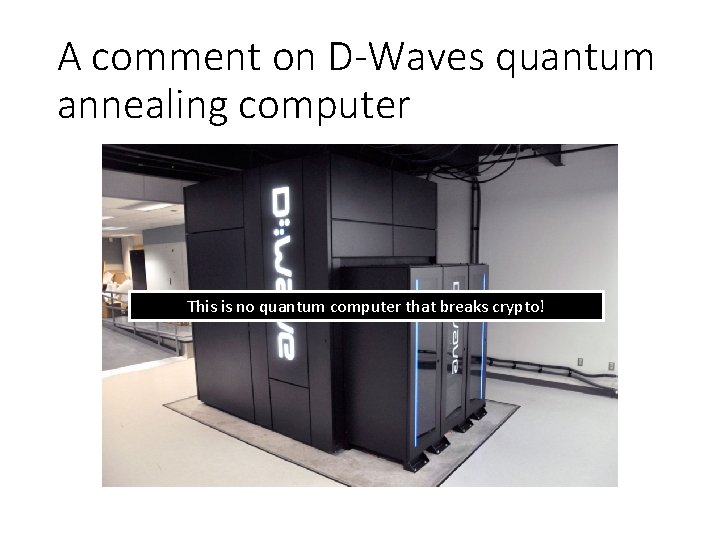
A comment on D-Waves quantum annealing computer This is no quantum computer that breaks crypto!
Interim conclusion • Quantum computers are powerful but not almighty • Can be used to break some crypto but not all crypto: Deployed asymmetric falls, symmetric survives • Unclear when large scale QC‘s ready • If we want to preserve privacy for more than a short time: We have to react now!
Quantum Cryptography
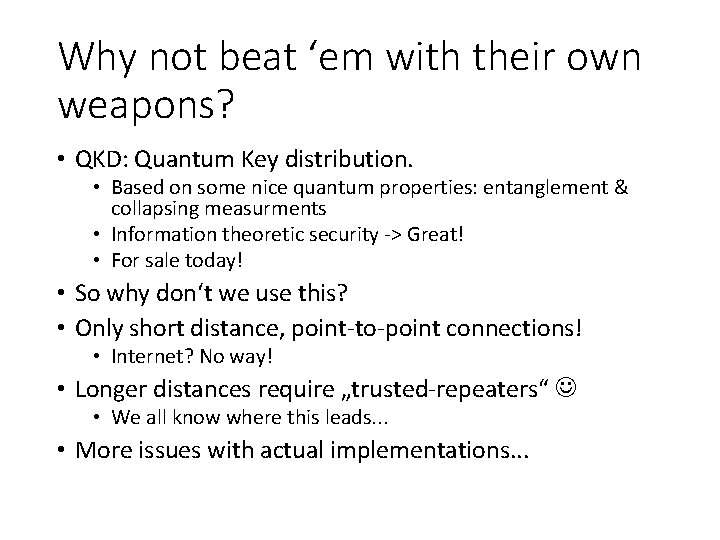
Why not beat ‘em with their own weapons? • QKD: Quantum Key distribution. • Based on some nice quantum properties: entanglement & collapsing measurments • Information theoretic security -> Great! • For sale today! • So why don‘t we use this? • Only short distance, point-to-point connections! • Internet? No way! • Longer distances require „trusted-repeaters“ • We all know where this leads. . . • More issues with actual implementations. . .
Post-Quantum Cryptography
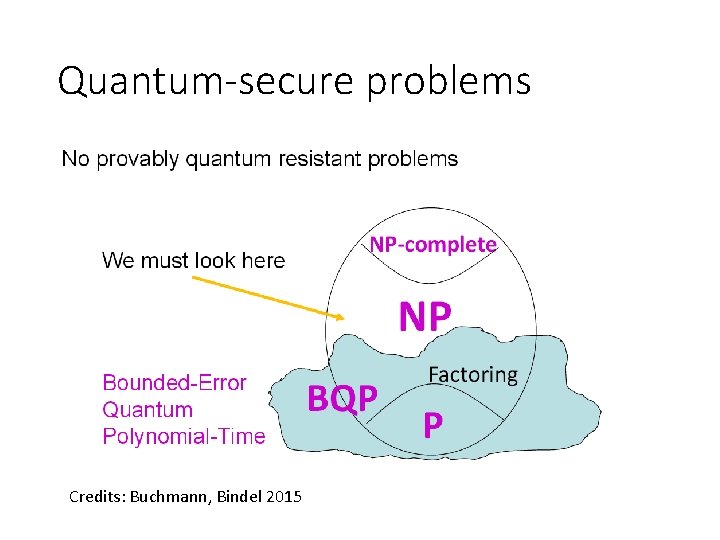
Quantum-secure problems Credits: Buchmann, Bindel 2015
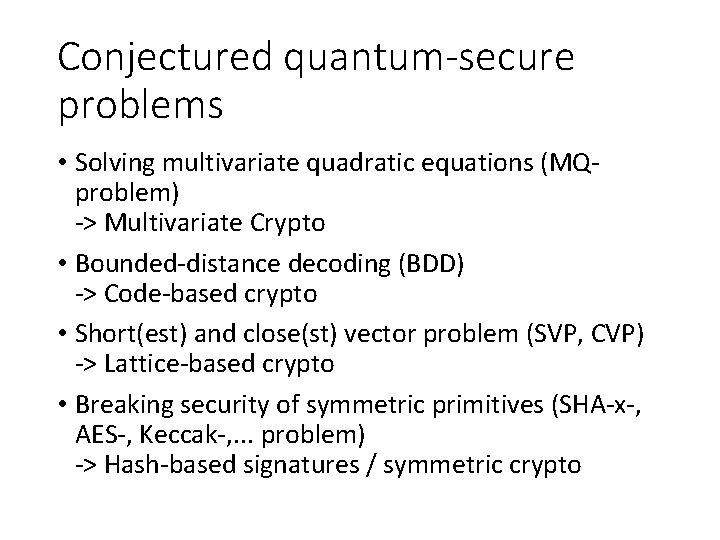
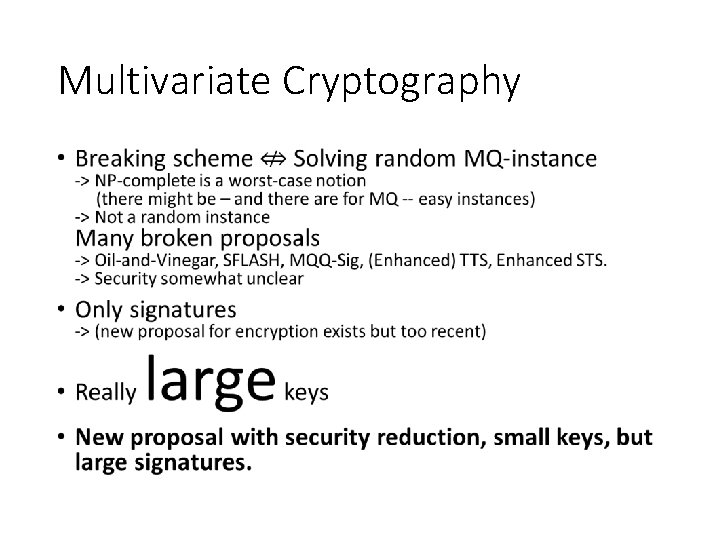
Conjectured quantum-secure problems • Solving multivariate quadratic equations (MQproblem) -> Multivariate Crypto • Bounded-distance decoding (BDD) -> Code-based crypto • Short(est) and close(st) vector problem (SVP, CVP) -> Lattice-based crypto • Breaking security of symmetric primitives (SHA-x-, AES-, Keccak-, . . . problem) -> Hash-based signatures / symmetric crypto
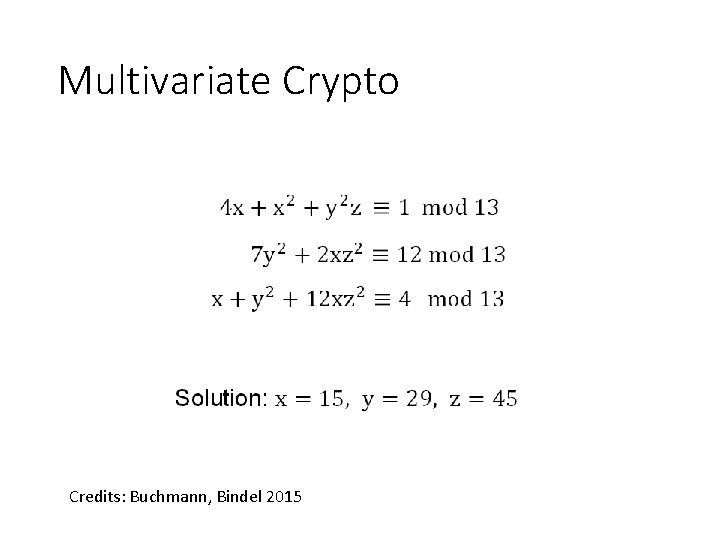
Multivariate Crypto Credits: Buchmann, Bindel 2015
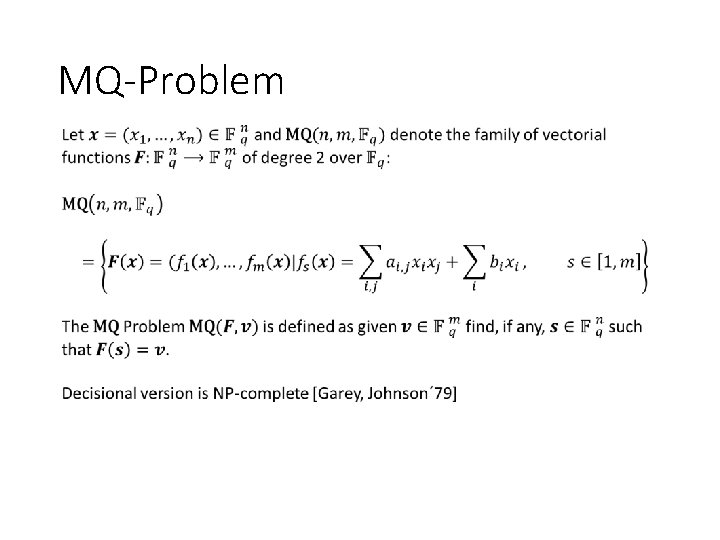
MQ-Problem
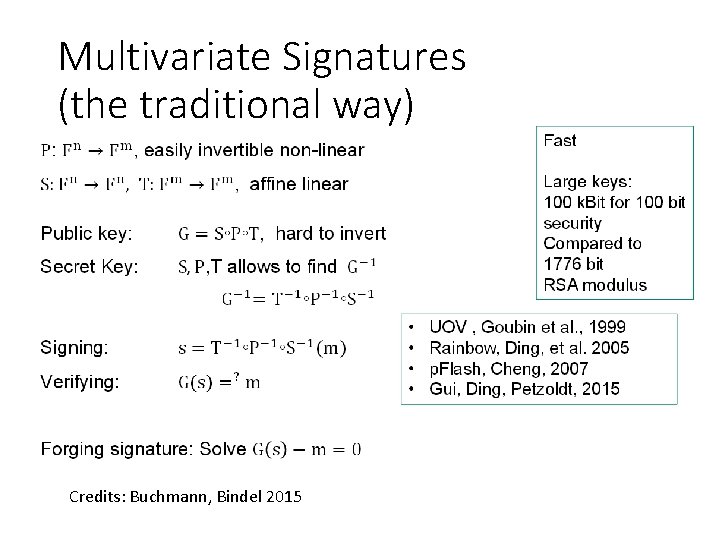
Multivariate Signatures (the traditional way) Credits: Buchmann, Bindel 2015
Multivariate Cryptography •
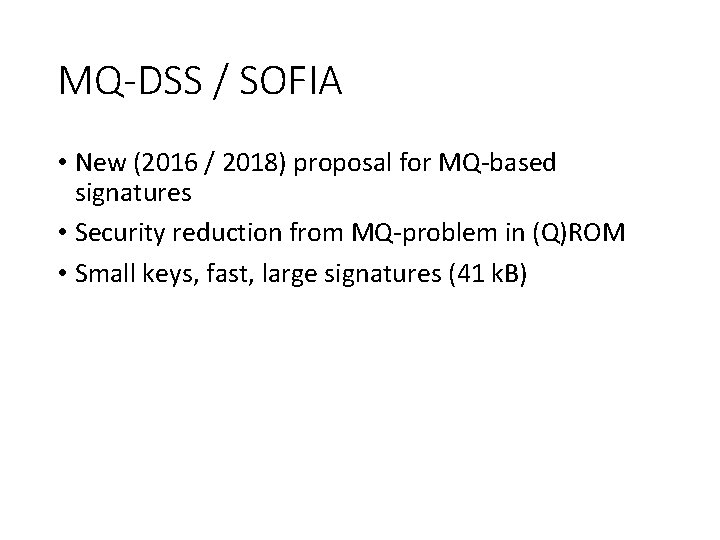
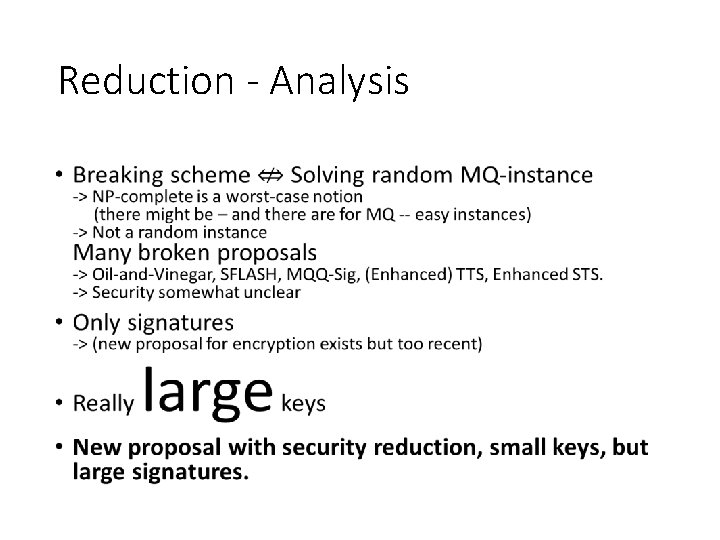
MQ-DSS / SOFIA • New (2016 / 2018) proposal for MQ-based signatures • Security reduction from MQ-problem in (Q)ROM • Small keys, fast, large signatures (41 k. B)
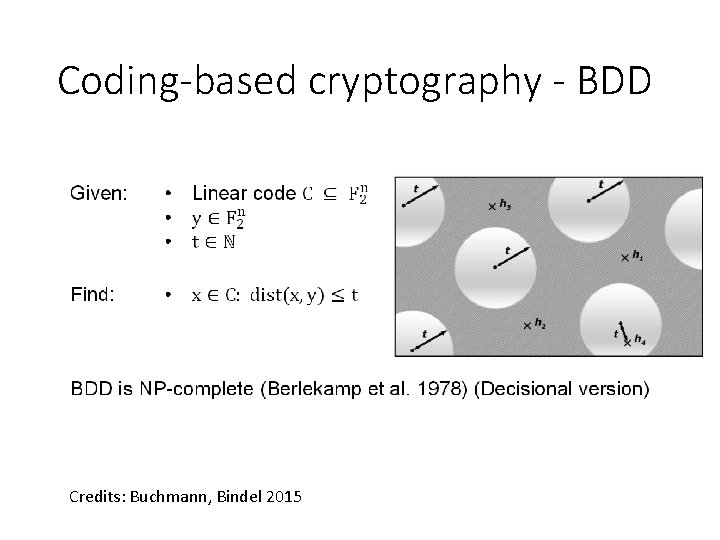
Coding-based cryptography - BDD Credits: Buchmann, Bindel 2015
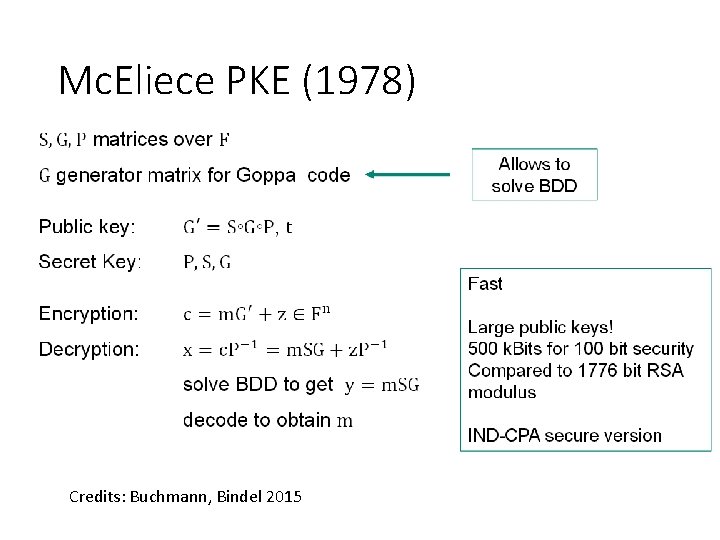
Mc. Eliece PKE (1978) Credits: Buchmann, Bindel 2015
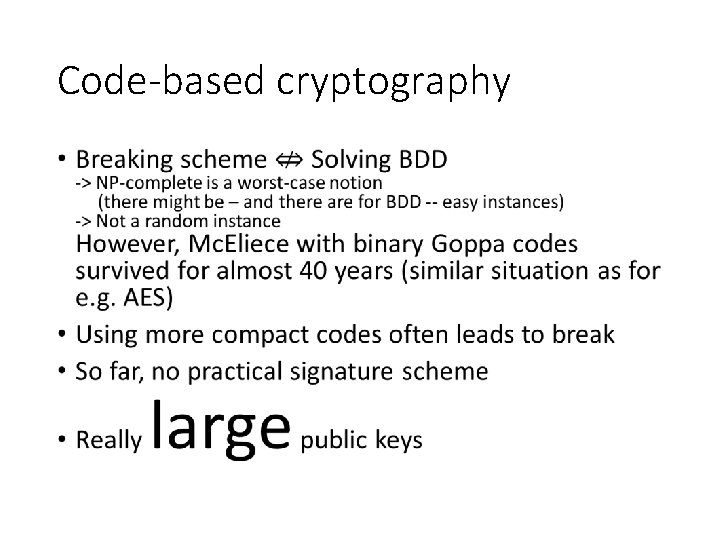
Code-based cryptography •
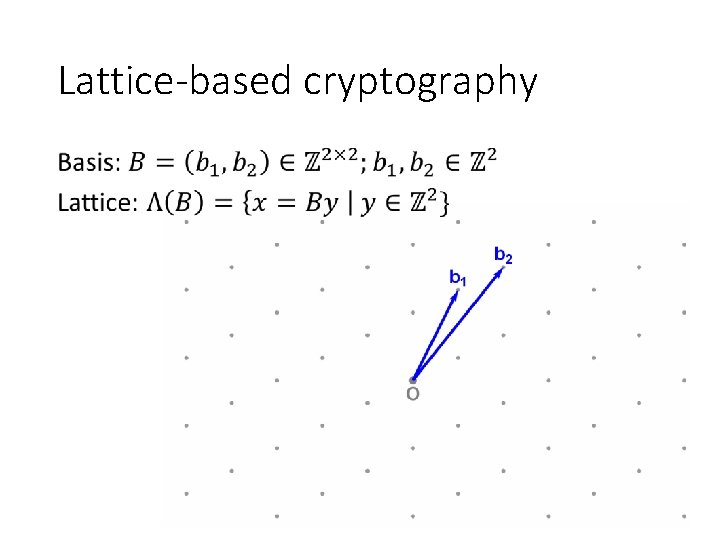
Lattice-based cryptography •
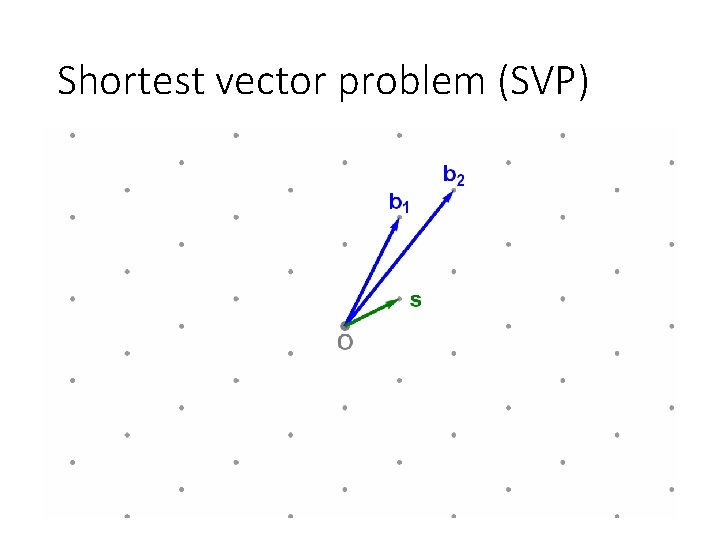
Shortest vector problem (SVP)
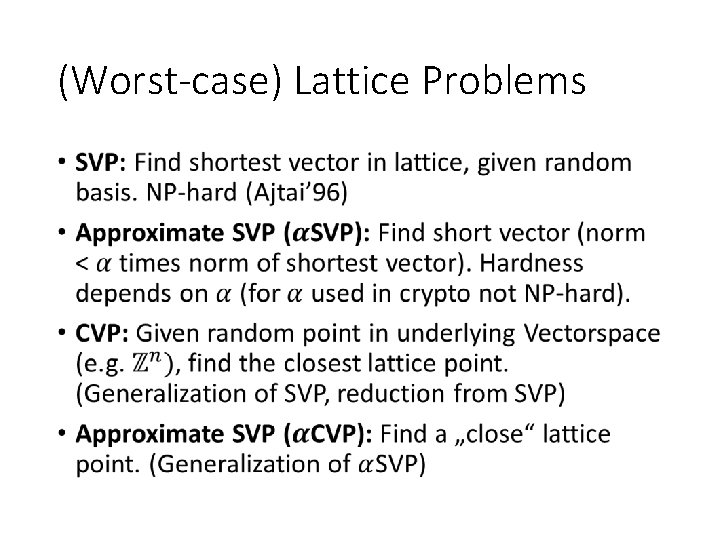
(Worst-case) Lattice Problems •
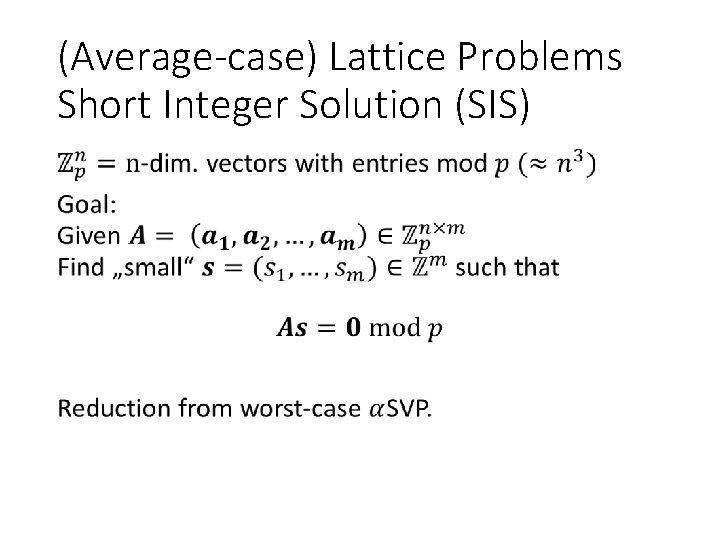
(Average-case) Lattice Problems Short Integer Solution (SIS) •
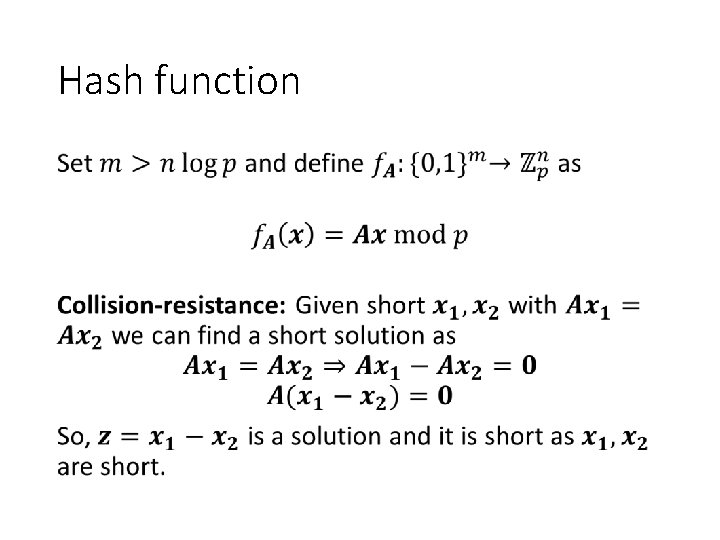
Hash function •
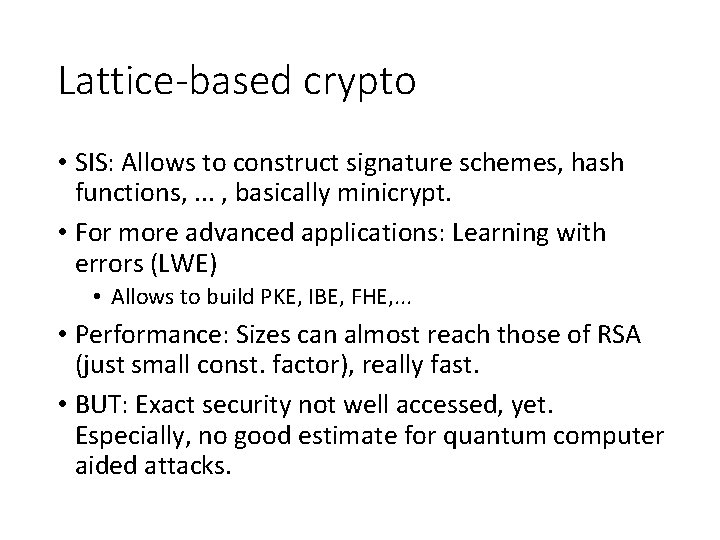
Lattice-based crypto • SIS: Allows to construct signature schemes, hash functions, . . . , basically minicrypt. • For more advanced applications: Learning with errors (LWE) • Allows to build PKE, IBE, FHE, . . . • Performance: Sizes can almost reach those of RSA (just small const. factor), really fast. • BUT: Exact security not well accessed, yet. Especially, no good estimate for quantum computer aided attacks.
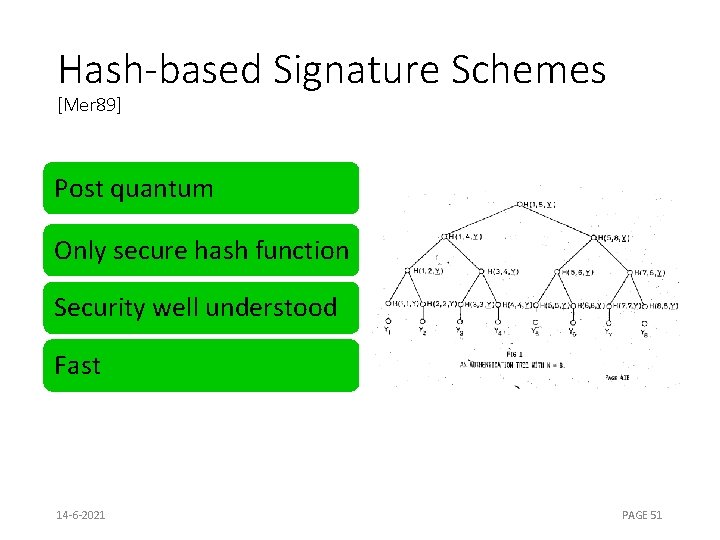
Hash-based Signature Schemes [Mer 89] Post quantum Only secure hash function Security well understood Fast 14 -6 -2021 PAGE 51
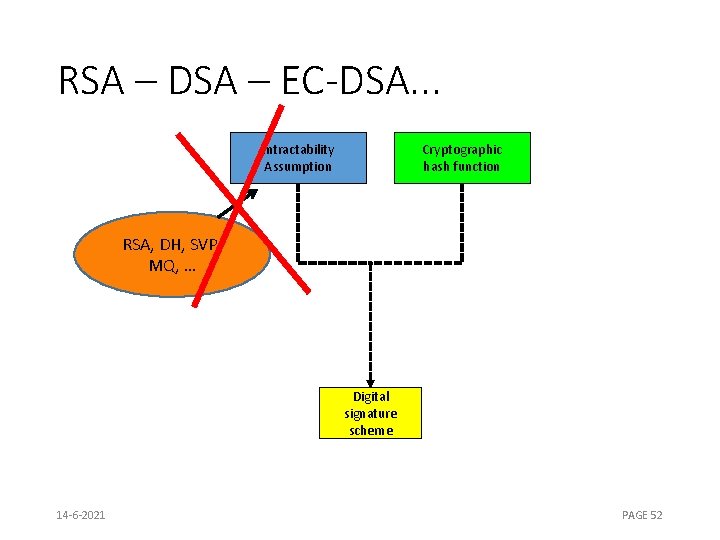
RSA – DSA – EC-DSA. . . Intractability Assumption Cryptographic hash function RSA, DH, SVP, MQ, … Digital signature scheme 14 -6 -2021 PAGE 52
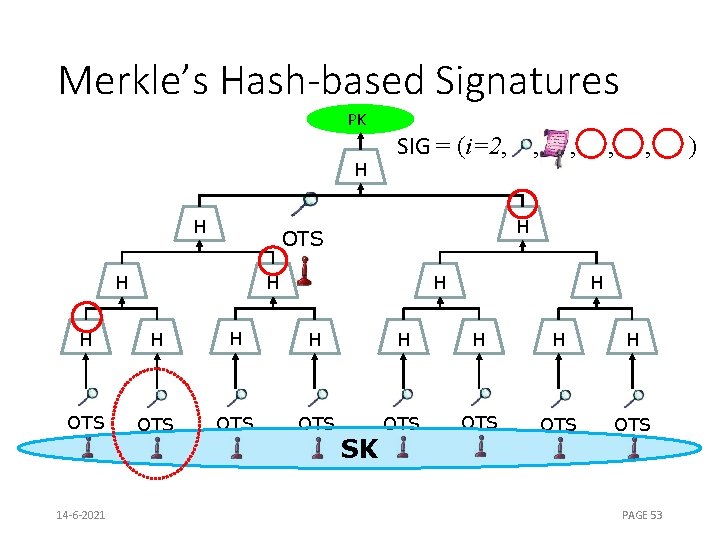
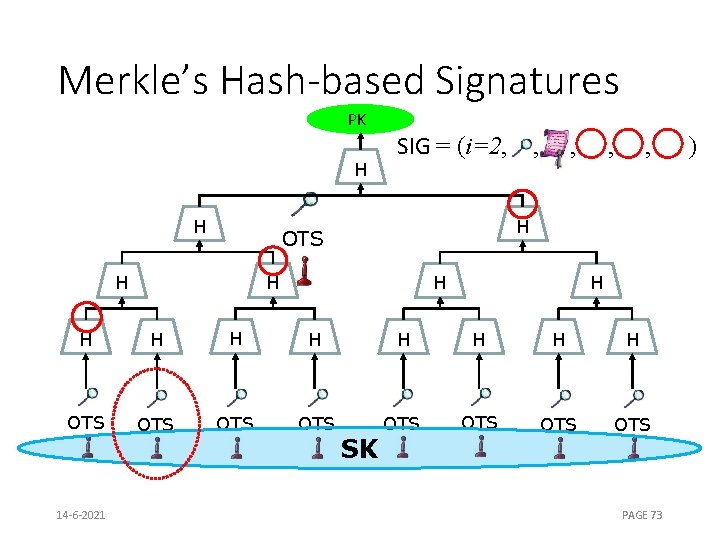
Merkle’s Hash-based Signatures PK H H SIG = (i=2, , H OTS H , H H H OTS OTS 14 -6 -2021 SK PAGE 53 )
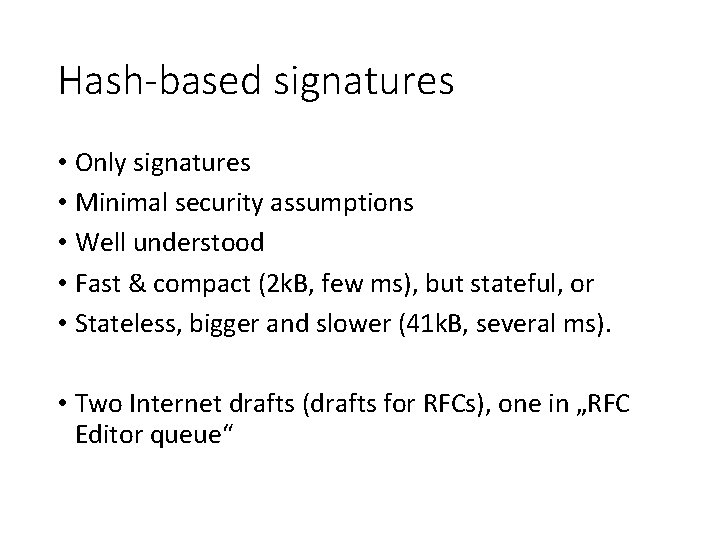
Hash-based signatures • Only signatures • Minimal security assumptions • Well understood • Fast & compact (2 k. B, few ms), but stateful, or • Stateless, bigger and slower (41 k. B, several ms). • Two Internet drafts (drafts for RFCs), one in „RFC Editor queue“
NIST Competition 6/14/2021 Andreas Hülsing https: //huelsing. net 55
Resources • PQ Summer School: https: //2017. pqcrypto. org/school/index. html • NIST PQC Standardization Project: https: //csrc. nist. gov/Projects/Post-Quantum. Cryptography • Master Math (Selected Areas in Cryptology): https: //elo. mastermath. nl/
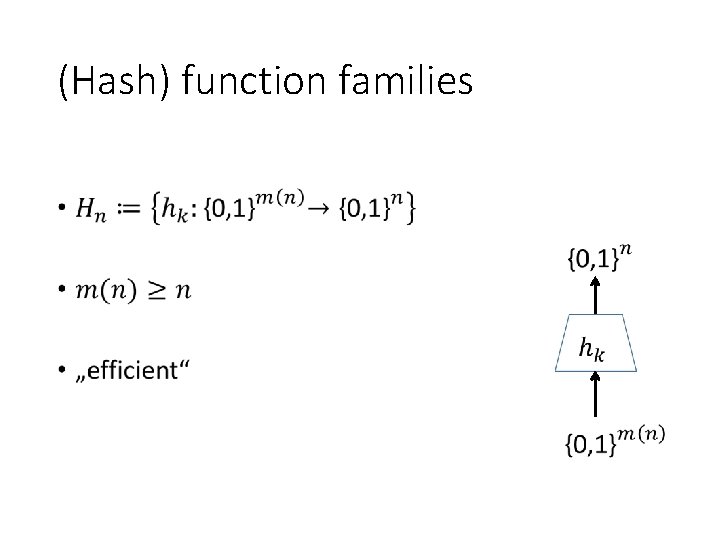
(Hash) function families •
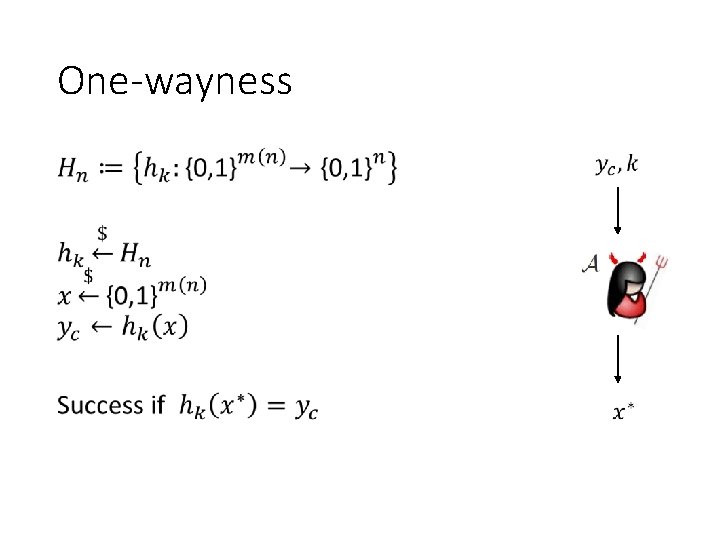
One-wayness •
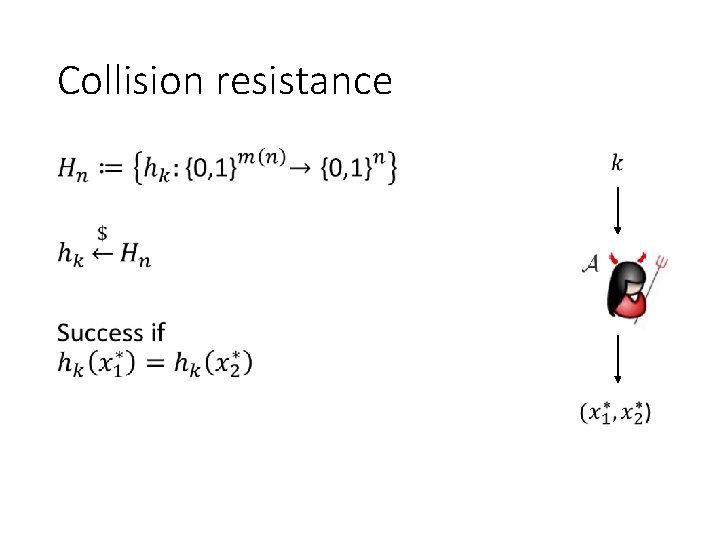
Collision resistance
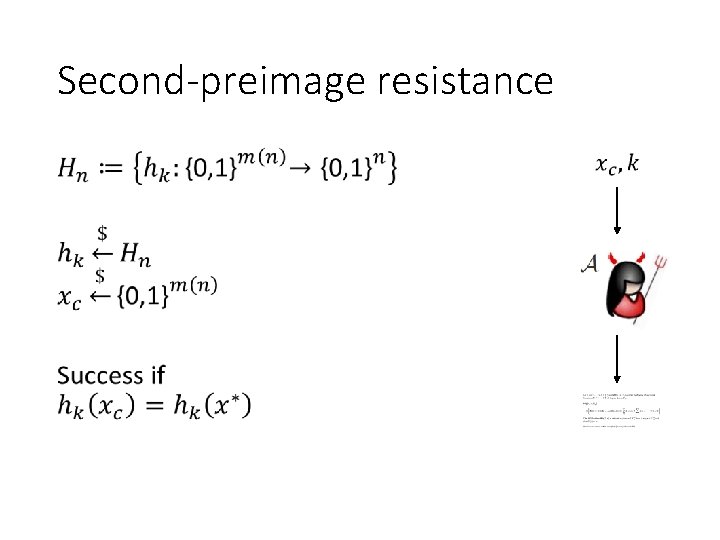
Second-preimage resistance •
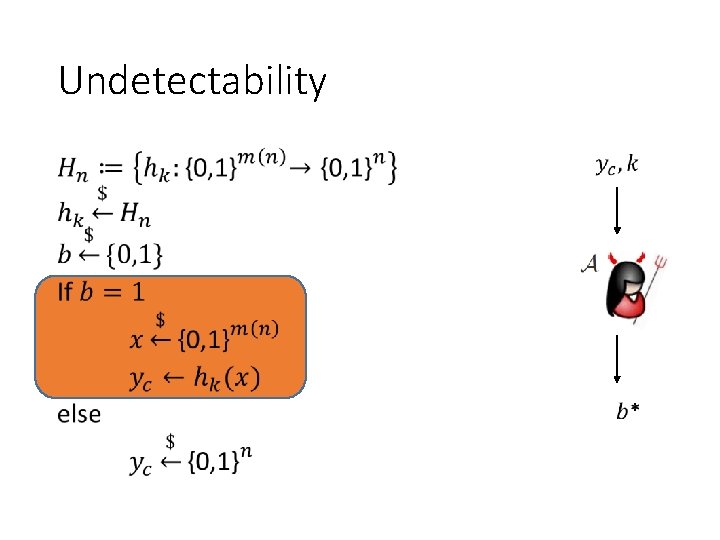
Undetectability •
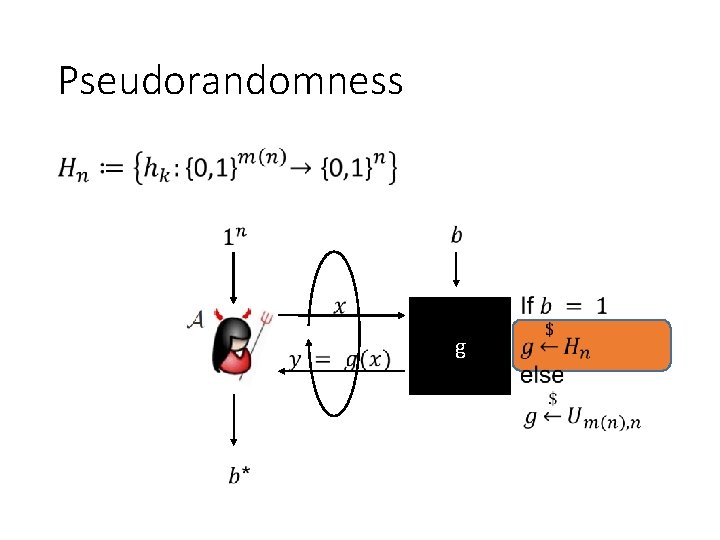
Pseudorandomness • g
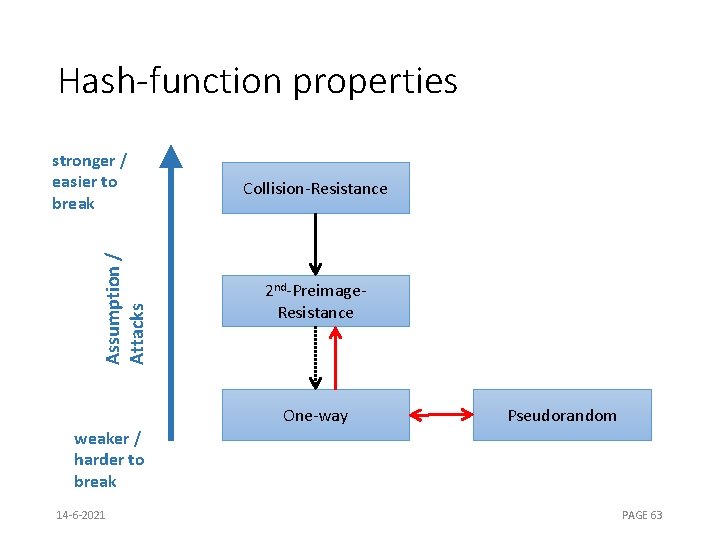
Hash-function properties Assumption / Attacks stronger / easier to break Collision-Resistance 2 nd-Preimage. Resistance One-way Pseudorandom weaker / harder to break 14 -6 -2021 PAGE 63
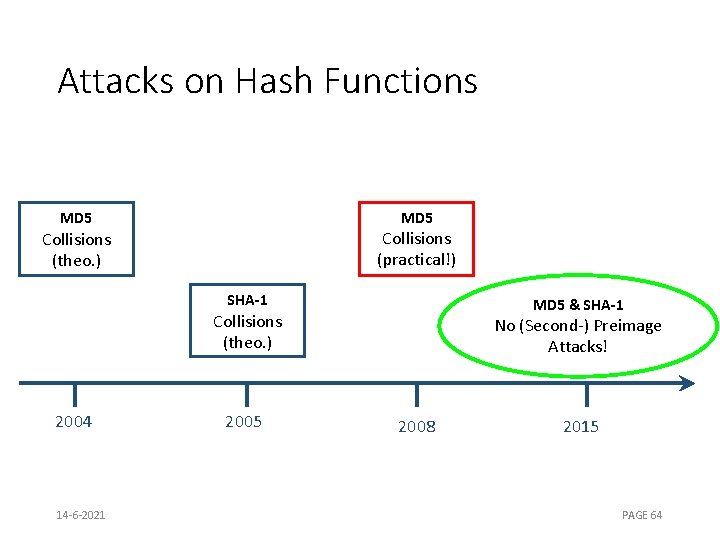
Attacks on Hash Functions MD 5 Collisions (practical!) Collisions (theo. ) SHA-1 MD 5 & SHA-1 Collisions (theo. ) 2004 14 -6 -2021 2005 No (Second-) Preimage Attacks! 2008 2015 PAGE 64
Basic Construction 14 -6 -2021 PAGE 65
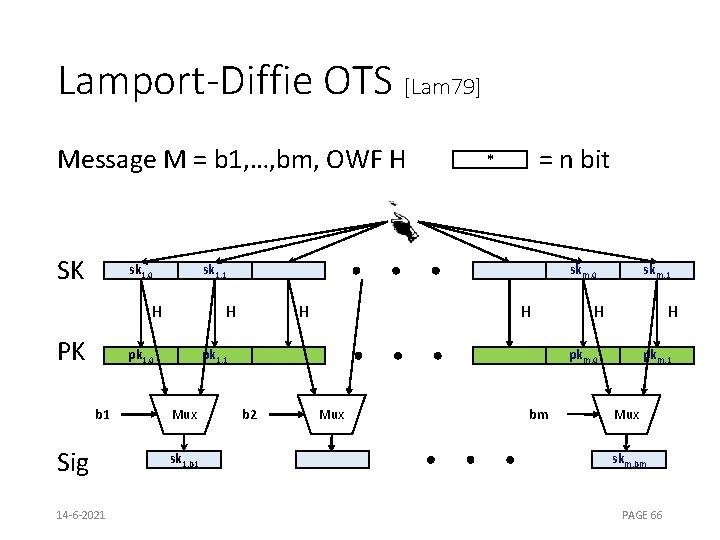
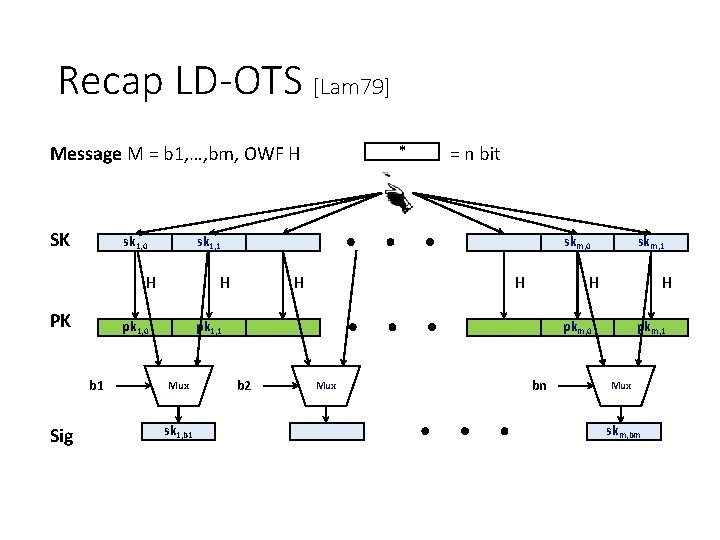
Lamport-Diffie OTS [Lam 79] Message M = b 1, …, bm, OWF H SK sk 1, 0 sk 1, 1 H PK Sig 14 -6 -2021 skm, 0 H pk 1, 0 b 1 = n bit * H H pk 1, 1 Mux sk 1, b 1 skm, 1 H H pkm, 0 b 2 Mux bm pkm, 1 Mux skm, bm PAGE 66
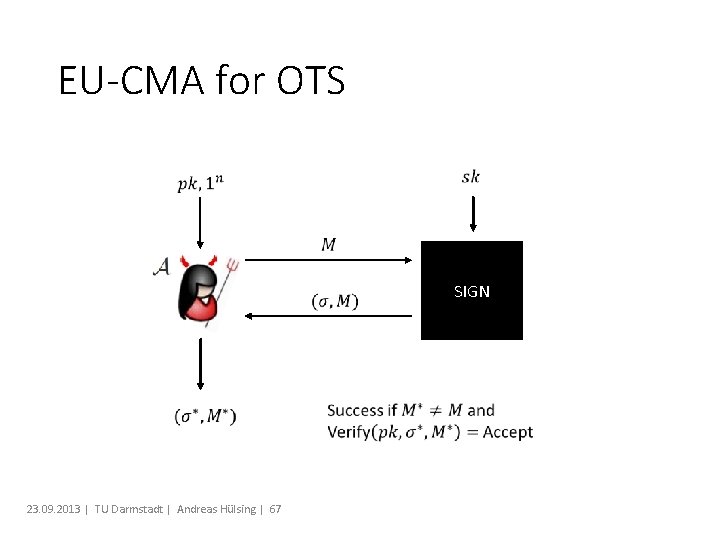
EU-CMA for OTS SIGN 23. 09. 2013 | TU Darmstadt | Andreas Hülsing | 67
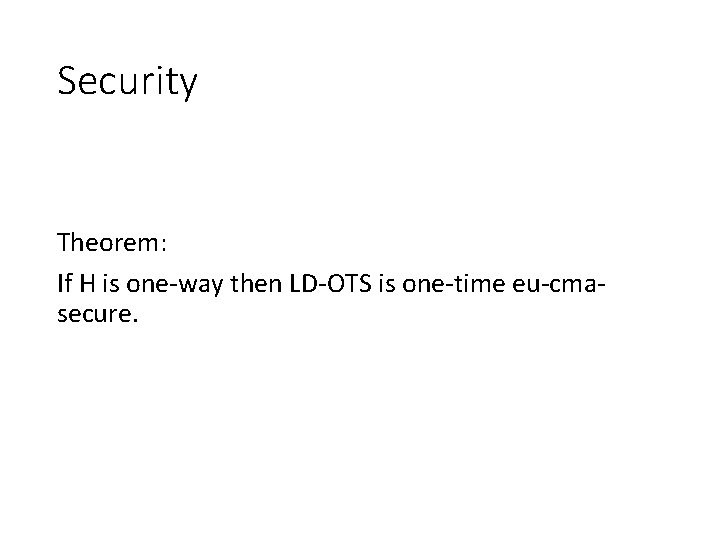
Security Theorem: If H is one-way then LD-OTS is one-time eu-cmasecure.
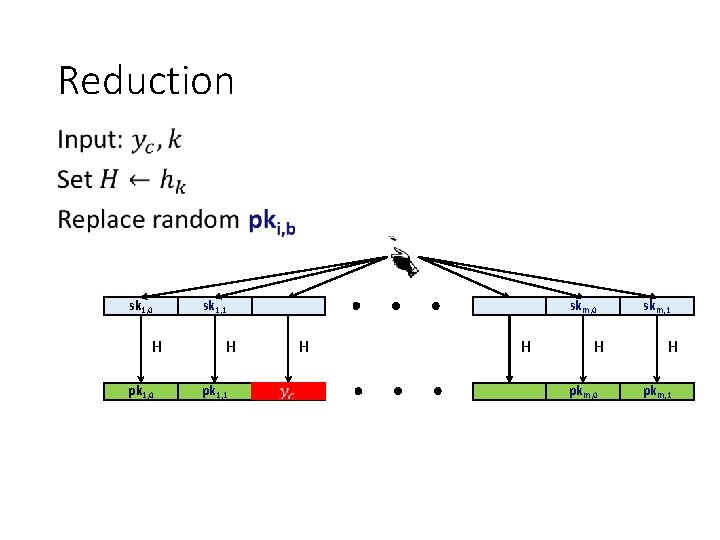
Reduction • sk 1, 0 H pk 1, 0 sk 1, 1 H pk 1, 1 skm, 0 H H H pkm, 0 skm, 1 H pkm, 1
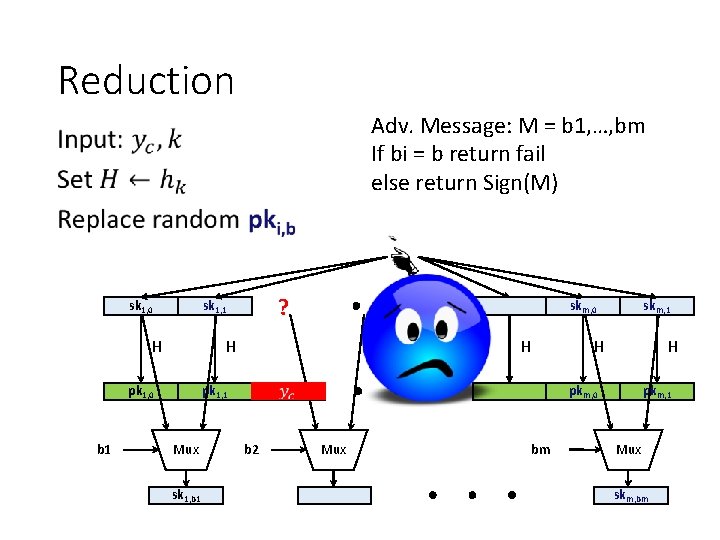
Reduction Adv. Message: M = b 1, …, bm If bi = b return fail else return Sign(M) • sk 1, 0 H skm, 0 H pk 1, 0 b 1 ? sk 1, 1 H H pk 1, 1 Mux sk 1, b 1 skm, 1 H pkm, 0 b 2 Mux bm pkm, 1 Mux skm, bm
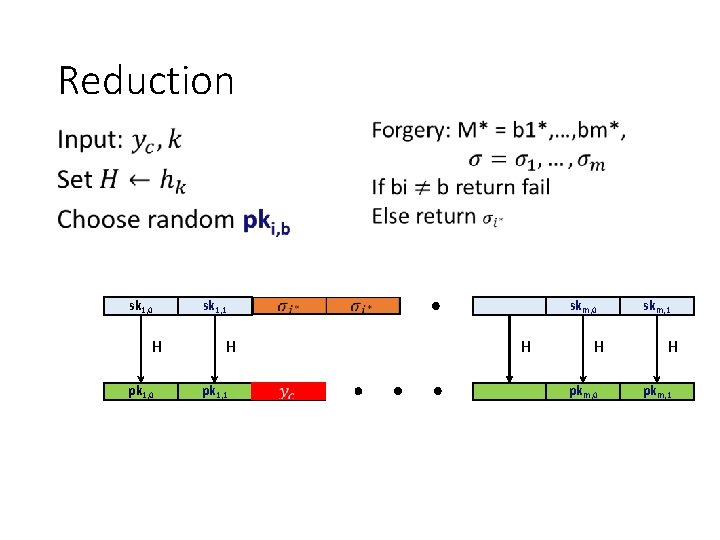
Reduction • sk 1, 0 H pk 1, 0 sk 1, 1 H pk 1, 1 ? skm, 0 H H pkm, 0 skm, 1 H pkm, 1
Reduction - Analysis •
Merkle’s Hash-based Signatures PK H H SIG = (i=2, , H OTS H , H H H OTS OTS 14 -6 -2021 SK PAGE 73 )
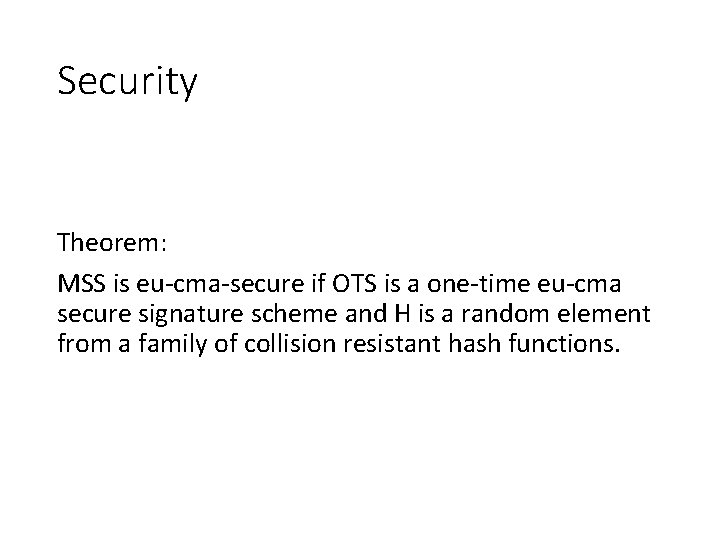
Security Theorem: MSS is eu-cma-secure if OTS is a one-time eu-cma secure signature scheme and H is a random element from a family of collision resistant hash functions.
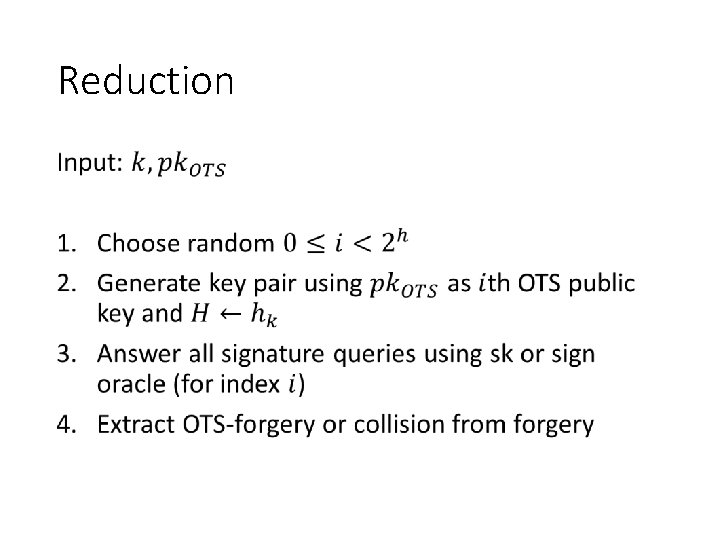
Reduction •
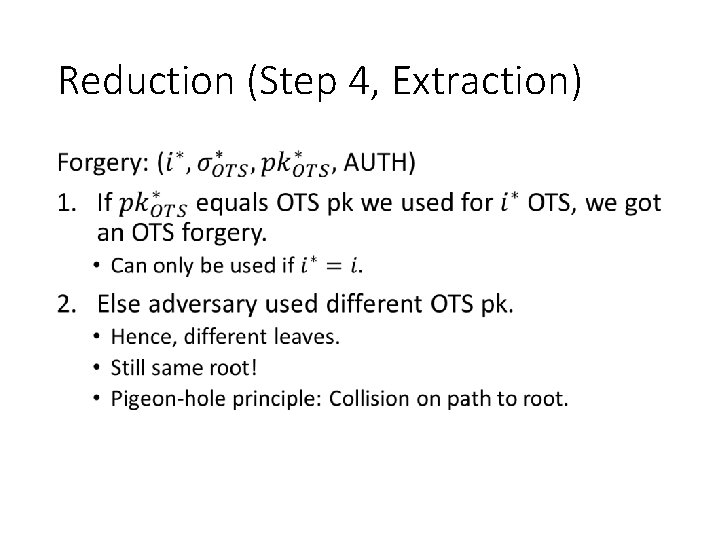
Reduction (Step 4, Extraction) •
Winternitz-OTS
Recap LD-OTS [Lam 79] Message M = b 1, …, bm, OWF H SK sk 1, 0 Sig skm, 0 H pk 1, 0 b 1 = n bit sk 1, 1 H PK * H H H pk 1, 1 Mux sk 1, b 1 skm, 1 H pkm, 0 b 2 Mux bn pkm, 1 Mux skm, bm
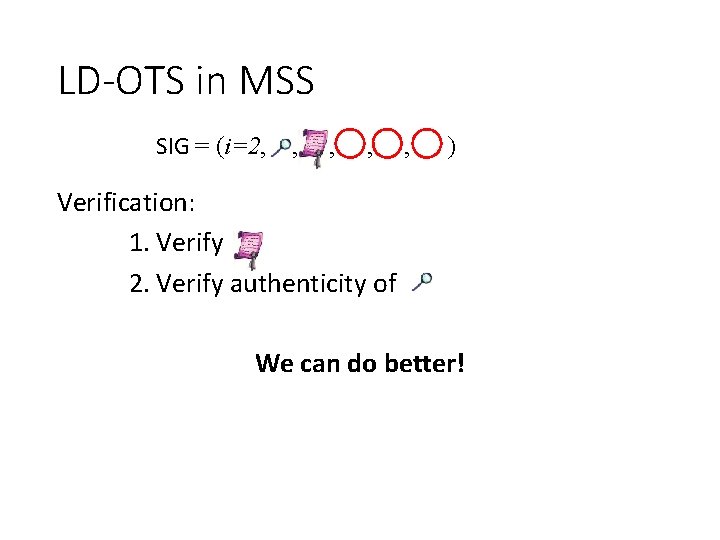
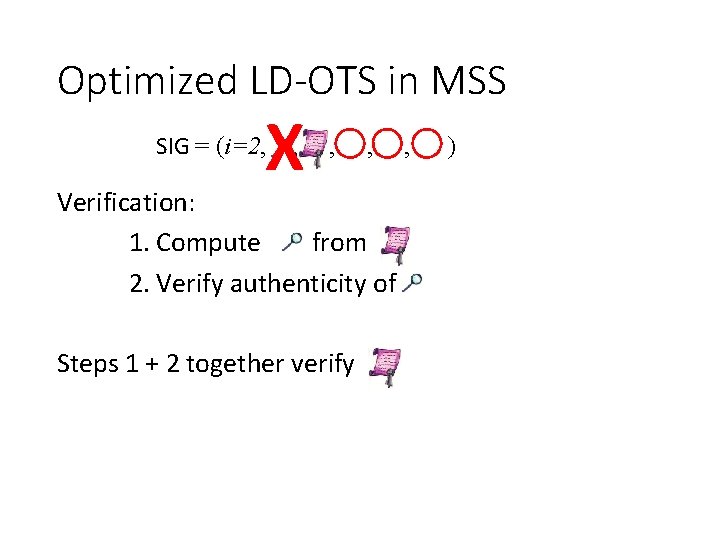
LD-OTS in MSS SIG = (i=2, , , ) Verification: 1. Verify 2. Verify authenticity of We can do better!
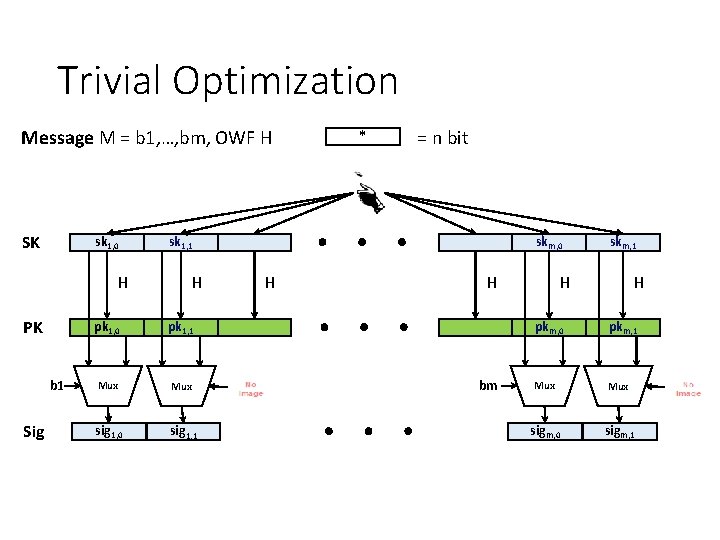
Trivial Optimization Message M = b 1, …, bm, OWF H SK sk 1, 0 H PK b 1 Sig * = n bit sk 1, 1 H pk 1, 0 pk 1, 1 Mux sig 1, 0 sig 1, 1 skm, 0 H H bm skm, 1 H H pkm, 0 pkm, 1 Mux sigm, 0 sigm, 1
Optimized LD-OTS in MSS X SIG = (i=2, , , , Verification: 1. Compute from 2. Verify authenticity of Steps 1 + 2 together verify , )
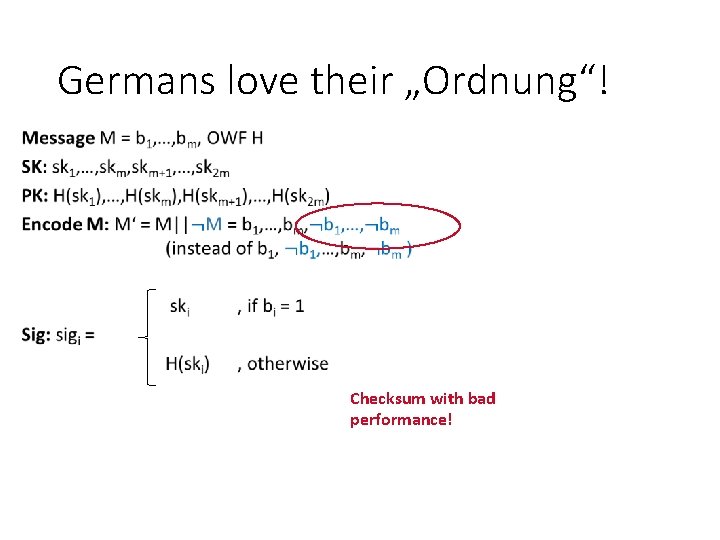
Germans love their „Ordnung“! Checksum with bad performance!
Optimized LD-OTS
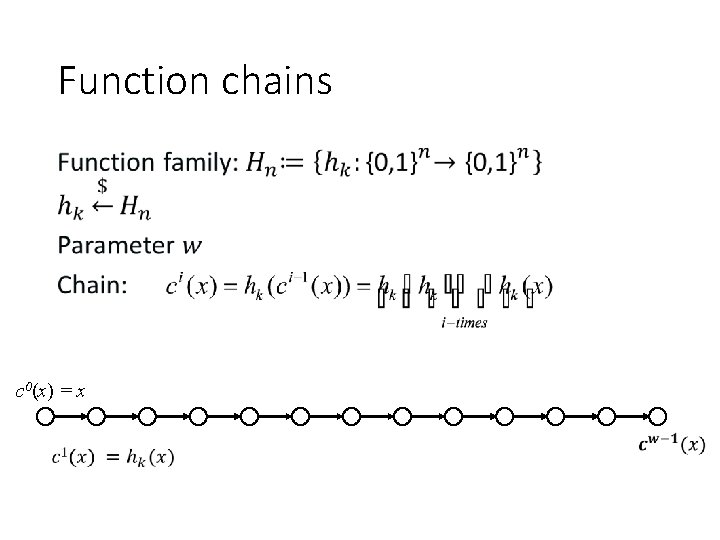
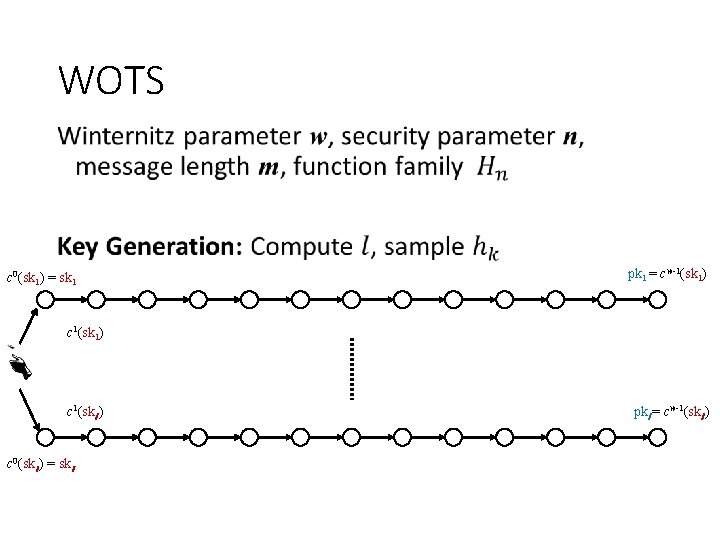
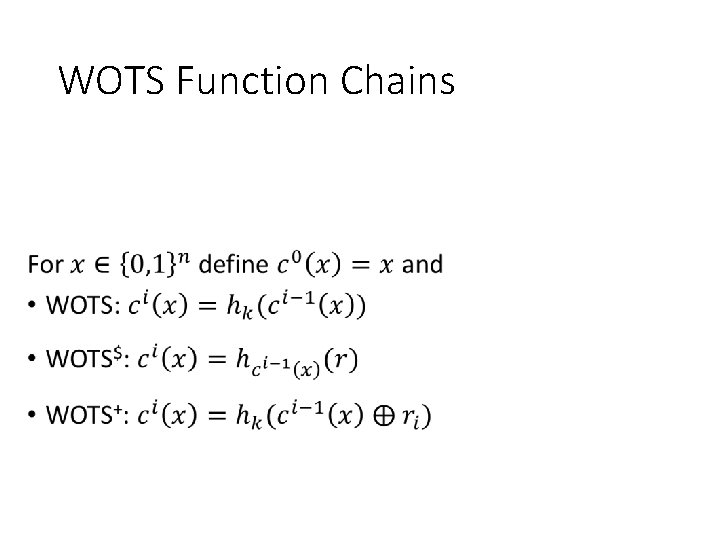
Function chains • c 0(x) = x
WOTS • c 0(sk 1) = sk 1 pk 1 = cw-1(sk 1) c 1(skl ) c 0(skl ) = skl pkl = cw-1(skl )
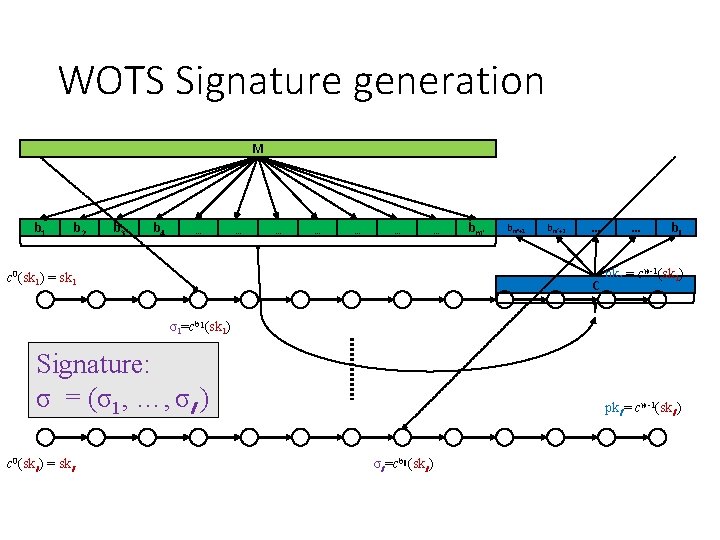
WOTS Signature generation M b 1 b 2 b 3 b 4 … … … … c 0(sk 1) = sk 1 bm‘+1 bm‘+2 … C … bl pk 1 = cw-1(sk 1) σ1=cb 1(sk 1) Signature: σ = (σ1, …, σl ) c 0(skl ) = skl pkl = cw-1(skl ) σl =cbl (skl )
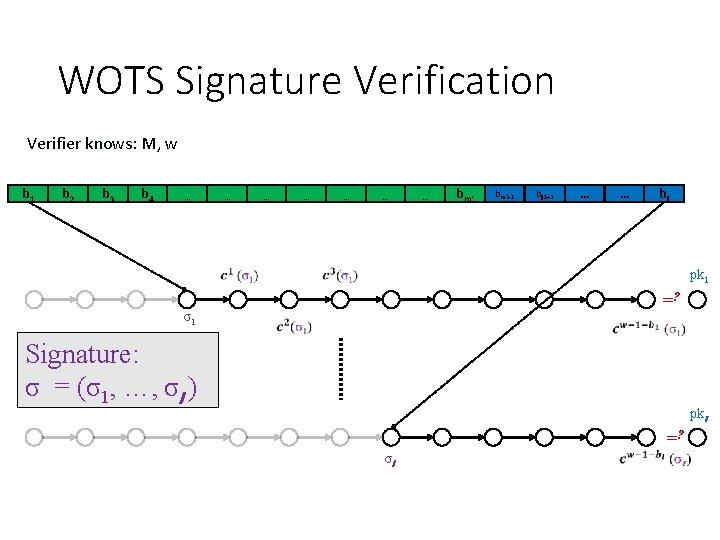
WOTS Signature Verification Verifier knows: M, w b 1 b 2 b 3 b 4 … … … … bm‘+1 bl 1+2 … … bl pk 1 =? σ1 Signature: σ = (σ1, …, σl ) pkl =? σl
WOTS Function Chains •
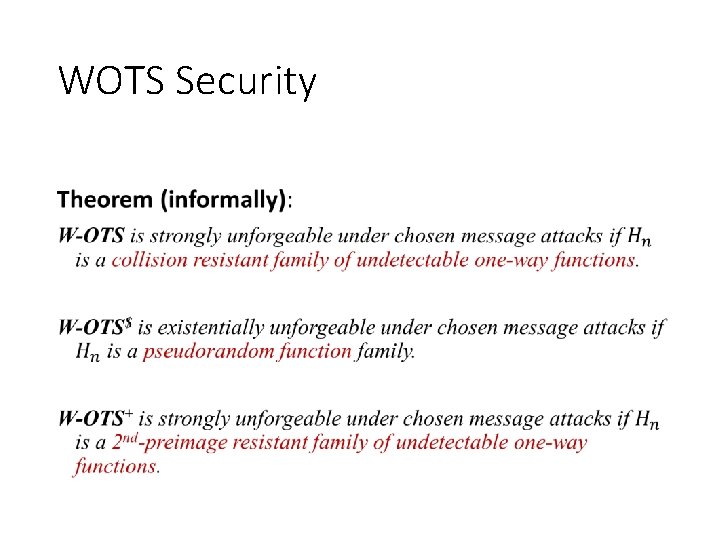
WOTS Security •
XMSS
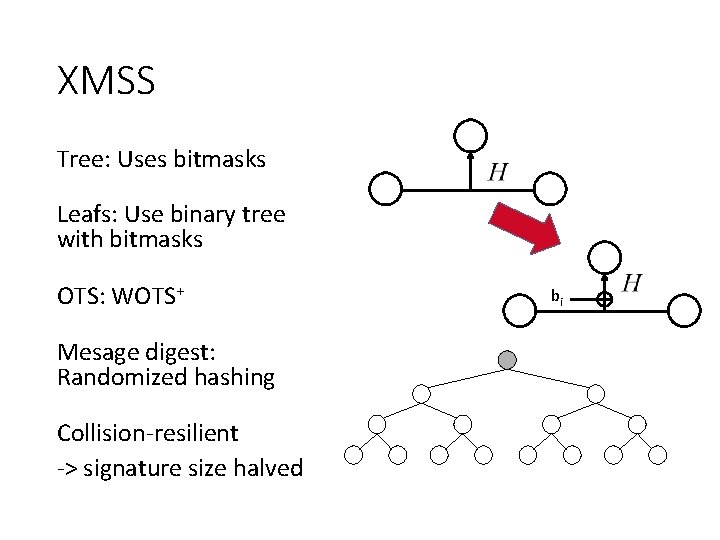
XMSS Tree: Uses bitmasks Leafs: Use binary tree with bitmasks OTS: WOTS+ Mesage digest: Randomized hashing Collision-resilient -> signature size halved bi
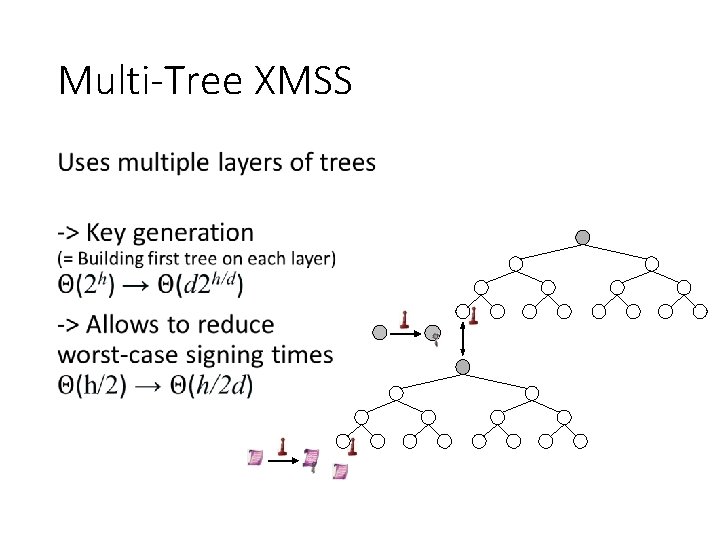
Multi-Tree XMSS •
How to Eliminate the State
Protest? PAGE 95 14 -6 -2021
Few-Time Signature Schemes 14 -6 -2021 PAGE 96
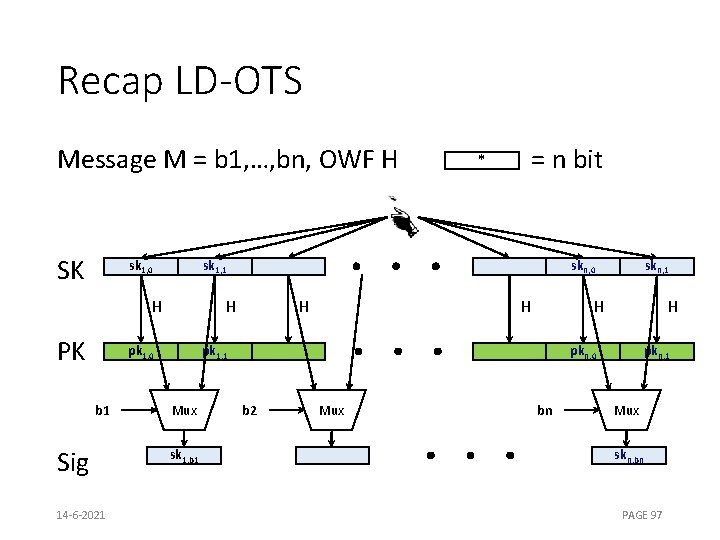
Recap LD-OTS Message M = b 1, …, bn, OWF H SK sk 1, 0 sk 1, 1 H PK Sig 14 -6 -2021 skn, 0 H pk 1, 0 b 1 = n bit * H H H pk 1, 1 Mux sk 1, b 1 skn, 1 H pkn, 0 b 2 Mux bn pkn, 1 Mux skn, bn PAGE 97
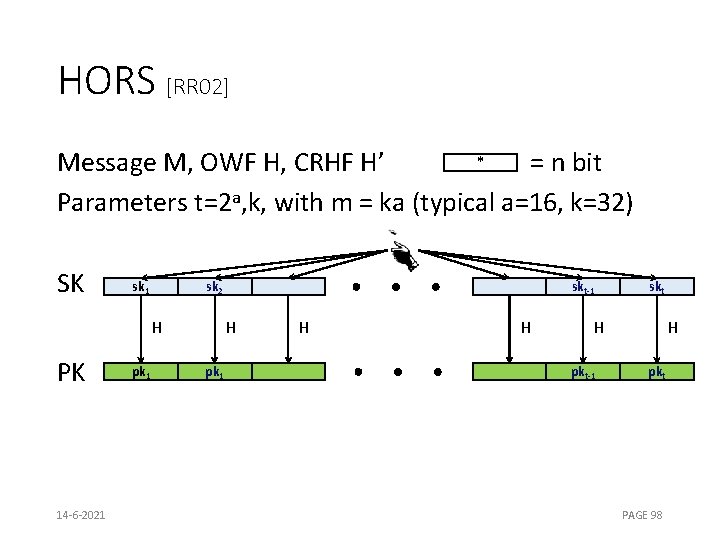
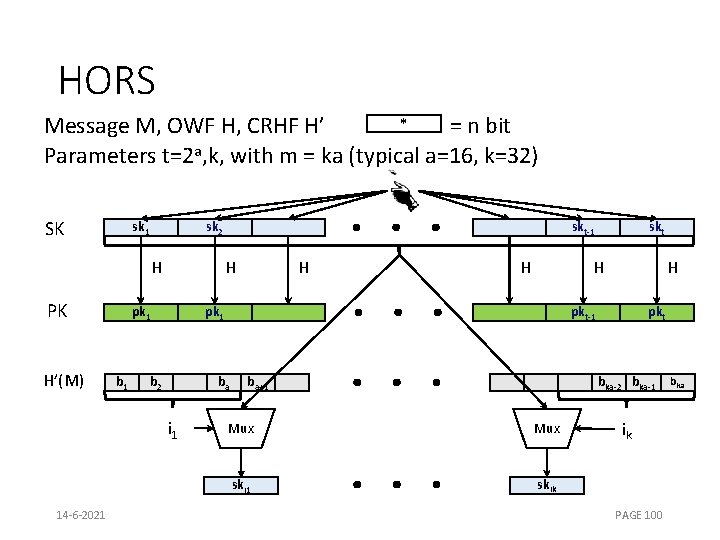
HORS [RR 02] * Message M, OWF H, CRHF H’ = n bit Parameters t=2 a, k, with m = ka (typical a=16, k=32) SK sk 1 sk 2 H PK 14 -6 -2021 pk 1 skt-1 H pk 1 H H skt H pkt-1 H pkt PAGE 98
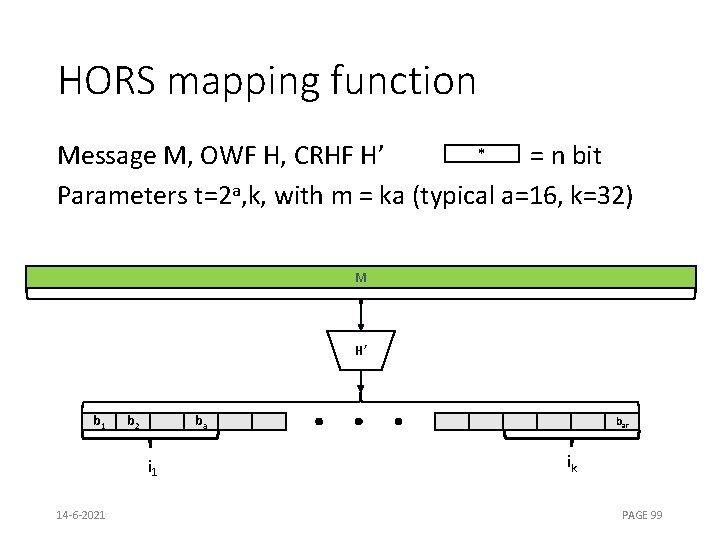
HORS mapping function * Message M, OWF H, CRHF H’ = n bit Parameters t=2 a, k, with m = ka (typical a=16, k=32) M H’ b 1 b 2 ba i 1 14 -6 -2021 bar ik PAGE 99
HORS * Message M, OWF H, CRHF H’ = n bit Parameters t=2 a, k, with m = ka (typical a=16, k=32) SK sk 1 sk 2 H PK H’(M) H pk 1 b 1 H H b 2 skt H pk 1 H pkt-1 ba i 1 14 -6 -2021 skt-1 ba+1 pkt bka-2 bka-1 Mux ski 1 skik ik PAGE 100 bka
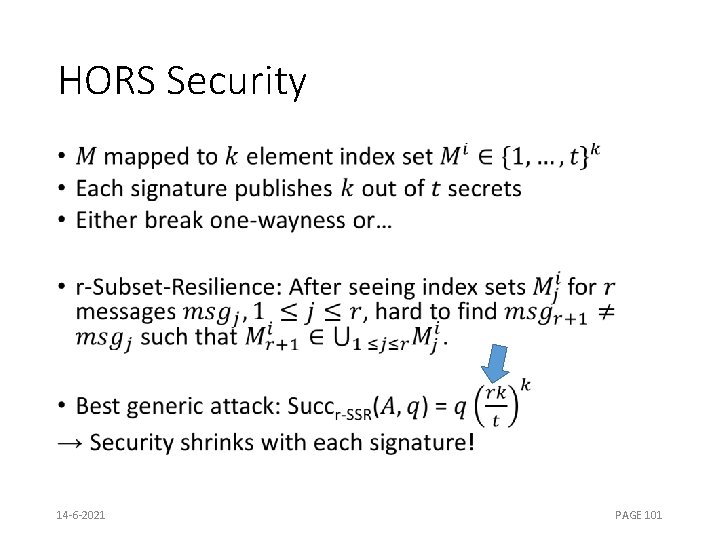
HORS Security • 14 -6 -2021 PAGE 101
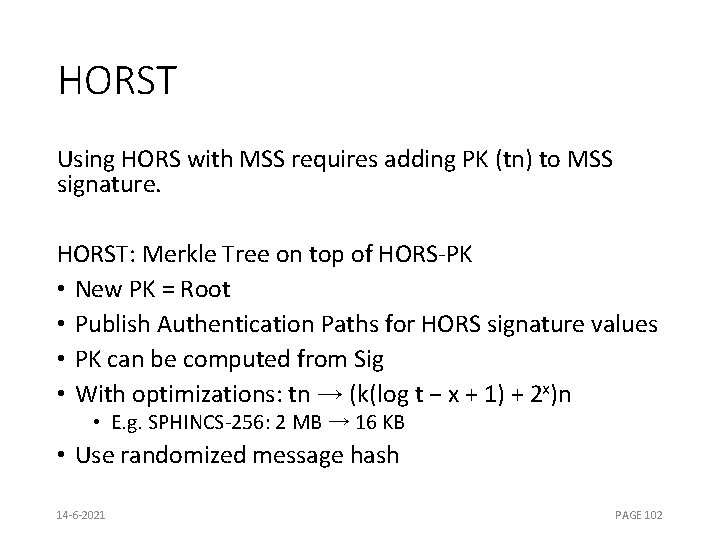
HORST Using HORS with MSS requires adding PK (tn) to MSS signature. HORST: Merkle Tree on top of HORS-PK • New PK = Root • Publish Authentication Paths for HORS signature values • PK can be computed from Sig • With optimizations: tn → (k(log t − x + 1) + 2 x)n • E. g. SPHINCS-256: 2 MB → 16 KB • Use randomized message hash 14 -6 -2021 PAGE 102
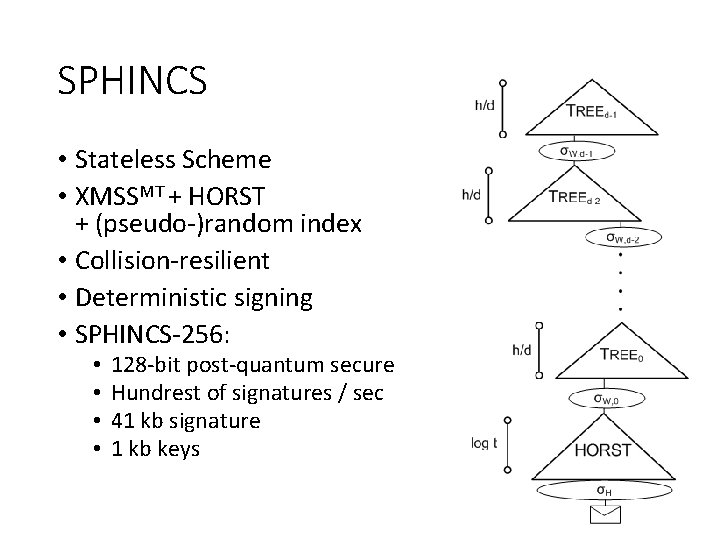
SPHINCS • Stateless Scheme • XMSSMT + HORST + (pseudo-)random index • Collision-resilient • Deterministic signing • SPHINCS-256: • • 128 -bit post-quantum secure Hundrest of signatures / sec 41 kb signature 1 kb keys
PQ-Crypto is currently a hot topic
Thank you! Questions? For references & further literature see https: //huelsing. wordpress. com/hash-based-signature-schemes/literature/ 14 -6 -2021 PAGE 105