
Cryptography and Network Security Sixth Edition by William

Cryptography and Network Security Sixth Edition by William Stallings
Chapter 4 Basic Concepts in Number Theory and Finite Fields

“Mathematics has long been known in the printing trade as difficult, or penalty, copy because it is slower, more difficult, and more expensive to set in type than any other kind of copy. ” —Chicago Manual of Style, 14 th Edition
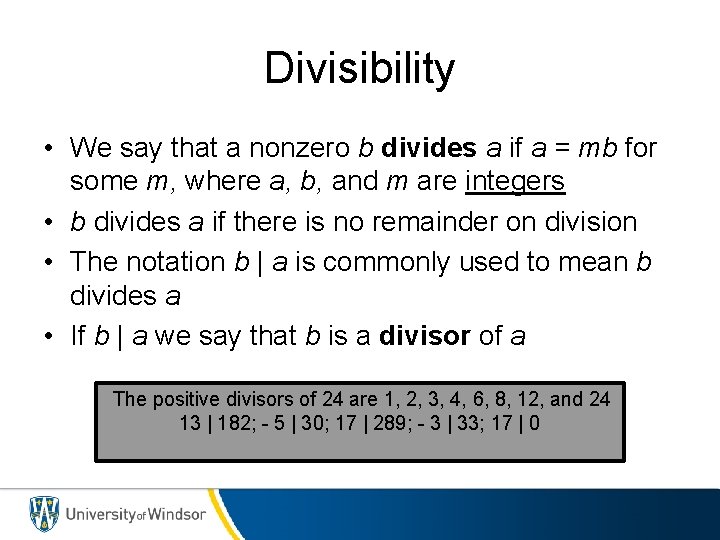
Divisibility • We say that a nonzero b divides a if a = mb for some m, where a, b, and m are integers • b divides a if there is no remainder on division • The notation b | a is commonly used to mean b divides a • If b | a we say that b is a divisor of a The positive divisors of 24 are 1, 2, 3, 4, 6, 8, 12, and 24 13 | 182; - 5 | 30; 17 | 289; - 3 | 33; 17 | 0
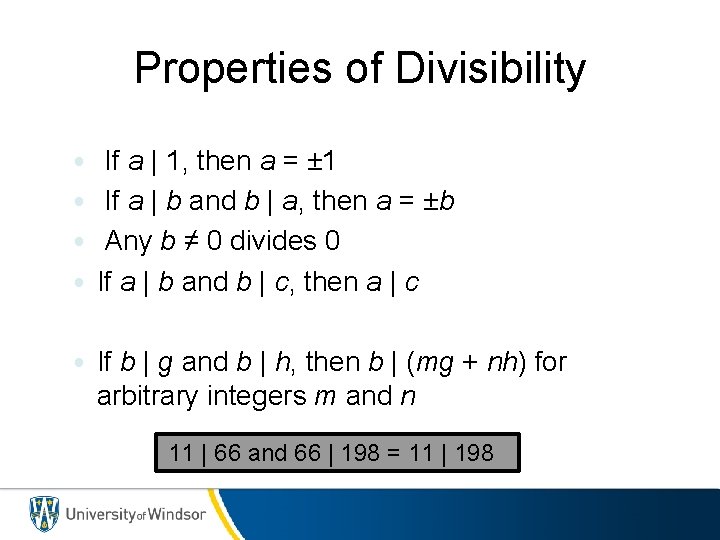
Properties of Divisibility • If a | 1, then a = ± 1 • If a | b and b | a, then a = ±b • Any b ≠ 0 divides 0 • If a | b and b | c, then a | c • If b | g and b | h, then b | (mg + nh) for arbitrary integers m and n 11 | 66 and 66 | 198 = 11 | 198
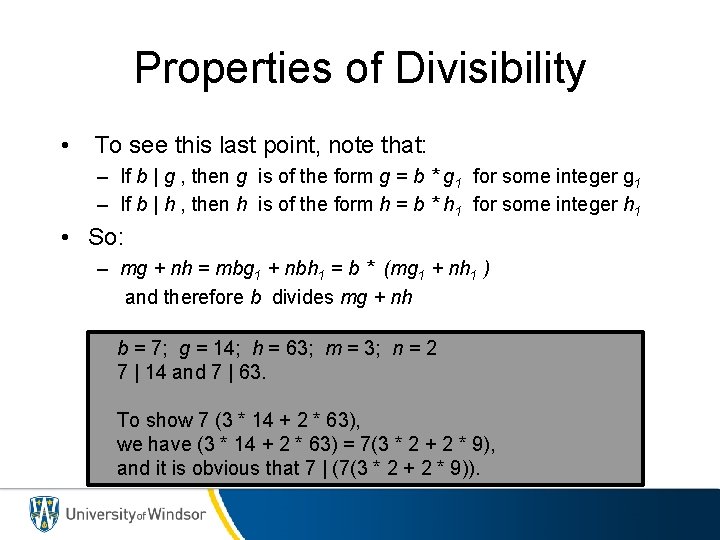
Properties of Divisibility • To see this last point, note that: – If b | g , then g is of the form g = b * g 1 for some integer g 1 – If b | h , then h is of the form h = b * h 1 for some integer h 1 • So: – mg + nh = mbg 1 + nbh 1 = b * (mg 1 + nh 1 ) and therefore b divides mg + nh b = 7; g = 14; h = 63; m = 3; n = 2 7 | 14 and 7 | 63. To show 7 (3 * 14 + 2 * 63), we have (3 * 14 + 2 * 63) = 7(3 * 2 + 2 * 9), and it is obvious that 7 | (7(3 * 2 + 2 * 9)).
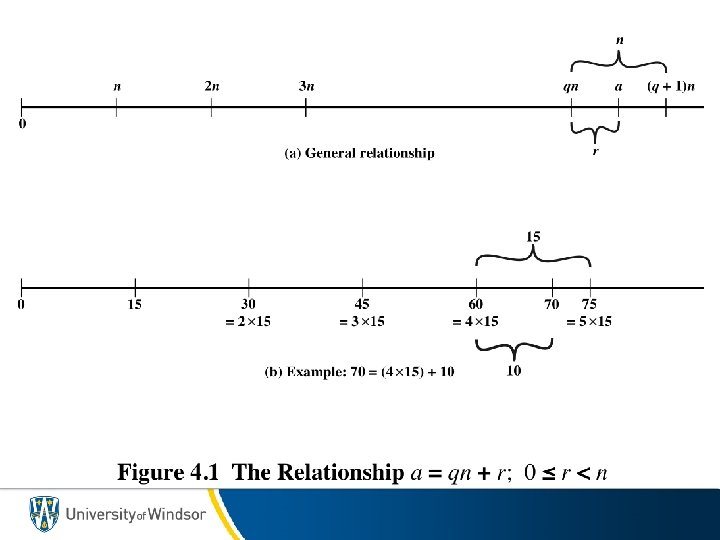
Division Algorithm • Given any positive integer n and any nonnegative integer a, if we divide a by n we get an integer quotient q and an integer remainder r that obey the following relationship: a = qn + r 0 ≤ r < n; q = [a/n]
Euclidean Algorithm • One of the basic techniques of number theory • Procedure for determining the greatest common divisor of two positive integers • Two integers are relatively prime if their only common positive integer factor is 1
Greatest Common Divisor (GCD) • The greatest common divisor of a and b is the largest integer that divides both a and b • We can use the notation gcd(a, b) to mean the greatest common divisor of a and b • We also define gcd(0, 0) = 0 • Positive integer c is said to be the gcd of a and b if: • c is a divisor of a and b • Any divisor of a and b is a divisor of c • An equivalent definition is: gcd(a, b) = max[k, such that k | a and k | b]
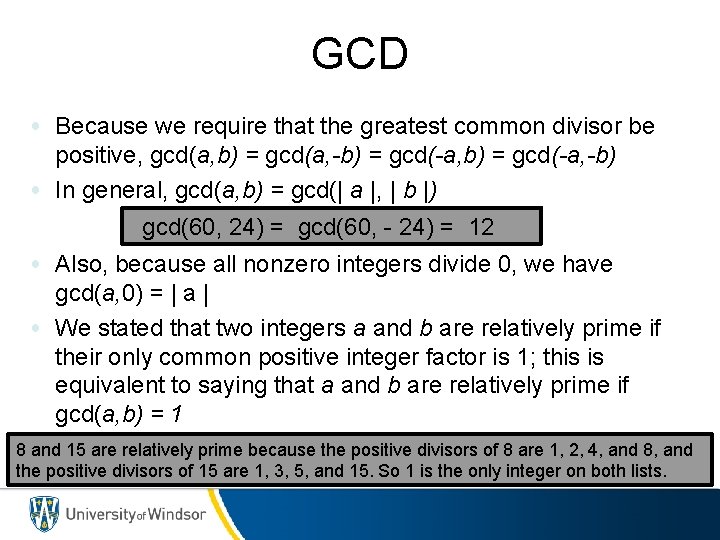
GCD • Because we require that the greatest common divisor be positive, gcd(a, b) = gcd(a, -b) = gcd(-a, -b) • In general, gcd(a, b) = gcd(| a |, | b |) gcd(60, 24) = gcd(60, - 24) = 12 • Also, because all nonzero integers divide 0, we have gcd(a, 0) = | a | • We stated that two integers a and b are relatively prime if their only common positive integer factor is 1; this is equivalent to saying that a and b are relatively prime if gcd(a, b) = 1 8 and 15 are relatively prime because the positive divisors of 8 are 1, 2, 4, and 8, and the positive divisors of 15 are 1, 3, 5, and 15. So 1 is the only integer on both lists.
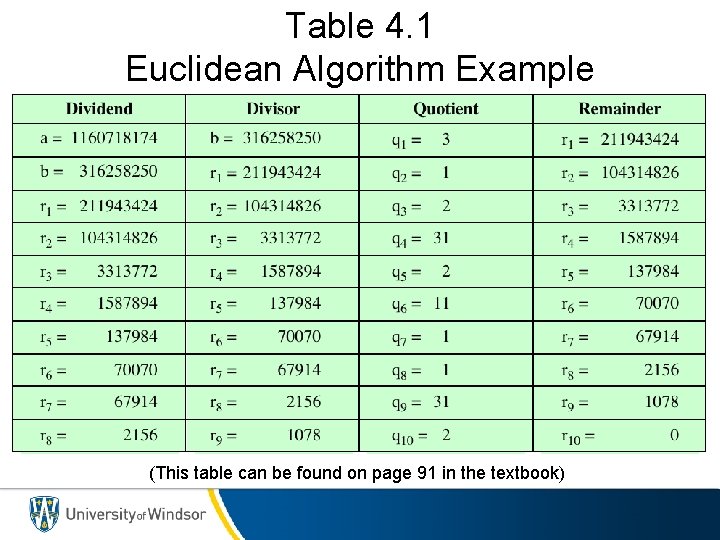
Table 4. 1 Euclidean Algorithm Example (This table can be found on page 91 in the textbook)
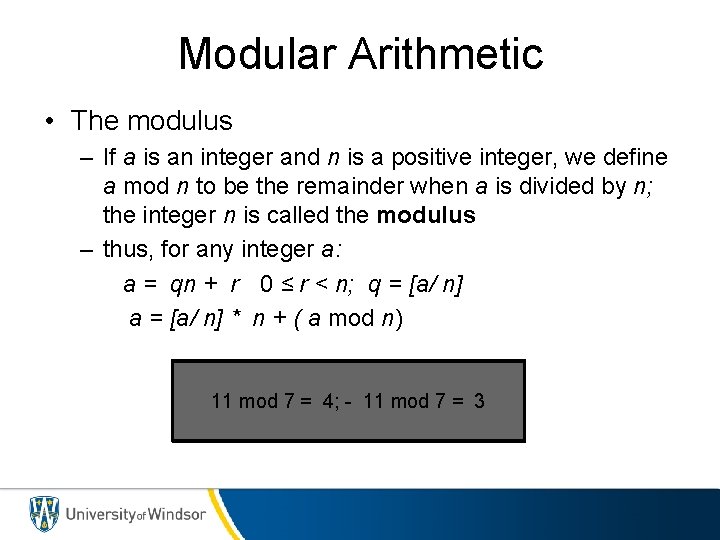
Modular Arithmetic • The modulus – If a is an integer and n is a positive integer, we define a mod n to be the remainder when a is divided by n; the integer n is called the modulus – thus, for any integer a: a = qn + r 0 ≤ r < n; q = [a/ n] a = [a/ n] * n + ( a mod n) 11 mod 7 = 4; - 11 mod 7 = 3
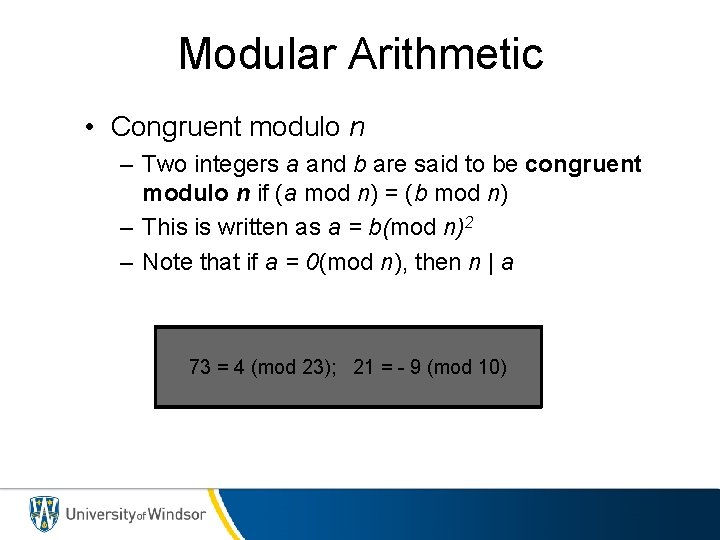
Modular Arithmetic • Congruent modulo n – Two integers a and b are said to be congruent modulo n if (a mod n) = (b mod n) – This is written as a = b(mod n)2 – Note that if a = 0(mod n), then n | a 73 = 4 (mod 23); 21 = - 9 (mod 10)
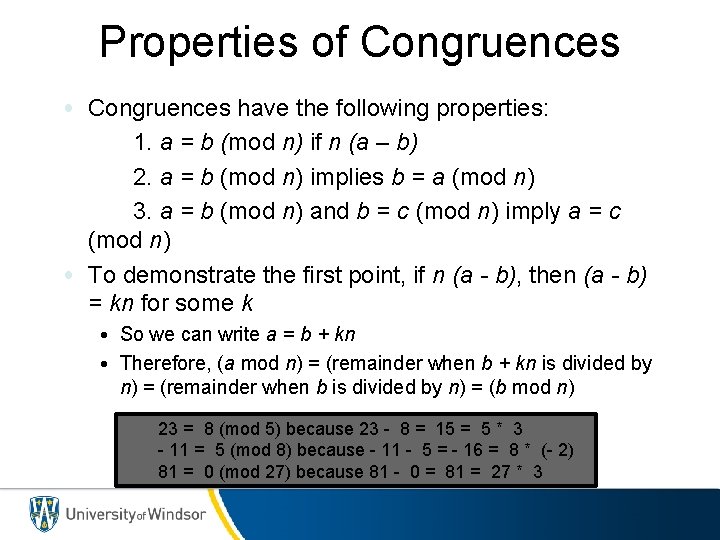
Properties of Congruences • Congruences have the following properties: 1. a = b (mod n) if n (a – b) 2. a = b (mod n) implies b = a (mod n) 3. a = b (mod n) and b = c (mod n) imply a = c (mod n) • To demonstrate the first point, if n (a - b), then (a - b) = kn for some k • So we can write a = b + kn • Therefore, (a mod n) = (remainder when b + kn is divided by n) = (remainder when b is divided by n) = (b mod n) 23 = 8 (mod 5) because 23 - 8 = 15 = 5 * 3 - 11 = 5 (mod 8) because - 11 - 5 = - 16 = 8 * (- 2) 81 = 0 (mod 27) because 81 - 0 = 81 = 27 * 3
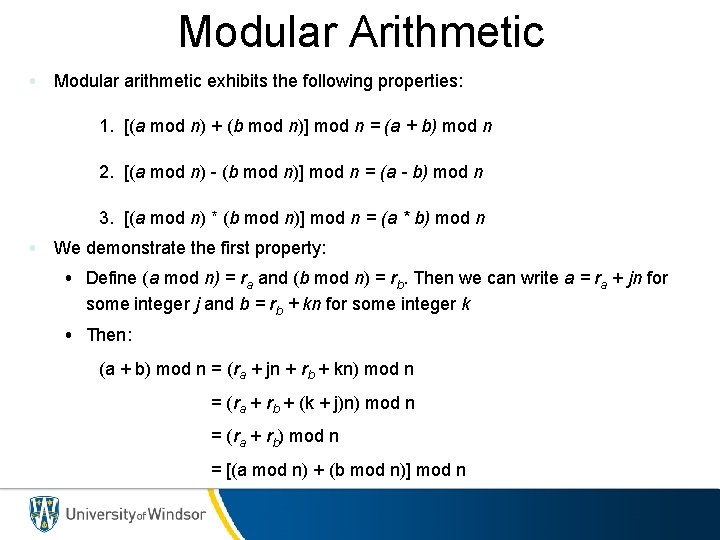
Modular Arithmetic • Modular arithmetic exhibits the following properties: 1. [(a mod n) + (b mod n)] mod n = (a + b) mod n 2. [(a mod n) - (b mod n)] mod n = (a - b) mod n 3. [(a mod n) * (b mod n)] mod n = (a * b) mod n • We demonstrate the first property: • Define (a mod n) = ra and (b mod n) = rb. Then we can write a = ra + jn for some integer j and b = rb + kn for some integer k • Then: (a + b) mod n = (ra + jn + rb + kn) mod n = (ra + rb + (k + j)n) mod n = (ra + rb) mod n = [(a mod n) + (b mod n)] mod n
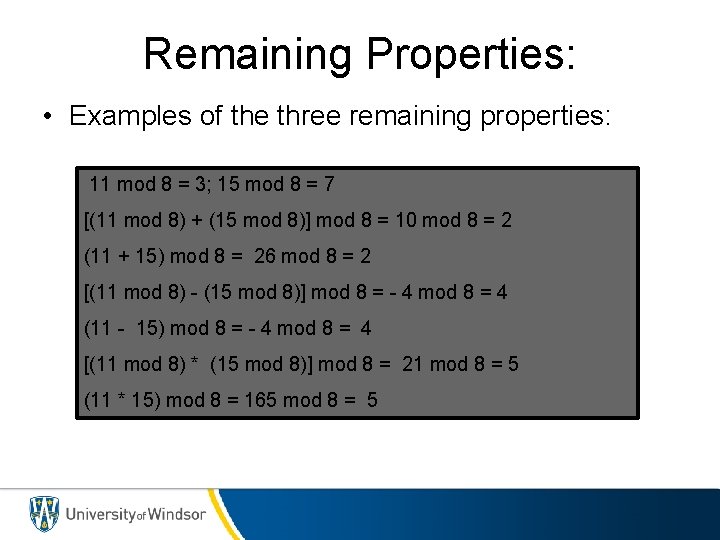
Remaining Properties: • Examples of the three remaining properties: 11 mod 8 = 3; 15 mod 8 = 7 [(11 mod 8) + (15 mod 8)] mod 8 = 10 mod 8 = 2 (11 + 15) mod 8 = 26 mod 8 = 2 [(11 mod 8) - (15 mod 8)] mod 8 = - 4 mod 8 = 4 (11 - 15) mod 8 = - 4 mod 8 = 4 [(11 mod 8) * (15 mod 8)] mod 8 = 21 mod 8 = 5 (11 * 15) mod 8 = 165 mod 8 = 5
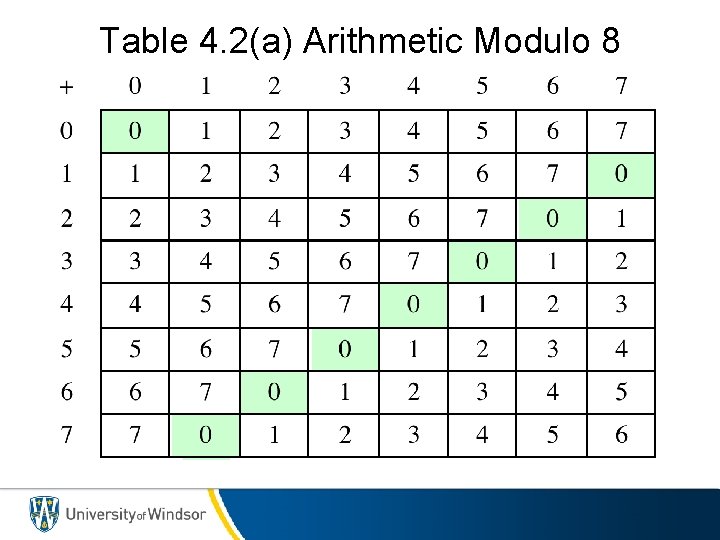
Table 4. 2(a) Arithmetic Modulo 8
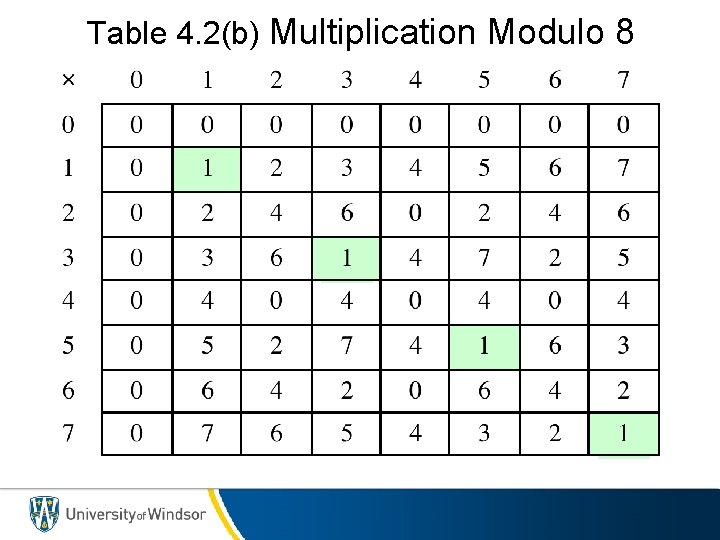
Table 4. 2(b) Multiplication Modulo 8
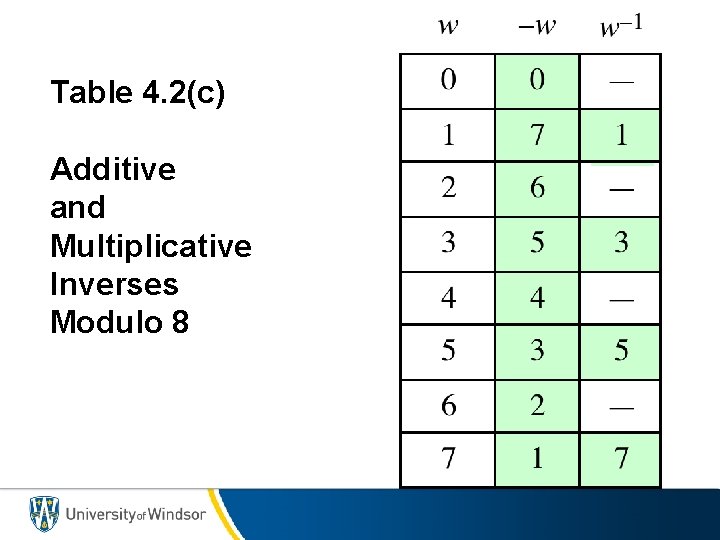
Table 4. 2(c) Additive and Multiplicative Inverses Modulo 8
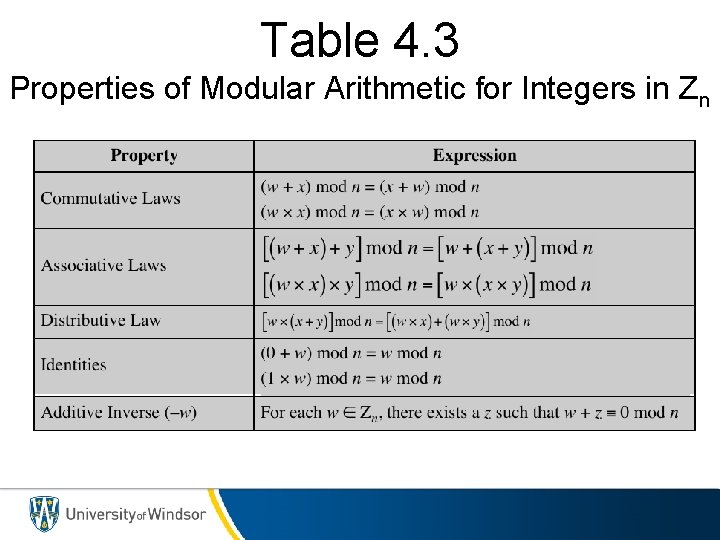
Table 4. 3 Properties of Modular Arithmetic for Integers in Zn
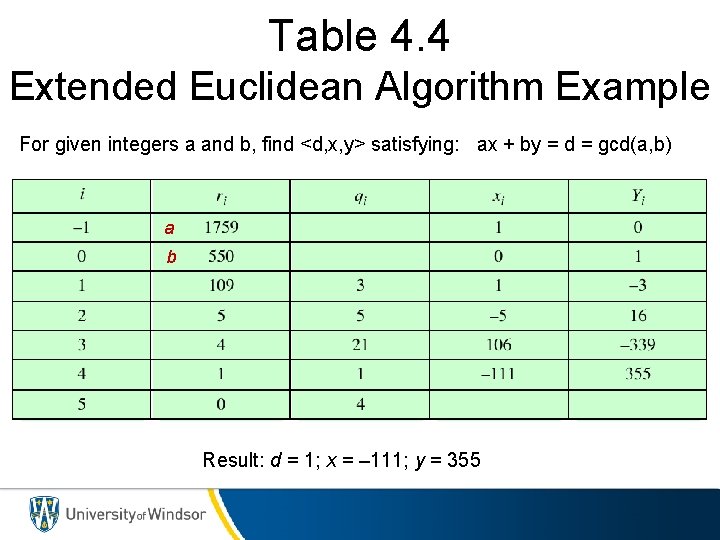
Table 4. 4 Extended Euclidean Algorithm Example For given integers a and b, find <d, x, y> satisfying: ax + by = d = gcd(a, b) a b Result: d = 1; x = – 111; y = 355
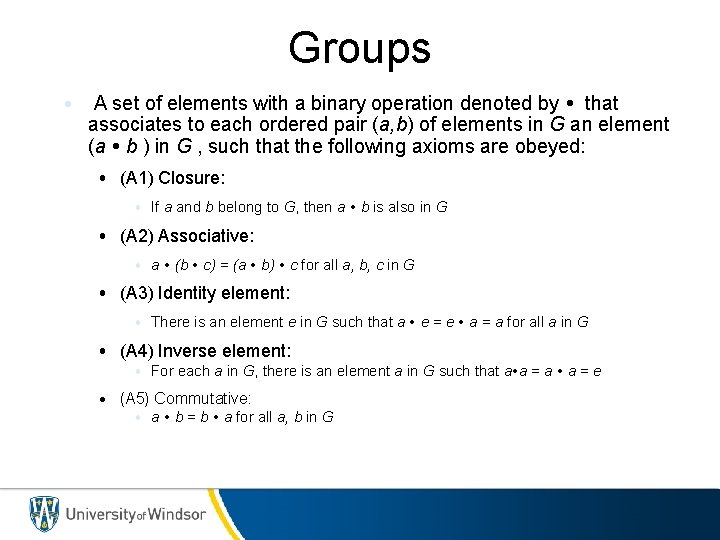
Groups • A set of elements with a binary operation denoted by that associates to each ordered pair (a, b) of elements in G an element (a b ) in G , such that the following axioms are obeyed: • (A 1) Closure: • If a and b belong to G, then a b is also in G • (A 2) Associative: • a (b c) = (a b) c for all a, b, c in G • (A 3) Identity element: • There is an element e in G such that a e = e a = a for all a in G • (A 4) Inverse element: • For each a in G, there is an element a in G such that a a = a a = e • (A 5) Commutative: • a b = b a for all a, b in G
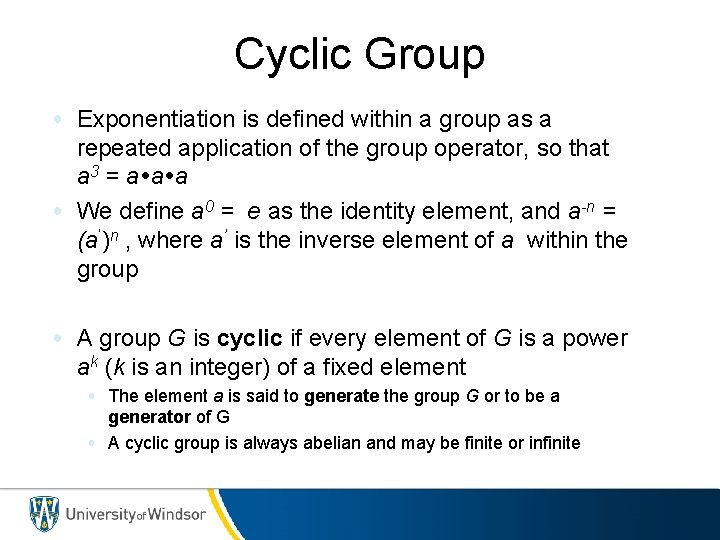
Cyclic Group • Exponentiation is defined within a group as a repeated application of the group operator, so that a 3 = a a a • We define a 0 = e as the identity element, and a-n = (a’)n , where a’ is the inverse element of a within the group • A group G is cyclic if every element of G is a power ak (k is an integer) of a fixed element • The element a is said to generate the group G or to be a generator of G • A cyclic group is always abelian and may be finite or infinite
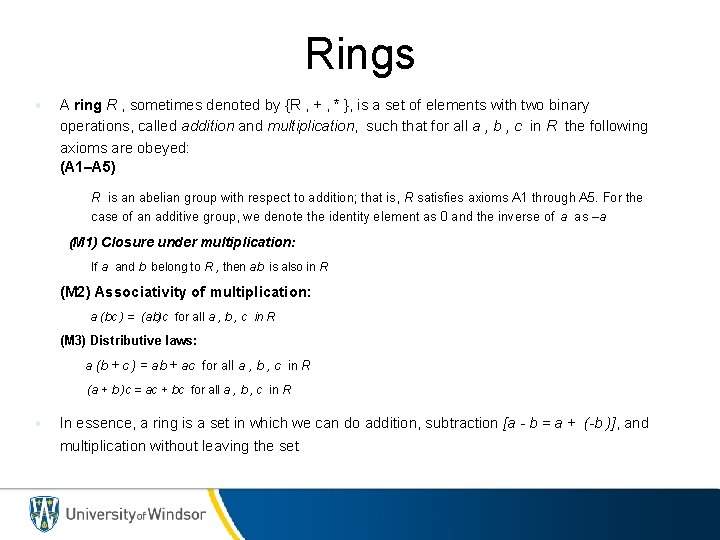
Rings • A ring R , sometimes denoted by {R , + , * }, is a set of elements with two binary operations, called addition and multiplication, such that for all a , b , c in R the following axioms are obeyed: (A 1–A 5) R is an abelian group with respect to addition; that is, R satisfies axioms A 1 through A 5. For the case of an additive group, we denote the identity element as 0 and the inverse of a as –a (M 1) Closure under multiplication: If a and b belong to R , then ab is also in R (M 2) Associativity of multiplication: a (bc ) = (ab)c for all a , b , c in R (M 3) Distributive laws: a (b + c ) = ab + ac for all a , b , c in R (a + b )c = ac + bc for all a , b , c in R • In essence, a ring is a set in which we can do addition, subtraction [a - b = a + (-b )], and multiplication without leaving the set
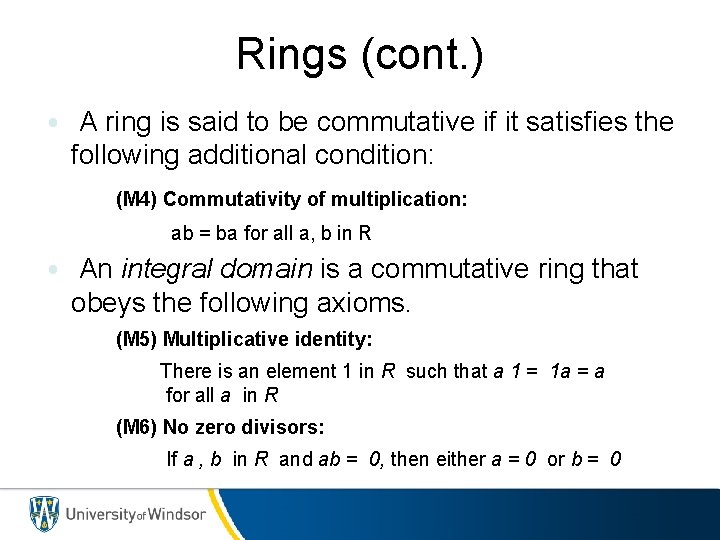
Rings (cont. ) • A ring is said to be commutative if it satisfies the following additional condition: (M 4) Commutativity of multiplication: ab = ba for all a, b in R • An integral domain is a commutative ring that obeys the following axioms. (M 5) Multiplicative identity: There is an element 1 in R such that a 1 = 1 a = a for all a in R (M 6) No zero divisors: If a , b in R and ab = 0, then either a = 0 or b = 0
Fields • A field F , sometimes denoted by {F, +, * }, is a set of elements with two binary operations, called addition and multiplication, such that for all a, b, c in F the following axioms are obeyed: (A 1–M 6) F is an integral domain; that is, F satisfies axioms A 1 through A 5 and M 1 through M 6 (M 7) Multiplicative inverse: For each a in F, except 0, there is an element a-1 in F such that aa-1 = (a 1 )a = 1 • In essence, a field is a set in which we can do addition, subtraction, multiplication, and division without leaving the set. Division is defined with the following rule: a /b = a (b-1 ) Familiar examples of fields are the rational numbers, the real numbers, and the complex numbers. Note that the set of all integers is not a field, because not every element of the set has a multiplicative inverse.
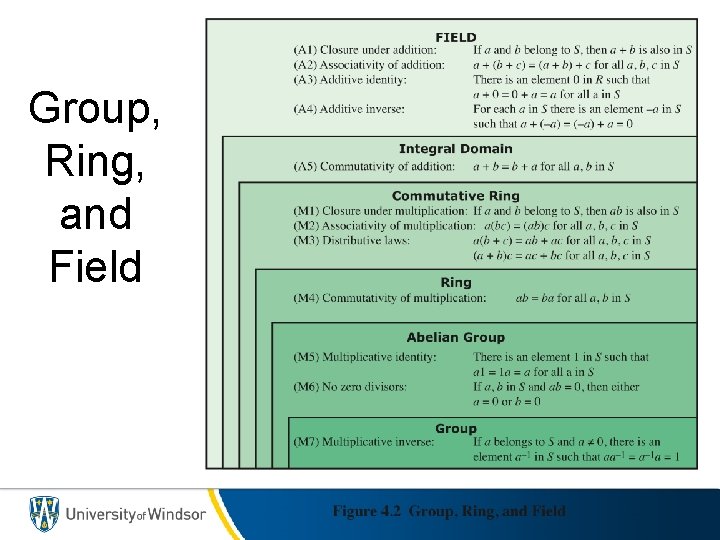
Group, Ring, and Field
Finite Fields of the Form GF(p) • Finite fields play a crucial role in many cryptographic algorithms • It can be shown that the order of a finite field must be a power of a prime pn, where n is a positive integer • The only positive integers that are divisors of p are p and 1 • The finite field of order pn is generally written GF(pn ) • GF stands for Galois field, in honor of the mathematician who first studied finite fields
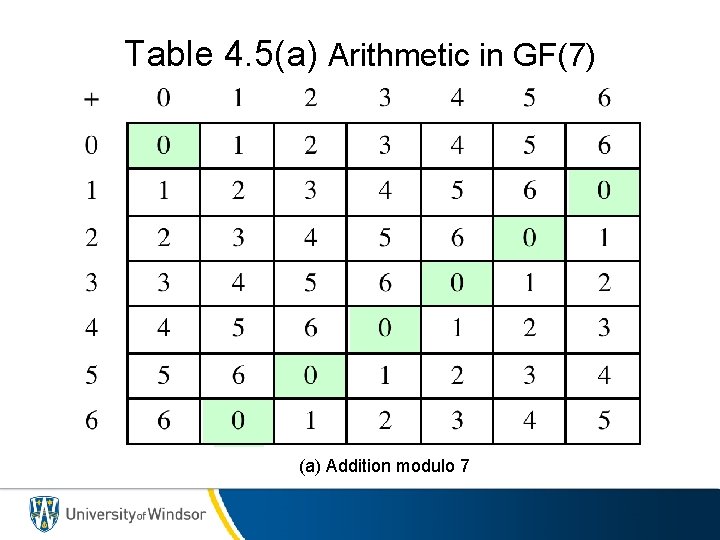
Table 4. 5(a) Arithmetic in GF(7) (a) Addition modulo 7
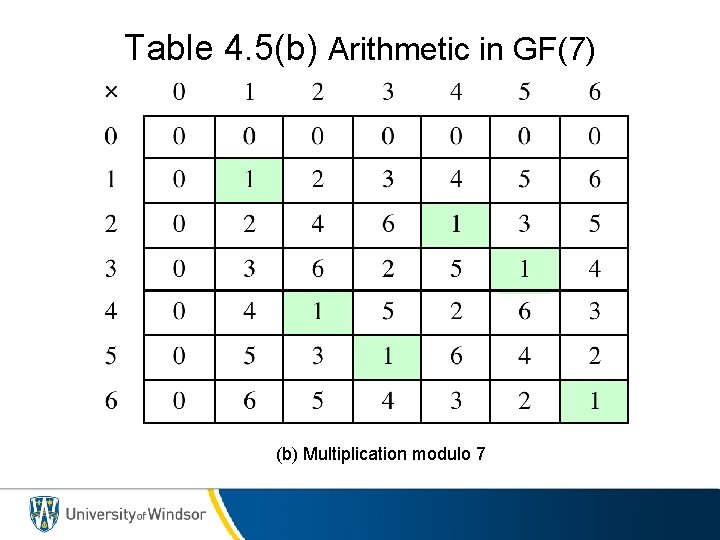
Table 4. 5(b) Arithmetic in GF(7) (b) Multiplication modulo 7
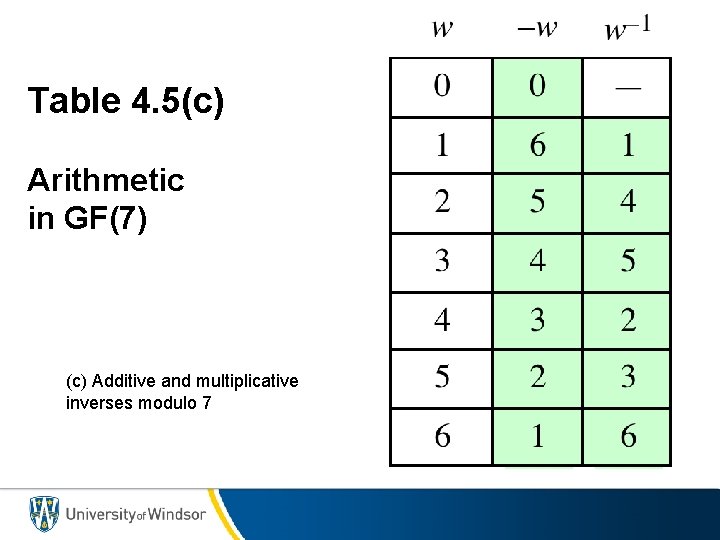
Table 4. 5(c) Arithmetic in GF(7) (c) Additive and multiplicative inverses modulo 7
In this section, we have shown how to construct a finite field of order p, where p is prime. GF(p) is defined with the following properties: • 1. GF(p) consists of p elements • 2. The binary operations + and * are defined over the set. The operations of addition, subtraction, multiplication, and division can be performed without leaving the set. Each element of the set other than 0 has a multiplicative inverse • We have shown that the elements of GF(p) are the integers {0, 1, . . . , p – 1} and that the arithmetic operations are addition and multiplication mod p
Polynomial Arithmetic • We can distinguish three classes of polynomial arithmetic: • Ordinary polynomial arithmetic, using the basic rules of algebra • Polynomial arithmetic in which the arithmetic on the coefficients is performed modulo p; that is, the coefficients are in GF(p ) • Polynomial arithmetic in which the coefficients are in GF(p ), and the polynomials are defined modulo a polynomial m (x ) whose highest power is some integer n
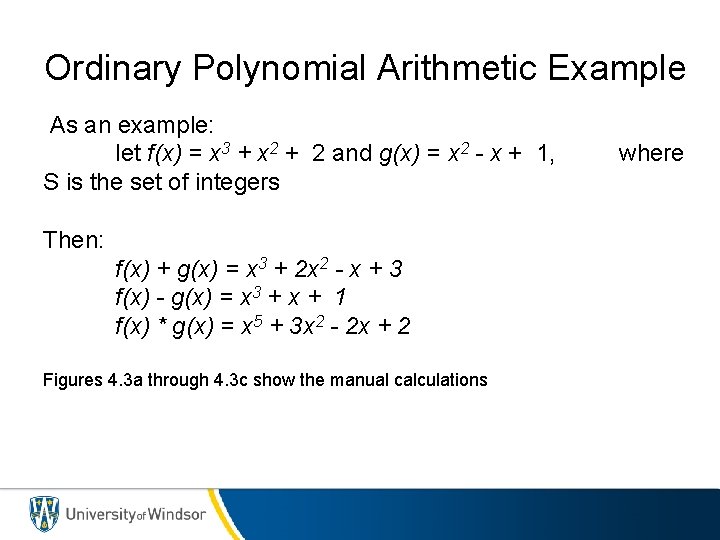
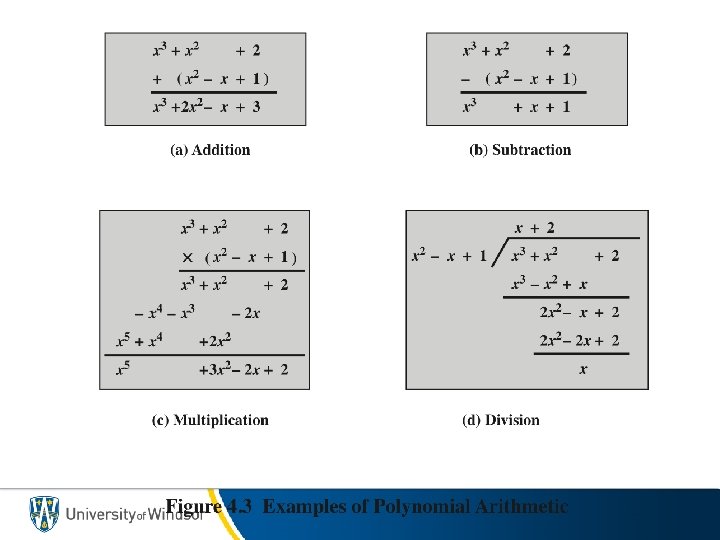
Ordinary Polynomial Arithmetic Example As an example: let f(x) = x 3 + x 2 + 2 and g(x) = x 2 - x + 1, S is the set of integers Then: f(x) + g(x) = x 3 + 2 x 2 - x + 3 f(x) - g(x) = x 3 + x + 1 f(x) * g(x) = x 5 + 3 x 2 - 2 x + 2 Figures 4. 3 a through 4. 3 c show the manual calculations where
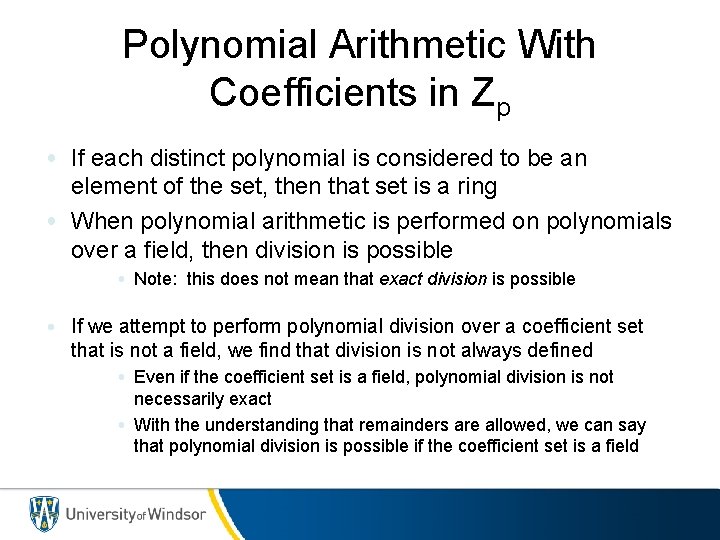
Polynomial Arithmetic With Coefficients in Zp • If each distinct polynomial is considered to be an element of the set, then that set is a ring • When polynomial arithmetic is performed on polynomials over a field, then division is possible • Note: this does not mean that exact division is possible • If we attempt to perform polynomial division over a coefficient set that is not a field, we find that division is not always defined • Even if the coefficient set is a field, polynomial division is not necessarily exact • With the understanding that remainders are allowed, we can say that polynomial division is possible if the coefficient set is a field
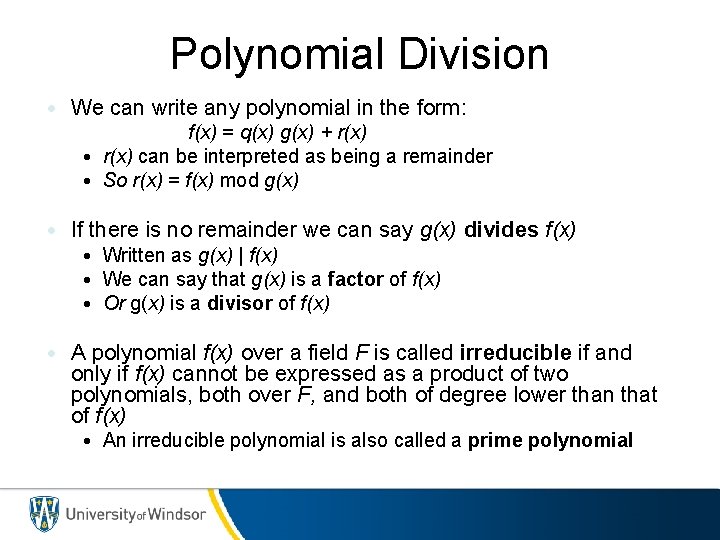
Polynomial Division • We can write any polynomial in the form: f(x) = q(x) g(x) + r(x) • r(x) can be interpreted as being a remainder • So r(x) = f(x) mod g(x) • If there is no remainder we can say g(x) divides f(x) • Written as g(x) | f(x) • We can say that g(x) is a factor of f(x) • Or g(x) is a divisor of f(x) • A polynomial f(x) over a field F is called irreducible if and only if f(x) cannot be expressed as a product of two polynomials, both over F, and both of degree lower than that of f(x) • An irreducible polynomial is also called a prime polynomial
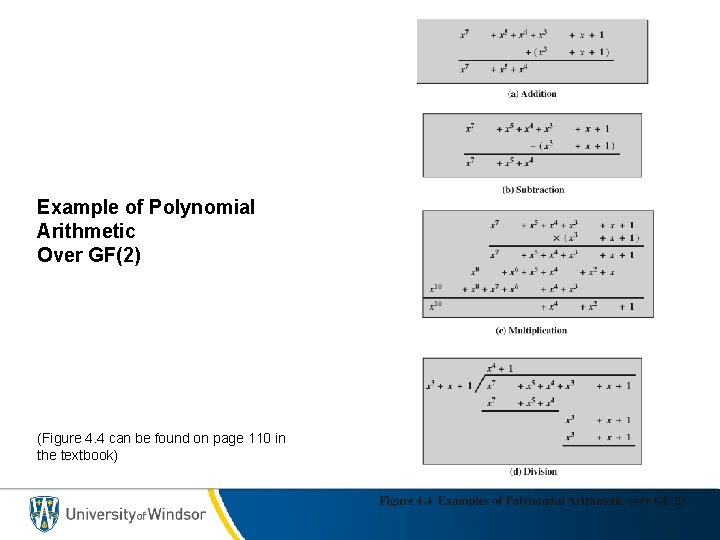
Example of Polynomial Arithmetic Over GF(2) (Figure 4. 4 can be found on page 110 in the textbook)
Polynomial GCD • The polynomial c(x) is said to be the greatest common divisor of a(x) and b(x) if the following are true: • c(x) divides both a(x) and b(x) • Any divisor of a(x) and b(x) is a divisor of c(x) • An equivalent definition is: • gcd[a(x), b(x)] is the polynomial of maximum degree that divides both a(x) and b(x) • The Euclidean algorithm can be extended to find the greatest common divisor of two polynomials whose coefficients are elements of a field
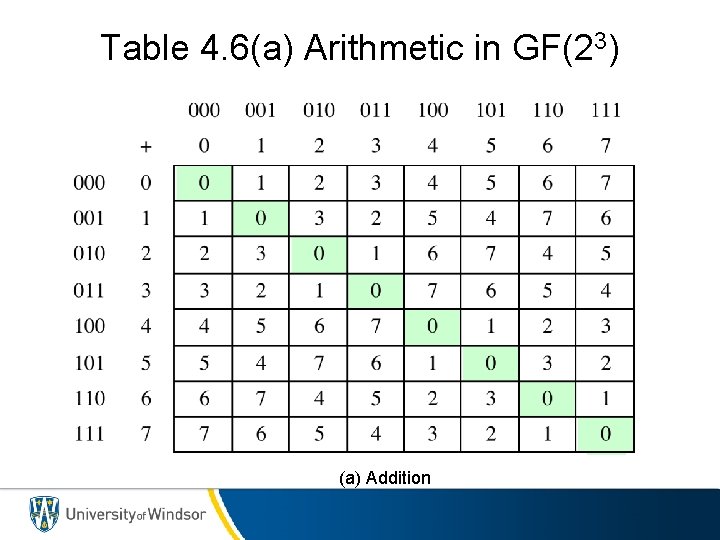
Table 4. 6(a) Arithmetic in GF(23) (a) Addition
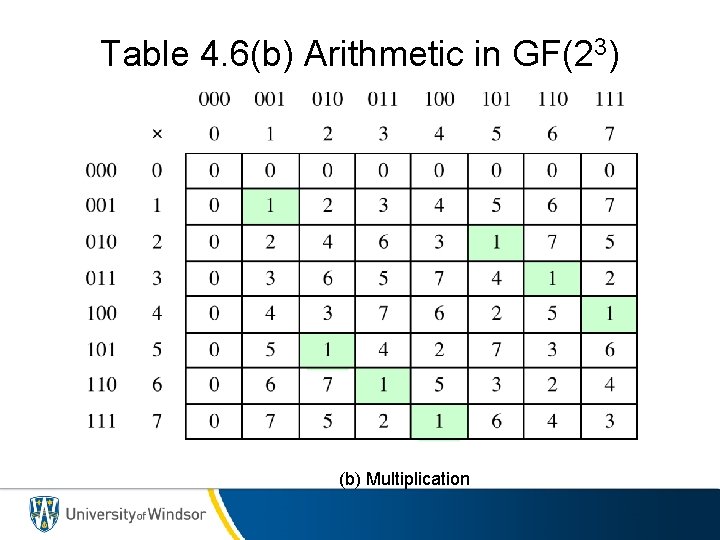
Table 4. 6(b) Arithmetic in GF(23) (b) Multiplication
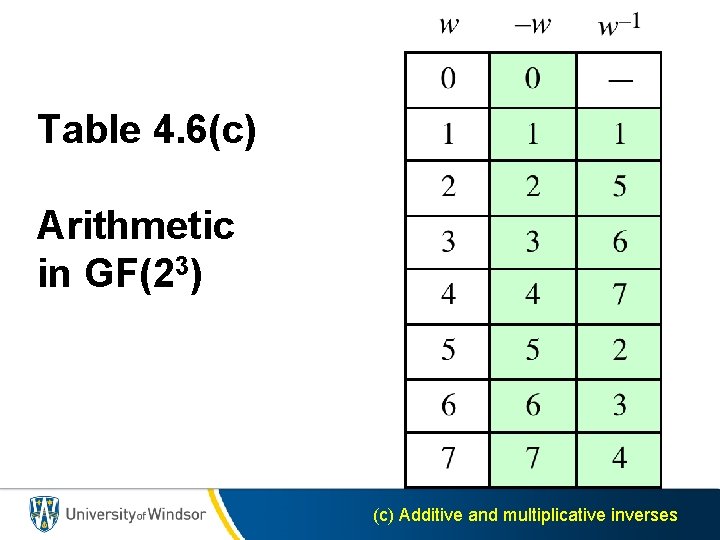
Table 4. 6(c) Arithmetic in GF(23) (c) Additive and multiplicative inverses
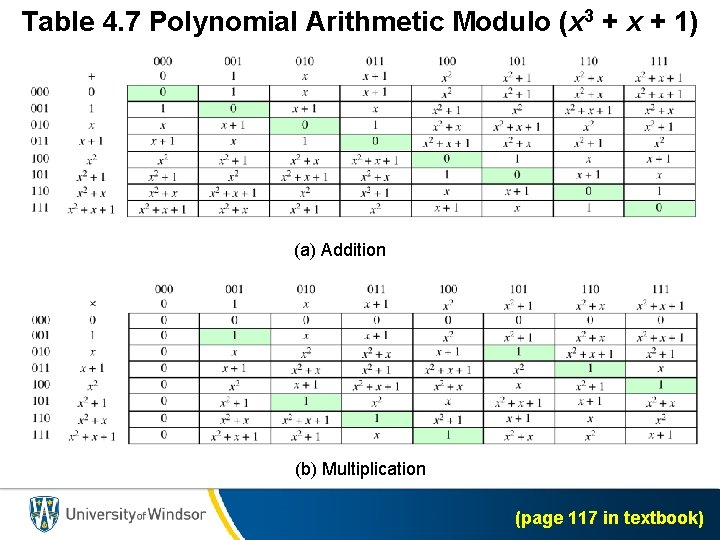
Table 4. 7 Polynomial Arithmetic Modulo (x 3 + x + 1) (a) Addition (b) Multiplication (page 117 in textbook)
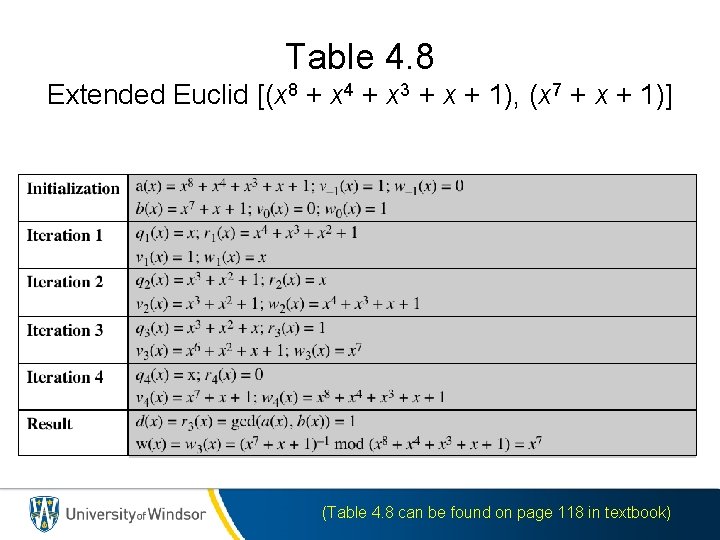
Table 4. 8 Extended Euclid [(x 8 + x 4 + x 3 + x + 1), (x 7 + x + 1)] (Table 4. 8 can be found on page 118 in textbook)
Computational Considerations • Since coefficients are 0 or 1, they can represent any such polynomial as a bit string • Addition becomes XOR of these bit strings • Multiplication is shift and XOR – cf long-hand multiplication • Modulo reduction is done by repeatedly substituting highest power with remainder of irreducible polynomial (also shift and XOR)
Using a Generator • A generator g of a finite field F of order q (contains q elements) is an element whose first q-1 powers generate all the nonzero elements of F • The elements of F consist of 0, g 1, . . , gq-2 • Consider a field F defined by a polynomial f(x) • An element b contained in F is called a root of the polynomial if f(b) = 0 • Finally, it can be shown that a root g of an irreducible polynomial is a generator of the finite field defined on that polynomial
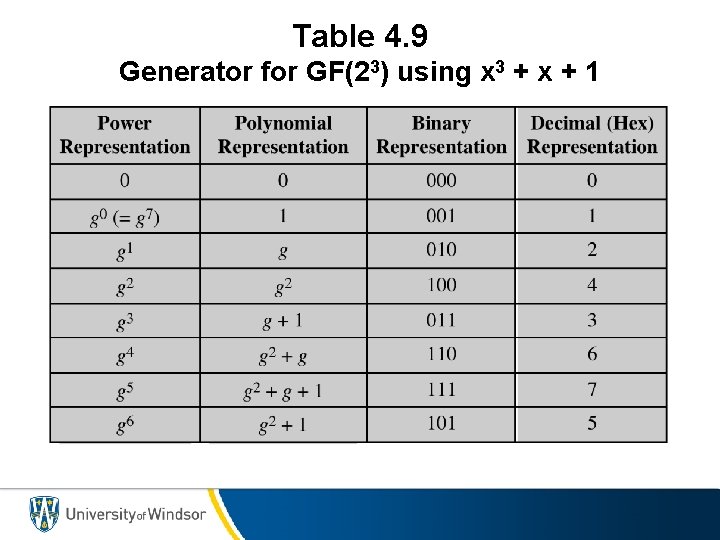
Table 4. 9 Generator for GF(23) using x 3 + x + 1
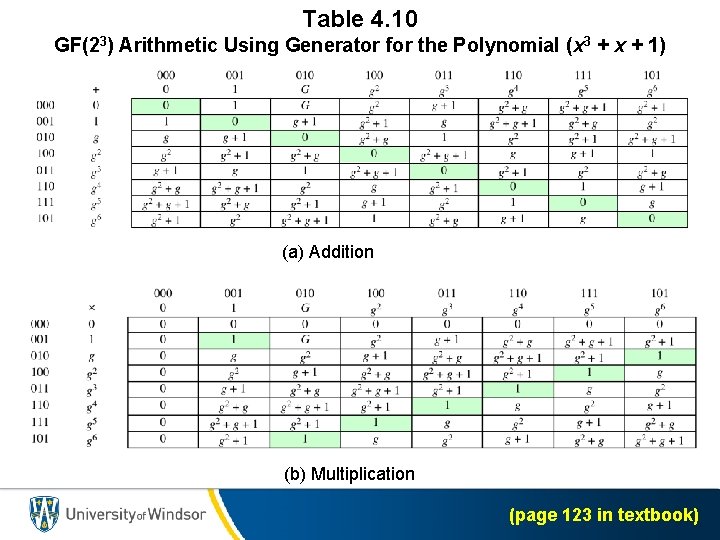
Table 4. 10 GF(23) Arithmetic Using Generator for the Polynomial (x 3 + x + 1) (a) Addition (b) Multiplication (page 123 in textbook)
Summary • Divisibility and the division algorithm • The Euclidean algorithm • Modular arithmetic • Groups, rings, and fields • Finite fields of the form GF(p) • Polynomial arithmetic • Finite fields of the form GF(2 n)

Chapter 5 Advanced Encryption Standard
“It seems very simple. ” “It is very simple. But if you don’t know what the key is it’s virtually indecipherable. ” —Talking to Strange Men, Ruth Rendell
Finite Field Arithmetic • In the Advanced Encryption Standard (AES) all operations are performed on 8 -bit bytes • The arithmetic operations of addition, multiplication, and division are performed over the finite field GF(28) • A field is a set in which we can do addition, subtraction, multiplication, and division without leaving the set • Division is defined with the following rule: • a /b = a (b-1 ) • An example of a finite field (one with a finite number of elements) is the set Zp consisting of all the integers {0, 1, . . , p - 1}, where p is a prime number and in which arithmetic is carried out modulo p
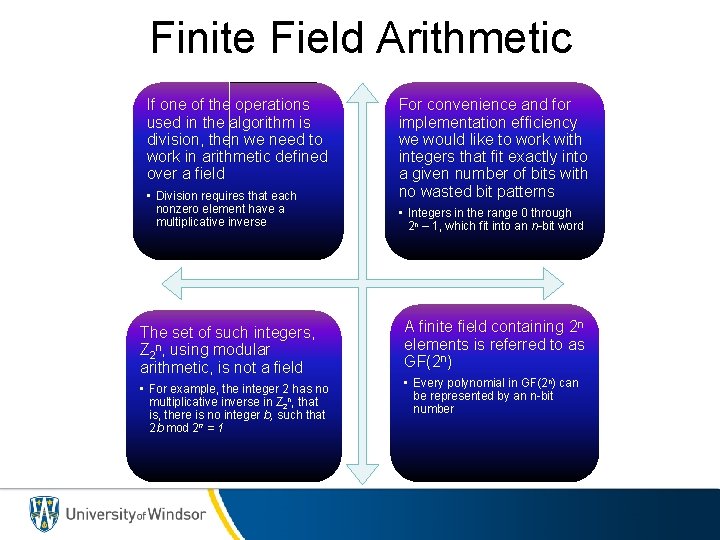
Finite Field Arithmetic If one of the operations used in the algorithm is division, then we need to work in arithmetic defined over a field • Division requires that each nonzero element have a multiplicative inverse The set of such integers, Z 2 n, using modular arithmetic, is not a field • For example, the integer 2 has no multiplicative inverse in Z 2 n, that is, there is no integer b, such that 2 b mod 2 n = 1 For convenience and for implementation efficiency we would like to work with integers that fit exactly into a given number of bits with no wasted bit patterns • Integers in the range 0 through 2 n – 1, which fit into an n-bit word A finite field containing 2 n elements is referred to as GF(2 n) • Every polynomial in GF(2 n) can be represented by an n-bit number
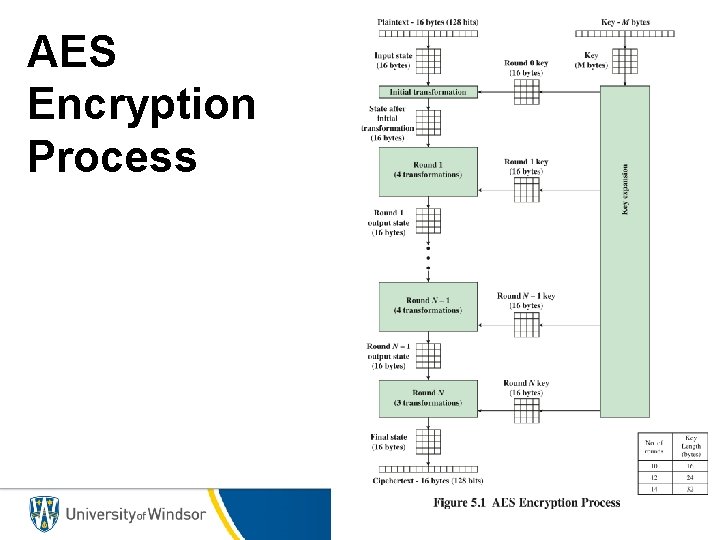
AES Encryption Process
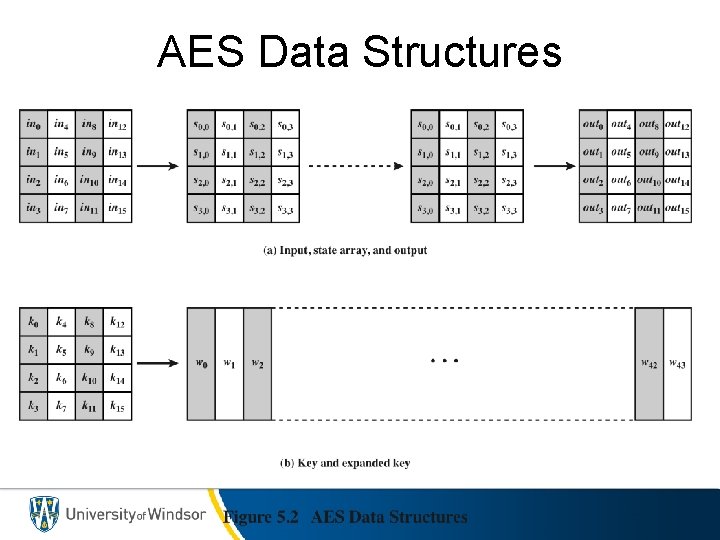
AES Data Structures
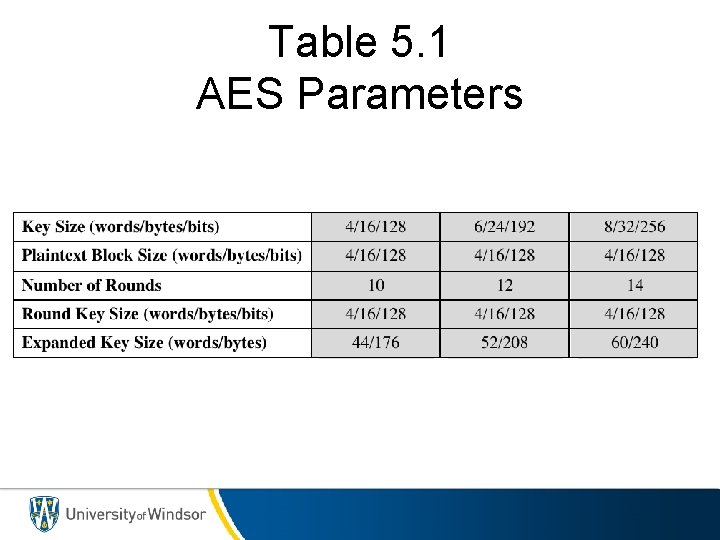
Table 5. 1 AES Parameters
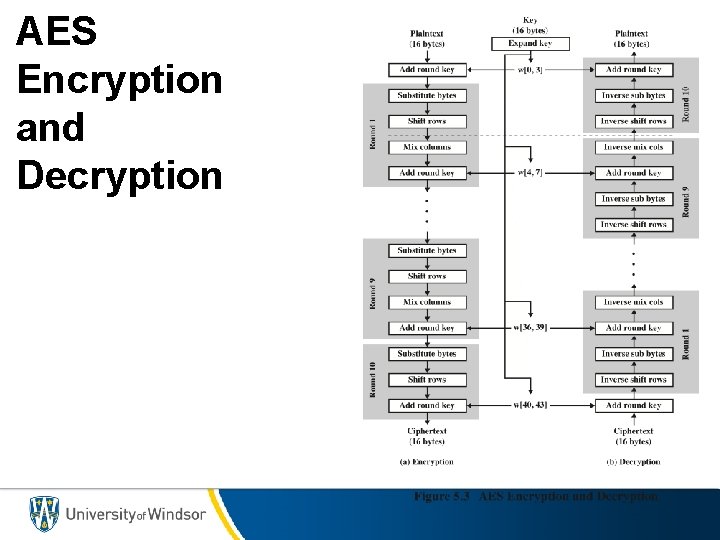
AES Encryption and Decryption
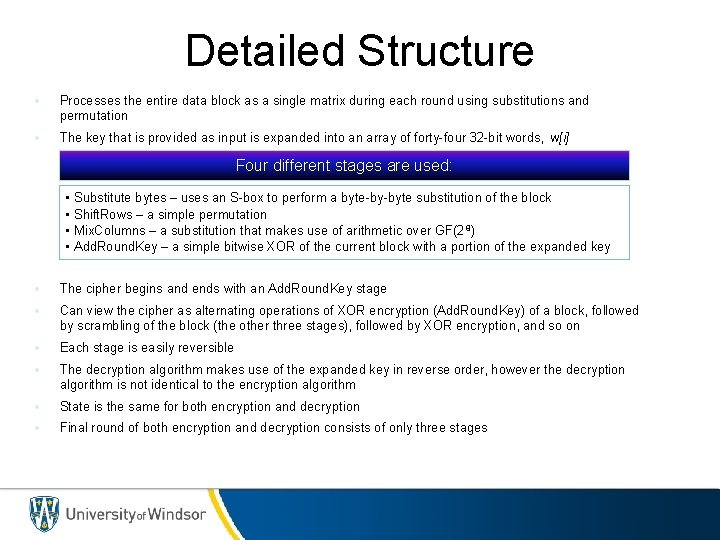
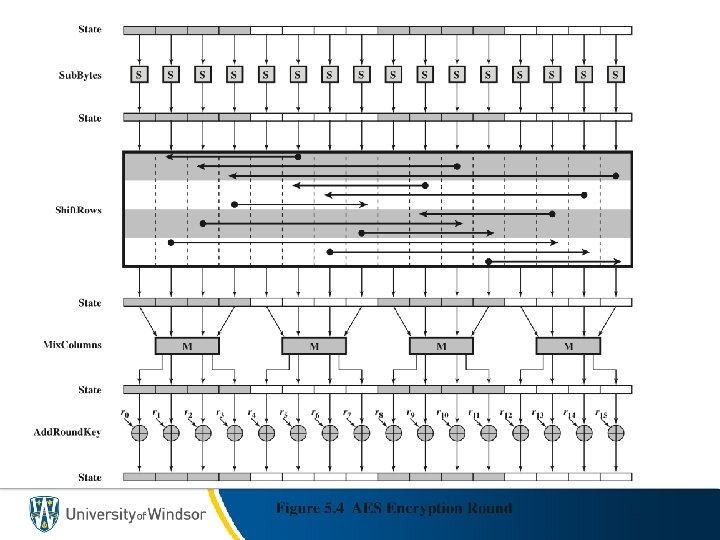
Detailed Structure • Processes the entire data block as a single matrix during each round using substitutions and permutation • The key that is provided as input is expanded into an array of forty-four 32 -bit words, w[i] Four different stages are used: • • Substitute bytes – uses an S-box to perform a byte-by-byte substitution of the block Shift. Rows – a simple permutation Mix. Columns – a substitution that makes use of arithmetic over GF(2 8) Add. Round. Key – a simple bitwise XOR of the current block with a portion of the expanded key • The cipher begins and ends with an Add. Round. Key stage • Can view the cipher as alternating operations of XOR encryption (Add. Round. Key) of a block, followed by scrambling of the block (the other three stages), followed by XOR encryption, and so on • Each stage is easily reversible • The decryption algorithm makes use of the expanded key in reverse order, however the decryption algorithm is not identical to the encryption algorithm • State is the same for both encryption and decryption • Final round of both encryption and decryption consists of only three stages
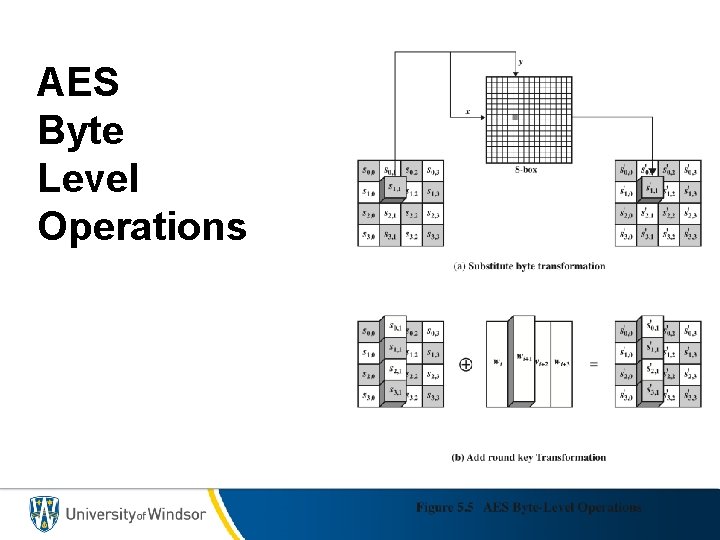
AES Byte Level Operations
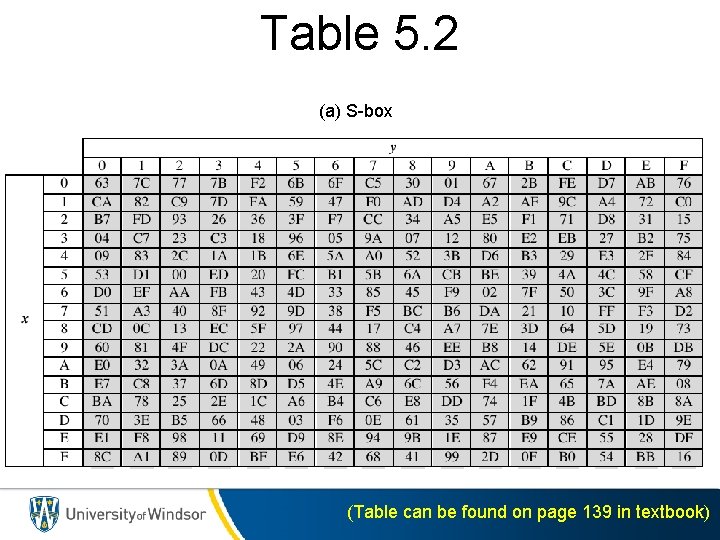
Table 5. 2 (a) S-box (Table can be found on page 139 in textbook)
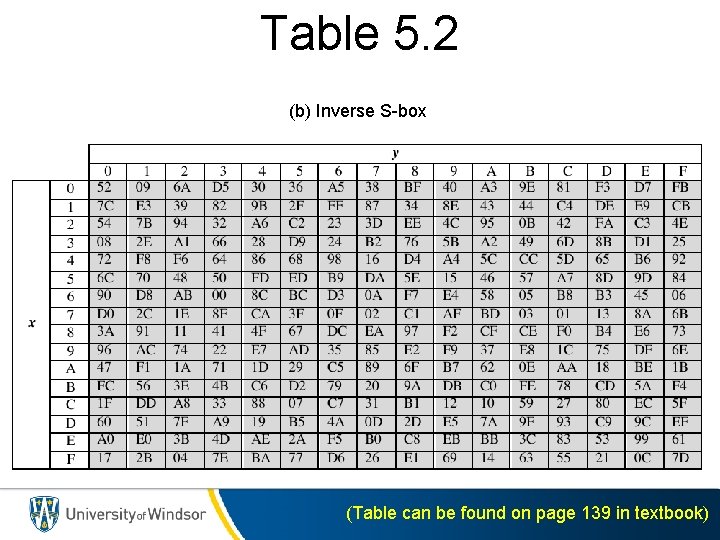
Table 5. 2 (b) Inverse S-box (Table can be found on page 139 in textbook)
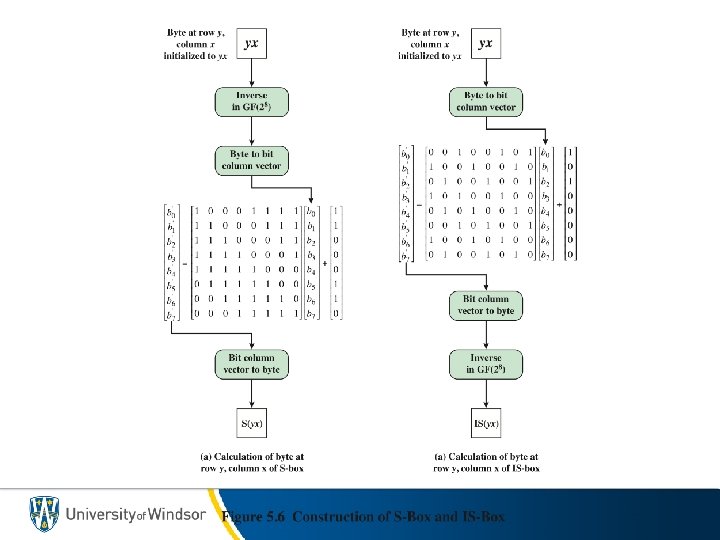
S-Box Rationale • The S-box is designed to be resistant to known cryptanalytic attacks • The Rijndael developers sought a design that has a low correlation between input bits and output bits and the property that the output is not a linear mathematical function of the input • The nonlinearity is due to the use of the multiplicative inverse
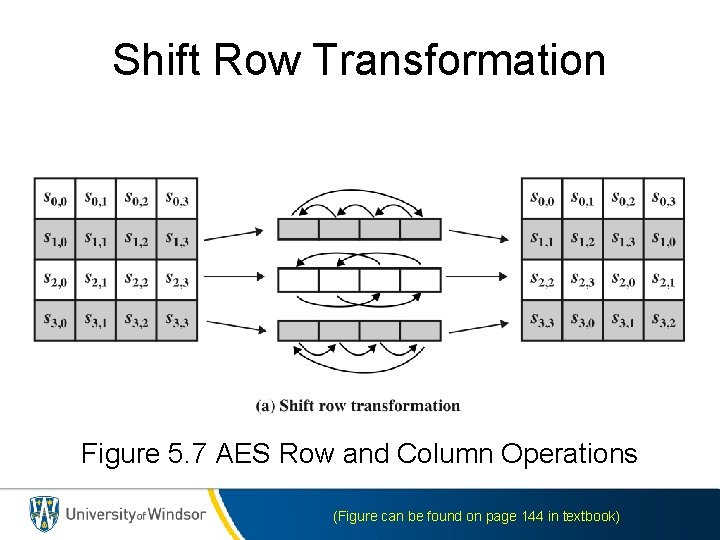
Shift Row Transformation Figure 5. 7 AES Row and Column Operations (Figure can be found on page 144 in textbook)
Shift Row Rationale • More substantial than it may first appear • The State, as well as the cipher input and output, is treated as an array of four 4 -byte columns • On encryption, the first 4 bytes of the plaintext are copied to the first column of State, and so on • The round key is applied to State column by column • Thus, a row shift moves an individual byte from one column to another, which is a linear distance of a multiple of 4 bytes • Transformation ensures that the 4 bytes of one column are spread out to four different columns
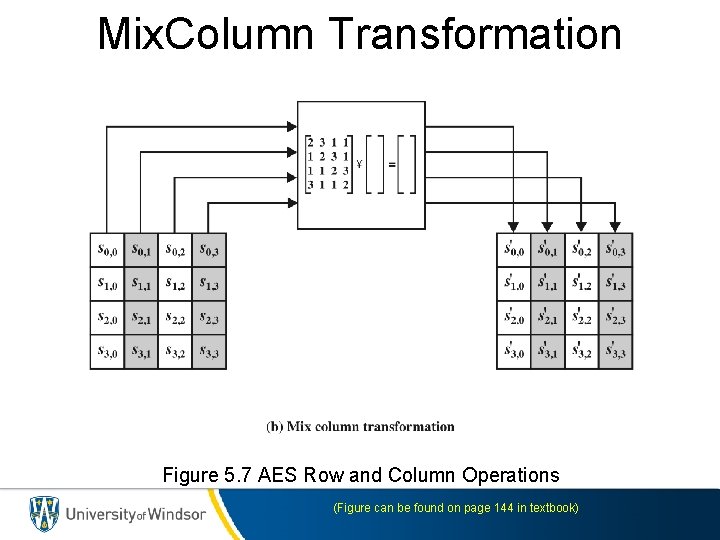
Mix. Column Transformation Figure 5. 7 AES Row and Column Operations (Figure can be found on page 144 in textbook)
Mix Columns Rationale • Coefficients of a matrix based on a linear code with maximal distance between code words ensures a good mixing among the bytes of each column • The mix column transformation combined with the shift row transformation ensures that after a few rounds all output bits depend on all input bits
Add. Round. Key Transformation • The 128 bits of State are bitwise XORed with the 128 bits of the round key • Operation is viewed as a columnwise operation between the 4 bytes of a State column and one word of the round key • Can also be viewed as a byte-level operation Rationale: Is as simple as possible and affects every bit of State The complexity of the round key expansion plus the complexity of the other stages of AES ensure security
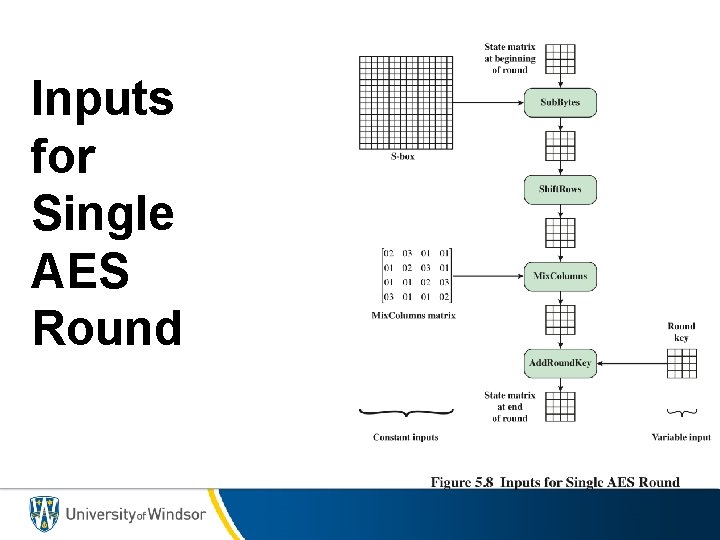
Inputs for Single AES Round
AES Key Expansion • Takes as input a four-word (16 byte) key and produces a linear array of 44 words (176) bytes • This is sufficient to provide a four-word round key for the initial Add. Round. Key stage and each of the 10 rounds of the cipher • Key is copied into the first four words of the expanded key • The remainder of the expanded key is filled in four words at a time • Each added word w[i] depends on the immediately preceding word, w[i – 1], and the word four positions back, w[i – 4] • In three out of four cases a simple XOR is used • For a word whose position in the w array is a multiple of 4, a more complex function is used
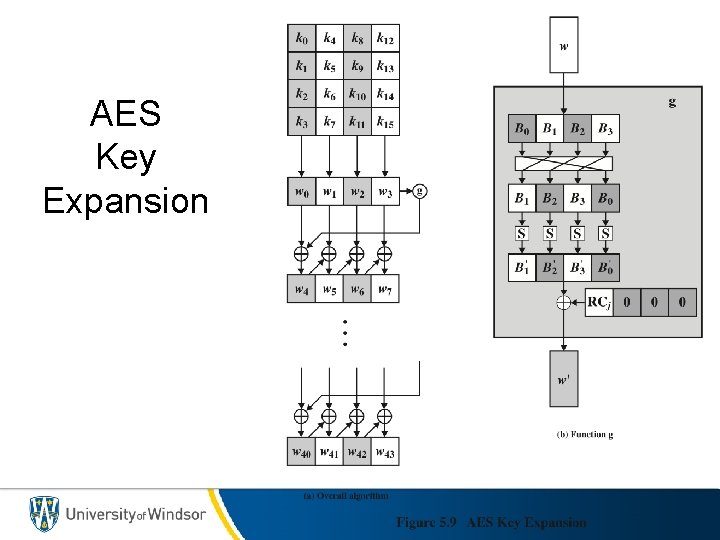
AES Key Expansion
Key Expansion Rationale • The Rijndael developers designed the expansion key algorithm to be resistant to known cryptanalytic attacks • Inclusion of a rounddependent round constant eliminates the symmetry between the ways in which round keys are generated in different rounds The specific criteria that were used are: • Knowledge of a part of the cipher key or round key does not enable calculation of many other round-key bits • An invertible transformation • Speed on a wide range of processors • Usage of round constants to eliminate symmetries • Diffusion of cipher key differences into the round keys • Enough nonlinearity to prohibit the full determination of round key differences from cipher key differences only • Simplicity of description
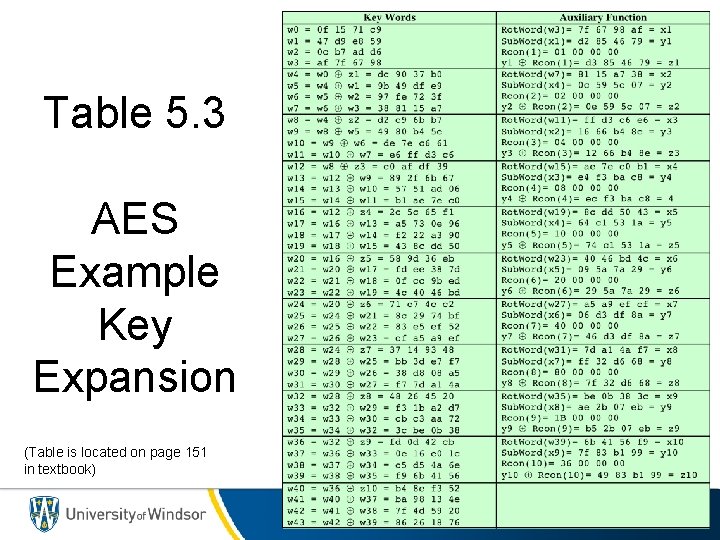
Table 5. 3 AES Example Key Expansion (Table is located on page 151 in textbook)
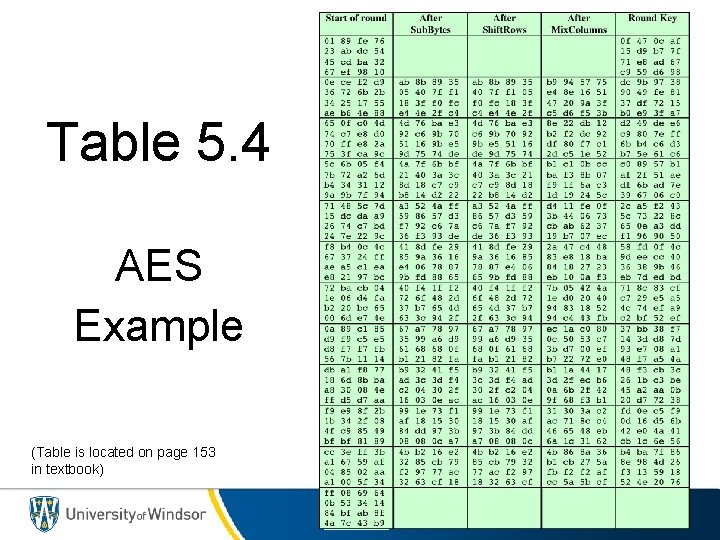
Table 5. 4 AES Example (Table is located on page 153 in textbook)
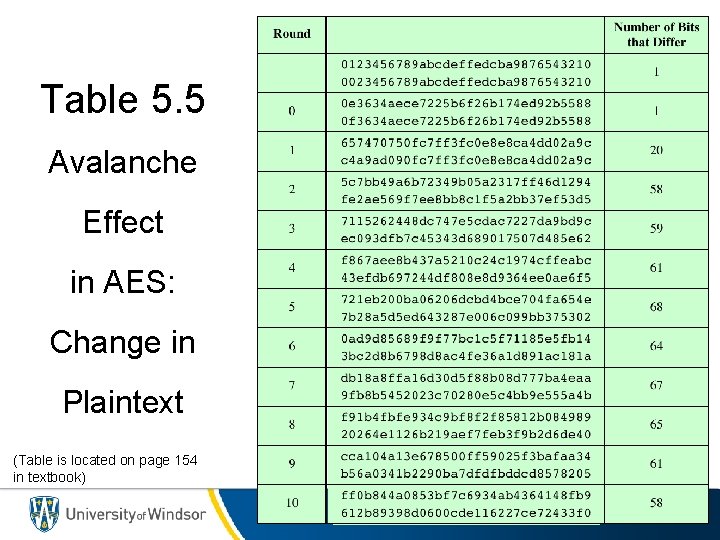
Table 5. 5 Avalanche Effect in AES: Change in Plaintext (Table is located on page 154 in textbook)
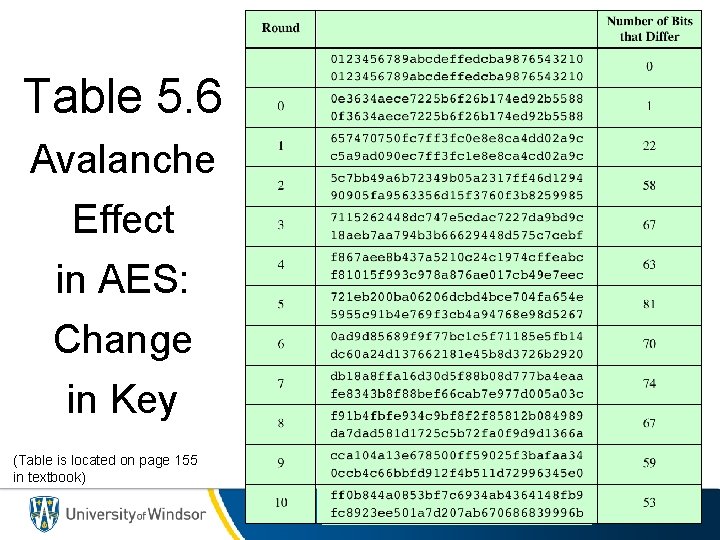
Table 5. 6 Avalanche Effect in AES: Change in Key (Table is located on page 155 in textbook)
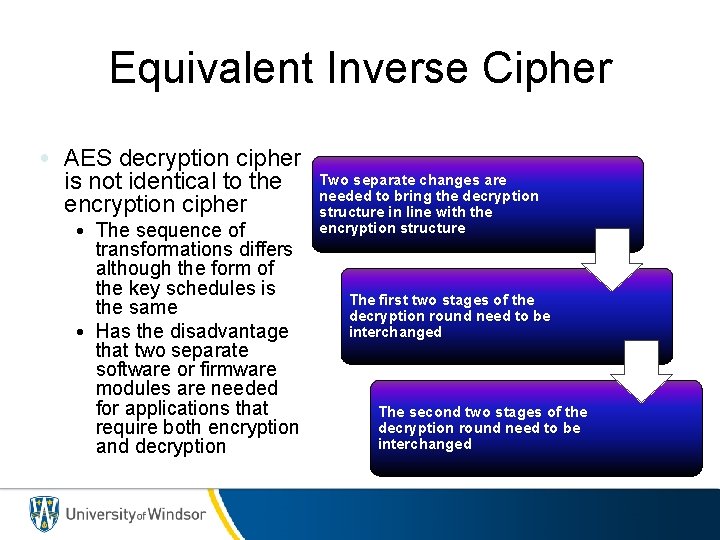
Equivalent Inverse Cipher • AES decryption cipher is not identical to the encryption cipher • The sequence of transformations differs although the form of the key schedules is the same • Has the disadvantage that two separate software or firmware modules are needed for applications that require both encryption and decryption Two separate changes are needed to bring the decryption structure in line with the encryption structure The first two stages of the decryption round need to be interchanged The second two stages of the decryption round need to be interchanged

Interchanging Inv. Shift. Rows and Inv. Sub. Bytes • Inv. Shift. Rows affects the sequence of bytes in State but does not alter byte contents and does not depend on byte contents to perform its transformation • Inv. Sub. Bytes affects the contents of bytes in State but does not alter byte sequence and does not depend on byte sequence to perform its transformation • Thus, these two operations commute and can be interchanged
Interchanging Add. Round. Key and Inv. Mix. Columns The transformations Add. Round. Key and Inv. Mix. Columns do not alter the sequence of bytes in State If we view the key as a sequence of words, then both Add. Round. Key and Inv. Mix. Columns operate on State one column at a time These two operations are linear with respect to the column input
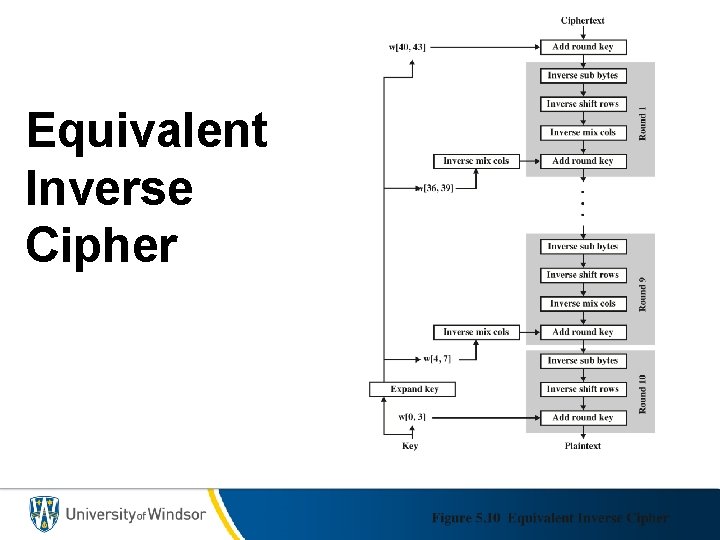
Equivalent Inverse Cipher
Implementation Aspects • AES can be implemented very efficiently on an 8 -bit processor • Add. Round. Key is a bytewise XOR operation • Shift. Rows is a simple byte-shifting operation • Sub. Bytes operates at the byte level and only requires a table of 256 bytes • Mix. Columns requires matrix multiplication in the field GF(28), which means that all operations are carried out on bytes
Implementation Aspects • Can efficiently implement on a 32 -bit processor • Redefine steps to use 32 -bit words • Can precompute 4 tables of 256 -words • Then each column in each round can be computed using 4 table lookups + 4 XORs • At a cost of 4 Kb to store tables • Designers believe this very efficient implementation was a key factor in its selection as the AES cipher

AES Rijndael Encryption Cipher Overview • Youtube Example
AES Rijndael Cipher - Visualization • Thanks to Abin Alichin and Youtube • Example • Scholartica Channel – some details and examples • https: //www. youtube. com/watch? v=n. L 1 Apw. EXrz 0
Summary • Finite field arithmetic • AES structure – General structure – Detailed structure • AES key expansion – Key expansion algorithm – Rationale • AES transformation functions • • Substitute bytes Shift. Rows Mix. Columns Add. Round. Key • AES implementation • Equivalent inverse cipher • Implementation aspects
- Slides: 87