Information Security CS 526 Topic 2 Cryptography Terminology

- Slides: 28
Information Security CS 526 Topic 2 Cryptography: Terminology & Classic Ciphers CS 526 Topic 2: Classical Cryptography 1
Readings for This Lecture Required readings: – Cryptography on Wikipedia Interesting reading – The Code Book by Simon Singh CS 526 Topic 2: Classical Cryptography 2
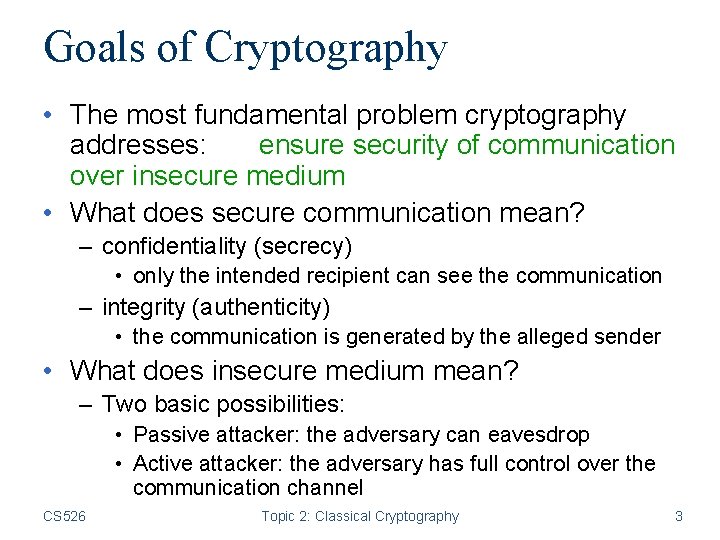
Goals of Cryptography • The most fundamental problem cryptography addresses: ensure security of communication over insecure medium • What does secure communication mean? – confidentiality (secrecy) • only the intended recipient can see the communication – integrity (authenticity) • the communication is generated by the alleged sender • What does insecure medium mean? – Two basic possibilities: • Passive attacker: the adversary can eavesdrop • Active attacker: the adversary has full control over the communication channel CS 526 Topic 2: Classical Cryptography 3
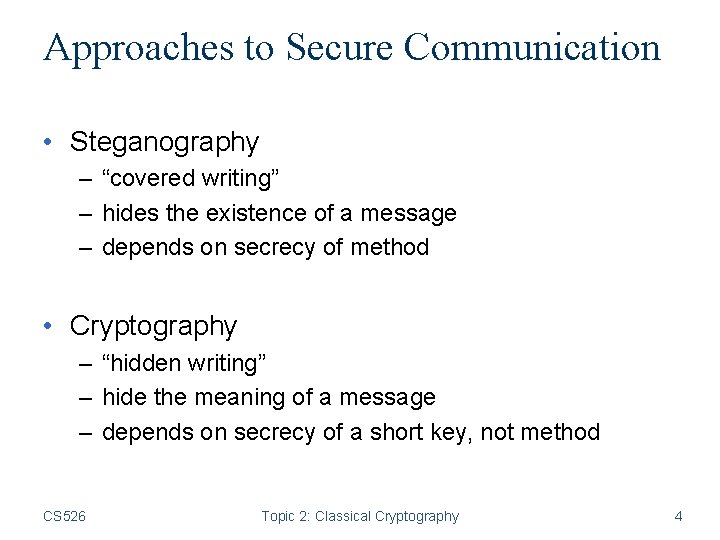
Approaches to Secure Communication • Steganography – “covered writing” – hides the existence of a message – depends on secrecy of method • Cryptography – “hidden writing” – hide the meaning of a message – depends on secrecy of a short key, not method CS 526 Topic 2: Classical Cryptography 4
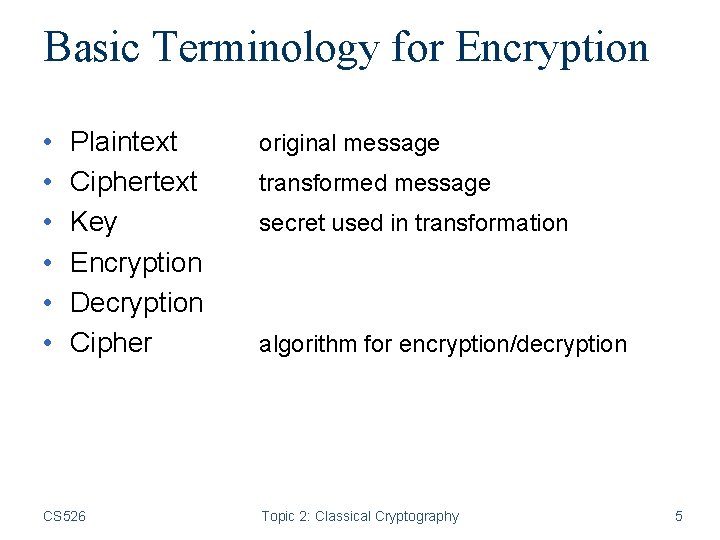
Basic Terminology for Encryption • • • Plaintext Ciphertext Key Encryption Decryption Cipher CS 526 original message transformed message secret used in transformation algorithm for encryption/decryption Topic 2: Classical Cryptography 5
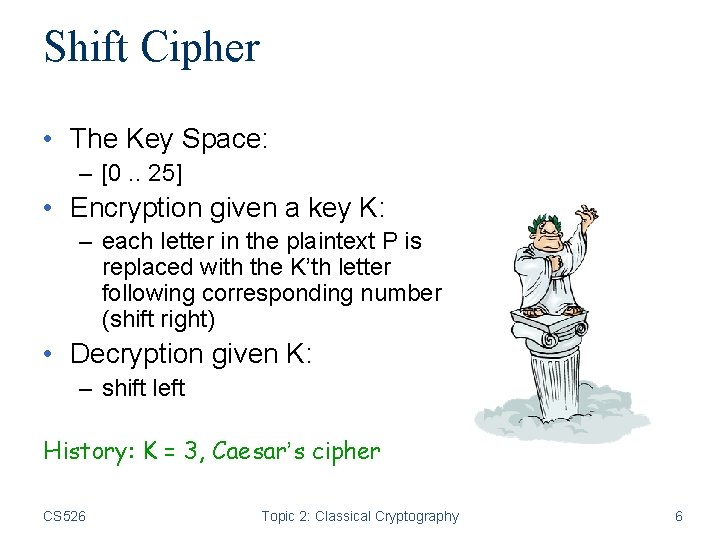
Shift Cipher • The Key Space: – [0. . 25] • Encryption given a key K: – each letter in the plaintext P is replaced with the K’th letter following corresponding number (shift right) • Decryption given K: – shift left History: K = 3, Caesar’s cipher CS 526 Topic 2: Classical Cryptography 6
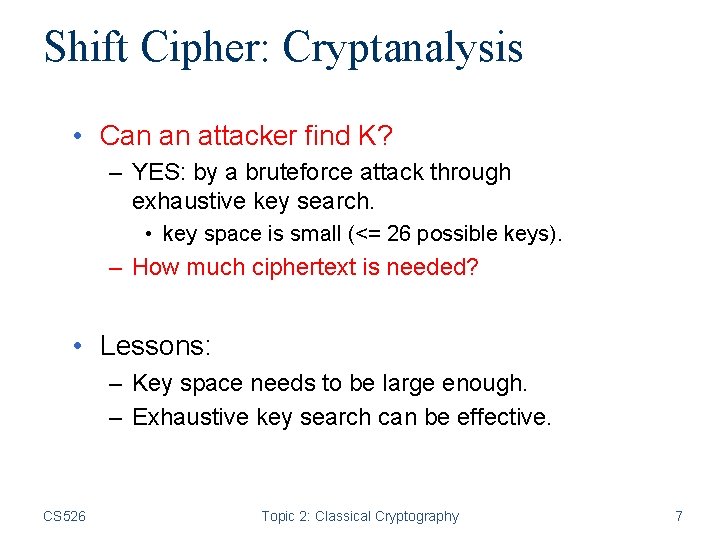
Shift Cipher: Cryptanalysis • Can an attacker find K? – YES: by a bruteforce attack through exhaustive key search. • key space is small (<= 26 possible keys). – How much ciphertext is needed? • Lessons: – Key space needs to be large enough. – Exhaustive key search can be effective. CS 526 Topic 2: Classical Cryptography 7
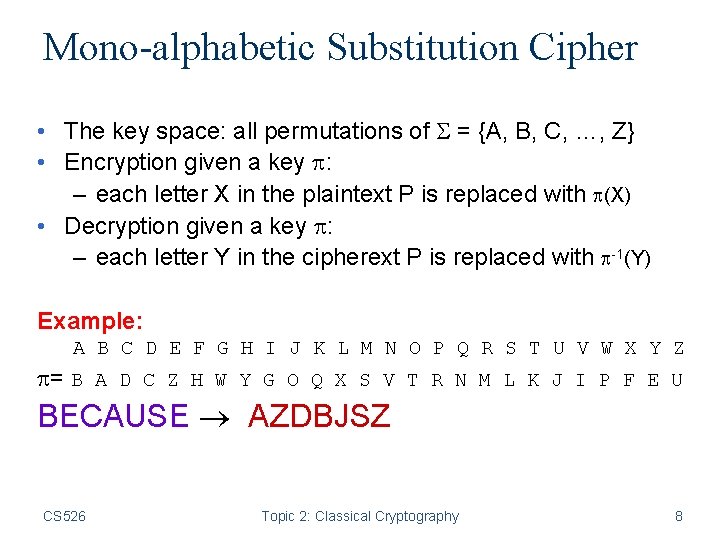
Mono-alphabetic Substitution Cipher • The key space: all permutations of = {A, B, C, …, Z} • Encryption given a key : – each letter X in the plaintext P is replaced with (X) • Decryption given a key : – each letter Y in the cipherext P is replaced with -1(Y) Example: A B C D E F G H I J K L M N O P Q R S T U V W X Y Z = B A D C Z H W Y G O Q X S V T R N M L K J I P F E U BECAUSE AZDBJSZ CS 526 Topic 2: Classical Cryptography 8
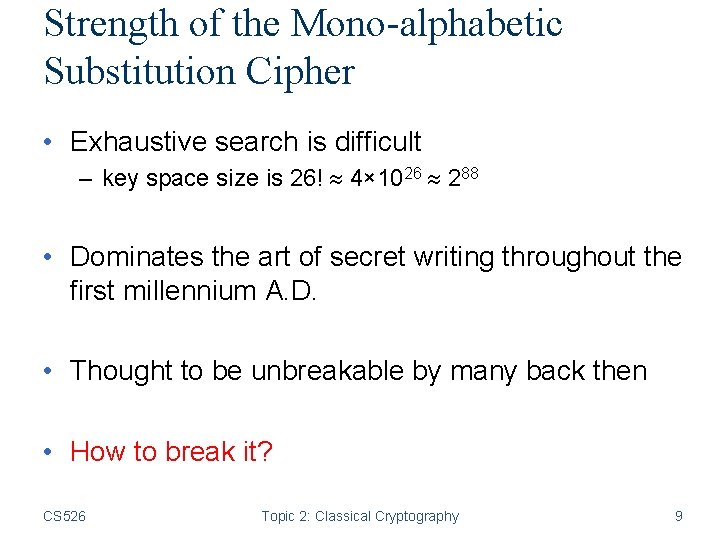
Strength of the Mono-alphabetic Substitution Cipher • Exhaustive search is difficult – key space size is 26! 4× 1026 288 • Dominates the art of secret writing throughout the first millennium A. D. • Thought to be unbreakable by many back then • How to break it? CS 526 Topic 2: Classical Cryptography 9
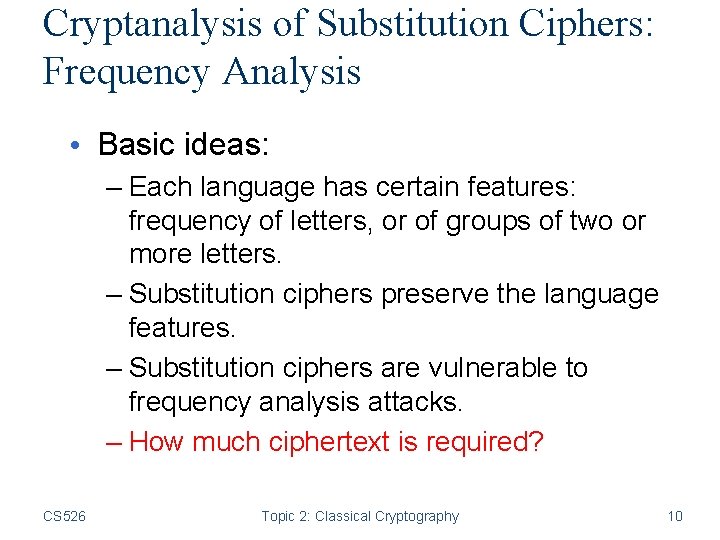
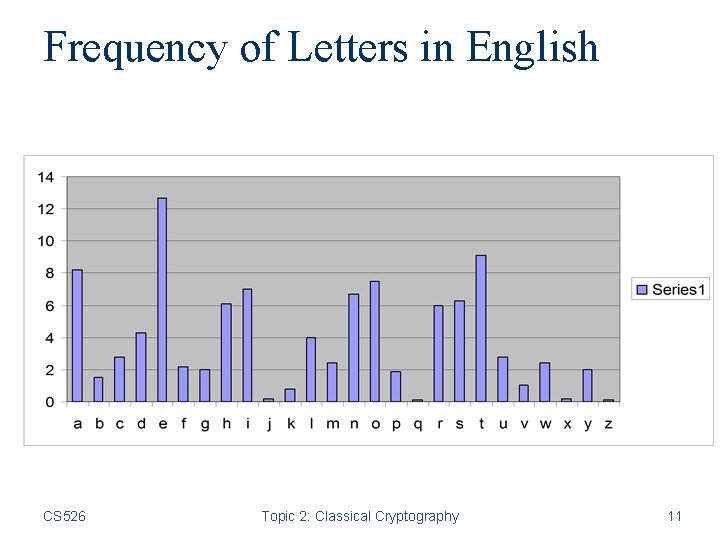
Cryptanalysis of Substitution Ciphers: Frequency Analysis • Basic ideas: – Each language has certain features: frequency of letters, or of groups of two or more letters. – Substitution ciphers preserve the language features. – Substitution ciphers are vulnerable to frequency analysis attacks. – How much ciphertext is required? CS 526 Topic 2: Classical Cryptography 10
Frequency of Letters in English CS 526 Topic 2: Classical Cryptography 11
How to Defeat Frequency Analysis? • Use larger blocks as the basis of substitution. Rather than substituting one letter at a time, substitute 64 bits at a time, or 128 bits. – Leads to block ciphers such as DES & AES. • Use different substitutions to get rid of frequency features. – Leads to polyalphabetical substituion ciphers, and to stream ciphers such as RC 4 CS 526 Topic 2: Classical Cryptography 12
Towards the Polyalphabetic Substitution Ciphers • Main weaknesses of monoalphabetic substitution ciphers – In ciphertext, different letters have different frequency • each letter in the ciphertext corresponds to only one letter in the plaintext letter • Idea for a stronger cipher (1460’s by Alberti) – Use more than one substitutions, and switch between them when encrypting different letters • As result, frequencies of letters in ciphertext are similar • Developed into an easy-to-use cipher by Vigenère (published in 1586) CS 526 Topic 2: Classical Cryptography 13
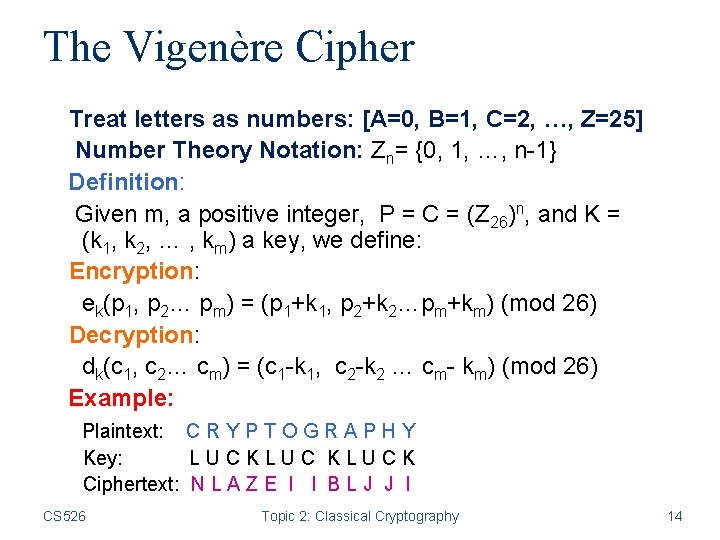
The Vigenère Cipher Treat letters as numbers: [A=0, B=1, C=2, …, Z=25] Number Theory Notation: Zn= {0, 1, …, n-1} Definition: Given m, a positive integer, P = C = (Z 26)n, and K = (k 1, k 2, … , km) a key, we define: Encryption: ek(p 1, p 2… pm) = (p 1+k 1, p 2+k 2…pm+km) (mod 26) Decryption: dk(c 1, c 2… cm) = (c 1 -k 1, c 2 -k 2 … cm- km) (mod 26) Example: Plaintext: C R Y P T O G R A P H Y Key: LUCKLUCK Ciphertext: N L A Z E I I B L J J I CS 526 Topic 2: Classical Cryptography 14
Security of Vigenere Cipher • Vigenere masks the frequency with which a character appears in a language: one letter in the ciphertext corresponds to multiple letters in the plaintext. Makes the use of frequency analysis more difficult. • Any message encrypted by a Vigenere cipher is a collection of as many shift ciphers as there are letters in the key. CS 526 Topic 2: Classical Cryptography 15
Vigenere Cipher: Cryptanalysis • Find the length of the key. – Kasisky test – Index of coincidence (we won’t cover here) • Divide the message into that many shift cipher encryptions. • Use frequency analysis to solve the resulting shift ciphers. – How? CS 526 Topic 2: Classical Cryptography 16
Kasisky Test for Finding Key Length • Observation: two identical segments of plaintext, will be encrypted to the same ciphertext, if they occur in the text at a distance such that is a multiple of m, the key length. • Algorithm: – Search for pairs of identical segments of length at least 3 – Record distances between the two segments: 1, 2, … – m divides gcd( 1, 2, …) CS 526 Topic 2: Classical Cryptography 17
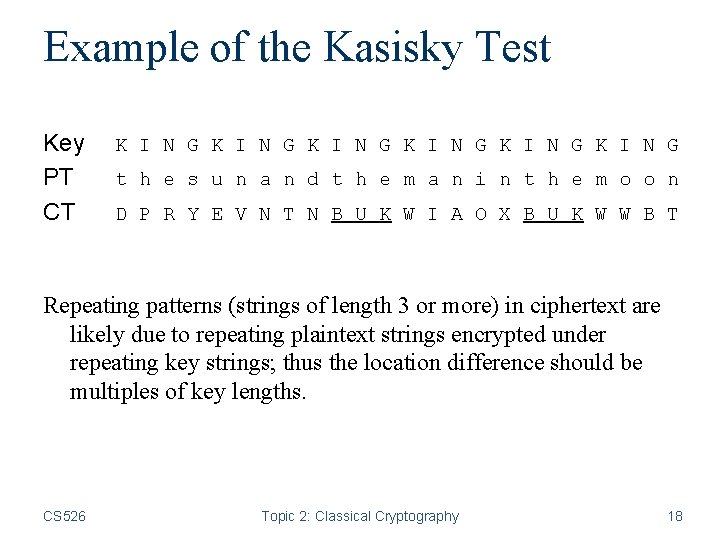
Example of the Kasisky Test Key PT CT K I N G K I N G t h e s u n a n d t h e m a n i n t h e m o o n D P R Y E V N T N B U K W I A O X B U K W W B T Repeating patterns (strings of length 3 or more) in ciphertext are likely due to repeating plaintext strings encrypted under repeating key strings; thus the location difference should be multiples of key lengths. CS 526 Topic 2: Classical Cryptography 18
One-Time Pad • Fix the vulnerability of the Vigenere cipher by using very long keys • Key is a random string that is at least as long as the plaintext • Encryption is similar to shift cipher • Invented by Vernam in the 1920 s CS 526 Topic 3: One-time Pad and Perfect Secrecy 19
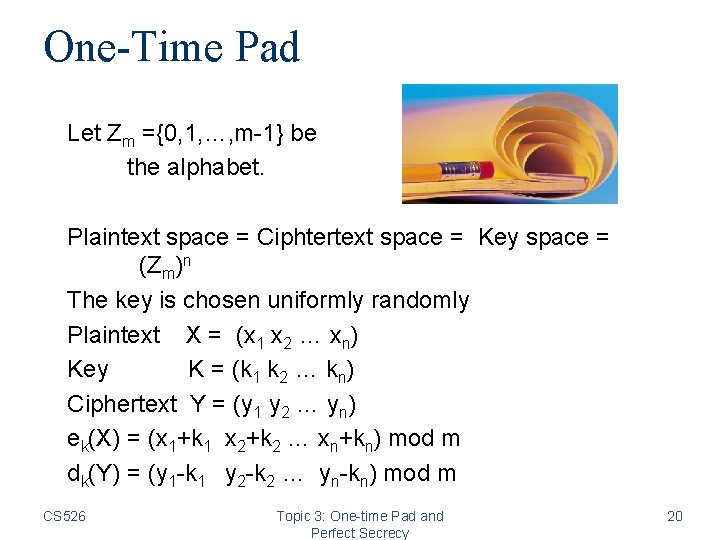
One-Time Pad Let Zm ={0, 1, …, m-1} be the alphabet. Plaintext space = Ciphtertext space = Key space = (Zm)n The key is chosen uniformly randomly Plaintext X = (x 1 x 2 … xn) Key K = (k 1 k 2 … kn) Ciphertext Y = (y 1 y 2 … yn) ek(X) = (x 1+k 1 x 2+k 2 … xn+kn) mod m dk(Y) = (y 1 -k 1 y 2 -k 2 … yn-kn) mod m CS 526 Topic 3: One-time Pad and Perfect Secrecy 20
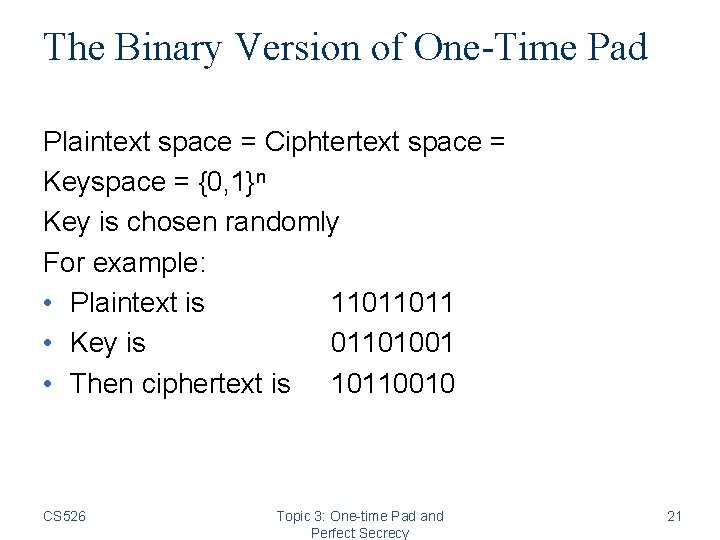
The Binary Version of One-Time Pad Plaintext space = Ciphtertext space = Keyspace = {0, 1}n Key is chosen randomly For example: • Plaintext is 11011011 • Key is 01101001 • Then ciphertext is 10110010 CS 526 Topic 3: One-time Pad and Perfect Secrecy 21
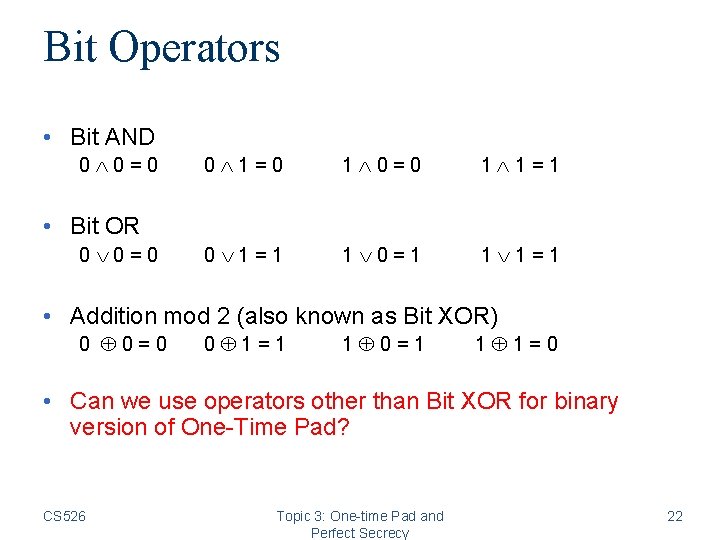
Bit Operators • Bit AND 0 0=0 0 1=0 1 0=0 1 1=1 0 1=1 1 0=1 1 1=1 • Bit OR 0 0=0 • Addition mod 2 (also known as Bit XOR) 0 0 = 0 0 1=1 1 0=1 1 1=0 • Can we use operators other than Bit XOR for binary version of One-Time Pad? CS 526 Topic 3: One-time Pad and Perfect Secrecy 22
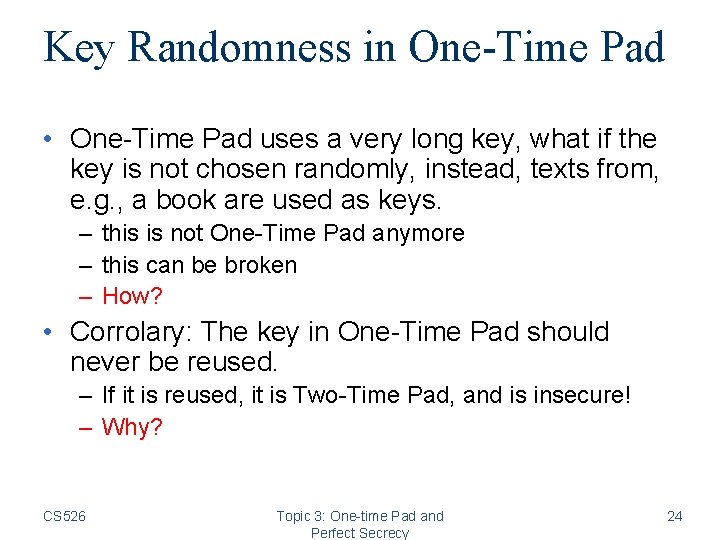
Key Randomness in One-Time Pad • One-Time Pad uses a very long key, what if the key is not chosen randomly, instead, texts from, e. g. , a book are used as keys. – this is not One-Time Pad anymore – this can be broken – How? • Corrolary: The key in One-Time Pad should never be reused. – If it is reused, it is Two-Time Pad, and is insecure! – Why? CS 526 Topic 3: One-time Pad and Perfect Secrecy 24
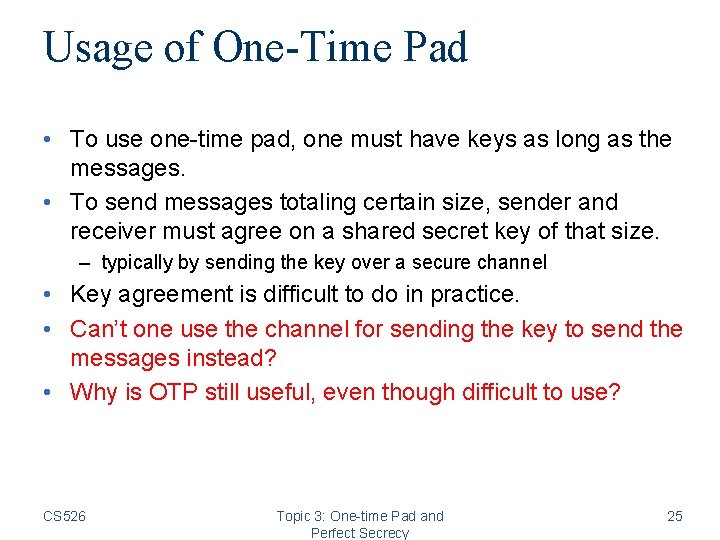
Usage of One-Time Pad • To use one-time pad, one must have keys as long as the messages. • To send messages totaling certain size, sender and receiver must agree on a shared secret key of that size. – typically by sending the key over a secure channel • Key agreement is difficult to do in practice. • Can’t one use the channel for sending the key to send the messages instead? • Why is OTP still useful, even though difficult to use? CS 526 Topic 3: One-time Pad and Perfect Secrecy 25
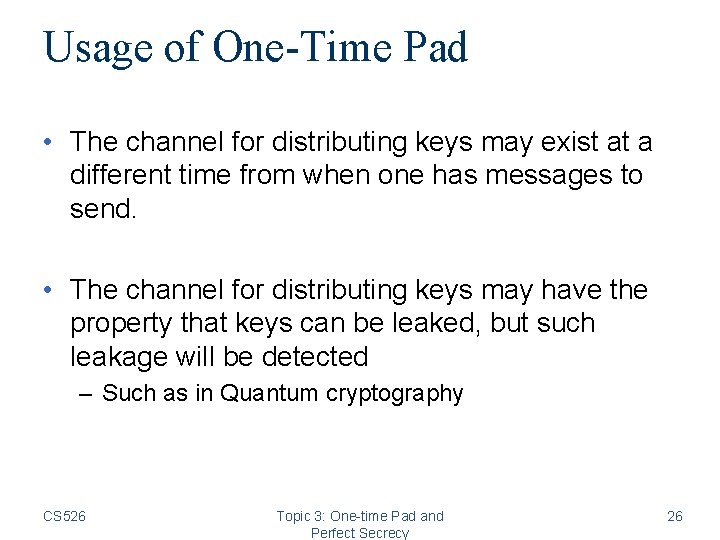
Usage of One-Time Pad • The channel for distributing keys may exist at a different time from when one has messages to send. • The channel for distributing keys may have the property that keys can be leaked, but such leakage will be detected – Such as in Quantum cryptography CS 526 Topic 3: One-time Pad and Perfect Secrecy 26
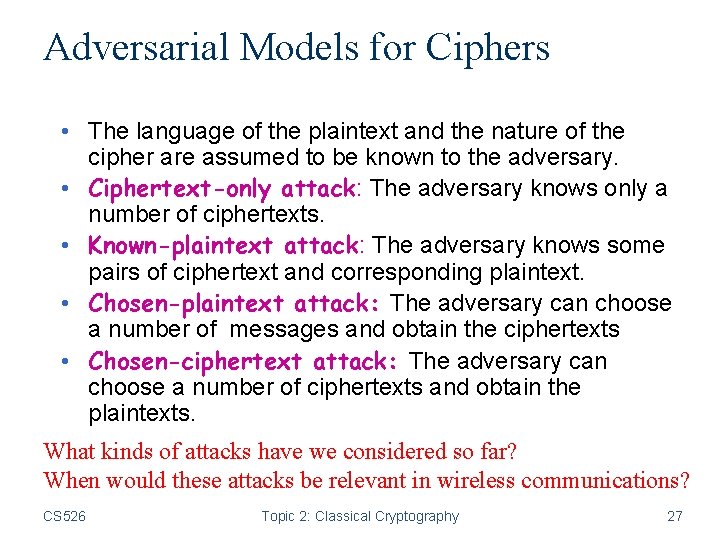
Adversarial Models for Ciphers • The language of the plaintext and the nature of the cipher are assumed to be known to the adversary. • Ciphertext-only attack: The adversary knows only a number of ciphertexts. • Known-plaintext attack: The adversary knows some pairs of ciphertext and corresponding plaintext. • Chosen-plaintext attack: The adversary can choose a number of messages and obtain the ciphertexts • Chosen-ciphertext attack: The adversary can choose a number of ciphertexts and obtain the plaintexts. What kinds of attacks have we considered so far? When would these attacks be relevant in wireless communications? CS 526 Topic 2: Classical Cryptography 27
The Open Design Security Principle • Kerckhoffs's Principle: – A cryptosystem should be secure even if everything about the system, except the key, is public knowledge. • Shannon's maxim: – "The enemy knows the system. " • Security by obscurity doesn’t work • Should assume that the adversary knows the algorithm; the only secret the adversary is assumed to not know is the key • What is the difference between the algorithm and the key? CS 526 Topic 2: Classical Cryptography 28
Coming Attractions … • Cryptography: Informational Theoretical Security, Stream Ciphers CS 526 Topic 2: Classical Cryptography 29