Cryptography and Security Services Mechanisms and Applications Session
- Slides: 40
Cryptography and Security Services: Mechanisms and Applications Session 11 Wireless Security Manuel Mogollon m_mogollon@verizon. net M. Mogollon – 0
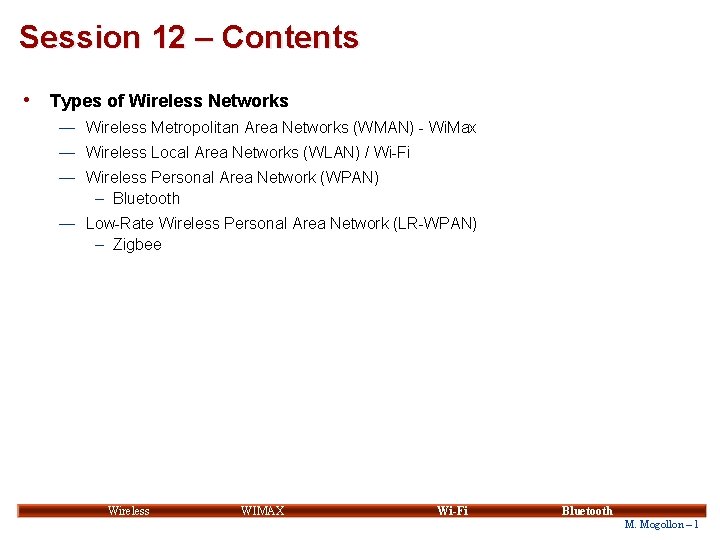
Session 12 – Contents • Types of Wireless Networks — Wireless Metropolitan Area Networks (WMAN) - Wi. Max — Wireless Local Area Networks (WLAN) / Wi-Fi — Wireless Personal Area Network (WPAN) – Bluetooth — Low-Rate Wireless Personal Area Network (LR-WPAN) – Zigbee Wireless WIMAX Wi-Fi Bluetooth M. Mogollon – 1
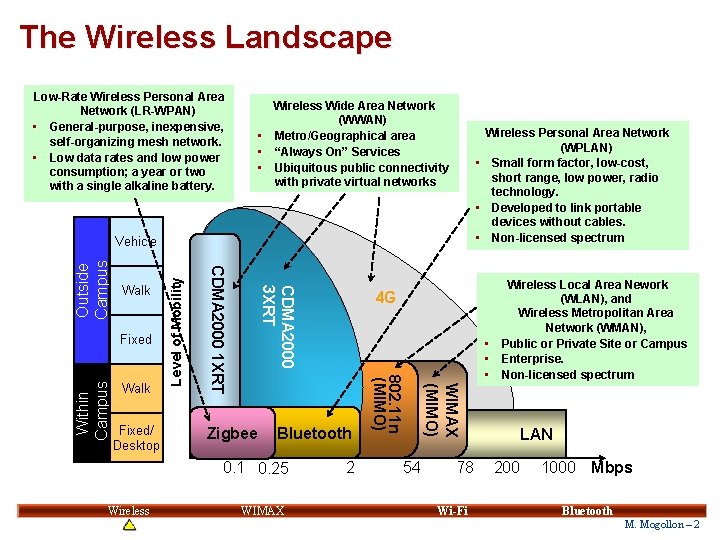
The Wireless Landscape Low-Rate Wireless Personal Area Network (LR-WPAN) • General-purpose, inexpensive, self-organizing mesh network. • Low data rates and low power consumption; a year or two with a single alkaline battery. • • • Wireless Wide Area Network (WWAN) Metro/Geographical area “Always On” Services Ubiquitous public connectivity with private virtual networks Wireless Personal Area Network (WPLAN) • Small form factor, low-cost, short range, low power, radio technology. • Developed to link portable devices without cables. • Non-licensed spectrum Fixed/ Desktop Zigbee Bluetooth Level of Mobility 0. 1 0. 25 Wireless WIMAX 2 54 • • • WIMAX (MIMO) Walk 4 G 802. 11 n (MIMO) Within Campus Fixed CDMA 2000 3 XRT Walk CDMA 2000 1 XRT Outside Campus Vehicle 78 Wi-Fi Wireless Local Area Nework (WLAN), and Wireless Metropolitan Area Network (WMAN), Public or Private Site or Campus Enterprise. Non-licensed spectrum LAN 200 1000 Mbps Bluetooth M. Mogollon – 2
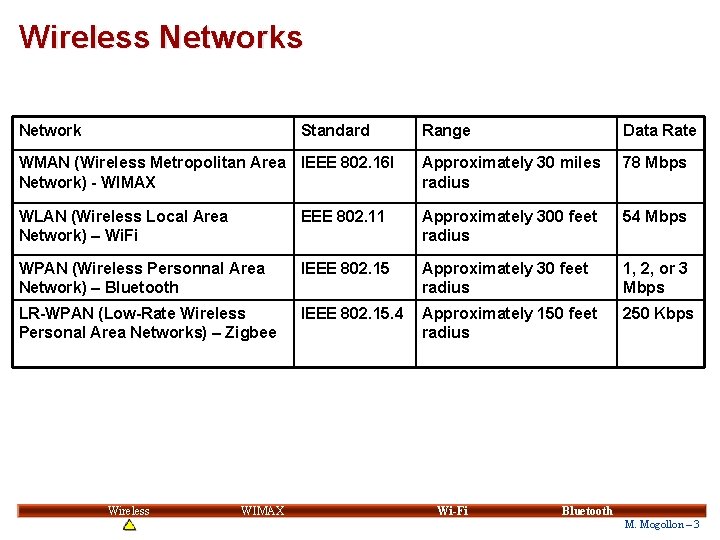
Wireless Network Standard Range Data Rate WMAN (Wireless Metropolitan Area IEEE 802. 16 I Network) - WIMAX Approximately 30 miles radius 78 Mbps WLAN (Wireless Local Area Network) – Wi. Fi EEE 802. 11 Approximately 300 feet radius 54 Mbps WPAN (Wireless Personnal Area Network) – Bluetooth IEEE 802. 15 Approximately 30 feet radius 1, 2, or 3 Mbps LR-WPAN (Low-Rate Wireless Personal Area Networks) – Zigbee IEEE 802. 15. 4 Approximately 150 feet radius 250 Kbps Wireless WIMAX Wi-Fi Bluetooth M. Mogollon – 3
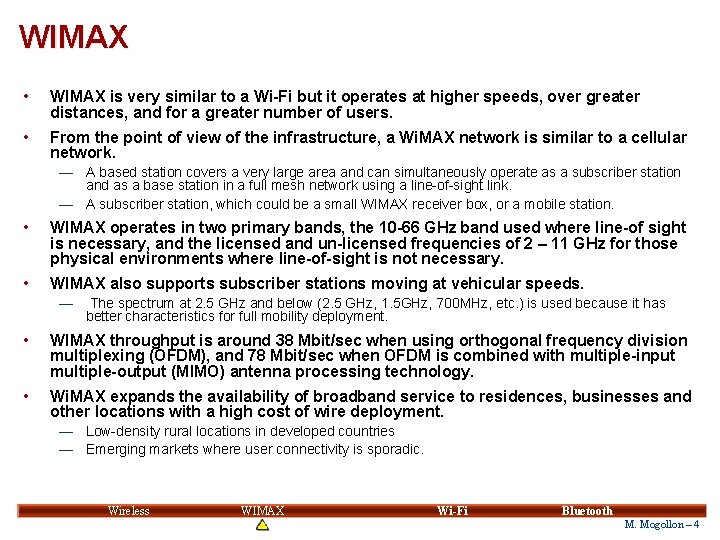
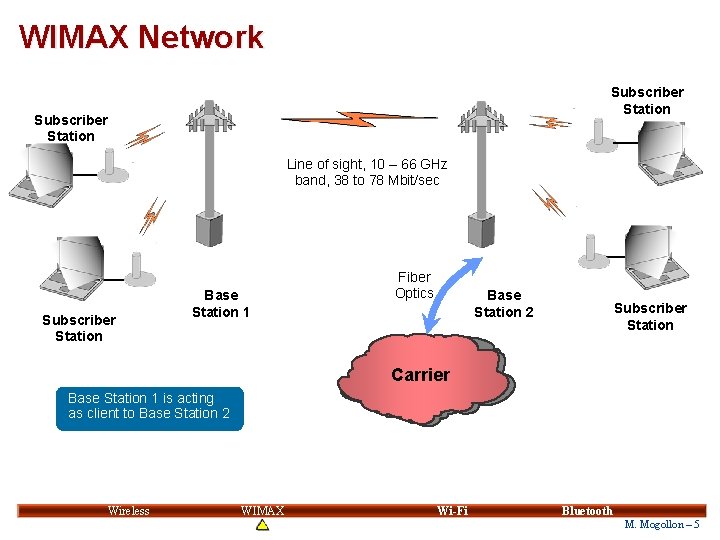
WIMAX • WIMAX is very similar to a Wi-Fi but it operates at higher speeds, over greater distances, and for a greater number of users. • From the point of view of the infrastructure, a Wi. MAX network is similar to a cellular network. — A based station covers a very large area and can simultaneously operate as a subscriber station and as a base station in a full mesh network using a line-of-sight link. — A subscriber station, which could be a small WIMAX receiver box, or a mobile station. • WIMAX operates in two primary bands, the 10 -66 GHz band used where line-of sight is necessary, and the licensed and un-licensed frequencies of 2 – 11 GHz for those physical environments where line-of-sight is not necessary. • WIMAX also supports subscriber stations moving at vehicular speeds. — The spectrum at 2. 5 GHz and below (2. 5 GHz, 1. 5 GHz, 700 MHz, etc. ) is used because it has better characteristics for full mobility deployment. • WIMAX throughput is around 38 Mbit/sec when using orthogonal frequency division multiplexing (OFDM), and 78 Mbit/sec when OFDM is combined with multiple-input multiple-output (MIMO) antenna processing technology. • Wi. MAX expands the availability of broadband service to residences, businesses and other locations with a high cost of wire deployment. — Low-density rural locations in developed countries — Emerging markets where user connectivity is sporadic. Wireless WIMAX Wi-Fi Bluetooth M. Mogollon – 4
WIMAX Network Subscriber Station Line of sight, 10 – 66 GHz band, 38 to 78 Mbit/sec Subscriber Station Base Station 1 Fiber Optics Base Station 2 Subscriber Station Carrier Base Station 1 is acting as client to Base Station 2 Wireless WIMAX Wi-Fi Bluetooth M. Mogollon – 5
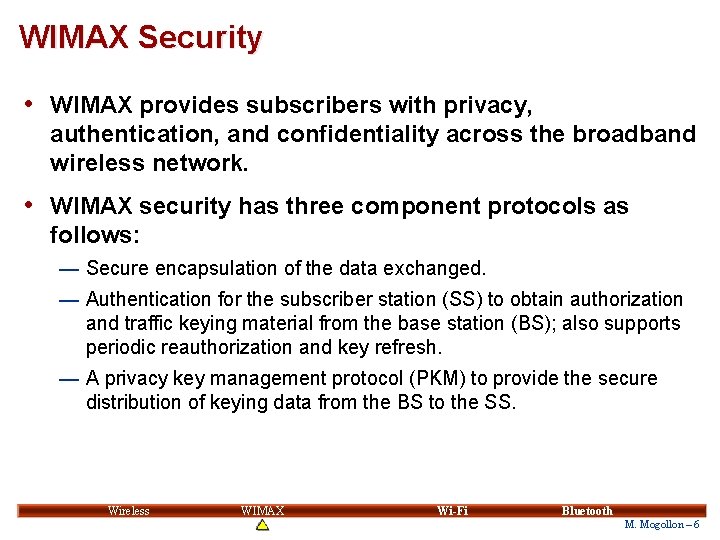
WIMAX Security • WIMAX provides subscribers with privacy, authentication, and confidentiality across the broadband wireless network. • WIMAX security has three component protocols as follows: — Secure encapsulation of the data exchanged. — Authentication for the subscriber station (SS) to obtain authorization and traffic keying material from the base station (BS); also supports periodic reauthorization and key refresh. — A privacy key management protocol (PKM) to provide the secure distribution of keying data from the BS to the SS. Wireless WIMAX Wi-Fi Bluetooth M. Mogollon – 6
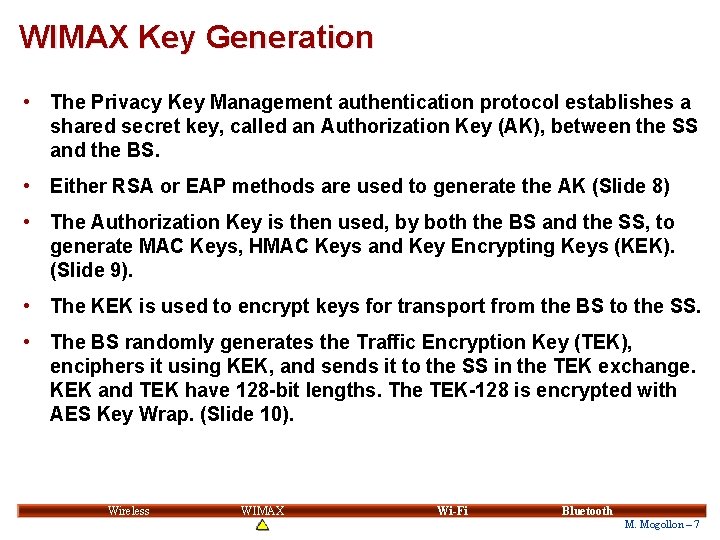
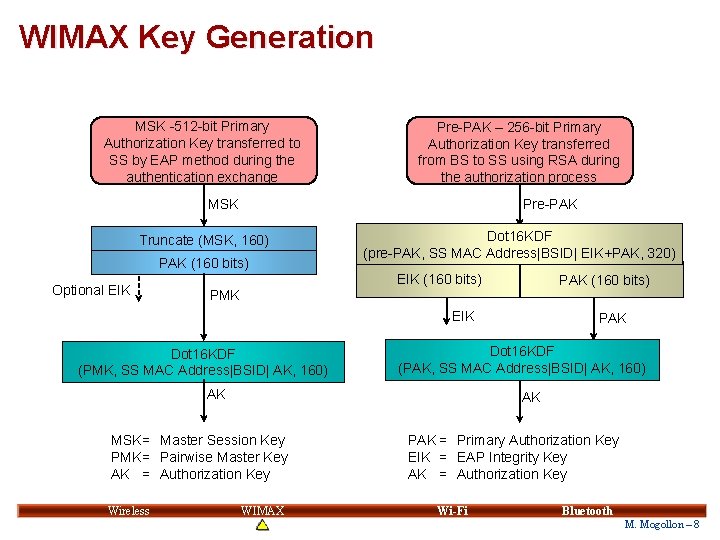
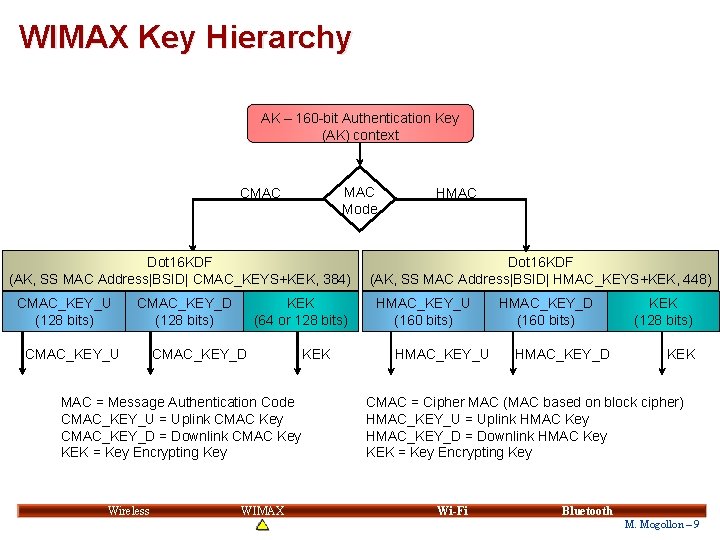
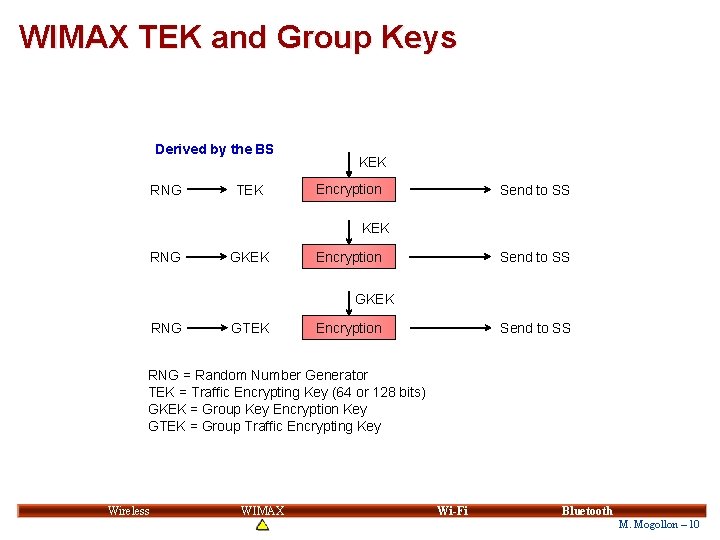
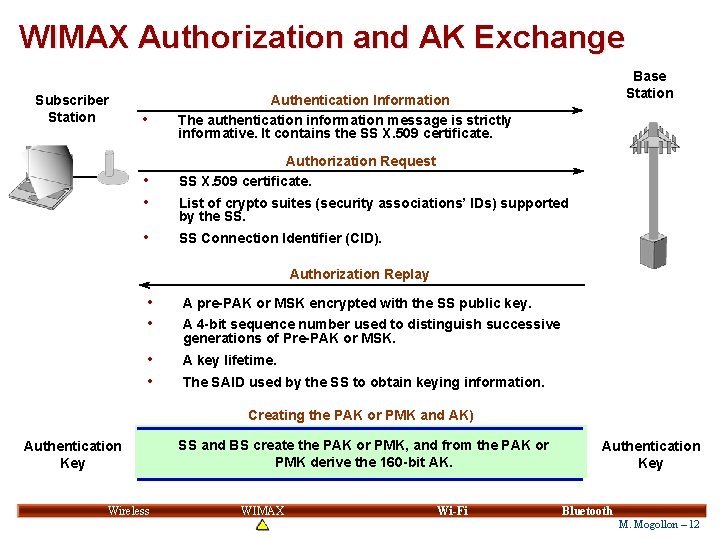
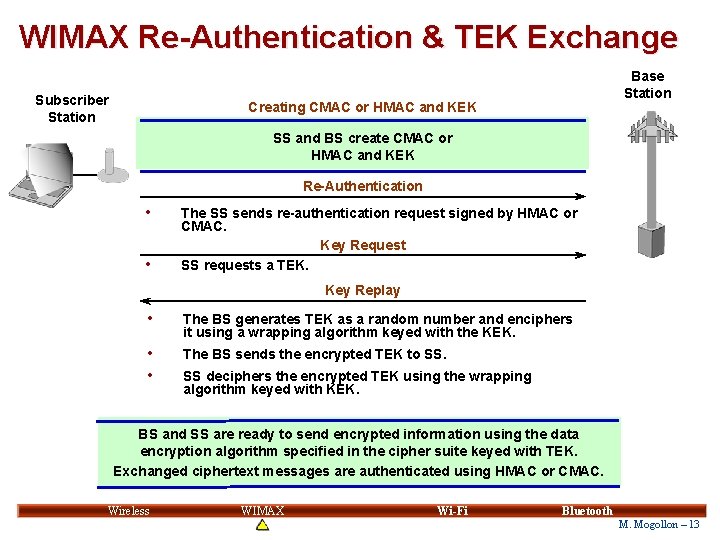
WIMAX Key Generation • The Privacy Key Management authentication protocol establishes a shared secret key, called an Authorization Key (AK), between the SS and the BS. • Either RSA or EAP methods are used to generate the AK (Slide 8) • The Authorization Key is then used, by both the BS and the SS, to generate MAC Keys, HMAC Keys and Key Encrypting Keys (KEK). (Slide 9). • The KEK is used to encrypt keys for transport from the BS to the SS. • The BS randomly generates the Traffic Encryption Key (TEK), enciphers it using KEK, and sends it to the SS in the TEK exchange. KEK and TEK have 128 -bit lengths. The TEK-128 is encrypted with AES Key Wrap. (Slide 10). Wireless WIMAX Wi-Fi Bluetooth M. Mogollon – 7
WIMAX Key Generation MSK -512 -bit Primary Authorization Key transferred to SS by EAP method during the authentication exchange Pre-PAK – 256 -bit Primary Authorization Key transferred from BS to SS using RSA during the authorization process MSK Pre-PAK Truncate (MSK, 160) PAK (160 bits) Optional EIK Dot 16 KDF (pre-PAK, SS MAC Address|BSID| EIK+PAK, 320) EIK (160 bits) PAK (160 bits) PMK EIK Dot 16 KDF (PMK, SS MAC Address|BSID| AK, 160) Dot 16 KDF (PAK, SS MAC Address|BSID| AK, 160) AK AK MSK= Master Session Key PMK= Pairwise Master Key AK = Authorization Key Wireless PAK WIMAX PAK = Primary Authorization Key EIK = EAP Integrity Key AK = Authorization Key Wi-Fi Bluetooth M. Mogollon – 8
WIMAX Key Hierarchy AK – 160 -bit Authentication Key (AK) context MAC Mode CMAC Dot 16 KDF (AK, SS MAC Address|BSID| CMAC_KEYS+KEK, 384) CMAC_KEY_U (128 bits) KEK (64 or 128 bits) CMAC_KEY_D (128 bits) CMAC_KEY_U CMAC_KEY_D MAC = Message Authentication Code CMAC_KEY_U = Uplink CMAC Key CMAC_KEY_D = Downlink CMAC Key KEK = Key Encrypting Key Wireless WIMAX KEK HMAC Dot 16 KDF (AK, SS MAC Address|BSID| HMAC_KEYS+KEK, 448) HMAC_KEY_U (160 bits) HMAC_KEY_U HMAC_KEY_D (160 bits) HMAC_KEY_D KEK (128 bits) KEK CMAC = Cipher MAC (MAC based on block cipher) HMAC_KEY_U = Uplink HMAC Key HMAC_KEY_D = Downlink HMAC Key KEK = Key Encrypting Key Wi-Fi Bluetooth M. Mogollon – 9
WIMAX TEK and Group Keys Derived by the BS RNG TEK KEK Encryption Send to SS KEK RNG GKEK Encryption Send to SS GKEK RNG GTEK Encryption Send to SS RNG = Random Number Generator TEK = Traffic Encrypting Key (64 or 128 bits) GKEK = Group Key Encryption Key GTEK = Group Traffic Encrypting Key Wireless WIMAX Wi-Fi Bluetooth M. Mogollon – 10
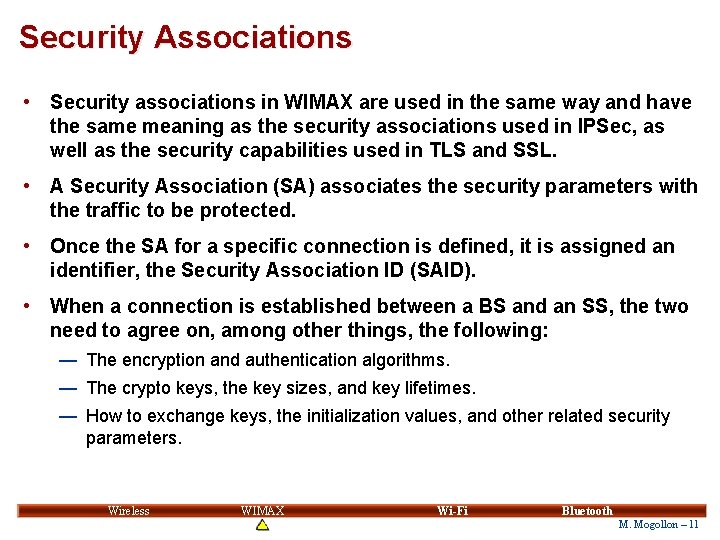
Security Associations • Security associations in WIMAX are used in the same way and have the same meaning as the security associations used in IPSec, as well as the security capabilities used in TLS and SSL. • A Security Association (SA) associates the security parameters with the traffic to be protected. • Once the SA for a specific connection is defined, it is assigned an identifier, the Security Association ID (SAID). • When a connection is established between a BS and an SS, the two need to agree on, among other things, the following: — The encryption and authentication algorithms. — The crypto keys, the key sizes, and key lifetimes. — How to exchange keys, the initialization values, and other related security parameters. Wireless WIMAX Wi-Fi Bluetooth M. Mogollon – 11
WIMAX Authorization and AK Exchange Subscriber Station • • Base Station Authentication Information The authentication information message is strictly informative. It contains the SS X. 509 certificate. Authorization Request SS X. 509 certificate. List of crypto suites (security associations’ IDs) supported by the SS. SS Connection Identifier (CID). Authorization Replay • • A pre-PAK or MSK encrypted with the SS public key. • • A key lifetime. A 4 -bit sequence number used to distinguish successive generations of Pre-PAK or MSK. The SAID used by the SS to obtain keying information. Creating the PAK or PMK and AK) Authentication Key Wireless SS and BS create the PAK or PMK, and from the PAK or PMK derive the 160 -bit AK. WIMAX Wi-Fi Authentication Key Bluetooth M. Mogollon – 12
WIMAX Re-Authentication & TEK Exchange Subscriber Station Base Station Creating CMAC or HMAC and KEK SS and BS create CMAC or HMAC and KEK Re-Authentication • • The SS sends re-authentication request signed by HMAC or CMAC. Key Request SS requests a TEK. Key Replay • The BS generates TEK as a random number and enciphers it using a wrapping algorithm keyed with the KEK. • • The BS sends the encrypted TEK to SS. SS deciphers the encrypted TEK using the wrapping algorithm keyed with KEK. BS and SS are ready to send encrypted information using the data encryption algorithm specified in the cipher suite keyed with TEK. Exchanged ciphertext messages are authenticated using HMAC or CMAC. Wireless WIMAX Wi-Fi Bluetooth M. Mogollon – 13
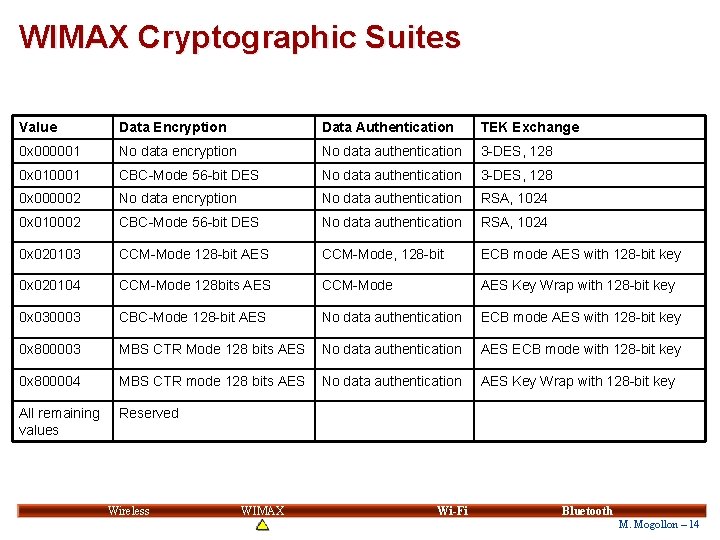
WIMAX Cryptographic Suites Value Data Encryption Data Authentication TEK Exchange 0 x 000001 No data encryption No data authentication 3 -DES, 128 0 x 010001 CBC-Mode 56 -bit DES No data authentication 3 -DES, 128 0 x 000002 No data encryption No data authentication RSA, 1024 0 x 010002 CBC-Mode 56 -bit DES No data authentication RSA, 1024 0 x 020103 CCM-Mode 128 -bit AES CCM-Mode, 128 -bit ECB mode AES with 128 -bit key 0 x 020104 CCM-Mode 128 bits AES CCM-Mode AES Key Wrap with 128 -bit key 0 x 030003 CBC-Mode 128 -bit AES No data authentication ECB mode AES with 128 -bit key 0 x 800003 MBS CTR Mode 128 bits AES No data authentication AES ECB mode with 128 -bit key 0 x 800004 MBS CTR mode 128 bits AES No data authentication AES Key Wrap with 128 -bit key All remaining values Reserved Wireless WIMAX Wi-Fi Bluetooth M. Mogollon – 14
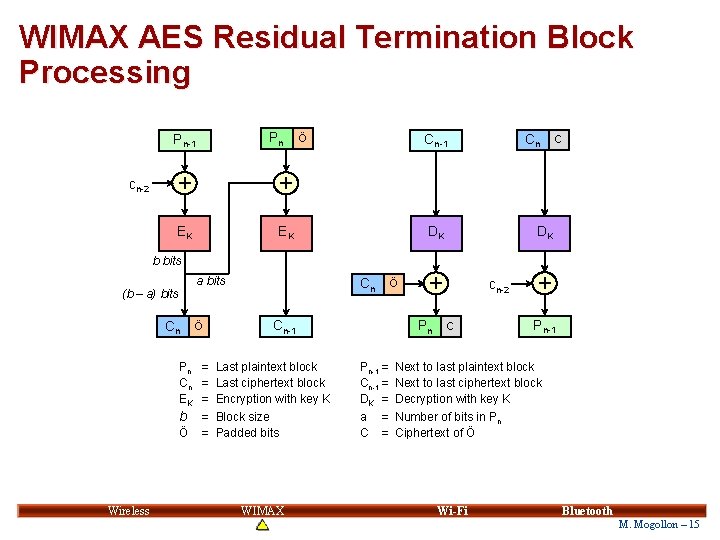
WIMAX AES Residual Termination Block Processing Pn Pn-1 cn-2 + + EK EK Cn Cn-1 Ö C DK DK b bits a bits (b – a) bits Cn Cn-1 Ö + Pn cn-2 C + Pn-1 Pn = Last plaintext block Cn = Last ciphertext block EK = Encryption with key K Pn-1 = Next to last plaintext block Cn-1 = Next to last ciphertext block DK = Decryption with key K b a C Ö Wireless Ö Cn = Block size = Padded bits WIMAX = Number of bits in Pn = Ciphertext of Ö Wi-Fi Bluetooth M. Mogollon – 15
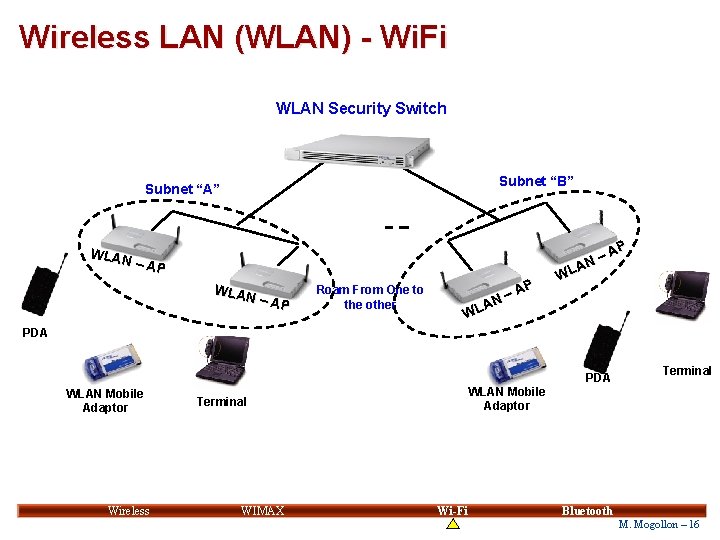
Wireless LAN (WLAN) - Wi. Fi WLAN Security Switch Subnet “B” Subnet “A” WLAN – AP Roam From One to the other AP – AN WL – AN L W AP PDA WLAN Mobile Adaptor Wireless WLAN Mobile Adaptor Terminal WIMAX Terminal Wi-Fi Bluetooth M. Mogollon – 16
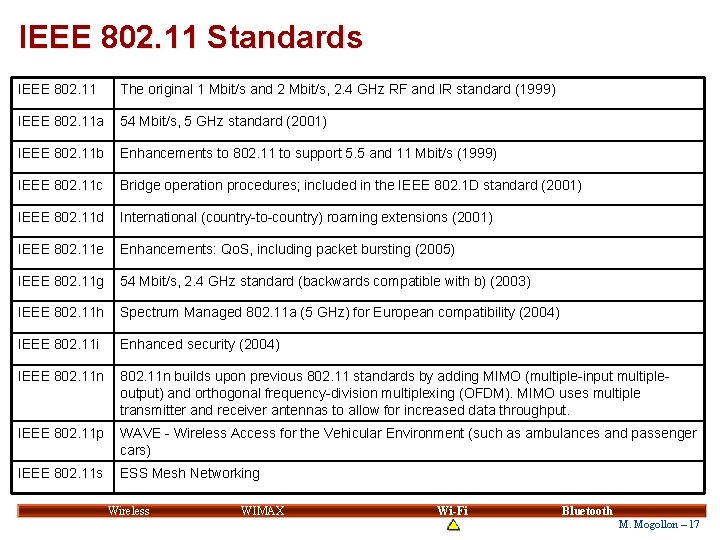
IEEE 802. 11 Standards IEEE 802. 11 The original 1 Mbit/s and 2 Mbit/s, 2. 4 GHz RF and IR standard (1999) IEEE 802. 11 a 54 Mbit/s, 5 GHz standard (2001) IEEE 802. 11 b Enhancements to 802. 11 to support 5. 5 and 11 Mbit/s (1999) IEEE 802. 11 c Bridge operation procedures; included in the IEEE 802. 1 D standard (2001) IEEE 802. 11 d International (country-to-country) roaming extensions (2001) IEEE 802. 11 e Enhancements: Qo. S, including packet bursting (2005) IEEE 802. 11 g 54 Mbit/s, 2. 4 GHz standard (backwards compatible with b) (2003) IEEE 802. 11 h Spectrum Managed 802. 11 a (5 GHz) for European compatibility (2004) IEEE 802. 11 i Enhanced security (2004) IEEE 802. 11 n builds upon previous 802. 11 standards by adding MIMO (multiple-input multipleoutput) and orthogonal frequency-division multiplexing (OFDM). MIMO uses multiple transmitter and receiver antennas to allow for increased data throughput. IEEE 802. 11 p WAVE - Wireless Access for the Vehicular Environment (such as ambulances and passenger cars) IEEE 802. 11 s ESS Mesh Networking Wireless WIMAX Wi-Fi Bluetooth M. Mogollon – 17
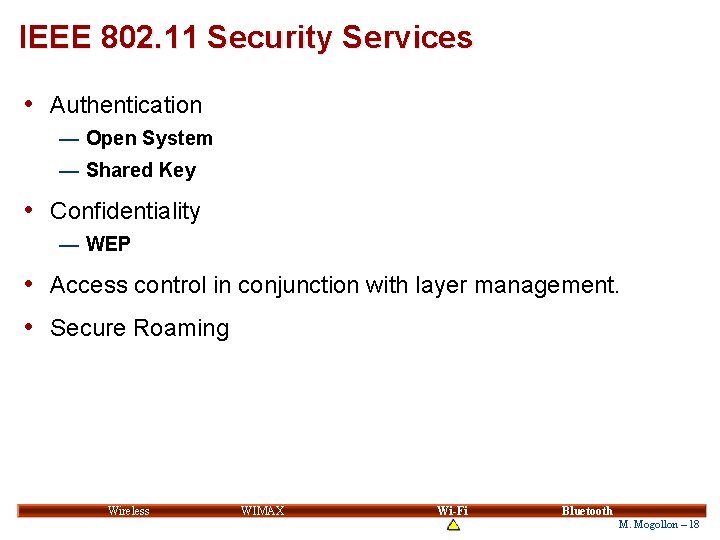
IEEE 802. 11 Security Services • Authentication — Open System — Shared Key • Confidentiality — WEP • Access control in conjunction with layer management. • Secure Roaming Wireless WIMAX Wi-Fi Bluetooth M. Mogollon – 18
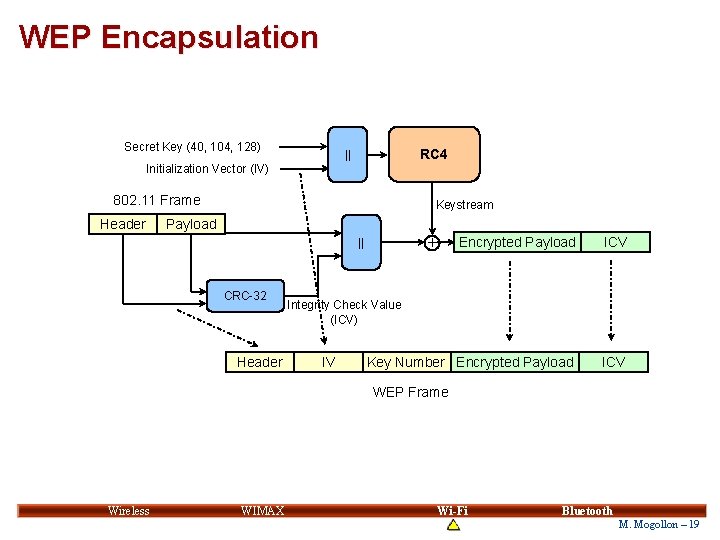
WEP Encapsulation Secret Key (40, 104, 128) RC 4 || Initialization Vector (IV) 802. 11 Frame Header Keystream Payload + Encrypted Payload ICV Key Number Encrypted Payload ICV || CRC-32 Header Integrity Check Value (ICV) IV WEP Frame Wireless WIMAX Wi-Fi Bluetooth M. Mogollon – 19
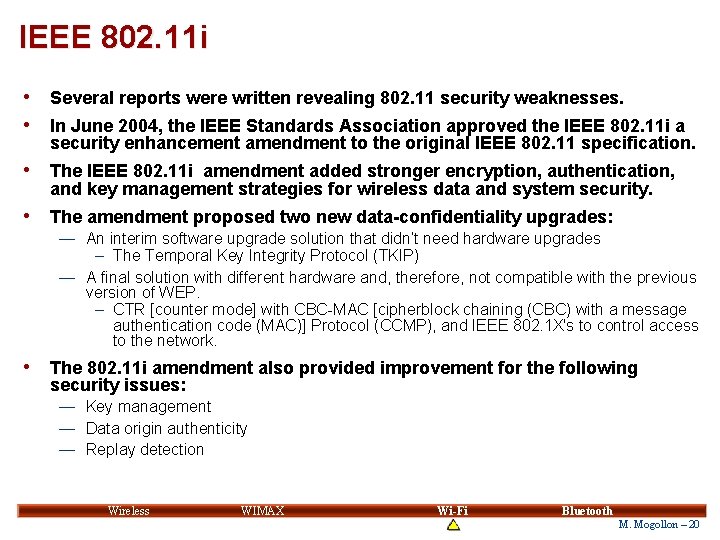
IEEE 802. 11 i • • Several reports were written revealing 802. 11 security weaknesses. • The IEEE 802. 11 i amendment added stronger encryption, authentication, and key management strategies for wireless data and system security. • The amendment proposed two new data-confidentiality upgrades: In June 2004, the IEEE Standards Association approved the IEEE 802. 11 i a security enhancement amendment to the original IEEE 802. 11 specification. — An interim software upgrade solution that didn’t need hardware upgrades – The Temporal Key Integrity Protocol (TKIP) — A final solution with different hardware and, therefore, not compatible with the previous version of WEP. – CTR [counter mode] with CBC-MAC [cipherblock chaining (CBC) with a message authentication code (MAC)] Protocol (CCMP), and IEEE 802. 1 X's to control access to the network. • The 802. 11 i amendment also provided improvement for the following security issues: — Key management — Data origin authenticity — Replay detection Wireless WIMAX Wi-Fi Bluetooth M. Mogollon – 20
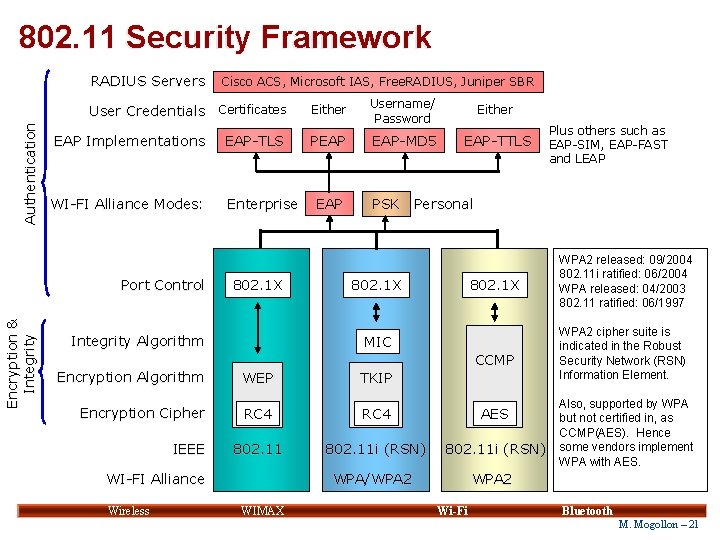
802. 11 Security Framework Authentication RADIUS Servers User Credentials Certificates Either Username/ Password Either EAP Implementations EAP-TLS PEAP EAP-MD 5 EAP-TTLS WI-FI Alliance Modes: Enterprise Port Control Encryption & Integrity Cisco ACS, Microsoft IAS, Free. RADIUS, Juniper SBR 802. 1 X Integrity Algorithm EAP PSK Personal 802. 1 X WPA 2 released: 09/2004 802. 11 i ratified: 06/2004 WPA released: 04/2003 802. 11 ratified: 06/1997 CCMP WPA 2 cipher suite is indicated in the Robust Security Network (RSN) Information Element. MIC Encryption Algorithm WEP TKIP Encryption Cipher RC 4 AES 802. 11 i (RSN) WPA/WPA 2 IEEE WI-FI Alliance Wireless WIMAX Plus others such as EAP-SIM, EAP-FAST and LEAP Wi-Fi Also, supported by WPA but not certified in, as CCMP(AES). Hence some vendors implement WPA with AES. Bluetooth M. Mogollon – 21
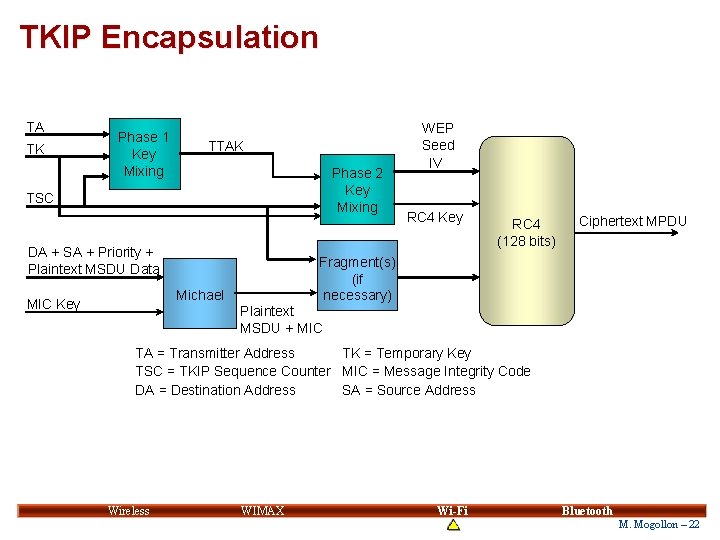
TKIP Encapsulation TA TK Phase 1 Key Mixing TTAK Phase 2 Key Mixing TSC DA + SA + Priority + Plaintext MSDU Data RC 4 Key RC 4 (128 bits) Ciphertext MPDU Fragment(s) (if necessary) Michael MIC Key WEP Seed IV Plaintext MSDU + MIC TA = Transmitter Address TK = Temporary Key TSC = TKIP Sequence Counter MIC = Message Integrity Code DA = Destination Address SA = Source Address Wireless WIMAX Wi-Fi Bluetooth M. Mogollon – 22
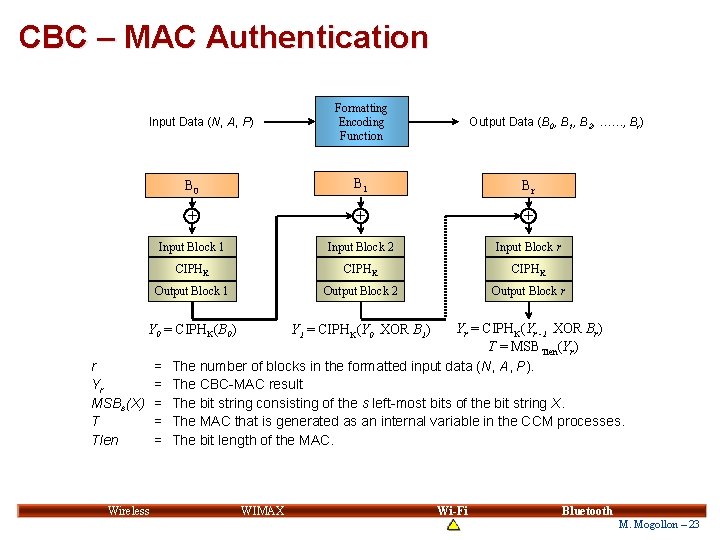
CBC – MAC Authentication Input Data (N, A, P) Wireless Output Data (B 0, B 1, B 2, ……, Br) B 0 B 1 Br + + + Input Block 1 Input Block 2 Input Block r CIPHK Output Block 1 Output Block 2 Output Block r Yr = CIPHK(Yr -1 XOR Br) T = MSBTlen(Yr) The number of blocks in the formatted input data (N, A, P). The CBC-MAC result The bit string consisting of the s left-most bits of the bit string X. The MAC that is generated as an internal variable in the CCM processes. The bit length of the MAC. Y 0 = CIPHK(B 0) r Yr MSBs(X) T Tlen Formatting Encoding Function = = = Y 1 = CIPHK(Y 0 XOR B 1) WIMAX Wi-Fi Bluetooth M. Mogollon – 23
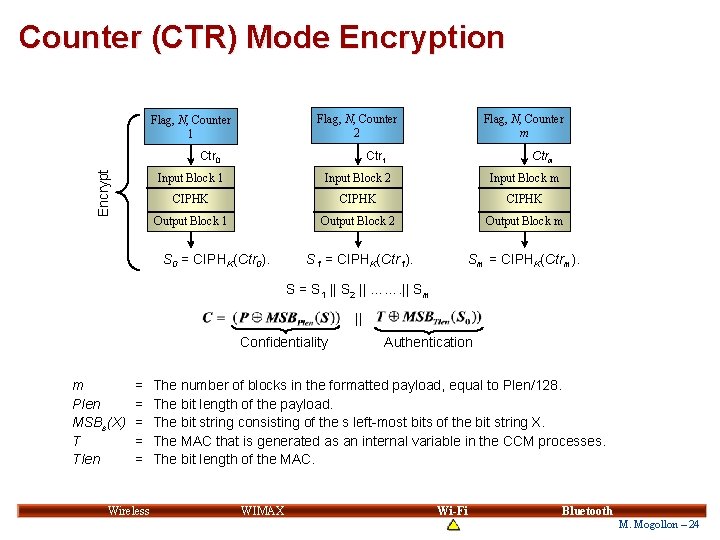
Counter (CTR) Mode Encryption Flag, N, Counter 2 Flag, N, Counter 1 Encrypt Ctr 0 Flag, N, Counter m Ctr 1 Ctrm Input Block 1 Input Block 2 Input Block m CIPHK Output Block 1 Output Block 2 Output Block m S 1 = CIPHK(Ctr 1). Sm = CIPHK(Ctrm). S 0 = CIPHK(Ctr 0). S = S 1 || S 2 || ……. || Sm || Confidentiality m Plen MSBs(X) T Tlen = = = Wireless Authentication The number of blocks in the formatted payload, equal to Plen/128. The bit length of the payload. The bit string consisting of the s left-most bits of the bit string X. The MAC that is generated as an internal variable in the CCM processes. The bit length of the MAC. WIMAX Wi-Fi Bluetooth M. Mogollon – 24
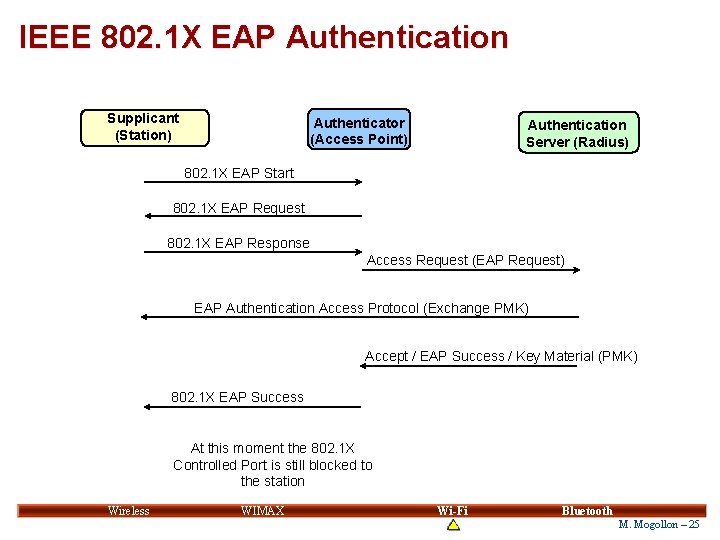
IEEE 802. 1 X EAP Authentication Supplicant (Station) Authenticator (Access Point) Authentication Server (Radius) 802. 1 X EAP Start 802. 1 X EAP Request 802. 1 X EAP Response Access Request (EAP Request) EAP Authentication Access Protocol (Exchange PMK) Accept / EAP Success / Key Material (PMK) 802. 1 X EAP Success At this moment the 802. 1 X Controlled Port is still blocked to the station Wireless WIMAX Wi-Fi Bluetooth M. Mogollon – 25
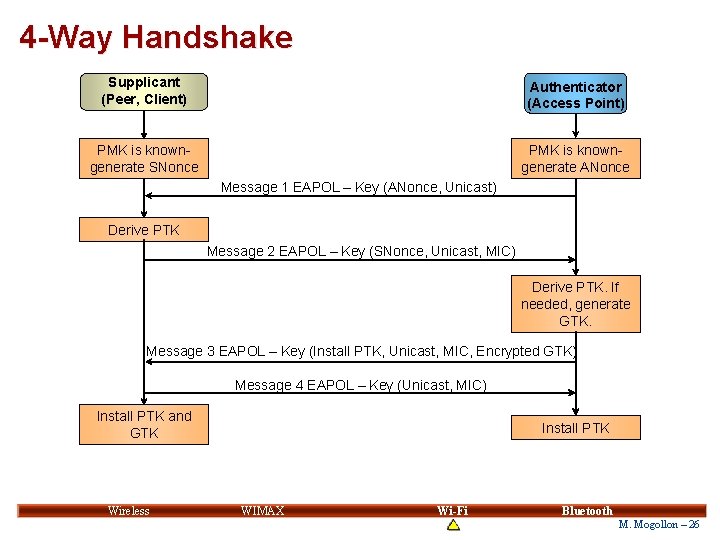
4 -Way Handshake Supplicant (Peer, Client) Authenticator (Access Point) PMK is knowngenerate SNonce PMK is knowngenerate ANonce Message 1 EAPOL – Key (ANonce, Unicast) Derive PTK Message 2 EAPOL – Key (SNonce, Unicast, MIC) Derive PTK. If needed, generate GTK. Message 3 EAPOL – Key (Install PTK, Unicast, MIC, Encrypted GTK) Message 4 EAPOL – Key (Unicast, MIC) Install PTK and GTK Wireless Install PTK WIMAX Wi-Fi Bluetooth M. Mogollon – 26
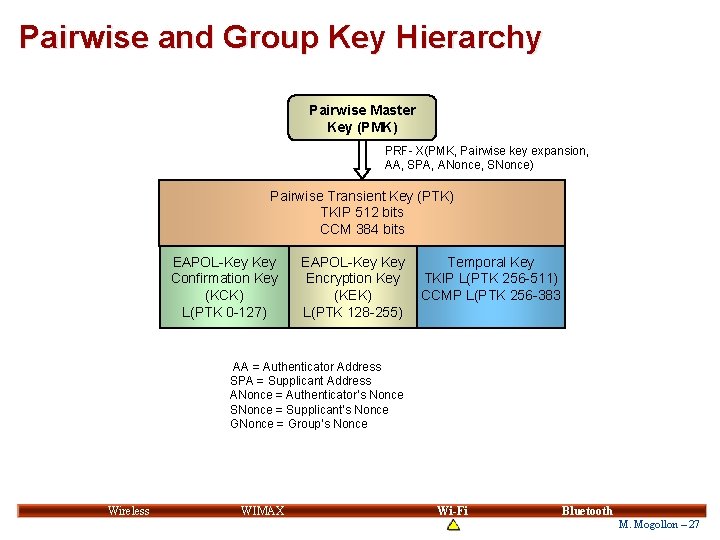
Pairwise and Group Key Hierarchy Pairwise Master Key (PMK) PRF- X(PMK, Pairwise key expansion, AA, SPA, ANonce, SNonce) Pairwise Transient Key (PTK) TKIP 512 bits CCM 384 bits EAPOL-Key Confirmation Key (KCK) L(PTK 0 -127) EAPOL-Key Encryption Key (KEK) L(PTK 128 -255) Temporal Key TKIP L(PTK 256 -511) CCMP L(PTK 256 -383 AA = Authenticator Address SPA = Supplicant Address ANonce = Authenticator’s Nonce SNonce = Supplicant’s Nonce GNonce = Group’s Nonce Wireless WIMAX Wi-Fi Bluetooth M. Mogollon – 27
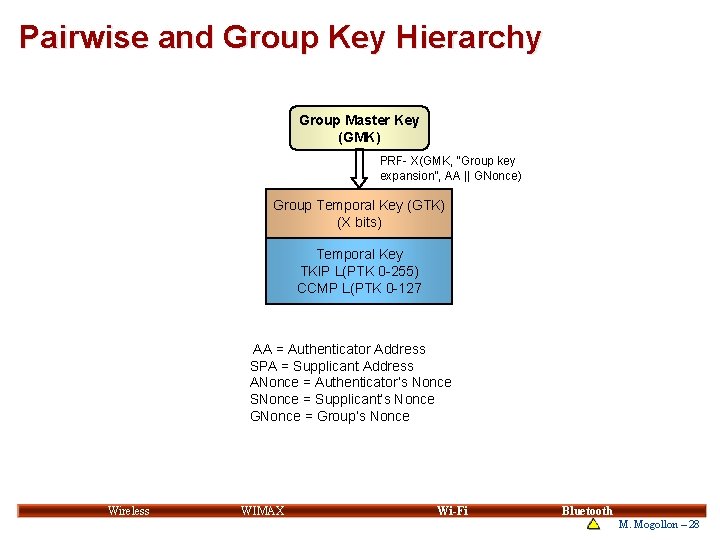
Pairwise and Group Key Hierarchy Group Master Key (GMK) PRF- X(GMK, “Group key expansion”, AA || GNonce) Group Temporal Key (GTK) (X bits) Temporal Key TKIP L(PTK 0 -255) CCMP L(PTK 0 -127 AA = Authenticator Address SPA = Supplicant Address ANonce = Authenticator’s Nonce SNonce = Supplicant’s Nonce GNonce = Group’s Nonce Wireless WIMAX Wi-Fi Bluetooth M. Mogollon – 28
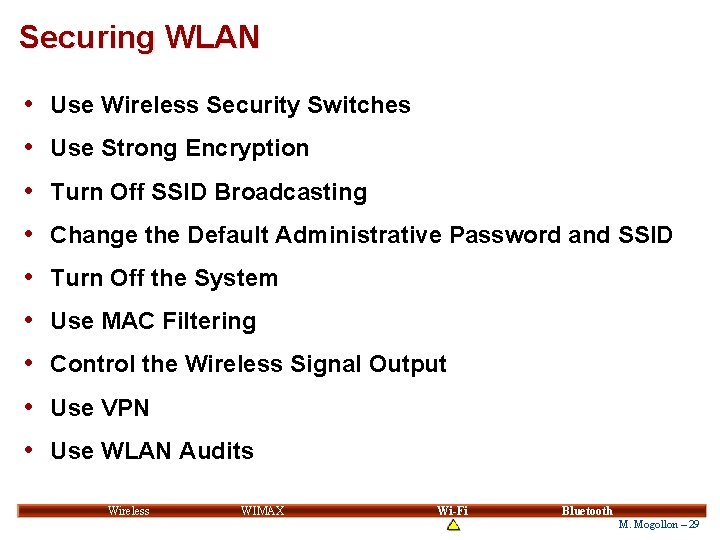
Securing WLAN • Use Wireless Security Switches • Use Strong Encryption • Turn Off SSID Broadcasting • Change the Default Administrative Password and SSID • Turn Off the System • Use MAC Filtering • Control the Wireless Signal Output • Use VPN • Use WLAN Audits Wireless WIMAX Wi-Fi Bluetooth M. Mogollon – 29
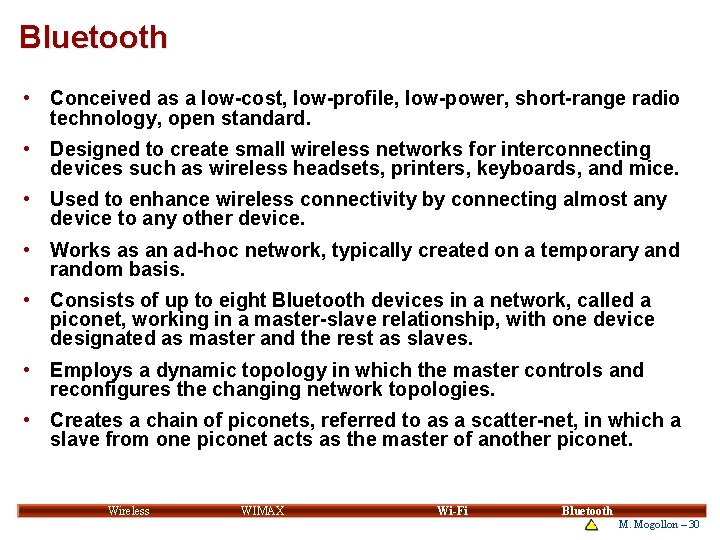
Bluetooth • Conceived as a low-cost, low-profile, low-power, short-range radio technology, open standard. • Designed to create small wireless networks for interconnecting devices such as wireless headsets, printers, keyboards, and mice. • Used to enhance wireless connectivity by connecting almost any device to any other device. • Works as an ad-hoc network, typically created on a temporary and random basis. • Consists of up to eight Bluetooth devices in a network, called a piconet, working in a master-slave relationship, with one device designated as master and the rest as slaves. • Employs a dynamic topology in which the master controls and reconfigures the changing network topologies. • Creates a chain of piconets, referred to as a scatter-net, in which a slave from one piconet acts as the master of another piconet. Wireless WIMAX Wi-Fi Bluetooth M. Mogollon – 30
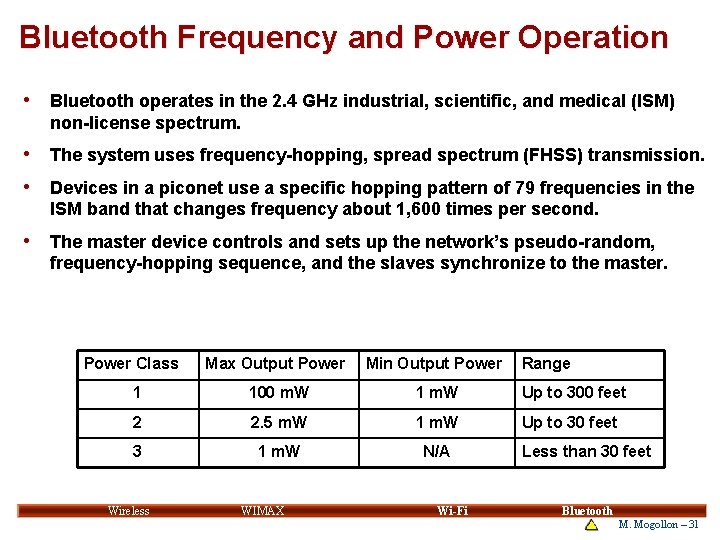
Bluetooth Frequency and Power Operation • Bluetooth operates in the 2. 4 GHz industrial, scientific, and medical (ISM) non-license spectrum. • The system uses frequency-hopping, spread spectrum (FHSS) transmission. • Devices in a piconet use a specific hopping pattern of 79 frequencies in the ISM band that changes frequency about 1, 600 times per second. • The master device controls and sets up the network’s pseudo-random, frequency-hopping sequence, and the slaves synchronize to the master. Power Class Max Output Power Min Output Power 1 100 m. W 1 m. W Up to 300 feet 2 2. 5 m. W 1 m. W Up to 30 feet 3 1 m. W N/A Wireless WIMAX Wi-Fi Range Less than 30 feet Bluetooth M. Mogollon – 31
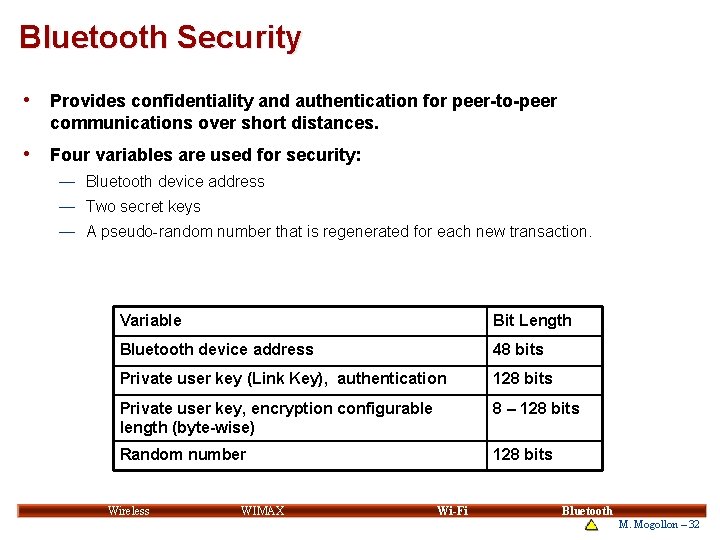
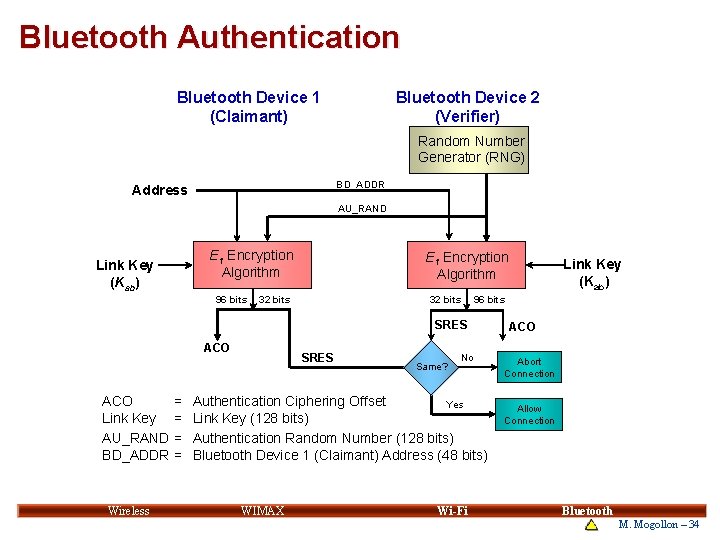
Bluetooth Security • Provides confidentiality and authentication for peer-to-peer communications over short distances. • Four variables are used for security: — Bluetooth device address — Two secret keys — A pseudo-random number that is regenerated for each new transaction. Variable Bit Length Bluetooth device address 48 bits Private user key (Link Key), authentication 128 bits Private user key, encryption configurable length (byte-wise) 8 – 128 bits Random number 128 bits Wireless WIMAX Wi-Fi Bluetooth M. Mogollon – 32
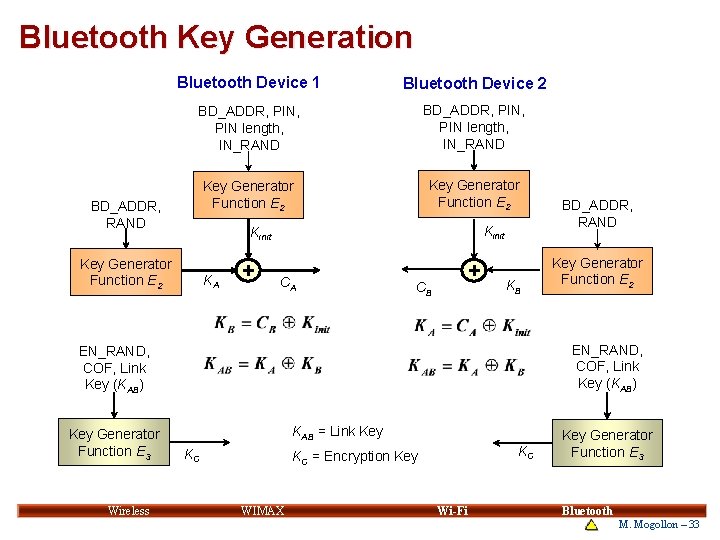
Bluetooth Key Generation Bluetooth Device 1 Bluetooth Device 2 BD_ADDR, PIN, PIN length, IN_RAND Key Generator Function E 2 BD_ADDR, RAND Kinit Key Generator Function E 2 KA + CB KB Wireless Key Generator Function E 2 EN_RAND, COF, Link Key (KAB) Key Generator Function E 3 BD_ADDR, RAND KAB = Link Key KC KC KC = Encryption Key WIMAX Wi-Fi Key Generator Function E 3 Bluetooth M. Mogollon – 33
Bluetooth Authentication Bluetooth Device 1 (Claimant) Bluetooth Device 2 (Verifier) Random Number Generator (RNG) BD_ADDR Address AU_RAND E 1 Encryption Algorithm Link Key (Kab) 96 bits E 1 Encryption Algorithm 32 bits 96 bits SRES ACO Link Key AU_RAND BD_ADDR Wireless = = SRES Same? No Authentication Ciphering Offset Yes Link Key (128 bits) Authentication Random Number (128 bits) Bluetooth Device 1 (Claimant) Address (48 bits) WIMAX Wi-Fi Link Key (Kab) ACO Abort Connection Allow Connection Bluetooth M. Mogollon – 34
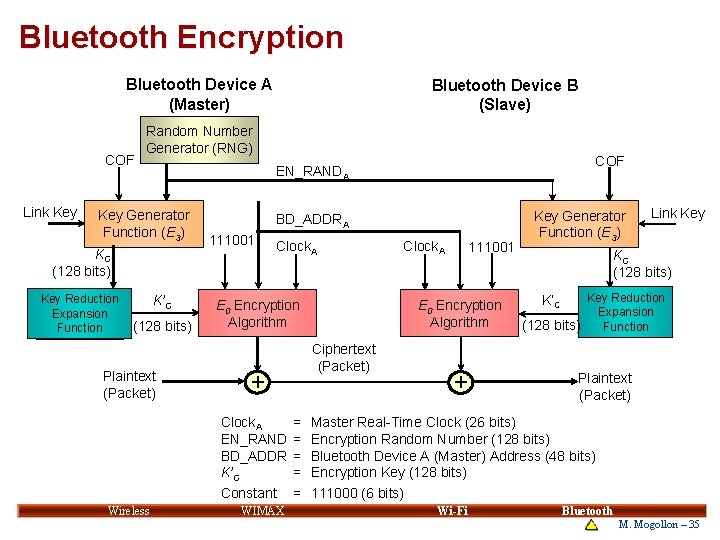
Bluetooth Encryption Bluetooth Device A (Master) COF Link Key Random Number Generator (RNG) KC (128 bits) K’C (128 bits) Plaintext (Packet) BD_ADDRA 111001 Clock. A E 0 Encryption Algorithm WIMAX = = = Clock. A 111001 E 0 Encryption Algorithm Ciphertext (Packet) + Clock. A EN_RAND BD_ADDR K’C Constant Wireless COF EN_RANDA Key Generator Function (E 3) Key Reduction Expansion Function Bluetooth Device B (Slave) + Key Generator Function (E 3) Link Key KC (128 bits) Key Reduction Expansion (128 bits) Function K’C Plaintext (Packet) Master Real-Time Clock (26 bits) Encryption Random Number (128 bits) Bluetooth Device A (Master) Address (48 bits) Encryption Key (128 bits) 111000 (6 bits) Wi-Fi Bluetooth M. Mogollon – 35
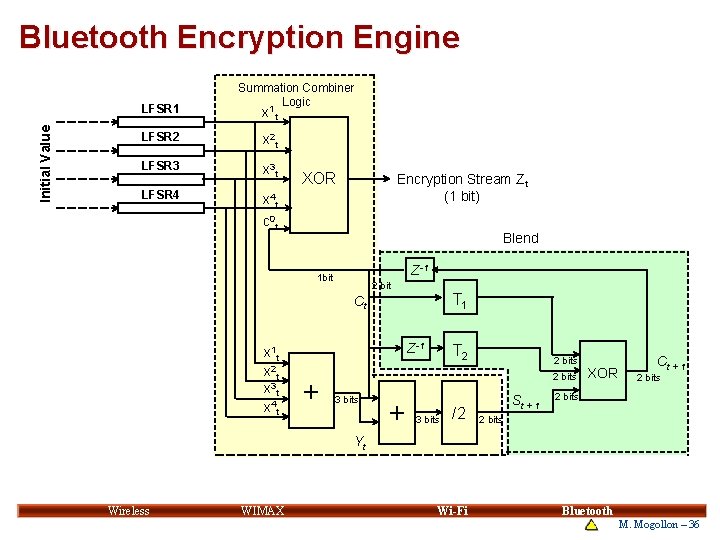
Bluetooth Encryption Engine Initial Value LFSR 1 Summation Combiner Logic 1 x t LFSR 2 x 2 t LFSR 3 x 3 t LFSR 4 x 4 t XOR Encryption Stream Zt (1 bit) c 0 t Blend Z-1 1 bit 2 bit T 1 Ct x 1 t x 2 t x 3 t x 4 t Z-1 + T 2 2 bits 3 bits + 3 bits /2 St + 1 XOR Ct + 1 2 bits Yt Wireless WIMAX Wi-Fi Bluetooth M. Mogollon – 36
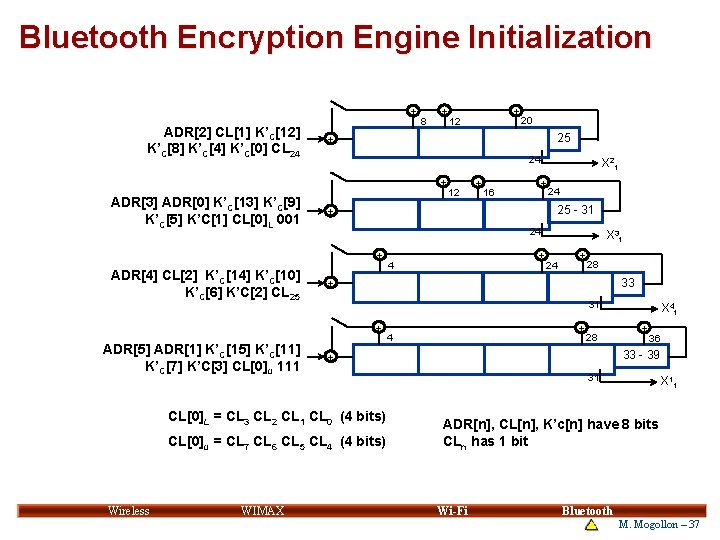
Bluetooth Encryption Engine Initialization + ADR[2] CL[1] K’C[12] K’C[8] K’C[4] K’C[0] CL 24 8 + 25 24 + 4 X 3 t 24 + 28 33 + 31 + 4 28 X 4 t + 36 33 - 39 + CL[0]u = CL 7 CL 6 CL 5 CL 4 (4 bits) WIMAX 16 24 CL[0]L = CL 3 CL 2 CL 1 CL 0 (4 bits) Wireless + 25 - 31 + ADR[5] ADR[1] K’C[15] K’C[11] K’C[7] K’C[3] CL[0]u 111 12 X 2 t + + ADR[4] CL[2] K’C[14] K’C[10] K’C[6] K’C[2] CL 25 20 + + ADR[3] ADR[0] K’C[13] K’C[9] K’C[5] K’C[1] CL[0]L 001 + 12 31 X 1 t ADR[n], CL[n], K’c[n] have 8 bits CLn has 1 bit Wi-Fi Bluetooth M. Mogollon – 37
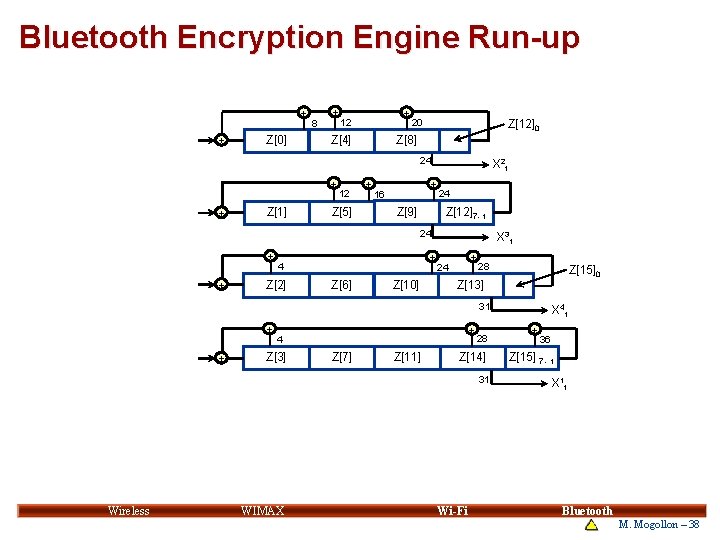
Bluetooth Encryption Engine Run-up + + Z[0] 8 + + 12 Z[4] 20 Z[12]0 Z[8] 24 + + Z[1] 12 Z[5] + X 2 t + 16 Z[9] 24 Z[12]7 - 1 24 + + + 4 Z[2] Z[6] Z[10] X 3 t + 24 28 Z[15]0 Z[13] 31 + + + 4 Z[3] Z[7] Z[11] 28 Z[14] 31 Wireless WIMAX Wi-Fi X 4 t + 36 Z[15] 7 - 1 X 1 t Bluetooth M. Mogollon – 38
To Probe Further • Bluetooth Special Interest Group (SIG) – 2004, “Specification of the Bluetooth System V 2. ” Retrieved on December 19, 2005, from https: //www. bluetooth. org/spec/ • Dworkin, M (December 2001). Recommendation for Block Cipher Modes of Operation Methods and Techniques. NIST Special Publication 800 -38 A. Natl. Inst. Stand. Technol. Retrieved December 19, 2005, from http: //csrc. nist. gov/publications/nistpubs/800 -38 a/sp 800 -38 a. pdf • Dworkin, M (May 2005). Recommendation for Block Cipher Modes of Operation: The CMAC Mode for Authentication. NIST Special Publication 800 -38 B. Natl. Inst. Stand. Technol. Retrieved December 21, 2005, from http: //csrc. nist. gov/publications/nistpubs/800 -38 B/SP_800 -38 B. pdf • Dworkin, M (May 2004). Recommendation for Block Cipher Modes of Operation: The CCM Mode for Authentication and Confidentiality. NIST Special Publication 800 -38 C. Natl. Inst. Stand. Technol. Retrieved December 21, 2005, from http: //csrc. nist. gov/publications/nistpubs/800 -38 C/SP 800 -38 C. pdf • Fluher, S. , Mantin, I. , and Shamir, A. (2001). Weaknesses in the Key Scheduling Algorithm of RC 4. 8 th Annual Workshop Selected areas in Cryptography. August 2001. • • IEEE Std 802. 16 e – 2005, “Part 16: Air Interface for Fixed and Mobile Broadband Wireless Access Systems. ” • IEEE Std 802. 11 i – 2004, “Part 11: Wireless LAN Medium Access Control (MAC) and Physical Layer (PHY) specifications Amendment 6: Medium Access Control (MAC) Security Enhancements. ” • Karygiannis, T, Owens L. (2002). Wireless Network Security, 802. 11. Bluetooth and Handheld Devices. NIST Special Publication. Downloaded on November 15, 2004, from http: //csrc. nist. gov/publications/nistpubs/80048/NIST_SP_800 -48. pdf • Shinder, D. (2005). 10 Ways to Wireless Security. Tech Republic. Retrieved October 10, 2005, from http: //insight. zdnet. co. uk • Wi-Fi Security – Addressing Concerns. Hewlett Packer. Downloaded on October 10, 2003 from http: //h 50012. www 5. hp. com/createuse/learning/ITguide_planning. asp IEEE Std 802. 15. 1 – 2005, “Part 15. 1: Wireless medium access control (MAC) and physical layer (PHY) specifications for wireless personal area networks (WPANs). ” Wireless WIMAX Wi-Fi Bluetooth M. Mogollon – 39