
Cryptography Slides adopted and prepared by Dr Shahriar
Cryptography Slides adopted and prepared by Dr. Shahriar
Topics • Terminologies and assumption • Symmetric cryptography • Asymmetric cryptography • Hashes • Attacks on cryptography
Topics • Terminologies and assumption • Symmetric cryptography • Asymmetric cryptography • Hashes • Attacks on cryptography and best practices
Crypto • Cryptology The art and science of making and breaking “secret codes” • Cryptography making “secret codes” • Cryptanalysis breaking “secret codes” • Crypto all of the above (and more)
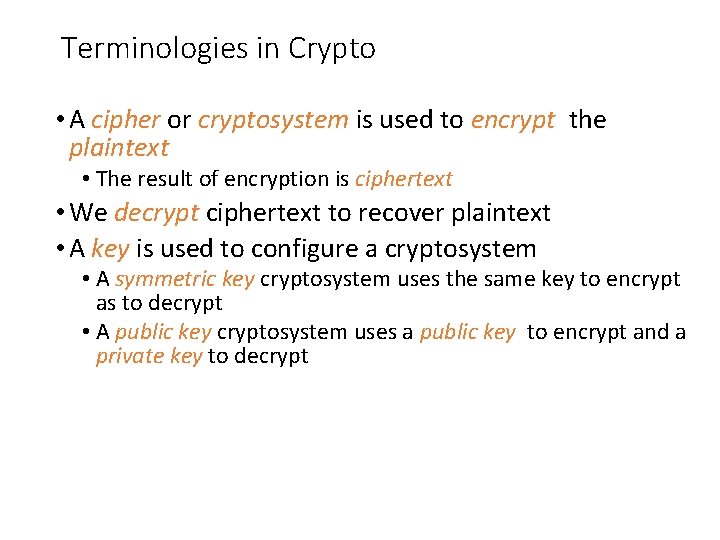
Terminologies in Crypto • A cipher or cryptosystem is used to encrypt the plaintext • The result of encryption is ciphertext • We decrypt ciphertext to recover plaintext • A key is used to configure a cryptosystem • A symmetric key cryptosystem uses the same key to encrypt as to decrypt • A public key cryptosystem uses a public key to encrypt and a private key to decrypt
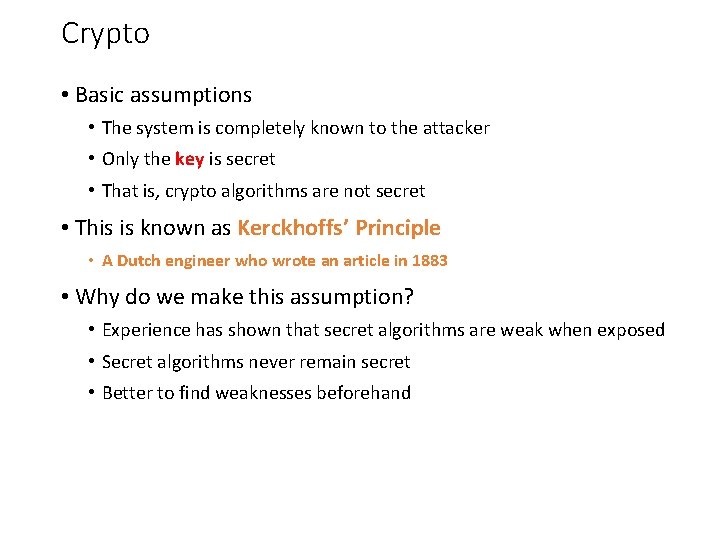
Crypto • Basic assumptions • The system is completely known to the attacker • Only the key is secret • That is, crypto algorithms are not secret • This is known as Kerckhoffs’ Principle • A Dutch engineer who wrote an article in 1883 • Why do we make this assumption? • Experience has shown that secret algorithms are weak when exposed • Secret algorithms never remain secret • Better to find weaknesses beforehand
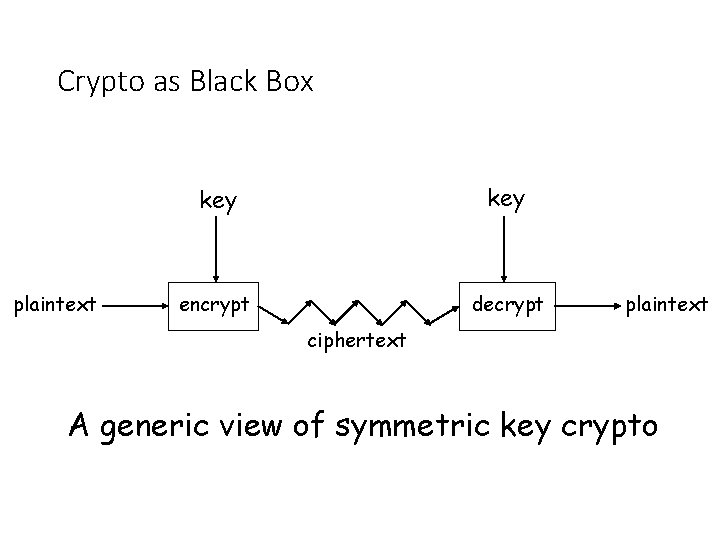
Crypto as Black Box plaintext key encrypt decrypt plaintext ciphertext A generic view of symmetric key crypto
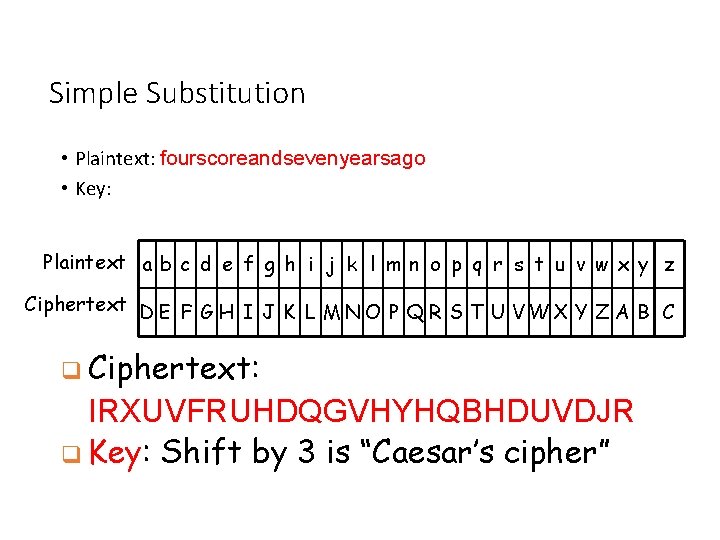
Simple Substitution • Plaintext: fourscoreandsevenyearsago • Key: Plaintext a b c d e f g h i j k l m n o p q r s t u v w x y z Ciphertext D E F G H I J K L M N O P Q R S T U V W X Y Z A B C q Ciphertext: IRXUVFRUHDQGVHYHQBHDUVDJR q Key: Shift by 3 is “Caesar’s cipher”

Caesar’s cipher (Simple Substitution) • A type of substitution cipher in which each letter in the plaintext is replaced by a letter some fixed number of positions down the alphabet • For example, with a left shift of 3, D would be replaced by A, E would become B, and so on. • The method is named after Julius Caesar, who used it in his private correspondence.
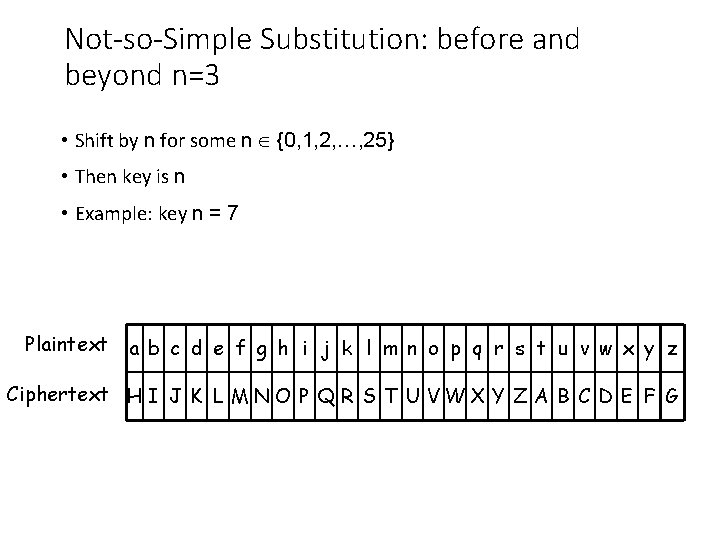
Not-so-Simple Substitution: before and beyond n=3 • Shift by n for some n {0, 1, 2, …, 25} • Then key is n • Example: key n = 7 Plaintext a b c d e f g h i j k l m n o p q r s t u v w x y z Ciphertext H I J K L M N O P Q R S T U V W X Y Z A B C D E F G
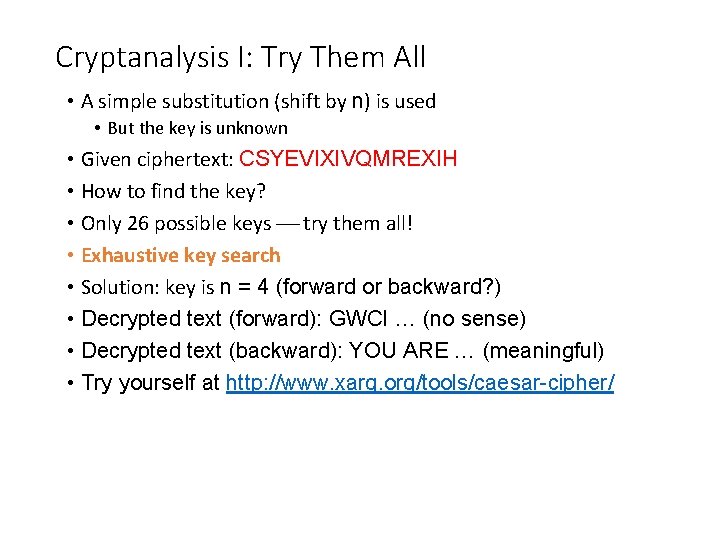
Cryptanalysis I: Try Them All • A simple substitution (shift by n) is used • But the key is unknown • Given ciphertext: CSYEVIXIVQMREXIH • How to find the key? • Only 26 possible keys try them all! • Exhaustive key search • Solution: key is n = 4 (forward or backward? ) • Decrypted text (forward): GWCI … (no sense) • Decrypted text (backward): YOU ARE … (meaningful) • Try yourself at http: //www. xarg. org/tools/caesar-cipher/
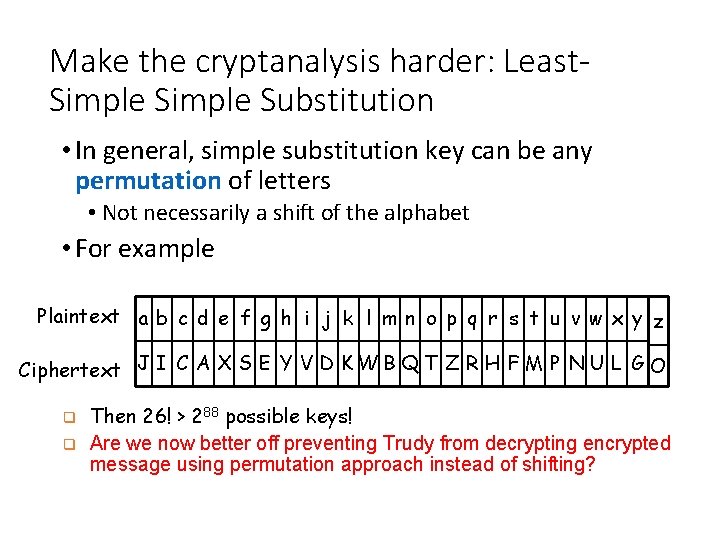
Make the cryptanalysis harder: Least. Simple Substitution • In general, simple substitution key can be any permutation of letters • Not necessarily a shift of the alphabet • For example Plaintext a b c d e f g h i j k l m n o p q r s t u v w x y z Ciphertext J I C A X S E Y V D K W B Q T Z R H F M P N U L G O q q Then 26! > 288 possible keys! Are we now better off preventing Trudy from decrypting encrypted message using permutation approach instead of shifting?
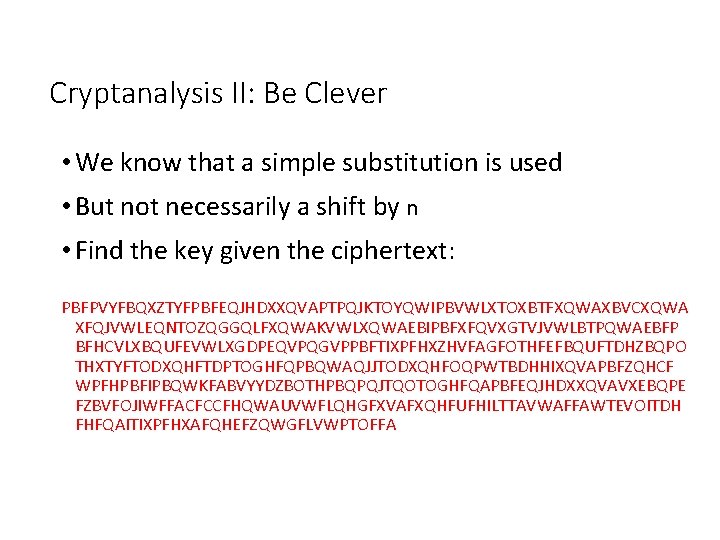
Cryptanalysis II: Be Clever • We know that a simple substitution is used • But not necessarily a shift by n • Find the key given the ciphertext: PBFPVYFBQXZTYFPBFEQJHDXXQVAPTPQJKTOYQWIPBVWLXTOXBTFXQWAXBVCXQWA XFQJVWLEQNTOZQGGQLFXQWAKVWLXQWAEBIPBFXFQVXGTVJVWLBTPQWAEBFP BFHCVLXBQUFEVWLXGDPEQVPQGVPPBFTIXPFHXZHVFAGFOTHFEFBQUFTDHZBQPO THXTYFTODXQHFTDPTOGHFQPBQWAQJJTODXQHFOQPWTBDHHIXQVAPBFZQHCF WPFHPBFIPBQWKFABVYYDZBOTHPBQPQJTQOTOGHFQAPBFEQJHDXXQVAVXEBQPE FZBVFOJIWFFACFCCFHQWAUVWFLQHGFXVAFXQHFUFHILTTAVWAFFAWTEVOITDH FHFQAITIXPFHXAFQHEFZQWGFLVWPTOFFA
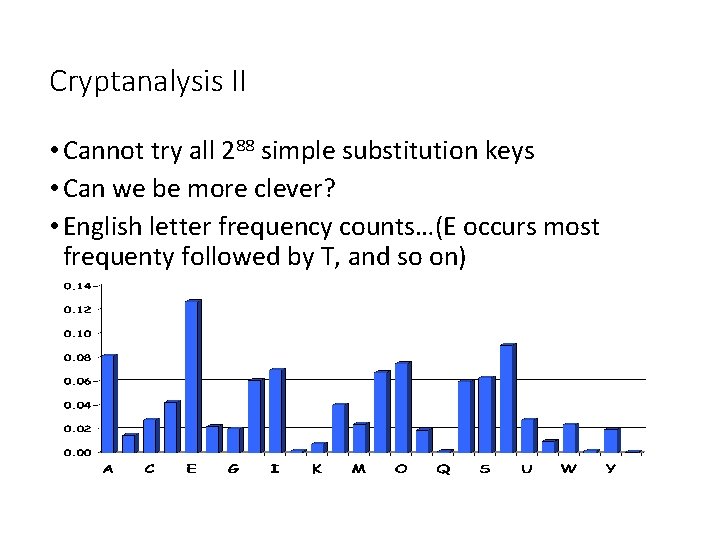
Cryptanalysis II • Cannot try all 288 simple substitution keys • Can we be more clever? • English letter frequency counts…(E occurs most frequenty followed by T, and so on)
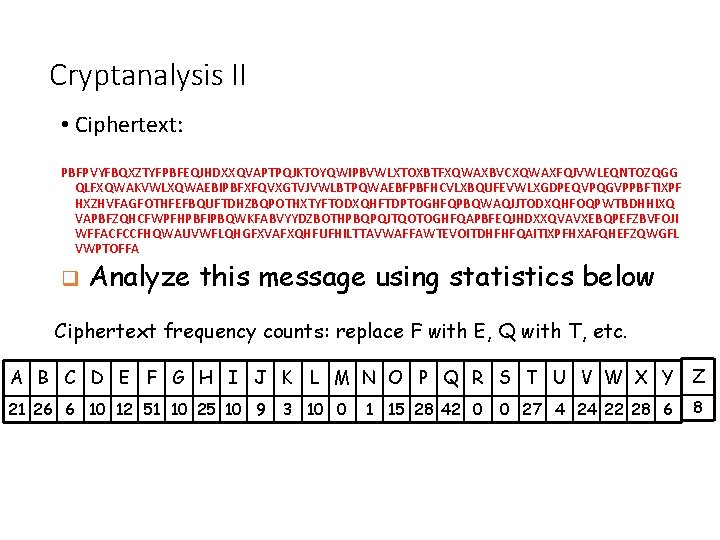
Cryptanalysis II • Ciphertext: PBFPVYFBQXZTYFPBFEQJHDXXQVAPTPQJKTOYQWIPBVWLXTOXBTFXQWAXBVCXQWAXFQJVWLEQNTOZQGG QLFXQWAKVWLXQWAEBIPBFXFQVXGTVJVWLBTPQWAEBFPBFHCVLXBQUFEVWLXGDPEQVPQGVPPBFTIXPF HXZHVFAGFOTHFEFBQUFTDHZBQPOTHXTYFTODXQHFTDPTOGHFQPBQWAQJJTODXQHFOQPWTBDHHIXQ VAPBFZQHCFWPFHPBFIPBQWKFABVYYDZBOTHPBQPQJTQOTOGHFQAPBFEQJHDXXQVAVXEBQPEFZBVFOJI WFFACFCCFHQWAUVWFLQHGFXVAFXQHFUFHILTTAVWAFFAWTEVOITDHFHFQAITIXPFHXAFQHEFZQWGFL VWPTOFFA q Analyze this message using statistics below Ciphertext frequency counts: replace F with E, Q with T, etc. A B C D E F G H I J K L M N O P Q R S T U V W X Y Z 21 26 6 10 12 51 10 25 10 9 3 10 0 1 15 28 42 0 0 27 4 24 22 28 6 8
Cryptanalysis: secure vs. insecure • Cryptosystem is secure if the best known decryption (also considered an attack on the system) by Trudy is to try all keys • Exhaustive key search, that is • Cryptosystem is insecure if any shortcut attack is known
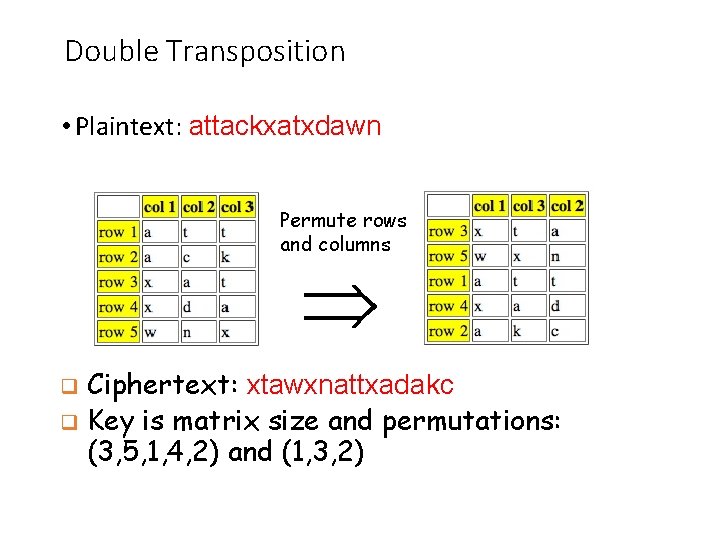
Double Transposition • Plaintext: attackxatxdawn Permute rows and columns Ciphertext: xtawxnattxadakc q Key is matrix size and permutations: (3, 5, 1, 4, 2) and (1, 3, 2) q
One-Time Pad • Each bit or character from the plaintext is encrypted by a secret random key (or pad) of the same length as the plaintext, resulting in a ciphertext. • If the key is truly random, as large as or greater than the plaintext, never reused in whole or part, and kept secret, the ciphertext will be impossible to decrypt or break without knowing the key. • It has been proven that any cipher with the perfect secrecy property must use keys with the same requirements as One -time pad keys • C. Shannon, 1949
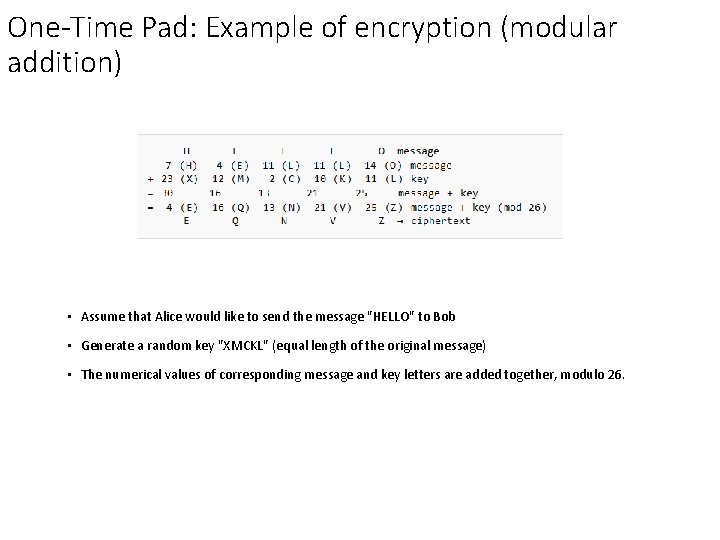
One-Time Pad: Example of encryption (modular addition) • Assume that Alice would like to send the message "HELLO" to Bob • Generate a random key "XMCKL" (equal length of the original message) • The numerical values of corresponding message and key letters are added together, modulo 26.
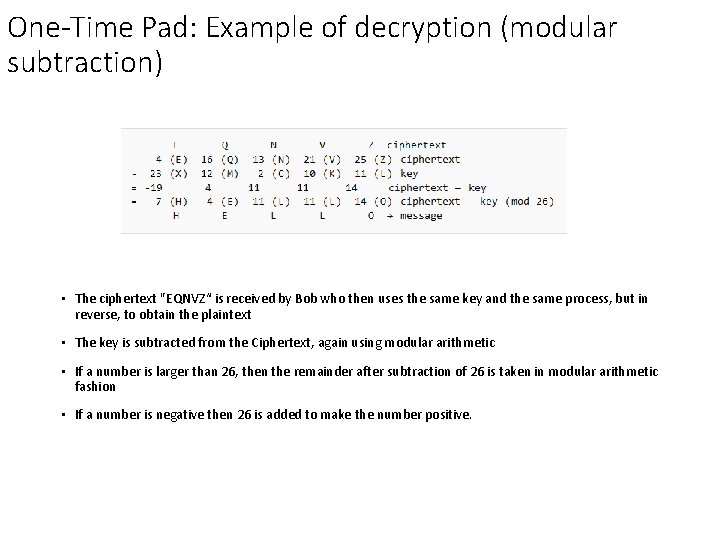
One-Time Pad: Example of decryption (modular subtraction) • The ciphertext "EQNVZ“ is received by Bob who then uses the same key and the same process, but in reverse, to obtain the plaintext • The key is subtracted from the Ciphertext, again using modular arithmetic • If a number is larger than 26, then the remainder after subtraction of 26 is taken in modular arithmetic fashion • If a number is negative then 26 is added to make the number positive.
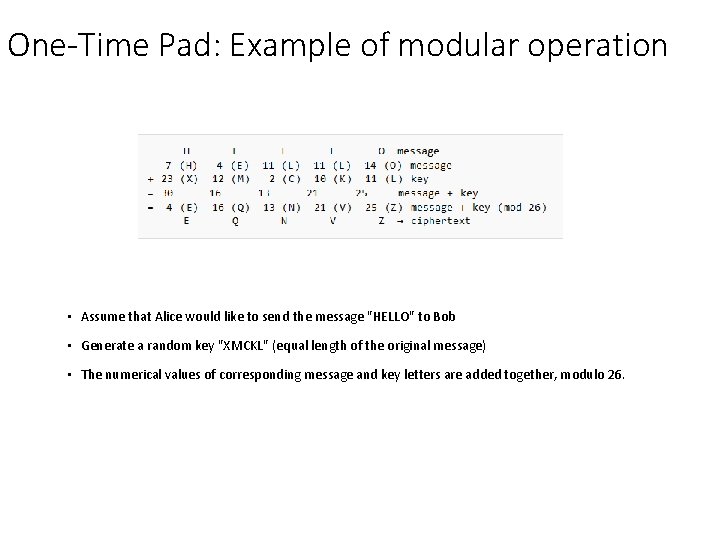
One-Time Pad: Example of modular operation • Assume that Alice would like to send the message "HELLO" to Bob • Generate a random key "XMCKL" (equal length of the original message) • The numerical values of corresponding message and key letters are added together, modulo 26.
Codebook Cipher • A codebook is a type of document used for gathering and storing codes. • A codebook contains a lookup table for coding and decoding; each word or phrase has one or more strings which replace it. • To decipher messages written in code, corresponding copies of the codebook must be available at either end. • The distribution and physical security of codebooks presents a special difficulty in the use of codes, compared to the other crypto. Part 1 Cryptography 22
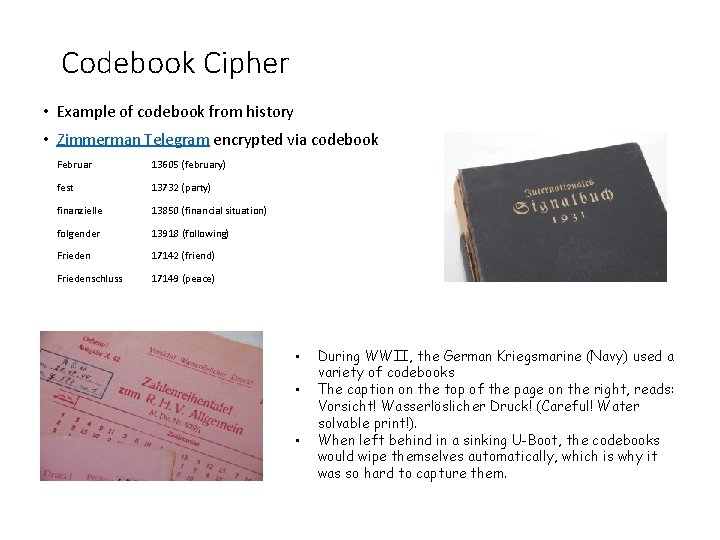
Codebook Cipher • Example of codebook from history • Zimmerman Telegram encrypted via codebook Februar 13605 (february) fest 13732 (party) finanzielle 13850 (financial situation) folgender 13918 (following) Frieden 17142 (friend) Friedenschluss 17149 (peace) • • • During WWII, the German Kriegsmarine (Navy) used a variety of codebooks The caption on the top of the page on the right, reads: Vorsicht! Wasserlöslicher Druck! (Careful! Water solvable print!). When left behind in a sinking U-Boot, the codebooks would wipe themselves automatically, which is why it was so hard to capture them.
Next • Symmetric Key • Same key for encryption and decryption
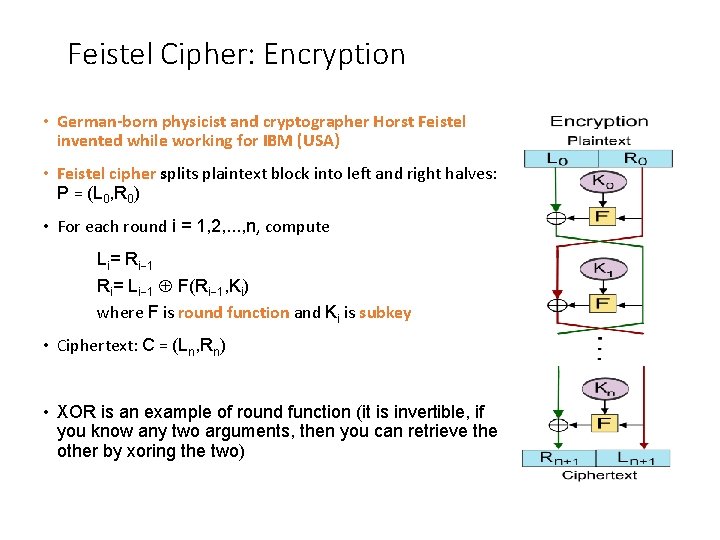
Feistel Cipher: Encryption • German-born physicist and cryptographer Horst Feistel invented while working for IBM (USA) • Feistel cipher splits plaintext block into left and right halves: P = (L 0, R 0) • For each round i = 1, 2, . . . , n, compute Li= Ri 1 Ri= Li 1 F(Ri 1, Ki) where F is round function and Ki is subkey • Ciphertext: C = (Ln, Rn) • XOR is an example of round function (it is invertible, if you know any two arguments, then you can retrieve the other by xoring the two)
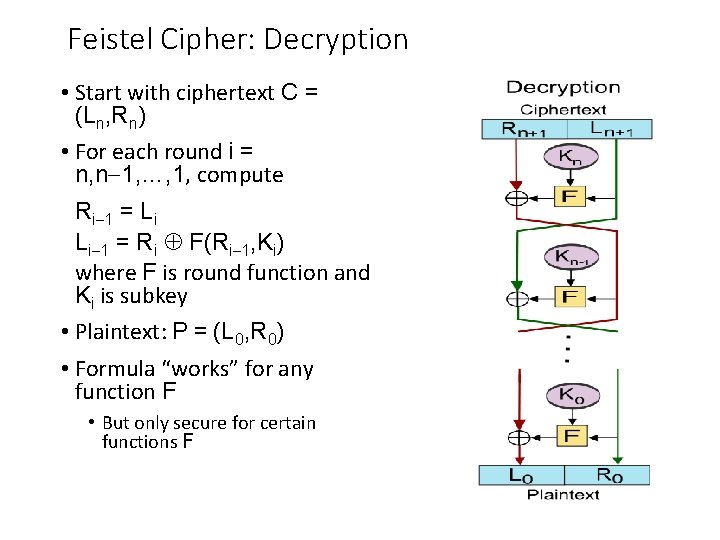
Feistel Cipher: Decryption • Start with ciphertext C = (Ln, Rn) • For each round i = n, n 1, …, 1, compute Ri 1 = Li Li 1 = Ri F(Ri 1, Ki) where F is round function and Ki is subkey • Plaintext: P = (L 0, R 0) • Formula “works” for any function F • But only secure for certain functions F
Data Encryption Standard • DES is a Feistel cipher with… • 64 bit block length • 56 bit key length along with 48 bits of key used each round (subkey) • 16 rounds of iteration • Each round is simple (for a block cipher) • Security depends heavily on “S-boxes” • Each S-boxes maps 6 bits to 4 bits
LM encryption LAN Manager hash Hash of a password is computed using a six-step process: 1. Password is converted into all uppercase letters 2. Null characters added to it until it equals 14 characters 3. New password is split into two 7 character halves 4. Values are used to create two DES encryption keys, one from each half with a parity bit added. 5. Each DES key is used to encrypt the ASCII string (KGS!@#$%), resulting in two 8 -byte ciphertext 6. The two 8 -byte ciphertext values are combined to form a 16 -byte value, which is the completed LM hash
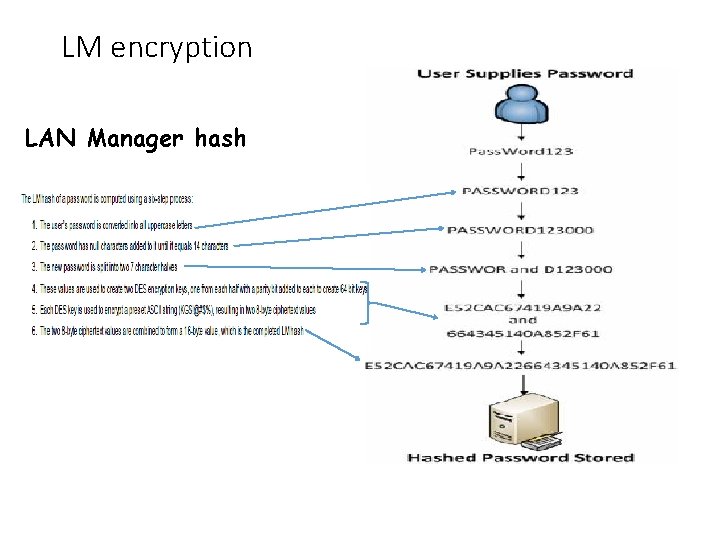
LM encryption LAN Manager hash
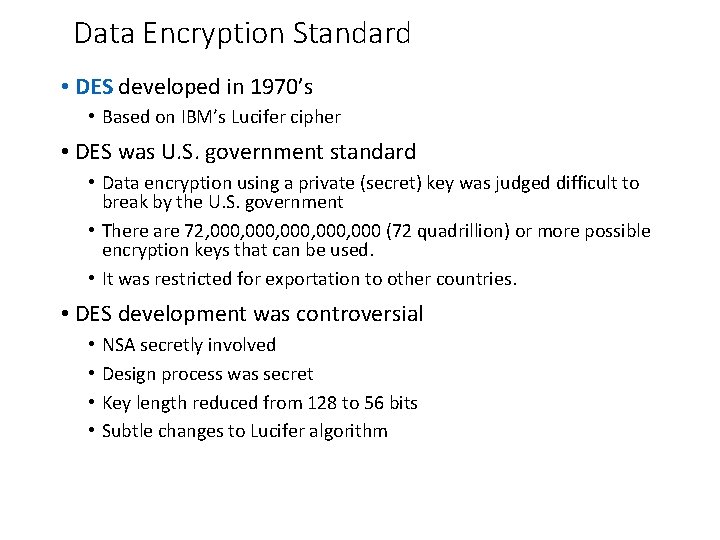
Data Encryption Standard • DES developed in 1970’s • Based on IBM’s Lucifer cipher • DES was U. S. government standard • Data encryption using a private (secret) key was judged difficult to break by the U. S. government • There are 72, 000, 000 (72 quadrillion) or more possible encryption keys that can be used. • It was restricted for exportation to other countries. • DES development was controversial • • NSA secretly involved Design process was secret Key length reduced from 128 to 56 bits Subtle changes to Lucifer algorithm
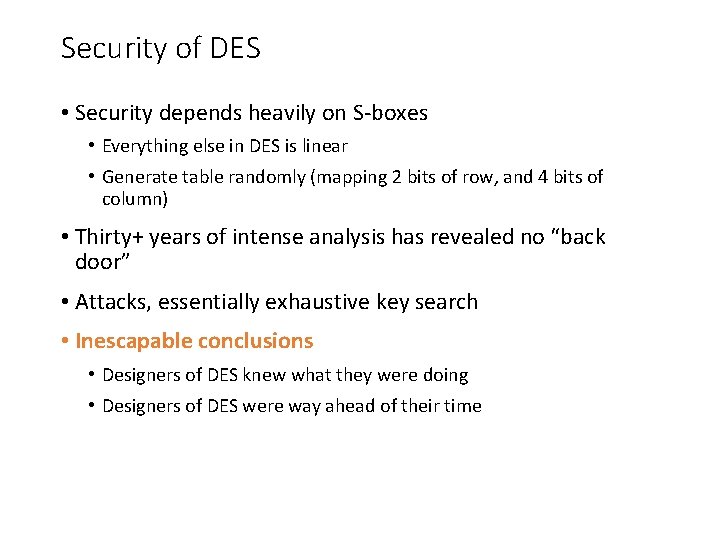
Security of DES • Security depends heavily on S-boxes • Everything else in DES is linear • Generate table randomly (mapping 2 bits of row, and 4 bits of column) • Thirty+ years of intense analysis has revealed no “back door” • Attacks, essentially exhaustive key search • Inescapable conclusions • Designers of DES knew what they were doing • Designers of DES were way ahead of their time
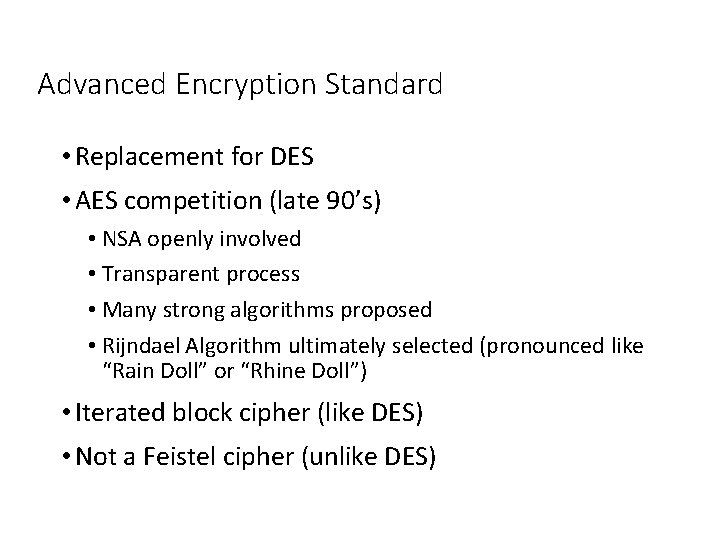
Advanced Encryption Standard • Replacement for DES • AES competition (late 90’s) • NSA openly involved • Transparent process • Many strong algorithms proposed • Rijndael Algorithm ultimately selected (pronounced like “Rain Doll” or “Rhine Doll”) • Iterated block cipher (like DES) • Not a Feistel cipher (unlike DES)
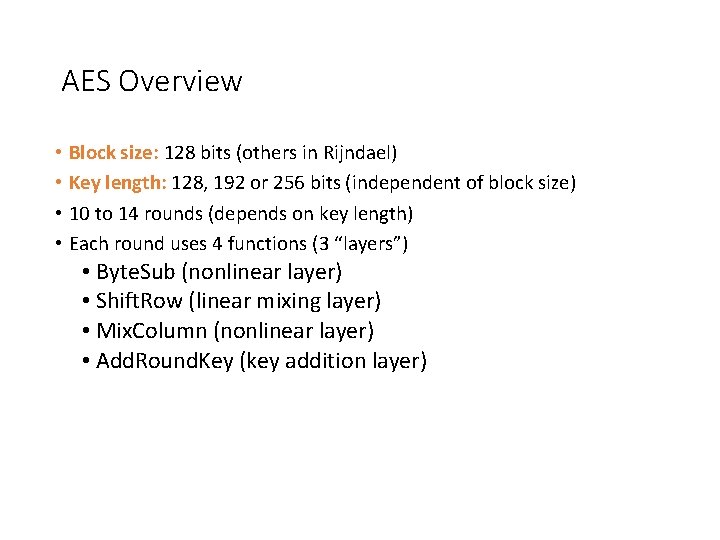
AES Overview • Block size: 128 bits (others in Rijndael) • Key length: 128, 192 or 256 bits (independent of block size) • 10 to 14 rounds (depends on key length) • Each round uses 4 functions (3 “layers”) • Byte. Sub (nonlinear layer) • Shift. Row (linear mixing layer) • Mix. Column (nonlinear layer) • Add. Round. Key (key addition layer)
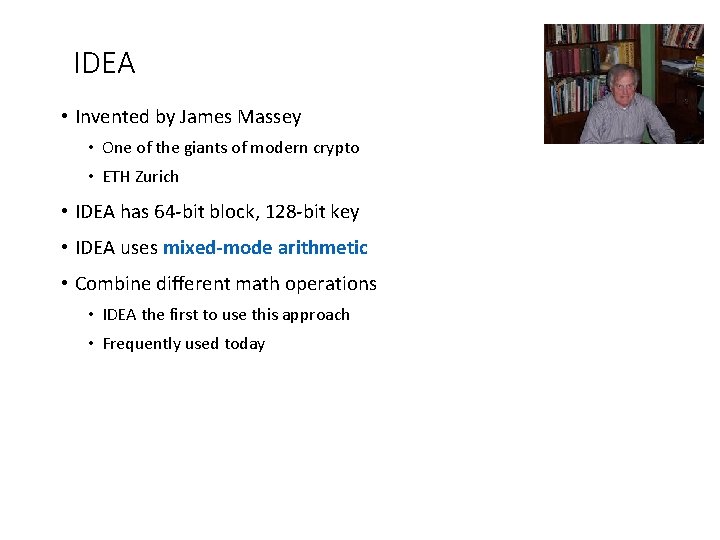
IDEA • Invented by James Massey • One of the giants of modern crypto • ETH Zurich • IDEA has 64 -bit block, 128 -bit key • IDEA uses mixed-mode arithmetic • Combine different math operations • IDEA the first to use this approach • Frequently used today
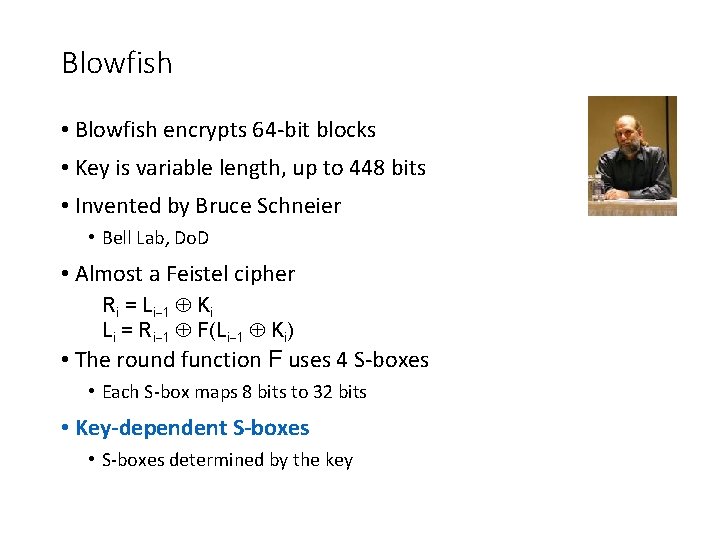
Blowfish • Blowfish encrypts 64 -bit blocks • Key is variable length, up to 448 bits • Invented by Bruce Schneier • Bell Lab, Do. D • Almost a Feistel cipher Ri = Li 1 Ki Li = Ri 1 F(Li 1 Ki) • The round function F uses 4 S-boxes • Each S-box maps 8 bits to 32 bits • Key-dependent S-boxes • S-boxes determined by the key
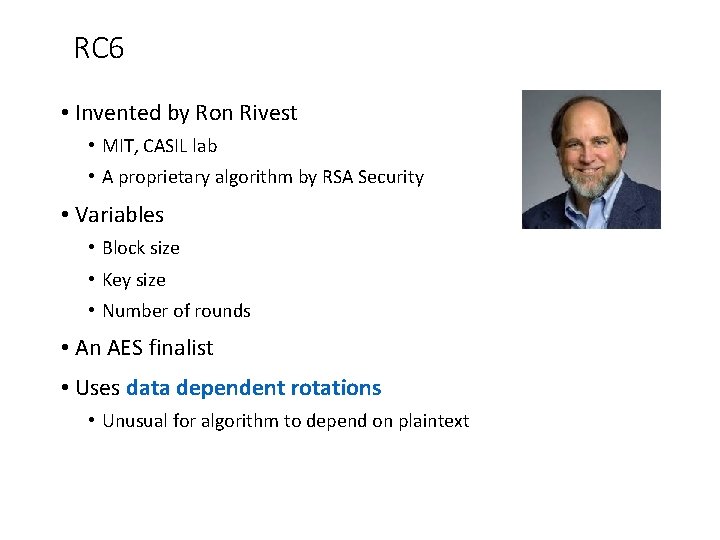
RC 6 • Invented by Ron Rivest • MIT, CASIL lab • A proprietary algorithm by RSA Security • Variables • Block size • Key size • Number of rounds • An AES finalist • Uses data dependent rotations • Unusual for algorithm to depend on plaintext
Next • Asymmetric Key (or asymmetric crypto) • Two keys, one for encryption (public), and one for decryption (private)
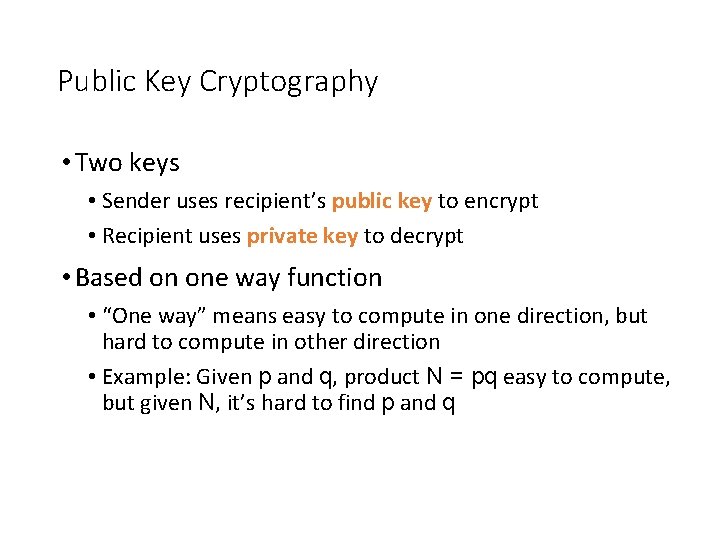
Public Key Cryptography • Two keys • Sender uses recipient’s public key to encrypt • Recipient uses private key to decrypt • Based on one way function • “One way” means easy to compute in one direction, but hard to compute in other direction • Example: Given p and q, product N = pq easy to compute, but given N, it’s hard to find p and q
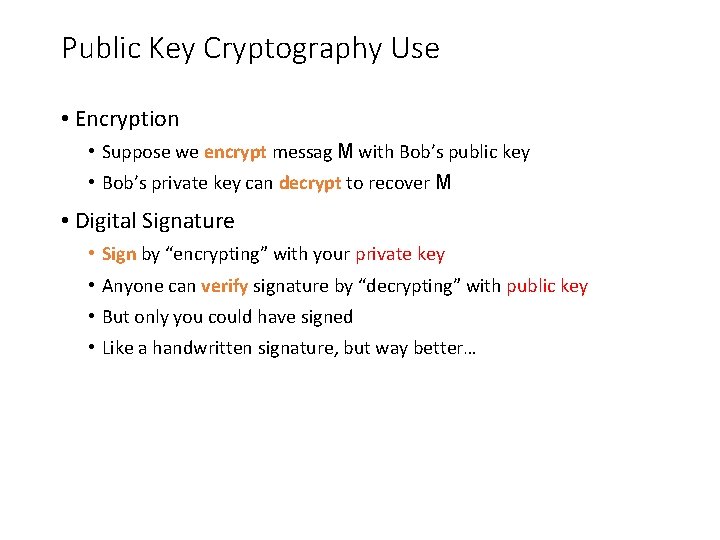
Public Key Cryptography Use • Encryption • Suppose we encrypt messag M with Bob’s public key • Bob’s private key can decrypt to recover M • Digital Signature • Sign by “encrypting” with your private key • Anyone can verify signature by “decrypting” with public key • But only you could have signed • Like a handwritten signature, but way better…
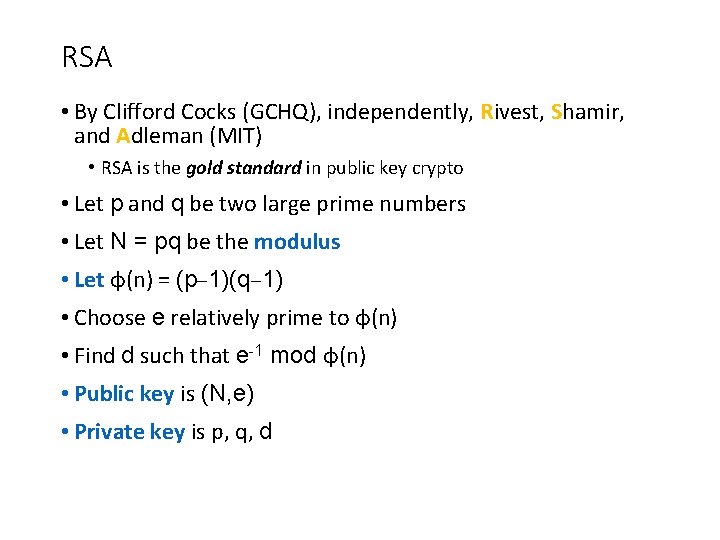
RSA • By Clifford Cocks (GCHQ), independently, Rivest, Shamir, and Adleman (MIT) • RSA is the gold standard in public key crypto • Let p and q be two large prime numbers • Let N = pq be the modulus • Let φ(n) = (p 1)(q 1) • Choose e relatively prime to φ(n) • Find d such that e-1 mod φ(n) • Public key is (N, e) • Private key is p, q, d
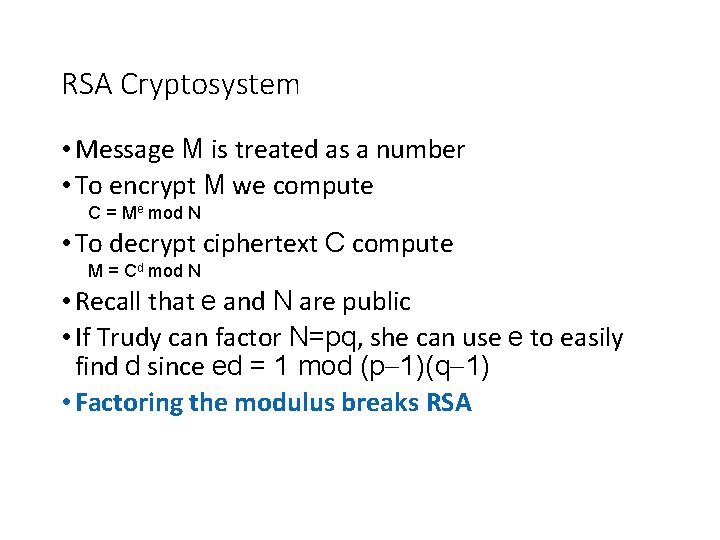
RSA Cryptosystem • Message M is treated as a number • To encrypt M we compute C = Me mod N • To decrypt ciphertext C compute M = Cd mod N • Recall that e and N are public • If Trudy can factor N=pq, she can use e to easily find d since ed = 1 mod (p 1)(q 1) • Factoring the modulus breaks RSA
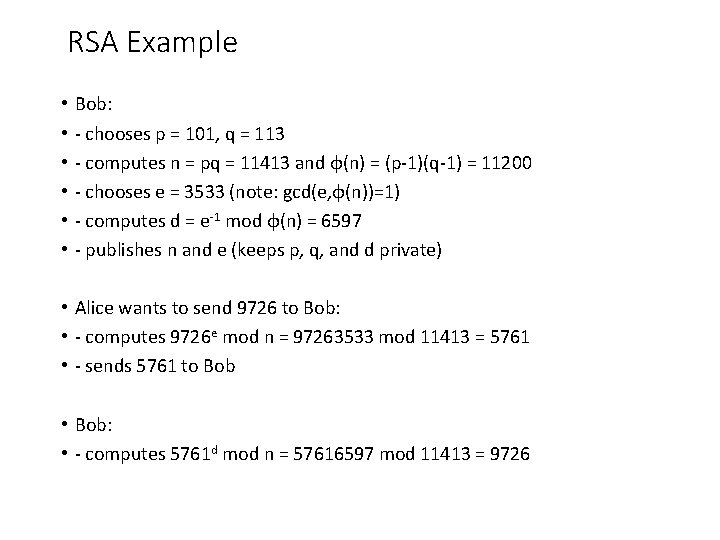
RSA Example • • • Bob: - chooses p = 101, q = 113 - computes n = pq = 11413 and φ(n) = (p-1)(q-1) = 11200 - chooses e = 3533 (note: gcd(e, φ(n))=1) - computes d = e-1 mod φ(n) = 6597 - publishes n and e (keeps p, q, and d private) • Alice wants to send 9726 to Bob: • - computes 9726 e mod n = 97263533 mod 11413 = 5761 • - sends 5761 to Bob • Bob: • - computes 5761 d mod n = 57616597 mod 11413 = 9726
Diffie-Hellman • Invented by Williamson (GCHQ) and, independently, by D and H (Stanford) • A “key exchange” algorithm • Used to establish a shared symmetric key among two parties over an insecure channel • Not for encrypting or signing
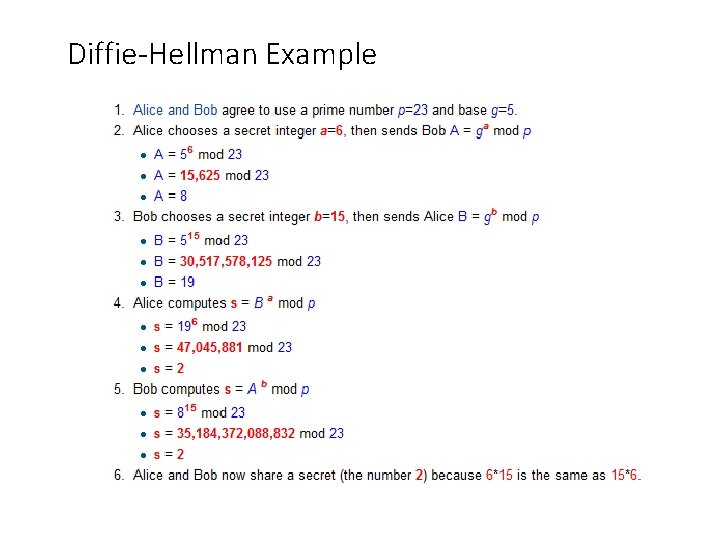
Diffie-Hellman Example
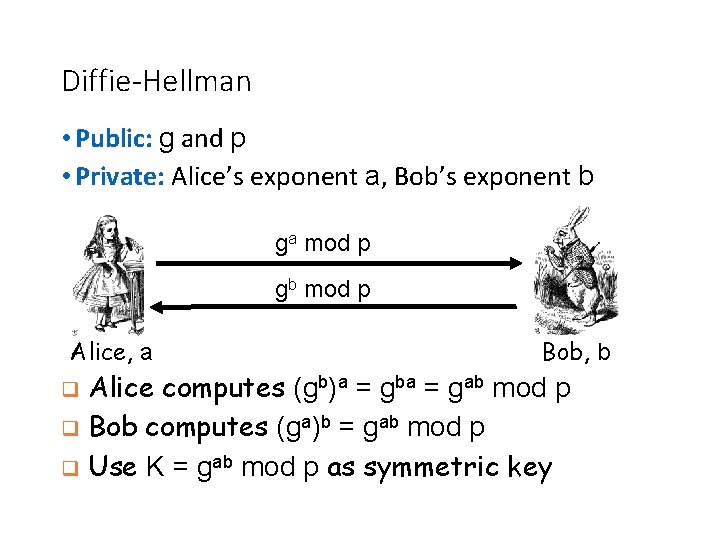
Diffie-Hellman • Public: g and p • Private: Alice’s exponent a, Bob’s exponent b ga mod p gb mod p Alice, a Bob, b Alice computes (gb)a = gba = gab mod p q Bob computes (ga)b = gab mod p q Use K = gab mod p as symmetric key q

Next • Hashing
What is hash function? • A cryptographic hash function is a hash function that converts a given input data into a message (digest) • Hash is a one-way function which makes it impossible recreate the input data from its digest value alone.
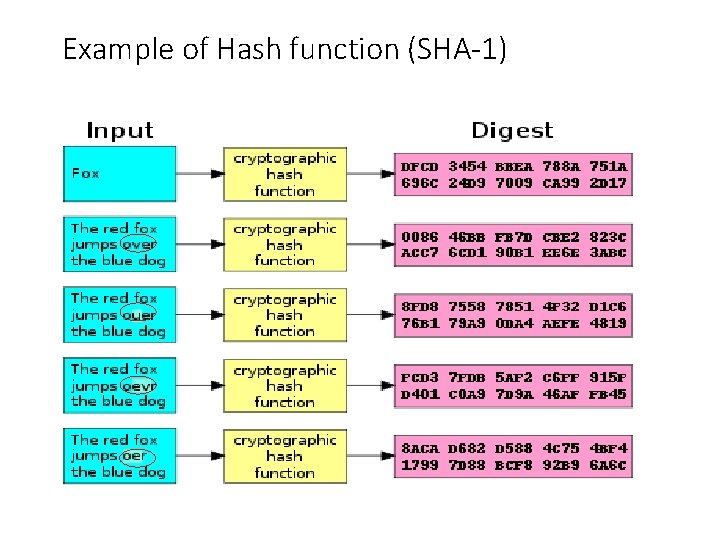
Example of Hash function (SHA-1)
MD 5 algorithm • Message Digest algorithm 5 • Invented by Ronald Rivest in 1991 • Input data can be of any size or length, but the output “hash value” size is always fixed • The algorithm generates a fixed size (32 digit hex) MD 5 hash • Original algorithm is given here https: //www. ietf. org/rfc 1321. txt
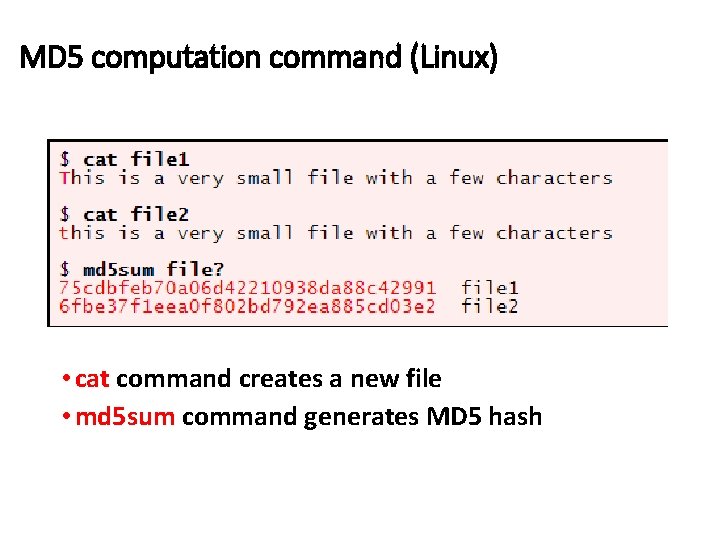
MD 5 computation command (Linux) • cat command creates a new file • md 5 sum command generates MD 5 hash
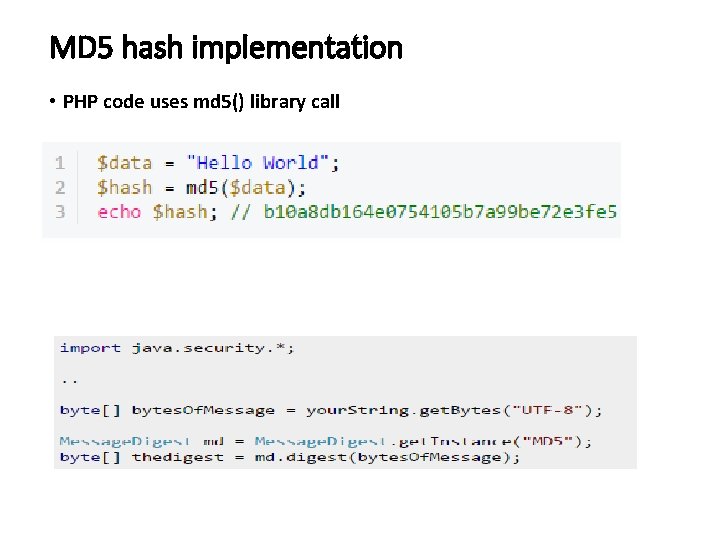
MD 5 hash implementation • PHP code uses md 5() library call • Java code uses Message. Digest class
Hash != Encryption • Encryption" is a two-way operation whereas Hash is one-way operation • Encryption transforms data from a cleartext to ciphertext and back (with the right keys) • The two texts should correspond to each other in same size
Hash generation demo • http: //onlinemd 5. com/
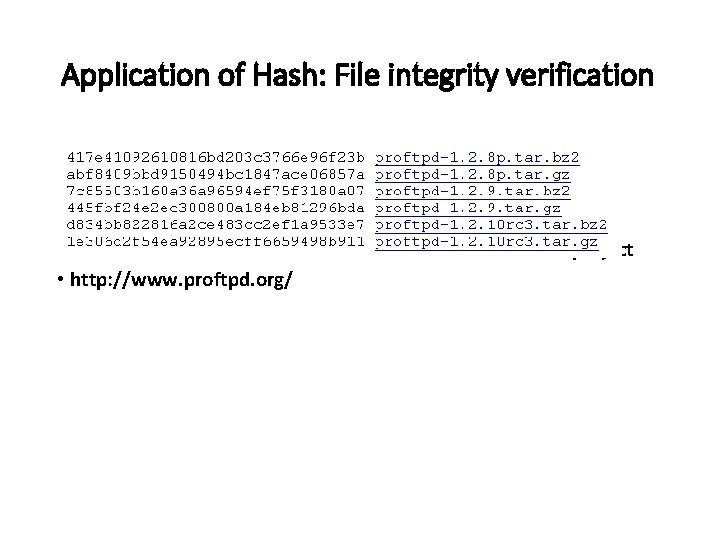
Application of Hash: File integrity verification • MD 5 checksums for downloadable software from Pro. FTP project • http: //www. proftpd. org/
Application of Hash: Password storage • Computer systems store passwords in hashed form instated of clear text • Since these hashes are not reversible, there is no way to find out for sure "what clear text password produced this hash? "
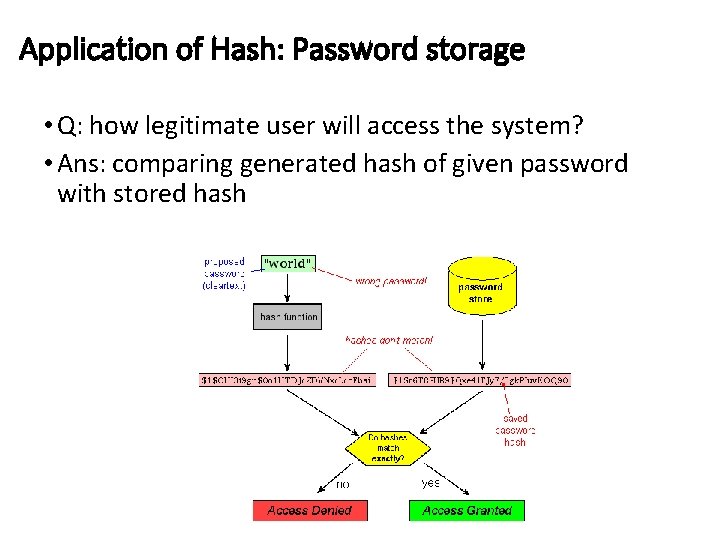
Application of Hash: Password storage • Q: how legitimate user will access the system? • Ans: comparing generated hash of given password with stored hash
Next • Attacks on cryptosystems
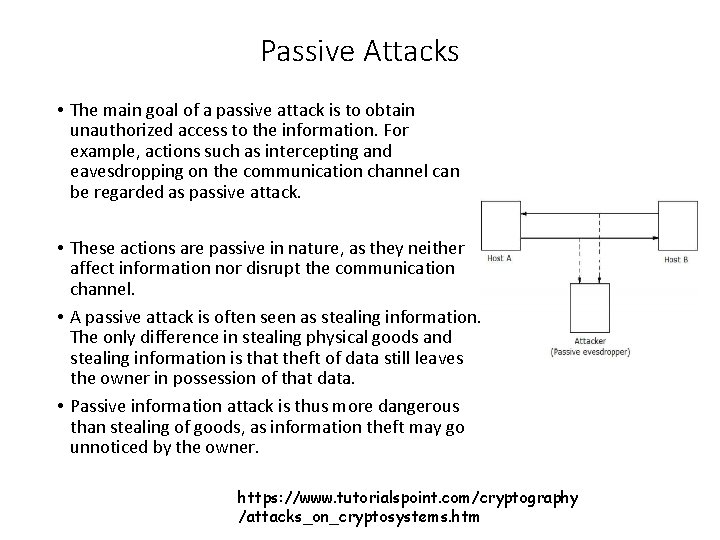
Passive Attacks • The main goal of a passive attack is to obtain unauthorized access to the information. For example, actions such as intercepting and eavesdropping on the communication channel can be regarded as passive attack. • These actions are passive in nature, as they neither affect information nor disrupt the communication channel. • A passive attack is often seen as stealing information. The only difference in stealing physical goods and stealing information is that theft of data still leaves the owner in possession of that data. • Passive information attack is thus more dangerous than stealing of goods, as information theft may go unnoticed by the owner. https: //www. tutorialspoint. com/cryptography /attacks_on_cryptosystems. htm
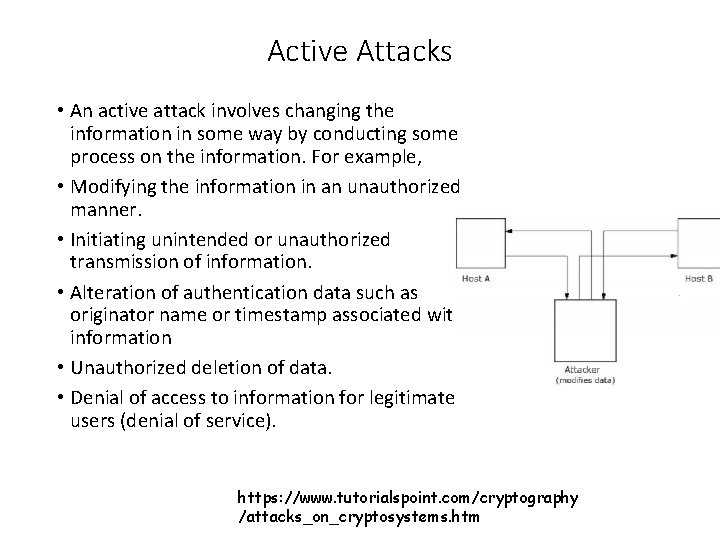
Active Attacks • An active attack involves changing the information in some way by conducting some process on the information. For example, • Modifying the information in an unauthorized manner. • Initiating unintended or unauthorized transmission of information. • Alteration of authentication data such as originator name or timestamp associated with information • Unauthorized deletion of data. • Denial of access to information for legitimate users (denial of service). https: //www. tutorialspoint. com/cryptography /attacks_on_cryptosystems. htm
Attacks on Cryptosystems • Ciphertext Only Attacks: In this method, the attacker has access to a set of ciphertext(s). He does not have access to corresponding plaintext. COA is said to be successful when the corresponding plaintext can be determined from a given set of ciphertext. Occasionally, the encryption key can be determined from this attack. Modern cryptosystems are guarded against ciphertext-only attacks. • Known Plaintext Attack (KPA) − In this method, the attacker knows the plaintext for some parts of the ciphertext. The task is to decrypt the rest of the ciphertext using this information. This may be done by determining the key or via some other method. The best example of this attack is linear cryptanalysis against block ciphers. https: //www. tutorialspoint. com/cryptography /attacks_on_cryptosystems. htm
Attacks on Cryptosystems • Chosen Plaintext Attack (CPA) − In this method, the attacker has the text of his choice encrypted. So he has the ciphertext-plaintext pair of his choice. This simplifies his task of determining the encryption key. An example of this attack is differential cryptanalysis applied against block ciphers as well as hash functions. A popular public key cryptosystem, RSA is also vulnerable to chosen-plaintext attacks. • Dictionary Attack − This attack has many variants, all of which involve compiling a ‘dictionary’. In simplest method of this attack, attacker builds a dictionary of ciphertexts and corresponding plaintexts that he has learnt over a period of time. In future, when an attacker gets the ciphertext, he refers the dictionary to find the corresponding plaintext https: //www. tutorialspoint. com/cryptography /attacks_on_cryptosystems. htm
Attacks on Cryptosystems • Brute Force Attack (BFA) − In this method, the attacker tries to determine the key by attempting all possible keys. If the key is 8 bits long, then the number of possible keys is 28 = 256. The attacker knows the ciphertext and the algorithm, now he attempts all the 256 keys one by one for decryption. The time to complete the attack would be very high if the key is long. • Birthday Attack − This attack is a variant of brute-force technique. It is used against the cryptographic hash function. When students in a class are asked about their birthdays, the answer is one of the possible 365 dates. Let us assume the first student's birthdate is 3 rd Aug. Then to find the next student whose birthdate is 3 rd Aug, we need to enquire 1. 25*� √ 365 ≈ 25 students. https: //www. tutorialspoint. com/cryptography /attacks_on_cryptosystems. htm
Attacks on Cryptosystems • Man in Middle Attack (MIM) − The targets of this attack are mostly public key cryptosystems where key exchange is involved before communication takes place. Host A wants to communicate to host B, hence requests public key of B. An attacker intercepts this request and sends his public key instead. Thus, whatever host A sends to host B, the attacker is able to read. In order to maintain communication, the attacker re-encrypts the data after reading with his public key and sends to B. • The attacker sends his public key as A’s public key so that B takes it as if it is taking it from A. • • • Side Channel Attack (SCA) − This type of attack is not against any particular type of cryptosystem or algorithm. Instead, it is launched to exploit the weakness in physical implementation of the cryptosystem. • Timing Attacks − They exploit the fact that different computations take different times to compute on processor. By measuring such timings, it is be possible to know about a particular computation the processor is carrying out. For example, if the encryption takes a longer time, it indicates that the secret key is long. https: //www. tutorialspoint. com/cryptography /attacks_on_cryptosystems. htm
Attacks on Cryptosystems • Power Analysis Attacks − These attacks are similar to timing attacks except that the amount of power consumption is used to obtain information about the nature of the underlying computations. • Fault analysis Attacks − In these attacks, errors are induced in the cryptosystem and the attacker studies the resulting output for useful information. https: //www. tutorialspoint. com/cryptography /attacks_on_cryptosystems. htm
- Slides: 64