Philosophy Concepts and methods for linking EE ESD
- Slides: 65
“Philosophy, Concepts and methods for linking EE / ESD with management of BRs & other designated areas Prof. Michael Scoullos UNESCO Chair & Network on Sustainable Development Management and Education in the Mediterranean University of Athens Chair, MIO-ECSDE, GWP-med Chair, Greek National Commission of ΜΑΒ UNESCO
Basic Axis of the book (a) • Fields of EE/ESD which are directly linked to BRs/Pas or may gain from such a link What EE/ESD gains from BRs/PAs? Where BRs/PAs are necessary for EE/ESD
Basic Axis of the book (b) • What are the processes in BRs/PAs and what are the activities of EE/ESD that can be developed in favour of BRs/Pas. What BRs/PAs gain from EE/ESD ? How EE/ESD may help the management?
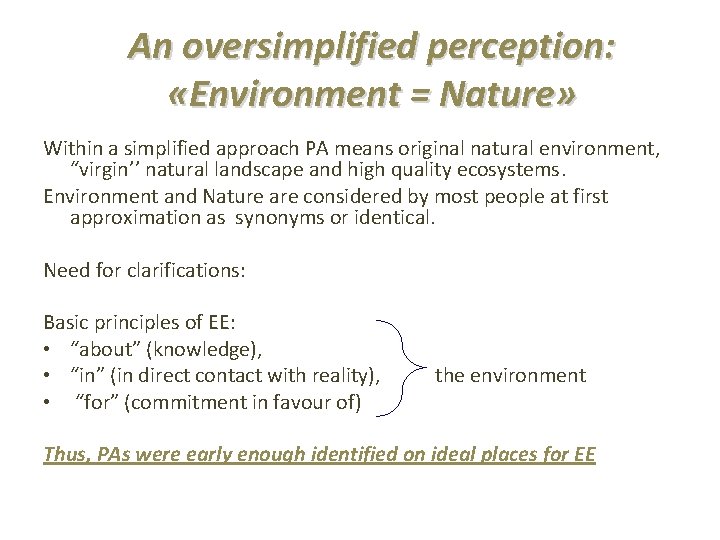
An oversimplified perception: «Environment = Nature» Within a simplified approach PA means original natural environment, “virgin’’ natural landscape and high quality ecosystems. Environment and Nature are considered by most people at first approximation as synonyms or identical. Need for clarifications: Basic principles of EE: • “about” (knowledge), • “in” (in direct contact with reality), the environment • “for” (commitment in favour of) Thus, PAs were early enough identified on ideal places for EE
A dynamic system • The concepts, the institutions involved and the level of “comprehension/interpretation” of them (BRs, EE, ESD) are not static but evolving, having multiple nuances and approaches. They are open to explanations, clarifications and further “enrichment”.
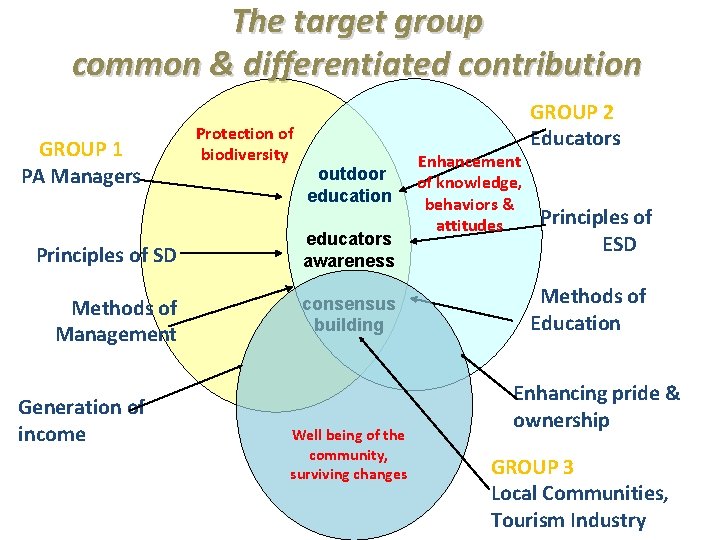
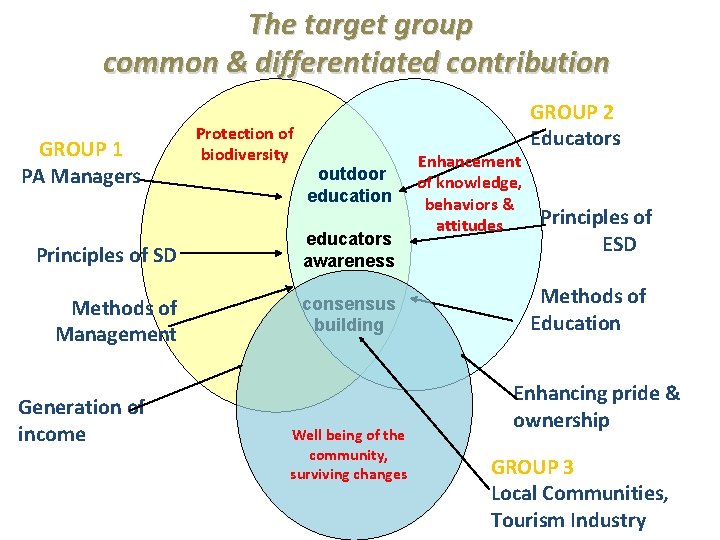
The target group common & differentiated contribution GROUP 1 PA Managers Protection of biodiversity outdoor education Principles of SD educators awareness Methods of Management consensus building Generation of income Well being of the community, surviving changes Enhancement of knowledge, behaviors & attitudes GROUP 2 Educators Principles of ESD Methods of Education Enhancing pride & ownership GROUP 3 Local Communities, Tourism Industry
Nature’s observation as a learning tool • From the very beginning of education the direct contact with nature (being in nature) and observation (either in situ or in the laboratory) (invivo or invitro) was an important learning tool for empirical knowledge and deeper reflection.
Evolution in the relationship: Man & Nature In the ancient world, Nature & Divine (supernatural) were almost identical. Even when we step ahead from naturalism and we see nature as «world» / «structure» from the point of view of literature, the “personification” of nature remains in the human conscience and the related cognitive and learning processes.
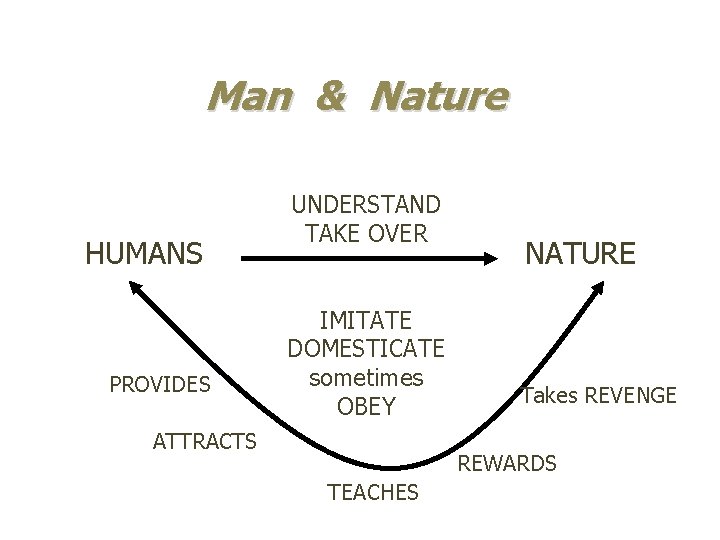
Man & Nature HUMANS PROVIDES UNDERSTAND TAKE OVER IMITATE DOMESTICATE sometimes OBEY ATTRACTS NATURE Takes REVENGE REWARDS TEACHES
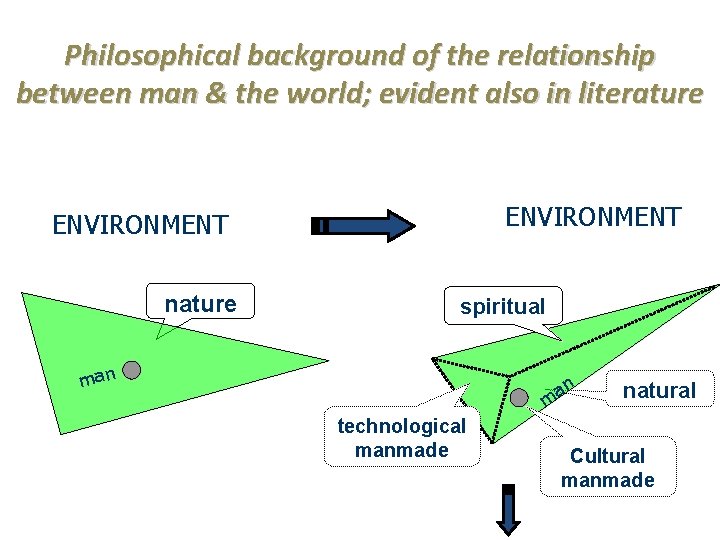
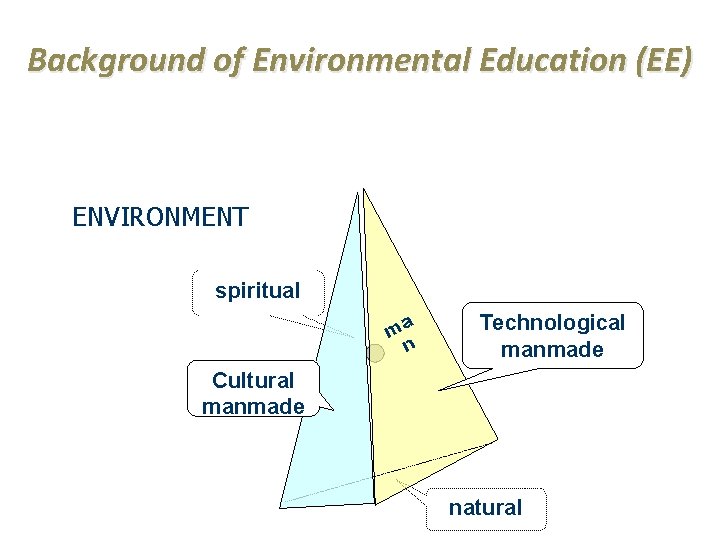
Philosophical background of the relationship between man & the world; evident also in literature ENVIRONMENT nature spiritual man an m technological manmade natural Cultural manmade
Background of Environmental Education (EE) ENVIRONMENT spiritual m a n Technological manmade Cultural manmade natural
Man & Nature Already from the antiquity there is an attempt to relate lessons learnt about the “fury” or the consequences of the natural phenomena to human choices either as: 1. The God’s punishment for human “sins” (i. e. the Noe cataclysm). 2. As result of not obeying the rules of Nature i. e. the case of Ikaros.
In the roots of environmental awareness as it is identified today one may trace: Many ancient philosophical ideas as they survived and evolved until today. - Pastoralism and nature worship of Jean-Jac Rousseau, etc. - The appreciation of indigenous rural people wisdom, culture and practices. - The Darwin’s theories on evolution, holistic thinking (“ecology”). - The living “Gaia” theories. - The systemic thinking (eco-system). - Social and health impact of the «Black Cities» of the Industrial Revolution. - The reactions for the “chemical war” of the First World War. - The reactions for nuclear energy and its impact (Hiroshima and Nagasaki). - The reactions to large-scale industrial accidents. - The fears to genetic engineering. -
Goals of the establishment PAs • The first Natural (national) Park created in 1872 in Yellowstone, USA as «a public park and area for recreation for people’s benefit» . • In 1911 in Canada: the first coordination unit worldwide. • Five years later in 1916 in USA the National Parks Service was established, having the important task of the management of protected areas. • In Greece, the first National Parks, the one of Olympus and of Parnassus were established in 1938. • Samaria & Olympus= the two BRs of Greece.
PAs as witnesses of environmental changes The impacts of urban, industrial and air pollution were obvious in PAs, Natural Parks, etc. - Acid rain impact (i. e. in the forest and PAs in Scandinavian countries) - The oil spills and litter in marine parks - Threats on species and loss of biodiversity even within many of the PAs.
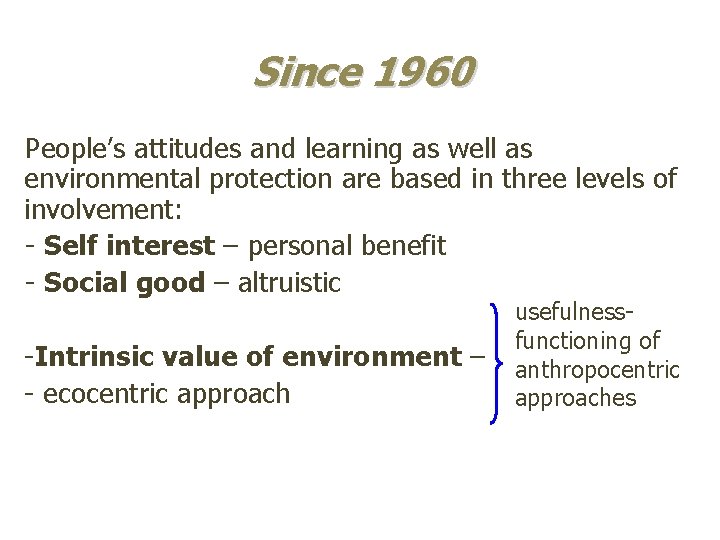
Since 1960 People’s attitudes and learning as well as environmental protection are based in three levels of involvement: - Self interest – personal benefit - Social good – altruistic -Intrinsic value of environment – - ecocentric approach usefulnessfunctioning of anthropocentric approaches
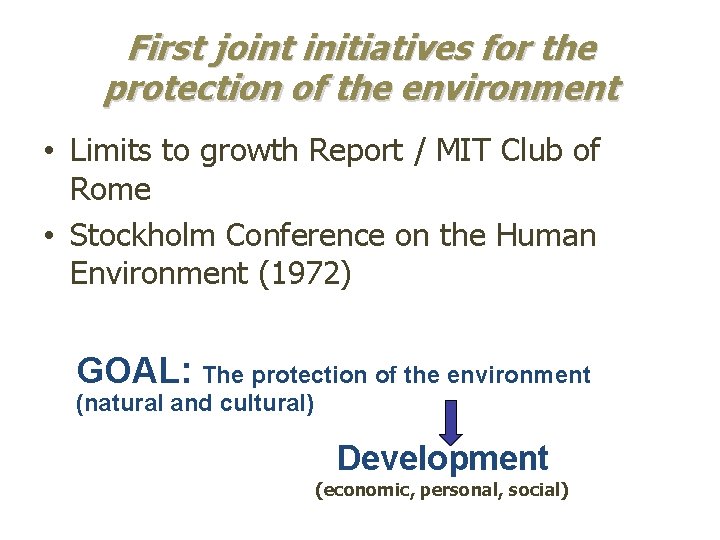
First joint initiatives for the protection of the environment • Limits to growth Report / ΜΙΤ Club of Rome • Stockholm Conference on the Human Environment (1972) GOAL: The protection of the environment (natural and cultural) Development (economic, personal, social)
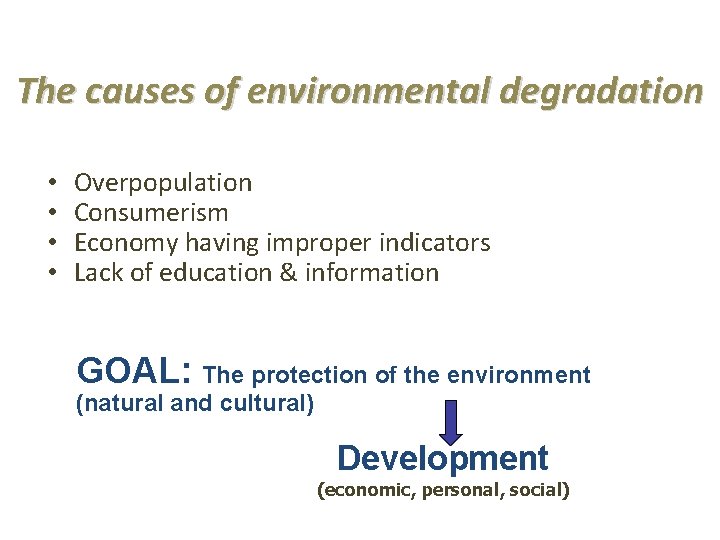
The causes of environmental degradation • • Overpopulation Consumerism Economy having improper indicators Lack of education & information GOAL: The protection of the environment (natural and cultural) Development (economic, personal, social)
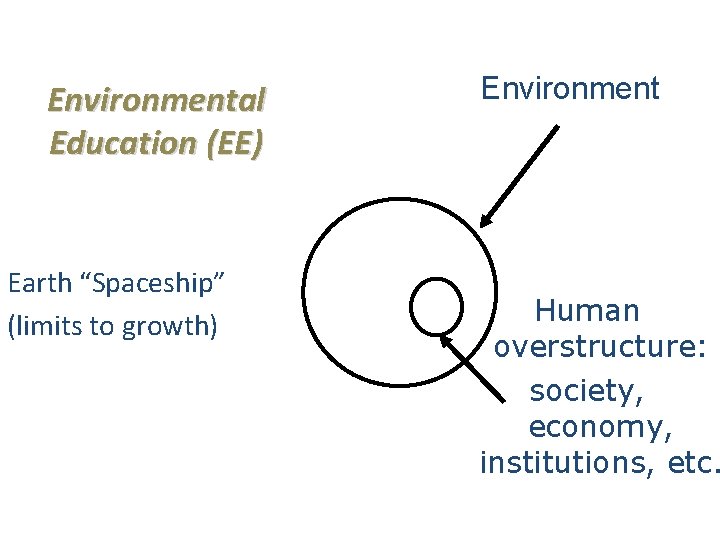
Environmental Education (EE) Earth “Spaceship” (limits to growth) Environment Human overstructure: society, economy, institutions, etc.
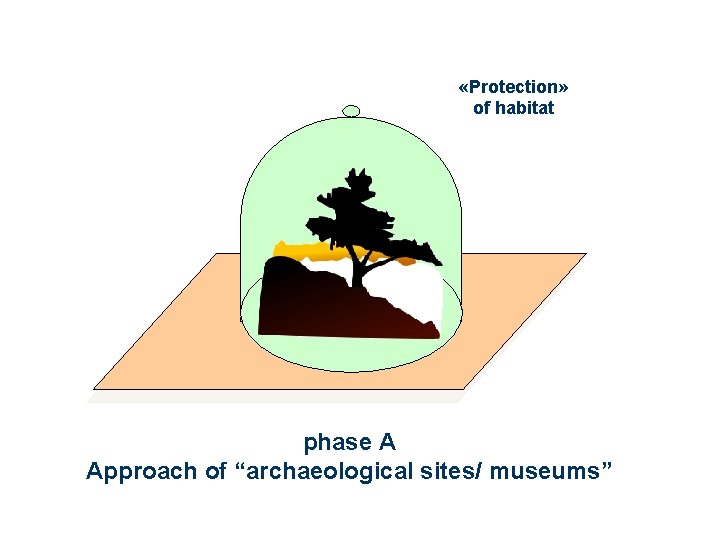
Evolution in the Protection First steps: • The protection of species in danger Followed by: • The protection of particular isolated habitats / ecosystems (as “islands of protection”) Similar approach by spatial planning experts, economists, archaeologists for other areas of special interest.
«Protection» of habitat phase Α Approach of “archaeological sites/ museums”
Evolution in the Protection • Soon the limits of the “islands of protection” approach became apparent and the concept of protection evolved to cover wider zones, “zoning approach” (see industrial zones, areas of urban development, protected areas, etc. )
Protected Areas • IUCN – World Conservation Union “areas of land or sea, designated to ensure long- term protection and maintenance of biological diversity, as well as their natural and cultural value, which can be managed through legal or other effective ways” • Initially 10 categories of ecotypes (1978) that finally combined in the following six (1994):
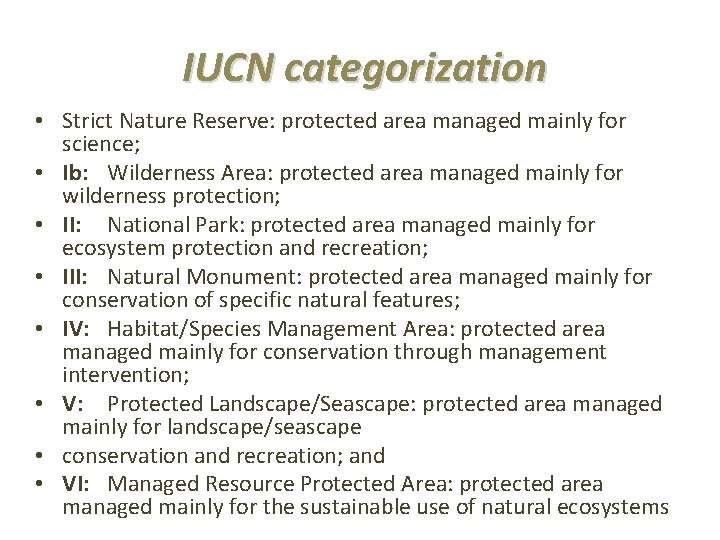
IUCN categorization • Strict Nature Reserve: protected area managed mainly for science; • Ib: Wilderness Area: protected area managed mainly for wilderness protection; • II: National Park: protected area managed mainly for ecosystem protection and recreation; • III: Natural Monument: protected area managed mainly for conservation of specific natural features; • IV: Habitat/Species Management Area: protected area managed mainly for conservation through management intervention; • V: Protected Landscape/Seascape: protected area managed mainly for landscape/seascape • conservation and recreation; and • VI: Managed Resource Protected Area: protected area managed mainly for the sustainable use of natural ecosystems
Internationally important specially designated areas • Wetlands Ramsar Convention • UNESCO World Heritage Monuments. • Barcelona Convention Specially Protected Areas (SPA). • Biosphere Reserves UNESCO Man & the Biosphere (MAB) Programme
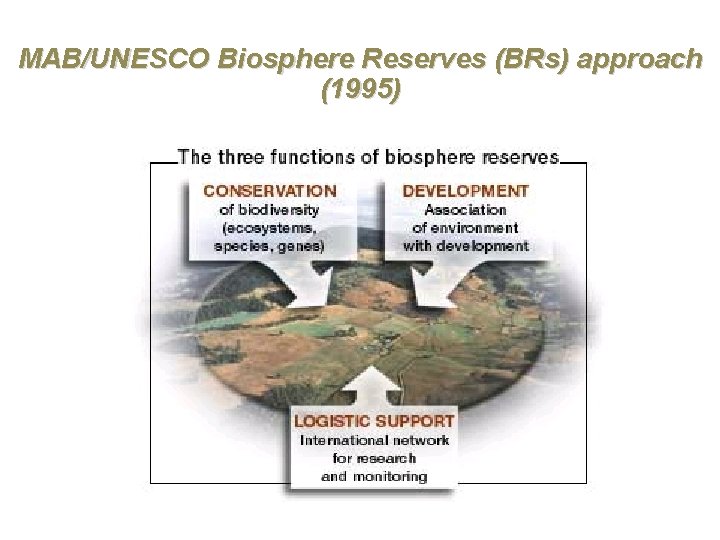
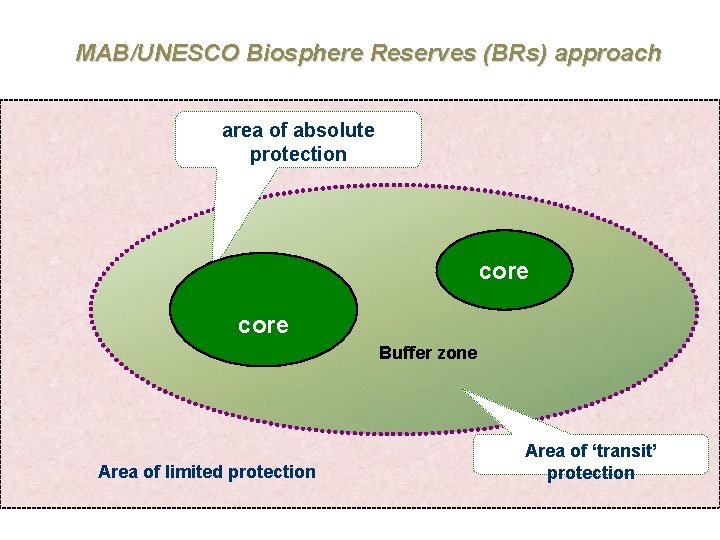
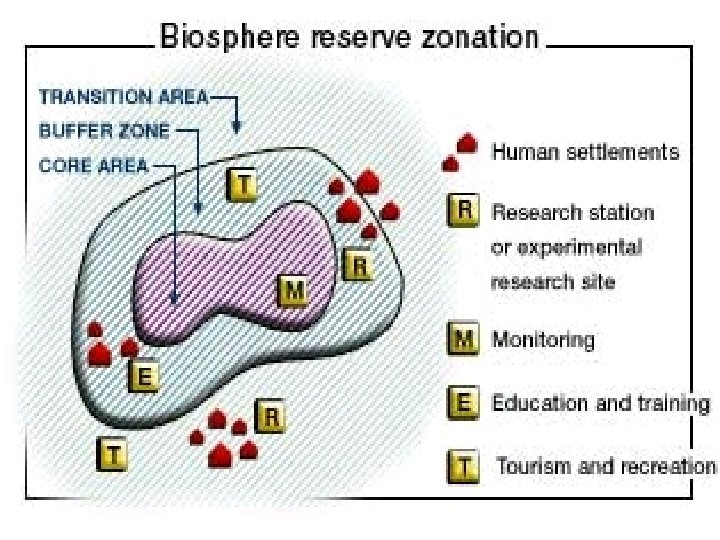
ΜΑΒ/UNESCO Biosphere Reserves (BRs) approach (1995)
ΜΑΒ/UNESCO Biosphere Reserves (BRs) approach area of absolute protection core Buffer zone Area of limited protection Area of ‘transit’ protection
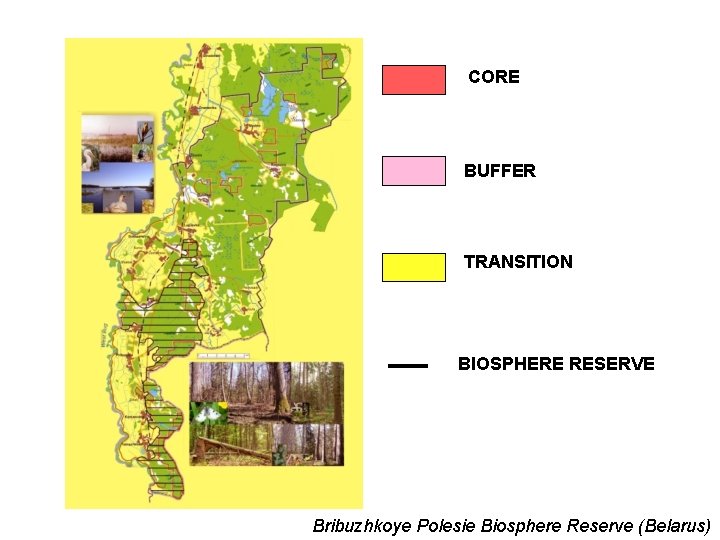
CORE BUFFER TRANSITION BIOSPHERE RESERVE Bribuzhkoye Polesie Biosphere Reserve (Belarus)
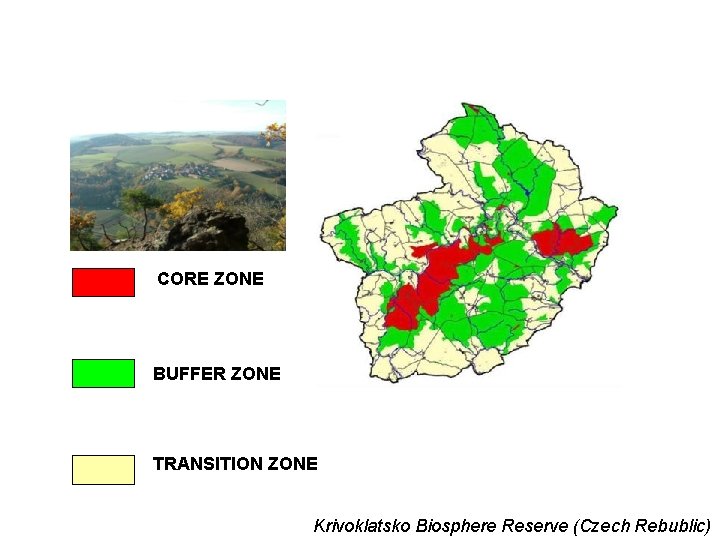
CORE ZONE BUFFER ZONE TRANSITION ZONE Krivoklatsko Biosphere Reserve (Czech Rebublic)
BRs’ functions • Conservation (landscapes, ecosystems, species generic variation) • Logistic support (research, monitoring, ESD, training, knowledge) • Development (economic, human and culturally adapted)
Protected Areas • Convention for Biodiversity (1992) « protected areas are identified geographical areas which are established and their management aims at the achievement of particular purposes of protection and conservation» The ultimate goal is the Sustainable Development Newer and recent approaches: • Networks of PAs • Eco-Corridors • Cultural Paths
European Legal framework for PAs • Directive 79/409 on the conservation of wild birds • Directive 92/43 on the conservation of natural habitats and of wild fauna and flora • Natura 2000, Network of Protected Areas. 2 types of areas: “Special Protection Areas – SPA” and “Sites of Community Importance – SCI”.
Protection is not always “desired” The establishment of PAs is one of the most difficult social issues due to frequent reaction by local communities : • They do not want to be “under protection” • They wish the same type of “development” as all other areas.
Sustainable development approach to the establishment PAs Protection of natural and cultural characteristics with the direct or indirect support/participation of the local society. This includes : • Habitats’ protection • Conservation of species generic variations • Promotion of scientific research • Conservation of natural, cultural and traditional (heritage) elements • Education • Recreation and development of sustainable tourism and other compatible to SD activities (human and culturally adapted) • Sustainable management of natural resources. • Conservation of a set of services and goods necessary for the well being of current and future generations.
1960 s & 1970 s: Introduction of EE An alternative approach to the environment but also to education • Its explicit aims were often concerned with stimulating a sense of individual responsibility for both the natural and manmade aesthetic/cultural environment, based on general ecological principles and knowledge of the scientific bio-geo-chemical cycles and observation of a series of impacts of human activities on them.
First steps of EE • Limits to Growth Report - Stockholm Conference on the Human Environment (1972) • Belgrade (1975) & Tbilisi (1977) documents on EE emphasized the need to build knowledge, acquire comprehension & decision making skills and adopt values & attitudes which could protect the environment.
Key Methodologies • “about” (knowledge), • “in” (in direct contact with reality), • “for” (commitment in favour of) the environment. • Combination of knowledge with action. • The learners in the centre. • Multidisciplinary approach.
During the 80’s & 90’s • “Unbalanced” evolution of EE in the various countries. • Ideological and other constrains in implementation • Moscow Congress on EE & Training (1987): more emphasis on the gender issue, health, poverty & peace. • Endeavours to effectively tackle the environmental problems based on reliable scientific research. • The precautionary principle. • Introduction of a series of “targeted” forms of education i. e. Education for Development, Global Education, Education for Peace and Human Rights, Education for Women, Education for Citizenship. • Establishment of the first national and international networks on EE supported by UNESCO and other international organisations.
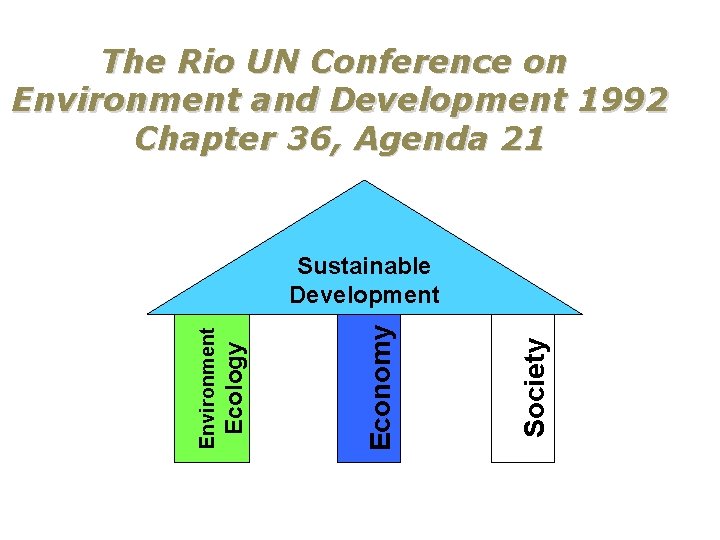
The Rio UN Conference on Environment and Development 1992 Chapter 36, Agenda 21 Society Economy Ecology Environment Sustainable Development
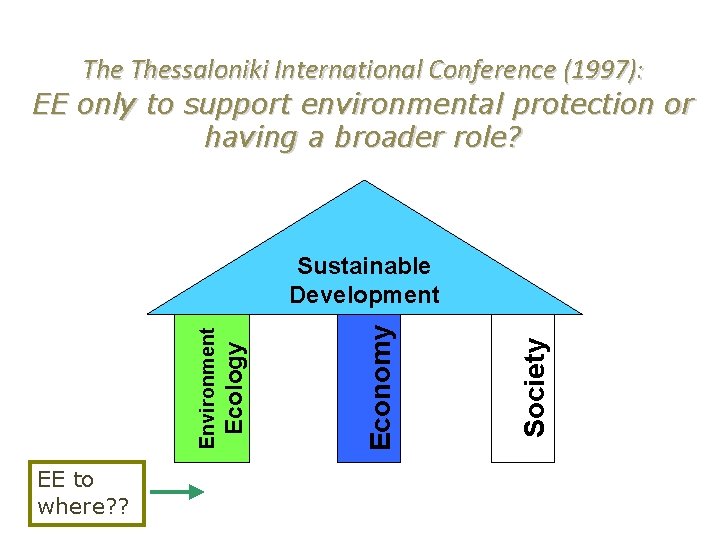
The Thessaloniki International Conference (1997): EE only to support environmental protection or having a broader role? EE to where? ? Society Economy Ecology Environment Sustainable Development
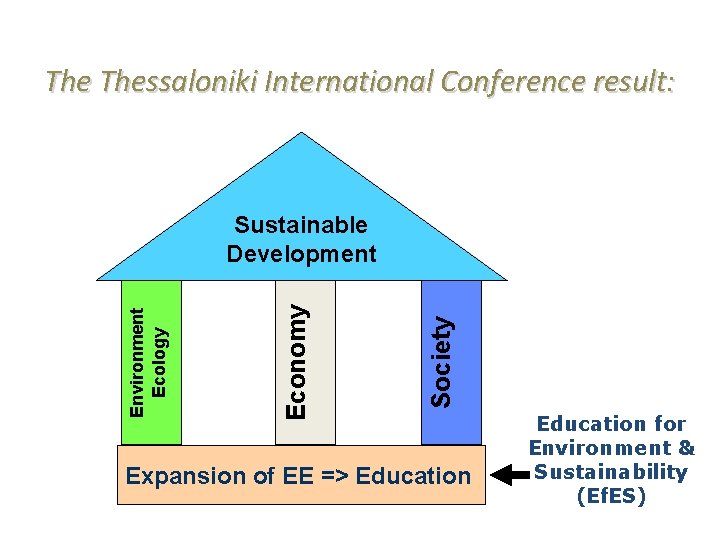
The Thessaloniki International Conference result: Society Economy Environment Ecology Sustainable Development Expansion of EE => Education for Environment & Sustainability (Ef. ES)
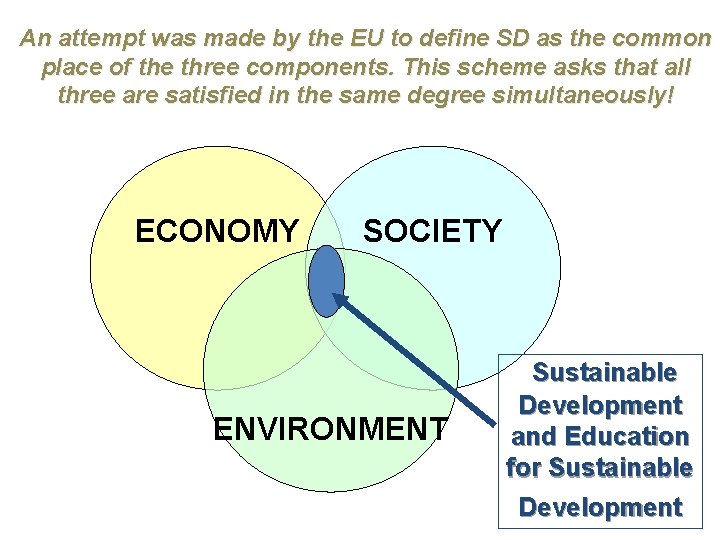
An attempt was made by the EU to define SD as the common place of the three components. This scheme asks that all three are satisfied in the same degree simultaneously! ECONOMY SOCIETY ENVIRONMENT Sustainable Development and Education for Sustainable Development
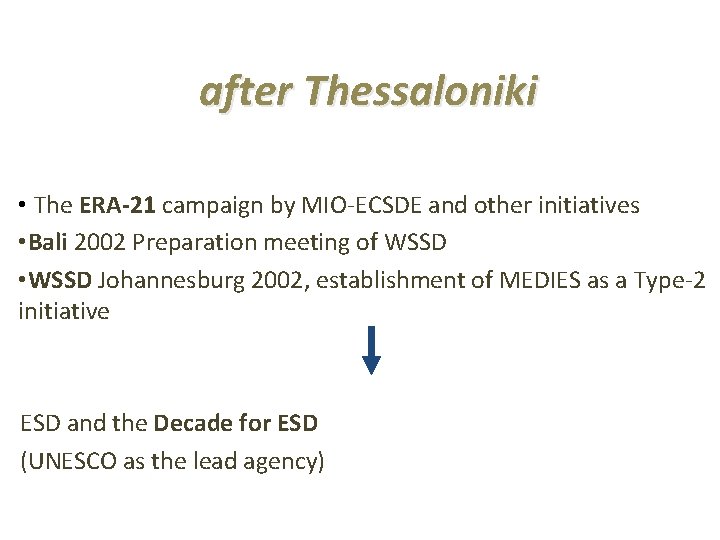
after Thessaloniki • The ERA-21 campaign by MIO-ECSDE and other initiatives • Bali 2002 Preparation meeting of WSSD • WSSD Johannesburg 2002, establishment of MEDIES as a Type-2 initiative ESD and the Decade for ESD (UNESCO as the lead agency)
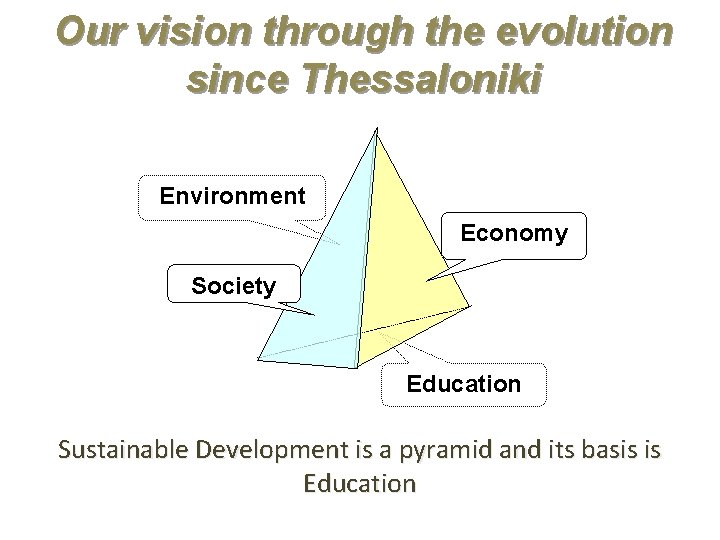
Our vision through the evolution since Thessaloniki Environment Economy Society Education Sustainable Development is a pyramid and its basis is Education
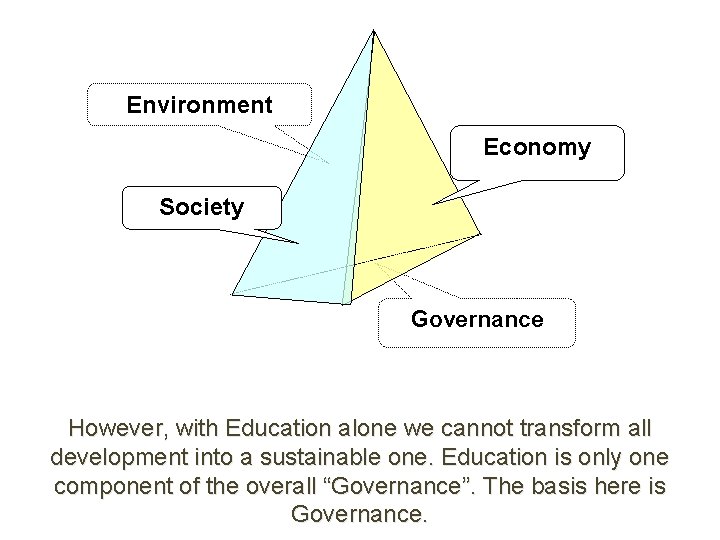
Environment Economy Society Governance However, with Education alone we cannot transform all development into a sustainable one. Education is only one component of the overall “Governance”. The basis here is Governance.
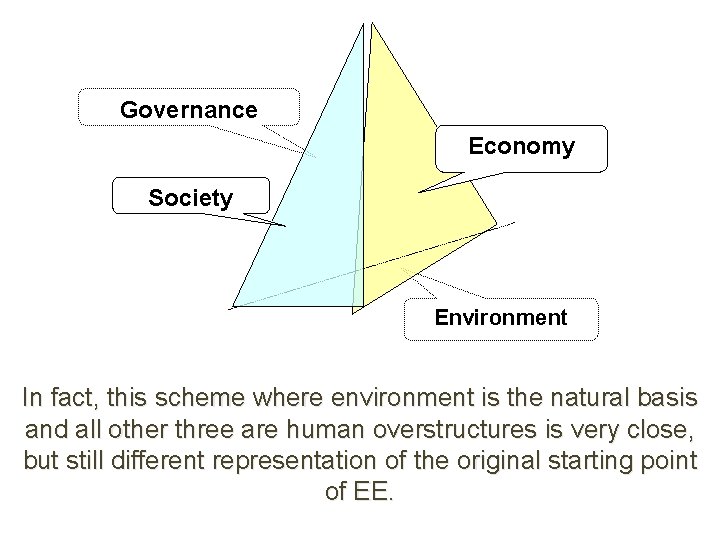
Governance Economy Society Environment In fact, this scheme where environment is the natural basis and all other three are human overstructures is very close, but still different representation of the original starting point of EE.
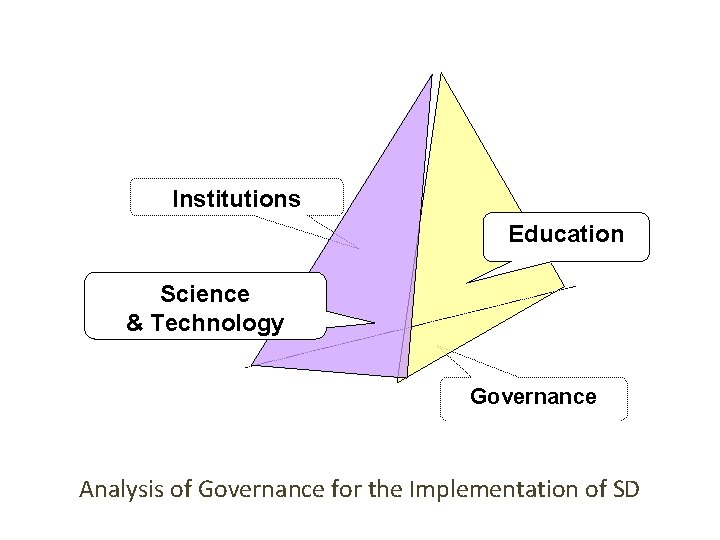
Institutions Education Science & Technology Governance Analysis of Governance for the Implementation of SD
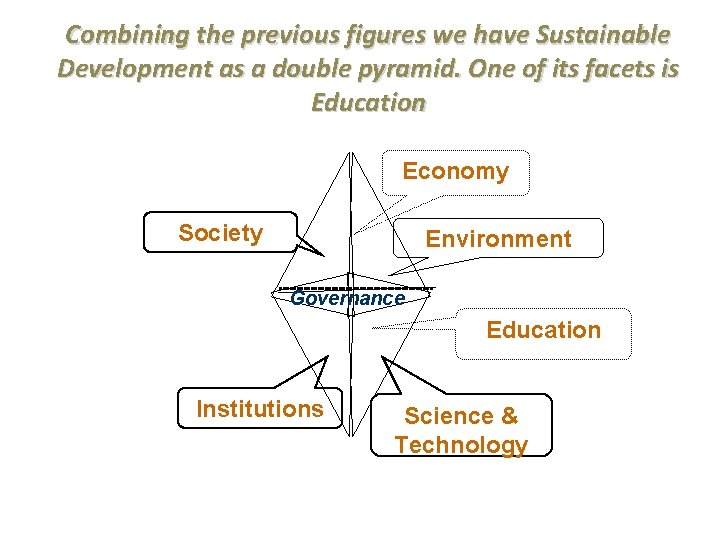
Combining the previous figures we have Sustainable Development as a double pyramid. One of its facets is Education Economy Society Environment Governance Education Institutions Science & Technology
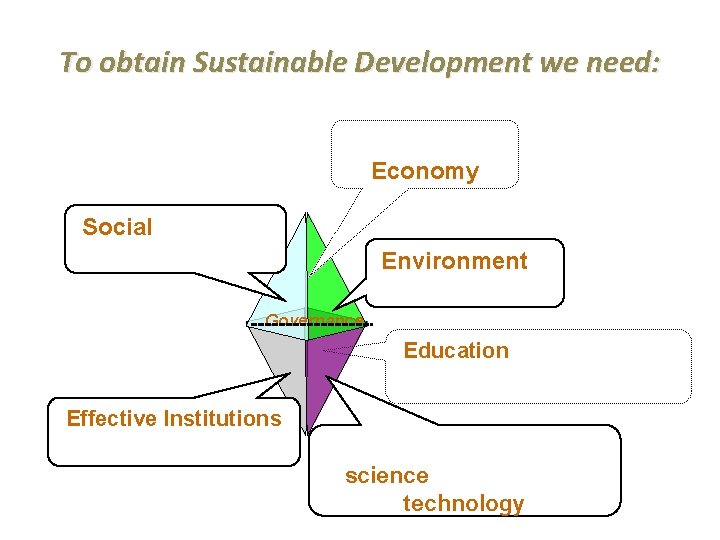
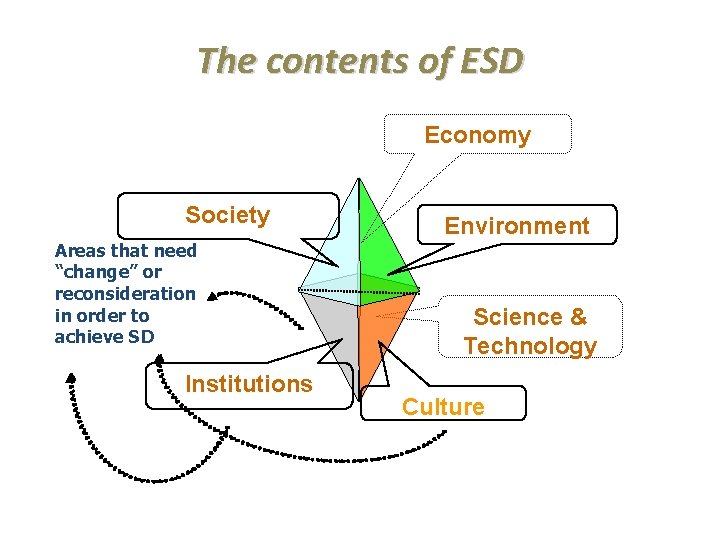
To obtain Sustainable Development we need: Responsible Economy Social Cohesion & Welfare Environmental Protection Governance Education for Sustainable Development Effective Institutions (Good planning, etc) Application of innovative science & appropriate technology
The contents of ESD Economy Society Areas that need “change” or reconsideration in order to achieve SD Institutions Environment Science & Technology Culture
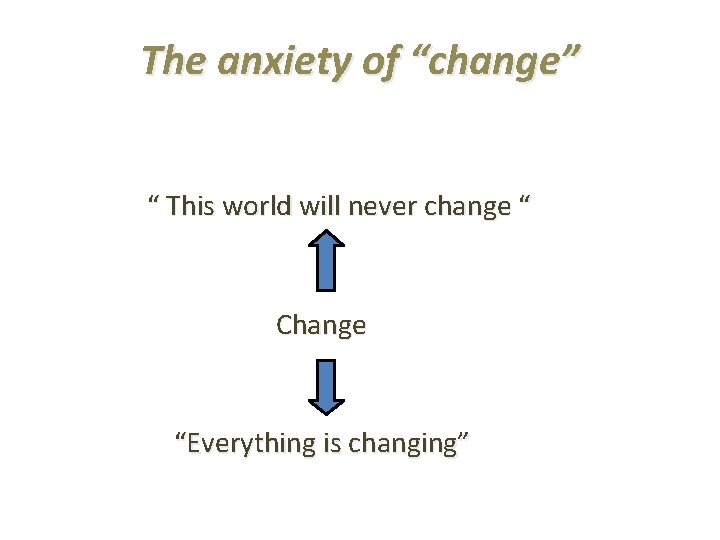
The anxiety of “change” “ This world will never change “ Change “Everything is changing”
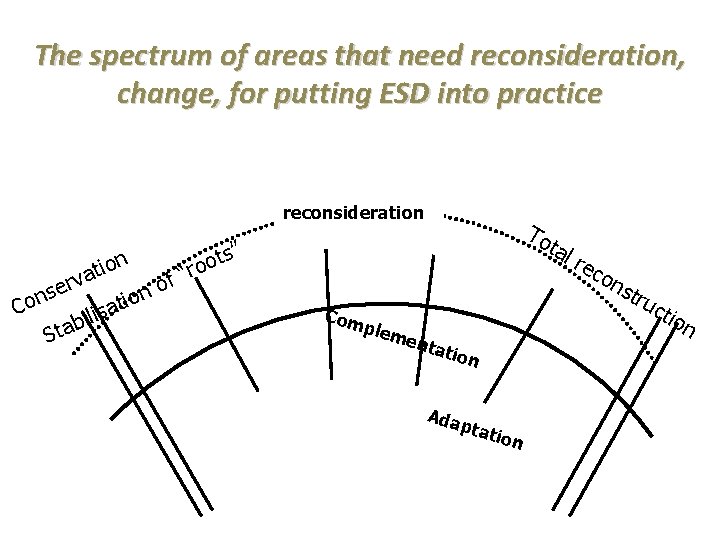
The spectrum of areas that need reconsideration, change, for putting ESD into practice reconsideration To tal n o i t ro “ a v f r o e s n n o i t Co a s i bil a t S ” ots Com plem enta tion Ada ptat ion rec on str u cti on
Everything is changing rapidly: No reference • Computers, Internet, the rapidly growing impacts on the planet by pollution, on one hand, and globalisation of the economy on the other, resulted in the shrinking of our planet and require reorientation of the focus of our Education NEED FOR STABILITY, CONTINUITY AND REFERENCE. • Within this framework EE evolves in ESD
Nothing is changing Wars, greed, inequity. “Rule of power” based on money and violence. Victims among the innocence, frequently among women and children. • The ideas guide us but their implementation is lagging behind. NEED FOR CHANGE Within this framework EE evolves in ESD • • •
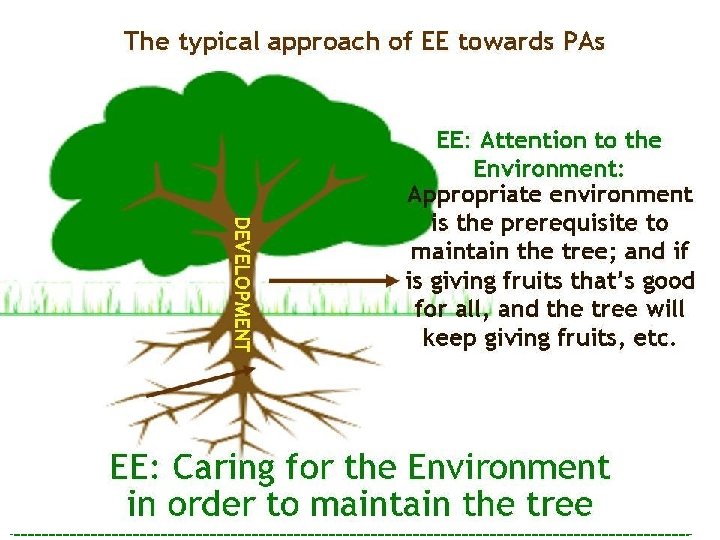
FROM DEVELOPMENT Appropriate environment = the prerequisite to maintain the tree EE: Attention to the ENVIRONMENT! EΕ: Caring for the ENVIRONMENT in order to maintain the tree
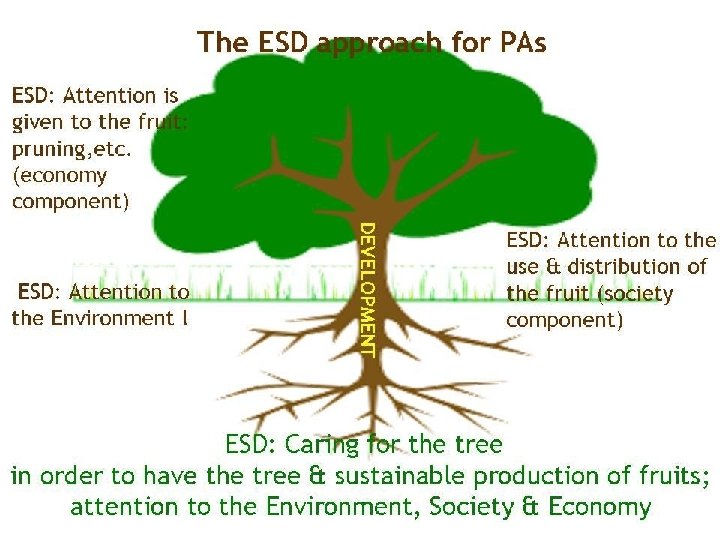
TO DEVELOPEMNT ΕSD Attention is given to the fruit: pruning, etc. (ECONOMY) ΕSD Attention to the use and distribution of the fruit (SOCIETY) ESD: Attention Ε to. SD: Caring for the tree the Environment in order to have !the tree & sustainable production of fruits Attention to the Environment, Society & Economy
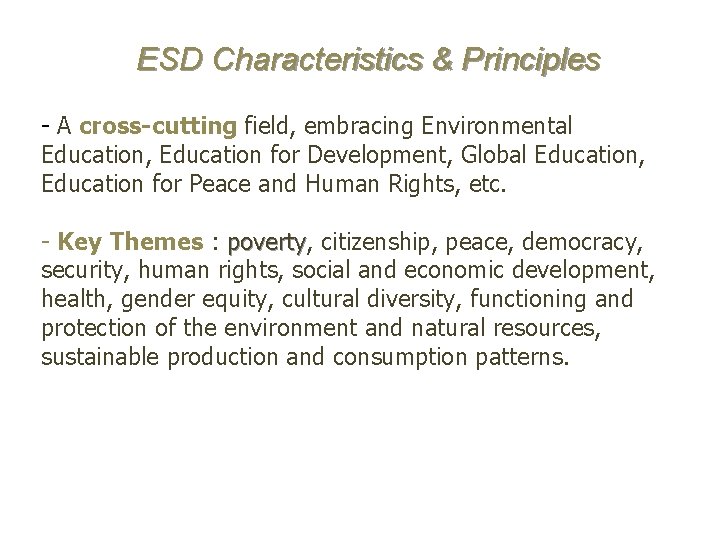
ESD Characteristics & Principles - By nature, an evolving and dynamic concept seeking to balance human and economic welfare for the present and future generations with cultural values and respect for the environment and the earth’s natural resources. - Aims to empower all people of all ages to develop the appropriate knowledge and skills; to adopt attitudes and values and shape behaviours towards sustainable development in order to assume responsibilities for creating a sustainable future.
ESD Characteristics & Principles - A cross-cutting field, embracing Environmental Education, Education for Development, Global Education, Education for Peace and Human Rights, etc. - Key Themes : poverty, poverty citizenship, peace, democracy, security, human rights, social and economic development, health, gender equity, cultural diversity, functioning and protection of the environment and natural resources, sustainable production and consumption patterns.
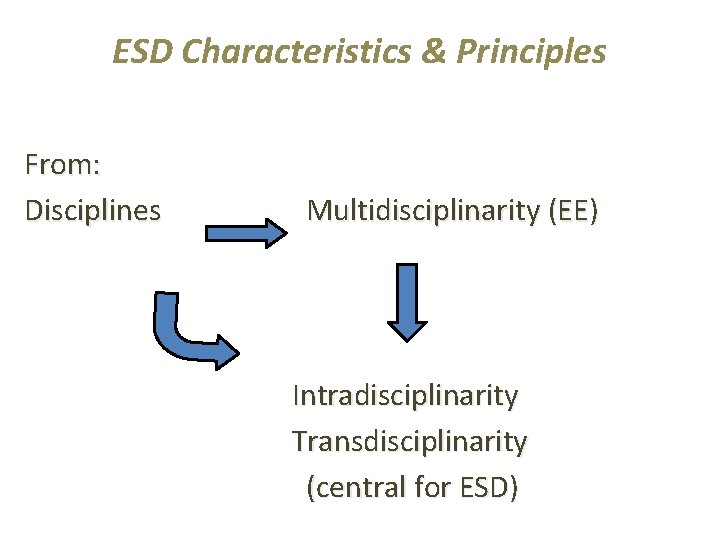
ESD Characteristics & Principles From: Disciplines Multidisciplinarity (EE) Intradisciplinarity Transdisciplinarity (central for ESD)
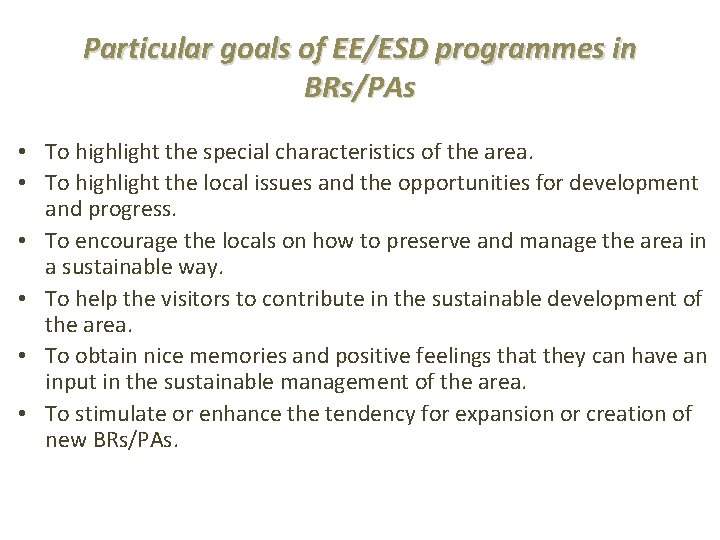
Particular goals of EE/ESD programmes in BRs/PAs • To highlight the special characteristics of the area. • To highlight the local issues and the opportunities for development and progress. • To encourage the locals on how to preserve and manage the area in a sustainable way. • To help the visitors to contribute in the sustainable development of the area. • To obtain nice memories and positive feelings that they can have an input in the sustainable management of the area. • To stimulate or enhance the tendency for expansion or creation of new BRs/PAs.
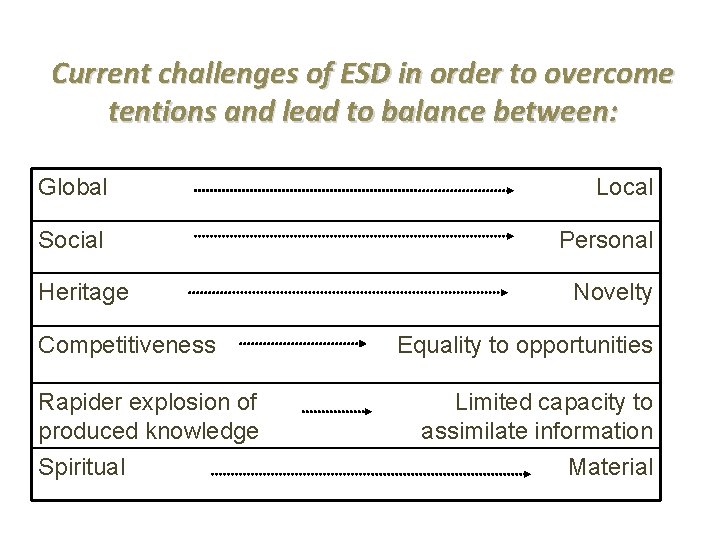
Current challenges of ESD in order to overcome tentions and lead to balance between: Global Local Social Personal Heritage Competitiveness Rapider explosion of produced knowledge Spiritual Novelty Equality to opportunities Limited capacity to assimilate information Material
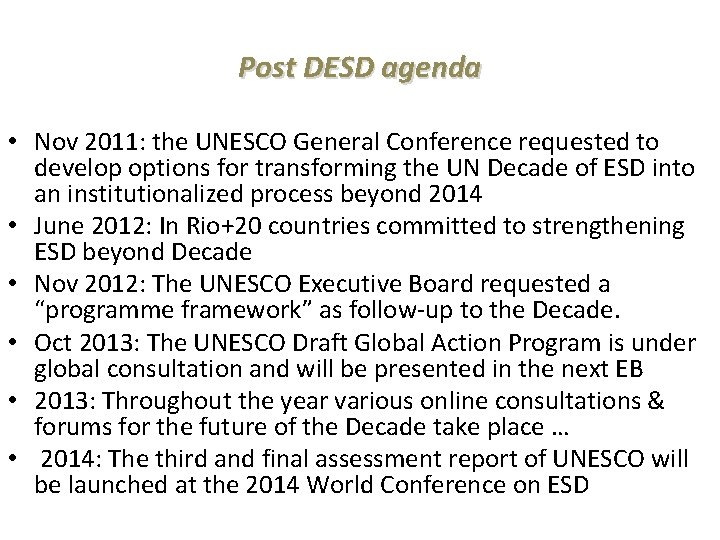
Post DESD agenda • Nov 2011: the UNESCO General Conference requested to develop options for transforming the UN Decade of ESD into an institutionalized process beyond 2014 • June 2012: In Rio+20 countries committed to strengthening ESD beyond Decade • Nov 2012: The UNESCO Executive Board requested a “programme framework” as follow-up to the Decade. • Oct 2013: The UNESCO Draft Global Action Program is under global consultation and will be presented in the next EB • 2013: Throughout the year various online consultations & forums for the future of the Decade take place … • 2014: The third and final assessment report of UNESCO will be launched at the 2014 World Conference on ESD
The target group common & differentiated contribution GROUP 1 PA Managers Protection of biodiversity outdoor education Principles of SD educators awareness Methods of Management consensus building Generation of income Well being of the community, surviving changes Enhancement of knowledge, behaviors & attitudes GROUP 2 Educators Principles of ESD Methods of Education Enhancing pride & ownership GROUP 3 Local Communities, Tourism Industry
• All the afore mentioned challenges should ideally be experimented in the BRs/PAs • Both educators and BR managers should be prepared and trained to the extent possible, to help learners in order to face these challenges with wisdom, understanding, solidarity, courage and hope.