OCR A 2 F 325 5 2 1
- Slides: 77
OCR A 2 F 325 5. 2. 1 Lattice enthalpy
Contents • 5. 2. 1 Lattice enthalpy • Background theory • Ionisation and electron affinity • Drawing the cycles
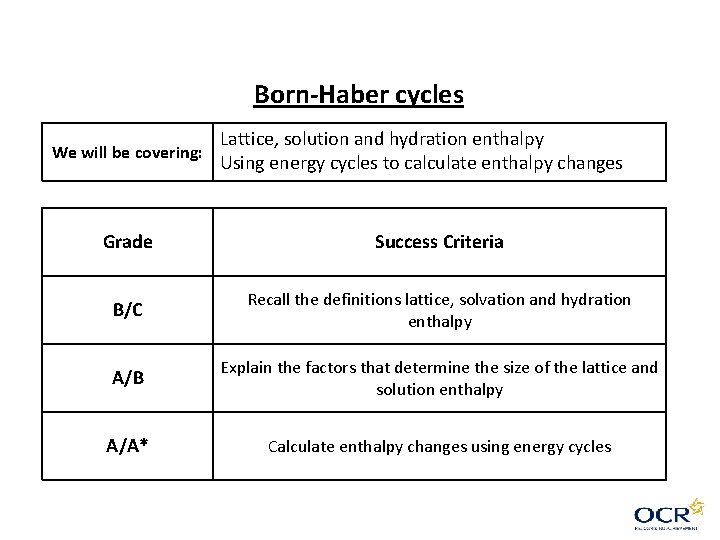
Born-Haber cycles We will be covering: Lattice, solution and hydration enthalpy Using energy cycles to calculate enthalpy changes Grade Success Criteria B/C Recall the definitions lattice, solvation and hydration enthalpy A/B Explain the factors that determine the size of the lattice and solution enthalpy A/A* Calculate enthalpy changes using energy cycles
Ionic Bonding • An ionic bond is an electrostatic attraction between oppositely charged ions • Ionic bonding occurs between a metal and a nonmetal and involves the transfer of electrons from the metal to the non-metal • The bigger the difference in electronegativity between the two atoms, the more ionic the bond • Ionic bonds are strong, consequently the melting and boiling points of ionic compounds are very high
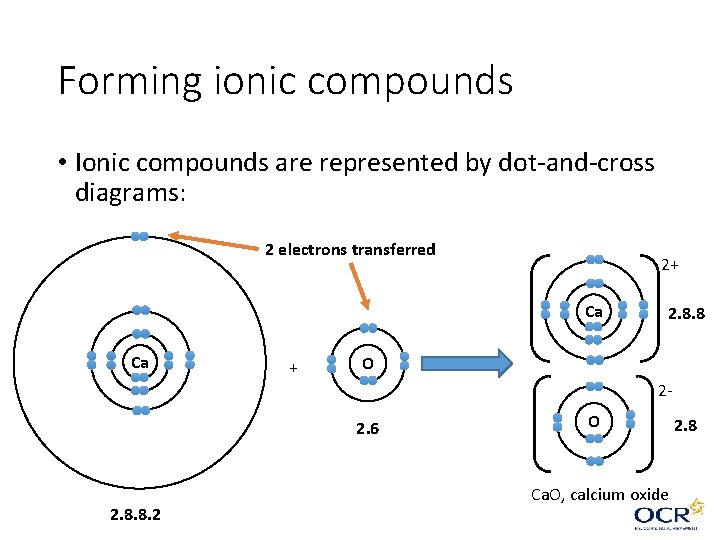
Forming ionic compounds • Ionic compounds are represented by dot-and-cross diagrams: 2 electrons transferred 2+ Ca Ca + 2. 8. 8 O 22. 6 2. 8. 8. 2 O Ca. O, calcium oxide 2. 8
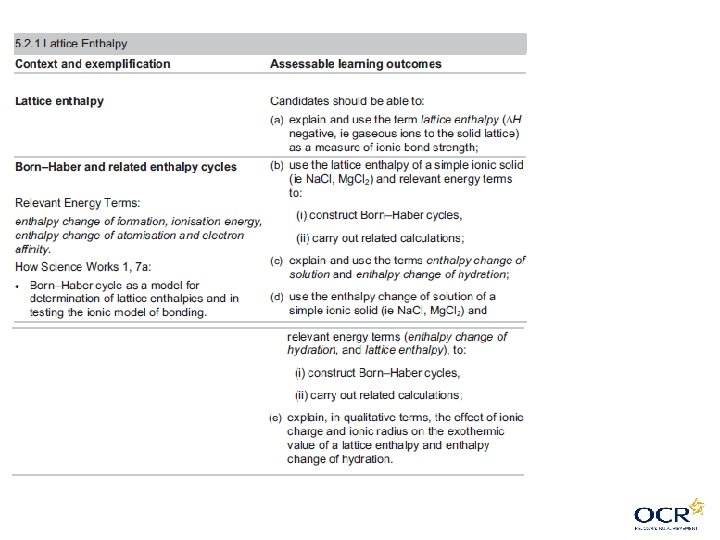
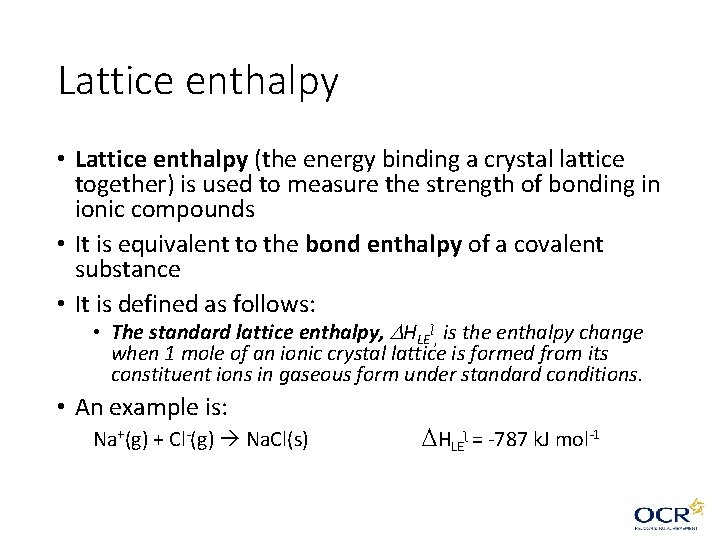
Lattice enthalpy • Lattice enthalpy (the energy binding a crystal lattice together) is used to measure the strength of bonding in ionic compounds • It is equivalent to the bond enthalpy of a covalent substance • It is defined as follows: • The standard lattice enthalpy, HLEʅ, is the enthalpy change when 1 mole of an ionic crystal lattice is formed from its constituent ions in gaseous form under standard conditions. • An example is: Na+(g) + Cl-(g) Na. Cl(s) HLEʅ = -787 k. J mol-1
Calculating lattice enthalpy • Lattice enthalpy cannot be measured directly – why? * • To determine lattice enthalpy, an energy cycle based on Hess’s Law is used • This cycle, called a Born-Haber cycle, uses enthalpy values that have been measured and recorded in data books to calculate the lattice enthalpy of a compound • A Born-Haber cycle is actually several Hess’s Law cycles joined together, so is quite complicated *you can’t separate gaseous ions and then measure the enthalpy change when they combine
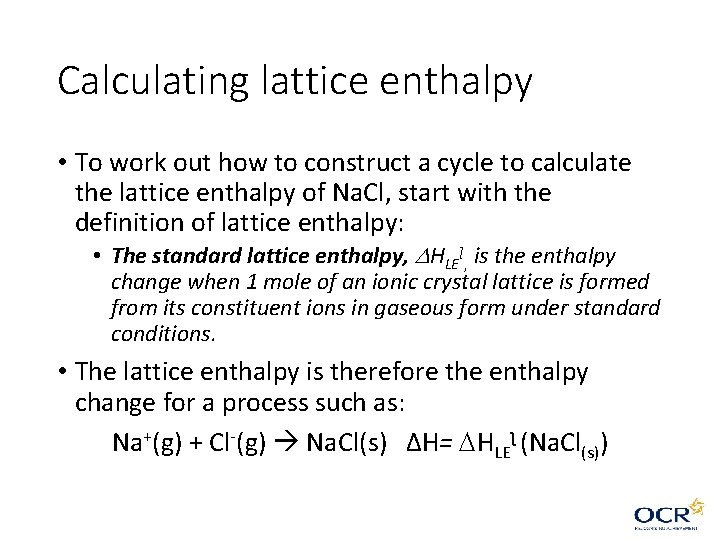
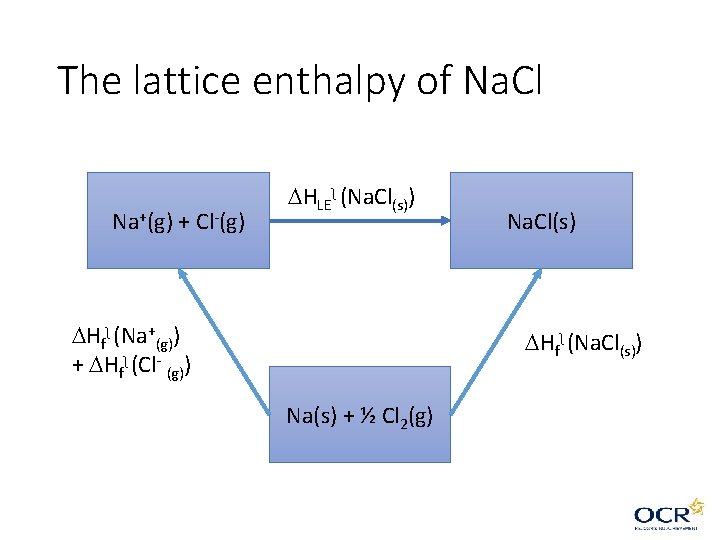
Calculating lattice enthalpy • To work out how to construct a cycle to calculate the lattice enthalpy of Na. Cl, start with the definition of lattice enthalpy: • The standard lattice enthalpy, HLEʅ, is the enthalpy change when 1 mole of an ionic crystal lattice is formed from its constituent ions in gaseous form under standard conditions. • The lattice enthalpy is therefore the enthalpy change for a process such as: Na+(g) + Cl-(g) Na. Cl(s) ∆H= HLEʅ (Na. Cl(s))
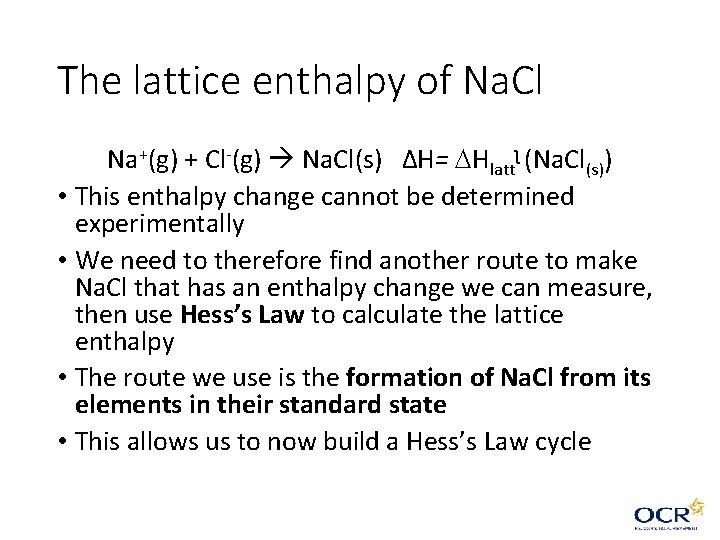
The lattice enthalpy of Na. Cl Na+(g) + Cl-(g) Na. Cl(s) ∆H= Hlattʅ (Na. Cl(s)) • This enthalpy change cannot be determined experimentally • We need to therefore find another route to make Na. Cl that has an enthalpy change we can measure, then use Hess’s Law to calculate the lattice enthalpy • The route we use is the formation of Na. Cl from its elements in their standard state • This allows us to now build a Hess’s Law cycle
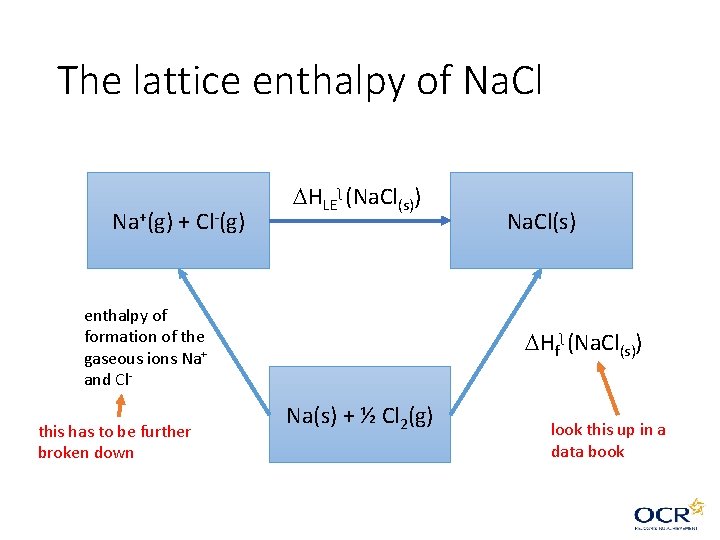
The lattice enthalpy of Na. Cl Na+(g) + Cl-(g) HLEʅ (Na. Cl(s)) enthalpy of formation of the gaseous ions Na+ and Clthis has to be further broken down Na. Cl(s) Hfʅ (Na. Cl(s)) Na(s) + ½ Cl 2(g) look this up in a data book
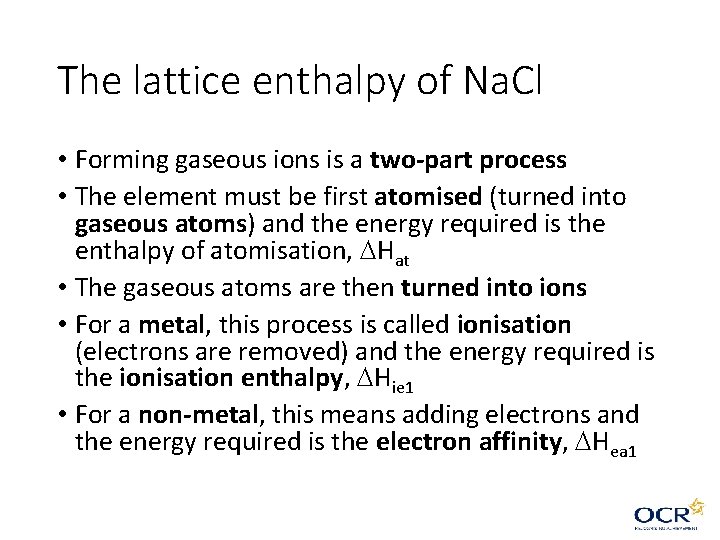
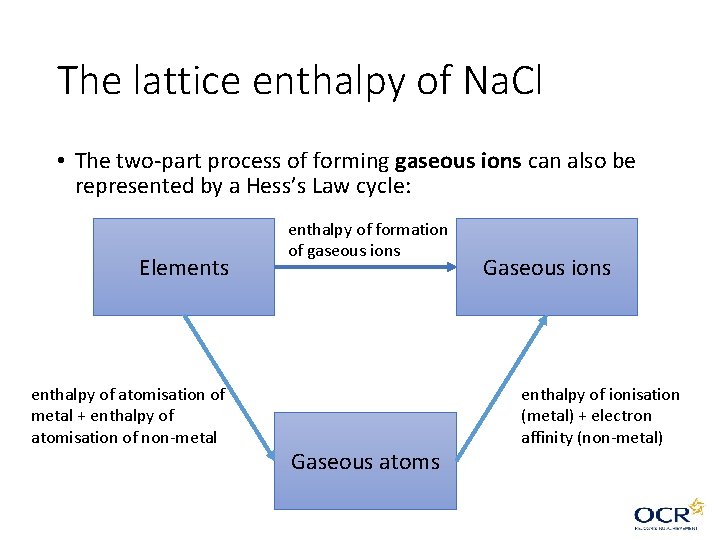
The lattice enthalpy of Na. Cl • Forming gaseous ions is a two-part process • The element must be first atomised (turned into gaseous atoms) and the energy required is the enthalpy of atomisation, Hat • The gaseous atoms are then turned into ions • For a metal, this process is called ionisation (electrons are removed) and the energy required is the ionisation enthalpy, Hie 1 • For a non-metal, this means adding electrons and the energy required is the electron affinity, Hea 1
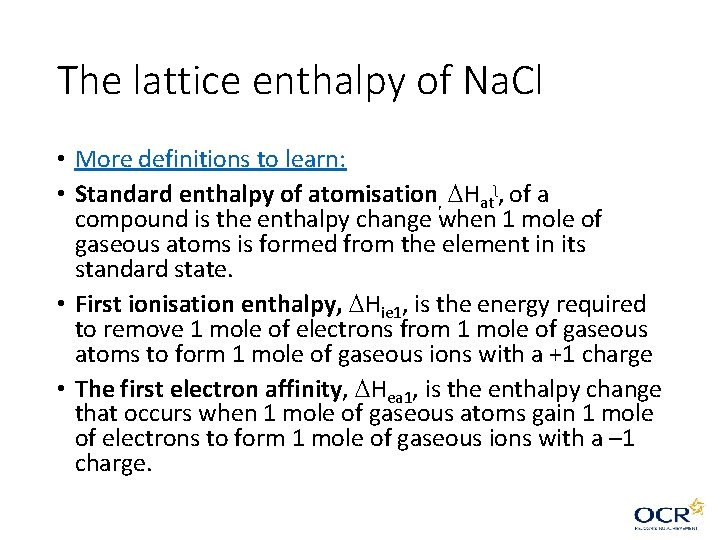
The lattice enthalpy of Na. Cl • More definitions to learn: • Standard enthalpy of atomisation, Hatʅ, of a compound is the enthalpy change when 1 mole of gaseous atoms is formed from the element in its standard state. • First ionisation enthalpy, Hie 1, is the energy required to remove 1 mole of electrons from 1 mole of gaseous atoms to form 1 mole of gaseous ions with a +1 charge • The first electron affinity, Hea 1, is the enthalpy change that occurs when 1 mole of gaseous atoms gain 1 mole of electrons to form 1 mole of gaseous ions with a – 1 charge.
The lattice enthalpy of Na. Cl Na+(g) + Cl-(g) HLEʅ (Na. Cl(s)) Hfʅ (Na+(g)) + Hfʅ (Cl- (g)) Na. Cl(s) Hfʅ (Na. Cl(s)) Na(s) + ½ Cl 2(g)
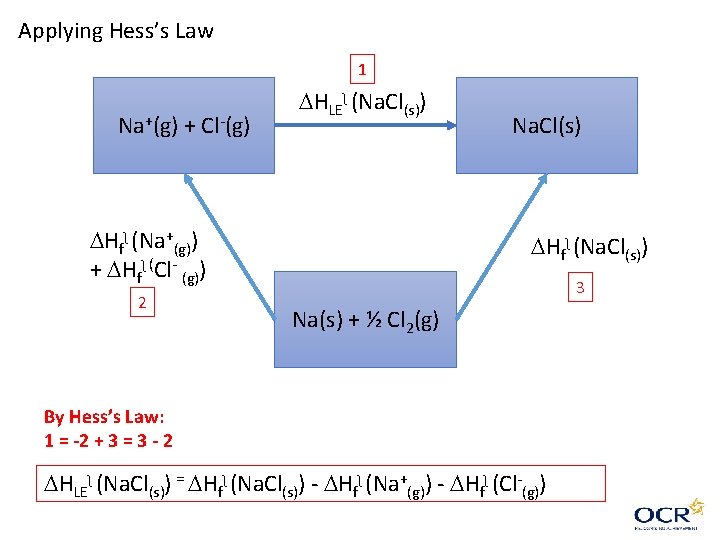
Applying Hess’s Law 1 Na+(g) + Cl-(g) HLEʅ (Na. Cl(s)) Hfʅ (Na+(g)) + Hfʅ (Cl- (g)) 2 Na. Cl(s) Hfʅ (Na. Cl(s)) 3 Na(s) + ½ Cl 2(g) By Hess’s Law: 1 = -2 + 3 = 3 - 2 HLEʅ (Na. Cl(s)) = Hfʅ (Na. Cl(s)) - Hfʅ (Na+(g)) - Hfʅ (Cl-(g))
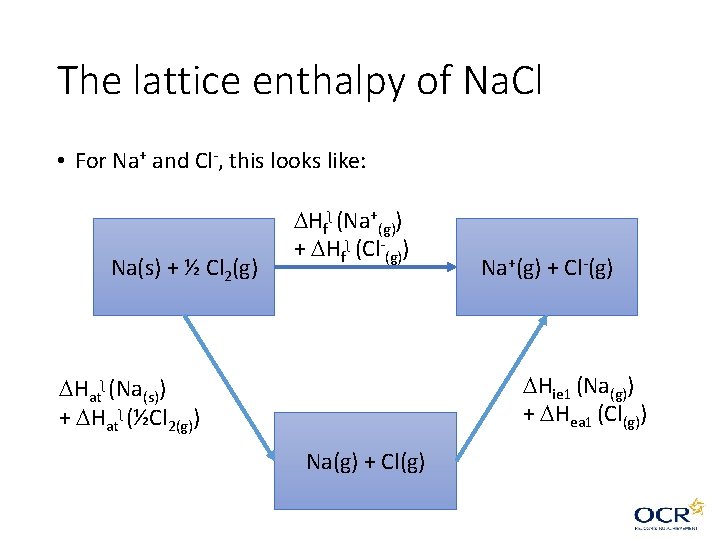
The lattice enthalpy of Na. Cl • The two-part process of forming gaseous ions can also be represented by a Hess’s Law cycle: Elements enthalpy of atomisation of metal + enthalpy of atomisation of non-metal enthalpy of formation of gaseous ions Gaseous atoms Gaseous ions enthalpy of ionisation (metal) + electron affinity (non-metal)
The lattice enthalpy of Na. Cl • For Na+ and Cl-, this looks like: Na(s) + ½ Cl 2(g) Hfʅ (Na+(g)) + Hfʅ (Cl-(g)) Na+(g) + Cl-(g) Hie 1 (Na(g)) + Hea 1 (Cl(g)) Hatʅ (Na(s)) + Hatʅ (½Cl 2(g)) Na(g) + Cl(g)
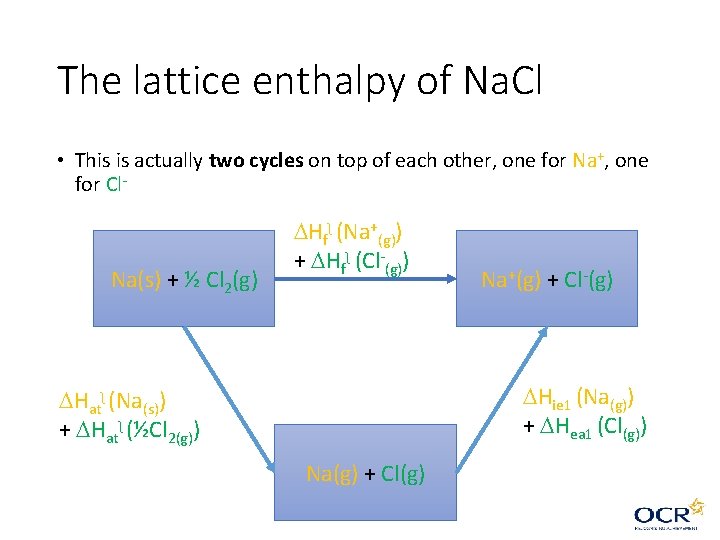
The lattice enthalpy of Na. Cl • This is actually two cycles on top of each other, one for Na+, one for Cl- Na(s) + ½ Cl 2(g) Hfʅ (Na+(g)) + Hfʅ (Cl-(g)) Na+(g) + Cl-(g) Hie 1 (Na(g)) + Hea 1 (Cl(g)) Hatʅ (Na(s)) + Hatʅ (½Cl 2(g)) Na(g) + Cl(g)
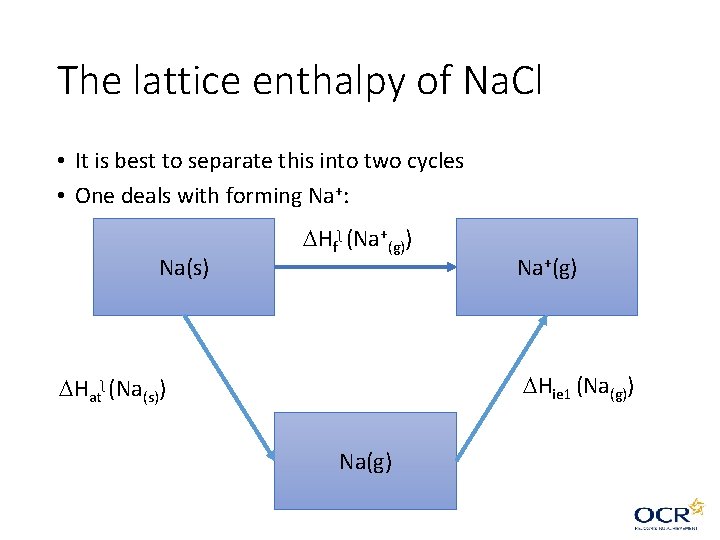
The lattice enthalpy of Na. Cl • It is best to separate this into two cycles • One deals with forming Na+: Na(s) Hfʅ (Na+(g)) Na+(g) Hie 1 (Na(g)) Hatʅ (Na(s)) Na(g)
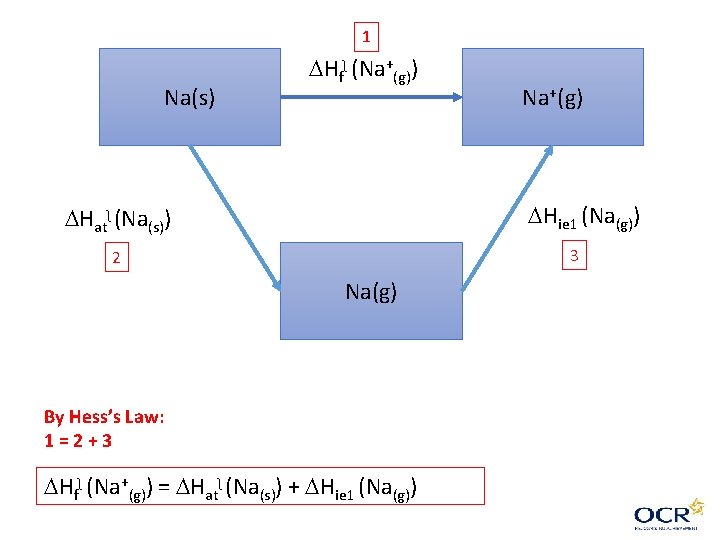
1 Na(s) Hfʅ (Na+(g)) Na+(g) Hie 1 (Na(g)) Hatʅ (Na(s)) 3 2 Na(g) By Hess’s Law: 1=2+3 Hfʅ (Na+(g)) = Hatʅ (Na(s)) + Hie 1 (Na(g))
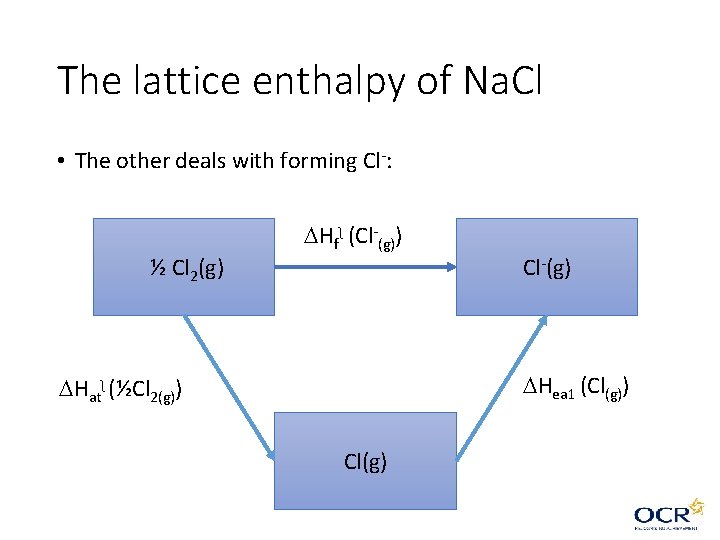
The lattice enthalpy of Na. Cl • The other deals with forming Cl-: ½ Cl 2(g) Hfʅ (Cl-(g)) Cl-(g) Hea 1 (Cl(g)) Hatʅ (½Cl 2(g)) Cl(g)
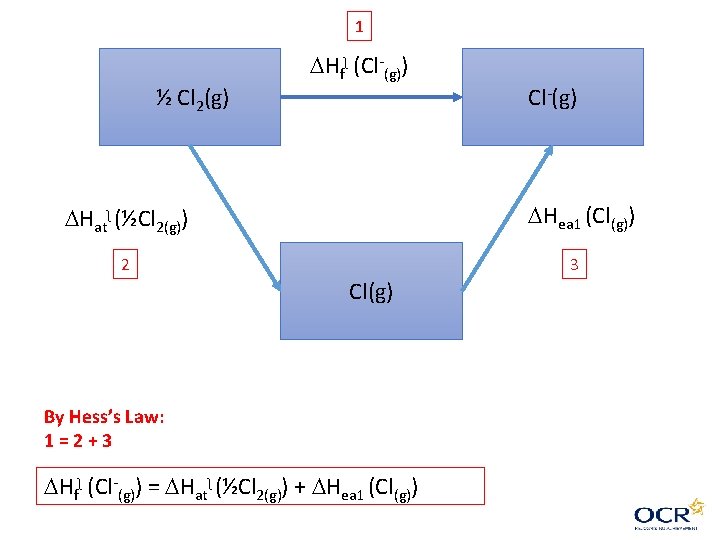
1 ½ Cl 2(g) Hfʅ (Cl-(g)) Cl-(g) Hea 1 (Cl(g)) Hatʅ (½Cl 2(g)) 2 3 Cl(g) By Hess’s Law: 1=2+3 Hfʅ (Cl-(g)) = Hatʅ (½Cl 2(g)) + Hea 1 (Cl(g))
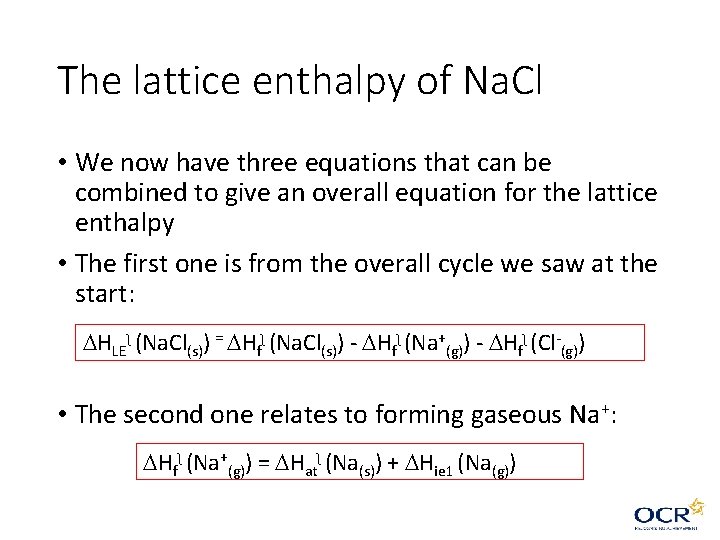
The lattice enthalpy of Na. Cl • We now have three equations that can be combined to give an overall equation for the lattice enthalpy • The first one is from the overall cycle we saw at the start: HLEʅ (Na. Cl(s)) = Hfʅ (Na. Cl(s)) - Hfʅ (Na+(g)) - Hfʅ (Cl-(g)) • The second one relates to forming gaseous Na+: Hfʅ (Na+(g)) = Hatʅ (Na(s)) + Hie 1 (Na(g))
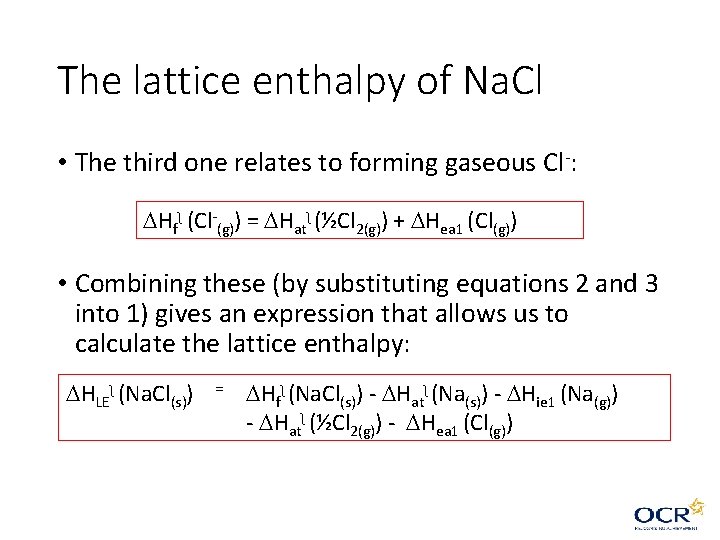
The lattice enthalpy of Na. Cl • The third one relates to forming gaseous Cl-: Hfʅ (Cl-(g)) = Hatʅ (½Cl 2(g)) + Hea 1 (Cl(g)) • Combining these (by substituting equations 2 and 3 into 1) gives an expression that allows us to calculate the lattice enthalpy: HLEʅ (Na. Cl(s)) = Hfʅ (Na. Cl(s)) - Hatʅ (Na(s)) - Hie 1 (Na(g)) - Hatʅ (½Cl 2(g)) - Hea 1 (Cl(g))
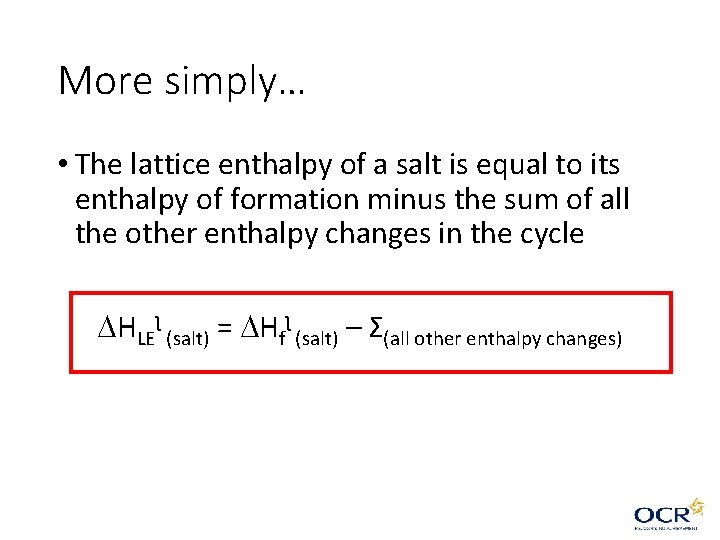
More simply… • The lattice enthalpy of a salt is equal to its enthalpy of formation minus the sum of all the other enthalpy changes in the cycle HLEʅ (salt) = Hfʅ (salt) – Σ(all other enthalpy changes)
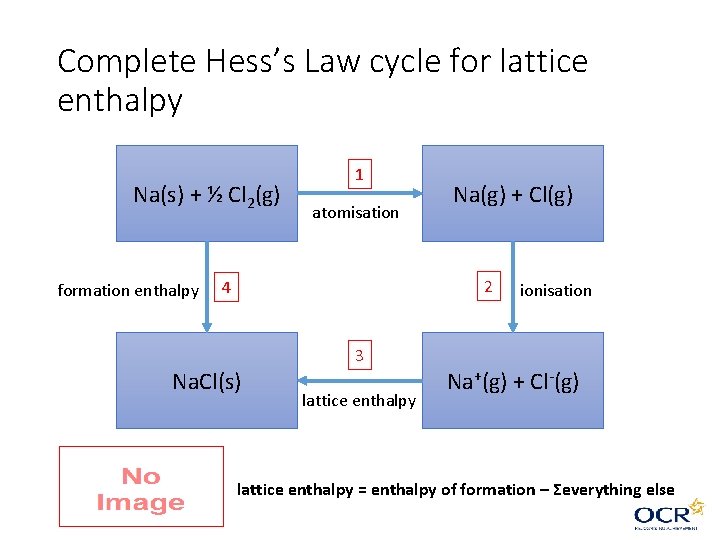
Complete Hess’s Law cycle for lattice enthalpy Na(s) + ½ Cl 2(g) formation enthalpy 1 atomisation Na(g) + Cl(g) 2 4 ionisation 3 Na. Cl(s) lattice enthalpy Na+(g) + Cl-(g) lattice enthalpy = enthalpy of formation – Σeverything else
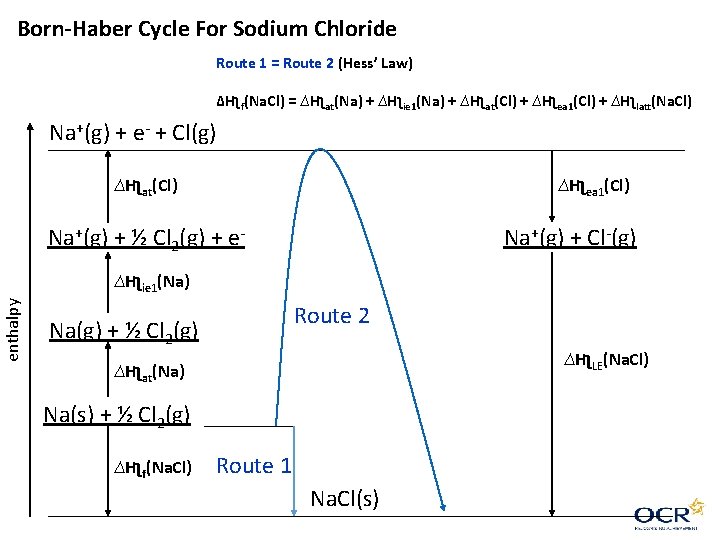
Born-Haber cycle • When the processes used to calculate lattice enthalpy are represented on an energy diagram, the result is a Born-Haber cycle • In a Born-Haber cycle, enthalpy changes have to be placed relative to each other depending on whether they are endothermic or exothermic • You need to remember some essential periodic trends to understand this
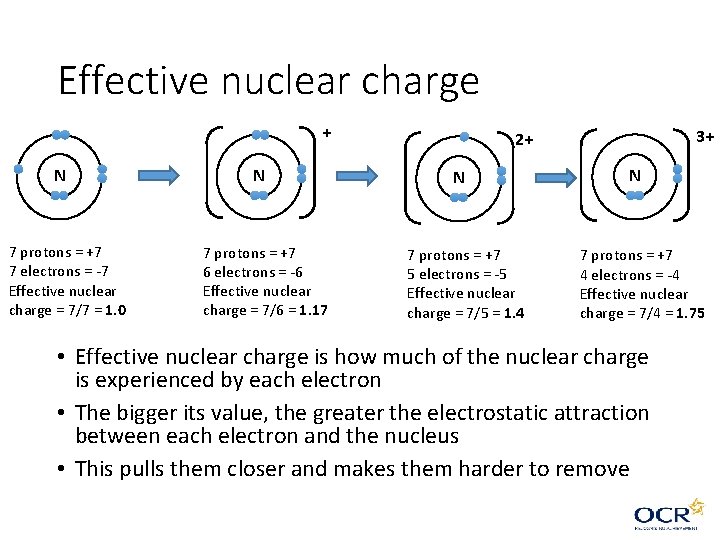
Effective nuclear charge and shielding • Two important phenomena that help to explain many periodic trends (and the reactivity of most elements) are effective nuclear charge and the shielding effect
Effective nuclear charge + N 7 protons = +7 7 electrons = -7 Effective nuclear charge = 7/7 = 1. 0 N 7 protons = +7 6 electrons = -6 Effective nuclear charge = 7/6 = 1. 17 3+ 2+ N 7 protons = +7 5 electrons = -5 Effective nuclear charge = 7/5 = 1. 4 N 7 protons = +7 4 electrons = -4 Effective nuclear charge = 7/4 = 1. 75 • Effective nuclear charge is how much of the nuclear charge is experienced by each electron • The bigger its value, the greater the electrostatic attraction between each electron and the nucleus • This pulls them closer and makes them harder to remove
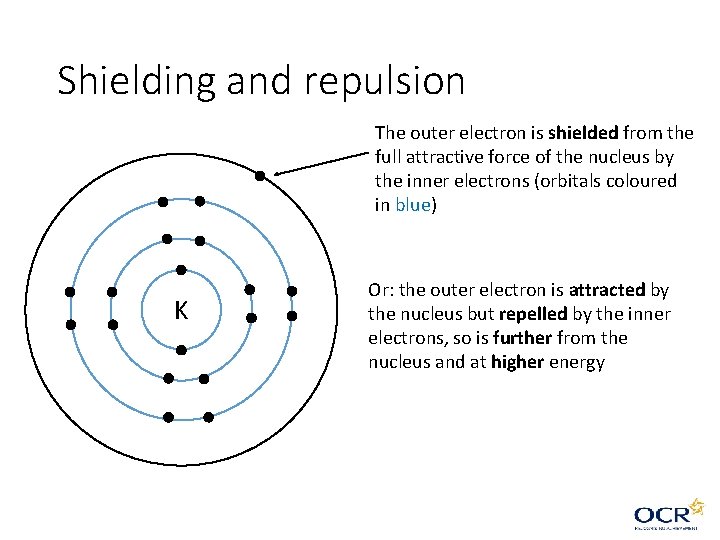
Shielding and repulsion The outer electron is shielded from the full attractive force of the nucleus by the inner electrons (orbitals coloured in blue) K Or: the outer electron is attracted by the nucleus but repelled by the inner electrons, so is further from the nucleus and at higher energy
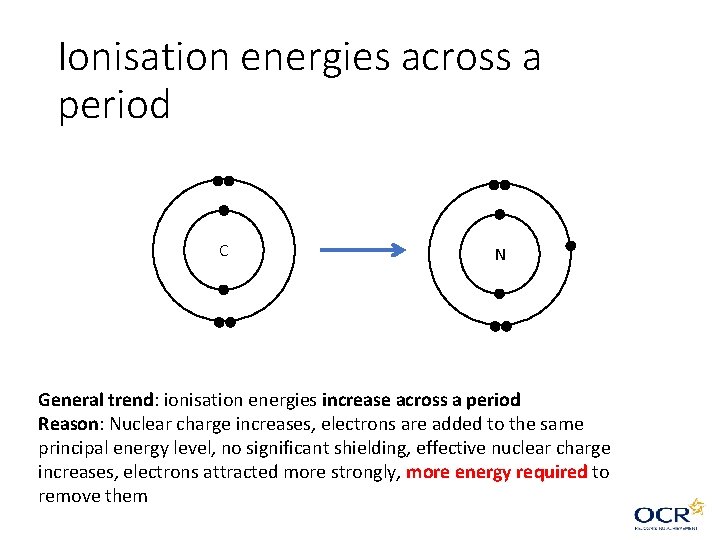
Ionisation energies across a period C N General trend: ionisation energies increase across a period Reason: Nuclear charge increases, electrons are added to the same principal energy level, no significant shielding, effective nuclear charge increases, electrons attracted more strongly, more energy required to remove them
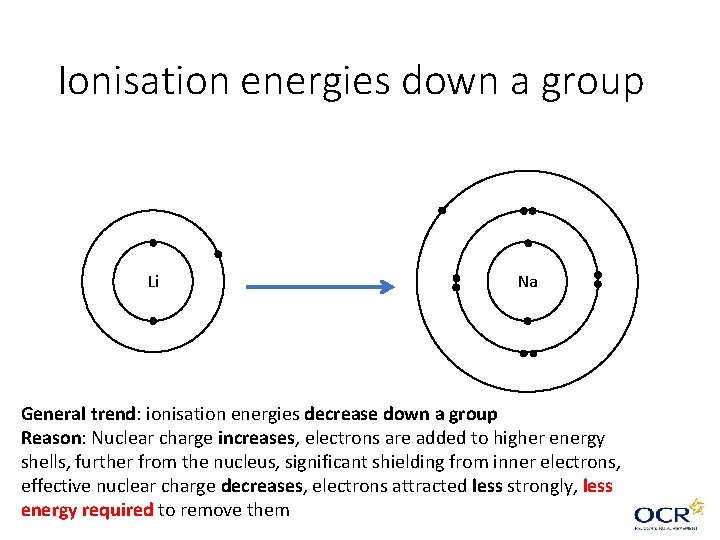
Ionisation energies down a group Li Na General trend: ionisation energies decrease down a group Reason: Nuclear charge increases, electrons are added to higher energy shells, further from the nucleus, significant shielding from inner electrons, effective nuclear charge decreases, electrons attracted less strongly, less energy required to remove them
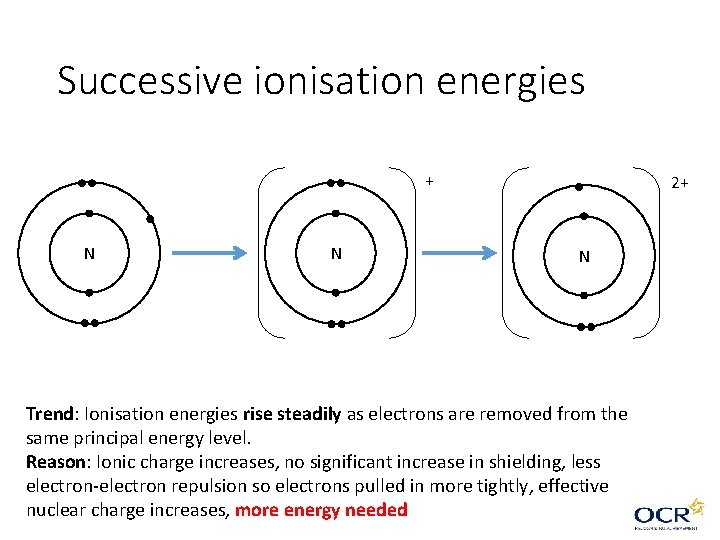
Successive ionisation energies + N N 2+ N Trend: Ionisation energies rise steadily as electrons are removed from the same principal energy level. Reason: Ionic charge increases, no significant increase in shielding, less electron-electron repulsion so electrons pulled in more tightly, effective nuclear charge increases, more energy needed
Ionisation energy trends • First ionisation enthalpy is the energy required to remove 1 mole of electrons from 1 mole of gaseous atoms to form 1 mole of gaseous ions with a +1 charge • This is always endothermic because it takes energy to do this • Second ionisation enthalpy is the energy required to remove 1 mole of electrons from one mole of gaseous 1+ ions to produces one mole of gaseous +2 ions. • This is even more endothermic because more energy is required to overcome stronger electrostatic attraction
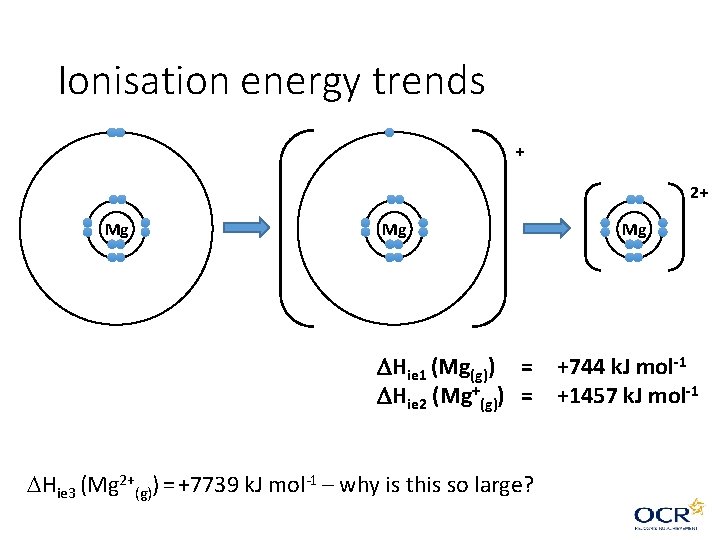
Ionisation energy trends + 2+ Mg Mg Hie 1 (Mg(g)) = Hie 2 (Mg+(g)) = Hie 3 (Mg 2+(g)) = +7739 k. J mol-1 – why is this so large? Mg +744 k. J mol-1 +1457 k. J mol-1
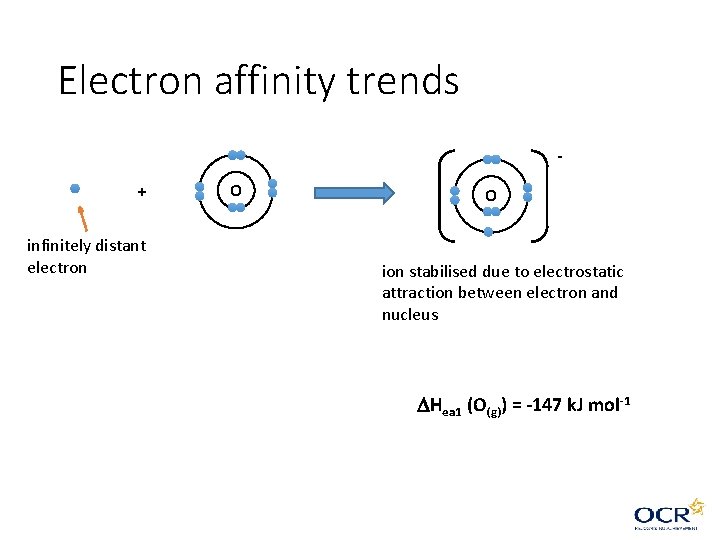
Electron affinity trends • The first electron affinity is the enthalpy change that occurs when 1 mole of gaseous atoms gain 1 mole of electrons to form 1 mole of gaseous ions with a – 1 charge • The first electron affinity is exothermic for atoms that normally form negative ions • This can be explained by considering the more precise definition of electron affinity: • The enthalpy change when one infinitely distant electron is added to each atom in one mole of gaseous atoms under standard conditions • It is a favourable process to bring an atom from far way to the outer shell of an atom, where it feels the attractive nuclear force, hence exothermic
Electron affinity trends + infinitely distant electron O O ion stabilised due to electrostatic attraction between electron and nucleus Hea 1 (O(g)) = -147 k. J mol-1
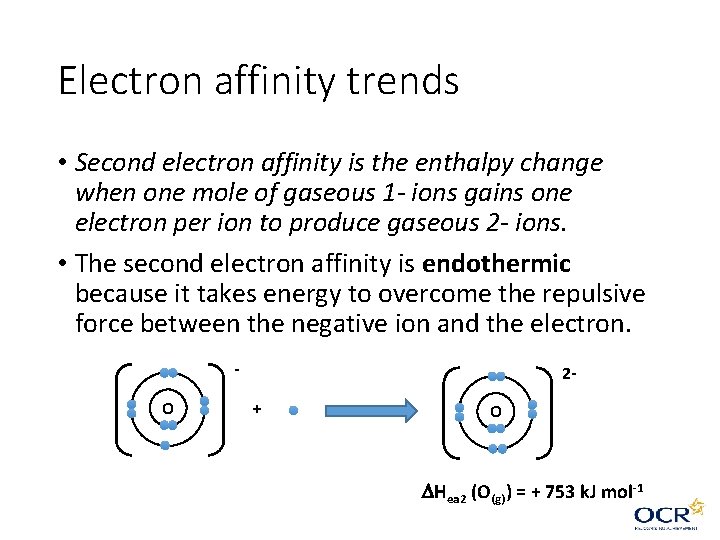
Electron affinity trends • Second electron affinity is the enthalpy change when one mole of gaseous 1 - ions gains one electron per ion to produce gaseous 2 - ions. • The second electron affinity is endothermic because it takes energy to overcome the repulsive force between the negative ion and the electron. O 2+ O Hea 2 (O(g)) = + 753 k. J mol-1
Enthalpy of atomisation • Standard enthalpy of atomisation of an element is the enthalpy change when 1 mole of gaseous atoms is formed from the element in its standard state. • It corresponds to breaking covalent bonds for molecular compounds, or disrupting metallic bonding in metals. • These processes require energy so it is always endothermic • For solid elements (metals and non-metals such as carbon), it is equivalent to the enthalpy of sublimation.
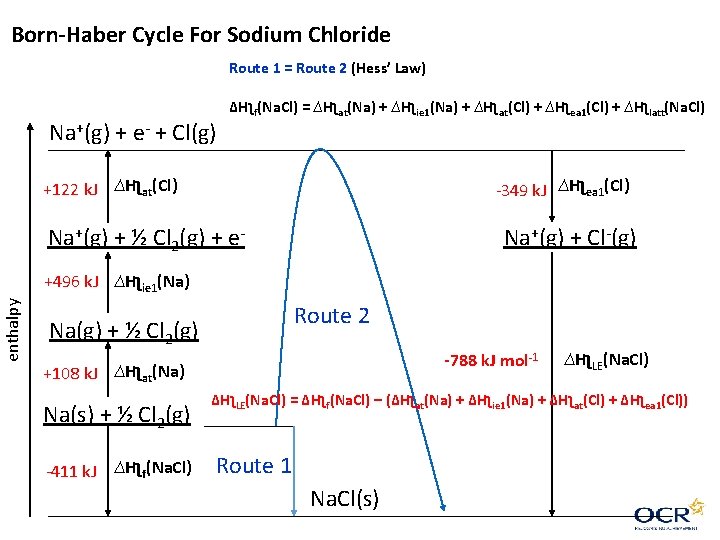
Drawing Born-Haber Cycles • First draw a vertical line to represent the y-axis, which will be the enthalpy scale • Then draw a horizontal line to represent the x-axis and put the ionic solid on this line • A line is then drawn at the top to represent the highest energy point (optional) • Next, the elements needed to form the ionic solid are placed in their standard states on a line above the ionic solid • This line corresponds to zero energy • Continue to add the other steps until you end up with gaseous ions needed to form the ionic solid
Born-Haber Cycle For Sodium Chloride Route 1 = Route 2 (Hess’ Law) ∆Hʅf(Na. Cl) = ∆Hʅat(Na) + ∆Hʅie 1(Na) + ∆Hʅat(Cl) + ∆Hʅea 1(Cl) + ∆Hʅlatt(Na. Cl) Na+(g) + e- + Cl(g) ∆Hʅat(Cl) ∆Hʅea 1(Cl) Na+(g) + ½ Cl 2(g) + e- Na+(g) + Cl-(g) enthalpy ∆Hʅie 1(Na) Route 2 Na(g) + ½ Cl 2(g) ∆HʅLE(Na. Cl) ∆Hʅat(Na) Na(s) + ½ Cl 2(g) ∆Hʅf(Na. Cl) Route 1 Na. Cl(s)
Born-Haber Cycle For Sodium Chloride Route 1 = Route 2 (Hess’ Law) Na+(g) + e- + Cl(g) ∆Hʅf(Na. Cl) = ∆Hʅat(Na) + ∆Hʅie 1(Na) + ∆Hʅat(Cl) + ∆Hʅea 1(Cl) + ∆Hʅlatt(Na. Cl) +122 k. J ∆Hʅat(Cl) -349 k. J ∆Hʅea 1(Cl) Na+(g) + ½ Cl 2(g) + e- Na+(g) + Cl-(g) enthalpy +496 k. J ∆Hʅie 1(Na) Route 2 Na(g) + ½ Cl 2(g) -788 k. J mol-1 +108 k. J ∆Hʅat(Na) Na(s) + ½ Cl 2(g) -411 k. J ∆Hʅf(Na. Cl) ∆HʅLE(Na. Cl) = ∆Hʅf(Na. Cl) – (∆Hʅat(Na) + ∆Hʅie 1(Na) + ∆Hʅat(Cl) + ∆Hʅea 1(Cl)) Route 1 Na. Cl(s)
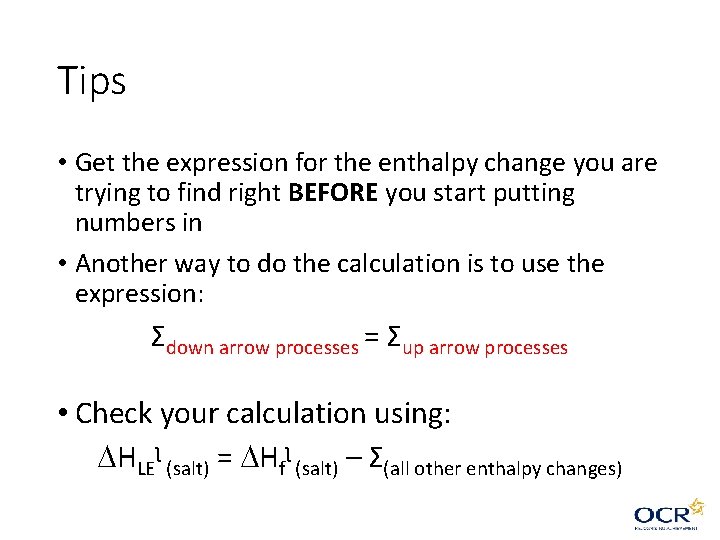
Tips • Get the expression for the enthalpy change you are trying to find right BEFORE you start putting numbers in • Another way to do the calculation is to use the expression: Σdown arrow processes = Σup arrow processes • Check your calculation using: HLEʅ (salt) = Hfʅ (salt) – Σ(all other enthalpy changes)
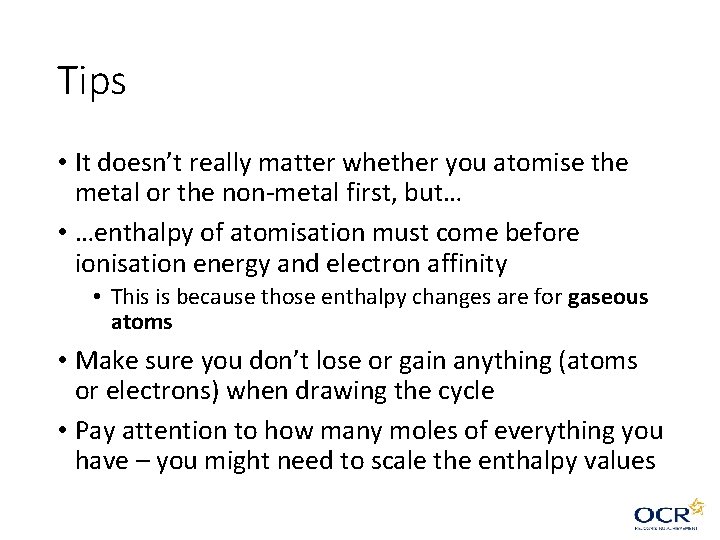
Tips • It doesn’t really matter whether you atomise the metal or the non-metal first, but… • …enthalpy of atomisation must come before ionisation energy and electron affinity • This is because those enthalpy changes are for gaseous atoms • Make sure you don’t lose or gain anything (atoms or electrons) when drawing the cycle • Pay attention to how many moles of everything you have – you might need to scale the enthalpy values
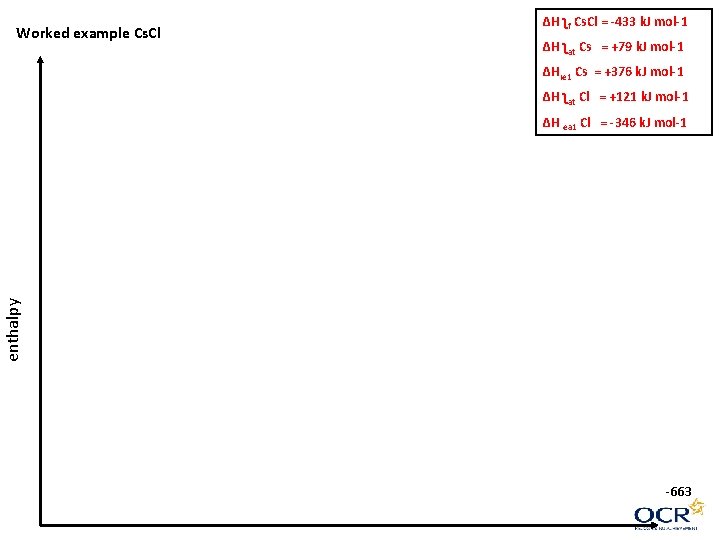
Worked example Cs. Cl ΔH ʅf Cs. Cl = -433 k. J mol-1 ΔH ʅat Cs = +79 k. J mol-1 ΔHie 1 Cs = +376 k. J mol-1 ΔH ʅat Cl = +121 k. J mol-1 enthalpy ΔH ea 1 Cl = -346 k. J mol-1 -663
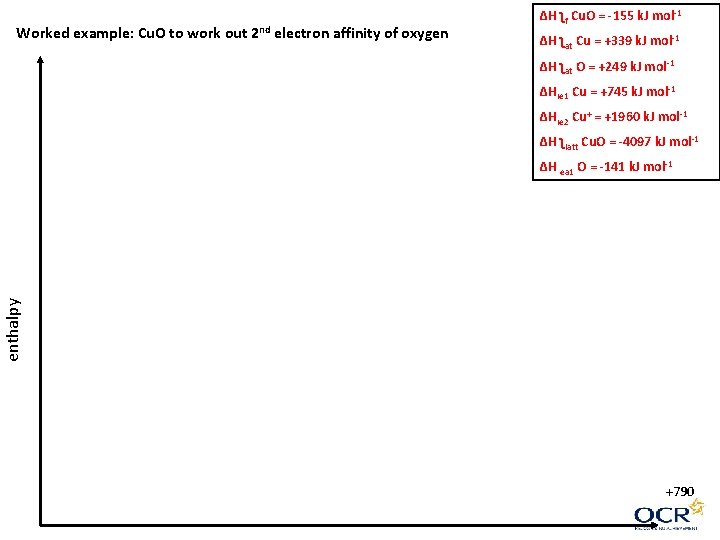
Worked example: Cu. O to work out 2 nd electron affinity of oxygen ΔH ʅf Cu. O = -155 k. J mol-1 ΔH ʅat Cu = +339 k. J mol-1 ΔH ʅat O = +249 k. J mol-1 ΔHie 1 Cu = +745 k. J mol-1 ΔHie 2 Cu+ = +1960 k. J mol-1 ΔH ʅlatt Cu. O = -4097 k. J mol-1 enthalpy ΔH ea 1 O = -141 k. J mol-1 +790
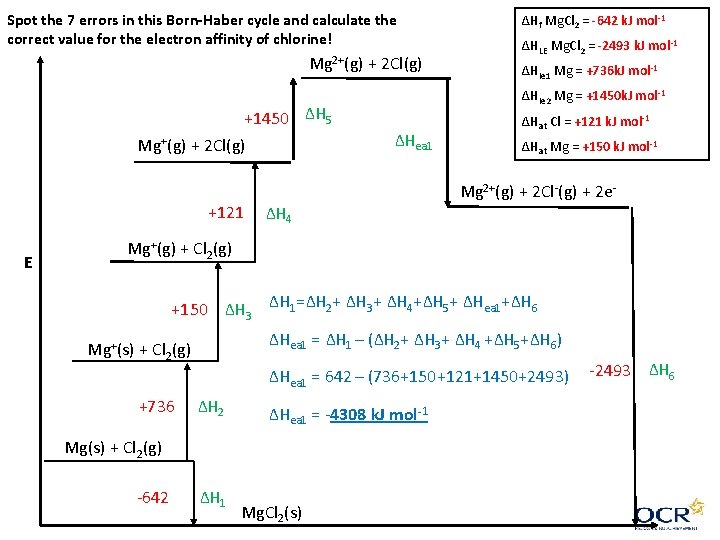
Spot the 7 errors in this Born-Haber cycle and calculate the correct value for the electron affinity of chlorine! Mg 2+(g) + 2 Cl(g) +121 E ∆HLE Mg. Cl 2 = -2493 k. J mol-1 ∆Hie 1 Mg = +736 k. J mol-1 ∆Hie 2 Mg = +1450 k. J mol-1 +1450 ∆H 5 ∆Hea 1 Mg+(g) + 2 Cl(g) ∆Hf Mg. Cl 2 = -642 k. J mol-1 ∆H 4 ∆Hat Cl = +121 k. J mol-1 ∆Hat Mg = +150 k. J mol-1 Mg 2+(g) + 2 Cl-(g) + 2 e- Mg+(g) + Cl 2(g) +150 ∆H 3 ∆H 1=∆H 2+ ∆H 3+ ∆H 4+∆H 5+ ∆Hea 1+∆H 6 ∆Hea 1 = ∆H 1 – (∆H 2+ ∆H 3+ ∆H 4 +∆H 5+∆H 6) Mg+(s) + Cl 2(g) ∆Hea 1 = 642 – (736+150+121+1450+2493) +736 ∆H 2 ∆Hea 1 = -4308 k. J mol-1 Mg(s) + Cl 2(g) -642 ∆H 1 Mg. Cl 2(s) -2493 ∆H 6
Factors affecting the lattice enthalpy
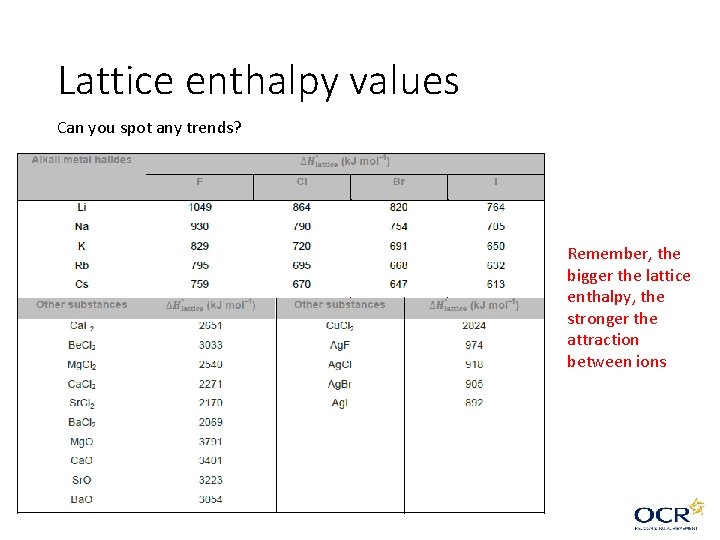
Lattice enthalpy values Can you spot any trends? Remember, the bigger the lattice enthalpy, the stronger the attraction between ions
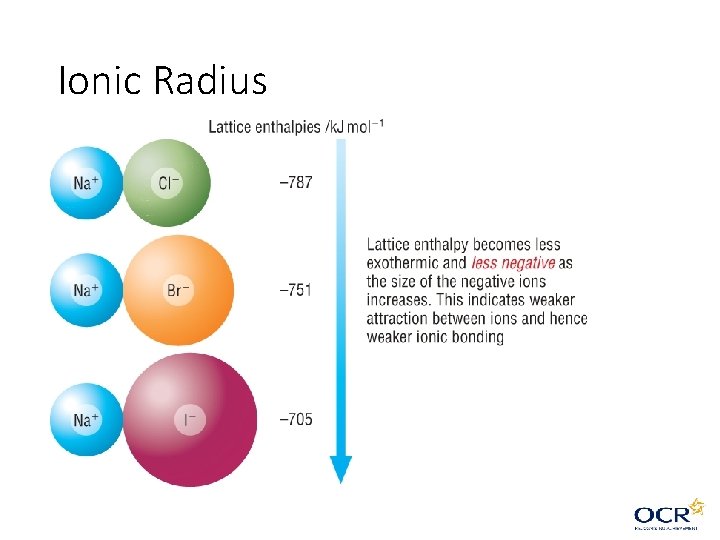
Ionic Radius
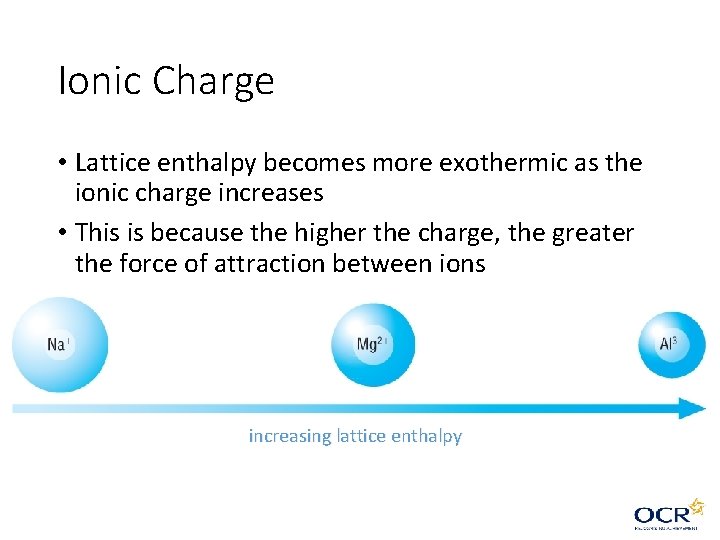
Ionic Charge • Lattice enthalpy becomes more exothermic as the ionic charge increases • This is because the higher the charge, the greater the force of attraction between ions increasing lattice enthalpy
Key points so far • The bigger the lattice enthalpy, the stronger the electrostatic force of attraction between ions and the more stable the compound • The higher the charge on the ions, the more they will attract each other and the bigger the lattice enthalpy • The larger the ionic radius, the smaller the lattice enthalpy (because there is greater distance and hence less attraction between the centres of the ions)
Dissolving ionic solids
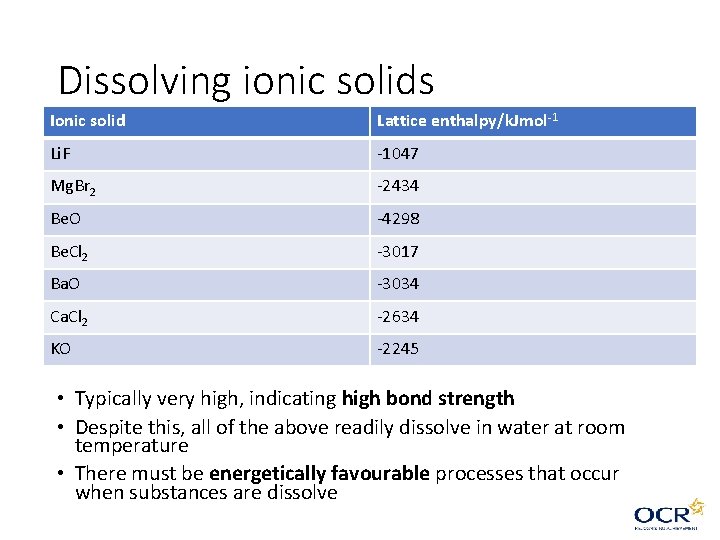
Dissolving ionic solids Ionic solid Lattice enthalpy/k. Jmol-1 Li. F -1047 Mg. Br 2 -2434 Be. O -4298 Be. Cl 2 -3017 Ba. O -3034 Ca. Cl 2 -2634 KO -2245 • Typically very high, indicating high bond strength • Despite this, all of the above readily dissolve in water at room temperature • There must be energetically favourable processes that occur when substances are dissolve
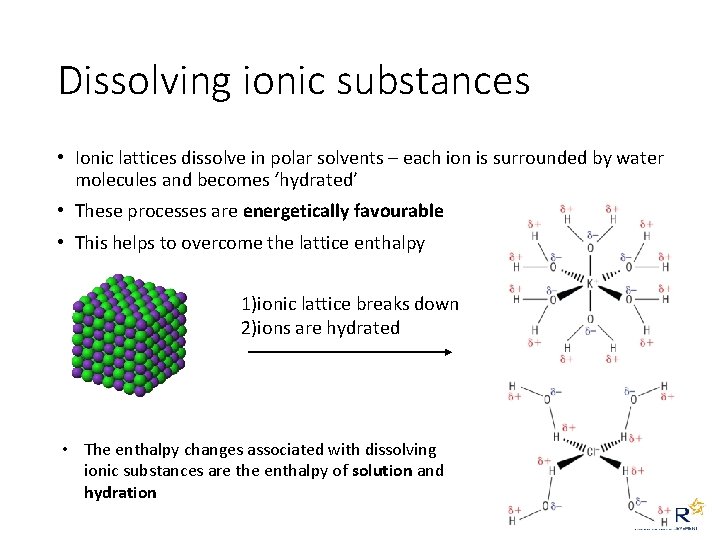
Dissolving ionic substances • Ionic lattices dissolve in polar solvents – each ion is surrounded by water molecules and becomes ‘hydrated’ • These processes are energetically favourable • This helps to overcome the lattice enthalpy 1)ionic lattice breaks down 2)ions are hydrated • The enthalpy changes associated with dissolving ionic substances are the enthalpy of solution and hydration
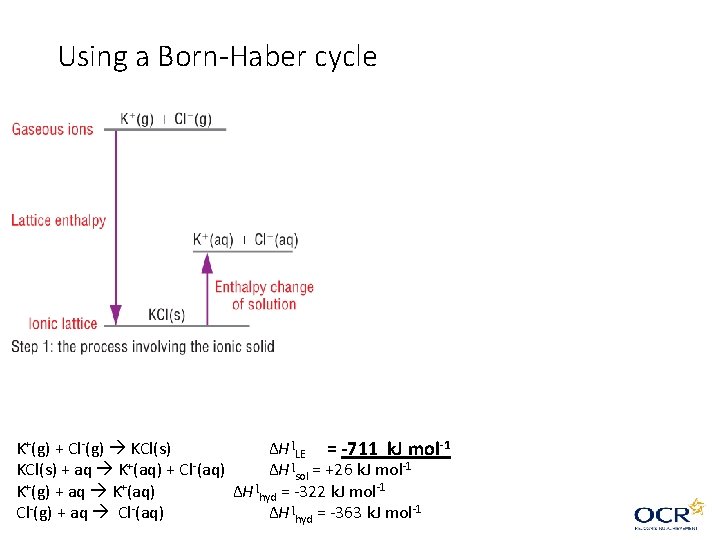
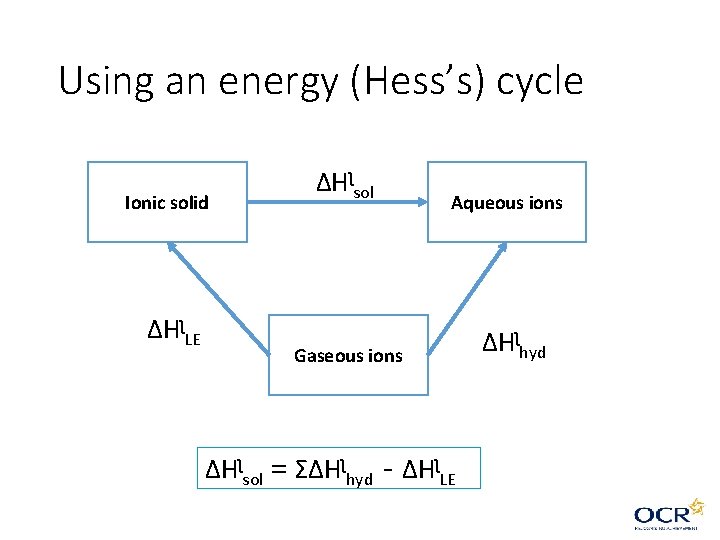
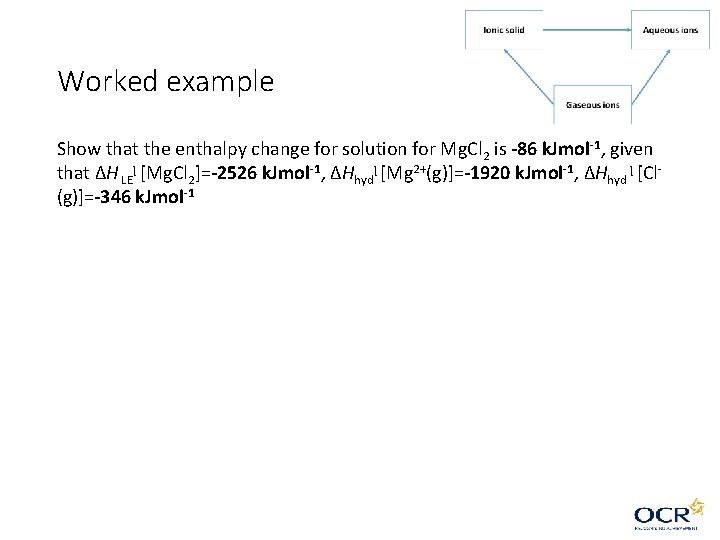
Dissolving ionic substances • Enthalpy of solution, hydration and the lattice enthalpy can be related using a Born-Haber cycle or a standard Hess’s cycle • These cycles enable any of the three enthalpy changes to be calculated from the other two values (using Hess’s law again) • Two more definitions
Using a Born-Haber cycle K+(g) + Cl-(g) KCl(s) ΔH ʅLE = -711 k. J mol-1 KCl(s) + aq K+(aq) + Cl-(aq) ΔH ʅsol = +26 k. J mol-1 K+(g) + aq K+(aq) ΔH ʅhyd = -322 k. J mol-1 Cl-(g) + aq Cl-(aq) ΔH ʅhyd = -363 k. J mol-1
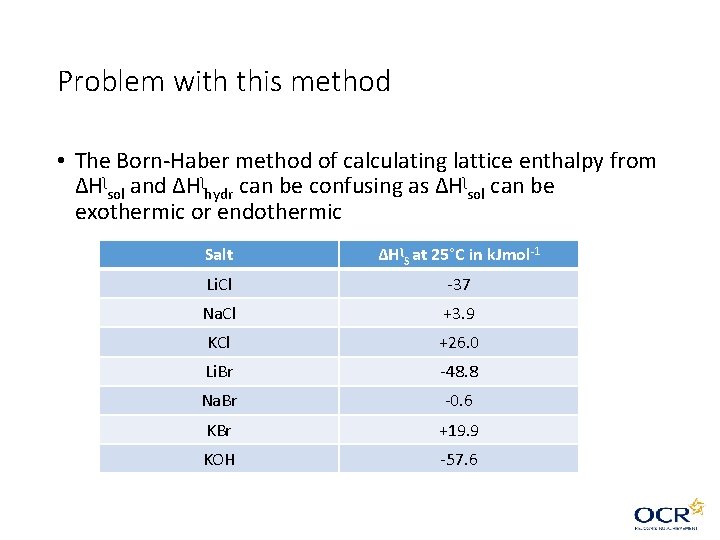
Problem with this method • The Born-Haber method of calculating lattice enthalpy from ΔHʅsol and ΔHʅhydr can be confusing as ΔHʅsol can be exothermic or endothermic Salt ΔHʅS at 25°C in k. Jmol-1 Li. Cl -37 Na. Cl +3. 9 KCl +26. 0 Li. Br -48. 8 Na. Br -0. 6 KBr +19. 9 KOH -57. 6
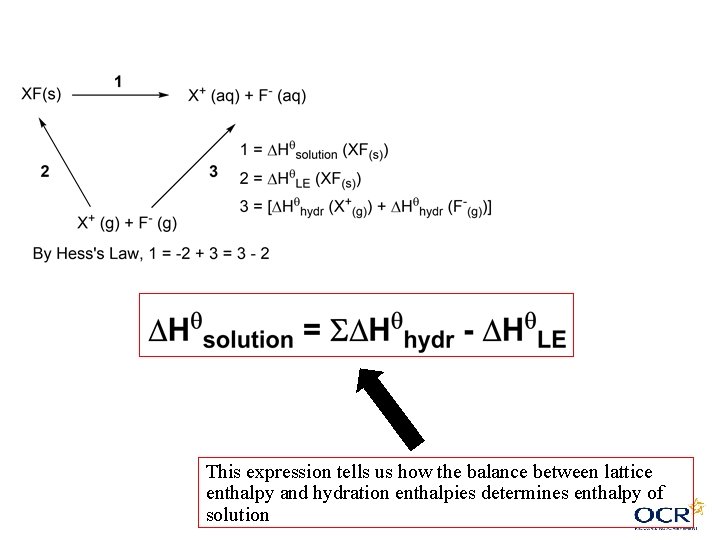
Using an energy (Hess’s) cycle Ionic solid ΔHʅLE ΔHʅsol Aqueous ions Gaseous ions ΔHʅsol = ΣΔHʅhyd - ΔHʅLE ΔHʅhyd
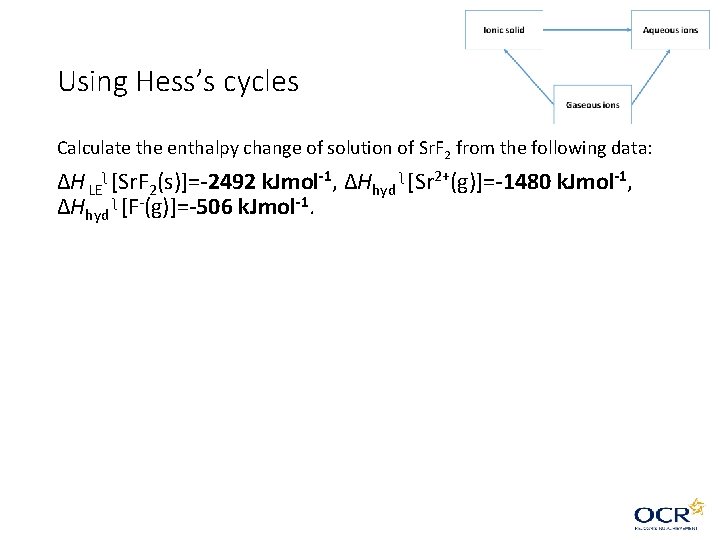
Using Hess’s cycles Calculate the enthalpy change of solution of Sr. F 2 from the following data: ΔH LEʅ [Sr. F 2(s)]=-2492 k. Jmol-1, ΔHhyd ʅ [Sr 2+(g)]=-1480 k. Jmol-1, ΔHhyd ʅ [F-(g)]=-506 k. Jmol-1.
Worked example Show that the enthalpy change for solution for Mg. Cl 2 is -86 k. Jmol-1, given that ΔH LEʅ [Mg. Cl 2]=-2526 k. Jmol-1, ΔHhydʅ [Mg 2+(g)]=-1920 k. Jmol-1, ΔHhyd ʅ [Cl(g)]=-346 k. Jmol-1
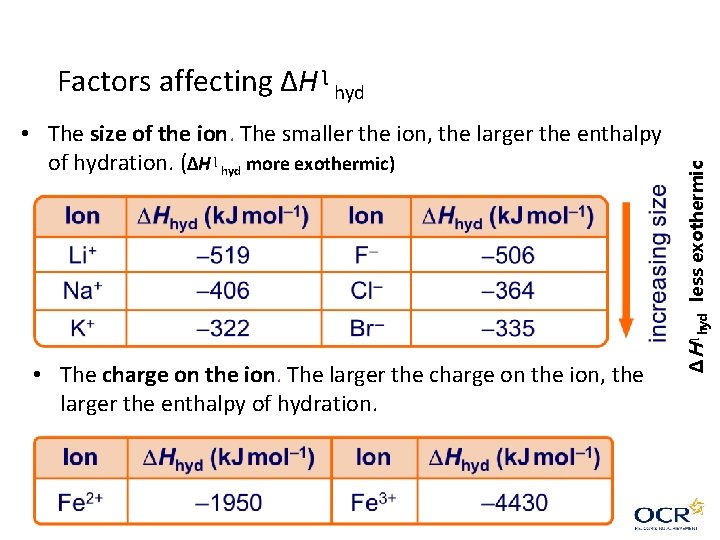
• The size of the ion. The smaller the ion, the larger the enthalpy of hydration. (ΔH ʅ hyd more exothermic) • The charge on the ion. The larger the charge on the ion, the larger the enthalpy of hydration. ΔH ʅ hyd less exothermic Factors affecting ΔH ʅ hyd
The charge density concept • The values for melting points and lattice enthalpies of ionic solids depends on • The charges on the ionic species • Their ionic radii • It is helpful to know the concept of charge density
Charge density is greater for: • ions with a higher charge (e. g. Mg 2+ > Li+) • ions with a smaller ionic radius (because they have a smaller volume) Ions with greater charger density have: • higher melting points (because more energy is required to overcome the electrostatic forces of attraction) • more exothermic lattice enthalpies • more exothermic hydration enthalpies due to having strong attraction for, and more stable bonds with, water molecules
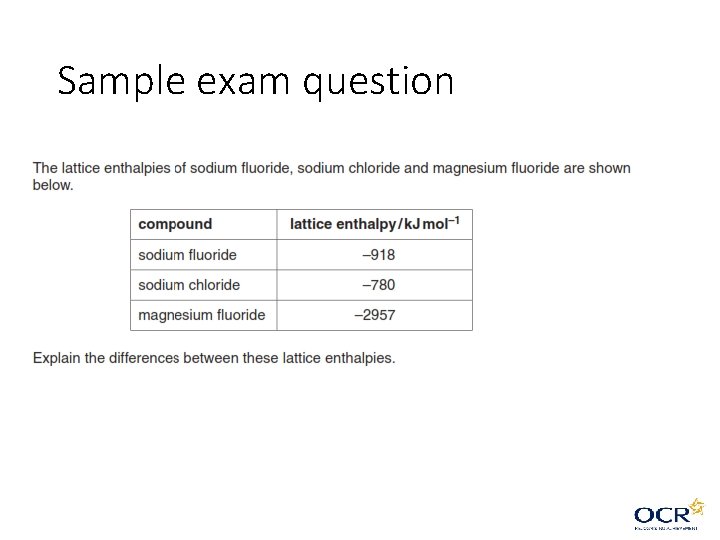
Sample exam question
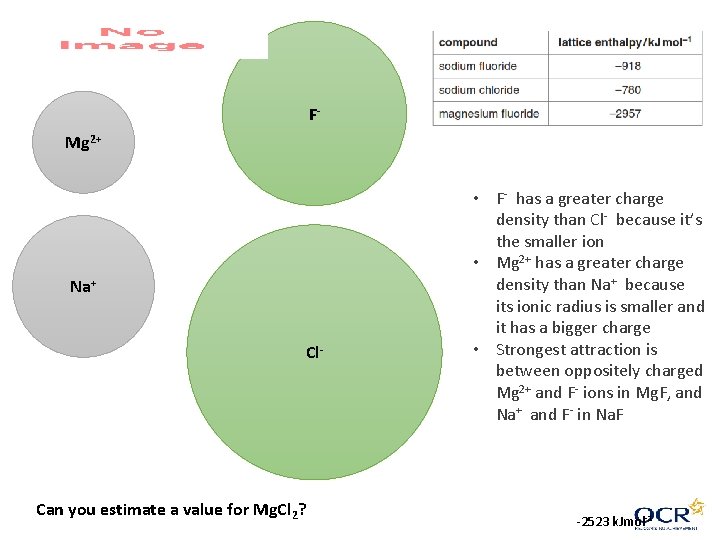
FMg 2+ Na+ Cl- Can you estimate a value for Mg. Cl 2? • F- has a greater charge density than Cl- because it’s the smaller ion • Mg 2+ has a greater charge density than Na+ because its ionic radius is smaller and it has a bigger charge • Strongest attraction is between oppositely charged Mg 2+ and F- ions in Mg. F, and Na+ and F- in Na. F -2523 k. Jmol-1
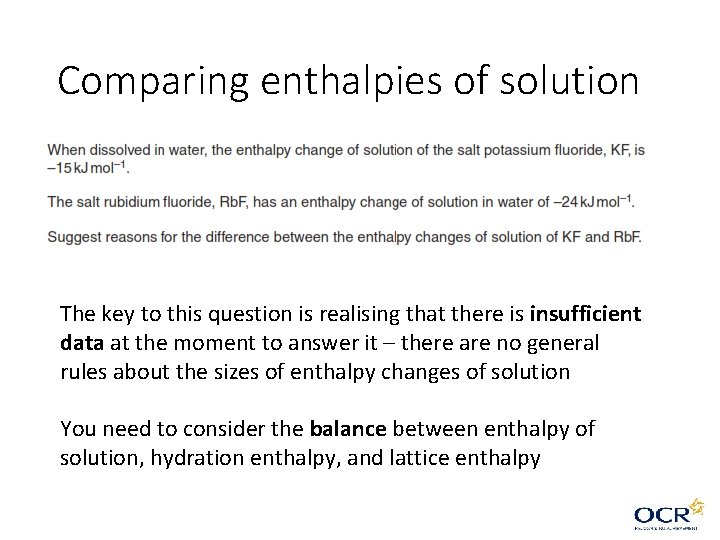
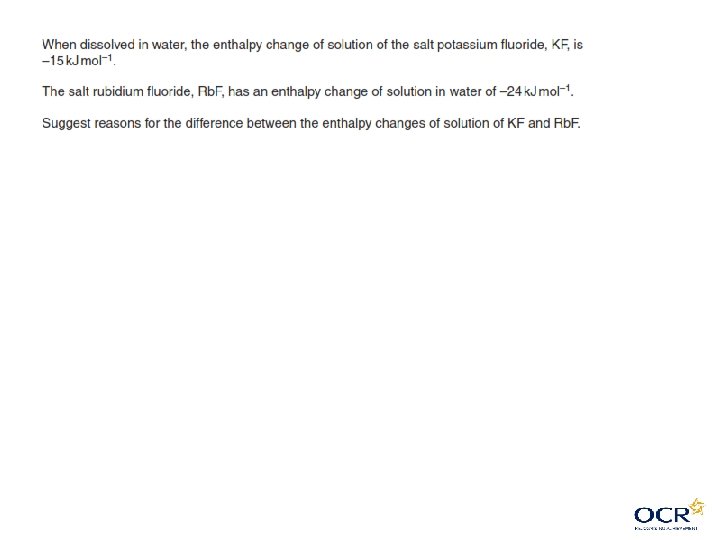
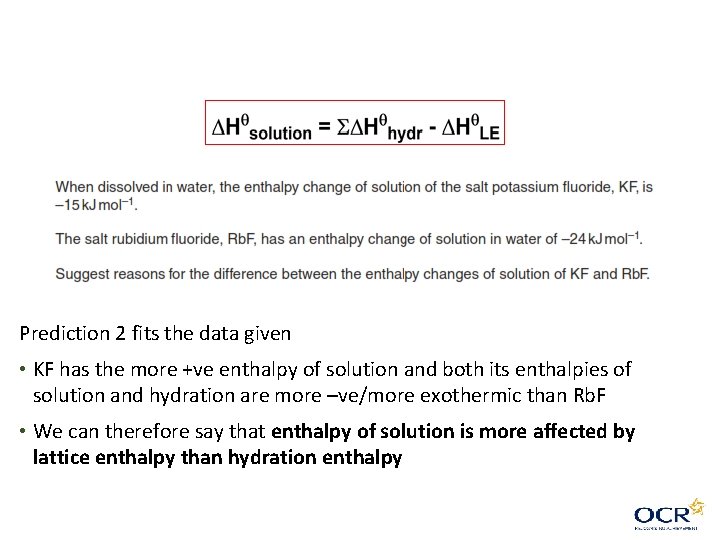
Comparing enthalpies of solution • Tricky question from 2011 The key to this question is realising that there is insufficient data at the moment to answer it – there are no general rules about the sizes of enthalpy changes of solution You need to consider the balance between enthalpy of solution, hydration enthalpy, and lattice enthalpy
This expression tells us how the balance between lattice enthalpy and hydration enthalpies determines enthalpy of solution
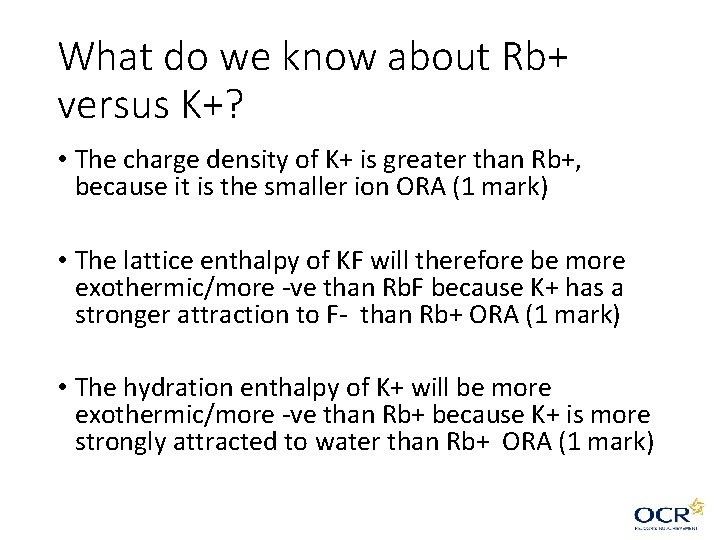
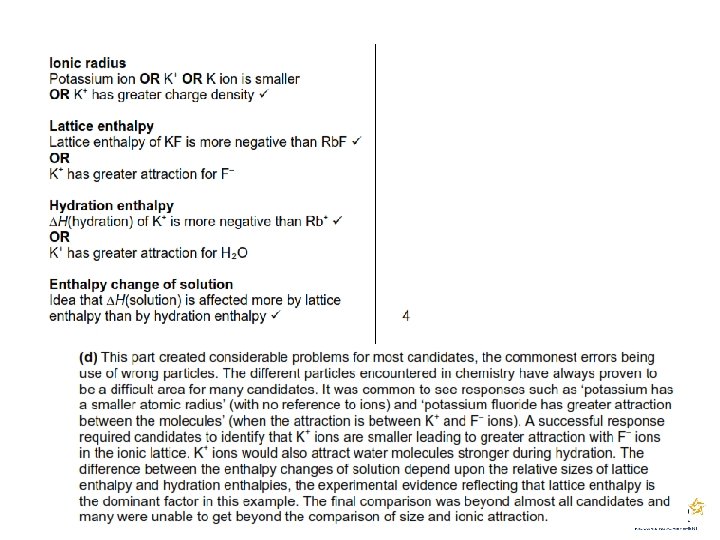
What do we know about Rb+ versus K+? • The charge density of K+ is greater than Rb+, because it is the smaller ion ORA (1 mark) • The lattice enthalpy of KF will therefore be more exothermic/more -ve than Rb. F because K+ has a stronger attraction to F- than Rb+ ORA (1 mark) • The hydration enthalpy of K+ will be more exothermic/more -ve than Rb+ because K+ is more strongly attracted to water than Rb+ ORA (1 mark)
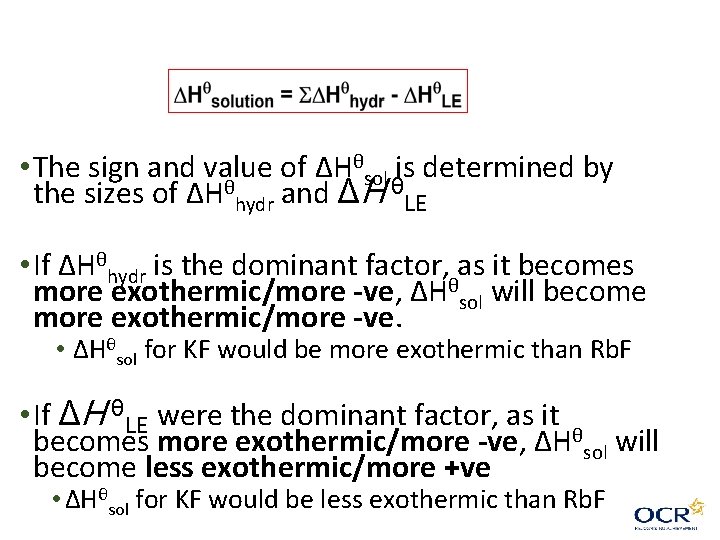
• The sign and value of ΔHθsol is determined by the sizes of ΔHθhydr and ΔH θLE • If ΔHθhydr is the dominant factor, as it becomes more exothermic/more -ve, ΔHθsol will become more exothermic/more -ve. • ΔHθsol for KF would be more exothermic than Rb. F • If ΔH θLE were the dominant factor, as it becomes more exothermic/more -ve, ΔHθsol will become less exothermic/more +ve • ΔHθsol for KF would be less exothermic than Rb. F
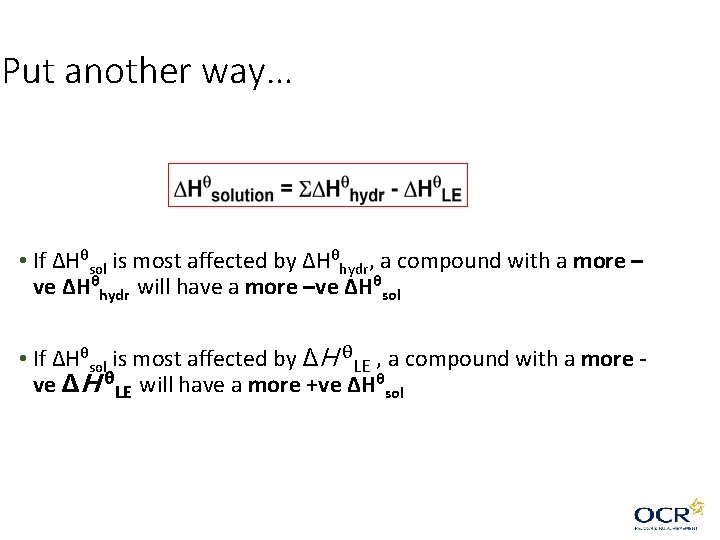
Put another way… • If ΔHθsol is most affected by ΔHθhydr, a compound with a more – ve ΔHθhydr will have a more –ve ΔHθsol • If ΔHθsol is most affected by ΔH θLE , a compound with a more ve ΔH θLE will have a more +ve ΔHθsol
Prediction 2 fits the data given • KF has the more +ve enthalpy of solution and both its enthalpies of solution and hydration are more –ve/more exothermic than Rb. F • We can therefore say that enthalpy of solution is more affected by lattice enthalpy than hydration enthalpy
ΔH LEθ : Experimental versus Theoretical • Born-Haber gives experimental values – lattice enthalpy is calculated using other enthalpy values that have been measured • Lattice enthalpy can also be calculated - theoretical values are obtained by treating the ions as point charges that come together to form a lattice • For Na. Cl, experimental and theoretical values for ΔH LE θ agree to within 1%
ΔH LEθ : Experimental versus Theoretical • However, for Ag. Cl, the experimental values are larger (more negative) than theoretical values • This is because Ag. Cl has significant covalent bonding – the difference in electronegativity between Ag and Cl is not enough for complete transfer of an electron from the Ag to Cl. • Differences between experimental and theoretical ΔH LEθ are also due to purity for ionic solids (impurities lead to lower values)
Self-test questions 1. Describe and explain the effect of ionic radius and ionic charge on the size of LE 2. The LE of Na. Cl is more exothermic than the lattice enthalpy of Cs. Cl. State and explain the relative strengths of ionic bonding of these 2 chlorides. 3. Describe how, and explain why, the enthalpy change of hydration of Na+ differs from that of Rb+ 4. The lattice enthalpies of Be. O and Mg. Cl 2 are 4, 298 and -3, 800 k. J mol-1 respectively. Their solubilities in water are 0. 00003 g/100 g and 55 g/100 g respectively. Explain the relative solubilities.