
Application example Photo OCR Problem description and pipeline
Application example: Photo OCR Problem description and pipeline Machine Learning
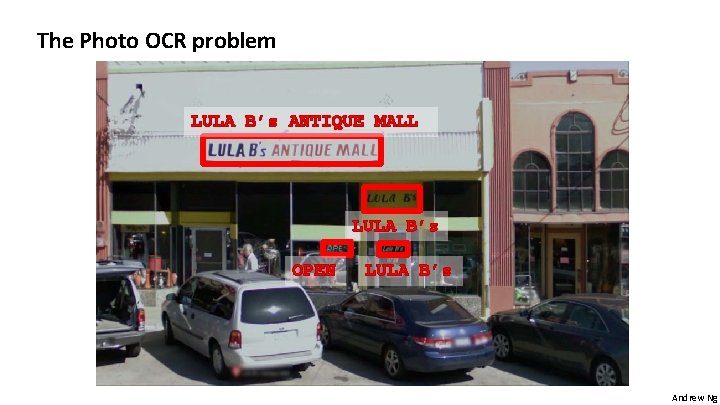
The Photo OCR problem LULA B’s ANTIQUE MALL LULA B’s OPEN LULA B’s Andrew Ng
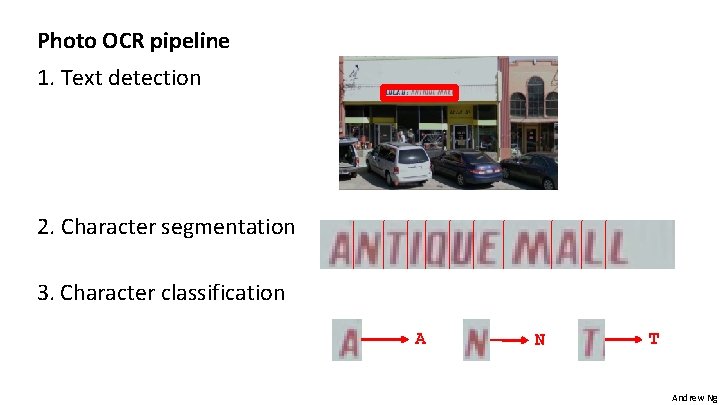
Photo OCR pipeline 1. Text detection 2. Character segmentation 3. Character classification A N T Andrew Ng
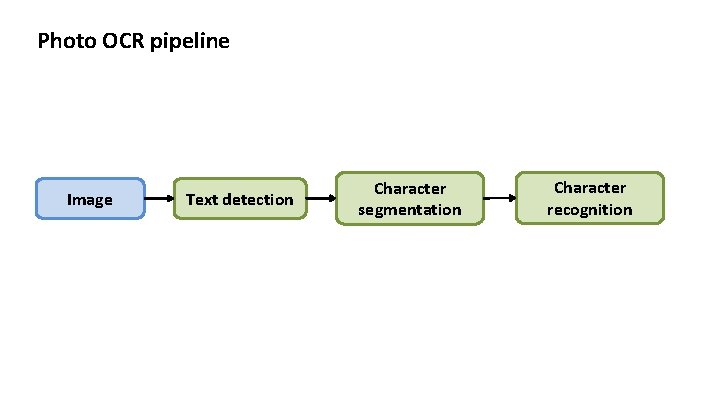
Photo OCR pipeline Image Text detection Character segmentation Character recognition
Application example: Photo OCR Sliding windows Machine Learning

Text detection Pedestrian detection Andrew Ng
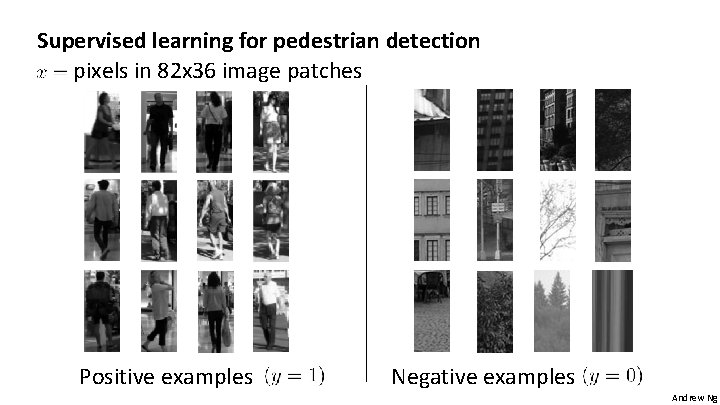
Supervised learning for pedestrian detection pixels in 82 x 36 image patches Positive examples Negative examples Andrew Ng
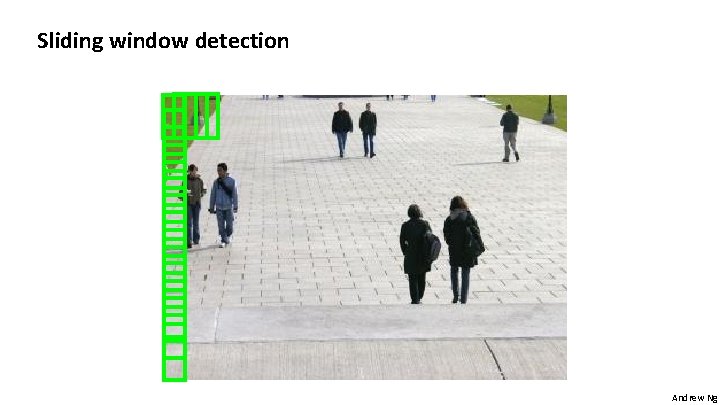
Sliding window detection Andrew Ng
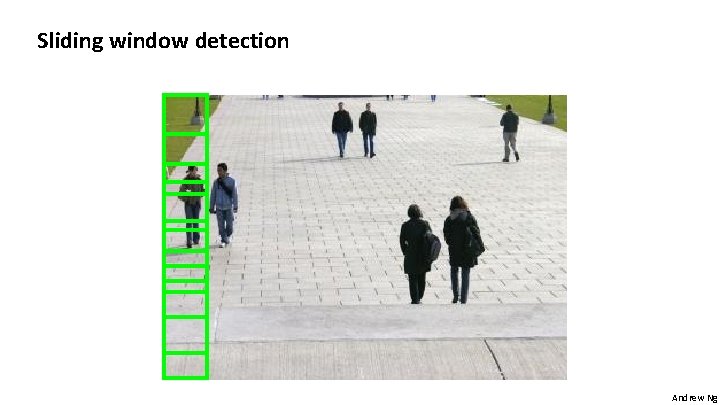
Sliding window detection Andrew Ng
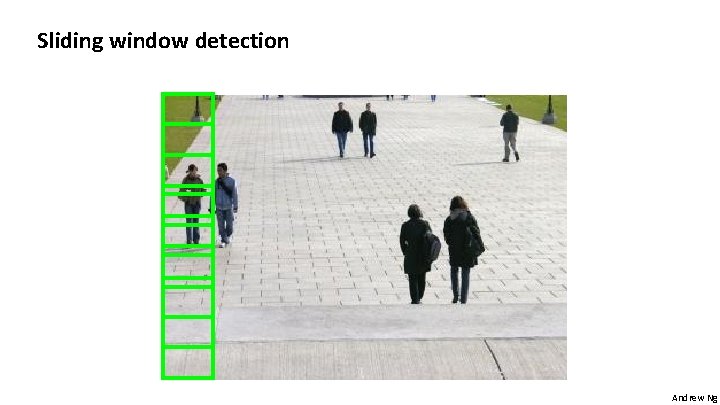
Sliding window detection Andrew Ng
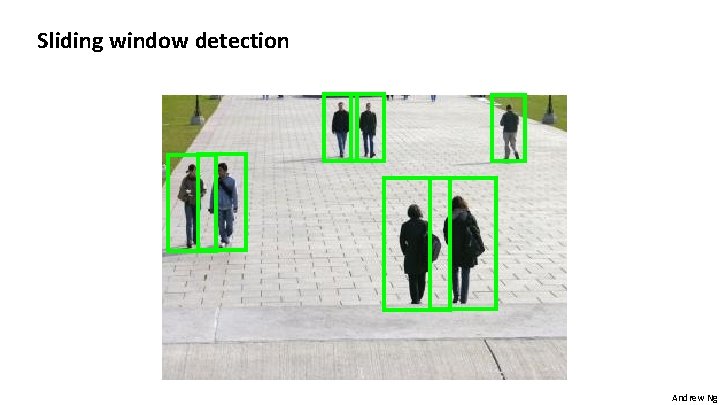
Sliding window detection Andrew Ng
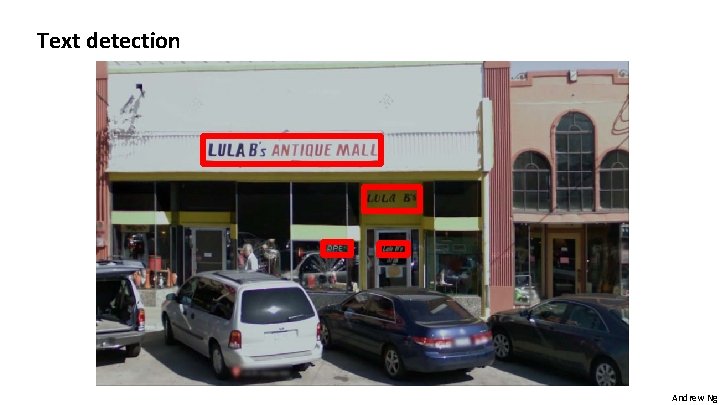
Text detection Andrew Ng
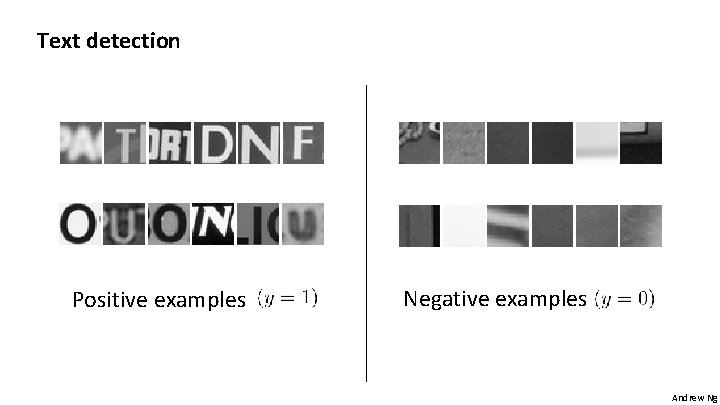
Text detection Positive examples Negative examples Andrew Ng
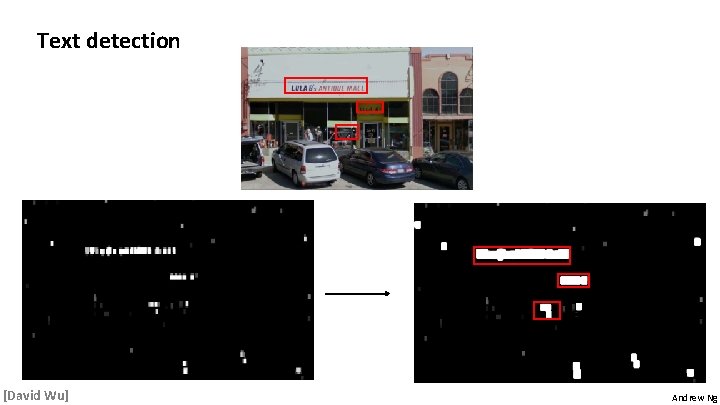
Text detection [David Wu] Andrew Ng
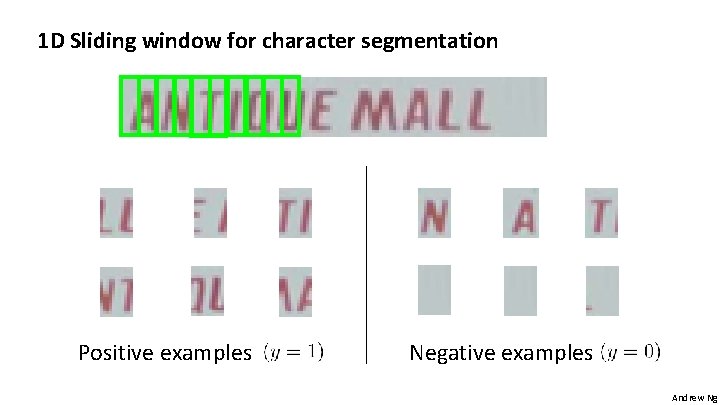
1 D Sliding window for character segmentation Positive examples Negative examples Andrew Ng
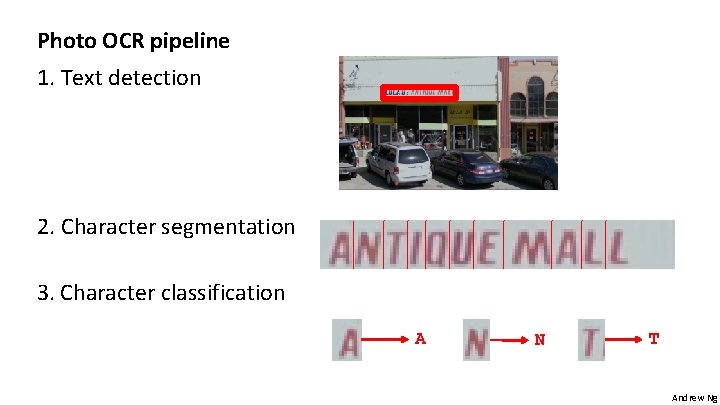
Photo OCR pipeline 1. Text detection 2. Character segmentation 3. Character classification A N T Andrew Ng
Application example: Photo OCR Machine Learning Getting lots of data: Artificial data synthesis
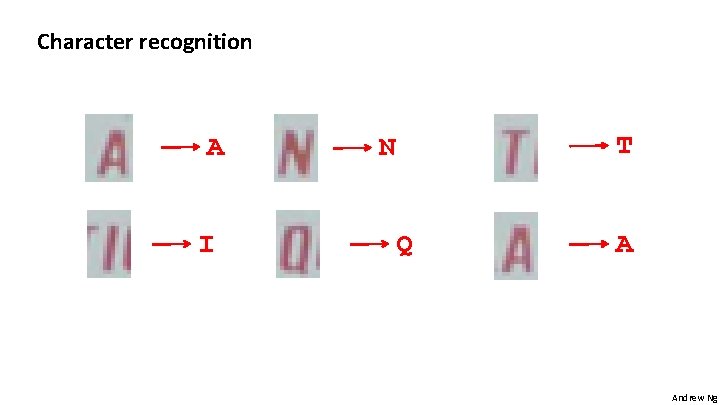
Character recognition A I T N Q A Andrew Ng
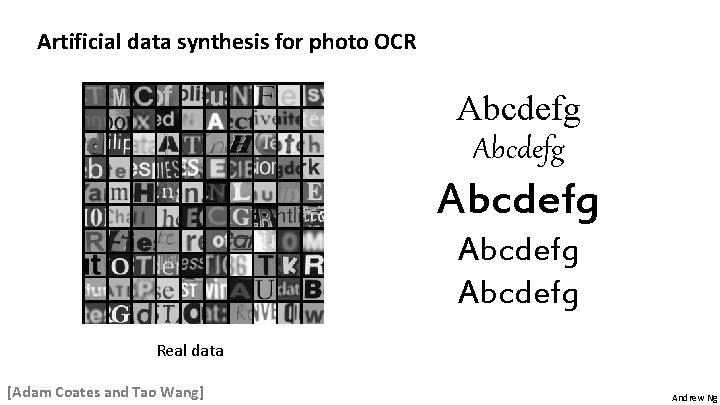
Artificial data synthesis for photo OCR Abcdefg Abcdefg Real data [Adam Coates and Tao Wang] Andrew Ng
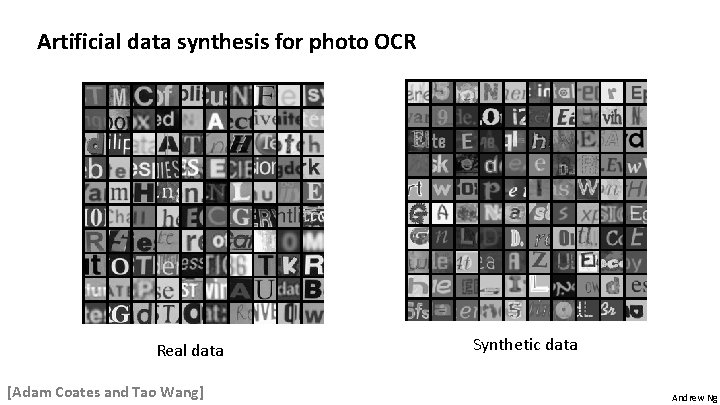
Artificial data synthesis for photo OCR Real data [Adam Coates and Tao Wang] Synthetic data Andrew Ng
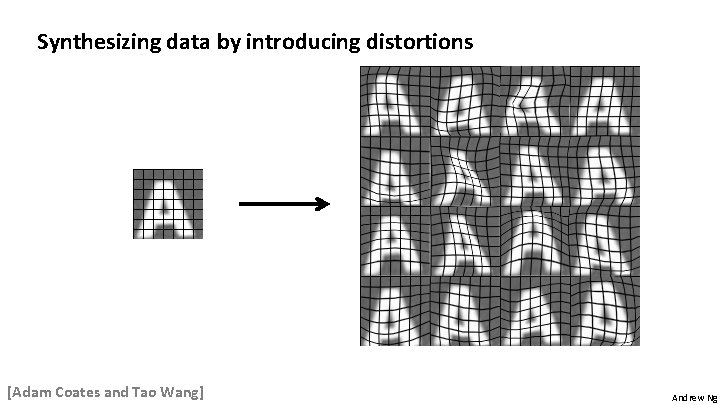
Synthesizing data by introducing distortions [Adam Coates and Tao Wang] Andrew Ng
Synthesizing data by introducing distortions: Speech recognition Original audio: Audio on bad cellphone connection Noisy background: Crowd Noisy background: Machinery [www. pdsounds. org] Andrew Ng
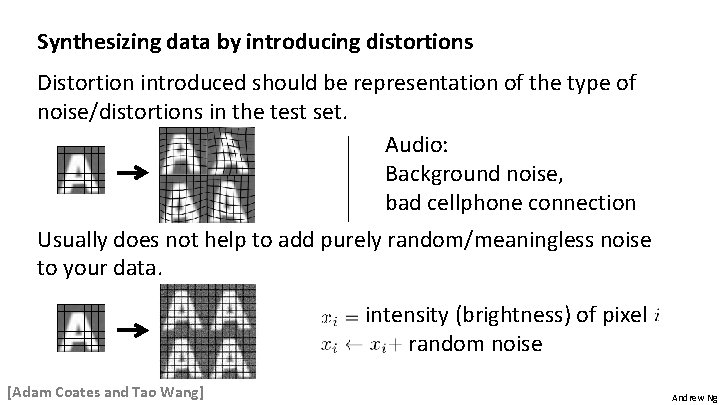
Synthesizing data by introducing distortions Distortion introduced should be representation of the type of noise/distortions in the test set. Audio: Background noise, bad cellphone connection Usually does not help to add purely random/meaningless noise to your data. intensity (brightness) of pixel random noise [Adam Coates and Tao Wang] Andrew Ng
Discussion on getting more data 1. Make sure you have a low bias classifier before expending the effort. (Plot learning curves). E. g. keep increasing the number of features/number of hidden units in neural network until you have a low bias classifier. 2. “How much work would it be to get 10 x as much data as we currently have? ” - Artificial data synthesis - Collect/label it yourself - “Crowd source” (E. g. Amazon Mechanical Turk) Andrew Ng
Discussion on getting more data 1. Make sure you have a low bias classifier before expending the effort. (Plot learning curves). E. g. keep increasing the number of features/number of hidden units in neural network until you have a low bias classifier. 2. “How much work would it be to get 10 x as much data as we currently have? ” - Artificial data synthesis - Collect/label it yourself - “Crowd source” (E. g. Amazon Mechanical Turk) Andrew Ng
Application example: Photo OCR Ceiling analysis: What part of the pipeline to work on next Machine Learning
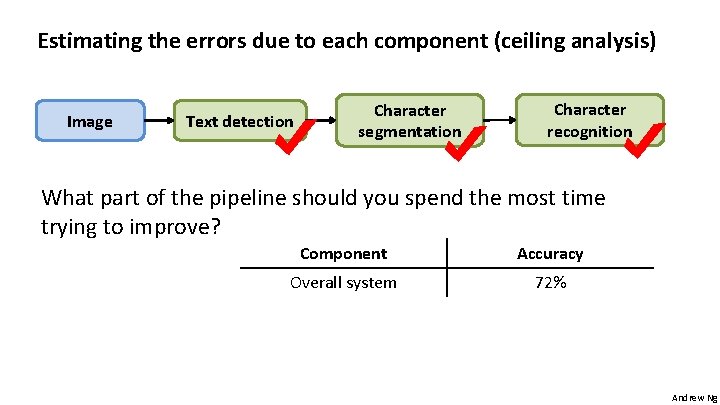
Estimating the errors due to each component (ceiling analysis) Image Text detection Character segmentation Character recognition What part of the pipeline should you spend the most time trying to improve? Component Accuracy Overall system 72% Text detection 89% Character segmentation 90% Character recognition 100% Andrew Ng

Another ceiling analysis example Face recognition from images (Artificial example) Camera image Preprocess (remove background) Eyes segmentation Face detection Nose segmentation Logistic regression Label Mouth segmentation Andrew Ng
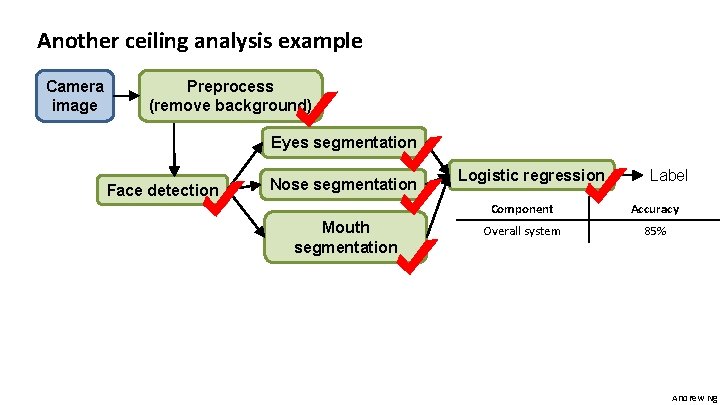
Another ceiling analysis example Camera image Preprocess (remove background) Eyes segmentation Face detection Nose segmentation Mouth segmentation Logistic regression Label Component Accuracy Overall system 85% Preprocess (remove background) 85. 1% Face detection 91% Eyes segmentation 95% Nose segmentation 96% Mouth segmentation 97% Logistic regression 100% Andrew Ng
- Slides: 29