
Y 542 Statistics Annotated sample assessment materials OCR
- Slides: 36
Y 542 Statistics Annotated sample assessment materials © OCR 2018 Y 542
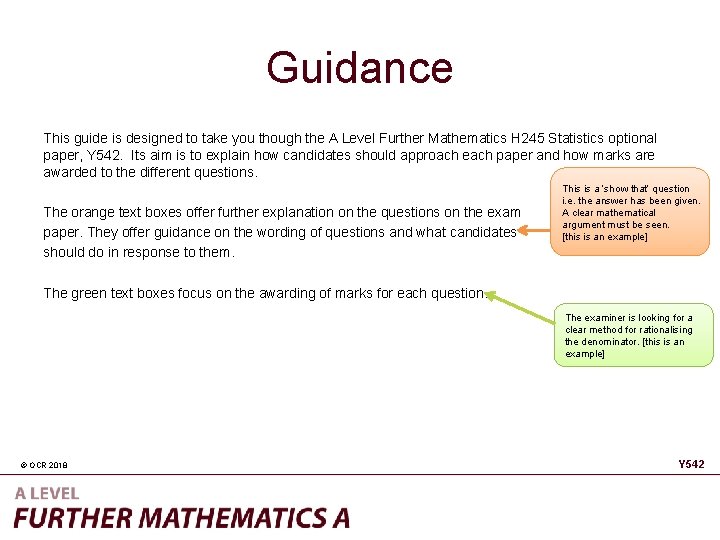
Guidance This guide is designed to take you though the A Level Further Mathematics H 245 Statistics optional paper, Y 542. Its aim is to explain how candidates should approach each paper and how marks are awarded to the different questions. The orange text boxes offer further explanation on the questions on the exam paper. They offer guidance on the wording of questions and what candidates should do in response to them. This is a ‘show that’ question i. e. the answer has been given. A clear mathematical argument must be seen. [this is an example] The green text boxes focus on the awarding of marks for each question. The examiner is looking for a clear method for rationalising the denominator. [this is an example] © OCR 2018 Y 542
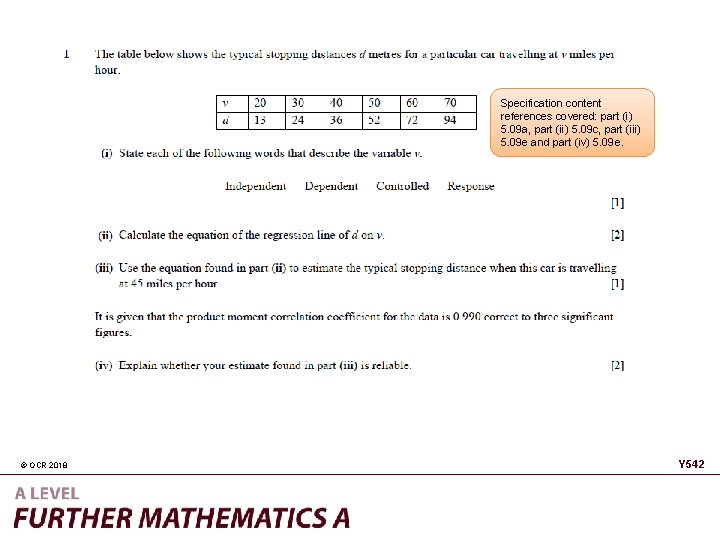
Specification content references covered: part (i) 5. 09 a, part (ii) 5. 09 c, part (iii) 5. 09 e and part (iv) 5. 09 e. © OCR 2018 Y 542
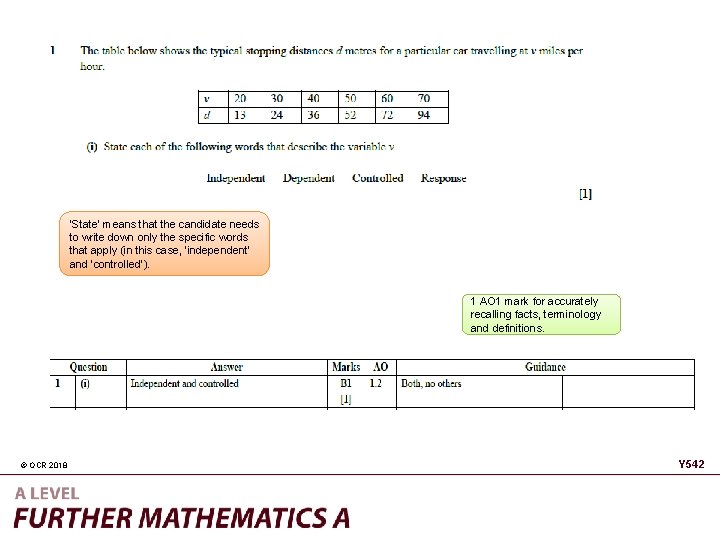
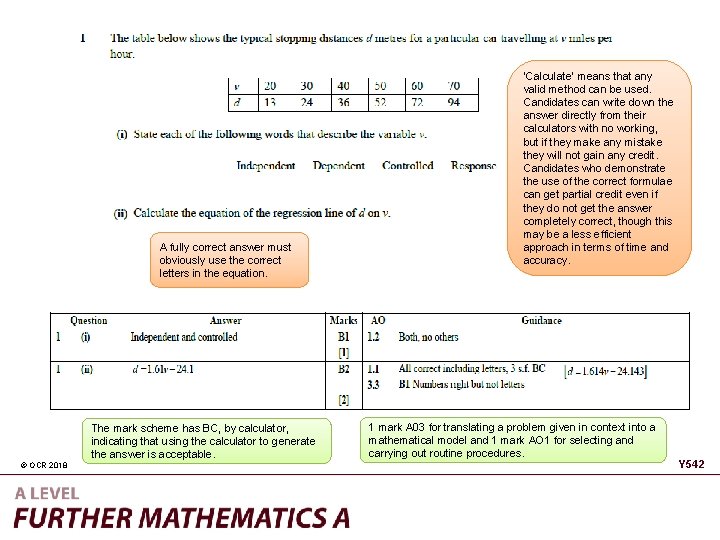
‘State’ means that the candidate needs to write down only the specific words that apply (in this case, ‘independent’ and ‘controlled’). 1 AO 1 mark for accurately recalling facts, terminology and definitions. © OCR 2018 Y 542
A fully correct answer must obviously use the correct letters in the equation. The mark scheme has BC, by calculator, indicating that using the calculator to generate the answer is acceptable. © OCR 2018 ‘Calculate’ means that any valid method can be used. Candidates can write down the answer directly from their calculators with no working, but if they make any mistake they will not gain any credit. Candidates who demonstrate the use of the correct formulae can get partial credit even if they do not get the answer completely correct, though this may be a less efficient approach in terms of time and accuracy. 1 mark A 03 for translating a problem given in context into a mathematical model and 1 mark AO 1 for selecting and carrying out routine procedures. Y 542
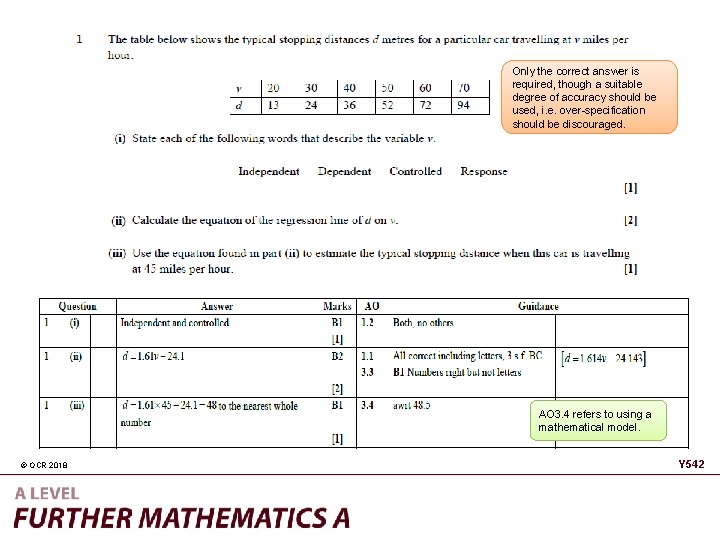
Only the correct answer is required, though a suitable degree of accuracy should be used, i. e. over-specification should be discouraged. AO 3. 4 refers to using a mathematical model. © OCR 2018 Y 542
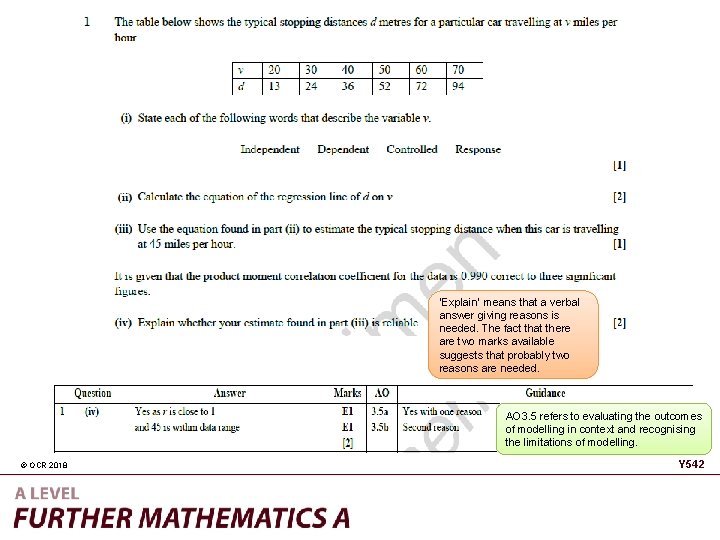
‘Explain’ means that a verbal answer giving reasons is needed. The fact that there are two marks available suggests that probably two reasons are needed. AO 3. 5 refers to evaluating the outcomes of modelling in context and recognising the limitations of modelling. © OCR 2018 Y 542
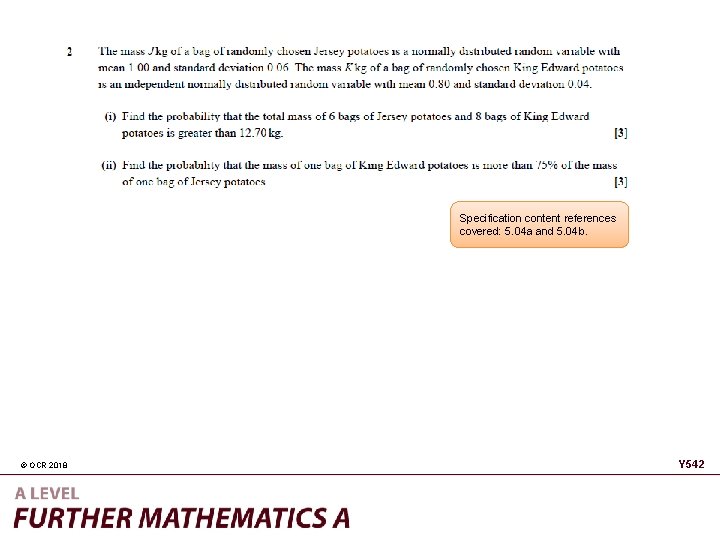
Specification content references covered: 5. 04 a and 5. 04 b. © OCR 2018 Y 542
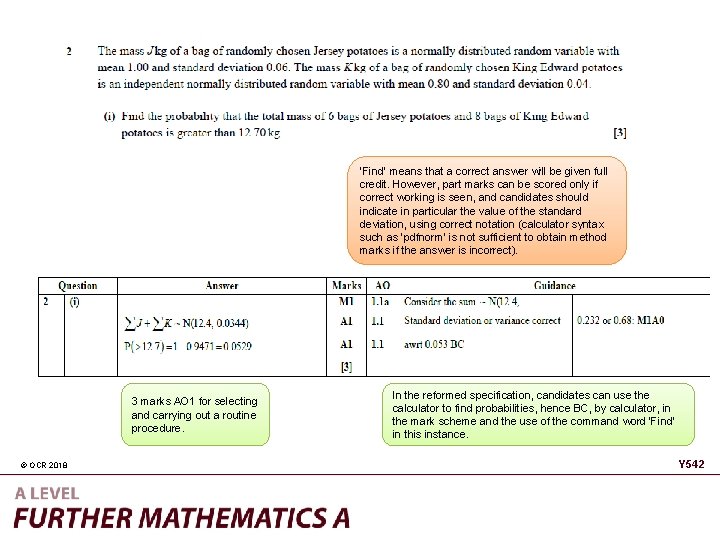
‘Find’ means that a correct answer will be given full credit. However, part marks can be scored only if correct working is seen, and candidates should indicate in particular the value of the standard deviation, using correct notation (calculator syntax such as ‘pdfnorm’ is not sufficient to obtain method marks if the answer is incorrect). 3 marks AO 1 for selecting and carrying out a routine procedure. © OCR 2018 In the reformed specification, candidates can use the calculator to find probabilities, hence BC, by calculator, in the mark scheme and the use of the command word ‘Find’ in this instance. Y 542
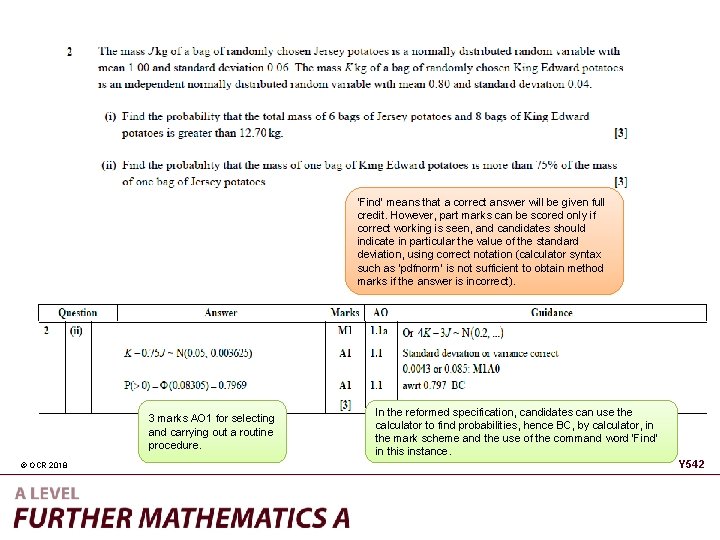
‘Find’ means that a correct answer will be given full credit. However, part marks can be scored only if correct working is seen, and candidates should indicate in particular the value of the standard deviation, using correct notation (calculator syntax such as ‘pdfnorm’ is not sufficient to obtain method marks if the answer is incorrect). 3 marks AO 1 for selecting and carrying out a routine procedure. © OCR 2018 In the reformed specification, candidates can use the calculator to find probabilities, hence BC, by calculator, in the mark scheme and the use of the command word ‘Find’ in this instance. Y 542
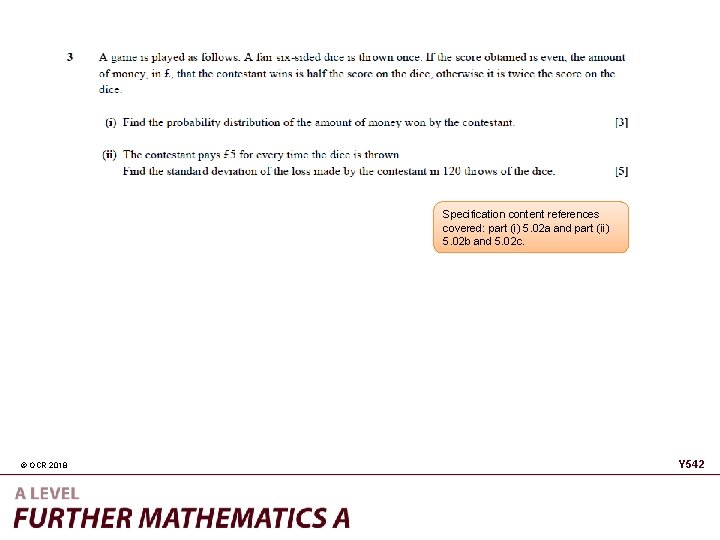
Specification content references covered: part (i) 5. 02 a and part (ii) 5. 02 b and 5. 02 c. © OCR 2018 Y 542
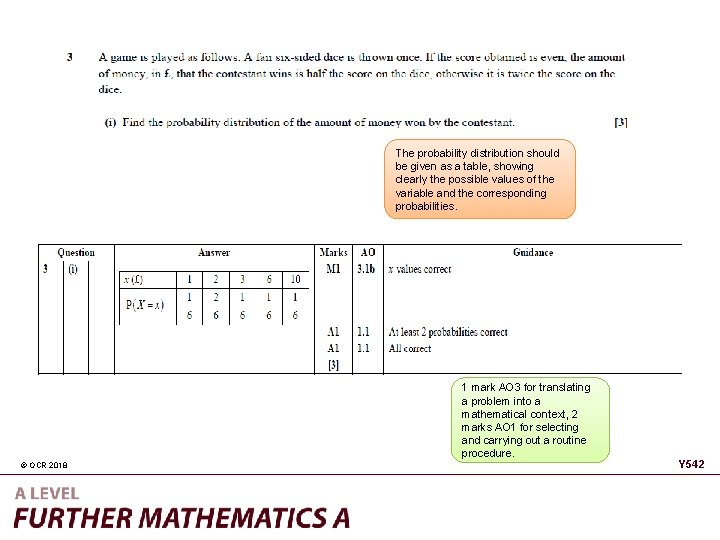
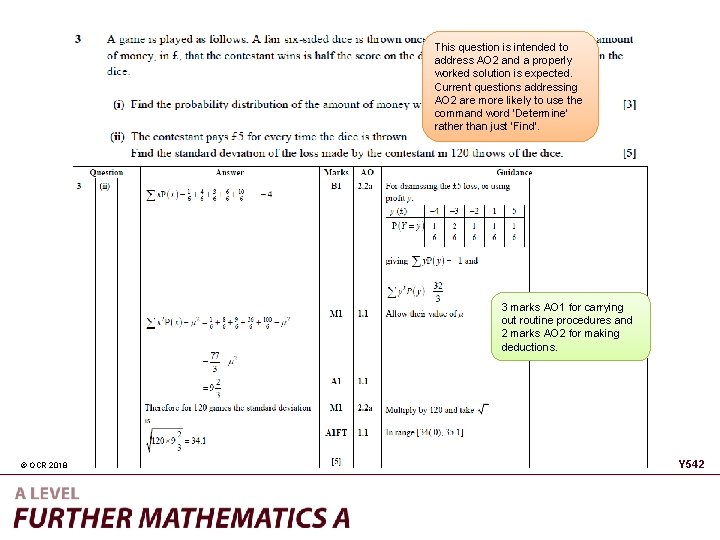
The probability distribution should be given as a table, showing clearly the possible values of the variable and the corresponding probabilities. 1 mark AO 3 for translating a problem into a mathematical context, 2 marks AO 1 for selecting and carrying out a routine procedure. © OCR 2018 Y 542
This question is intended to address AO 2 and a properly worked solution is expected. Current questions addressing AO 2 are more likely to use the command word ‘Determine’ rather than just ‘Find’. 3 marks AO 1 for carrying out routine procedures and 2 marks AO 2 for making deductions. © OCR 2018 Y 542
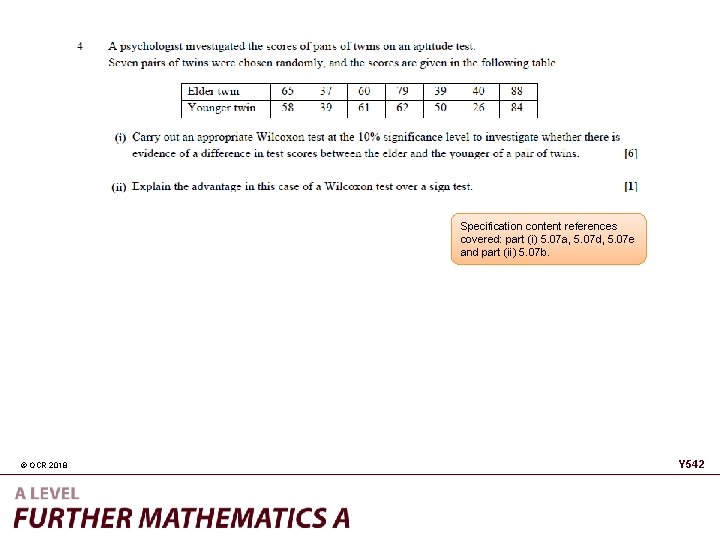
Specification content references covered: part (i) 5. 07 a, 5. 07 d, 5. 07 e and part (ii) 5. 07 b. © OCR 2018 Y 542
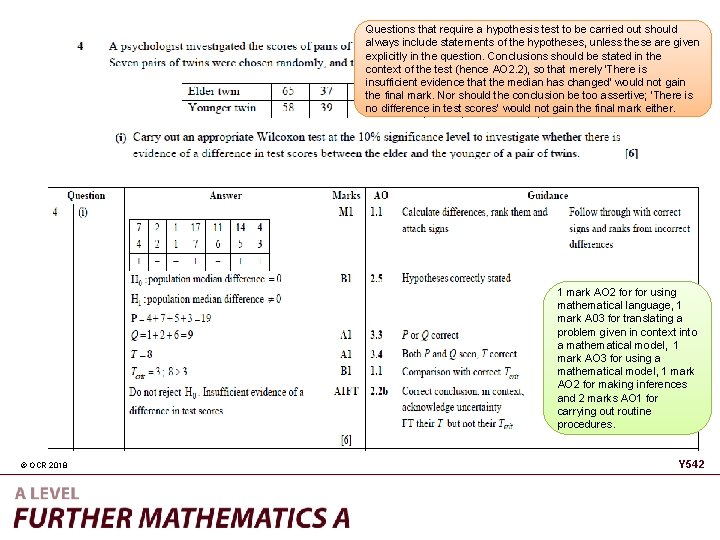
Questions that require a hypothesis test to be carried out should always include statements of the hypotheses, unless these are given explicitly in the question. Conclusions should be stated in the context of the test (hence AO 2. 2), so that merely ‘There is insufficient evidence that the median has changed’ would not gain the final mark. Nor should the conclusion be too assertive; ‘There is no difference in test scores’ would not gain the final mark either. 1 mark AO 2 for using mathematical language, 1 mark A 03 for translating a problem given in context into a mathematical model, 1 mark AO 3 for using a mathematical model, 1 mark AO 2 for making inferences and 2 marks AO 1 for carrying out routine procedures. © OCR 2018 Y 542
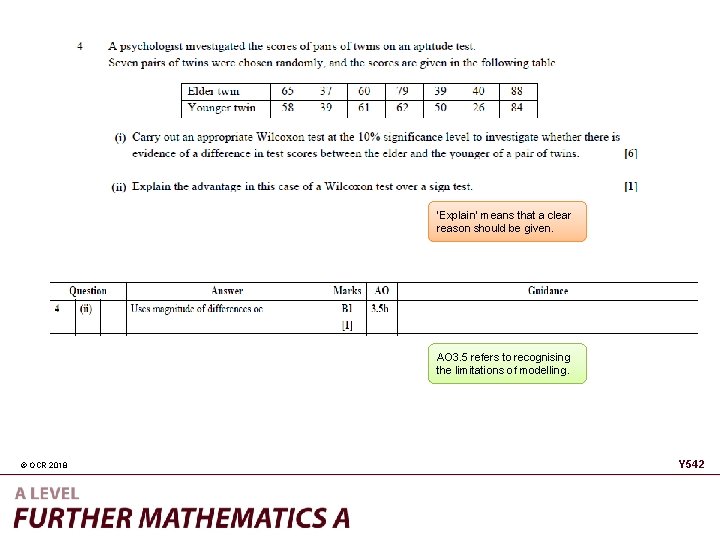
‘Explain’ means that a clear reason should be given. AO 3. 5 refers to recognising the limitations of modelling. © OCR 2018 Y 542
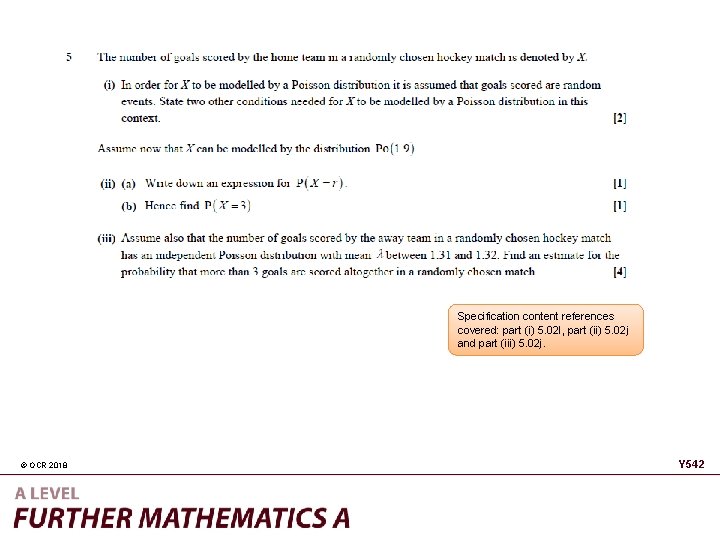
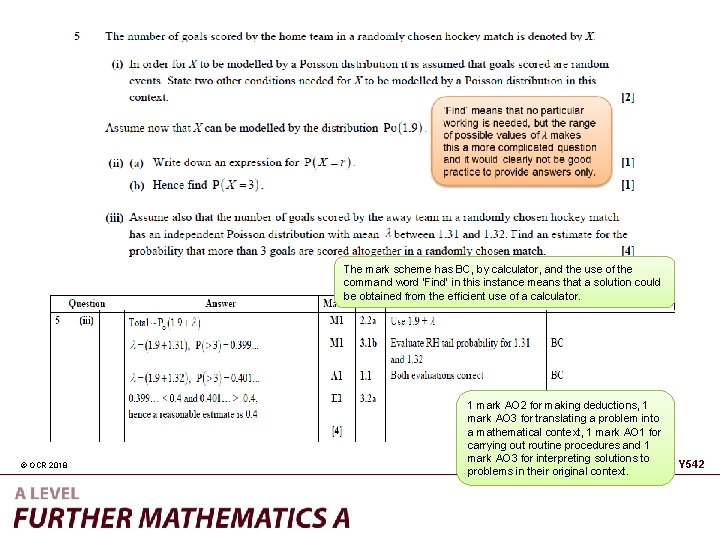
Specification content references covered: part (i) 5. 02 l, part (ii) 5. 02 j and part (iii) 5. 02 j. © OCR 2018 Y 542
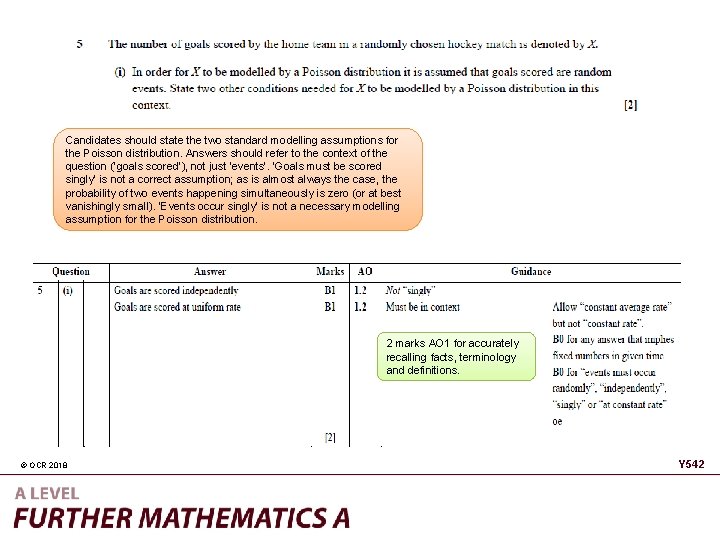
Candidates should state the two standard modelling assumptions for the Poisson distribution. Answers should refer to the context of the question (‘goals scored’), not just ‘events’. ‘Goals must be scored singly’ is not a correct assumption; as is almost always the case, the probability of two events happening simultaneously is zero (or at best vanishingly small). ‘Events occur singly’ is not a necessary modelling assumption for the Poisson distribution. 2 marks AO 1 for accurately recalling facts, terminology and definitions. © OCR 2018 Y 542
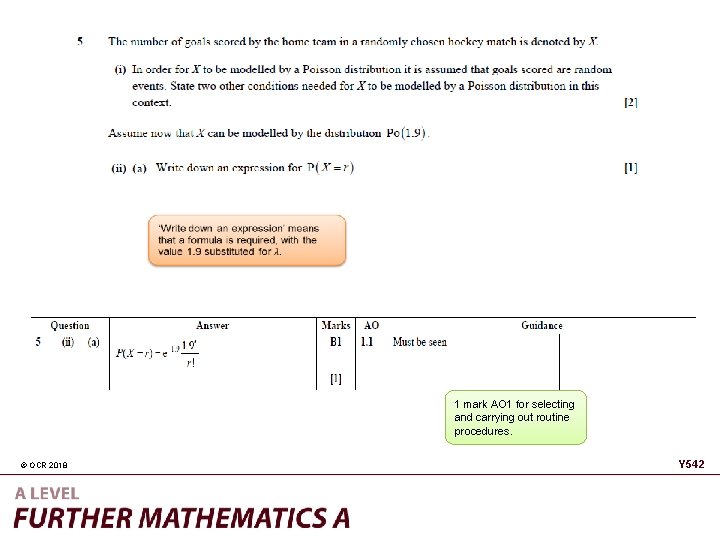
1 mark AO 1 for selecting and carrying out routine procedures. © OCR 2018 Y 542
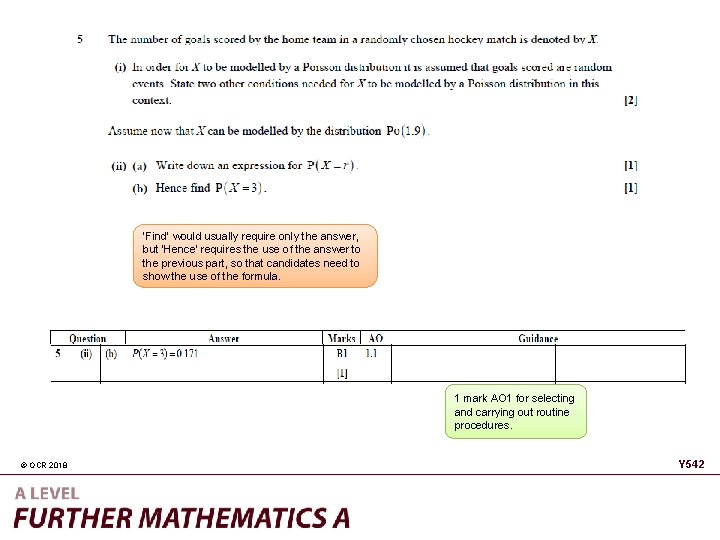
‘Find’ would usually require only the answer, but ‘Hence’ requires the use of the answer to the previous part, so that candidates need to show the use of the formula. 1 mark AO 1 for selecting and carrying out routine procedures. © OCR 2018 Y 542
The mark scheme has BC, by calculator, and the use of the command word ‘Find’ in this instance means that a solution could be obtained from the efficient use of a calculator. © OCR 2018 1 mark AO 2 for making deductions, 1 mark AO 3 for translating a problem into a mathematical context, 1 mark AO 1 for carrying out routine procedures and 1 mark AO 3 for interpreting solutions to problems in their original context. Y 542
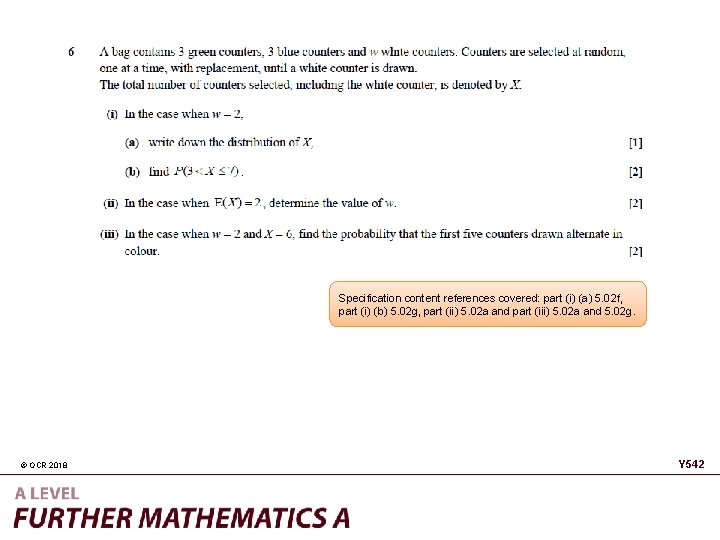
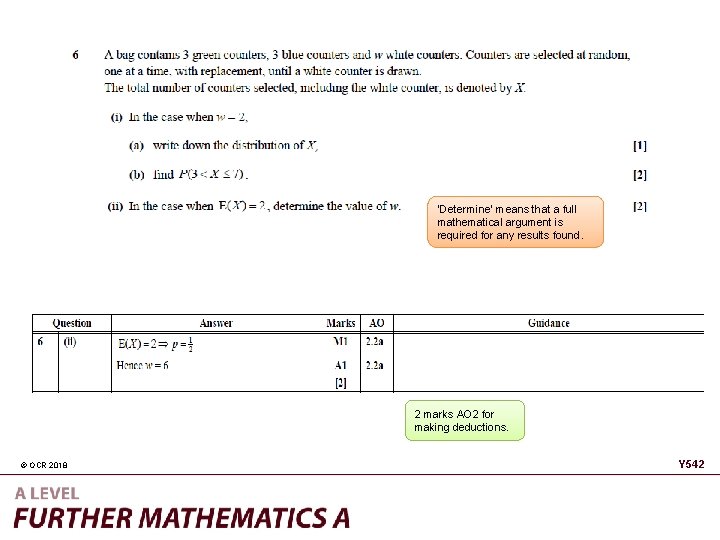
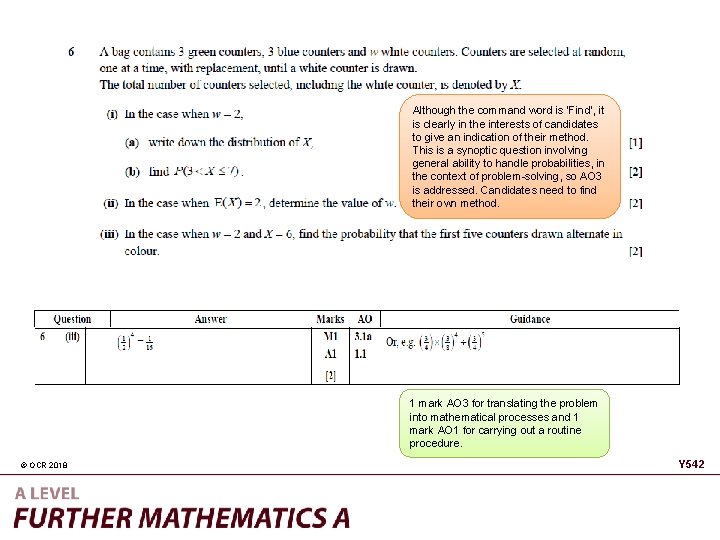
Specification content references covered: part (i) (a) 5. 02 f, part (i) (b) 5. 02 g, part (ii) 5. 02 a and part (iii) 5. 02 a and 5. 02 g. © OCR 2018 Y 542
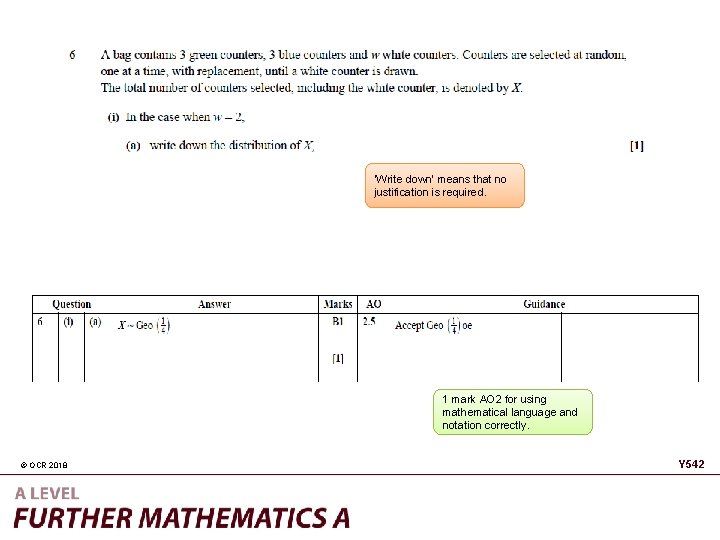
‘Write down’ means that no justification is required. 1 mark AO 2 for using mathematical language and notation correctly. © OCR 2018 Y 542
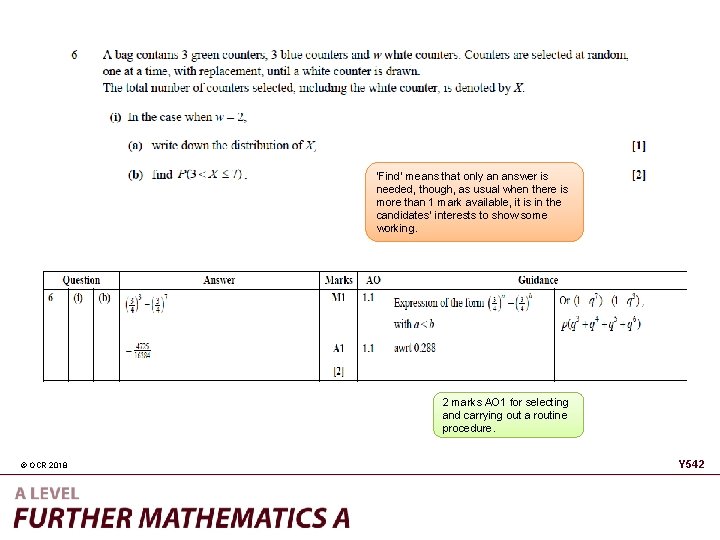
‘Find’ means that only an answer is needed, though, as usual when there is more than 1 mark available, it is in the candidates’ interests to show some working. 2 marks AO 1 for selecting and carrying out a routine procedure. © OCR 2018 Y 542
‘Determine’ means that a full mathematical argument is required for any results found. 2 marks AO 2 for making deductions. © OCR 2018 Y 542
Although the command word is ‘Find’, it is clearly in the interests of candidates to give an indication of their method. This is a synoptic question involving general ability to handle probabilities, in the context of problem-solving, so AO 3 is addressed. Candidates need to find their own method. 1 mark AO 3 for translating the problem into mathematical processes and 1 mark AO 1 for carrying out a routine procedure. © OCR 2018 Y 542
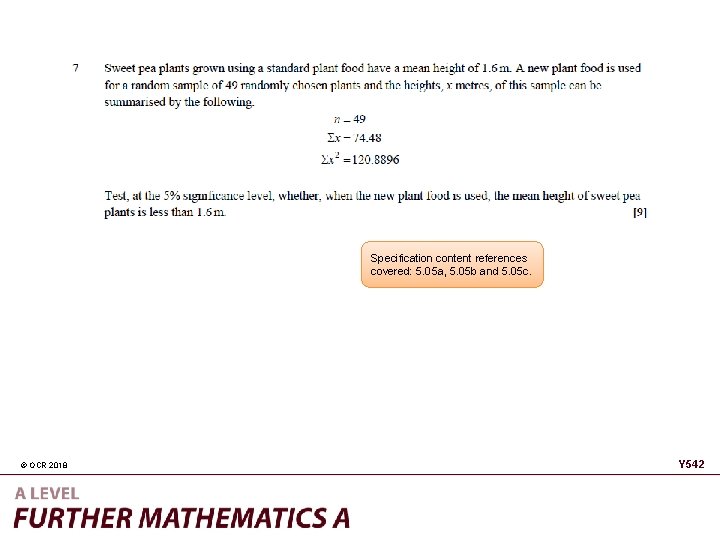
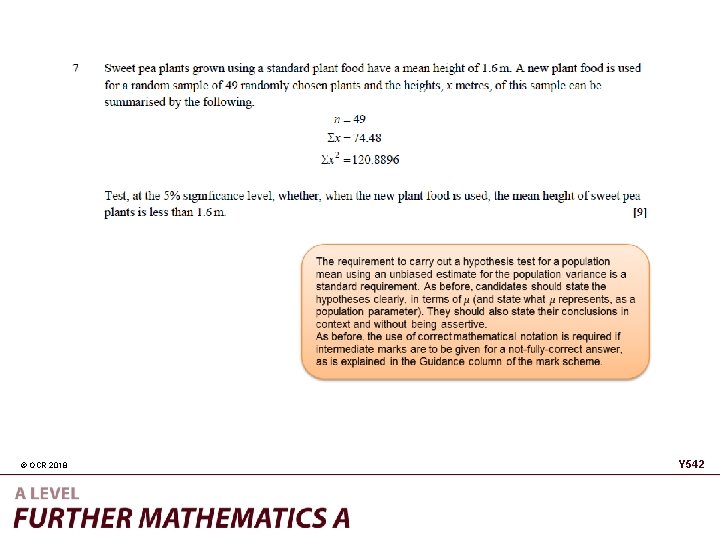
Specification content references covered: 5. 05 a, 5. 05 b and 5. 05 c. © OCR 2018 Y 542
© OCR 2018 Y 542
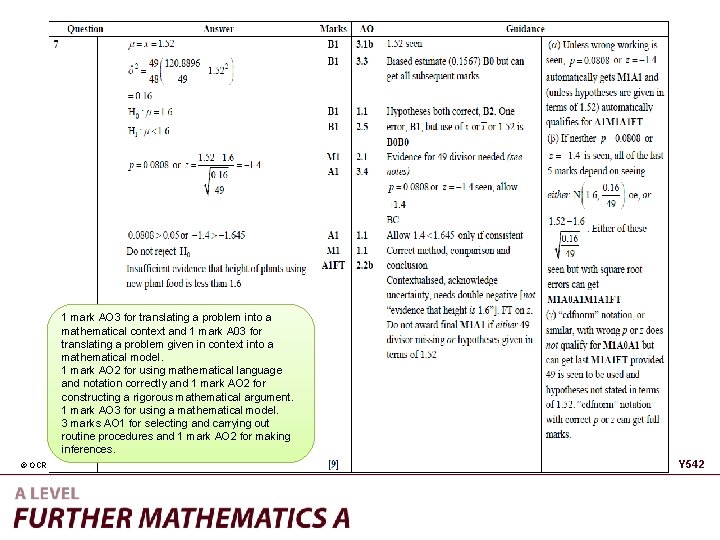
1 mark AO 3 for translating a problem into a mathematical context and 1 mark A 03 for translating a problem given in context into a mathematical model. 1 mark AO 2 for using mathematical language and notation correctly and 1 mark AO 2 for constructing a rigorous mathematical argument. 1 mark AO 3 for using a mathematical model. 3 marks AO 1 for selecting and carrying out routine procedures and 1 mark AO 2 for making inferences. © OCR 2018 Y 542
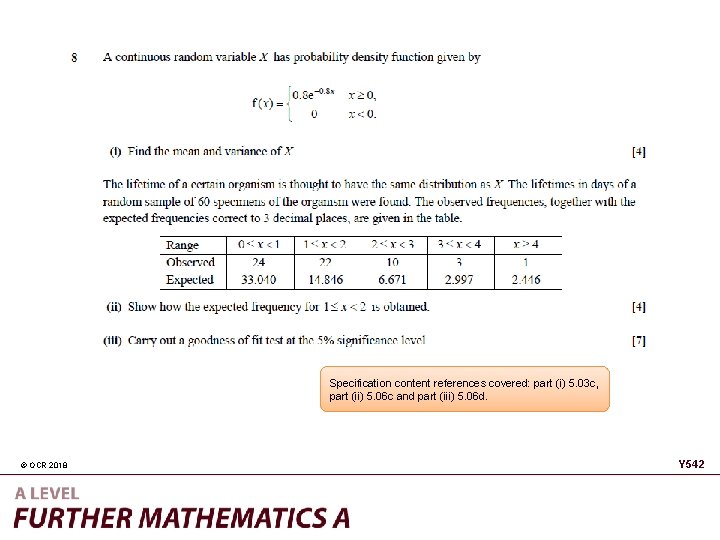
Specification content references covered: part (i) 5. 03 c, part (ii) 5. 06 c and part (iii) 5. 06 d. © OCR 2018 Y 542
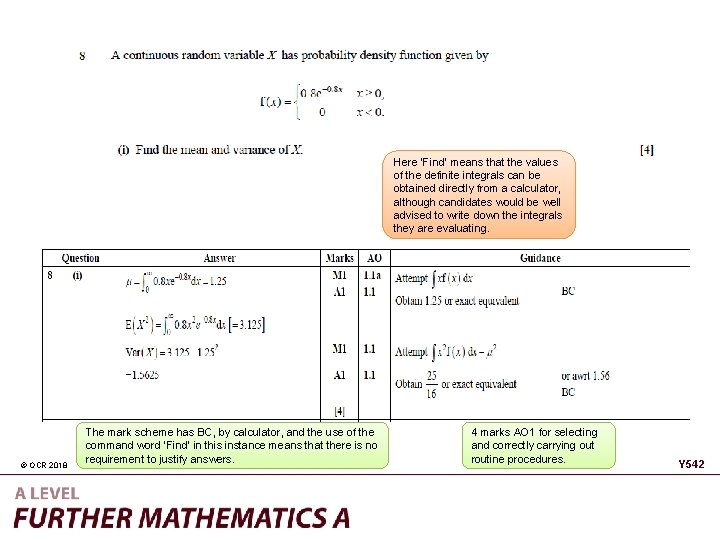
Here ‘Find’ means that the values of the definite integrals can be obtained directly from a calculator, although candidates would be well advised to write down the integrals they are evaluating. © OCR 2018 The mark scheme has BC, by calculator, and the use of the command word ‘Find’ in this instance means that there is no requirement to justify answers. 4 marks AO 1 for selecting and correctly carrying out routine procedures. Y 542
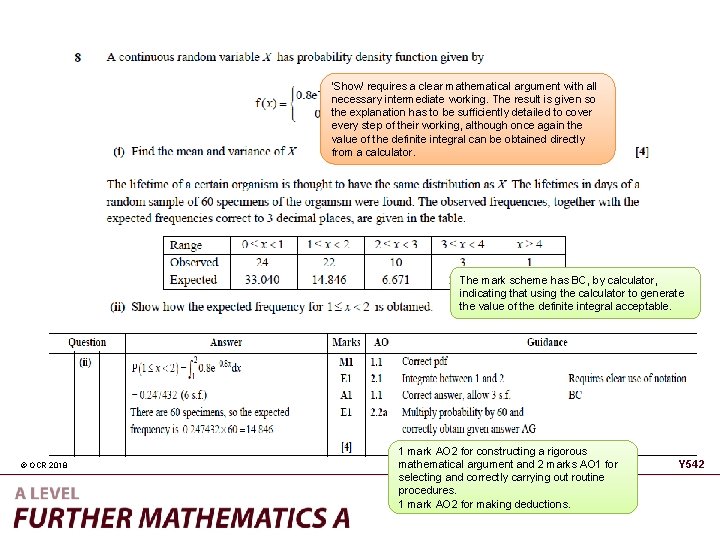
‘Show’ requires a clear mathematical argument with all necessary intermediate working. The result is given so the explanation has to be sufficiently detailed to cover every step of their working, although once again the value of the definite integral can be obtained directly from a calculator. The mark scheme has BC, by calculator, indicating that using the calculator to generate the value of the definite integral acceptable. © OCR 2018 1 mark AO 2 for constructing a rigorous mathematical argument and 2 marks AO 1 for selecting and correctly carrying out routine procedures. 1 mark AO 2 for making deductions. Y 542
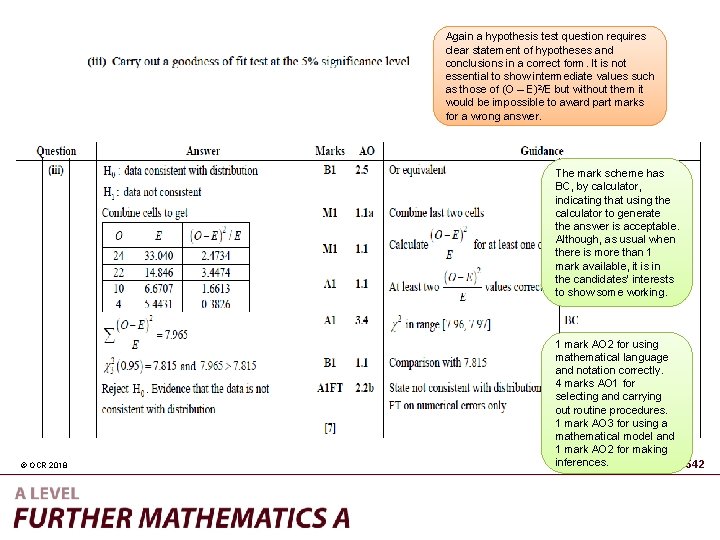
Again a hypothesis test question requires clear statement of hypotheses and conclusions in a correct form. It is not essential to show intermediate values such as those of (O – E)2/E but without them it would be impossible to award part marks for a wrong answer. The mark scheme has BC, by calculator, indicating that using the calculator to generate the answer is acceptable. Although, as usual when there is more than 1 mark available, it is in the candidates’ interests to show some working. © OCR 2018 1 mark AO 2 for using mathematical language and notation correctly. 4 marks AO 1 for selecting and carrying out routine procedures. 1 mark AO 3 for using a mathematical model and 1 mark AO 2 for making inferences. Y 542
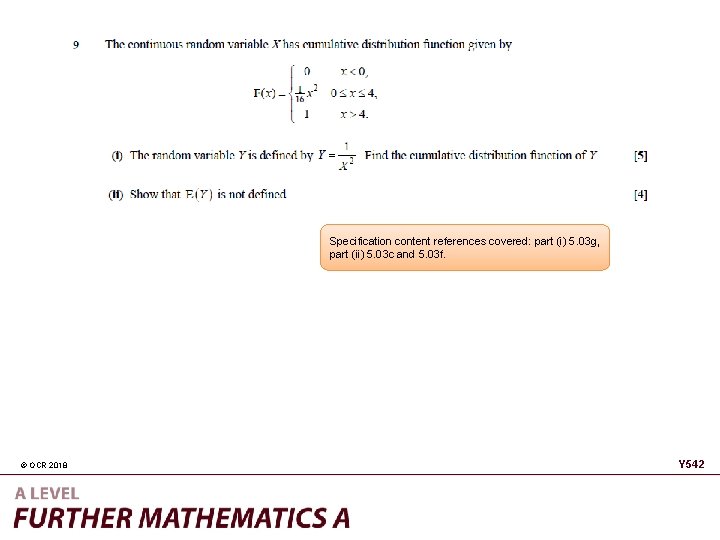
Specification content references covered: part (i) 5. 03 g, part (ii) 5. 03 c and 5. 03 f. © OCR 2018 Y 542
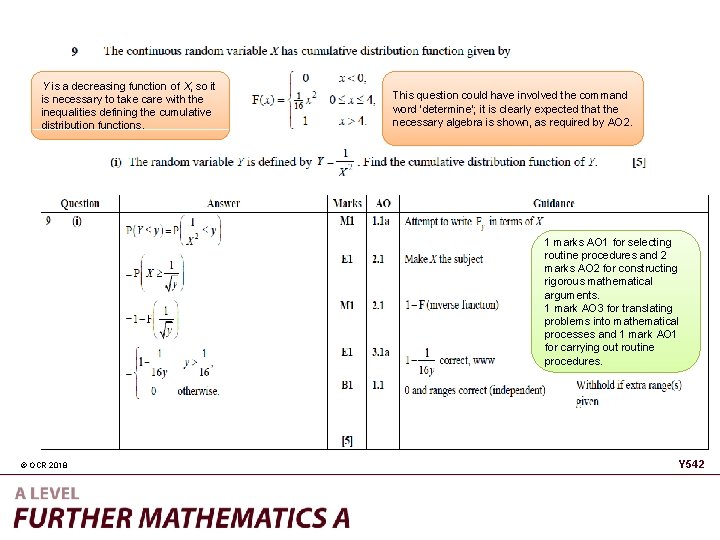
Y is a decreasing function of X, so it is necessary to take care with the inequalities defining the cumulative distribution functions. This question could have involved the command word ‘determine’; it is clearly expected that the necessary algebra is shown, as required by AO 2. 1 marks AO 1 for selecting routine procedures and 2 marks AO 2 for constructing rigorous mathematical arguments. 1 mark AO 3 for translating problems into mathematical processes and 1 mark AO 1 for carrying out routine procedures. © OCR 2018 Y 542
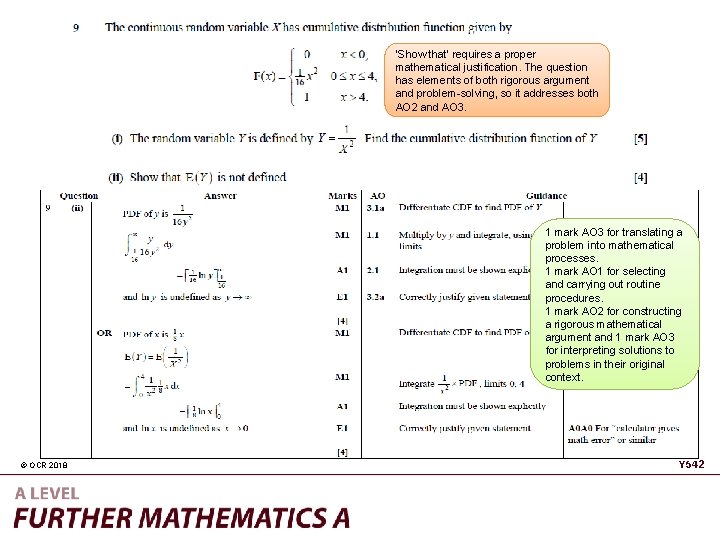
‘Show that’ requires a proper mathematical justification. The question has elements of both rigorous argument and problem-solving, so it addresses both AO 2 and AO 3. 1 mark AO 3 for translating a problem into mathematical processes. 1 mark AO 1 for selecting and carrying out routine procedures. 1 mark AO 2 for constructing a rigorous mathematical argument and 1 mark AO 3 for interpreting solutions to problems in their original context. © OCR 2018 Y 542