
Nonlinear Normalization to Improve Telugu OCR Atul Negi


- Slides: 21
Non-linear Normalization to Improve Telugu OCR Atul Negi, Chakravarthy Bhagvati, V. V. Suresh Kumar Department of Computer and Information Sciences, University of Hyderabad 25 th June 2002 IEMCT CDAC Pune 1
Acknowledgements Ministry of Information Technology, New Delhi Under the Project Resource Center for Indian Language Technology Solutions (Telugu) 25 th June 2002 IEMCT CDAC Pune 2
Organization of Presentation • Introduction • Telugu Script • Classification By Template Matching • Complete OCR Algorithm • Nonlinear Normalization • Results • Concluding Remarks • Bibliography • 25 th Contact Information June 2002 IEMCT CDAC Pune 3
Introduction • OCR Research Indian Scripts – Initial era Pioneers: RMK Sinha, Deekshitalu, ISI Kolkata – Maturity: Mid Nineties Complete Systems • Bangla • Devanagari • Recent Status of OCR in Indian Scripts – ICDAR 1999, Bangalore – ILOCR Workshop, 2002 Uo. H – Sadhana, Indian Acad. Sci. Feb `02, Special Issue 25 th June 2002 IEMCT CDAC Pune 4
Introduction: Progress of Telugu OCR • Structural approach (ref. 4), – moments and size of the character used • Neural networks (ref. 1), – Connected Components, training and recognition • Template Matching (ref. 5), – Connected Components, Templates and linear size normalization • Wavelet multi-resolution analysis (ref. 6) 25 th June 2002 IEMCT CDAC Pune 5
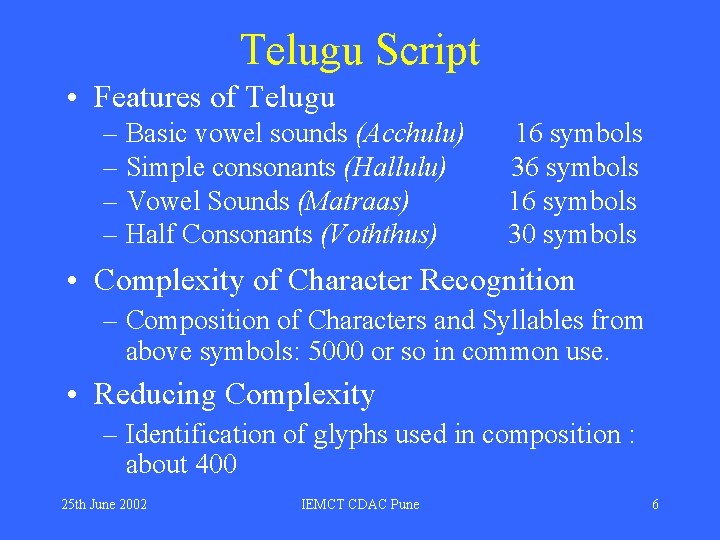
Telugu Script • Features of Telugu – Basic vowel sounds (Acchulu) – Simple consonants (Hallulu) – Vowel Sounds (Matraas) – Half Consonants (Voththus) 16 symbols 36 symbols 16 symbols 30 symbols • Complexity of Character Recognition – Composition of Characters and Syllables from above symbols: 5000 or so in common use. • Reducing Complexity – Identification of glyphs used in composition : about 400 25 th June 2002 IEMCT CDAC Pune 6
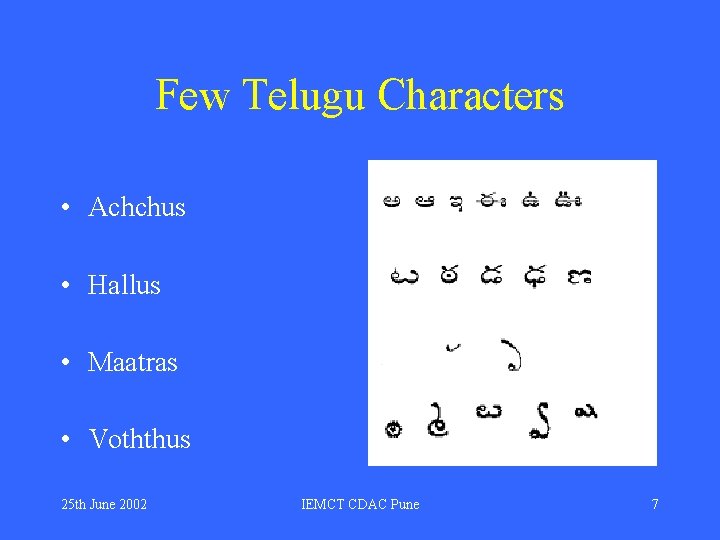
Few Telugu Characters • Achchus • Hallus • Maatras • Voththus 25 th June 2002 IEMCT CDAC Pune 7
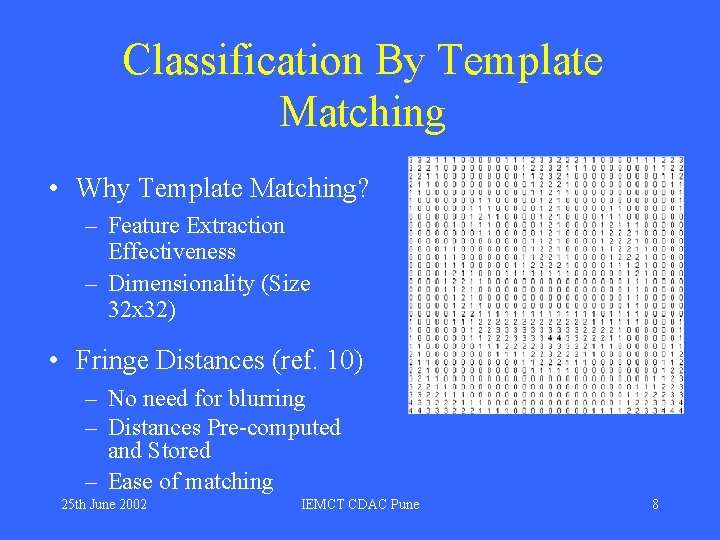
Classification By Template Matching • Why Template Matching? – Feature Extraction Effectiveness – Dimensionality (Size 32 x 32) • Fringe Distances (ref. 10) – No need for blurring – Distances Pre-computed and Stored – Ease of matching 25 th June 2002 IEMCT CDAC Pune 8
The Complete OCR algorithm • Read an input binary image • Segment the image into words • Extract the connected components from each word • For each component – (a) Normalize size to match stored templates – (b) Compute fringe distance map – (c) Compute fringe distance from all templates – (d) Output template with smallest fringe distance – (e) Convert template code to ISCII • Store ISCII output in a file 25 th June 2002 IEMCT CDAC Pune 9
Nonlinear Normalization • Need for Normalization – Preprocessing step to equalize size, position, inclination etc. to ease recognition – Necessary when recognition is by template matching • Non-Linear Normalization – All parts of the character image not treated equally – Hypothesis: Differences between characters will be increased, therefore improved discrimination 25 th June 2002 IEMCT CDAC Pune 10
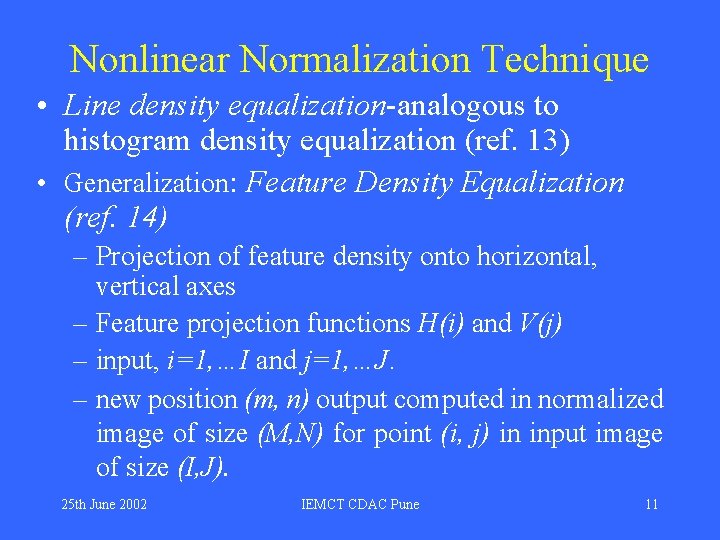
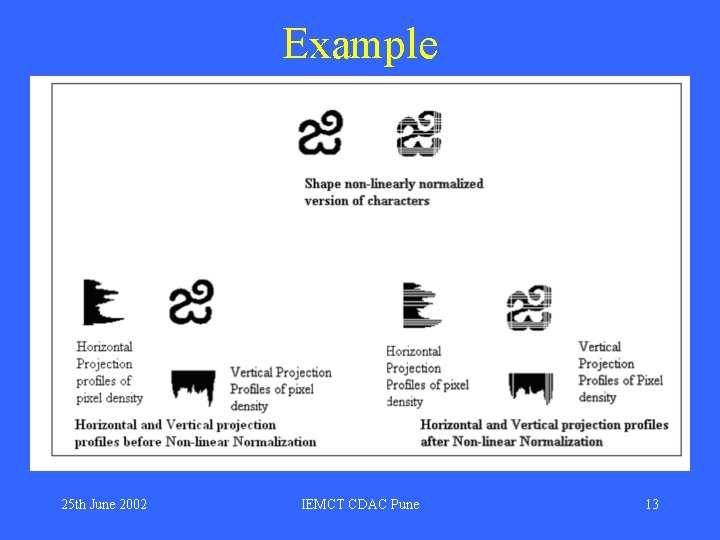
Nonlinear Normalization Technique • Line density equalization-analogous to histogram density equalization (ref. 13) • Generalization: Feature Density Equalization (ref. 14) – Projection of feature density onto horizontal, vertical axes – Feature projection functions H(i) and V(j) – input, i=1, …I and j=1, …J. – new position (m, n) output computed in normalized image of size (M, N) for point (i, j) in input image of size (I, J). 25 th June 2002 IEMCT CDAC Pune 11
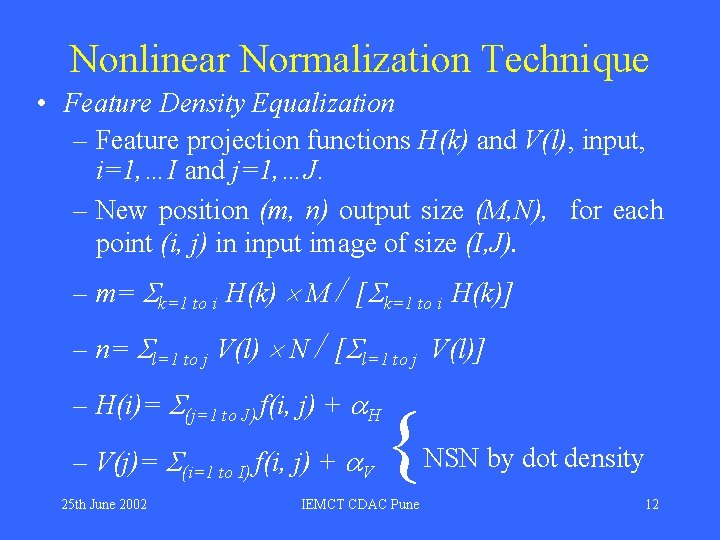
Nonlinear Normalization Technique • Feature Density Equalization – Feature projection functions H(k) and V(l), input, i=1, …I and j=1, …J. – New position (m, n) output size (M, N), for each point (i, j) in input image of size (I, J). – m= k=1 to i H(k) M / [ k=1 to i H(k)] – n= l=1 to j V(l) N / [ l=1 to j V(l)] – H(i)= (j=1 to J) f(i, j) + H – V(j)= (i=1 to I) f(i, j) + V 25 th June 2002 { IEMCT CDAC Pune NSN by dot density 12
Example 25 th June 2002 IEMCT CDAC Pune 13
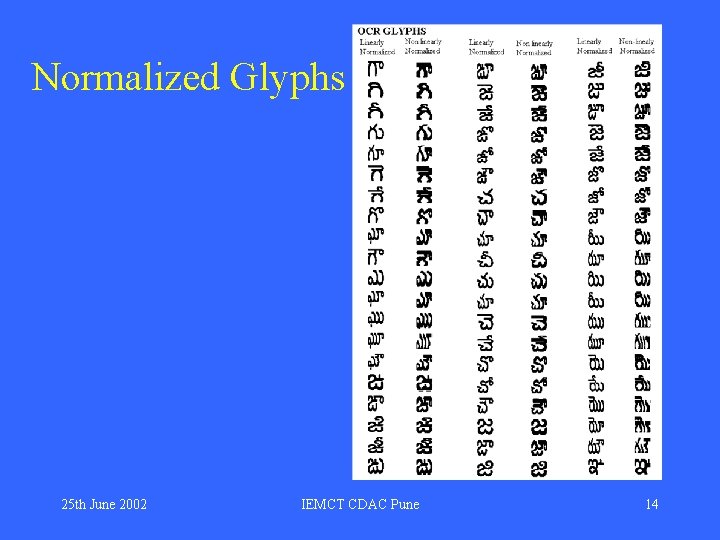
Normalized Glyphs 25 th June 2002 IEMCT CDAC Pune 14
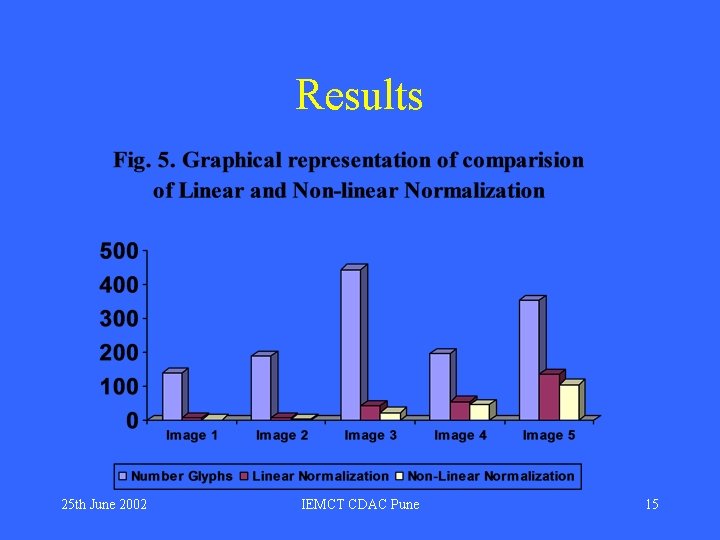
Results 25 th June 2002 IEMCT CDAC Pune 15
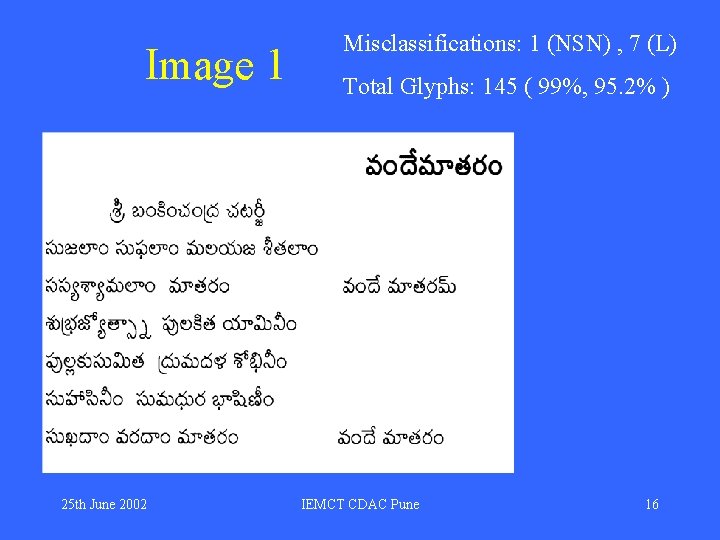
Image 1 25 th June 2002 Misclassifications: 1 (NSN) , 7 (L) Total Glyphs: 145 ( 99%, 95. 2% ) IEMCT CDAC Pune 16
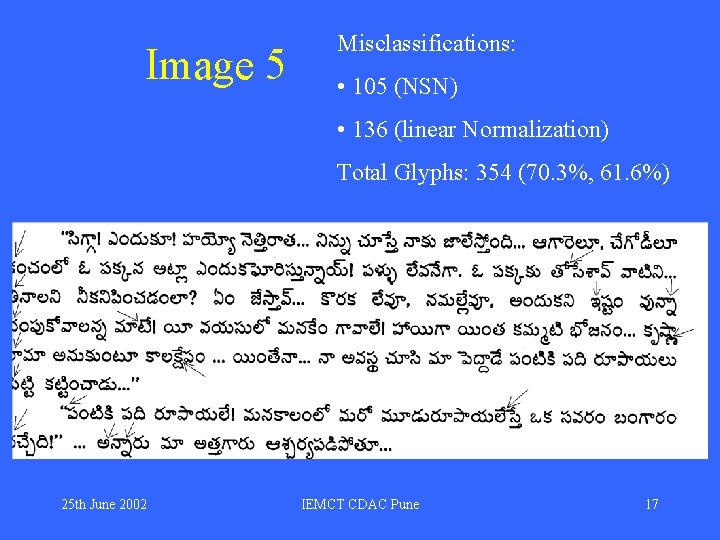
Image 5 Misclassifications: • 105 (NSN) • 136 (linear Normalization) Total Glyphs: 354 (70. 3%, 61. 6%) 25 th June 2002 IEMCT CDAC Pune 17
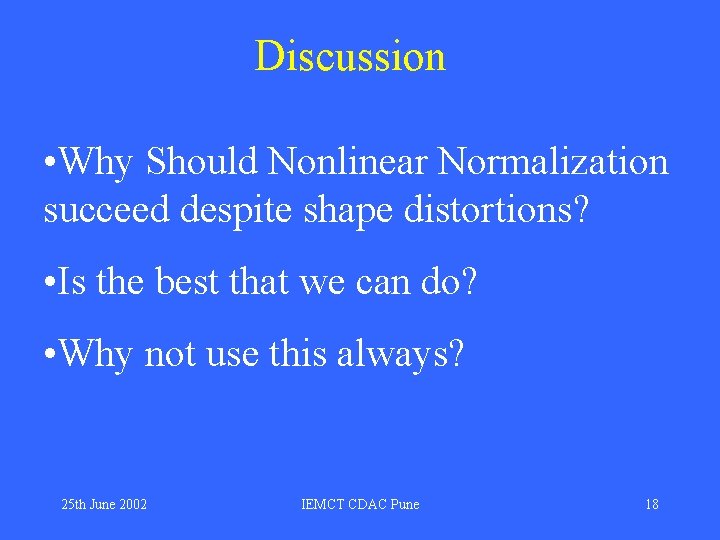
Discussion • Why Should Nonlinear Normalization succeed despite shape distortions? • Is the best that we can do? • Why not use this always? 25 th June 2002 IEMCT CDAC Pune 18
Concluding Remarks • Non-linear normalization appears to improve OCR accuracy (based on 1300 glyphs examined) • More experimentation with the features is required to overcome problems like gaps • Further testing on variety of fonts and sizes is required to conclude recognition improvement with more confidence 25 th June 2002 IEMCT CDAC Pune 19
Bibliography • • • • 25 th June 2002 M. B. Sukhswami, P. Seetharamulu , and Arun K. Pujari, “Recognition of Telugu characters using Neural networks, ” Int. J. of Neural Systems, 6(3): 317 (1995). R. Kasturi and S. N. Srihari (Eds. ). Proc. Fifth International Conf. Document Anaalysis and Recognition. Bangalore, India, IEEE Computer Society Press, Los Alamitos, CA, (1999). B. B. Chaudhuri and U. Garain, and M. Mitra, “On OCR of the most popular two Indian language scripts: Devanagari and Bangla”, in Visual Text Recogntion and Document Processing, Ed. N. Murshed, World Scientific Press (2000). SNS Rajasekharan and B. L. Deekshatulu, “Generation and Recognition of Printed Telugu characters”, Computer Graphics and Image Processing, 6: 335 -360, (1977). Atul Negi, Chakravarthy Bhagvati, and B. Krishna, “An OCR system for Telugu”, Proc. . Sixth International Conf. Document Analysis and Recognition. Seattle, USA, IEEE Computer Society Press, Los Alamitos, CA, (2001). A. K. Pujari, C. D. Naidu, and B. C. Jinaga, “An addaptive and intelligent character recognizer for Telugu scripts using multiresolution analysis and associative memory”, Proc. Canadian Conf. On AI, Calagary, Canada, May 2002, LNCS, Springer Verlag (2002). B. Krishna, “Design and implementation of a Telugu script recognition system” Technical report, Dept. of Computer and Information Sciences, University of Hyderabad, India, (2000). R. C. Gonzalez and R. E. Woods. Digital Image Processing. Addison-Wesley, 1993 O. D. Trier, A. K. Jain, and R. Taxt. “Feature extraction methods for character recognition-a survey”, Pattern Recognition, 29(4): 641 -662, (1996). R. L. Brown. “The fringe distance measure: an easily calculated image distance measure with recognition results comparable to Gaussian blurring”, IEEE Trans. System Man and Cybernetics, 24(1): 111 -116, (1994). K. Wong, R. Casey, and F. Wahl. “Document analysis system”. IBM J. Research and Development, 26(6), (1982). G. Nagy, S. Seth, and M. Vishwanathan, “A prototype document image analysis system for technical journals” Computer, 25(7), (1992). H. Yamada, K. Yamamoto and T. Saito, “A nonlinear normalization method for handprinted Kanji character recognition-line density equalization”, Pattern Recognition, 23(9): 1023 -1029, (1990). S-W. Lee and J-S. Park, “Nonlinear shape normalization methods for the recognition of large set handwritten characters”, Pattern Recognition, 27(7): 895 -902, (1994). V. V. Suresh Kumar, “Non-linear Normalization Techniques to Improve OCR”, Technical report, Dept. of Computer and Information Sciences, University of Hyderabad, India, (2002). IEMCT Hyderabad, CDAC Pune 20
Contact Information Atul Negi, Chakravarthy Bhagvati Department of Computer and Information Sciences, University of Hyderabad 500 046, AP INDIA Email: atulcs@uohyd. ernet. in Visit http: //www. uohyd. ernet. in and http: //www. Languagetechnologies. ac. in 25 th June 2002 IEMCT CDAC Pune 21