Game Engine Architecture Chapter 4 3 D Math
- Slides: 93
Game Engine Architecture Chapter 4 3 D Math for Games prepared by Roger Mailler, Ph. D. , Associate Professor of Computer Science, University of Tulsa 1
Topics • Math for games o o o o Points and Vectors Matrices Quaternions Comparison of rotational representations Other useful math objects Hardware-accelerated SIMD Math Random Number Generation prepared by Roger Mailler, Ph. D. , Associate Professor of Computer Science, University of Tulsa 2
2 D as a Start • Most operations in 3 D also make sense in 2 D • Always use 2 D as a basis, it’ll help prepared by Roger Mailler, Ph. D. , Associate Professor of Computer Science, University of Tulsa 3
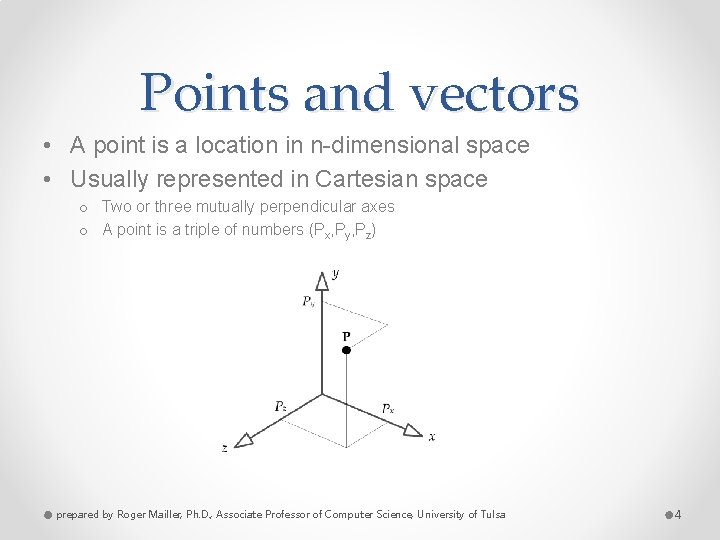
Points and vectors • A point is a location in n-dimensional space • Usually represented in Cartesian space o Two or three mutually perpendicular axes o A point is a triple of numbers (Px, Py, Pz) prepared by Roger Mailler, Ph. D. , Associate Professor of Computer Science, University of Tulsa 4
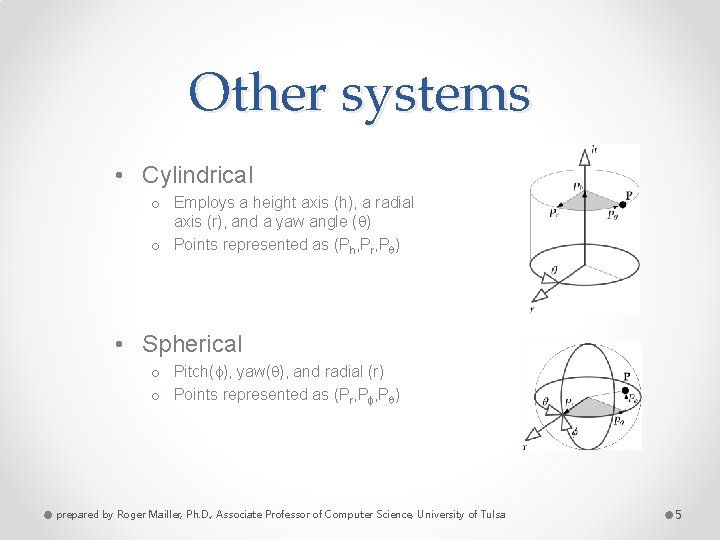
Other systems • Cylindrical o Employs a height axis (h), a radial axis (r), and a yaw angle ( ) o Points represented as (Ph, Pr, P ) • Spherical o Pitch( ), yaw( ), and radial (r) o Points represented as (Pr, P ) prepared by Roger Mailler, Ph. D. , Associate Professor of Computer Science, University of Tulsa 5
Picking a system • Most people use Cartesian • Sometimes it is easier to use something else o Swirling objects around a character are easier in cylindrical o Explosions may be easier in spherical prepared by Roger Mailler, Ph. D. , Associate Professor of Computer Science, University of Tulsa 6
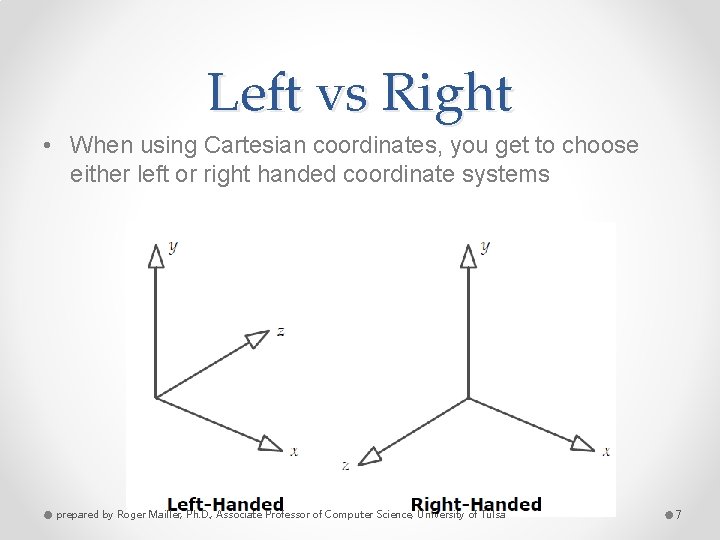
Left vs Right • When using Cartesian coordinates, you get to choose either left or right handed coordinate systems prepared by Roger Mailler, Ph. D. , Associate Professor of Computer Science, University of Tulsa 7
Left vs Right • Converting is easy, flip the direction of any one axis. • Graphics programmers typically pick left-handed with y pointing up, x to the right, and z pointing into the screen • Helps with z-buffering prepared by Roger Mailler, Ph. D. , Associate Professor of Computer Science, University of Tulsa 8
Vectors • Vector have o Magnitude o Direction • • Extend from the tail toward the head Differs from a scalar because of the direction Technically represents an offset relative to a known point Can be used to represent a point if it is relative to the origin o Called a position vector versus direction vector prepared by Roger Mailler, Ph. D. , Associate Professor of Computer Science, University of Tulsa 9
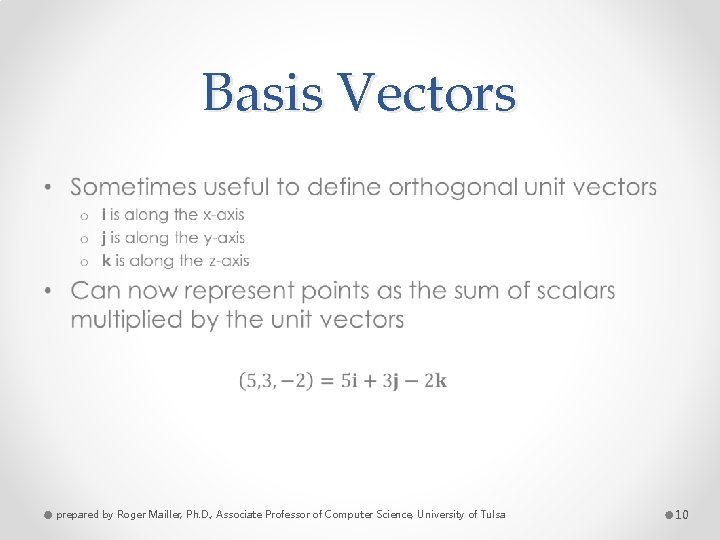
Basis Vectors • prepared by Roger Mailler, Ph. D. , Associate Professor of Computer Science, University of Tulsa 10
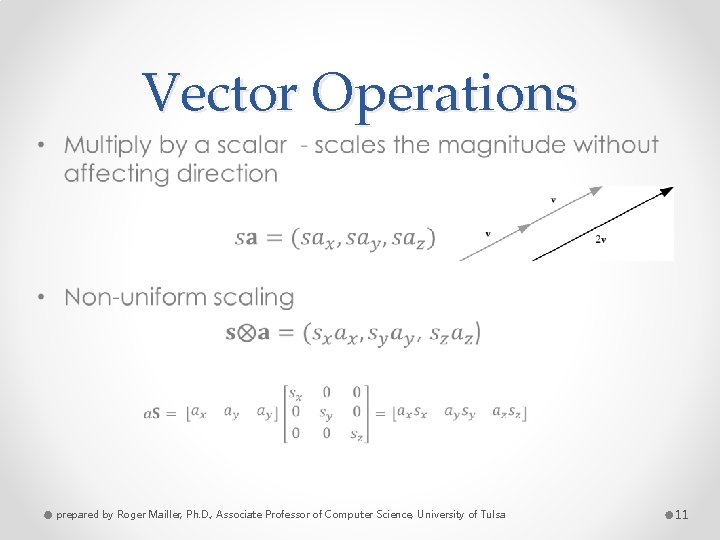
Vector Operations • prepared by Roger Mailler, Ph. D. , Associate Professor of Computer Science, University of Tulsa 11
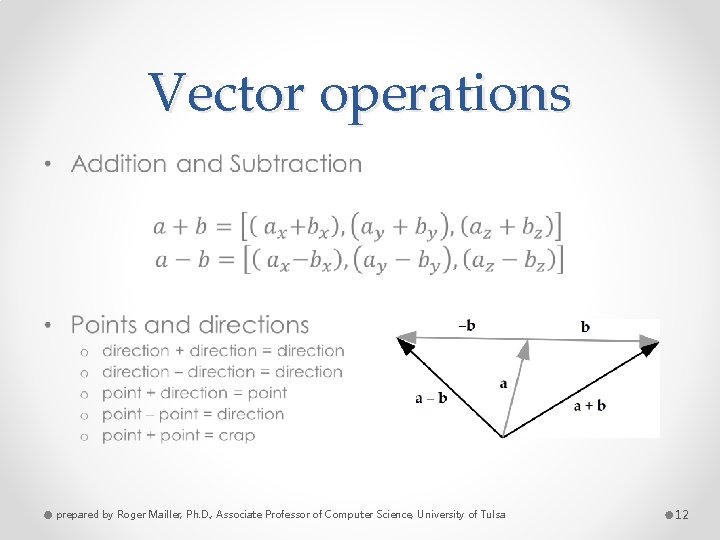
Vector operations prepared by Roger Mailler, Ph. D. , Associate Professor of Computer Science, University of Tulsa 12
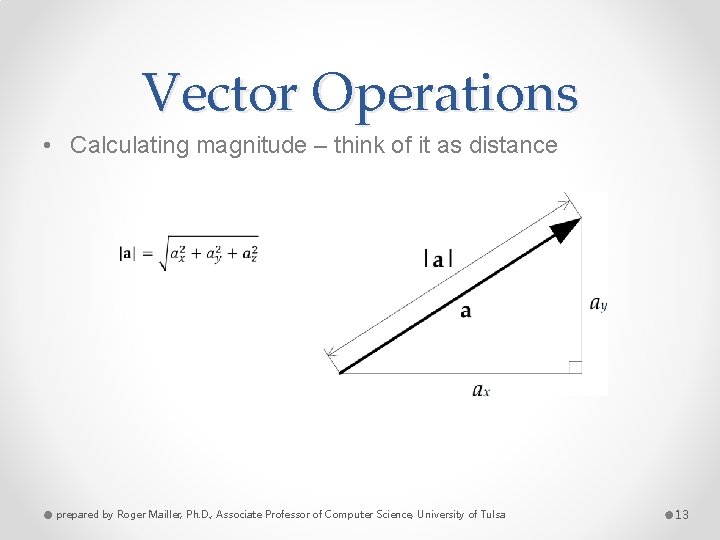
Vector Operations • Calculating magnitude – think of it as distance prepared by Roger Mailler, Ph. D. , Associate Professor of Computer Science, University of Tulsa 13
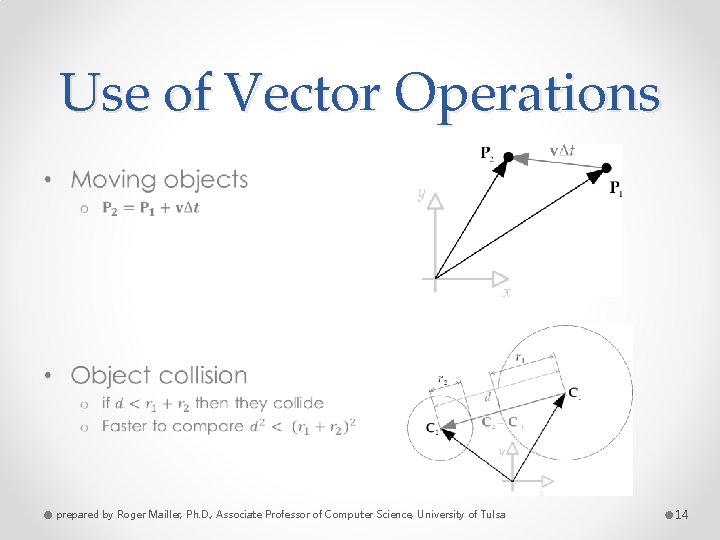
Use of Vector Operations • prepared by Roger Mailler, Ph. D. , Associate Professor of Computer Science, University of Tulsa 14
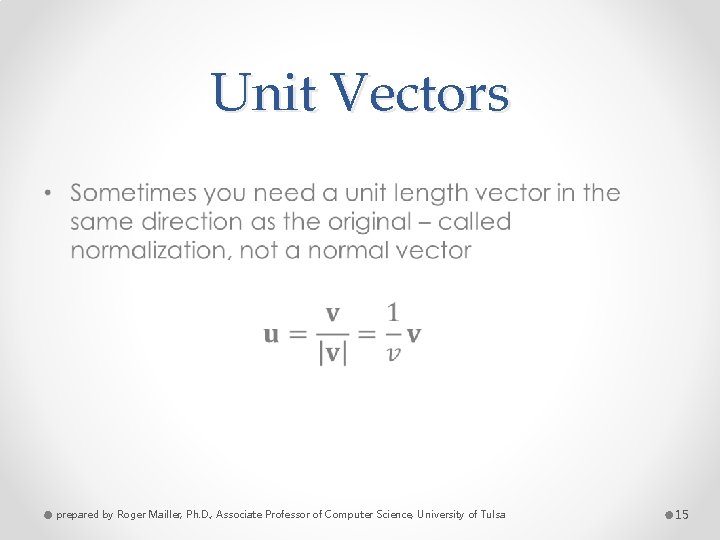
Unit Vectors • prepared by Roger Mailler, Ph. D. , Associate Professor of Computer Science, University of Tulsa 15
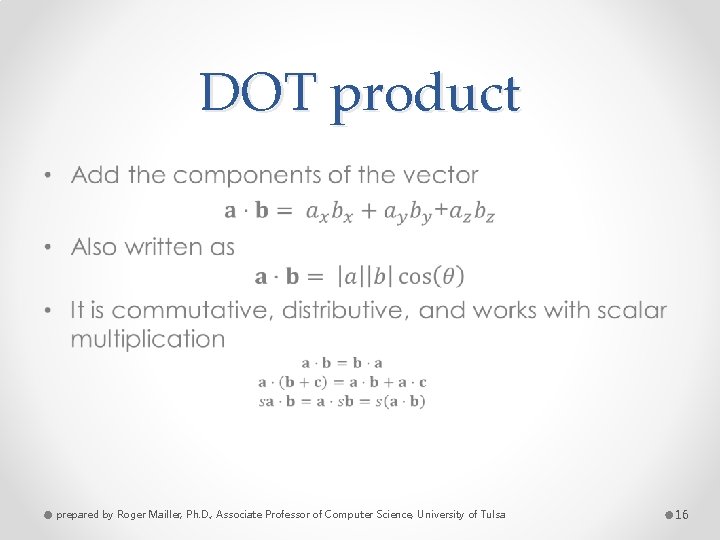
DOT product • prepared by Roger Mailler, Ph. D. , Associate Professor of Computer Science, University of Tulsa 16
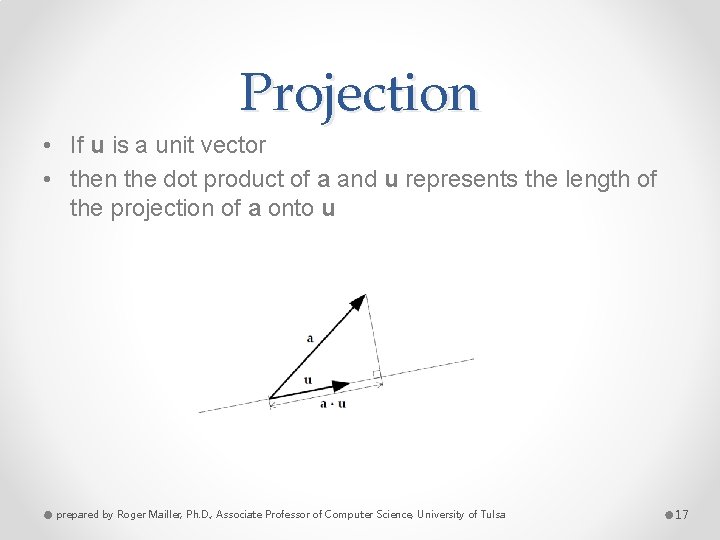
Projection • If u is a unit vector • then the dot product of a and u represents the length of the projection of a onto u prepared by Roger Mailler, Ph. D. , Associate Professor of Computer Science, University of Tulsa 17
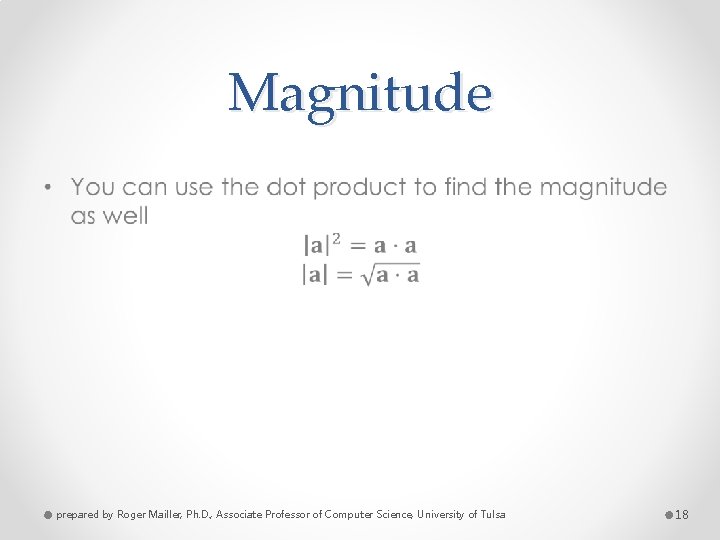
Magnitude • prepared by Roger Mailler, Ph. D. , Associate Professor of Computer Science, University of Tulsa 18
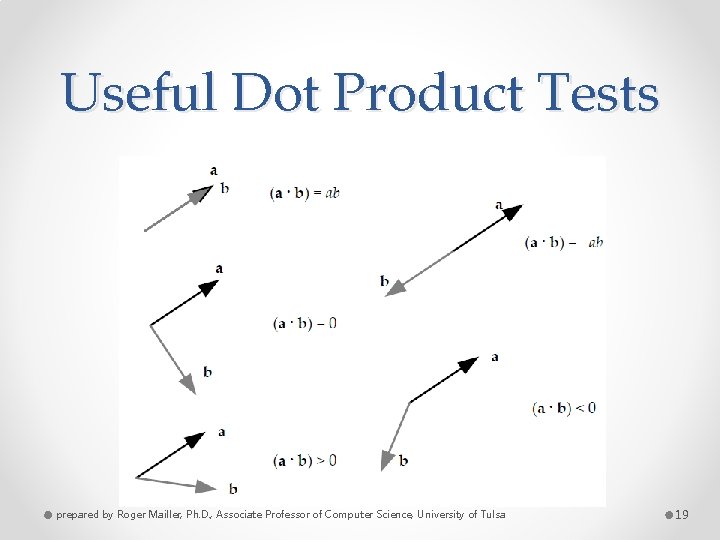
Useful Dot Product Tests prepared by Roger Mailler, Ph. D. , Associate Professor of Computer Science, University of Tulsa 19
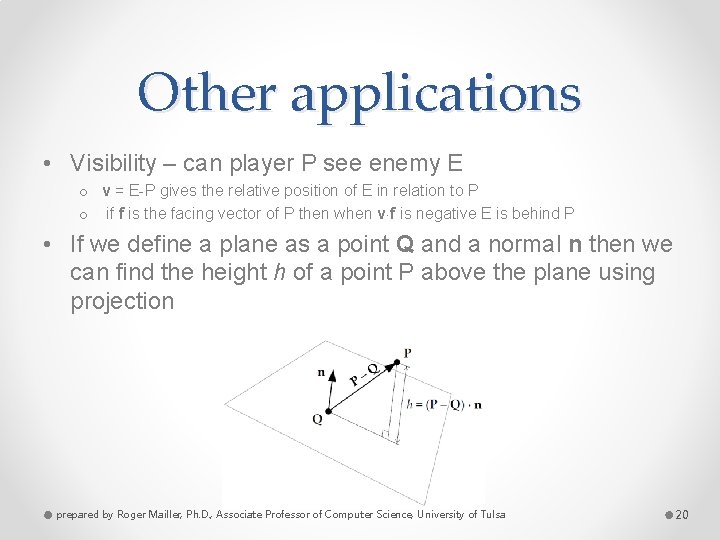
Other applications • Visibility – can player P see enemy E o v = E-P gives the relative position of E in relation to P o if f is the facing vector of P then when v f is negative E is behind P • If we define a plane as a point Q and a normal n then we can find the height h of a point P above the plane using projection prepared by Roger Mailler, Ph. D. , Associate Professor of Computer Science, University of Tulsa 20
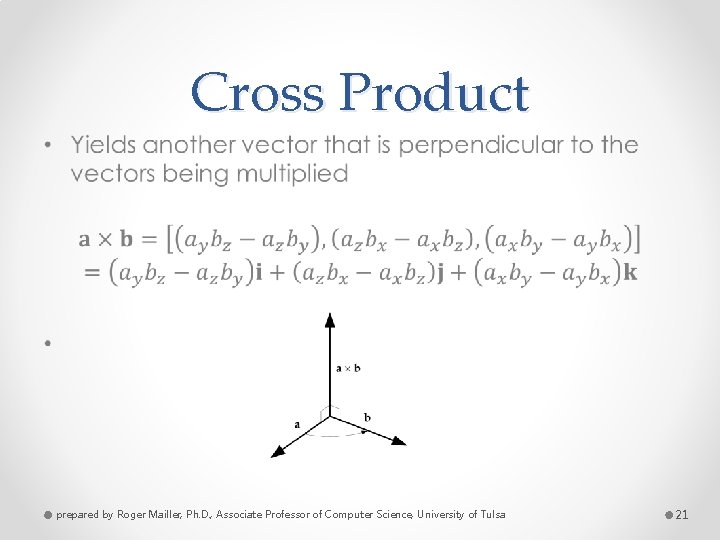
Cross Product • prepared by Roger Mailler, Ph. D. , Associate Professor of Computer Science, University of Tulsa 21
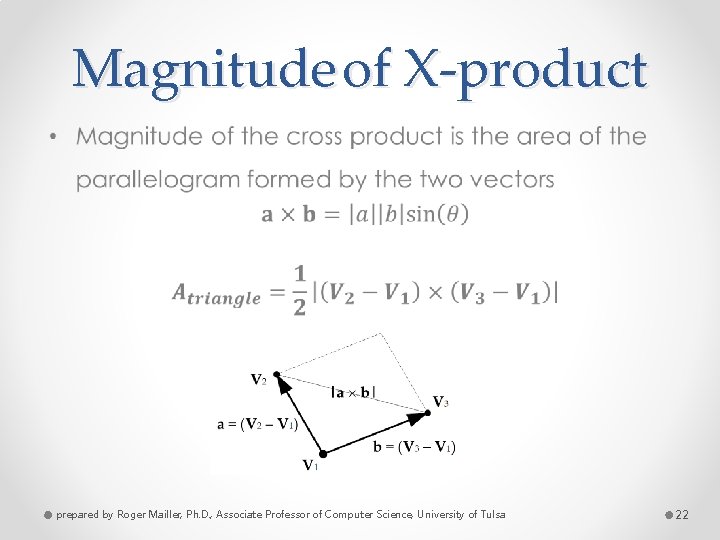
Magnitude of X-product prepared by Roger Mailler, Ph. D. , Associate Professor of Computer Science, University of Tulsa 22
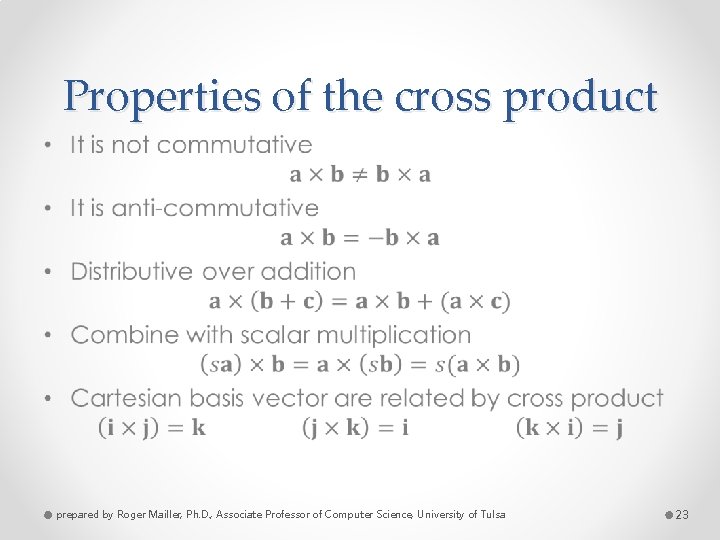
Properties of the cross product • prepared by Roger Mailler, Ph. D. , Associate Professor of Computer Science, University of Tulsa 23
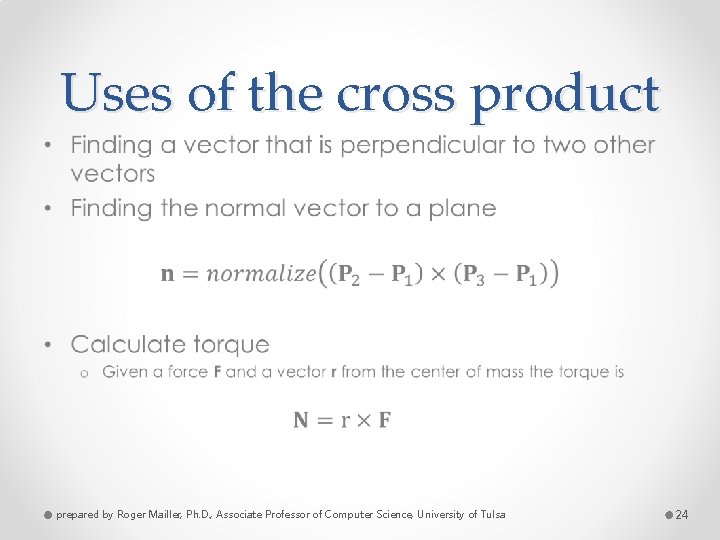
Uses of the cross product • prepared by Roger Mailler, Ph. D. , Associate Professor of Computer Science, University of Tulsa 24
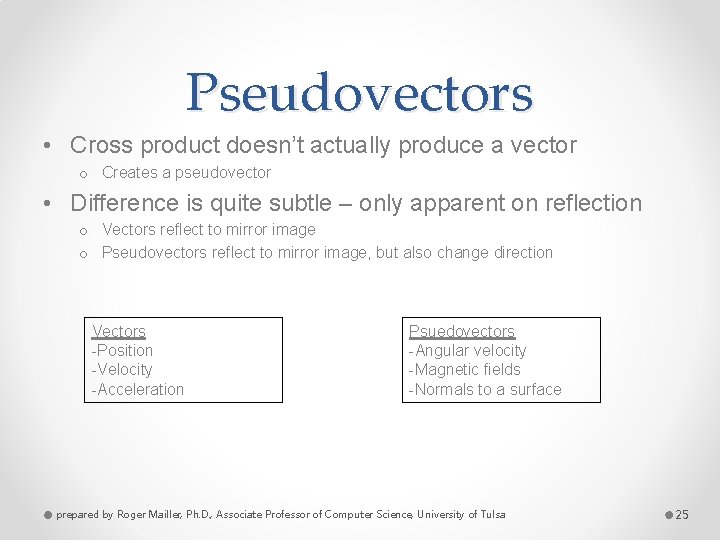
Pseudovectors • Cross product doesn’t actually produce a vector o Creates a pseudovector • Difference is quite subtle – only apparent on reflection o Vectors reflect to mirror image o Pseudovectors reflect to mirror image, but also change direction Vectors -Position -Velocity -Acceleration Psuedovectors -Angular velocity -Magnetic fields -Normals to a surface prepared by Roger Mailler, Ph. D. , Associate Professor of Computer Science, University of Tulsa 25
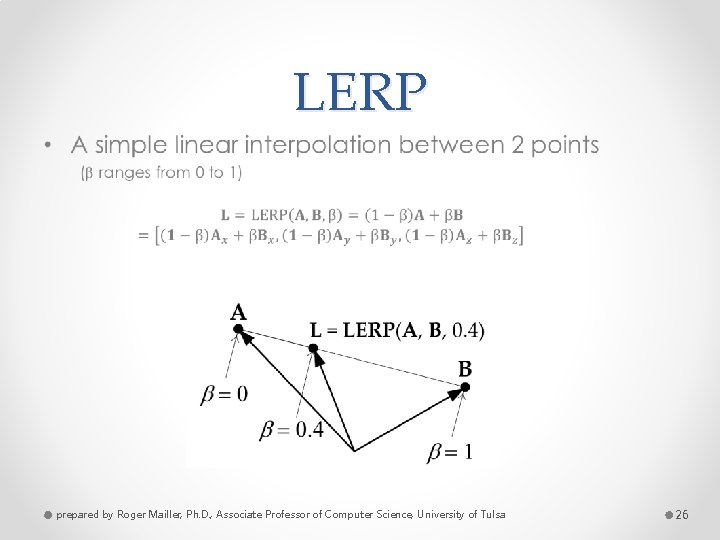
LERP • prepared by Roger Mailler, Ph. D. , Associate Professor of Computer Science, University of Tulsa 26
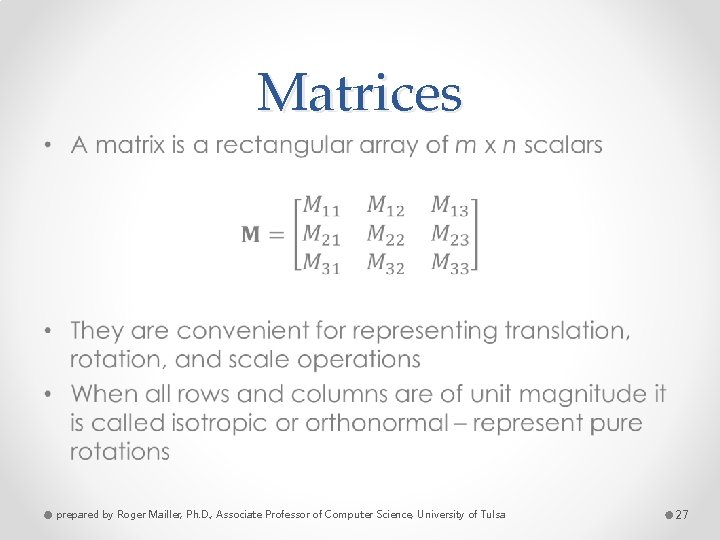
Matrices • prepared by Roger Mailler, Ph. D. , Associate Professor of Computer Science, University of Tulsa 27
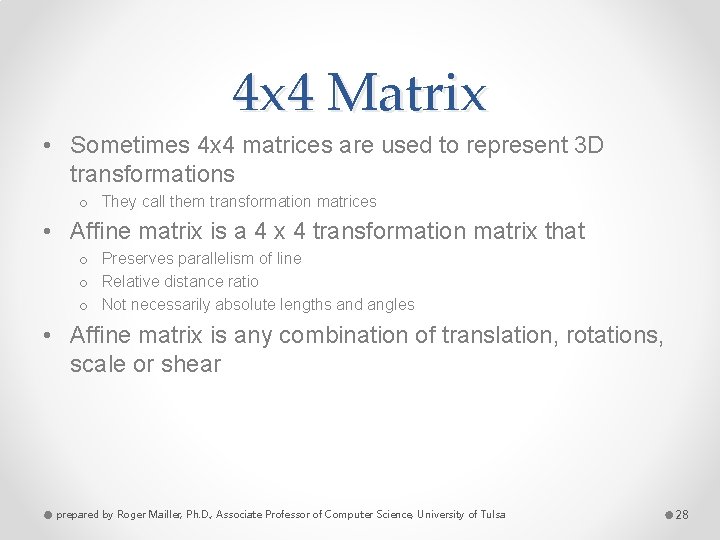
4 x 4 Matrix • Sometimes 4 x 4 matrices are used to represent 3 D transformations o They call them transformation matrices • Affine matrix is a 4 x 4 transformation matrix that o Preserves parallelism of line o Relative distance ratio o Not necessarily absolute lengths and angles • Affine matrix is any combination of translation, rotations, scale or shear prepared by Roger Mailler, Ph. D. , Associate Professor of Computer Science, University of Tulsa 28
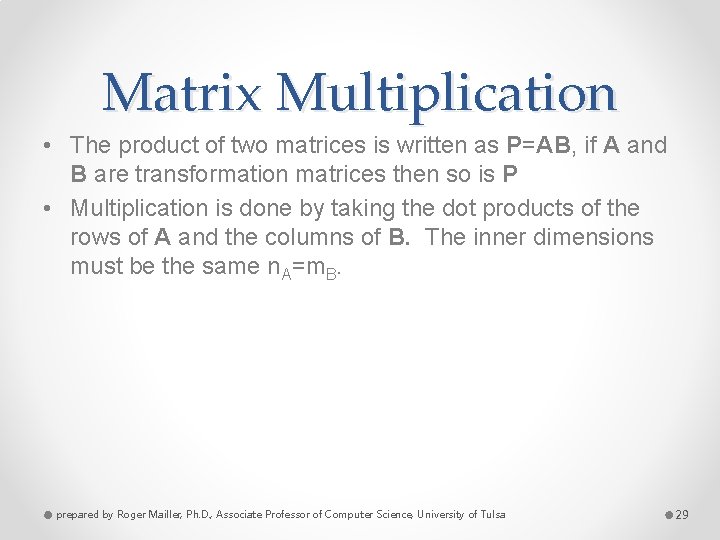
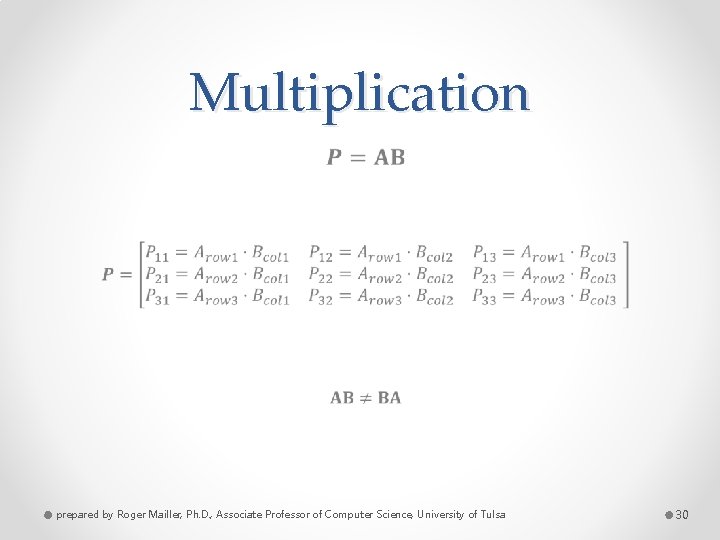
Matrix Multiplication • The product of two matrices is written as P=AB, if A and B are transformation matrices then so is P • Multiplication is done by taking the dot products of the rows of A and the columns of B. The inner dimensions must be the same n. A=m. B. prepared by Roger Mailler, Ph. D. , Associate Professor of Computer Science, University of Tulsa 29
Multiplication • prepared by Roger Mailler, Ph. D. , Associate Professor of Computer Science, University of Tulsa 30
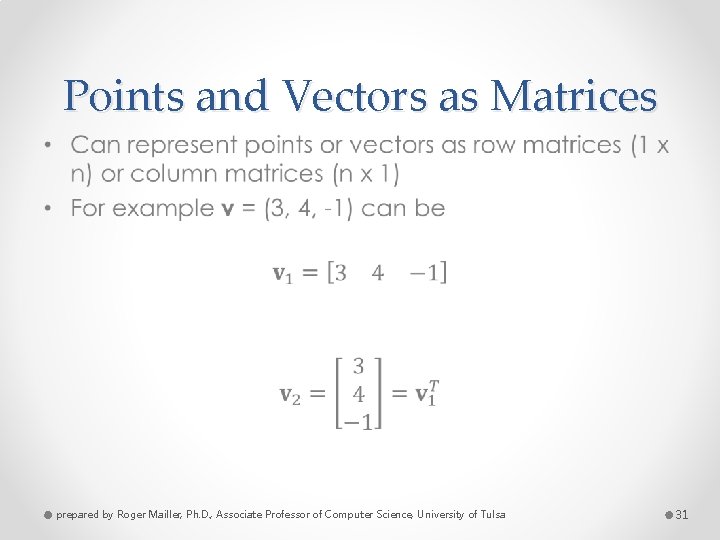
Points and Vectors as Matrices • prepared by Roger Mailler, Ph. D. , Associate Professor of Computer Science, University of Tulsa 31
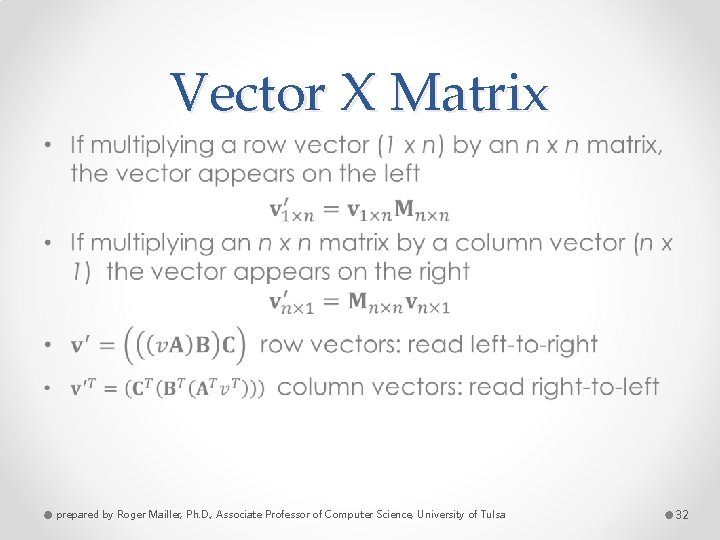
Vector X Matrix • prepared by Roger Mailler, Ph. D. , Associate Professor of Computer Science, University of Tulsa 32
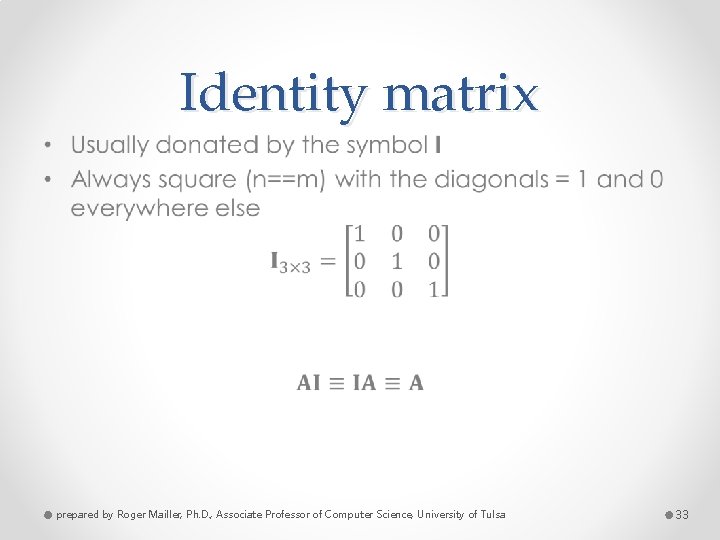
Identity matrix • prepared by Roger Mailler, Ph. D. , Associate Professor of Computer Science, University of Tulsa 33
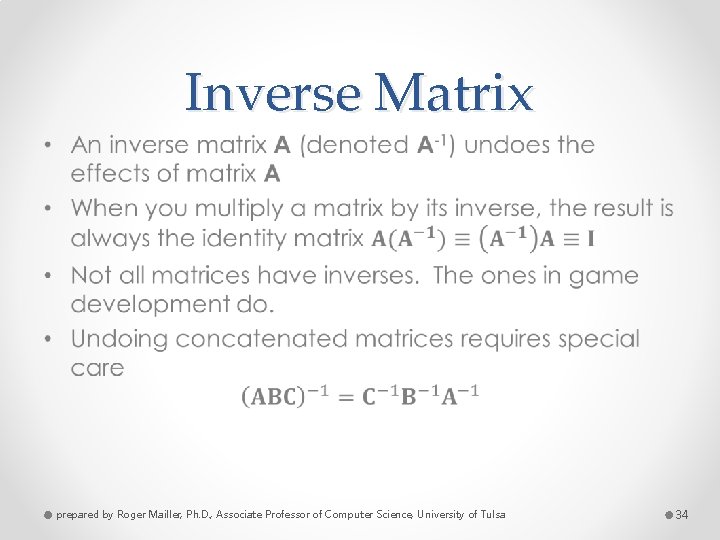
Inverse Matrix • prepared by Roger Mailler, Ph. D. , Associate Professor of Computer Science, University of Tulsa 34
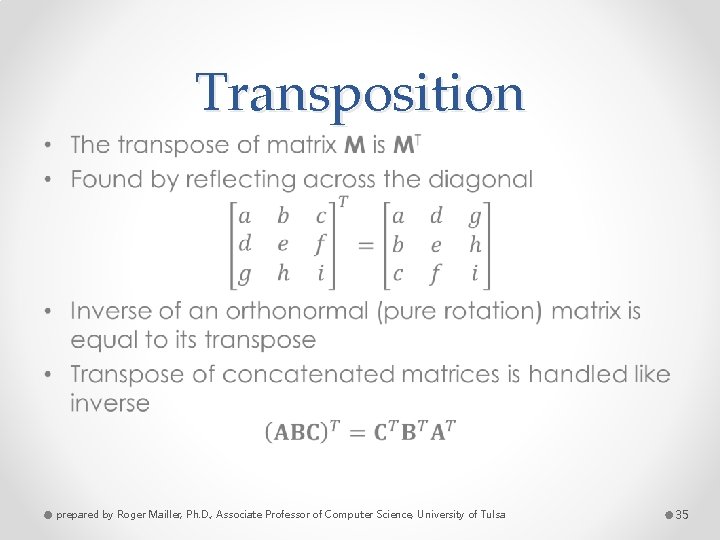
Transposition • prepared by Roger Mailler, Ph. D. , Associate Professor of Computer Science, University of Tulsa 35
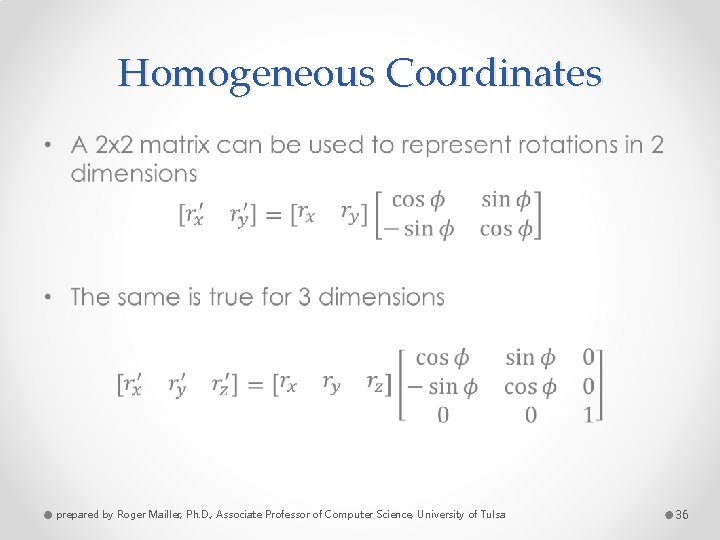
Homogeneous Coordinates • prepared by Roger Mailler, Ph. D. , Associate Professor of Computer Science, University of Tulsa 36
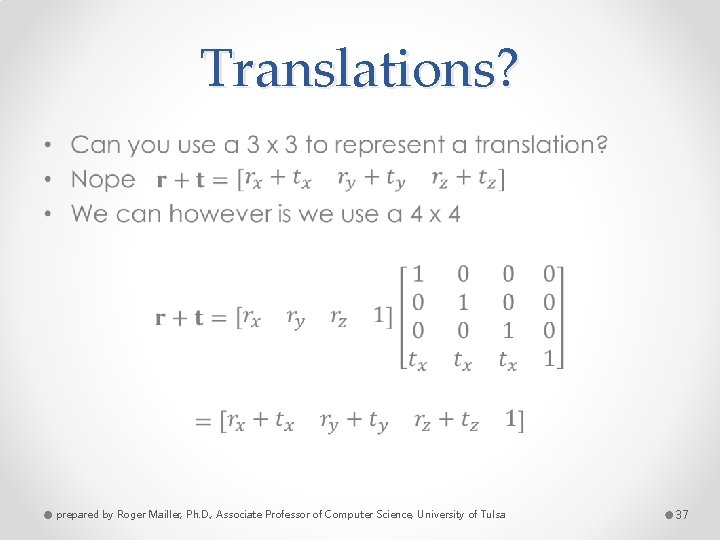
Translations? • prepared by Roger Mailler, Ph. D. , Associate Professor of Computer Science, University of Tulsa 37
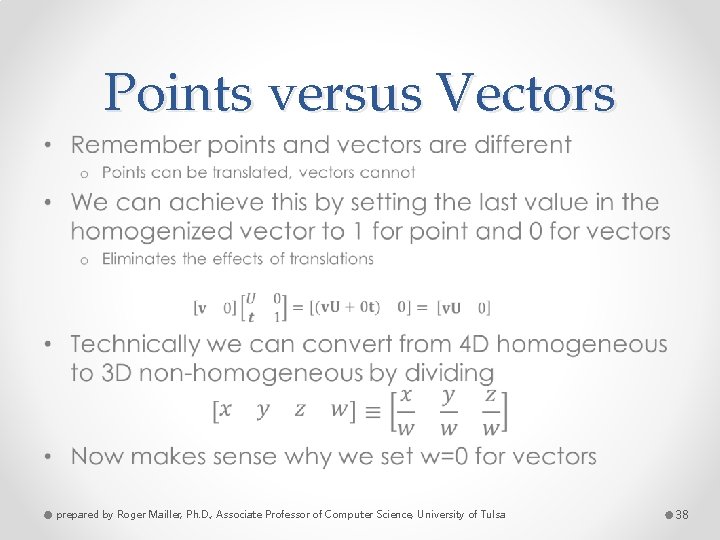
Points versus Vectors • prepared by Roger Mailler, Ph. D. , Associate Professor of Computer Science, University of Tulsa 38
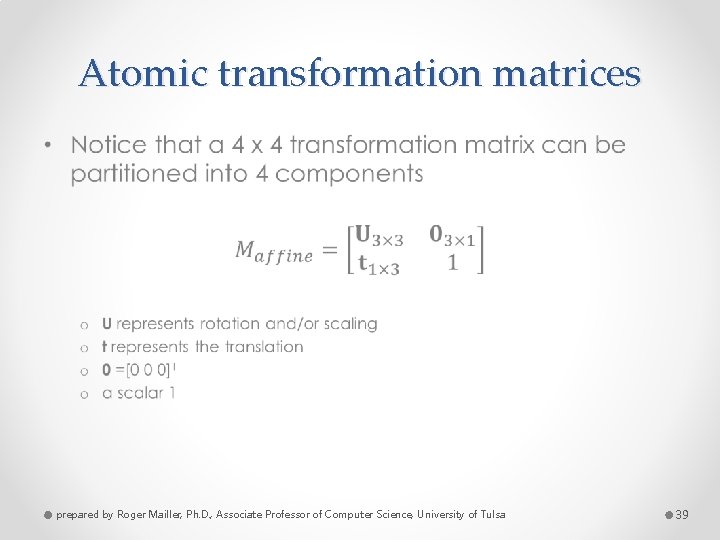
Atomic transformation matrices • prepared by Roger Mailler, Ph. D. , Associate Professor of Computer Science, University of Tulsa 39
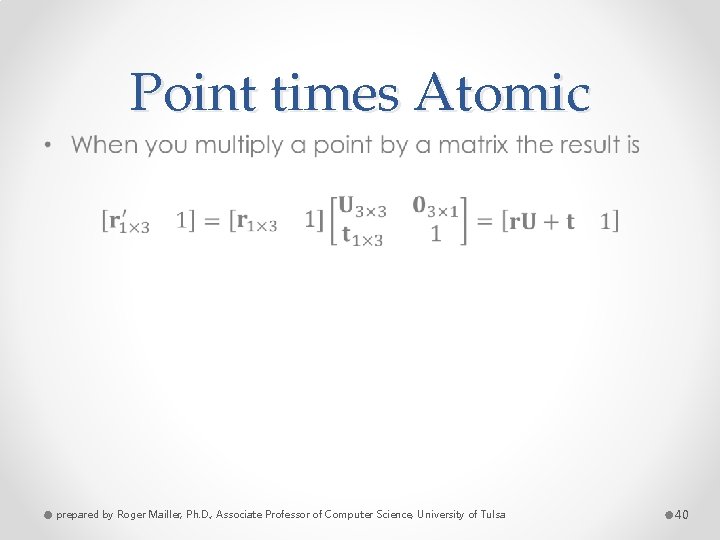
Point times Atomic • prepared by Roger Mailler, Ph. D. , Associate Professor of Computer Science, University of Tulsa 40
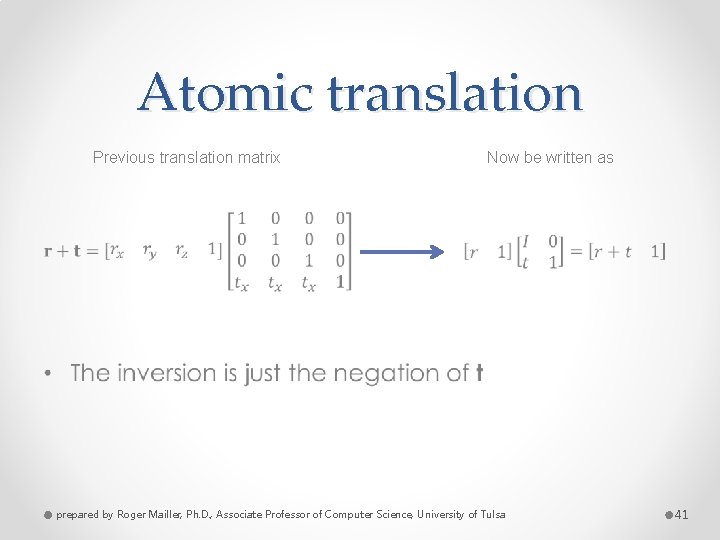
Atomic translation • Previous translation matrix Now be written as prepared by Roger Mailler, Ph. D. , Associate Professor of Computer Science, University of Tulsa 41
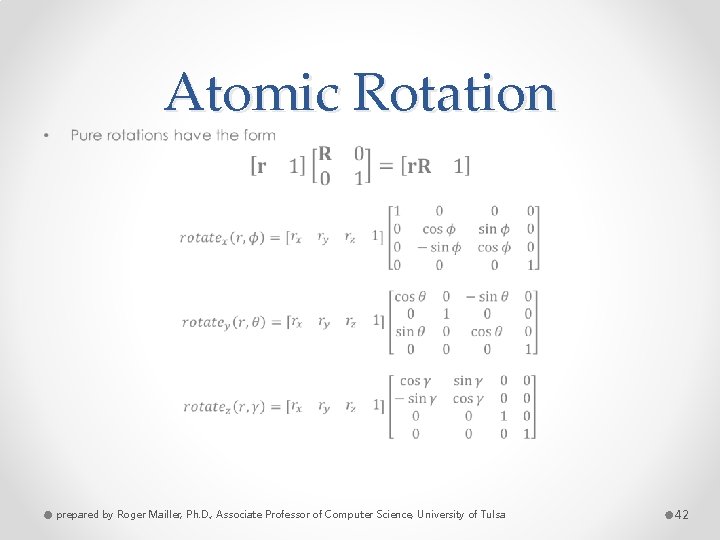
Atomic Rotation • prepared by Roger Mailler, Ph. D. , Associate Professor of Computer Science, University of Tulsa 42
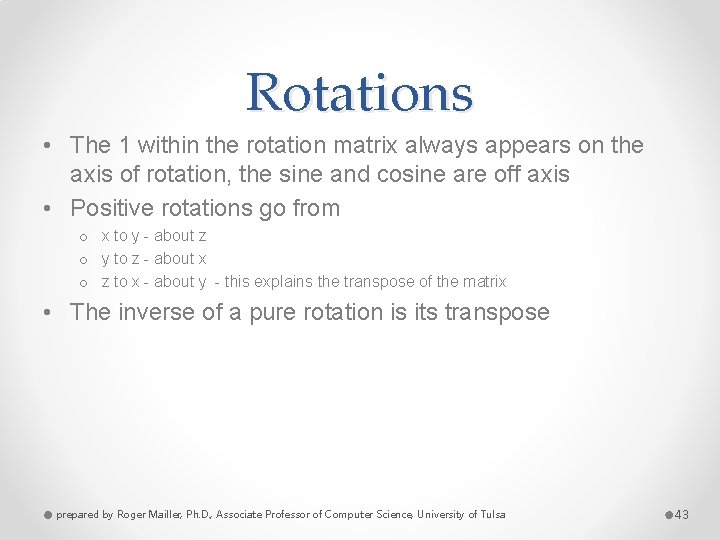
Rotations • The 1 within the rotation matrix always appears on the axis of rotation, the sine and cosine are off axis • Positive rotations go from o x to y - about z o y to z - about x o z to x - about y - this explains the transpose of the matrix • The inverse of a pure rotation is its transpose prepared by Roger Mailler, Ph. D. , Associate Professor of Computer Science, University of Tulsa 43
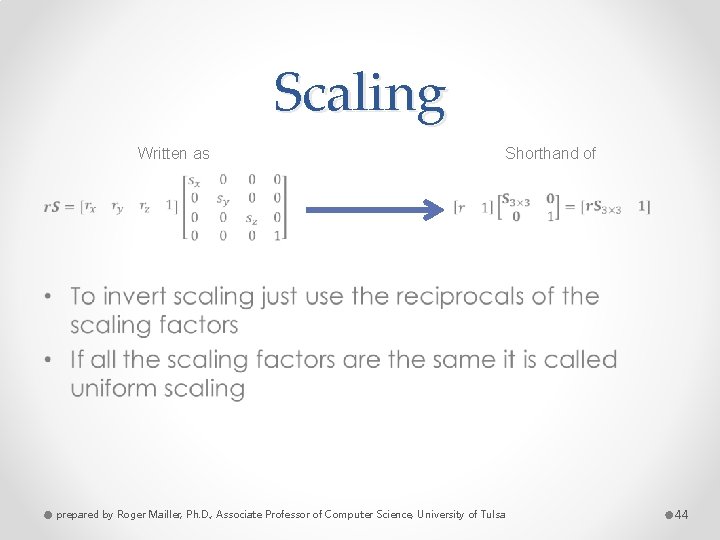
Scaling • Written as Shorthand of prepared by Roger Mailler, Ph. D. , Associate Professor of Computer Science, University of Tulsa 44
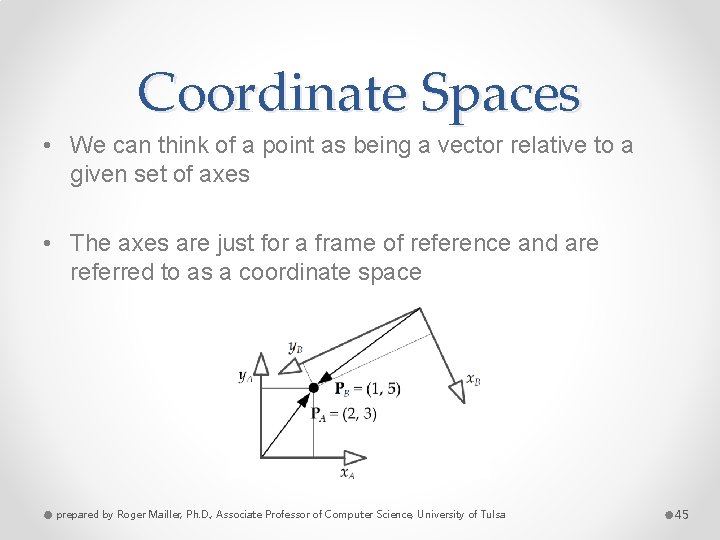
Coordinate Spaces • We can think of a point as being a vector relative to a given set of axes • The axes are just for a frame of reference and are referred to as a coordinate space prepared by Roger Mailler, Ph. D. , Associate Professor of Computer Science, University of Tulsa 45
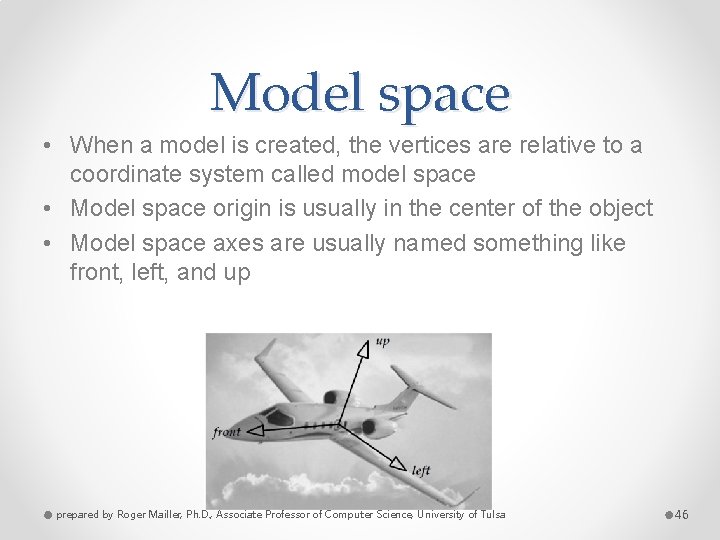
Model space • When a model is created, the vertices are relative to a coordinate system called model space • Model space origin is usually in the center of the object • Model space axes are usually named something like front, left, and up prepared by Roger Mailler, Ph. D. , Associate Professor of Computer Science, University of Tulsa 46
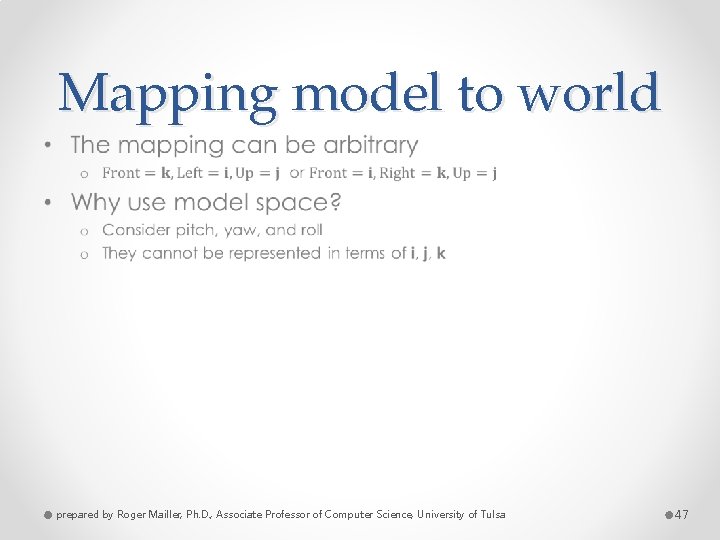
Mapping model to world • prepared by Roger Mailler, Ph. D. , Associate Professor of Computer Science, University of Tulsa 47
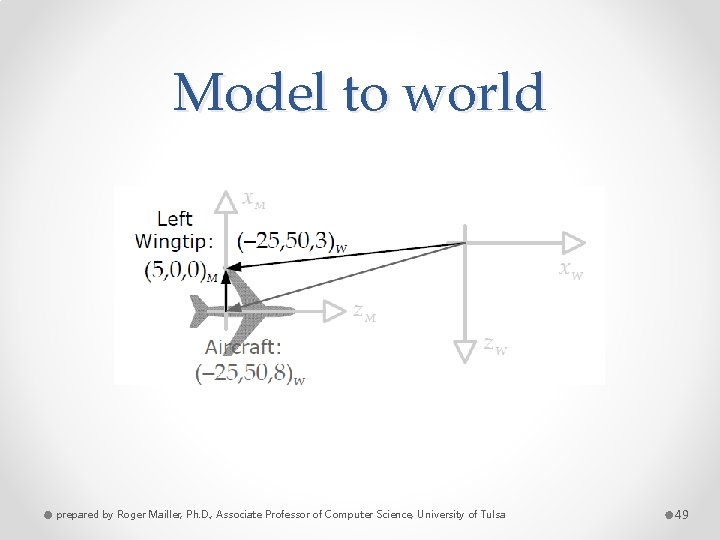
World Space • A fixed coordinate system where the objects, orientations, and scales are defined • Center usually placed at the center of the playable area • The orientation is arbitrary but usually y or z is up prepared by Roger Mailler, Ph. D. , Associate Professor of Computer Science, University of Tulsa 48
Model to world prepared by Roger Mailler, Ph. D. , Associate Professor of Computer Science, University of Tulsa 49
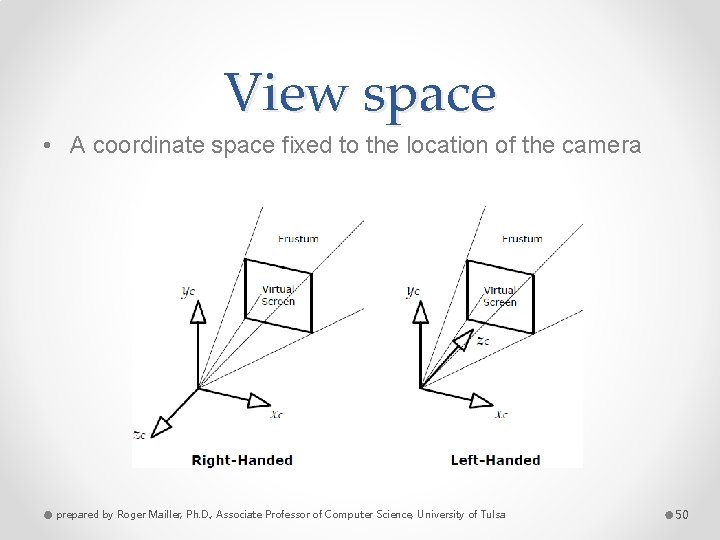
View space • A coordinate space fixed to the location of the camera prepared by Roger Mailler, Ph. D. , Associate Professor of Computer Science, University of Tulsa 50
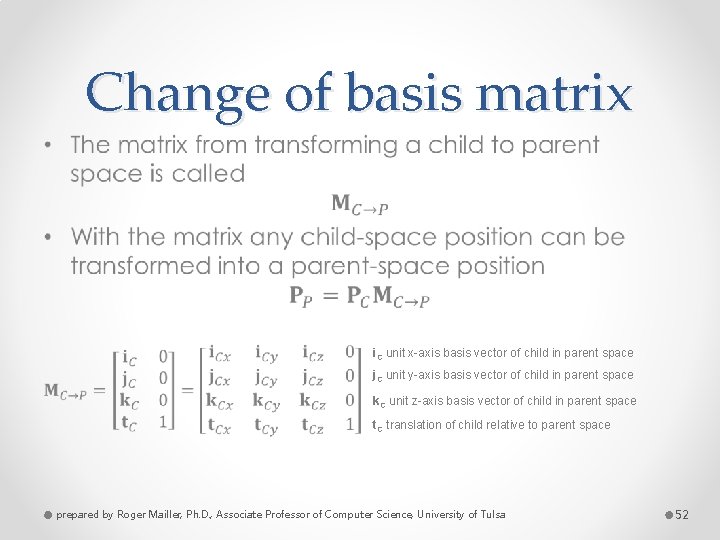
Change of basis • All coordinate spaces are relative o You must specify them in relation to another space • This implies a hierarchy of spaces o The world space is at the root • The camera has a location in world space, so its view space has the world space as a parent prepared by Roger Mailler, Ph. D. , Associate Professor of Computer Science, University of Tulsa 51
Change of basis matrix • i. C unit x-axis basis vector of child in parent space j. C unit y-axis basis vector of child in parent space k. C unit z-axis basis vector of child in parent space t. C translation of child relative to parent space prepared by Roger Mailler, Ph. D. , Associate Professor of Computer Science, University of Tulsa 52
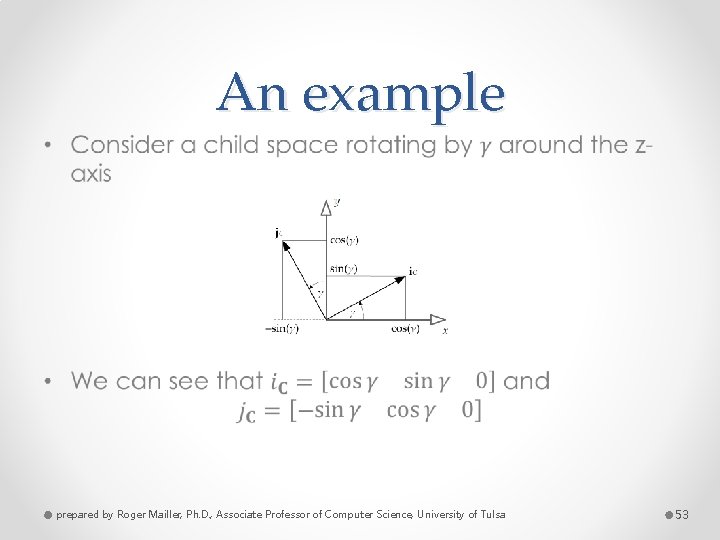
An example • prepared by Roger Mailler, Ph. D. , Associate Professor of Computer Science, University of Tulsa 53
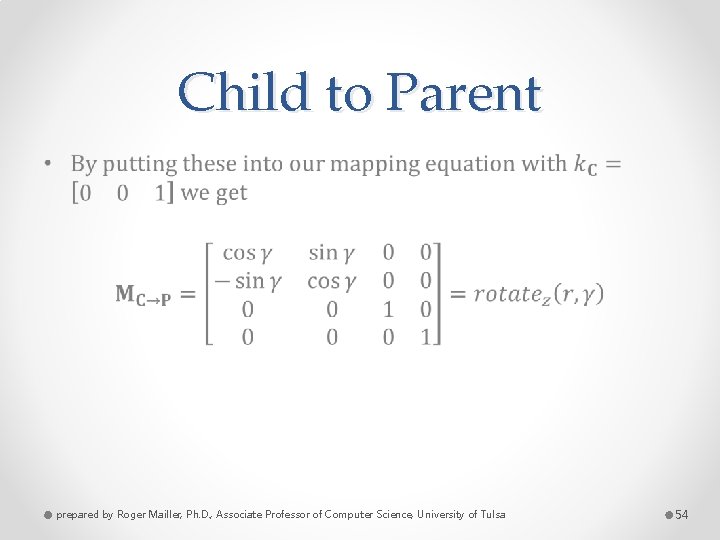
Child to Parent • prepared by Roger Mailler, Ph. D. , Associate Professor of Computer Science, University of Tulsa 54
Extracting the basis • Given a 4 X 4 transformation matrix we can extract the unit basis vectors by grabbing the proper row • Say you have a vehicle’s model-to-world affine matrix and assume the vehicle always points in the positive zaxis • We can extract kc from the transformation to get the vehicle facing direction prepared by Roger Mailler, Ph. D. , Associate Professor of Computer Science, University of Tulsa 55
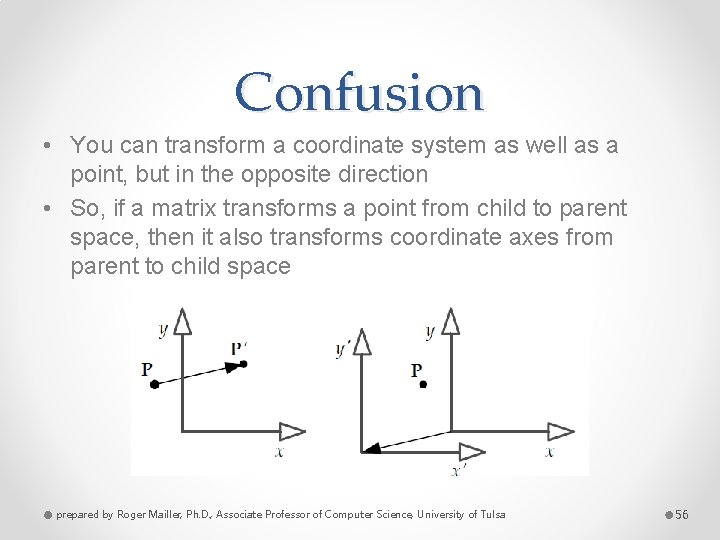
Confusion • You can transform a coordinate system as well as a point, but in the opposite direction • So, if a matrix transforms a point from child to parent space, then it also transforms coordinate axes from parent to child space prepared by Roger Mailler, Ph. D. , Associate Professor of Computer Science, University of Tulsa 56
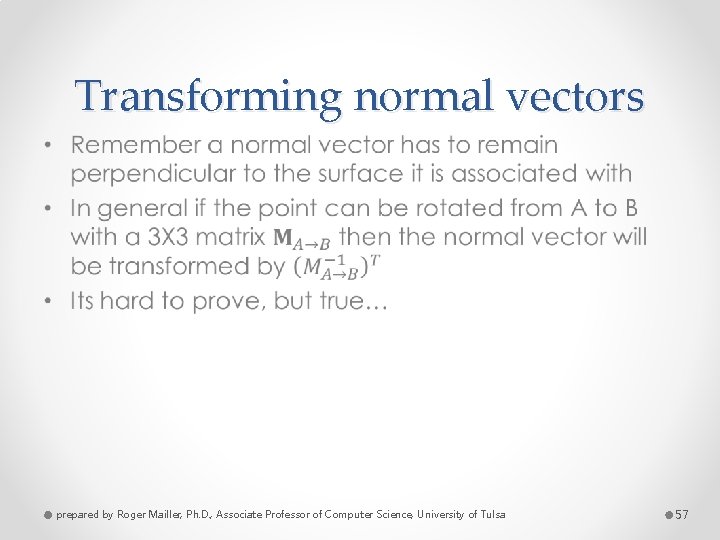
Transforming normal vectors • prepared by Roger Mailler, Ph. D. , Associate Professor of Computer Science, University of Tulsa 57
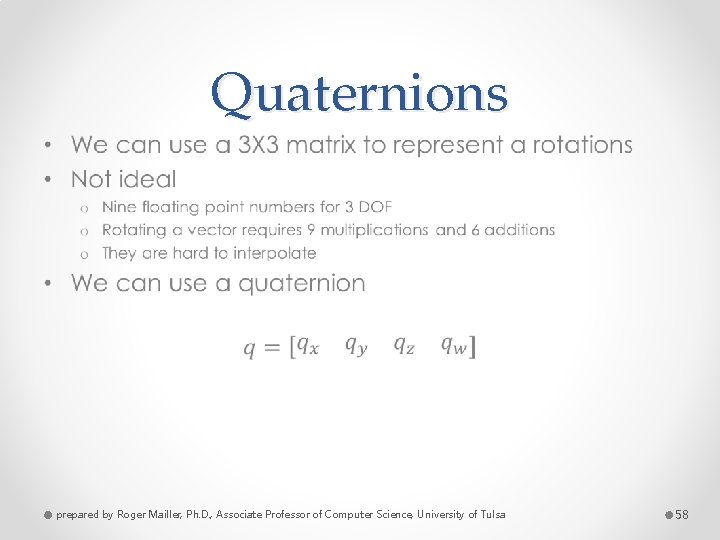
Quaternions • prepared by Roger Mailler, Ph. D. , Associate Professor of Computer Science, University of Tulsa 58
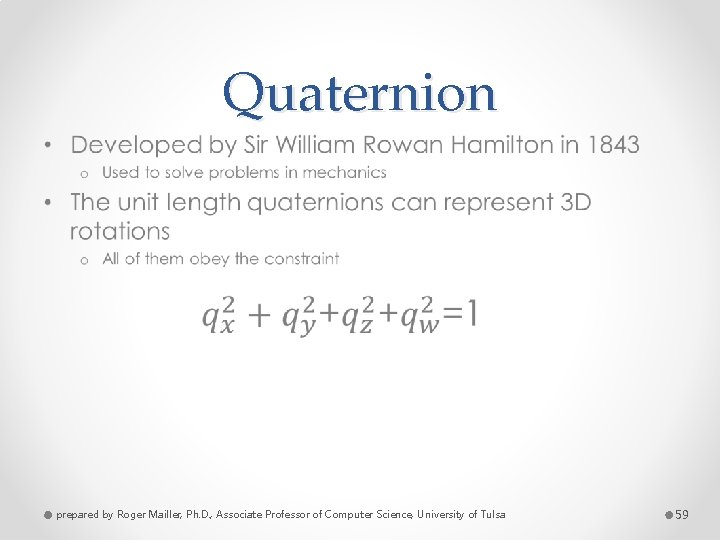
Quaternion • prepared by Roger Mailler, Ph. D. , Associate Professor of Computer Science, University of Tulsa 59
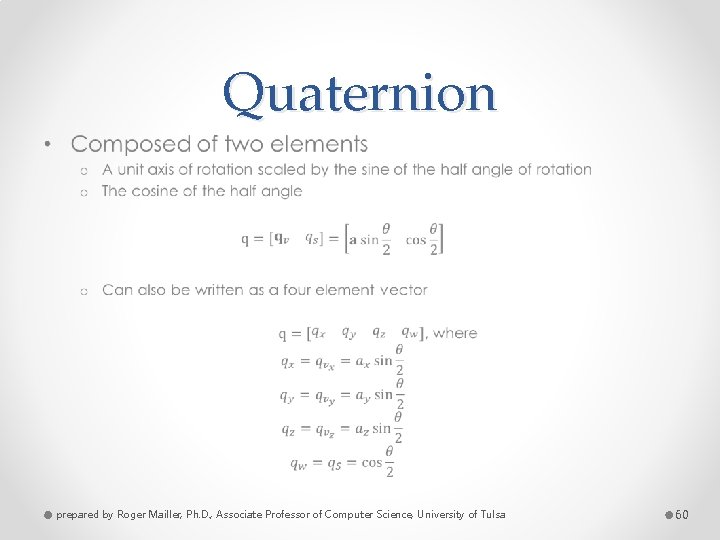
Quaternion • prepared by Roger Mailler, Ph. D. , Associate Professor of Computer Science, University of Tulsa 60
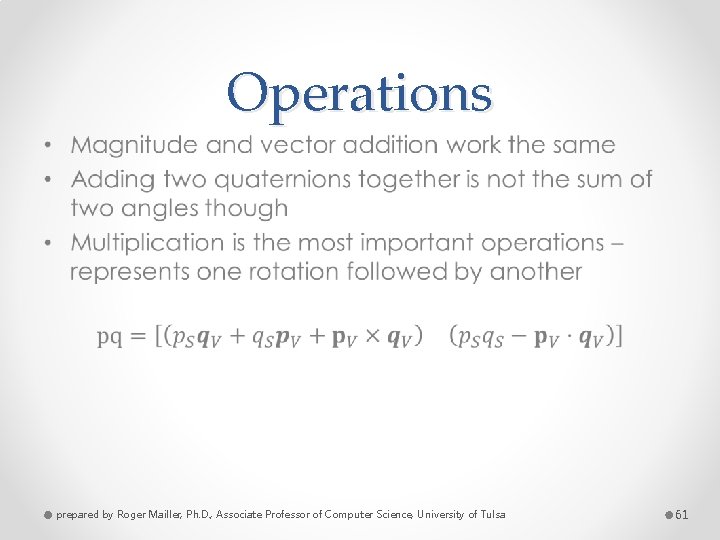
Operations • prepared by Roger Mailler, Ph. D. , Associate Professor of Computer Science, University of Tulsa 61
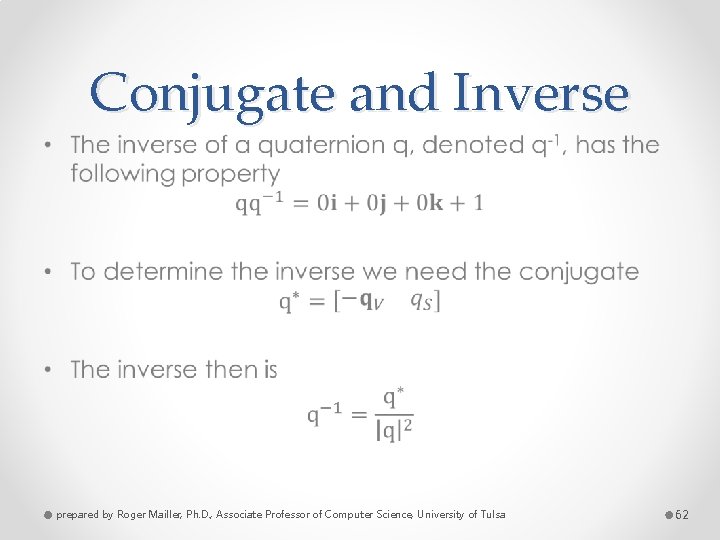
Conjugate and Inverse • prepared by Roger Mailler, Ph. D. , Associate Professor of Computer Science, University of Tulsa 62
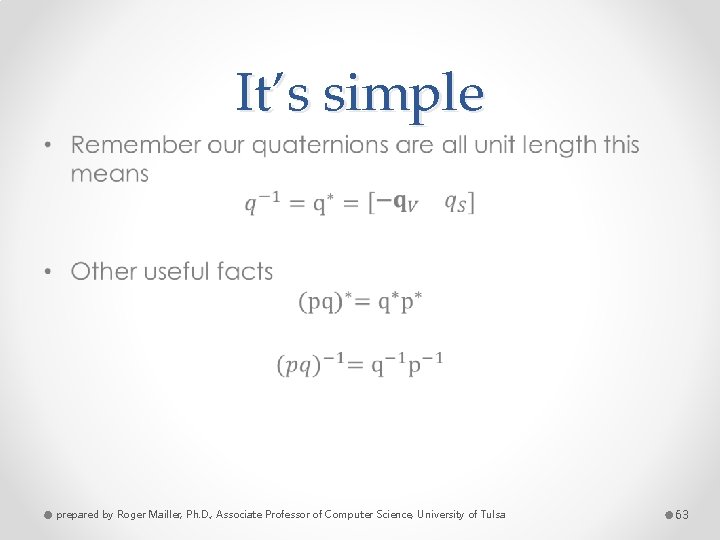
It’s simple • prepared by Roger Mailler, Ph. D. , Associate Professor of Computer Science, University of Tulsa 63
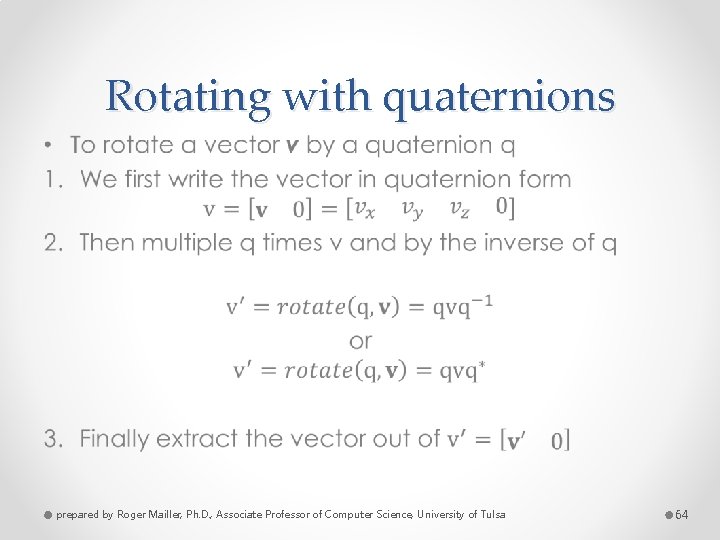
Rotating with quaternions • prepared by Roger Mailler, Ph. D. , Associate Professor of Computer Science, University of Tulsa 64
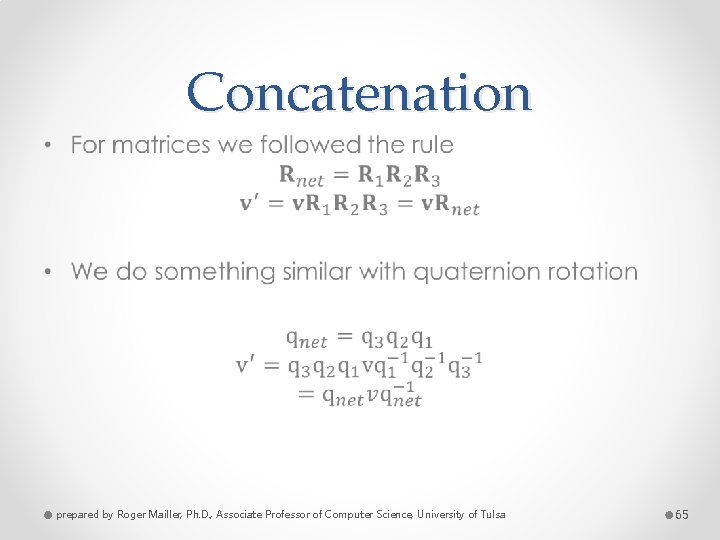
Concatenation • prepared by Roger Mailler, Ph. D. , Associate Professor of Computer Science, University of Tulsa 65
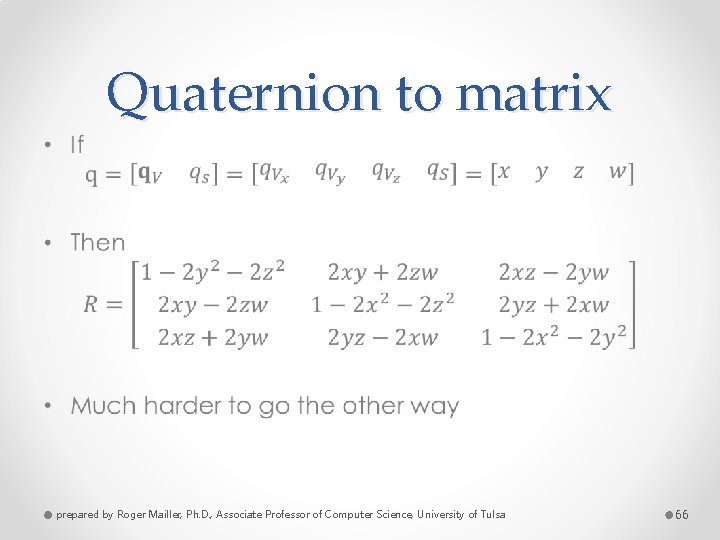
Quaternion to matrix • prepared by Roger Mailler, Ph. D. , Associate Professor of Computer Science, University of Tulsa 66
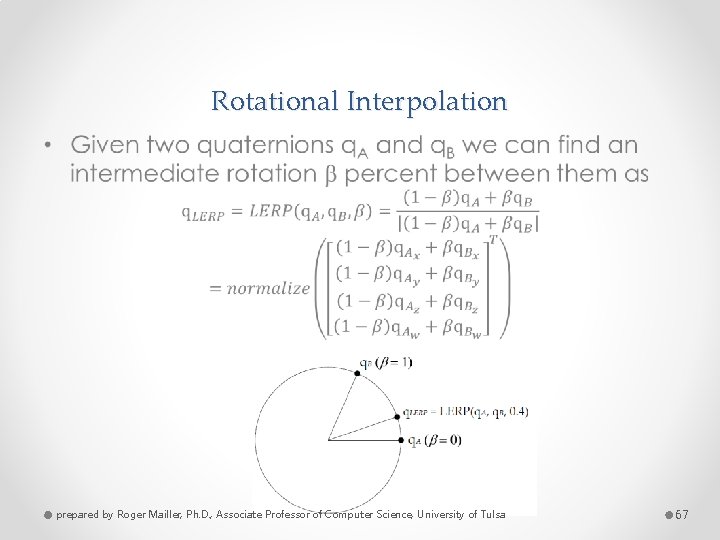
Rotational Interpolation • prepared by Roger Mailler, Ph. D. , Associate Professor of Computer Science, University of Tulsa 67
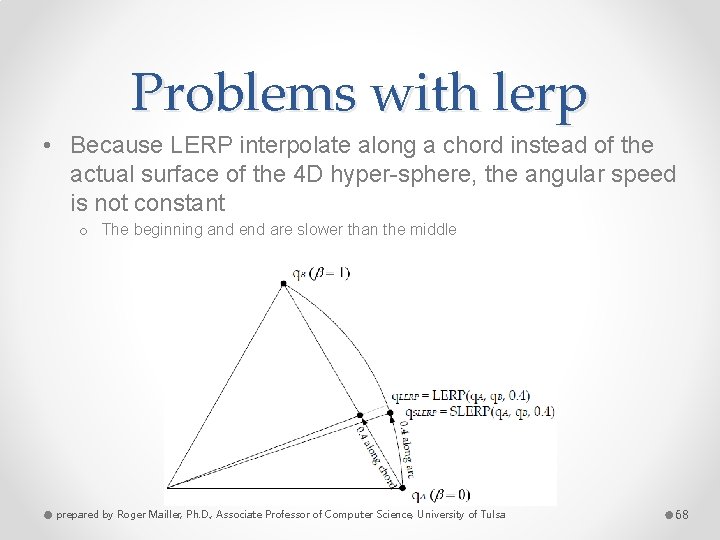
Problems with lerp • Because LERP interpolate along a chord instead of the actual surface of the 4 D hyper-sphere, the angular speed is not constant o The beginning and end are slower than the middle prepared by Roger Mailler, Ph. D. , Associate Professor of Computer Science, University of Tulsa 68
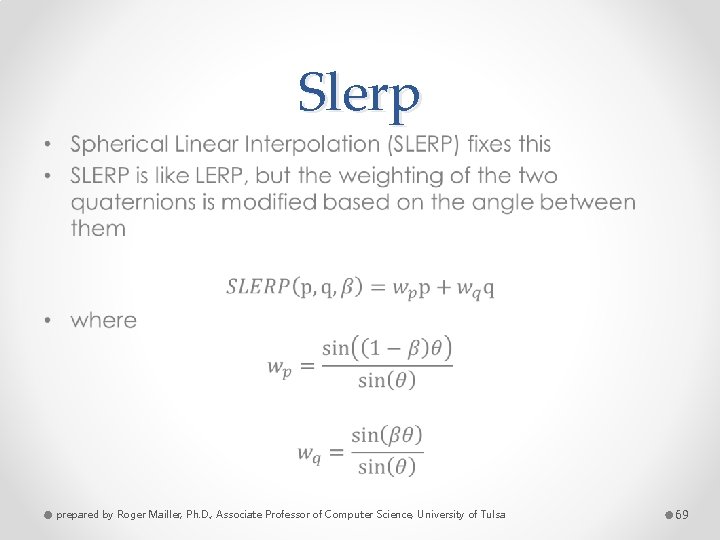
Slerp • prepared by Roger Mailler, Ph. D. , Associate Professor of Computer Science, University of Tulsa 69
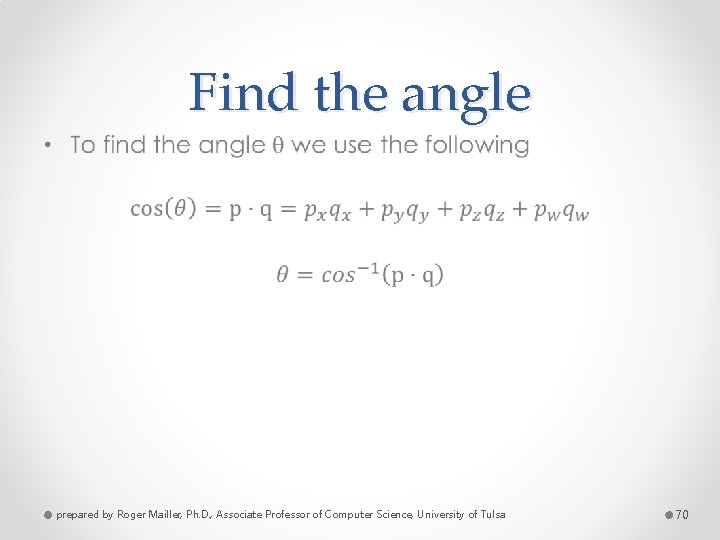
Find the angle • prepared by Roger Mailler, Ph. D. , Associate Professor of Computer Science, University of Tulsa 70
Should you slerp? • It depends • If you can get it to be fast enough, then use it • Otherwise LERP is fine and likely the user can’t tell anyway prepared by Roger Mailler, Ph. D. , Associate Professor of Computer Science, University of Tulsa 71
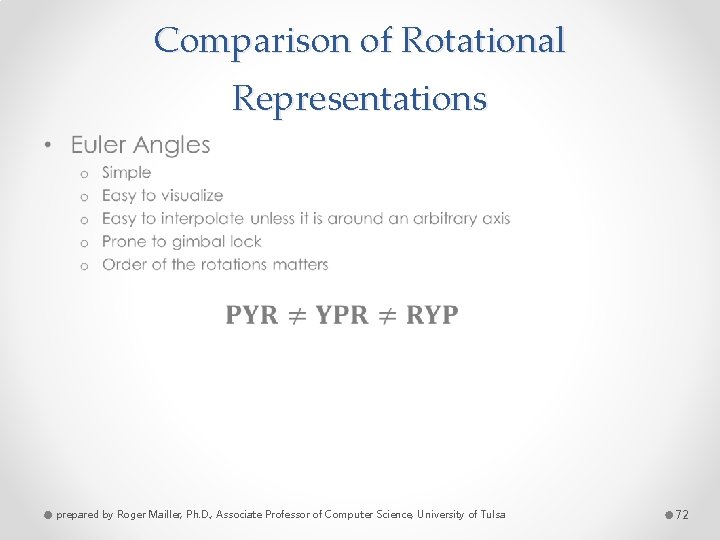
Comparison of Rotational Representations • prepared by Roger Mailler, Ph. D. , Associate Professor of Computer Science, University of Tulsa 72
3 X 3 Matrix • • Overall pretty good Not subject to gimbal lock Uses lots of computation and memory Not very intuitive to read prepared by Roger Mailler, Ph. D. , Associate Professor of Computer Science, University of Tulsa 73
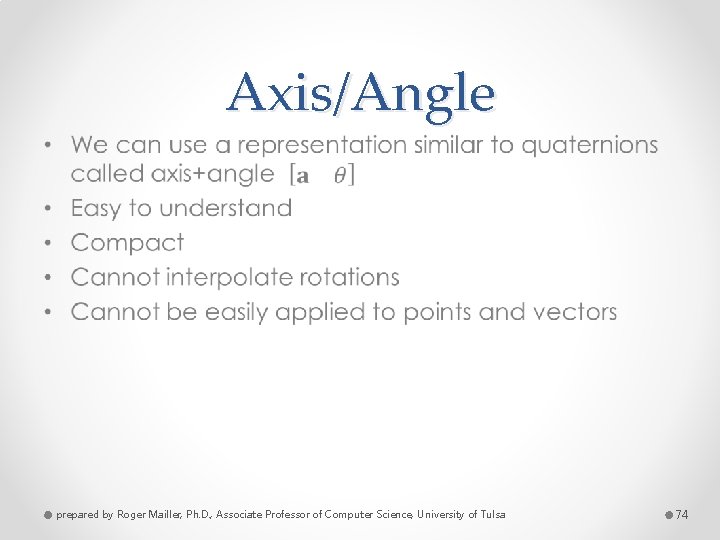
Axis/Angle • prepared by Roger Mailler, Ph. D. , Associate Professor of Computer Science, University of Tulsa 74
Quaternions • • Small Can be easily applied to vectors and points Easy to interpolate Hard to read prepared by Roger Mailler, Ph. D. , Associate Professor of Computer Science, University of Tulsa 75
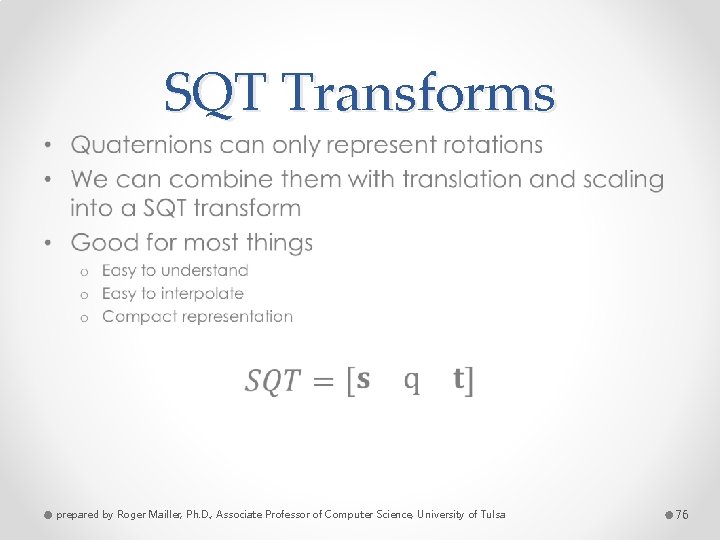
SQT Transforms • prepared by Roger Mailler, Ph. D. , Associate Professor of Computer Science, University of Tulsa 76
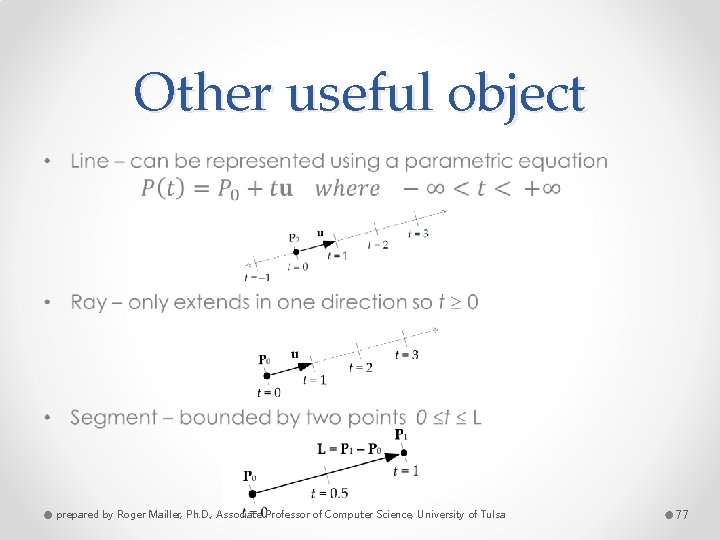
Other useful object • prepared by Roger Mailler, Ph. D. , Associate Professor of Computer Science, University of Tulsa 77
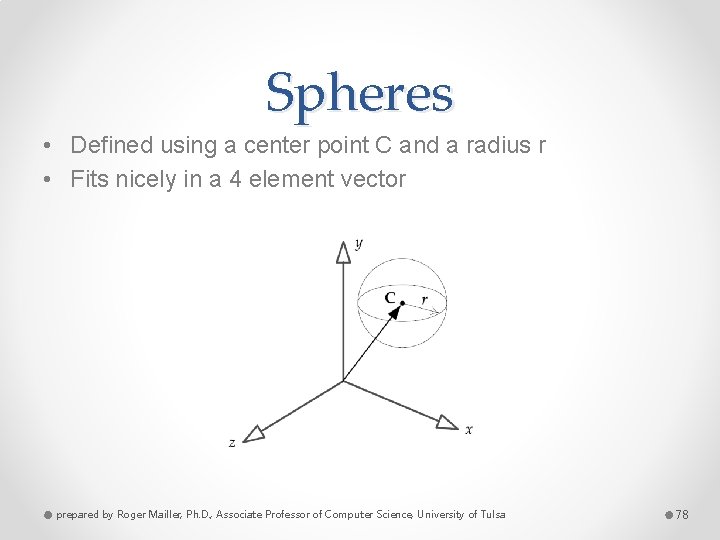
Spheres • Defined using a center point C and a radius r • Fits nicely in a 4 element vector prepared by Roger Mailler, Ph. D. , Associate Professor of Computer Science, University of Tulsa 78
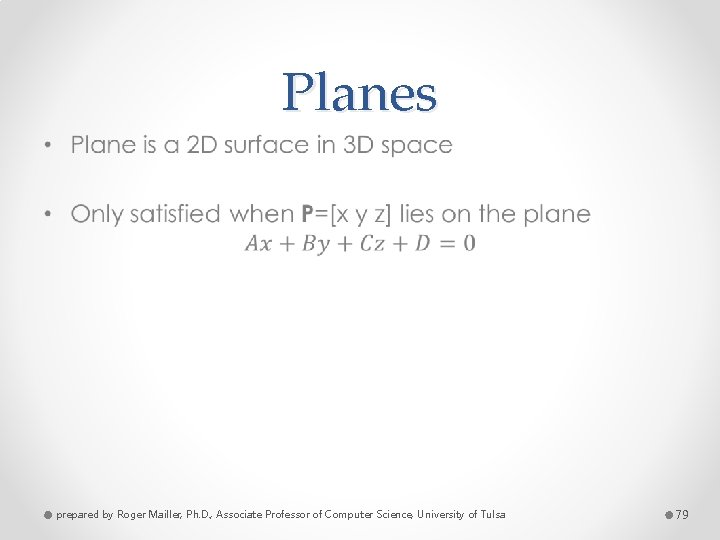
Planes • prepared by Roger Mailler, Ph. D. , Associate Professor of Computer Science, University of Tulsa 79
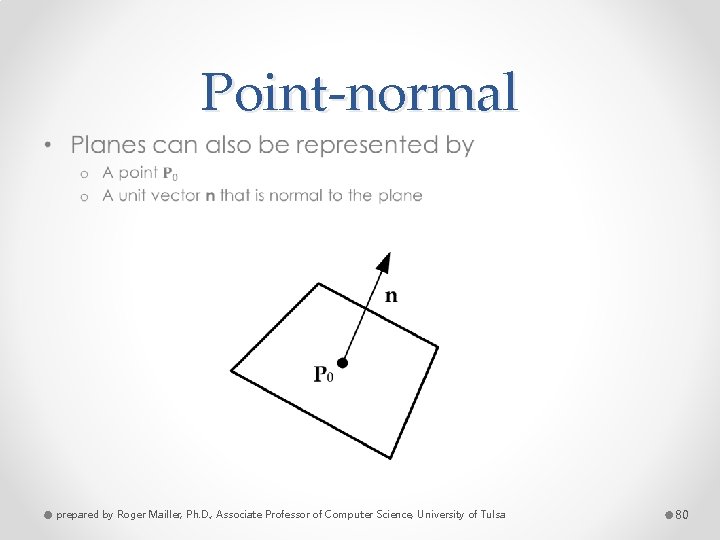
Point-normal • prepared by Roger Mailler, Ph. D. , Associate Professor of Computer Science, University of Tulsa 80
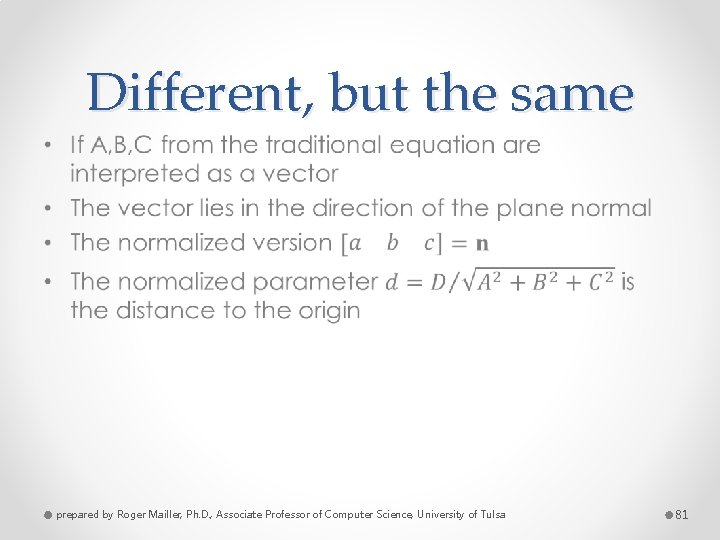
Different, but the same • prepared by Roger Mailler, Ph. D. , Associate Professor of Computer Science, University of Tulsa 81
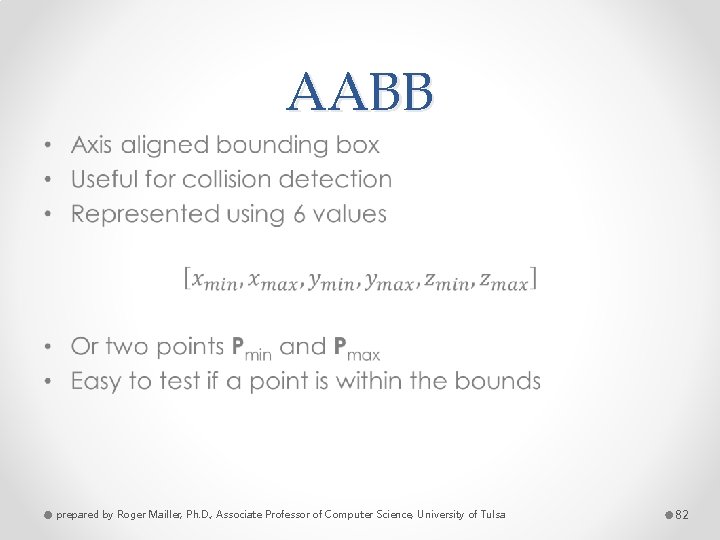
AABB • prepared by Roger Mailler, Ph. D. , Associate Professor of Computer Science, University of Tulsa 82
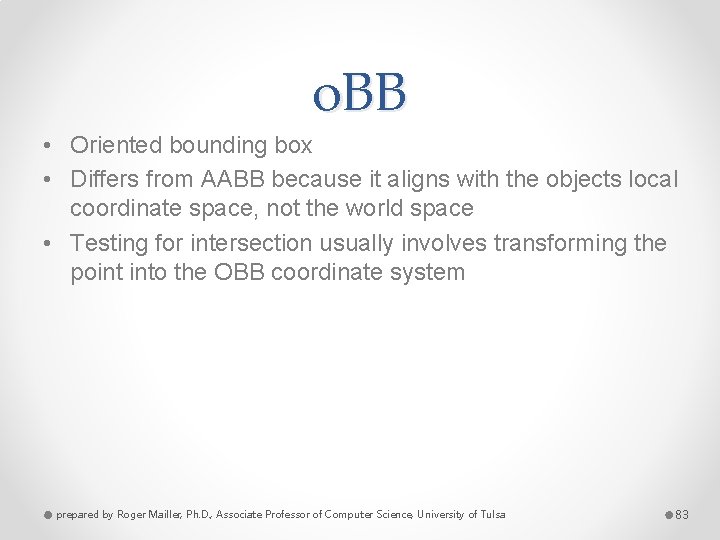
o. BB • Oriented bounding box • Differs from AABB because it aligns with the objects local coordinate space, not the world space • Testing for intersection usually involves transforming the point into the OBB coordinate system prepared by Roger Mailler, Ph. D. , Associate Professor of Computer Science, University of Tulsa 83
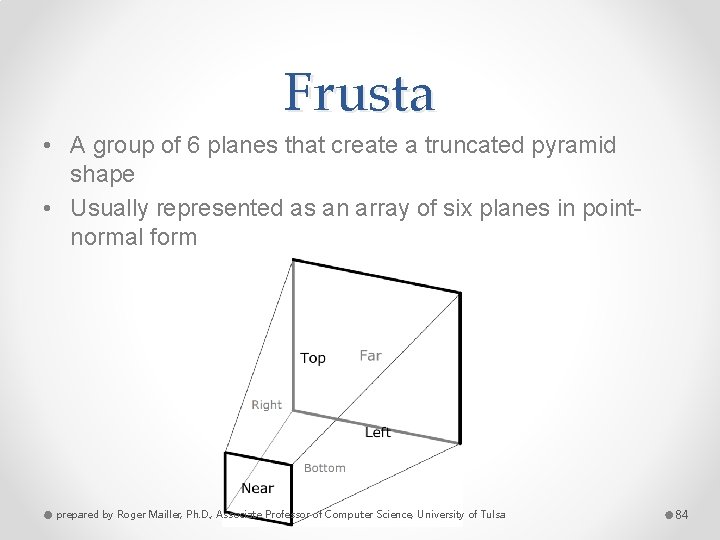
Frusta • A group of 6 planes that create a truncated pyramid shape • Usually represented as an array of six planes in pointnormal form prepared by Roger Mailler, Ph. D. , Associate Professor of Computer Science, University of Tulsa 84
Hardware-accelerated SIMD Math • Stands for Single Instruction Multiple Data • Allows a single operation to be performed on multiple data items in parallel • For example you can multiple four pairs of floating point numbers with a single command prepared by Roger Mailler, Ph. D. , Associate Professor of Computer Science, University of Tulsa 85
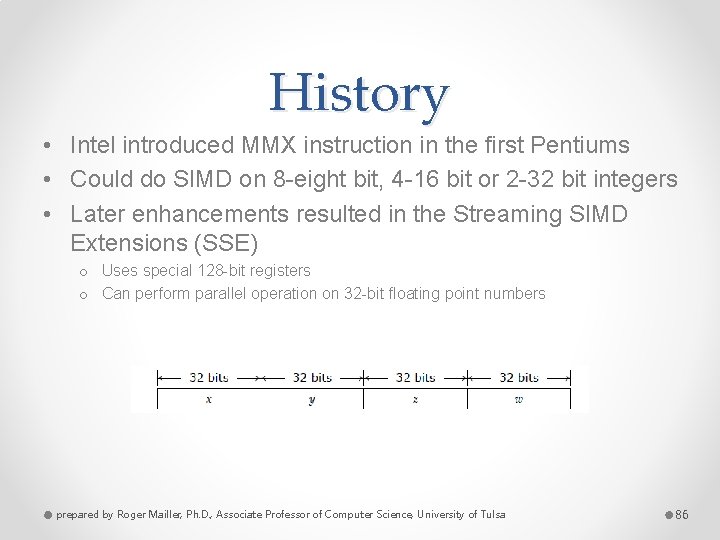
History • Intel introduced MMX instruction in the first Pentiums • Could do SIMD on 8 -eight bit, 4 -16 bit or 2 -32 bit integers • Later enhancements resulted in the Streaming SIMD Extensions (SSE) o Uses special 128 -bit registers o Can perform parallel operation on 32 -bit floating point numbers prepared by Roger Mailler, Ph. D. , Associate Professor of Computer Science, University of Tulsa 86
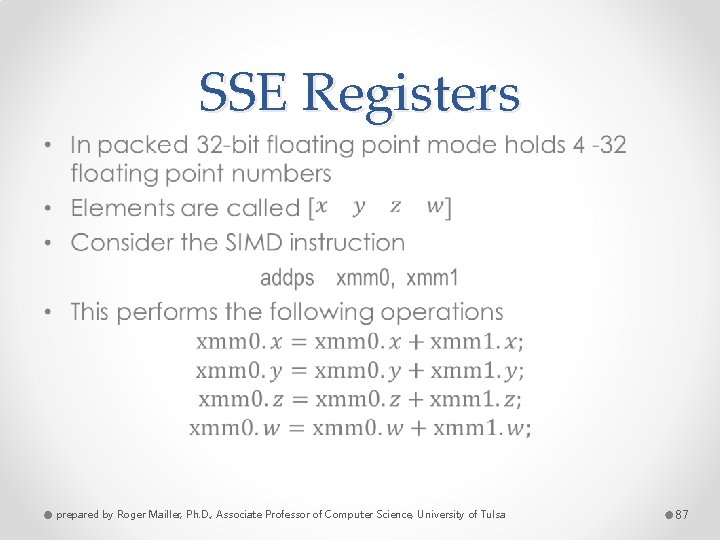
SSE Registers • prepared by Roger Mailler, Ph. D. , Associate Professor of Computer Science, University of Tulsa 87
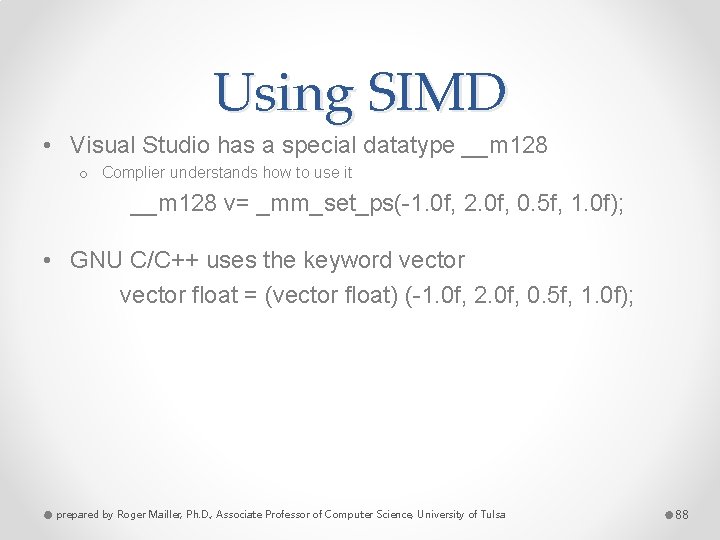
Using SIMD • Visual Studio has a special datatype __m 128 o Complier understands how to use it __m 128 v= _mm_set_ps(-1. 0 f, 2. 0 f, 0. 5 f, 1. 0 f); • GNU C/C++ uses the keyword vector float = (vector float) (-1. 0 f, 2. 0 f, 0. 5 f, 1. 0 f); prepared by Roger Mailler, Ph. D. , Associate Professor of Computer Science, University of Tulsa 88
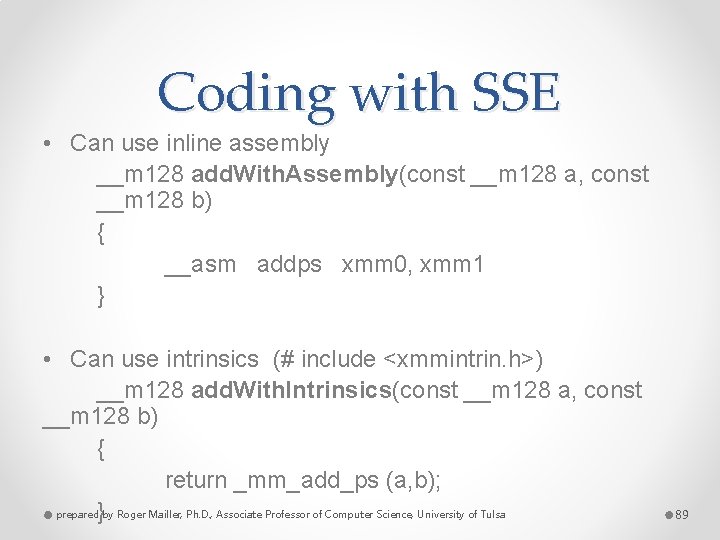
Coding with SSE • Can use inline assembly __m 128 add. With. Assembly(const __m 128 a, const __m 128 b) { __asm addps xmm 0, xmm 1 } • Can use intrinsics (# include <xmmintrin. h>) __m 128 add. With. Intrinsics(const __m 128 a, const __m 128 b) { return _mm_add_ps (a, b); prepared}by Roger Mailler, Ph. D. , Associate Professor of Computer Science, University of Tulsa 89
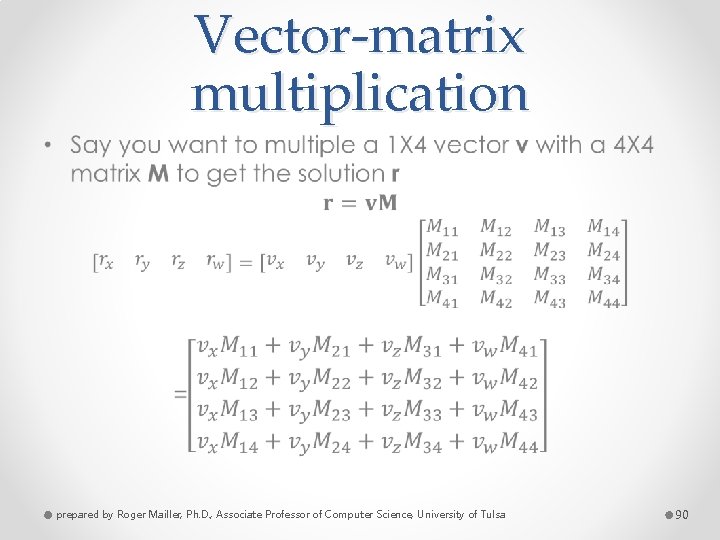
Vector-matrix multiplication • prepared by Roger Mailler, Ph. D. , Associate Professor of Computer Science, University of Tulsa 90
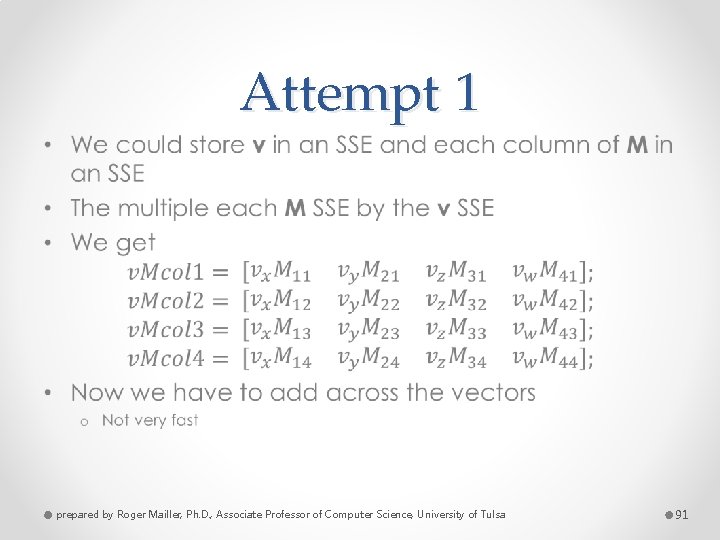
Attempt 1 • prepared by Roger Mailler, Ph. D. , Associate Professor of Computer Science, University of Tulsa 91
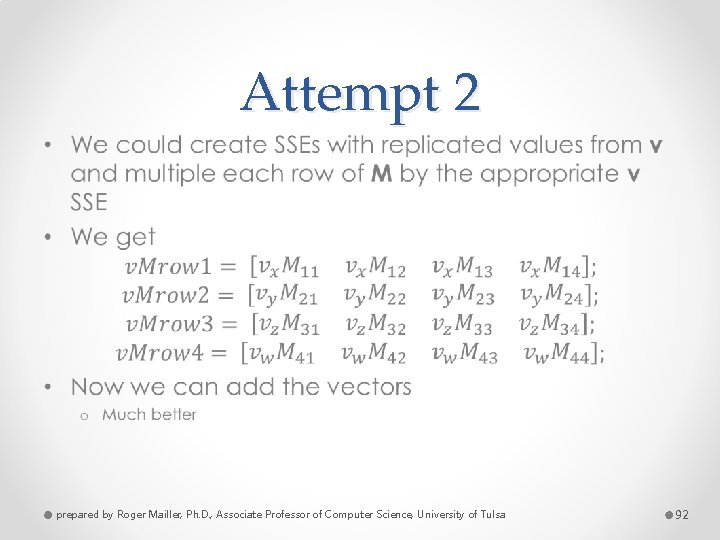
Attempt 2 • prepared by Roger Mailler, Ph. D. , Associate Professor of Computer Science, University of Tulsa 92
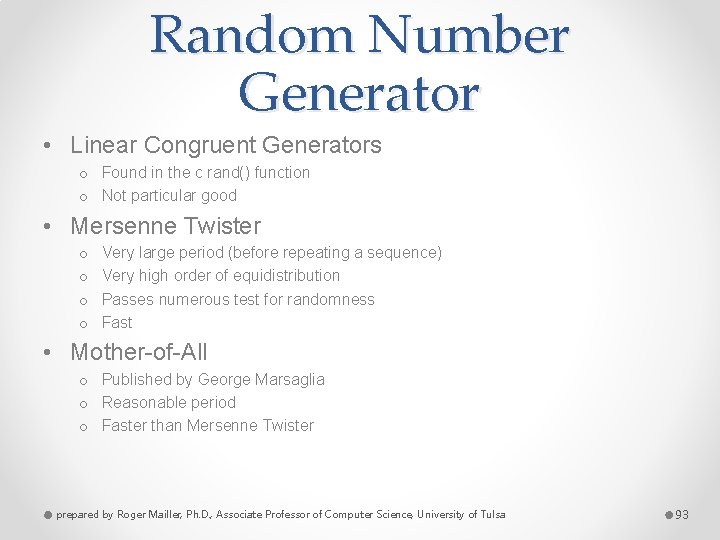
Random Number Generator • Linear Congruent Generators o Found in the c rand() function o Not particular good • Mersenne Twister o o Very large period (before repeating a sequence) Very high order of equidistribution Passes numerous test for randomness Fast • Mother-of-All o Published by George Marsaglia o Reasonable period o Faster than Mersenne Twister prepared by Roger Mailler, Ph. D. , Associate Professor of Computer Science, University of Tulsa 93