EECS 150 Components and Design Techniques for Digital

- Slides: 34
EECS 150 - Components and Design Techniques for Digital Systems Lec 26 – CRCs, LFSRs (and a little power) David Culler Electrical Engineering and Computer Sciences University of California, Berkeley http: //www. eecs. berkeley. edu/~culler http: //www-inst. eecs. berkeley. edu/~cs 150 1
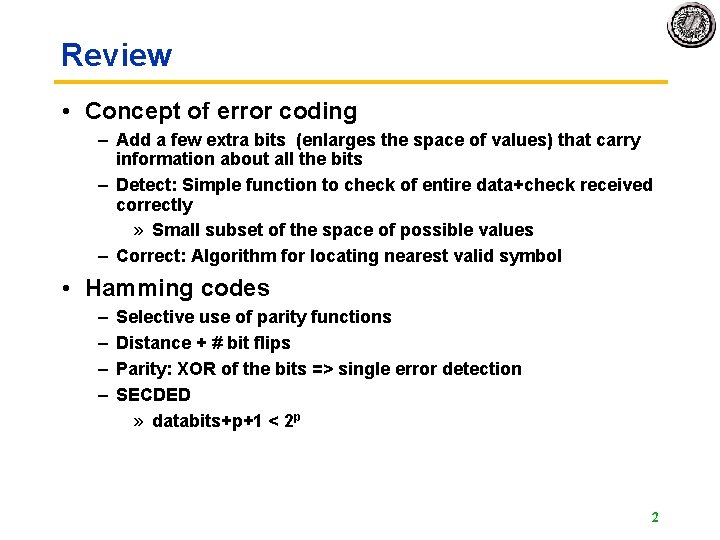
Review • Concept of error coding – Add a few extra bits (enlarges the space of values) that carry information about all the bits – Detect: Simple function to check of entire data+check received correctly » Small subset of the space of possible values – Correct: Algorithm for locating nearest valid symbol • Hamming codes – – Selective use of parity functions Distance + # bit flips Parity: XOR of the bits => single error detection SECDED » databits+p+1 < 2 p 2
Outline • Introduce LFSR as fancy counter • Practice of Cyclic Redundancy Checks – Burst errors in networks, disks, etc. • Theory of LFSRs • Power 3
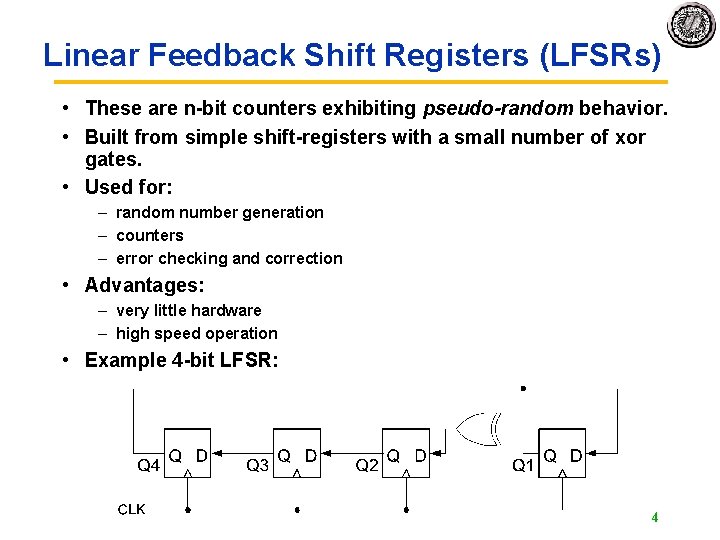
Linear Feedback Shift Registers (LFSRs) • These are n-bit counters exhibiting pseudo-random behavior. • Built from simple shift-registers with a small number of xor gates. • Used for: – random number generation – counters – error checking and correction • Advantages: – very little hardware – high speed operation • Example 4 -bit LFSR: 4
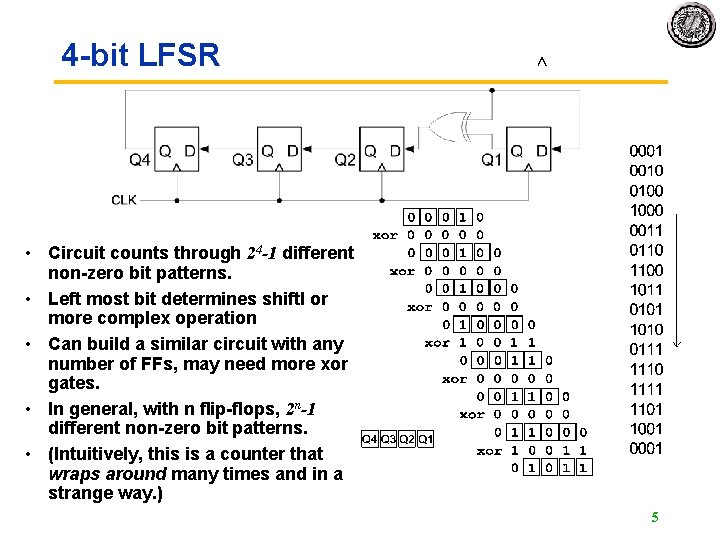
4 -bit LFSR • Circuit counts through 24 -1 different non-zero bit patterns. • Left most bit determines shiftl or more complex operation • Can build a similar circuit with any number of FFs, may need more xor gates. • In general, with n flip-flops, 2 n-1 different non-zero bit patterns. • (Intuitively, this is a counter that wraps around many times and in a strange way. ) 5
Applications of LFSRs • Performance: – In general, xors are only ever 2 -input and never connect in series. – Therefore the minimum clock period for these circuits is: T > T 2 -input-xor + clock overhead – Very little latency, and independent of n! • This can be used as a fast counter, if the particular sequence of count values is not important. – Example: micro-code micro-pc • Can be used as a random number generator. – Sequence is a pseudo-random sequence: » numbers appear in a random sequence » repeats every 2 n-1 patterns – Random numbers useful in: » computer graphics » cryptography » automatic testing • Used for error detection and correction » CRC (cyclic redundancy codes) » ethernet uses them 6
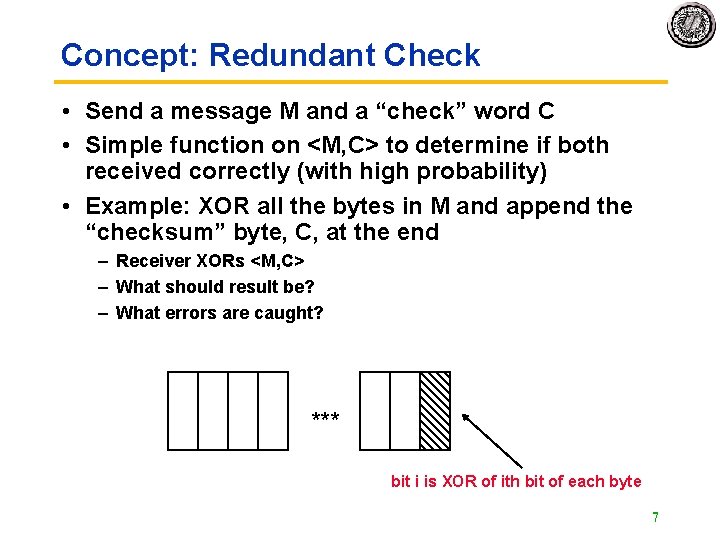
Concept: Redundant Check • Send a message M and a “check” word C • Simple function on <M, C> to determine if both received correctly (with high probability) • Example: XOR all the bytes in M and append the “checksum” byte, C, at the end – Receiver XORs <M, C> – What should result be? – What errors are caught? *** bit i is XOR of ith bit of each byte 7
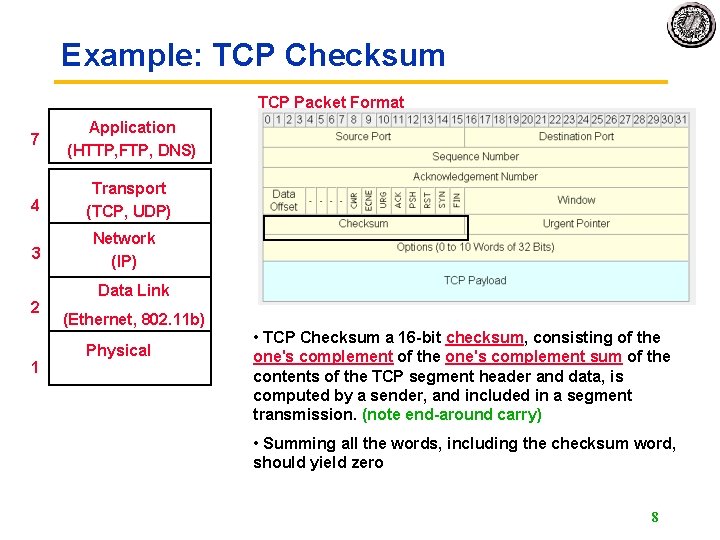
Example: TCP Checksum TCP Packet Format 7 Application (HTTP, FTP, DNS) 4 Transport (TCP, UDP) 3 2 1 Network (IP) Data Link (Ethernet, 802. 11 b) Physical • TCP Checksum a 16 -bit checksum, consisting of the one's complement sum of the contents of the TCP segment header and data, is computed by a sender, and included in a segment transmission. (note end-around carry) • Summing all the words, including the checksum word, should yield zero 8
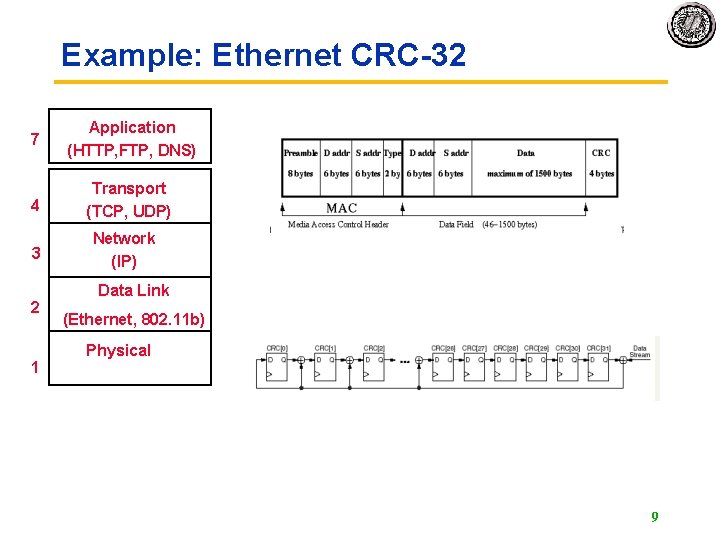
Example: Ethernet CRC-32 7 Application (HTTP, FTP, DNS) 4 Transport (TCP, UDP) 3 2 1 Network (IP) Data Link (Ethernet, 802. 11 b) Physical 9
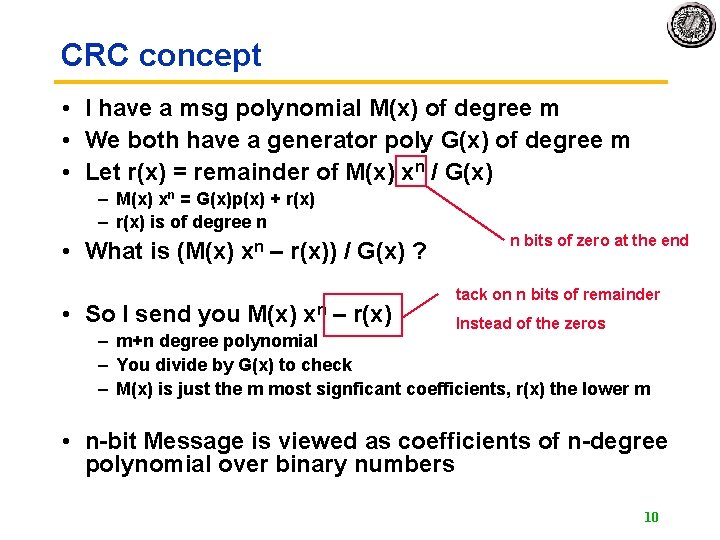
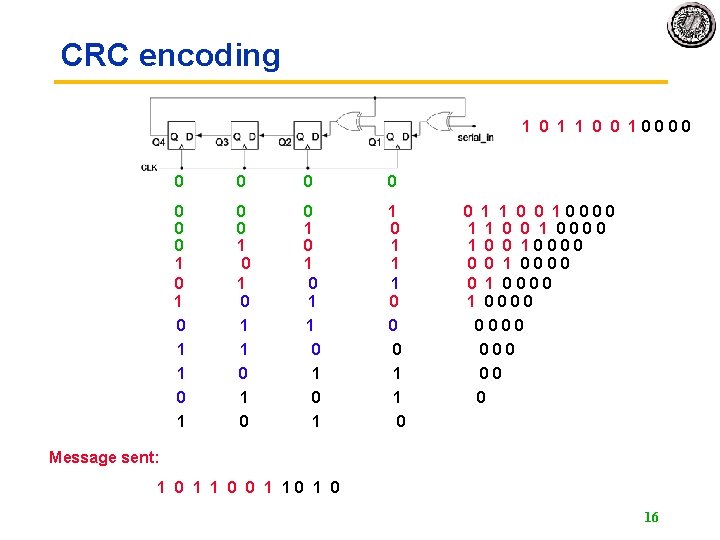
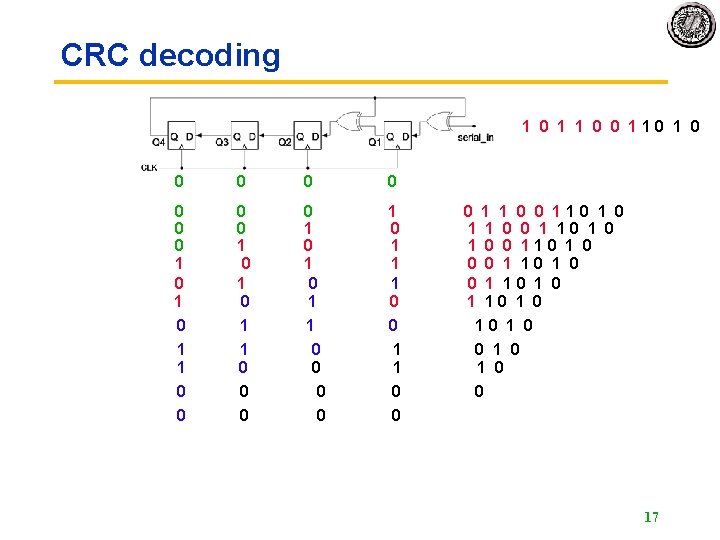
CRC concept • I have a msg polynomial M(x) of degree m • We both have a generator poly G(x) of degree m • Let r(x) = remainder of M(x) xn / G(x) – M(x) xn = G(x)p(x) + r(x) – r(x) is of degree n • What is (M(x) xn – r(x)) / G(x) ? • So I send you M(x) xn – r(x) n bits of zero at the end tack on n bits of remainder Instead of the zeros – m+n degree polynomial – You divide by G(x) to check – M(x) is just the m most signficant coefficients, r(x) the lower m • n-bit Message is viewed as coefficients of n-degree polynomial over binary numbers 10
Announcements • Reading – XILINX IEEE 802. 3 Cyclic Redundancy Check (pages 1 -3) – ftp: //ftp. rocksoft. com/papers/crc_v 3. txt • Final on 12/15 • What’s Going on in EECS? – Towards simulation of a Digital Human – Yelick: Simulation of the Human Heart Using the Immersed Boundary Method on Parallel Machines 11
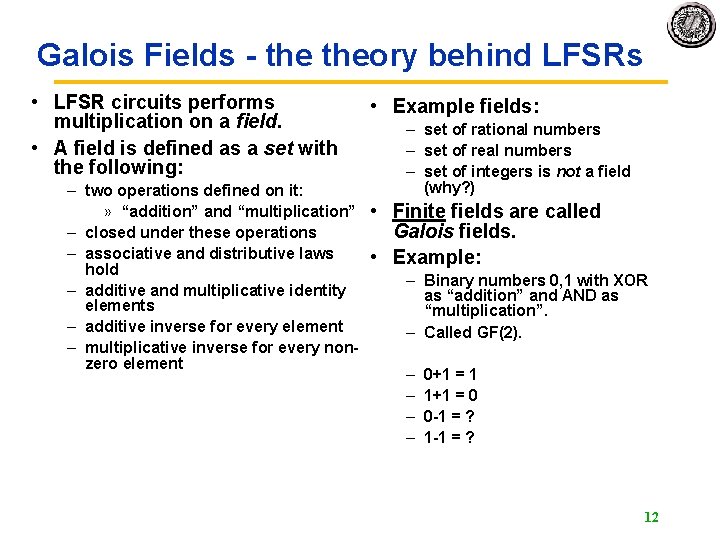
Galois Fields - theory behind LFSRs • LFSR circuits performs multiplication on a field. • A field is defined as a set with the following: – two operations defined on it: » “addition” and “multiplication” – closed under these operations – associative and distributive laws hold – additive and multiplicative identity elements – additive inverse for every element – multiplicative inverse for every nonzero element • Example fields: – set of rational numbers – set of real numbers – set of integers is not a field (why? ) • Finite fields are called Galois fields. • Example: – Binary numbers 0, 1 with XOR as “addition” and AND as “multiplication”. – Called GF(2). – – 0+1 = 1 1+1 = 0 0 -1 = ? 1 -1 = ? 12
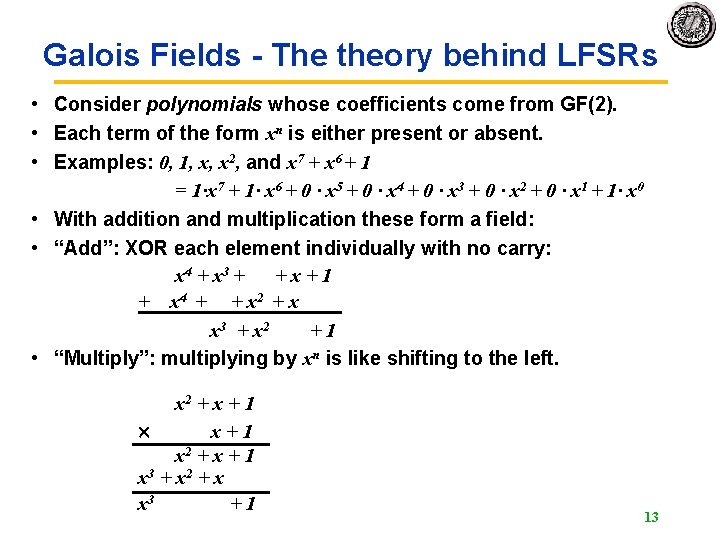
Galois Fields - The theory behind LFSRs • Consider polynomials whose coefficients come from GF(2). • Each term of the form xn is either present or absent. • Examples: 0, 1, x, x 2, and x 7 + x 6 + 1 = 1·x 7 + 1· x 6 + 0 · x 5 + 0 · x 4 + 0 · x 3 + 0 · x 2 + 0 · x 1 + 1· x 0 • With addition and multiplication these form a field: • “Add”: XOR each element individually with no carry: x 4 + x 3 + +x+1 + x 4 + + x 2 + x x 3 + x 2 +1 • “Multiply”: multiplying by xn is like shifting to the left. x 2 + x + 1 x+1 x 2 + x + 1 x 3 + x 2 + x x 3 +1 13
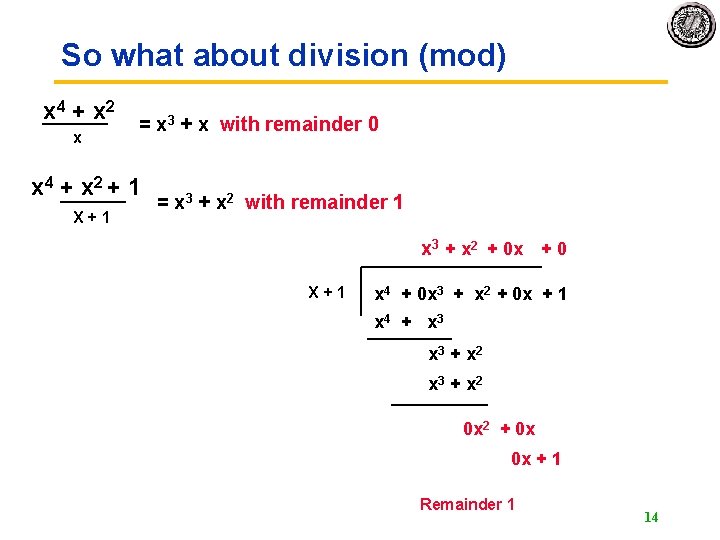
So what about division (mod) x 4 + x 2 x = x 3 + x with remainder 0 x 4 + x 2 + 1 X+1 = x 3 + x 2 with remainder 1 x 3 + x 2 + 0 x + 0 X+1 x 4 + 0 x 3 + x 2 + 0 x + 1 x 4 + x 3 + x 2 0 x 2 + 0 x 0 x + 1 Remainder 1 14
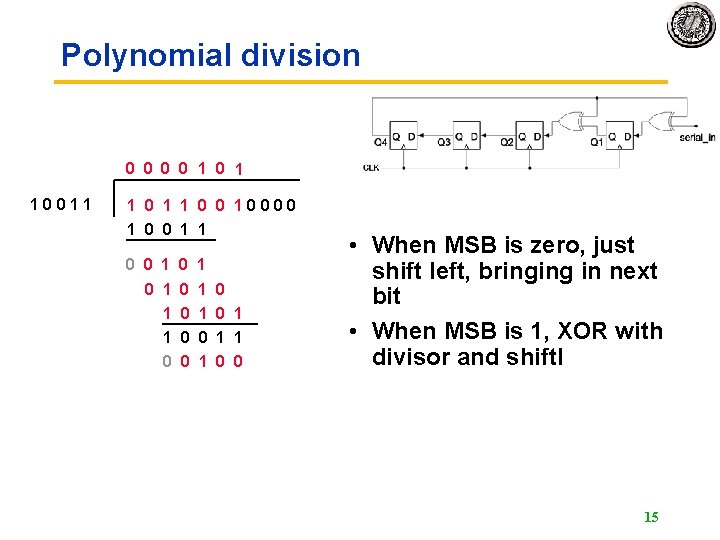
Polynomial division 0 0 1 0 1 10011 1 0 0 10000 1 0 1 1 1 0 0 0 1 1 1 0 0 • When MSB is zero, just shift left, bringing in next bit • When MSB is 1, XOR with divisor and shiftl 15
CRC encoding 1 0 1 1 0 0 10000 0 0 0 1 0 1 0 1 1 0 1 1 1 0 0 0 1 1 0 0 10000 1 1 0 0 1 0000 1 0 0 10000 0 0 1 0000 000 00 0 Message sent: 1 0 1 1 0 0 1 10 1 0 16
CRC decoding 1 0 1 1 0 0 110 1 0 0 0 0 1 0 1 0 1 1 0 0 0 0 1 0 1 1 1 0 0 0 1 1 0 0 110 1 1 0 0 1 10 1 0 0 110 1 0 0 0 1 10 1 0 0 17
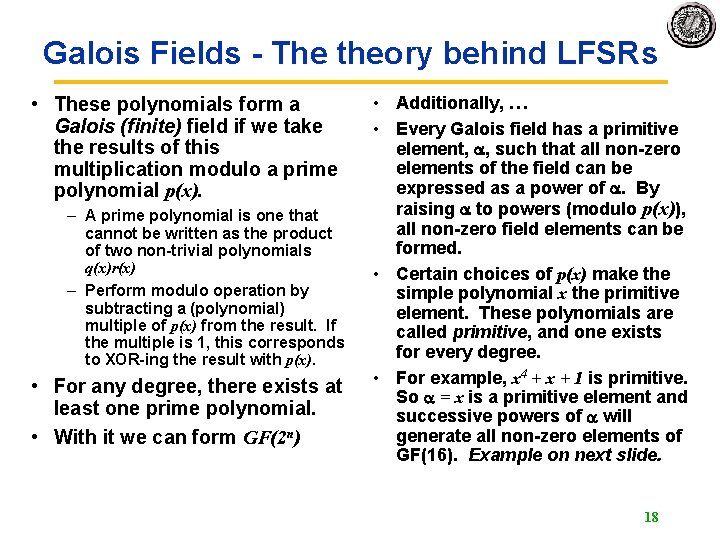
Galois Fields - The theory behind LFSRs • These polynomials form a Galois (finite) field if we take the results of this multiplication modulo a prime polynomial p(x). – A prime polynomial is one that cannot be written as the product of two non-trivial polynomials q(x)r(x) – Perform modulo operation by subtracting a (polynomial) multiple of p(x) from the result. If the multiple is 1, this corresponds to XOR-ing the result with p(x). • For any degree, there exists at least one prime polynomial. • With it we can form GF(2 n) • Additionally, … • Every Galois field has a primitive element, , such that all non-zero elements of the field can be expressed as a power of . By raising to powers (modulo p(x)), all non-zero field elements can be formed. • Certain choices of p(x) make the simple polynomial x the primitive element. These polynomials are called primitive, and one exists for every degree. • For example, x 4 + x + 1 is primitive. So = x is a primitive element and successive powers of will generate all non-zero elements of GF(16). Example on next slide. 18
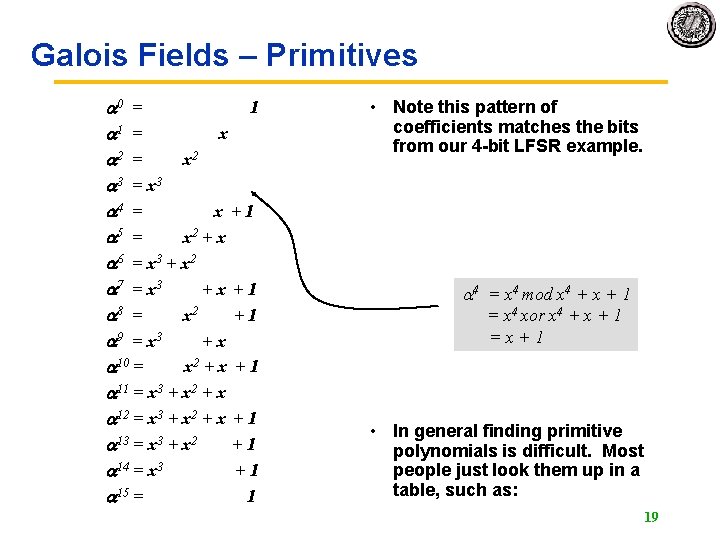
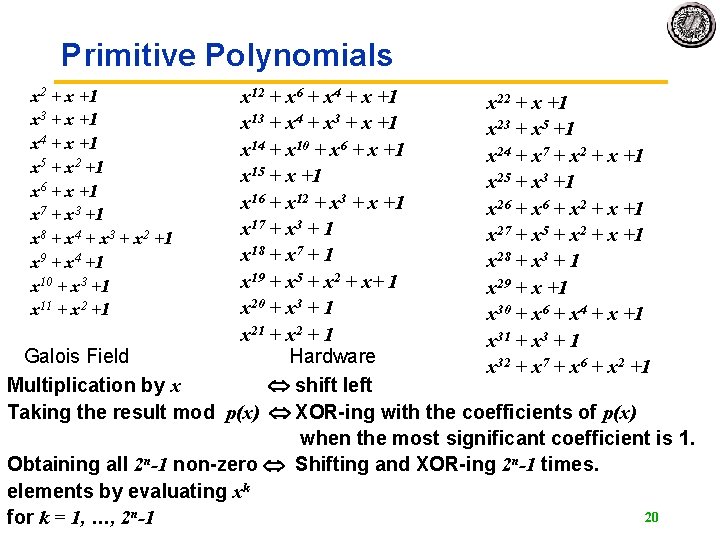
Galois Fields – Primitives 0 = 1 1 = x 2 3 = x 3 4 = x +1 5 = x 2 + x 6 = x 3 + x 2 7 = x 3 +x +1 8 = x 2 +1 9 = x 3 +x 10 = x 2 + x + 1 11 = x 3 + x 2 + x 12 = x 3 + x 2 + x + 1 13 = x 3 + x 2 +1 14 = x 3 +1 15 = 1 • Note this pattern of coefficients matches the bits from our 4 -bit LFSR example. 4 = x 4 mod x 4 + x + 1 = x 4 xor x 4 + x + 1 =x+1 • In general finding primitive polynomials is difficult. Most people just look them up in a table, such as: 19
Primitive Polynomials x 12 + x 6 + x 4 + x +1 x 22 + x +1 x 13 + x 4 + x 3 + x +1 x 23 + x 5 +1 x 14 + x 10 + x 6 + x +1 x 24 + x 7 + x 2 + x +1 x 15 + x +1 x 25 + x 3 +1 x 16 + x 12 + x 3 + x +1 x 26 + x 2 + x +1 x 17 + x 3 + 1 x 27 + x 5 + x 2 + x +1 x 18 + x 7 + 1 x 28 + x 3 + 1 x 19 + x 5 + x 2 + x+ 1 x 29 + x +1 x 20 + x 3 + 1 x 30 + x 6 + x 4 + x +1 x 21 + x 2 + 1 x 31 + x 3 + 1 Galois Field Hardware x 32 + x 7 + x 6 + x 2 +1 Multiplication by x shift left Taking the result mod p(x) XOR-ing with the coefficients of p(x) when the most significant coefficient is 1. Obtaining all 2 n-1 non-zero Shifting and XOR-ing 2 n-1 times. elements by evaluating xk 20 for k = 1, …, 2 n-1 x 2 + x +1 x 3 + x +1 x 4 + x +1 x 5 + x 2 +1 x 6 + x +1 x 7 + x 3 +1 x 8 + x 4 + x 3 + x 2 +1 x 9 + x 4 +1 x 10 + x 3 +1 x 11 + x 2 +1
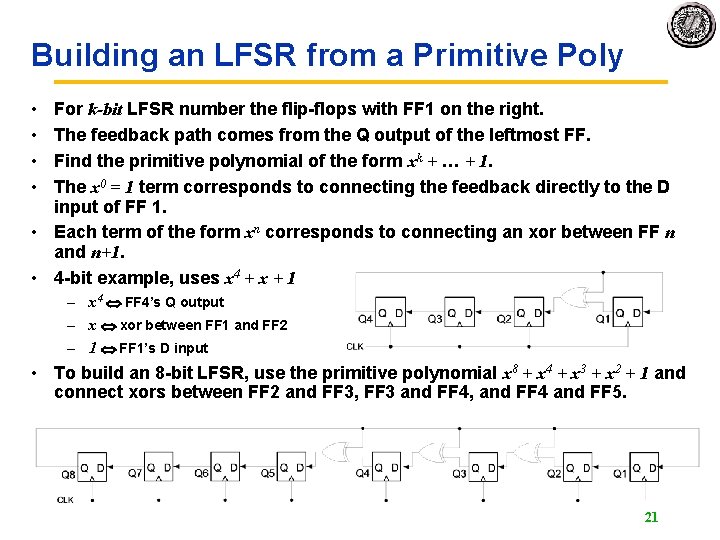
Building an LFSR from a Primitive Poly • • For k-bit LFSR number the flip-flops with FF 1 on the right. The feedback path comes from the Q output of the leftmost FF. Find the primitive polynomial of the form xk + … + 1. The x 0 = 1 term corresponds to connecting the feedback directly to the D input of FF 1. • Each term of the form xn corresponds to connecting an xor between FF n and n+1. • 4 -bit example, uses x 4 + x + 1 – x 4 FF 4’s Q output – x xor between FF 1 and FF 2 – 1 FF 1’s D input • To build an 8 -bit LFSR, use the primitive polynomial x 8 + x 4 + x 3 + x 2 + 1 and connect xors between FF 2 and FF 3, FF 3 and FF 4, and FF 4 and FF 5. 21
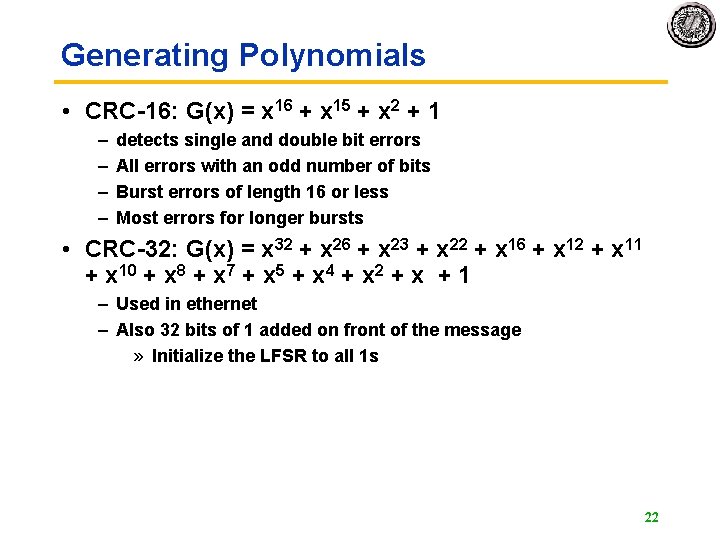
Generating Polynomials • CRC-16: G(x) = x 16 + x 15 + x 2 + 1 – – detects single and double bit errors All errors with an odd number of bits Burst errors of length 16 or less Most errors for longer bursts • CRC-32: G(x) = x 32 + x 26 + x 23 + x 22 + x 16 + x 12 + x 11 + x 10 + x 8 + x 7 + x 5 + x 4 + x 2 + x + 1 – Used in ethernet – Also 32 bits of 1 added on front of the message » Initialize the LFSR to all 1 s 22
POWER 23
Motivation Why should a digital designer care about power consumption? • Portable devices: – handhelds, laptops, phones, MP 3 players, cameras, … all need to run for extended periods on small batteries without recharging – Devices that need regular recharging or large heavy batteries will lose out to those that don’t. • Power consumption important even in “tethered” devices. – System cost tracks power consumption: » power supplies, distribution, heat removal – power conservation, environmental concerns • In a span of 10 years we have gone from designing without concern for power consumption to (in many cases) designing with power consumption as the primary design constraint! 24
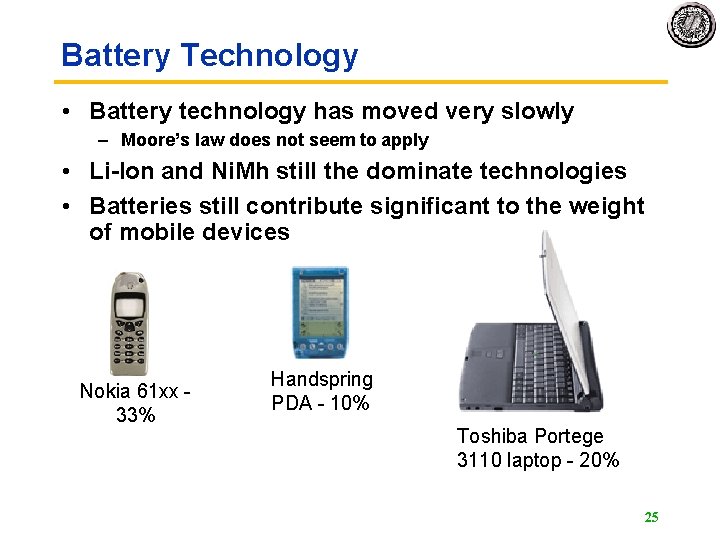
Battery Technology • Battery technology has moved very slowly – Moore’s law does not seem to apply • Li-Ion and Ni. Mh still the dominate technologies • Batteries still contribute significant to the weight of mobile devices Nokia 61 xx 33% Handspring PDA - 10% Toshiba Portege 3110 laptop - 20% 25
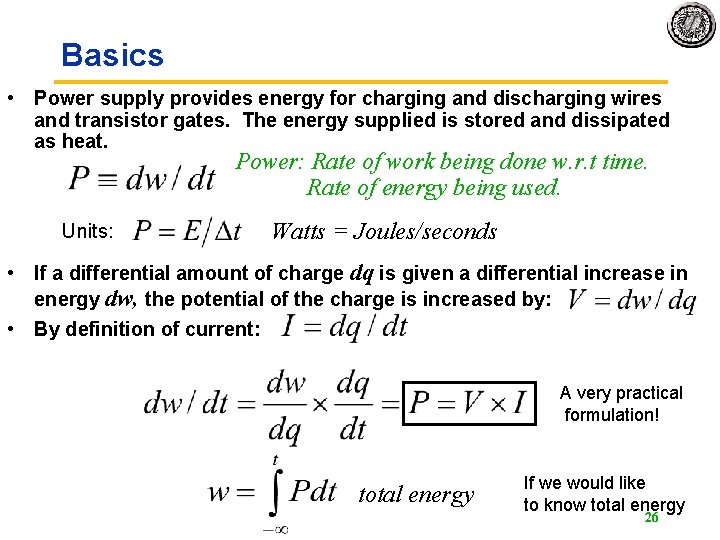
Basics • Power supply provides energy for charging and discharging wires and transistor gates. The energy supplied is stored and dissipated as heat. Power: Rate of work being done w. r. t time. Rate of energy being used. Units: Watts = Joules/seconds • If a differential amount of charge dq is given a differential increase in energy dw, the potential of the charge is increased by: • By definition of current: A very practical formulation! total energy If we would like to know total energy 26
Basics • Warning! In everyday language, the term “power” is used incorrectly in place of “energy. ” • Power is not energy. • Power is not something you can run out of. • Power can not be lost or used up. • It is not a thing, it is merely a rate. • It can not be put into a battery any more than velocity can be put in the gas tank of a car. 27
Metrics How do we measure and compare power consumption? • One popular metric for microprocessors is: MIPS/watt – MIPS, millions of instructions per second. » Typical modern value? – Watt, standard unit of power consumption. » Typical value for modern processor? – MIPS/watt is reflective of the tradeoff between performance and power. Increasing performance requires increasing power. – Problem with “MIPS/watt” » MIPS/watt values are typically not independent of MIPS • techniques exist to achieve very high MIPS/watt values, but at very low absolute MIPS (used in watches) » Metric only relevant for comparing processors with a similar performance. – One solution, MIPS 2/watt. Puts more weight on performance. 28
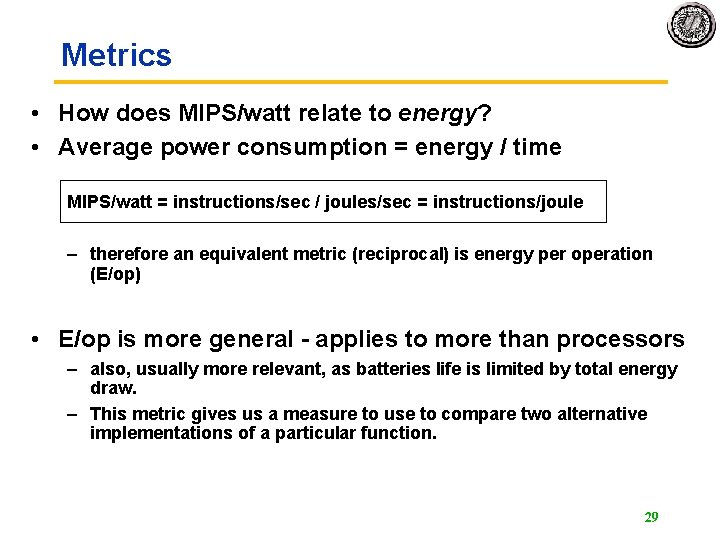
Metrics • How does MIPS/watt relate to energy? • Average power consumption = energy / time MIPS/watt = instructions/sec / joules/sec = instructions/joule – therefore an equivalent metric (reciprocal) is energy per operation (E/op) • E/op is more general - applies to more than processors – also, usually more relevant, as batteries life is limited by total energy draw. – This metric gives us a measure to use to compare two alternative implementations of a particular function. 29
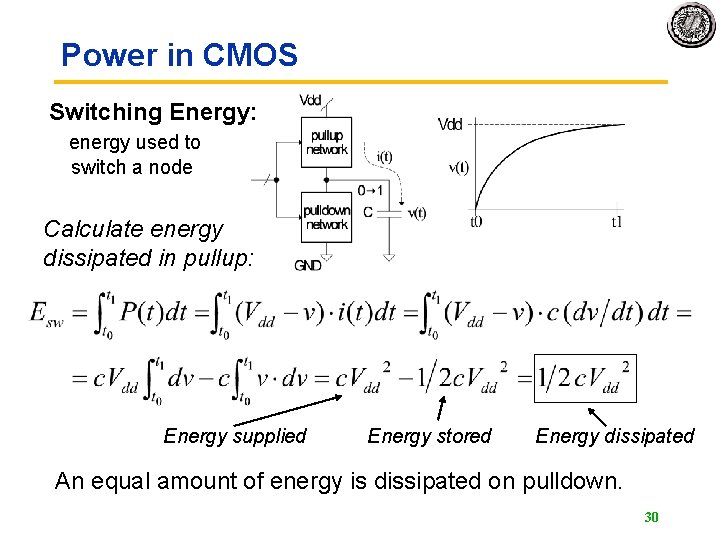
Power in CMOS Switching Energy: energy used to switch a node Calculate energy dissipated in pullup: Energy supplied Energy stored Energy dissipated An equal amount of energy is dissipated on pulldown. 30
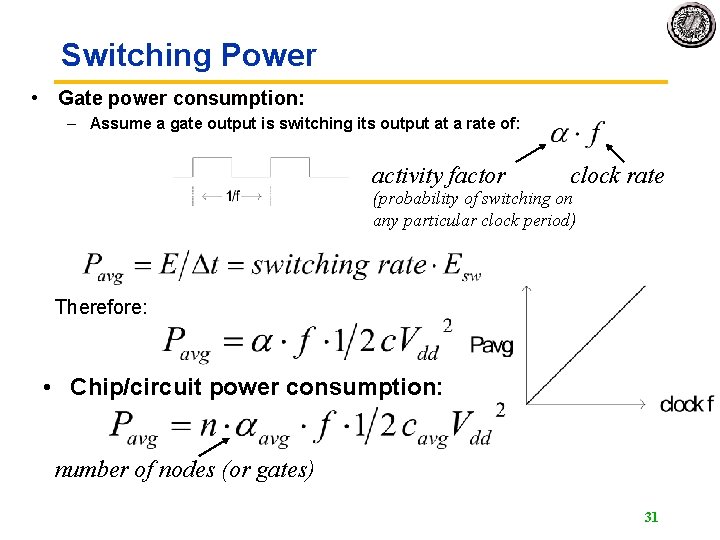
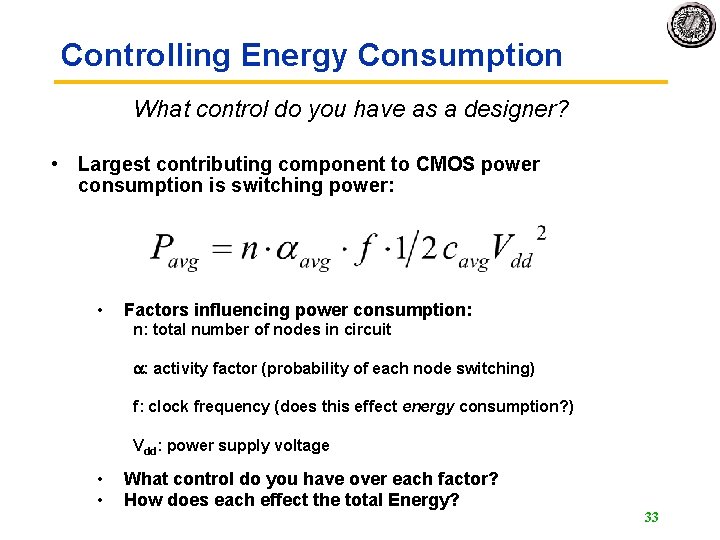
Switching Power • Gate power consumption: – Assume a gate output is switching its output at a rate of: activity factor clock rate (probability of switching on any particular clock period) Therefore: • Chip/circuit power consumption: number of nodes (or gates) 31
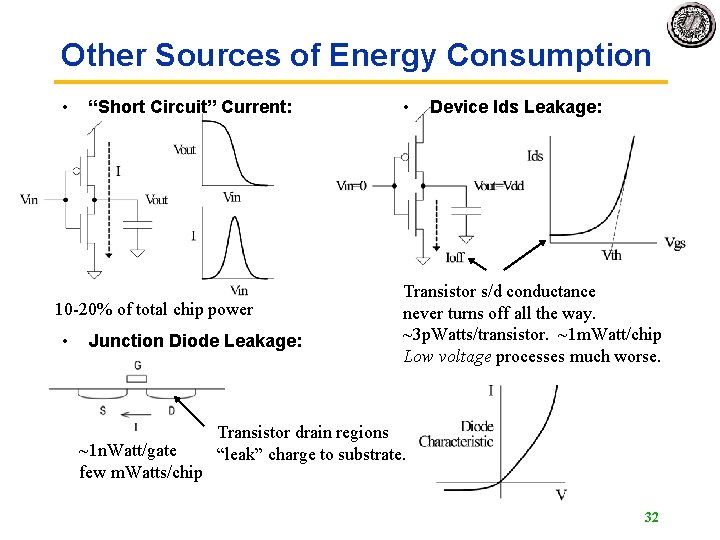
Other Sources of Energy Consumption • “Short Circuit” Current: 10 -20% of total chip power • Junction Diode Leakage: ~1 n. Watt/gate few m. Watts/chip • Device Ids Leakage: Transistor s/d conductance never turns off all the way. ~3 p. Watts/transistor. ~1 m. Watt/chip Low voltage processes much worse. Transistor drain regions “leak” charge to substrate. 32
Controlling Energy Consumption What control do you have as a designer? • Largest contributing component to CMOS power consumption is switching power: • Factors influencing power consumption: n: total number of nodes in circuit : activity factor (probability of each node switching) f: clock frequency (does this effect energy consumption? ) Vdd: power supply voltage • • What control do you have over each factor? How does each effect the total Energy? 33
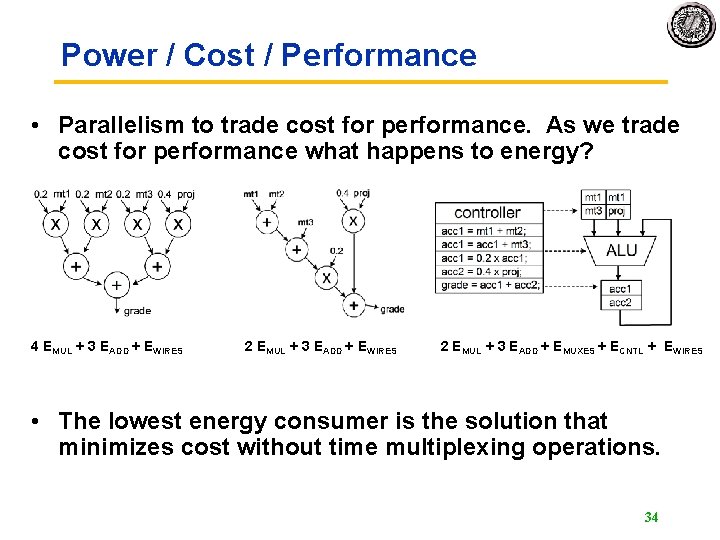
Power / Cost / Performance • Parallelism to trade cost for performance. As we trade cost for performance what happens to energy? 4 EMUL + 3 EADD + EWIRES 2 EMUL + 3 EADD + EMUXES + ECNTL + EWIRES • The lowest energy consumer is the solution that minimizes cost without time multiplexing operations. 34