CS 502 Directed Studies Adversarial Machine Learning Dr
- Slides: 65
CS 502 Directed Studies: Adversarial Machine Learning Dr. Alex Vakanski
CS 502, Fall 2020 Lecture 1 Introduction to Adversarial Machine Learning 2
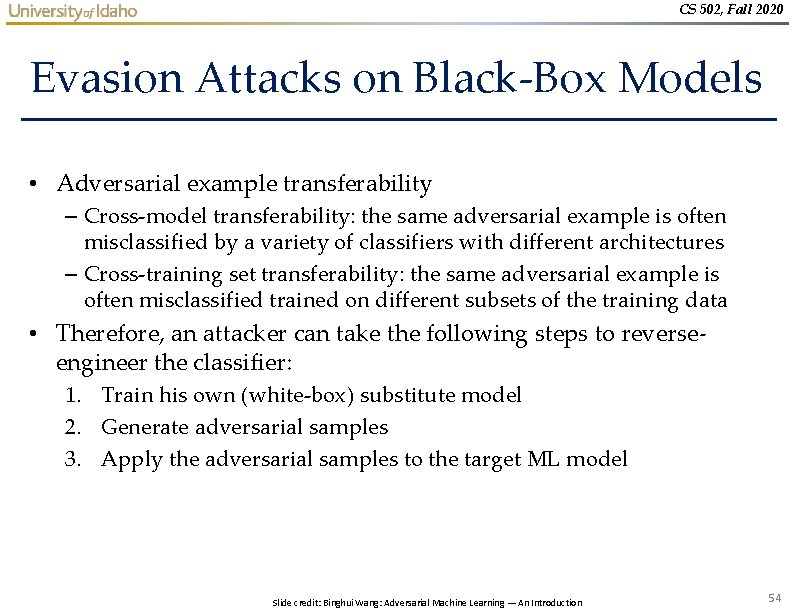
CS 502, Fall 2020 Lecture Outline • Machine Learning (ML) • Adversarial ML (AML) – Adversarial examples • Attack taxonomy • Common adversarial attacks – Noise, semantic attack, FGSM, BIM, PGD, Deep. Fool, CW attack • Defense against adversarial attacks – Adversarial training, random resizing and padding, detect adversarial examples • Conclusion • References • Other AML resources 3
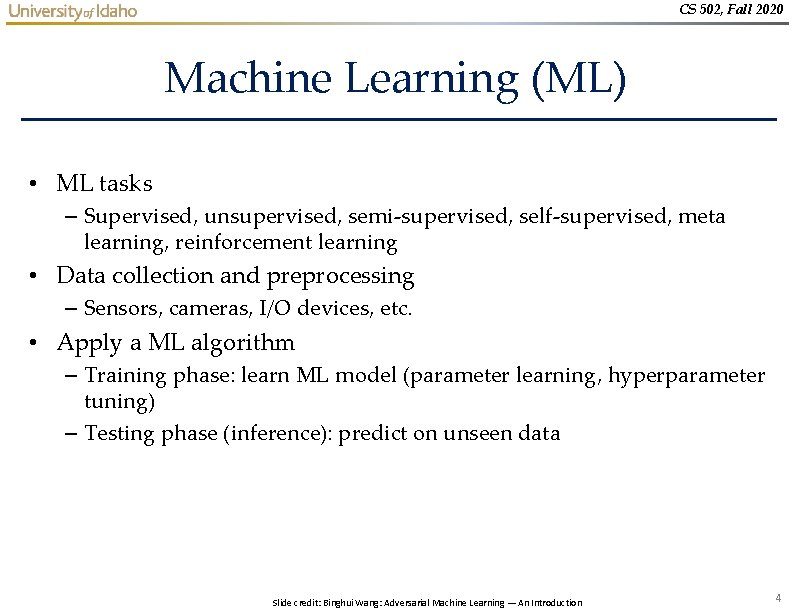
CS 502, Fall 2020 Machine Learning (ML) • ML tasks – Supervised, unsupervised, semi-supervised, self-supervised, meta learning, reinforcement learning • Data collection and preprocessing – Sensors, cameras, I/O devices, etc. • Apply a ML algorithm – Training phase: learn ML model (parameter learning, hyperparameter tuning) – Testing phase (inference): predict on unseen data Slide credit: Binghui Wang: Adversarial Machine Learning — An Introduction 4
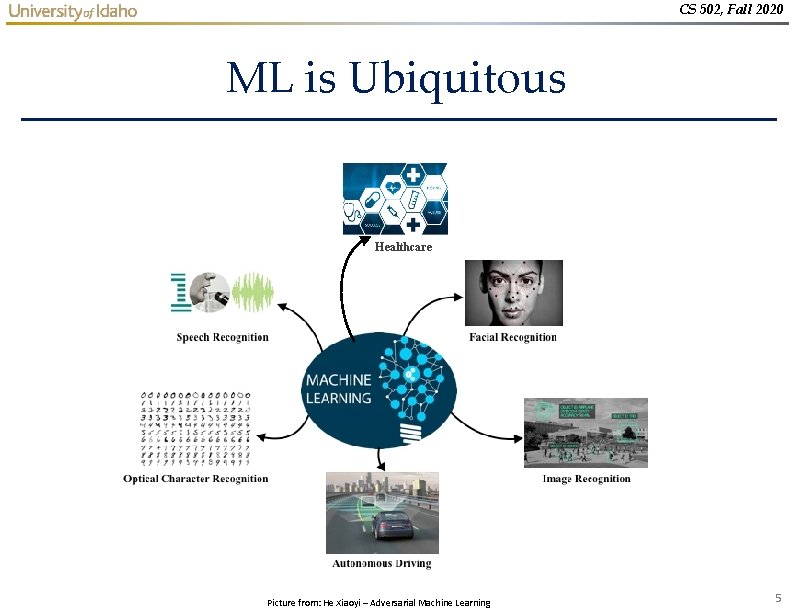
CS 502, Fall 2020 ML is Ubiquitous Healthcare Picture from: He Xiaoyi – Adversarial Machine Learning 5
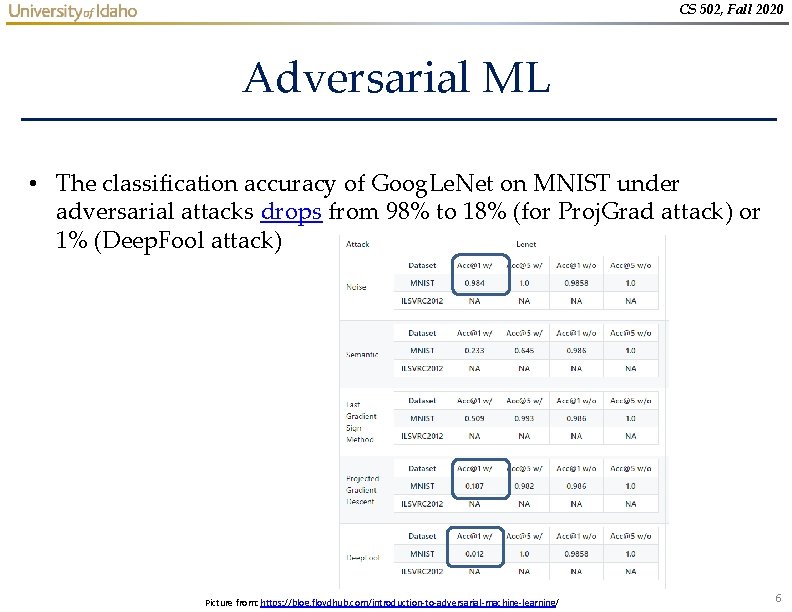
CS 502, Fall 2020 Adversarial ML • The classification accuracy of Goog. Le. Net on MNIST under adversarial attacks drops from 98% to 18% (for Proj. Grad attack) or 1% (Deep. Fool attack) Picture from: https: //blog. floydhub. com/introduction-to-adversarial-machine-learning/ 6
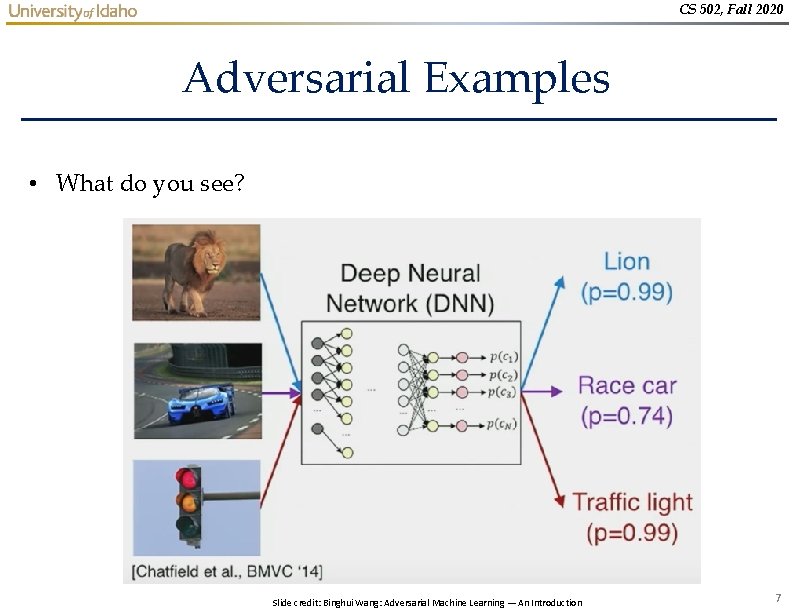
CS 502, Fall 2020 Adversarial Examples • What do you see? Slide credit: Binghui Wang: Adversarial Machine Learning — An Introduction 7
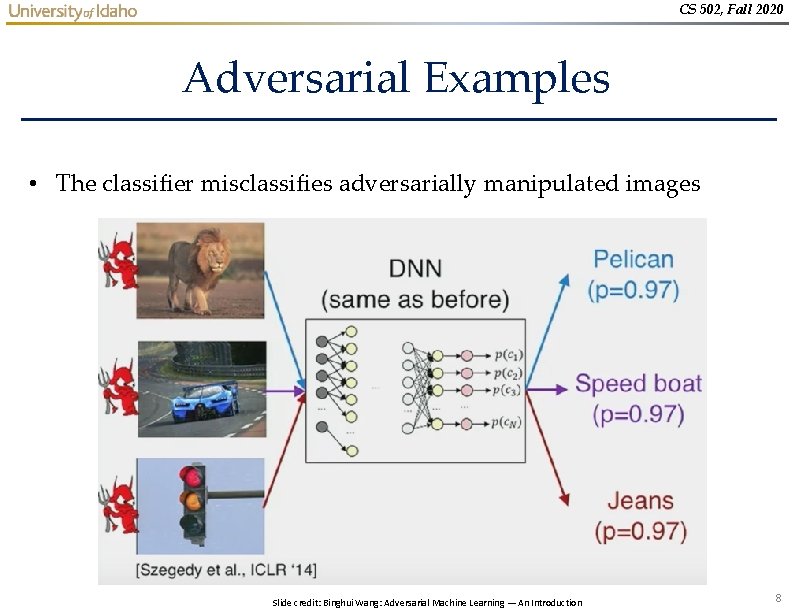
CS 502, Fall 2020 Adversarial Examples • The classifier misclassifies adversarially manipulated images Slide credit: Binghui Wang: Adversarial Machine Learning — An Introduction 8
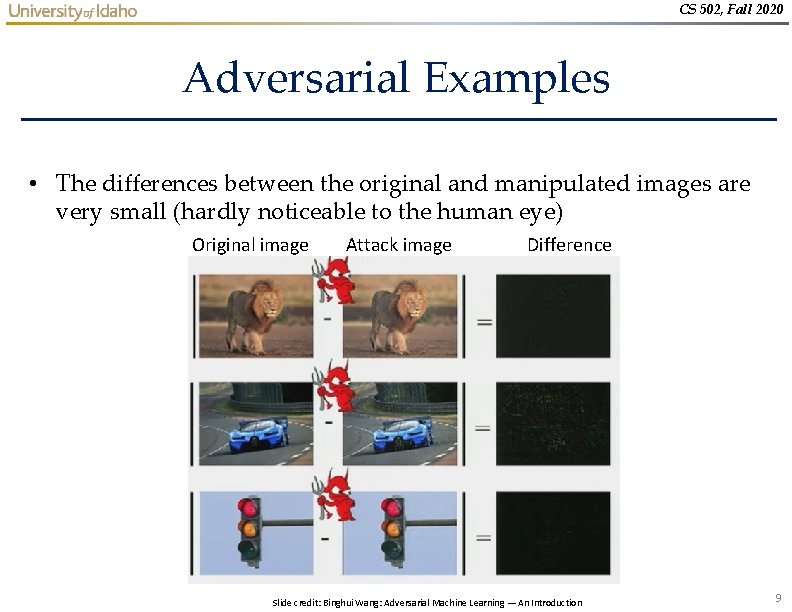
CS 502, Fall 2020 Adversarial Examples • The differences between the original and manipulated images are very small (hardly noticeable to the human eye) Original image Attack image Difference Slide credit: Binghui Wang: Adversarial Machine Learning — An Introduction 9
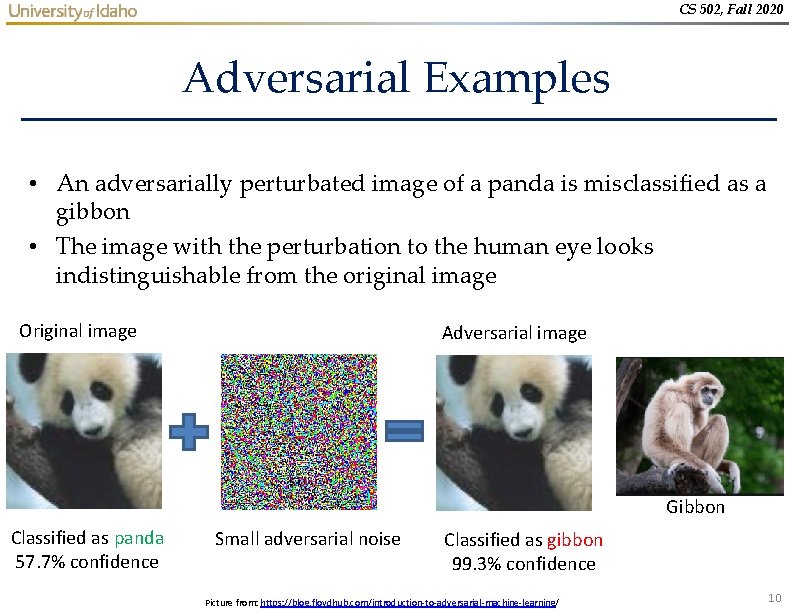
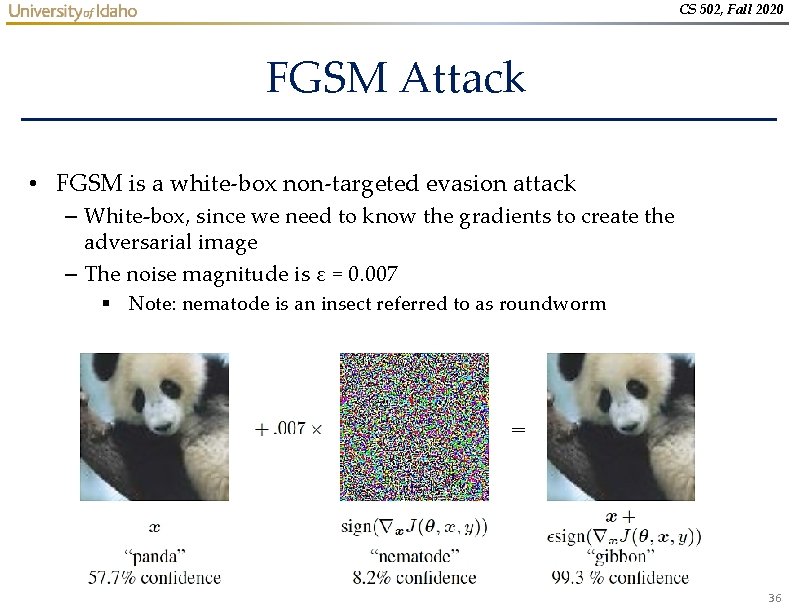
CS 502, Fall 2020 Adversarial Examples • An adversarially perturbated image of a panda is misclassified as a gibbon • The image with the perturbation to the human eye looks indistinguishable from the original image Original image Adversarial image Gibbon Classified as panda 57. 7% confidence Small adversarial noise Classified as gibbon 99. 3% confidence Picture from: https: //blog. floydhub. com/introduction-to-adversarial-machine-learning/ 10
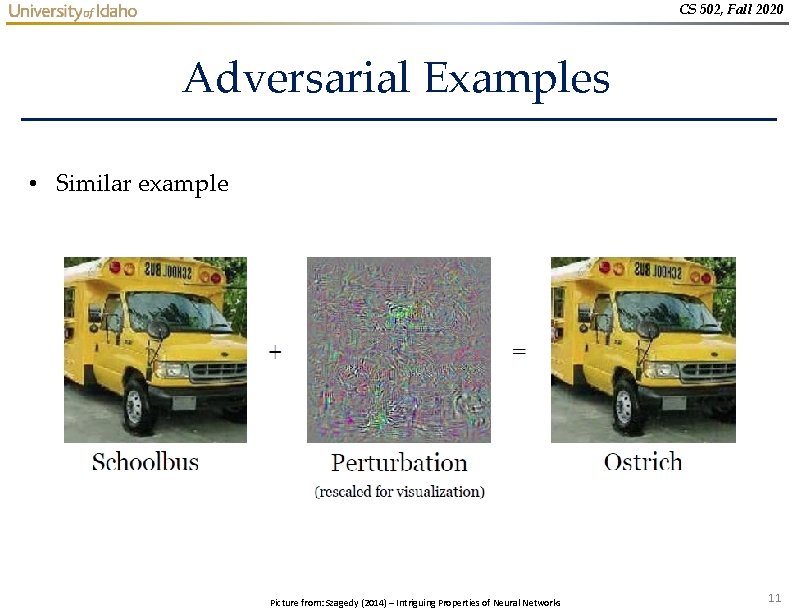
CS 502, Fall 2020 Adversarial Examples • Similar example Picture from: Szagedy (2014) – Intriguing Properties of Neural Networks 11
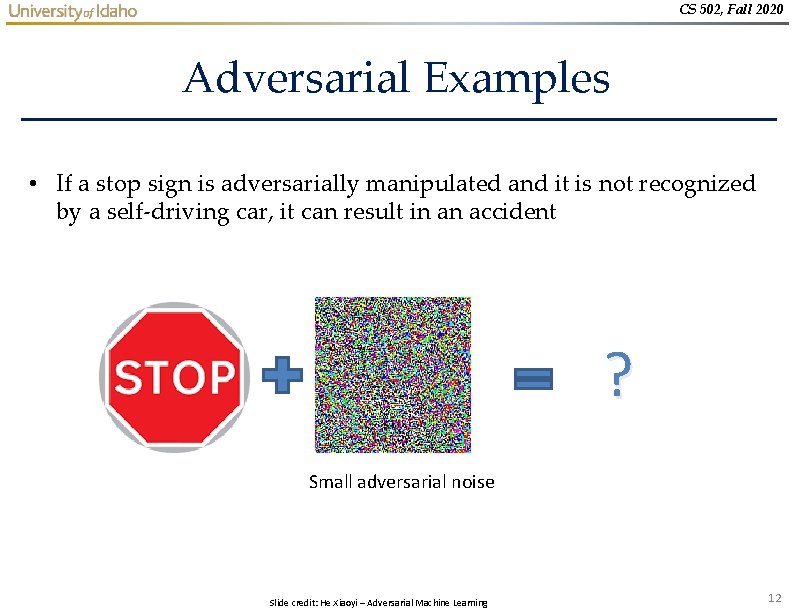
CS 502, Fall 2020 Adversarial Examples • If a stop sign is adversarially manipulated and it is not recognized by a self-driving car, it can result in an accident ? Small adversarial noise Slide credit: He Xiaoyi – Adversarial Machine Learning 12
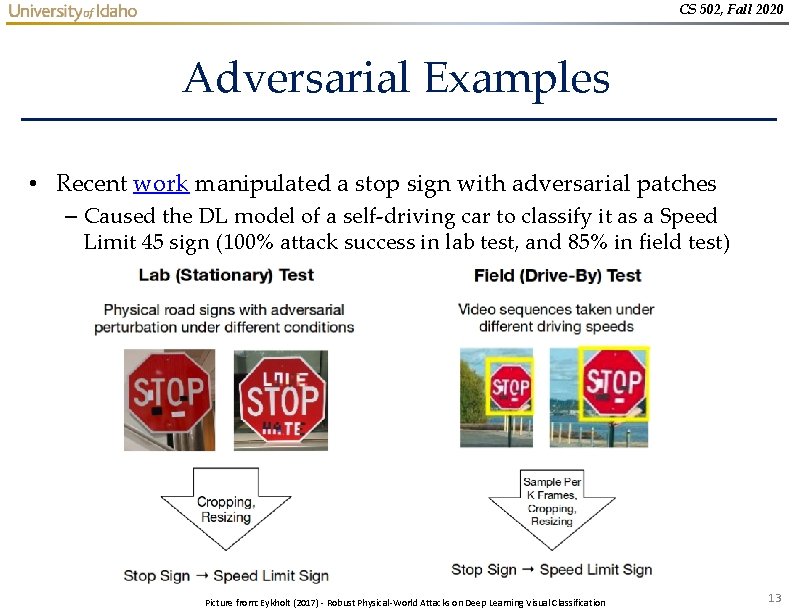
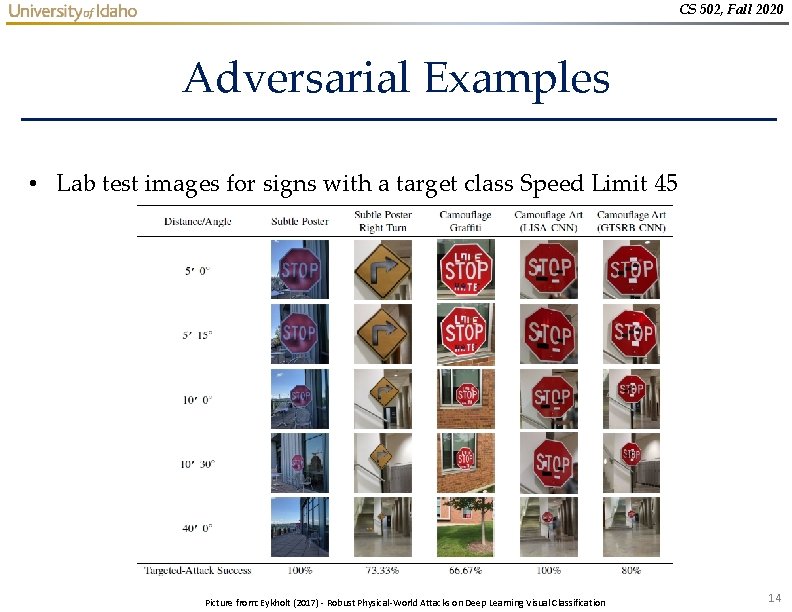
CS 502, Fall 2020 Adversarial Examples • Recent work manipulated a stop sign with adversarial patches – Caused the DL model of a self-driving car to classify it as a Speed Limit 45 sign (100% attack success in lab test, and 85% in field test) Picture from: Eykholt (2017) - Robust Physical-World Attacks on Deep Learning Visual Classification 13
CS 502, Fall 2020 Adversarial Examples • Lab test images for signs with a target class Speed Limit 45 Picture from: Eykholt (2017) - Robust Physical-World Attacks on Deep Learning Visual Classification 14
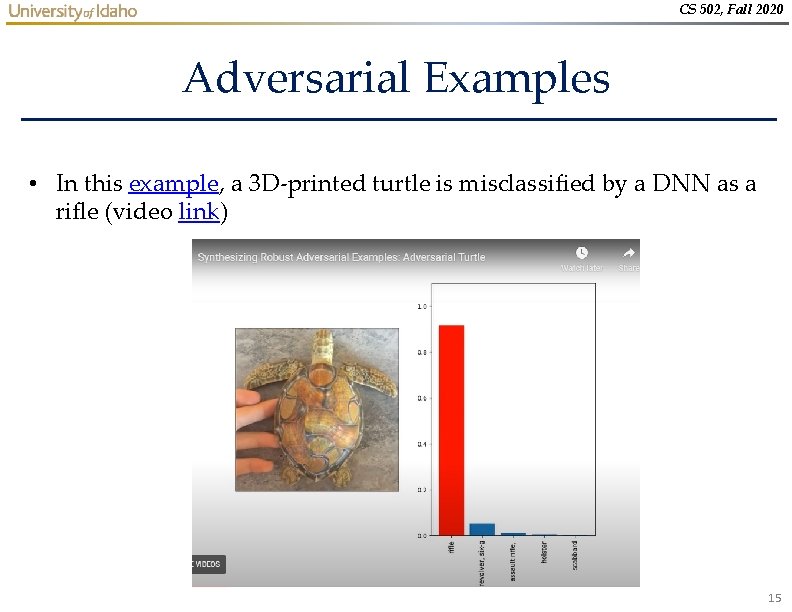
CS 502, Fall 2020 Adversarial Examples • In this example, a 3 D-printed turtle is misclassified by a DNN as a rifle (video link) 15
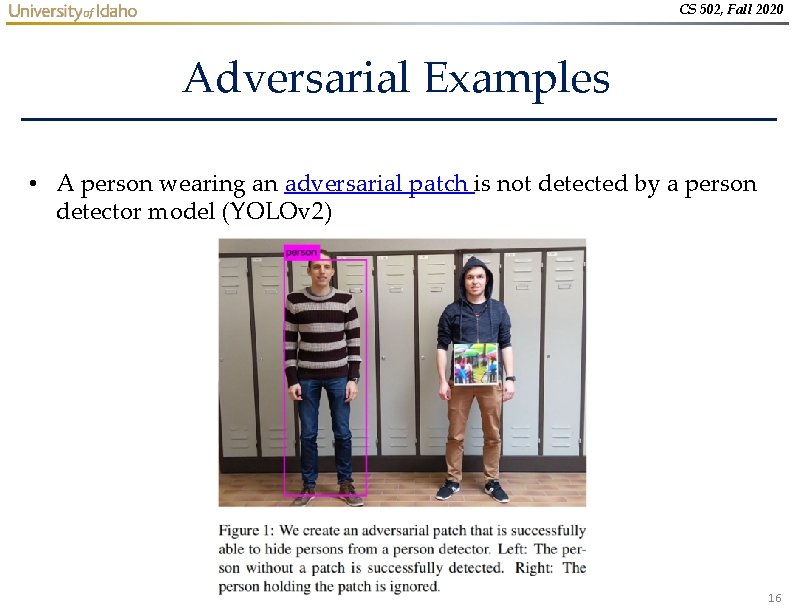
CS 502, Fall 2020 Adversarial Examples • A person wearing an adversarial patch is not detected by a person detector model (YOLOv 2) 16
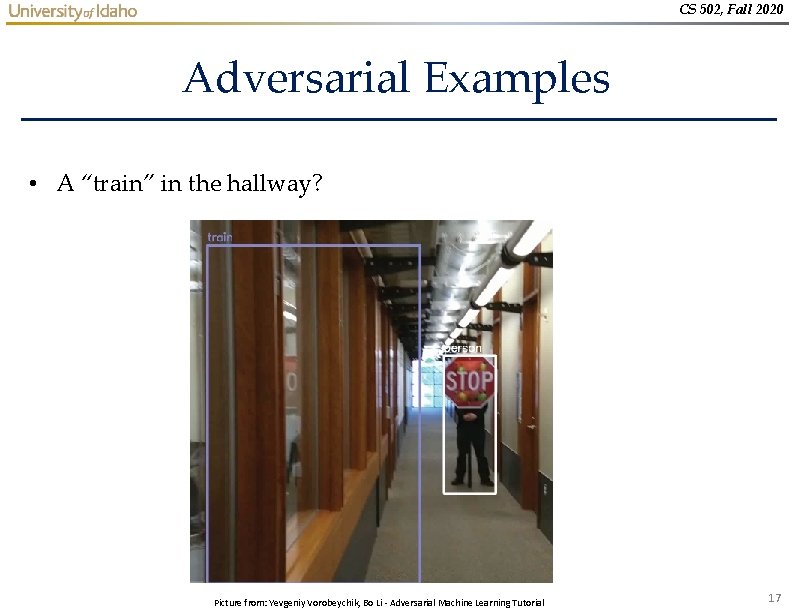
CS 502, Fall 2020 Adversarial Examples • A “train” in the hallway? Picture from: Yevgeniy Vorobeychik, Bo Li - Adversarial Machine Learning Tutorial 17
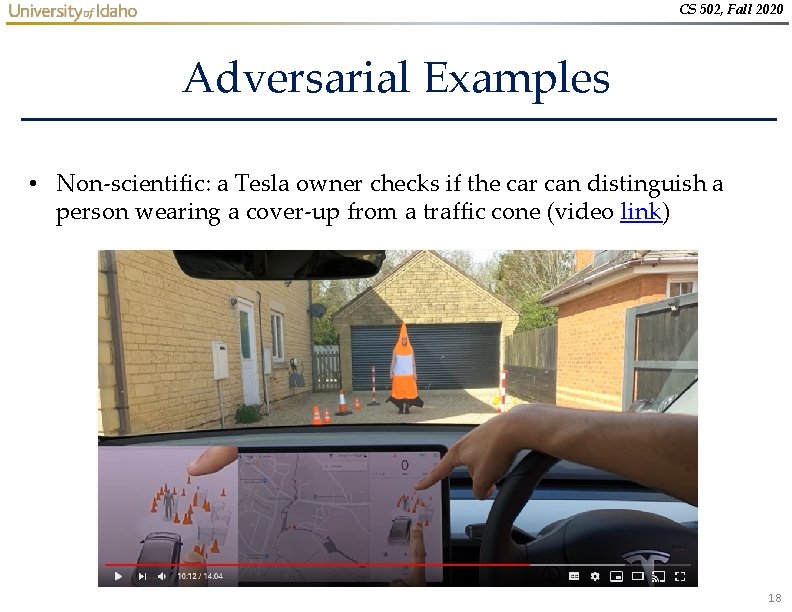
CS 502, Fall 2020 Adversarial Examples • Non-scientific: a Tesla owner checks if the car can distinguish a person wearing a cover-up from a traffic cone (video link) 18
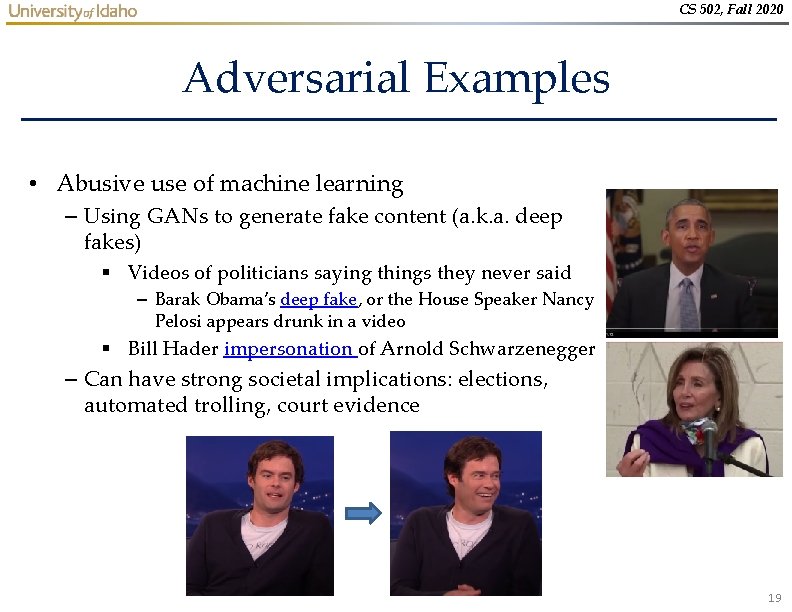
CS 502, Fall 2020 Adversarial Examples • Abusive use of machine learning – Using GANs to generate fake content (a. k. a. deep fakes) § Videos of politicians saying things they never said – Barak Obama’s deep fake, or the House Speaker Nancy Pelosi appears drunk in a video § Bill Hader impersonation of Arnold Schwarzenegger – Can have strong societal implications: elections, automated trolling, court evidence 19
CS 502, Fall 2020 Adversarial ML • AML is a research field that lies at the intersection of ML and computer security – E. g. , network intrusion detection, spam filtering, malware classification, biometric authentication (facial detection) • ML algorithms in real-world applications mainly focus on increased accuracy – However, few techniques and design decisions focus on keeping the ML models secure and robust • Adversarial ML: ML in adversarial settings – Attack is a major component of AML – Bad actors do bad things § Their main objective is not to get detected (change behavior to avoid detection) Slide credit: Binghui Wang: Adversarial Machine Learning — An Introduction 20
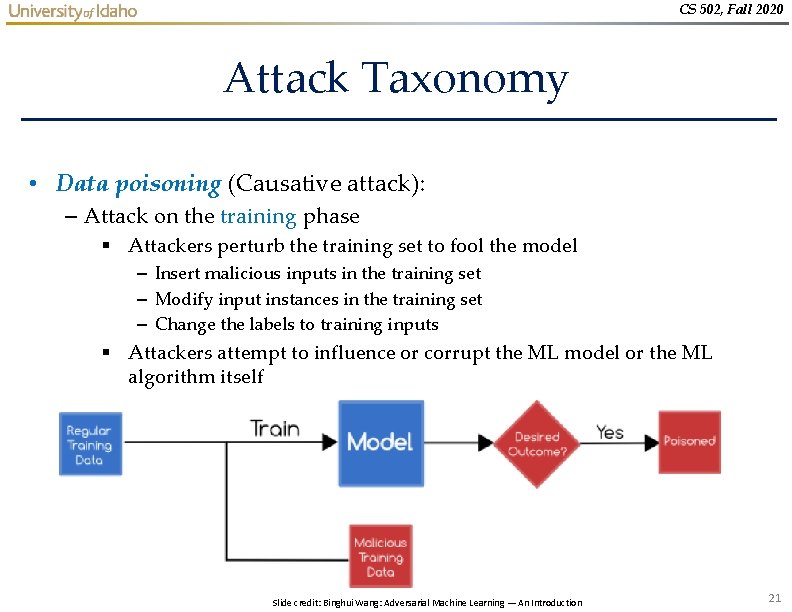
CS 502, Fall 2020 Attack Taxonomy • Data poisoning (Causative attack): – Attack on the training phase § Attackers perturb the training set to fool the model – Insert malicious inputs in the training set – Modify input instances in the training set – Change the labels to training inputs § Attackers attempt to influence or corrupt the ML model or the ML algorithm itself Slide credit: Binghui Wang: Adversarial Machine Learning — An Introduction 21
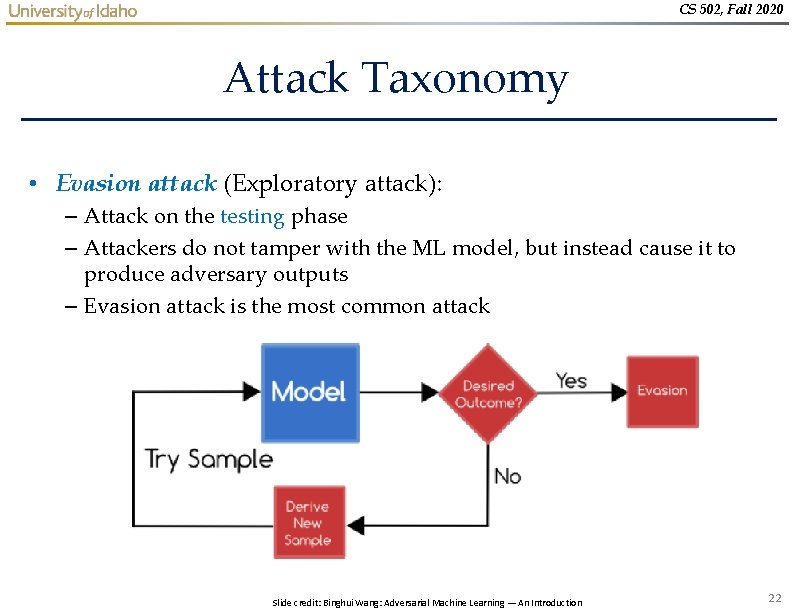
CS 502, Fall 2020 Attack Taxonomy • Evasion attack (Exploratory attack): – Attack on the testing phase – Attackers do not tamper with the ML model, but instead cause it to produce adversary outputs – Evasion attack is the most common attack Slide credit: Binghui Wang: Adversarial Machine Learning — An Introduction 22
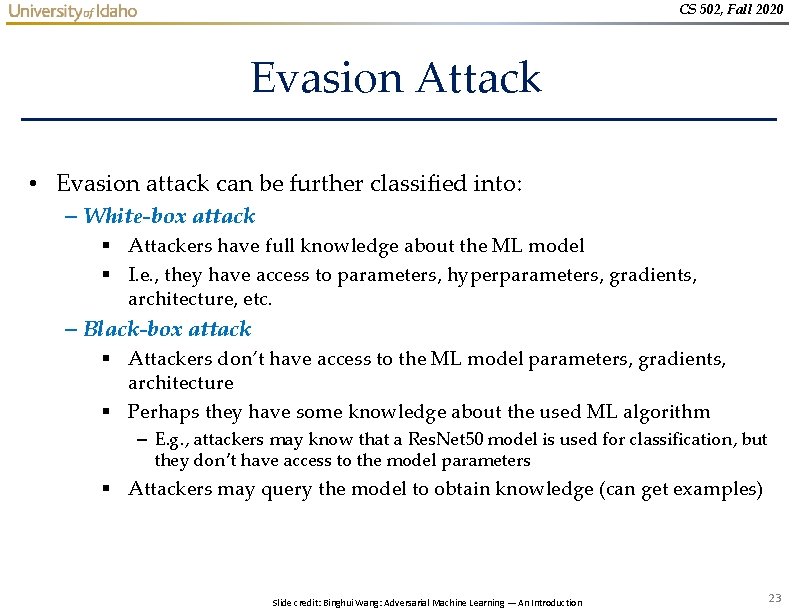
CS 502, Fall 2020 Evasion Attack • Evasion attack can be further classified into: – White-box attack § Attackers have full knowledge about the ML model § I. e. , they have access to parameters, hyperparameters, gradients, architecture, etc. – Black-box attack § Attackers don’t have access to the ML model parameters, gradients, architecture § Perhaps they have some knowledge about the used ML algorithm – E. g. , attackers may know that a Res. Net 50 model is used for classification, but they don’t have access to the model parameters § Attackers may query the model to obtain knowledge (can get examples) Slide credit: Binghui Wang: Adversarial Machine Learning — An Introduction 23
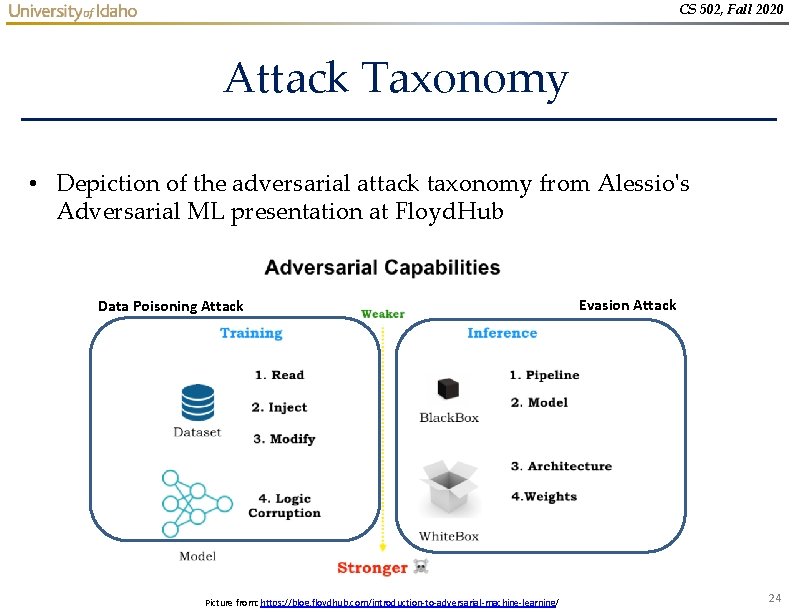
CS 502, Fall 2020 Attack Taxonomy • Depiction of the adversarial attack taxonomy from Alessio's Adversarial ML presentation at Floyd. Hub Data Poisoning Attack Picture from: https: //blog. floydhub. com/introduction-to-adversarial-machine-learning/ Evasion Attack 24
CS 502, Fall 2020 Attack Taxonomy • Each of the above attacks can further be: – Non-targeted attack § The goal is to mislead the classifier to predict any labels other than the ground truth label § Most existing work deals with this goal § E. g. , perturb an image of a military tank, so that the model predicts it is any other class than a military tank – Targeted attack § § The goal is to mislead the classifier to predict a target label for an image More difficult E. g. , perturb an image of a turtle, so that the model predicts it is a riffle E. g. , perturb an image of a Stop sign, so that the model predicts it is a Speed Limit sign 25
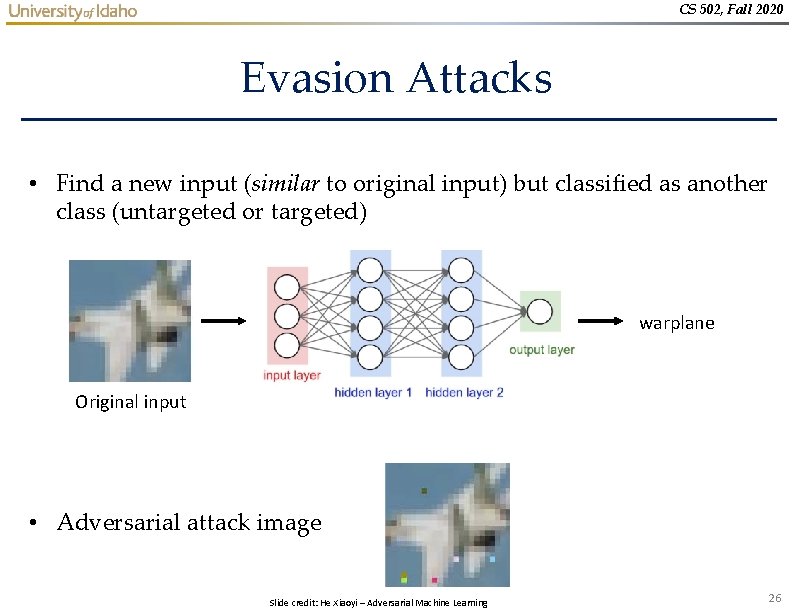
CS 502, Fall 2020 Evasion Attacks • Find a new input (similar to original input) but classified as another class (untargeted or targeted) warplane Original input • Adversarial attack image Slide credit: He Xiaoyi – Adversarial Machine Learning 26
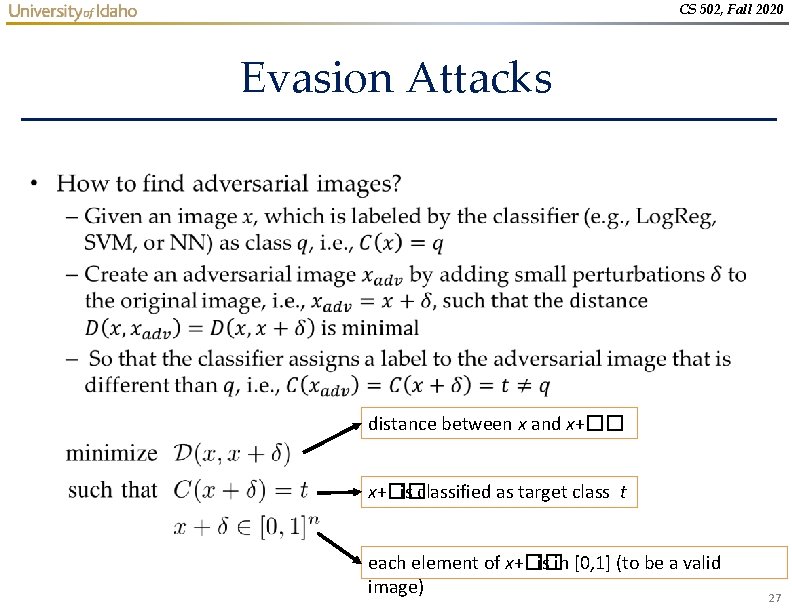
CS 502, Fall 2020 Evasion Attacks • distance between x and x+�� is classified as target class t each element of x+�� is in [0, 1] (to be a valid image) 27
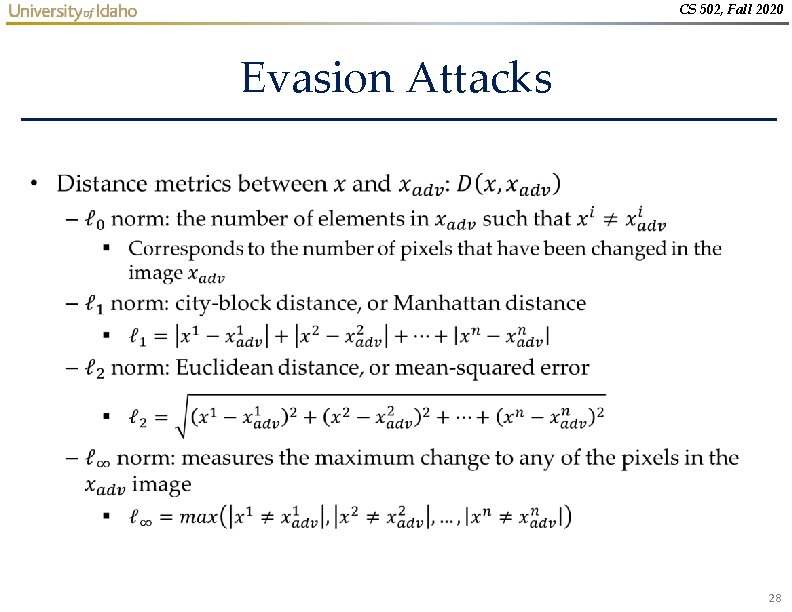
CS 502, Fall 2020 Evasion Attacks • 28
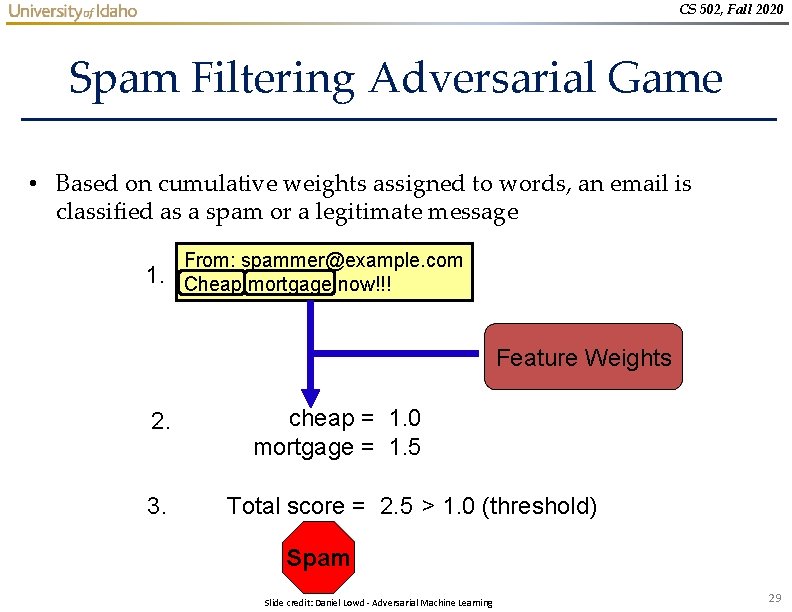
CS 502, Fall 2020 Spam Filtering Adversarial Game • Based on cumulative weights assigned to words, an email is classified as a spam or a legitimate message 1. From: spammer@example. com Cheap mortgage now!!! Feature Weights 2. 3. cheap = 1. 0 mortgage = 1. 5 Total score = 2. 5 > 1. 0 (threshold) Spam Slide credit: Daniel Lowd - Adversarial Machine Learning 29
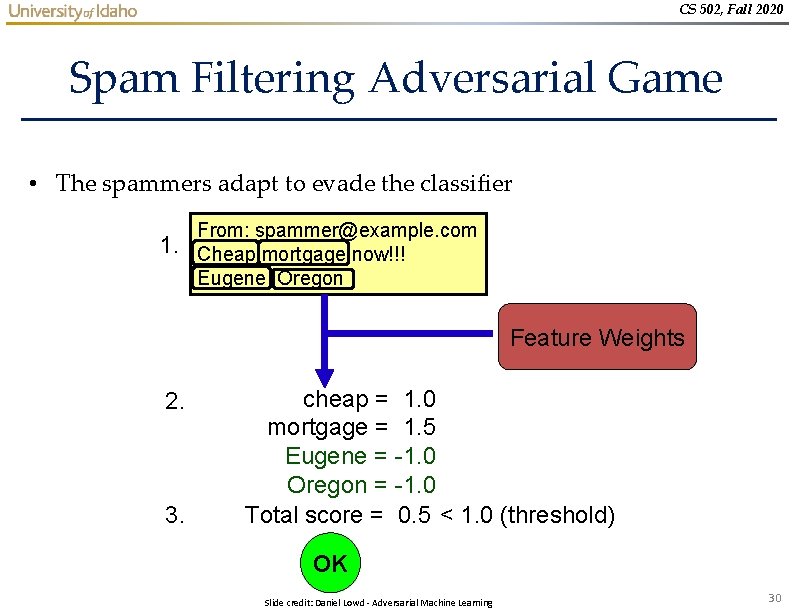
CS 502, Fall 2020 Spam Filtering Adversarial Game • The spammers adapt to evade the classifier 1. From: spammer@example. com Cheap mortgage now!!! Eugene Oregon Feature Weights 2. 3. cheap = 1. 0 mortgage = 1. 5 Eugene = -1. 0 Oregon = -1. 0 Total score = 0. 5 < 1. 0 (threshold) OK Slide credit: Daniel Lowd - Adversarial Machine Learning 30
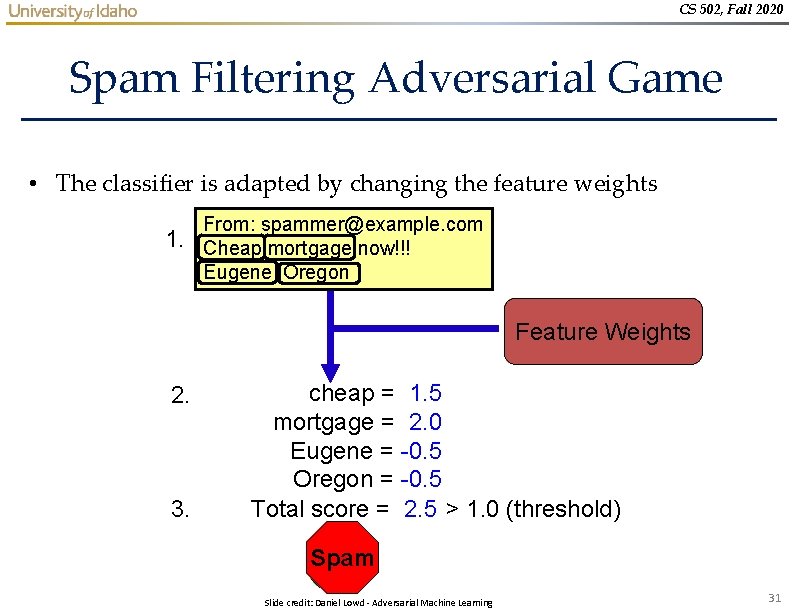
CS 502, Fall 2020 Spam Filtering Adversarial Game • The classifier is adapted by changing the feature weights 1. From: spammer@example. com Cheap mortgage now!!! Eugene Oregon Feature Weights 2. 3. cheap = 1. 5 mortgage = 2. 0 Eugene = -0. 5 Oregon = -0. 5 Total score = 2. 5 > 1. 0 (threshold) Spam OK Slide credit: Daniel Lowd - Adversarial Machine Learning 31
CS 502, Fall 2020 Common Adversarial Attacks • • Noise attack Semantic attack Fast gradient sign method (FGSM) attack Basic iterative method (BIM) attack Projected gradient descent (PGD) attack Deep. Fool attack Carlini-Wagner (CW) attack 32
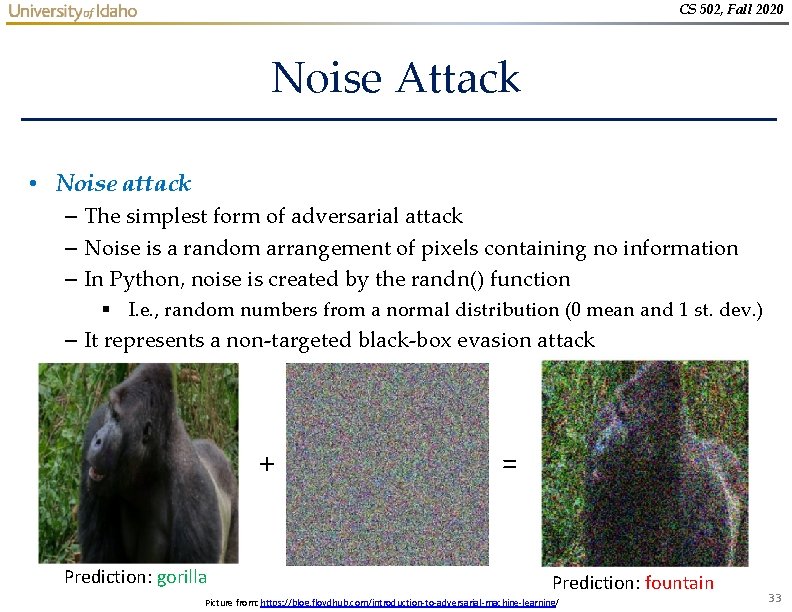
CS 502, Fall 2020 Noise Attack • Noise attack – The simplest form of adversarial attack – Noise is a random arrangement of pixels containing no information – In Python, noise is created by the randn() function § I. e. , random numbers from a normal distribution (0 mean and 1 st. dev. ) – It represents a non-targeted black-box evasion attack + Prediction: gorilla = Prediction: fountain Picture from: https: //blog. floydhub. com/introduction-to-adversarial-machine-learning/ 33
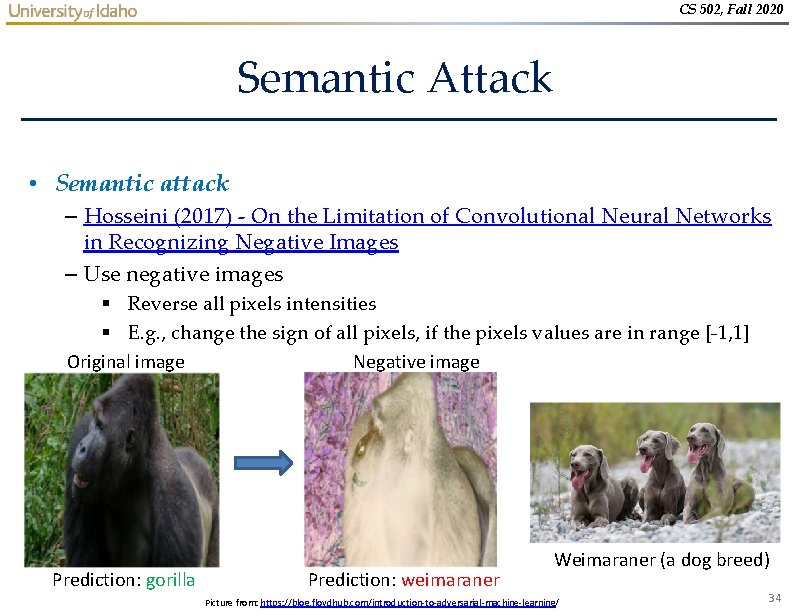
CS 502, Fall 2020 Semantic Attack • Semantic attack – Hosseini (2017) - On the Limitation of Convolutional Neural Networks in Recognizing Negative Images – Use negative images § Reverse all pixels intensities § E. g. , change the sign of all pixels, if the pixels values are in range [-1, 1] Original image Negative image Prediction: gorilla Prediction: weimaraner Weimaraner (a dog breed) Picture from: https: //blog. floydhub. com/introduction-to-adversarial-machine-learning/ 34
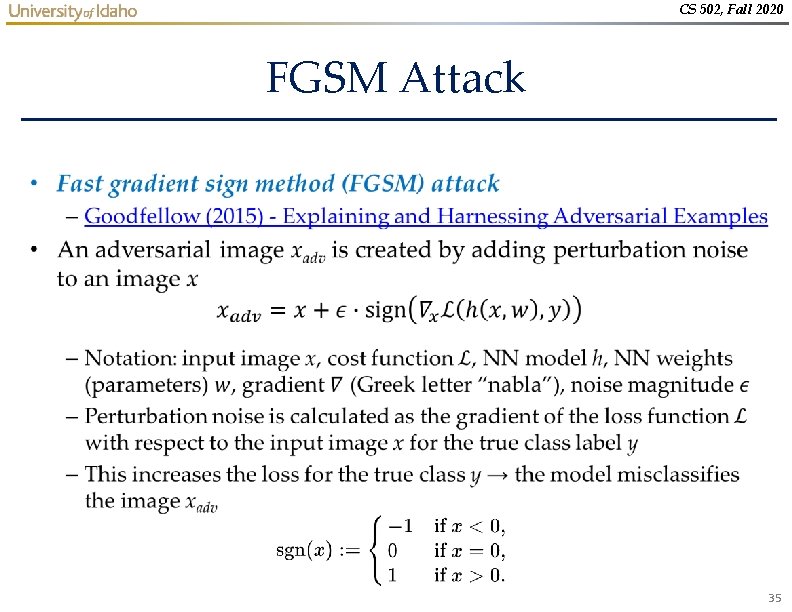
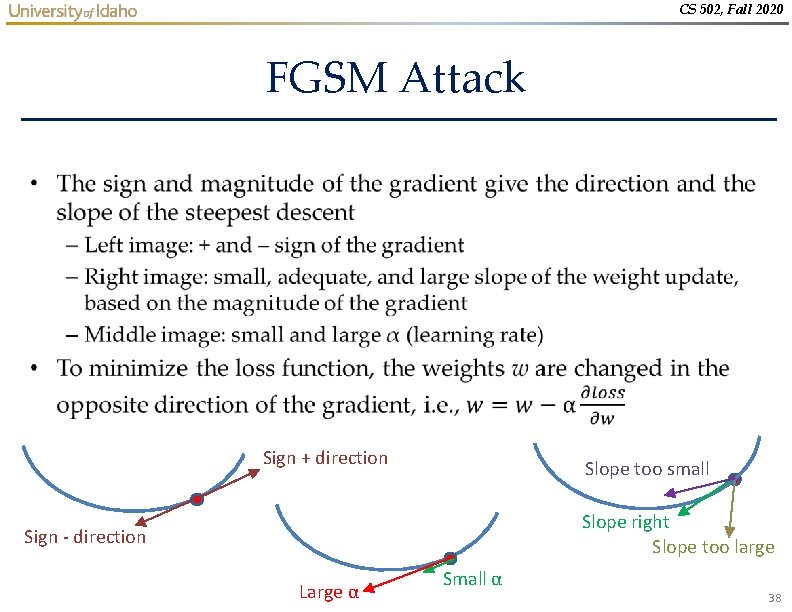
CS 502, Fall 2020 FGSM Attack • 35
CS 502, Fall 2020 FGSM Attack • FGSM is a white-box non-targeted evasion attack – White-box, since we need to know the gradients to create the adversarial image – The noise magnitude is ε = 0. 007 § Note: nematode is an insect referred to as roundworm 36
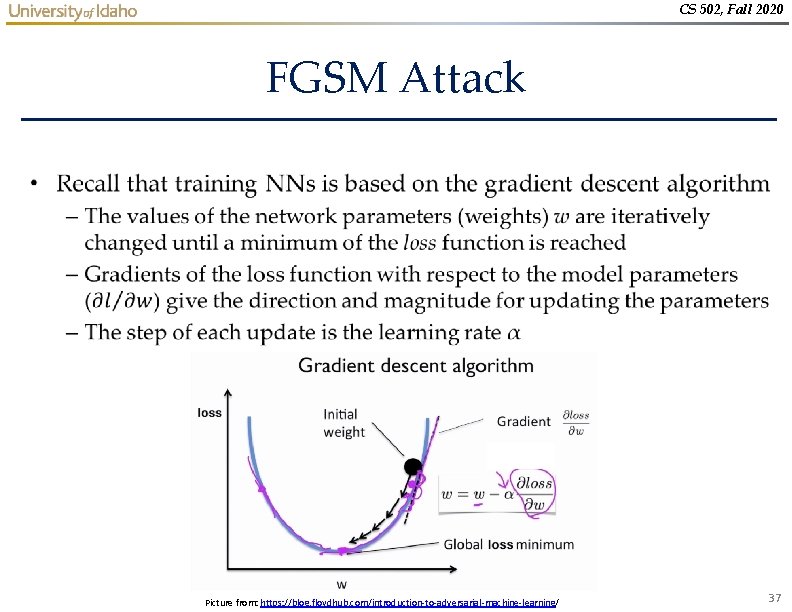
CS 502, Fall 2020 FGSM Attack • Picture from: https: //blog. floydhub. com/introduction-to-adversarial-machine-learning/ 37
CS 502, Fall 2020 FGSM Attack • Sign + direction Slope too small Slope right Slope too large Sign - direction Large α Small α 38
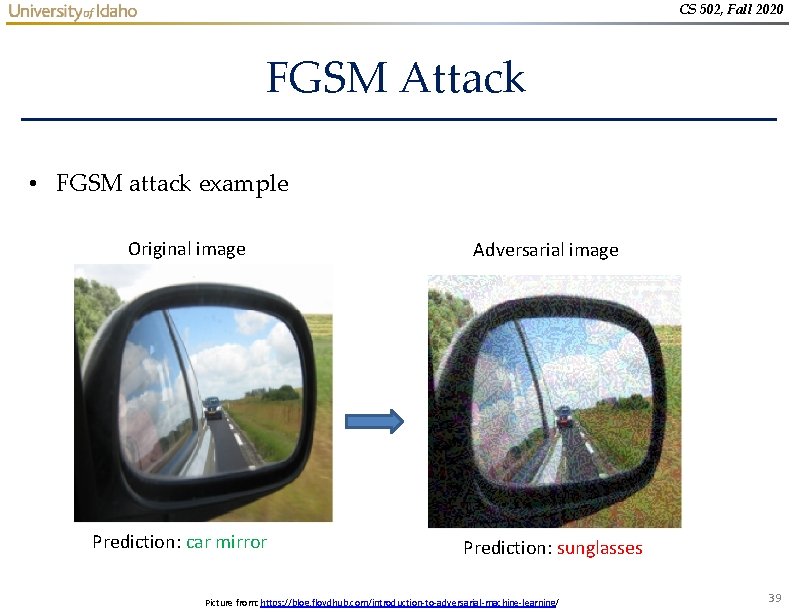
CS 502, Fall 2020 FGSM Attack • FGSM attack example Original image Prediction: car mirror Adversarial image Prediction: sunglasses Picture from: https: //blog. floydhub. com/introduction-to-adversarial-machine-learning/ 39
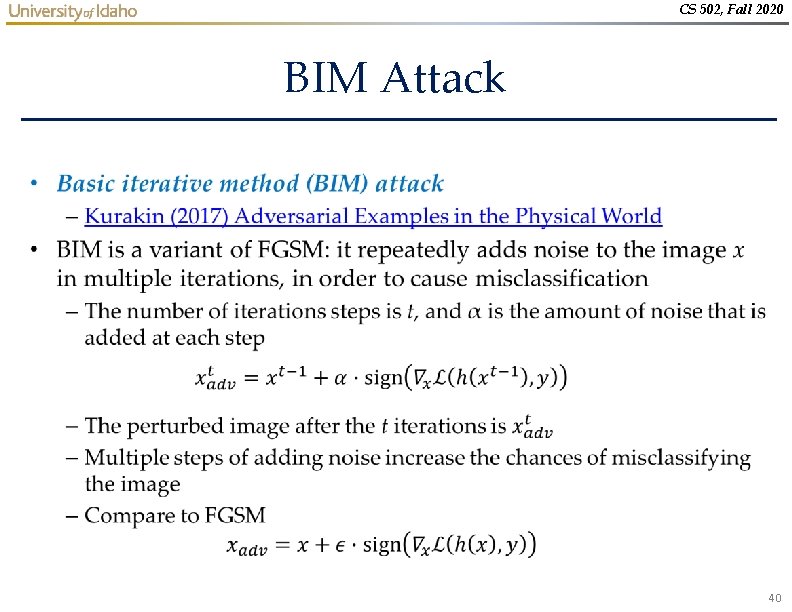
CS 502, Fall 2020 BIM Attack • 40
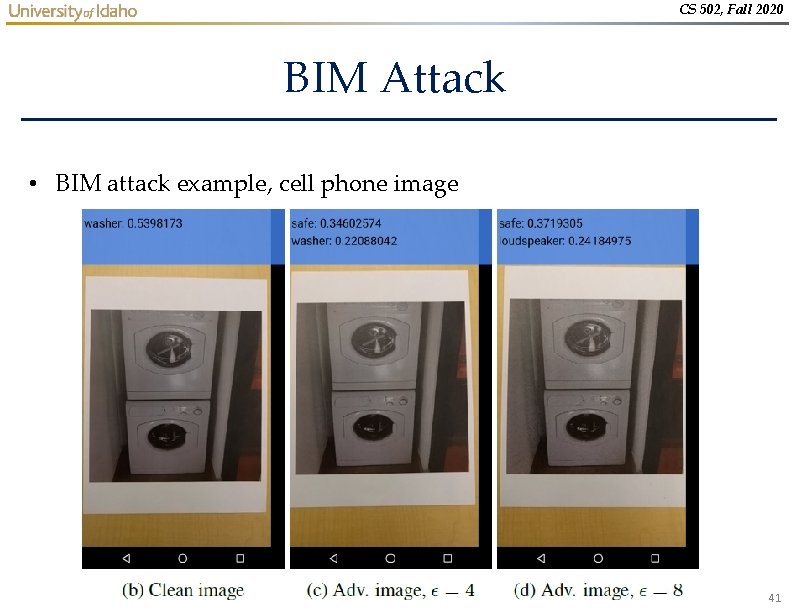
CS 502, Fall 2020 BIM Attack • BIM attack example, cell phone image 41
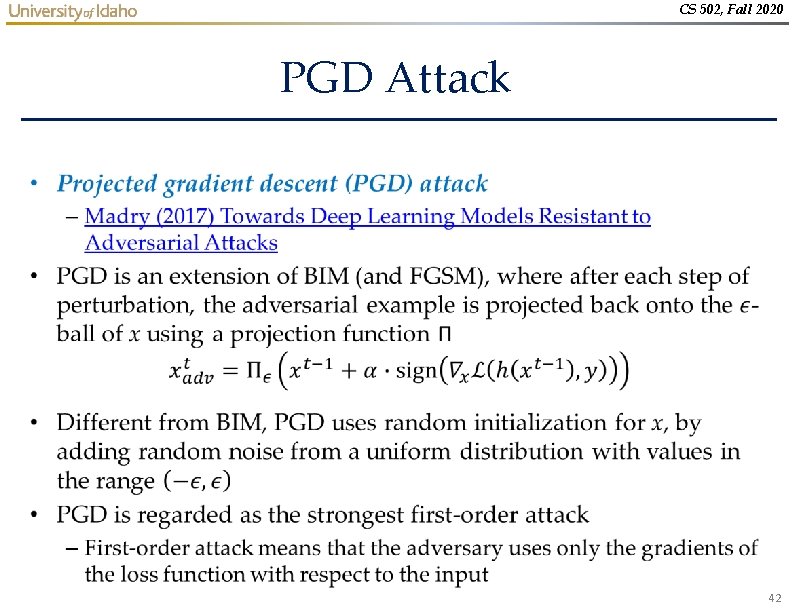
CS 502, Fall 2020 PGD Attack • 42
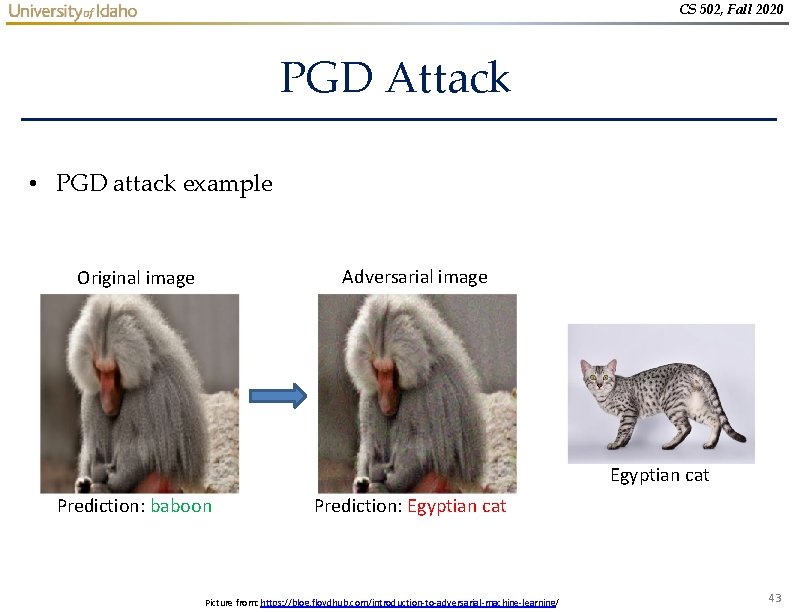
CS 502, Fall 2020 PGD Attack • PGD attack example Adversarial image Original image Egyptian cat Prediction: baboon Prediction: Egyptian cat Picture from: https: //blog. floydhub. com/introduction-to-adversarial-machine-learning/ 43
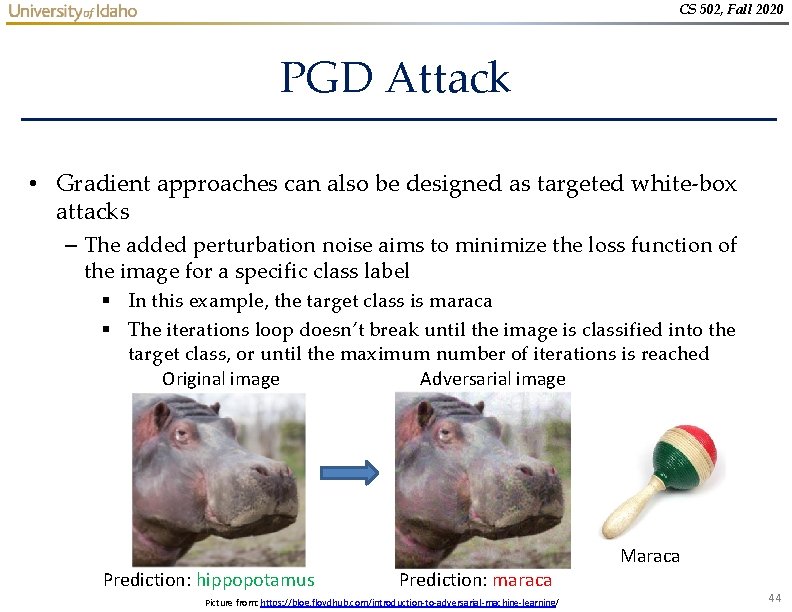
CS 502, Fall 2020 PGD Attack • Gradient approaches can also be designed as targeted white-box attacks – The added perturbation noise aims to minimize the loss function of the image for a specific class label § In this example, the target class is maraca § The iterations loop doesn’t break until the image is classified into the target class, or until the maximum number of iterations is reached Original image Adversarial image Prediction: hippopotamus Prediction: maraca Picture from: https: //blog. floydhub. com/introduction-to-adversarial-machine-learning/ Maraca 44
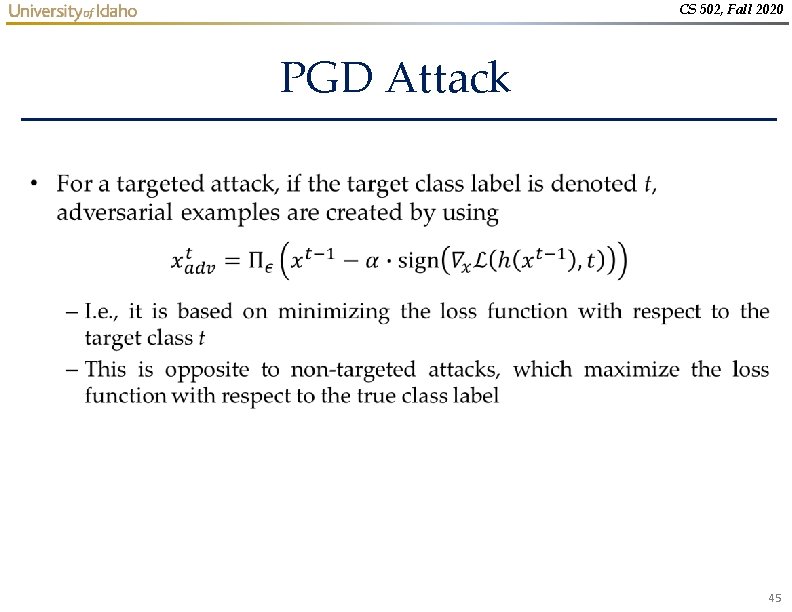
CS 502, Fall 2020 PGD Attack • 45
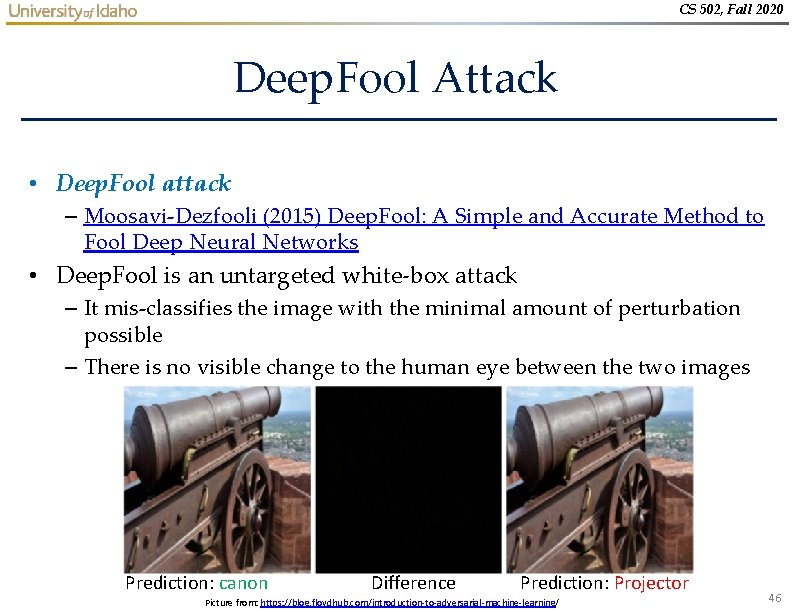
CS 502, Fall 2020 Deep. Fool Attack • Deep. Fool attack – Moosavi-Dezfooli (2015) Deep. Fool: A Simple and Accurate Method to Fool Deep Neural Networks • Deep. Fool is an untargeted white-box attack – It mis-classifies the image with the minimal amount of perturbation possible – There is no visible change to the human eye between the two images Prediction: canon Difference Prediction: Projector Picture from: https: //blog. floydhub. com/introduction-to-adversarial-machine-learning/ 46
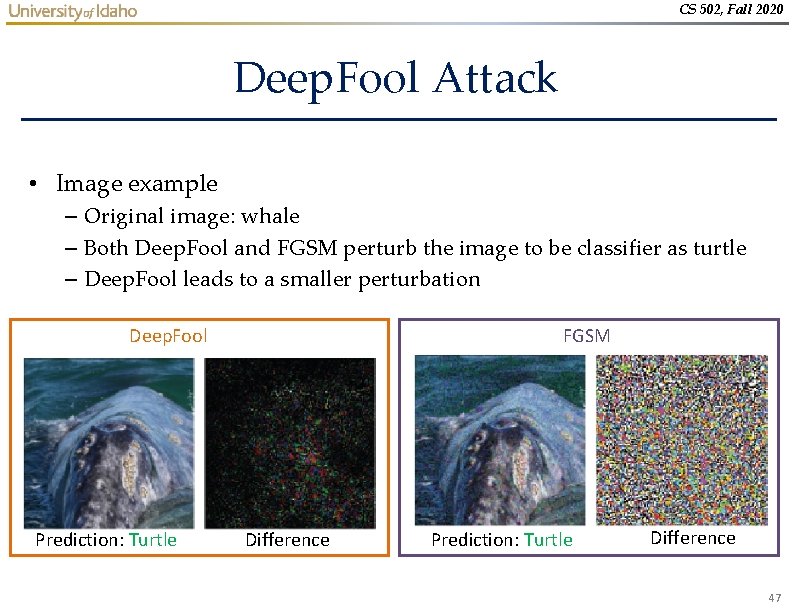
CS 502, Fall 2020 Deep. Fool Attack • Image example – Original image: whale – Both Deep. Fool and FGSM perturb the image to be classifier as turtle – Deep. Fool leads to a smaller perturbation FGSM Deep. Fool Prediction: Turtle Difference 47
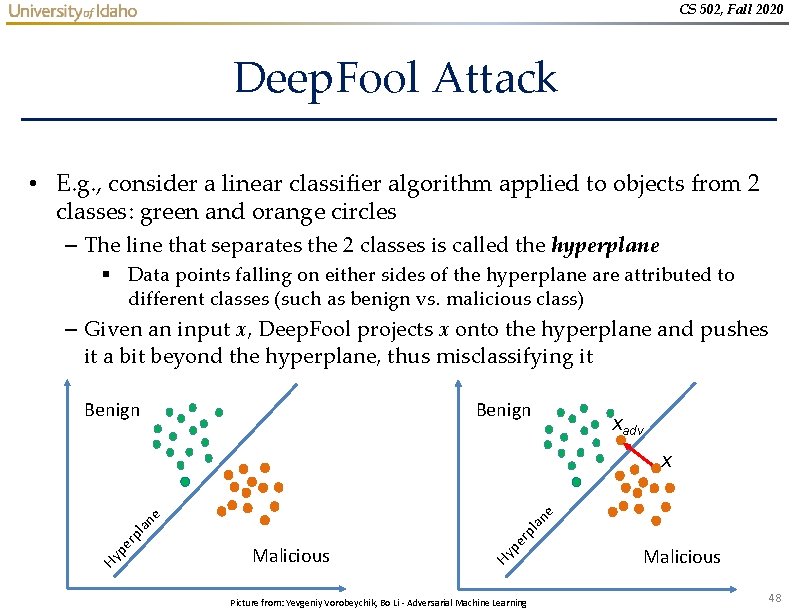
CS 502, Fall 2020 Deep. Fool Attack • E. g. , consider a linear classifier algorithm applied to objects from 2 classes: green and orange circles – The line that separates the 2 classes is called the hyperplane § Data points falling on either sides of the hyperplane are attributed to different classes (such as benign vs. malicious class) – Given an input x, Deep. Fool projects x onto the hyperplane and pushes it a bit beyond the hyperplane, thus misclassifying it Benign xadv pe r Malicious Hy Hy pe r pl an e e x Picture from: Yevgeniy Vorobeychik, Bo Li - Adversarial Machine Learning Malicious 48
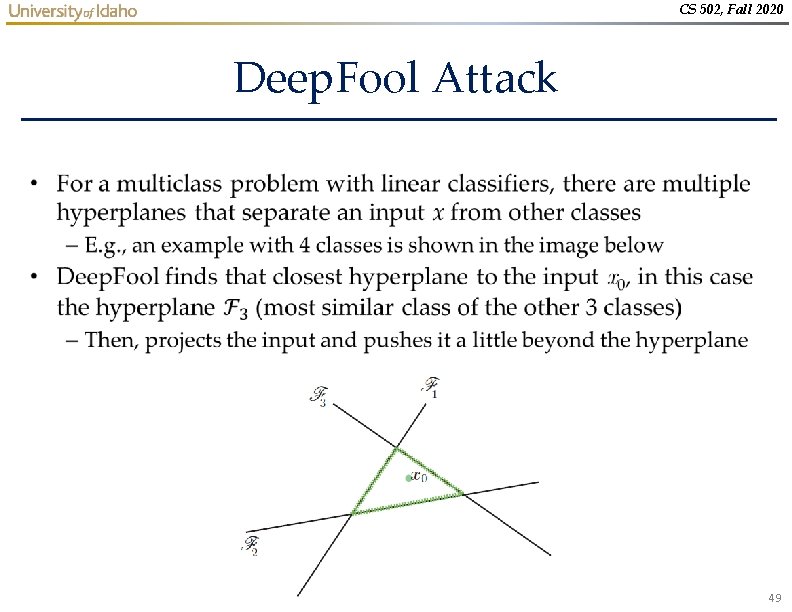
CS 502, Fall 2020 Deep. Fool Attack • 49
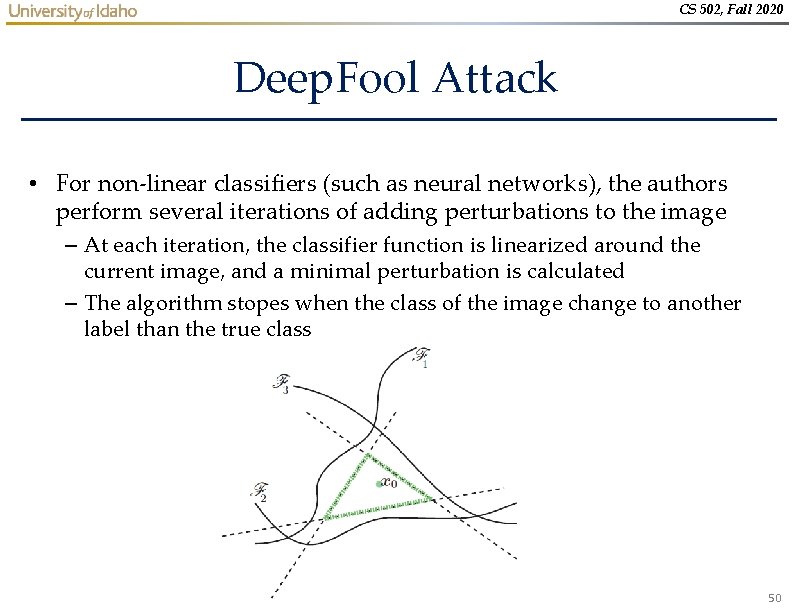
CS 502, Fall 2020 Deep. Fool Attack • For non-linear classifiers (such as neural networks), the authors perform several iterations of adding perturbations to the image – At each iteration, the classifier function is linearized around the current image, and a minimal perturbation is calculated – The algorithm stopes when the class of the image change to another label than the true class 50
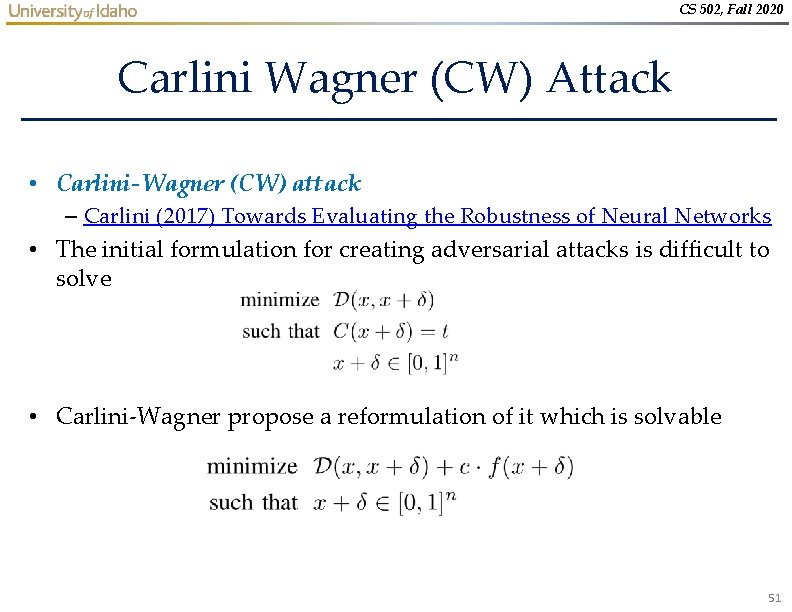
CS 502, Fall 2020 Carlini Wagner (CW) Attack • Carlini-Wagner (CW) attack – Carlini (2017) Towards Evaluating the Robustness of Neural Networks • The initial formulation for creating adversarial attacks is difficult to solve • Carlini-Wagner propose a reformulation of it which is solvable 51
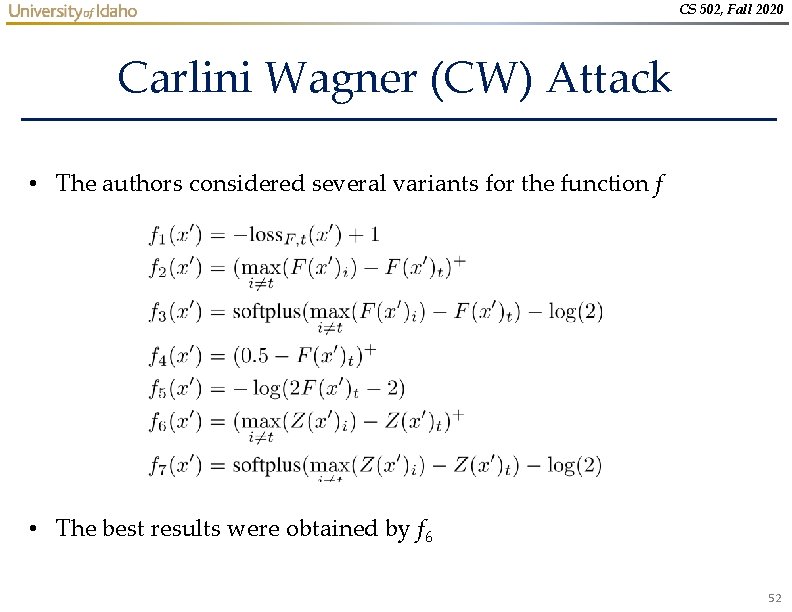
CS 502, Fall 2020 Carlini Wagner (CW) Attack • The authors considered several variants for the function f • The best results were obtained by f 6 52
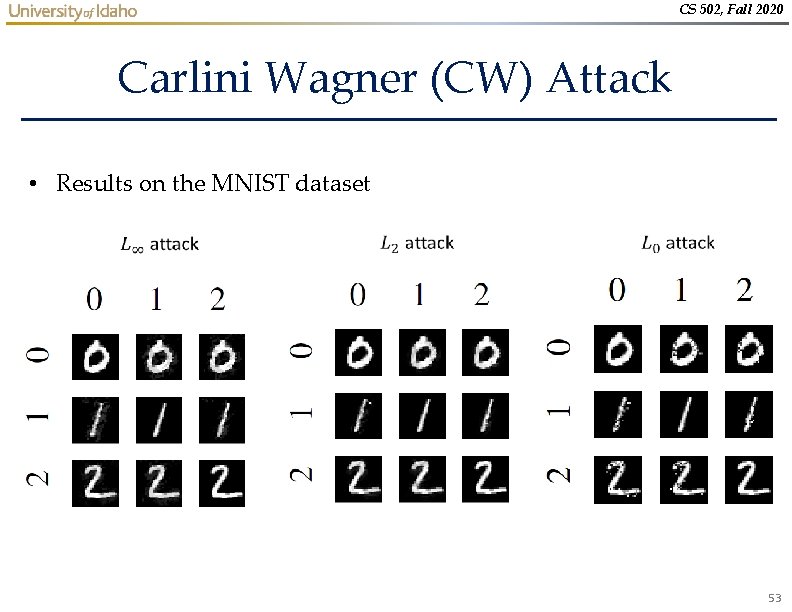
CS 502, Fall 2020 Carlini Wagner (CW) Attack • Results on the MNIST dataset 53
CS 502, Fall 2020 Evasion Attacks on Black-Box Models • Adversarial example transferability – Cross-model transferability: the same adversarial example is often misclassified by a variety of classifiers with different architectures – Cross-training set transferability: the same adversarial example is often misclassified trained on different subsets of the training data • Therefore, an attacker can take the following steps to reverseengineer the classifier: 1. Train his own (white-box) substitute model 2. Generate adversarial samples 3. Apply the adversarial samples to the target ML model Slide credit: Binghui Wang: Adversarial Machine Learning — An Introduction 54
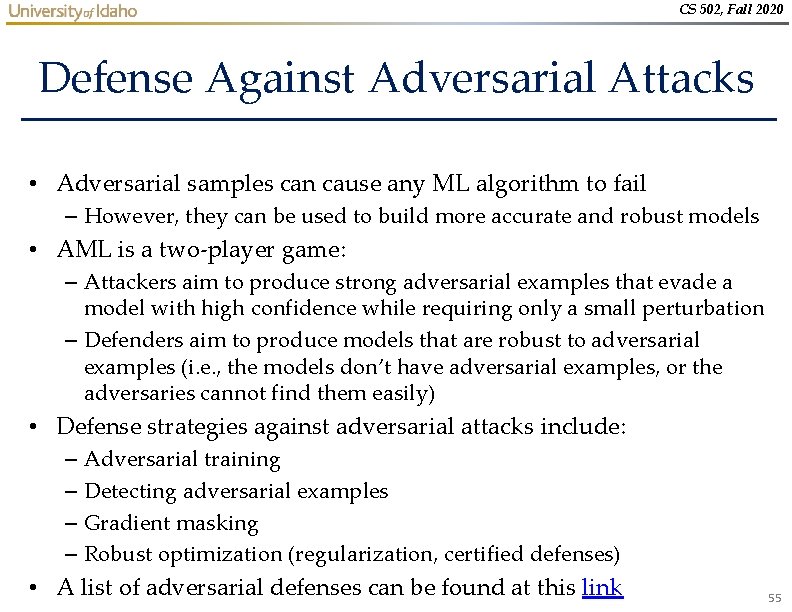
CS 502, Fall 2020 Defense Against Adversarial Attacks • Adversarial samples can cause any ML algorithm to fail – However, they can be used to build more accurate and robust models • AML is a two-player game: – Attackers aim to produce strong adversarial examples that evade a model with high confidence while requiring only a small perturbation – Defenders aim to produce models that are robust to adversarial examples (i. e. , the models don’t have adversarial examples, or the adversaries cannot find them easily) • Defense strategies against adversarial attacks include: – Adversarial training – Detecting adversarial examples – Gradient masking – Robust optimization (regularization, certified defenses) • A list of adversarial defenses can be found at this link 55
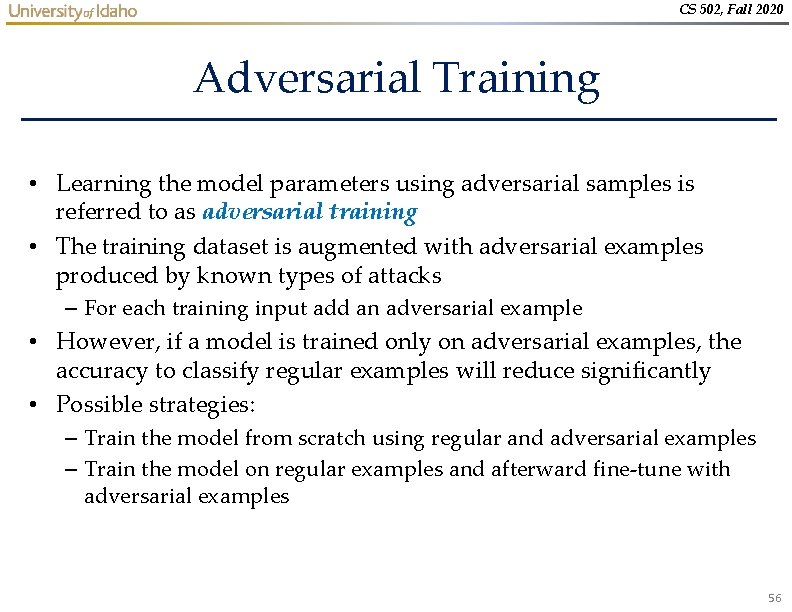
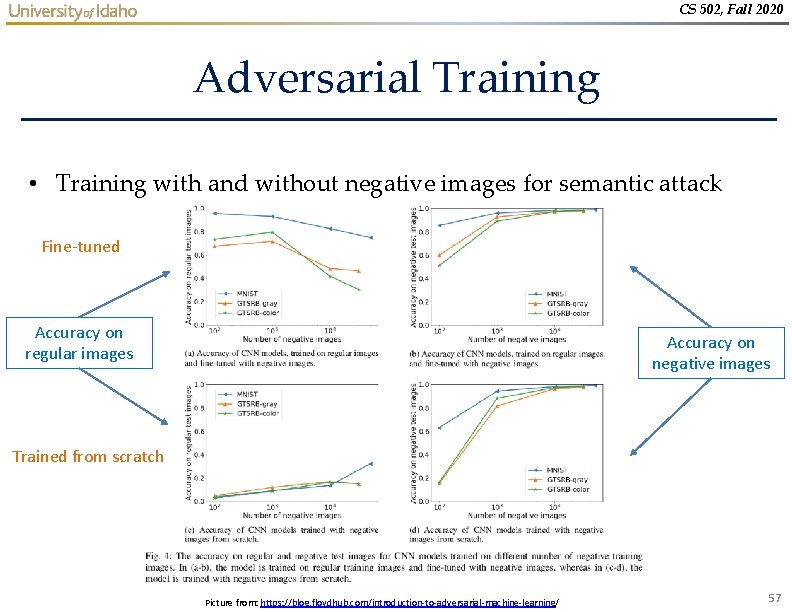
CS 502, Fall 2020 Adversarial Training • Learning the model parameters using adversarial samples is referred to as adversarial training • The training dataset is augmented with adversarial examples produced by known types of attacks – For each training input add an adversarial example • However, if a model is trained only on adversarial examples, the accuracy to classify regular examples will reduce significantly • Possible strategies: – Train the model from scratch using regular and adversarial examples – Train the model on regular examples and afterward fine-tune with adversarial examples 56
CS 502, Fall 2020 Adversarial Training • Training with and without negative images for semantic attack Fine-tuned Accuracy on regular images Accuracy on negative images Trained from scratch Picture from: https: //blog. floydhub. com/introduction-to-adversarial-machine-learning/ 57
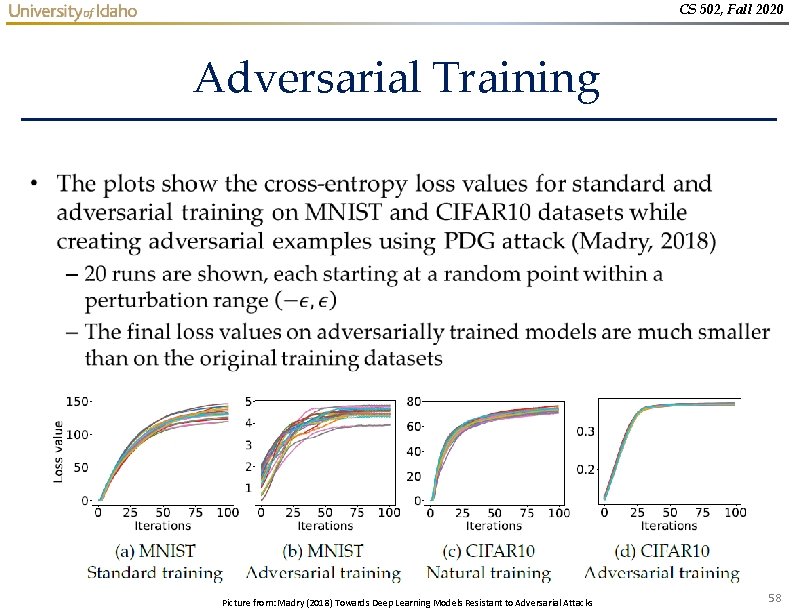
CS 502, Fall 2020 Adversarial Training • Picture from: Madry (2018) Towards Deep Learning Models Resistant to Adversarial Attacks 58
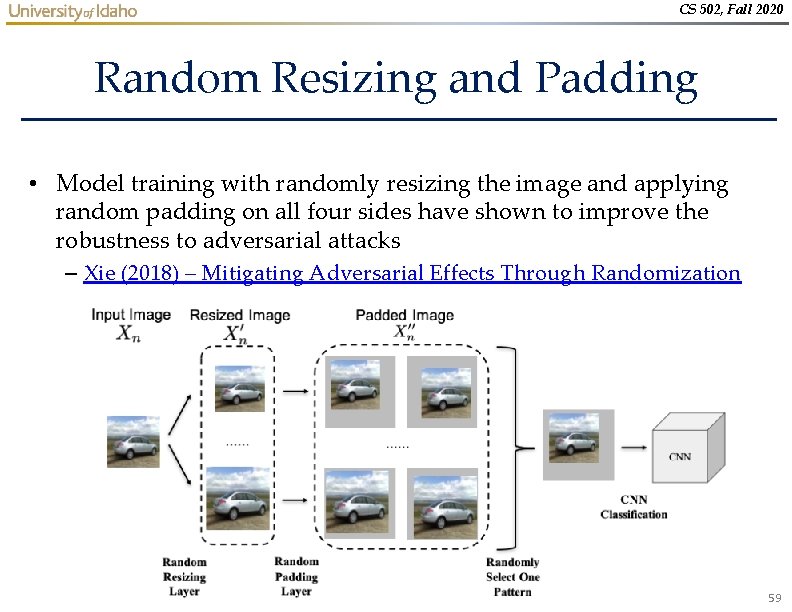
CS 502, Fall 2020 Random Resizing and Padding • Model training with randomly resizing the image and applying random padding on all four sides have shown to improve the robustness to adversarial attacks – Xie (2018) – Mitigating Adversarial Effects Through Randomization 59
CS 502, Fall 2020 Detecting Adversarial Examples • A body of work focused on distinguishing adversarial examples from regular clean examples – If the defense method detects that an input example is adversarial, the classifier will refuse to predict its class label • Example detection defense methods – Kernel Density (KD) detector based on Bayesian uncertainty features § Feinman (2017) – Detecting Adversarial Samples from Artifacts – Local Intrinsic Dimensionality (LID) of adversarial subspaces § Ma (2018) - Characterizing Adversarial Subspaces Using Local Intrinsic Dimensionality – Adversary detection networks § Metzen (2017) On detecting adversarial perturbations 60
CS 502, Fall 2020 Gradient Masking • Gradient masking defense methods deliberately hide the gradient information of the model – Since most attacks are based on the model’s gradient information • Distillation defense – changes the scaling of the last hidden layer in NNs, hindering the calculation of gradients – Papernot (2016) Distillation as a defense to adversarial perturbations against deep neural networks • Input preprocessing by discretization of image’s pixel values, or resizing and cropping, or smoothing – Buckman (2018) Thermometer encoding: One hot way to resist adversarial examples • Defense. GAN – uses a GAN model to transform perturbed images into clean images – Samangouei (2017) Defense-GAN: Protecting classifiers against adversarial attacks using generative models 61
CS 502, Fall 2020 Robust Optimization • Robust optimization aims to evaluate, and improve, the model robustness to adversarial attacks – Consequently, learn model parameters that minimize the misclassification of adversarial examples • Regularization methods – train the model by penalizing large values of the parameters, or large values of the gradients – Cisse (2017) Parseval networks: Improving robustness to adversarial examples • Certified defenses – for a given dataset and model, find the lower bound of the minimal perturbation: the model will be safe against any perturbations smaller than the lower bound – Raghunathan (2018) Certified defenses against adversarial examples 62
CS 502, Fall 2020 Conclusion • ML algorithms and methods are vulnerable to many types of attacks • Adversarial examples show its transferability in ML models – I. e. , either cross-models or cross-training sets • Adversarial examples can be leveraged to improve the performance or the robustness of ML models 63
CS 502, Fall 2020 References 1. Introduction to Adversarial Machine Learning – blog post by Arunava Chakraborty 2. Binghui Wang: Adversarial Machine Learning — An Introduction 3. Daniel Lowd, Adversarial Machine Learning 4. Yevgeniy Vorobeychik, Bo Li, Adversarial Machine Learning (Tutorial) 64
CS 502, Fall 2020 Other AML Recourses • Cleverhans - a repository from Google that implements latest research in AML – The library is being updated to support Tensor. Flow 2, Py. Torch, and Jax • Adversarial Robustness Toolbox - a toolbox from IBM that implements state-of-the-art attacks and defenses – The algorithms are framework-independent, and support Tensor. Flow, Keras, Py. Torch, MXNet, XGBoost, Light. GBM, Cat. Boost, etc. • Scratch. AI – a smaller AML library developed in Py. Torch, and explained in this blog post • Robust ML Defenses - list of adversarial defenses with code • AML Tutorial – by Bo Li, Dawn Song, and Yevgeniy Vorobeychik • Nicholas Carlini website 65