Computer Organization and Architecture Themes and Variations 1

- Slides: 74
Computer Organization and Architecture: Themes and Variations, 1 st Edition CHAPTER 5 Computer Organization and Architecture 1 © 2014 Cengage Learning Engineering. All Rights Reserved. Clements
Computer Organization and Architecture: Themes and Variations, 1 st Edition Clements Computer Architecture and Multimedia The rise of the RISC processor in the 1980 s seemed poised to sweep away complex instruction set architectures. Complex operations were to be carried out as fast sequences of primitive operations. However, complex instructions did not disappear. The rise of multimedia applications demanded new levels of performance and special operations were developed to facilitate audio and video processing. These new operations became known as instruction set extensions. 2 © 2014 Cengage Learning Engineering. All Rights Reserved.
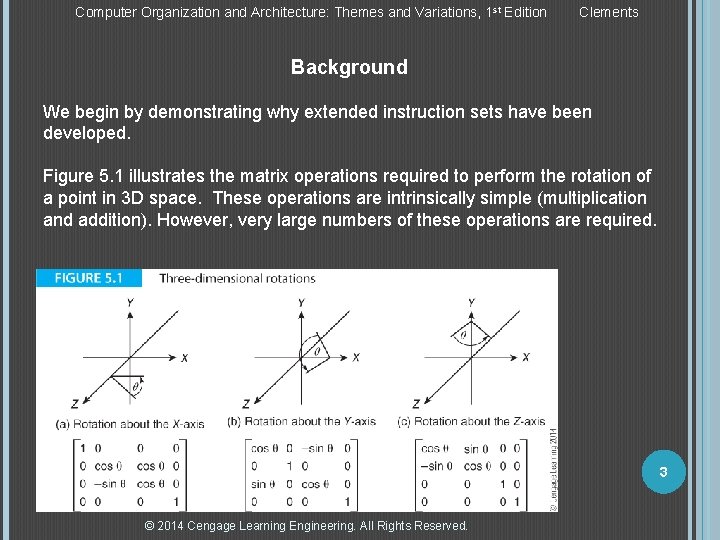
Computer Organization and Architecture: Themes and Variations, 1 st Edition Clements Background We begin by demonstrating why extended instruction sets have been developed. Figure 5. 1 illustrates the matrix operations required to perform the rotation of a point in 3 D space. These operations are intrinsically simple (multiplication and addition). However, very large numbers of these operations are required. 3 © 2014 Cengage Learning Engineering. All Rights Reserved.
Computer Organization and Architecture: Themes and Variations, 1 st Edition Clements A particular feature of multimedia operations is that the data elements are small – typically 8 or 16 bits. Today, the host computer can usually perform 64 bit operations. In other words, a 64 -bit processor performing multimedia operations is often using only 16 bits and throwing away 56 bits of the word. Multimedia operations improve performance by using all the 64 bits of a register. 4 © 2014 Cengage Learning Engineering. All Rights Reserved.
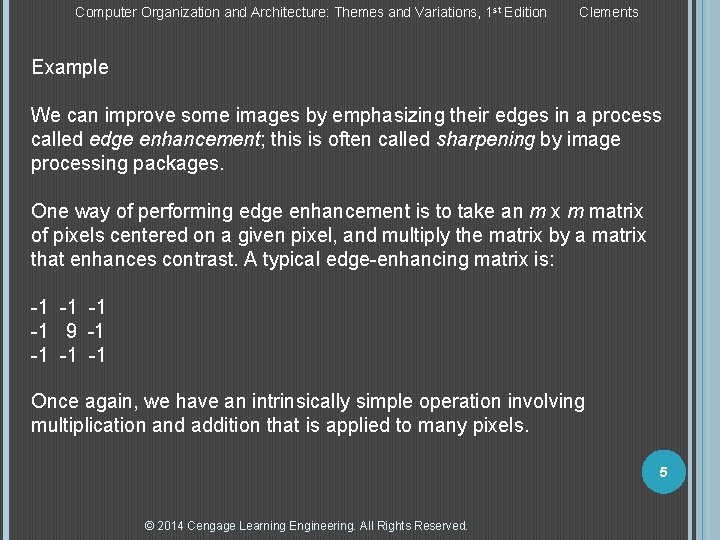
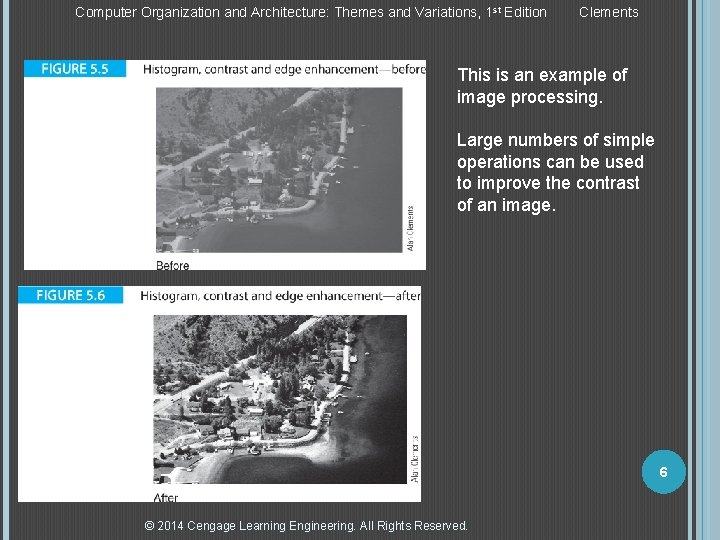
Computer Organization and Architecture: Themes and Variations, 1 st Edition Clements Example We can improve some images by emphasizing their edges in a process called edge enhancement; this is often called sharpening by image processing packages. One way of performing edge enhancement is to take an m x m matrix of pixels centered on a given pixel, and multiply the matrix by a matrix that enhances contrast. A typical edge-enhancing matrix is: -1 -1 9 -1 -1 Once again, we have an intrinsically simple operation involving multiplication and addition that is applied to many pixels. 5 © 2014 Cengage Learning Engineering. All Rights Reserved.
Computer Organization and Architecture: Themes and Variations, 1 st Edition Clements This is an example of image processing. Large numbers of simple operations can be used to improve the contrast of an image. 6 © 2014 Cengage Learning Engineering. All Rights Reserved.
Computer Organization and Architecture: Themes and Variations, 1 st Edition Clements Digital Signal Processing Let’s take a short detour and introduce digital signal processing. Digital signal processing, DSP, is referred to in the joint ACM/IEEE Computing Curriculum 2005 as “The field of computing that deals with digital filters, time and frequency transforms, and other digital methods of handling analog signals. ” DSP is not a topic normally covered in computer architecture texts, and DSP is all but invisible to most students taking CS and IT degrees. DSP is probably the most important of all computing applications in today’s world 7 © 2014 Cengage Learning Engineering. All Rights Reserved.
Computer Organization and Architecture: Themes and Variations, 1 st Edition Clements DSP covers the branch of computer science (computer engineering) that deals with the processing and interpretation of signals from electrocardiograms (EKGs), MRI scanners, seismometers, ultrasound scanners, oil rigs (when exploring), and so on. These are applications that are vital to the world’s economy and to our health-care systems. DSP has its origins in the 1960 s when the adaptive equalizer was designed to maximize the bandwidth of transmission paths across the global analog-based telecommunications network of the 1960 s and 70 s. In the 1960 s high-speed wide bandwidth optical transmission lines didn’t exist and public switched telephone data links had a bandwidth of only 3000 Hz. 8 © 2014 Cengage Learning Engineering. All Rights Reserved.
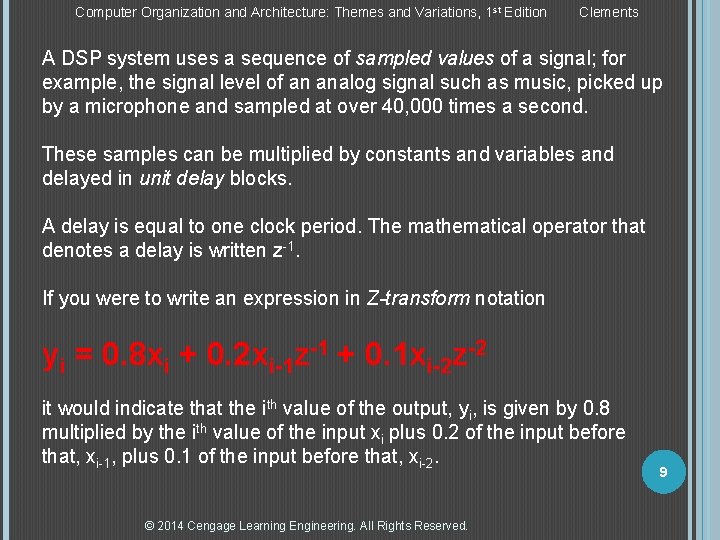
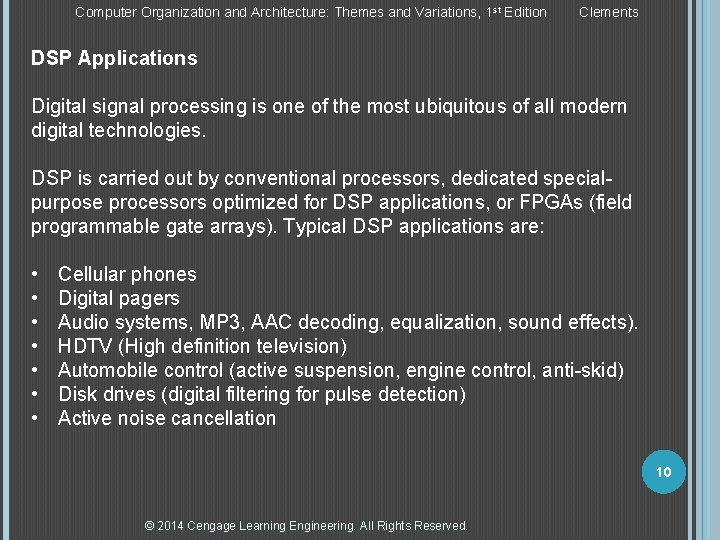
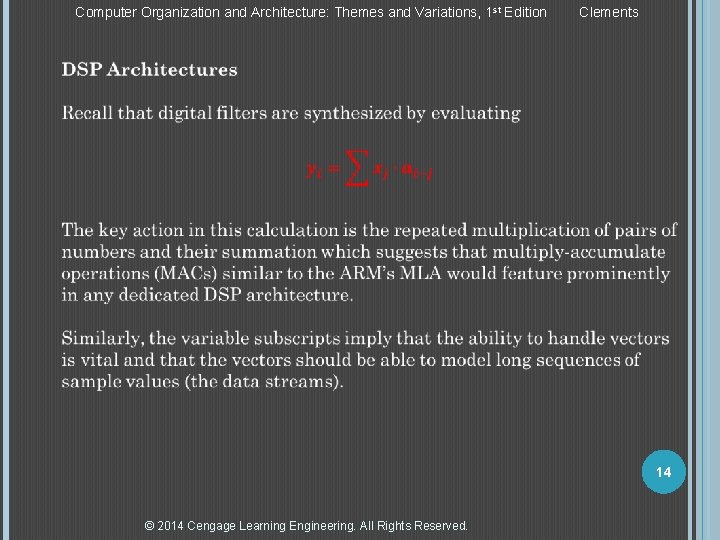
Computer Organization and Architecture: Themes and Variations, 1 st Edition Clements A DSP system uses a sequence of sampled values of a signal; for example, the signal level of an analog signal such as music, picked up by a microphone and sampled at over 40, 000 times a second. These samples can be multiplied by constants and variables and delayed in unit delay blocks. A delay is equal to one clock period. The mathematical operator that denotes a delay is written z-1. If you were to write an expression in Z-transform notation yi = 0. 8 xi + 0. 2 xi-1 z-1 + 0. 1 xi-2 z-2 it would indicate that the ith value of the output, yi, is given by 0. 8 multiplied by the ith value of the input xi plus 0. 2 of the input before that, xi-1, plus 0. 1 of the input before that, xi-2. © 2014 Cengage Learning Engineering. All Rights Reserved. 9
Computer Organization and Architecture: Themes and Variations, 1 st Edition Clements DSP Applications Digital signal processing is one of the most ubiquitous of all modern digital technologies. DSP is carried out by conventional processors, dedicated specialpurpose processors optimized for DSP applications, or FPGAs (field programmable gate arrays). Typical DSP applications are: • Cellular phones • Digital pagers • Audio systems, MP 3, AAC decoding, equalization, sound effects). • HDTV (High definition television) • Automobile control (active suspension, engine control, anti-skid) • Disk drives (digital filtering for pulse detection) • Active noise cancellation 10 © 2014 Cengage Learning Engineering. All Rights Reserved.
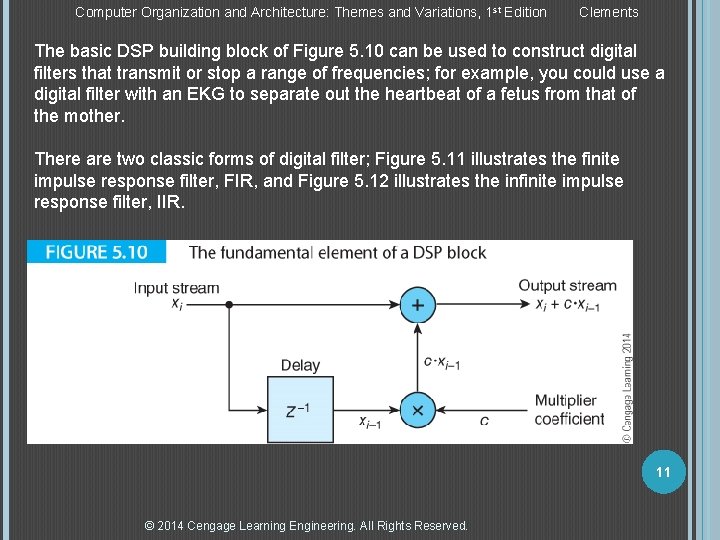
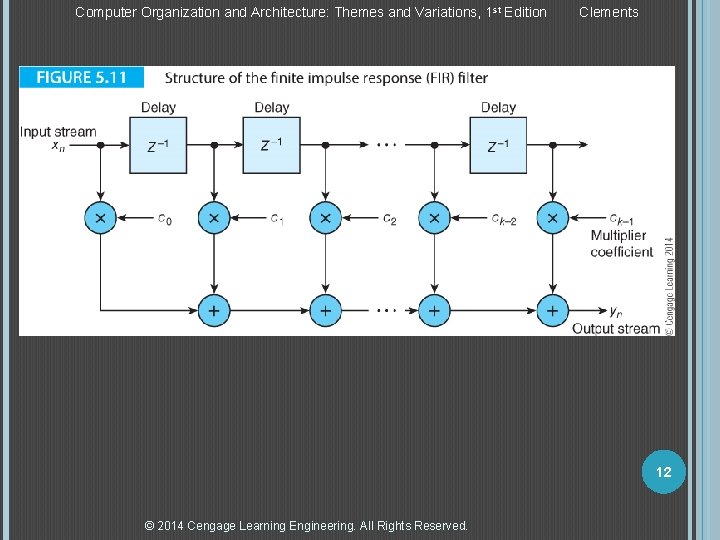
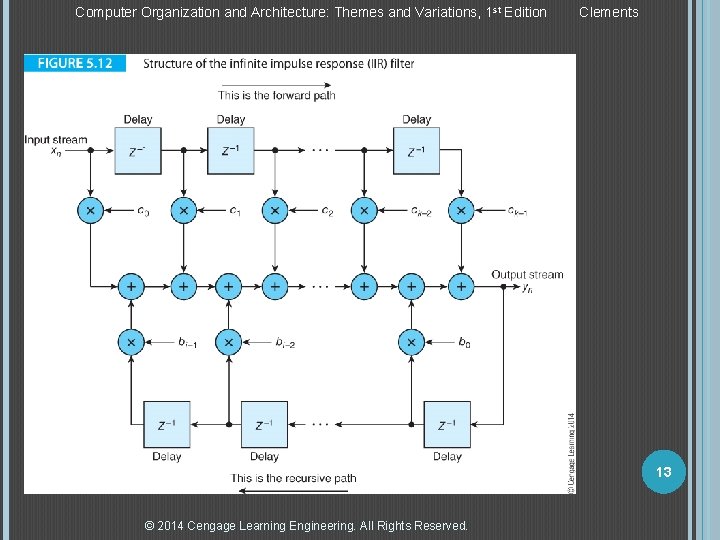
Computer Organization and Architecture: Themes and Variations, 1 st Edition Clements The basic DSP building block of Figure 5. 10 can be used to construct digital filters that transmit or stop a range of frequencies; for example, you could use a digital filter with an EKG to separate out the heartbeat of a fetus from that of the mother. There are two classic forms of digital filter; Figure 5. 11 illustrates the finite impulse response filter, FIR, and Figure 5. 12 illustrates the infinite impulse response filter, IIR. 11 © 2014 Cengage Learning Engineering. All Rights Reserved.
Computer Organization and Architecture: Themes and Variations, 1 st Edition Clements 12 © 2014 Cengage Learning Engineering. All Rights Reserved.
Computer Organization and Architecture: Themes and Variations, 1 st Edition Clements 13 © 2014 Cengage Learning Engineering. All Rights Reserved.
Computer Organization and Architecture: Themes and Variations, 1 st Edition Clements 14 © 2014 Cengage Learning Engineering. All Rights Reserved.
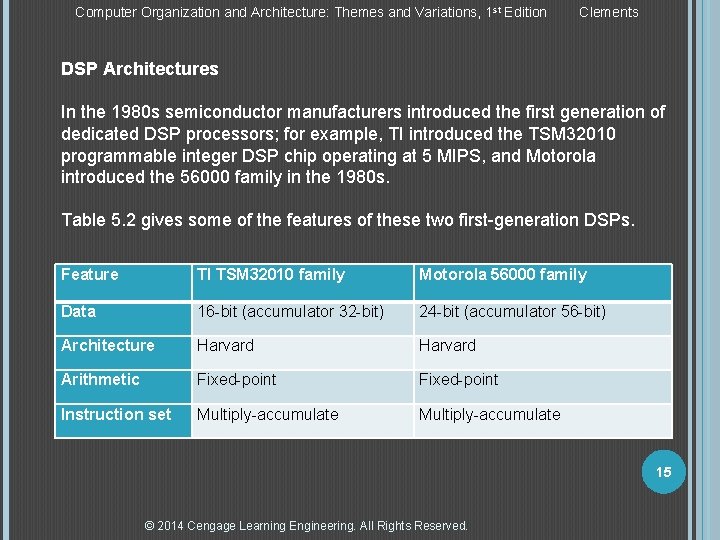
Computer Organization and Architecture: Themes and Variations, 1 st Edition Clements DSP Architectures In the 1980 s semiconductor manufacturers introduced the first generation of dedicated DSP processors; for example, TI introduced the TSM 32010 programmable integer DSP chip operating at 5 MIPS, and Motorola introduced the 56000 family in the 1980 s. Table 5. 2 gives some of the features of these two first-generation DSPs. Feature TI TSM 32010 family Motorola 56000 family Data 16 -bit (accumulator 32 -bit) 24 -bit (accumulator 56 -bit) Architecture Harvard Arithmetic Fixed-point Instruction set Multiply-accumulate 15 © 2014 Cengage Learning Engineering. All Rights Reserved.
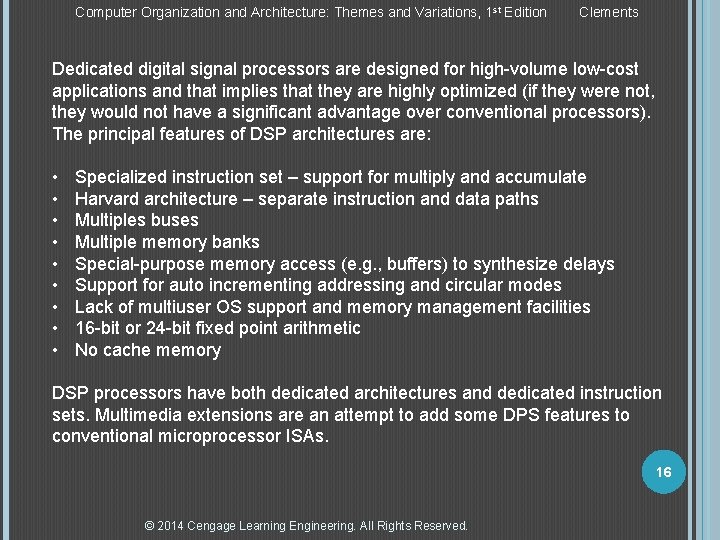
Computer Organization and Architecture: Themes and Variations, 1 st Edition Clements Dedicated digital signal processors are designed for high-volume low-cost applications and that implies that they are highly optimized (if they were not, they would not have a significant advantage over conventional processors). The principal features of DSP architectures are: • Specialized instruction set – support for multiply and accumulate • Harvard architecture – separate instruction and data paths • Multiples buses • Multiple memory banks • Special-purpose memory access (e. g. , buffers) to synthesize delays • Support for auto incrementing addressing and circular modes • Lack of multiuser OS support and memory management facilities • 16 -bit or 24 -bit fixed point arithmetic • No cache memory DSP processors have both dedicated architectures and dedicated instruction sets. Multimedia extensions are an attempt to add some DPS features to conventional microprocessor ISAs. 16 © 2014 Cengage Learning Engineering. All Rights Reserved.
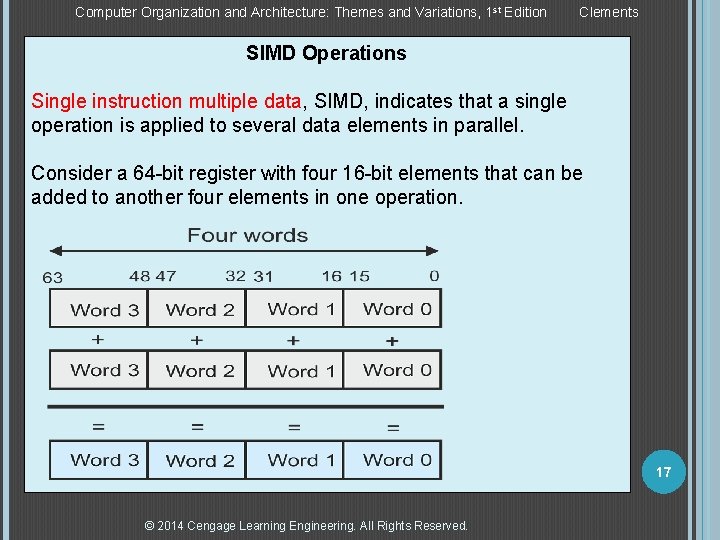
Computer Organization and Architecture: Themes and Variations, 1 st Edition Clements SIMD Operations Single instruction multiple data, SIMD, indicates that a single operation is applied to several data elements in parallel. Consider a 64 -bit register with four 16 -bit elements that can be added to another four elements in one operation. 17 © 2014 Cengage Learning Engineering. All Rights Reserved.
Computer Organization and Architecture: Themes and Variations, 1 st Edition Clements In 1996 Intel announced a multimedia extension technology, called MMX, that added innovative architectural features to the IA 32 architecture. This move was surprising in that Intel was increasing instruction set complexity when the trend was in the other direction. It made good sense to incorporate facilities that would give the IA 32 a strongly competitive edge. Since then, each new generation of a microprocessor family has added special-purpose multimedia friendly instructions to its core of existing instructions. 18 © 2014 Cengage Learning Engineering. All Rights Reserved.
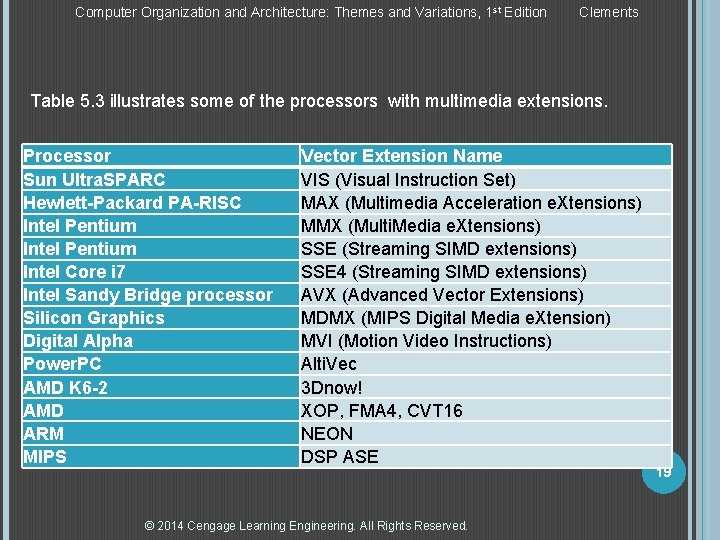
Computer Organization and Architecture: Themes and Variations, 1 st Edition Clements Table 5. 3 illustrates some of the processors with multimedia extensions. Processor Sun Ultra. SPARC Hewlett-Packard PA-RISC Intel Pentium Intel Core i 7 Intel Sandy Bridge processor Silicon Graphics Digital Alpha Power. PC AMD K 6 -2 AMD ARM MIPS Vector Extension Name VIS (Visual Instruction Set) MAX (Multimedia Acceleration e. Xtensions) MMX (Multi. Media e. Xtensions) SSE (Streaming SIMD extensions) SSE 4 (Streaming SIMD extensions) AVX (Advanced Vector Extensions) MDMX (MIPS Digital Media e. Xtension) MVI (Motion Video Instructions) Alti. Vec 3 Dnow! XOP, FMA 4, CVT 16 NEON DSP ASE © 2014 Cengage Learning Engineering. All Rights Reserved. 19
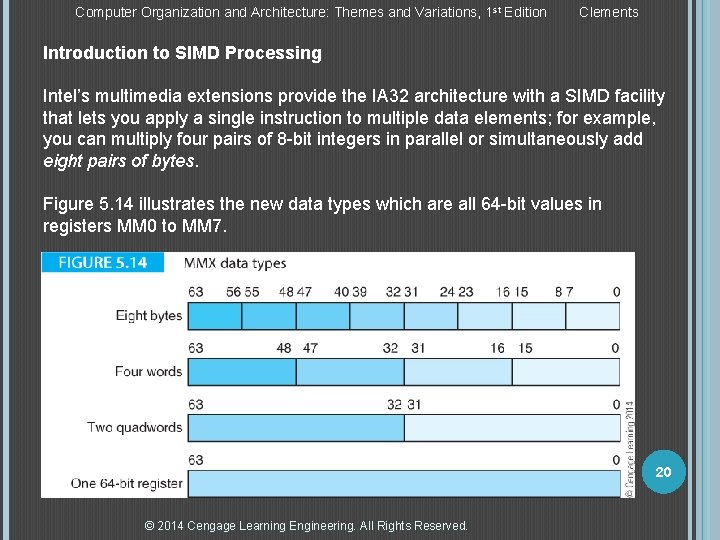
Computer Organization and Architecture: Themes and Variations, 1 st Edition Clements Introduction to SIMD Processing Intel’s multimedia extensions provide the IA 32 architecture with a SIMD facility that lets you apply a single instruction to multiple data elements; for example, you can multiply four pairs of 8 -bit integers in parallel or simultaneously add eight pairs of bytes. Figure 5. 14 illustrates the new data types which are all 64 -bit values in registers MM 0 to MM 7. 20 © 2014 Cengage Learning Engineering. All Rights Reserved.
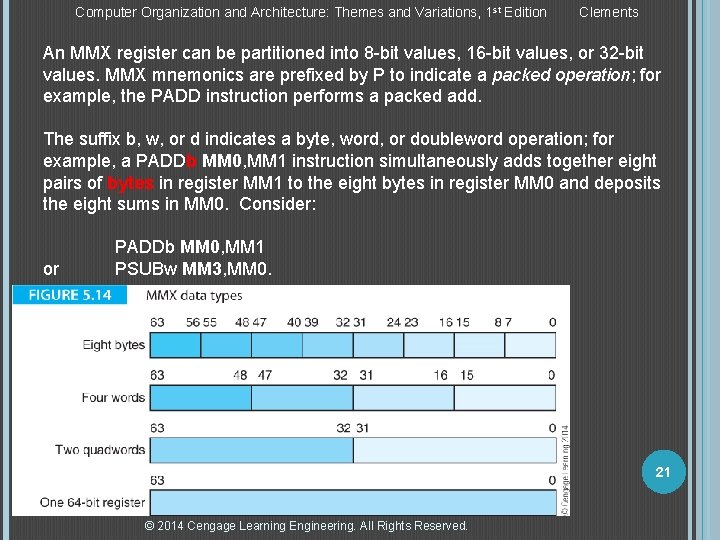
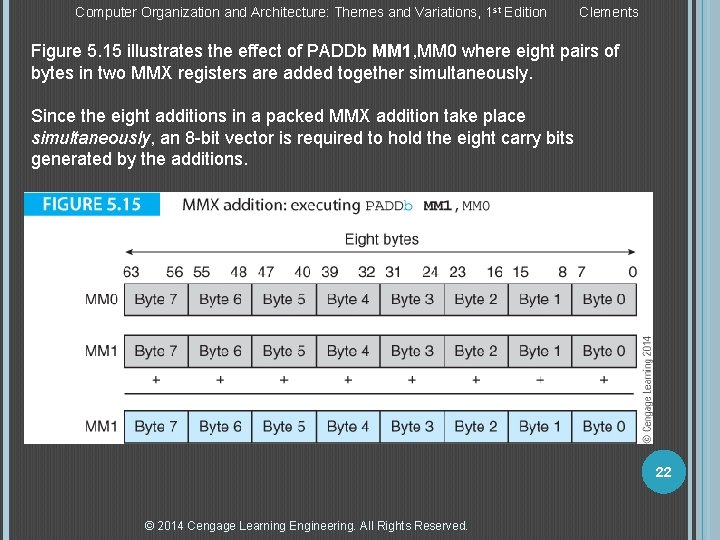
Computer Organization and Architecture: Themes and Variations, 1 st Edition Clements An MMX register can be partitioned into 8 -bit values, 16 -bit values, or 32 -bit values. MMX mnemonics are prefixed by P to indicate a packed operation; for example, the PADD instruction performs a packed add. The suffix b, w, or d indicates a byte, word, or doubleword operation; for example, a PADDb MM 0, MM 1 instruction simultaneously adds together eight pairs of bytes in register MM 1 to the eight bytes in register MM 0 and deposits the eight sums in MM 0. Consider: PADDb MM 0, MM 1 or PSUBw MM 3, MM 0. 21 © 2014 Cengage Learning Engineering. All Rights Reserved.
Computer Organization and Architecture: Themes and Variations, 1 st Edition Clements Figure 5. 15 illustrates the effect of PADDb MM 1, MM 0 where eight pairs of bytes in two MMX registers are added together simultaneously. Since the eight additions in a packed MMX addition take place simultaneously, an 8 -bit vector is required to hold the eight carry bits generated by the additions. 22 © 2014 Cengage Learning Engineering. All Rights Reserved.
Computer Organization and Architecture: Themes and Variations, 1 st Edition Clements Saturating arithmetic A particularly interesting aspect of MMX instructions is their treatment of overflow and underflow in integer arithmetic. Conventional integer arithmetic uses a wraparound mode where, for example, in eight bits the addition of 1 to 1111 results in 0000 and a carry out. The term wraparound indicates that the maximum value wraps around to the minimum value. MMX instructions can operate in a conventional wraparound mode, but this does not model well the physical reality of multimedia operations. 23 © 2014 Cengage Learning Engineering. All Rights Reserved.
Computer Organization and Architecture: Themes and Variations, 1 st Edition Clements Suppose we use an 8 -bit value to represent the intensity of a blue pixel. If 1111 represents the brightest blue and 0000 represents no blue, the physical reality is 1111 + 1 = 1111; that is, you can’t get bluer than blue. Similarly, 0000 – 1 is 0000 because you can’t get less blue than no blue. In both cases, the maximum or minimum value is constrained during arithmetic operations. This philosophy of clamping a value at its maximum or minimum corresponds well to physical reality. If you are representing part of a scene that is fully white, you can’t make it even whiter. Operations that clamp a value at its limits and don’t permit wraparound are called saturating operations. 24 © 2014 Cengage Learning Engineering. All Rights Reserved.
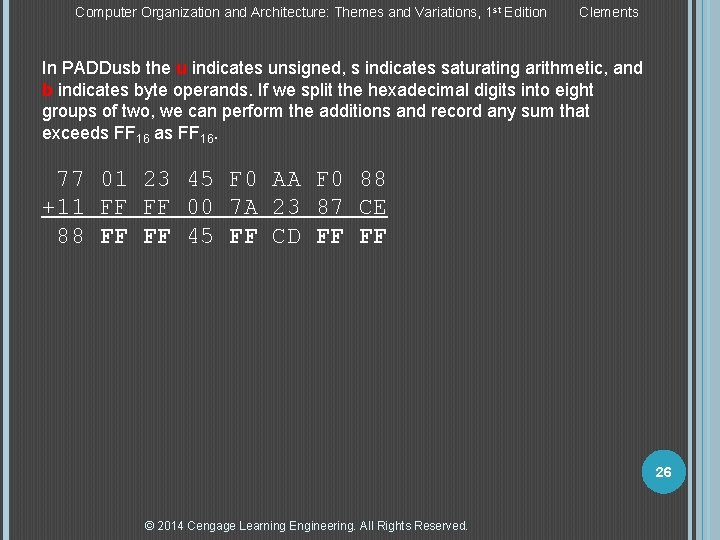
Computer Organization and Architecture: Themes and Variations, 1 st Edition Clements All MMX instructions except for multiplication take place in a single cycle. Some MMX operations may operate in a wraparound or a saturated mode. If the operation is both signed and saturated, the upper and lower values are 7 F 16 and 8016 (in byte arithmetic). If the operation is unsigned and saturated, the upper and lower values are 0016 and FF 16 (in byte arithmetic). Consider the unsigned byte addition operation, PADDusb MM 0, MM 1, where the initial vales in MM 0 and MM 1 are 77012345 F 0 AAF 01 F and 11 FFEE 00002387 CE 25 © 2014 Cengage Learning Engineering. All Rights Reserved.
Computer Organization and Architecture: Themes and Variations, 1 st Edition Clements In PADDusb the u indicates unsigned, s indicates saturating arithmetic, and b indicates byte operands. If we split the hexadecimal digits into eight groups of two, we can perform the additions and record any sum that exceeds FF 16 as FF 16. 77 01 23 45 F 0 AA F 0 88 +11 FF FF 00 7 A 23 87 CE 88 FF FF 45 FF CD FF FF 26 © 2014 Cengage Learning Engineering. All Rights Reserved.
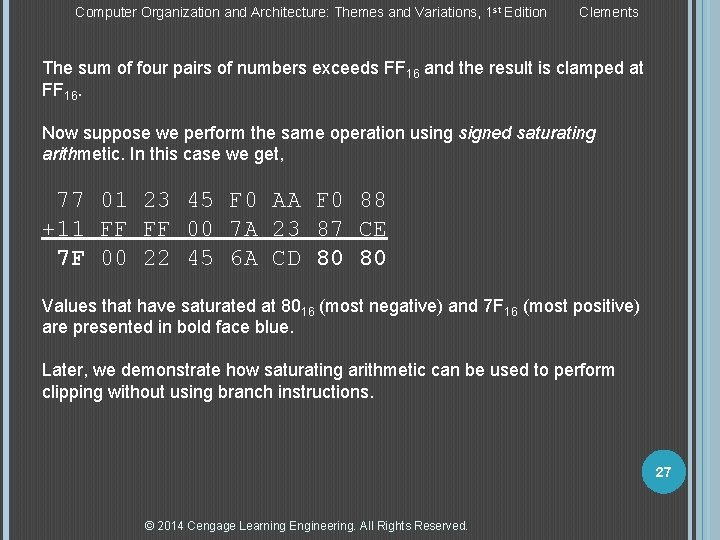
Computer Organization and Architecture: Themes and Variations, 1 st Edition Clements The sum of four pairs of numbers exceeds FF 16 and the result is clamped at FF 16. Now suppose we perform the same operation using signed saturating arithmetic. In this case we get, 77 01 23 45 F 0 AA F 0 88 +11 FF FF 00 7 A 23 87 CE 7 F 00 22 45 6 A CD 80 80 Values that have saturated at 8016 (most negative) and 7 F 16 (most positive) are presented in bold face blue. Later, we demonstrate how saturating arithmetic can be used to perform clipping without using branch instructions. 27 © 2014 Cengage Learning Engineering. All Rights Reserved.
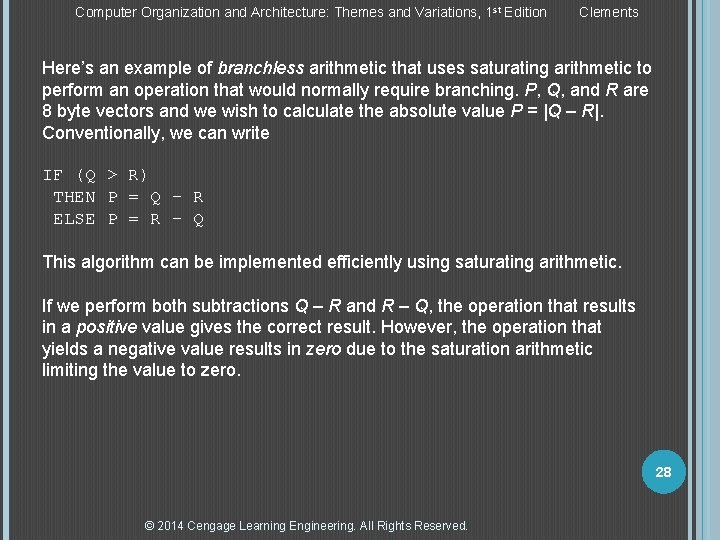
Computer Organization and Architecture: Themes and Variations, 1 st Edition Clements Here’s an example of branchless arithmetic that uses saturating arithmetic to perform an operation that would normally require branching. P, Q, and R are 8 byte vectors and we wish to calculate the absolute value P = |Q – R|. Conventionally, we can write IF (Q > R) THEN P = Q – R ELSE P = R – Q This algorithm can be implemented efficiently using saturating arithmetic. If we perform both subtractions Q – R and R – Q, the operation that results in a positive value gives the correct result. However, the operation that yields a negative value results in zero due to the saturation arithmetic limiting the value to zero. 28 © 2014 Cengage Learning Engineering. All Rights Reserved.
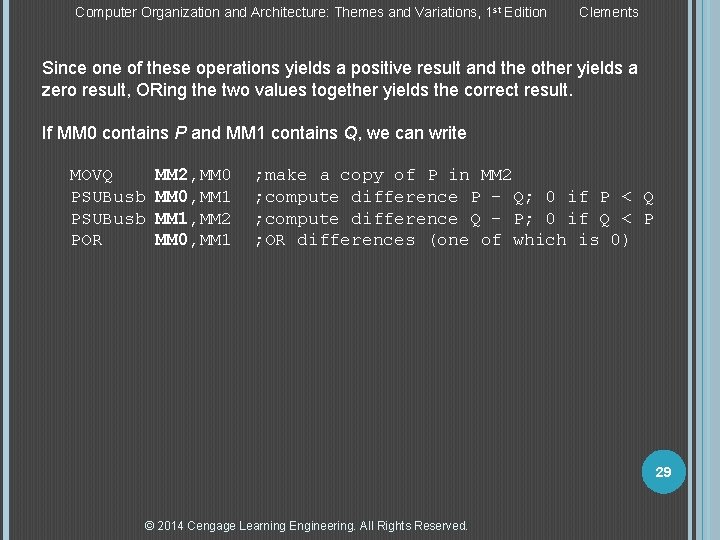
Computer Organization and Architecture: Themes and Variations, 1 st Edition Clements Since one of these operations yields a positive result and the other yields a zero result, ORing the two values together yields the correct result. If MM 0 contains P and MM 1 contains Q, we can write MOVQ MM 2, MM 0 ; make a copy of P in MM 2 PSUBusb MM 0, MM 1 ; compute difference P – Q; 0 if P < Q PSUBusb MM 1, MM 2 ; compute difference Q – P; 0 if Q < P POR MM 0, MM 1 ; OR differences (one of which is 0) 29 © 2014 Cengage Learning Engineering. All Rights Reserved.
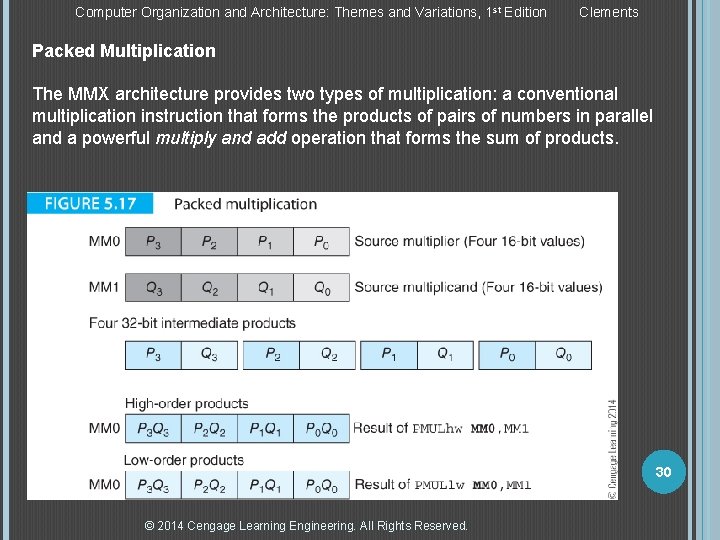
Computer Organization and Architecture: Themes and Variations, 1 st Edition Clements Packed Multiplication The MMX architecture provides two types of multiplication: a conventional multiplication instruction that forms the products of pairs of numbers in parallel and a powerful multiply and add operation that forms the sum of products. 30 © 2014 Cengage Learning Engineering. All Rights Reserved.
Computer Organization and Architecture: Themes and Variations, 1 st Edition Clements The PMULhw and PMULlw instructions each multiply four signed, packed, 16 -bit words to generate four 32 -bit products. Because four double-length 32 -bit products will not fit in a 64 -bit MMX register, you must use PMULhw to select the upper-order 16 -bits of each product or PMULlw to select the lower-order 16 -bits of each product. Figure 5. 17 demonstrates the effect of these two instructions on the contents of two MMX registers. Note how the MMX instruction set provides more options for add and subtract instructions (8 - to 32 -bit additions), whereas the multiplication instructions are constrained to 16 -bit signed arithmetic. 31 © 2014 Cengage Learning Engineering. All Rights Reserved.
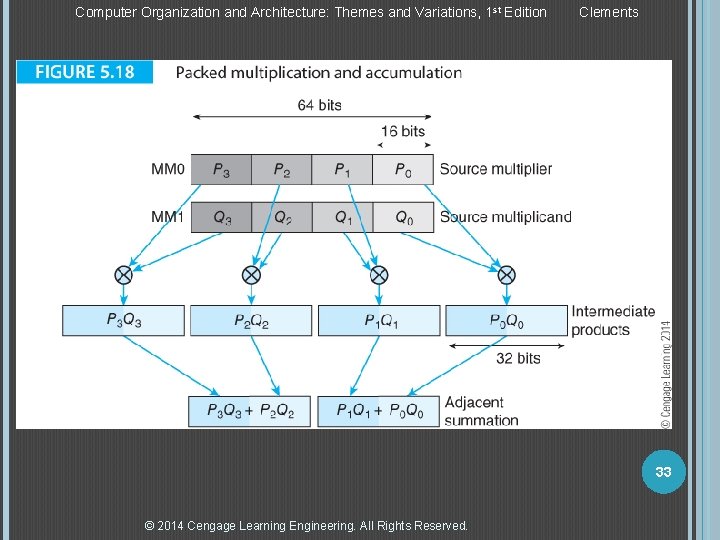
Computer Organization and Architecture: Themes and Variations, 1 st Edition Clements The packed multiply and add instruction, PMADDwd, also multiplies four pairs of signed 16 -bit words. However, the two pairs of adjacent 32 -bit products are added together to create two 32 -bit sums. If the source words are P 3, P 2, P 1, P 0 and Q 3, Q 2, Q 1, Q 0, the products are P 3 Q 3, P 2 Q 2, P 1 Q 1, P 0 Q 0. The adjacent pairs of products are then summed to get P 3 Q 3+ P 2 Q 2, P 1 Q 1+ P 0 Q 0. Figure 5. 18 describes this operation. 32 © 2014 Cengage Learning Engineering. All Rights Reserved.
Computer Organization and Architecture: Themes and Variations, 1 st Edition Clements 33 © 2014 Cengage Learning Engineering. All Rights Reserved.
Computer Organization and Architecture: Themes and Variations, 1 st Edition Clements Parallel Comparison MMX instructions allow you to compare two values, although both the way in which values are compared and how you use the results of the comparison is anything but conventional. Because the MMX architecture doesn’t modify the IA 32’s architectural state, the result of a test cannot be permitted to set one of the processor’s flags. Consequently, any test or comparison has to operate by setting or clearing the bits of a register. Moreover, since the MMX is operating on words in parallel, the nature of a vector comparison is different to a scalar comparison because there are multiple results. 34 © 2014 Cengage Learning Engineering. All Rights Reserved.
Computer Organization and Architecture: Themes and Variations, 1 st Edition Clements The MMX architecture provides two comparison instructions, one that performs a comparison for equality, and the other provides a greater than test. Intel has adopted an interesting approach to testing. Instead of setting a flag bit in a status register, the outcome of an MMX test either fills the destination operand with all zeros or with all ones. The condition true yields all ones, and the condition false yields all zeros; for example, the test of equality with the values 5 and 9 would yield 0000 (in a byte comparison) whereas a test with the values 7 and 7 would yield 1111. In other words, the outcome of a comparison is a data value rather than a flag value. 35 © 2014 Cengage Learning Engineering. All Rights Reserved.
Computer Organization and Architecture: Themes and Variations, 1 st Edition Clements Packing and Unpacking Packing and unpacking instructions are provided to perform conversions between data sizes; that is, 32 bits to 16 bits, or 16 bits to 8 bits. As its name suggests, the pack instruction packs data into an MMX register by converting words into bytes (or doublewords into words). When data is packed, it loses precision and may have to be truncated using either signed or unsigned saturating arithmetic. The pack with signed saturating arithmetic instruction PACKss packs and saturates the signed data elements from the source and the destination operands and writes the signed results to the destination operand (the signed, saturated mode is the only option with this instruction). 36 © 2014 Cengage Learning Engineering. All Rights Reserved.
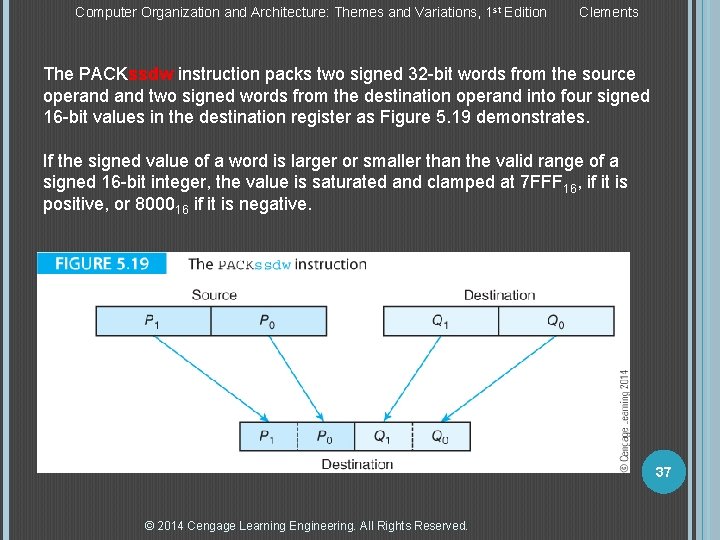
Computer Organization and Architecture: Themes and Variations, 1 st Edition Clements The PACKssdw instruction packs two signed 32 -bit words from the source operand two signed words from the destination operand into four signed 16 -bit values in the destination register as Figure 5. 19 demonstrates. If the signed value of a word is larger or smaller than the valid range of a signed 16 -bit integer, the value is saturated and clamped at 7 FFF 16, if it is positive, or 800016 if it is negative. 37 © 2014 Cengage Learning Engineering. All Rights Reserved.
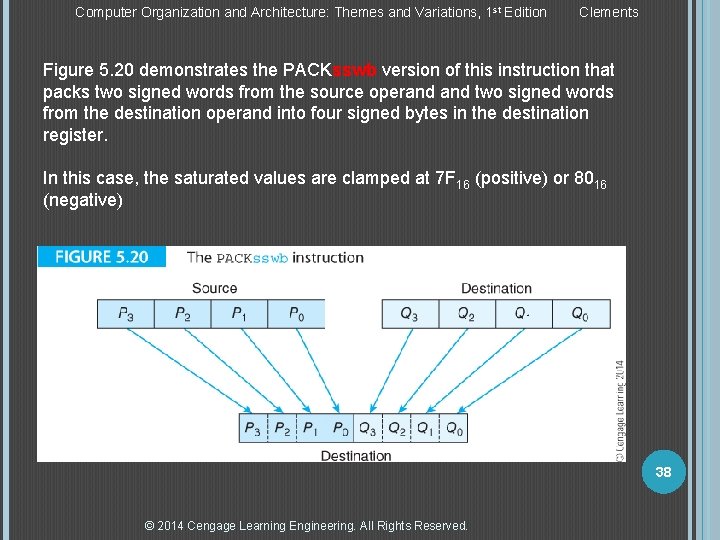
Computer Organization and Architecture: Themes and Variations, 1 st Edition Clements Figure 5. 20 demonstrates the PACKsswb version of this instruction that packs two signed words from the source operand two signed words from the destination operand into four signed bytes in the destination register. In this case, the saturated values are clamped at 7 F 16 (positive) or 8016 (negative) 38 © 2014 Cengage Learning Engineering. All Rights Reserved.
Computer Organization and Architecture: Themes and Variations, 1 st Edition Clements The inverse operation to packing is unpacking, where data is expanded. However, the PUNPCK instruction is not a simple inverse of the parallel pack instruction. The parallel unpack instruction should really be thought of as a parallel merge instruction that operates with three data sizes: byte-to-word (bw), word-to-doubleword (wd), and doubleword-to-quadword (dq). When a word is unpacked, it occupies twice the number of bits. Each MMX instruction allows you to unpack from either the upper half of a word or the lower half of a word. Consequently, there are six variations on the unpack instruction 39 © 2014 Cengage Learning Engineering. All Rights Reserved.
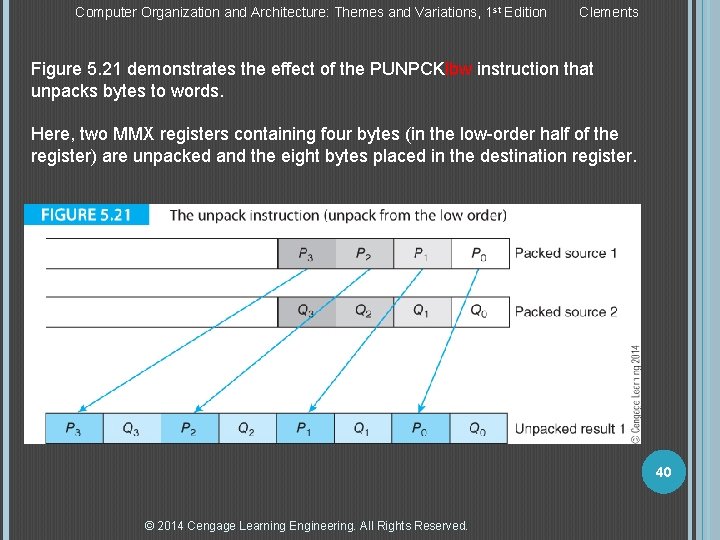
Computer Organization and Architecture: Themes and Variations, 1 st Edition Clements Figure 5. 21 demonstrates the effect of the PUNPCKlbw instruction that unpacks bytes to words. Here, two MMX registers containing four bytes (in the low-order half of the register) are unpacked and the eight bytes placed in the destination register. 40 © 2014 Cengage Learning Engineering. All Rights Reserved.
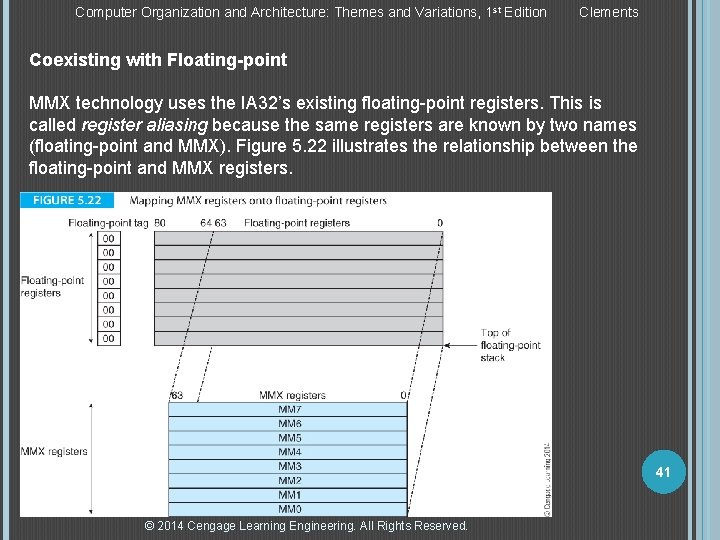
Computer Organization and Architecture: Themes and Variations, 1 st Edition Clements Coexisting with Floating-point MMX technology uses the IA 32’s existing floating-point registers. This is called register aliasing because the same registers are known by two names (floating-point and MMX). Figure 5. 22 illustrates the relationship between the floating-point and MMX registers. 41 © 2014 Cengage Learning Engineering. All Rights Reserved.
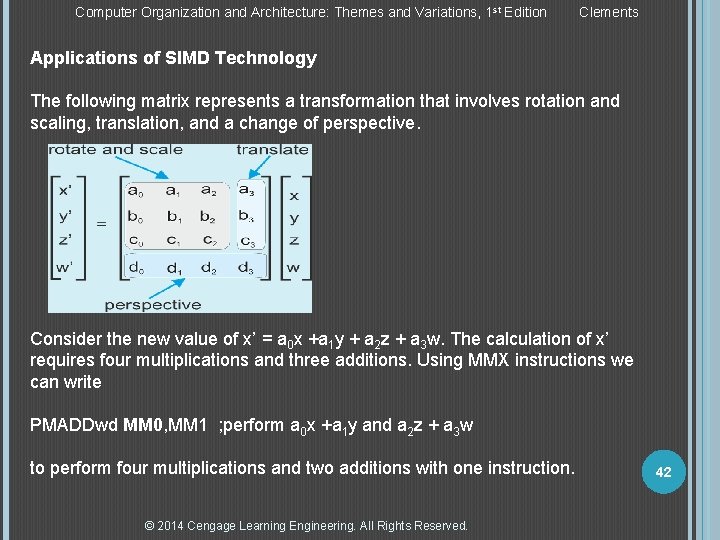
Computer Organization and Architecture: Themes and Variations, 1 st Edition Clements Applications of SIMD Technology The following matrix represents a transformation that involves rotation and scaling, translation, and a change of perspective. Consider the new value of x’ = a 0 x +a 1 y + a 2 z + a 3 w. The calculation of x’ requires four multiplications and three additions. Using MMX instructions we can write PMADDwd MM 0, MM 1 ; perform a 0 x +a 1 y and a 2 z + a 3 w to perform four multiplications and two additions with one instruction. © 2014 Cengage Learning Engineering. All Rights Reserved. 42
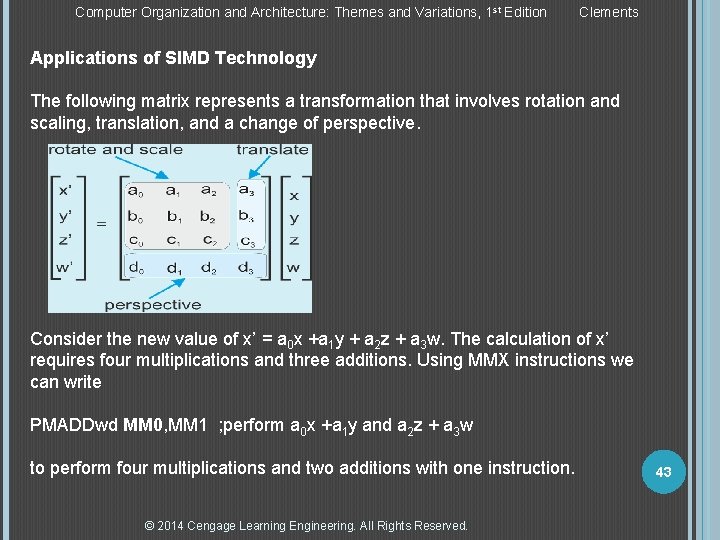
Computer Organization and Architecture: Themes and Variations, 1 st Edition Clements Applications of SIMD Technology The following matrix represents a transformation that involves rotation and scaling, translation, and a change of perspective. Consider the new value of x’ = a 0 x +a 1 y + a 2 z + a 3 w. The calculation of x’ requires four multiplications and three additions. Using MMX instructions we can write PMADDwd MM 0, MM 1 ; perform a 0 x +a 1 y and a 2 z + a 3 w to perform four multiplications and two additions with one instruction. © 2014 Cengage Learning Engineering. All Rights Reserved. 43
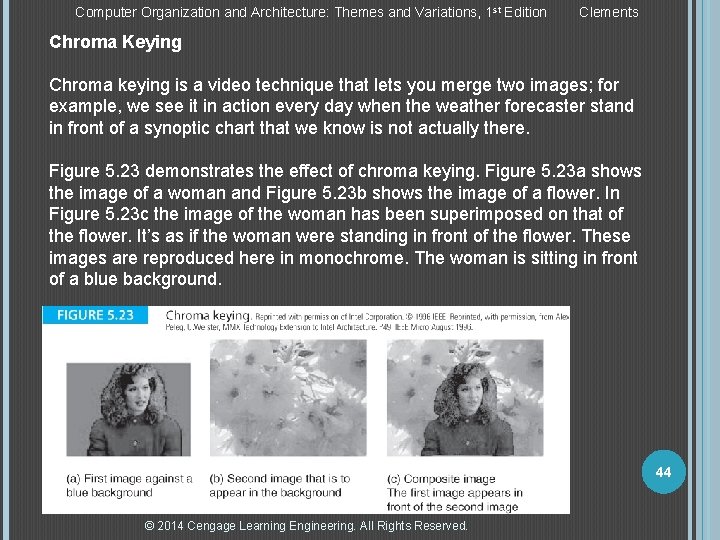
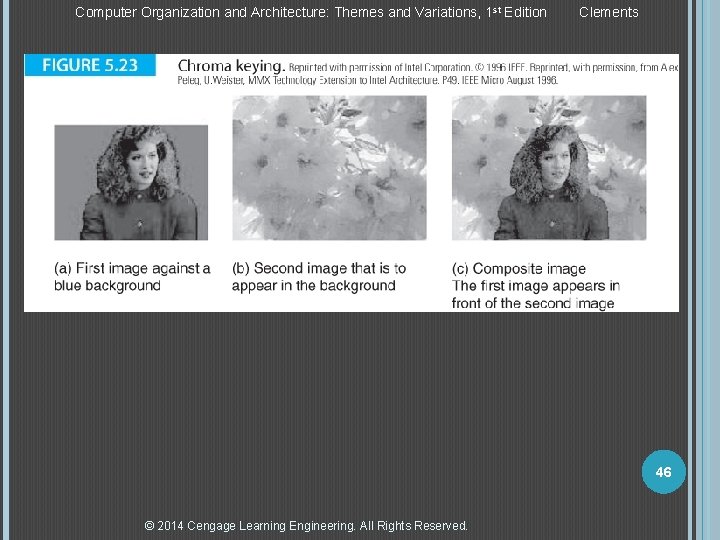
Computer Organization and Architecture: Themes and Variations, 1 st Edition Clements Chroma Keying Chroma keying is a video technique that lets you merge two images; for example, we see it in action every day when the weather forecaster stand in front of a synoptic chart that we know is not actually there. Figure 5. 23 demonstrates the effect of chroma keying. Figure 5. 23 a shows the image of a woman and Figure 5. 23 b shows the image of a flower. In Figure 5. 23 c the image of the woman has been superimposed on that of the flower. It’s as if the woman were standing in front of the flower. These images are reproduced here in monochrome. The woman is sitting in front of a blue background. 44 © 2014 Cengage Learning Engineering. All Rights Reserved.
Computer Organization and Architecture: Themes and Variations, 1 st Edition Clements Although chroma keying looks as if it requires some applied magic, it’s achieved by a remarkably simple trick. The woman in Figure 5. 23 is placed against a dark blue background. If this image is scanned and converted into pixels, a pixel will either be blue (the background) or not blue (part of the desired image to be superimposed). If any part of the woman’s image is the same color as the blue background, part of the second image will bleed through. To form the composite image, we just read a pixel from image (a) and the corresponding pixel from image (b) and then determine the final pixel for the composite image (c) as: if pixela = blue then pixelc = pixelb else pixelc = pixela 45 © 2014 Cengage Learning Engineering. All Rights Reserved.
Computer Organization and Architecture: Themes and Variations, 1 st Edition Clements 46 © 2014 Cengage Learning Engineering. All Rights Reserved.
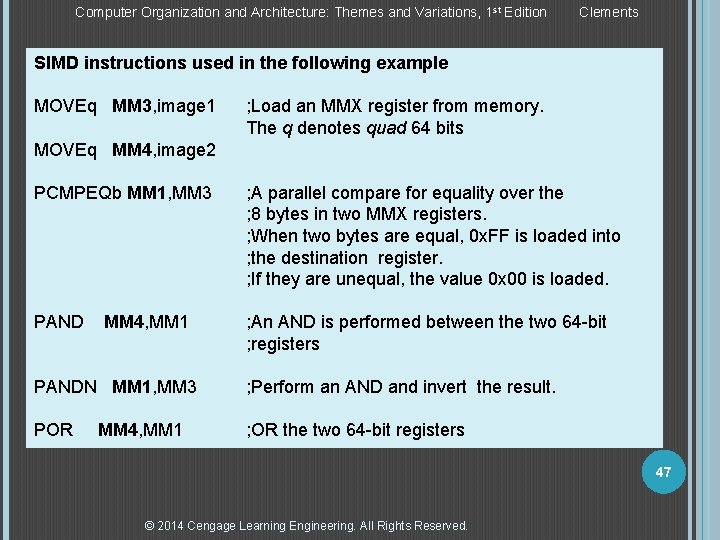
Computer Organization and Architecture: Themes and Variations, 1 st Edition Clements SIMD instructions used in the following example MOVEq MM 3, image 1 ; Load an MMX register from memory. The q denotes quad 64 bits MOVEq MM 4, image 2 PCMPEQb MM 1, MM 3 ; A parallel compare for equality over the ; 8 bytes in two MMX registers. ; When two bytes are equal, 0 x. FF is loaded into ; the destination register. ; If they are unequal, the value 0 x 00 is loaded. PAND MM 4, MM 1 ; An AND is performed between the two 64 -bit ; registers PANDN MM 1, MM 3 ; Perform an AND and invert the result. POR MM 4, MM 1 ; OR the two 64 -bit registers 47 © 2014 Cengage Learning Engineering. All Rights Reserved.
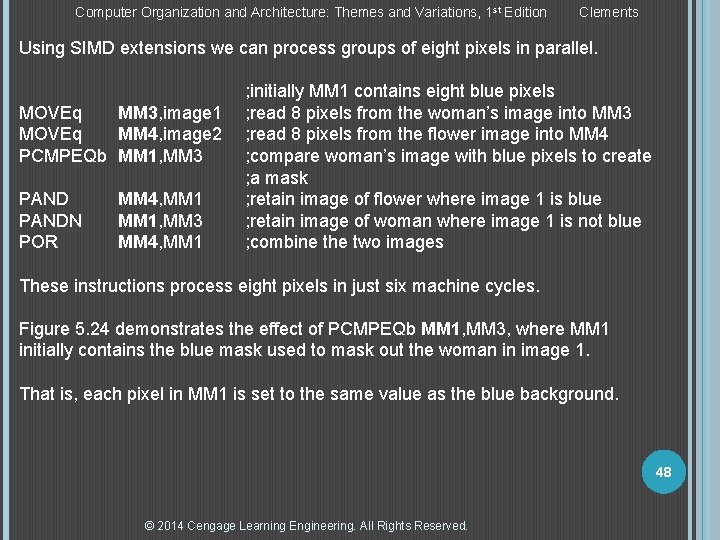
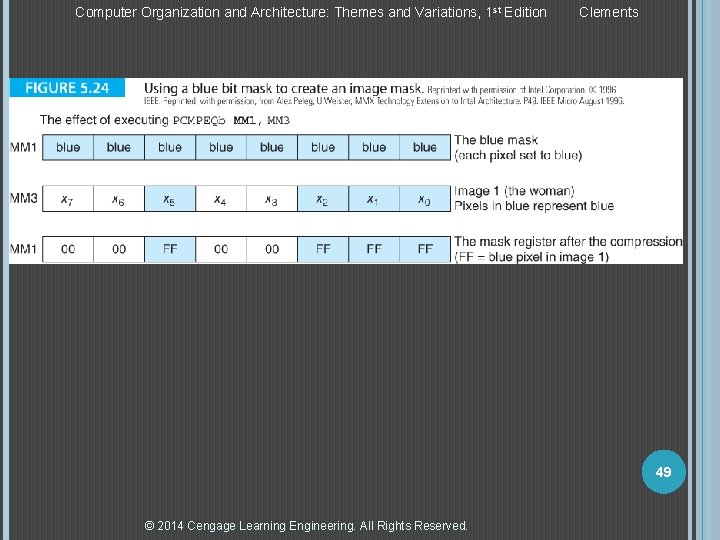
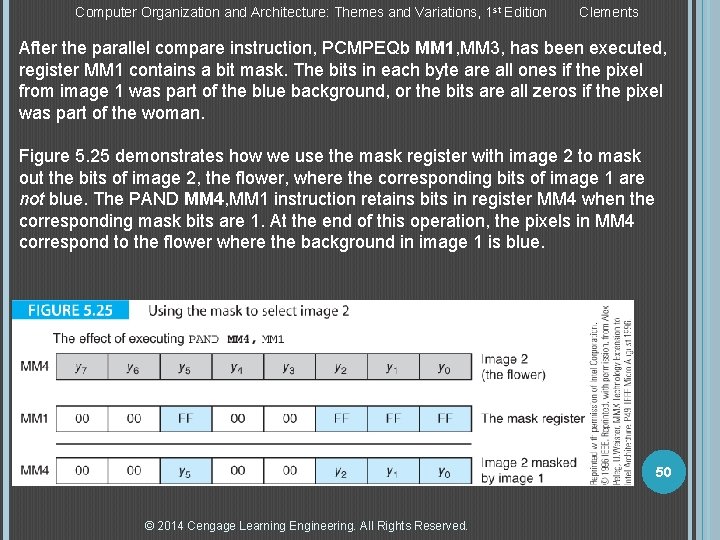
Computer Organization and Architecture: Themes and Variations, 1 st Edition Clements Using SIMD extensions we can process groups of eight pixels in parallel. ; initially MM 1 contains eight blue pixels MOVEq MM 3, image 1 ; read 8 pixels from the woman’s image into MM 3 MOVEq MM 4, image 2 ; read 8 pixels from the flower image into MM 4 PCMPEQb MM 1, MM 3 ; compare woman’s image with blue pixels to create ; a mask PAND MM 4, MM 1 ; retain image of flower where image 1 is blue PANDN MM 1, MM 3 ; retain image of woman where image 1 is not blue POR MM 4, MM 1 ; combine the two images These instructions process eight pixels in just six machine cycles. Figure 5. 24 demonstrates the effect of PCMPEQb MM 1, MM 3, where MM 1 initially contains the blue mask used to mask out the woman in image 1. That is, each pixel in MM 1 is set to the same value as the blue background. 48 © 2014 Cengage Learning Engineering. All Rights Reserved.
Computer Organization and Architecture: Themes and Variations, 1 st Edition Clements 49 © 2014 Cengage Learning Engineering. All Rights Reserved.
Computer Organization and Architecture: Themes and Variations, 1 st Edition Clements After the parallel compare instruction, PCMPEQb MM 1, MM 3, has been executed, register MM 1 contains a bit mask. The bits in each byte are all ones if the pixel from image 1 was part of the blue background, or the bits are all zeros if the pixel was part of the woman. Figure 5. 25 demonstrates how we use the mask register with image 2 to mask out the bits of image 2, the flower, where the corresponding bits of image 1 are not blue. The PAND MM 4, MM 1 instruction retains bits in register MM 4 when the corresponding mask bits are 1. At the end of this operation, the pixels in MM 4 correspond to the flower where the background in image 1 is blue. 50 © 2014 Cengage Learning Engineering. All Rights Reserved.
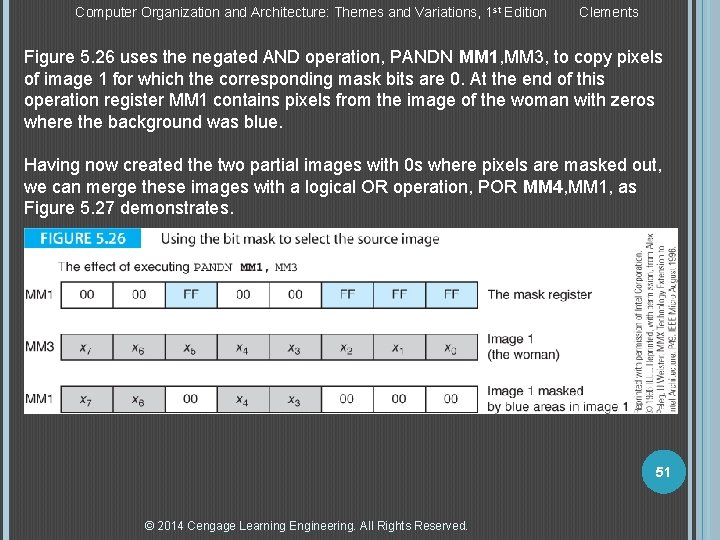
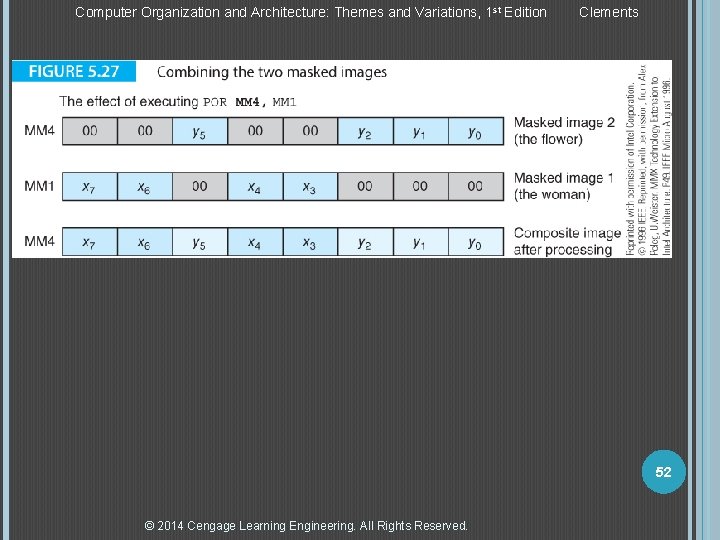
Computer Organization and Architecture: Themes and Variations, 1 st Edition Clements Figure 5. 26 uses the negated AND operation, PANDN MM 1, MM 3, to copy pixels of image 1 for which the corresponding mask bits are 0. At the end of this operation register MM 1 contains pixels from the image of the woman with zeros where the background was blue. Having now created the two partial images with 0 s where pixels are masked out, we can merge these images with a logical OR operation, POR MM 4, MM 1, as Figure 5. 27 demonstrates. 51 © 2014 Cengage Learning Engineering. All Rights Reserved.
Computer Organization and Architecture: Themes and Variations, 1 st Edition Clements 52 © 2014 Cengage Learning Engineering. All Rights Reserved.
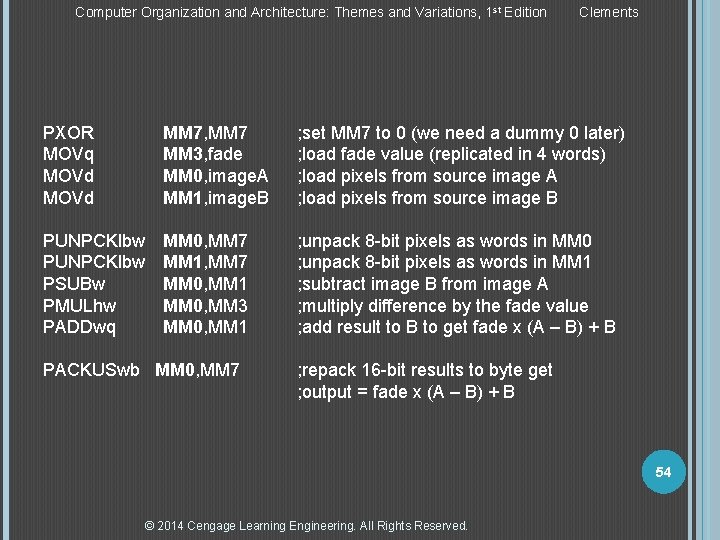
Computer Organization and Architecture: Themes and Variations, 1 st Edition Clements Fade In and Out Another video processing application that can make good use of SIMD extensions is image combining or image merging. Most people are familiar with the dissolve shot on video where one image gradually fades out while another image fades in. If we combine image. A (the old image) with image. B (the new image) we get: output = fade x image. A + (1 – fade) x image. B We re-label image. A as A and image. B as B and rearrange the equation to get output = fade x (A – B) + B 53 © 2014 Cengage Learning Engineering. All Rights Reserved.
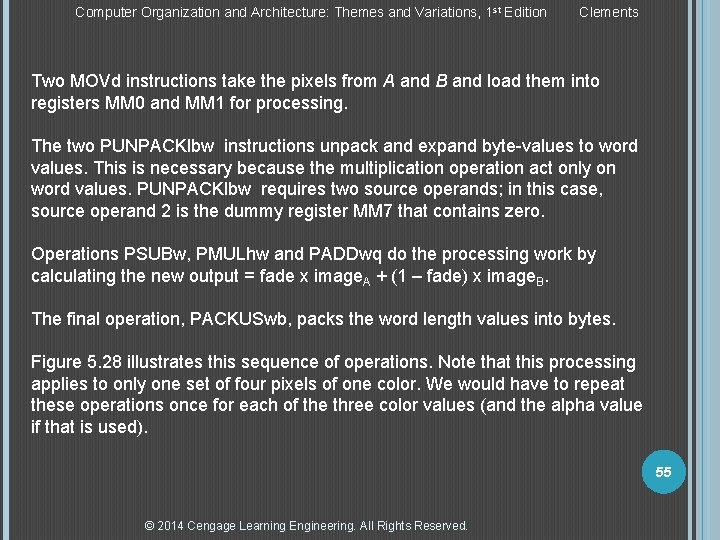
Computer Organization and Architecture: Themes and Variations, 1 st Edition Clements PXOR MOVq MOVd MM 7, MM 7 MM 3, fade MM 0, image. A MM 1, image. B ; set MM 7 to 0 (we need a dummy 0 later) ; load fade value (replicated in 4 words) ; load pixels from source image A ; load pixels from source image B PUNPCKlbw PSUBw PMULhw PADDwq MM 0, MM 7 MM 1, MM 7 MM 0, MM 1 MM 0, MM 3 MM 0, MM 1 ; unpack 8 -bit pixels as words in MM 0 ; unpack 8 -bit pixels as words in MM 1 ; subtract image B from image A ; multiply difference by the fade value ; add result to B to get fade x (A – B) + B PACKUSwb MM 0, MM 7 ; repack 16 -bit results to byte get ; output = fade x (A – B) + B 54 © 2014 Cengage Learning Engineering. All Rights Reserved.
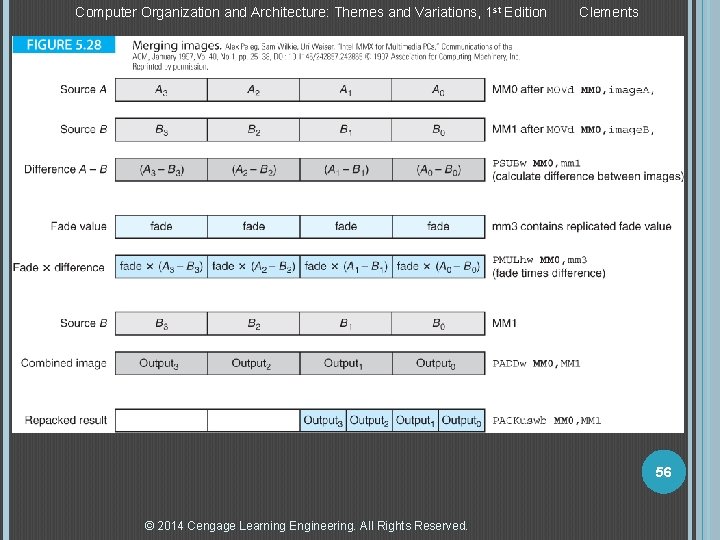
Computer Organization and Architecture: Themes and Variations, 1 st Edition Clements Two MOVd instructions take the pixels from A and B and load them into registers MM 0 and MM 1 for processing. The two PUNPACKlbw instructions unpack and expand byte-values to word values. This is necessary because the multiplication operation act only on word values. PUNPACKlbw requires two source operands; in this case, source operand 2 is the dummy register MM 7 that contains zero. Operations PSUBw, PMULhw and PADDwq do the processing work by calculating the new output = fade x image. A + (1 – fade) x image. B. The final operation, PACKUSwb, packs the word length values into bytes. Figure 5. 28 illustrates this sequence of operations. Note that this processing applies to only one set of four pixels of one color. We would have to repeat these operations once for each of the three color values (and the alpha value if that is used). 55 © 2014 Cengage Learning Engineering. All Rights Reserved.
Computer Organization and Architecture: Themes and Variations, 1 st Edition Clements 56 © 2014 Cengage Learning Engineering. All Rights Reserved.
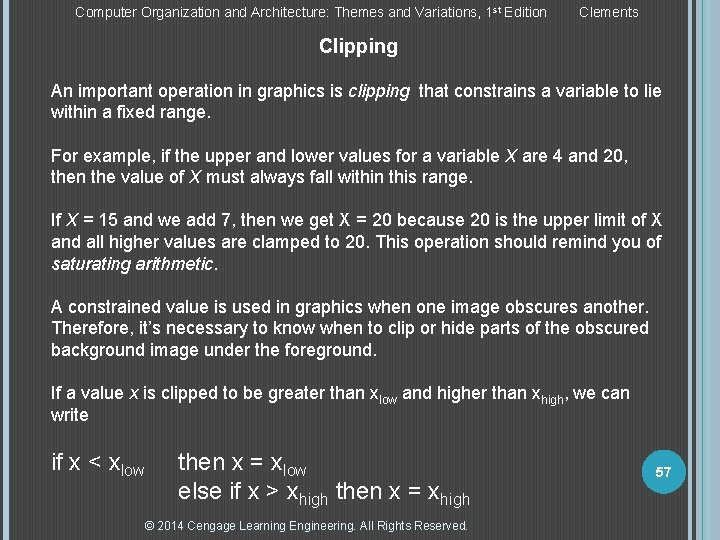
Computer Organization and Architecture: Themes and Variations, 1 st Edition Clements Clipping An important operation in graphics is clipping that constrains a variable to lie within a fixed range. For example, if the upper and lower values for a variable X are 4 and 20, then the value of X must always fall within this range. If X = 15 and we add 7, then we get X = 20 because 20 is the upper limit of X and all higher values are clamped to 20. This operation should remind you of saturating arithmetic. A constrained value is used in graphics when one image obscures another. Therefore, it’s necessary to know when to clip or hide parts of the obscured background image under the foreground. If a value x is clipped to be greater than xlow and higher than xhigh, we can write if x < xlow then x = xlow else if x > xhigh then x = xhigh © 2014 Cengage Learning Engineering. All Rights Reserved. 57
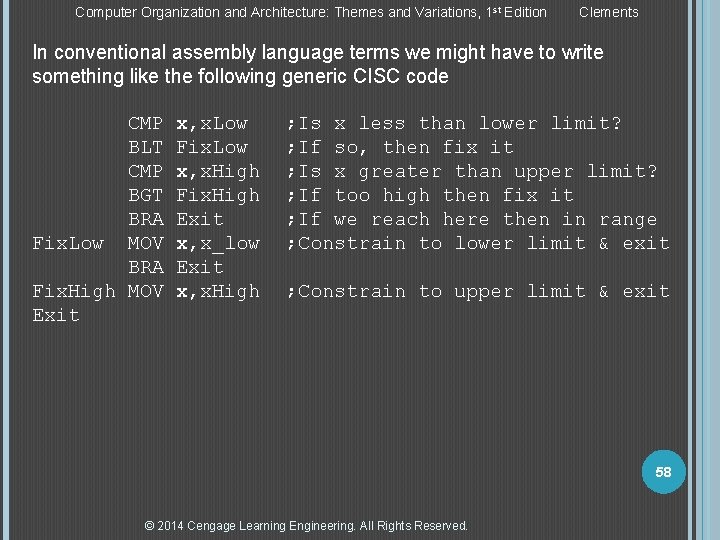
Computer Organization and Architecture: Themes and Variations, 1 st Edition Clements In conventional assembly language terms we might have to write something like the following generic CISC code CMP x, x. Low ; Is x less than lower limit? BLT Fix. Low ; If so, then fix it CMP x, x. High ; Is x greater than upper limit? BGT Fix. High ; If too high then fix it BRA Exit ; If we reach here then in range Fix. Low MOV x, x_low ; Constrain to lower limit & exit BRA Exit Fix. High MOV x, x. High ; Constrain to upper limit & exit Exit 58 © 2014 Cengage Learning Engineering. All Rights Reserved.
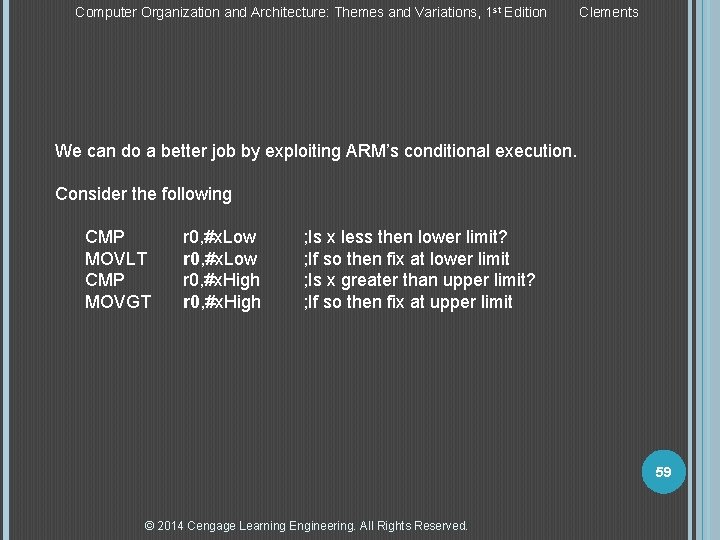
Computer Organization and Architecture: Themes and Variations, 1 st Edition Clements We can do a better job by exploiting ARM’s conditional execution. Consider the following CMP r 0, #x. Low MOVLT r 0, #x. Low CMP r 0, #x. High MOVGT r 0, #x. High ; Is x less then lower limit? ; If so then fix at lower limit ; Is x greater than upper limit? ; If so then fix at upper limit 59 © 2014 Cengage Learning Engineering. All Rights Reserved.
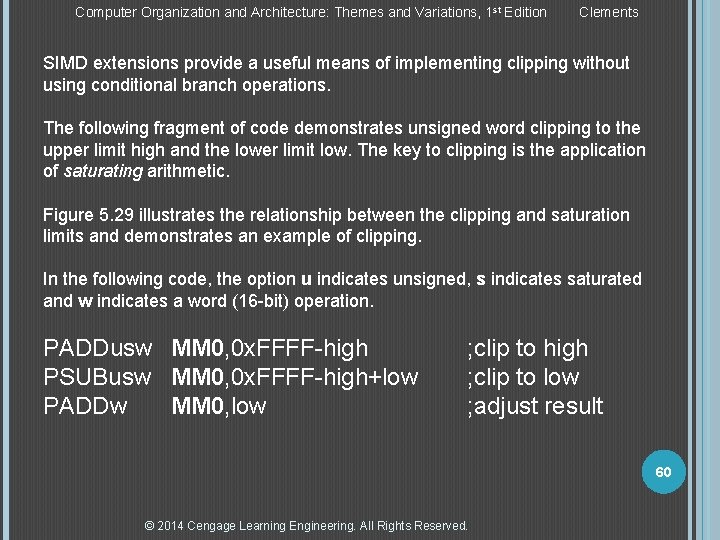
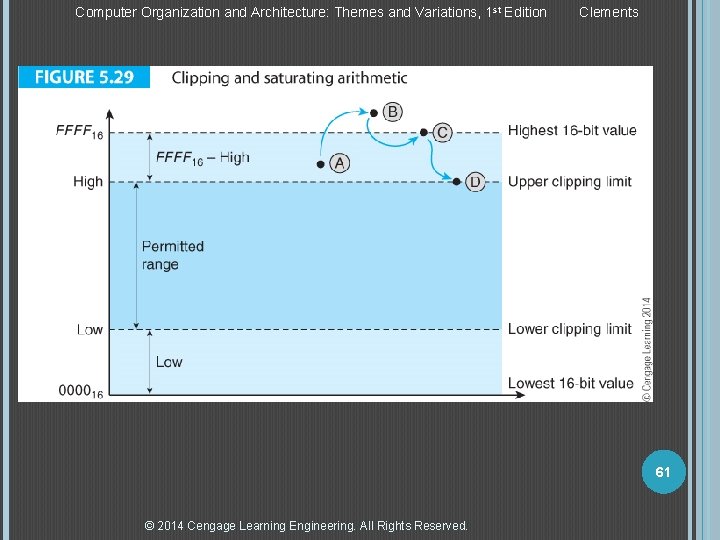
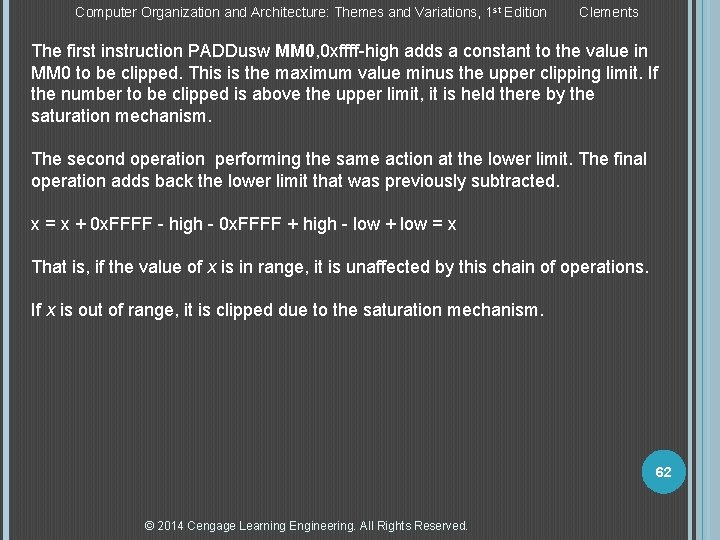
Computer Organization and Architecture: Themes and Variations, 1 st Edition Clements SIMD extensions provide a useful means of implementing clipping without using conditional branch operations. The following fragment of code demonstrates unsigned word clipping to the upper limit high and the lower limit low. The key to clipping is the application of saturating arithmetic. Figure 5. 29 illustrates the relationship between the clipping and saturation limits and demonstrates an example of clipping. In the following code, the option u indicates unsigned, s indicates saturated and w indicates a word (16 -bit) operation. PADDusw MM 0, 0 x. FFFF-high PSUBusw MM 0, 0 x. FFFF-high+low PADDw MM 0, low ; clip to high ; clip to low ; adjust result 60 © 2014 Cengage Learning Engineering. All Rights Reserved.
Computer Organization and Architecture: Themes and Variations, 1 st Edition Clements 61 © 2014 Cengage Learning Engineering. All Rights Reserved.
Computer Organization and Architecture: Themes and Variations, 1 st Edition Clements The first instruction PADDusw MM 0, 0 xffff-high adds a constant to the value in MM 0 to be clipped. This is the maximum value minus the upper clipping limit. If the number to be clipped is above the upper limit, it is held there by the saturation mechanism. The second operation performing the same action at the lower limit. The final operation adds back the lower limit that was previously subtracted. x = x + 0 x. FFFF - high - 0 x. FFFF + high - low + low = x That is, if the value of x is in range, it is unaffected by this chain of operations. If x is out of range, it is clipped due to the saturation mechanism. 62 © 2014 Cengage Learning Engineering. All Rights Reserved.
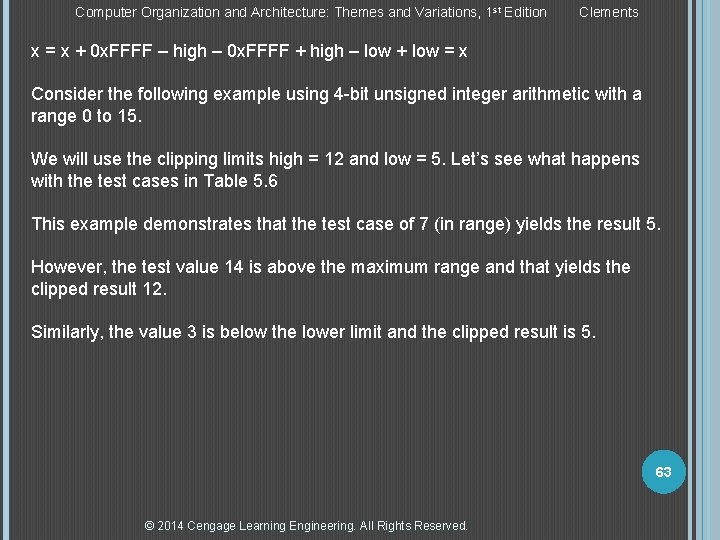
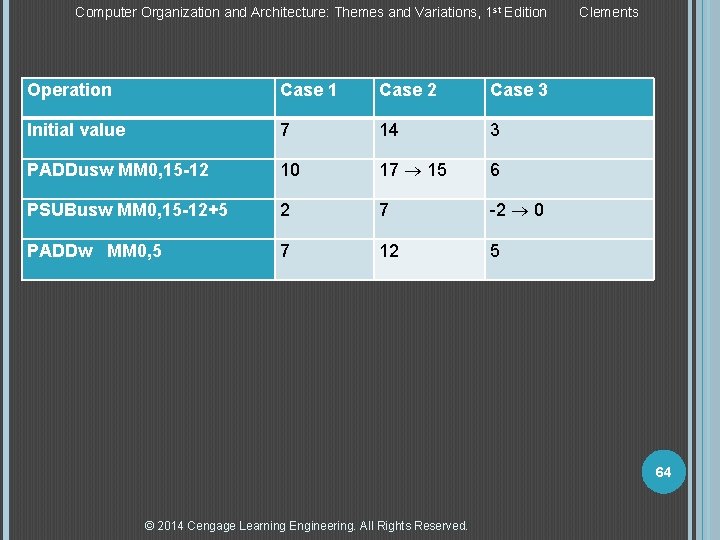
Computer Organization and Architecture: Themes and Variations, 1 st Edition Clements x = x + 0 x. FFFF – high – 0 x. FFFF + high – low + low = x Consider the following example using 4 -bit unsigned integer arithmetic with a range 0 to 15. We will use the clipping limits high = 12 and low = 5. Let’s see what happens with the test cases in Table 5. 6 This example demonstrates that the test case of 7 (in range) yields the result 5. However, the test value 14 is above the maximum range and that yields the clipped result 12. Similarly, the value 3 is below the lower limit and the clipped result is 5. 63 © 2014 Cengage Learning Engineering. All Rights Reserved.
Computer Organization and Architecture: Themes and Variations, 1 st Edition Operation Case 1 Case 2 Case 3 Initial value 7 14 3 PADDusw MM 0, 15 -12 10 17 15 6 PSUBusw MM 0, 15 -12+5 2 7 -2 0 PADDw MM 0, 5 7 12 5 Clements 64 © 2014 Cengage Learning Engineering. All Rights Reserved.
Computer Organization and Architecture: Themes and Variations, 1 st Edition Clements Streaming Extensions and the Development of SIMD Technology Since the introduction of SIMD extensions, development has been continuous, and the handful of MMX extensions has been replaced by generation after generation of new extensions. However, the basic principles are still the same; the ability to manipulate multiple elements in a single register and to perform operations that are of importance in multimedia or in other domains such as cryptography. A short time is a long time in the microprocessor world. Intel had hardly launched its MMX architecture before it moved on and introduced its Streaming SIMD Extensions, SSE, in 1999. Streaming SIMD Extensions first appeared in the Pentium III with two components, integer instructions known as New-media Instructions that operate on the MMX register set, and floating-point SIMD operations that operate on an entirely new set of registers. 65 © 2014 Cengage Learning Engineering. All Rights Reserved.
Computer Organization and Architecture: Themes and Variations, 1 st Edition Clements To a considerable extent, the Pentium III’s new media instructions are MMX extensions that didn’t make it onto silicon the first time around. Some of these instructions are extended MMX instructions, and some provide floating-point facilities. One commentator writing on the introduction of SSE stated it was really Intel’s attempt at getting MMX right the second time round. You have to appreciate that Intel was locked into a battle with those making IA 32 compatible processors such as AMD and that delaying innovation until it was perfect was not an option. This is probably less true today since Intel appears to have emerged as the undisputed winner in the PC-architecture wars even though AMD is still a major player. 66 © 2014 Cengage Learning Engineering. All Rights Reserved.
Computer Organization and Architecture: Themes and Variations, 1 st Edition Clements Intel’s Pentium 4 introduced yet a new batch of SIMD Streaming Extensions called SSE 2 that extended both the MMX and the SSE architectures by adding 144 new instructions and increasing the number of data types. The new data types are a 128 -bit packed double-precision floating point, a 64 -bit quadword integer, and four 128 -bit integer data types. The packed floating-point type allows two IEEE 64 -bit double-precision floating-point values to be packed into one double quadword. The 64 -bit quadword integer supports both signed and unsigned values, and the 128 -bit integer allows two quadwords, four doublewords, eight words, or 16 bytes integers to be packed into a double quadword. 67 © 2014 Cengage Learning Engineering. All Rights Reserved.
Computer Organization and Architecture: Themes and Variations, 1 st Edition Clements The double-precision floating-point instructions provide data movement, arithmetic, comparison, conversion, logical, and shuffle ioperations. Floatingpoint SSE 2 instructions can move packed double-precision floating-points and perform arithmetic operations on them, as well as converting between doubleand single-precision floating-point formats. Some of the new integer instructions are PADDQ (packed quadword add), PMULUDQ (unsigned doubleword multiply), PSHUFD (shuffle packed doublewords in an XMM register), and MOVQ 2 DQ (move integer data from MMX to XMM registers). Existing 64 -bit MMX/SSE integer instructions are extended to operate on 128 -bit operands in the XMM registers. Pentium’s new multimedia-friendly SSE 2 architecture is rather messy, having picked up so much baggage along the way. You can’t convert MMX code into SSE 2 code just by replacing register name MM 0 with XMM 0, etc. You can’t use MOVQ to access the 128 -bit registers; you have to use a MOVAPD instruction instead. Similarly, you have to use new versions of shuffle and shifting instructions. 68 © 2014 Cengage Learning Engineering. All Rights Reserved.
Computer Organization and Architecture: Themes and Variations, 1 st Edition Clements Intel’s SSE 3 and SSE 4 Instructions The Pentium 4 E introduced SSE 3 extensions in 2004. They use 128 -bit registers and add 14 instructions aimed at floating-point to integer conversion, complex arithmetic, video encoding, and thread synchronization. In 2006 they were extended in the Core Duo with the addition of a further 16 op-codes. Complex arithmetic is important in digital signal processing applications, particularly in the realm of Fourier transforms. A complex value z is represented by a + bi where i is the square root of ‑ 1. The product of a 1 + b 1 i and a 2 + b 2 i is given by a 1 a 2 – b 1 b 2 + (a 1 b 2 + a 2 b 1) i. SSE 3 provides support for complex arithmetic. ADDSUBPS Operand. A Operand. B, where Operand A contains coefficients a 3, a 2, a 1, a 0 and Operand B contains b 3, b 2, b 1, b 0, generates a 3+b 3, a 2 -b 2, a 1+b 1, a 0, b 0. © 2014 Cengage Learning Engineering. All Rights Reserved. 69
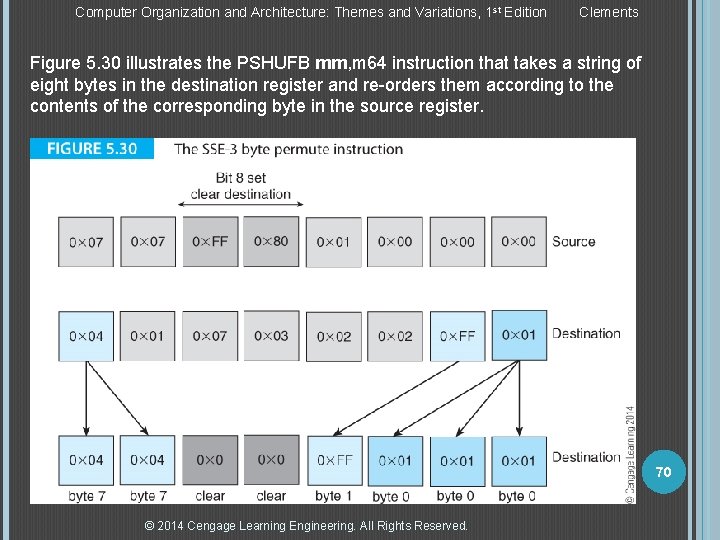
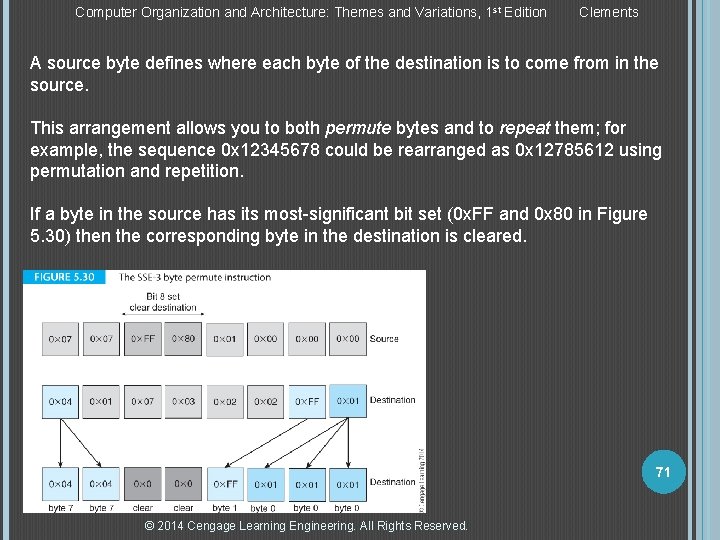
Computer Organization and Architecture: Themes and Variations, 1 st Edition Clements Figure 5. 30 illustrates the PSHUFB mm, m 64 instruction that takes a string of eight bytes in the destination register and re-orders them according to the contents of the corresponding byte in the source register. 70 © 2014 Cengage Learning Engineering. All Rights Reserved.
Computer Organization and Architecture: Themes and Variations, 1 st Edition Clements A source byte defines where each byte of the destination is to come from in the source. This arrangement allows you to both permute bytes and to repeat them; for example, the sequence 0 x 12345678 could be rearranged as 0 x 12785612 using permutation and repetition. If a byte in the source has its most-significant bit set (0 x. FF and 0 x 80 in Figure 5. 30) then the corresponding byte in the destination is cleared. 71 © 2014 Cengage Learning Engineering. All Rights Reserved.
Computer Organization and Architecture: Themes and Variations, 1 st Edition Clements ARM Family Multimedia Instructions Members of the ARM family have also implemented instruction extensions. The Cortex-A ARM processor has an advanced SIMD architecture extension, called NEON technology operates with 64 - and 128 -bit data registers and can perform MP 3 operations on processors operating at 10 MHz (a clock rate far lower than conventional PC processors). ARM family SIMD extensions, also called DSP extensions, allow low-cost, lowspeed processors to have cutting-edge architectures that permit the mass manufacture of very low-cost consumer entertainment and automotive systems. 72 © 2014 Cengage Learning Engineering. All Rights Reserved.
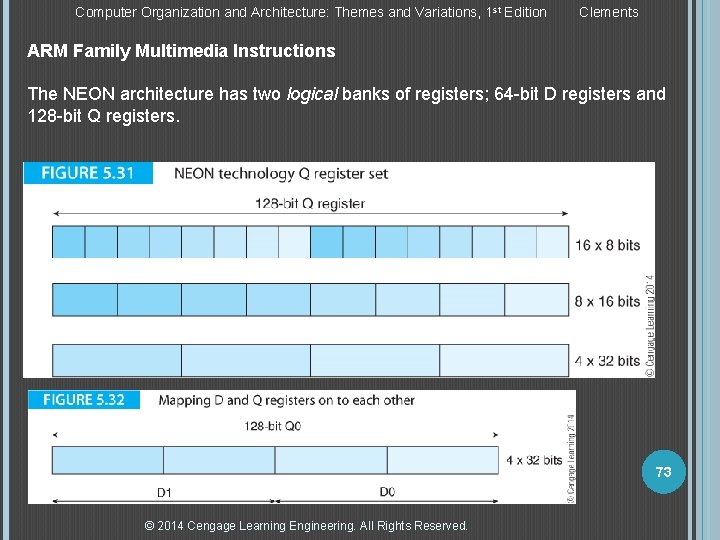
Computer Organization and Architecture: Themes and Variations, 1 st Edition Clements ARM Family Multimedia Instructions The NEON architecture has two logical banks of registers; 64 -bit D registers and 128 -bit Q registers. 73 © 2014 Cengage Learning Engineering. All Rights Reserved.
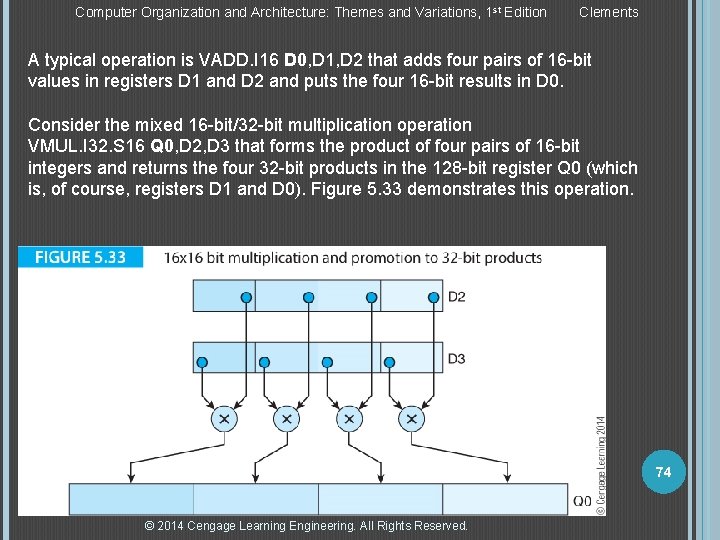
Computer Organization and Architecture: Themes and Variations, 1 st Edition Clements A typical operation is VADD. I 16 D 0, D 1, D 2 that adds four pairs of 16 -bit values in registers D 1 and D 2 and puts the four 16 -bit results in D 0. Consider the mixed 16 -bit/32 -bit multiplication operation VMUL. I 32. S 16 Q 0, D 2, D 3 that forms the product of four pairs of 16 -bit integers and returns the four 32 -bit products in the 128 -bit register Q 0 (which is, of course, registers D 1 and D 0). Figure 5. 33 demonstrates this operation. 74 © 2014 Cengage Learning Engineering. All Rights Reserved.