Chassis Drive Train 101 Tom Milnes Team 2199

- Slides: 87
Chassis / Drive Train 101 Tom Milnes Team 2199 Systems Mentor Principal Mathematician JHU/APL
Chassis / Drive Train • Chassis / Drive Train are foundational elements of your robot – Without the chassis you have no where to place manipulators / drive system and electrical components – Without drive train the robot doesn’t move § Impossible to score any points § Often it is possible to score points by moving past a line in autonomous
What is a Chassis / Drive Train? • Chassis (Merriam Webster Online) – The supporting frame of a structure (as an automobile, television, or robot) • Drive Train (Mr. Milnes’ Definition) – The assembled parts including motors, gearboxes, gears, chains, belts, wheels that make a vehicle move
Chassis The Foundation for Everything!
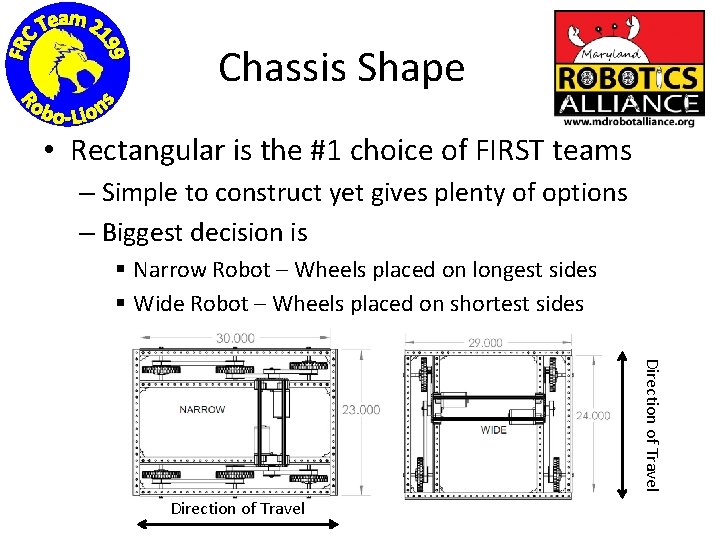
Chassis Shape • Rectangular is the #1 choice of FIRST teams – Simple to construct yet gives plenty of options – Biggest decision is § Narrow Robot – Wheels placed on longest sides § Wide Robot – Wheels placed on shortest sides Direction of Travel
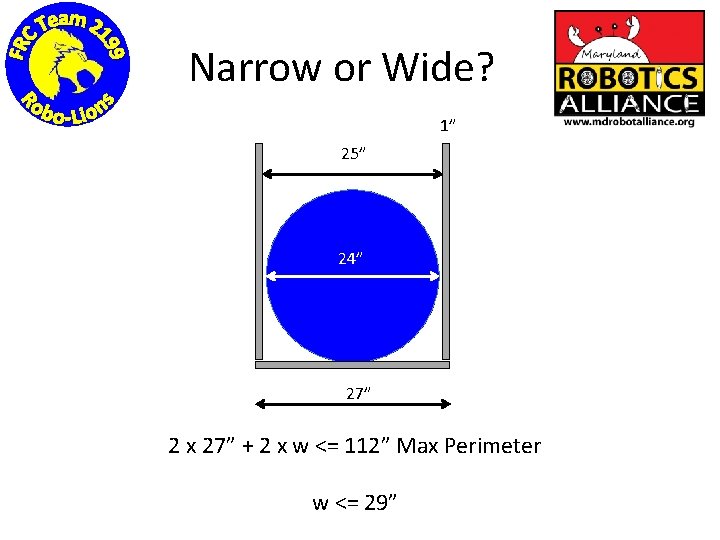
Narrow or Wide? • Depends on the Game Being Played – Want chassis that will allow you to score the greatest number of points / game – Need to figure out your game strategy / manipulators to implement first • Example 2014 Game – Had a 24” diameter ball which you probably wanted to get on your robot so you could transport it and score it in a goal – Had a perimeter limit of 112”
Narrow or Wide? 1” 25” 24” 27” 2 x 27” + 2 x w <= 112” Max Perimeter w <= 29”
Narrow, Wide, Square? • Everything being equal here are Pros / Cons for Narrow / Wide • Narrow – Harder to block going forward but harder to block other robots – Can segment robot into manipulator section (FWD) and electronics / pneumatics section (AFT) – Less precise turning but quicker – Will pick up fewer objects at a time (objects back to back) • Wide – More precise turning but slower – Manipulator section in center of robot electronics / pneumatics on side – Easier to block other robots and vice versa – Will pick up more objects at a time (objects side to side) • Square – Game element is large and with comparable length and width
Chassis Material • Must be strong enough to hold everything else in place • Must be light enough so you can add drive train and manipulators and stay within weight limit (120 pounds) • Options – – Steel – Strong but Too Heavy! Wood – Light but Too Fragile! Aluminum – Just Right!! Exotica – Graphite, Fiberglass, … § Not a good idea for an inexperienced team! § Not a good idea if you haven’t mastered the technology in the offseason (including reliability testing) § Must be able to be repaired!
Chassis – Custom or COTS? • Custom – Machined from CAD drawing – Constructed by hand from square or rectangular tubing • COTS – Commercial Off The Shelf – Robot Parts or Manufacturing Retailers § 80 -20 - https: //8020. net/ “Industrial Erector Set” § Andy. Mark - http: //www. andymark. com § Vexpro - https: //www. vexrobotics. com/vexpro
Custom-CAD? • Machined from CAD drawing – ONLY IF – You have several CAD experts – You have a dedicated machine shop that works quickly – You have successfully done this in previous years or in the offseason
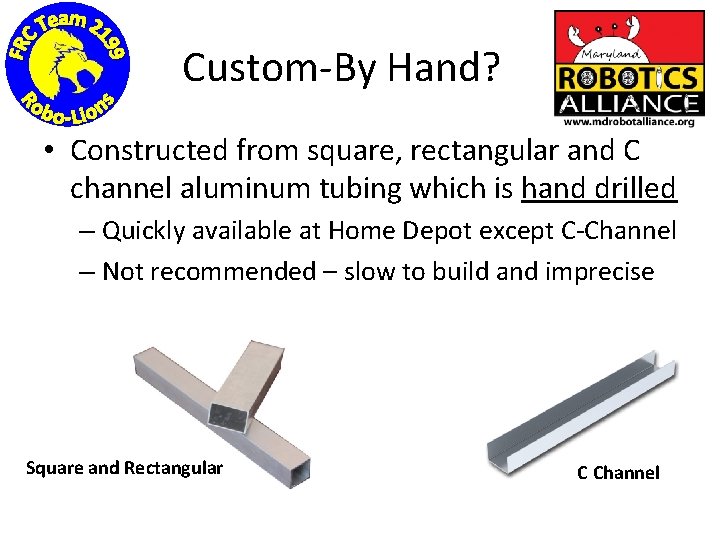
Custom-By Hand? • Constructed from square, rectangular and C channel aluminum tubing which is hand drilled – Quickly available at Home Depot except C-Channel – Not recommended – slow to build and imprecise Square and Rectangular C Channel
COTS Chassis Parts • Dedicated Robotics or Engineering supplier • Recommended for rookie, inexperienced, small or under-resourced teams • Lots of good options from – 80 -20, Andy. Mark, Vexpro
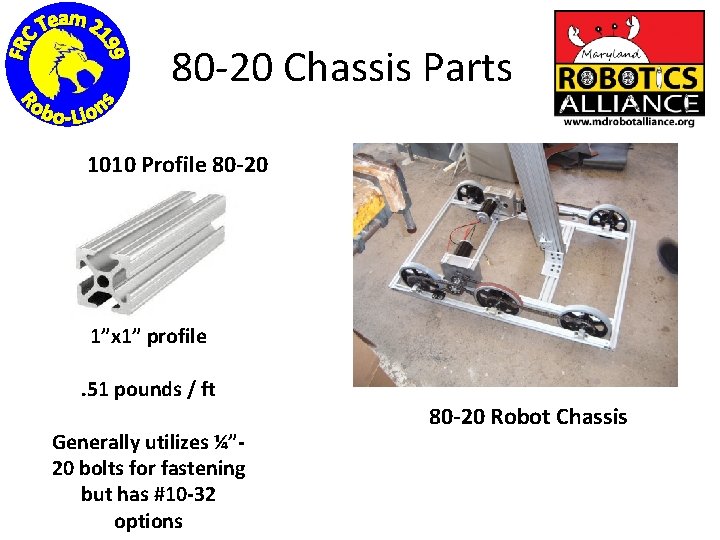
80 -20 Chassis Parts 1010 Profile 80 -20 1”x 1” profile. 51 pounds / ft Generally utilizes ¼” 20 bolts for fastening but has #10 -32 options 80 -20 Robot Chassis
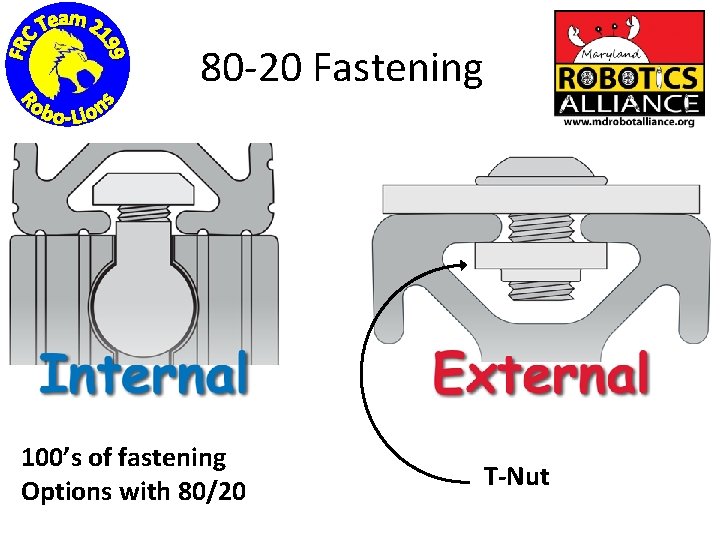
80 -20 Fastening 100’s of fastening Options with 80/20 T-Nut
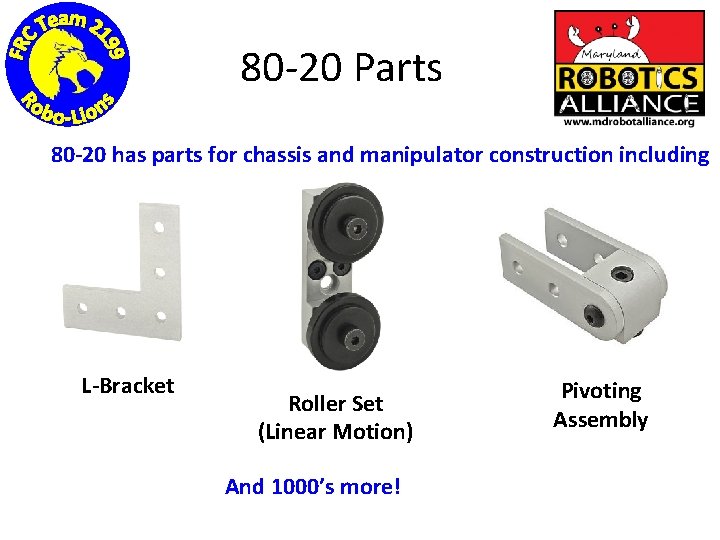
80 -20 Parts 80 -20 has parts for chassis and manipulator construction including L-Bracket Roller Set (Linear Motion) And 1000’s more! Pivoting Assembly
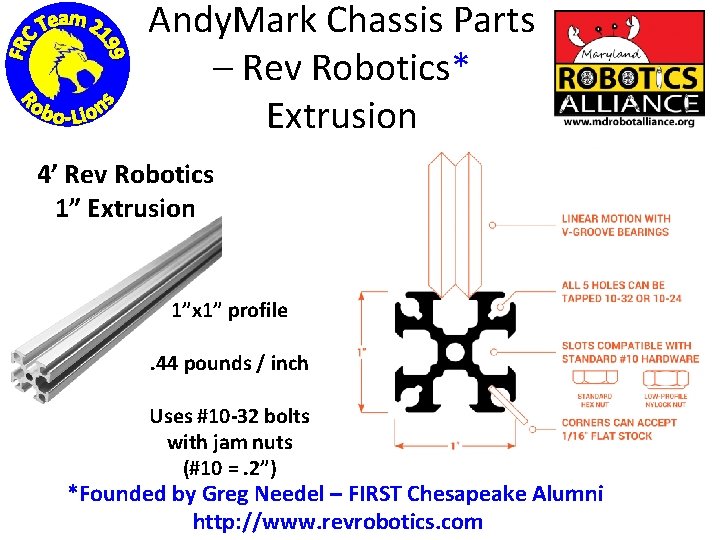
Andy. Mark Chassis Parts – Rev Robotics* Extrusion 4’ Rev Robotics 1” Extrusion 1”x 1” profile. 44 pounds / inch Uses #10 -32 bolts with jam nuts (#10 =. 2”) *Founded by Greg Needel – FIRST Chesapeake Alumni http: //www. revrobotics. com
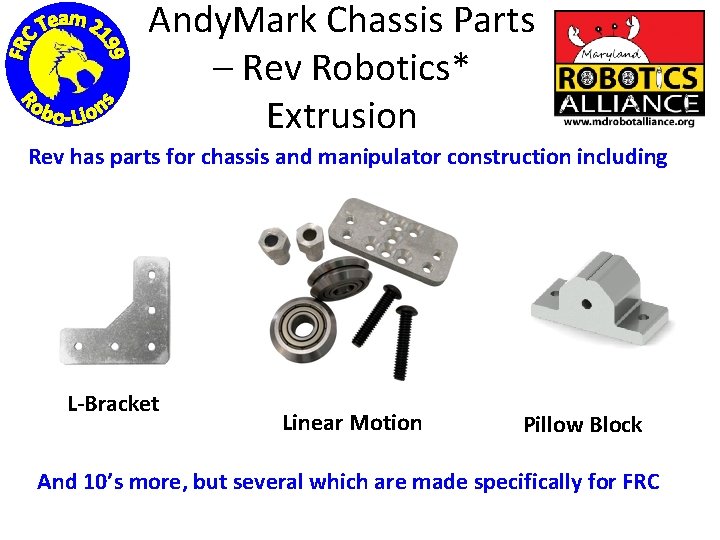
Andy. Mark Chassis Parts – Rev Robotics* Extrusion Rev has parts for chassis and manipulator construction including L-Bracket Linear Motion Pillow Block And 10’s more, but several which are made specifically for FRC
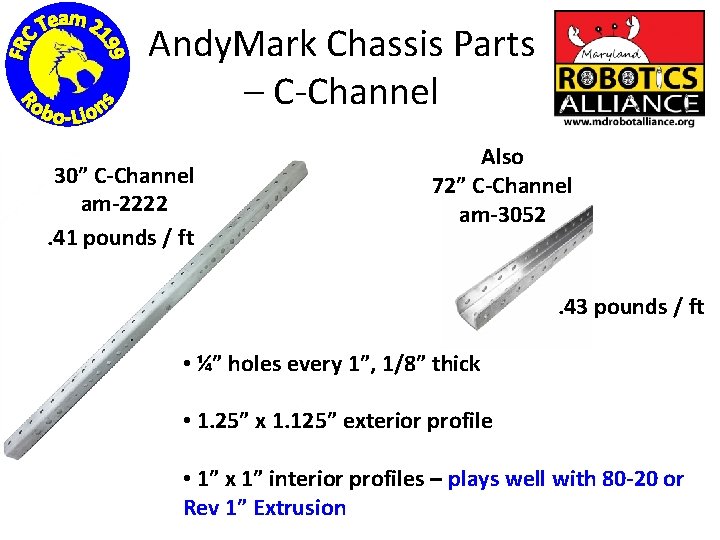
Andy. Mark Chassis Parts – C-Channel 30” C-Channel am-2222. 41 pounds / ft Also 72” C-Channel am-3052 . 43 pounds / ft • ¼” holes every 1”, 1/8” thick • 1. 25” x 1. 125” exterior profile • 1” x 1” interior profiles – plays well with 80 -20 or Rev 1” Extrusion
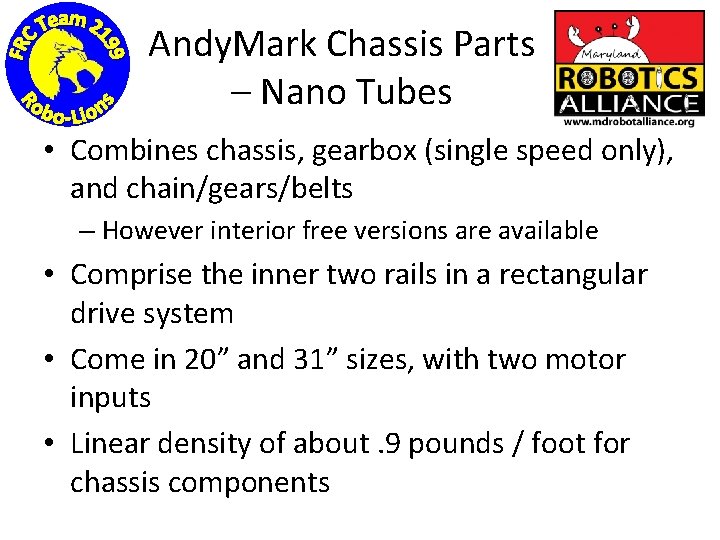
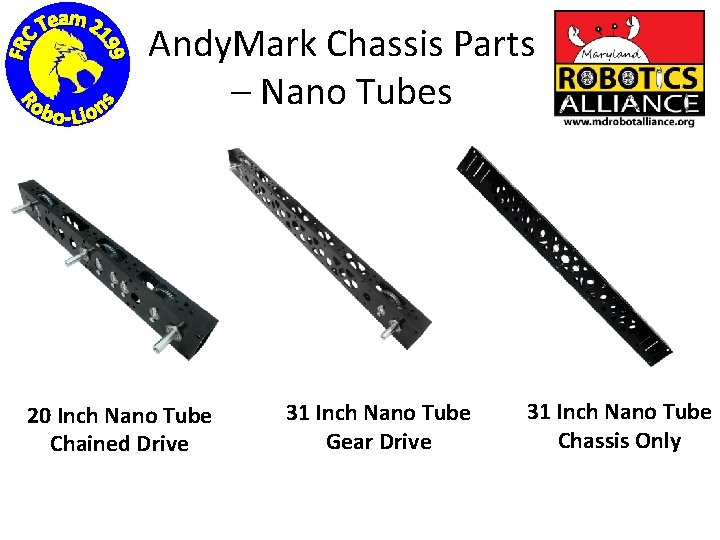
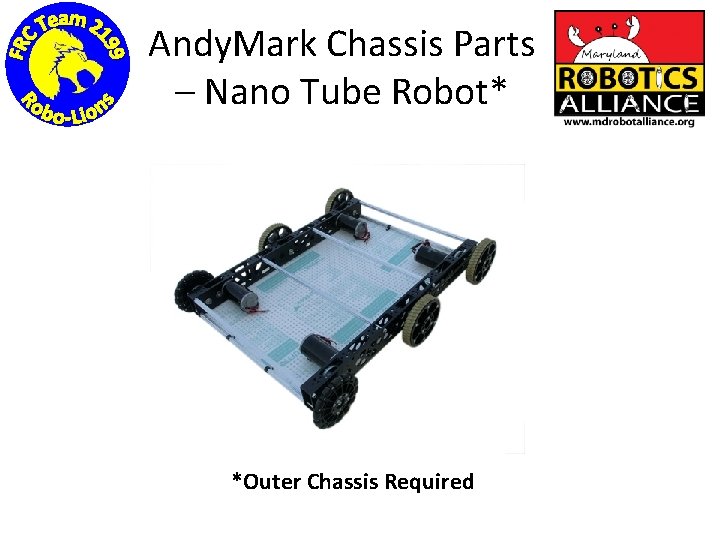
Andy. Mark Chassis Parts – Nano Tubes • Combines chassis, gearbox (single speed only), and chain/gears/belts – However interior free versions are available • Comprise the inner two rails in a rectangular drive system • Come in 20” and 31” sizes, with two motor inputs • Linear density of about. 9 pounds / foot for chassis components
Andy. Mark Chassis Parts – Nano Tubes 20 Inch Nano Tube Chained Drive 31 Inch Nano Tube Gear Drive 31 Inch Nano Tube Chassis Only
Andy. Mark Chassis Parts – Nano Tube Robot* *Outer Chassis Required
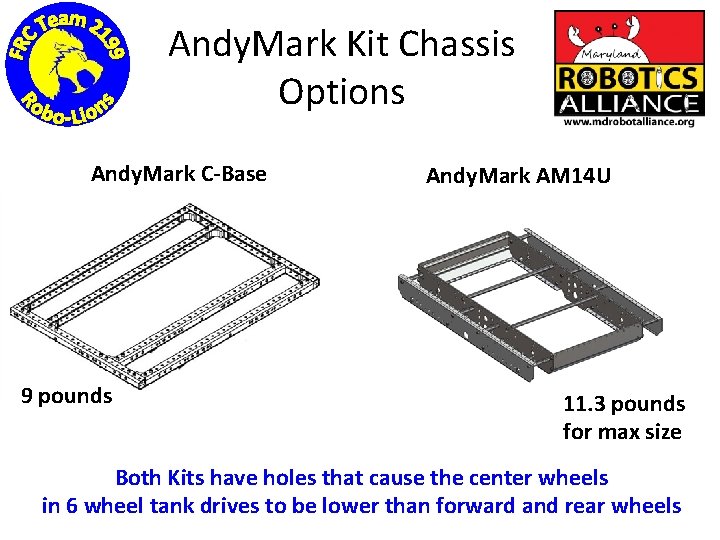
Andy. Mark Kit Chassis Options Andy. Mark C-Base 9 pounds Andy. Mark AM 14 U 11. 3 pounds for max size Both Kits have holes that cause the center wheels in 6 wheel tank drives to be lower than forward and rear wheels
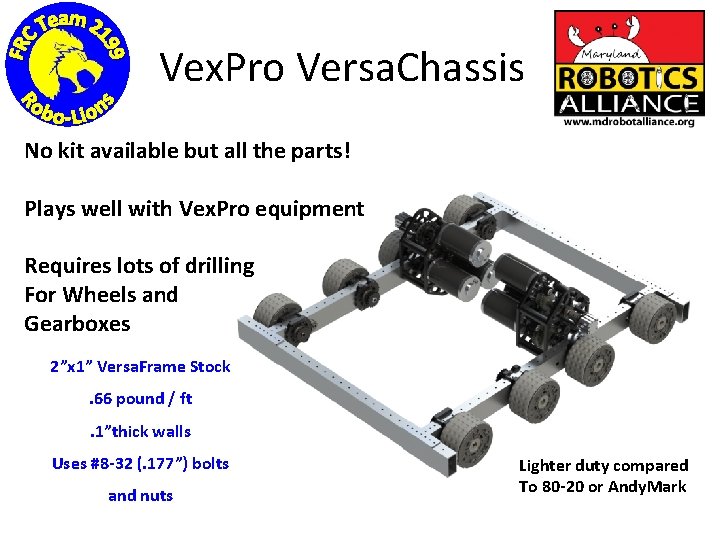
Vex. Pro Versa. Chassis No kit available but all the parts! Plays well with Vex. Pro equipment Requires lots of drilling For Wheels and Gearboxes 2”x 1” Versa. Frame Stock. 66 pound / ft. 1”thick walls Uses #8 -32 (. 177”) bolts and nuts Lighter duty compared To 80 -20 or Andy. Mark
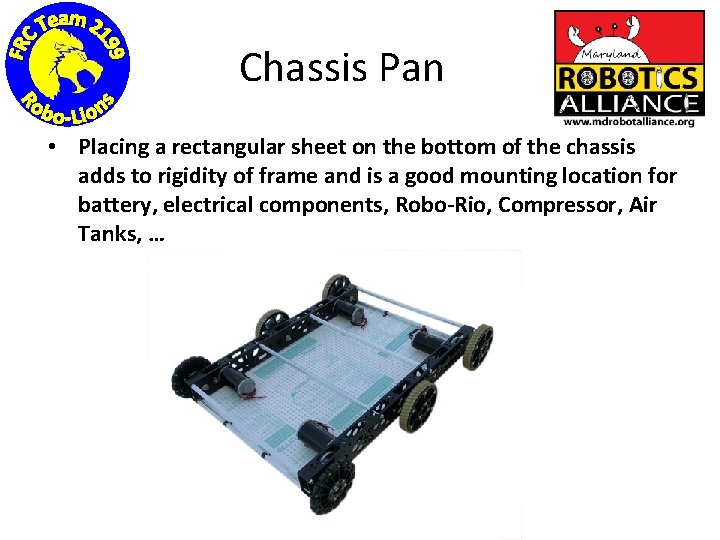
Chassis Pan • Placing a rectangular sheet on the bottom of the chassis adds to rigidity of frame and is a good mounting location for battery, electrical components, Robo-Rio, Compressor, Air Tanks, …
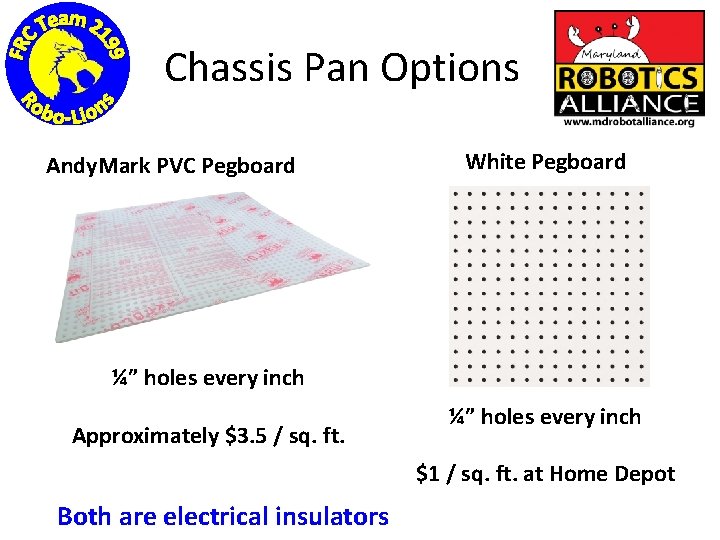
Chassis Pan Options Andy. Mark PVC Pegboard White Pegboard ¼” holes every inch Approximately $3. 5 / sq. ft. ¼” holes every inch $1 / sq. ft. at Home Depot Both are electrical insulators
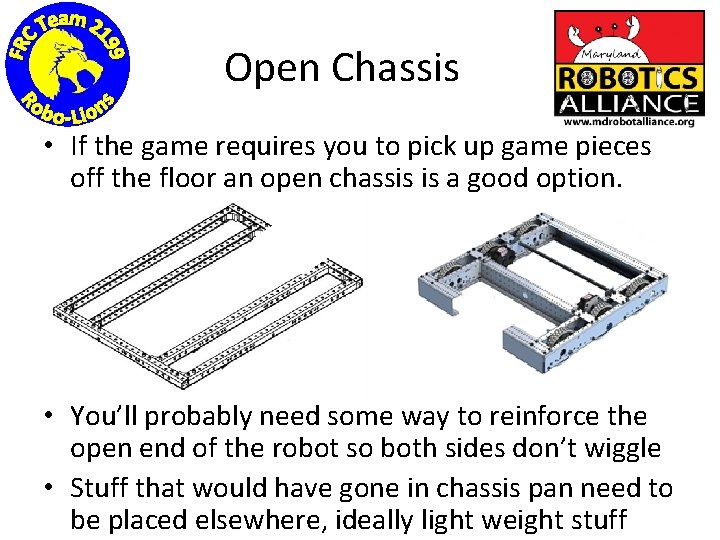
Open Chassis • If the game requires you to pick up game pieces off the floor an open chassis is a good option. X • You’ll probably need some way to reinforce the open end of the robot so both sides don’t wiggle • Stuff that would have gone in chassis pan need to be placed elsewhere, ideally light weight stuff
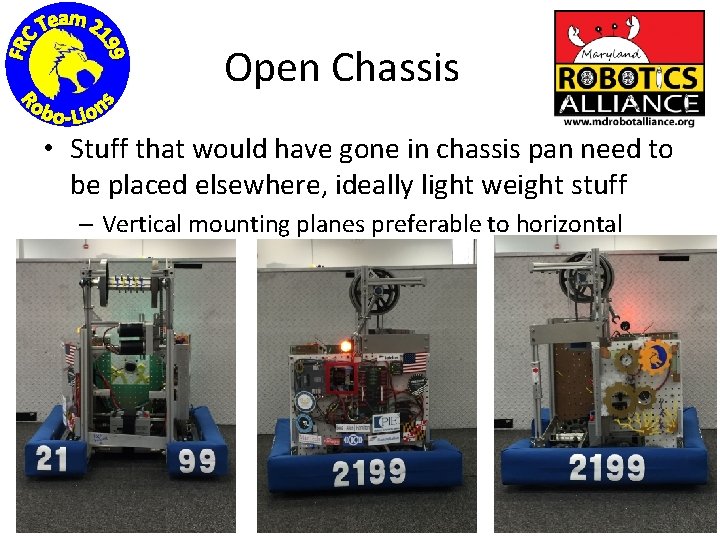
Open Chassis • Stuff that would have gone in chassis pan need to be placed elsewhere, ideally light weight stuff – Vertical mounting planes preferable to horizontal
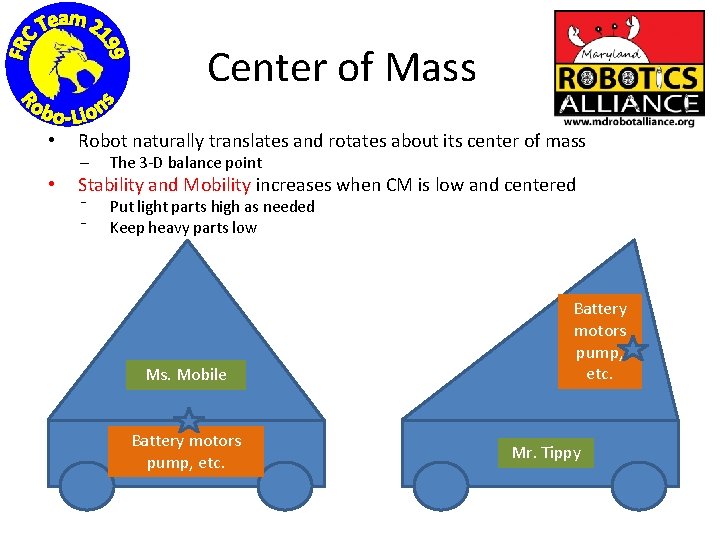
Center of Mass • Robot naturally translates and rotates about its center of mass – • The 3 -D balance point Stability and Mobility increases when CM is low and centered ⁻ ⁻ Put light parts high as needed Keep heavy parts low Ms. Mobile Battery motors pump, etc. Mr. Tippy
Center of Mass • Ideally for a closed chassis robot battery would be in the center of the robot on the chassis pan • If not possible (many open chassis designs) compensate by moving other heavy objects to counterbalance battery – For instance drive gearboxes and motors – Always keep battery low!!
Chassis Summary • Choose Narrow or Wide Chassis based on your chosen game strategy / chosen manipulators • Construct chassis out of aluminum parts • Choose COTS or Custom (CAD / Machine Shop) based on your team’s experience level – Avoid trying something you haven’t already done in previous years or in the offseason • Place pan at bottom of chassis for mounting stuff if closed chassis • Consider open chassis when game pieces are on floor – Place electronics / pneumatics on vertical planes • Keep center of mass low and centered
Drive Train Let’s Make That Robot Move!
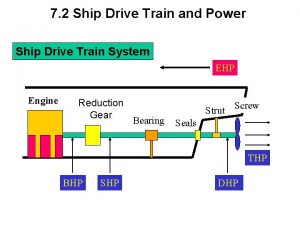
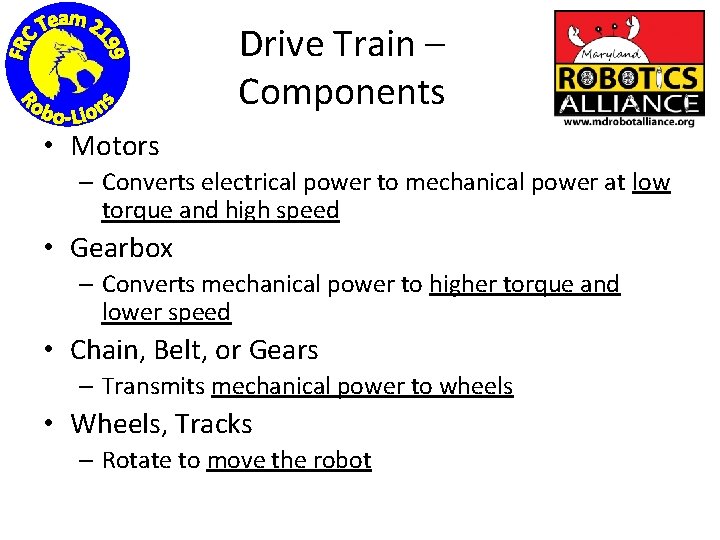
Drive Train – Components • Motors – Converts electrical power to mechanical power at low torque and high speed • Gearbox – Converts mechanical power to higher torque and lower speed • Chain, Belt, or Gears – Transmits mechanical power to wheels • Wheels, Tracks – Rotate to move the robot
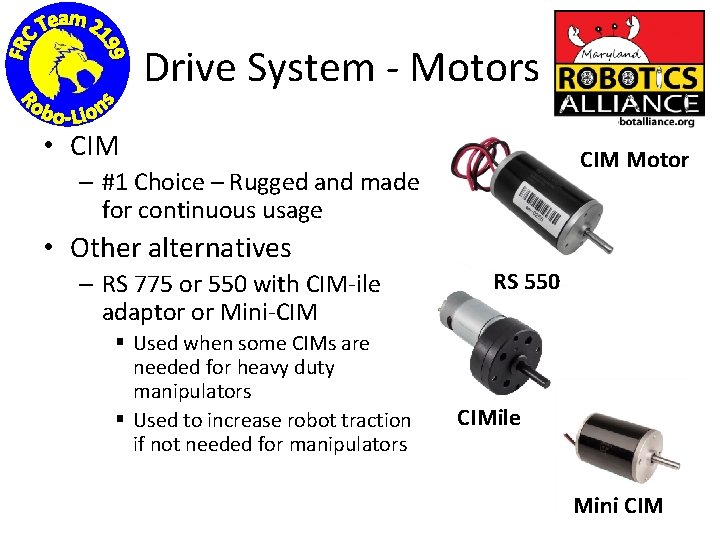
Drive System - Motors • CIM Motor – #1 Choice – Rugged and made for continuous usage • Other alternatives – RS 775 or 550 with CIM-ile adaptor or Mini-CIM § Used when some CIMs are needed for heavy duty manipulators § Used to increase robot traction if not needed for manipulators RS 550 CIMile Mini CIM
Drive System Gearboxes • COTS – Andy. Mark and Vex. Pro – Single Speed or Dual Speed (shifting) – 2 or 3 motor versions • Custom – Only if you have already built one in the off-season – Can have parts custom machined quickly – Not recommended for small, rookie, or inexperienced teams!!
Single Speed vs. Shifting • Single Speed Gear Boxes are simpler – But you have to choose a single speed / torque range § Fast speed and low torque – offensive robot § Medium speed / medium torque – compromise robot § Low speed / high torque – defensive robot • Shifting is more complicated because of the need for pneumatic or electrical actuators – But can shift from high speed / low torque to low speed / high torque – Can play offense and defense equally well
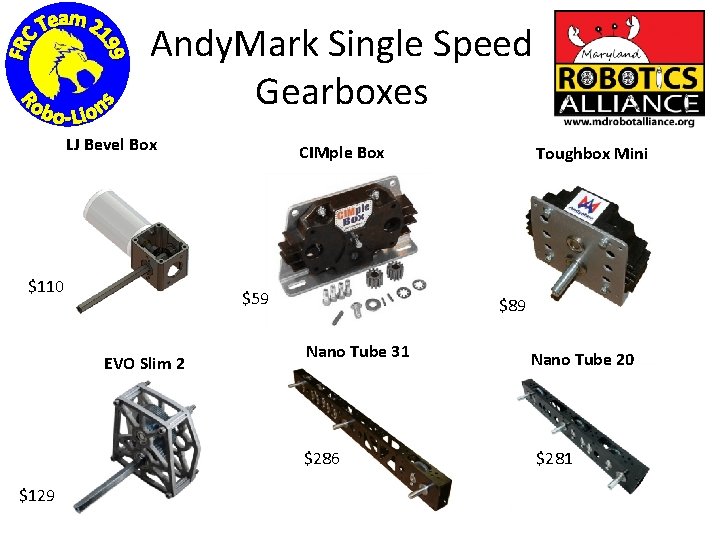
Andy. Mark Single Speed Gearboxes LJ Bevel Box $110 CIMple Box $59 EVO Slim 2 $89 Nano Tube 31 $286 $129 Toughbox Mini Nano Tube 20 $281
Andy. Mark • Lots of Choices • Andy. Mark gearboxes generally use US Digital Encoders – US Digital encoders can be finicky!!
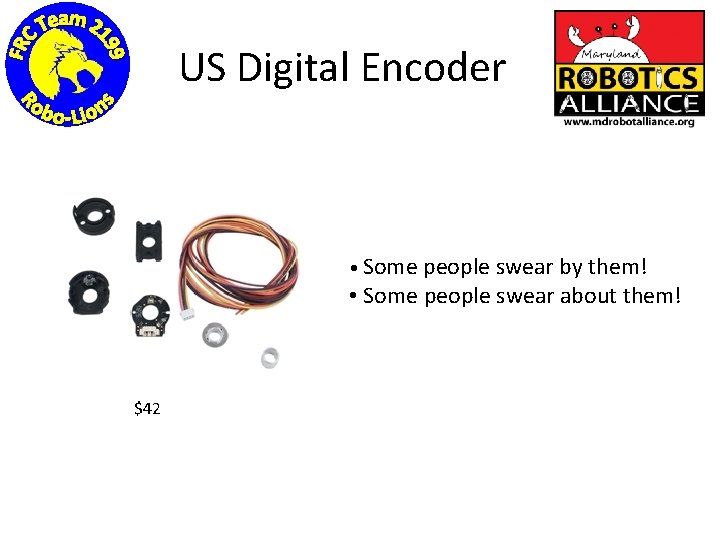
US Digital Encoder • Some people swear by them! • Some people swear about them! $42
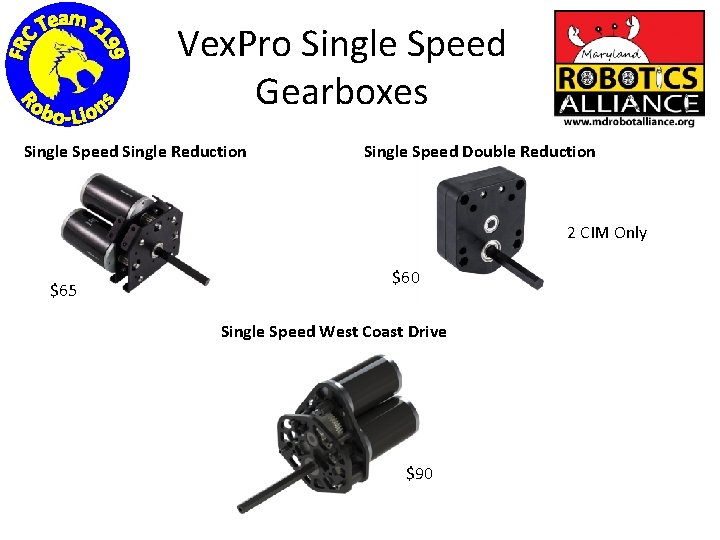
Vex. Pro Single Speed Gearboxes Single Speed Single Reduction Single Speed Double Reduction 2 CIM Only $65 $60 Single Speed West Coast Drive $90
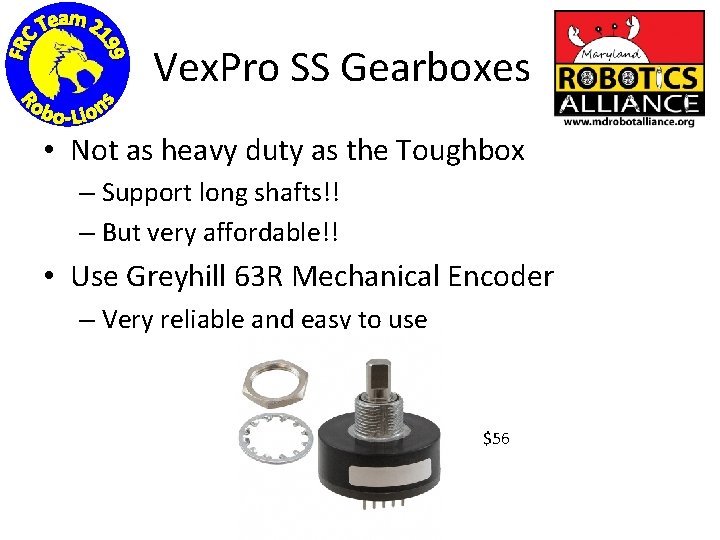
Vex. Pro SS Gearboxes • Not as heavy duty as the Toughbox – Support long shafts!! – But very affordable!! • Use Greyhill 63 R Mechanical Encoder – Very reliable and easy to use $56
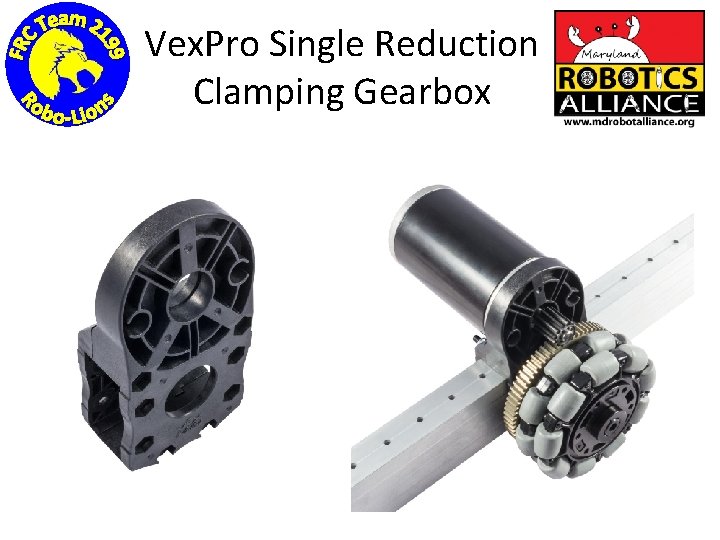
Vex. Pro Single Reduction Clamping Gearbox
Vex. Pro Single Reduction Clamping Gearbox • Have to use 1” x 2” Versaframe tube or equivalent. • If so, may be a good choice in a single speed gearbox since it is very light
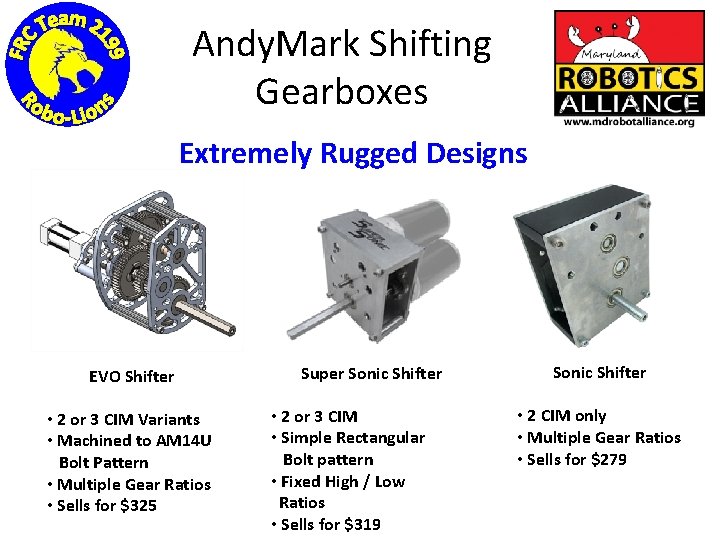
Andy. Mark Shifting Gearboxes Extremely Rugged Designs EVO Shifter • 2 or 3 CIM Variants • Machined to AM 14 U Bolt Pattern • Multiple Gear Ratios • Sells for $325 Super Sonic Shifter • 2 or 3 CIM • Simple Rectangular Bolt pattern • Fixed High / Low Ratios • Sells for $319 Sonic Shifter • 2 CIM only • Multiple Gear Ratios • Sells for $279
Andy. Mark Shifting Gearboxes • Very Heavy Duty – Typically don’t need shaft support • Use US Digital Encoders – Light Duty • Servo and Pneumatic Shifting – Servo will not support shifting on the fly
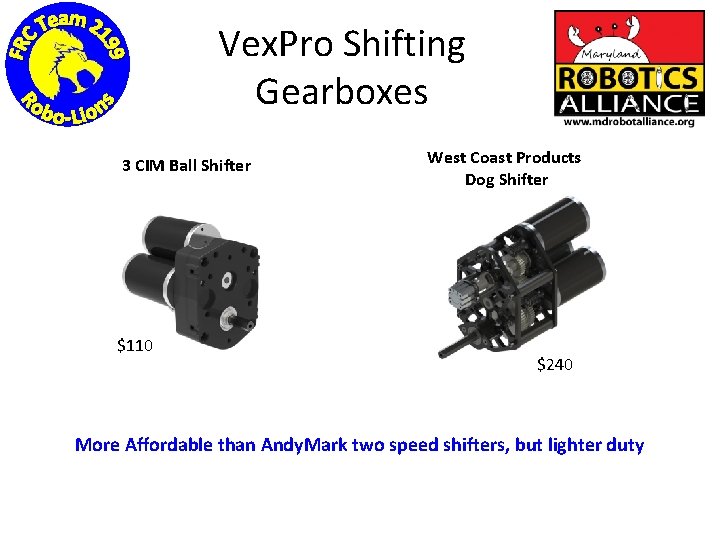
Vex. Pro Shifting Gearboxes 3 CIM Ball Shifter $110 West Coast Products Dog Shifter $240 More Affordable than Andy. Mark two speed shifters, but lighter duty
Vex. Pro Shifting Gearboxes • Not as heavy duty as Andy. Mark – Very attractively priced – Will have to support long shafts! • Pneumatic Shifting Only – Guaranteed shift on the fly • Uses Mechanical Greyhill 63 R Encoder – Very reliable and easy to use
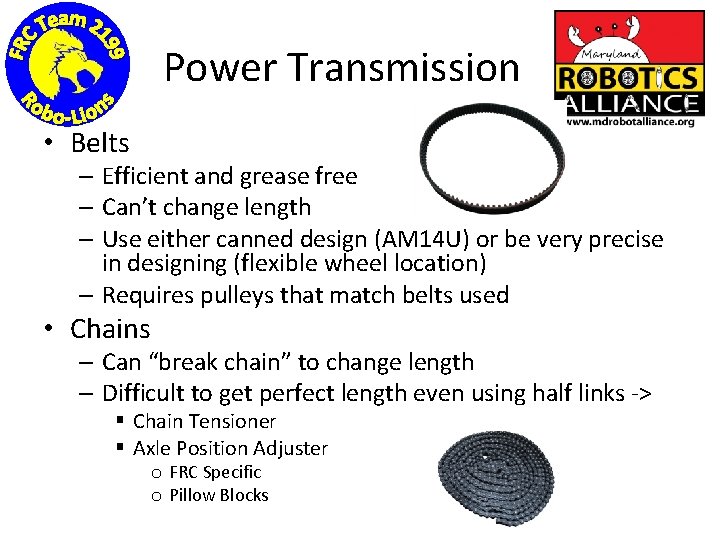
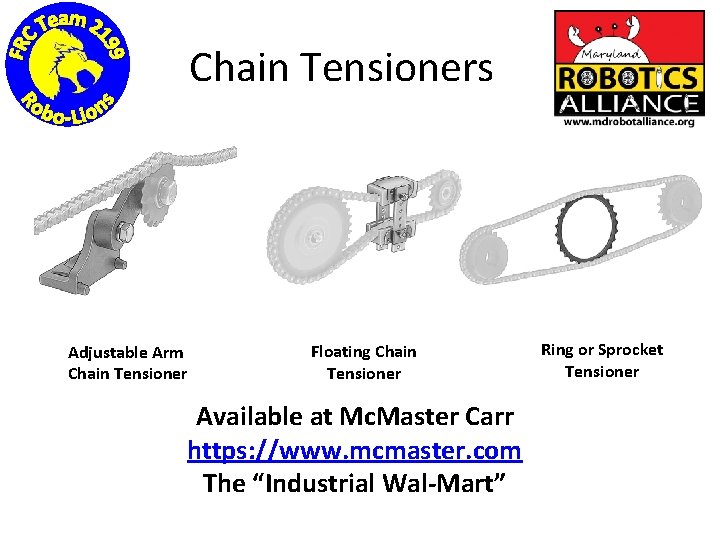
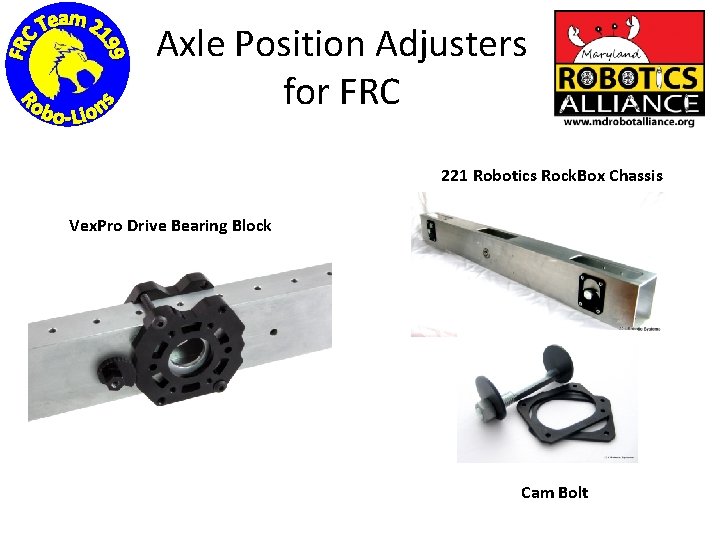
Power Transmission • Belts – Efficient and grease free – Can’t change length – Use either canned design (AM 14 U) or be very precise in designing (flexible wheel location) – Requires pulleys that match belts used • Chains – Can “break chain” to change length – Difficult to get perfect length even using half links -> § Chain Tensioner § Axle Position Adjuster o FRC Specific o Pillow Blocks
Chain Tensioners Adjustable Arm Chain Tensioner Floating Chain Tensioner Available at Mc. Master Carr https: //www. mcmaster. com The “Industrial Wal-Mart” Ring or Sprocket Tensioner
Axle Position Adjusters for FRC 221 Robotics Rock. Box Chassis Vex. Pro Drive Bearing Block Cam Bolt
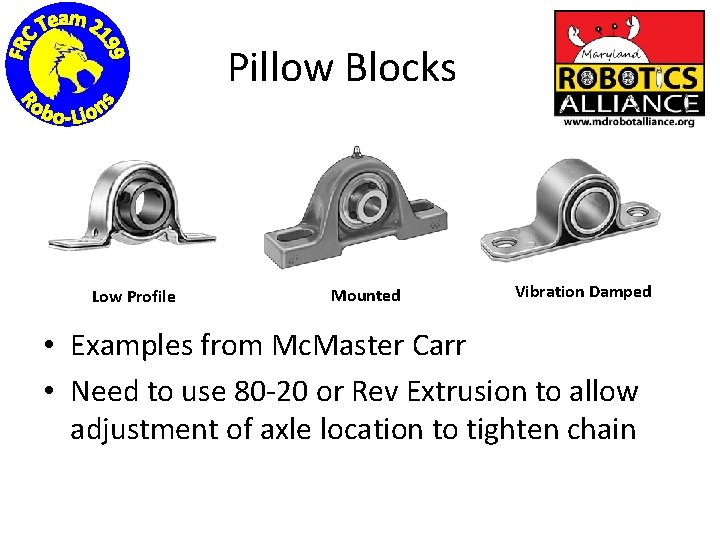
Pillow Blocks Low Profile Mounted Vibration Damped • Examples from Mc. Master Carr • Need to use 80 -20 or Rev Extrusion to allow adjustment of axle location to tighten chain
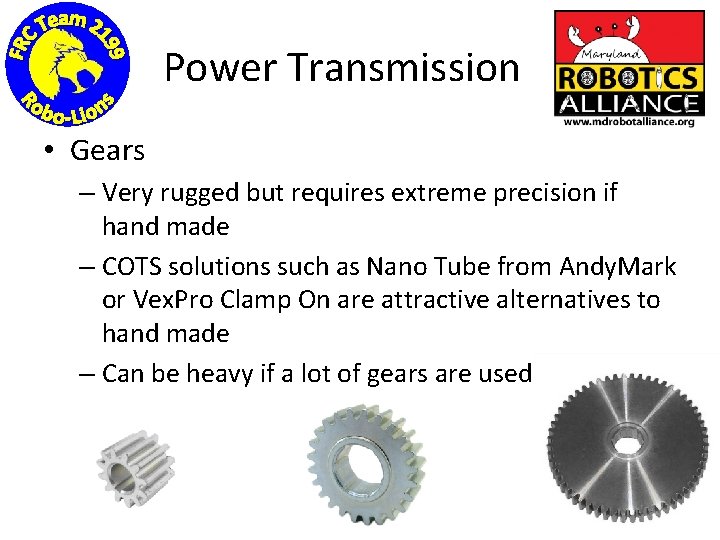
Power Transmission • Gears – Very rugged but requires extreme precision if hand made – COTS solutions such as Nano Tube from Andy. Mark or Vex. Pro Clamp On are attractive alternatives to hand made – Can be heavy if a lot of gears are used
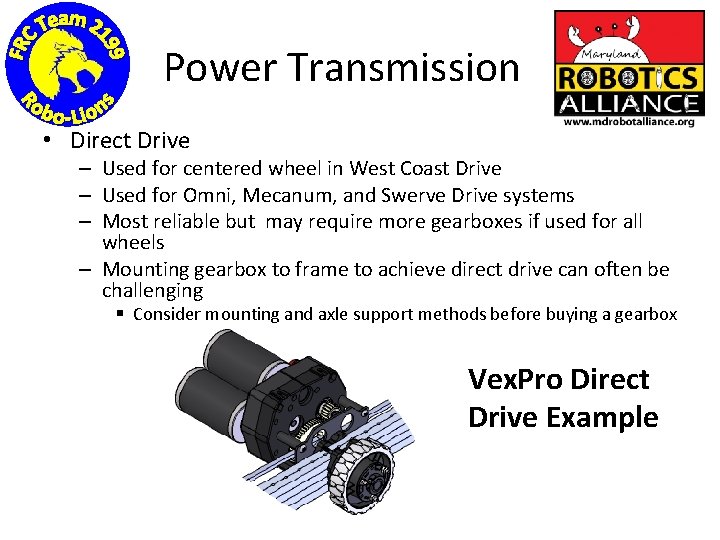
Power Transmission • Direct Drive – Used for centered wheel in West Coast Drive – Used for Omni, Mecanum, and Swerve Drive systems – Most reliable but may require more gearboxes if used for all wheels – Mounting gearbox to frame to achieve direct drive can often be challenging § Consider mounting and axle support methods before buying a gearbox Vex. Pro Direct Drive Example
Wheels, Tracks
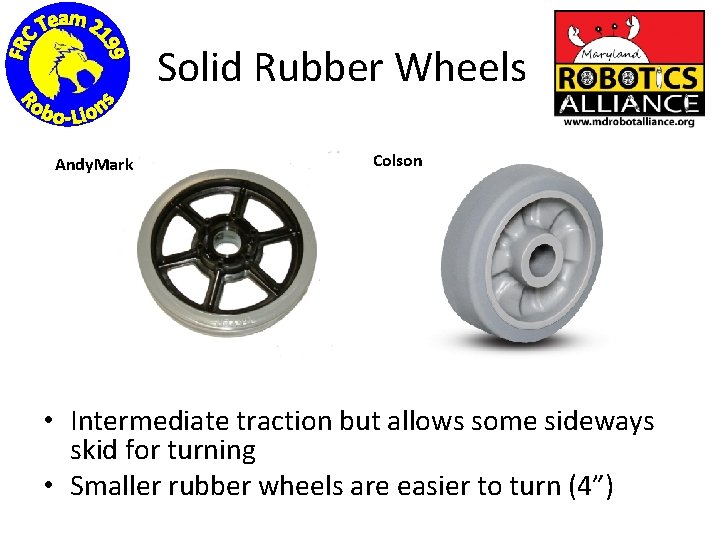
Solid Rubber Wheels Andy. Mark Colson • Intermediate traction but allows some sideways skid for turning • Smaller rubber wheels are easier to turn (4”)
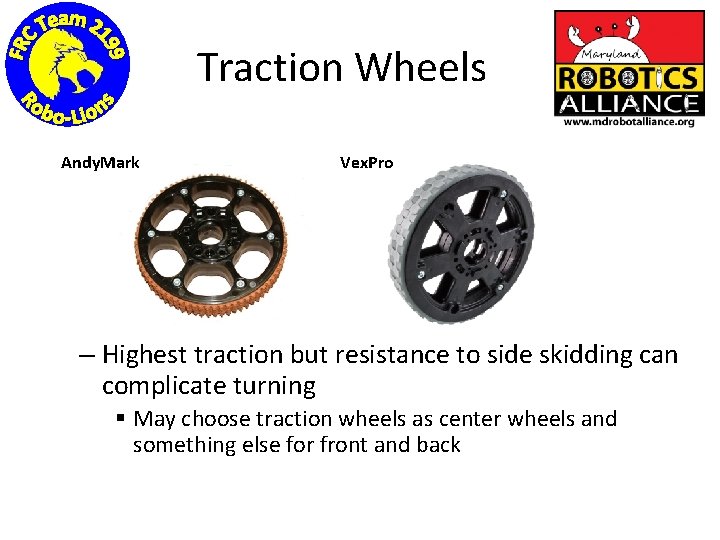
Traction Wheels Andy. Mark Vex. Pro – Highest traction but resistance to side skidding can complicate turning § May choose traction wheels as center wheels and something else for front and back
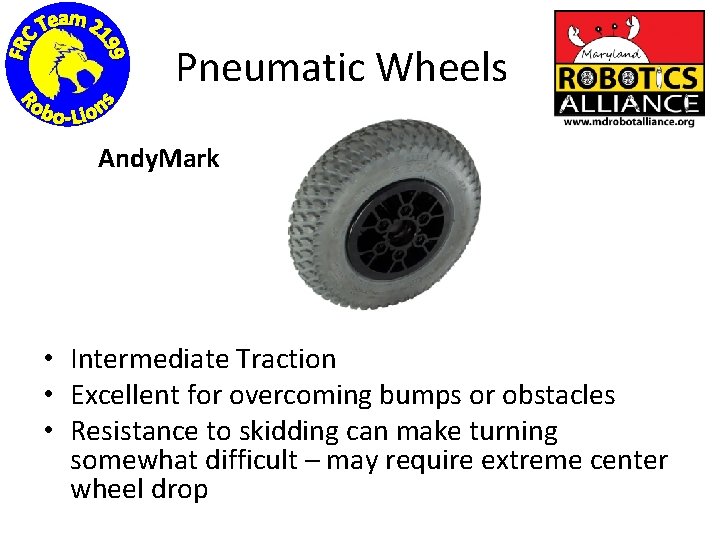
Pneumatic Wheels Andy. Mark • Intermediate Traction • Excellent for overcoming bumps or obstacles • Resistance to skidding can make turning somewhat difficult – may require extreme center wheel drop
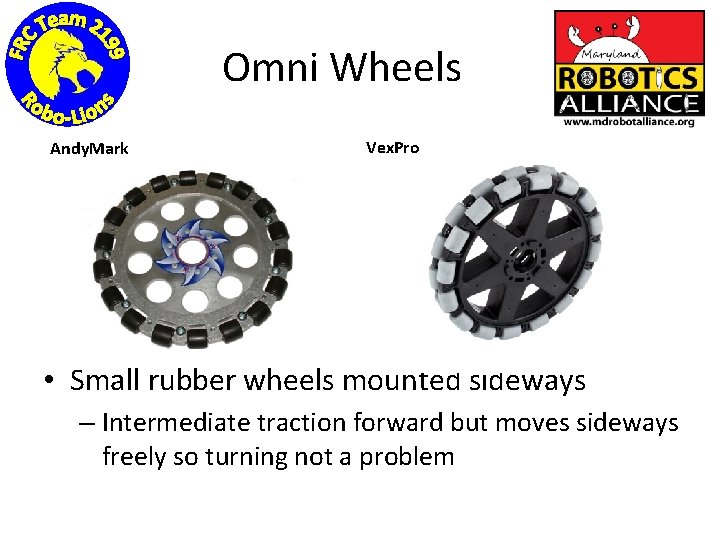
Omni Wheels Andy. Mark Vex. Pro • Small rubber wheels mounted sideways – Intermediate traction forward but moves sideways freely so turning not a problem
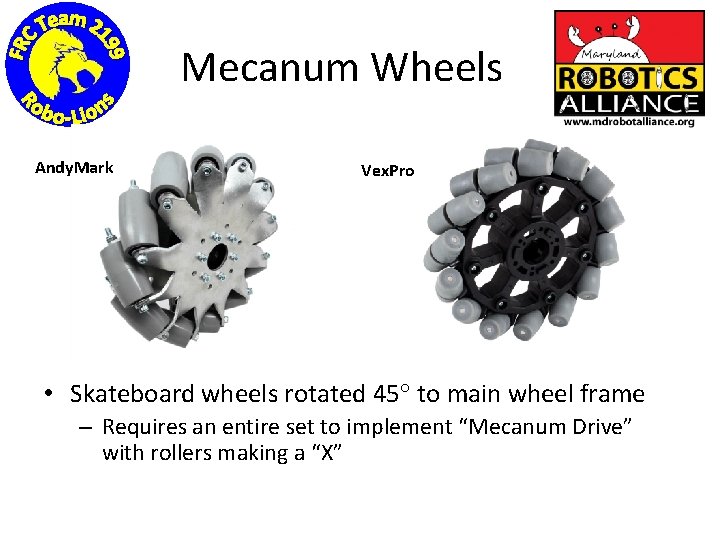
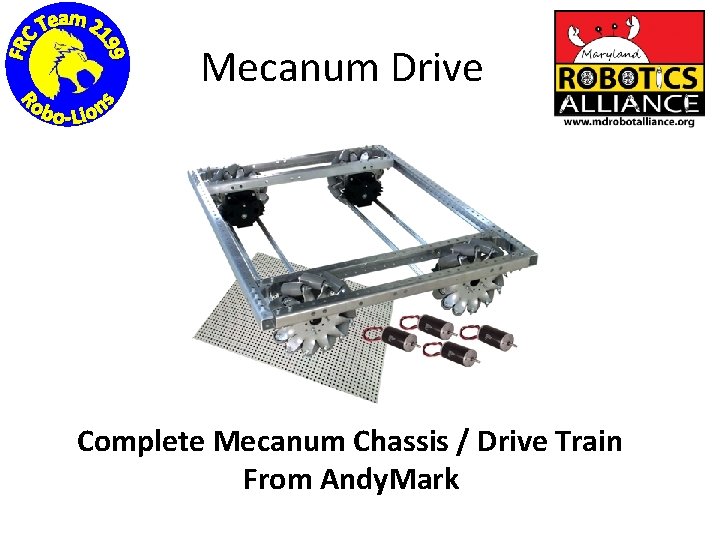
Mecanum Wheels Andy. Mark Vex. Pro • Skateboard wheels rotated 45 to main wheel frame – Requires an entire set to implement “Mecanum Drive” with rollers making a “X”
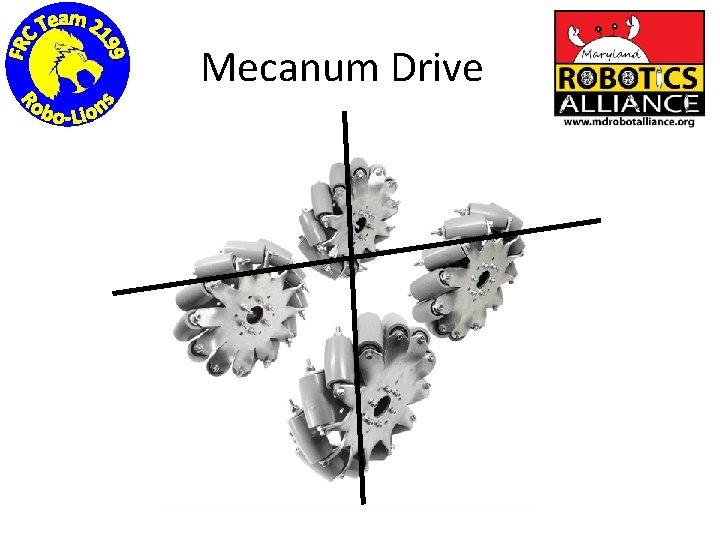
Mecanum Drive
Mecanum Drive • If front wheels move in opposite direction to back wheels vehicle moves sideways – Called strafing • Gives two directions of freedom in translation – Robot is extremely nimble! • Mecanum wheels are expensive! • Traction is compromised due to rolling elements and 45 angle • For the right game can be an excellent choice
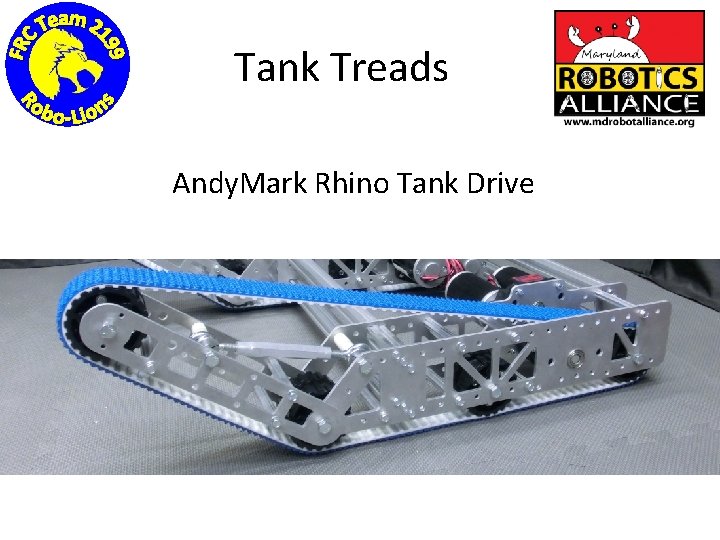
Tank Treads Andy. Mark Rhino Tank Drive
Tank Treads • Not a nimble turner but fast going straight • Good choice for obstacle defeat • Probably best to get a Tread System – Tread and Roller Wheels • Expensive!! – Andy. Mark product $369 per side
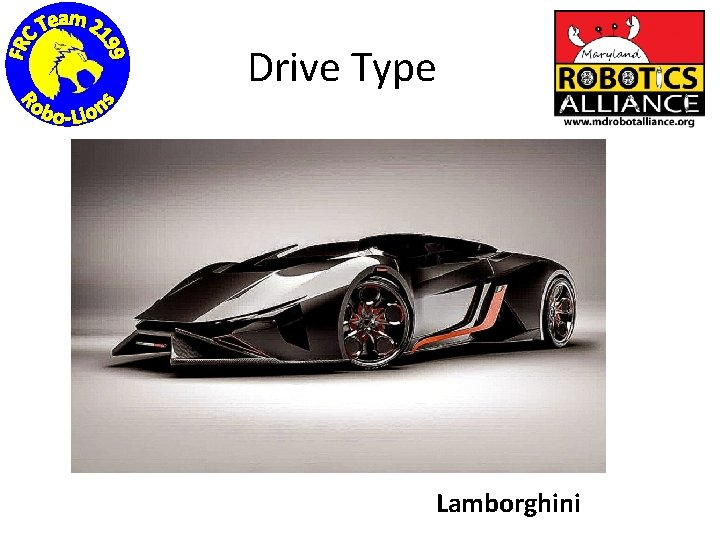
Drive Type Lamborghini
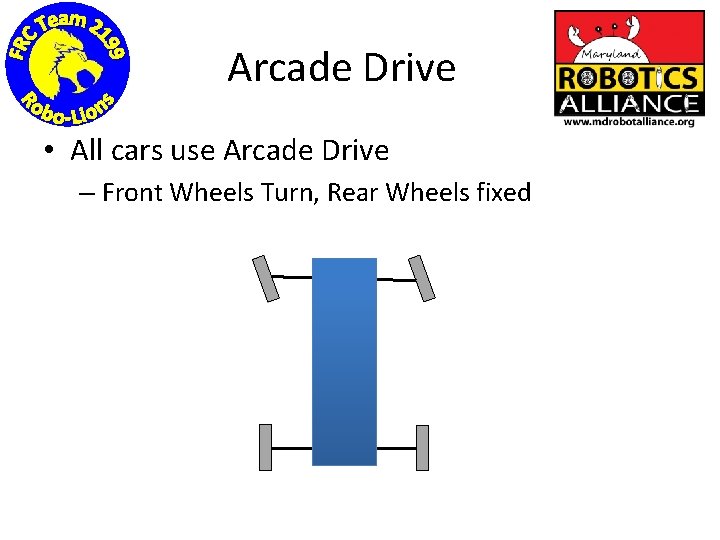
Arcade Drive • All cars use Arcade Drive – Front Wheels Turn, Rear Wheels fixed
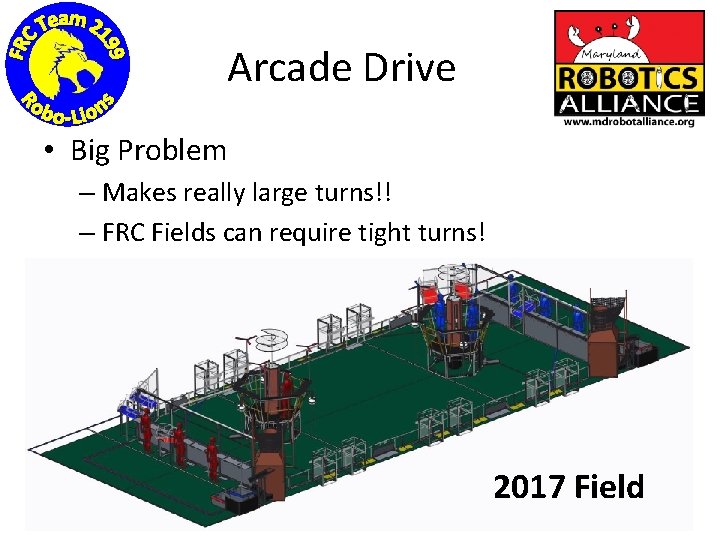
Arcade Drive • Big Problem – Makes really large turns!! – FRC Fields can require tight turns! 2017 Field
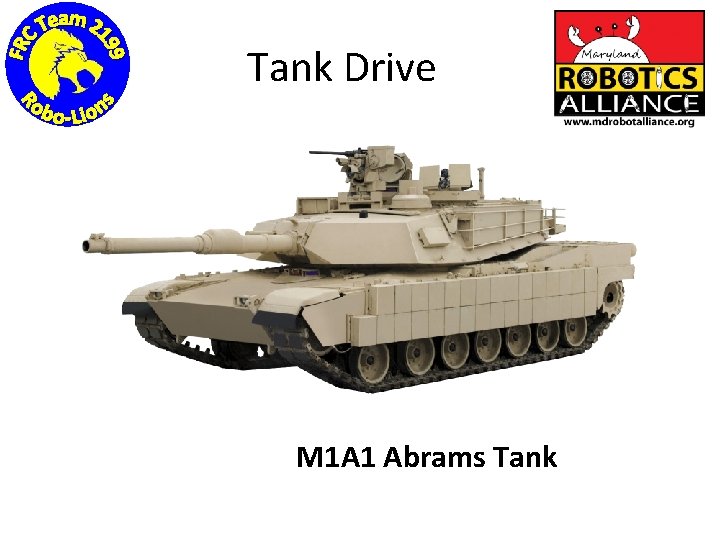
Tank Drive M 1 A 1 Abrams Tank
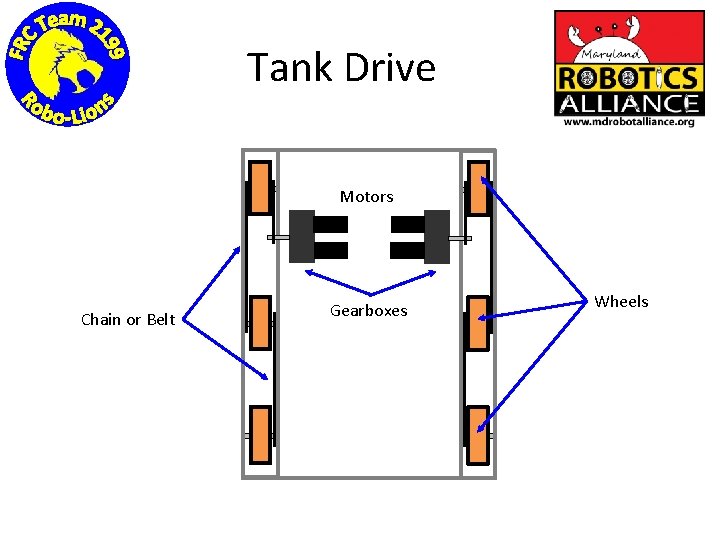
Tank Drive • For FIRST Robotics “Tank Drive” means wheels on left and right sides are driven independently – normally with two joysticks – Only a single gearbox per side – Can turn in place, go forward and backward – Good combination of simplicity and performance § The most popular drive system in FIRST!!
Tank Drive Motors Chain or Belt Gearboxes Wheels
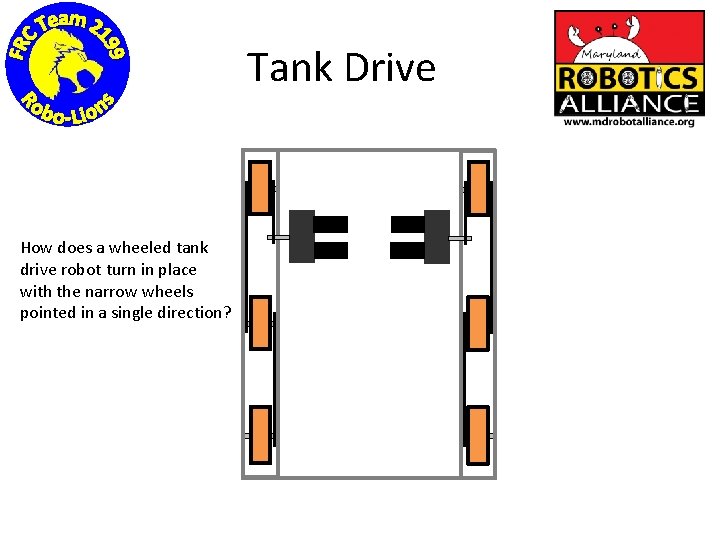
Tank Drive How does a wheeled tank drive robot turn in place with the narrow wheels pointed in a single direction?
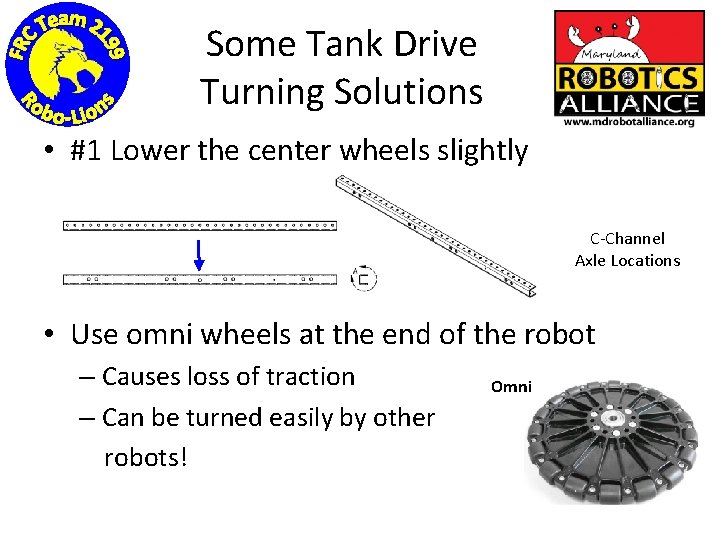
Some Tank Drive Turning Solutions • #1 Lower the center wheels slightly C-Channel Axle Locations • Use omni wheels at the end of the robot – Causes loss of traction – Can be turned easily by other robots! Omni
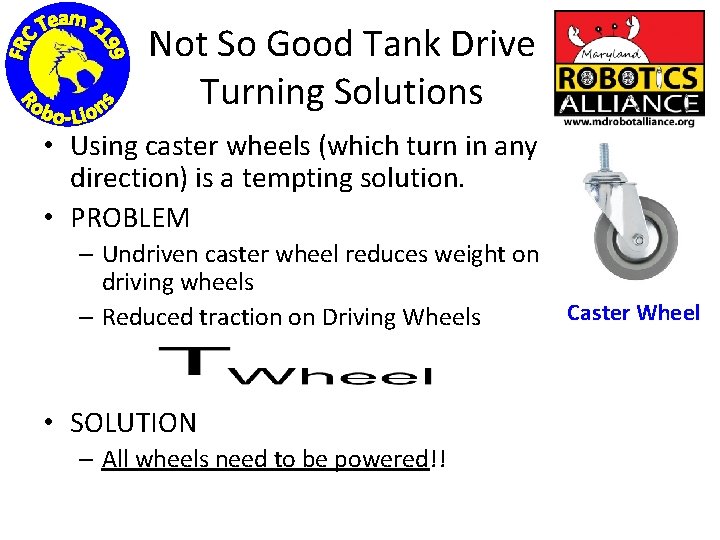
Not So Good Tank Drive Turning Solutions • Using caster wheels (which turn in any direction) is a tempting solution. • PROBLEM – Undriven caster wheel reduces weight on driving wheels – Reduced traction on Driving Wheels • SOLUTION – All wheels need to be powered!! Caster Wheel
Holonomic (2 -D Translation) Drive Systems
Mecanum Drive Complete Mecanum Chassis / Drive Train From Andy. Mark
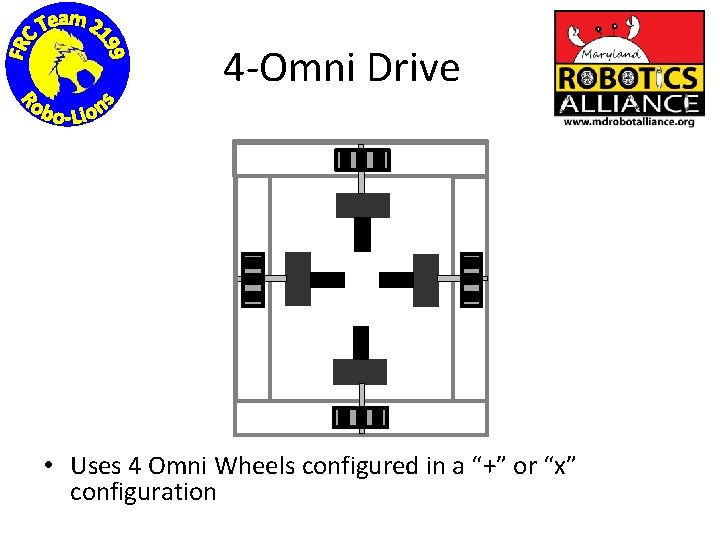
4 -Omni Drive • Uses 4 Omni Wheels configured in a “+” or “x” configuration
4 -Omni Drive • Highly maneuverable but has less traction than even the mecanum drive – Only ½ of the motors are pushing in any direction – Not recommended
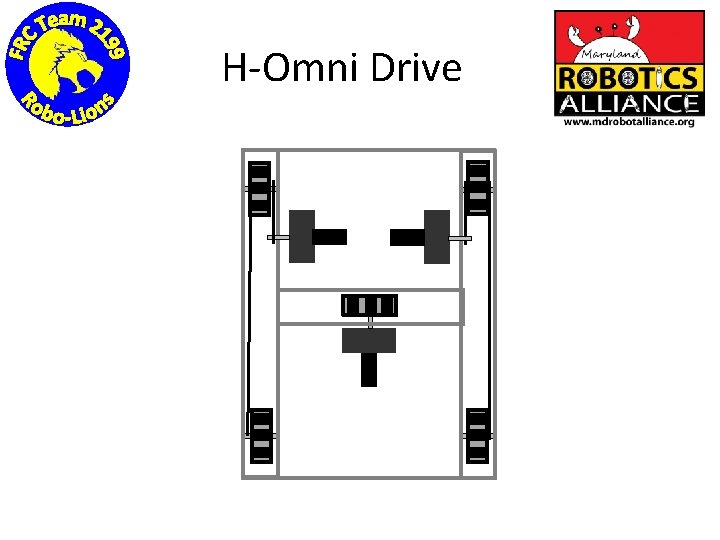
H-Omni Drive
H-Omni Drive • Basically a Tank Drive with a Slider Wheel • More traction than 4 -Omni Drive but lots less than tank drive • Requires only 3 gearboxes • Not a bad choice for 2015 game Recycle Rush – Since opposing alliances were on opposite of field with no defense played
Exotica
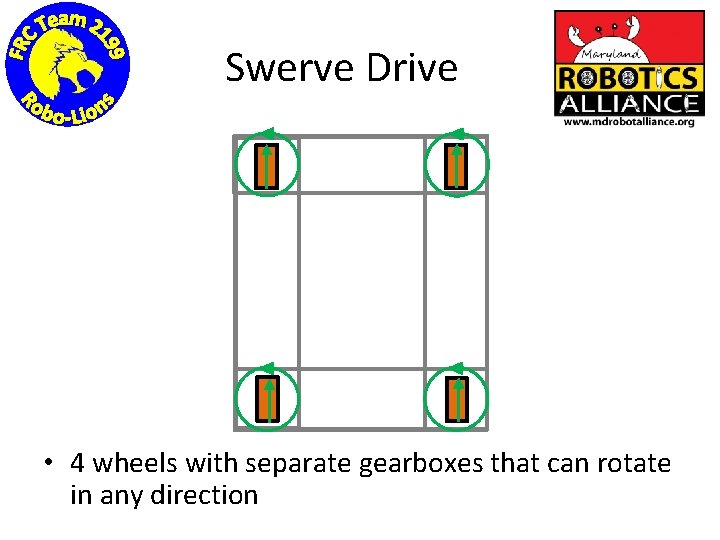
Swerve Drive • 4 wheels with separate gearboxes that can rotate in any direction
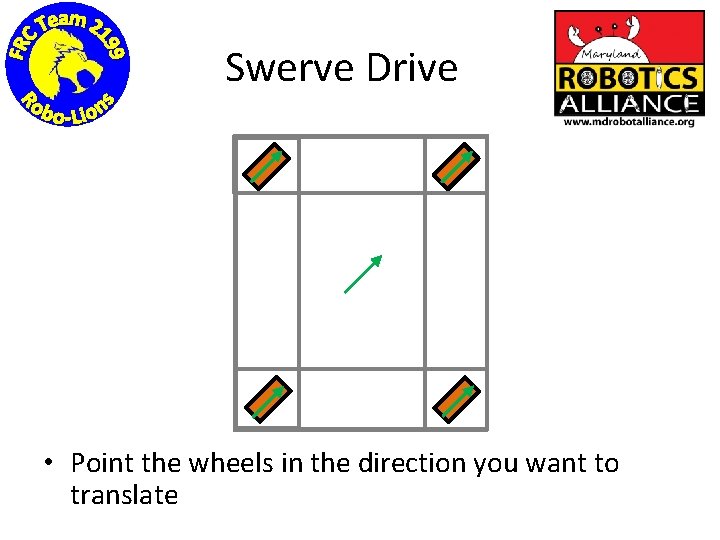
Swerve Drive • Point the wheels in the direction you want to translate
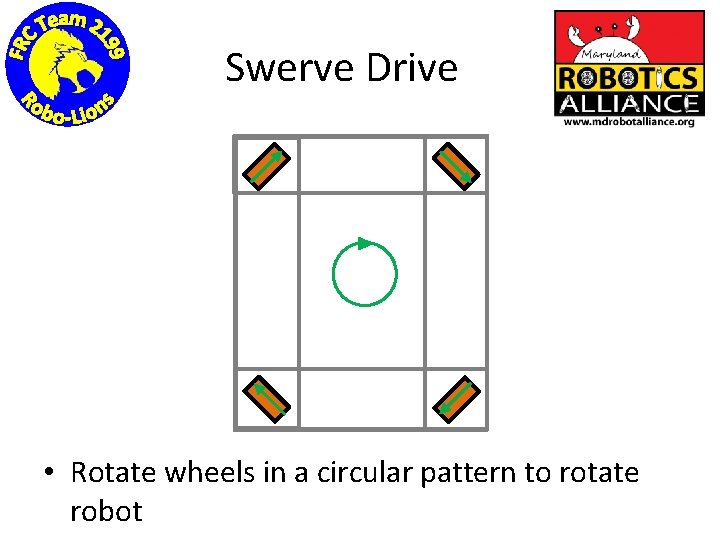
Swerve Drive • Rotate wheels in a circular pattern to rotate robot
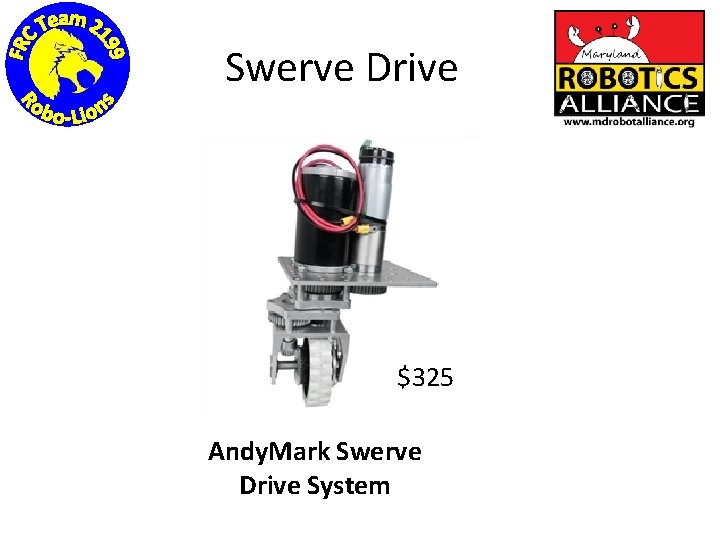
Swerve Drive $325 Andy. Mark Swerve Drive System
Swerve Drive • Highly Capable – 2 -D translation and rotation without loss in traction • Is a complete transmission system • Extremely expensive – A single swerve drive assembly (1 wheel apiece) costs $325 or more § Requires 1 CIM drive motor and 1 other motor to rotate wheel • Very complicated to program • Not recommended for rookie or inexperienced teams • Should be mastered in off-season
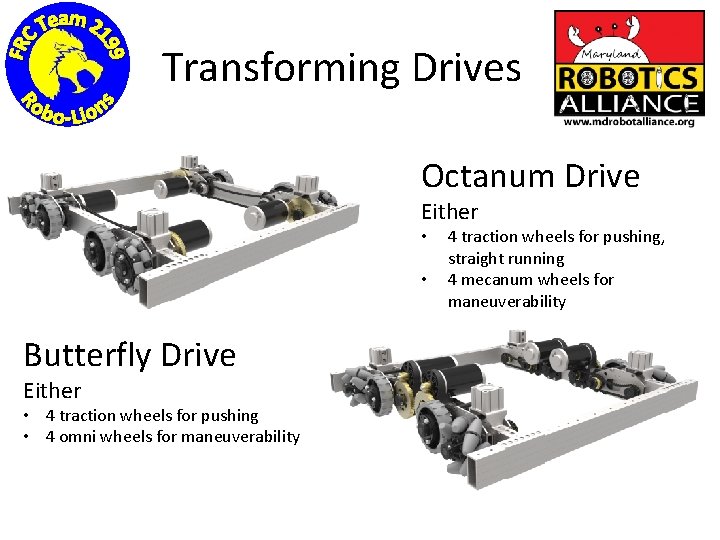
Transforming Drives Octanum Drive Either • • Butterfly Drive Either • 4 traction wheels for pushing • 4 omni wheels for maneuverability 4 traction wheels for pushing, straight running 4 mecanum wheels for maneuverability
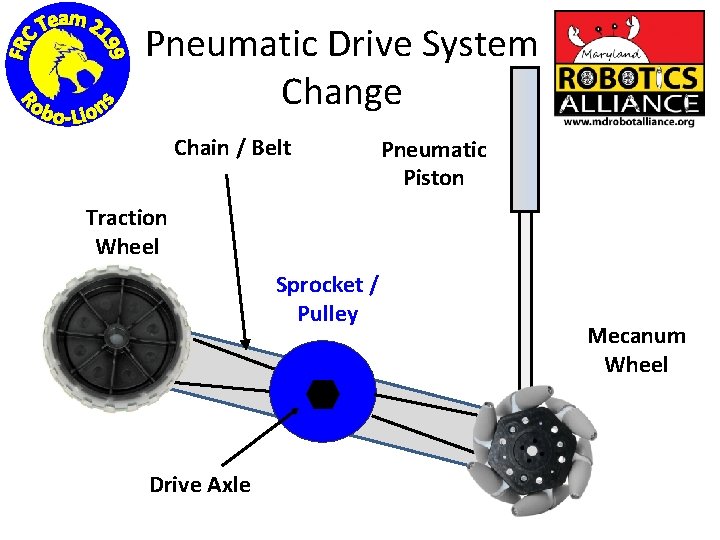
Pneumatic Drive System Change Chain / Belt Pneumatic Piston Traction Wheel Sprocket / Pulley Drive Axle Mecanum Wheel
Drive Systems • Lots of choices! • Choose drive system and drive system components based on – Required robot performance according to game strategy – Experience with components and systems – Financial and Weight budgets