Updates to MCS AMD and AFS Template GRAP




- Slides: 79
Updates to MCS, AMD and AFS Template GRAP FOR DEPARTMENTS Presenter: OAG | March 2016
Modified Cash Standard (MCS) Overview
Developing the MCS Considered pronouncements issued by : • ASB • IPSASB • IASB (mainly IFRS for SMEs) • Other organisations that develop financial reporting, accounting and auditing requirements for the public sector. • Best practices, both locally and internationally. • The capacity of departments to comply with the reporting requirements. • The systems used by departments in preparing and collating the information required to comply with the reporting requirements. 3
Background • Workshop held in September 2015 • Draft updates to MCS, AMD and Specimen AFS published in October 2015 • Comment period ended in November 2015 • Final documents published 4
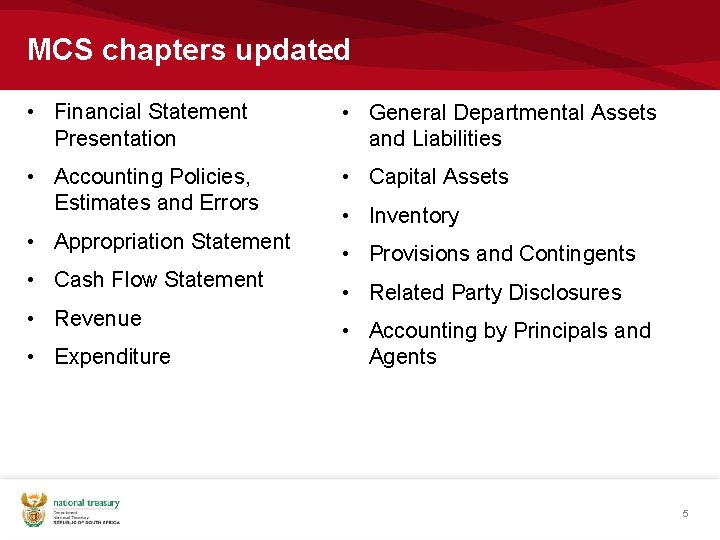
MCS chapters updated • Financial Statement Presentation • General Departmental Assets and Liabilities • Accounting Policies, Estimates and Errors • Capital Assets • Appropriation Statement • Cash Flow Statement • Revenue • Expenditure • Inventory • Provisions and Contingents • Related Party Disclosures • Accounting by Principals and Agents 5
Financial Statements Presentation
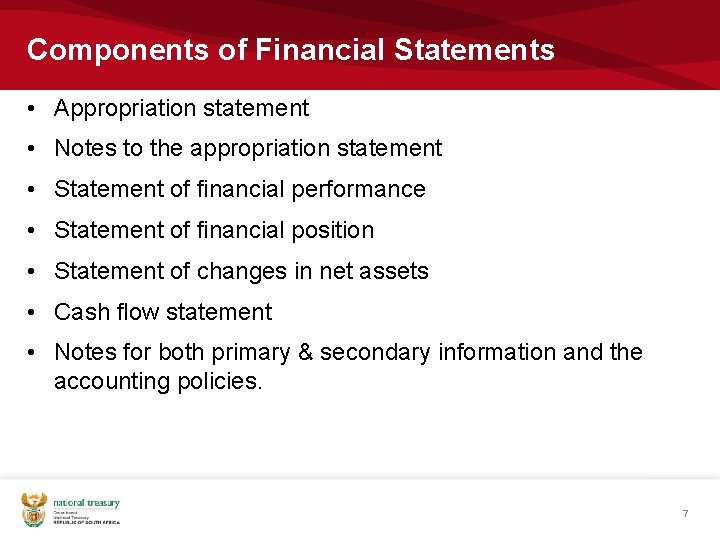
Components of Financial Statements • Appropriation statement • Notes to the appropriation statement • Statement of financial performance • Statement of financial position • Statement of changes in net assets • Cash flow statement • Notes for both primary & secondary information and the accounting policies. 7
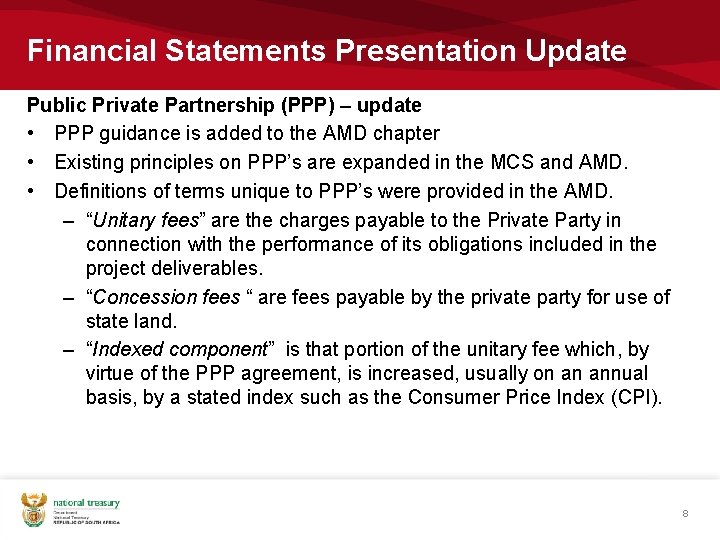
Financial Statements Presentation Update Public Private Partnership (PPP) – update • PPP guidance is added to the AMD chapter • Existing principles on PPP’s are expanded in the MCS and AMD. • Definitions of terms unique to PPP’s were provided in the AMD. – “Unitary fees” are the charges payable to the Private Party in connection with the performance of its obligations included in the project deliverables. – “Concession fees “ are fees payable by the private party for use of state land. – “Indexed component” is that portion of the unitary fee which, by virtue of the PPP agreement, is increased, usually on an annual basis, by a stated index such as the Consumer Price Index (CPI). 8
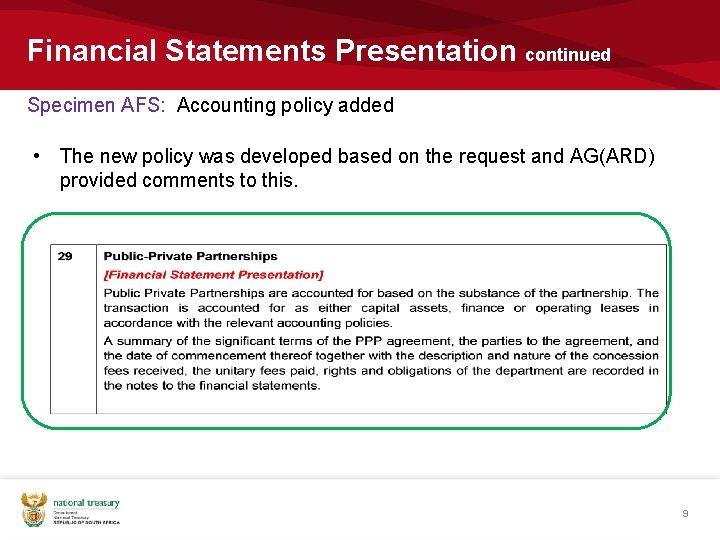
Financial Statements Presentation continued Specimen AFS: Accounting policy added • The new policy was developed based on the request and AG(ARD) provided comments to this. 9
Accounting policies, estimates and errors
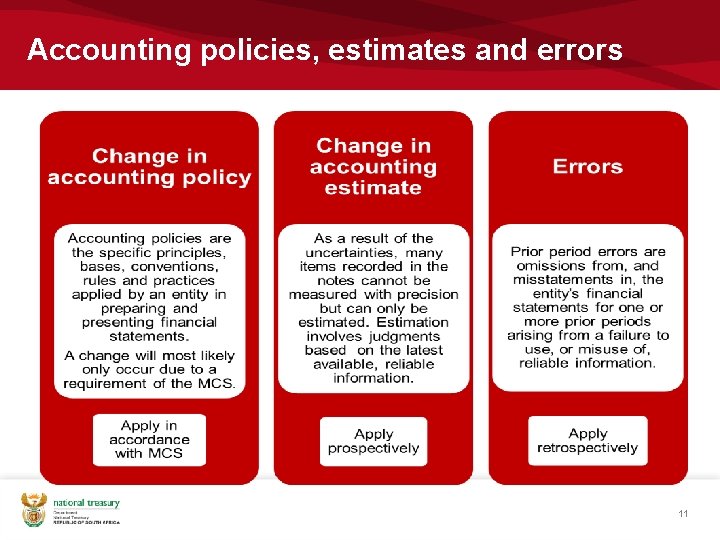
Accounting policies, estimates and errors 11
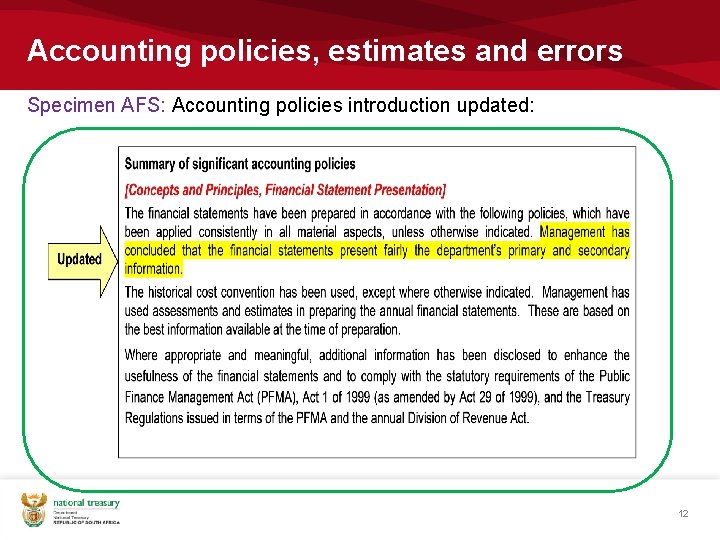
Accounting policies, estimates and errors Specimen AFS: Accounting policies introduction updated: 12
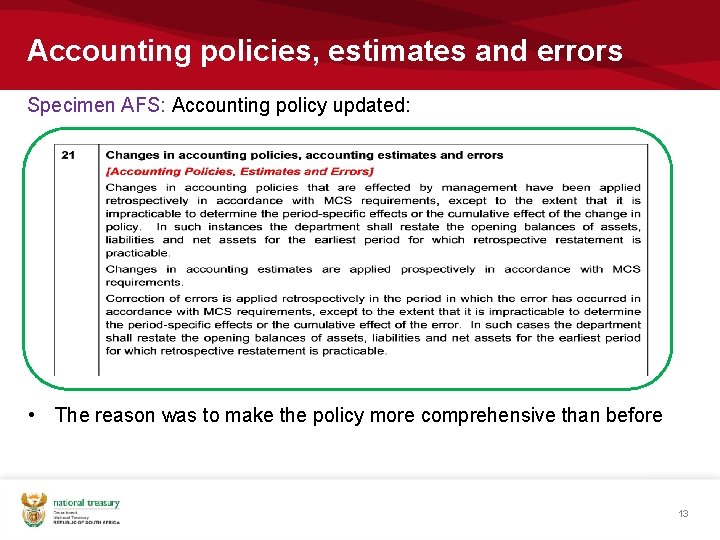
Accounting policies, estimates and errors Specimen AFS: Accounting policy updated: • The reason was to make the policy more comprehensive than before 13
Appropriation Statement
Appropriation Statement The appropriation statement provides a comparison between budget amounts and the actual amounts arising from the execution of the budget with an explanation of the reasons for material differences. 15
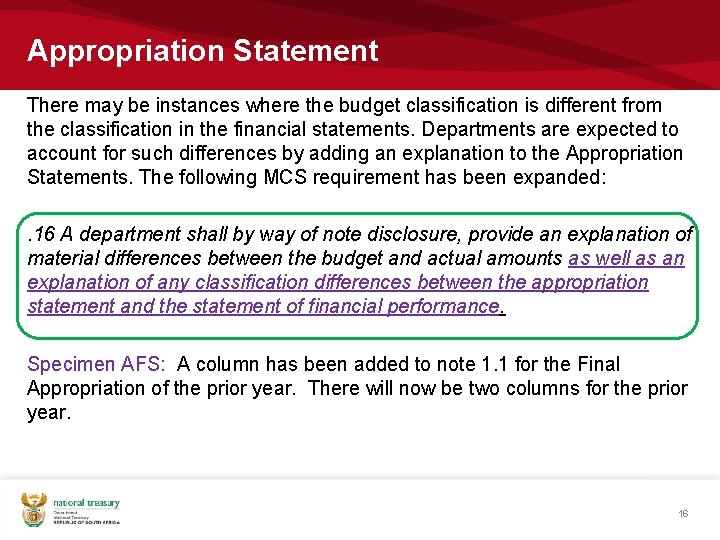
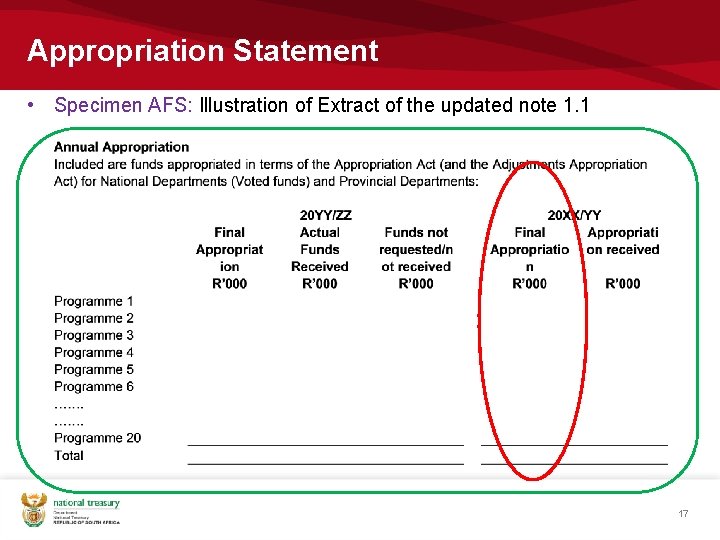
Appropriation Statement There may be instances where the budget classification is different from the classification in the financial statements. Departments are expected to account for such differences by adding an explanation to the Appropriation Statements. The following MCS requirement has been expanded: . 16 A department shall by way of note disclosure, provide an explanation of material differences between the budget and actual amounts as well as an explanation of any classification differences between the appropriation statement and the statement of financial performance. Specimen AFS: A column has been added to note 1. 1 for the Final Appropriation of the prior year. There will now be two columns for the prior year. 16
Appropriation Statement • Specimen AFS: Illustration of Extract of the updated note 1. 1 17
Cash Flow Statement
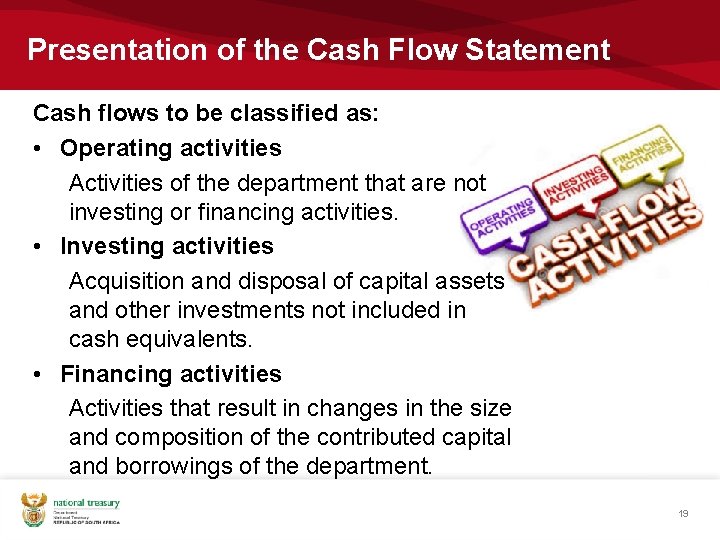
Presentation of the Cash Flow Statement Cash flows to be classified as: • Operating activities Activities of the department that are not investing or financing activities. • Investing activities Acquisition and disposal of capital assets and other investments not included in cash equivalents. • Financing activities Activities that result in changes in the size and composition of the contributed capital and borrowings of the department. 19
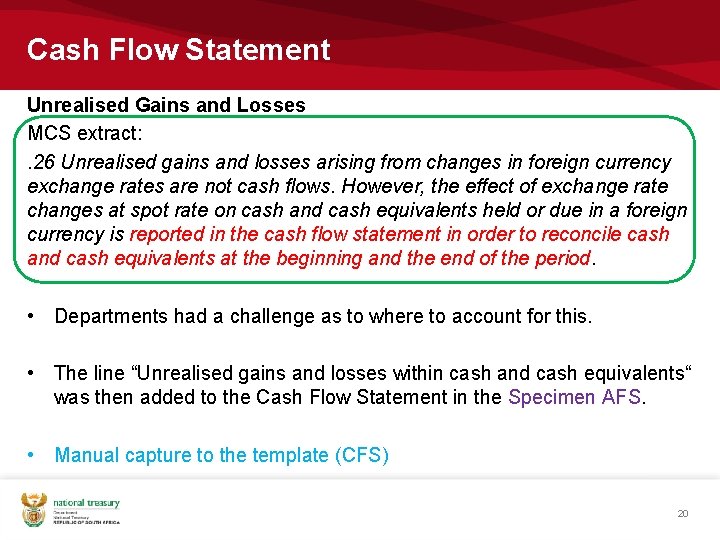
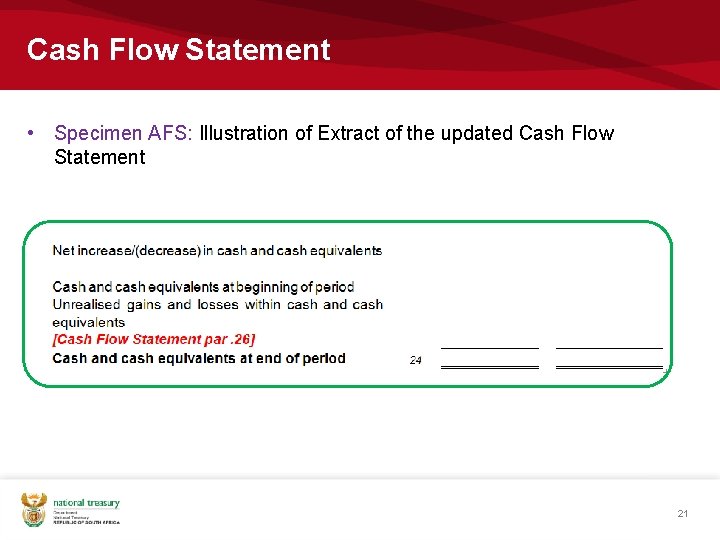
Cash Flow Statement Unrealised Gains and Losses MCS extract: . 26 Unrealised gains and losses arising from changes in foreign currency exchange rates are not cash flows. However, the effect of exchange rate changes at spot rate on cash and cash equivalents held or due in a foreign currency is reported in the cash flow statement in order to reconcile cash and cash equivalents at the beginning and the end of the period. • Departments had a challenge as to where to account for this. • The line “Unrealised gains and losses within cash and cash equivalents“ was then added to the Cash Flow Statement in the Specimen AFS. • Manual capture to the template (CFS) 20
Cash Flow Statement • Specimen AFS: Illustration of Extract of the updated Cash Flow Statement 21
Revenue
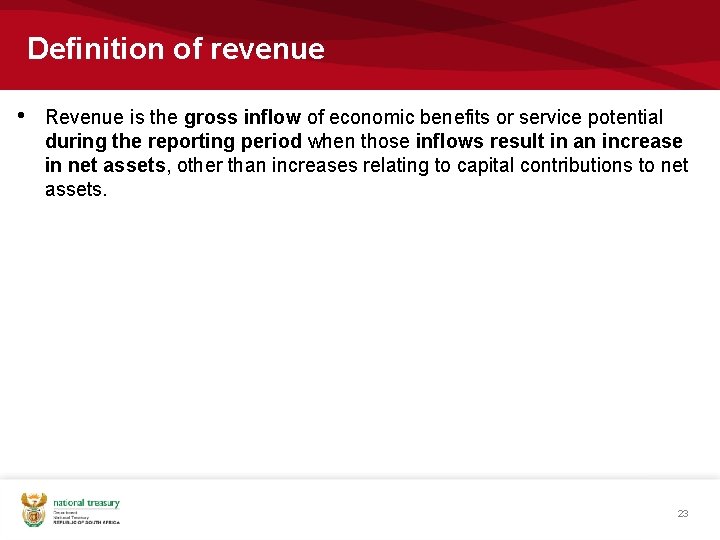
Definition of revenue • Revenue is the gross inflow of economic benefits or service potential during the reporting period when those inflows result in an increase in net assets, other than increases relating to capital contributions to net assets. 23
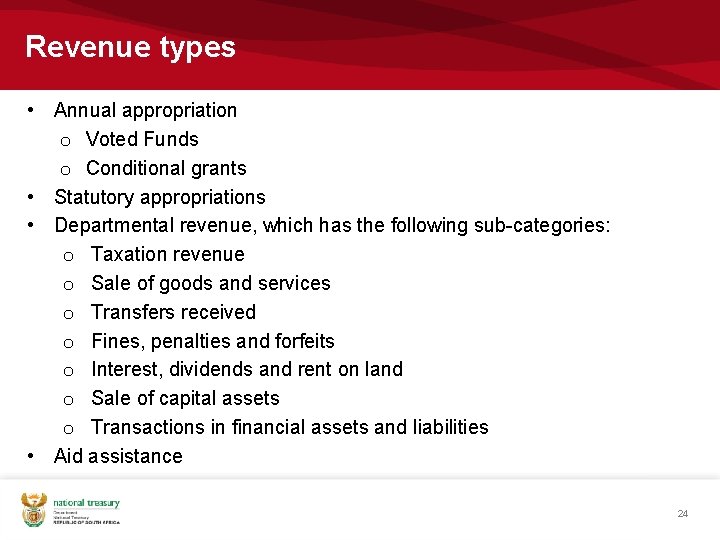
Revenue types • Annual appropriation o Voted Funds o Conditional grants • Statutory appropriations • Departmental revenue, which has the following sub-categories: o Taxation revenue o Sale of goods and services o Transfers received o Fines, penalties and forfeits o Interest, dividends and rent on land o Sale of capital assets o Transactions in financial assets and liabilities • Aid assistance 24
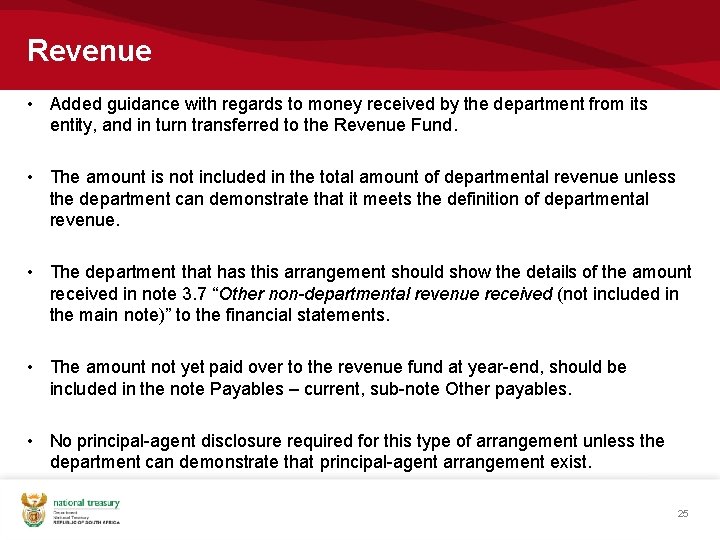
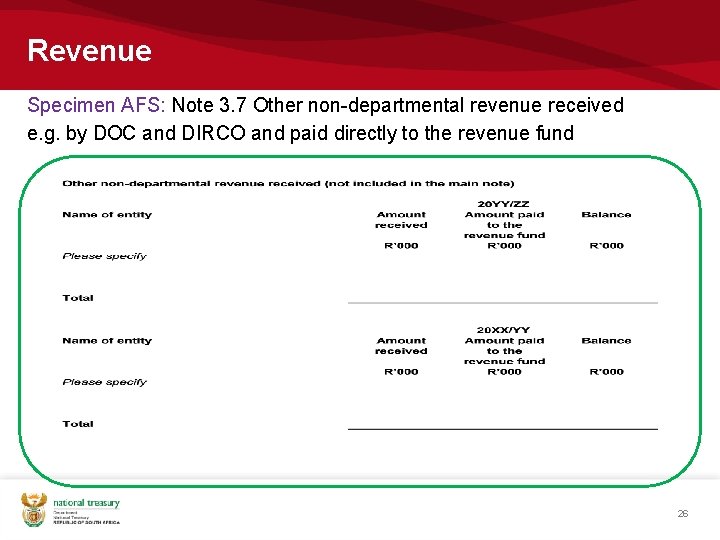
Revenue • Added guidance with regards to money received by the department from its entity, and in turn transferred to the Revenue Fund. • The amount is not included in the total amount of departmental revenue unless the department can demonstrate that it meets the definition of departmental revenue. • The department that has this arrangement should show the details of the amount received in note 3. 7 “Other non-departmental revenue received (not included in the main note)” to the financial statements. • The amount not yet paid over to the revenue fund at year-end, should be included in the note Payables – current, sub-note Other payables. • No principal-agent disclosure required for this type of arrangement unless the department can demonstrate that principal-agent arrangement exist. 25
Revenue Specimen AFS: Note 3. 7 Other non-departmental revenue received e. g. by DOC and DIRCO and paid directly to the revenue fund 26
Expenditure
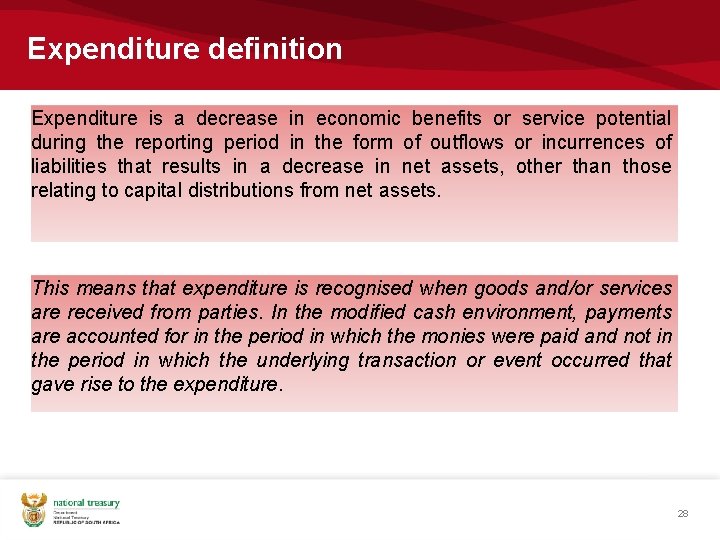
Expenditure definition Expenditure is a decrease in economic benefits or service potential during the reporting period in the form of outflows or incurrences of liabilities that results in a decrease in net assets, other than those relating to capital distributions from net assets. This means that expenditure is recognised when goods and/or services are received from parties. In the modified cash environment, payments are accounted for in the period in which the monies were paid and not in the period in which the underlying transaction or event occurred that gave rise to the expenditure. 28
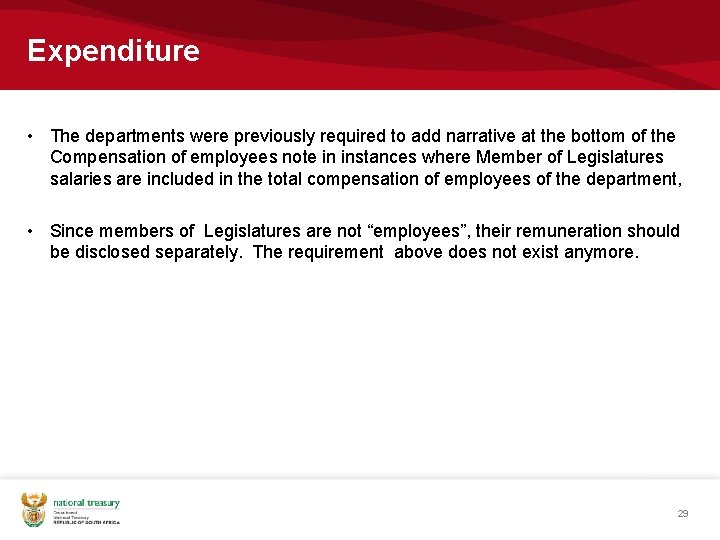
Expenditure • The departments were previously required to add narrative at the bottom of the Compensation of employees note in instances where Member of Legislatures salaries are included in the total compensation of employees of the department, • Since members of Legislatures are not “employees”, their remuneration should be disclosed separately. The requirement above does not exist anymore. 29
General Departmental Assets and Liabilities
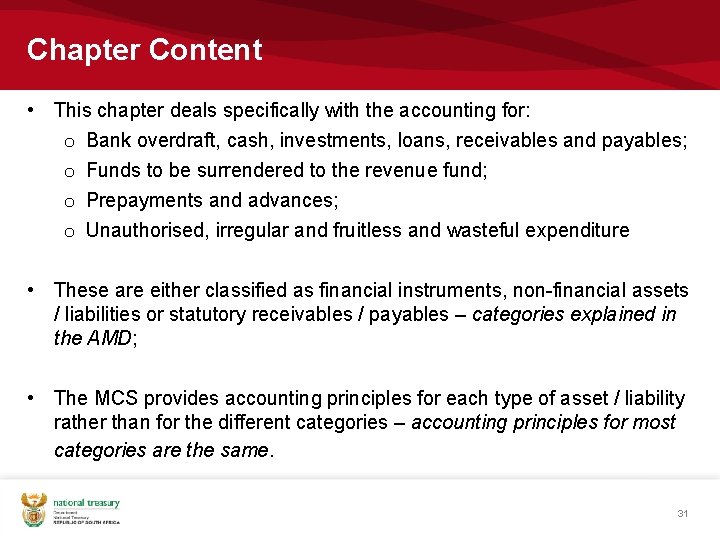
Chapter Content • This chapter deals specifically with the accounting for: o Bank overdraft, cash, investments, loans, receivables and payables; o Funds to be surrendered to the revenue fund; o Prepayments and advances; o Unauthorised, irregular and fruitless and wasteful expenditure • These are either classified as financial instruments, non-financial assets / liabilities or statutory receivables / payables – categories explained in the AMD; • The MCS provides accounting principles for each type of asset / liability rather than for the different categories – accounting principles for most categories are the same. 31
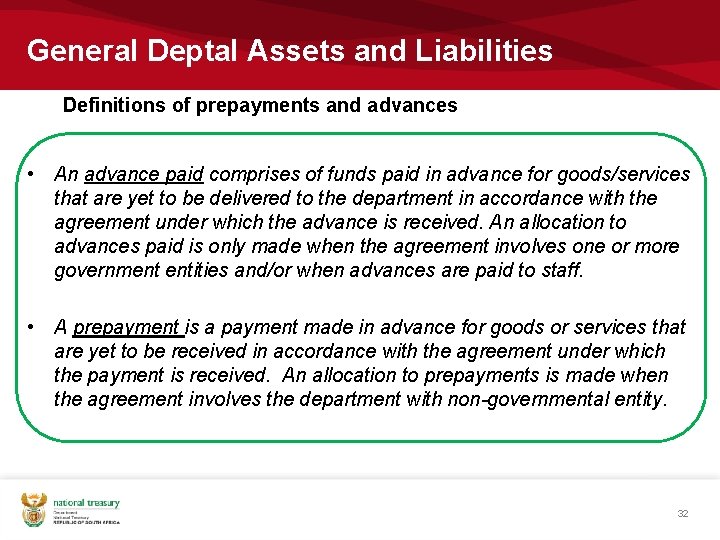
General Deptal Assets and Liabilities Definitions of prepayments and advances • An advance paid comprises of funds paid in advance for goods/services that are yet to be delivered to the department in accordance with the agreement under which the advance is received. An allocation to advances paid is only made when the agreement involves one or more government entities and/or when advances are paid to staff. • A prepayment is a payment made in advance for goods or services that are yet to be received in accordance with the agreement under which the payment is received. An allocation to prepayments is made when the agreement involves the department with non-governmental entity. 32
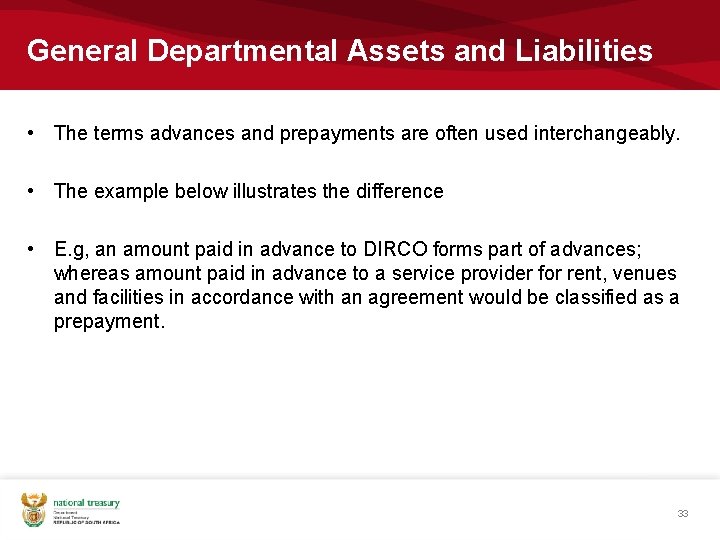
General Departmental Assets and Liabilities • The terms advances and prepayments are often used interchangeably. • The example below illustrates the difference • E. g, an amount paid in advance to DIRCO forms part of advances; whereas amount paid in advance to a service provider for rent, venues and facilities in accordance with an agreement would be classified as a prepayment. 33
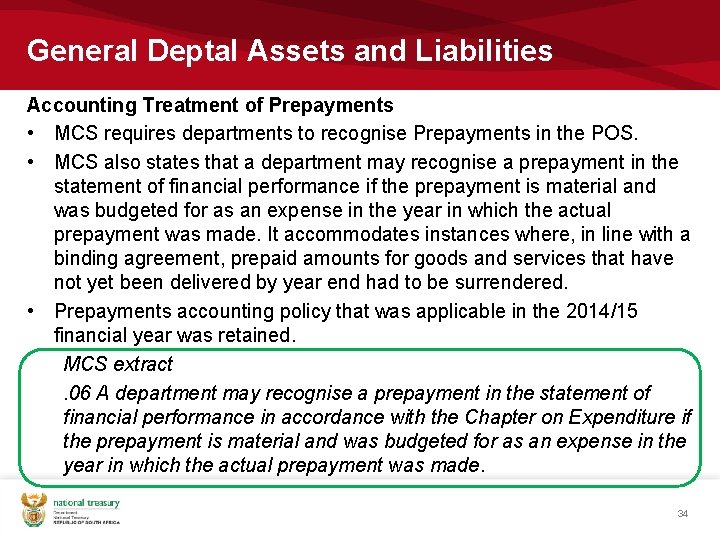
General Deptal Assets and Liabilities Accounting Treatment of Prepayments • MCS requires departments to recognise Prepayments in the POS. • MCS also states that a department may recognise a prepayment in the statement of financial performance if the prepayment is material and was budgeted for as an expense in the year in which the actual prepayment was made. It accommodates instances where, in line with a binding agreement, prepaid amounts for goods and services that have not yet been delivered by year end had to be surrendered. • Prepayments accounting policy that was applicable in the 2014/15 financial year was retained. MCS extract. 06 A department may recognise a prepayment in the statement of financial performance in accordance with the Chapter on Expenditure if the prepayment is material and was budgeted for as an expense in the year in which the actual prepayment was made. 34
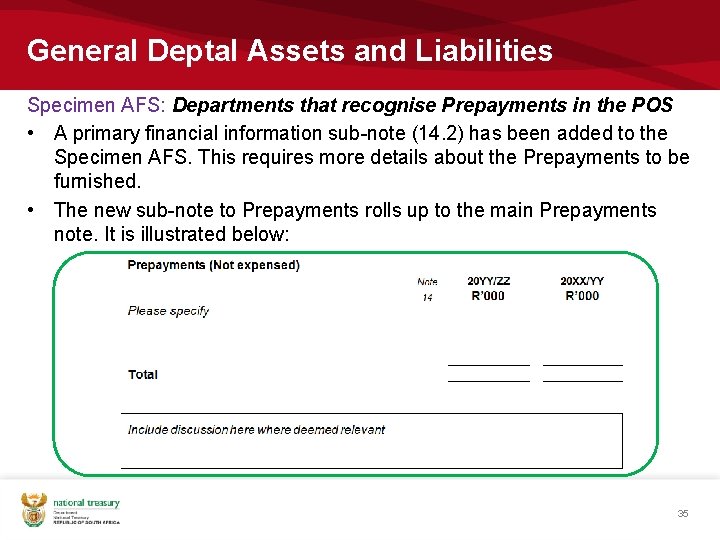
General Deptal Assets and Liabilities Specimen AFS: Departments that recognise Prepayments in the POS • A primary financial information sub-note (14. 2) has been added to the Specimen AFS. This requires more details about the Prepayments to be furnished. • The new sub-note to Prepayments rolls up to the main Prepayments note. It is illustrated below: 35
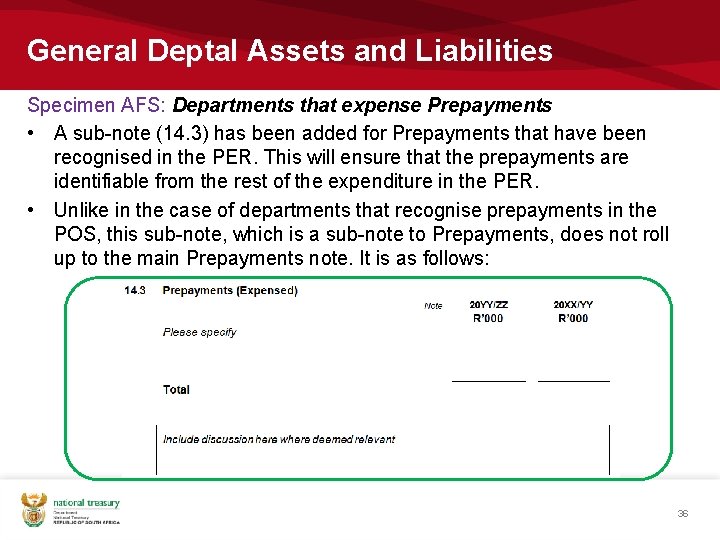
General Deptal Assets and Liabilities Specimen AFS: Departments that expense Prepayments • A sub-note (14. 3) has been added for Prepayments that have been recognised in the PER. This will ensure that the prepayments are identifiable from the rest of the expenditure in the PER. • Unlike in the case of departments that recognise prepayments in the POS, this sub-note, which is a sub-note to Prepayments, does not roll up to the main Prepayments note. It is as follows: 36
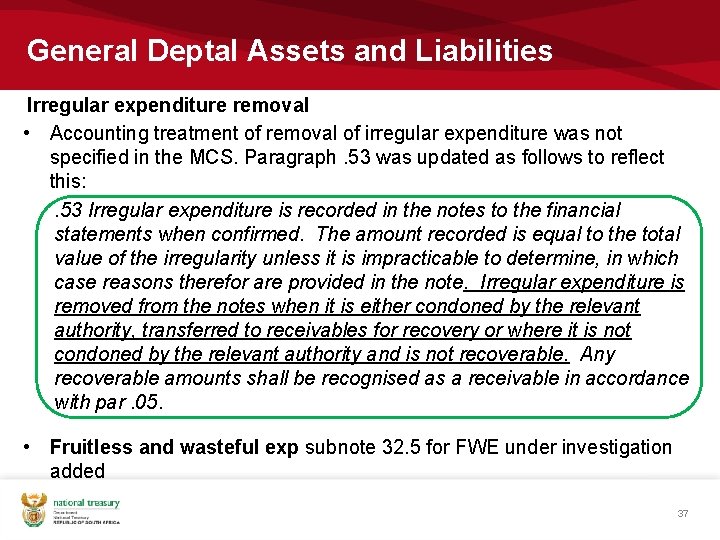
General Deptal Assets and Liabilities Irregular expenditure removal • Accounting treatment of removal of irregular expenditure was not specified in the MCS. Paragraph. 53 was updated as follows to reflect this: . 53 Irregular expenditure is recorded in the notes to the financial statements when confirmed. The amount recorded is equal to the total value of the irregularity unless it is impracticable to determine, in which case reasons therefor are provided in the note. Irregular expenditure is removed from the notes when it is either condoned by the relevant authority, transferred to receivables for recovery or where it is not condoned by the relevant authority and is not recoverable. Any recoverable amounts shall be recognised as a receivable in accordance with par. 05. • Fruitless and wasteful exp subnote 32. 5 for FWE under investigation added 37
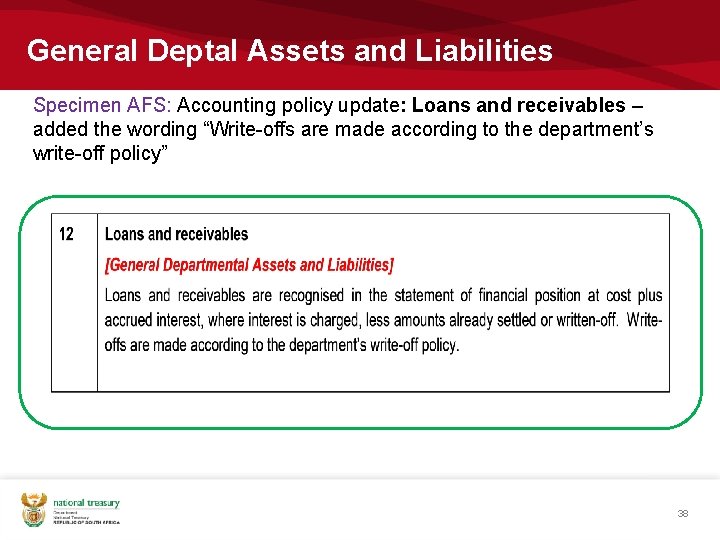
General Deptal Assets and Liabilities Specimen AFS: Accounting policy update: Loans and receivables – added the wording “Write-offs are made according to the department’s write-off policy” 38
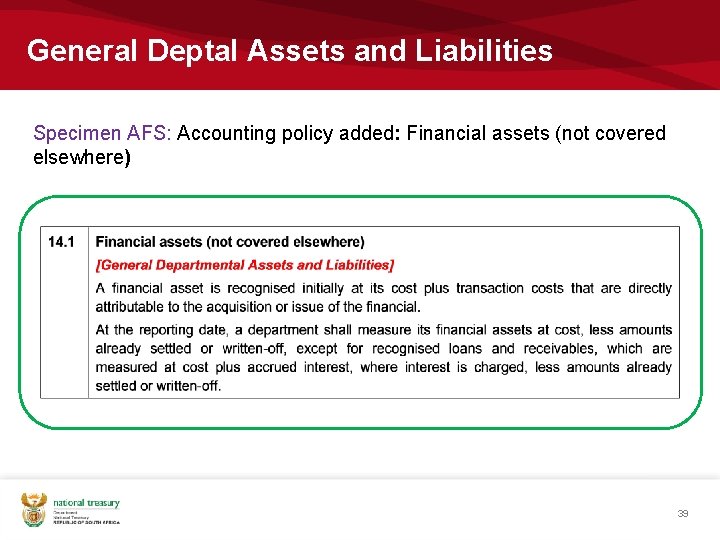
General Deptal Assets and Liabilities Specimen AFS: Accounting policy added: Financial assets (not covered elsewhere) 39
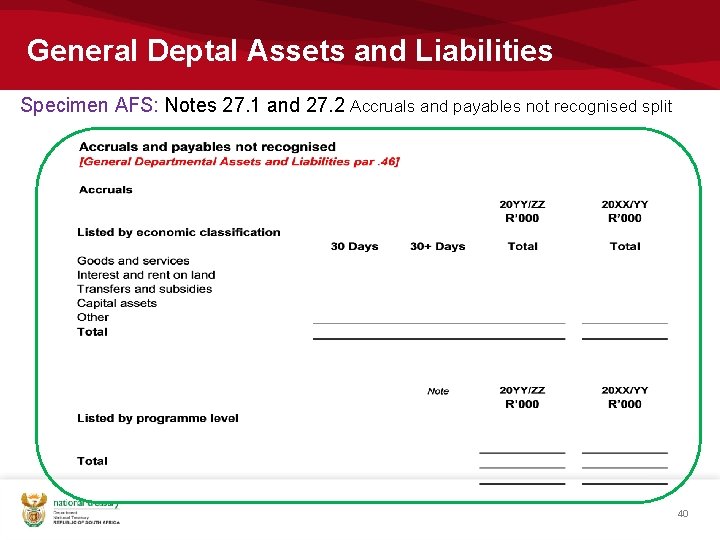
General Deptal Assets and Liabilities Specimen AFS: Notes 27. 1 and 27. 2 Accruals and payables not recognised split 40
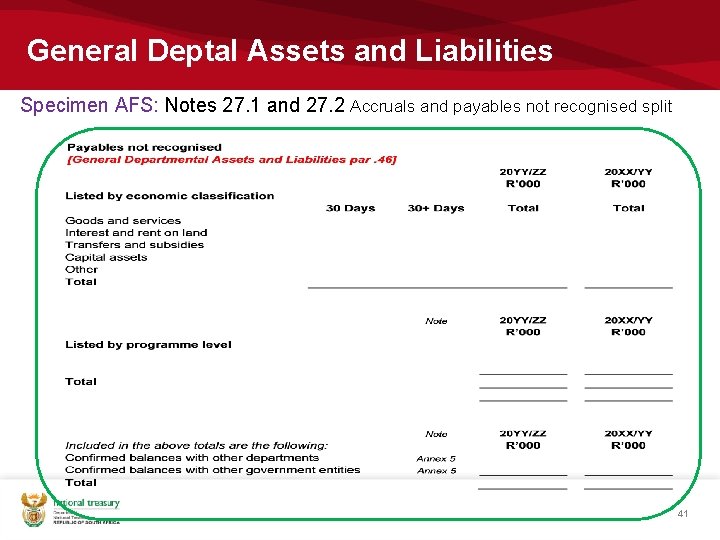
General Deptal Assets and Liabilities Specimen AFS: Notes 27. 1 and 27. 2 Accruals and payables not recognised split 41
Capital Assets
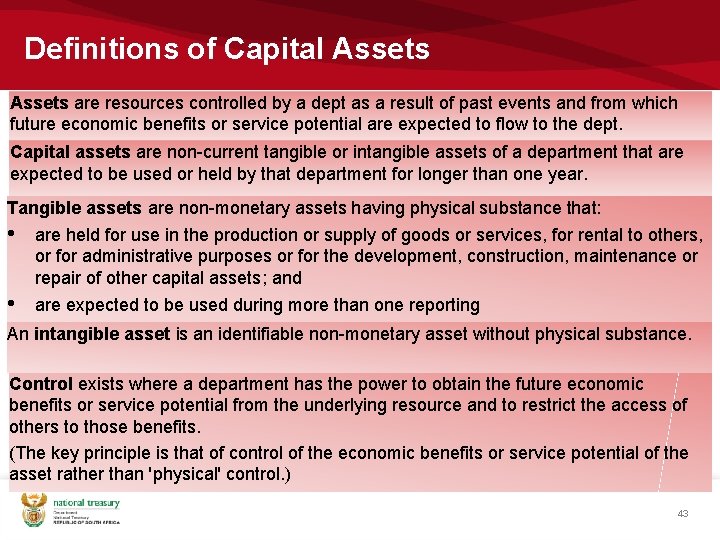
Definitions of Capital Assets are resources controlled by a dept as a result of past events and from which future economic benefits or service potential are expected to flow to the dept. Capital assets are non-current tangible or intangible assets of a department that are expected to be used or held by that department for longer than one year. Tangible assets are non-monetary assets having physical substance that: • are held for use in the production or supply of goods or services, for rental to others, or for administrative purposes or for the development, construction, maintenance or repair of other capital assets; and • are expected to be used during more than one reporting An intangible asset is an identifiable non-monetary asset without physical substance. Control exists where a department has the power to obtain the future economic benefits or service potential from the underlying resource and to restrict the access of others to those benefits. (The key principle is that of control of the economic benefits or service potential of the asset rather than 'physical' control. ) 43
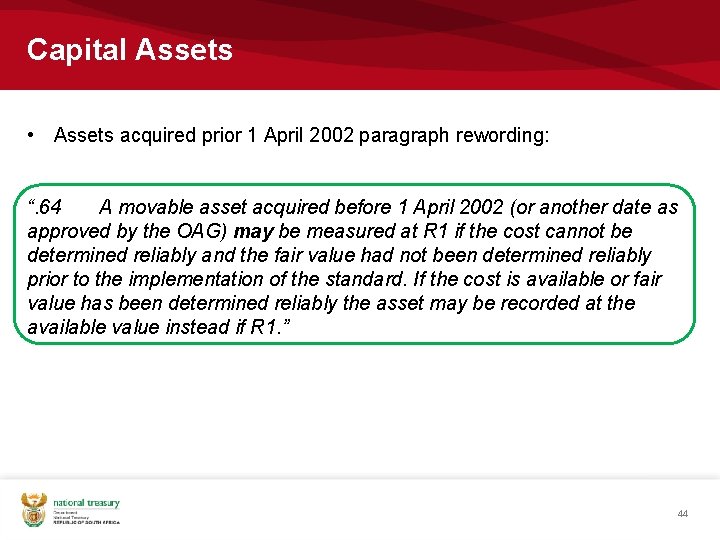
Capital Assets • Assets acquired prior 1 April 2002 paragraph rewording: “. 64 A movable asset acquired before 1 April 2002 (or another date as approved by the OAG) may be measured at R 1 if the cost cannot be determined reliably and the fair value had not been determined reliably prior to the implementation of the standard. If the cost is available or fair value has been determined reliably the asset may be recorded at the available value instead if R 1. ” 44
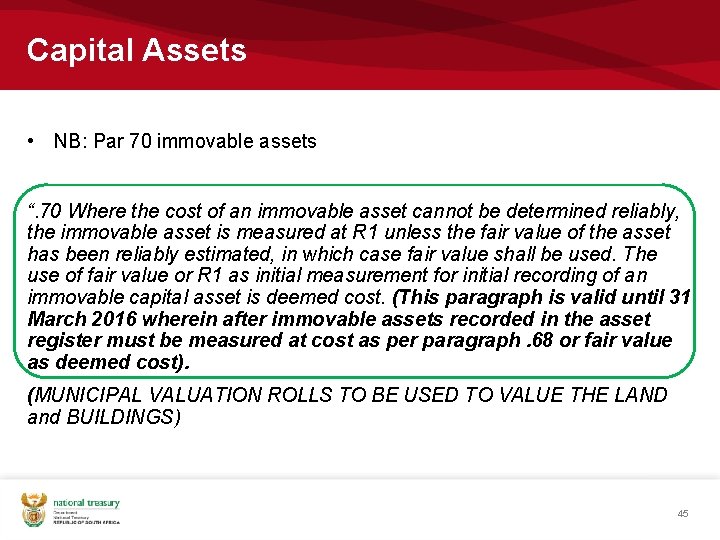
Capital Assets • NB: Par 70 immovable assets “. 70 Where the cost of an immovable asset cannot be determined reliably, the immovable asset is measured at R 1 unless the fair value of the asset has been reliably estimated, in which case fair value shall be used. The use of fair value or R 1 as initial measurement for initial recording of an immovable capital asset is deemed cost. (This paragraph is valid until 31 March 2016 wherein after immovable assets recorded in the asset register must be measured at cost as per paragraph. 68 or fair value as deemed cost). (MUNICIPAL VALUATION ROLLS TO BE USED TO VALUE THE LAND and BUILDINGS) 45
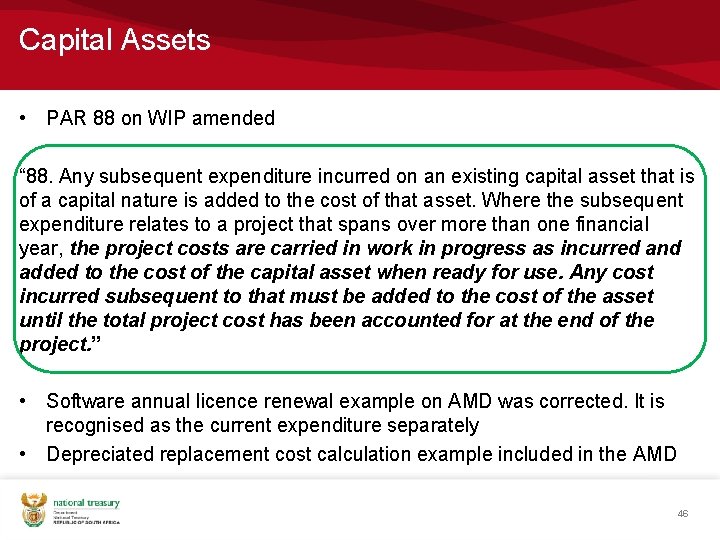
Capital Assets • PAR 88 on WIP amended “ 88. Any subsequent expenditure incurred on an existing capital asset that is of a capital nature is added to the cost of that asset. Where the subsequent expenditure relates to a project that spans over more than one financial year, the project costs are carried in work in progress as incurred and added to the cost of the capital asset when ready for use. Any cost incurred subsequent to that must be added to the cost of the asset until the total project cost has been accounted for at the end of the project. ” • Software annual licence renewal example on AMD was corrected. It is recognised as the current expenditure separately • Depreciated replacement cost calculation example included in the AMD 46
Inventory
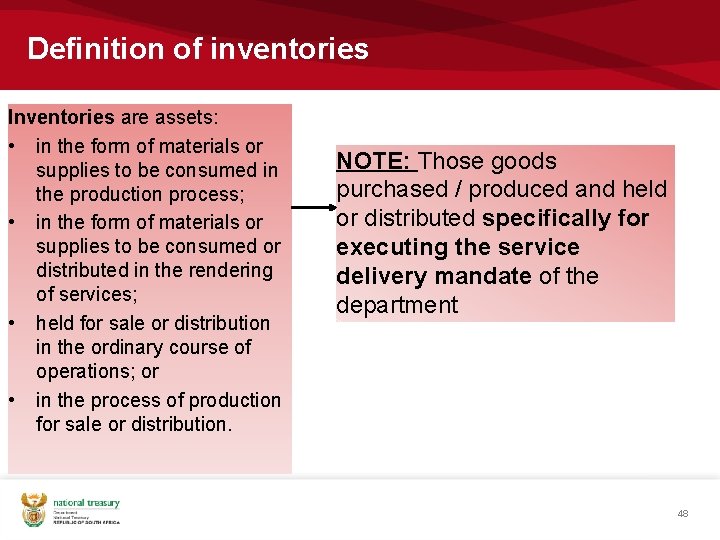
Definition of inventories Inventories are assets: • in the form of materials or supplies to be consumed in the production process; • in the form of materials or supplies to be consumed or distributed in the rendering of services; • held for sale or distribution in the ordinary course of operations; or • in the process of production for sale or distribution. NOTE: Those goods purchased / produced and held or distributed specifically for executing the service delivery mandate of the department 48
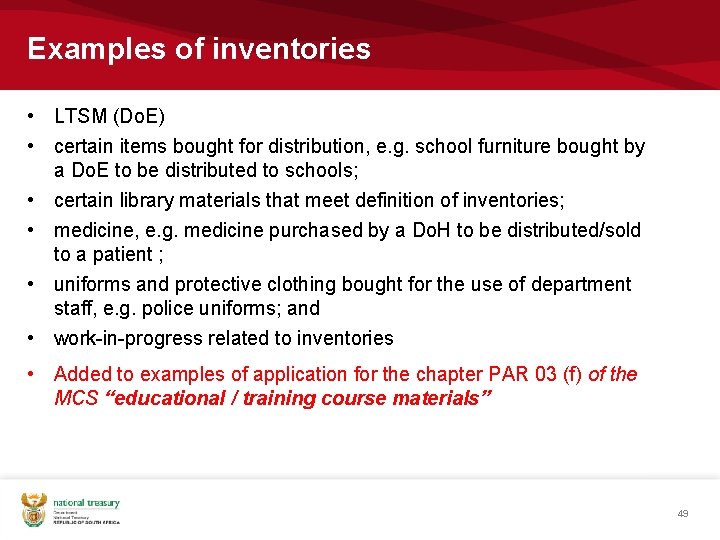
Examples of inventories • LTSM (Do. E) • certain items bought for distribution, e. g. school furniture bought by a Do. E to be distributed to schools; • certain library materials that meet definition of inventories; • medicine, e. g. medicine purchased by a Do. H to be distributed/sold to a patient ; • uniforms and protective clothing bought for the use of department staff, e. g. police uniforms; and • work-in-progress related to inventories • Added to examples of application for the chapter PAR 03 (f) of the MCS “educational / training course materials” 49
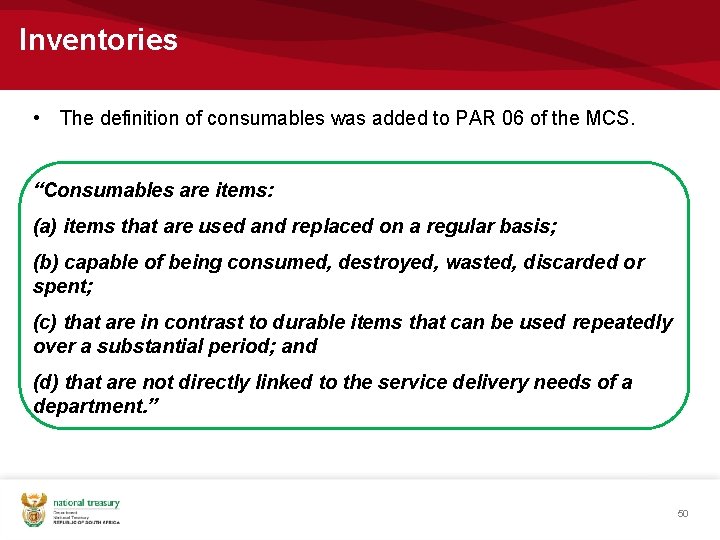
Inventories • The definition of consumables was added to PAR 06 of the MCS. “Consumables are items: (a) items that are used and replaced on a regular basis; (b) capable of being consumed, destroyed, wasted, discarded or spent; (c) that are in contrast to durable items that can be used repeatedly over a substantial period; and (d) that are not directly linked to the service delivery needs of a department. ” 50
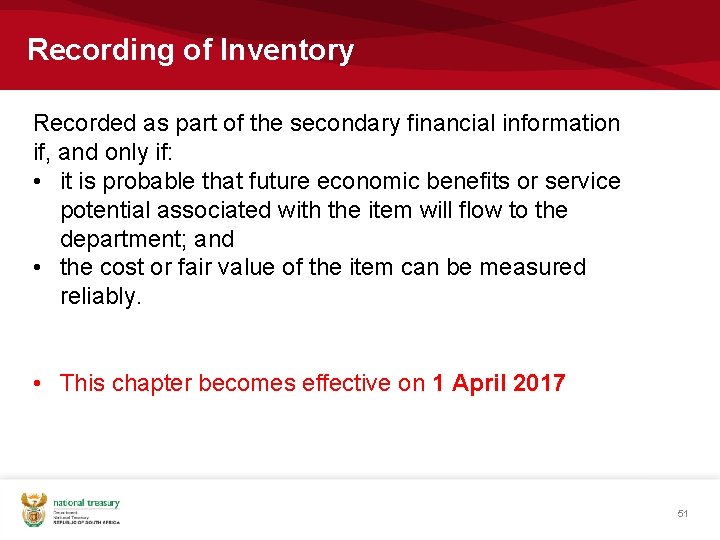
Recording of Inventory Recorded as part of the secondary financial information if, and only if: • it is probable that future economic benefits or service potential associated with the item will flow to the department; and • the cost or fair value of the item can be measured reliably. • This chapter becomes effective on 1 April 2017 51
Provisions and Contingents
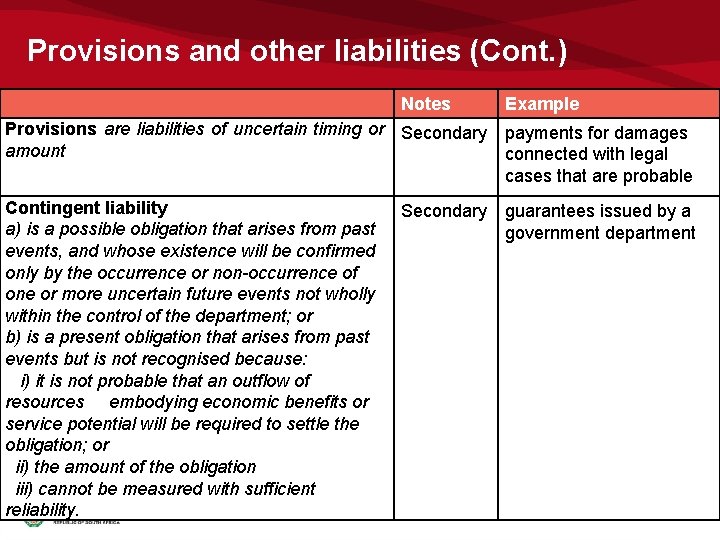
Provisions and other liabilities (Cont. ) Notes Example Provisions are liabilities of uncertain timing or Secondary payments for damages amount connected with legal cases that are probable Contingent liability a) is a possible obligation that arises from past events, and whose existence will be confirmed only by the occurrence or non-occurrence of one or more uncertain future events not wholly within the control of the department; or b) is a present obligation that arises from past events but is not recognised because: i) it is not probable that an outflow of resources embodying economic benefits or service potential will be required to settle the obligation; or ii) the amount of the obligation iii) cannot be measured with sufficient reliability. Secondary guarantees issued by a government department 53
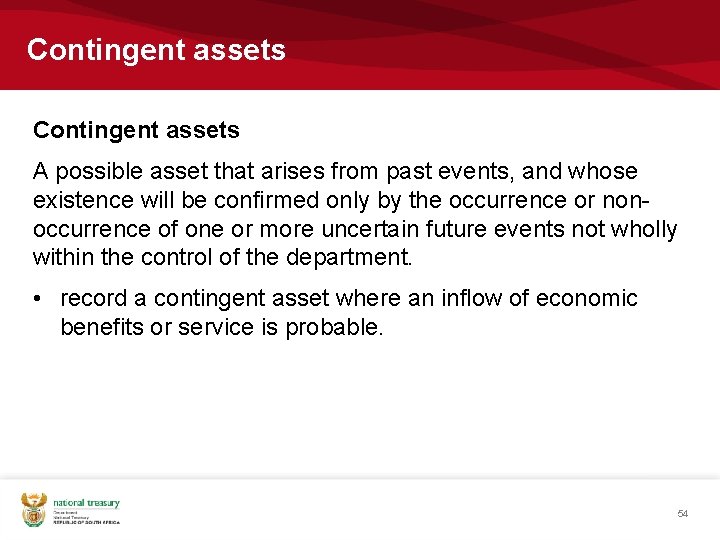
Contingent assets A possible asset that arises from past events, and whose existence will be confirmed only by the occurrence or nonoccurrence of one or more uncertain future events not wholly within the control of the department. • record a contingent asset where an inflow of economic benefits or service is probable. 54
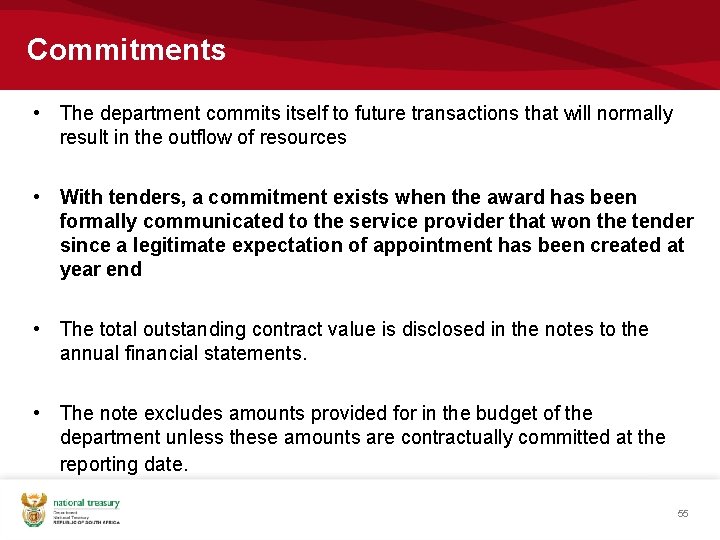
Commitments • The department commits itself to future transactions that will normally result in the outflow of resources • With tenders, a commitment exists when the award has been formally communicated to the service provider that won the tender since a legitimate expectation of appointment has been created at year end • The total outstanding contract value is disclosed in the notes to the annual financial statements. • The note excludes amounts provided for in the budget of the department unless these amounts are contractually committed at the reporting date. 55
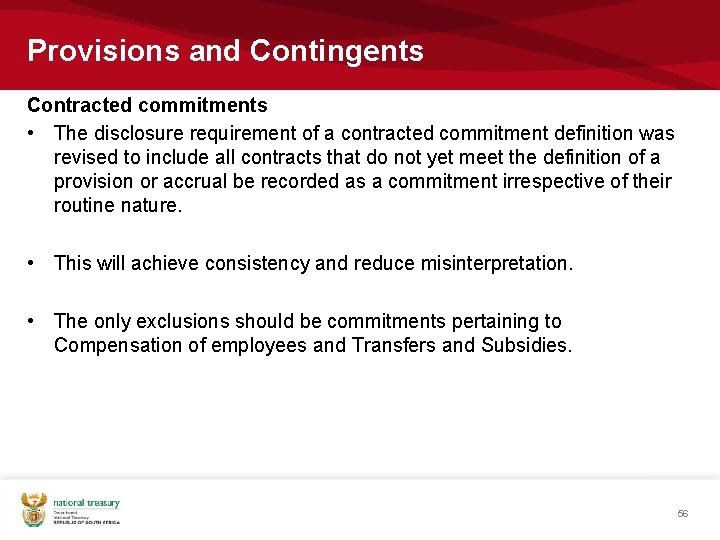
Provisions and Contingents Contracted commitments • The disclosure requirement of a contracted commitment definition was revised to include all contracts that do not yet meet the definition of a provision or accrual be recorded as a commitment irrespective of their routine nature. • This will achieve consistency and reduce misinterpretation. • The only exclusions should be commitments pertaining to Compensation of employees and Transfers and Subsidies. 56
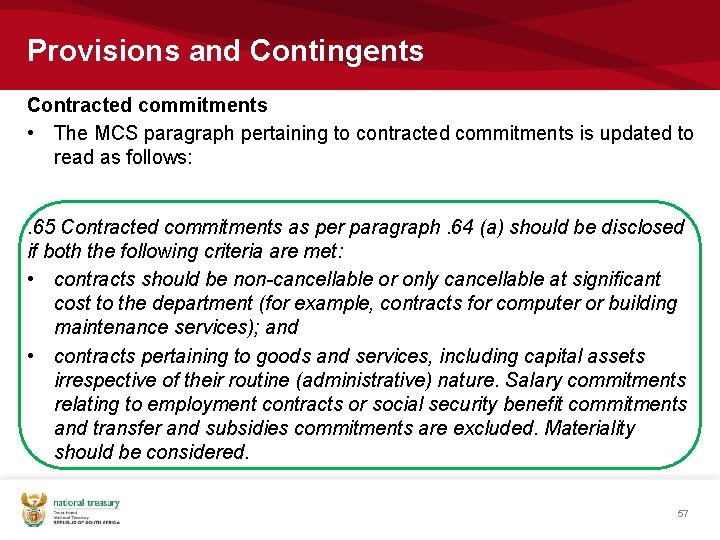
Provisions and Contingents Contracted commitments • The MCS paragraph pertaining to contracted commitments is updated to read as follows: . 65 Contracted commitments as per paragraph. 64 (a) should be disclosed if both the following criteria are met: • contracts should be non-cancellable or only cancellable at significant cost to the department (for example, contracts for computer or building maintenance services); and • contracts pertaining to goods and services, including capital assets irrespective of their routine (administrative) nature. Salary commitments relating to employment contracts or social security benefit commitments and transfer and subsidies commitments are excluded. Materiality should be considered. 57
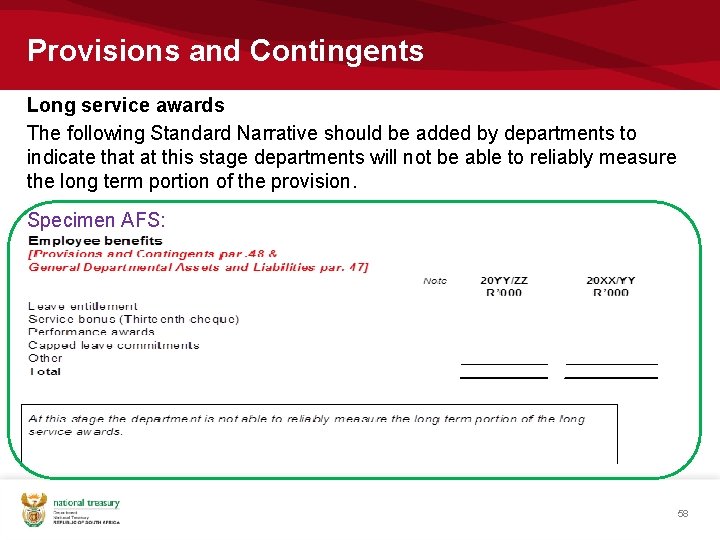
Provisions and Contingents Long service awards The following Standard Narrative should be added by departments to indicate that at this stage departments will not be able to reliably measure the long term portion of the provision. Specimen AFS: 58
Related Party Disclosures
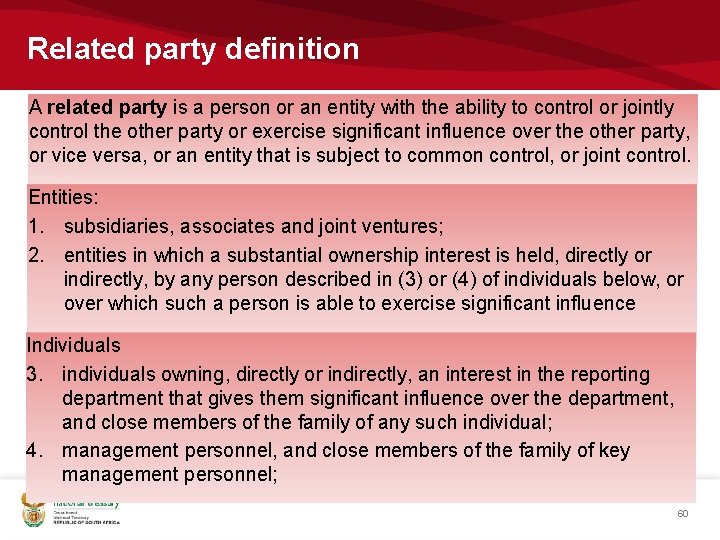
Related party definition A related party is a person or an entity with the ability to control or jointly control the other party or exercise significant influence over the other party, or vice versa, or an entity that is subject to common control, or joint control. Entities: 1. subsidiaries, associates and joint ventures; 2. entities in which a substantial ownership interest is held, directly or indirectly, by any person described in (3) or (4) of individuals below, or over which such a person is able to exercise significant influence Individuals 3. individuals owning, directly or indirectly, an interest in the reporting department that gives them significant influence over the department, and close members of the family of any such individual; 4. management personnel, and close members of the family of key management personnel; 60
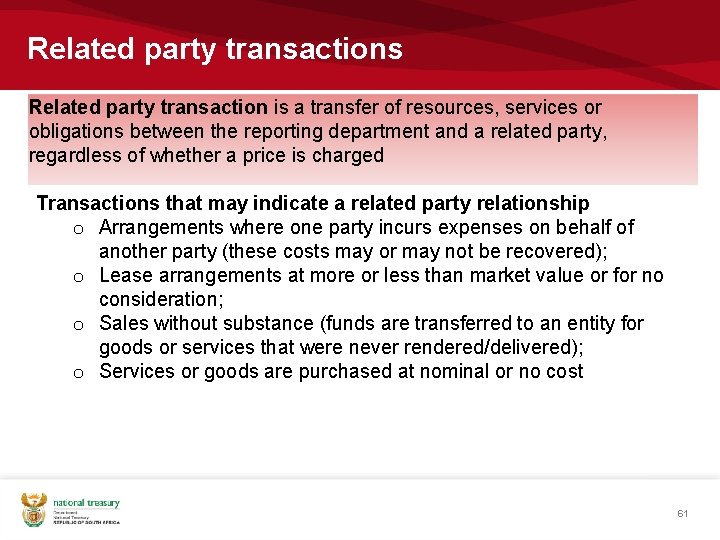
Related party transactions Related party transaction is a transfer of resources, services or obligations between the reporting department and a related party, regardless of whether a price is charged Transactions that may indicate a related party relationship o Arrangements where one party incurs expenses on behalf of another party (these costs may or may not be recovered); o Lease arrangements at more or less than market value or for no consideration; o Sales without substance (funds are transferred to an entity for goods or services that were never rendered/delivered); o Services or goods are purchased at nominal or no cost 61
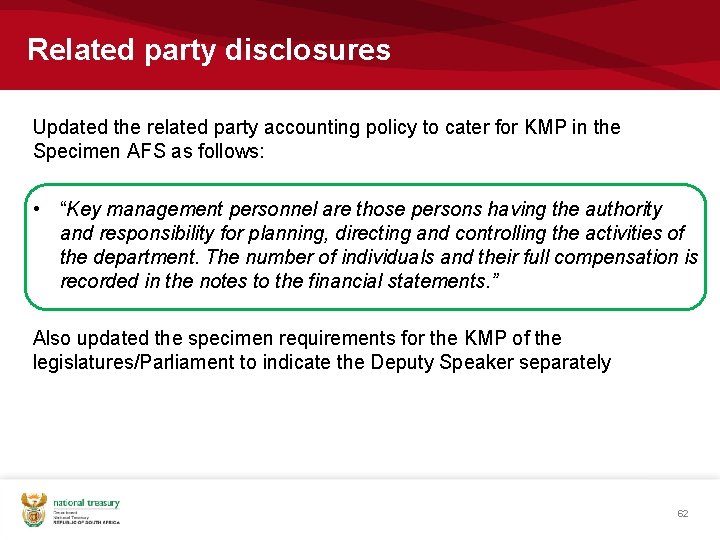
Related party disclosures Updated the related party accounting policy to cater for KMP in the Specimen AFS as follows: • “Key management personnel are those persons having the authority and responsibility for planning, directing and controlling the activities of the department. The number of individuals and their full compensation is recorded in the notes to the financial statements. ” Also updated the specimen requirements for the KMP of the legislatures/Parliament to indicate the Deputy Speaker separately 62
Accounting by Principals and Agents
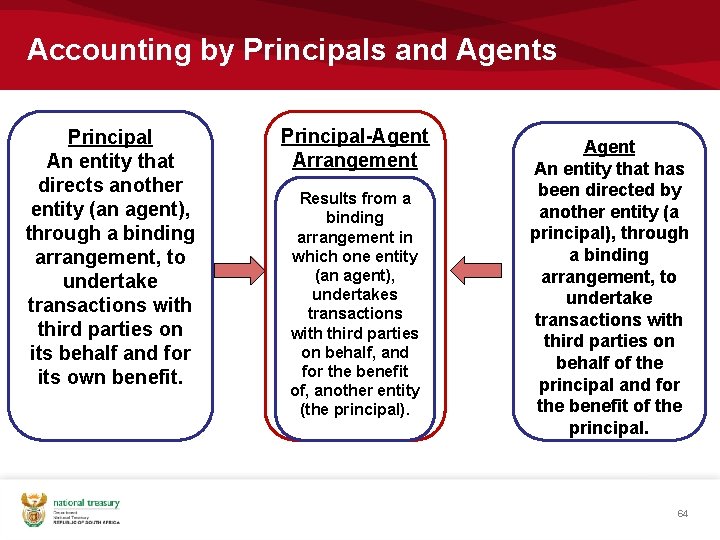
Accounting by Principals and Agents Principal An entity that directs another entity (an agent), through a binding arrangement, to undertake transactions with third parties on its behalf and for its own benefit. Principal-Agent Arrangement Results from a binding arrangement in which one entity (an agent), undertakes transactions with third parties on behalf, and for the benefit of, another entity (the principal). Agent An entity that has been directed by another entity (a principal), through a binding arrangement, to undertake transactions with third parties on behalf of the principal and for the benefit of the principal. 64
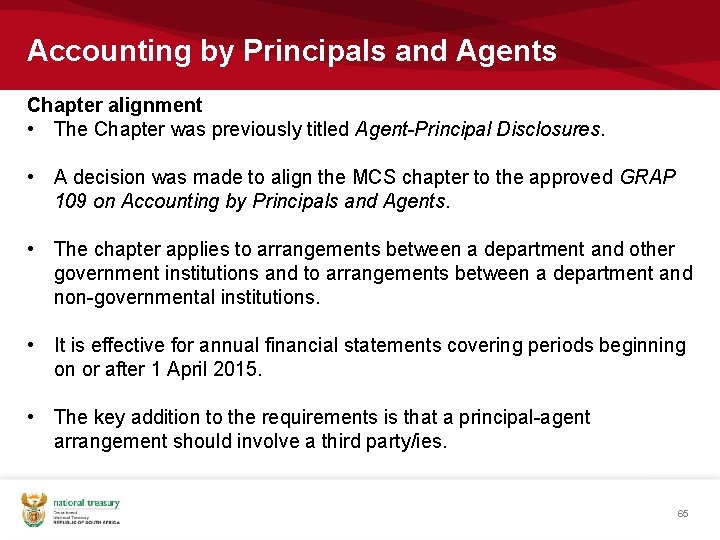
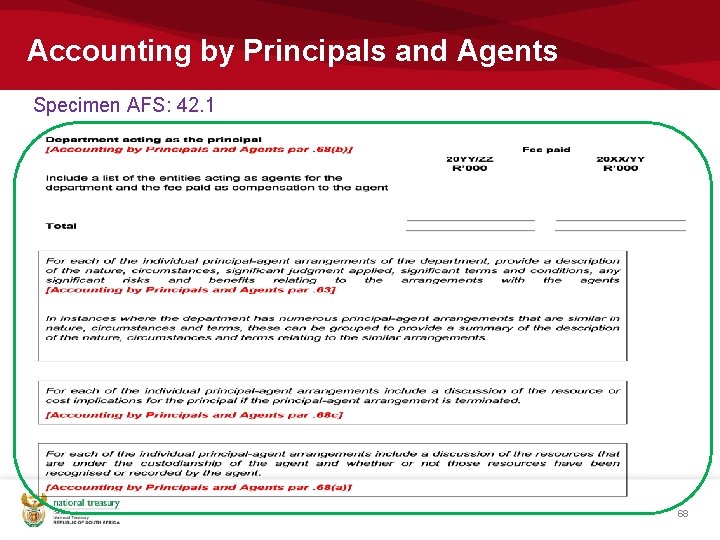
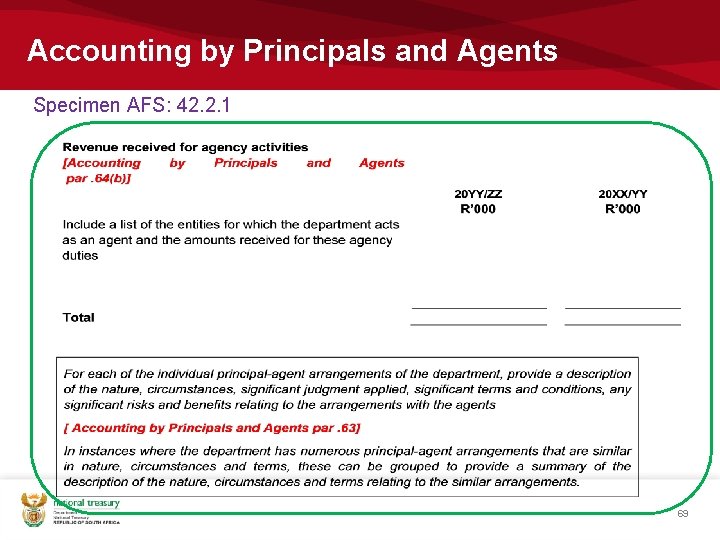
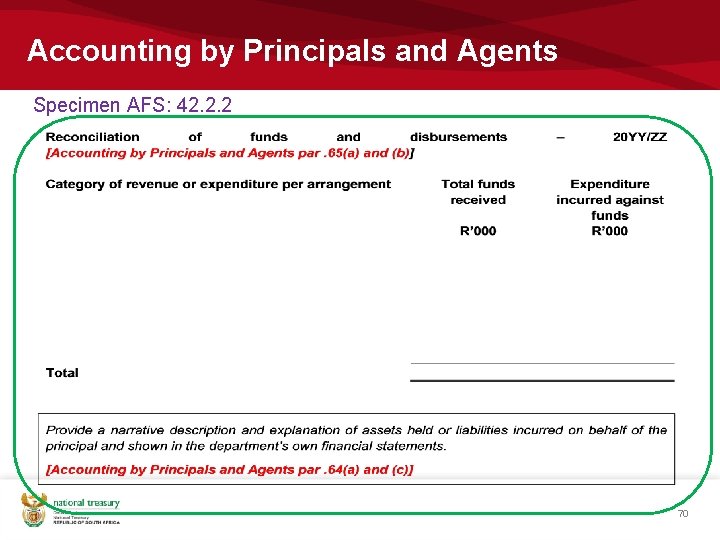
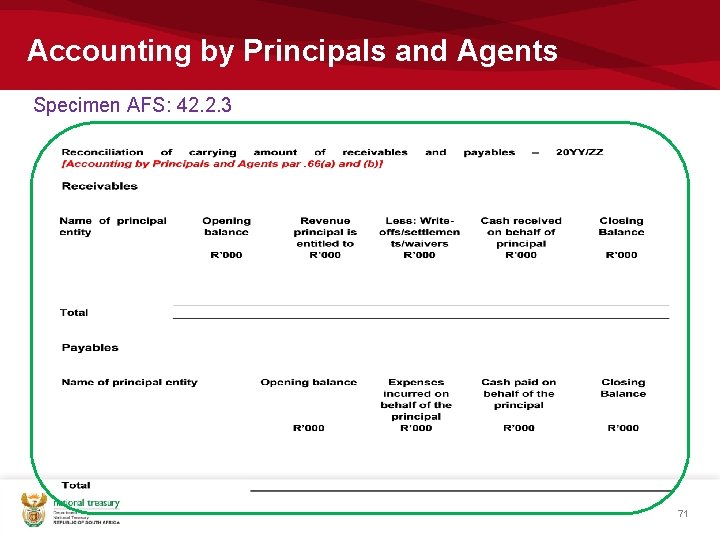
Accounting by Principals and Agents Chapter alignment • The Chapter was previously titled Agent-Principal Disclosures. • A decision was made to align the MCS chapter to the approved GRAP 109 on Accounting by Principals and Agents. • The chapter applies to arrangements between a department and other government institutions and to arrangements between a department and non-governmental institutions. • It is effective for annual financial statements covering periods beginning on or after 1 April 2015. • The key addition to the requirements is that a principal-agent arrangement should involve a third party/ies. 65
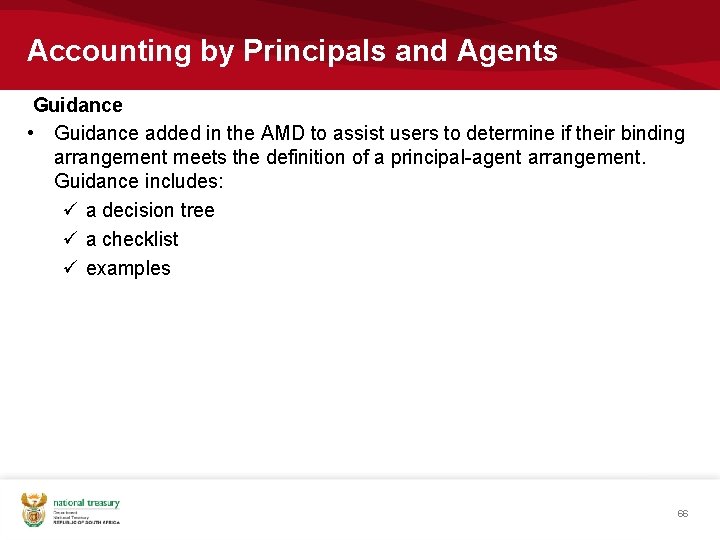
Accounting by Principals and Agents Guidance • Guidance added in the AMD to assist users to determine if their binding arrangement meets the definition of a principal-agent arrangement. Guidance includes: ü a decision tree ü a checklist ü examples 66
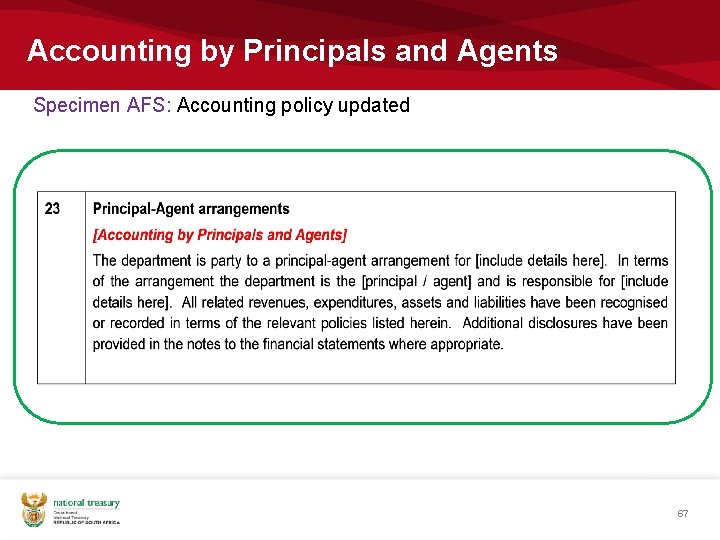
Accounting by Principals and Agents Specimen AFS: Accounting policy updated 67
Accounting by Principals and Agents Specimen AFS: 42. 1 68
Accounting by Principals and Agents Specimen AFS: 42. 2. 1 69
Accounting by Principals and Agents Specimen AFS: 42. 2. 2 70
Accounting by Principals and Agents Specimen AFS: 42. 2. 3 71
Inter-departmental transactions
Inter-Departmental Transactions • Consolidated Inter-departmental confirmed balances are audited • NT has developed processes to identify, confirm and recognise all confirmed balances for elimination at consolidation level • Auditors mentioned that there is still room for improvement • NT urges departments to ensure that they report on all confirmed and unconfirmed inter-departmental transactions accurately and completely • That will assist NT to avoid possible audit findings re the elimination of inter-departmental transactions. 73
Inter-Departmental Transactions • Amounts (Receivables / Payables) per annexure (both confirmed and unconfirmed balances) should agree to the main note • NT will therefore require a listings of pmts made in advance by Dept A to any other dept and the listing of advances received from any other dept • These lists should be accompanied by confirmations between the depts • This info is requested with the submission of AFS on the 31 st of May 2016 and the 31 st of July 2016 74
Guarantees and Related Parties
Guarantees and Related Parties Guarantees • Disclosure Note for Contingent Liabilities lists guarantees • Annually NT finds that depts(especially those with SOE’s) don’t disclose the same as our Assets and Liabilities Management division • Departments are urged to pay attention and ensure this note is completed accurately • Departments should ensure that all related party guarantees are included in the Related Party Disclosure Note 76
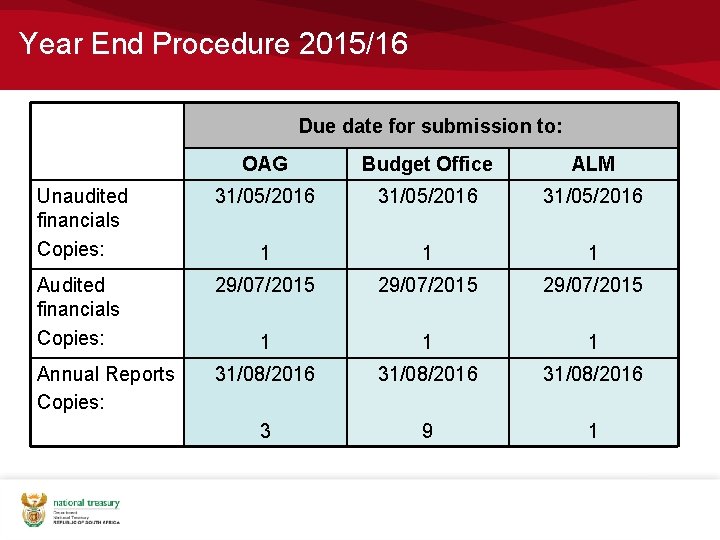
Year End Procedure 2015/16 Due date for submission to: OAG Budget Office ALM Unaudited financials Copies: 31/05/2016 1 1 1 Audited financials Copies: 29/07/2015 1 1 1 Annual Reports Copies: 31/08/2016 3 9 1
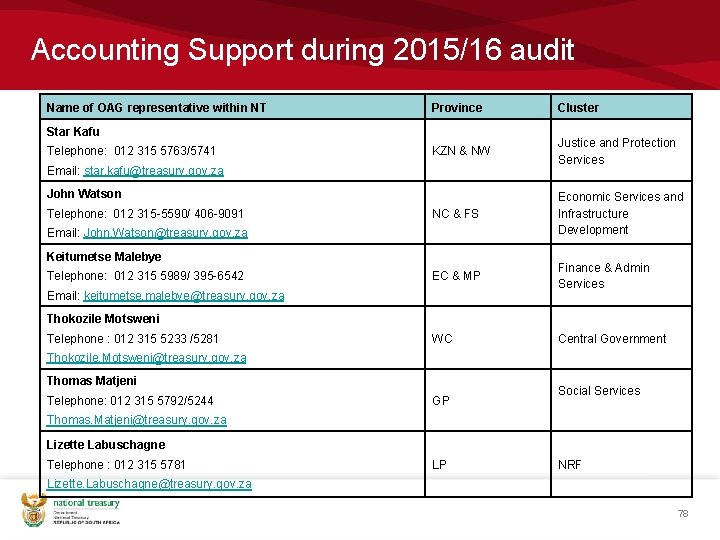
Accounting Support during 2015/16 audit Name of OAG representative within NT Province Cluster KZN & NW Justice and Protection Services NC & FS Economic Services and Infrastructure Development EC & MP Finance & Admin Services WC Central Government Star Kafu Telephone: 012 315 5763/5741 Email: star. kafu@treasury. gov. za John Watson Telephone: 012 315 -5590/ 406 -9091 Email: John. Watson@treasury. gov. za Keitumetse Malebye Telephone: 012 315 5989/ 395 -6542 Email: keitumetse. malebye@treasury. gov. za Thokozile Motsweni Telephone : 012 315 5233 /5281 Thokozile. Motsweni@treasury. gov. za Thomas Matjeni Telephone: 012 315 5792/5244 GP Social Services Thomas. Matjeni@treasury. gov. za Lizette Labuschagne Telephone : 012 315 5781 LP NRF Lizette. Labuschagne@treasury. gov. za 78
Thank you