
RAPYDLI RAPID PROTOTYPING HPC ENVIRONMENT FOR DEEP LEARNING



- Slides: 36
RAPYDLI: RAPID PROTOTYPING HPC ENVIRONMENT FOR DEEP LEARNING NSF 1439007 NSF XPS PI MEETING JUNE 2, 2015 INDIANA UNIVERSITY, UNIVERSITY OF TENNESSEE KNOXVILLE, STANFORD UNIVERSITY Geoffrey Fox Indiana University Bloomington Jack Dongarra UTK Andrew Ng Stanford, Baidu http: //rapydli. org 11/6/2020 1
INTRODUCTION 11/6/2020 2
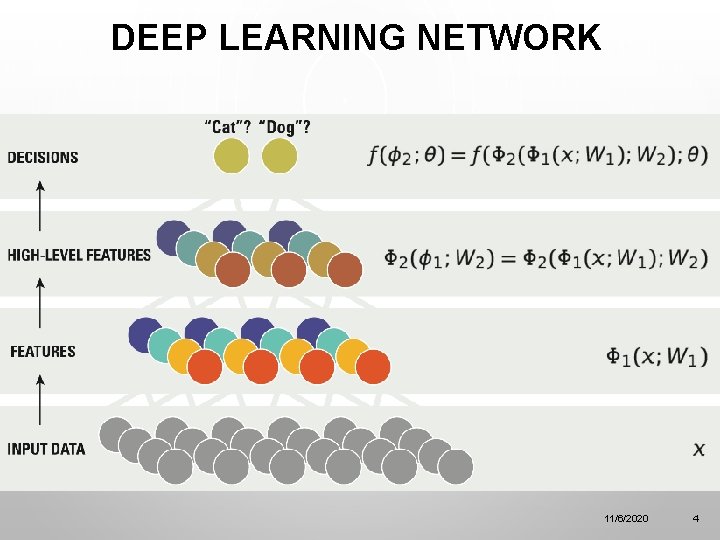
DEEP LEARNING • Learning Networks take input data, such as a set of pixels in images, and map them into decisions, such as labelling animals in an image, or deciding how best to drive given a video image from a car-mounted camera. • The input and output are linked by multiple nodes in a layered network where each node corresponds to a parameterized transformation–a function of weights and thresholds. • A (very) deep learning (DL) network has multiple layers (intermediate nodes)–perhaps 10 or more. Introduced around 25 years ago, • DL networks were originally unsuccessful, but improved algorithms and drastic increases in available compute power led to practical breakthroughs around 10 years ago. • DL networks have the advantage of being very general; you don’t need to make application -specific models, but rather you can use general structures, such as in convolutional neural networks that work well with images and generate translation and rotation invariant mappings. • DLs are now used in all major commercial speech recognition systems and outperform previous Hidden Markov Model based systems. • The quality of a DL depends on the number of layers and nature of nodes in network. These choices require extensive prototyping with rapid turnaround on trial networks. Ra. Py. DLI aims to enable this prototyping with an attractive Python interface and a high 11/6/2020 performance DL network computation engine for the training stage. 3
DEEP LEARNING NETWORK 11/6/2020 4
RAPYDLI COMPONENTS • Goals • Rapid Prototyping • Interoperability/ portability with very good performance (include GPU Intel) • Environment supporting broad base of deep learning • Data management • Approach • Python Frontend • Runtime • Autotuning • Hbase 11/6/2020 5
STATE OF THE ART ANDREW NG, ADAM COATES, BRODY HUVAL 11/6/2020 6
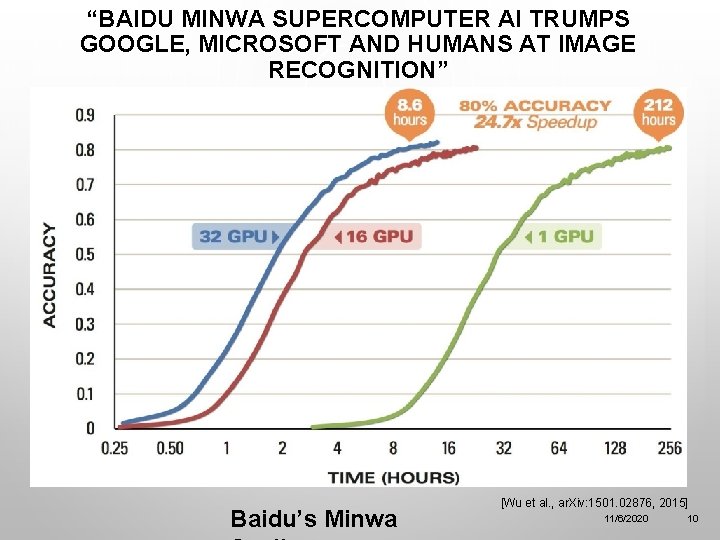
RAPIDLY CHANGING STATE OF THE ART • The Image-net Large Scale Visual Recognition Challenge (ILSVRC) has become the most significant large scale benchmark for computer vision. • Since the success of Alex. Net in 2012, Convolutional Neural Networks (CNNs) have been essential to obtaining state-of-theart performance on ILSVRC. • The trend in CNNs since Alex. Net has been to increase network size and data set size (through augmentation). Both of these require substantially more computational power which motivates a need for software that can utilize multiple GPUs while still allowing for rapid prototyping. • In the current state-of-the-art model for ILSVRC, Baidu showed 11/6/2020 7 how they were able to train their network using 32 GPUs in 8. 6
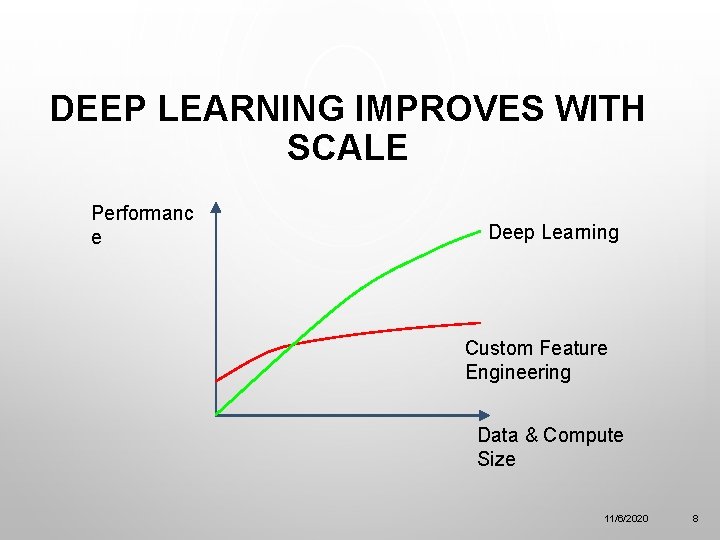
DEEP LEARNING IMPROVES WITH SCALE Performanc e Deep Learning Custom Feature Engineering Data & Compute Size 11/6/2020 8
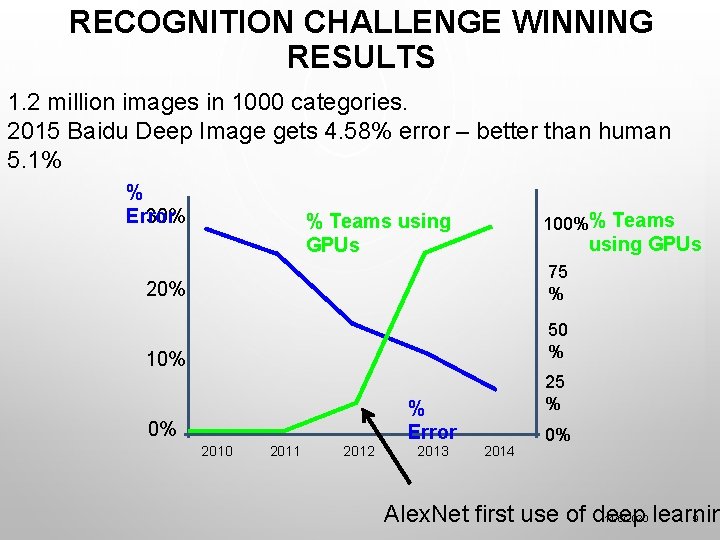
RECOGNITION CHALLENGE WINNING RESULTS 1. 2 million images in 1000 categories. 2015 Baidu Deep Image gets 4. 58% error – better than human 5. 1% % 30% Error 100%% Teams using GPUs 20% 75 % 10% 50 % 0% 2010 2011 2012 % Error 2013 25 % 2014 0% 11/6/2020 9 Alex. Net first use of deep learnin
“BAIDU MINWA SUPERCOMPUTER AI TRUMPS GOOGLE, MICROSOFT AND HUMANS AT IMAGE RECOGNITION” Baidu’s Minwa [Wu et al. , ar. Xiv: 1501. 02876, 2015] 11/6/2020 10
CAVEAT FROM BAIDU • Dear ILSVRC community, • Recently the ILSVRC organizers contacted the Heterogeneous Computing team to inform us that we exceeded the allowable number of weekly submissions to the Image. Net servers (~ 200 submissions during the lifespan of our project). • We apologize for this mistake and are continuing to review the results. We have added a note to our research paper, Deep Image: Scaling up Image Recognition, and will continue to provide relevant updates as we learn more. • We are staunch supporters of fairness and transparency in the Image. Net Challenge and are committed to the integrity of the scientific process. • Ren Wu – Baidu Heterogeneous Computing Team
RAPYDLI COMPUTATIONAL MODEL
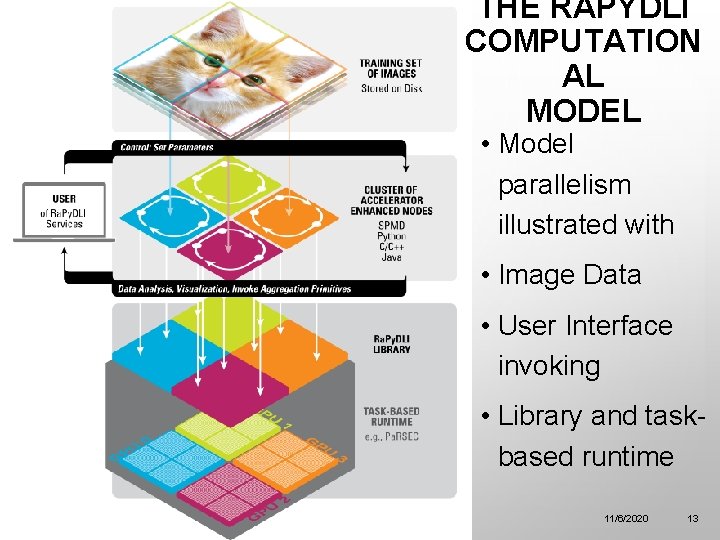
THE RAPYDLI COMPUTATION AL MODEL • Model parallelism illustrated with • Image Data • User Interface invoking • Library and taskbased runtime 11/6/2020 13
RAPYDLI FRONT END GREGOR VON LASZEWSKI, GEOFFREY FOX 11/6/2020 14
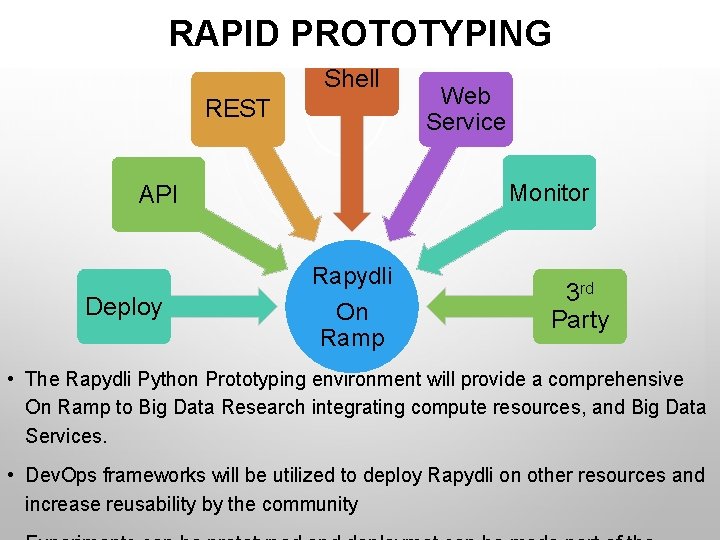
RAPID PROTOTYPING • Ra. Py. DLI can be used as an on-ramp to deep learning. • It serves as an aggregator for modules related to deep learning while simplifying access via a service interface and hosted services that provide access to fast computing resources. • To achieve this we need to address a multitude of issues, including deployment, access, and integration of other frameworks. • We offer simple interfaces to the deployment framework but also the actual algorithmic functionality through a variety of interfaces. • This includes a Python API, REST, a command shell, and Web Services. In addition we will provide an experiment management framework that allows us to monitor the services and resources. 11/6/2020 15
RAPYDLI FRONTEND • Multiple frontends are provided to make it possible to utilize Ra. Py. DLI as a developer and user platform. • The Ra. Py. DLI Frontend will therefore become an On Ramp to deep learning and the deployment of hosted Ra. Py. DLI services. • A prototype hosted web service is used to demonstrate the capabilities of the Ra. Py. DLI framework. • These services can then be choreographed to deploy and stage services users may need. • The Ra. Py. DLI framework can leverage HPC, Clouds, or Grids through service orchestration. 11/6/2020 16
RAPID PROTOTYPING Shell REST Monitor API Rapydli Deploy Web Service On Ramp 3 rd Party • The Rapydli Python Prototyping environment will provide a comprehensive On Ramp to Big Data Research integrating compute resources, and Big Data Services. • Dev. Ops frameworks will be utilized to deploy Rapydli on other resources and increase reusability by the community
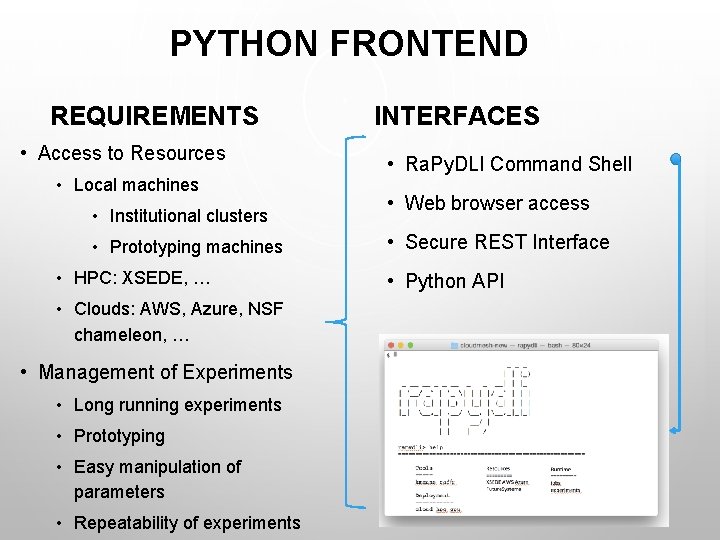
PYTHON FRONTEND REQUIREMENTS • Access to Resources • Local machines • Institutional clusters • Prototyping machines • HPC: XSEDE, … • Clouds: AWS, Azure, NSF chameleon, … • Management of Experiments • Long running experiments • Prototyping • Easy manipulation of parameters • Repeatability of experiments INTERFACES • Ra. Py. DLI Command Shell • Web browser access • Secure REST Interface • Python API
TUNING AND OPTIMIZATION CONVOLUTIONAL DEEP NEURAL NETWORKS JAKUB KURZAK, PIOTR LUSZCZEK, YAOHUNG (MIKE) TSAI, BLAKE HAUGEN
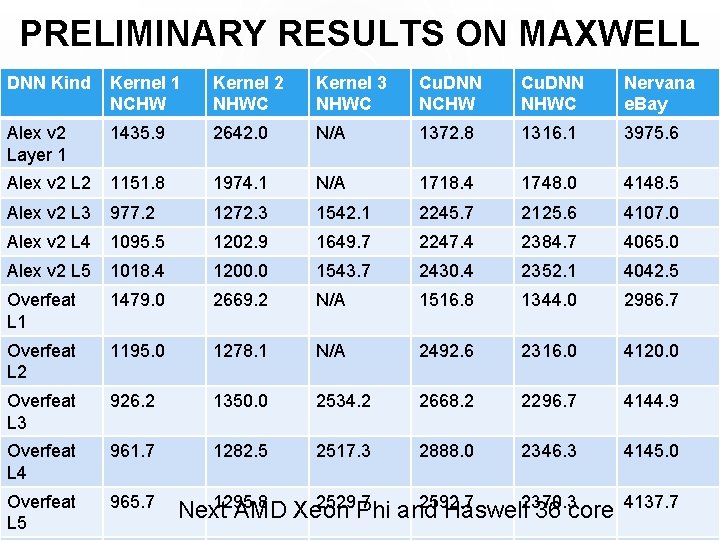
INTEROPERABILITY/ PORTABILITY WITH VERY GOOD PERFORMANCE • Our convolution kernel, at the heart of deep learning neural networks for some of the network layers, achieves almost the same performance as the cu. DNN library provided by NVIDIA. • Both of these implementations are competitive replacements of the most time consuming kernels of the Caffe project for deep neural networks from the University of California at Berkeley. • Almost the same percent of the peak performance is achieved by our kernels on both Kepler and the newly released Maxwell GPU cards. • The competing implementations are either closed source (NVIDIA’s cu. DNN) and do not contribute to the broader impact that our optimization techniques have, or they are platform specific • max. DNN is a convolutional network implementation from Ebay based on a Maxwell-only assembler from Nervana. 11/6/2020 20
ENVIRONMENT SUPPORTING BROAD BASE OF DEEP LEARNING • Our approach is based on a general framework that includes various dimensions of the deep network layers to allow us to provide a high performance kernels, not just for one particular network type or configuration, which might be of great interest at the moment, but we can also target broader application space that utilize a variety of neural network layers, dimensionality, and connectivity. • The goal is to first target the popular classifier networks of interest to the community and then broaden the scope further to accommodate for other uses, e. g. , 11/6/2020 21
RUNTIME • We are investigating two parallelization potentials offered by the deep neural networks: data-parallel and model-parallel. • Model parallel allows Bulk Synchronous Parallel execution with great potential for locality-aware computing with sporadic data interchanges of the border neurons and synapses. • Data parallel gives rise to independent calculation with concurrent access to the global state. • Our work focuses on combining both and improving on Stanford’s Fast. Lab code base for deep neural networks that exposes both types of parallelism. We are using our dataflow runtime systems that support both multicore and accelerators. 11/6/2020 22
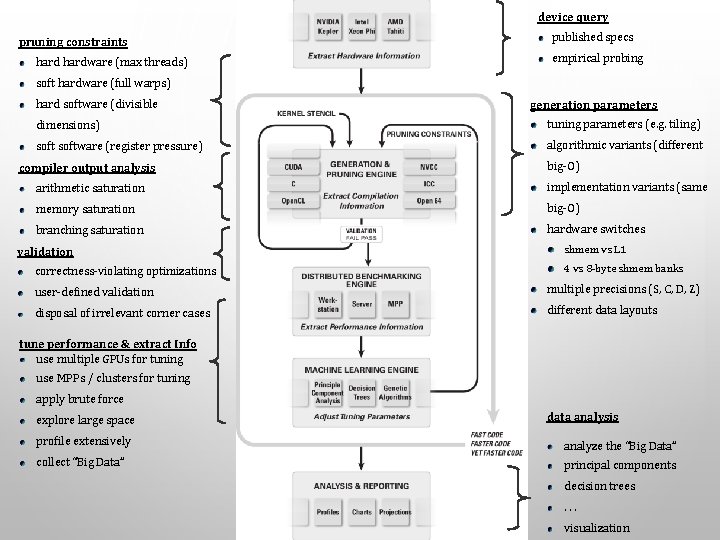
AUTOTUNING • Our kernel work is based on an autotuning framework that allows generic expression of a computational stencil. • The simplest cases are templates and/or stencils based on multiple loop nests--a perfect case for deep neural network research. • Given a generic code and the parameter space, our framework discovers a subspace of the parametric space that is allowed by the hardware (hard constraint pruning) and has not been excluded by the user (soft constraint pruning). • After the extensive pruning, we enumerate all possible instantiations of the kernel with all parameters replaced by constants, which gives the compiler the opportunity to generate a very specific--and hence potentially superior-code when compared with variable-length loop nests. • The execution harness tests the produced binaries and selects the best performer, often with a surprising set of parameters due to complex 11/6/2020 interaction between the kernel template, the compiler toolchain, and the 23
DEEP NEURAL NETWORKS (DNN) IMPLEMENTATION LANDSCAPE • In recent years, Deep Neural Networks have become a hotly contested technology by various commercial entities • Caffe from U. Cal. Berkeley has become the de facto standard (http: //demo. caffe. berkeleyvision. org/) • Other projects have been obseleted: Conv. Net, Conv. Net 2, … • Python-only Theano gets some traction due to its purely mathematical approach to defining machine learning algorithms • Stanford called Fast. Lab (formerly Deep. Sail) • It includes multi-GPU, MPI support but lacks some features
PERFORMANCE IN DNN • Berkeley Caffe achieves performance by calling cu. Blas • The matrix shapes passed to cu. Blas are not the most favorable to good performance (they’re driven by the shape of DNN) • In Ra. Py. DLI, we tried autotuning these oddly-shaped calls • Some improvement can be achieved • NVIDIA makes available a closed source library called cu. DNN (CUDA-based DNN) • Much better performance is achieved (10% as advertised by NVIDIA) due to more DNN-like interface
OTHER DNN LIBRARIES • Facebook’s approach is based on phase space computation and FFT through highly optimized fbfft • Ebay developed DNN library specifically for NVIDIA Maxwell: max. DNN • It is based on reverse engineered assembly for Maxwell provided by Nervana on Git. Hub • It achieves over 90% of the peak performance on single precision matrix-matrix multiply • The published code uses almost all available GPU optimization tricks • Instruction scheduling, constant cache to remove instructions…
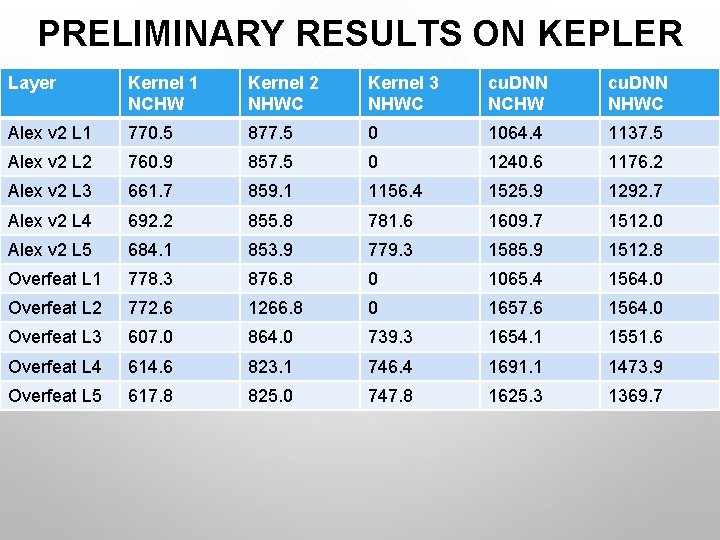
PRELIMINARY RESULTS ON KEPLER Layer Kernel 1 NCHW Kernel 2 NHWC Kernel 3 NHWC cu. DNN NCHW cu. DNN NHWC Alex v 2 L 1 770. 5 877. 5 0 1064. 4 1137. 5 Alex v 2 L 2 760. 9 857. 5 0 1240. 6 1176. 2 Alex v 2 L 3 661. 7 859. 1 1156. 4 1525. 9 1292. 7 Alex v 2 L 4 692. 2 855. 8 781. 6 1609. 7 1512. 0 Alex v 2 L 5 684. 1 853. 9 779. 3 1585. 9 1512. 8 Overfeat L 1 778. 3 876. 8 0 1065. 4 1564. 0 Overfeat L 2 772. 6 1266. 8 0 1657. 6 1564. 0 Overfeat L 3 607. 0 864. 0 739. 3 1654. 1 1551. 6 Overfeat L 4 614. 6 823. 1 746. 4 1691. 1 1473. 9 Overfeat L 5 617. 8 825. 0 747. 8 1625. 3 1369. 7
PRELIMINARY RESULTS ON MAXWELL DNN Kind Kernel 1 NCHW Kernel 2 NHWC Kernel 3 NHWC Cu. DNN NCHW Cu. DNN NHWC Nervana e. Bay Alex v 2 Layer 1 1435. 9 2642. 0 N/A 1372. 8 1316. 1 3975. 6 Alex v 2 L 2 1151. 8 1974. 1 N/A 1718. 4 1748. 0 4148. 5 Alex v 2 L 3 977. 2 1272. 3 1542. 1 2245. 7 2125. 6 4107. 0 Alex v 2 L 4 1095. 5 1202. 9 1649. 7 2247. 4 2384. 7 4065. 0 Alex v 2 L 5 1018. 4 1200. 0 1543. 7 2430. 4 2352. 1 4042. 5 Overfeat L 1 1479. 0 2669. 2 N/A 1516. 8 1344. 0 2986. 7 Overfeat L 2 1195. 0 1278. 1 N/A 2492. 6 2316. 0 4120. 0 Overfeat L 3 926. 2 1350. 0 2534. 2 2668. 2 2296. 7 4144. 9 Overfeat L 4 961. 7 1282. 5 2517. 3 2888. 0 2346. 3 4145. 0 Overfeat L 5 965. 7 1295. 8 2529. 7 2592. 7 2370. 3 Next AMD Xeon Phi and Haswell 36 core 4137. 7
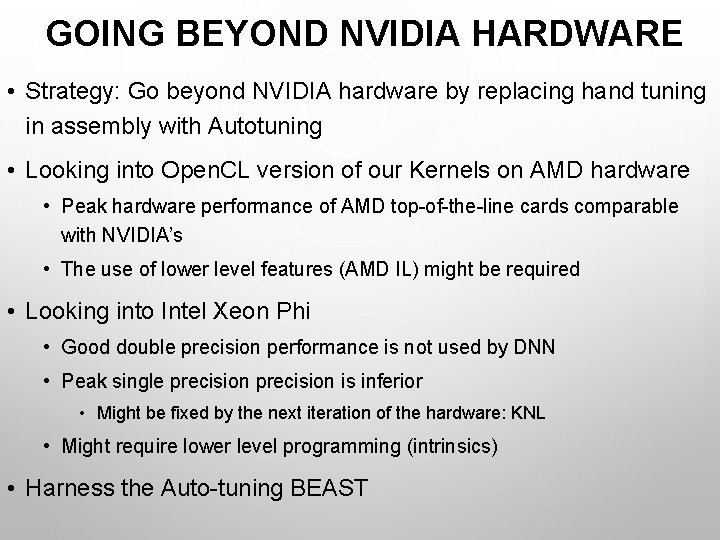
GOING BEYOND NVIDIA HARDWARE • Strategy: Go beyond NVIDIA hardware by replacing hand tuning in assembly with Autotuning • Looking into Open. CL version of our Kernels on AMD hardware • Peak hardware performance of AMD top-of-the-line cards comparable with NVIDIA’s • The use of lower level features (AMD IL) might be required • Looking into Intel Xeon Phi • Good double precision performance is not used by DNN • Peak single precision is inferior • Might be fixed by the next iteration of the hardware: KNL • Might require lower level programming (intrinsics) • Harness the Auto-tuning BEAST
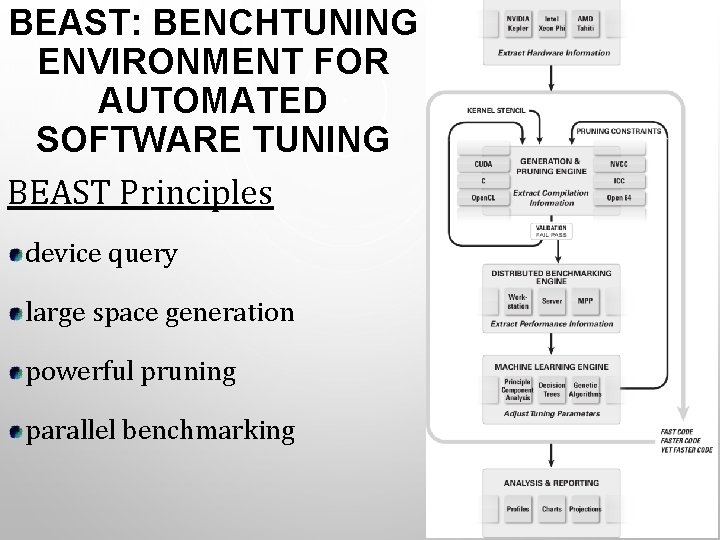
BEAST: BENCHTUNING ENVIRONMENT FOR AUTOMATED SOFTWARE TUNING BEAST Principles device query large space generation powerful pruning parallel benchmarking
device query pruning constraints hardware (max threads) published specs empirical probing soft hardware (full warps) hard software (divisible generation parameters dimensions) tuning parameters (e. g. tiling) software (register pressure) algorithmic variants (different compiler output analysis big-O) arithmetic saturation implementation variants (same memory saturation big-O) branching saturation hardware switches validation correctness-violating optimizations shmem vs L 1 4 vs 8 -byte shmem banks user-defined validation multiple precisions (S, C, D, Z) disposal of irrelevant corner cases different data layouts tune performance & extract Info use multiple GPUs for tuning use MPPs / clusters for tuning apply brute force explore large space data analysis profile extensively analyze the “Big Data” collect “Big Data” principal components decision trees. . . visualization
DATA MANAGEMENT JUDY QIU 11/6/2020 32
DATA MANAGEMENT • Deep Learning researchers will benefit from the ease of use and highly productive Ra. Py. DLI environment. • Data Storage • Data partitioning • Data movement • Data transformation • It will allow users rapid prototyping or interactive experimentation with new algorithms and apply to vast datasets with billions or trillions of parameters.
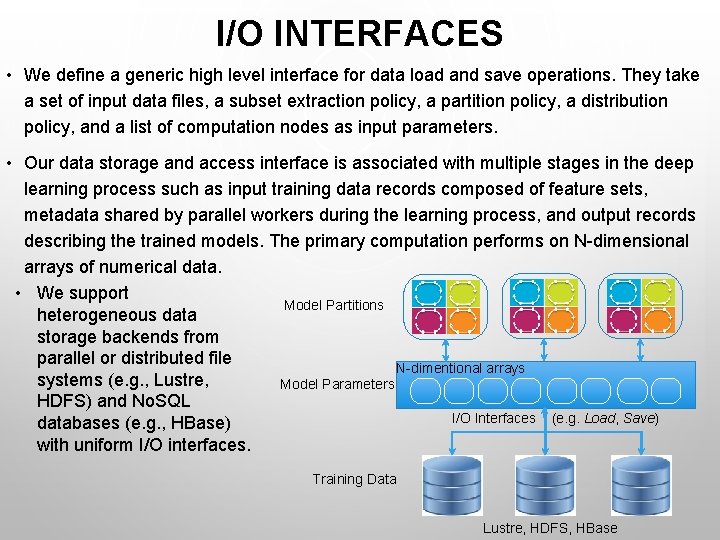
I/O INTERFACES • We define a generic high level interface for data load and save operations. They take a set of input data files, a subset extraction policy, a partition policy, a distribution policy, and a list of computation nodes as input parameters. • Our data storage and access interface is associated with multiple stages in the deep learning process such as input training data records composed of feature sets, metadata shared by parallel workers during the learning process, and output records describing the trained models. The primary computation performs on N-dimensional arrays of numerical data. • We support Model Partitions heterogeneous data storage backends from parallel or distributed file N-dimentional arrays systems (e. g. , Lustre, Model Parameters HDFS) and No. SQL I/O Interfaces (e. g. Load, Save) databases (e. g. , HBase) with uniform I/O interfaces. Training Data Lustre, HDFS, HBase
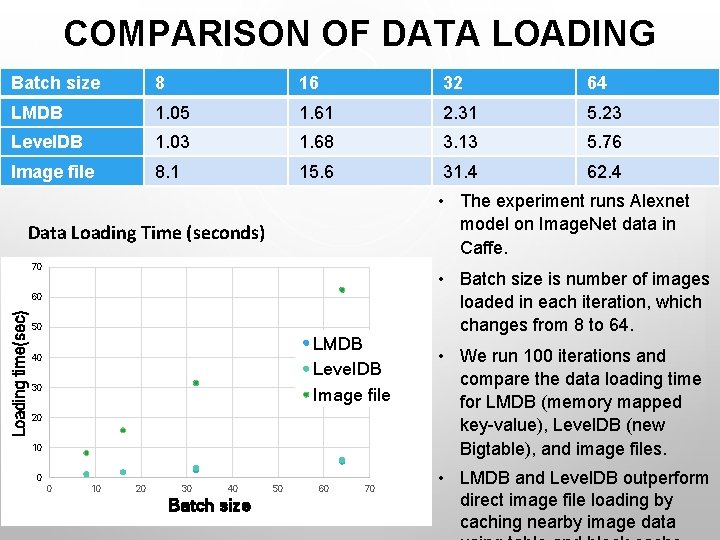
HBASE • To effectively support parallel computation of the Ra. Py. DLI library, we investigate the storage I/O interface that provides operations in three stages: input data loading, snapshot of intermediate parameters, and the resulting collection. • For example, various optimizations will be applied for the partition and distribution steps. We’ve compared existing database approaches in Caffe using an Alex. Net model on Image. Net Data. • Beyond the parallel file I/O operations, Ra. Py. DLI will also provide fine-grained record-level I/O operations using HBase and further compose higher-level abstractions, including N-dimensional array-based indexing.
COMPARISON OF DATA LOADING Batch size 8 16 32 64 LMDB 1. 05 1. 61 2. 31 5. 23 Level. DB 1. 03 1. 68 3. 13 5. 76 Image file 8. 1 15. 6 31. 4 62. 4 • The experiment runs Alexnet model on Image. Net data in Caffe. Data Loading Time (seconds) 70 Loading time(sec) 60 50 LMDB Level. DB Image file 40 30 20 10 0 0 10 20 30 40 Batch size 50 60 70 • Batch size is number of images loaded in each iteration, which changes from 8 to 64. • We run 100 iterations and compare the data loading time for LMDB (memory mapped key-value), Level. DB (new Bigtable), and image files. • LMDB and Level. DB outperform direct image file loading by caching nearby image data