
The Geometry of Innocent Flesh on the Bone
The Geometry of Innocent Flesh on the Bone: Return-into-libc without Function Calls (on the x 86) In Proceedings of the 14 th ACM Conference on Computer and Communications Security, (CCS '07) Shacham (UC San Diego ) Presented by: WANG Zhi
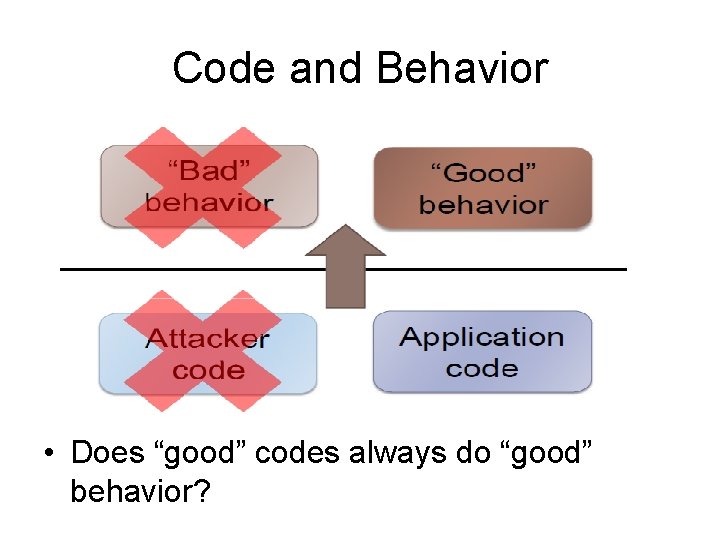
Code and Behavior • Does “good” codes always do “good” behavior?
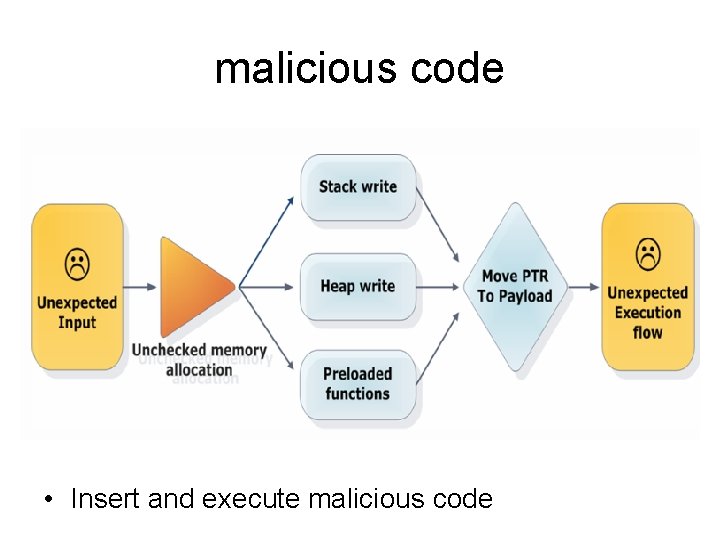
malicious code • Insert and execute malicious code
Preventing malicious code • Check the integrity of good codes in the system. • Isolate “bad” code that has been introduced into the system. (e. g. , W-xor-X, antivirus scanner. )
W-xor-X model • Memory is either marked as writable or executable, but may not be both. • Widely deployed: Linux (via Pa. X patches); Open. BSD; Windows (since XP SP 2); OS X (since 10. 5); … • Hardware support: Intel “XD” bit, AMD “NX” bit • So it is very difficult to execute the inserted malicious codes.
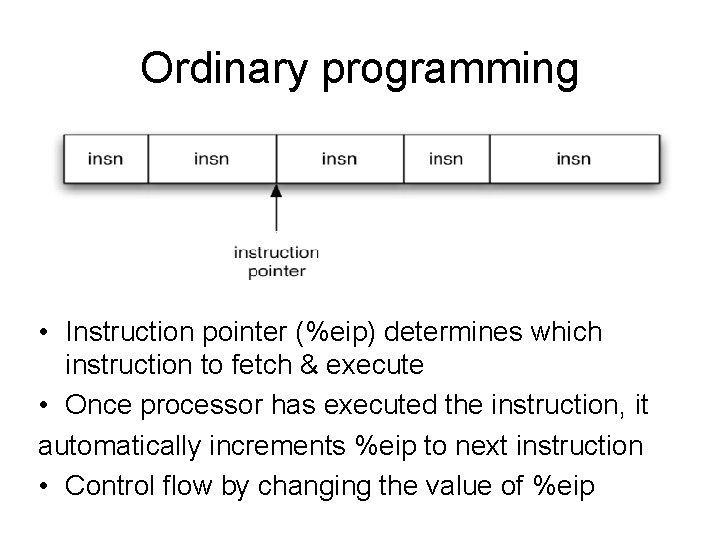
Ordinary programming • Instruction pointer (%eip) determines which instruction to fetch & execute • Once processor has executed the instruction, it automatically increments %eip to next instruction • Control flow by changing the value of %eip
Return-oriented programming • The “ret” instruction could transfers program control to a return address located on the top of the stack. • Return-oriented programming introduces no new instructions, just using carefully crafted stack to link existed code snippets together by ret instruction. • Return-oriented programming generates a new execution path based on existed “good” codes
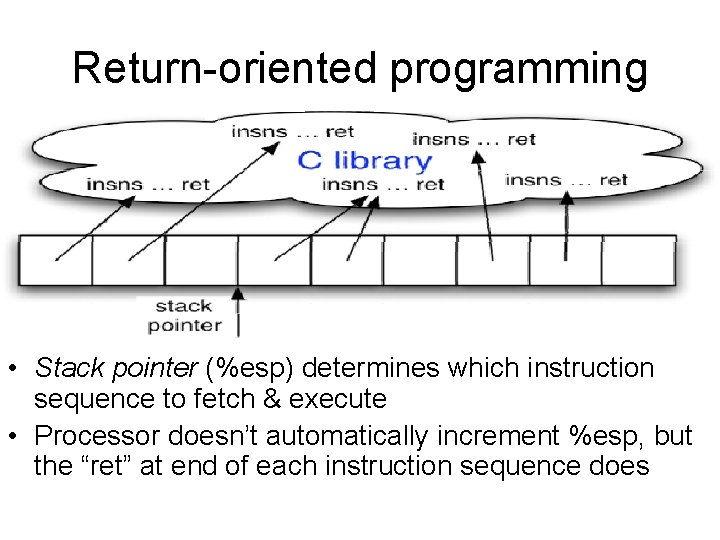
Return-oriented programming • Stack pointer (%esp) determines which instruction sequence to fetch & execute • Processor doesn’t automatically increment %esp, but the “ret” at end of each instruction sequence does
Useful Instruction Sequences • Useful Instruction Sequence: For a instruction sequence to be potentially useful, it needs only end in a return instruction. • In the libc library there are sufficient useful instruction sequences. • An attacker who controls the stack will be able to make the victim program to undertake arbitrary computation.
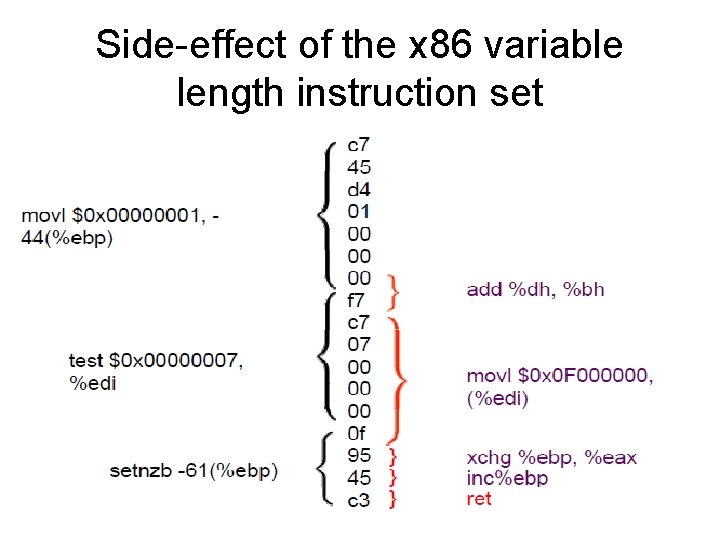
Side-effect of the x 86 variable length instruction set
Finding Useful sequences • • Galileo Algorithm: First, to identify the ret (c 3 byte) locations Second, to scan backwards from such locations. Does the single byte immediately preceding represent a valid one-byte instruction. • Dose the two bytes immediately preceding represent a valid two-byte instruction or two valid one-byte instructions. • And so on, up to the maximum length
Instruction Sequence Challenges • • �� Code sequences are difficult to use: �� short; perform a small unit of work �� no standard function prologue/epilogue �� haphazard interface, not an ABI
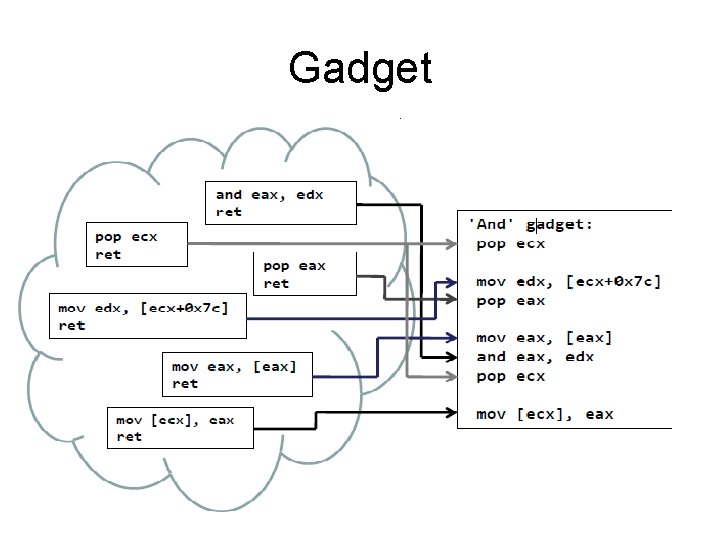
Gadget
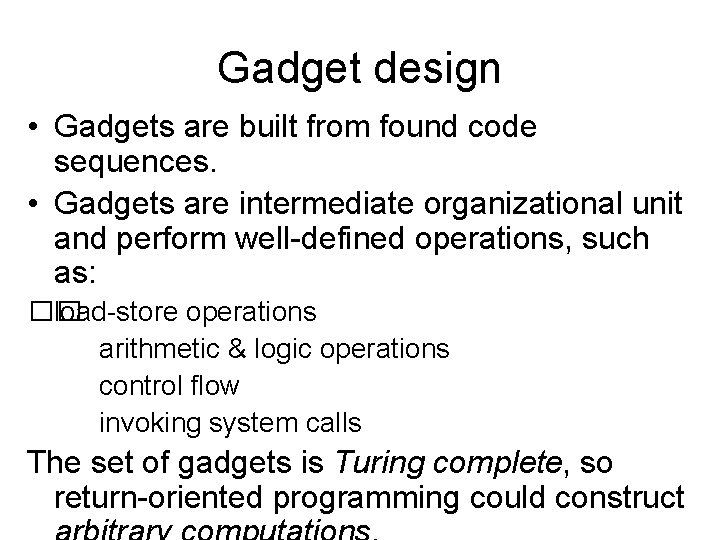
Gadget design • Gadgets are built from found code sequences. • Gadgets are intermediate organizational unit and perform well-defined operations, such as: �� load-store operations arithmetic & logic operations control flow invoking system calls The set of gadgets is Turing complete, so return-oriented programming could construct
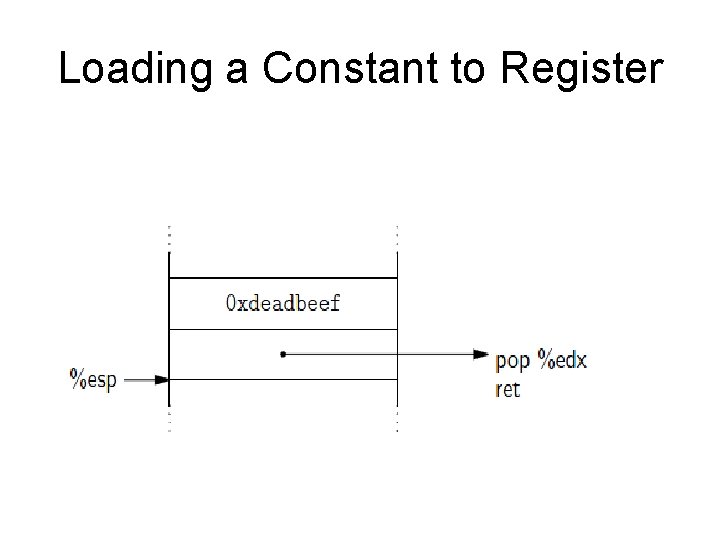
Loading a Constant to Register
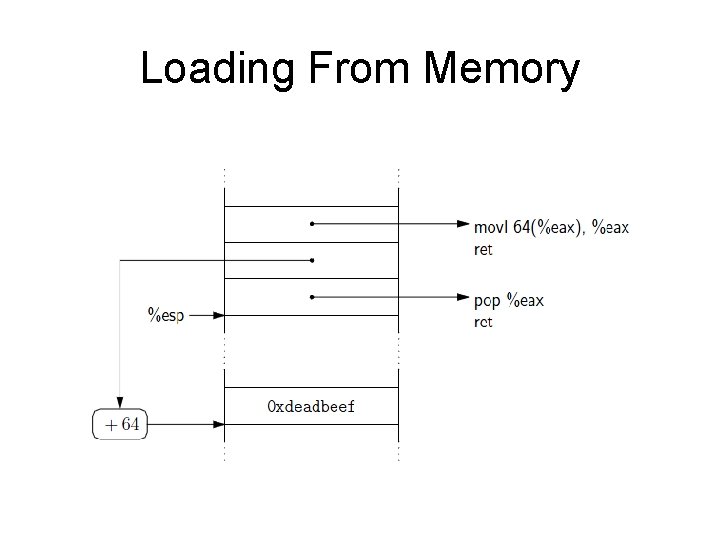
Loading From Memory
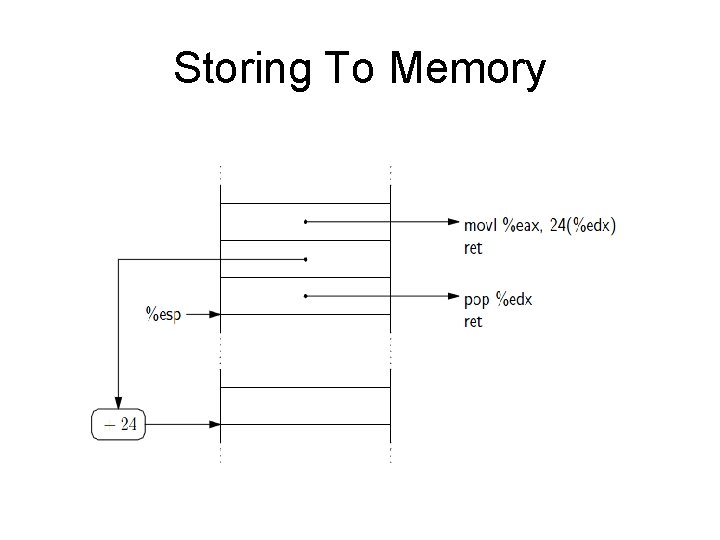
Storing To Memory
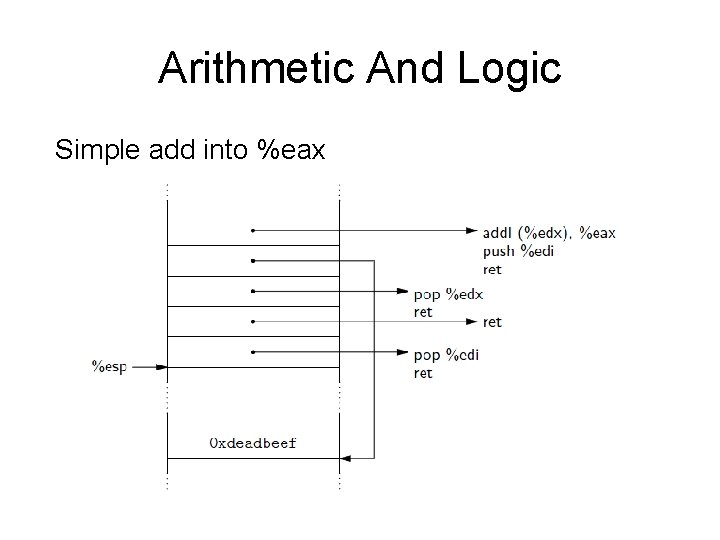
Arithmetic And Logic Simple add into %eax
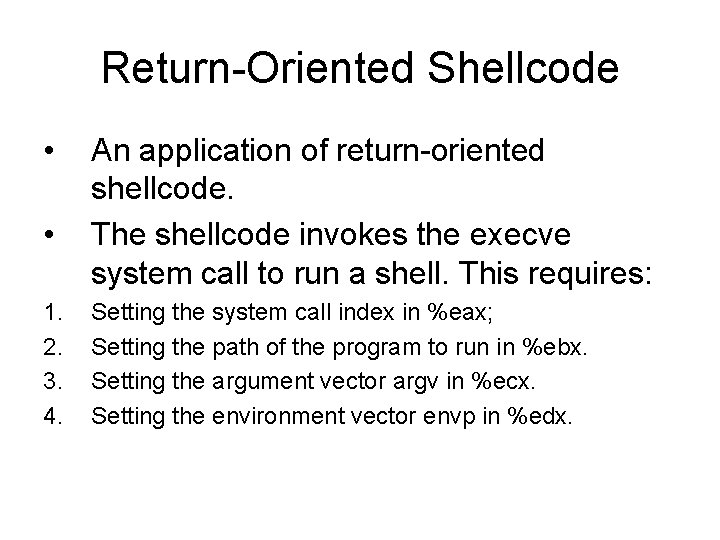
Return-Oriented Shellcode • • 1. 2. 3. 4. An application of return-oriented shellcode. The shellcode invokes the execve system call to run a shell. This requires: Setting the system call index in %eax; Setting the path of the program to run in %ebx. Setting the argument vector argv in %ecx. Setting the environment vector envp in %edx.
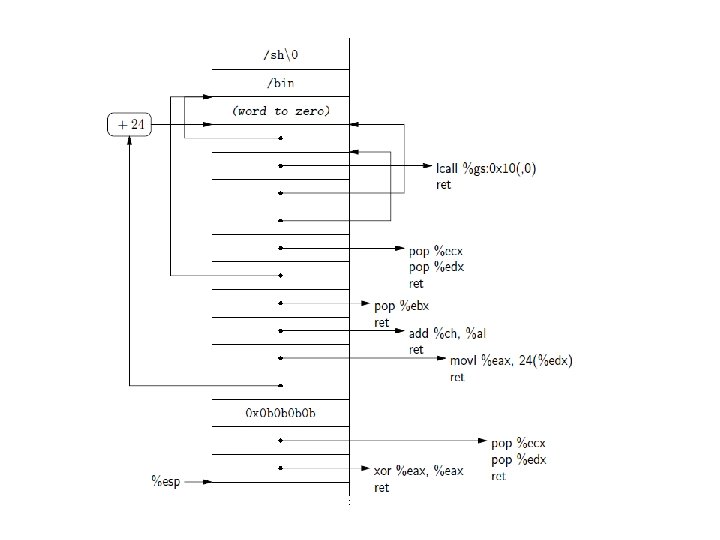
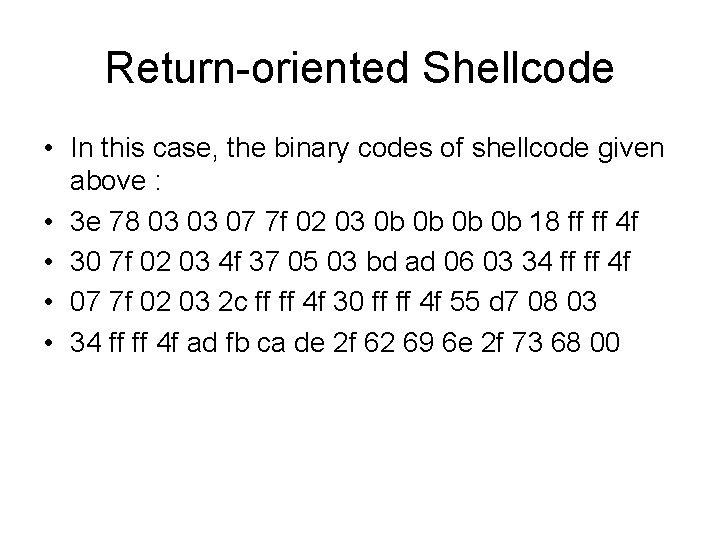
Return-oriented Shellcode • In this case, the binary codes of shellcode given above : • 3 e 78 03 03 07 7 f 02 03 0 b 0 b 18 ff ff 4 f • 30 7 f 02 03 4 f 37 05 03 bd ad 06 03 34 ff ff 4 f • 07 7 f 02 03 2 c ff ff 4 f 30 ff ff 4 f 55 d 7 08 03 • 34 ff ff 4 f ad fb ca de 2 f 62 69 6 e 2 f 73 68 00
Extension • Return-oriented programming has extended to the SPARC, Atmel AVR, Power. PC, Z 80, and ARM processors. • Using return-like instructions such as indirect jump instructions: ”pop x; jmp *x”;
![References • [CCS 08] Buchanan et al. : When good instructions go bad: Generalizing](http://slidetodoc.com/presentation_image_h/c5476f6d83768d1cca44779e4efd9aab/image-23.jpg "References • [CCS 08] Buchanan et al. : When good instructions go bad: Generalizing")
References • [CCS 08] Buchanan et al. : When good instructions go bad: Generalizing returnoriented programming to RISC. CCS 2008 • [USENIX Securiy 09] Hund et al. : Returnoriented rootkits: Bypassing kernel code integrity protection mechanisms
Conclusions • Code injection is not necessary for arbitrary exploitation. • Defenses that distinguish “good code” from “bad code” are useless. • Return-oriented programming likely possible on every architecture, not just x 86.

Thanks.
- Slides: 25