Unit 1 Education Unit 1 Education Unit 1
- Slides: 96
Unit 1 Education
返回 目录 Unit 1 Education
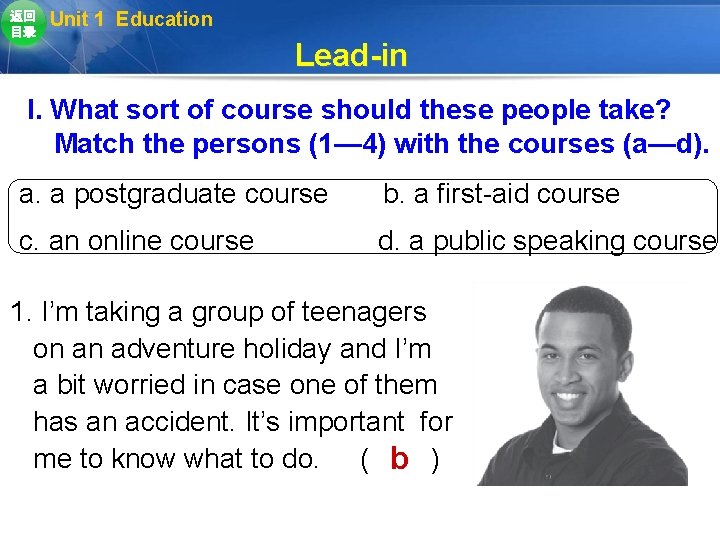
返回 目录 Unit 1 Education Lead-in I. What sort of course should these people take? Match the persons (1— 4) with the courses (a—d). a. a postgraduate course b. a first-aid course c. an online course d. a public speaking course 1. I’m taking a group of teenagers on an adventure holiday and I’m a bit worried in case one of them has an accident. It’s important for me to know what to do. ( b )
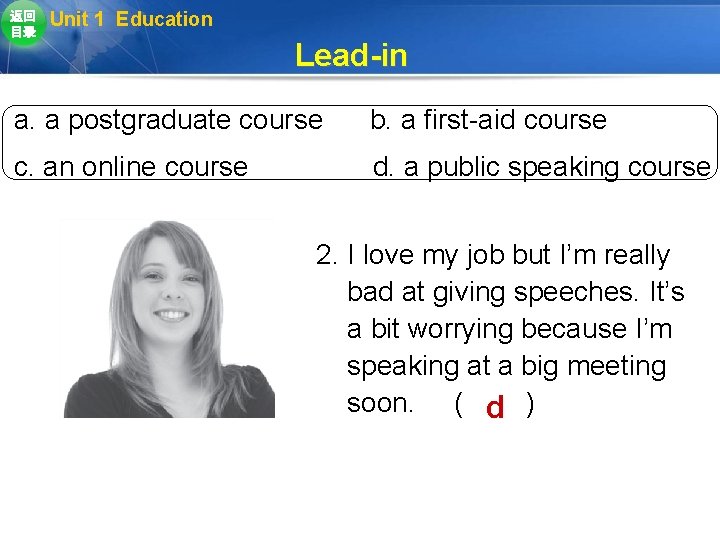
返回 目录 Unit 1 Education Lead-in a. a postgraduate course b. a first-aid course c. an online course d. a public speaking course 2. I love my job but I’m really bad at giving speeches. It’s a bit worrying because I’m speaking at a big meeting soon. ( d )
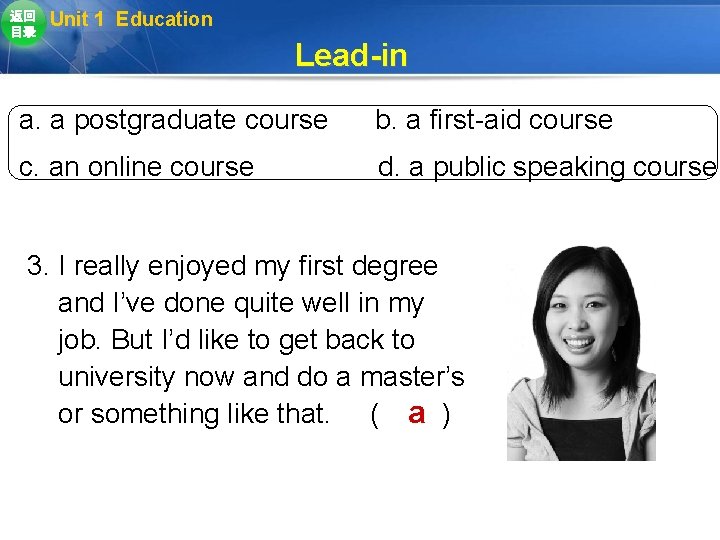
返回 目录 Unit 1 Education Lead-in a. a postgraduate course b. a first-aid course c. an online course d. a public speaking course 3. I really enjoyed my first degree and I’ve done quite well in my job. But I’d like to get back to university now and do a master’s or something like that. ( a )
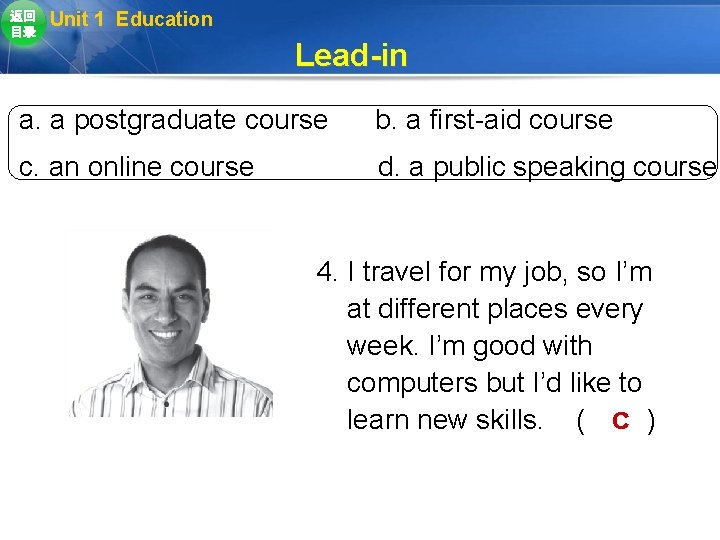
返回 目录 Unit 1 Education Lead-in a. a postgraduate course b. a first-aid course c. an online course d. a public speaking course 4. I travel for my job, so I’m at different places every week. I’m good with computers but I’d like to learn new skills. ( c )
返回 目录 Unit 1 Education Lead-in II. Work in pairs. Tell your partner what sort of course you’d like to take and why. Example A: Would you like to take any other courses apart from the ones you’re taking at school now? B: Yes. I’d like to take a driving course now, since I want to get a driving license when I graduate. When giving reasons, we often use: …, because … …, as … …, since …
返回 目录 Unit 1 Education Text A Translation Many children care a lot about getting good grades or high test scores at school. Is this good or bad for their development?
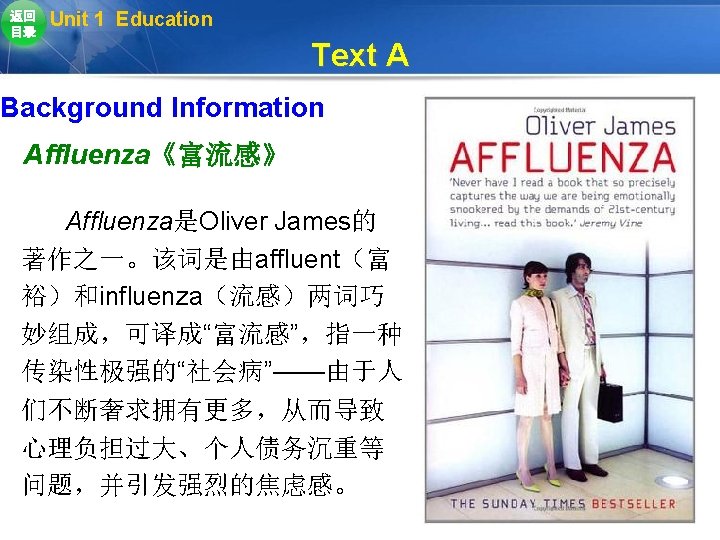
返回 目录 Unit 1 Education Text A Translation 1. 1 Learning to Be Happy Reading Oliver James’ new book Affluenza, I was reminded of a regular scene in our house. My 12 -year -old daughter is in tears. “I’ve got a test tomorrow. I don’t understand any of it, ” she screams. After shouting and shutting her door violently, she calms down enough to go through her notes. The following day I ask her how the test went and she just says “OK. I got a nine. ” 1
返回 目录 Unit 1 Education Text A Translation 2 “Wow, that’s brilliant! Well done!” I say, before she finishes with “But I never get a ten!”
返回 目录 Unit 1 Education Text A Translation According to James, this extreme interest in getting top marks has been a bad development, which encourages people to think of education in terms of work and consumption. To test this idea, I asked my daughter why she was so concerned about her tests. She looked at me as if I was sick. “Well, if I don’t get good grades, I won’t get into university. Then I probably won’t get a good job and if I don’t have a good job, I won’t be able to afford nice things like a car and stuff. ” 3
返回 目录 Unit 1 Education Text A Translation I was quite shocked, because I do not consider myself a pushy parent. But James suggests showing any interest in grades sends the message that what is important is results and it leaves students feeling failures even if they are very bright. He points out that creating happy citizens who have good social skills is more important than good marks at school. 4
返回 目录 Unit 1 Education Text A Translation The strange thing is that so little of what I’ve learnt at school is actually related to my job. I cannot remember the last time I had to calculate the area of a circle, or recite grammar rules. What I really needed to learn at school was how to make polite conversation, or how to avoid getting into debt, or how to control my own children! 5
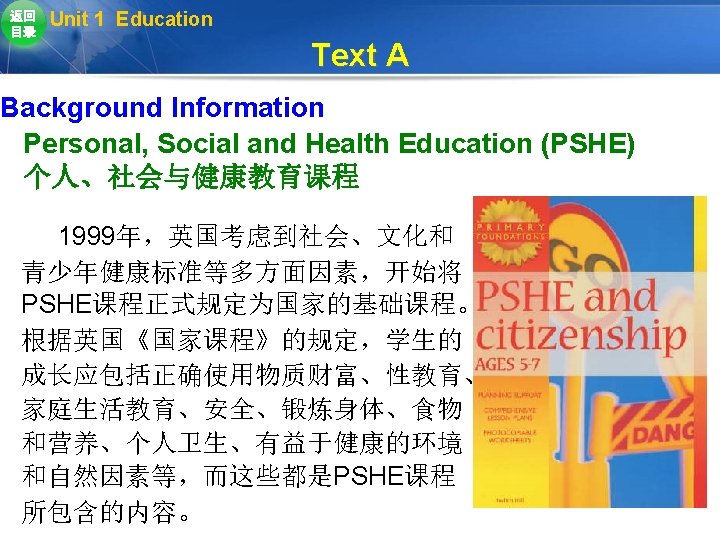
返回 目录 Unit 1 Education Text A Translation To be fair, both the responsibilities of parents and personal finances are now sometimes taught as part of Personal, Social and Health Education (PSHE), which also covers areas such as the responsibilities of citizens and the harm of illegal drugs. Many EU countries also teach the responsibilities of citizens as a core subject, although not everyone agrees what it should aim to teach. 6
返回 目录 Unit 1 Education Text A Translation Such ideas are not really what Oliver James has in mind, though. He seems to be looking for schools where students are encouraged to find and follow their own interests. It is thought that school education which gives students more freedom will provide the country with more creative thinkers. 7
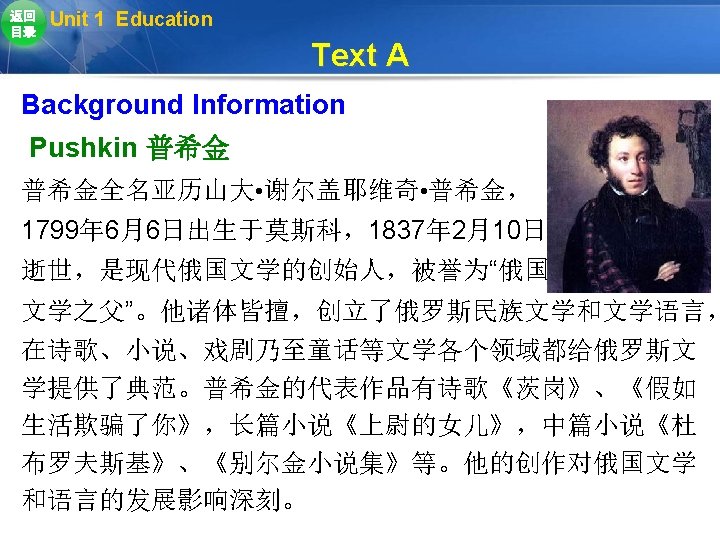
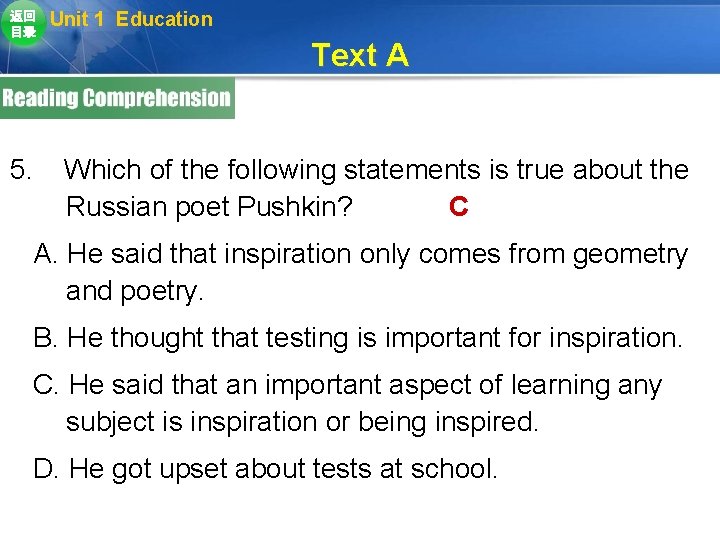
返回 目录 Unit 1 Education Text A Translation 8 As the Russian poet Pushkin said, “Inspiration is needed in geometry just as much as in poetry”, and inspiration does not come from revising for tests without end or getting upset about them.
返回 目录 Unit 1 Education Text A New Words 1. 2
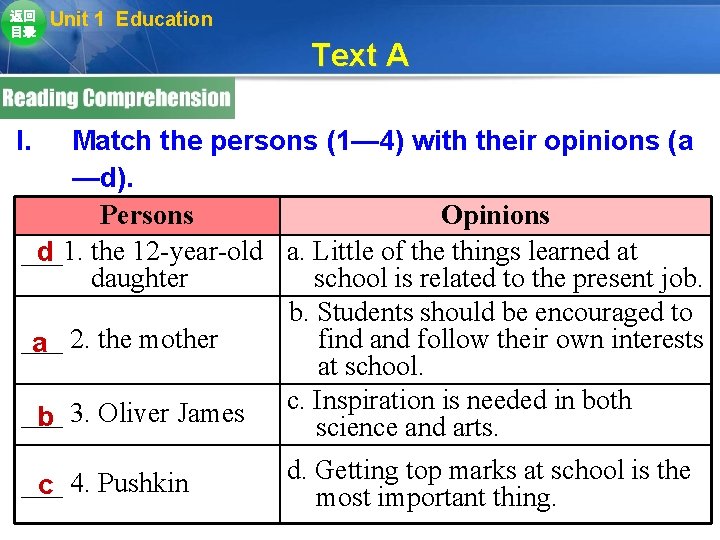
返回 目录 Unit 1 Education Text A I. Match the persons (1— 4) with their opinions (a —d). Persons Opinions ___1. d the 12 -year-old a. Little of the things learned at daughter school is related to the present job. b. Students should be encouraged to find and follow their own interests ___ a 2. the mother at school. c. Inspiration is needed in both ___ 3. Oliver James b science and arts. ___ c 4. Pushkin d. Getting top marks at school is the most important thing.
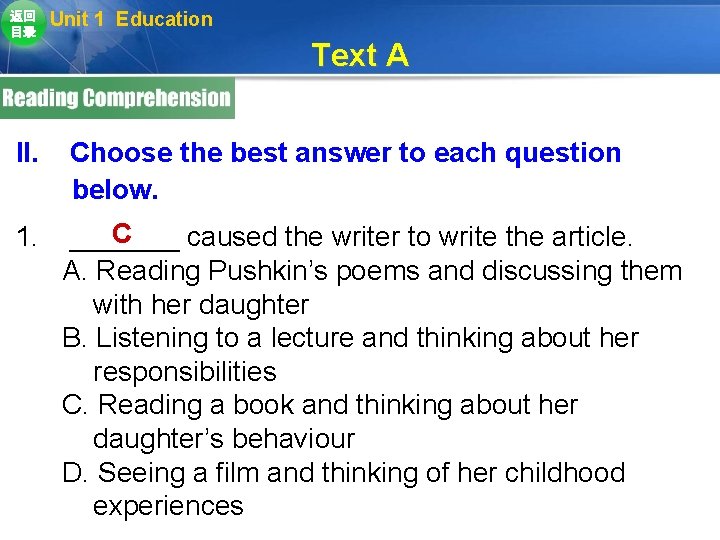
返回 目录 Unit 1 Education Text A II. Choose the best answer to each question below. 1. C _______ caused the writer to write the article. A. Reading Pushkin’s poems and discussing them with her daughter B. Listening to a lecture and thinking about her responsibilities C. Reading a book and thinking about her daughter’s behaviour D. Seeing a film and thinking of her childhood experiences
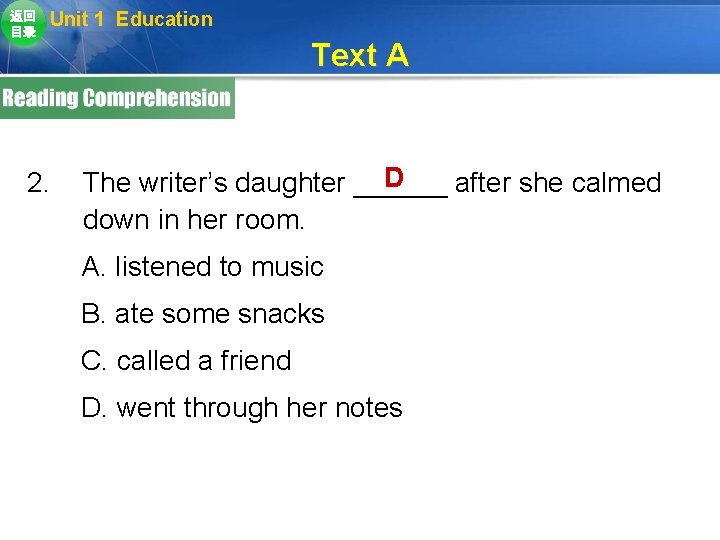
返回 目录 Unit 1 Education 2. Text A D The writer’s daughter ______ after she calmed down in her room. A. listened to music B. ate some snacks C. called a friend D. went through her notes
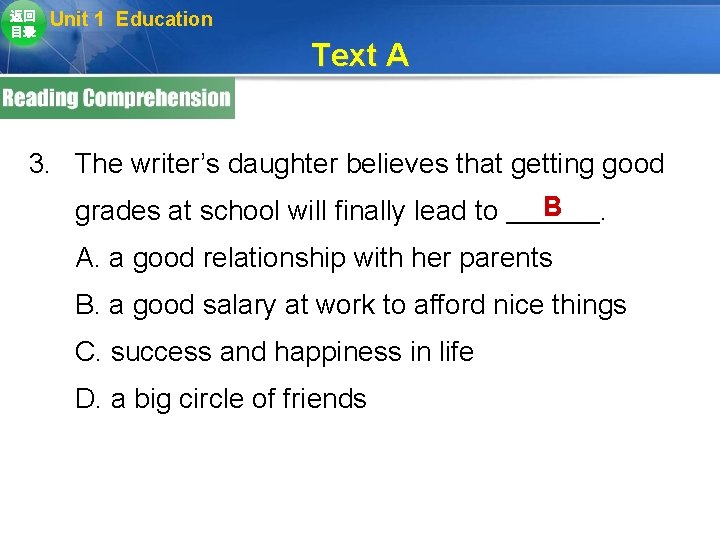
返回 目录 Unit 1 Education Text A 3. The writer’s daughter believes that getting good grades at school will finally lead to B . A. a good relationship with her parents B. a good salary at work to afford nice things C. success and happiness in life D. a big circle of friends
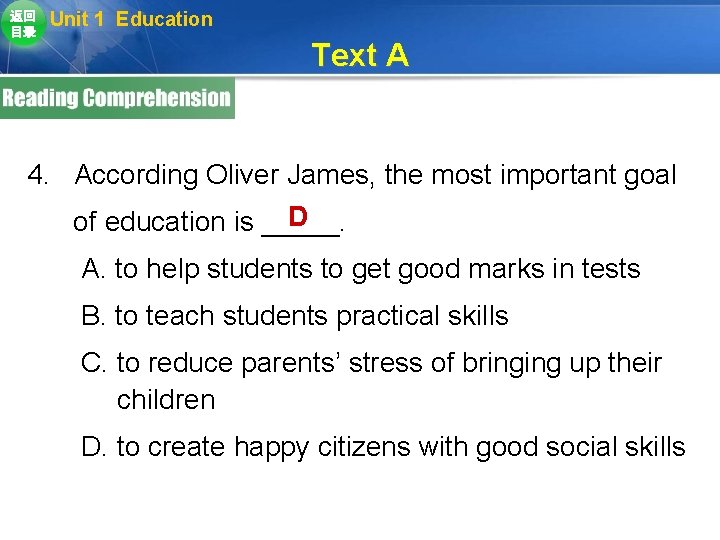
返回 目录 Unit 1 Education Text A 4. According Oliver James, the most important goal D of education is _____. A. to help students to get good marks in tests B. to teach students practical skills C. to reduce parents’ stress of bringing up their children D. to create happy citizens with good social skills
返回 目录 5. Unit 1 Education Text A Which of the following statements is true about the Russian poet Pushkin? C A. He said that inspiration only comes from geometry and poetry. B. He thought that testing is important for inspiration. C. He said that an important aspect of learning any subject is inspiration or being inspired. D. He got upset about tests at school.
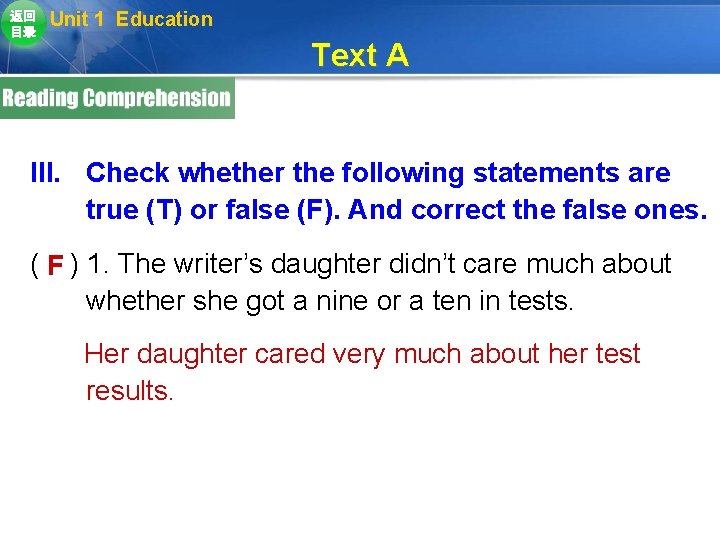
返回 目录 Unit 1 Education Text A III. Check whether the following statements are true (T) or false (F). And correct the false ones. ( F ) 1. The writer’s daughter didn’t care much about whether she got a nine or a ten in tests. Her daughter cared very much about her test results.
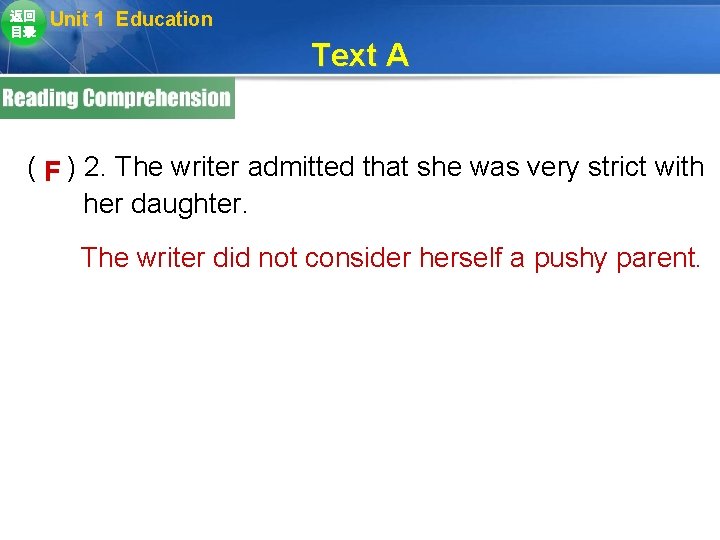
返回 目录 Unit 1 Education Text A ( F ) 2. The writer admitted that she was very strict with her daughter. The writer did not consider herself a pushy parent.
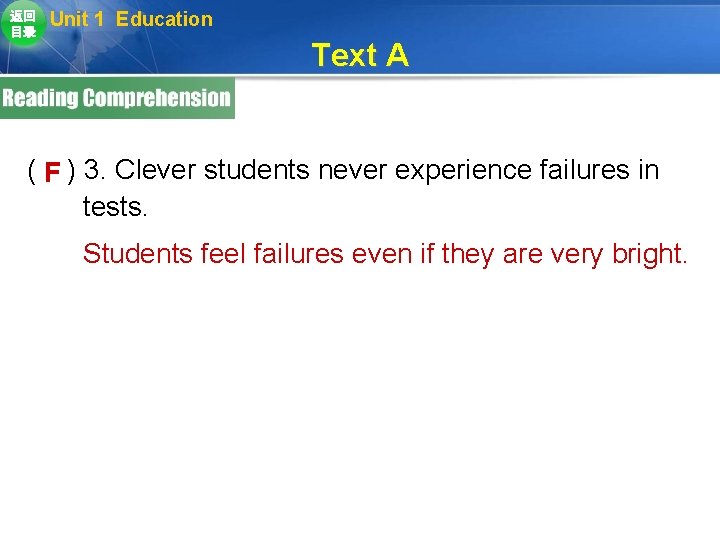
返回 目录 Unit 1 Education Text A ( F ) 3. Clever students never experience failures in tests. Students feel failures even if they are very bright.
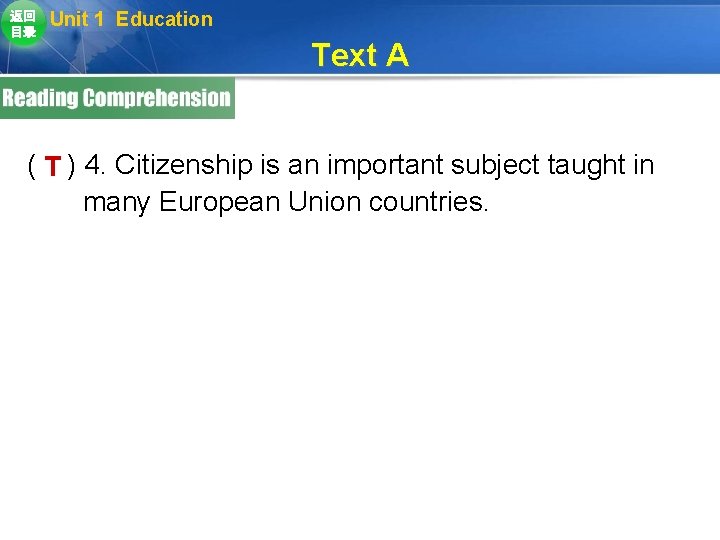
返回 目录 Unit 1 Education Text A ( T ) 4. Citizenship is an important subject taught in many European Union countries.
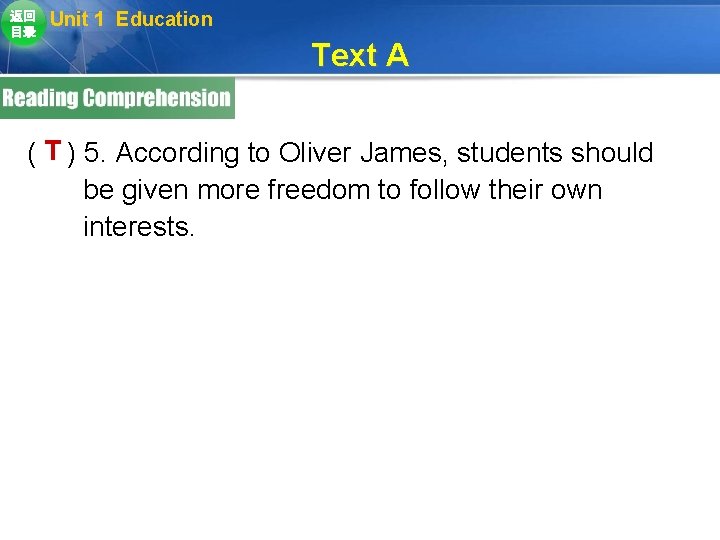
返回 目录 Unit 1 Education Text A ( T ) 5. According to Oliver James, students should be given more freedom to follow their own interests.
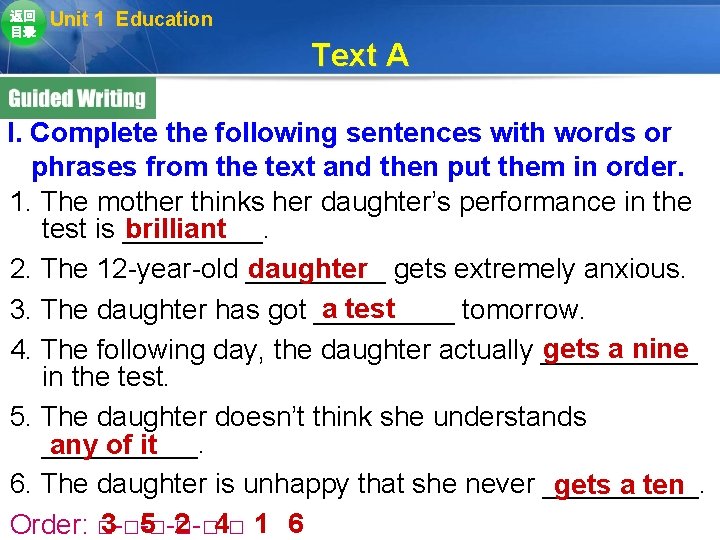
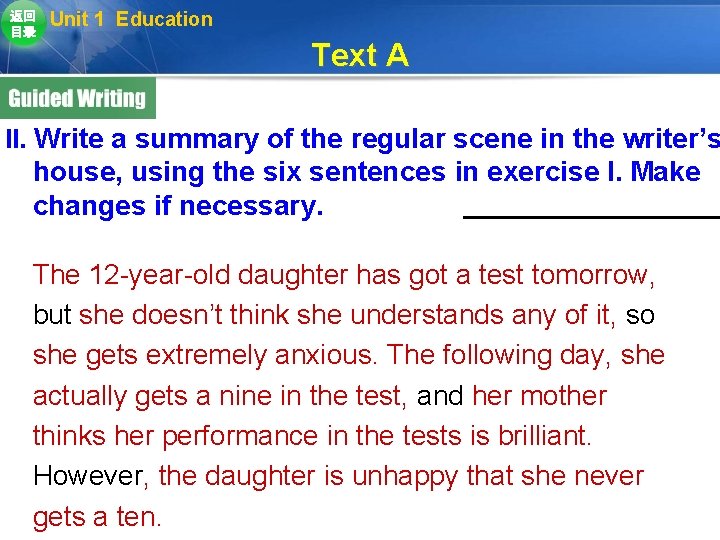
返回 目录 Unit 1 Education Text A I. Complete the following sentences with words or phrases from the text and then put them in order. 1. The mother thinks her daughter’s performance in the test is _____. brilliant daughter gets extremely anxious. 2. The 12 -year-old _____ a test 3. The daughter has got _____ tomorrow. gets a nine 4. The following day, the daughter actually _____ in the test. 5. The daughter doesn’t think she understands _____. any of it 6. The daughter is unhappy that she never _____. gets a ten 3 5 2 4 1 6 Order: □-□-□-□
返回 目录 Unit 1 Education Text A II. Write a summary of the regular scene in the writer’s house, using the six sentences in exercise I. Make changes if necessary. The 12 -year-old daughter has got a test tomorrow, but she doesn’t think she understands any of it, so she gets extremely anxious. The following day, she actually gets a nine in the test, and her mother thinks her performance in the tests is brilliant. However, the daughter is unhappy that she never gets a ten.
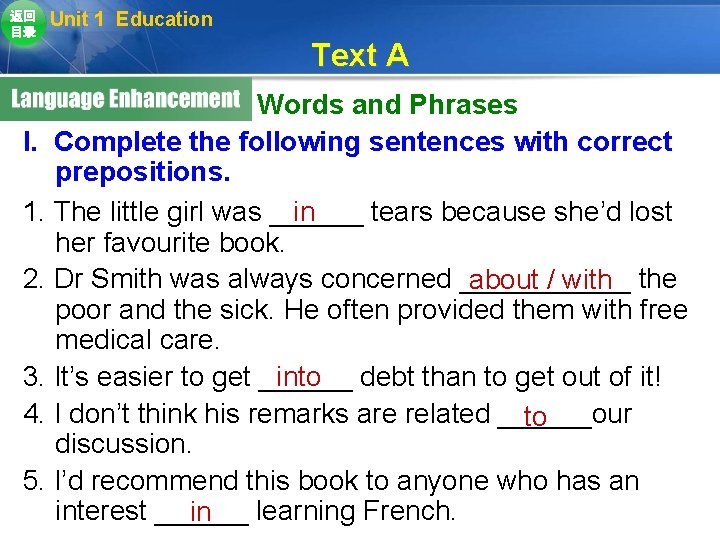
返回 目录 Unit 1 Education Text A Words and Phrases I. Complete the following sentences with correct prepositions. 1. The little girl was ______ tears because she’d lost in her favourite book. 2. Dr Smith was always concerned ______ about / with the poor and the sick. He often provided them with free medical care. into debt than to get out of it! 3. It’s easier to get ______ 4. I don’t think his remarks are related ______our to discussion. 5. I’d recommend this book to anyone who has an interest ______ learning French. in
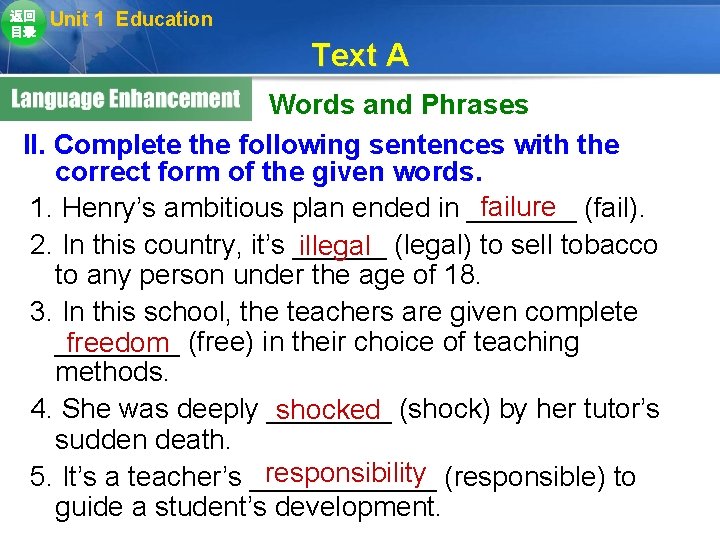
返回 目录 Unit 1 Education Text A Words and Phrases II. Complete the following sentences with the correct form of the given words. failure (fail). 1. Henry’s ambitious plan ended in _______ 2. In this country, it’s ______ illegal (legal) to sell tobacco to any person under the age of 18. 3. In this school, the teachers are given complete ____ freedom (free) in their choice of teaching methods. 4. She was deeply ____ shocked (shock) by her tutor’s sudden death. responsibility (responsible) to 5. It’s a teacher’s ______ guide a student’s development.
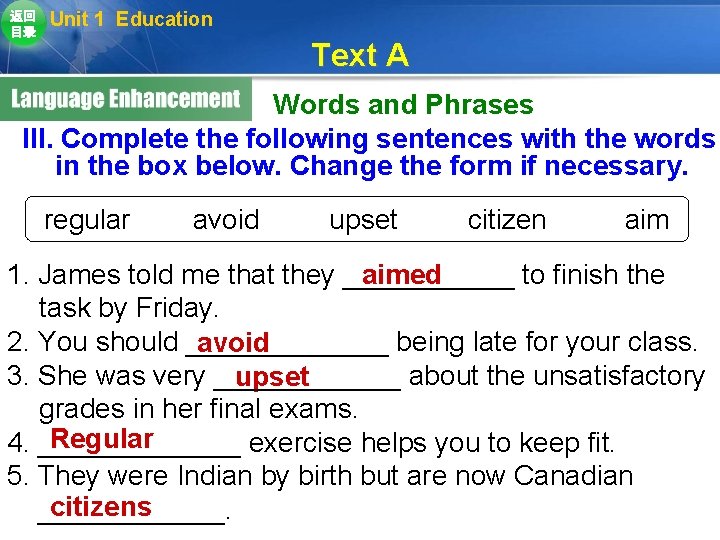
返回 目录 Unit 1 Education Text A Words and Phrases III. Complete the following sentences with the words in the box below. Change the form if necessary. regular avoid upset citizen aim 1. James told me that they ______ aimed to finish the task by Friday. 2. You should _______ being late for your class. avoid 3. She was very ______ about the unsatisfactory upset grades in her final exams. Regular 4. _______ exercise helps you to keep fit. 5. They were Indian by birth but are now Canadian citizens ______.
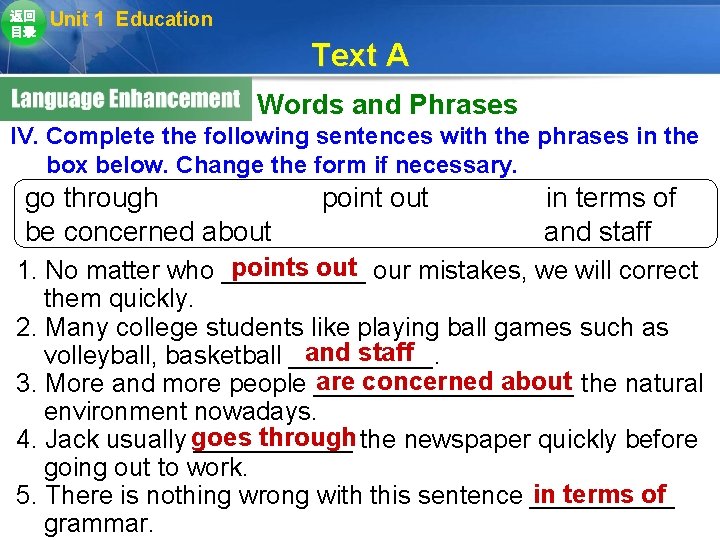
返回 目录 Unit 1 Education Text A Words and Phrases IV. Complete the following sentences with the phrases in the box below. Change the form if necessary. go through be concerned about point out in terms of and staff points out our mistakes, we will correct 1. No matter who _____ them quickly. 2. Many college students like playing ball games such as and staff volleyball, basketball _____. are concerned about the natural 3. More and more people _________ environment nowadays. through the newspaper quickly before 4. Jack usually goes ______ going out to work. in terms of 5. There is nothing wrong with this sentence _____ grammar.
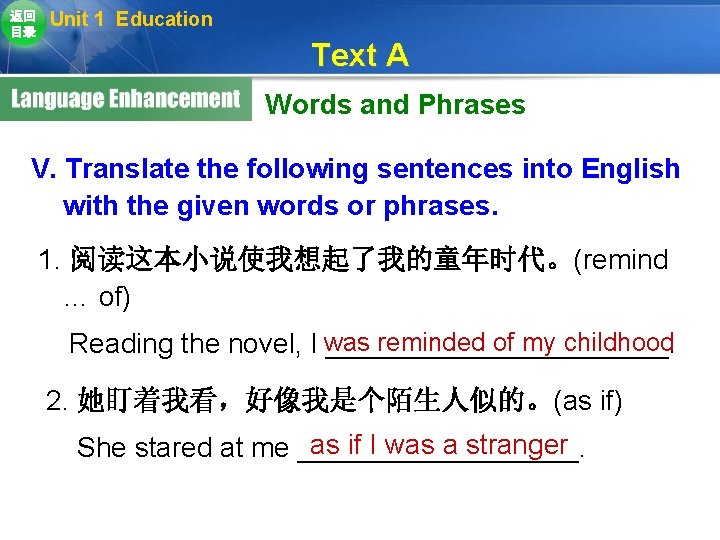
返回 目录 Unit 1 Education Text A Words and Phrases V. Translate the following sentences into English with the given words or phrases. 1. 阅读这本小说使我想起了我的童年时代。(remind … of) reminded of my childhood Reading the novel, I was ___________. 2. 她盯着我看,好像我是个陌生人似的。(as if) as if I was a stranger She stared at me _________.
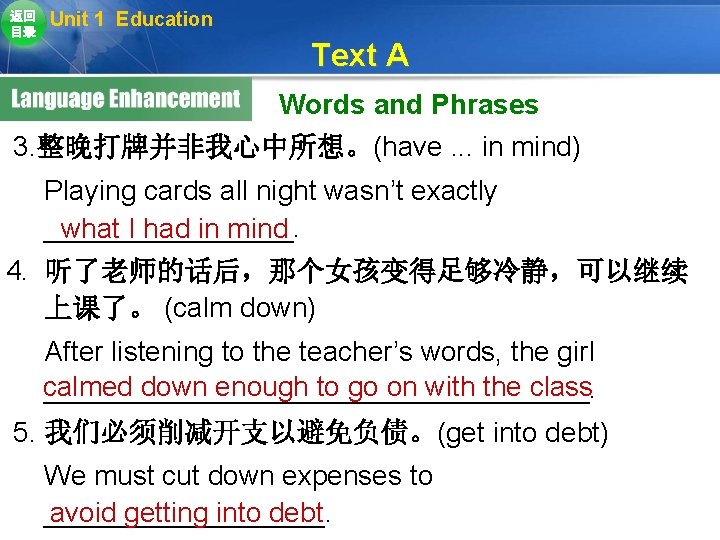
返回 目录 Unit 1 Education Text A Words and Phrases 3. 整晚打牌并非我心中所想。(have. . . in mind) Playing cards all night wasn’t exactly ________. what I had in mind 4. 听了老师的话后,那个女孩变得足够冷静,可以继续 上课了。 (calm down) After listening to the teacher’s words, the girl calmed down enough to go on with the class __________________. 5. 我们必须削减开支以避免负债。(get into debt) We must cut down expenses to avoid getting into debt _________.
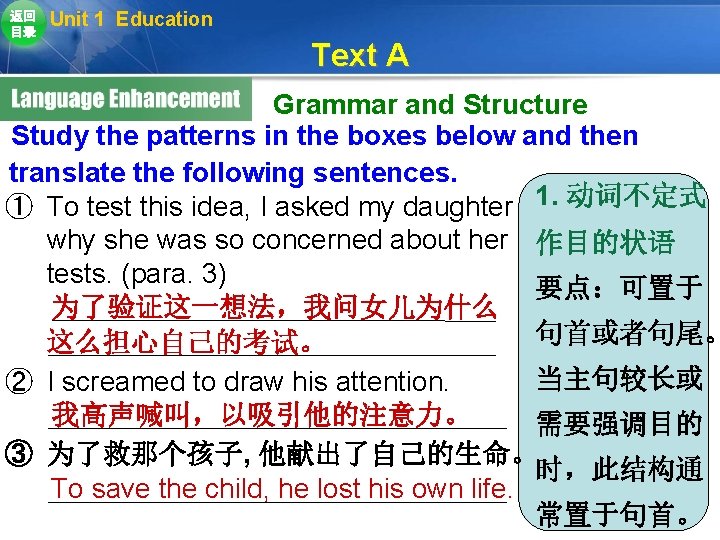
返回 目录 Unit 1 Education Text A Grammar and Structure Study the patterns in the boxes below and then translate the following sentences. ① To test this idea, I asked my daughter 1. 动词不定式 why she was so concerned about her 作目的状语 tests. (para. 3) 要点:可置于 为了验证这一想法,我问女儿为什么 句首或者句尾。 这么担心自己的考试。 当主句较长或 ② I screamed to draw his attention. 我高声喊叫,以吸引他的注意力。 需要强调目的 ③ 为了救那个孩子, 他献出了自己的生命。 时,此结构通 To save the child, he lost his own life. 常置于句首。
返回 目录 Unit 1 Education Text A Grammar and Structure ① I cannot remember the last time I had to calculate the area of a circle. . . 2. 定语从句中 (para. 5) when的省略 我记不清自己最后一次计算圆的面积 要点:在 day, 是在什么时候了。 year, time 等词 ② His father died the year he was born. 之后 when 可省 略。 他父亲在他出生那年去世了。 ③ 我永远不会忘记第一次见到你的那一天 I’ll never forget the day I first met you.
返回 目录 Unit 1 Education Text A Grammar and Structure 3. what 从句 做主语 要点:主句谓语 动词的数取决于 what 从句所表 达的含义是单数 还是复数。 ① What I really needed to learn at school was how to make polite conversation. . . (para. 5) 在学校我真正需要学习的是怎样说 客气的应酬话。 ② What they are really interested in are music and sports. 他们真正感兴趣的是音乐和体育。 ③ 刚毕业的大学生需要的是更多的 作经验。 What fresh college graduates need is more working experience.
返回 目录 Unit 1 Education Text A Grammar and Structure ① Many EU countries also teach the responsibilities of citizens as a core subject, although not everyone agrees what it should aim to teach. (para. 6) 虽然许多欧盟国家也将公民责任作为一门核 心课程来教,但是关于这门课该教些什么, 并非所有人都达成了一致意见。 ② Although his mother is waiting for him to have supper, yet he can’t leave school now. 尽管母亲在等着他吃晚饭,但他现在还不能 离开学校。 ③ 她虽然有很多钱,但是却不幸福。 Although she has a lot of money, (yet) she is unhappy. 4. although引 导让步状语从句 要点:不可与 but 连用,但可 与 yet 连用。
返回 目录 Unit 1 Education Text B Translation English, as a foreign language, is taught in China from primary school to university. What’s the language policy in Britain? Do British people have to learn a foreign at school? TEXT language A
返回 目录 Unit 1 Education Text B Translation 1. 3 Language Policy a Disaster? 1 In the UK, the number of students taking exams in languages at sixteen fell by 14. 4% because foreign languages are now optional after the age of 14.
返回 目录 Unit 1 Education Text B Translation 2 Low levels of language learning are nothing new in Britain – over 60% of the population are unable to get by in a foreign language. As Edward Jones, a teacher from Manchester, says, “Many of my students lack motivation and, strangely, foreign travel doesn’t really help. Often, they make an effort to speak French, or whatever, when they go abroad, but then find that local people reply in English and are more fluent than they are. They then feel embarrassed and just speak English after that. They come back to class asking ‘What’s the point? ’”
返回 目录 Unit 1 Education Text B Translation 3 According to a recent report, the point is that Britain is losing millions of euros of trade because of the lack of language skills. Relying on everyone else to speak English is not enough.
返回 目录 Unit 1 Education Text B Translation 4 Officials, however, defended their language policy. “We need to be realistic about what will improve language learning. Telling young people to learn a language at 16 won’t help. It’s better to give children the opportunity to learn a foreign language from the age of 7. ”
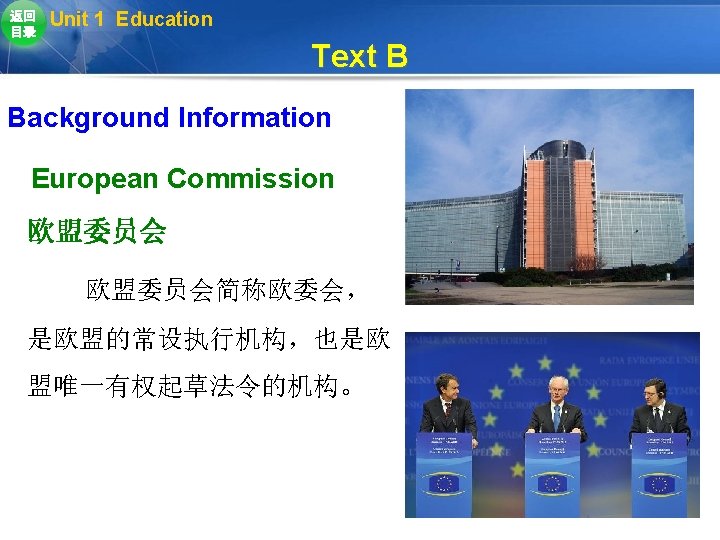
返回 目录 Unit 1 Education Text B Translation While there have been similar changes in many countries, studies have questioned if it really is easier for younger children to learn languages. A European Commission report has noted that there is a lack of evidence about the usefulness of early teaching. Although the report is generally in favour, it suggests that the advantages of an early start depend on providing “a good environment for learning and continuity from one year to the next. ” 5
返回 目录 Unit 1 Education Text B Translation That can be difficult, according to Brian Willis, a language expert. “Many primary teachers have a basic level themselves and can’t teach much. Also, students progress at different speeds – some pick things up quickly, some don’t learn anything at all! When they go to secondary school, their teachers have to deal with a wide range of levels. It’s very difficult. ” 6
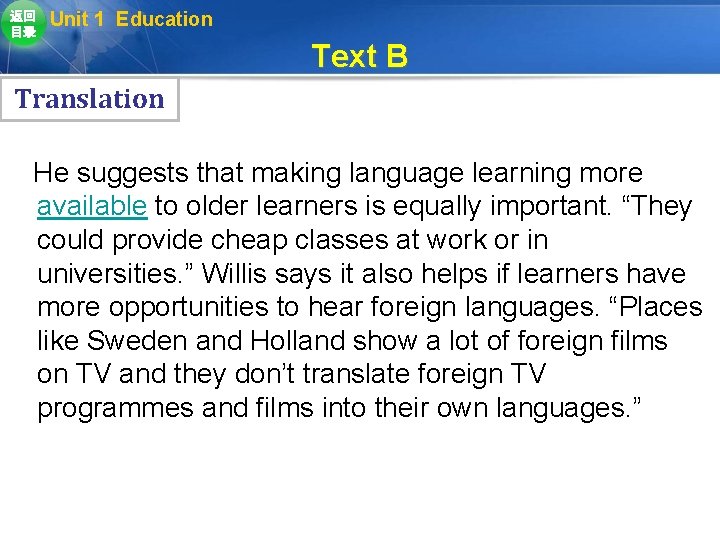
返回 目录 Unit 1 Education Text B Translation He suggests that making language learning more available to older learners is equally important. “They could provide cheap classes at work or in universities. ” Willis says it also helps if learners have more opportunities to hear foreign languages. “Places like Sweden and Holland show a lot of foreign films on TV and they don’t translate foreign TV programmes and films into their own languages. ”
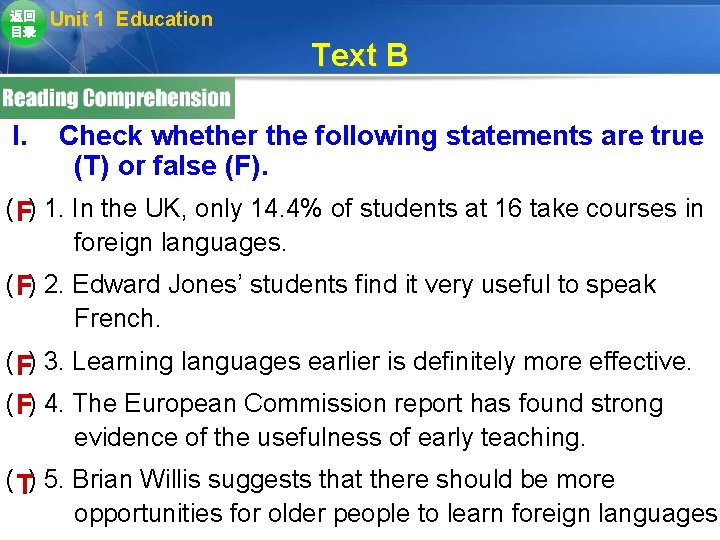
返回 目录 I. Unit 1 Education Text B Check whether the following statements are true (T) or false (F). ( F) 1. In the UK, only 14. 4% of students at 16 take courses in foreign languages. ( F) 2. Edward Jones’ students find it very useful to speak French. ( F) 3. Learning languages earlier is definitely more effective. ( F) 4. The European Commission report has found strong evidence of the usefulness of early teaching. ( T) 5. Brian Willis suggests that there should be more opportunities for older people to learn foreign languages.
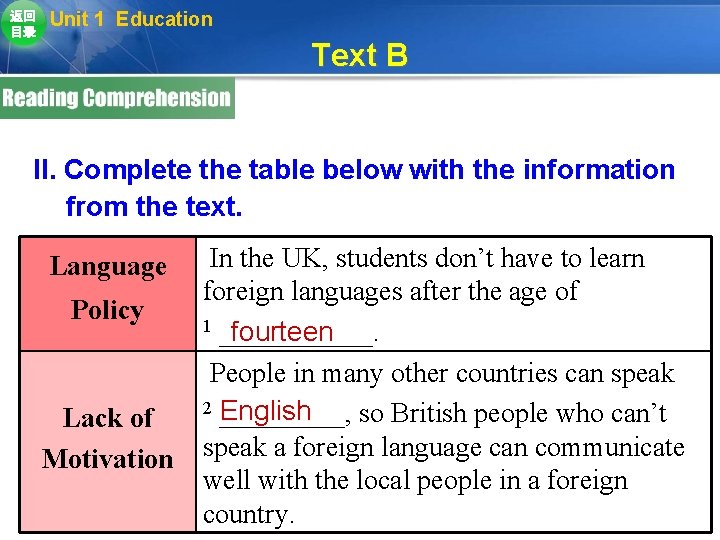
返回 目录 Unit 1 Education Text B II. Complete the table below with the information from the text. Language Policy Lack of Motivation In the UK, students don’t have to learn foreign languages after the age of 1 ______. fourteen People in many other countries can speak 2 _____, English so British people who can’t speak a foreign language can communicate well with the local people in a foreign country.
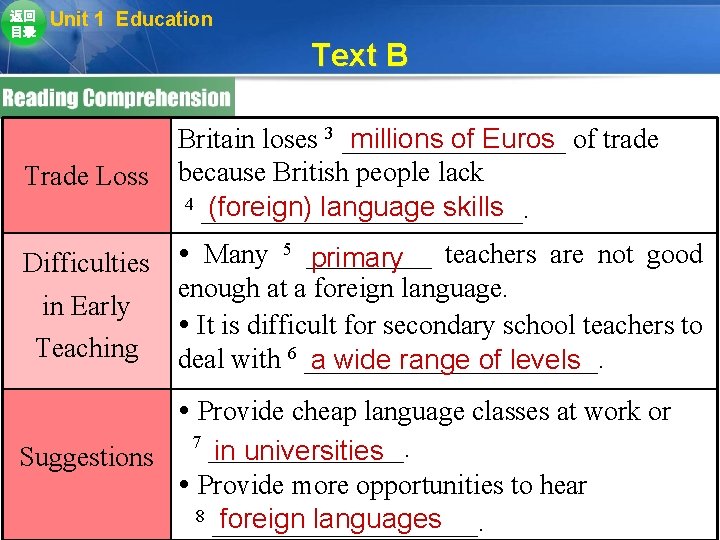
返回 目录 Unit 1 Education Trade Loss Text B Britain loses 3 ________ millions of Euros of trade because British people lack 4 ____________. (foreign) language skills 5 _____ teachers are not good Many primary Difficulties enough at a foreign language. in Early It is difficult for secondary school teachers to Teaching deal with 6 ___________. a wide range of levels Provide cheap language classes at work or 7 _______. in universities Suggestions Provide more opportunities to hear 8 __________. foreign languages
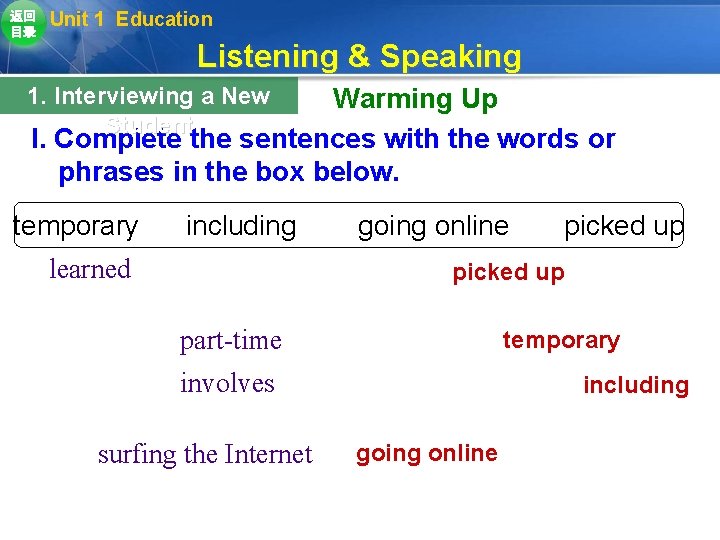
返回 目录 Unit 1 Education Listening & Speaking 1. Interviewing a New Student Warming Up I. Complete the sentences with the words or phrases in the box below. temporary including going online picked up 1. I learned some French last year — I _____ picked up it when I was there for a holiday. temporary 2. I am doing a part-time job in a bar — it’s ______. 3. Asia Studies involves a lot of interesting things, including _____ the history, economy, culture and politics of Asia. going online 4. I like surfing the Internet — _______ and doing many interesting things.
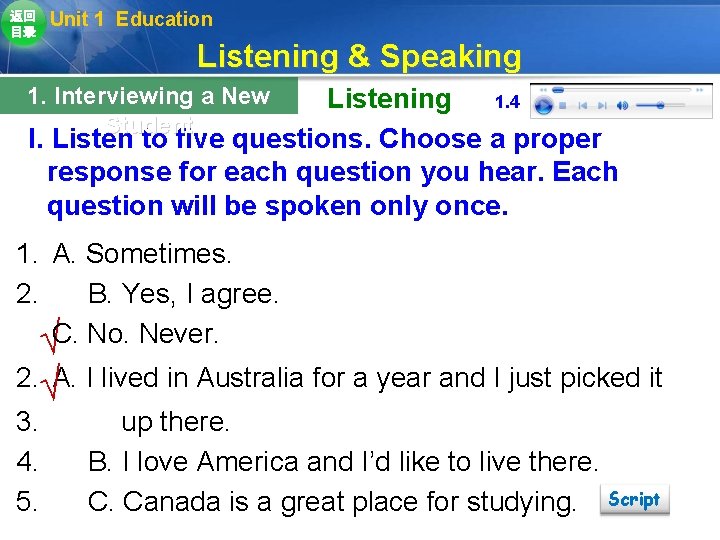
返回 目录 Unit 1 Education Listening & Speaking 1. Interviewing a New Student 1. 4 Listening I. Listen to five questions. Choose a proper response for each question you hear. Each question will be spoken only once. 1. A. Sometimes. 2. B. Yes, I agree. √C. No. Never. 2. √A. I lived in Australia for a year and I just picked it 3. 4. 5. up there. B. I love America and I’d like to live there. C. Canada is a great place for studying. Script
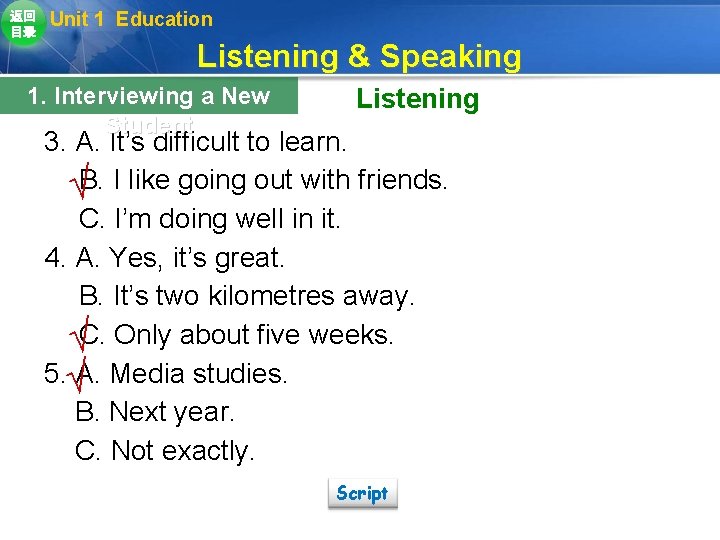
返回 目录 Unit 1 Education Listening & Speaking 1. Interviewing a New Student Listening 3. A. It’s difficult to learn. √B. I like going out with friends. C. I’m doing well in it. 4. A. Yes, it’s great. B. It’s two kilometres away. √C. Only about five weeks. 5. √A. Media studies. B. Next year. C. Not exactly. Script
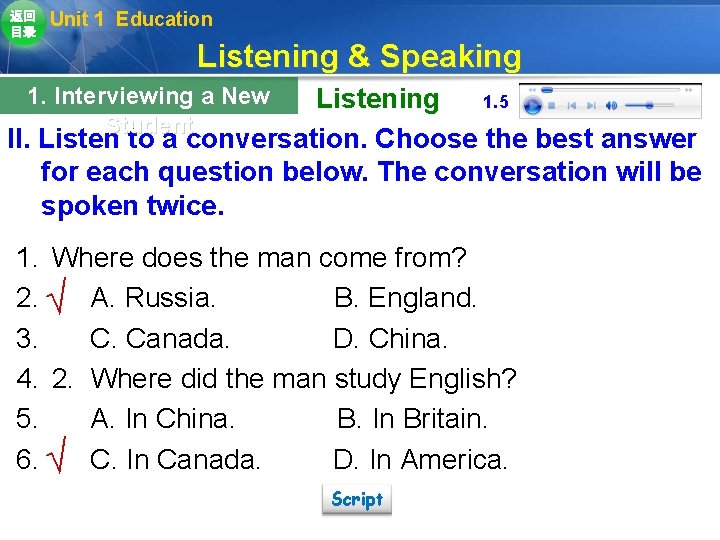
返回 目录 Unit 1 Education Listening & Speaking 1. Interviewing a New Student 1. 5 Listening II. Listen to a conversation. Choose the best answer for each question below. The conversation will be spoken twice. 1. Where does the man come from? 2. √ A. Russia. B. England. 3. C. Canada. D. China. 4. 2. Where did the man study English? 5. A. In China. B. In Britain. 6. √ C. In Canada. D. In America. Script
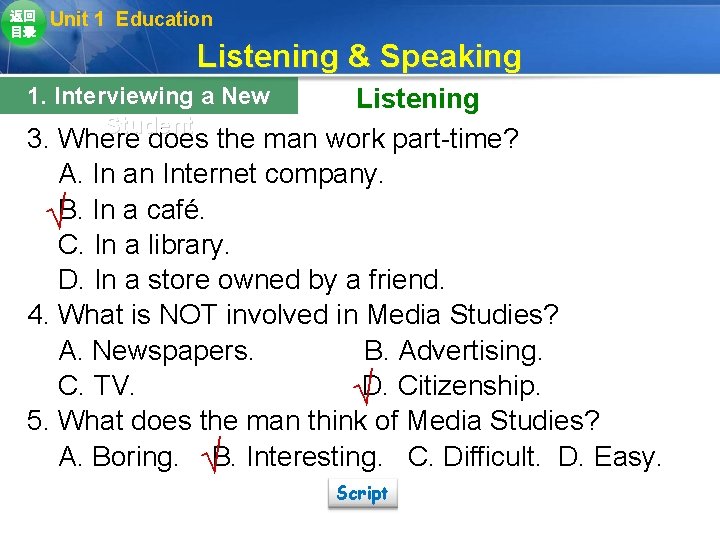
返回 目录 Unit 1 Education Listening & Speaking 1. Interviewing a New Student Listening 3. Where does the man work part-time? A. In an Internet company. √B. In a café. C. In a library. D. In a store owned by a friend. 4. What is NOT involved in Media Studies? A. Newspapers. B. Advertising. C. TV. √D. Citizenship. 5. What does the man think of Media Studies? A. Boring. √B. Interesting. C. Difficult. D. Easy. Script
返回 目录 Unit 1 Education Listening & Speaking 1. Interviewing a New Student Native Speaker English In English, people often say I’m really into instead of I really like. . . I am really into surfing the Internet.
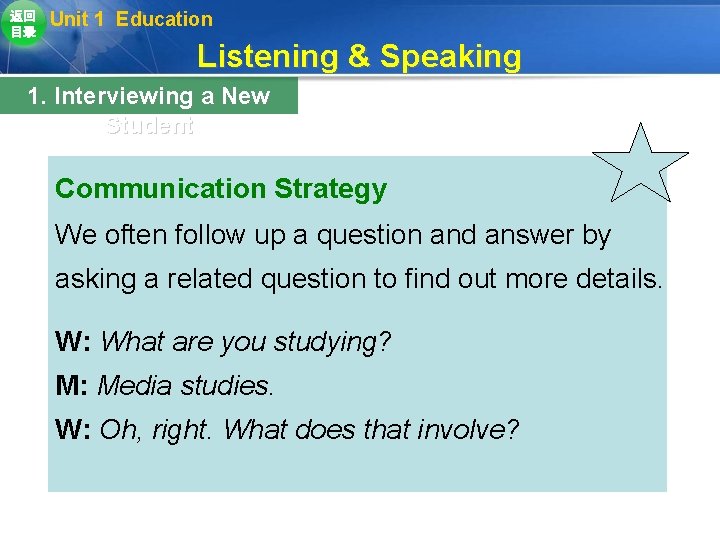
返回 目录 Unit 1 Education Listening & Speaking 1. Interviewing a New Student Communication Strategy We often follow up a question and answer by asking a related question to find out more details. W: What are you studying? M: Media studies. W: Oh, right. What does that involve?
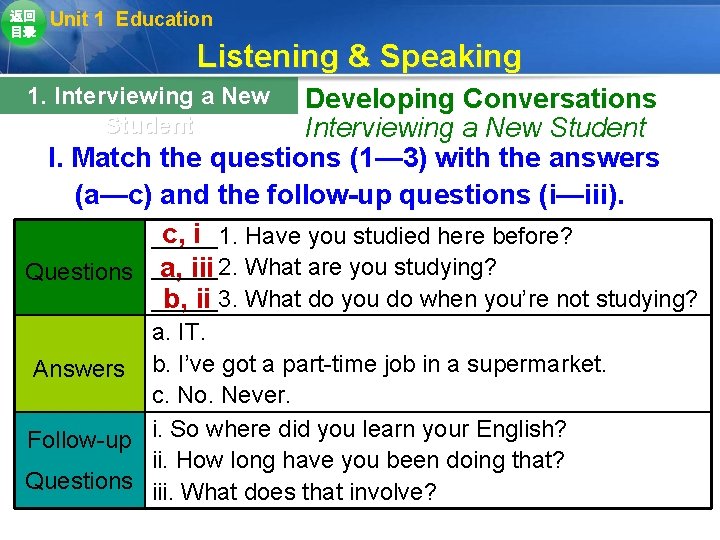
返回 目录 Unit 1 Education Listening & Speaking 1. Interviewing a New Student Developing Conversations Interviewing a New Student I. Match the questions (1— 3) with the answers (a—c) and the follow-up questions (i—iii). c, i _____1. Have you studied here before? a, iii What are you studying? Questions _____2. _____3. b, ii What do you do when you’re not studying? a. IT. Answers b. I’ve got a part-time job in a supermarket. c. No. Never. Follow-up i. So where did you learn your English? ii. How long have you been doing that? Questions iii. What does that involve?
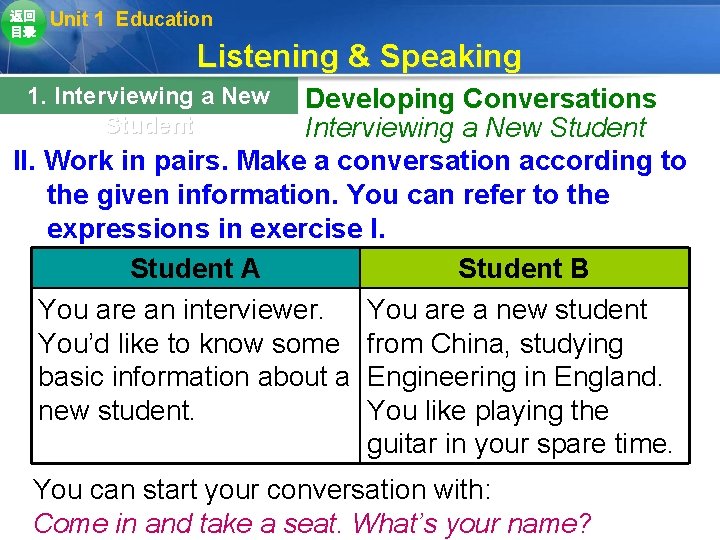
返回 目录 Unit 1 Education Listening & Speaking 1. Interviewing a New Student Developing Conversations Interviewing a New Student II. Work in pairs. Make a conversation according to the given information. You can refer to the expressions in exercise I. Student A Student B You are an interviewer. You are a new student You’d like to know some from China, studying basic information about a Engineering in England. new student. You like playing the guitar in your spare time. You can start your conversation with: Come in and take a seat. What’s your name?
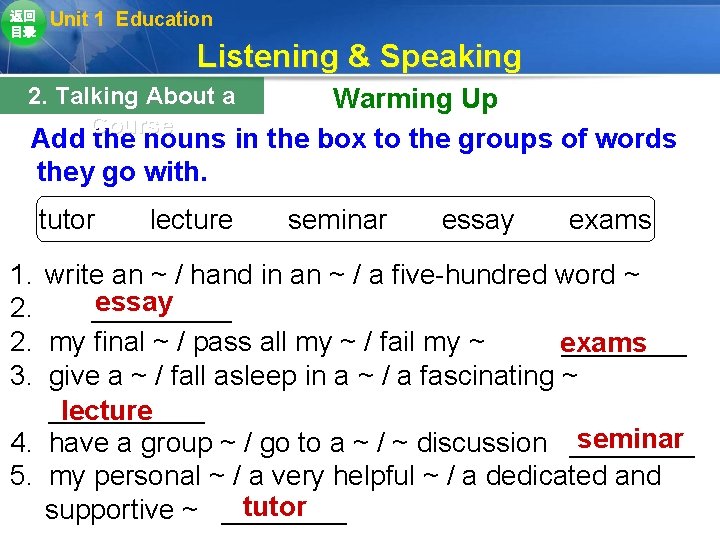
返回 目录 Unit 1 Education Listening & Speaking 2. Talking About a Course Warming Up Add the nouns in the box to the groups of words they go with. tutor lecture seminar essay exams 1. write an ~ / hand in an ~ / a five-hundred word ~ essay 2. _____ 2. my final ~ / pass all my ~ / fail my ~ ____ exams 3. give a ~ / fall asleep in a ~ / a fascinating ~ _____ lecture seminar 4. have a group ~ / go to a ~ / ~ discussion ____ 5. my personal ~ / a very helpful ~ / a dedicated and tutor supportive ~ ____
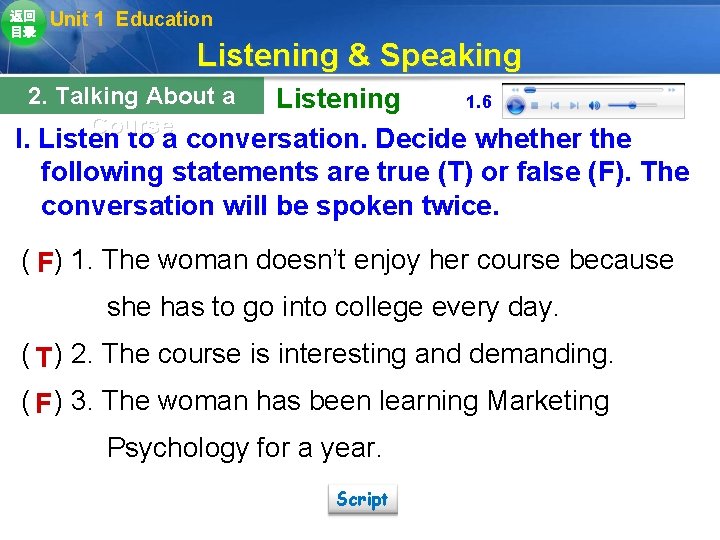
返回 目录 Unit 1 Education Listening & Speaking 2. Talking About a Course 1. 6 Listening I. Listen to a conversation. Decide whether the following statements are true (T) or false (F). The conversation will be spoken twice. ( F) 1. The woman doesn’t enjoy her course because she has to go into college every day. ( T ) 2. The course is interesting and demanding. ( F ) 3. The woman has been learning Marketing Psychology for a year. Script
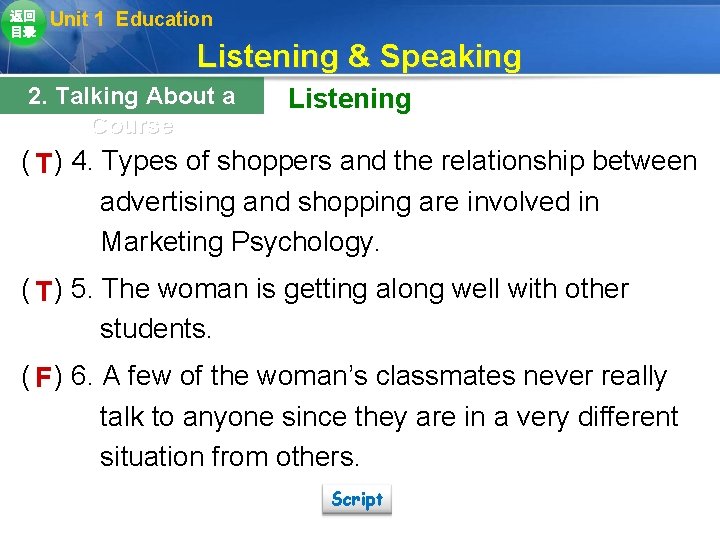
返回 目录 Unit 1 Education Listening & Speaking 2. Talking About a Course Listening ( T ) 4. Types of shoppers and the relationship between advertising and shopping are involved in Marketing Psychology. ( T ) 5. The woman is getting along well with other students. ( F ) 6. A few of the woman’s classmates never really talk to anyone since they are in a very different situation from others. Script
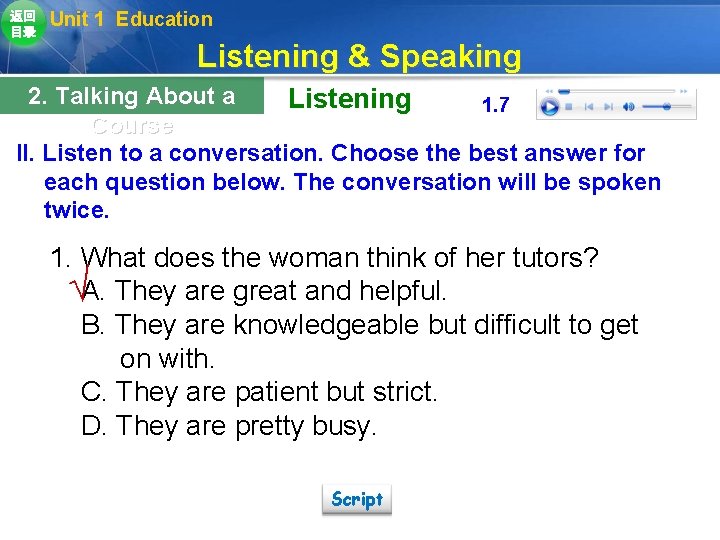
返回 目录 Unit 1 Education Listening & Speaking 2. Talking About a Listening 1. 7 Course II. Listen to a conversation. Choose the best answer for each question below. The conversation will be spoken twice. 1. What does the woman think of her tutors? √A. They are great and helpful. B. They are knowledgeable but difficult to get on with. C. They are patient but strict. D. They are pretty busy. Script
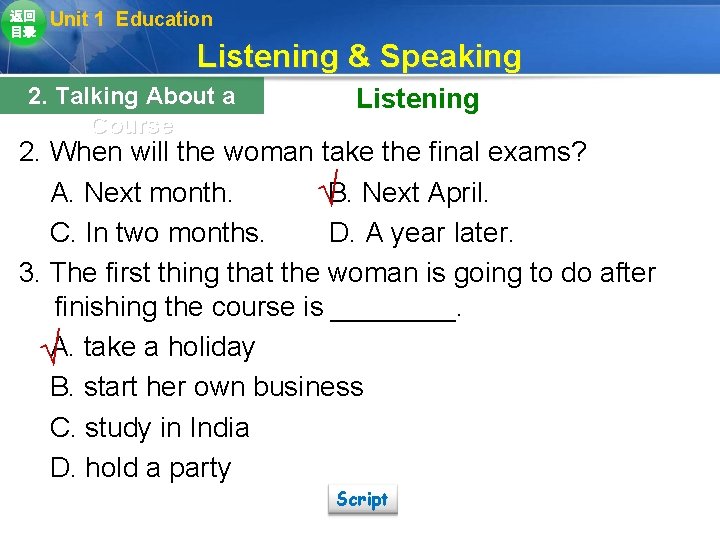
返回 目录 Unit 1 Education Listening & Speaking 2. Talking About a Course Listening 2. When will the woman take the final exams? A. Next month. √B. Next April. C. In two months. D. A year later. 3. The first thing that the woman is going to do after finishing the course is ____. √A. take a holiday B. start her own business C. study in India D. hold a party Script
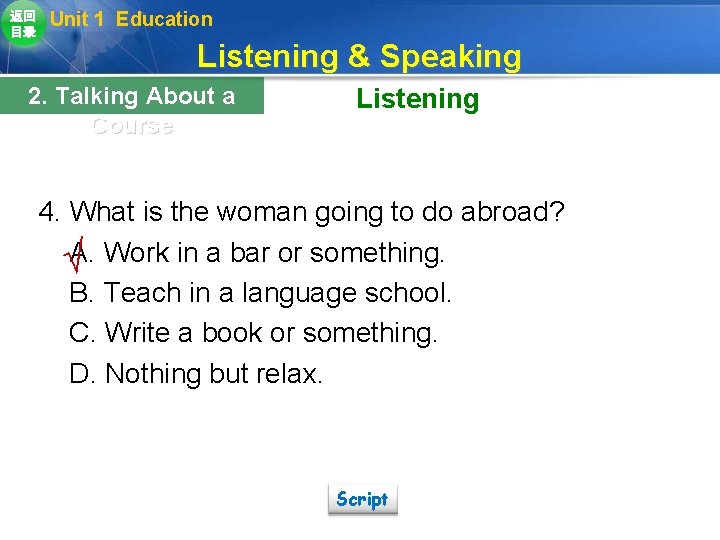
返回 目录 Unit 1 Education Listening & Speaking 2. Talking About a Course Listening 4. What is the woman going to do abroad? √A. Work in a bar or something. B. Teach in a language school. C. Write a book or something. D. Nothing but relax. Script
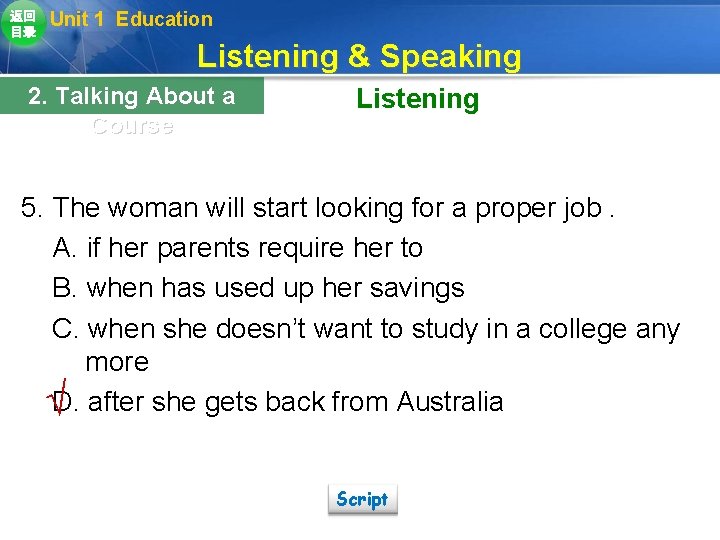
返回 目录 Unit 1 Education Listening & Speaking 2. Talking About a Course Listening 5. The woman will start looking for a proper job. A. if her parents require her to B. when has used up her savings C. when she doesn’t want to study in a college any more √D. after she gets back from Australia Script
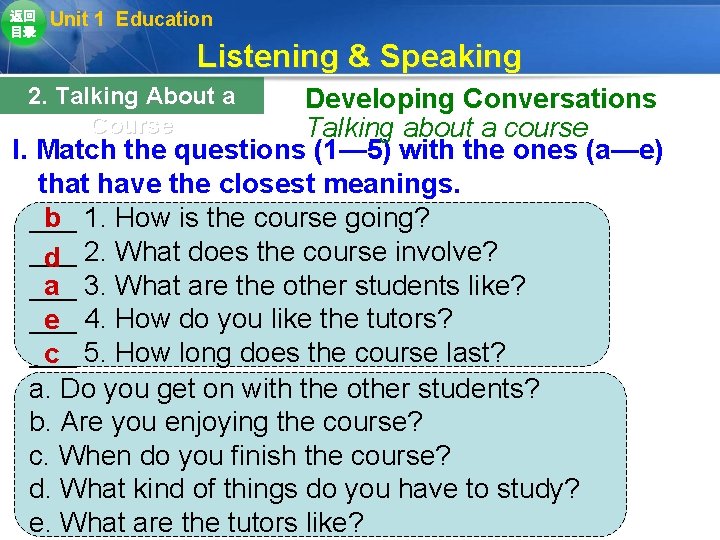
返回 目录 Unit 1 Education Listening & Speaking 2. Talking About a Course Developing Conversations Talking about a course I. Match the questions (1— 5) with the ones (a—e) that have the closest meanings. b 1. How is the course going? ___ d 2. What does the course involve? ___ a 3. What are the other students like? ___ e 4. How do you like the tutors? ___ c 5. How long does the course last? a. Do you get on with the other students? b. Are you enjoying the course? c. When do you finish the course? d. What kind of things do you have to study? e. What are the tutors like?
返回 目录 Unit 1 Education Listening & Speaking 2. Talking About a Course Developing Conversations Talking about a course II. Work in pairs. Talk about a course, using the questions in Exercise I. You can start your conversation with: How is your… course going? Are you enjoying it?
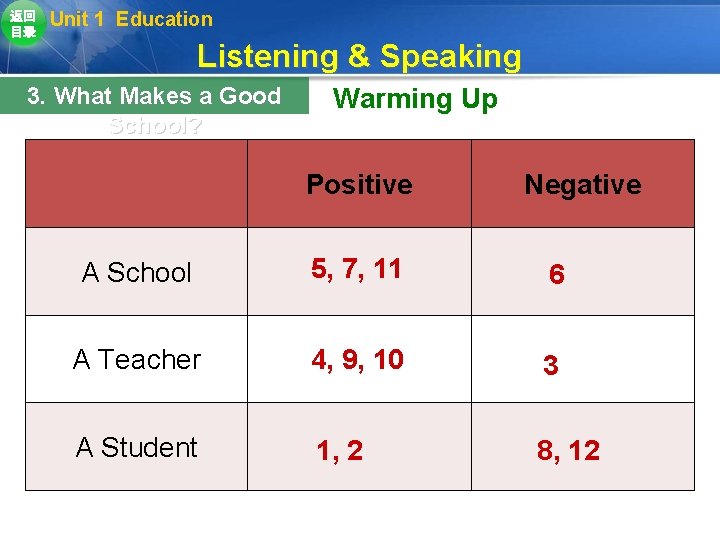
返回 目录 Unit 1 Education Listening & Speaking 3. What Makes a Good School? Warming Up Does each of the following sentences describe a school, a teacher or a student? Are they positive or negative descriptions? Put the numbers into the correct category.
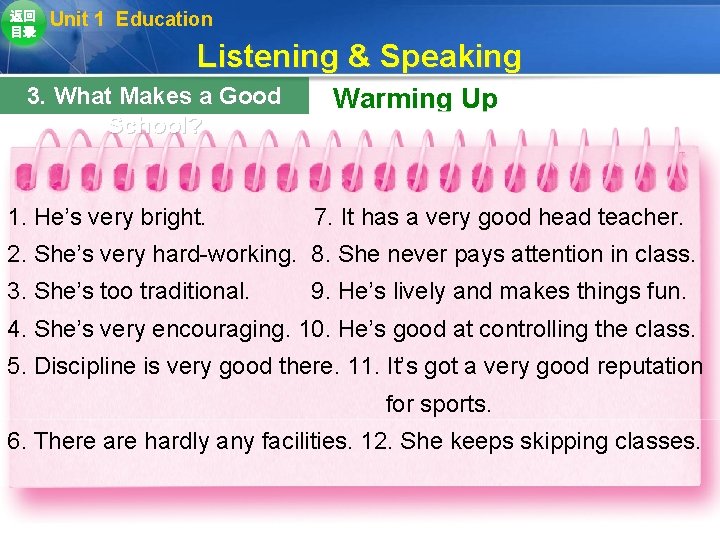
返回 目录 Unit 1 Education Listening & Speaking 3. What Makes a Good School? 1. He’s very bright. Warming Up 7. It has a very good head teacher. 2. She’s very hard-working. 8. She never pays attention in class. 3. She’s too traditional. 9. He’s lively and makes things fun. 4. She’s very encouraging. 10. He’s good at controlling the class. 5. Discipline is very good there. 11. It’s got a very good reputation for sports. 6. There are hardly any facilities. 12. She keeps skipping classes.
返回 目录 Unit 1 Education Listening & Speaking 3. What Makes a Good School? Warming Up Positive Negative A School 5, 7, 11 6 A Teacher 4, 9, 10 3 A Student 1, 2 8, 12
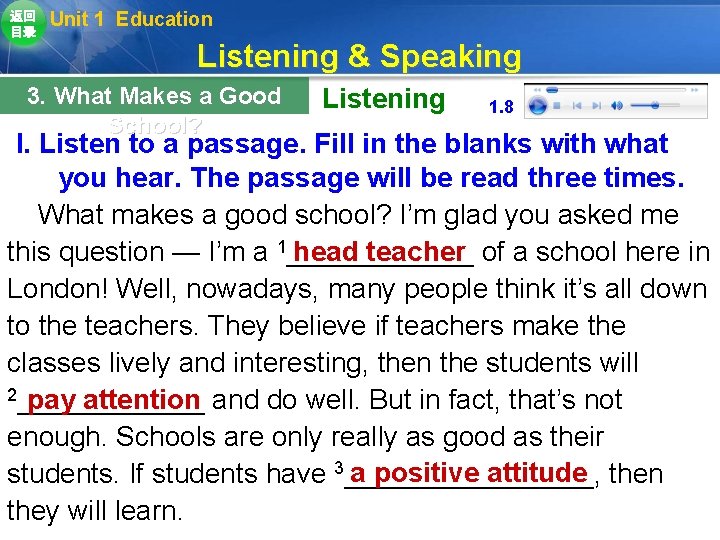
返回 目录 Unit 1 Education Listening & Speaking 3. What Makes a Good School? Listening 1. 8 I. Listen to a passage. Fill in the blanks with what you hear. The passage will be read three times. What makes a good school? I’m glad you asked me this question — I’m a 1______ head teacher of a school here in London! Well, nowadays, many people think it’s all down to the teachers. They believe if teachers make the classes lively and interesting, then the students will 2______ pay attention and do well. But in fact, that’s not enough. Schools are only really as good as their a positive attitude then students. If students have 3________, they will learn.
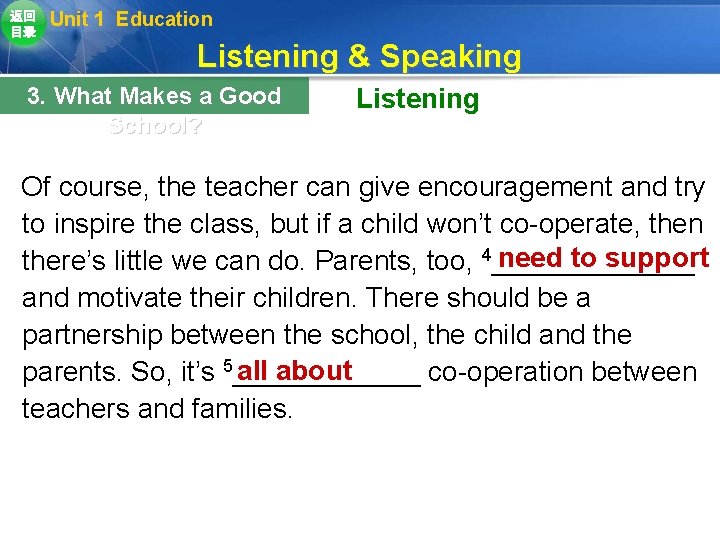
返回 目录 Unit 1 Education Listening & Speaking 3. What Makes a Good School? Listening Of course, the teacher can give encouragement and try to inspire the class, but if a child won’t co-operate, then need to support there’s little we can do. Parents, too, 4_______ and motivate their children. There should be a partnership between the school, the child and the all about parents. So, it’s 5______ co-operation between teachers and families.
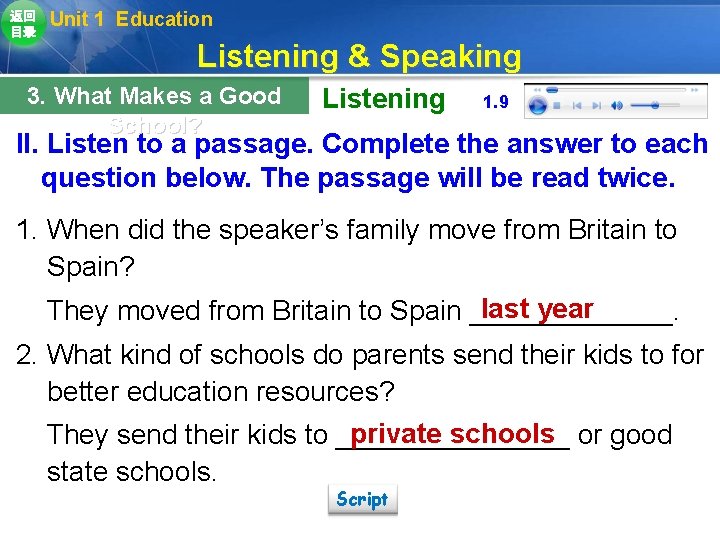
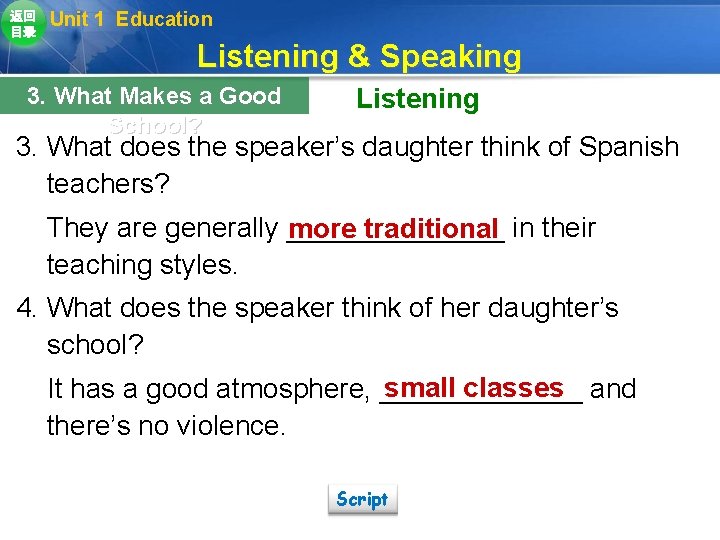
返回 目录 Unit 1 Education Listening & Speaking 3. What Makes a Good School? Listening 1. 9 II. Listen to a passage. Complete the answer to each question below. The passage will be read twice. 1. When did the speaker’s family move from Britain to Spain? last year They moved from Britain to Spain _______. 2. What kind of schools do parents send their kids to for better education resources? private schools or good They send their kids to ________ state schools. Script
返回 目录 Unit 1 Education Listening & Speaking 3. What Makes a Good School? Listening 3. What does the speaker’s daughter think of Spanish teachers? They are generally _______ more traditional in their teaching styles. 4. What does the speaker think of her daughter’s school? small classes and It has a good atmosphere, _______ there’s no violence. Script
返回 目录 Unit 1 Education Listening & Speaking 3. What Makes a Good School? Discussion Work in groups. Discuss the following questions. 1. What is a good student like? 2. What qualities should a good teacher have? 3. What makes a good school?
返回 目录 Unit 1 Education Practical Reading Work in groups. Discuss the following questions. In the Career Planning class at a vocational college, the teacher asks the students to read about the relationship between education and salary.
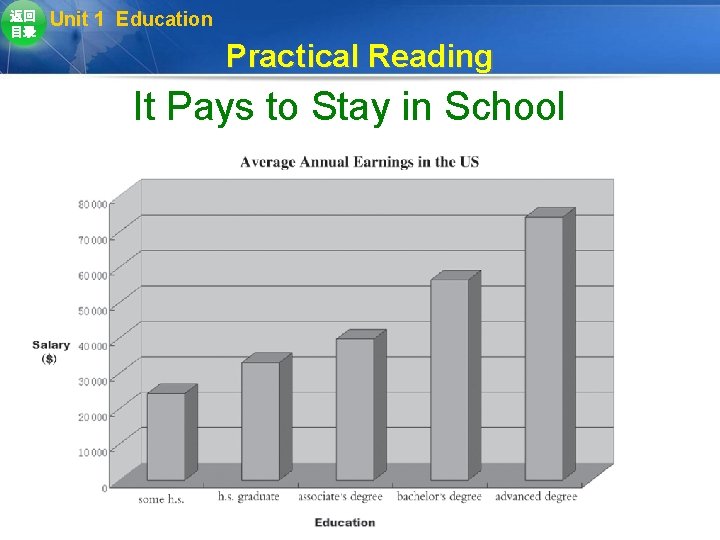
返回 目录 Unit 1 Education Practical Reading It Pays to Stay in School
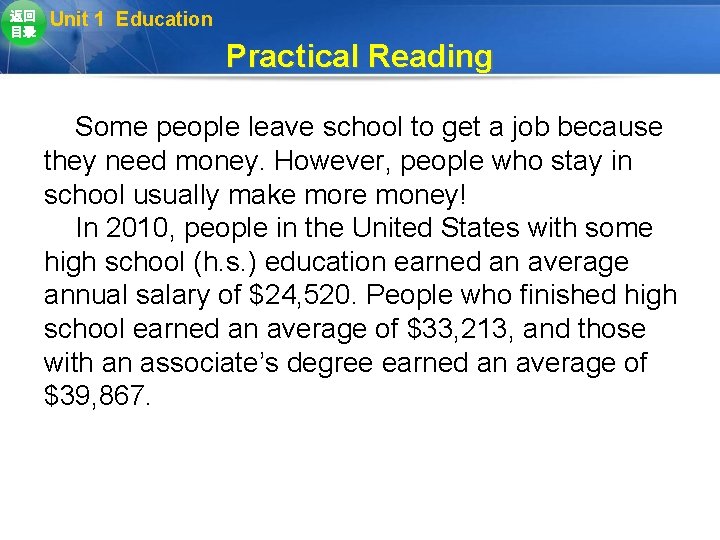
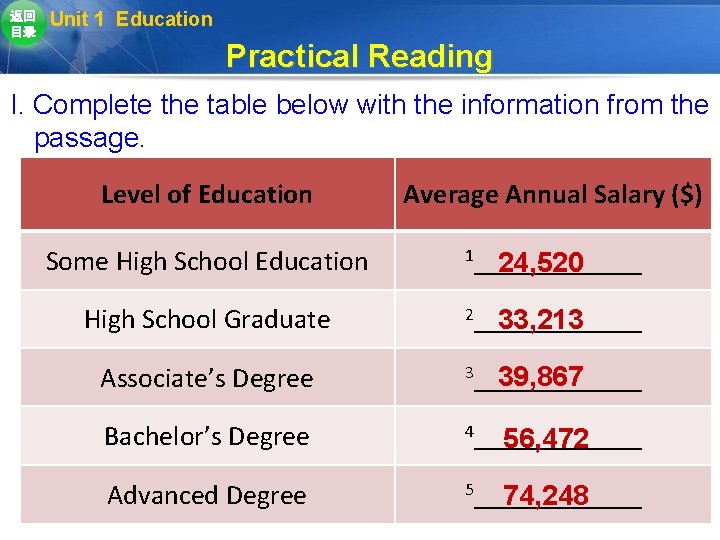
返回 目录 Unit 1 Education Practical Reading Some people leave school to get a job because they need money. However, people who stay in school usually make more money! In 2010, people in the United States with some high school (h. s. ) education earned an average annual salary of $24, 520. People who finished high school earned an average of $33, 213, and those with an associate’s degree earned an average of $39, 867.
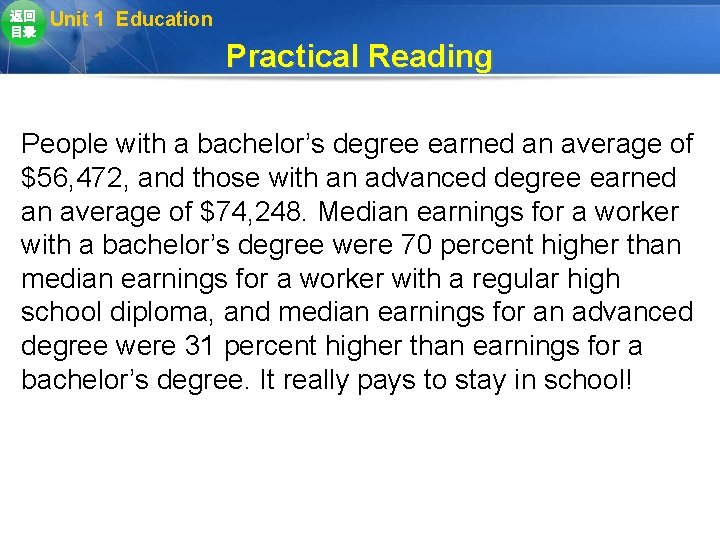
返回 目录 Unit 1 Education Practical Reading People with a bachelor’s degree earned an average of $56, 472, and those with an advanced degree earned an average of $74, 248. Median earnings for a worker with a bachelor’s degree were 70 percent higher than median earnings for a worker with a regular high school diploma, and median earnings for an advanced degree were 31 percent higher than earnings for a bachelor’s degree. It really pays to stay in school!
返回 目录 Unit 1 Education Practical Reading I. Complete the table below with the information from the passage. Level of Education Average Annual Salary ($) Some High School Education 1______ High School Graduate 2______ Associate’s Degree 3______ 39, 867 Bachelor’s Degree 4______ Advanced Degree 5______ 24, 520 33, 213 56, 472 74, 248
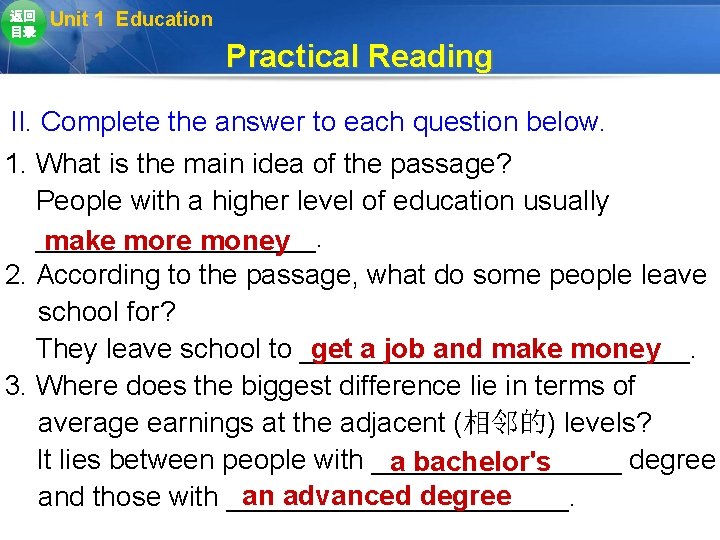
返回 目录 Unit 1 Education Practical Reading II. Complete the answer to each question below. 1. What is the main idea of the passage? People with a higher level of education usually _________. make more money 2. According to the passage, what do some people leave school for? get a job and make money They leave school to _____________. 3. Where does the biggest difference lie in terms of average earnings at the adjacent (相邻的) levels? It lies between people with ________ degree a bachelor's an advanced degree and those with ___________.
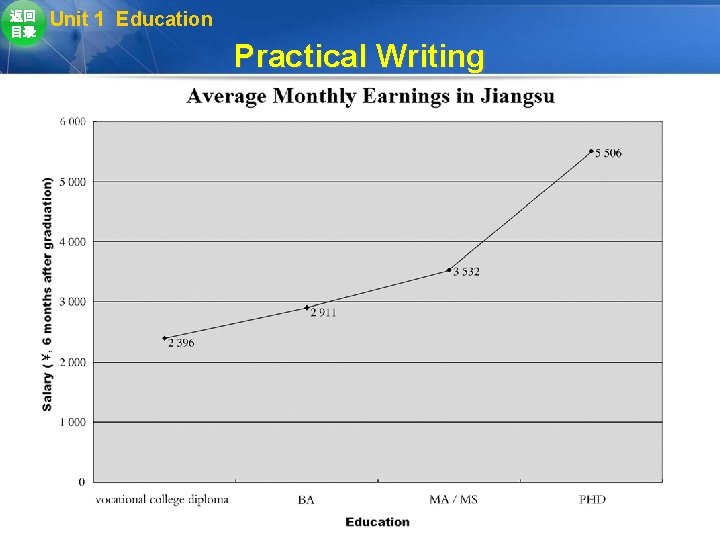
返回 目录 Unit 1 Education Practical Writing The teacher then shows the students a line graph about average earnings in Jiangsu. Complete the description of the following line graph.
返回 目录 Unit 1 Education Practical Writing
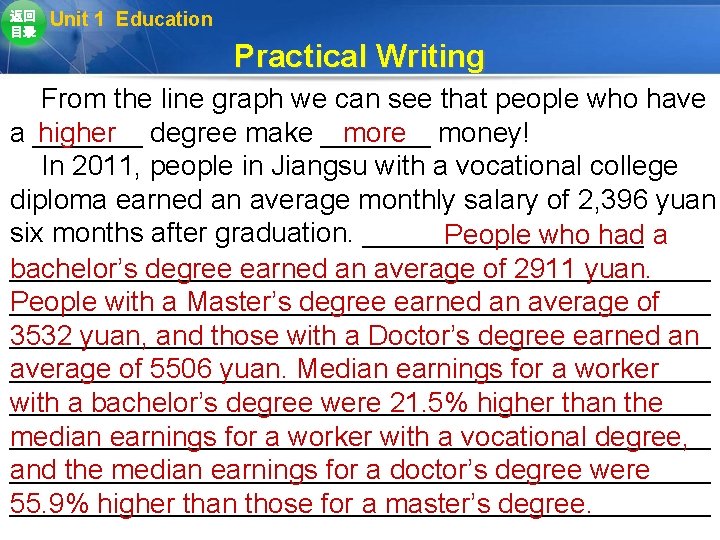
返回 目录 Unit 1 Education Practical Writing From the line graph we can see that people who have a _______ higher degree make _______ more money! In 2011, people in Jiangsu with a vocational college diploma earned an average monthly salary of 2, 396 yuan six months after graduation. _________ People who had a _______________________ bachelor’s degree earned an average of 2911 yuan. _______________________ People with a Master’s degree earned an average of _______________________ 3532 yuan, and those with a Doctor’s degree earned an _______________________ average of 5506 yuan. Median earnings for a worker _______________________ with a bachelor’s degree were 21. 5% higher than the _______________________ median earnings for a worker with a vocational degree, _______________________ and the median earnings for a doctor’s degree were _______________________ 55. 9% higher than those for a master’s degree.
返回 目录 Unit 1 Education Practical Speaking Plans After Graduation Mike is talking with a classmate named Barbara about their plans after graduation. Work in pairs. Complete the conversation below and then role-play it. You may use the information from Practical Reading and Practical Writing.
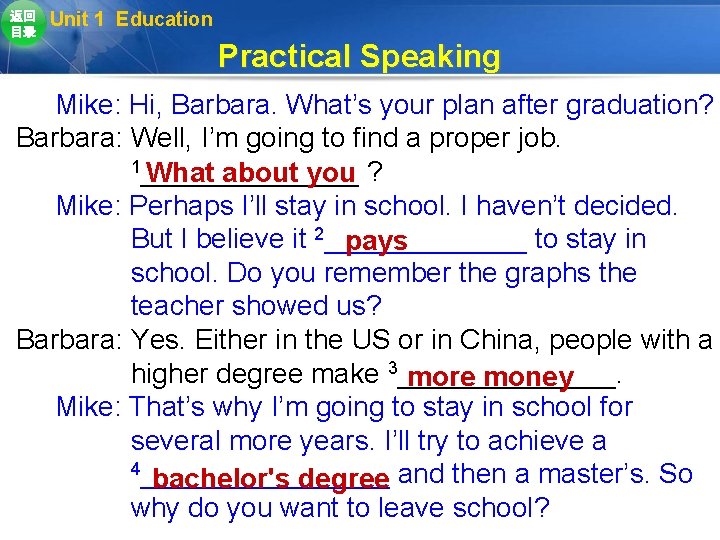
返回 目录 Unit 1 Education Practical Speaking Mike: Hi, Barbara. What’s your plan after graduation? Barbara: Well, I’m going to find a proper job. 1_______ ? What about you Mike: Perhaps I’ll stay in school. I haven’t decided. But I believe it 2_______ to stay in pays school. Do you remember the graphs the teacher showed us? Barbara: Yes. Either in the US or in China, people with a higher degree make 3_______. more money Mike: That’s why I’m going to stay in school for several more years. I’ll try to achieve a 4________ and then a master’s. So bachelor's degree why do you want to leave school?
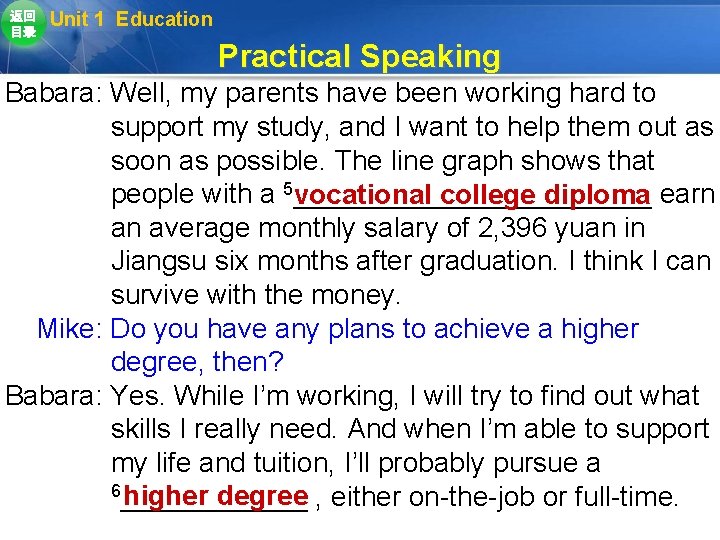
返回 目录 Unit 1 Education Practical Speaking Babara: Well, my parents have been working hard to support my study, and I want to help them out as soon as possible. The line graph shows that people with a 5 vocational ____________ college diploma earn an average monthly salary of 2, 396 yuan in Jiangsu six months after graduation. I think I can survive with the money. Mike: Do you have any plans to achieve a higher degree, then? Babara: Yes. While I’m working, I will try to find out what skills I really need. And when I’m able to support my life and tuition, I’ll probably pursue a 6______ higher degree , either on-the-job or full-time.