Arkansas Department of Education Child Nutrition Unit SY
- Slides: 2
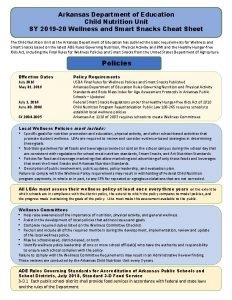
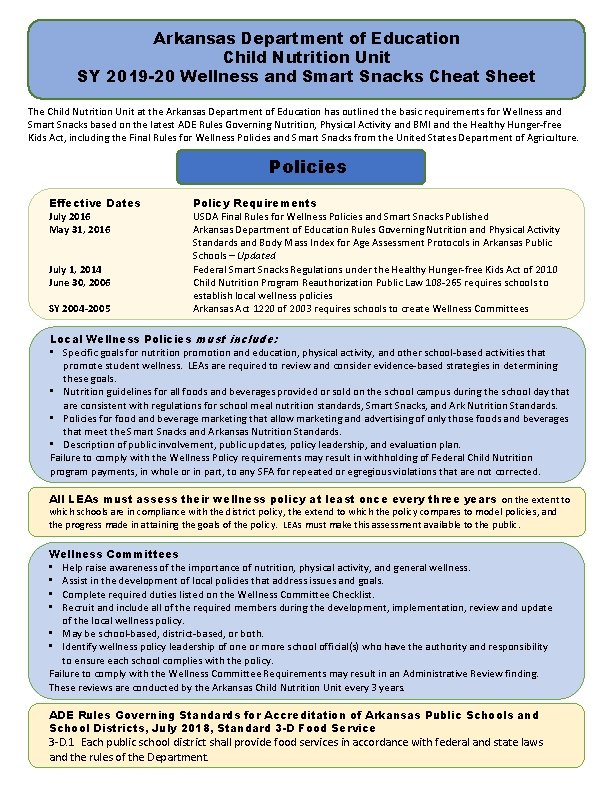
Arkansas Department of Education Child Nutrition Unit SY 2019 -20 Wellness and Smart Snacks Cheat Sheet The Child Nutrition Unit at the Arkansas Department of Education has outlined the basic requirements for Wellness and Smart Snacks based on the latest ADE Rules Governing Nutrition, Physical Activity and BMI and the Healthy Hunger-free Kids Act, including the Final Rules for Wellness Policies and Smart Snacks from the United States Department of Agriculture. Policies Effective Dates July 2016 May 31, 2016 July 1, 2014 June 30, 2006 SY 2004 -2005 Policy Requirements USDA Final Rules for Wellness Policies and Smart Snacks Published Arkansas Department of Education Rules Governing Nutrition and Physical Activity Standards and Body Mass Index for Age Assessment Protocols in Arkansas Public Schools – Updated Federal Smart Snacks Regulations under the Healthy Hunger-free Kids Act of 2010 Child Nutrition Program Reauthorization Public Law 108 -265 requires schools to establish local wellness policies Arkansas Act 1220 of 2003 requires schools to create Wellness Committees Local Wellness Policies must include: • Specific goals for nutrition promotion and education, physical activity, and other school-based activities that promote student wellness. LEAs are required to review and consider evidence-based strategies in determining these goals. • Nutrition guidelines for all foods and beverages provided or sold on the school campus during the school day that are consistent with regulations for school meal nutrition standards, Smart Snacks, and Ark Nutrition Standards. • Policies for food and beverage marketing that allow marketing and advertising of only those foods and beverages that meet the Smart Snacks and Arkansas Nutrition Standards. • Description of public involvement, public updates, policy leadership, and evaluation plan. Failure to comply with the Wellness Policy requirements may result in withholding of Federal Child Nutrition program payments, in whole or in part, to any SFA for repeated or egregious violations that are not corrected. All LEAs must assess their wellness policy at least once every three years on the extent to which schools are in compliance with the district policy, the extend to which the policy compares to model policies, and the progress made in attaining the goals of the policy. LEAs must make this assessment available to the public. Wellness Committees • Help raise awareness of the importance of nutrition, physical activity, and general wellness. • Assist in the development of local policies that address issues and goals. • Complete required duties listed on the Wellness Committee Checklist. • Recruit and include all of the required members during the development, implementation, review and update of the local wellness policy. • May be school-based, district-based, or both. • Identify wellness policy leadership of one or more school official(s) who have the authority and responsibility to ensure each school complies with the policy. Failure to comply with the Wellness Committee Requirements may result in an Administrative Review finding. These reviews are conducted by the Arkansas Child Nutrition Unit every 3 years. ADE Rules Governing Standards for Accreditation of Arkansas Public Schools and School Districts, July 2018, Standard 3 -D Food Service 3 -D. 1 Each public school district shall provide food services in accordance with federal and state laws and the rules of the Department.
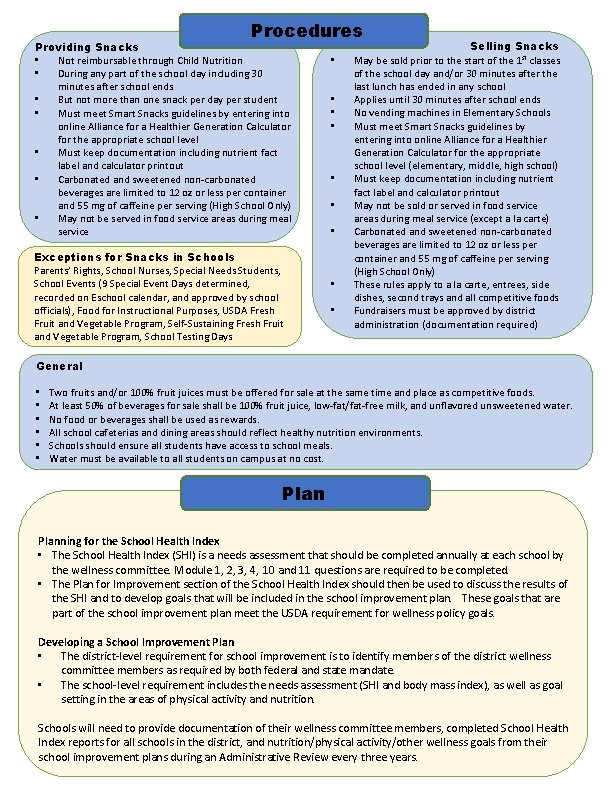
Procedures Providing Snacks • Not reimbursable through Child Nutrition • During any part of the school day including 30 minutes after school ends • But not more than one snack per day per student • Must meet Smart Snacks guidelines by entering into online Alliance for a Healthier Generation Calculator for the appropriate school level • Must keep documentation including nutrient fact label and calculator printout • Carbonated and sweetened non-carbonated beverages are limited to 12 oz or less per container and 55 mg of caffeine per serving (High School Only) • May not be served in food service areas during meal service Exceptions for Snacks in Schools Parents’ Rights, School Nurses, Special Needs Students, School Events (9 Special Event Days determined, recorded on Eschool calendar, and approved by school officials), Food for Instructional Purposes, USDA Fresh Fruit and Vegetable Program, Self-Sustaining Fresh Fruit and Vegetable Program, School Testing Days • • • Selling Snacks May be sold prior to the start of the 1 st classes of the school day and/or 30 minutes after the last lunch has ended in any school Applies until 30 minutes after school ends No vending machines in Elementary Schools Must meet Smart Snacks guidelines by entering into online Alliance for a Healthier Generation Calculator for the appropriate school level (elementary, middle, high school) Must keep documentation including nutrient fact label and calculator printout May not be sold or served in food service areas during meal service (except a la carte) Carbonated and sweetened non-carbonated beverages are limited to 12 oz or less per container and 55 mg of caffeine per serving (High School Only) These rules apply to a la carte, entrees, side dishes, second trays and all competitive foods Fundraisers must be approved by district administration (documentation required) General • • • Two fruits and/or 100% fruit juices must be offered for sale at the same time and place as competitive foods. At least 50% of beverages for sale shall be 100% fruit juice, low-fat/fat-free milk, and unflavored unsweetened water. No food or beverages shall be used as rewards. All school cafeterias and dining areas should reflect healthy nutrition environments. Schools should ensure all students have access to school meals. Water must be available to all students on campus at no cost. Planning for the School Health Index • The School Health Index (SHI) is a needs assessment that should be completed annually at each school by the wellness committee. Module 1, 2, 3, 4, 10 and 11 questions are required to be completed. • The Plan for Improvement section of the School Health Index should then be used to discuss the results of the SHI and to develop goals that will be included in the school improvement plan. These goals that are part of the school improvement plan meet the USDA requirement for wellness policy goals. Developing a School Improvement Plan • The district-level requirement for school improvement is to identify members of the district wellness committee members as required by both federal and state mandate. • The school-level requirement includes the needs assessment (SHI and body mass index), as well as goal setting in the areas of physical activity and nutrition. Schools will need to provide documentation of their wellness committee members, completed School Health Index reports for all schools in the district, and nutrition/physical activity/other wellness goals from their school improvement plans during an Administrative Review every three years.