
Tata Steel Education Excellence Programme TEEP Application for

- Slides: 45
Tata Steel Education Excellence Programme (TEEP) Application for ‘Dare To Try’ Award
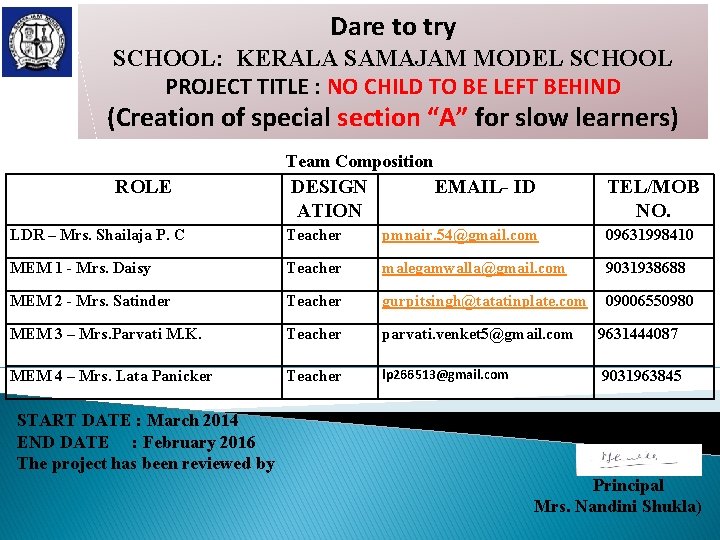
Dare to try SCHOOL: KERALA SAMAJAM MODEL SCHOOL PROJECT TITLE : NO CHILD TO BE LEFT BEHIND (Creation of special section “A” for slow learners) Team Composition ROLE DESIGN ATION EMAIL- ID TEL/MOB NO. LDR – Mrs. Shailaja P. C Teacher pmnair. 54@gmail. com 09631998410 MEM 1 - Mrs. Daisy Teacher malegamwalla@gmail. com 9031938688 MEM 2 - Mrs. Satinder Teacher gurpitsingh@tatatinplate. com 09006550980 MEM 3 – Mrs. Parvati M. K. Teacher parvati. venket 5@gmail. com 9631444087 MEM 4 – Mrs. Lata Panicker Teacher lp 266513@gmail. com 9031963845 START DATE : March 2014 END DATE : February 2016 The project has been reviewed by Principal Mrs. Nandini Shukla)
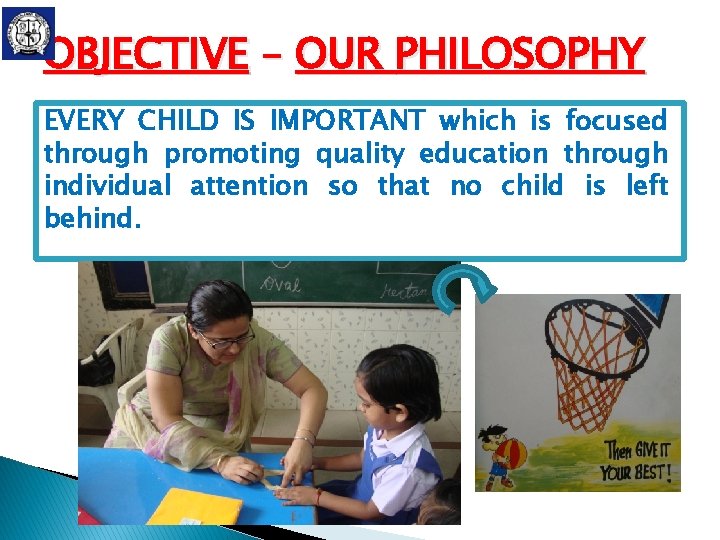
OBJECTIVE – OUR PHILOSOPHY EVERY CHILD IS IMPORTANT which is focused through promoting quality education through individual attention so that no child is left behind.
DEFINING OUR PROJECT � Our project can be defined as the application of new ideas for the children and for the school processes which leads to enhancement of academics as well as skills. � A more fruitful approach is to stimulate bottom up innovation and hence we tapped classes I to V in our teaching learning process.
Why did we select this approach? We wanted the bottom up innovation to: • • Be sustainable Bring together different stake holders Confront difficulties with stake holders Promote open systems Show case best practices Give a voice to teachers Provide room for experiments
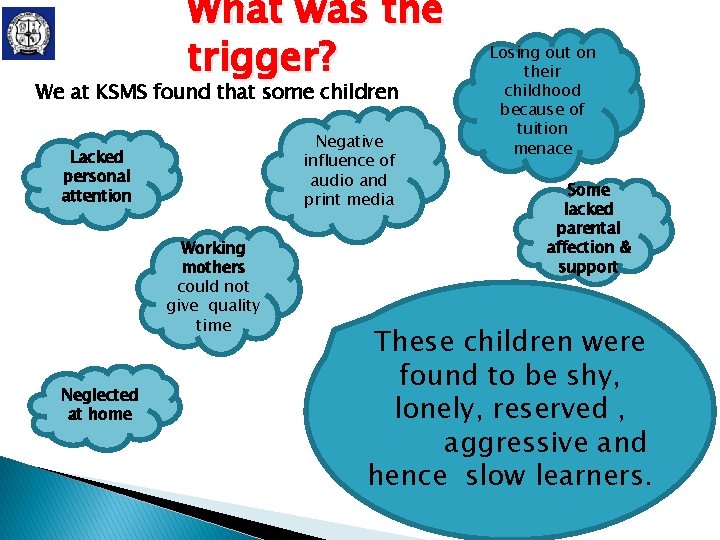
What was the trigger? We at KSMS found that some children Negative influence of audio and print media Lacked personal attention Working mothers could not give quality time Neglected at home Losing out on their childhood because of tuition menace Some lacked parental affection & support These children were found to be shy, lonely, reserved , aggressive and hence slow learners.
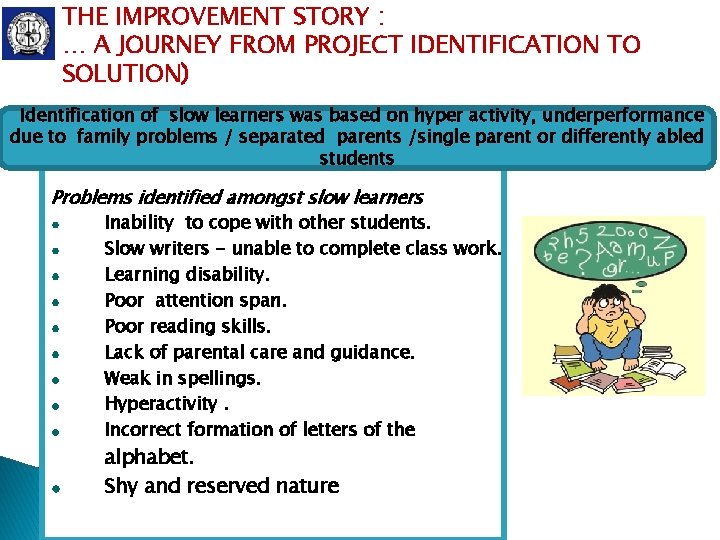
THE IMPROVEMENT STORY : … A JOURNEY FROM PROJECT IDENTIFICATION TO SOLUTION) Identification of slow learners was based on hyper activity, underperformance due to family problems / separated parents /single parent or differently abled students Problems identified amongst slow learners Inability to cope with other students. Slow writers - unable to complete class work. Learning disability. Poor attention span. Poor reading skills. Lack of parental care and guidance. Weak in spellings. Hyperactivity. Incorrect formation of letters of the alphabet. Shy and reserved nature
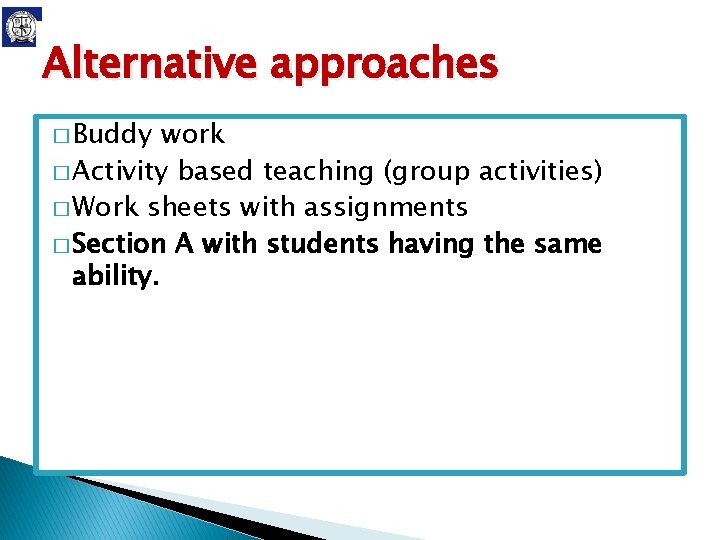
Alternative approaches � Buddy work � Activity based teaching (group activities) � Work sheets with assignments � Section A with students having the same ability.
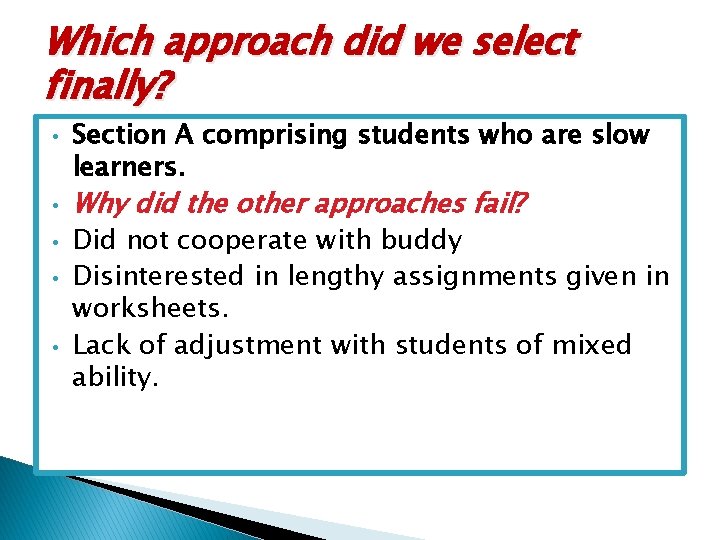
Which approach did we select finally? • • • Section A comprising students who are slow learners. Why did the other approaches fail? Did not cooperate with buddy Disinterested in lengthy assignments given in worksheets. Lack of adjustment with students of mixed ability.
What did we do thereafter? Keeping such children in mind, a Special Section “A” was created with a maximum of 30 students where individual attention could be given to such students to enhance their performance. Section A was chosen because parents have a feeling that section A is considered to be the best. To support this innovation we collaborated with parents who worked with teachers through the project Hum
To enhance overall development of the students. To help identified students perform better. AND WE EMBARKED ON OUR JOURNEY…. .
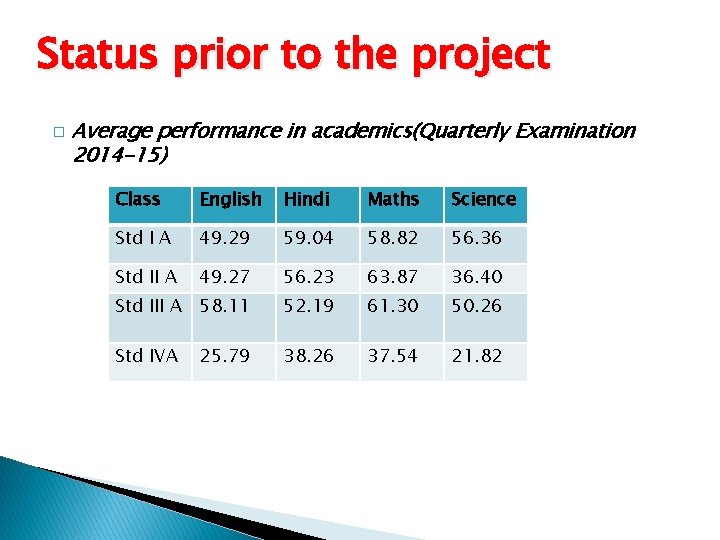
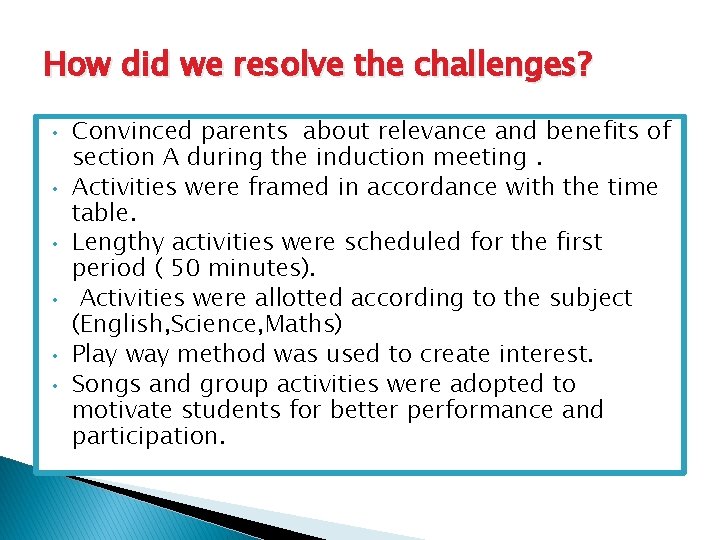
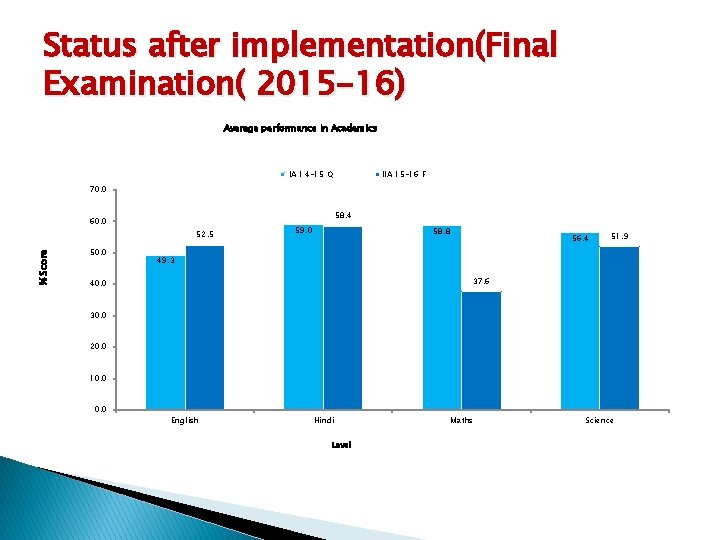
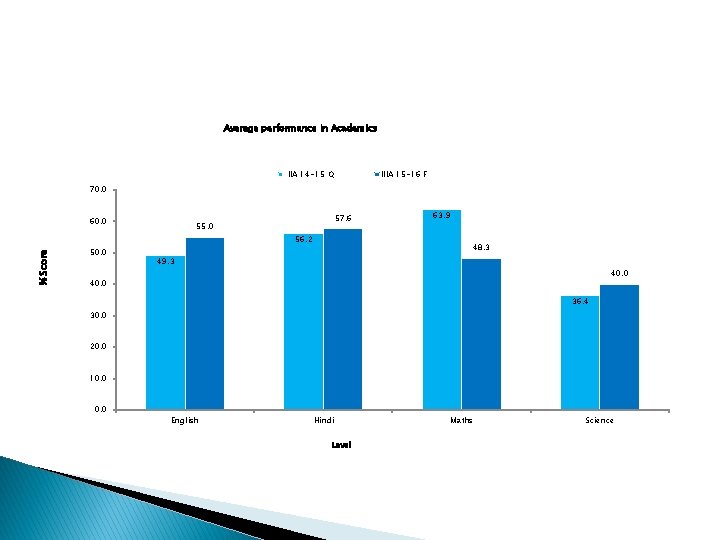
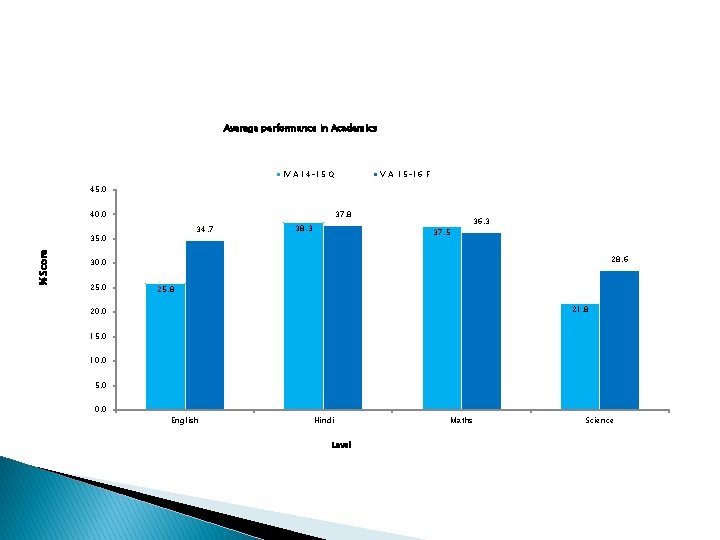
Status prior to the project � Average performance in academics(Quarterly Examination 2014 -15) Class English Hindi Maths Science Std I A 49. 29 59. 04 58. 82 56. 36 Std II A 49. 27 56. 23 63. 87 36. 40 Std III A 58. 11 52. 19 61. 30 50. 26 Std IVA 38. 26 37. 54 21. 82 25. 79
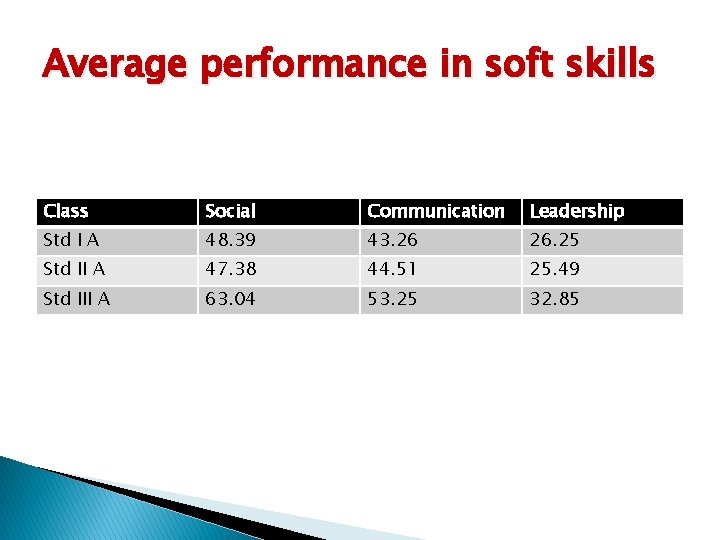
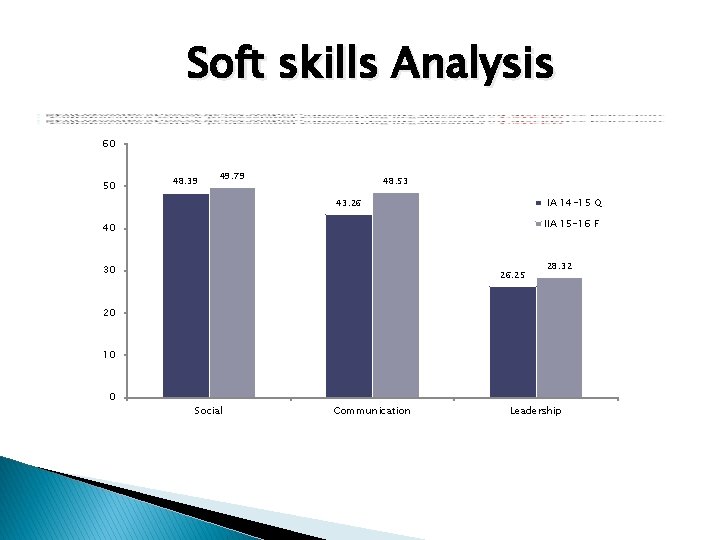
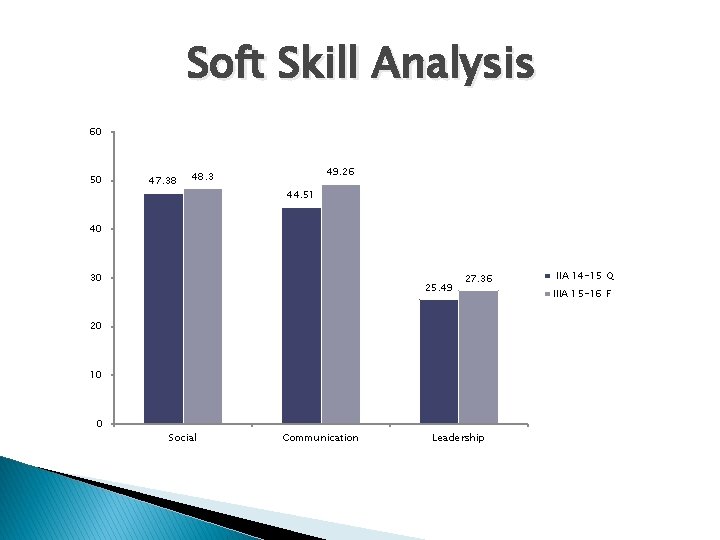
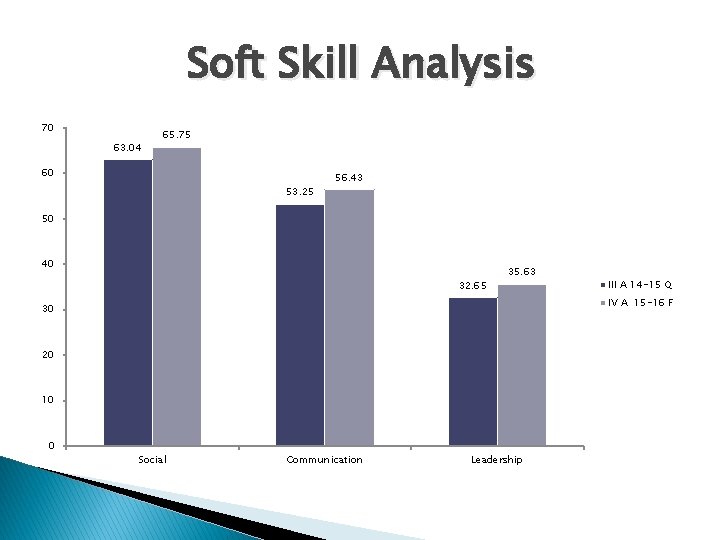
Average performance in soft skills Class Social Communication Leadership Std I A 48. 39 43. 26 26. 25 Std II A 47. 38 44. 51 25. 49 Std III A 63. 04 53. 25 32. 85
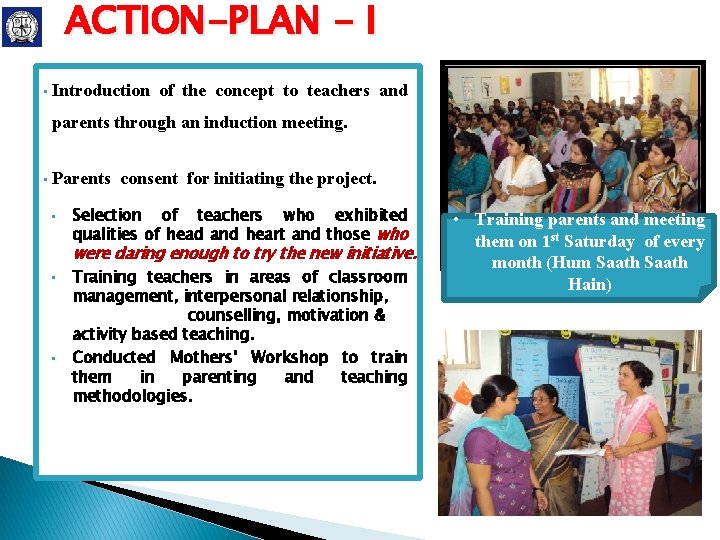
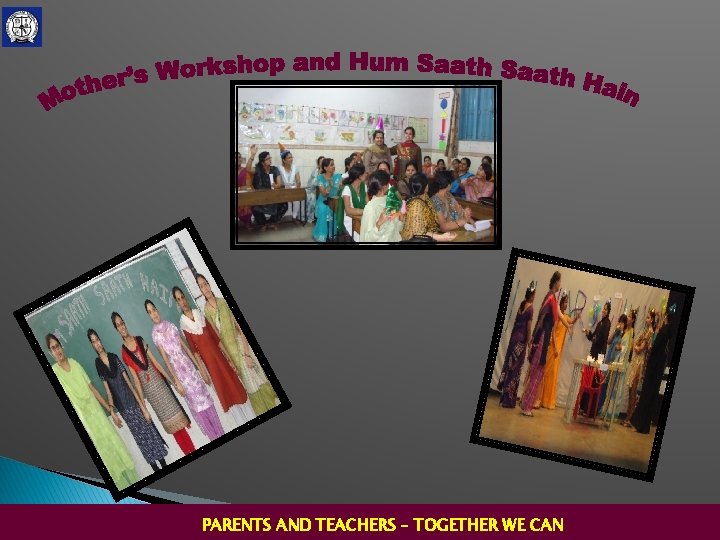
ACTION-PLAN - I • Introduction of the concept to teachers and parents through an induction meeting. • Parents consent for initiating the project. • Selection of teachers who exhibited qualities of head and heart and those who were daring enough to try the new initiative. • • Training teachers in areas of classroom management, interpersonal relationship, counselling, motivation & activity based teaching. Conducted Mothers’ Workshop to train them in parenting and teaching methodologies. • Training parents and meeting them on 1 st Saturday of every month (Hum Saath Hain)
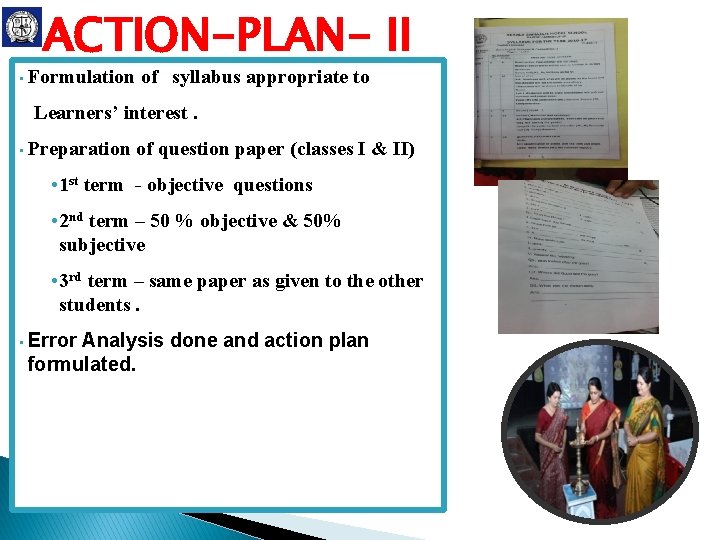
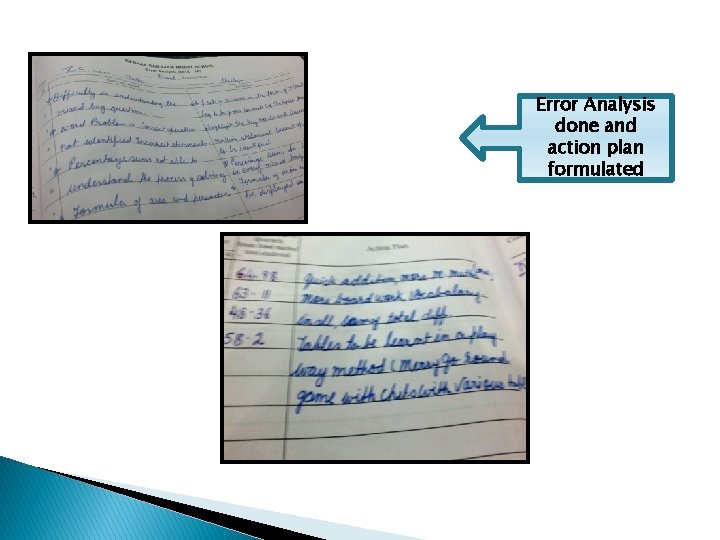
ACTION-PLAN- II • Formulation of syllabus appropriate to Learners’ interest. • Preparation of question paper (classes I & II) • 1 st term - objective questions • 2 nd term – 50 % objective & 50% subjective • 3 rd term – same paper as given to the other students. • Error Analysis done and action plan formulated.
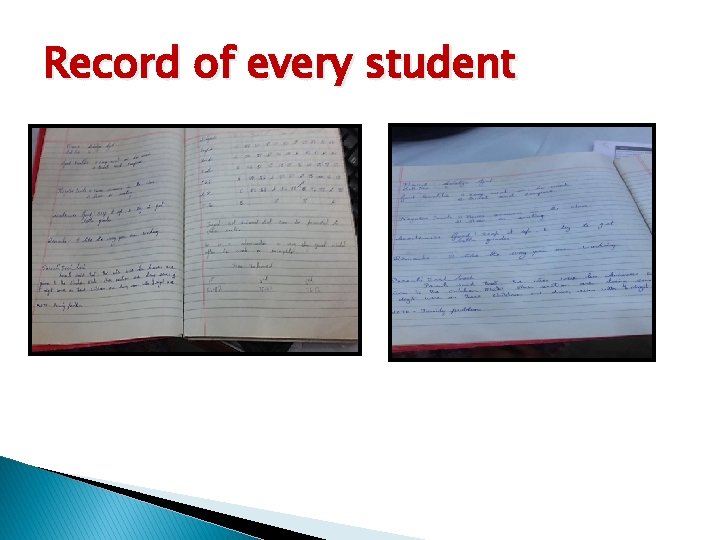
Action Plan III • Skill identification of every student. • Maintenance of records related to ailment , family discord and disruptive behaviour. • Sitting • arrangement in the classroom as per requirement. Collaboration with a professional Counselling organisation - UMEED
Record of every student
Error Analysis done and action plan formulated
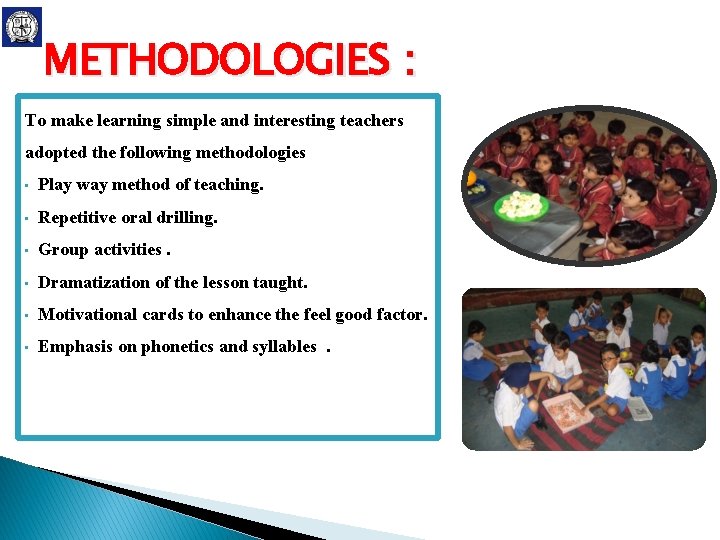
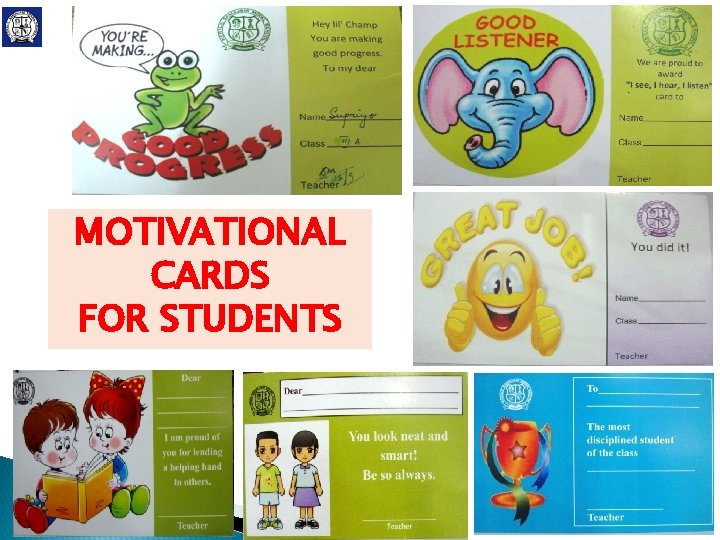
METHODOLOGIES : To make learning simple and interesting teachers adopted the following methodologies • Play way method of teaching. • Repetitive oral drilling. • Group activities. • Dramatization of the lesson taught. • Motivational cards to enhance the feel good factor. • Emphasis on phonetics and syllables.
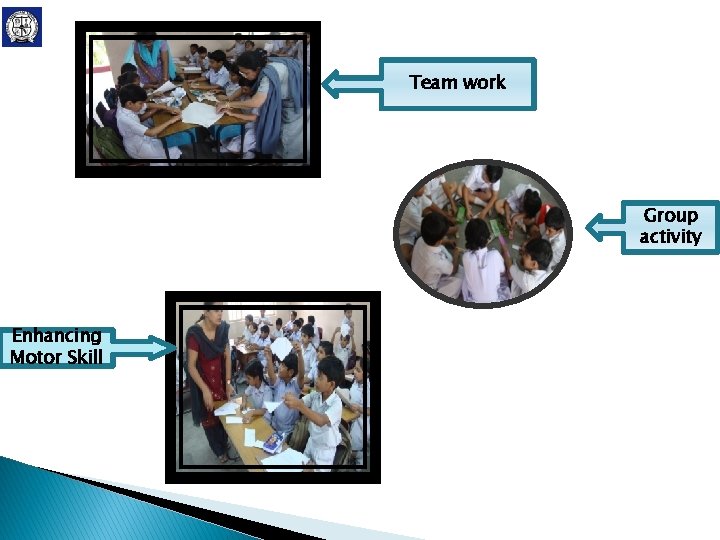
Team work Group activity Enhancing Motor Skill
MOTIVATIONAL CARDS FOR STUDENTS
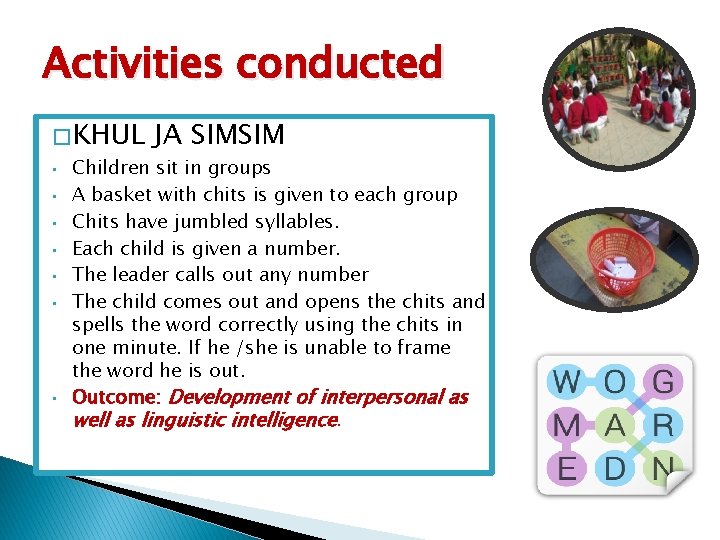
Activities conducted � KHUL • • JA SIMSIM Children sit in groups A basket with chits is given to each group Chits have jumbled syllables. Each child is given a number. The leader calls out any number The child comes out and opens the chits and spells the word correctly using the chits in one minute. If he /she is unable to frame the word he is out. Outcome: Development of interpersonal as well as linguistic intelligence.
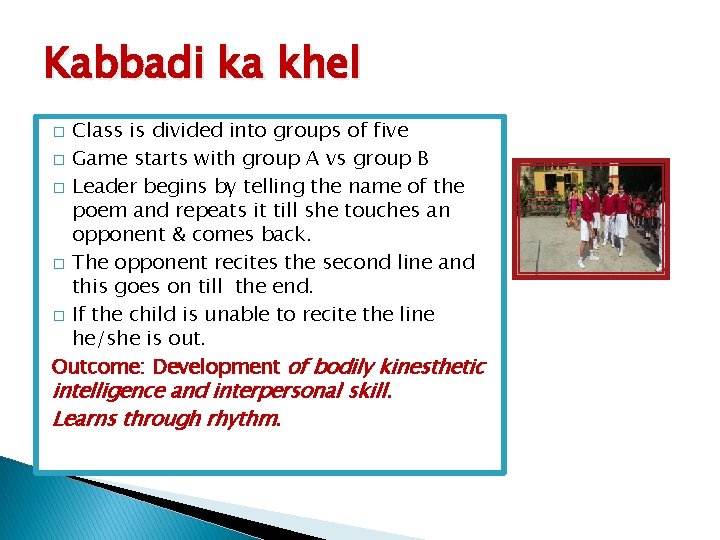
Kabbadi ka khel Class is divided into groups of five � Game starts with group A vs group B � Leader begins by telling the name of the poem and repeats it till she touches an opponent & comes back. � The opponent recites the second line and this goes on till the end. � If the child is unable to recite the line he/she is out. Outcome: Development of bodily kinesthetic � intelligence and interpersonal skill. Learns through rhythm.
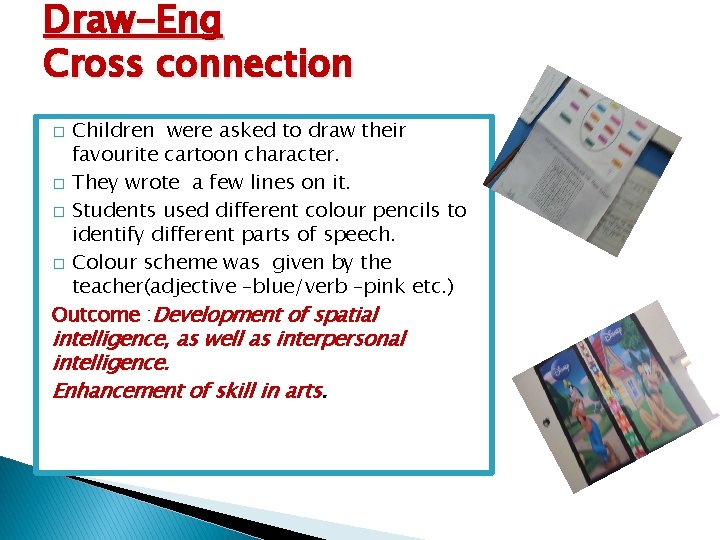
Draw-Eng Cross connection Children were asked to draw their favourite cartoon character. � They wrote a few lines on it. � Students used different colour pencils to identify different parts of speech. � Colour scheme was given by the teacher(adjective –blue/verb –pink etc. ) Outcome : Development of spatial � intelligence, as well as interpersonal intelligence. Enhancement of skill in arts.
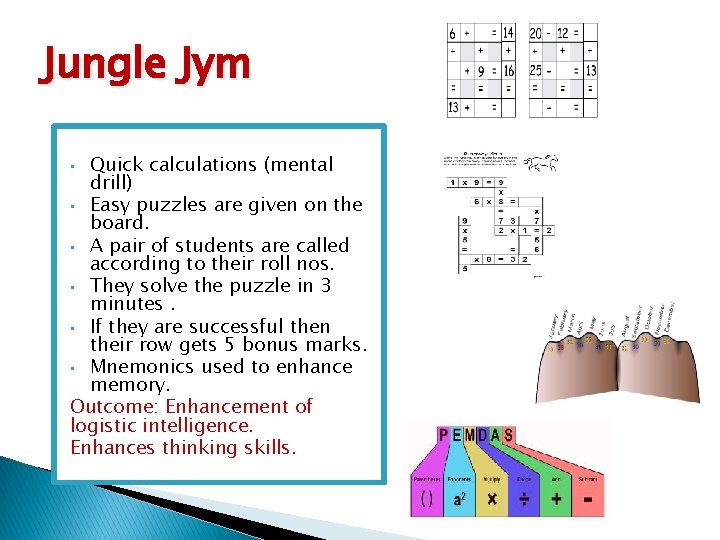
Jungle Jym Quick calculations (mental drill) • Easy puzzles are given on the board. • A pair of students are called according to their roll nos. • They solve the puzzle in 3 minutes. • If they are successful then their row gets 5 bonus marks. • Mnemonics used to enhance memory. Outcome: Enhancement of logistic intelligence. Enhances thinking skills. •
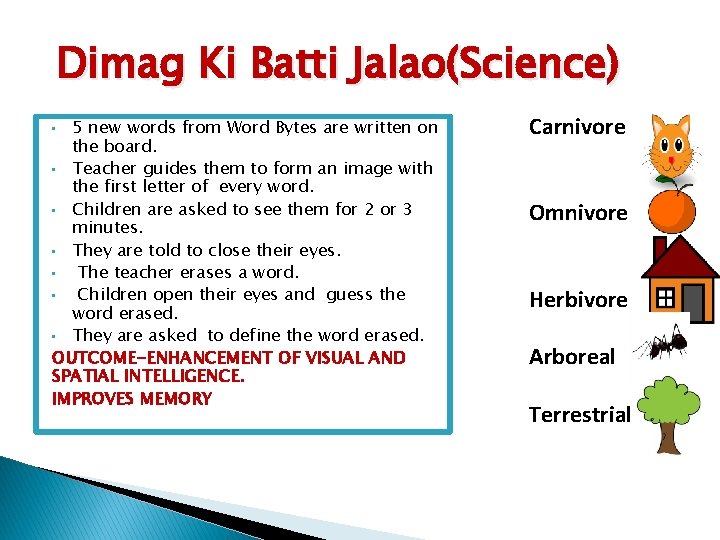
Dimag Ki Batti Jalao(Science) 5 new words from Word Bytes are written on the board. • Teacher guides them to form an image with the first letter of every word. • Children are asked to see them for 2 or 3 minutes. • They are told to close their eyes. • The teacher erases a word. • Children open their eyes and guess the word erased. • They are asked to define the word erased. OUTCOME-ENHANCEMENT OF VISUAL AND SPATIAL INTELLIGENCE. IMPROVES MEMORY • Carnivore Omnivore Herbivore Arboreal Terrestrial
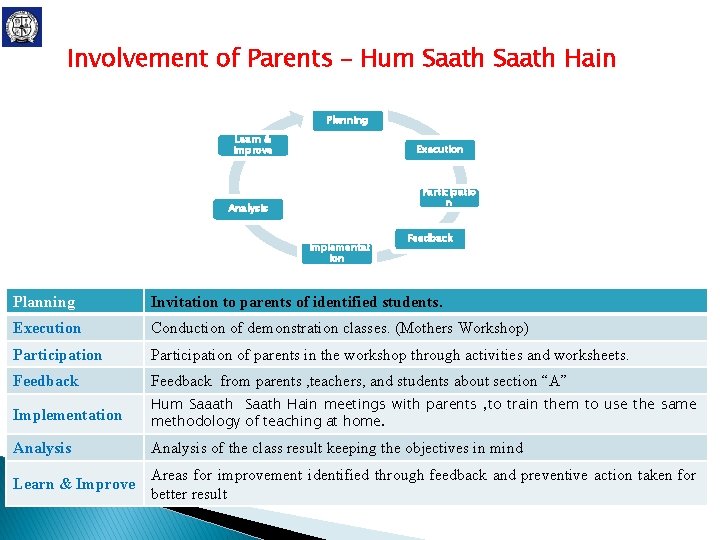
Involvement of Parents – Hum Saath Hain Planning Learn & Improve Execution Participatio n Analysis Implementat ion Feedback Planning Invitation to parents of identified students. Execution Conduction of demonstration classes. (Mothers Workshop) Participation of parents in the workshop through activities and worksheets. Feedback from parents , teachers, and students about section “A” Implementation Hum Saaath Saath Hain meetings with parents , to train them to use the same methodology of teaching at home. Analysis of the class result keeping the objectives in mind Learn & Improve Areas for improvement identified through feedback and preventive action taken for better result
PARENTS AND TEACHERS – TOGETHER WE CAN
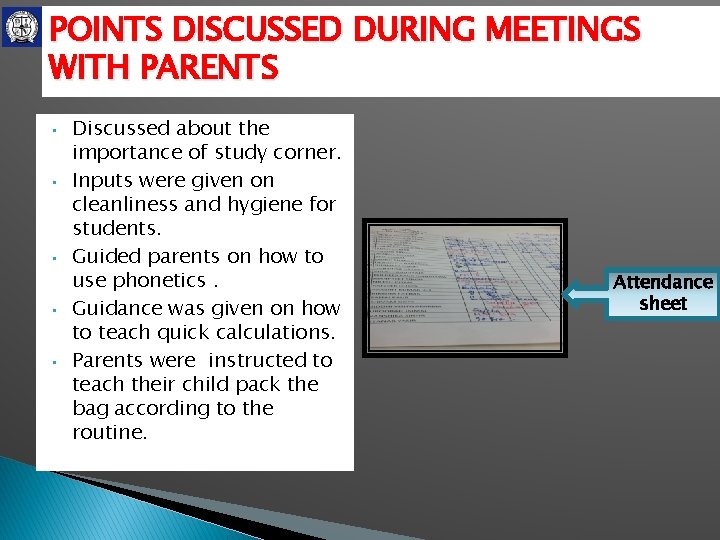
POINTS DISCUSSED DURING MEETINGS WITH PARENTS • • • Discussed about the importance of study corner. Inputs were given on cleanliness and hygiene for students. Guided parents on how to use phonetics. Guidance was given on how to teach quick calculations. Parents were instructed to teach their child pack the bag according to the routine. Attendance sheet
FEEDBACK OF HUM SAATH – SAATH HAIN APPRECIATION : The most co-operative parents were appreciated. PARENTS FEEDBACK: � Few mothers implemented the methods learnt. � Breaking up of words into syllables made learning of spellings easy eg. pea +cock. � Dictation helped children improve spellings and writing. � The idea of study corner was effective. � Awareness of Mental Maths helped mothers teach quick calculations. � Mothers shared time table prepared for their wards. � Parents appreciated the forum HUM SAATH SATH HAIN.
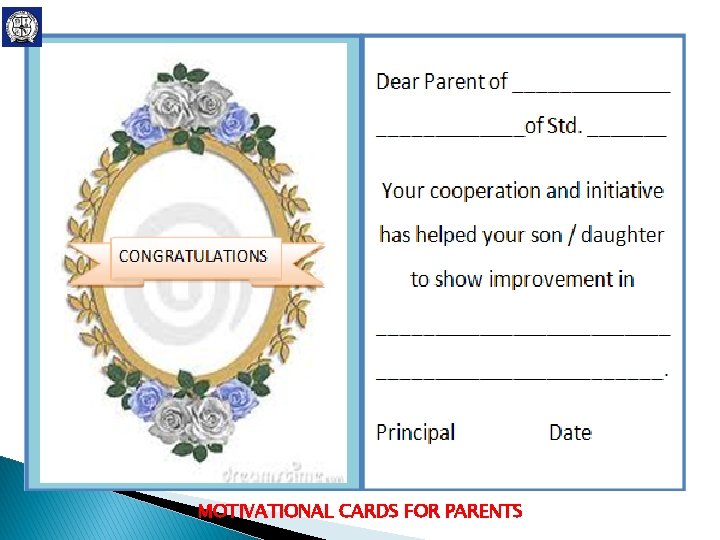
MOTIVATIONAL CARDS FOR PARENTS
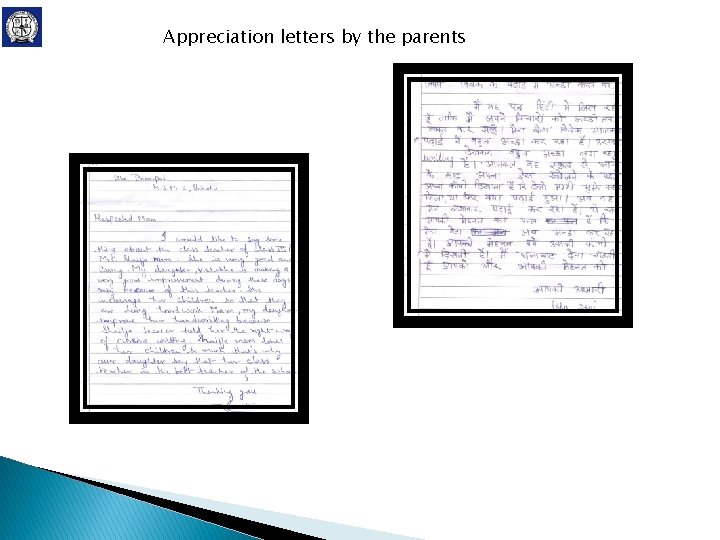
Appreciation letters by the parents
Difficulties/ Challenges faced, How we resolved, Other areas where solution can be implemented? • It was difficult to convince parents to put their child in section A. • Teachers had difficulty to channelize hyper activeness of students into productive learning. • Some activities conducted consumed more time than anticipated.
How did we resolve the challenges? • • • Convinced parents about relevance and benefits of section A during the induction meeting. Activities were framed in accordance with the time table. Lengthy activities were scheduled for the first period ( 50 minutes). Activities were allotted according to the subject (English, Science, Maths) Play way method was used to create interest. Songs and group activities were adopted to motivate students for better performance and participation.
Status after implementation(Final Examination( 2015 -16) Average performance in Academics IA 14 -15 Q IIA 15 -16 F 70. 0 58. 4 60. 0 % Score 52. 5 50. 0 59. 0 58. 8 56. 4 51. 9 49. 3 37. 6 40. 0 30. 0 20. 0 10. 0 English Hindi Level Maths Science
Average performance in Academics IIA 14 -15 Q IIIA 15 -16 F 70. 0 60. 0 57. 6 55. 0 % Score 56. 2 50. 0 63. 9 48. 3 49. 3 40. 0 36. 4 30. 0 20. 0 10. 0 English Hindi Level Maths Science
Average performance in Academics III A 14 -15 Q IV A 15 -16 F 70. 0 % Score 60. 0 61. 3 58. 1 52. 2 50. 0 50. 3 40. 0 36. 3 38. 0 37. 8 30. 4 20. 0 10. 0 English Hindi Level Maths Science
Average performance in Academics IV A 14 -15 Q V A 15 -16 F 45. 0 40. 0 37. 8 34. 7 % Score 35. 0 38. 3 37. 5 36. 3 28. 6 30. 0 25. 8 21. 8 20. 0 15. 0 10. 0 5. 0 0. 0 English Hindi Level Maths Science
Soft skills Analysis 60 50 48. 39 49. 79 48. 53 IA 14 -15 Q 43. 26 IIA 15 -16 F 40 30 26. 25 28. 32 20 10 0 Social Communication Leadership
Soft Skill Analysis 60 50 47. 38 49. 26 48. 3 44. 51 40 30 25. 49 27. 36 20 10 0 Social Communication Leadership IIA 14 -15 Q IIIA 15 -16 F
Soft Skill Analysis 70 63. 04 65. 75 60 53. 25 56. 43 50 40 32. 65 35. 63 IV A 15 -16 F 30 20 10 0 III A 14 -15 Q Social Communication Leadership
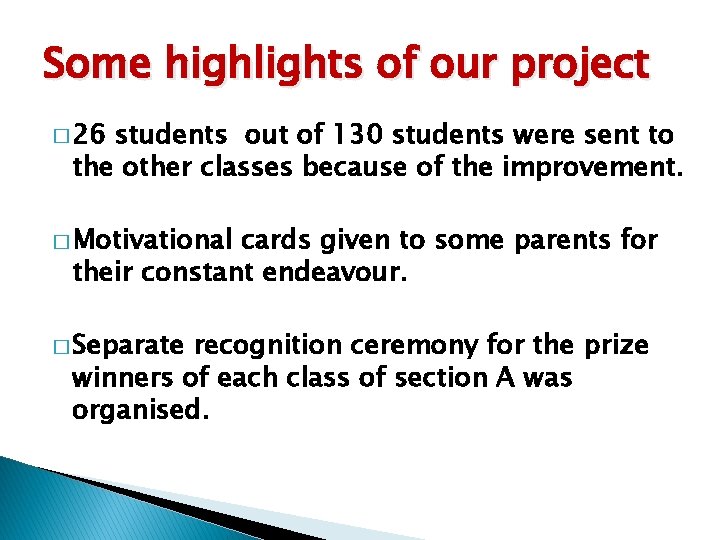
Some highlights of our project � 26 students out of 130 students were sent to the other classes because of the improvement. � Motivational cards given to some parents for their constant endeavour. � Separate recognition ceremony for the prize winners of each class of section A was organised.
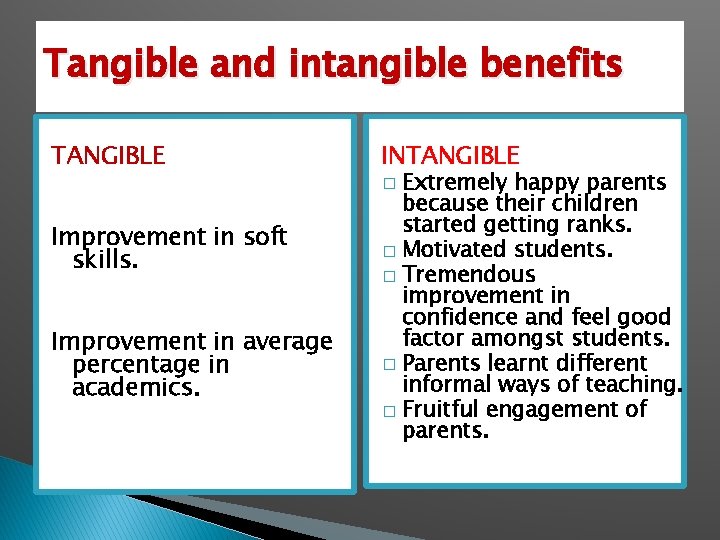
Tangible and intangible benefits TANGIBLE INTANGIBLE Extremely happy parents because their children started getting ranks. � Motivated students. � Tremendous improvement in confidence and feel good factor amongst students. � Parents learnt different informal ways of teaching. � Fruitful engagement of parents. � Improvement in soft skills. Improvement in average percentage in academics.
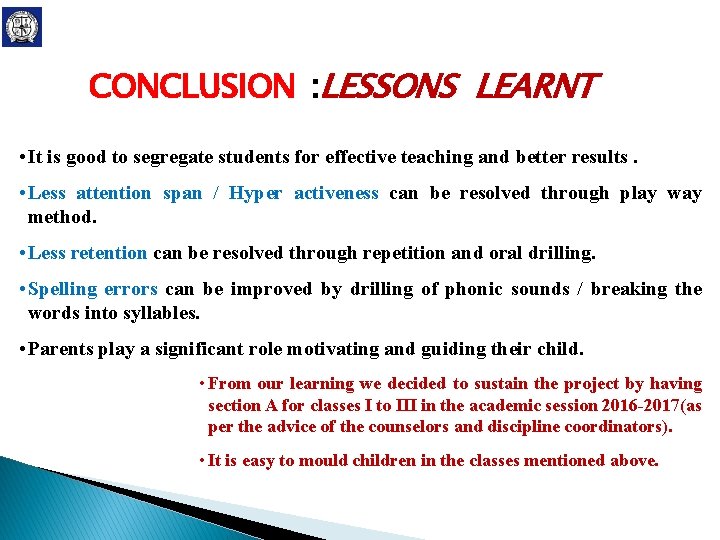
CONCLUSION : LESSONS LEARNT • It is good to segregate students for effective teaching and better results. • Less attention span / Hyper activeness can be resolved through play way method. • Less retention can be resolved through repetition and oral drilling. • Spelling errors can be improved by drilling of phonic sounds / breaking the words into syllables. • Parents play a significant role motivating and guiding their child. • From our learning we decided to sustain the project by having section A for classes I to III in the academic session 2016 -2017(as per the advice of the counselors and discipline coordinators). • It is easy to mould children in the classes mentioned above.
To dare to be different today allows you to be extraordinary tomorrow. Thank You