Warm Up Discuss the school education system in

- Slides: 19
Warm Up Discuss the school education system in Viet Nam: - Level of education - School system - National curriculum - School year - Exam
Unit 4 School Education System Period 1: Reading Class: 12 A 4 Teacher: Nguyễn Thị Huyền Trang
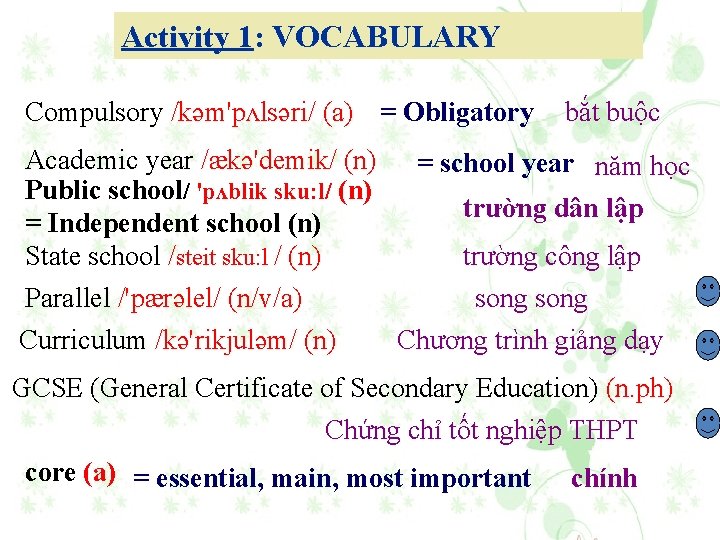
Activity 1: VOCABULARY Compulsory /kəm'pʌlsəri/ (a) = Obligatory bắt buộc Academic year /ækə'demik/ (n) = school year năm học Public school/ 'pʌblik sku: l/ (n) trường dân lập = Independent school (n) State school /steit sku: l / (n) trường công lập Parallel /'pærəlel/ (n/v/a) song Curriculum /kə'rikjuləm/ (n) Chương trình giảng dạy GCSE (General Certificate of Secondary Education) (n. ph) Chứng chỉ tốt nghiệp THPT core (a) = essential, main, most important chính
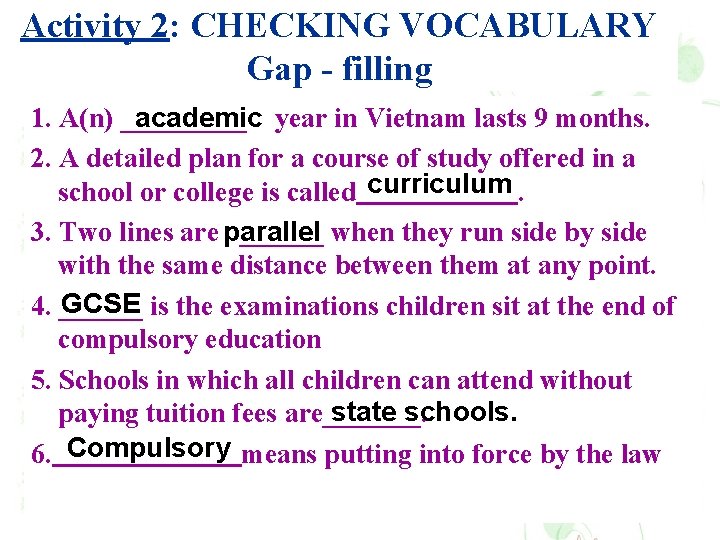
Activity 2: CHECKING VOCABULARY Gap - filling 1. A(n) _____ academic year in Vietnam lasts 9 months. 2. A detailed plan for a course of study offered in a school or college is called curriculum. 3. Two lines are parallel ______ when they run side by side with the same distance between them at any point. GCSE is the examinations children sit at the end of 4. ______ compulsory education 5. Schools in which all children can attend without state schools. paying tuition fees are_______. 6. Compulsory means putting into force by the law
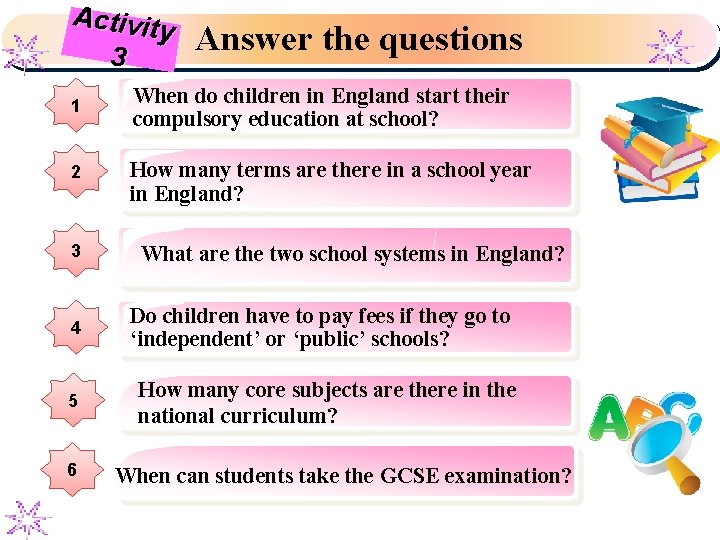
Activity 3 1 2 3 4 5 6 Answer the questions When do children in England start their compulsory education at school? How many terms are there in a school year in England? What are the two school systems in England? Do children have to pay fees if they go to ‘independent’ or ‘public’ schools? How many core subjects are there in the national curriculum? When can students take the GCSE examination?
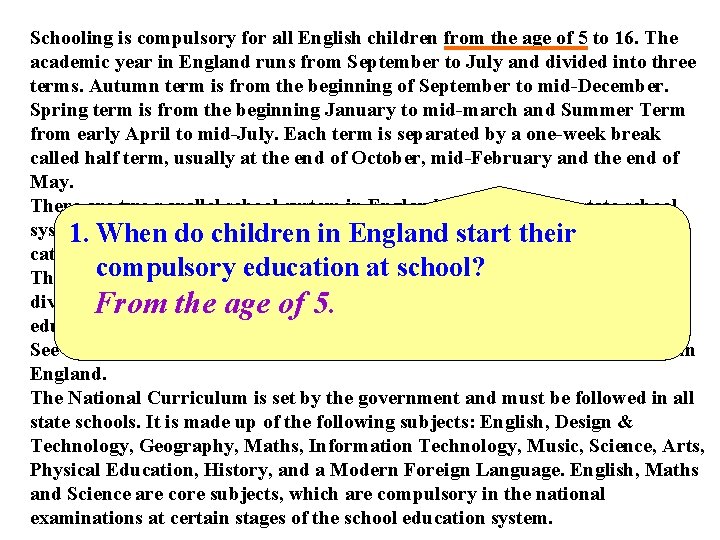
Schooling is compulsory for all English children from the age of 5 to 16. The academic year in England runs from September to July and divided into three terms. Autumn term is from the beginning of September to mid-December. Spring term is from the beginning January to mid-march and Summer Term from early April to mid-July. Each term is separated by a one-week break called half term, usually at the end of October, mid-February and the end of May. There are two parallel school system in England. The first is the state school system, which is free all Students paid by the state. The second 1. When do for children in and England start their category is the ‘independent’ or ‘public’ school system, which is fee-paying. compulsory education at school? The state school system, which educate 93% of the pupils in England, can be divided into two levels of education: Primary education and secondary education. See the table below for more information about the school education system in England. The National Curriculum is set by the government and must be followed in all state schools. It is made up of the following subjects: English, Design & Technology, Geography, Maths, Information Technology, Music, Science, Arts, Physical Education, History, and a Modern Foreign Language. English, Maths and Science are core subjects, which are compulsory in the national examinations at certain stages of the school education system. From the age of 5.
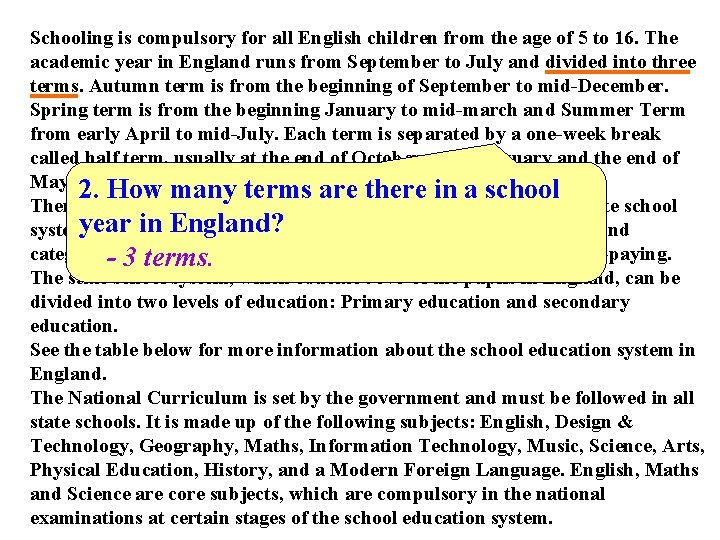
Schooling is compulsory for all English children from the age of 5 to 16. The academic year in England runs from September to July and divided into three terms. Autumn term is from the beginning of September to mid-December. Spring term is from the beginning January to mid-march and Summer Term from early April to mid-July. Each term is separated by a one-week break called half term, usually at the end of October, mid-February and the end of May. 2. How many terms are there in a school There are two parallel school system in England. The first is the state school year system, whichinis England? free for all Students and paid by the state. The second category -is 3 theterms. ‘independent’ or ‘public’ school system, which is fee-paying. The state school system, which educate 93% of the pupils in England, can be divided into two levels of education: Primary education and secondary education. See the table below for more information about the school education system in England. The National Curriculum is set by the government and must be followed in all state schools. It is made up of the following subjects: English, Design & Technology, Geography, Maths, Information Technology, Music, Science, Arts, Physical Education, History, and a Modern Foreign Language. English, Maths and Science are core subjects, which are compulsory in the national examinations at certain stages of the school education system.
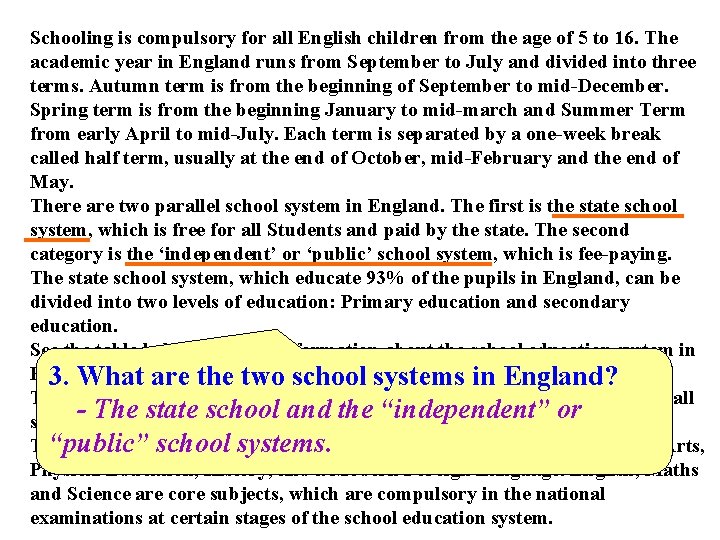
Schooling is compulsory for all English children from the age of 5 to 16. The academic year in England runs from September to July and divided into three terms. Autumn term is from the beginning of September to mid-December. Spring term is from the beginning January to mid-march and Summer Term from early April to mid-July. Each term is separated by a one-week break called half term, usually at the end of October, mid-February and the end of May. There are two parallel school system in England. The first is the state school system, which is free for all Students and paid by the state. The second category is the ‘independent’ or ‘public’ school system, which is fee-paying. The state school system, which educate 93% of the pupils in England, can be divided into two levels of education: Primary education and secondary education. See the table below for more information about the school education system in England. 3. What are the two school systems in England? The National Curriculum is set by the government and must be followed in all - The state school and the “independent” or & state schools. It is made up of the following subjects: English, Design Technology, Maths, Information Technology, Music, Science, Arts, “public”Geography, school systems. Physical Education, History, and a Modern Foreign Language. English, Maths and Science are core subjects, which are compulsory in the national examinations at certain stages of the school education system.
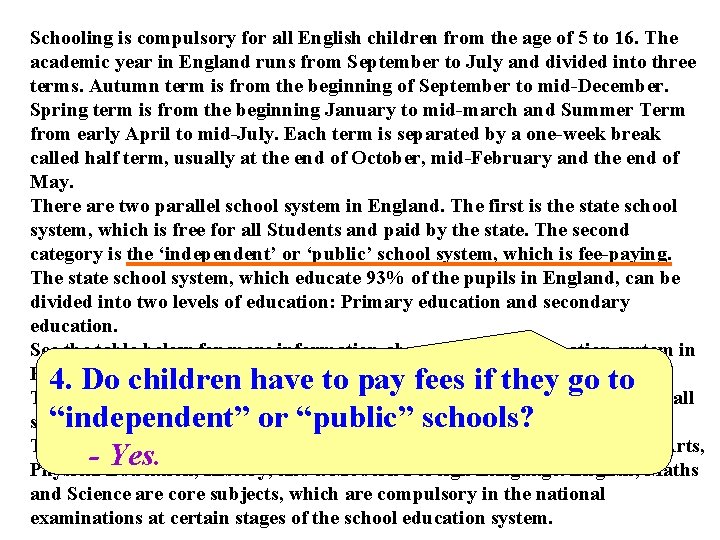
Schooling is compulsory for all English children from the age of 5 to 16. The academic year in England runs from September to July and divided into three terms. Autumn term is from the beginning of September to mid-December. Spring term is from the beginning January to mid-march and Summer Term from early April to mid-July. Each term is separated by a one-week break called half term, usually at the end of October, mid-February and the end of May. There are two parallel school system in England. The first is the state school system, which is free for all Students and paid by the state. The second category is the ‘independent’ or ‘public’ school system, which is fee-paying. The state school system, which educate 93% of the pupils in England, can be divided into two levels of education: Primary education and secondary education. See the table below for more information about the school education system in England. The National Curriculum is set by the government and must be followed in all state schools. It is made up of the following subjects: English, Design & Technology, Geography, Maths, Information Technology, Music, Science, Arts, Physical Education, History, and a Modern Foreign Language. English, Maths and Science are core subjects, which are compulsory in the national examinations at certain stages of the school education system. 4. Do children have to pay fees if they go to “independent” or “public” schools? - Yes.
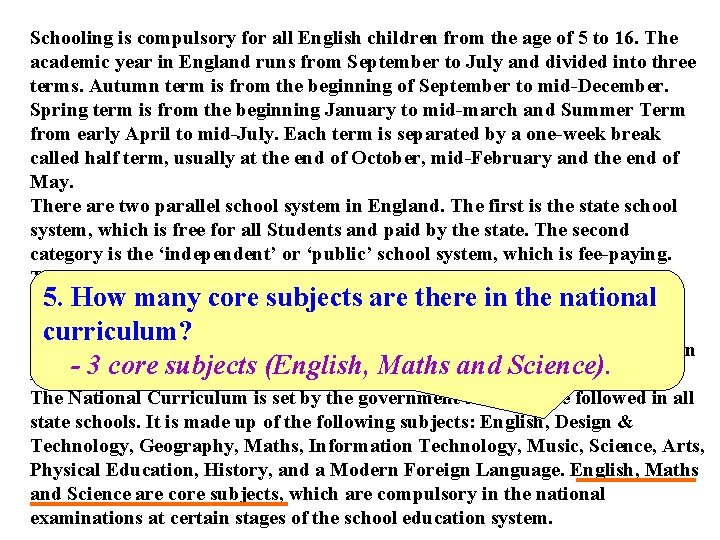
Schooling is compulsory for all English children from the age of 5 to 16. The academic year in England runs from September to July and divided into three terms. Autumn term is from the beginning of September to mid-December. Spring term is from the beginning January to mid-march and Summer Term from early April to mid-July. Each term is separated by a one-week break called half term, usually at the end of October, mid-February and the end of May. There are two parallel school system in England. The first is the state school system, which is free for all Students and paid by the state. The second category is the ‘independent’ or ‘public’ school system, which is fee-paying. The state school system, which educate 93% of the pupils in England, can be 5. How core subjects are there inand thesecondary national divided into many two levels of education: Primary education. curriculum? See the table below for more information about the school education system in - 3 core subjects (English, Maths and Science). England. The National Curriculum is set by the government and must be followed in all state schools. It is made up of the following subjects: English, Design & Technology, Geography, Maths, Information Technology, Music, Science, Arts, Physical Education, History, and a Modern Foreign Language. English, Maths and Science are core subjects, which are compulsory in the national examinations at certain stages of the school education system.
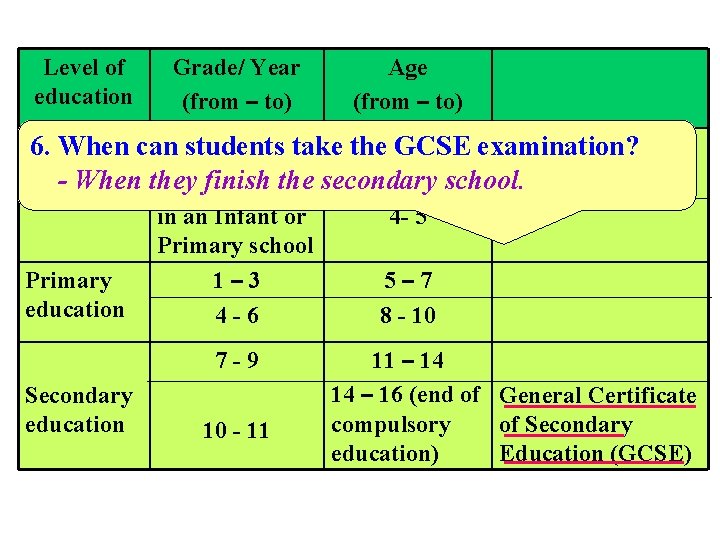
Level of education Grade/ Year (from – to) Age (from – to) – 4 childcare 6. When can students take the 3 GCSE examination? - When they finish the secondary school. Pre-school environment Primary education in an Infant or Primary school 1– 3 4 -6 7 -9 Secondary education 10 - 11 4 - 5 5– 7 8 - 10 11 – 14 14 – 16 (end of General Certificate compulsory of Secondary education) Education (GCSE)
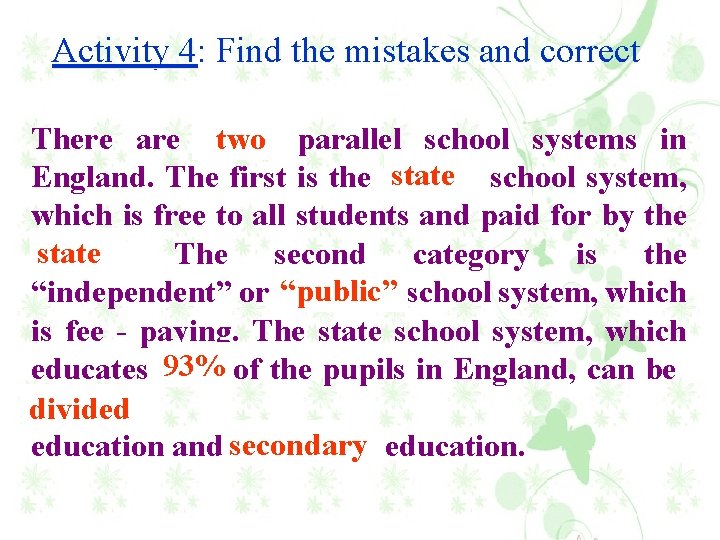
Activity 4: Find the mistakes and correct two parallel school systems in There are three state school system, England. The first is the private which is free to all students and paid for by the state people. The second category is the “public” school system, which “independent” or “special” is fee - paying. The state school system, which 93% of the pupils in England, can be educates 95% put divided education and secondary university education.
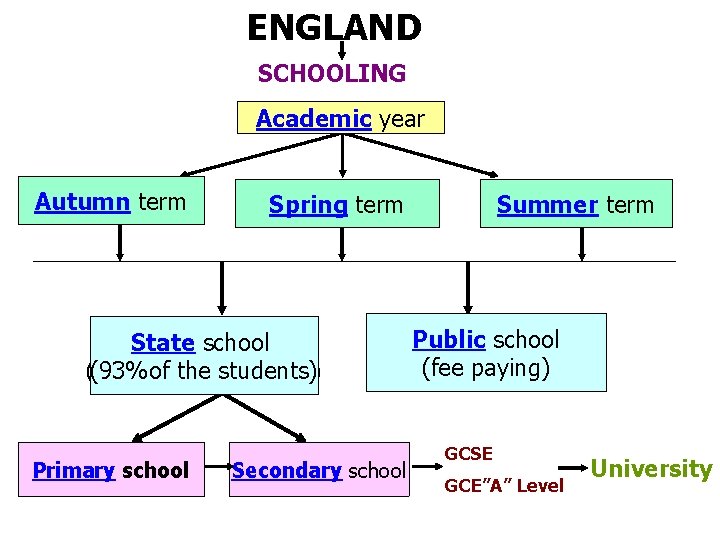
Activity 5: Read the text once more and fill in the diagram with correct information taken from the reading text.
ENGLAND SCHOOLING Academic ---(1)--- year Autumn ---(2)--- term ---(3)--Spring term ---(5)--State school (93%of of the students) Primary school ---(7)--- Secondary school ---(8)--- school Summer ---(4)--- term ---(6)--Public school (fee paying) GCSE GCE”A” Level University
Homework 1. Learnt new words by heart. 2. Prepare for the next lesson – Unit 4: Lesson 2: B. Speaking 3. Summarize the passage with your own words
You can begin like this: In England, the academic year begins at. . . . and ends in. . . There are. . . terms in an academic year: . . % of the students learn at. . . state school. . The National Curriculum contains. . . subjects. Core subjects are. . . When the students finish the secondary school, they can take an examination called the General Certificate of Secondary Education (GCSE).