Umpire training with the NZCUSA Level 4 Module

- Slides: 53
Umpire training with the NZCUSA Level 4 – Module 8 Incorporating the MCC Laws of Cricket 4 th edition 2010 and the New Zealand Cricket 2011 -12 season’s playing conditions
Module 4. 8 In this module we will review. . . Scorers’ Scorers duties & obligations to the game Scorers’ Scorers duties & obligations to the umpires Umpires’ Umpires duties & obligations to the scorers Some scoring symbols & formulae Determining the result
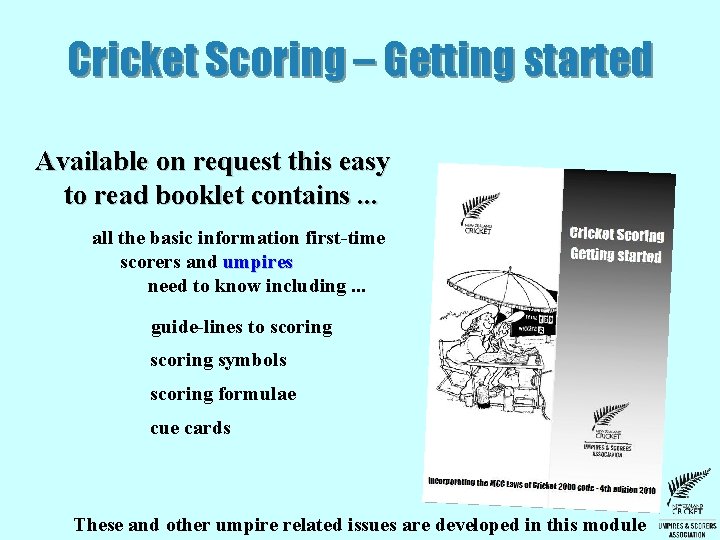
Cricket Scoring – Getting started Available on request this easy to read booklet contains. . . all the basic information first-time scorers and umpires need to know including. . . guide-lines to scoring symbols scoring formulae cue cards These and other umpire related issues are developed in this module
What the Laws require of scorers Law 4. 1 Yes. . . requires two scorers to be appointed to score a match They are required to record. . . all runs scored all wickets taken and when appropriate - all overs bowled this trivialises their duties If an umpire notices that the scorers are being interrupted distracted or obstructed in any way they must act
A solo scorer On occasions an umpire will be asked to officiate with only one scorer present or with only one score-book This presents additional problems and issues. . . If possible, umpires should ask the scorer to remove one of the pages from their book to enable a member of the batting team to score If not, the umpires must ask the batting captain to assist by having one of his players present at all times for identification purposes Scorers must continually balance their score-book Not having another scorer and score-book almost guarantees problems of accuracy will eventuate It is blatantly unfair on the solo scorer to be expected to score alone Umpires should do everything possible to ensure this is a rare event
What the Laws require of scorers Law 4. 2 requires the scorers to frequently check their records and agree with the umpires. . . at every interval – not drinks at every interruption at the end of each day’s play at the end of the match And confirm. . . and when appropriate all runs scored all wickets taken all overs bowled Here we see the umpires’ role confirmed. . . They are the final arbiters of the scores. . . and of the result
What the Laws require of scorers Law 4. 3 requires the scorers to. . . accept all instructions & signals given to them and immediately acknowledge each separate signal Once again confirming the umpires’ role in the game It is interesting to note that nowhere in the Laws are scorers required to attend to the score-board However, scorers should keep an over-view of the score-board and provide the information to others to ensure it is updated at the end of each over
What the Laws require of umpires Law 3. 3 requires the umpires to agree before the toss a number of issues with the captains and then inform the scorers Law 3. 4 requires the umpires to advise the scorers and the captains which clock & back-up clock will be used the scorers will adjust theirs to suit whether any obstacle within the field-of-play shall be regarded as a boundary Umpires should permit the scorers to copy their copy of the nominated team lists
What the Laws require of umpires Law 3. 15 states that consultation between umpires & scorers on doubtful points is essential Umpires must satisfy themselves as to the correctness of the runs scored of the wickets taken and when appropriate - the overs bowled They shall agree these with the scorers at least at every interval – not drinks at every interruption when they leave the field at the end of each day’s play at the end of the match
Confirmation It can be seen that the distinctive roles of umpires & scorers are confirmed in Law The scorers are there to record the events of the match The umpires have over-all responsibility for the correctness of the score and of the result It must be noted. . . The result that cannot be overturned if a mistake be found when the score-books are scrutinised at any later time This then is the prime function of this module. . . To ensure the ongoing co-operation between umpires & scorers Each recognising the contribution the other makes to the game Keep that co-operation alive & well
Do's & Don’t with scorers Do meet them prior to the start of each day’s play Do confirm with them all scorer related matters Do advise them of all agreements made by captains & umpires Do keep an open dialogue with them Do make sure your instructions are clear and unambiguous Do ensure your signals are clear and unobstructed by players Do consult with the scorers at every available moment Do clarify any point of doubt from your notes Do thank them for their contribution to the game Do not ask them to correct your mistakes – perhaps a miscounted over As the match minute secretaries, they record player mistakes too Do not ignore them – Sit with them at intervals
The scorers on-going duties During play, a scorer’s ongoing duty is to. . . watch the batsmen running count each run as it is completed Then when the ball becomes dead. . . watch for any umpire signal/s promptly acknowledging each one as it is given Then make the score-book entries as required. . . in the bowler’s analysis - for every ball delivered in the striker’s line - if to his credit in the extras’ section - if signalled cross-off all runs scored in the Tally
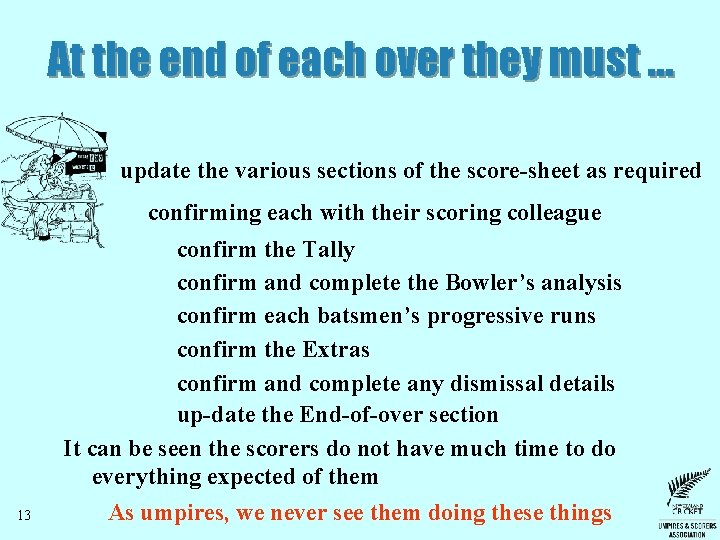
At the end of each over they must … update the various sections of the score-sheet as required confirming each with their scoring colleague 13 confirm the Tally confirm and complete the Bowler’s analysis confirm each batsmen’s progressive runs confirm the Extras confirm and complete any dismissal details up-date the End-of-over section It can be seen the scorers do not have much time to do everything expected of them As umpires, we never see them doing these things
Scoring methods Let us look at the different methods of scoring The most common is The Box method. . . developed by Charles Box in 1877 Named after the developer – not the style The Linear method. . . used by more experienced scorers The Computer method. . . used in many of our First-class matches This may be viewed on-line In this module we review the most common method … The Box method
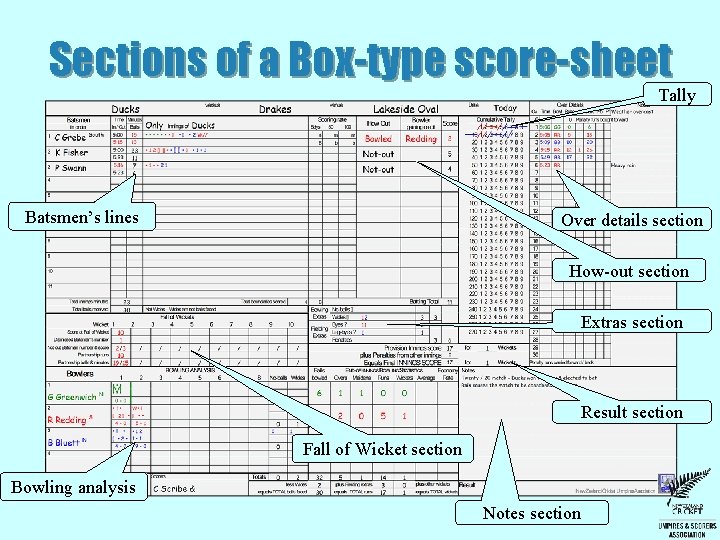
Sections of a Box-type score-sheet Tally Batsmen’s lines Over details section How-out section Extras section Result section Fall of Wicket section Bowling analysis Notes section
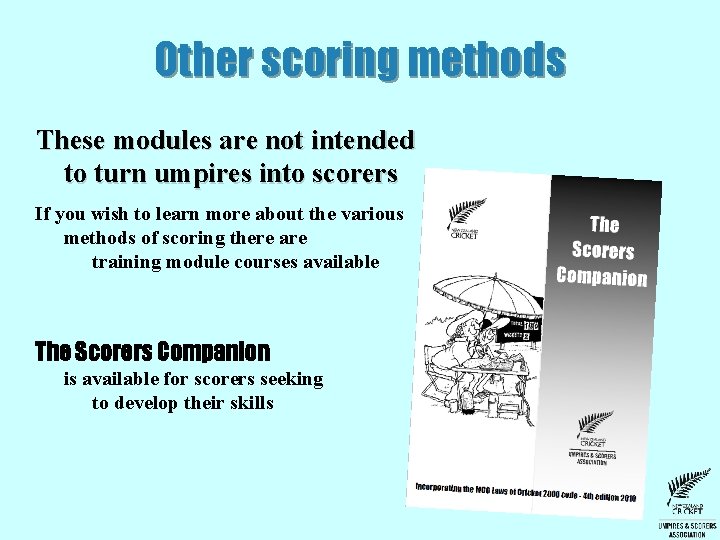
Other scoring methods These modules are not intended to turn umpires into scorers If you wish to learn more about the various methods of scoring there are training module courses available The Scorers Companion is available for scorers seeking to develop their skills
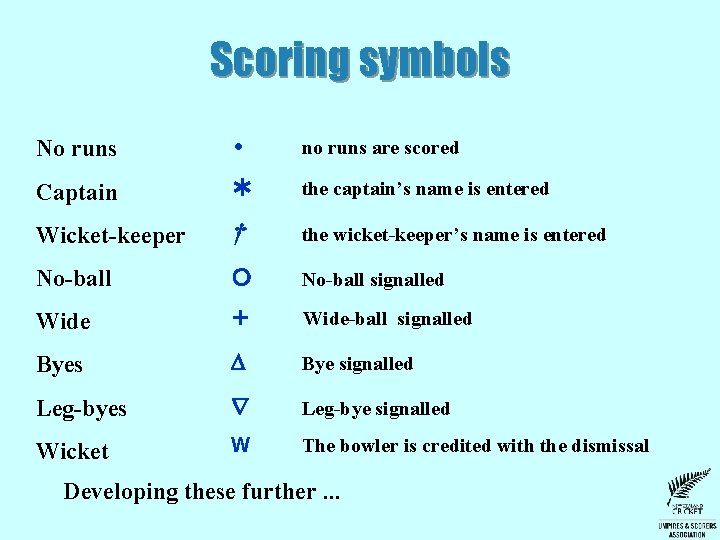
Scoring symbols No runs • no runs are scored Captain the captain’s name is entered Wicket-keeper † the wicket-keeper’s name is entered No-ball signalled Wide-ball signalled Byes Bye signalled Leg-byes Leg-bye signalled Wicket W The bowler is credited with the dismissal Developing these further. . .
Scoring symbols No runs ! a dot - no numerals No-ball – no runs no dots or numerals No-ball - Bat - run/s [ ] ^ ` numerals encircled No-ball - Byes - run/s # $ % & one dot = 1 run Wide - no runs + no dots inserted Wide - run/s ; < ' ( one dot = 1 run Wide - dismissed off a Wide ? a cross with letter W Byes - run/s no dots Leg-byes - run/s no dots Let us look now at some basic rules when using symbols
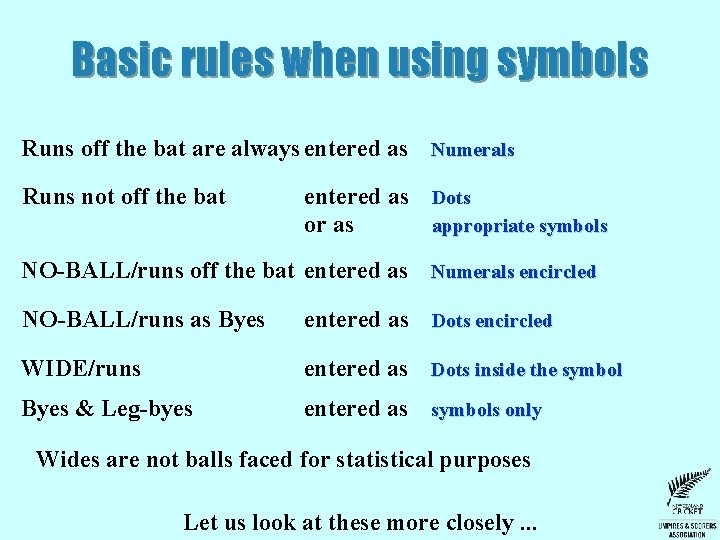
Basic rules when using symbols Runs off the bat are always entered as Numerals Runs not off the bat entered as Dots or as appropriate symbols NO-BALL/runs off the bat entered as Numerals encircled NO-BALL/runs as Byes entered as Dots encircled WIDE/runs entered as Dots inside the symbol Byes & Leg-byes entered as symbols only Wides are not balls faced for statistical purposes Let us look at these more closely. . .
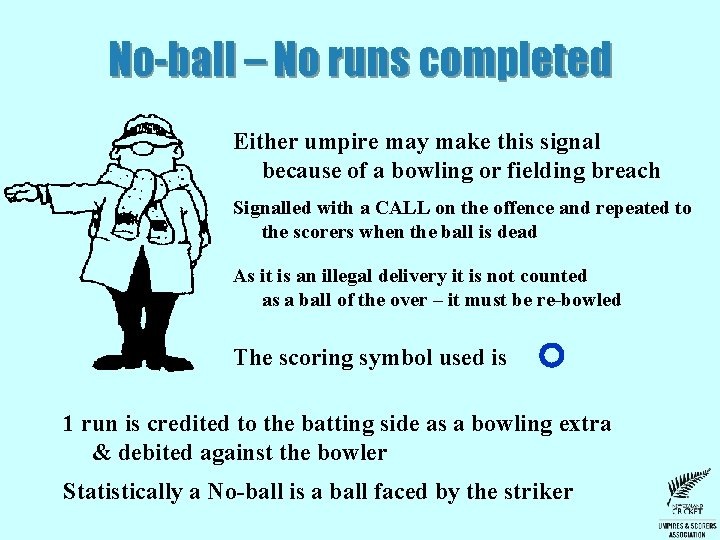
No-ball – No runs completed Either umpire may make this signal because of a bowling or fielding breach Signalled with a CALL on the offence and repeated to the scorers when the ball is dead As it is an illegal delivery it is not counted as a ball of the over – it must be re-bowled The scoring symbol used is 1 run is credited to the batting side as a bowling extra & debited against the bowler Statistically a No-ball is a ball faced by the striker
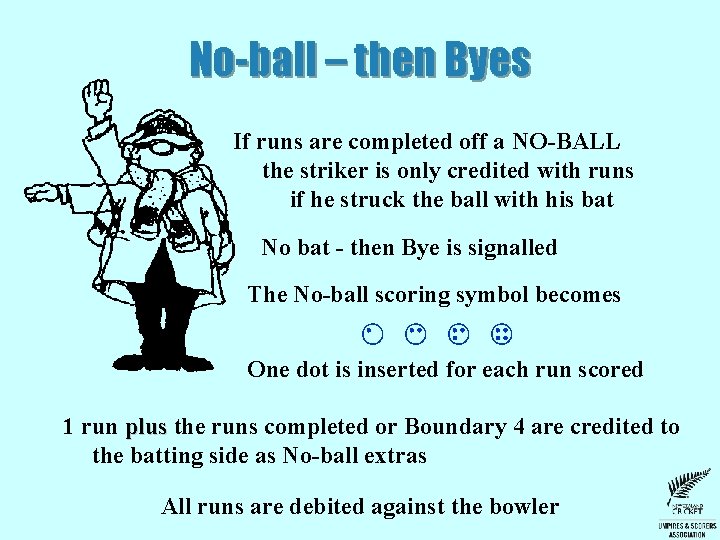
No-ball – then Byes If runs are completed off a NO-BALL the striker is only credited with runs if he struck the ball with his bat No bat - then Bye is signalled The No-ball scoring symbol becomes # $ % & One dot is inserted for each run scored 1 run plus the runs completed or Boundary 4 are credited to the batting side as No-ball extras All runs are debited against the bowler
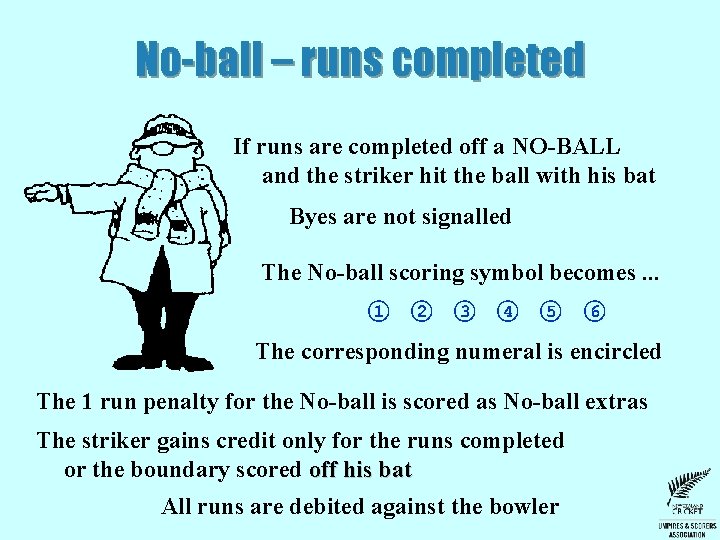
No-ball – runs completed If runs are completed off a NO-BALL and the striker hit the ball with his bat Byes are not signalled The No-ball scoring symbol becomes. . . [ ] ^ _ ` The corresponding numeral is encircled The 1 run penalty for the No-ball is scored as No-ball extras The striker gains credit only for the runs completed or the boundary scored off his bat All runs are debited against the bowler
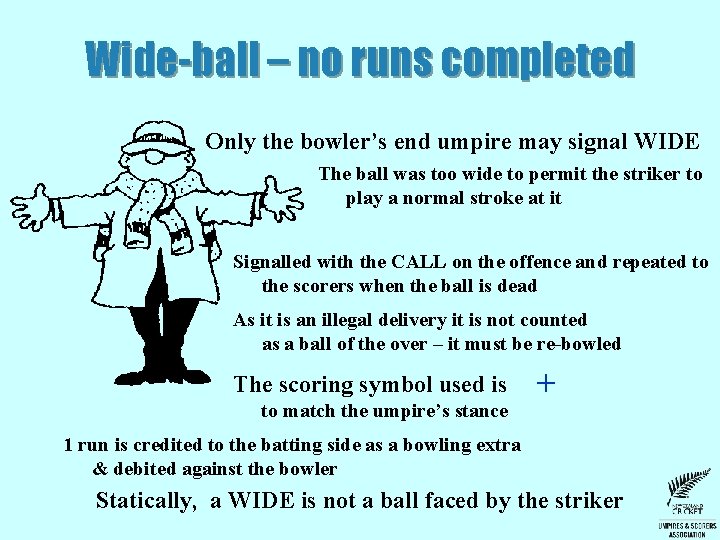
Wide-ball – no runs completed Only the bowler’s end umpire may signal WIDE The ball was too wide to permit the striker to play a normal stroke at it Signalled with the CALL on the offence and repeated to the scorers when the ball is dead As it is an illegal delivery it is not counted as a ball of the over – it must be re-bowled The scoring symbol used is to match the umpire’s stance + 1 run is credited to the batting side as a bowling extra & debited against the bowler Statically, a WIDE is not a ball faced by the striker
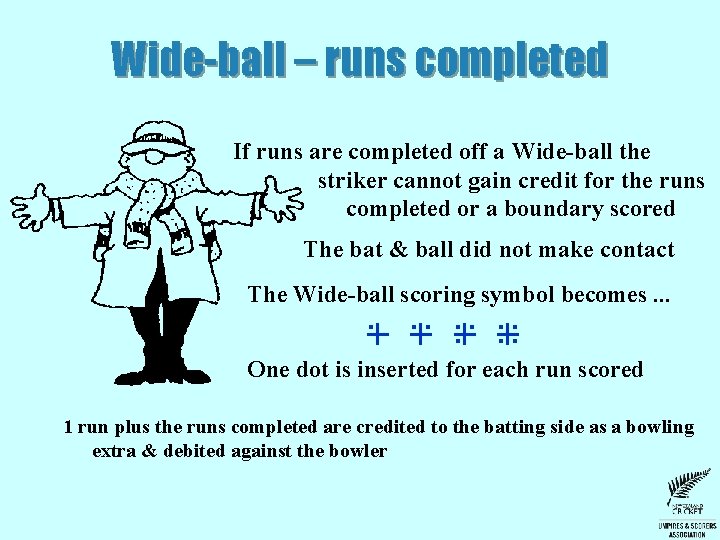
Wide-ball – runs completed If runs are completed off a Wide-ball the striker cannot gain credit for the runs completed or a boundary scored The bat & ball did not make contact The Wide-ball scoring symbol becomes. . . ; < ' ( One dot is inserted for each run scored 1 run plus the runs completed are credited to the batting side as a bowling extra & debited against the bowler
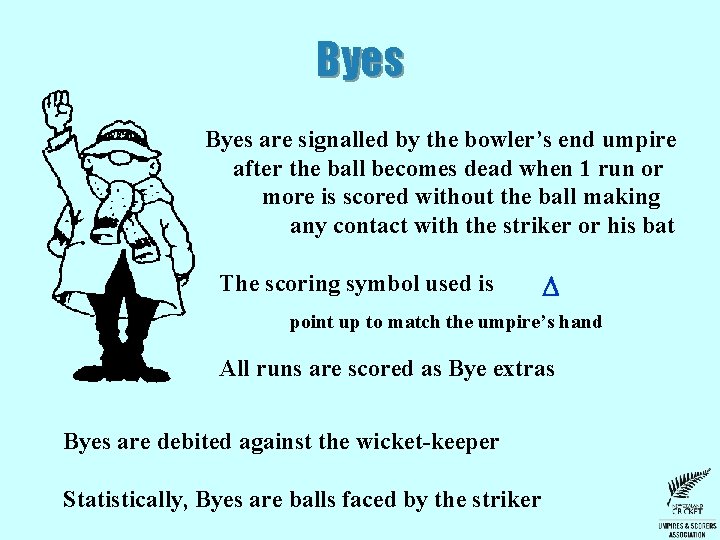
Byes are signalled by the bowler’s end umpire after the ball becomes dead when 1 run or more is scored without the ball making any contact with the striker or his bat The scoring symbol used is point up to match the umpire’s hand All runs are scored as Bye extras Byes are debited against the wicket-keeper Statistically, Byes are balls faced by the striker
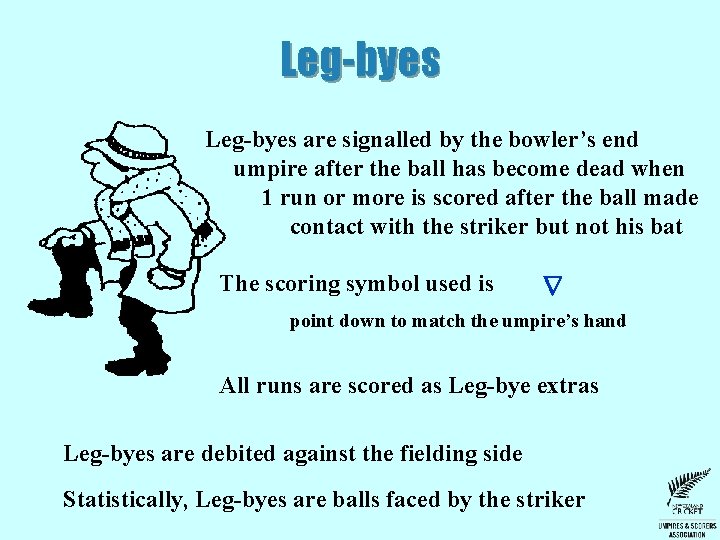
Leg-byes are signalled by the bowler’s end umpire after the ball has become dead when 1 run or more is scored after the ball made contact with the striker but not his bat The scoring symbol used is point down to match the umpire’s hand All runs are scored as Leg-bye extras Leg-byes are debited against the fielding side Statistically, Leg-byes are balls faced by the striker
Regular checks of the score-sheets Scorers must work as a team They should talk to each other as they make their entries For example. . . The umpire is going to signal No-ball The batsmen have completed one run – now two The umpire has signalled No-ball – acknowledge That’s 1 run to No-ball extras & 2 runs to the striker The tally is increased by 3 runs - confirmed Scorers cannot do these things if they are not sitting together Should they sit apart, errors in scoring are inevitable Umpires should encourage scorers to sit together wherever possible
Balancing a score-book Whenever the occasion arises and at the start of every interval each scorer must balance their own score-book and confirm their record corresponds with the other book This may be done using some simple formulae. . . Every umpire should be familiar with these and use them should the occasion arise when asked particularly when players are scoring Umpires have the duty of ensuring the scoring records are correct as required in Law 3. 15 & Law 21. 8
Cricket decimals In our ordinary life the divisor of 10 is a decimal Cricket uses the divisor 6 – the number of balls in an over Thus. . . 1. 1 overs = one over & one ball 3. 2 overs = three overs & two balls 7. 5 overs = seven overs & five balls Not 7 ½ overs
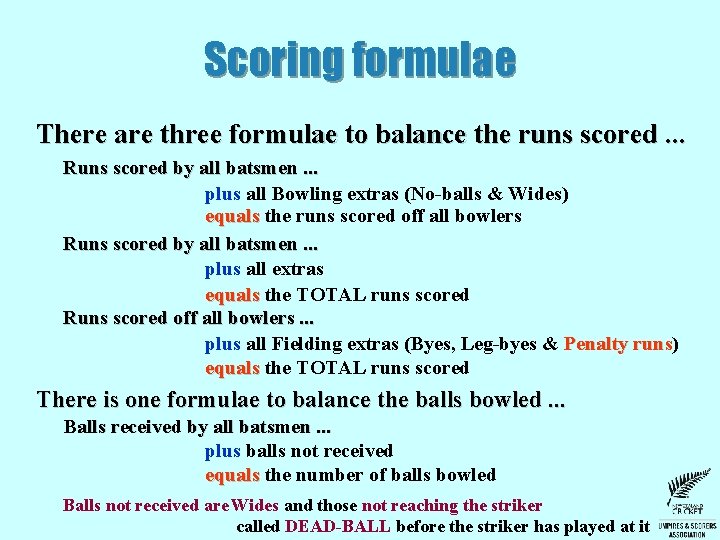
Scoring formulae There are three formulae to balance the runs scored. . . Runs scored by all batsmen. . . plus all Bowling extras (No-balls & Wides) equals the runs scored off all bowlers Runs scored by all batsmen. . . plus all extras equals the TOTAL runs scored Runs scored off all bowlers. . . plus all Fielding extras (Byes, Leg-byes & Penalty runs) runs equals the TOTAL runs scored There is one formulae to balance the balls bowled. . . Balls received by all batsmen. . . plus balls not received equals the number of balls bowled Balls not received are Wides and those not reaching the striker called DEAD-BALL before the striker has played at it
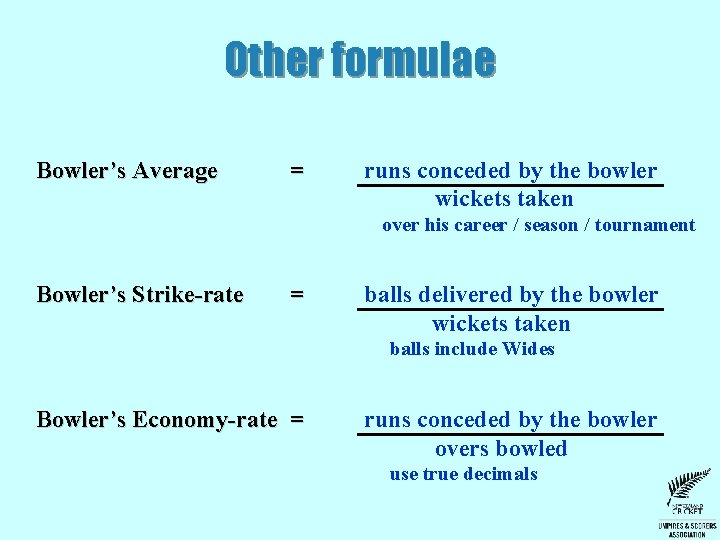
Other formulae Bowler’s Average = runs conceded by the bowler wickets taken over his career / season / tournament Bowler’s Strike-rate = balls delivered by the bowler wickets taken balls include Wides Bowler’s Economy-rate = runs conceded by the bowler overs bowled use true decimals
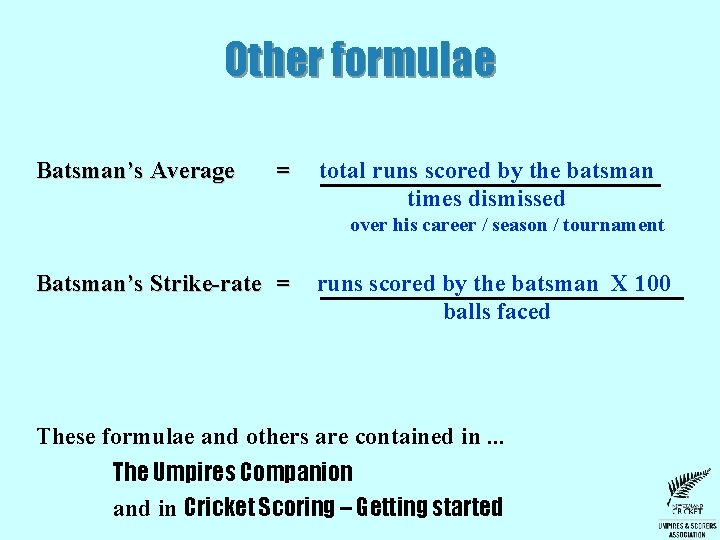
Other formulae Batsman’s Average = total runs scored by the batsman times dismissed over his career / season / tournament Batsman’s Strike-rate = runs scored by the batsman X 100 balls faced These formulae and others are contained in. . . The Umpires Companion and in Cricket Scoring – Getting started
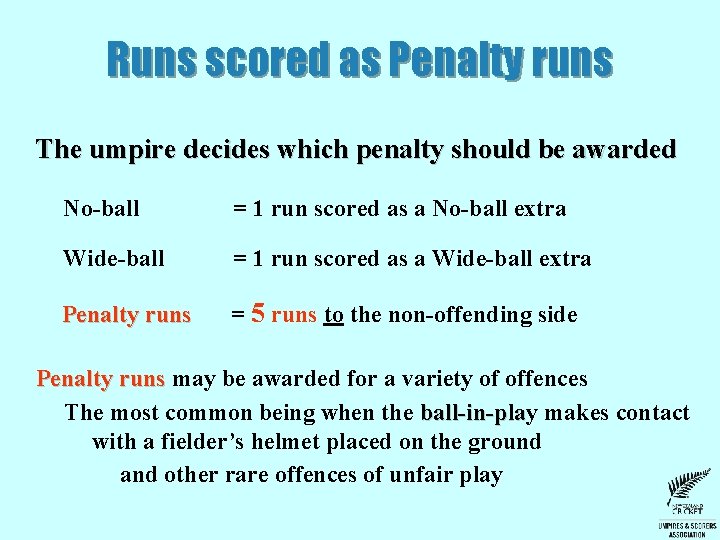
Runs scored as Penalty runs The umpire decides which penalty should be awarded No-ball = 1 run scored as a No-ball extra Wide-ball = 1 run scored as a Wide-ball extra Penalty runs = 5 runs to the non-offending side Penalty runs may be awarded for a variety of offences The most common being when the ball-in-play ball-in-pla makes contact with a fielder’s helmet placed on the ground and other rare offences of unfair play
Penalty runs can be awarded to the non-offending side at any time during a match up to the final call of TIME Note the positive term. . . They are awarded to the non-offending side. . . not against the offending side 5 Penalty runs are awarded - no more - no less Penalty runs are not debited against the bowler or credited to or assigned to any particular delivery or player They stand alone - always as separate Fielding extras Consultation with the scorers during the next interval is imperative as the scorers will require confirmation as to why the award was made and may seek advice on how this is recorded
Penalty runs not to be awarded If a batsman offends by. . . deliberately running a short run, or wasting time, or causing avoidable damage to the pitch, or attempting to steal a run before delivery it would be totally unfair for his side to receive an award of Penalty runs because of an offence by a fielder In these circumstances Penalty runs are not awarded
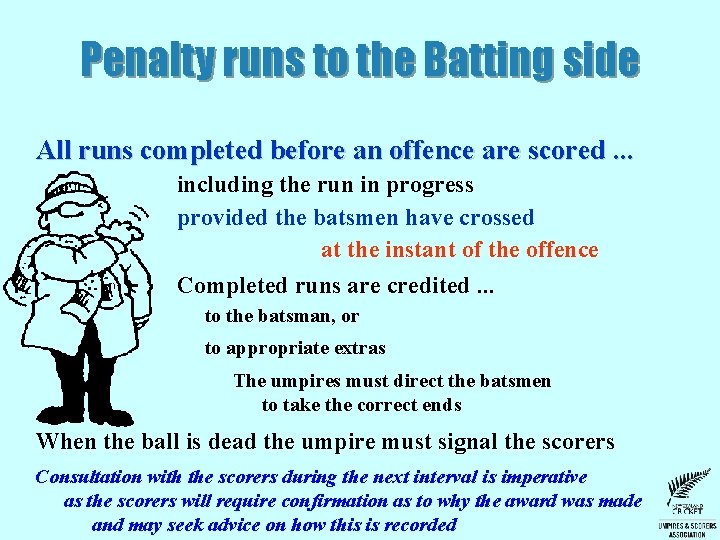
Penalty runs to the Batting side All runs completed before an offence are scored. . . including the run in progress provided the batsmen have crossed at the instant of the offence Completed runs are credited. . . to the batsman, or to appropriate extras The umpires must direct the batsmen to take the correct ends When the ball is dead the umpire must signal the scorers Consultation with the scorers during the next interval is imperative as the scorers will require confirmation as to why the award was made and may seek advice on how this is recorded
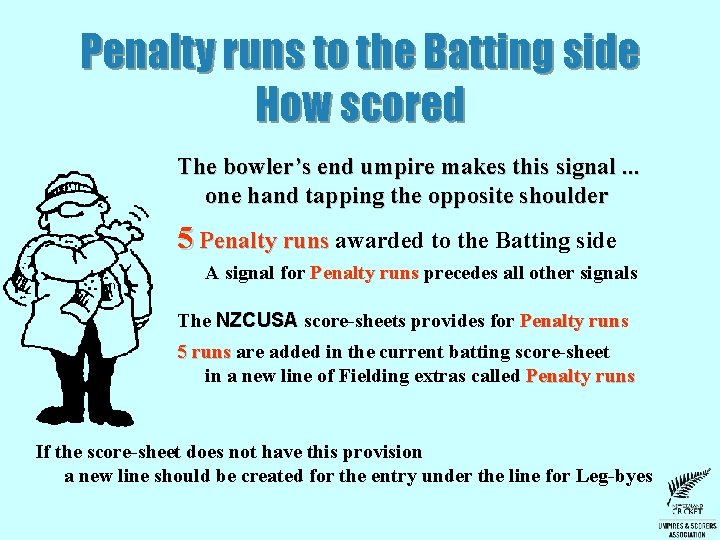
Penalty runs to the Batting side How scored The bowler’s end umpire makes this signal. . . one hand tapping the opposite shoulder 5 Penalty runs awarded to the Batting side A signal for Penalty runs precedes all other signals The NZCUSA score-sheets provides for Penalty runs 5 runs are added in the current batting score-sheet in a new line of Fielding extras called Penalty runs If the score-sheet does not have this provision a new line should be created for the entry under the line for Leg-byes
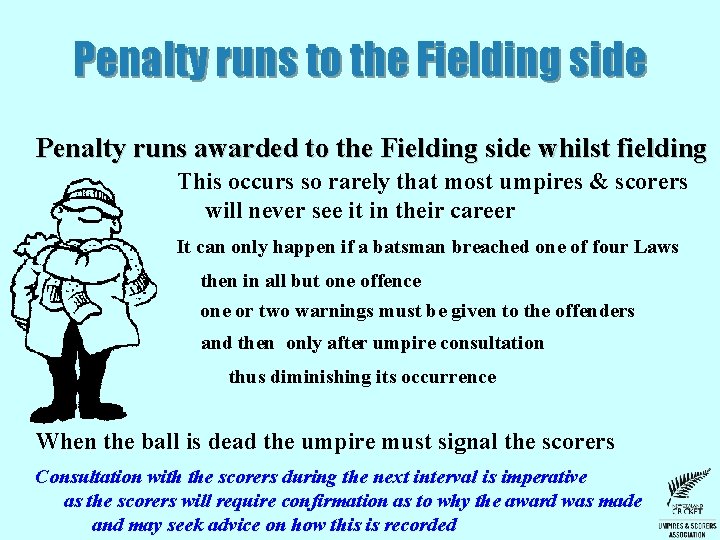
Penalty runs to the Fielding side Penalty runs awarded to the Fielding side whilst fielding This occurs so rarely that most umpires & scorers will never see it in their career It can only happen if a batsman breached one of four Laws then in all but one offence one or two warnings must be given to the offenders and then only after umpire consultation thus diminishing its occurrence When the ball is dead the umpire must signal the scorers Consultation with the scorers during the next interval is imperative as the scorers will require confirmation as to why the award was made and may seek advice on how this is recorded
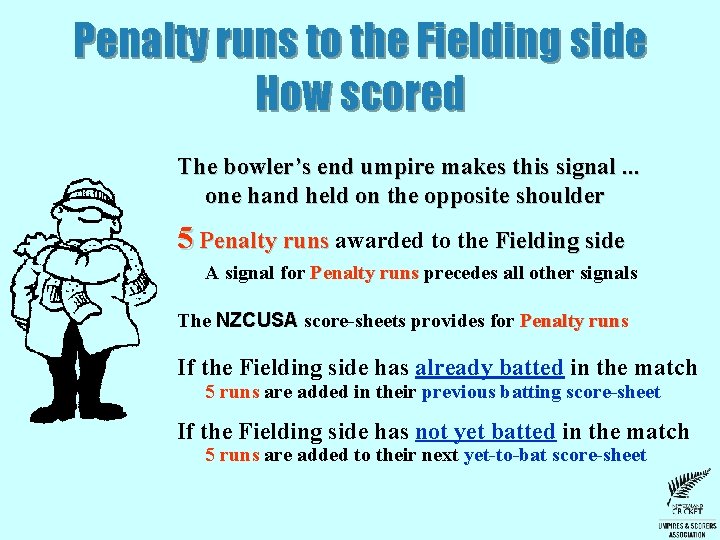
Penalty runs to the Fielding side How scored The bowler’s end umpire makes this signal. . . one hand held on the opposite shoulder 5 Penalty runs awarded to the Fielding side A signal for Penalty runs precedes all other signals The NZCUSA score-sheets provides for Penalty runs If the Fielding side has already batted in the match 5 runs are added in their previous batting score-sheet If the Fielding side has not yet batted in the match 5 runs are added to their next yet-to-bat score-sheet
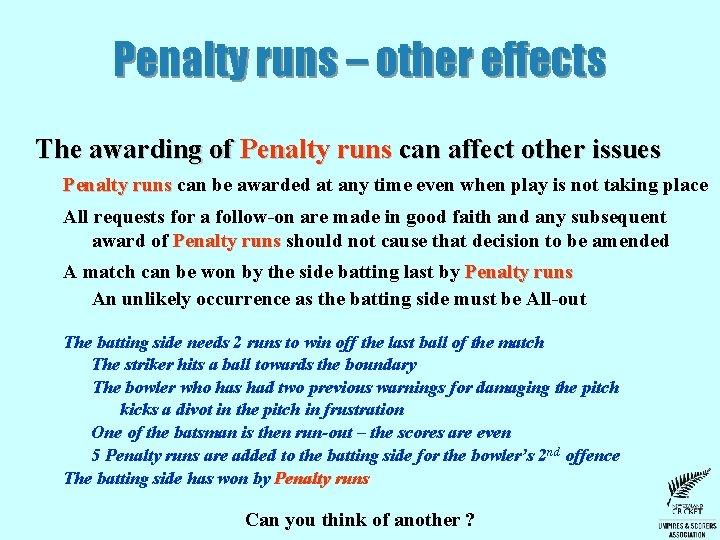
Penalty runs – other effects The awarding of Penalty runs can affect other issues Penalty runs can be awarded at any time even when play is not taking place All requests for a follow-on are made in good faith and any subsequent award of Penalty runs should not cause that decision to be amended A match can be won by the side batting last by Penalty runs An unlikely occurrence as the batting side must be All-out The batting side needs 2 runs to win off the last ball of the match The striker hits a ball towards the boundary The bowler who has had two previous warnings for damaging the pitch kicks a divot in the pitch in frustration One of the batsman is then run-out – the scores are even 5 Penalty runs are added to the batting side for the bowler’s 2 nd offence The batting side has won by Penalty runs Can you think of another ?
Law 21. 1 – A win in a two-innings match In a two-innings match. . . the team that scores most runs in their two innings is declared the winner Law 21. 2 – A win in a one-innings match In a one-innings match. . . the team that scores most runs in their respective innings is declared the winner
Law 21. 3 – Umpires awarding a match The umpires may award the match to the non-offending side if. . . one side refuses to play, or concedes defeat Law 21 – A win by Penalty runs The Laws permit the umpires to award Penalty runs after the final ball has been bowled As discussed – an unlikely event
Law 21. 4 – A Tie can only be achieved if. . . the side batting last is All-out and having completed their innings the scores are equal It does not matter if. . there is time or overs left or balls still to be bowled If they have failed to achieve the target score. . . because they are All-out the Result is a Tie
Law 21. 5 – A Draw If the match is not Won by either side. . . and it is not a Tie the result is a Draw In Law - there can be no other result however. . . in a two-innings match. . . some competitions permit a match to be won by one side by comparing their first-innings scores i. e. one side Won by Runs or Wickets on their First-innings
Law 21. 6 – Winning hit or extras Once a result has been achieved, the match is over Anything that happens after that moment is not scored If the scores are equal and the ball is hit to the boundary. . . If the batsmen complete one run before the ball reaches the boundary that run is scored – not the boundary If the ball reaches the boundary before the batsmen complete the run – the boundary allowance is scored If the scores are equal and a NO-BALL or WIDE is bowled. . . The extra is scored and the match is over If the scores are equal & the striker is dismissed Stumped or Hit-wicket off a WIDE The extra is scored - the striker is Not-out
Law 21. 7 – Statement of result The side that scores the most runs is the winner either by Wickets or by Runs If the side batting last achieves the target score. . . they Win by the number of Wickets Wicket yet-to-fall If the side batting last is All-out and fails to reach the target score their opponents Win by the number of Runs scored more than their opponents If the side fielding last Wins - having batted only once and their opponents have batted twice their Win is by an Innings Inning & Runs
Law 21. 8 – Correctness of result The umpires are the FINAL arbiters on the Result While it is not a requirement in law. . . when the players & umpires leave the field as confirmation of the Result. . . both umpires should pen their initials on the final score-sheet
Law 21. 9 – Mistakes in scoring Yes - mistakes can happen … … While they delegate the scoring to others. . . the umpires maintain overall responsibility of the scores and can require scorers to amend their records If a mistake in the scoring is discovered at the end of a match the umpires can insist that play resume. . . but only if Time and/or Overs permit If this is not possible, the umpires must amend the Result The captains must accept the amended Result
Law 21. 10 – Result not to be changed Can the result be changed after it has been declared ? Can the result be overturned by administrators ? Absolutely not This clause makes it quite specific. . . The Result as declared by the umpires. . . which must be accepted by both captains must stand However. . . the awarding of match points is outside the jurisdiction of umpires Thus the Governing body can award points as they see fit
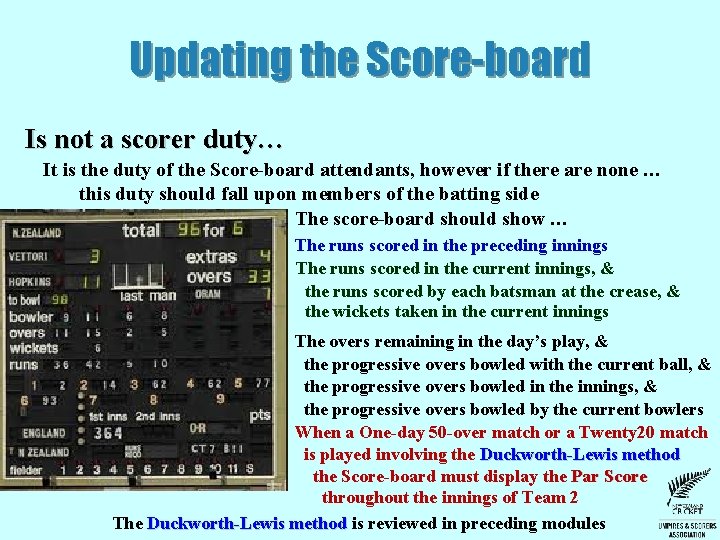
Updating the Score-board Is not a scorer duty… It is the duty of the Score-board attendants, however if there are none … this duty should fall upon members of the batting side The score-board should show … The runs scored in the preceding innings The runs scored in the current innings, & the runs scored by each batsman at the crease, & the wickets taken in the current innings The overs remaining in the day’s play, & the progressive overs bowled with the current ball, & the progressive overs bowled in the innings, & the progressive overs bowled by the current bowlers When a One-day 50 -over match or a Twenty 20 match is played involving the Duckworth-Lewis method the Score-board must display the Par Score throughout the innings of Team 2 The Duckworth-Lewis method is reviewed in preceding modules
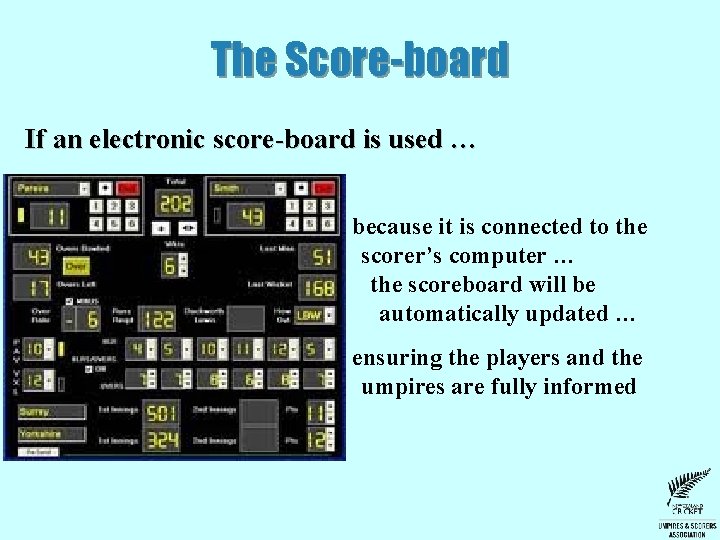
The Score-board If an electronic score-board is used … because it is connected to the scorer’s computer … the scoreboard will be automatically updated … ensuring the players and the umpires are fully informed
The end of Module 4. 8 In the last module we will review. . . Captains Reports on Umpires NZC Code of Conduct Reports & Hearings Match Reports Pitch & Ground Reports Assessment of umpires Examination Regulations & Procedures In your preparation for the NZCUSA Level 4 umpire examination
These modules were written & produced for New Zealand Cricket by the New Zealand Cricket Umpires & Scorers Association 53 © 2011 NZC-NZCUSA