Topic 5 Types COS 320 Compiling Techniques Princeton
- Slides: 61
Topic 5: Types COS 320 Compiling Techniques Princeton University Spring 2016 Lennart Beringer 1
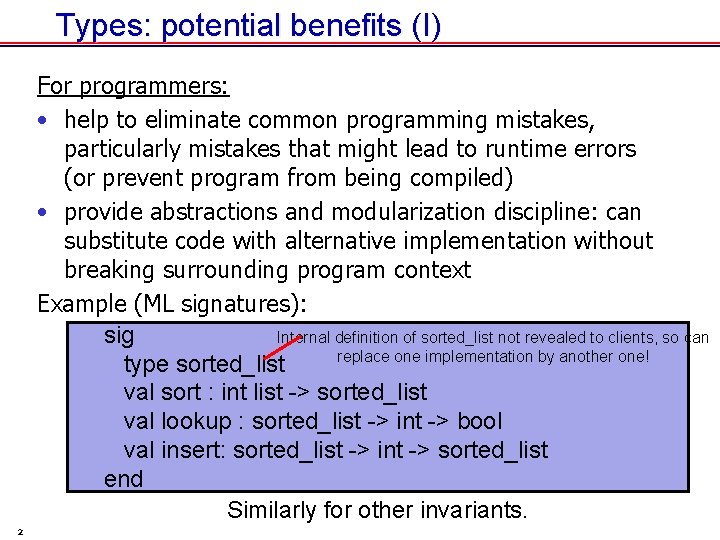
Types: potential benefits (I) For programmers: • help to eliminate common programming mistakes, particularly mistakes that might lead to runtime errors (or prevent program from being compiled) • provide abstractions and modularization discipline: can substitute code with alternative implementation without breaking surrounding program context Example (ML signatures): sig Internal definition of sorted_list not revealed to clients, so can replace one implementation by another one! type sorted_list val sort : int list -> sorted_list val lookup : sorted_list -> int -> bool val insert: sorted_list -> int -> sorted_list end Similarly for other invariants. 2
Types: potential benefits (II) For language designers: • yields structuring mechanism for programs – thus encodes abstraction principles that motivate development of new language • basis for studying (interaction between) language features (references, exceptions, IO, other side effects, h-o-functions) • formal basis for reasoning about program behavior (verification, security analysis, resource usage) 3
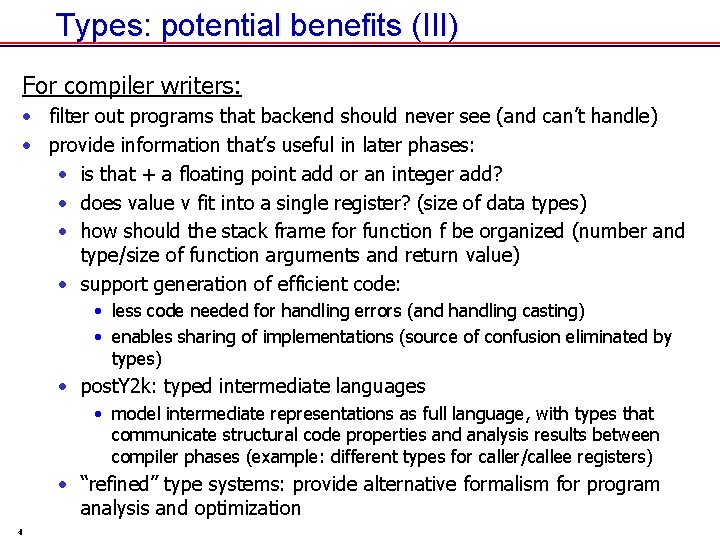
Types: potential benefits (III) For compiler writers: • filter out programs that backend should never see (and can’t handle) • provide information that’s useful in later phases: • is that + a floating point add or an integer add? • does value v fit into a single register? (size of data types) • how should the stack frame for function f be organized (number and type/size of function arguments and return value) • support generation of efficient code: • less code needed for handling errors (and handling casting) • enables sharing of implementations (source of confusion eliminated by types) • post. Y 2 k: typed intermediate languages • model intermediate representations as full language, with types that communicate structural code properties and analysis results between compiler phases (example: different types for caller/callee registers) • “refined” type systems: provide alternative formalism for program analysis and optimization 4
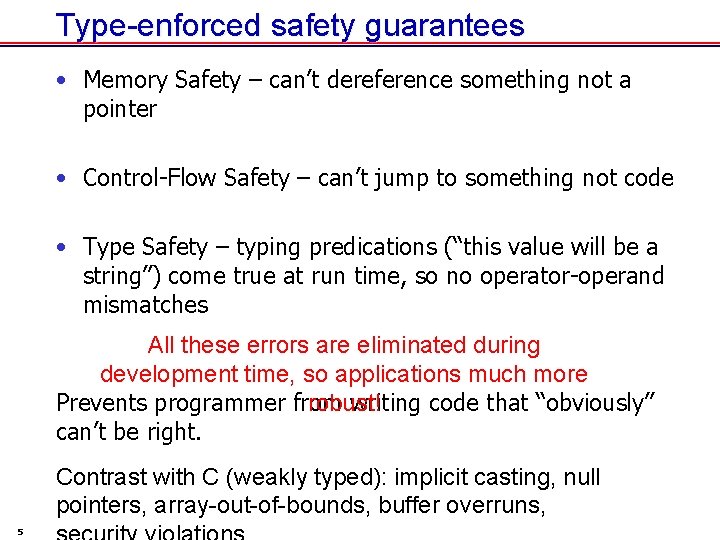
Type-enforced safety guarantees • Memory Safety – can’t dereference something not a pointer • Control-Flow Safety – can’t jump to something not code • Type Safety – typing predications (“this value will be a string”) come true at run time, so no operator-operand mismatches All these errors are eliminated during development time, so applications much more Prevents programmer from writing code that “obviously” robust! can’t be right. Contrast with C (weakly typed): implicit casting, null pointers, array-out-of-bounds, buffer overruns, 5
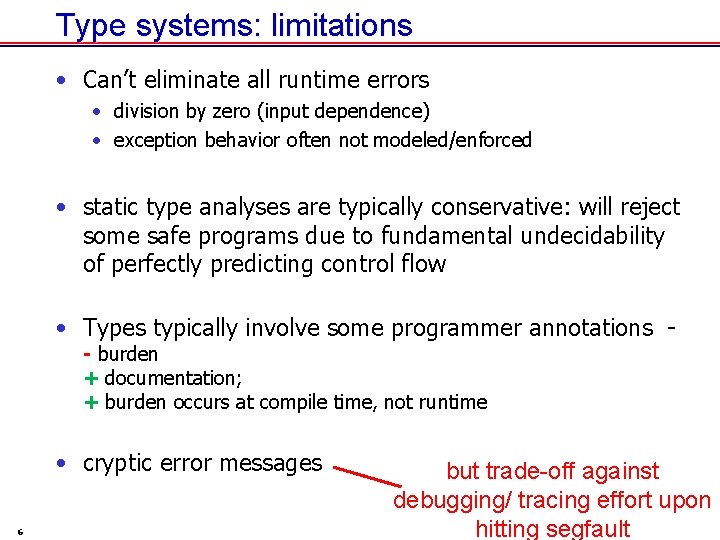
Type systems: limitations • Can’t eliminate all runtime errors • division by zero (input dependence) • exception behavior often not modeled/enforced • static type analyses are typically conservative: will reject some safe programs due to fundamental undecidability of perfectly predicting control flow • Types typically involve some programmer annotations - burden + documentation; + burden occurs at compile time, not runtime • cryptic error messages 6 but trade-off against debugging/ tracing effort upon hitting segfault
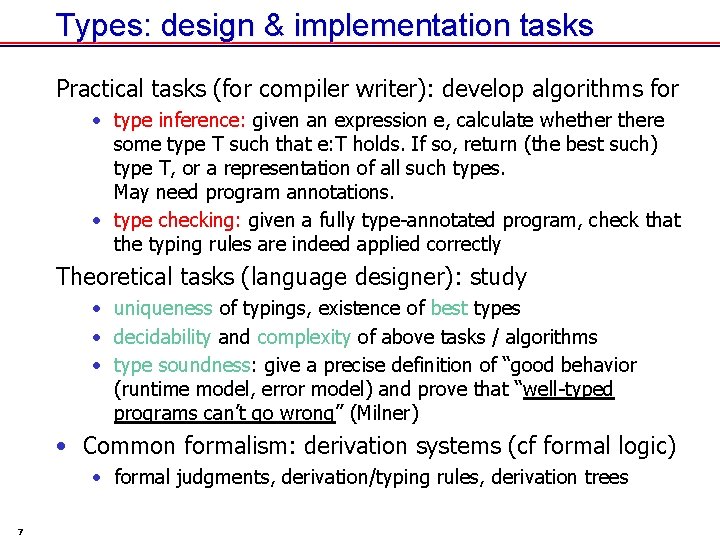
Types: design & implementation tasks Practical tasks (for compiler writer): develop algorithms for • type inference: given an expression e, calculate whethere some type T such that e: T holds. If so, return (the best such) type T, or a representation of all such types. May need program annotations. • type checking: given a fully type-annotated program, check that the typing rules are indeed applied correctly Theoretical tasks (language designer): study • uniqueness of typings, existence of best types • decidability and complexity of above tasks / algorithms • type soundness: give a precise definition of “good behavior (runtime model, error model) and prove that “well-typed programs can’t go wrong” (Milner) • Common formalism: derivation systems (cf formal logic) • formal judgments, derivation/typing rules, derivation trees 7
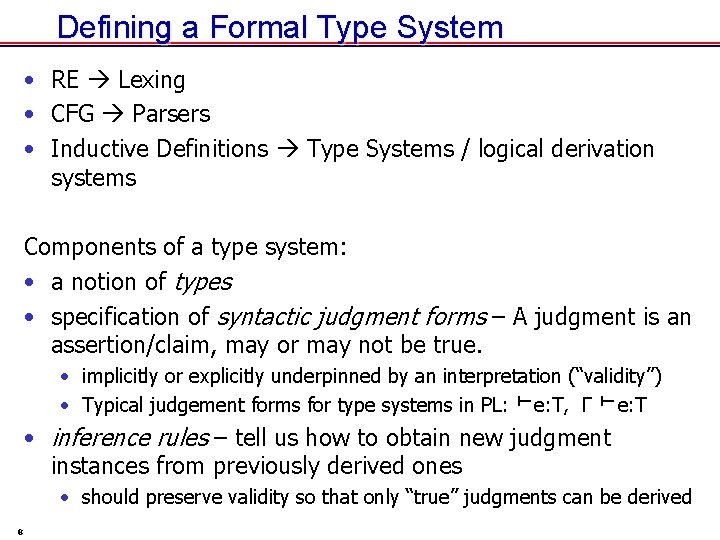
Defining a Formal Type System • RE Lexing • CFG Parsers • Inductive Definitions Type Systems / logical derivation systems Components of a type system: • a notion of types • specification of syntactic judgment forms – A judgment is an assertion/claim, may or may not be true. т т • implicitly or explicitly underpinned by an interpretation (“validity”) • Typical judgement forms for type systems in PL: e: T, Γ e: T • inference rules – tell us how to obtain new judgment instances from previously derived ones • should preserve validity so that only “true” judgments can be derived 8
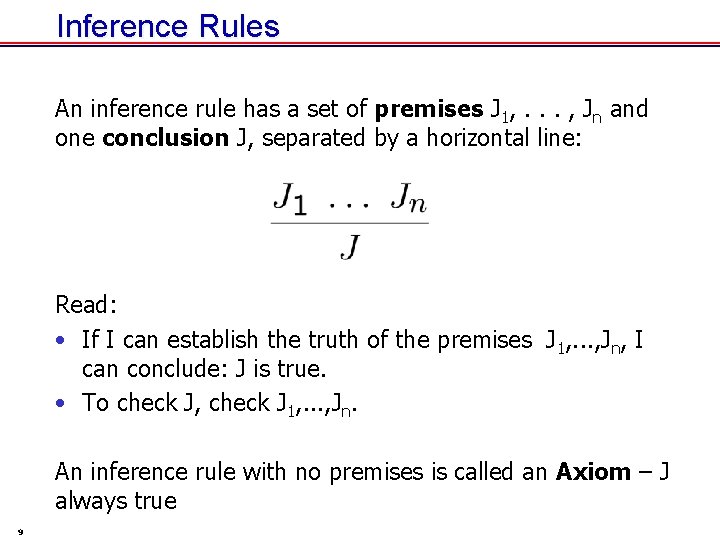
Inference Rules An inference rule has a set of premises J 1, . . . , Jn and one conclusion J, separated by a horizontal line: Read: • If I can establish the truth of the premises J 1, . . . , Jn, I can conclude: J is true. • To check J, check J 1, . . . , Jn. An inference rule with no premises is called an Axiom – J always true 9
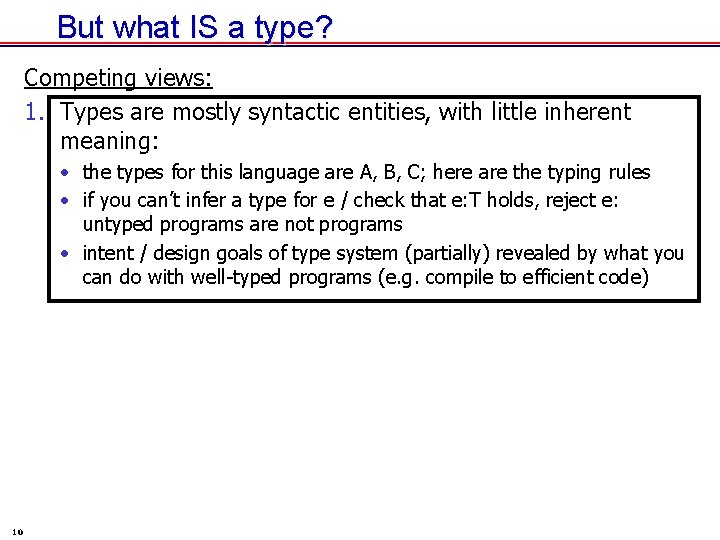
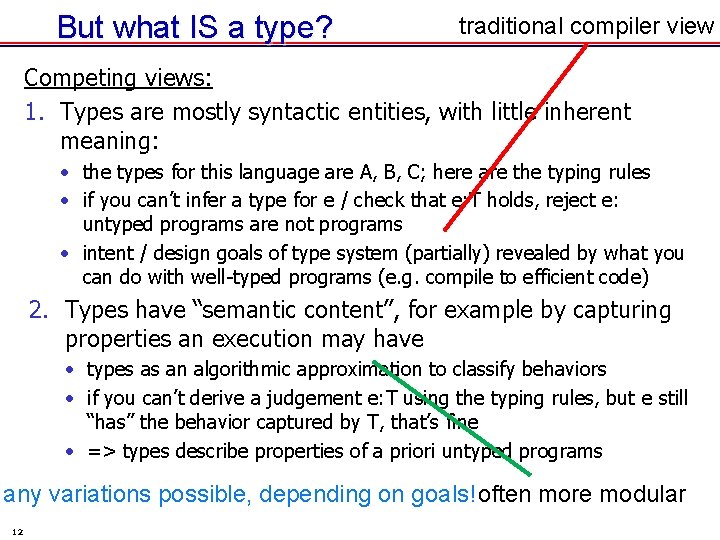
But what IS a type? Competing views: 1. Types are mostly syntactic entities, with little inherent meaning: • the types for this language are A, B, C; here are the typing rules • if you can’t infer a type for e / check that e: T holds, reject e: untyped programs are not programs • intent / design goals of type system (partially) revealed by what you can do with well-typed programs (e. g. compile to efficient code) 10
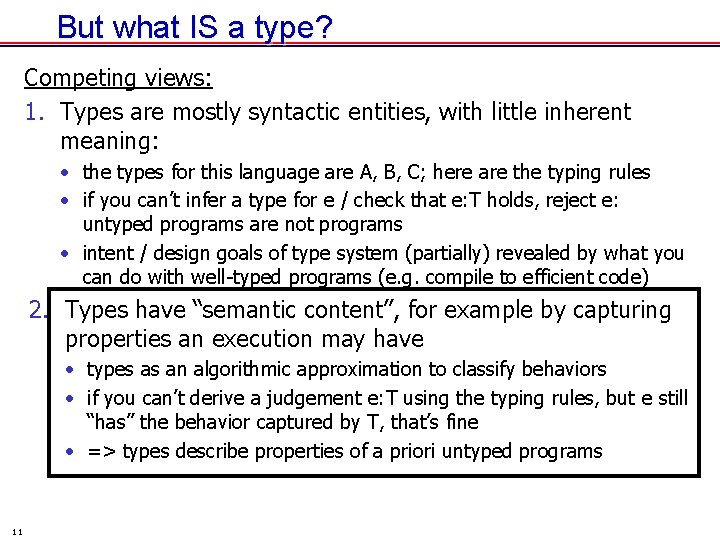
But what IS a type? Competing views: 1. Types are mostly syntactic entities, with little inherent meaning: • the types for this language are A, B, C; here are the typing rules • if you can’t infer a type for e / check that e: T holds, reject e: untyped programs are not programs • intent / design goals of type system (partially) revealed by what you can do with well-typed programs (e. g. compile to efficient code) 2. Types have “semantic content”, for example by capturing properties an execution may have • types as an algorithmic approximation to classify behaviors • if you can’t derive a judgement e: T using the typing rules, but e still “has” the behavior captured by T, that’s fine • => types describe properties of a priori untyped programs 11
But what IS a type? traditional compiler view Competing views: 1. Types are mostly syntactic entities, with little inherent meaning: • the types for this language are A, B, C; here are the typing rules • if you can’t infer a type for e / check that e: T holds, reject e: untyped programs are not programs • intent / design goals of type system (partially) revealed by what you can do with well-typed programs (e. g. compile to efficient code) 2. Types have “semantic content”, for example by capturing properties an execution may have • types as an algorithmic approximation to classify behaviors • if you can’t derive a judgement e: T using the typing rules, but e still “has” the behavior captured by T, that’s fine • => types describe properties of a priori untyped programs Many variations possible, depending on goals! often more modular 12
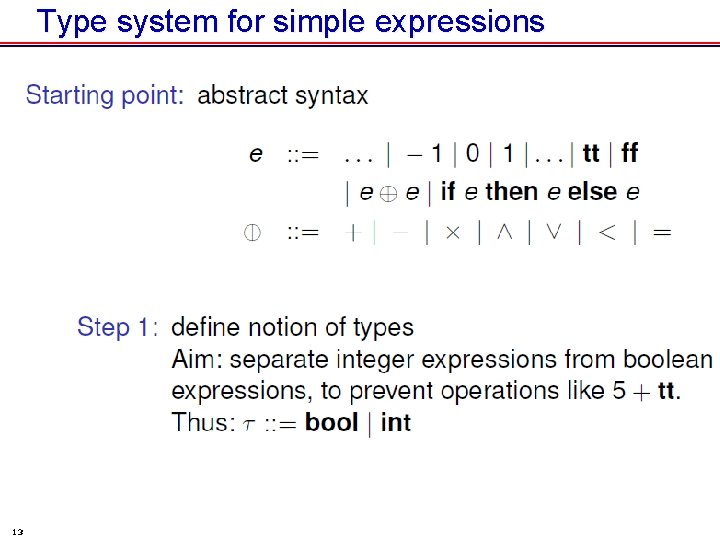
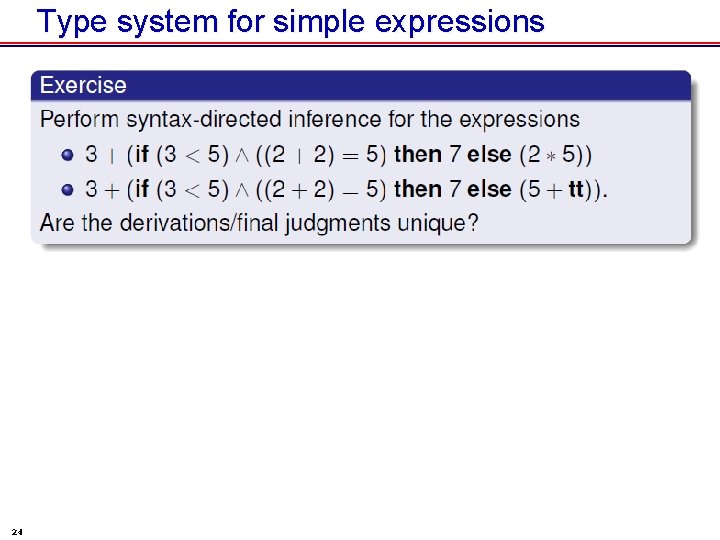
Type system for simple expressions 13
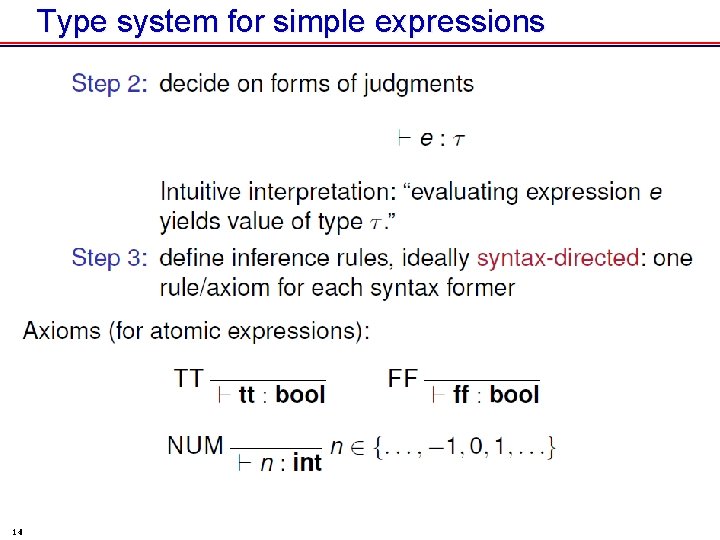
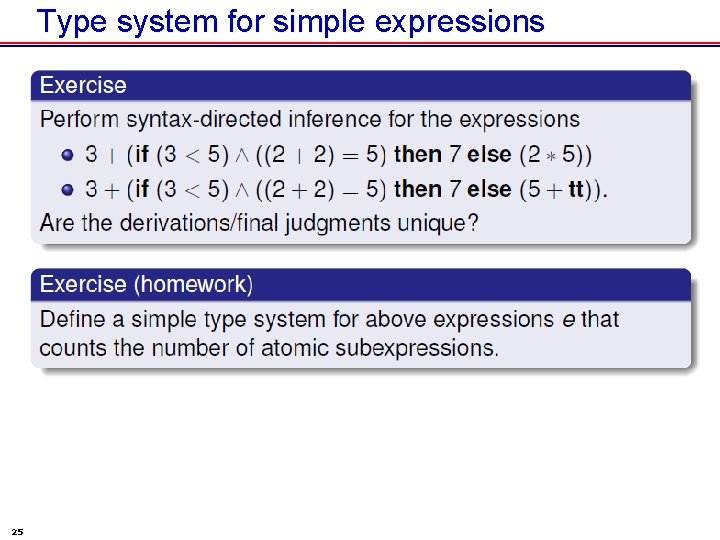
Type system for simple expressions 14
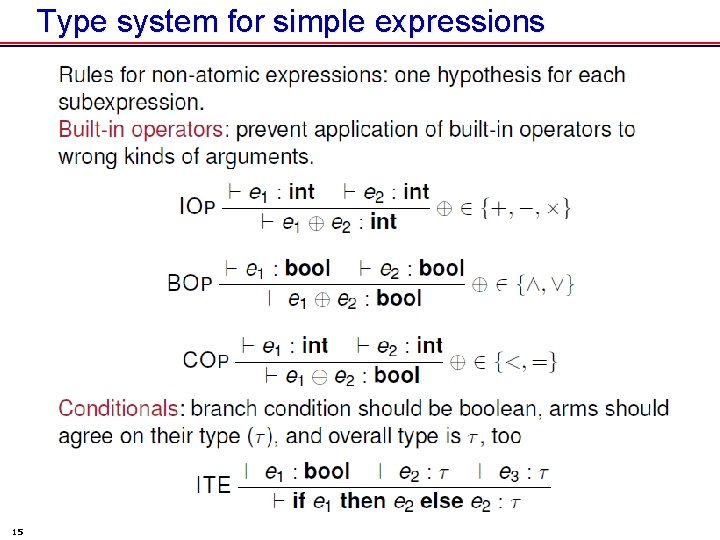
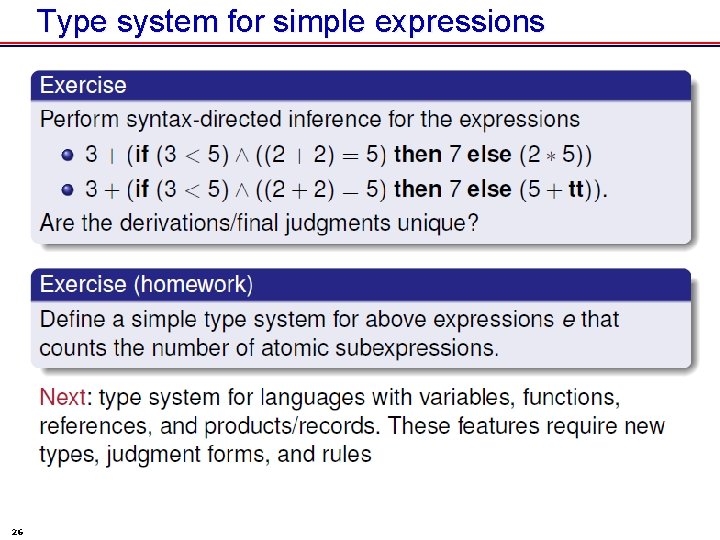
Type system for simple expressions 15
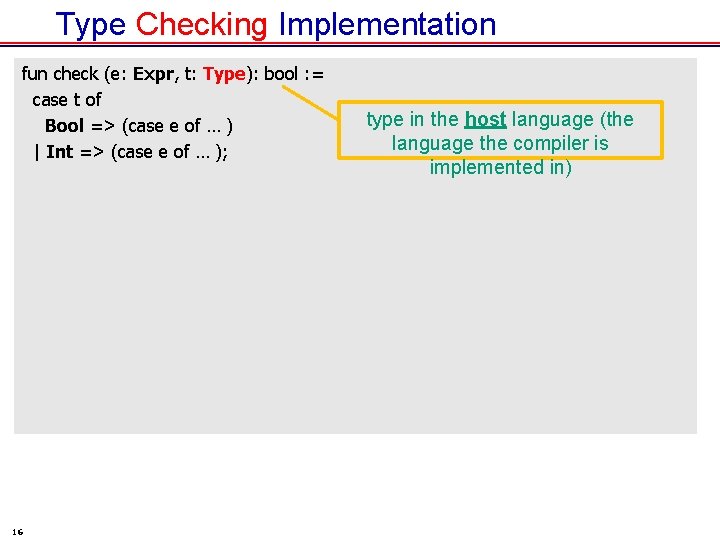
Type Checking Implementation fun check (e: Expr, t: Type): bool : = case t of Bool => (case e of … ) | Int => (case e of … ); 16 type in the host language (the language the compiler is implemented in)
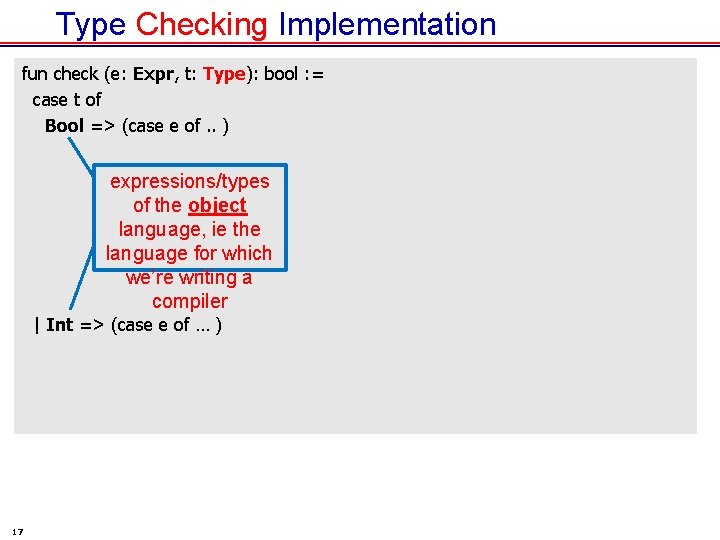
Type Checking Implementation fun check (e: Expr, t: Type): bool : = case t of Bool => (case e of. . ) expressions/types of the object language, ie the language for which we’re writing a compiler | Int => (case e of … ) 17
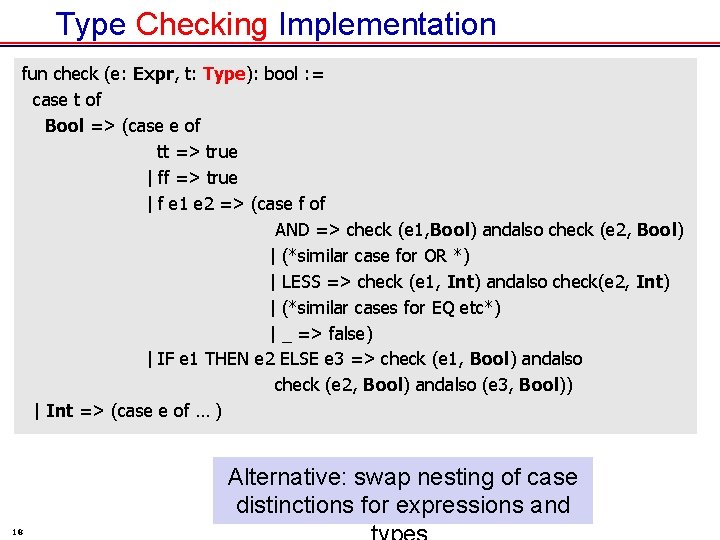
Type Checking Implementation fun check (e: Expr, t: Type): bool : = case t of Bool => (case e of tt => true | ff => true | f e 1 e 2 => (case f of AND => check (e 1, Bool) andalso check (e 2, Bool) | (*similar case for OR *) | LESS => check (e 1, Int) andalso check(e 2, Int) | (*similar cases for EQ etc*) | _ => false) | IF e 1 THEN e 2 ELSE e 3 => check (e 1, Bool) andalso check (e 2, Bool) andalso (e 3, Bool)) | Int => (case e of … ) Alternative: swap nesting of case distinctions for expressions and 18
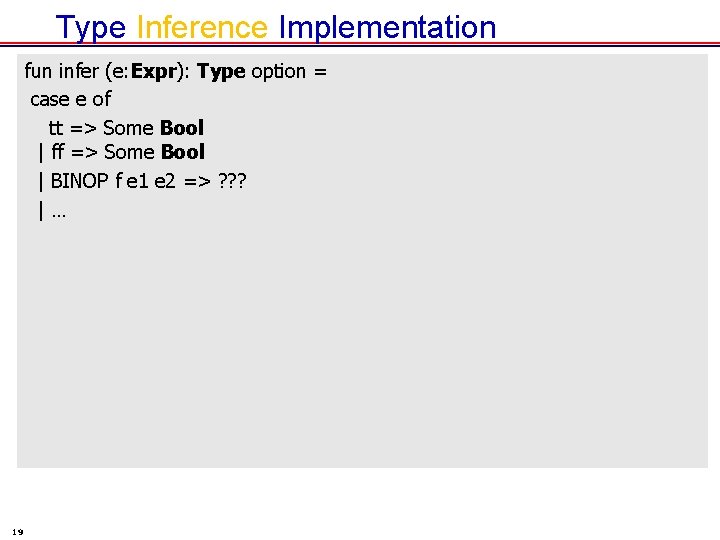
Type Inference Implementation fun infer (e: Expr): Type option = case e of tt => Some Bool | ff => Some Bool | BINOP f e 1 e 2 => ? ? ? |… 19
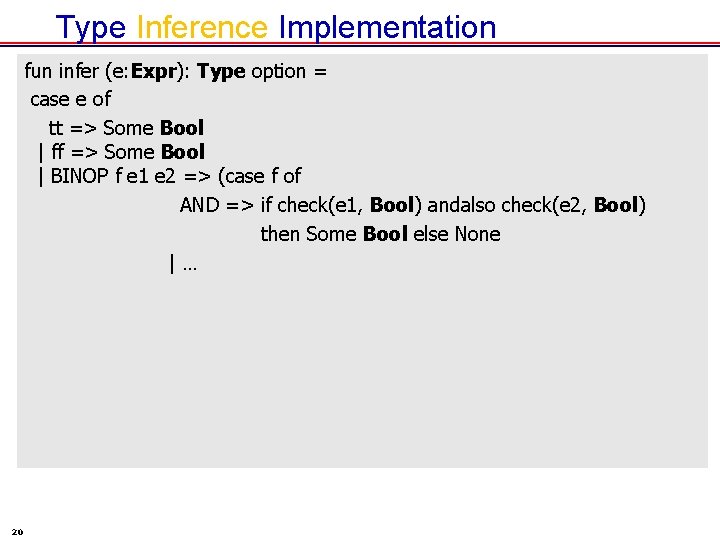
Type Inference Implementation fun infer (e: Expr): Type option = case e of tt => Some Bool | ff => Some Bool | BINOP f e 1 e 2 => (case f of AND => if check(e 1, Bool) andalso check(e 2, Bool) then Some Bool else None |… 20
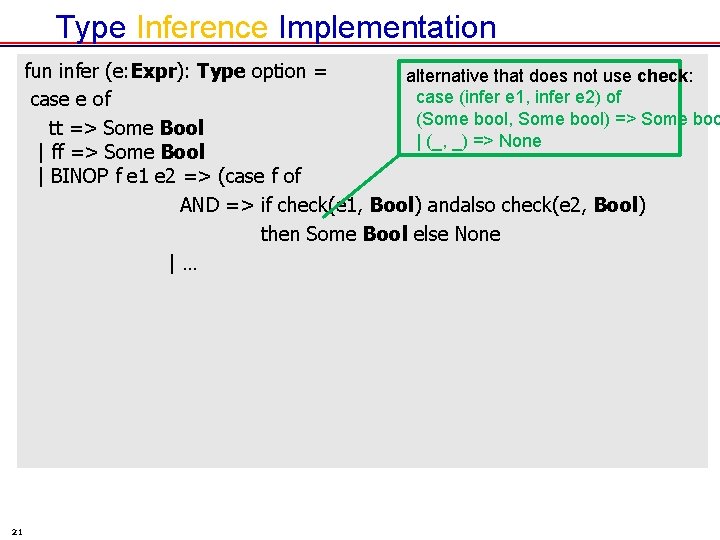
Type Inference Implementation fun infer (e: Expr): Type option = alternative that does not use check: case (infer e 1, infer e 2) of case e of (Some bool, Some bool) => Some boo tt => Some Bool | (_, _) => None | ff => Some Bool | BINOP f e 1 e 2 => (case f of AND => if check(e 1, Bool) andalso check(e 2, Bool) then Some Bool else None |… 21
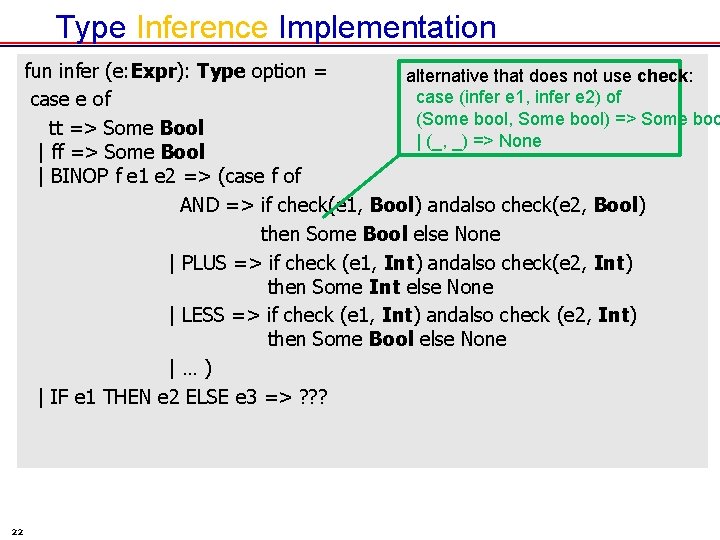
Type Inference Implementation fun infer (e: Expr): Type option = alternative that does not use check: case (infer e 1, infer e 2) of case e of (Some bool, Some bool) => Some boo tt => Some Bool | (_, _) => None | ff => Some Bool | BINOP f e 1 e 2 => (case f of AND => if check(e 1, Bool) andalso check(e 2, Bool) then Some Bool else None | PLUS => if check (e 1, Int) andalso check(e 2, Int) then Some Int else None | LESS => if check (e 1, Int) andalso check (e 2, Int) then Some Bool else None |…) | IF e 1 THEN e 2 ELSE e 3 => ? ? ? 22
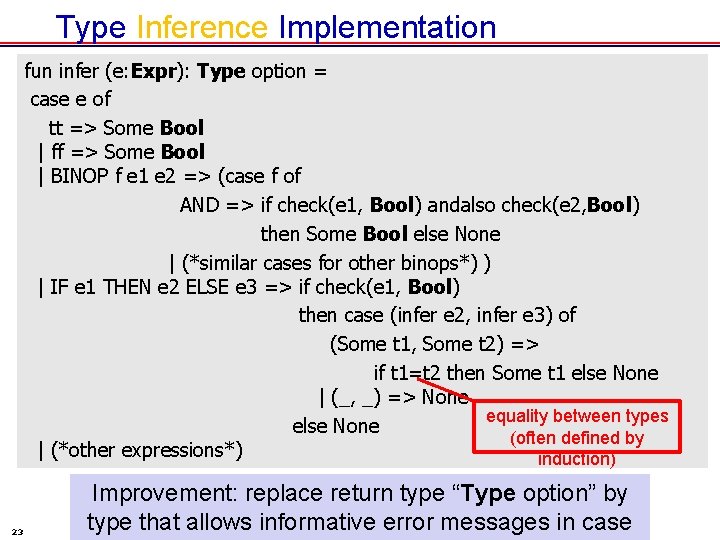
Type Inference Implementation fun infer (e: Expr): Type option = case e of tt => Some Bool | ff => Some Bool | BINOP f e 1 e 2 => (case f of AND => if check(e 1, Bool) andalso check(e 2, Bool) then Some Bool else None | (*similar cases for other binops*) ) | IF e 1 THEN e 2 ELSE e 3 => if check(e 1, Bool) then case (infer e 2, infer e 3) of (Some t 1, Some t 2) => if t 1=t 2 then Some t 1 else None | (_, _) => None equality between types else None (often defined by | (*other expressions*) induction) 23 Improvement: replace return type “Type option” by type that allows informative error messages in case
Type system for simple expressions 24
Type system for simple expressions 25
Type system for simple expressions 26
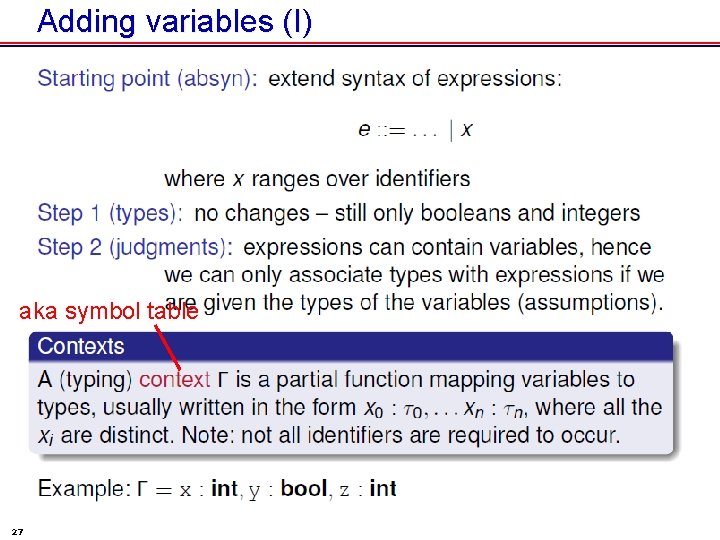
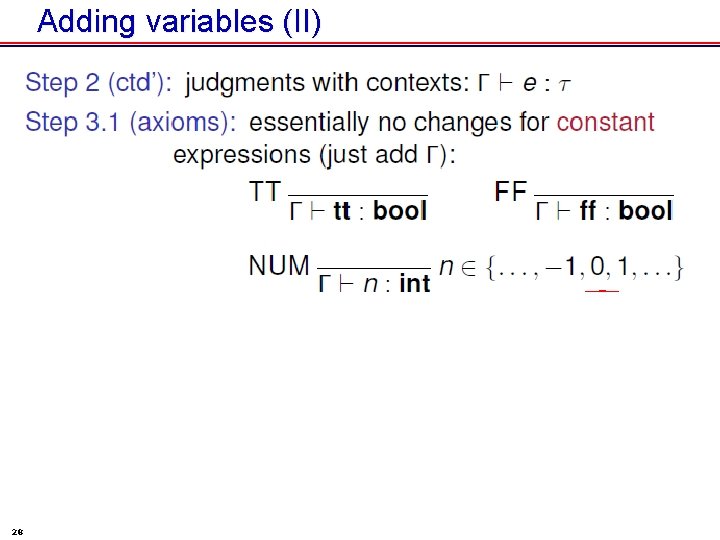
Adding variables (I) aka symbol table 27
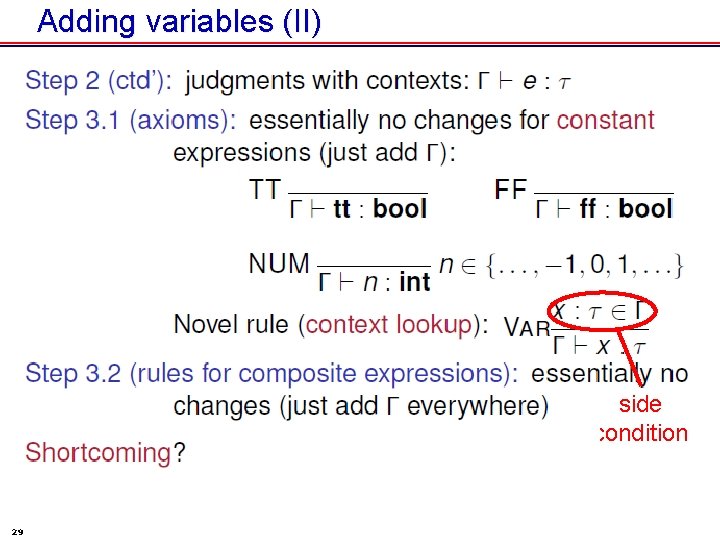
Adding variables (II) side conditio n 28
Adding variables (II) side condition 29
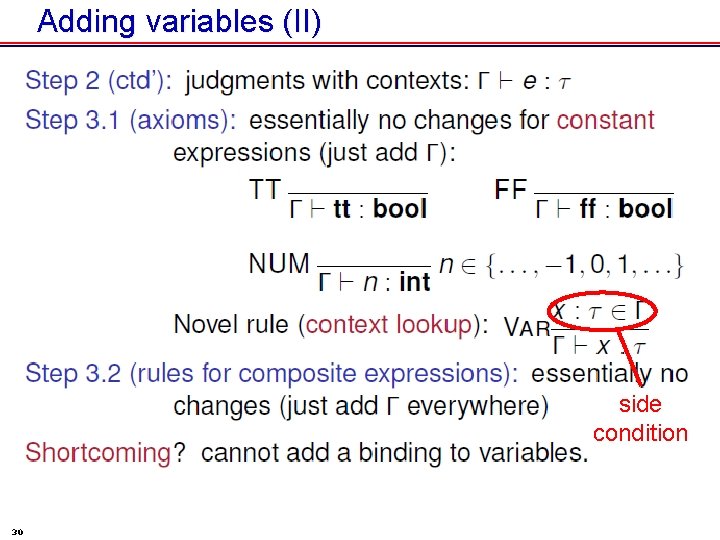
Adding variables (II) side condition 30
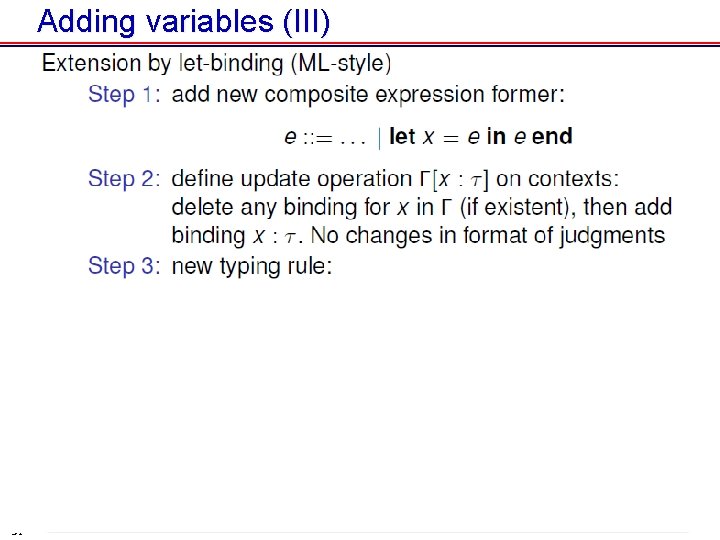
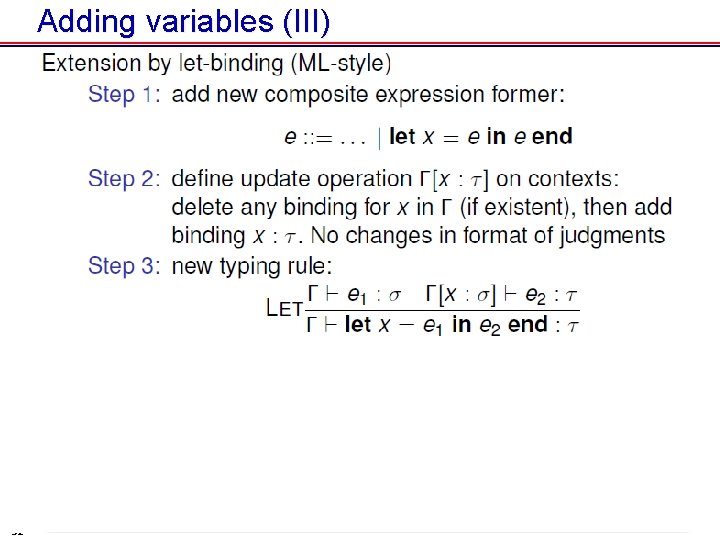
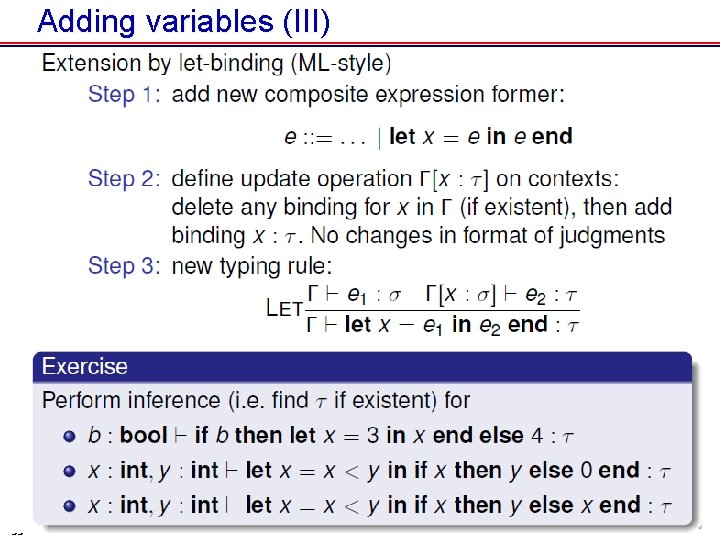
Adding variables (III) 31
Adding variables (III) 32
Adding variables (III) 33
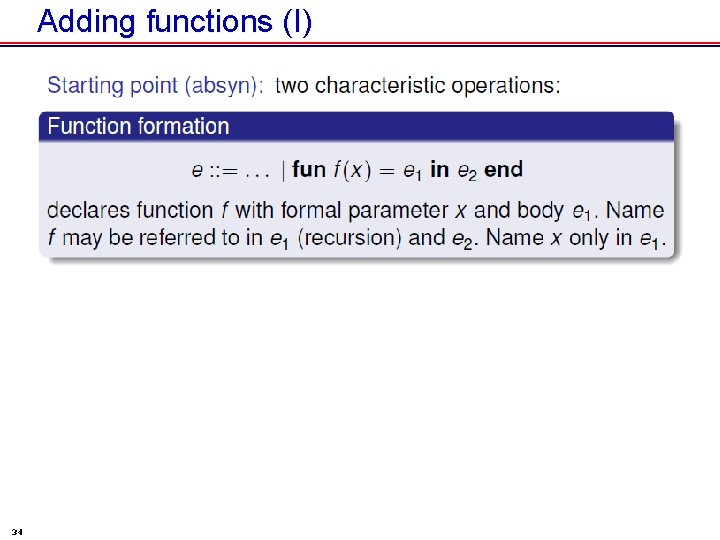
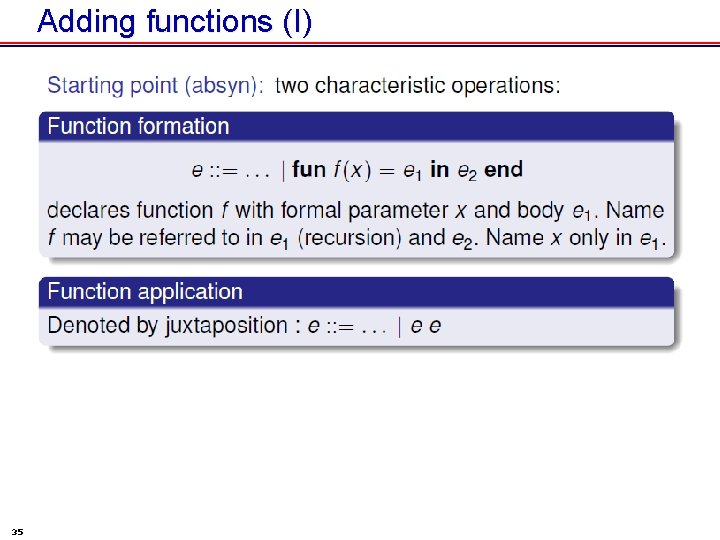
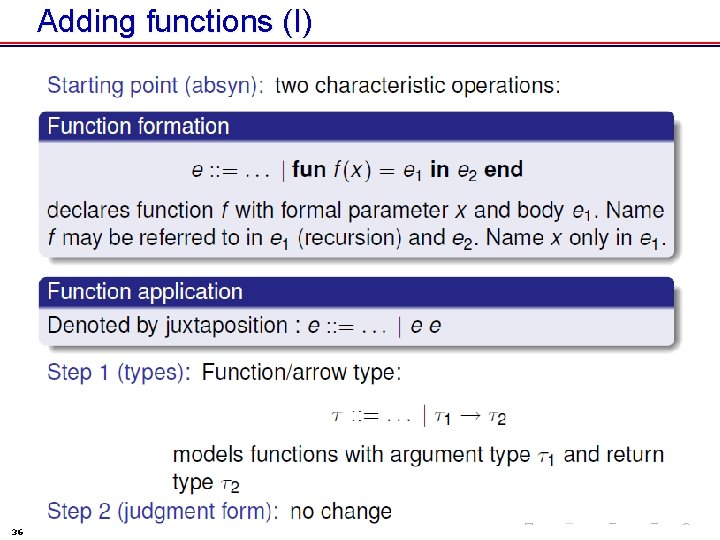
Adding functions (I) 34
Adding functions (I) 35
Adding functions (I) 36
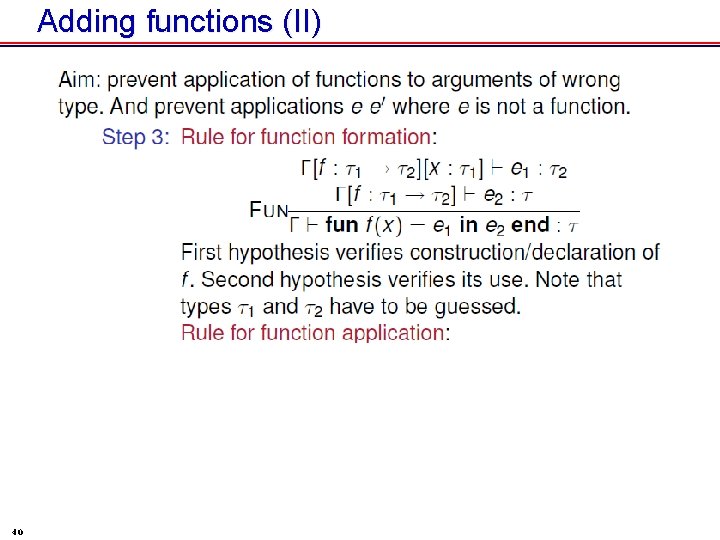
Adding functions (II) 37
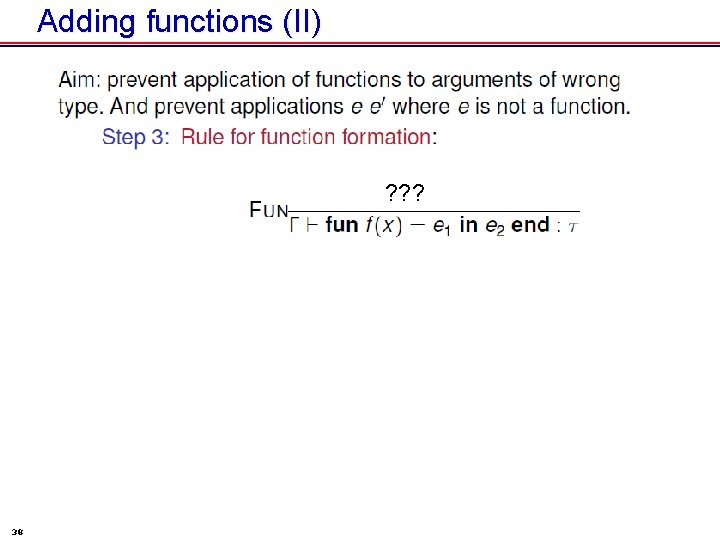
Adding functions (II) ? ? ? 38
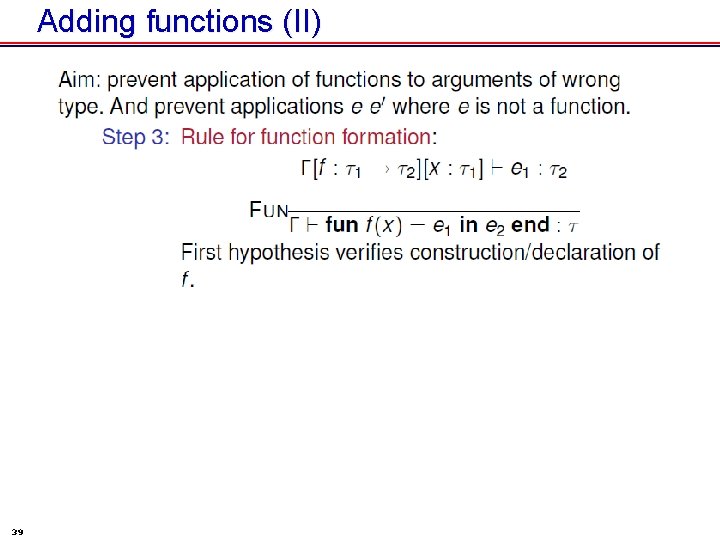
Adding functions (II) 39
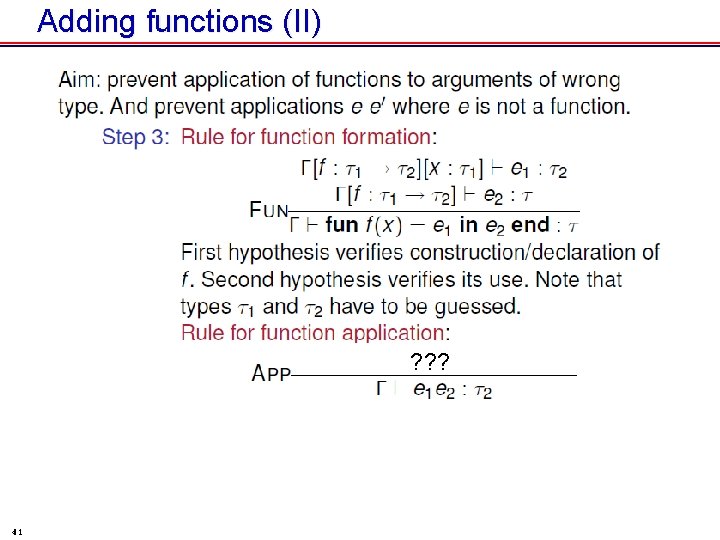
Adding functions (II) 40
Adding functions (II) ? ? ? 41
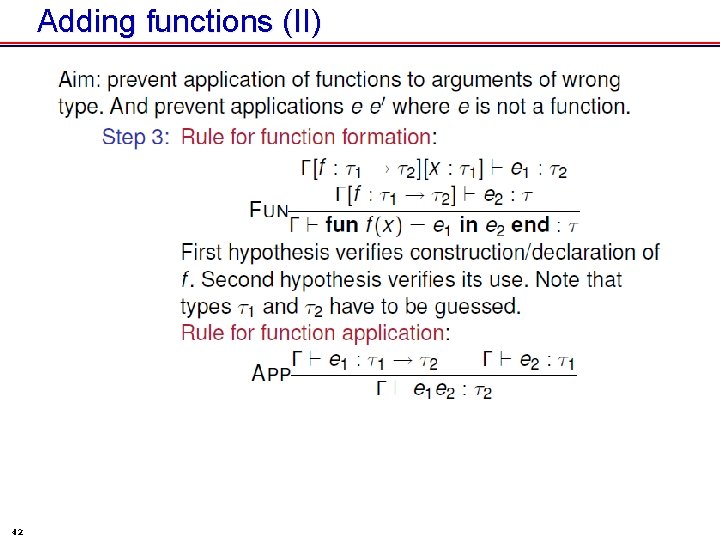
Adding functions (II) 42
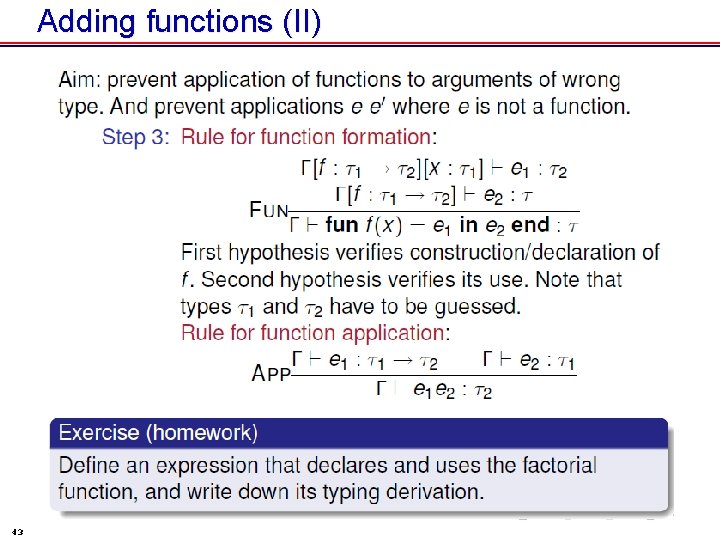
Adding functions (II) 43
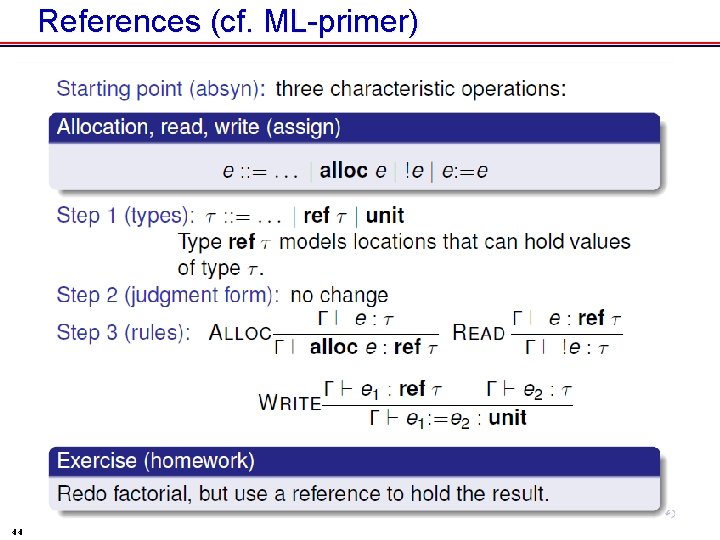
References (cf. ML-primer) 44
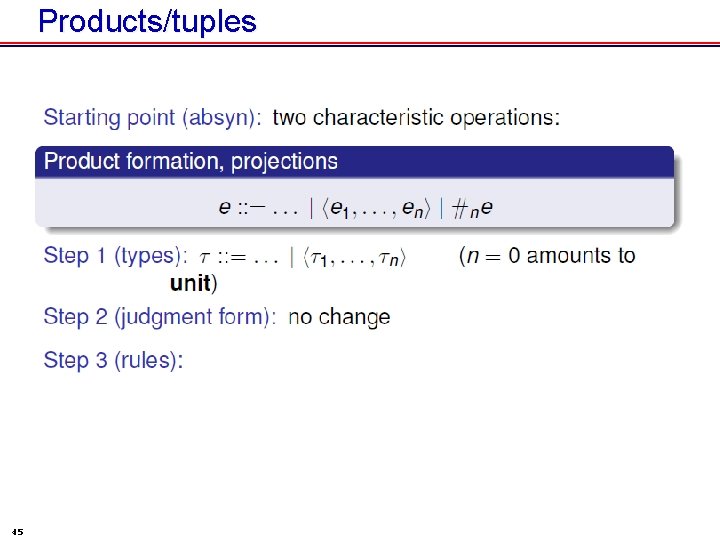
Products/tuples 45
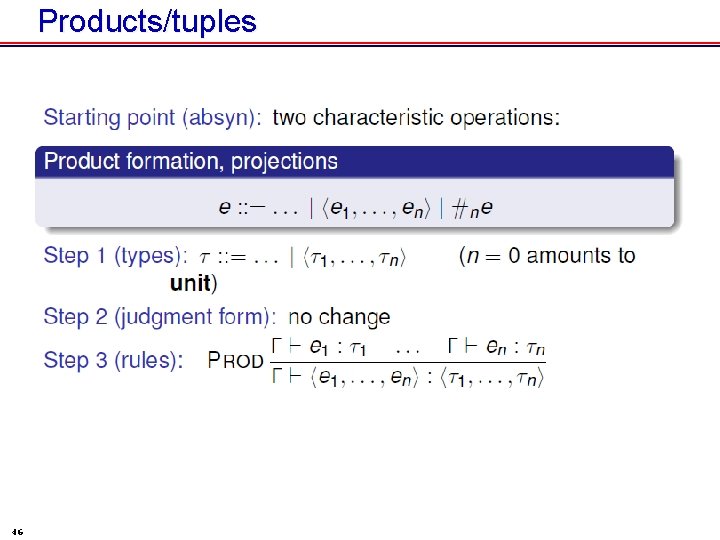
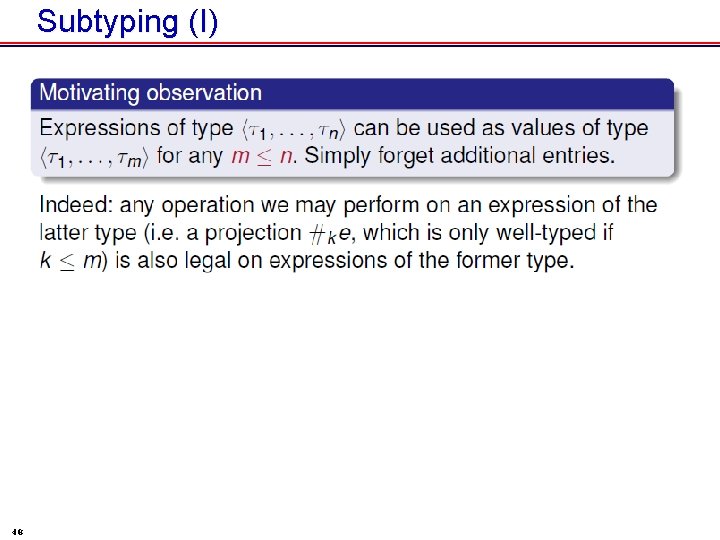
Products/tuples 46
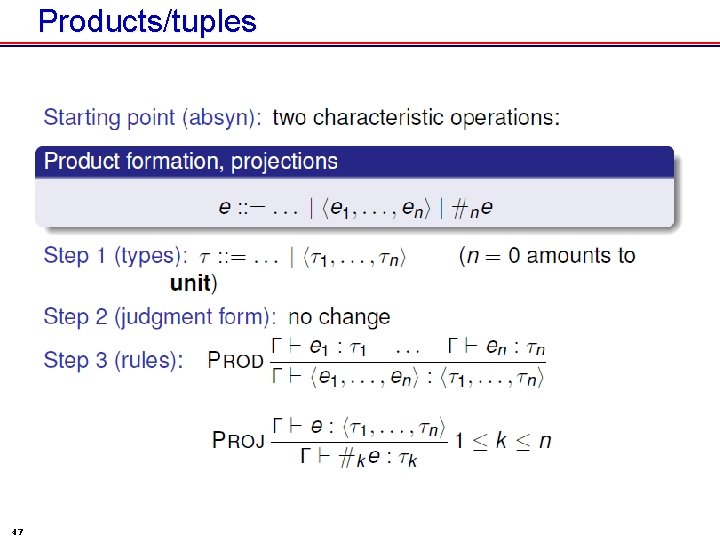
Products/tuples 47
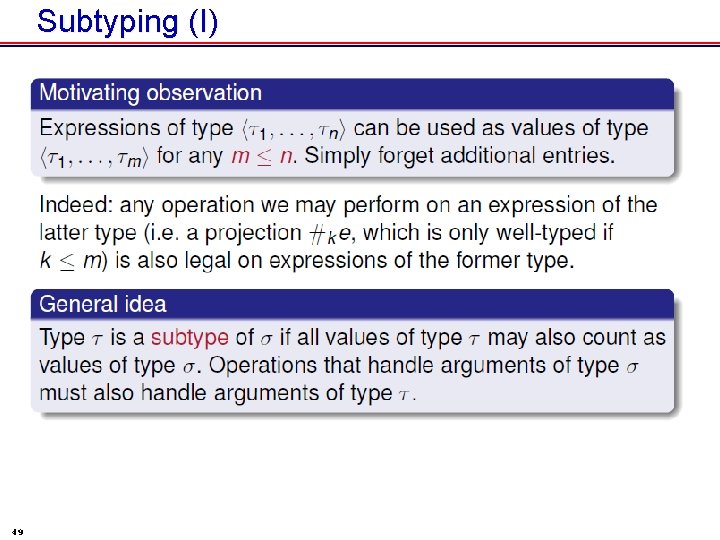
Subtyping (I) 48
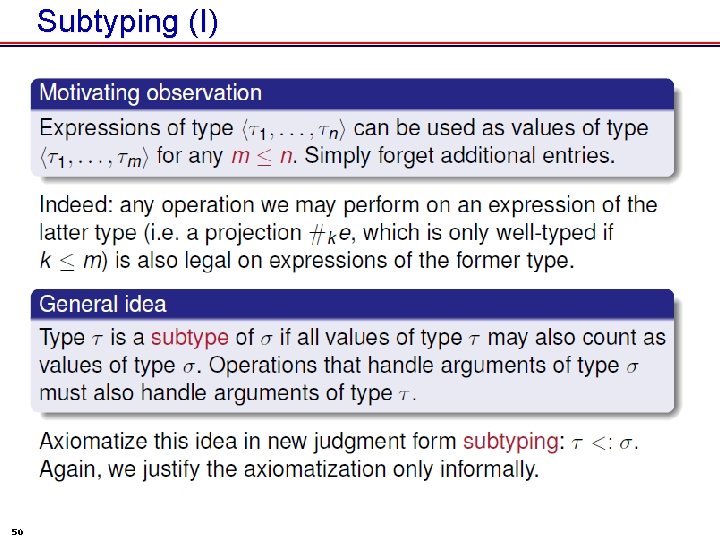
Subtyping (I) 49
Subtyping (I) 50
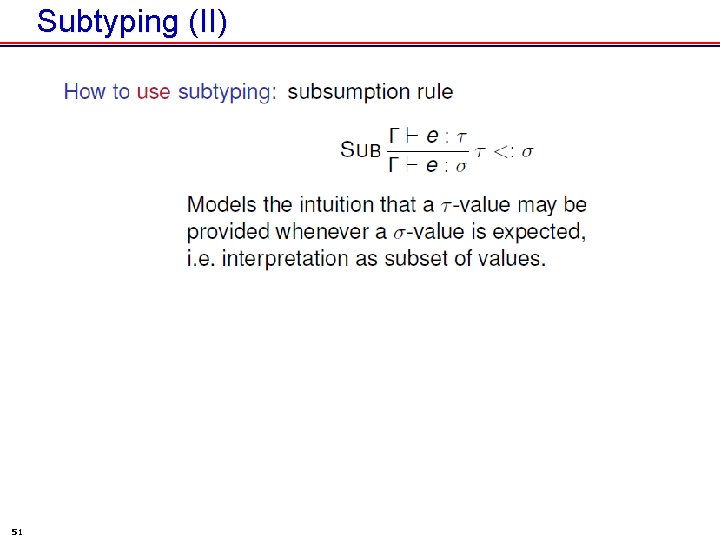
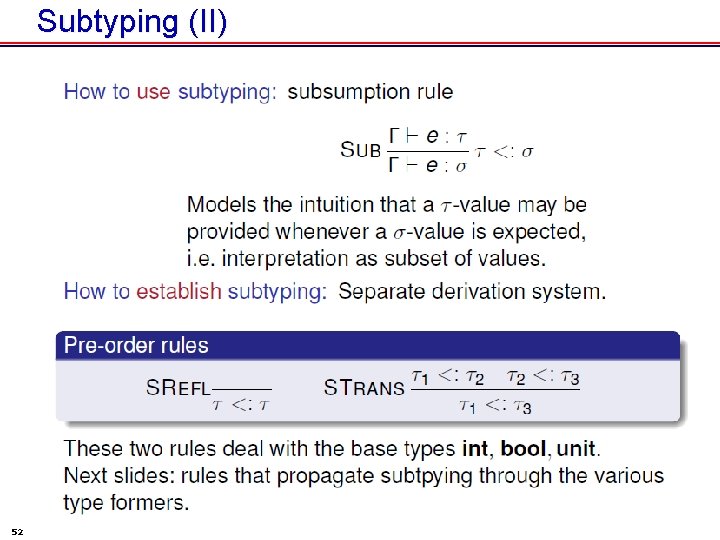
Subtyping (II) 51
Subtyping (II) 52
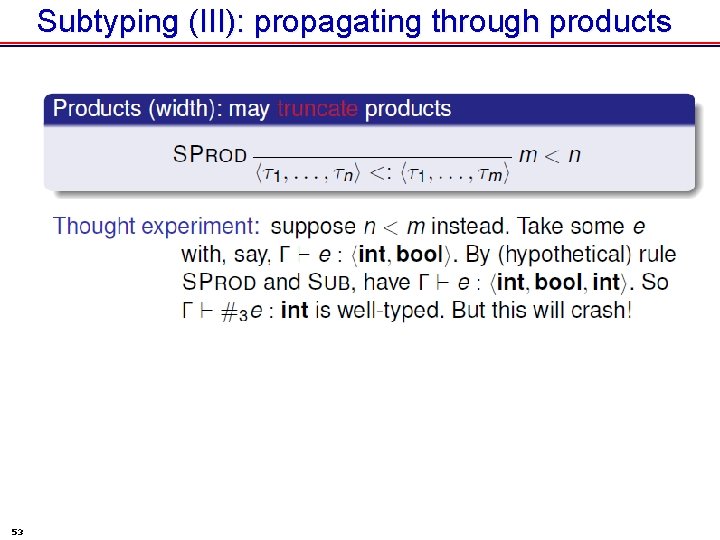
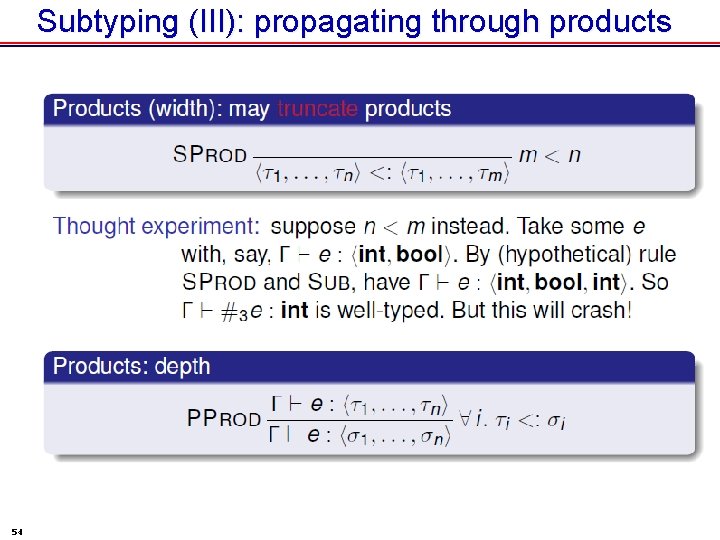
Subtyping (III): propagating through products 53
Subtyping (III): propagating through products 54
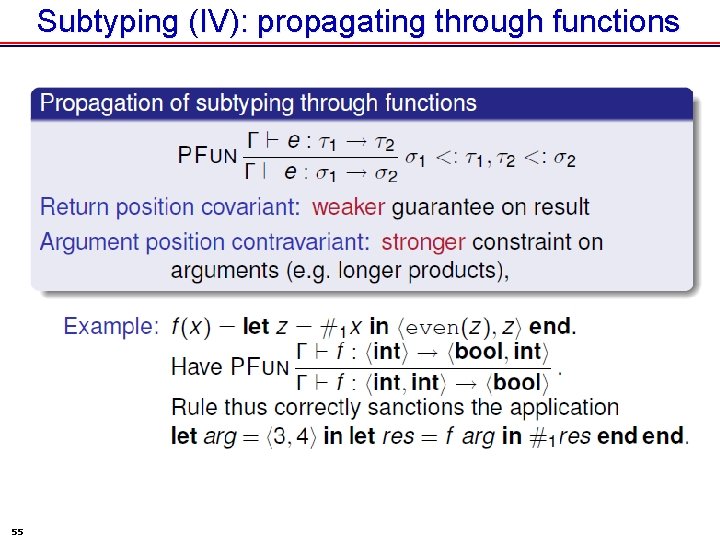
Subtyping (IV): propagating through functions 55
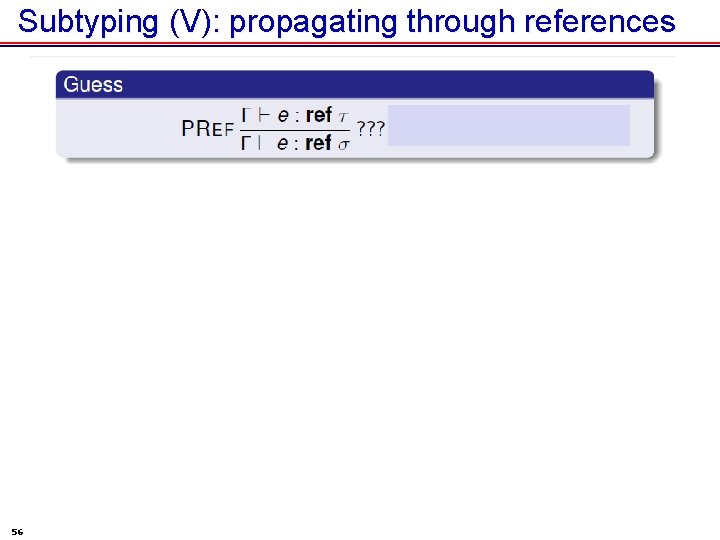
Subtyping (V): propagating through references 56
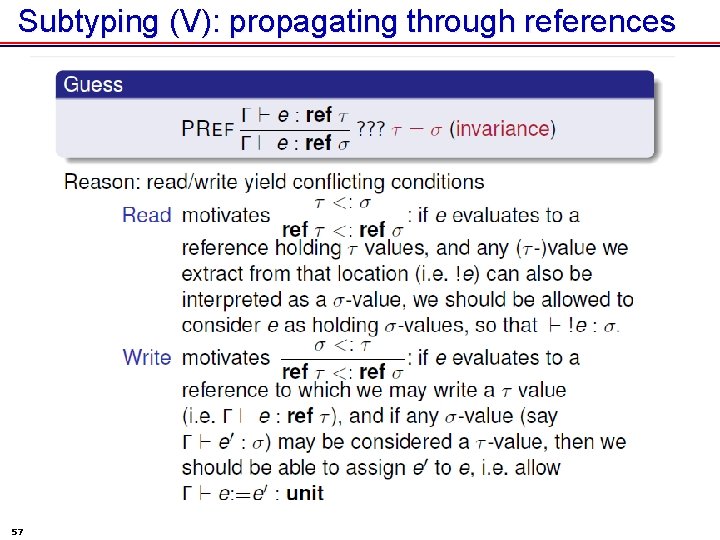
Subtyping (V): propagating through references 57
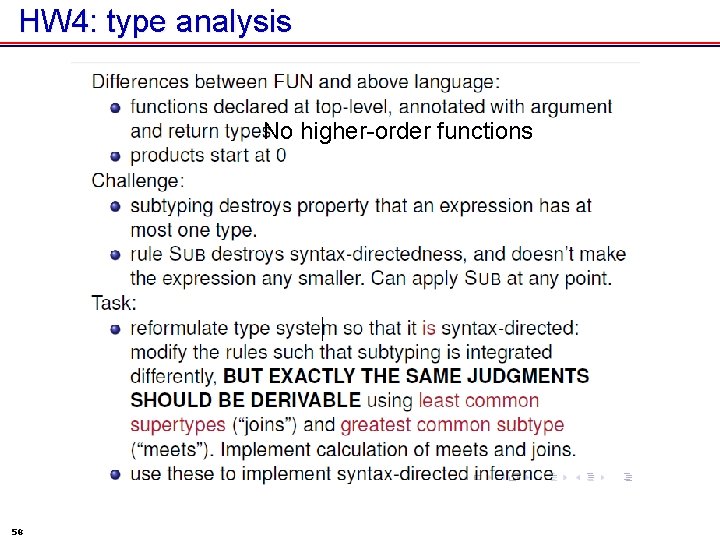
HW 4: type analysis No higher-order functions 58
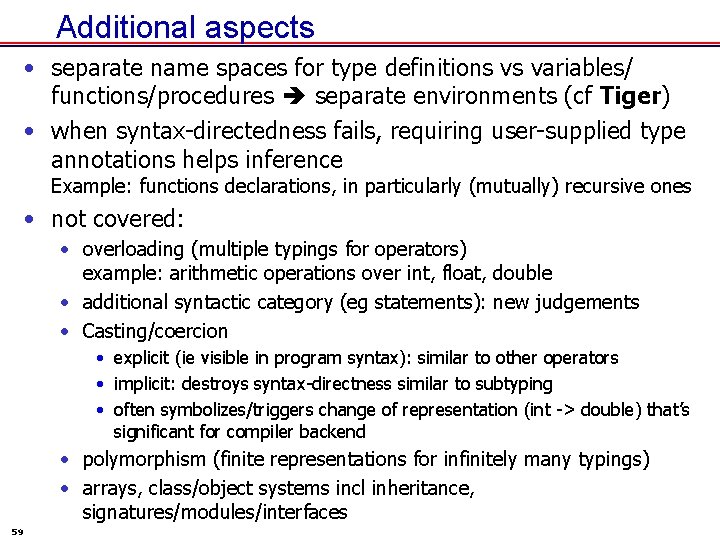
Additional aspects • separate name spaces for type definitions vs variables/ functions/procedures separate environments (cf Tiger) • when syntax-directedness fails, requiring user-supplied type annotations helps inference Example: functions declarations, in particularly (mutually) recursive ones • not covered: • overloading (multiple typings for operators) example: arithmetic operations over int, float, double • additional syntactic category (eg statements): new judgements • Casting/coercion • explicit (ie visible in program syntax): similar to other operators • implicit: destroys syntax-directness similar to subtyping • often symbolizes/triggers change of representation (int -> double) that’s significant for compiler backend • polymorphism (finite representations for infinitely many typings) • arrays, class/object systems incl inheritance, signatures/modules/interfaces 59
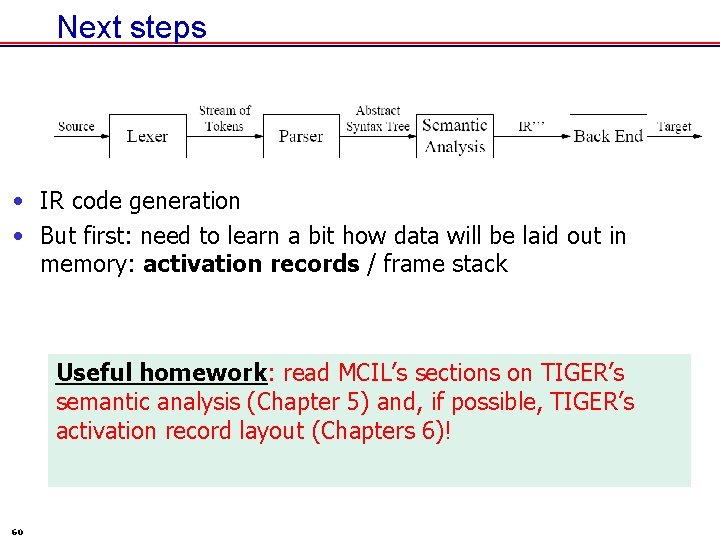
Next steps • IR code generation • But first: need to learn a bit how data will be laid out in memory: activation records / frame stack Useful homework: read MCIL’s sections on TIGER’s semantic analysis (Chapter 5) and, if possible, TIGER’s activation record layout (Chapters 6)! 60
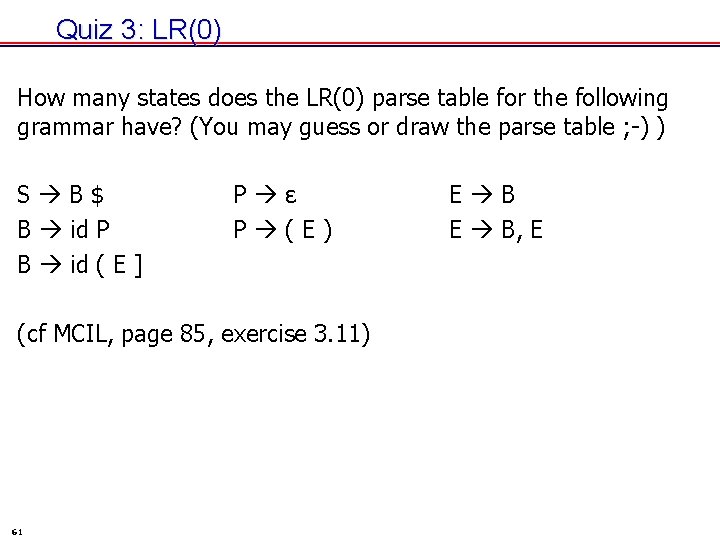
Quiz 3: LR(0) How many states does the LR(0) parse table for the following grammar have? (You may guess or draw the parse table ; -) ) S B$ B id P B id ( E ] P ε P (E) (cf MCIL, page 85, exercise 3. 11) 61 E B E B, E