
Topic 12 Register Allocation COS 320 Compiling Techniques
- Slides: 67
Topic 12: Register Allocation COS 320 Compiling Techniques Princeton University Spring 2016 Lennart Beringer 1
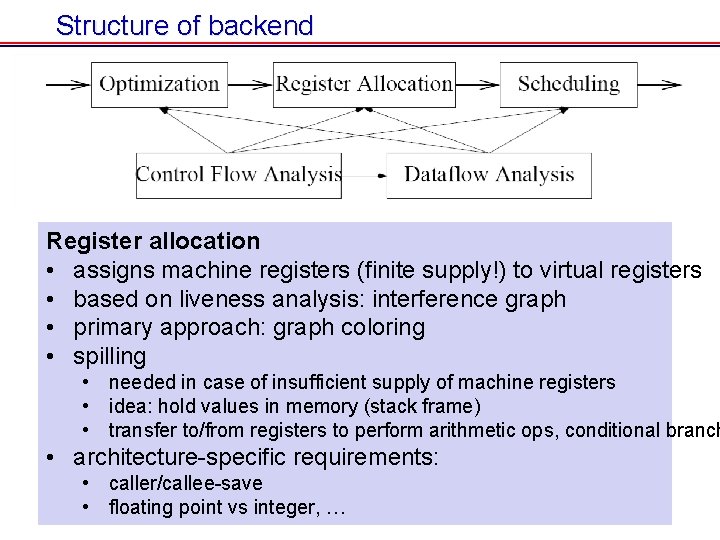
Structure of backend Register allocation • assigns machine registers (finite supply!) to virtual registers • based on liveness analysis: interference graph • primary approach: graph coloring • spilling • needed in case of insufficient supply of machine registers • idea: hold values in memory (stack frame) • transfer to/from registers to perform arithmetic ops, conditional branch • architecture-specific requirements: • caller/callee-save • floating point vs integer, …
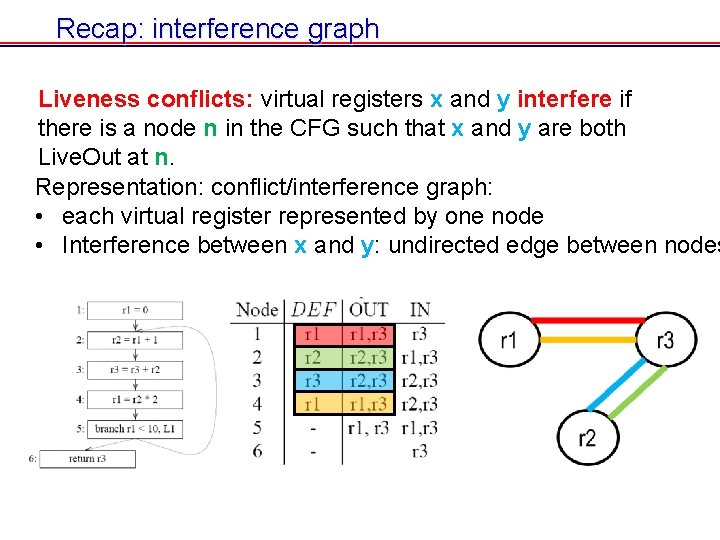
Recap: interference graph Liveness conflicts: virtual registers x and y interfere if there is a node n in the CFG such that x and y are both Live. Out at n. Representation: conflict/interference graph: • each virtual register represented by one node • Interference between x and y: undirected edge between nodes
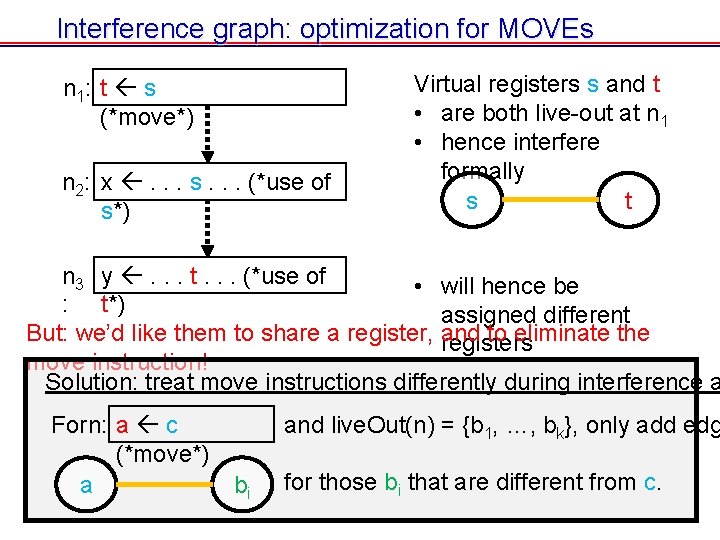
Interference graph: optimization for MOVEs n 1: t s (*move*) n 2: x . . . s. . . (*use of s*) Virtual registers s and t • are both live-out at n 1 • hence interfere formally s t n 3 y . . . t. . . (*use of • will hence be : t*) assigned different But: we’d like them to share a register, and to eliminate the registers move instruction! Solution: treat move instructions differently during interference a For n: a c (*move*) a and live. Out(n) = {b 1, …, bk}, only add edg bi for those bi that are different from c.
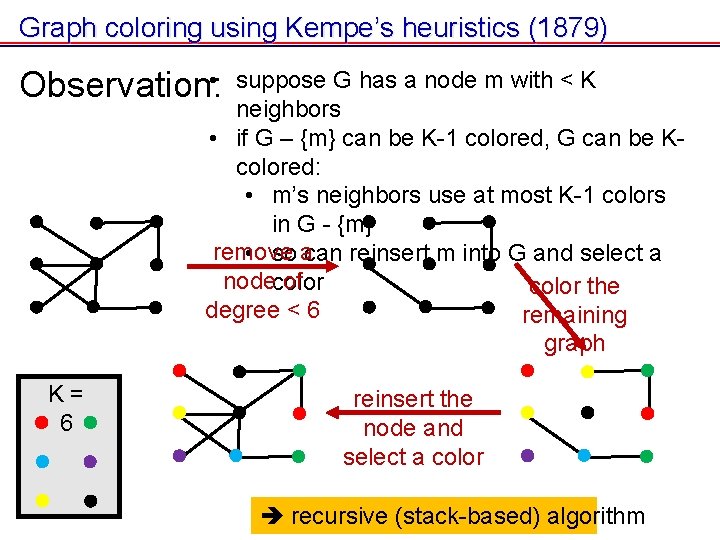
Graph coloring using Kempe’s heuristics (1879) Observation: • suppose G has a node m with < K neighbors • if G – {m} can be K-1 colored, G can be Kcolored: • m’s neighbors use at most K-1 colors in G - {m} remove • so acan reinsert m into G and select a nodecolor of color the degree < 6 remaining graph K= 6 reinsert the node and select a color recursive (stack-based) algorithm
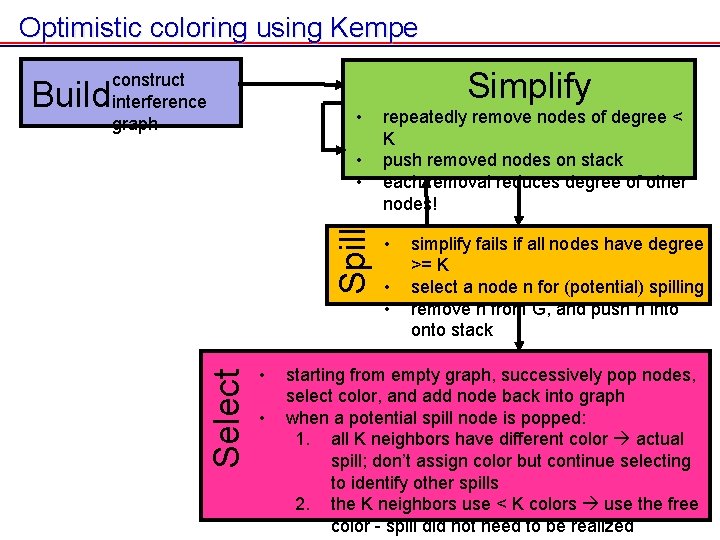
Optimistic coloring using Kempe Build construct interference graph
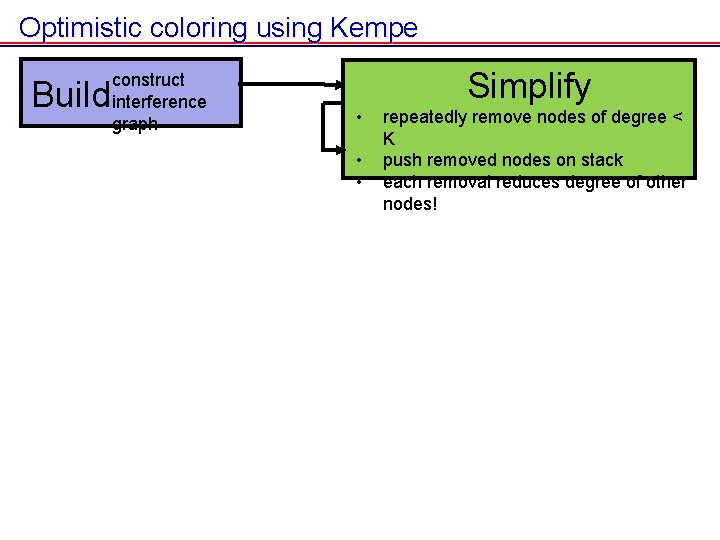
Optimistic coloring using Kempe Build construct interference graph Simplify • • • repeatedly remove nodes of degree < K push removed nodes on stack each removal reduces degree of other nodes!
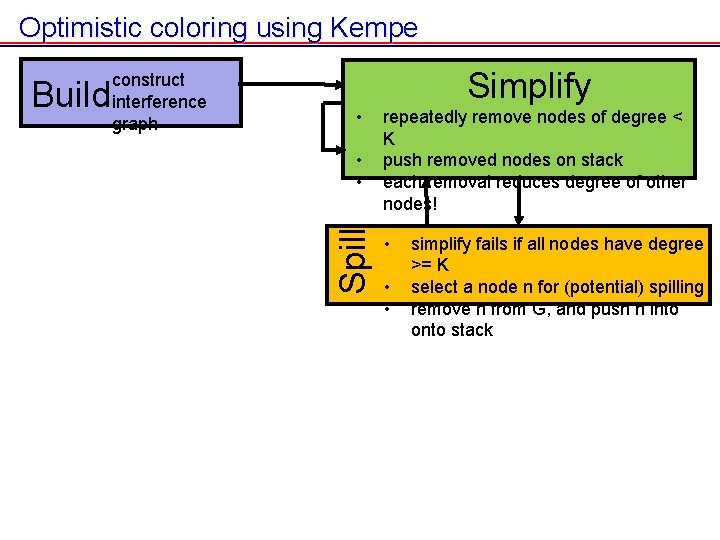
Optimistic coloring using Kempe Simplify • • • Spill Build construct interference graph repeatedly remove nodes of degree < K push removed nodes on stack each removal reduces degree of other nodes! • • • simplify fails if all nodes have degree >= K select a node n for (potential) spilling remove n from G, and push n into onto stack
Optimistic coloring using Kempe Simplify • Spill • • Select Build construct interference graph • • repeatedly remove nodes of degree < K push removed nodes on stack each removal reduces degree of other nodes! • • • simplify fails if all nodes have degree >= K select a node n for (potential) spilling remove n from G, and push n into onto stack starting from empty graph, successively pop nodes, select color, and add node back into graph when a potential spill node is popped: 1. all K neighbors have different color actual spill; don’t assign color but continue selecting to identify other spills 2. the K neighbors use < K colors use the free color - spill did not need to be realized
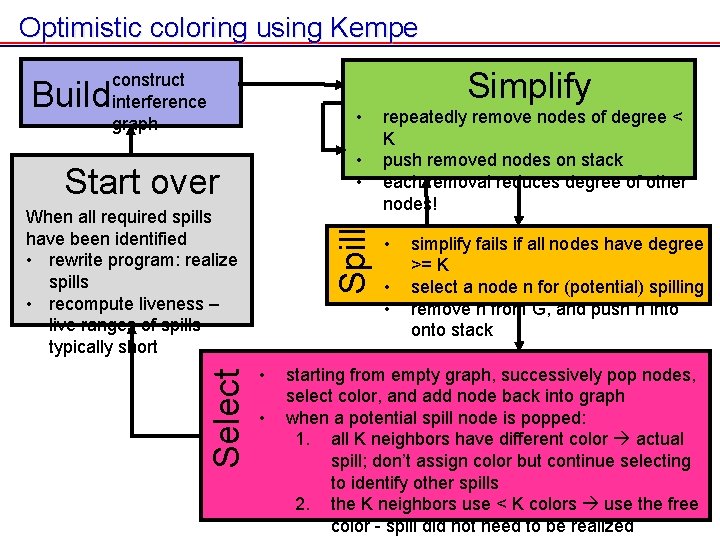
Optimistic coloring using Kempe Build Simplify construct interference graph • • • Start over Select Spill When all required spills have been identified • rewrite program: realize spills • recompute liveness – live ranges of spills typically short • • repeatedly remove nodes of degree < K push removed nodes on stack each removal reduces degree of other nodes! • • • simplify fails if all nodes have degree >= K select a node n for (potential) spilling remove n from G, and push n into onto stack starting from empty graph, successively pop nodes, select color, and add node back into graph when a potential spill node is popped: 1. all K neighbors have different color actual spill; don’t assign color but continue selecting to identify other spills 2. the K neighbors use < K colors use the free color - spill did not need to be realized
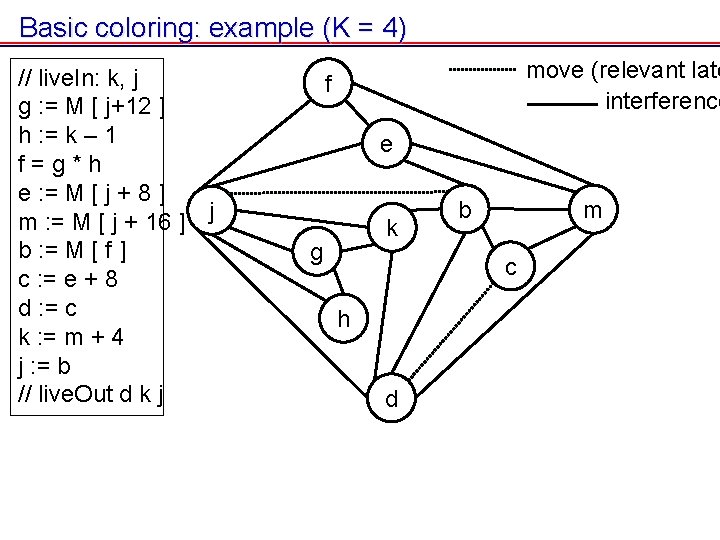
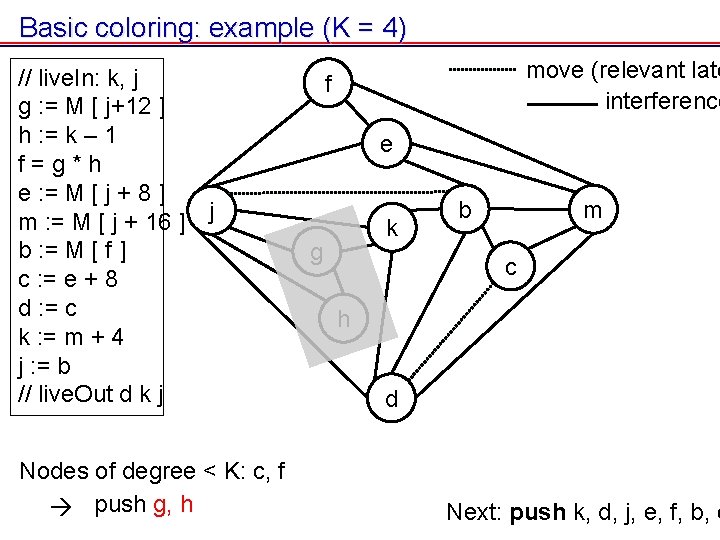
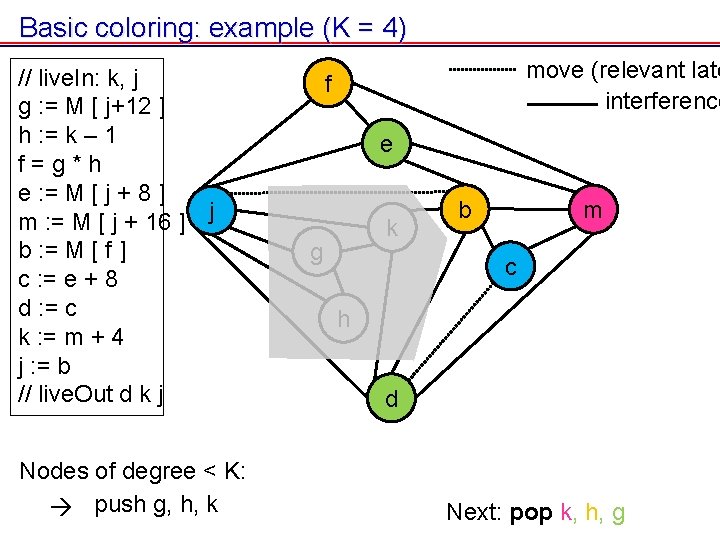
Basic coloring: example (K = 4) // live. In: k, j g : = M [ j+12 ] h : = k – 1 f=g*h e : = M [ j + 8 ] m : = M [ j + 16 ] b : = M [ f ] c : = e + 8 d : = c k : = m + 4 j : = b // live. Out d k j move (relevant late interference f e j k g b m c h d
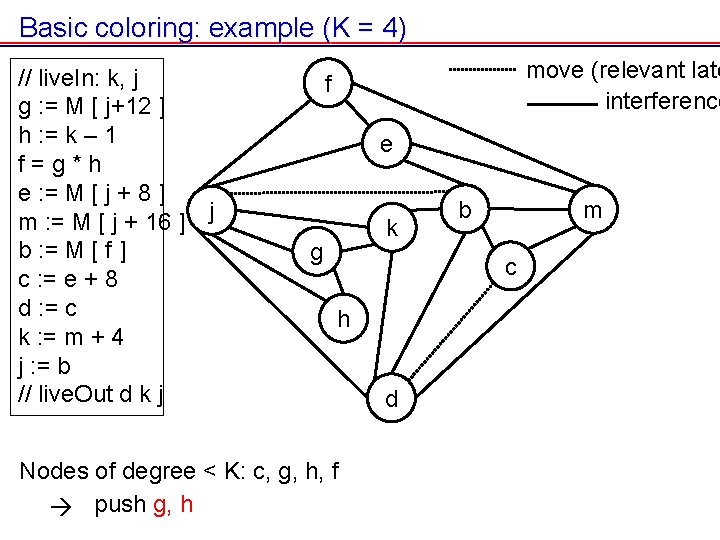
Basic coloring: example (K = 4) // live. In: k, j g : = M [ j+12 ] h : = k – 1 f=g*h e : = M [ j + 8 ] m : = M [ j + 16 ] b : = M [ f ] c : = e + 8 d : = c k : = m + 4 j : = b // live. Out d k j move (relevant late interference f e j k g b m c h Nodes of degree < K: c, g, h, f push g, h d
Basic coloring: example (K = 4) // live. In: k, j g : = M [ j+12 ] h : = k – 1 f=g*h e : = M [ j + 8 ] m : = M [ j + 16 ] b : = M [ f ] c : = e + 8 d : = c k : = m + 4 j : = b // live. Out d k j move (relevant late interference f e j Nodes of degree < K: c, f push g, h k g b m c h d Next: push k, d, j, e, f, b, c
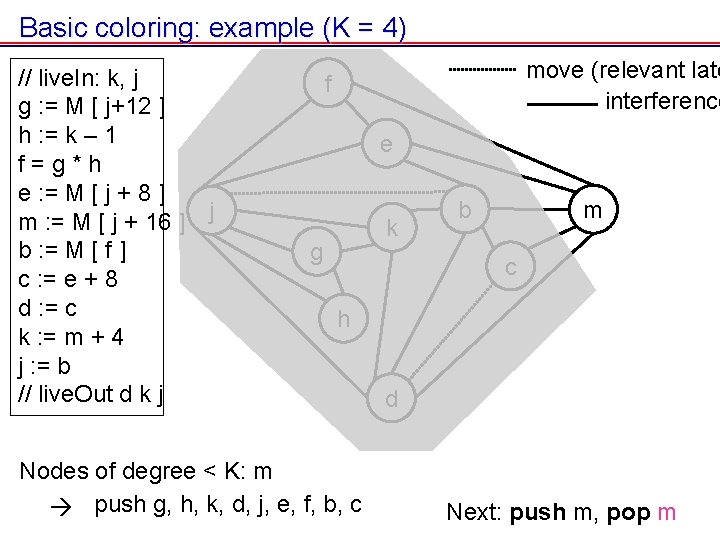
Basic coloring: example (K = 4) // live. In: k, j g : = M [ j+12 ] h : = k – 1 f=g*h e : = M [ j + 8 ] m : = M [ j + 16 ] b : = M [ f ] c : = e + 8 d : = c k : = m + 4 j : = b // live. Out d k j move (relevant late interference f e j k g b m c h Nodes of degree < K: m push g, h, k, d, j, e, f, b, c d Next: push m, pop m
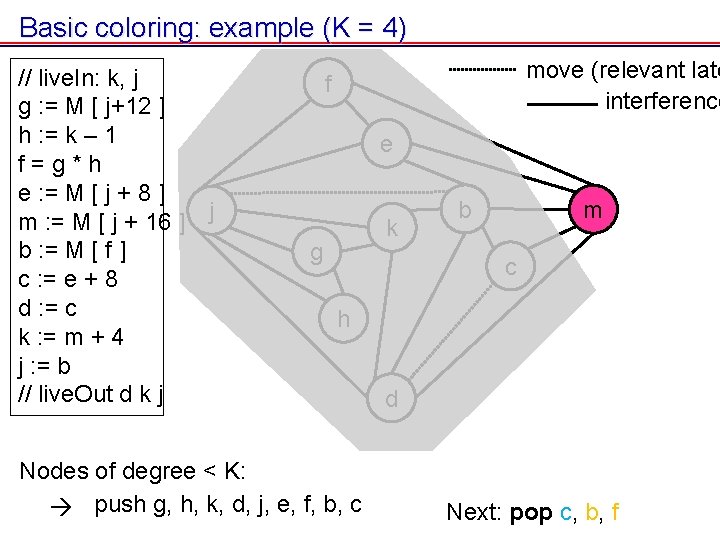
Basic coloring: example (K = 4) // live. In: k, j g : = M [ j+12 ] h : = k – 1 f=g*h e : = M [ j + 8 ] m : = M [ j + 16 ] b : = M [ f ] c : = e + 8 d : = c k : = m + 4 j : = b // live. Out d k j move (relevant late interference f e j k g b m c h Nodes of degree < K: push g, h, k, d, j, e, f, b, c d Next: pop c, b, f
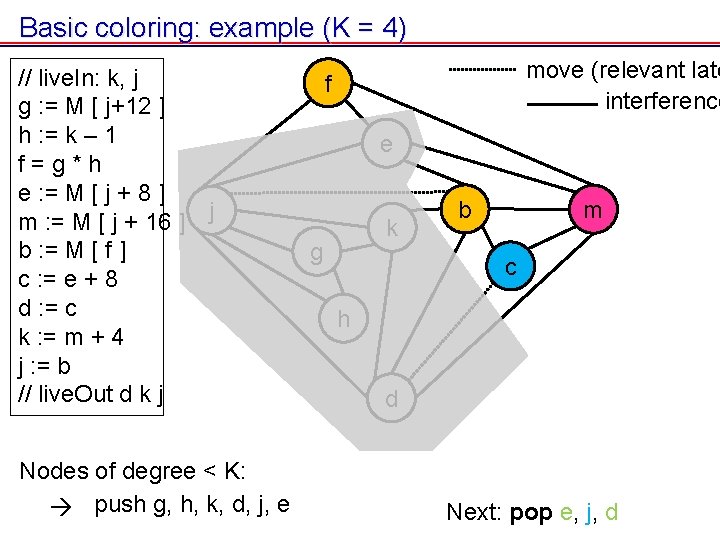
Basic coloring: example (K = 4) // live. In: k, j g : = M [ j+12 ] h : = k – 1 f=g*h e : = M [ j + 8 ] m : = M [ j + 16 ] b : = M [ f ] c : = e + 8 d : = c k : = m + 4 j : = b // live. Out d k j move (relevant late interference f e j Nodes of degree < K: push g, h, k, d, j, e k g b m c h d Next: pop e, j, d
Basic coloring: example (K = 4) // live. In: k, j g : = M [ j+12 ] h : = k – 1 f=g*h e : = M [ j + 8 ] m : = M [ j + 16 ] b : = M [ f ] c : = e + 8 d : = c k : = m + 4 j : = b // live. Out d k j move (relevant late interference f e j Nodes of degree < K: push g, h, k k g b m c h d Next: pop k, h, g
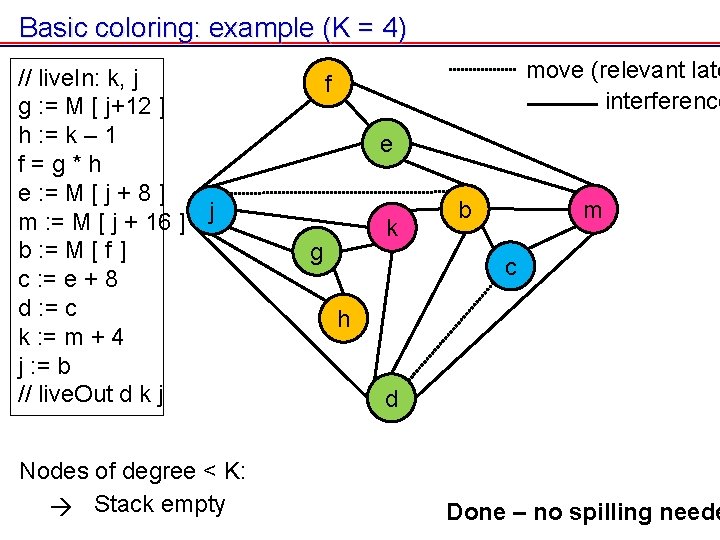
Basic coloring: example (K = 4) // live. In: k, j g : = M [ j+12 ] h : = k – 1 f=g*h e : = M [ j + 8 ] m : = M [ j + 16 ] b : = M [ f ] c : = e + 8 d : = c k : = m + 4 j : = b // live. Out d k j move (relevant late interference f e j Nodes of degree < K: Stack empty k g b m c h d Done – no spilling neede
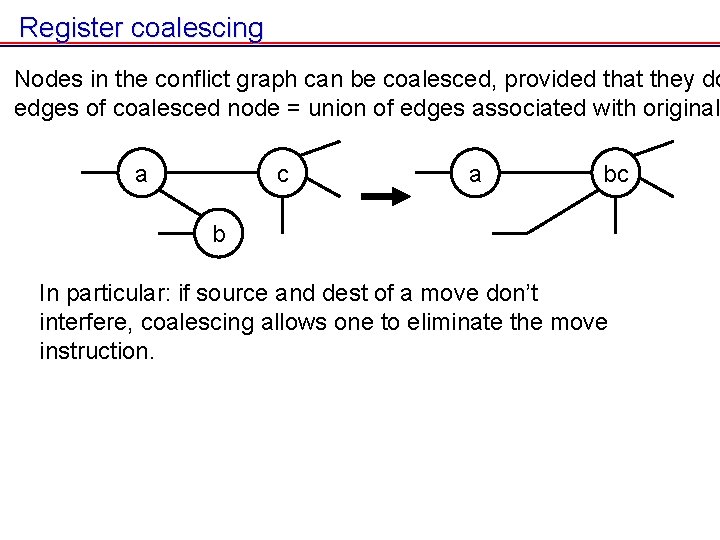
Register coalescing Nodes in the conflict graph can be coalesced, provided that they do edges of coalesced node = union of edges associated with original a c a bc b In particular: if source and dest of a move don’t interfere, coalescing allows one to eliminate the move instruction.
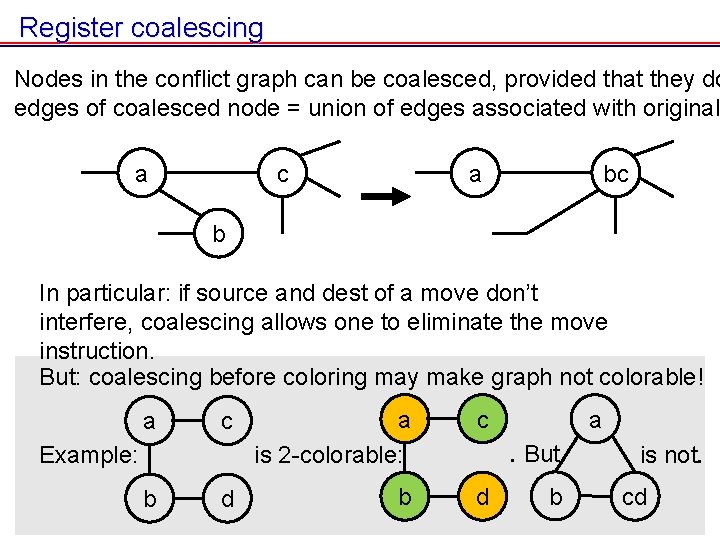
Register coalescing Nodes in the conflict graph can be coalesced, provided that they do edges of coalesced node = union of edges associated with original a c a bc b In particular: if source and dest of a move don’t interfere, coalescing allows one to eliminate the move instruction. But: coalescing before coloring may make graph not colorable! a c Example: b d a is 2 -colorable: c b d a. But b is not. cd
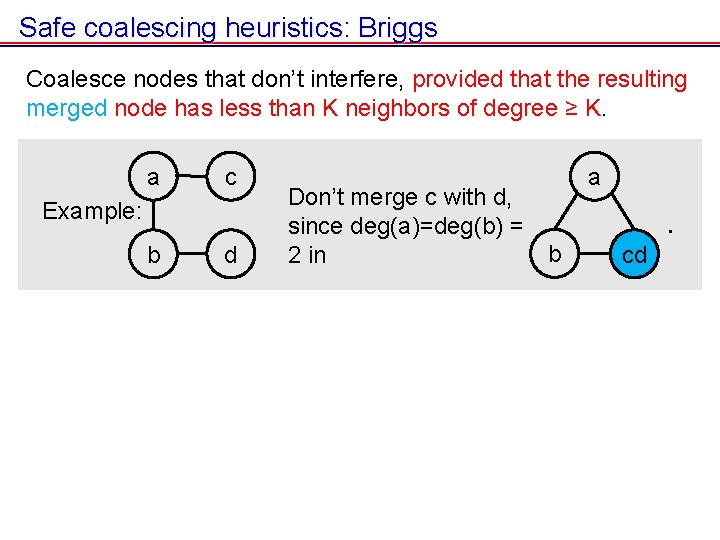
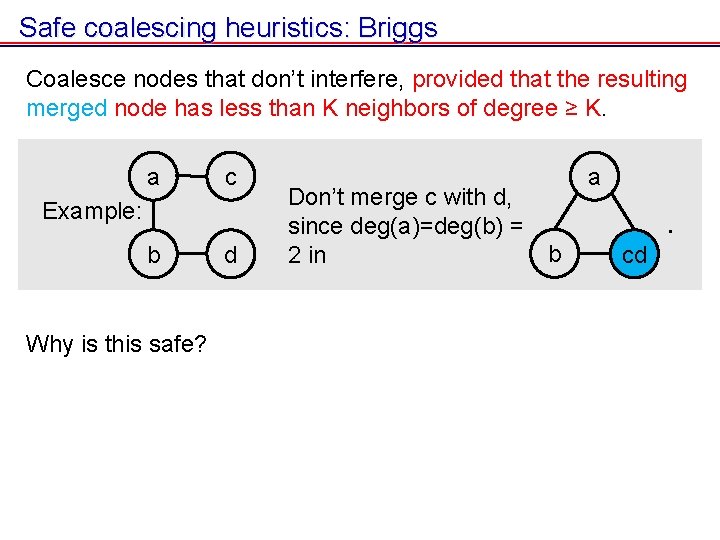
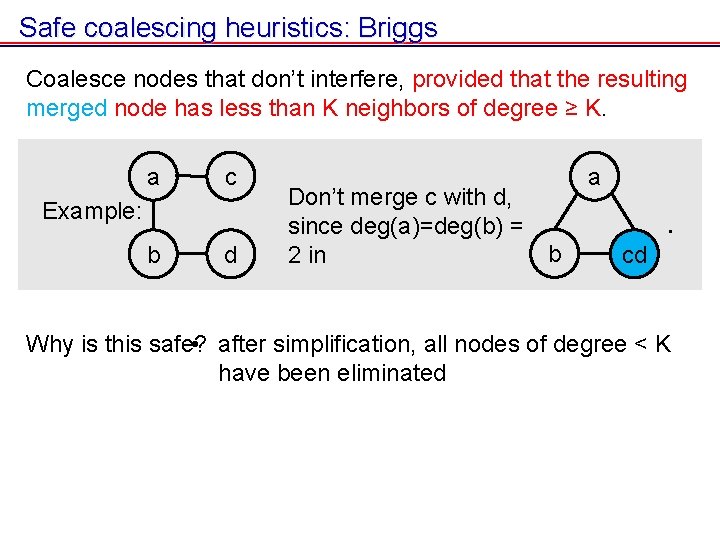
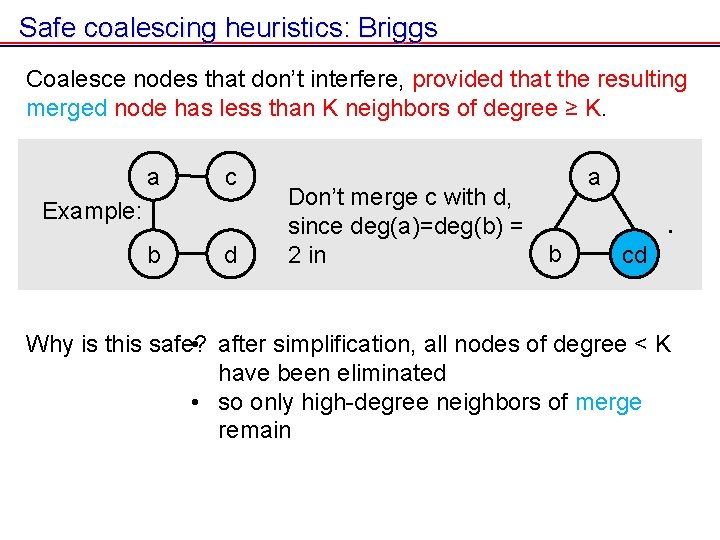
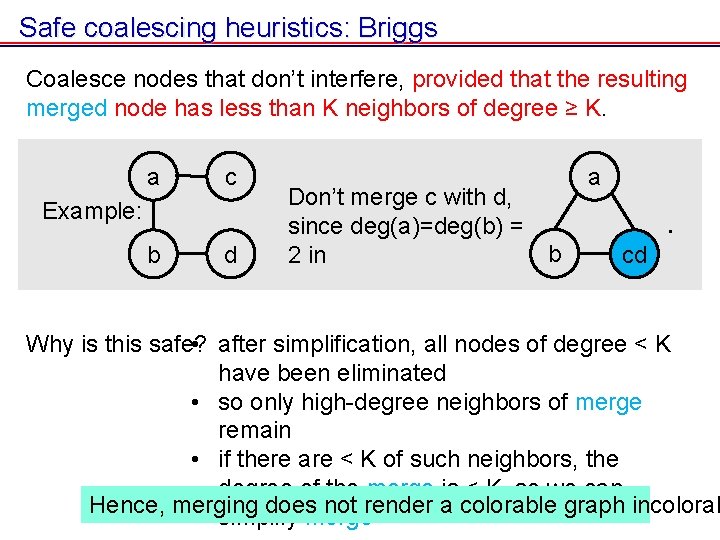
Safe coalescing heuristics: Briggs Coalesce nodes that don’t interfere, provided that the resulting merged node has less than K neighbors of degree ≥ K. a c Example: b d Don’t merge c with d, since deg(a)=deg(b) = 2 in a. b cd
Safe coalescing heuristics: Briggs Coalesce nodes that don’t interfere, provided that the resulting merged node has less than K neighbors of degree ≥ K. a c Example: b Why is this safe? d Don’t merge c with d, since deg(a)=deg(b) = 2 in a. b cd
Safe coalescing heuristics: Briggs Coalesce nodes that don’t interfere, provided that the resulting merged node has less than K neighbors of degree ≥ K. a c Example: b d Don’t merge c with d, since deg(a)=deg(b) = 2 in a. b cd Why is this safe? • after simplification, all nodes of degree < K have been eliminated
Safe coalescing heuristics: Briggs Coalesce nodes that don’t interfere, provided that the resulting merged node has less than K neighbors of degree ≥ K. a c Example: b d Don’t merge c with d, since deg(a)=deg(b) = 2 in a. b cd Why is this safe? • after simplification, all nodes of degree < K have been eliminated • so only high-degree neighbors of merge remain
Safe coalescing heuristics: Briggs Coalesce nodes that don’t interfere, provided that the resulting merged node has less than K neighbors of degree ≥ K. a c Example: b d Don’t merge c with d, since deg(a)=deg(b) = 2 in a. b cd Why is this safe? • after simplification, all nodes of degree < K have been eliminated • so only high-degree neighbors of merge remain • if there are < K of such neighbors, the degree of the merge is < K, so we can Hence, merging does not render a colorable graph incolorab simplify merge
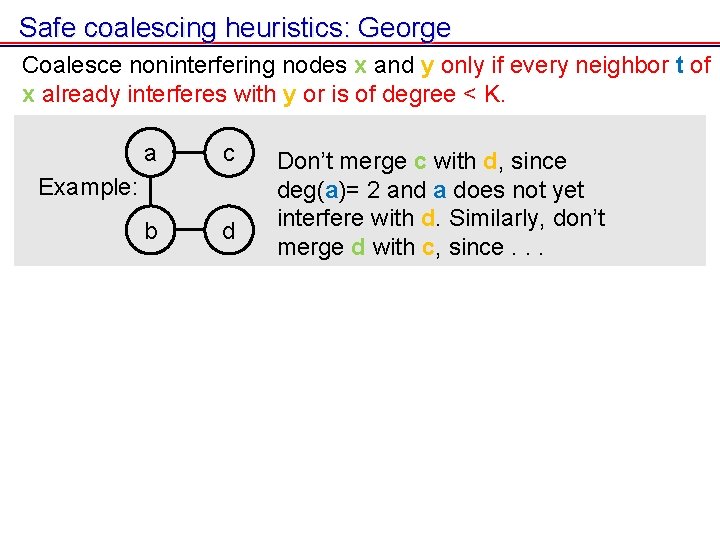
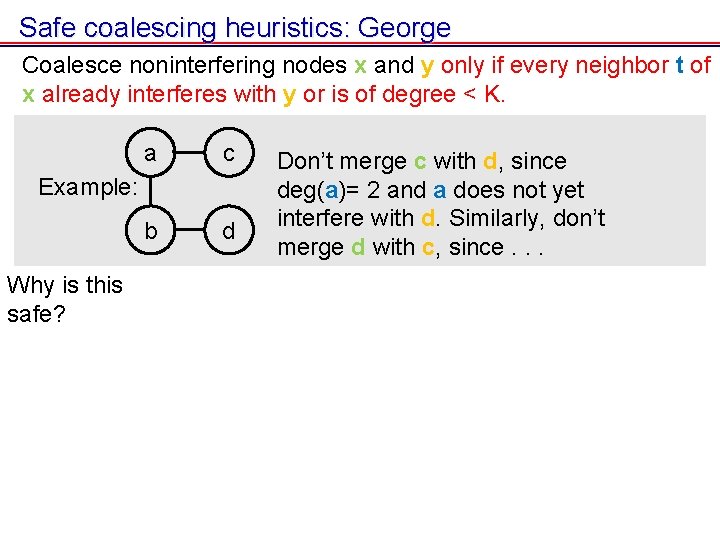
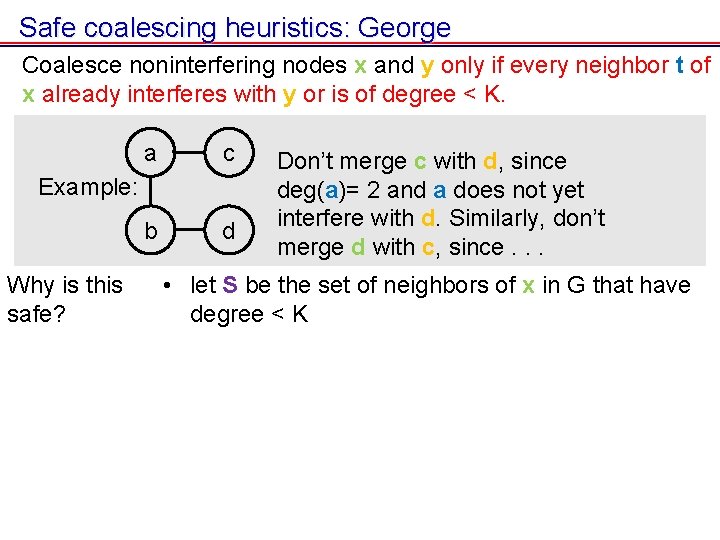
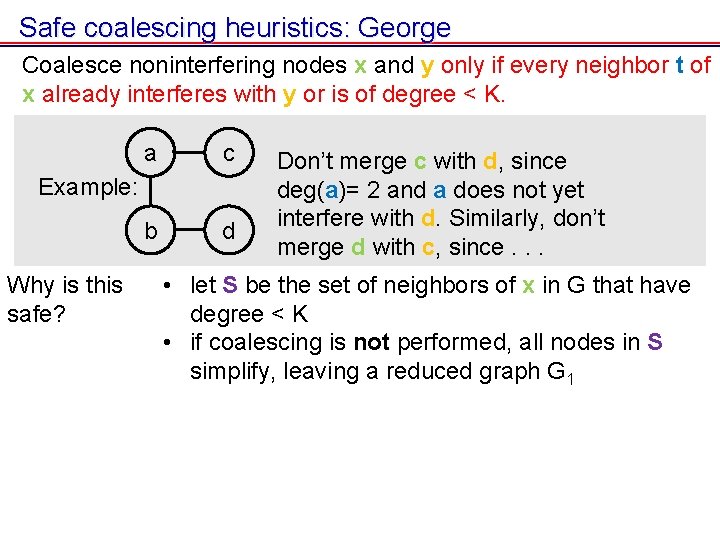
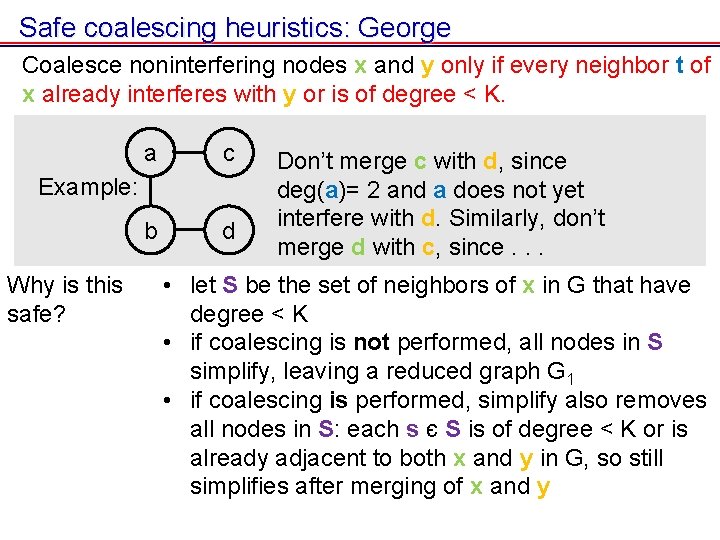
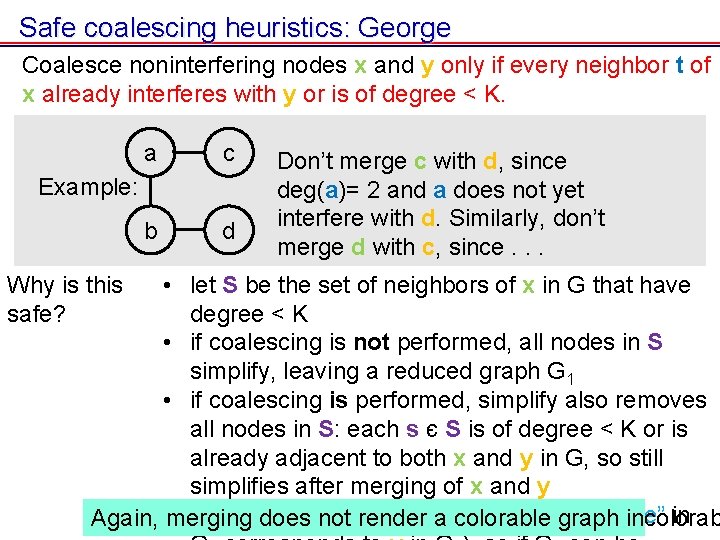
Safe coalescing heuristics: George Coalesce noninterfering nodes x and y only if every neighbor t of x already interferes with y or is of degree < K. a c b d Example: Don’t merge c with d, since deg(a)= 2 and a does not yet interfere with d. Similarly, don’t merge d with c, since. . .
Safe coalescing heuristics: George Coalesce noninterfering nodes x and y only if every neighbor t of x already interferes with y or is of degree < K. a c b d Example: Why is this safe? Don’t merge c with d, since deg(a)= 2 and a does not yet interfere with d. Similarly, don’t merge d with c, since. . .
Safe coalescing heuristics: George Coalesce noninterfering nodes x and y only if every neighbor t of x already interferes with y or is of degree < K. a c b d Example: Why is this safe? Don’t merge c with d, since deg(a)= 2 and a does not yet interfere with d. Similarly, don’t merge d with c, since. . . • let S be the set of neighbors of x in G that have degree < K
Safe coalescing heuristics: George Coalesce noninterfering nodes x and y only if every neighbor t of x already interferes with y or is of degree < K. a c b d Example: Why is this safe? Don’t merge c with d, since deg(a)= 2 and a does not yet interfere with d. Similarly, don’t merge d with c, since. . . • let S be the set of neighbors of x in G that have degree < K • if coalescing is not performed, all nodes in S simplify, leaving a reduced graph G 1
Safe coalescing heuristics: George Coalesce noninterfering nodes x and y only if every neighbor t of x already interferes with y or is of degree < K. a c b d Example: Why is this safe? Don’t merge c with d, since deg(a)= 2 and a does not yet interfere with d. Similarly, don’t merge d with c, since. . . • let S be the set of neighbors of x in G that have degree < K • if coalescing is not performed, all nodes in S simplify, leaving a reduced graph G 1 • if coalescing is performed, simplify also removes all nodes in S: each s є S is of degree < K or is already adjacent to both x and y in G, so still simplifies after merging of x and y
Safe coalescing heuristics: George Coalesce noninterfering nodes x and y only if every neighbor t of x already interferes with y or is of degree < K. a c b d Example: Don’t merge c with d, since deg(a)= 2 and a does not yet interfere with d. Similarly, don’t merge d with c, since. . . • let S be the set of neighbors of x in G that have degree < K • if coalescing is not performed, all nodes in S simplify, leaving a reduced graph G 1 • if coalescing is performed, simplify also removes all nodes in S: each s є S is of degree < K or is already adjacent to both x and y in G, so still simplifies after merging of x and y the resulting G 2 render is a subgraph of G 1 graph (“merge” in Again, • merging does not a colorable incolorab Why is this safe?
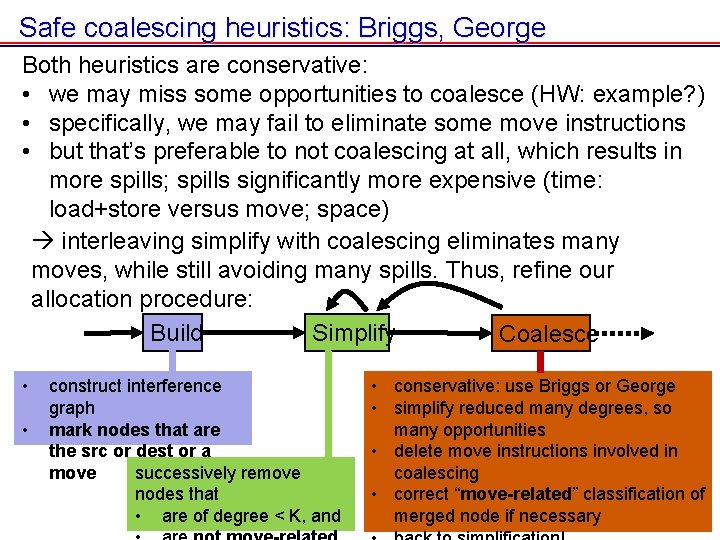
Safe coalescing heuristics: Briggs, George Both heuristics are conservative: • we may miss some opportunities to coalesce (HW: example? ) • specifically, we may fail to eliminate some move instructions • but that’s preferable to not coalescing at all, which results in more spills; spills significantly more expensive (time: load+store versus move; space)
Safe coalescing heuristics: Briggs, George Both heuristics are conservative: • we may miss some opportunities to coalesce (HW: example? ) • specifically, we may fail to eliminate some move instructions • but that’s preferable to not coalescing at all, which results in more spills; spills significantly more expensive (time: load+store versus move; space) interleaving simplify with coalescing eliminates many moves, while still avoiding many spills. Thus, refine our allocation procedure:
Safe coalescing heuristics: Briggs, George Both heuristics are conservative: • we may miss some opportunities to coalesce (HW: example? ) • specifically, we may fail to eliminate some move instructions • but that’s preferable to not coalescing at all, which results in more spills; spills significantly more expensive (time: load+store versus move; space) interleaving simplify with coalescing eliminates many moves, while still avoiding many spills. Thus, refine our allocation procedure: Build Simplify Coalesce • • construct interference graph mark nodes that are the src or dest or a successively remove nodes that • are of degree < K, and • conservative: use Briggs or George • simplify reduced many degrees, so many opportunities • delete move instructions involved in coalescing • correct “move-related” classification of merged node if necessary
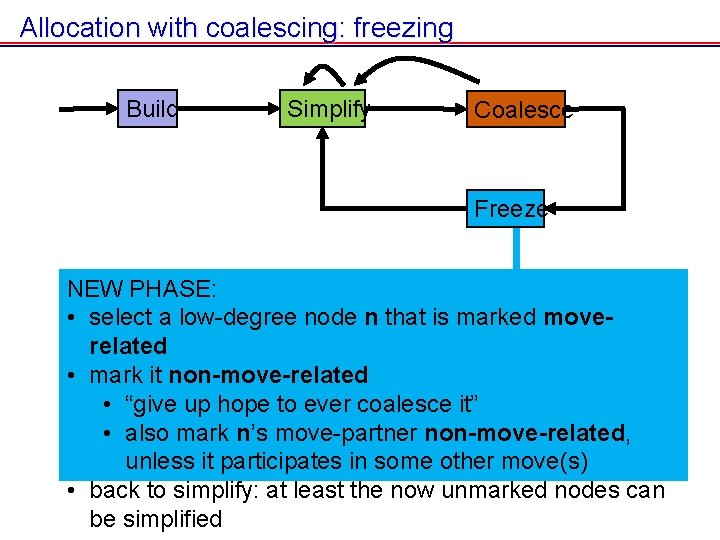
Allocation with coalescing: freezing Build Simplify Coalesce Freeze NEW PHASE: • select a low-degree node n that is marked moverelated • mark it non-move-related • “give up hope to ever coalesce it” • also mark n’s move-partner non-move-related, unless it participates in some other move(s) • back to simplify: at least the now unmarked nodes can be simplified
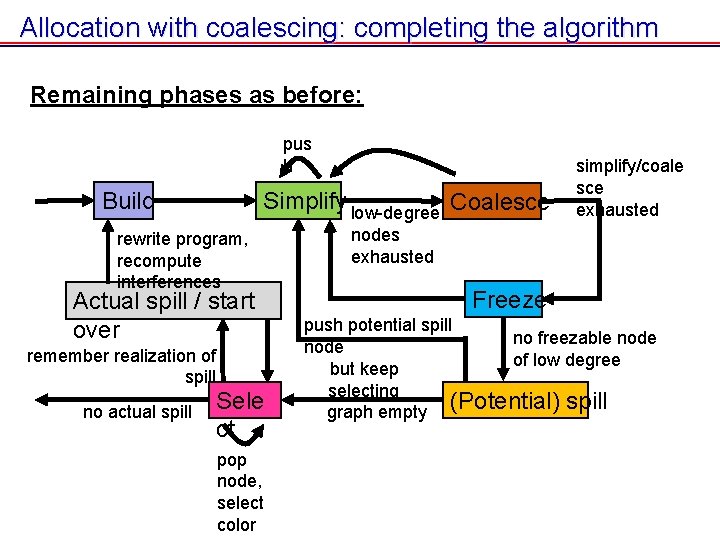
Allocation with coalescing: completing the algorithm Remaining phases as before: pus h Build Simplify low-degree Coalesce rewrite program, recompute interferences Actual spill / start over remember realization of spill no actual spill Sele ct pop node, select color simplify/coale sce exhausted nodes exhausted Freeze push potential spill no freezable node of low degree but keep selecting graph empty (Potential) spill
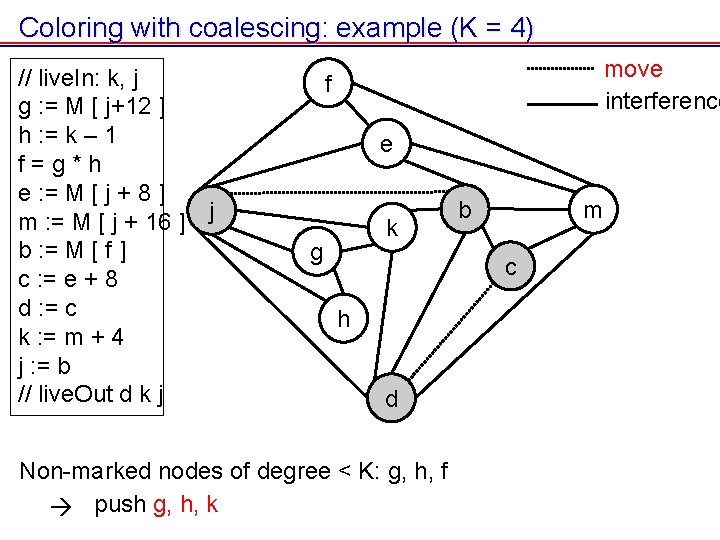
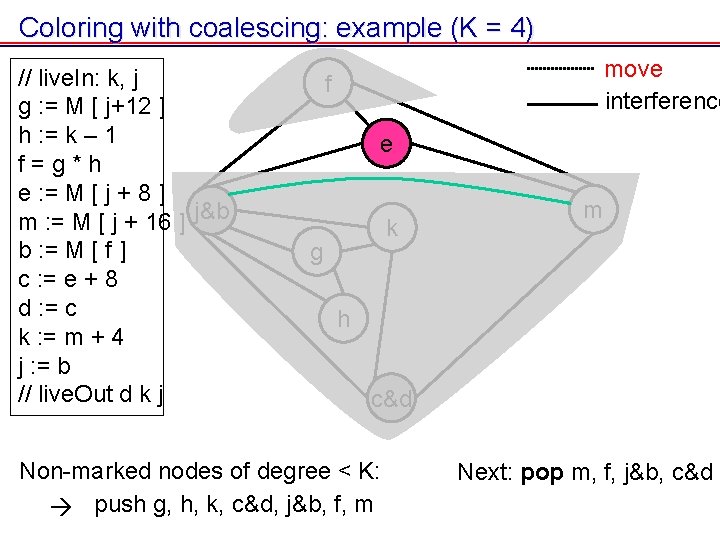
Coloring with coalescing: example (K = 4) // live. In: k, j g : = M [ j+12 ] h : = k – 1 f=g*h e : = M [ j + 8 ] m : = M [ j + 16 ] b : = M [ f ] c : = e + 8 d : = c k : = m + 4 j : = b // live. Out d k j move interference f e j k g b m c h d Non-marked nodes of degree < K: g, h, f push g, h, k
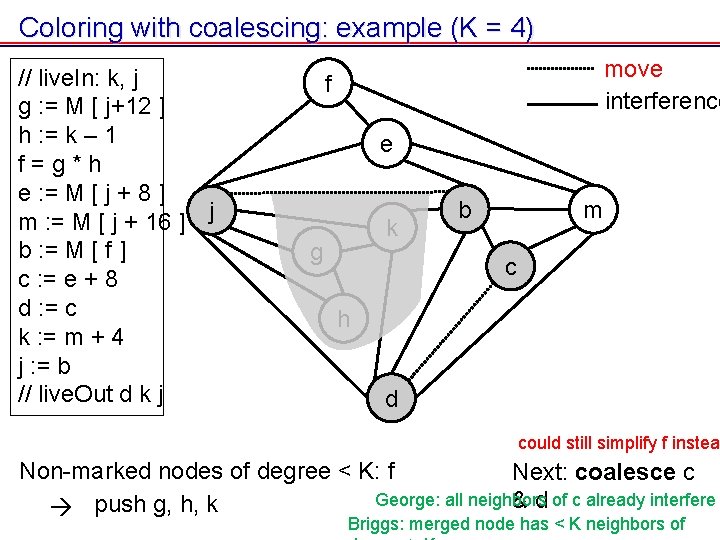
Coloring with coalescing: example (K = 4) // live. In: k, j g : = M [ j+12 ] h : = k – 1 f=g*h e : = M [ j + 8 ] m : = M [ j + 16 ] b : = M [ f ] c : = e + 8 d : = c k : = m + 4 j : = b // live. Out d k j move interference f e j k g b m c h d could still simplify f instead Non-marked nodes of degree < K: f Next: coalesce c George: all neighbors & d of c already interfere push g, h, k Briggs: merged node has < K neighbors of
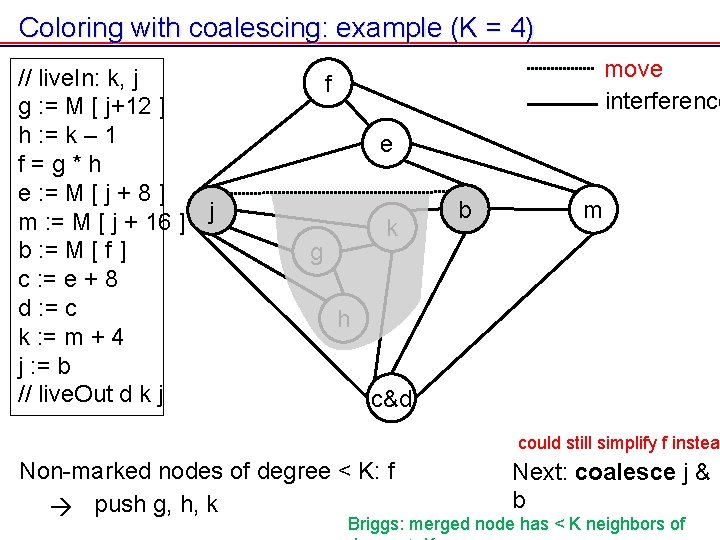
Coloring with coalescing: example (K = 4) // live. In: k, j g : = M [ j+12 ] h : = k – 1 f=g*h e : = M [ j + 8 ] m : = M [ j + 16 ] b : = M [ f ] c : = e + 8 d : = c k : = m + 4 j : = b // live. Out d k j move interference f e j k g b m h c&d could still simplify f instead Non-marked nodes of degree < K: f push g, h, k Next: coalesce j & b Briggs: merged node has < K neighbors of
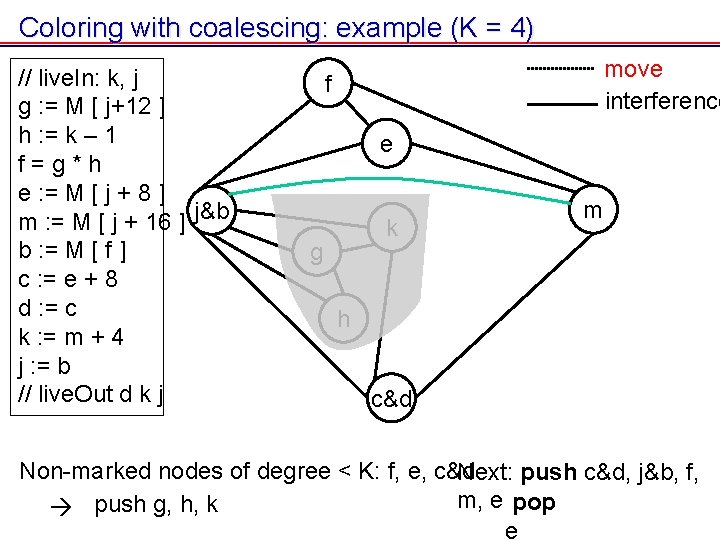
Coloring with coalescing: example (K = 4) // live. In: k, j g : = M [ j+12 ] h : = k – 1 f=g*h e : = M [ j + 8 ] m : = M [ j + 16 ] j&b b : = M [ f ] c : = e + 8 d : = c k : = m + 4 j : = b // live. Out d k j move interference f e k g m h c&d Non-marked nodes of degree < K: f, e, c&d Next: push c&d, j&b, f, m, e pop push g, h, k e
Coloring with coalescing: example (K = 4) // live. In: k, j g : = M [ j+12 ] h : = k – 1 f=g*h e : = M [ j + 8 ] m : = M [ j + 16 ] j&b b : = M [ f ] c : = e + 8 d : = c k : = m + 4 j : = b // live. Out d k j move interference f e k g m h c&d Non-marked nodes of degree < K: push g, h, k, c&d, j&b, f, m Next: pop m, f, j&b, c&d
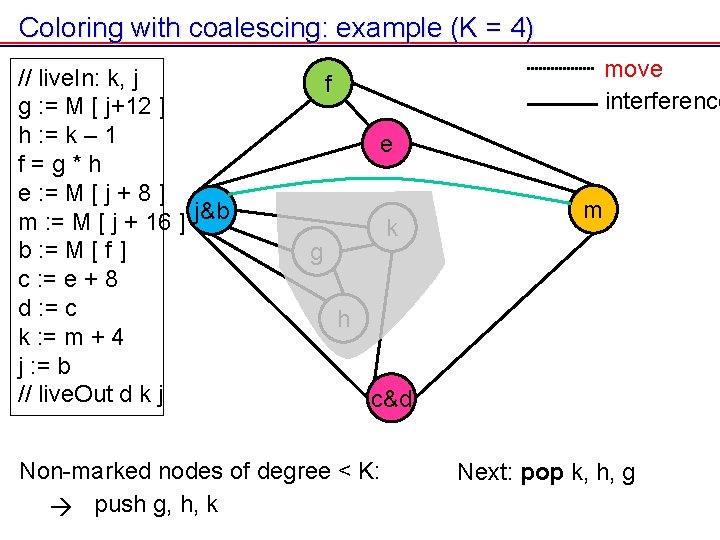
Coloring with coalescing: example (K = 4) // live. In: k, j g : = M [ j+12 ] h : = k – 1 f=g*h e : = M [ j + 8 ] m : = M [ j + 16 ] j&b b : = M [ f ] c : = e + 8 d : = c k : = m + 4 j : = b // live. Out d k j move interference f e k g m h c&d Non-marked nodes of degree < K: push g, h, k Next: pop k, h, g
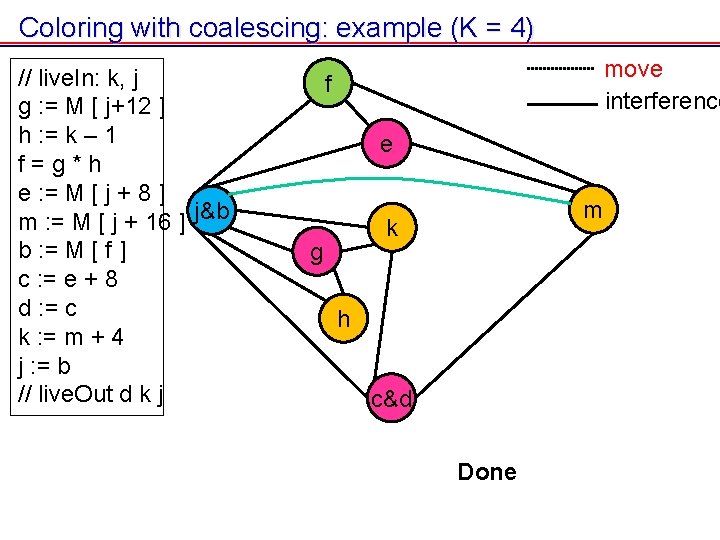
Coloring with coalescing: example (K = 4) // live. In: k, j g : = M [ j+12 ] h : = k – 1 f=g*h e : = M [ j + 8 ] m : = M [ j + 16 ] j&b b : = M [ f ] c : = e + 8 d : = c k : = m + 4 j : = b // live. Out d k j move interference f e m k g h c&d Done
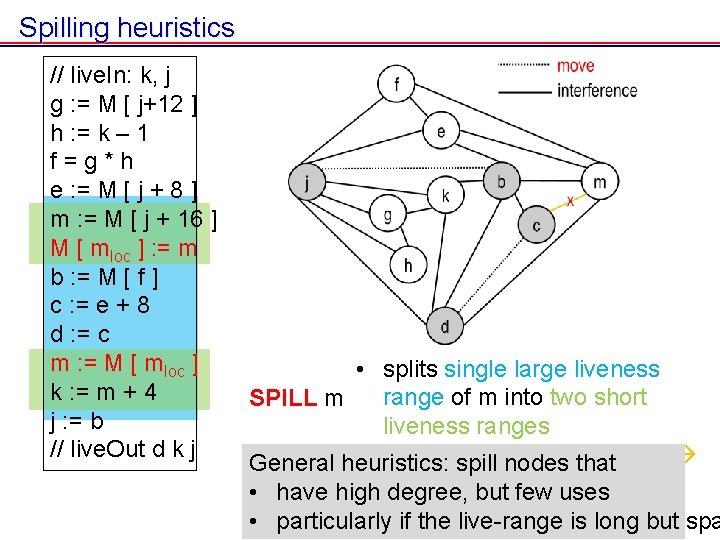
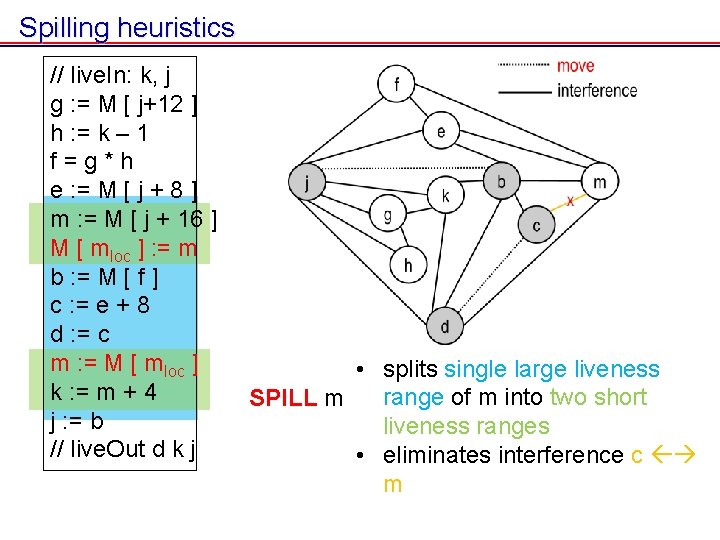
Spilling heuristics // live. In: k, j g : = M [ j+12 ] h : = k – 1 f=g*h e : = M [ j + 8 ] m : = M [ j + 16 ] M [ mloc ] : = m b : = M [ f ] c : = e + 8 d : = c m : = M [ mloc ] k : = m + 4 j : = b // live. Out d k j • splits single large liveness range of m into two short SPILL m liveness ranges • eliminates General heuristics: spillinterference nodes that c • have high m degree, but few uses • particularly if the live-range is long but spa
Spilling heuristics // live. In: k, j g : = M [ j+12 ] h : = k – 1 f=g*h e : = M [ j + 8 ] m : = M [ j + 16 ] M [ mloc ] : = m b : = M [ f ] c : = e + 8 d : = c m : = M [ mloc ] k : = m + 4 j : = b // live. Out d k j • splits single large liveness range of m into two short SPILL m liveness ranges • eliminates interference c m
Spilling heuristics Naïve spilling: when rewriting program, undo all register coalescing Improvement: remember all coalescing done before the first potential spill was discovered – they will tend to be rediscovered -- but undo the later coalescings.
Spilling heuristics Naïve spilling: when rewriting program, undo all register coalescing Improvement: remember all coalescing done before the first potential spill was discovered – they will tend to be rediscovered -but undo later coalescings. • many spillthe locations large stack frames Coalescing spills: • don’t need to keep spill locations apart if their virtual registers don’t interfere! • further benefit: eliminate spill-to-spill-moves: a b when both a and b are spilled: t M [bloc]; M[aloc] t (typo in MCIL here – see All done during “Start Over”, before spill code is generated and new register interference is computed errata list!) Hence, can use coloring to minimize spill locations: • infinitely many colors: no bound on size of frame • liveness info yields interference between
Precolored temporaries / nodes • some temporaries correspond directly to machine registers: stack / frame pointer, standard argument registers 1 & 2, … • these special temporaries implicitly interfere with each other • but: ordinary temporaries can share color with precolored node (see example below)
Precolored temporaries / nodes • some temporaries correspond directly to machine registers: stack / frame pointer, standard argument registers 1 & 2, … • these special temporaries implicitly interfere with each other • K-register but: ordinary temporaries can share color with machine: node (see example below) • precolored introduce precolored K nodes, all interfering with each • • other liveness range of special-purpose registers (frame pointer etc) interfere with all ordinary temporaries that are live general-purpose registers have no additional interferences precolored nodes can’t be simplified (they already have a color!), and can’t be spilled (they are registers!) hence, consider them to be of infinite degree and start
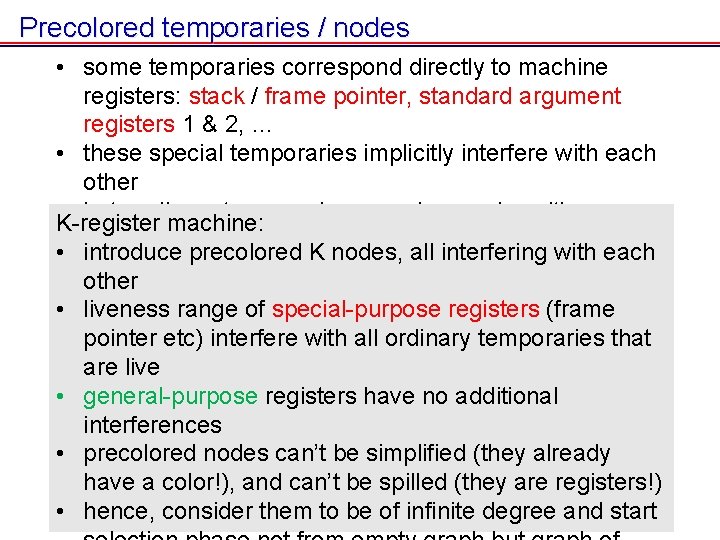
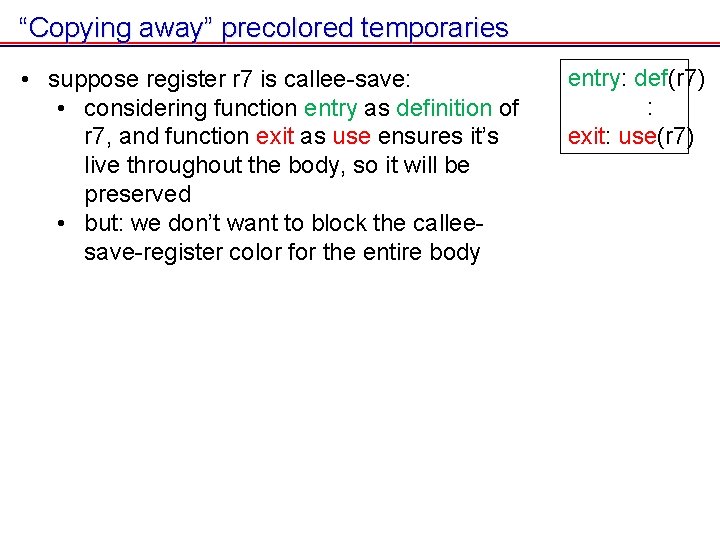
“Copying away” precolored temporaries • suppose register r 7 is callee-save: • considering function entry as definition of r 7, and function exit as use ensures it’s live throughout the body, so it will be preserved • but: we don’t want to block the calleesave-register color for the entire body entry: def(r 7) : exit: use(r 7)
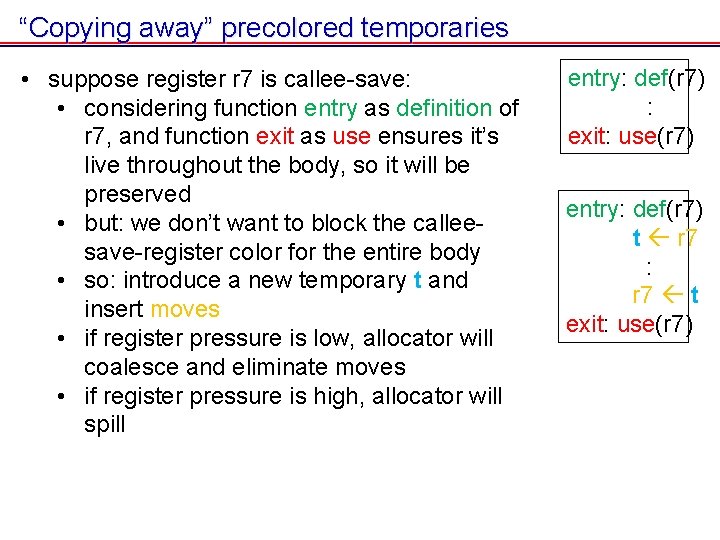
“Copying away” precolored temporaries • suppose register r 7 is callee-save: • considering function entry as definition of r 7, and function exit as use ensures it’s live throughout the body, so it will be preserved • but: we don’t want to block the calleesave-register color for the entire body • so: introduce a new temporary t and insert moves • if register pressure is low, allocator will coalesce and eliminate moves • if register pressure is high, allocator will spill entry: def(r 7) : exit: use(r 7) entry: def(r 7) t r 7 : r 7 t exit: use(r 7)
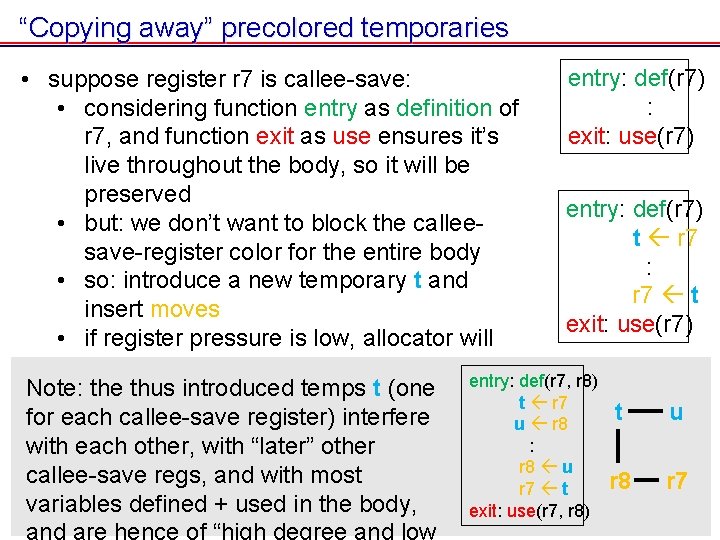
“Copying away” precolored temporaries entry: def(r 7) • suppose register r 7 is callee-save: : • considering function entry as definition of exit: use(r 7) r 7, and function exit as use ensures it’s live throughout the body, so it will be preserved entry: def(r 7) • but: we don’t want to block the calleet r 7 save-register color for the entire body : • so: introduce a new temporary t and r 7 t insert moves exit: use(r 7) • if register pressure is low, allocator will coalesce and eliminate moves entry: def(r 7, r 8) Note: the thus introduced temps t (one • if register pressure is high, allocator will t r 7 t u for each u r 8 spillcallee-save register) interfere : with each other, with “later” other r 8 u callee-save regs, and with most r 8 r 7 t variables defined + used in the body, exit: use(r 7, r 8)
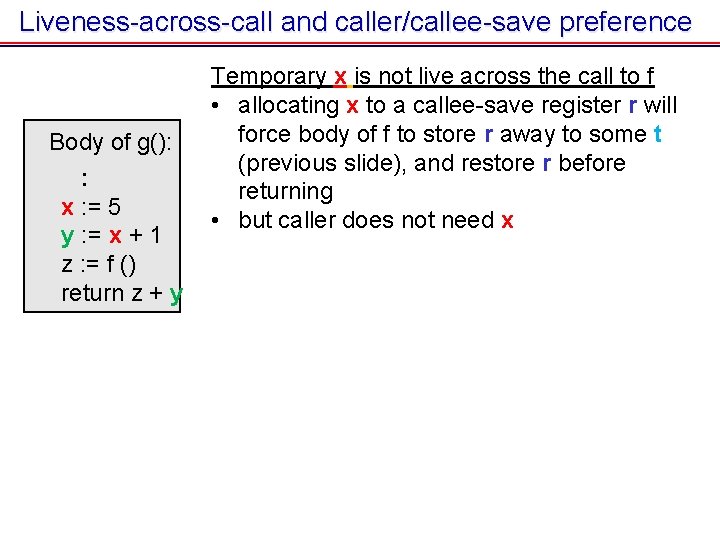
Liveness-across-call and caller/callee-save preference Body of g(): : x : = 5 y : = x + 1 z : = f () return z + y Temporary x is not live across the call to f • allocating x to a callee-save register r will force body of f to store r away to some t (previous slide), and restore r before returning • but caller does not need x
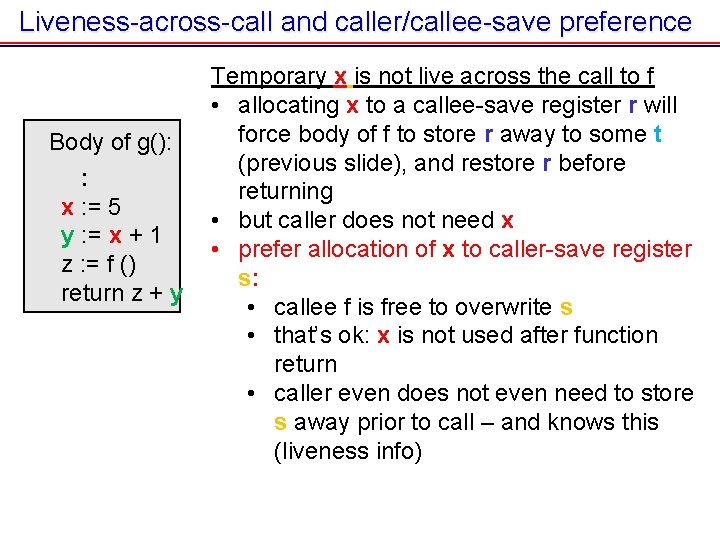
Liveness-across-call and caller/callee-save preference Body of g(): : x : = 5 y : = x + 1 z : = f () return z + y Temporary x is not live across the call to f • allocating x to a callee-save register r will force body of f to store r away to some t (previous slide), and restore r before returning • but caller does not need x • prefer allocation of x to caller-save register s: • callee f is free to overwrite s • that’s ok: x is not used after function return • caller even does not even need to store s away prior to call – and knows this (liveness info)
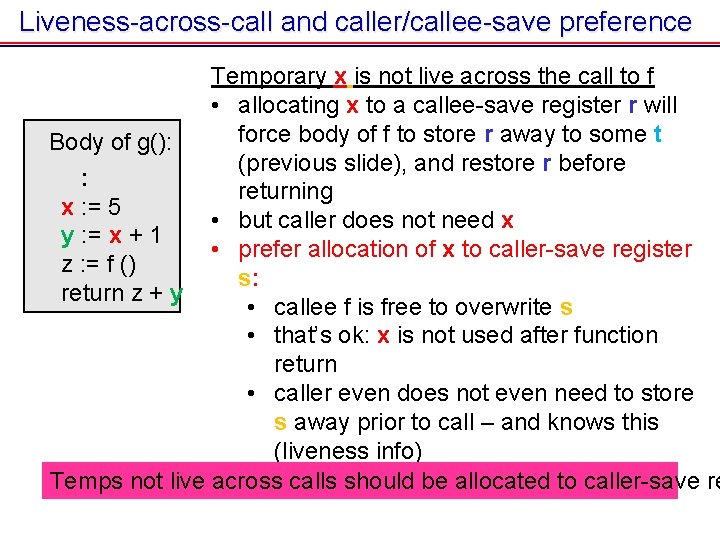
Liveness-across-call and caller/callee-save preference Temporary x is not live across the call to f • allocating x to a callee-save register r will force body of f to store r away to some t Body of g(): (previous slide), and restore r before : returning x : = 5 • but caller does not need x y : = x + 1 • prefer allocation of x to caller-save register z : = f () s: return z + y • callee f is free to overwrite s • that’s ok: x is not used after function return • caller even does not even need to store s away prior to call – and knows this (liveness info) Temps not live across calls should be allocated to caller-save re
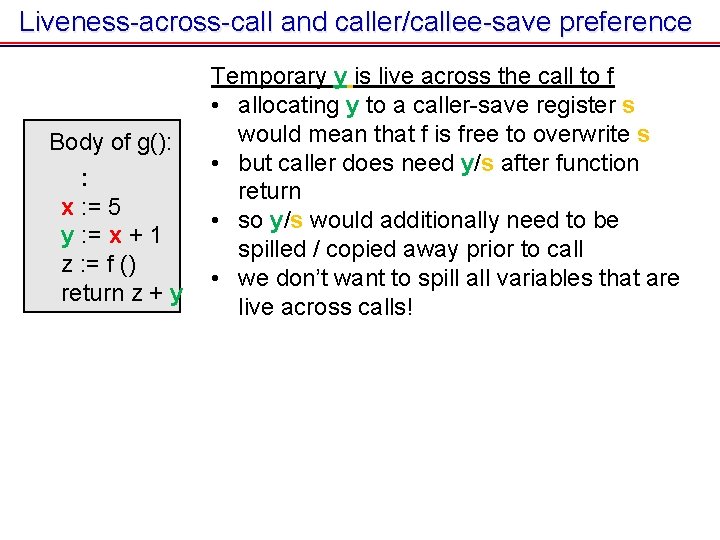
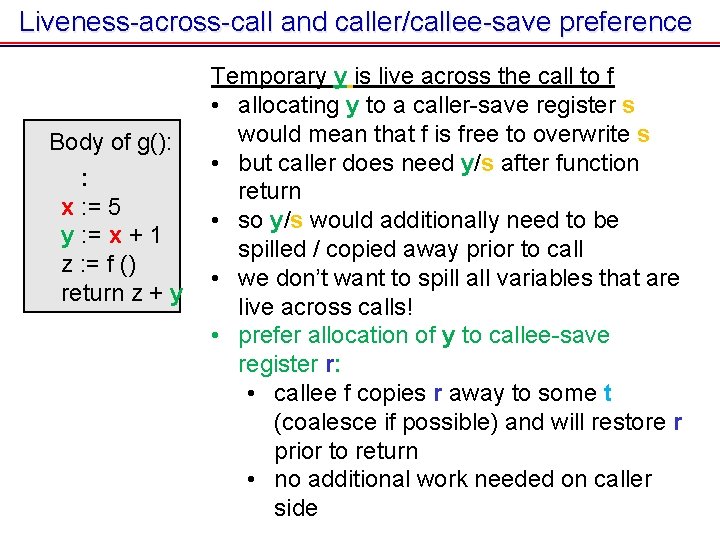
Liveness-across-call and caller/callee-save preference Body of g(): : x : = 5 y : = x + 1 z : = f () return z + y Temporary y is live across the call to f • allocating y to a caller-save register s would mean that f is free to overwrite s • but caller does need y/s after function return • so y/s would additionally need to be spilled / copied away prior to call • we don’t want to spill all variables that are live across calls!
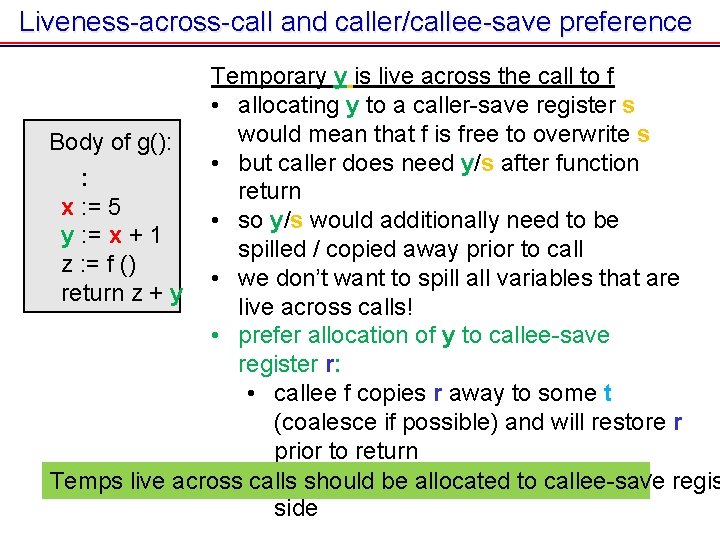
Liveness-across-call and caller/callee-save preference Body of g(): : x : = 5 y : = x + 1 z : = f () return z + y Temporary y is live across the call to f • allocating y to a caller-save register s would mean that f is free to overwrite s • but caller does need y/s after function return • so y/s would additionally need to be spilled / copied away prior to call • we don’t want to spill all variables that are live across calls! • prefer allocation of y to callee-save register r: • callee f copies r away to some t (coalesce if possible) and will restore r prior to return • no additional work needed on caller side
Liveness-across-call and caller/callee-save preference Temporary y is live across the call to f • allocating y to a caller-save register s would mean that f is free to overwrite s Body of g(): • but caller does need y/s after function : return x : = 5 • so y/s would additionally need to be y : = x + 1 spilled / copied away prior to call z : = f () • we don’t want to spill all variables that are return z + y live across calls! • prefer allocation of y to callee-save register r: • callee f copies r away to some t (coalesce if possible) and will restore r prior to return no should additional work needed on caller regis Temps live across • calls be allocated to callee-save side
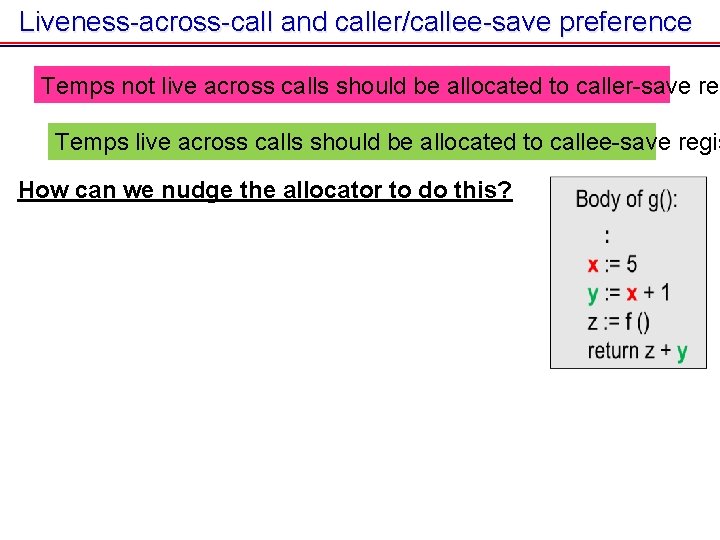
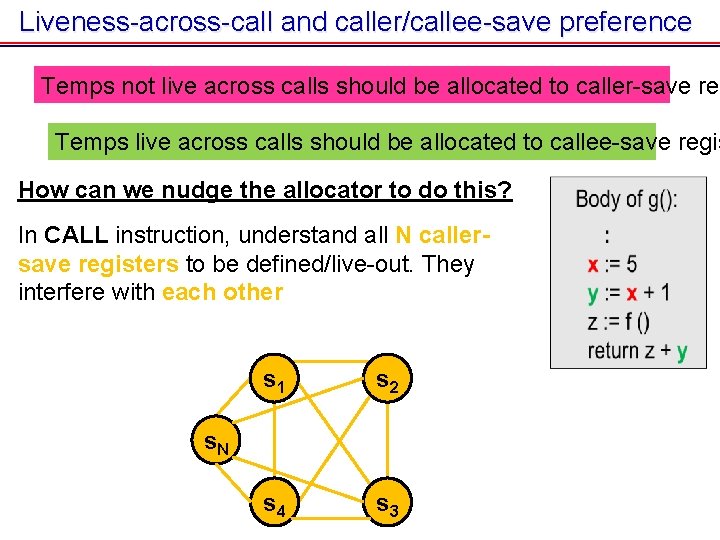
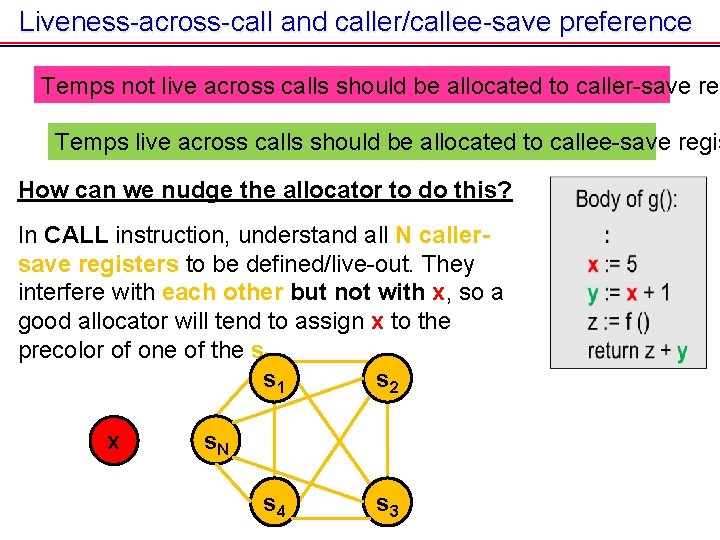
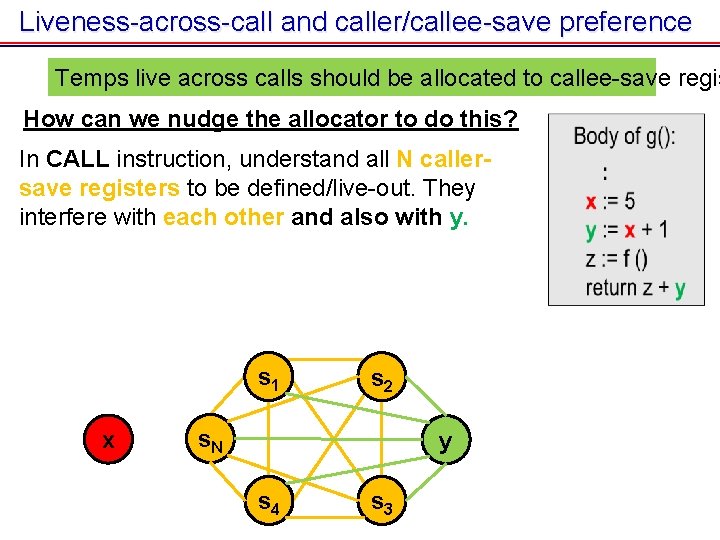
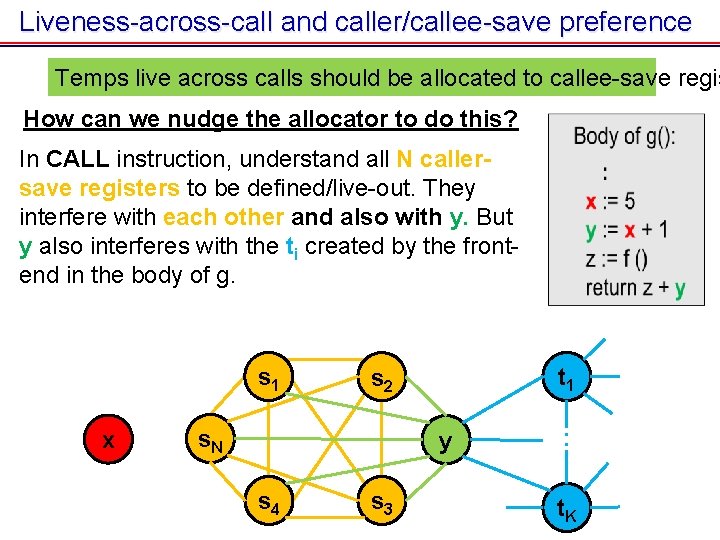
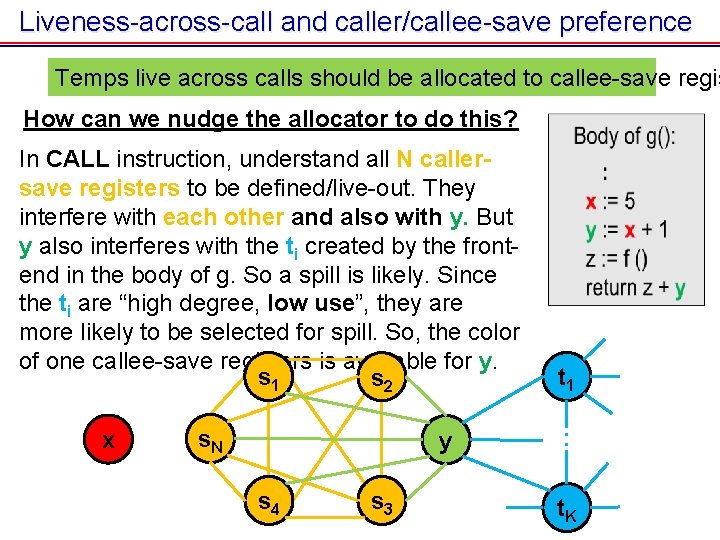
Liveness-across-call and caller/callee-save preference Temps not live across calls should be allocated to caller-save reg Temps live across calls should be allocated to callee-save regis How can we nudge the allocator to do this?
Liveness-across-call and caller/callee-save preference Temps not live across calls should be allocated to caller-save reg Temps live across calls should be allocated to callee-save regis How can we nudge the allocator to do this? In CALL instruction, understand all N callersave registers to be defined/live-out. They interfere with each other s 1 s 2 s 4 s 3 s. N
Liveness-across-call and caller/callee-save preference Temps not live across calls should be allocated to caller-save reg Temps live across calls should be allocated to callee-save regis How can we nudge the allocator to do this? In CALL instruction, understand all N callersave registers to be defined/live-out. They interfere with each other but not with x, so a good allocator will tend to assign x to the precolor of one of the si. s 1 s 2 x s. N s 4 s 3
Liveness-across-call and caller/callee-save preference Temps live across calls should be allocated to callee-save regis How can we nudge the allocator to do this? In CALL instruction, understand all N callersave registers to be defined/live-out. They interfere with each other and also with y. s 1 x s 2 s. N y s 4 s 3
Liveness-across-call and caller/callee-save preference Temps live across calls should be allocated to callee-save regis How can we nudge the allocator to do this? In CALL instruction, understand all N callersave registers to be defined/live-out. They interfere with each other and also with y. But y also interferes with the ti created by the frontend in the body of g. s 1 x t 1 s 2 s. N y s 4 s 3 : t. K
Liveness-across-call and caller/callee-save preference Temps live across calls should be allocated to callee-save regis How can we nudge the allocator to do this? In CALL instruction, understand all N callersave registers to be defined/live-out. They interfere with each other and also with y. But y also interferes with the ti created by the frontend in the body of g. So a spill is likely. Since the ti are “high degree, low use”, they are more likely to be selected for spill. So, the color of one callee-save registers is available for y. s 1 s 2 x s. N y s 4 s 3 t 1 : t. K
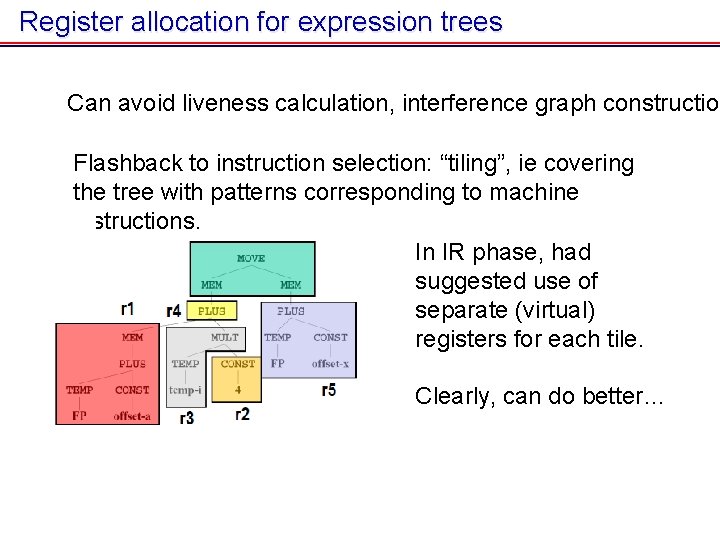
Register allocation for expression trees Can avoid liveness calculation, interference graph construction Flashback to instruction selection: “tiling”, ie covering the tree with patterns corresponding to machine instructions. In IR phase, had suggested use of separate (virtual) registers for each tile. Clearly, can do better…
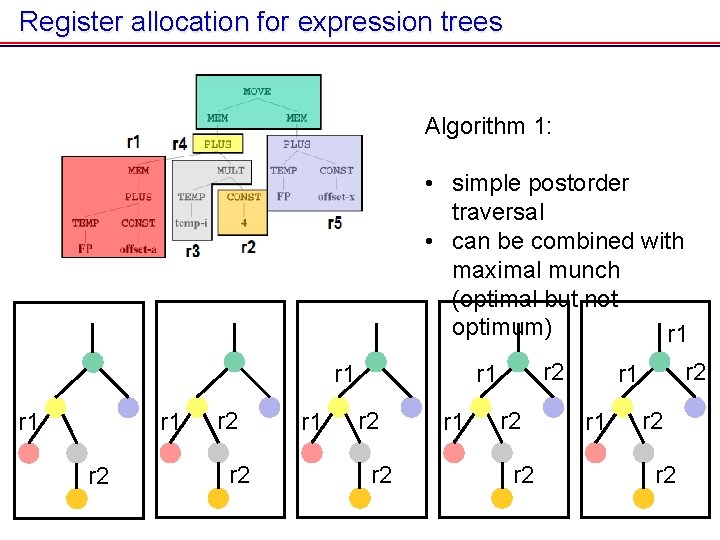
Register allocation for expression trees Algorithm 1: • simple postorder traversal • can be combined with maximal munch (optimal but not optimum) r 1 r 1 r 2 r 2 r 1 r 2
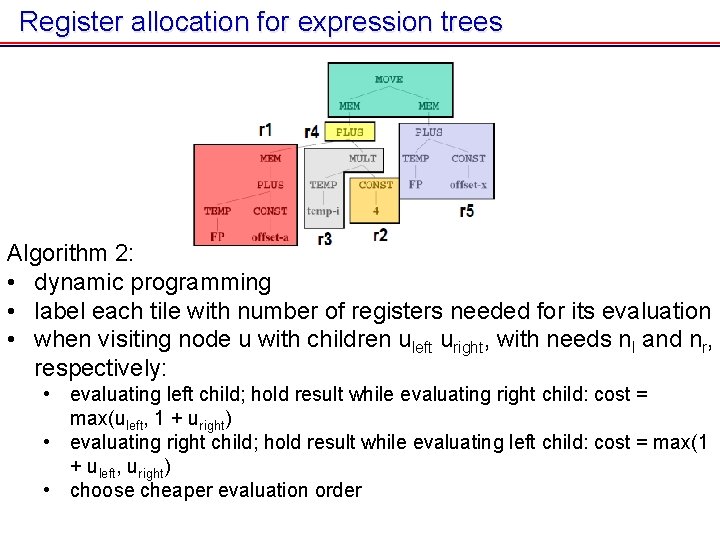
Register allocation for expression trees Algorithm 2: • dynamic programming • label each tile with number of registers needed for its evaluation • when visiting node u with children uleft uright, with needs nl and nr, respectively: • evaluating left child; hold result while evaluating right child: cost = max(uleft, 1 + uright) • evaluating right child; hold result while evaluating left child: cost = max(1 + uleft, uright) • choose cheaper evaluation order