
Topic 19 Tcnicas de animacin y expresin como
- Slides: 21
Topic 19 Técnicas de animación y expresión como recurso para el aprendizaje de las lenguas extranjeras. La dramatización de situaciones cotidianos de la vida y la representación de cuentos.
TABLE OF CONTENTS � 1. INTRODUCTION � 2. DRAMA TECHINQUES IN FOREIGN ANGUAGE TEACHING � 3. GROUP WORK IN CREATIVE ACTIVITIES: THE DRAMA PROJECT. � 4. THE ROLE OF THE TEACHER.
Introduction �Aim of the topic: to study the use of drama in EFL. �To do this we will discuss the following points: �Definition of Drama �Benefits of drama in EFL �Elements required for a drama lesson: planning and timing, types of drama techniques, simulations and role plays and evaluation. �Drama project �The role of the teacher in the drama lesson.
Introduction �Drama is a technique that can be used to develop certain language skills. �A well-known tradition: used in Middle Ages to teach Latin �It derives from the need to have some experience with language in a social context.
DRAMA TECHINQUES IN FOREIGN LANGUAGE TEACHING �POSSIBILITIES OF DRAMA �Drama can be used effectively in a number of situations in the classroom: �Most language teaching course books already use drama techniques (role plays, simulations, games, songs, rhymes, dialogues). �When practising skills. �When developing spoken communication skills. �Drama project: the full/scale staging of a play.
DRAMA TECHINQUES IN FOREIGN LANGUAGE TEACHING �BENEFITS OF DRAMA: �Drama is a technique of communicative language teaching, so it emphasizes students’ active participation. �Some factors of genuine communication inlcude: �The untidy way language is used (hesitations, interruptions, etc. ) �Emotions �Body language �Drama can teach structure and vocabulary, thus the using of the target language in a meaningful way.
DRAMA TECHINQUES IN FOREIGN LANGUAGE TEACHING �Benefits of drama (according to Wessels (1987)): �Meaningful interaction in a target language �Pronunciation features in the target context �Vocabulary and grammar in context �Self-confidence.
DRAMA TECHINQUES IN FOREIGN LANGUAGE TEACHING �The essential elements required for a lesson, using drama techniques (Wessels, 1987): �Relationships �Friendly atmosphere, mutual respect �Physical environment �Physical arrangements: horseshoe using only chairs �Warm-ups �Warming-up activities: games, songs, etc. �A background role of the teacher �Student leadership �Having group leaders to encourage the sense of responsibility �Using the most cooperative students.
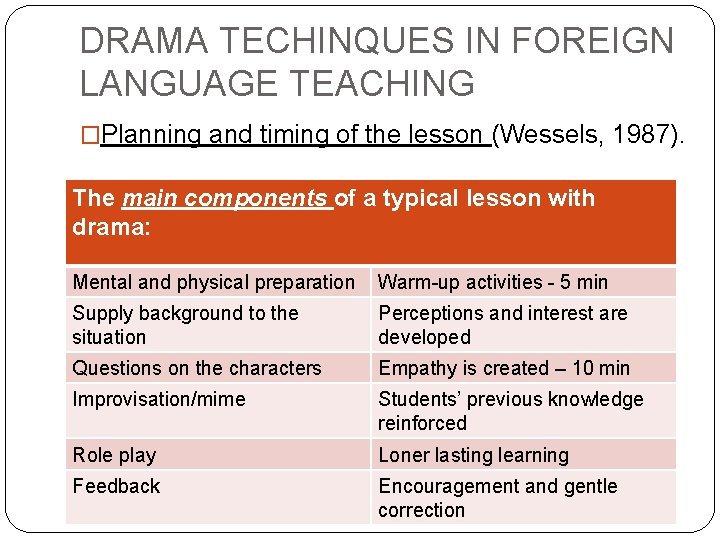
DRAMA TECHINQUES IN FOREIGN LANGUAGE TEACHING �Planning and timing of the lesson (Wessels, 1987). The main components of a typical lesson with drama: Mental and physical preparation Warm-up activities - 5 min Supply background to the situation Perceptions and interest are developed Questions on the characters Empathy is created – 10 min Improvisation/mime Students’ previous knowledge reinforced Role play Loner lasting learning Feedback Encouragement and gentle correction
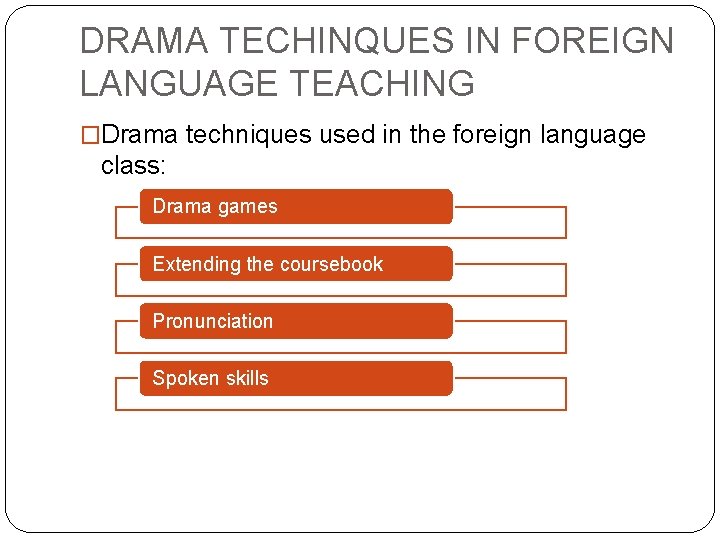
DRAMA TECHINQUES IN FOREIGN LANGUAGE TEACHING �Drama techniques used in the foreign language class: Drama games Extending the coursebook Pronunciation Spoken skills
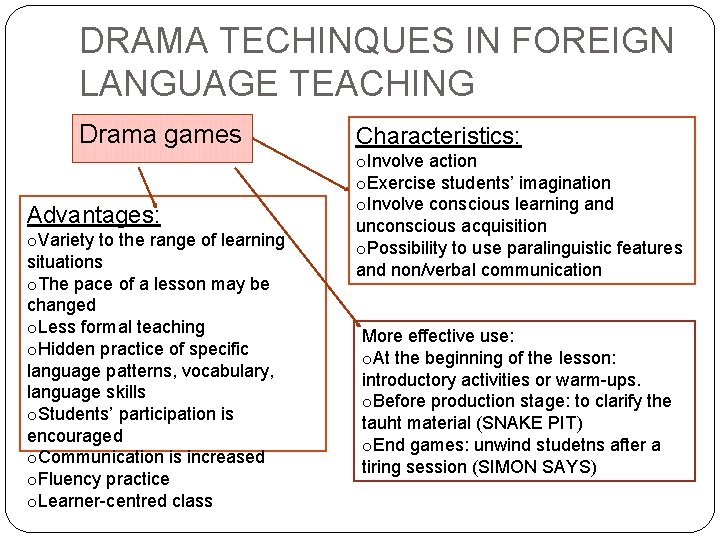
DRAMA TECHINQUES IN FOREIGN LANGUAGE TEACHING Drama games Advantages: o. Variety to the range of learning situations o. The pace of a lesson may be changed o. Less formal teaching o. Hidden practice of specific language patterns, vocabulary, language skills o. Students’ participation is encouraged o. Communication is increased o. Fluency practice o. Learner-centred class Characteristics: o. Involve action o. Exercise students’ imagination o. Involve conscious learning and unconscious acquisition o. Possibility to use paralinguistic features and non/verbal communication More effective use: o. At the beginning of the lesson: introductory activities or warm-ups. o. Before production stage: to clarify the tauht material (SNAKE PIT) o. End games: unwind studetns after a tiring session (SIMON SAYS)
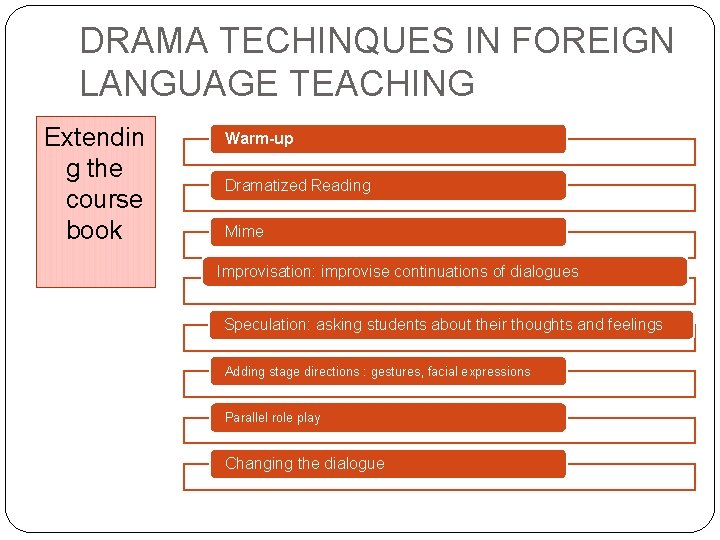
DRAMA TECHINQUES IN FOREIGN LANGUAGE TEACHING Extendin g the course book Warm-up Dramatized Reading Mime Improvisation: improvise continuations of dialogues Speculation: asking students about their thoughts and feelings Adding stage directions : gestures, facial expressions Parallel role play Changing the dialogue
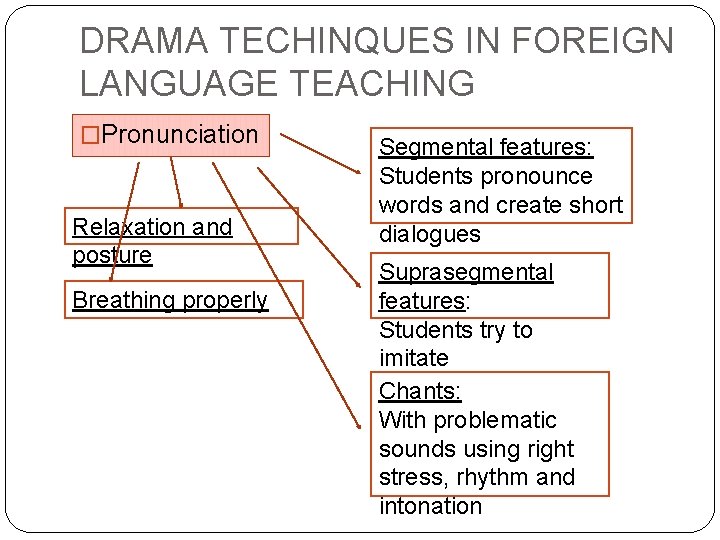
DRAMA TECHINQUES IN FOREIGN LANGUAGE TEACHING �Pronunciation Relaxation and posture Breathing properly Segmental features: Students pronounce words and create short dialogues Suprasegmental features: Students try to imitate Chants: With problematic sounds using right stress, rhythm and intonation
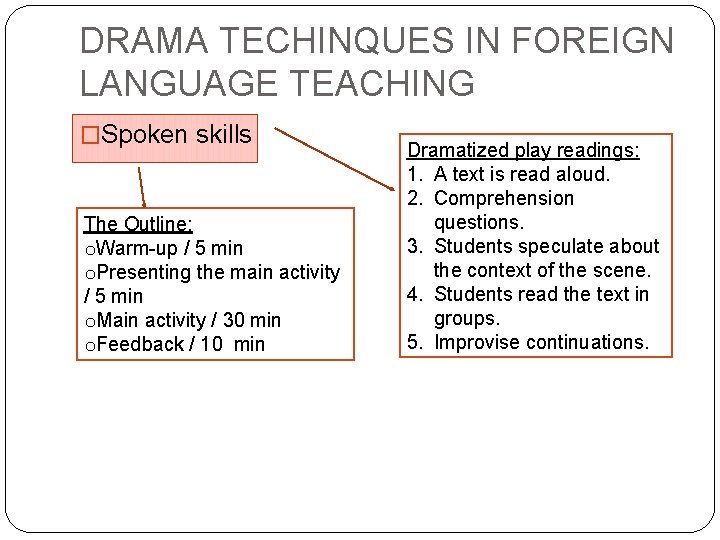
DRAMA TECHINQUES IN FOREIGN LANGUAGE TEACHING �Spoken skills The Outline: o. Warm-up / 5 min o. Presenting the main activity / 5 min o. Main activity / 30 min o. Feedback / 10 min Dramatized play readings: 1. A text is read aloud. 2. Comprehension questions. 3. Students speculate about the context of the scene. 4. Students read the text in groups. 5. Improvise continuations.
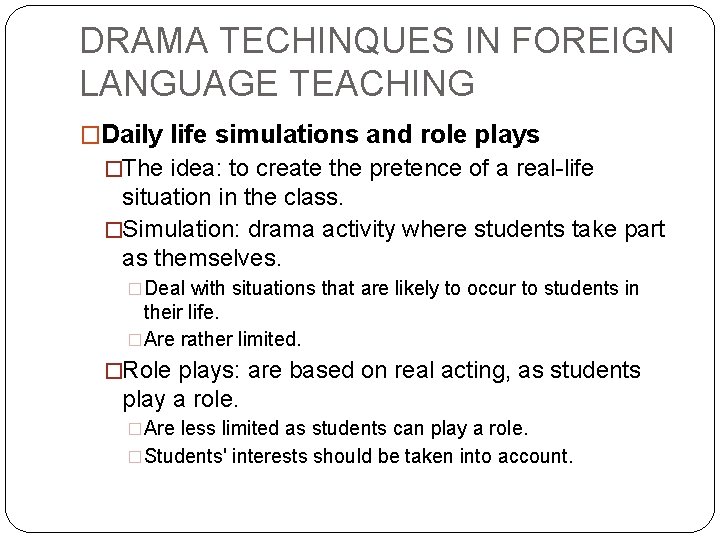
DRAMA TECHINQUES IN FOREIGN LANGUAGE TEACHING �Daily life simulations and role plays �The idea: to create the pretence of a real-life situation in the class. �Simulation: drama activity where students take part as themselves. �Deal with situations that are likely to occur to students in their life. �Are rather limited. �Role plays: are based on real acting, as students play a role. �Are less limited as students can play a role. �Students' interests should be taken into account.
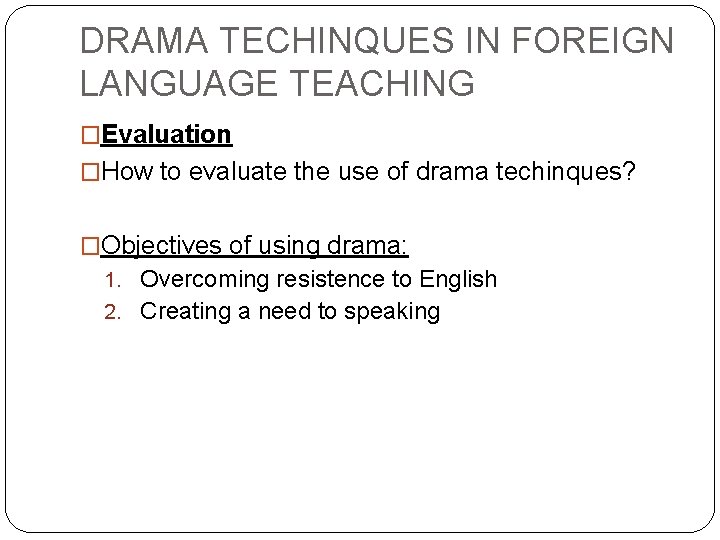
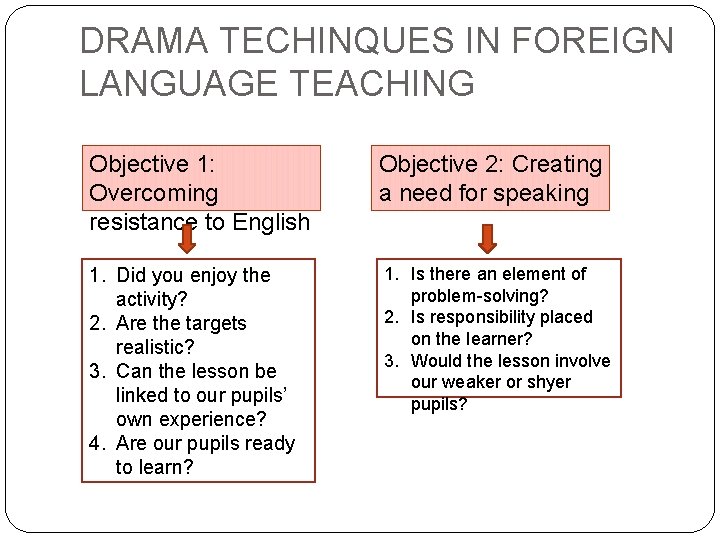
DRAMA TECHINQUES IN FOREIGN LANGUAGE TEACHING �Evaluation �How to evaluate the use of drama techinques? �Objectives of using drama: 1. Overcoming resistence to English 2. Creating a need to speaking
DRAMA TECHINQUES IN FOREIGN LANGUAGE TEACHING Objective 1: Overcoming resistance to English 1. Did you enjoy the activity? 2. Are the targets realistic? 3. Can the lesson be linked to our pupils’ own experience? 4. Are our pupils ready to learn? Objective 2: Creating a need for speaking 1. Is there an element of problem-solving? 2. Is responsibility placed on the learner? 3. Would the lesson involve our weaker or shyer pupils?
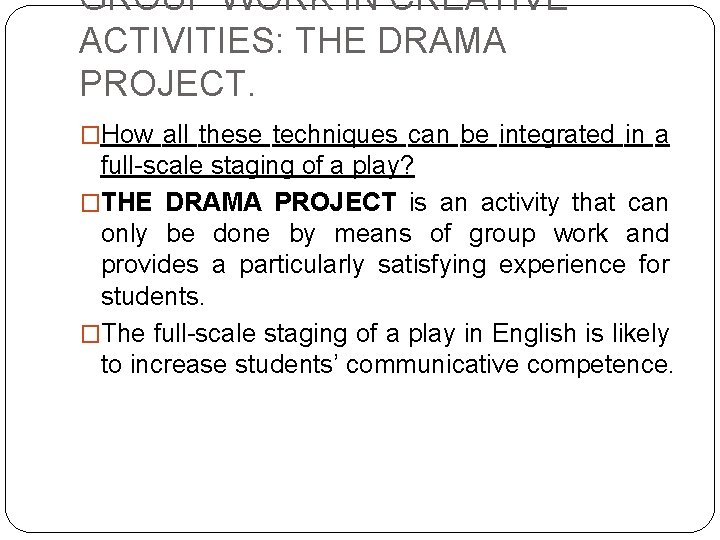
GROUP WORK IN CREATIVE ACTIVITIES: THE DRAMA PROJECT. �How all these techniques can be integrated in a full-scale staging of a play? �THE DRAMA PROJECT is an activity that can only be done by means of group work and provides a particularly satisfying experience for students. �The full-scale staging of a play in English is likely to increase students’ communicative competence.
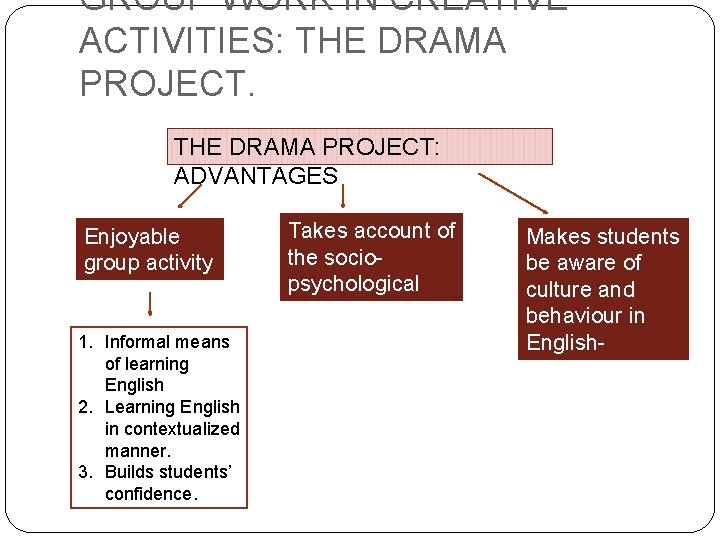
GROUP WORK IN CREATIVE ACTIVITIES: THE DRAMA PROJECT: ADVANTAGES Enjoyable group activity 1. Informal means of learning English 2. Learning English in contextualized manner. 3. Builds students’ confidence. Takes account of the sociopsychological aspects of learning. Makes students be aware of culture and behaviour in Englishspeaking countries.
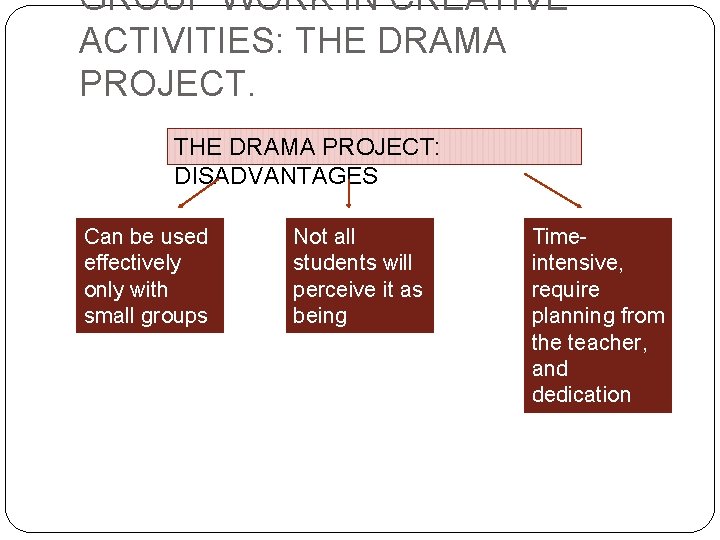
GROUP WORK IN CREATIVE ACTIVITIES: THE DRAMA PROJECT: DISADVANTAGES Can be used effectively only with small groups Not all students will perceive it as being inherently useful Timeintensive, require planning from the teacher, and dedication and loyalty from the students.
The role of the teacher in the drama lesson �Drama involves the formation of relationships and the breaking down of barriers between teachers and students. �Students are permitted to take responsibility foe their own learning, so teachers can take a less dominant role without losing control of the class. �The first tear’s role will be that of manager or theater producer. But teachers must be able to adopt many different roles: a prompter, a monitor, etc.