A centrality measure to quantify social capital in
- Slides: 27
A centrality measure to quantify social capital in a network Midterm Presentation Undergraduate Researchers: Graduate Student Mentor: Faculty Mentor: Jordan Cowart, Katie Allmeroth Krist Culmer Dr. Wenjun (Kevin) Zeng
2 Outline • Introduction ▫ Key terms ▫ The problem ▫ Project Goals • Related Work • Data Collection & Analysis ▫ Data Acquisition ▫ Tools for Analysis • Future Work
3 Outline • Introduction ▫ Key terms ▫ The problem ▫ Project Goals • Related Work • Data Collection & Analysis ▫ Data Acquisition ▫ Tools for Analysis • Future Work
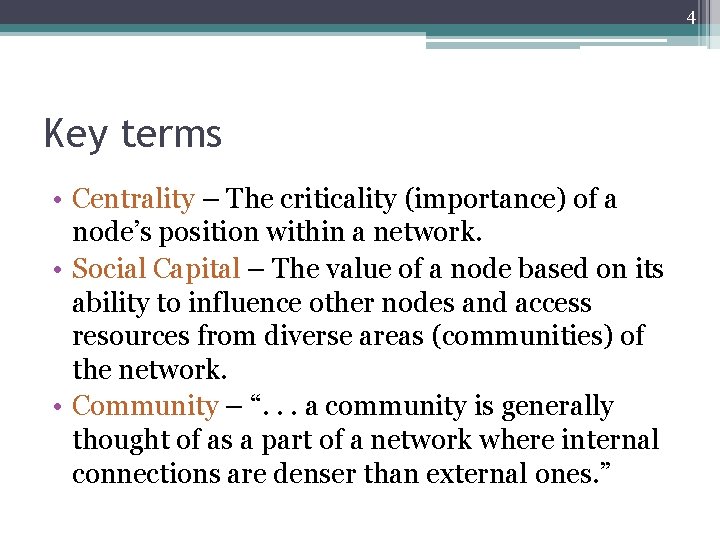
4 Key terms • Centrality – The criticality (importance) of a node’s position within a network. • Social Capital – The value of a node based on its ability to influence other nodes and access resources from diverse areas (communities) of the network. • Community – “. . . a community is generally thought of as a part of a network where internal connections are denser than external ones. ”
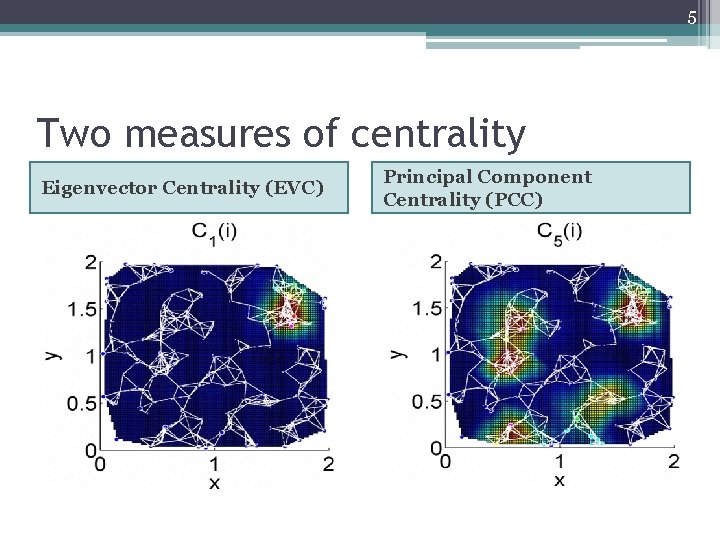
5 Two measures of centrality Eigenvector Centrality (EVC) Principal Component Centrality (PCC)
6 The problem • Current measures of centrality take into account the node’s “connectedness” but do not consider a node’s “community membership” • Want to incorporate social capital when computing a node’s centrality • Why is this important?
7 Project Goals • 1. Extract Facebook Data ▫ Develop a Web Crawler �Crawl Mizzou’s Facebook page • 2. Preliminary Analysis ▫ Apply EVC and PCC to test data/collected data ▫ Develop a visualization of data ▫ Derive any interesting information from the data • 3. Expand EVC/PCC to develop a new and improved centrality measure.
8 Outline • Introduction ▫ Key terms ▫ The problem ▫ Project Goals • Related Work • Data Collection & Analysis ▫ Data Acquisition ▫ Tools for Analysis • Future Work
9 Related Work • Ilyas et al. [1, 2] demonstrated shortcomings of EVC and then proposed and defined a new algorithm, PCC. • Yang et al. [3] discussed the use of ground-truth (user defined) communities as a bench marking tool for community detection algorithms • Xiao et al. [4] developed an algorithm for gathering Facebook data without the use of Facebook’s API • Salamos et al. [5] shows that there is correlation between “liked” Facebook pages and communities.
10 Outline • Introduction ▫ Key terms ▫ The problem ▫ Project Goals • Related Work • Data Collection & Analysis ▫ Data Acquisition ▫ Tools for Analysis • Future Work
11 Data Acquisition • Stanford Large Network Dataset Collection ▫ Provides a collection of more than 50 large network data sets that can include hundreds of thousands of nodes and edges • Mizzou Facebook page ▫ Ground-truth community consisting of individuals stating their education is from Mizzou
12 Data Acquisition • How would we gather information from Facebook? ▫ Facebook API or web crawler? • Decided to go with a web crawler ▫ Faster – Information is readily available, we don’t have to gather through an app ▫ Other papers had exhibited problems with the Facebook API – they used web crawlers in the end
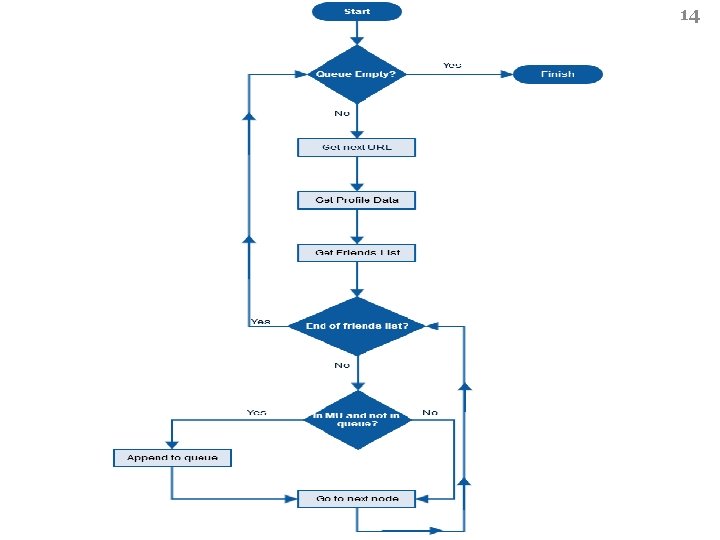
13 Data Acquisition - Web Crawler • Features: ▫ Python ▫ Queue based ▫ Breadth-first search (BFS) • Libraries Used: ▫ Beautiful. Soup ▫ Built in libraries (URLLib + RE) • Only scrapes data from individuals that attend Mizzou
14
15 Data Acquisition - Web Crawler • Information to be scraped: ▫ ▫ ▫ Node’s URL (e. g. - katie. marie. 5661) Major Gender Home Town Friends list Likes (only those related to Mizzou) • Keep track of nodes in Mizzou / Not in Mizzou / Private
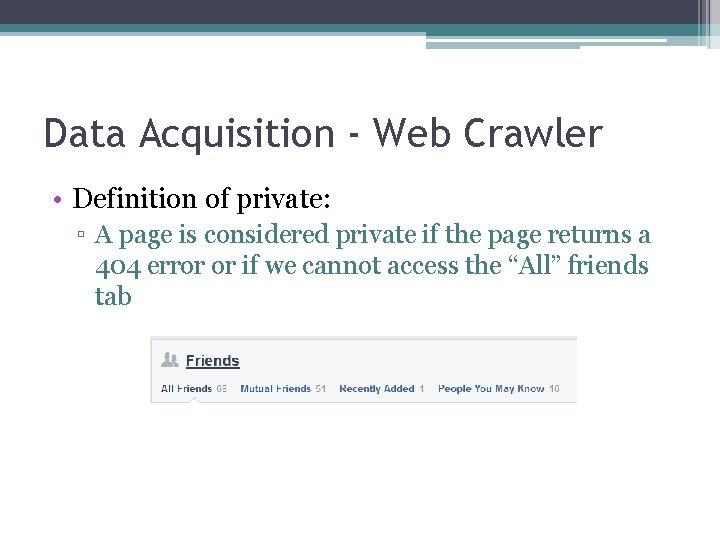
Data Acquisition - Web Crawler • Definition of private: ▫ A page is considered private if the page returns a 404 error or if we cannot access the “All” friends tab
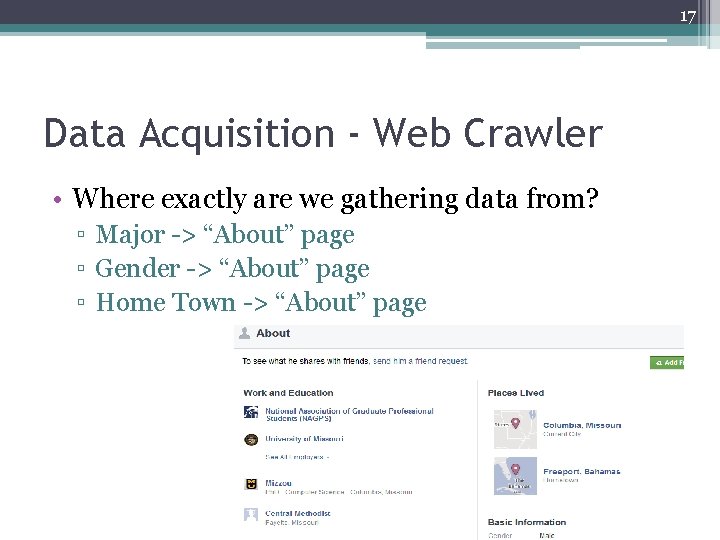
17 Data Acquisition - Web Crawler • Where exactly are we gathering data from? ▫ Major -> “About” page ▫ Gender -> “About” page ▫ Home Town -> “About” page
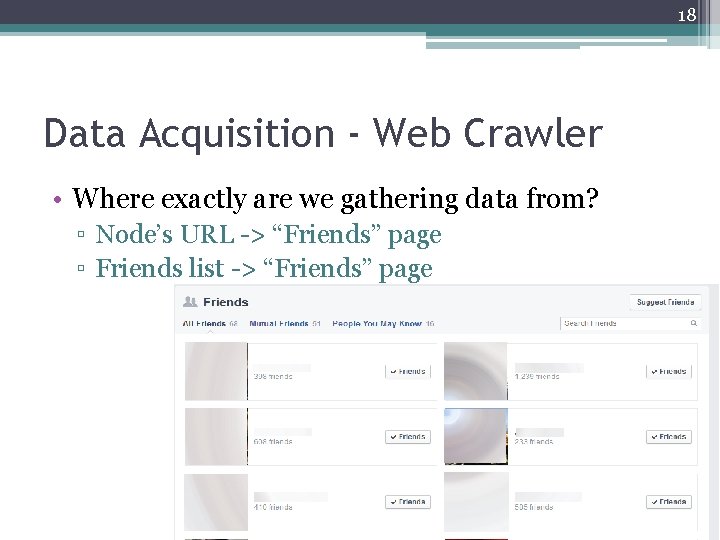
18 Data Acquisition - Web Crawler • Where exactly are we gathering data from? ▫ Node’s URL -> “Friends” page ▫ Friends list -> “Friends” page
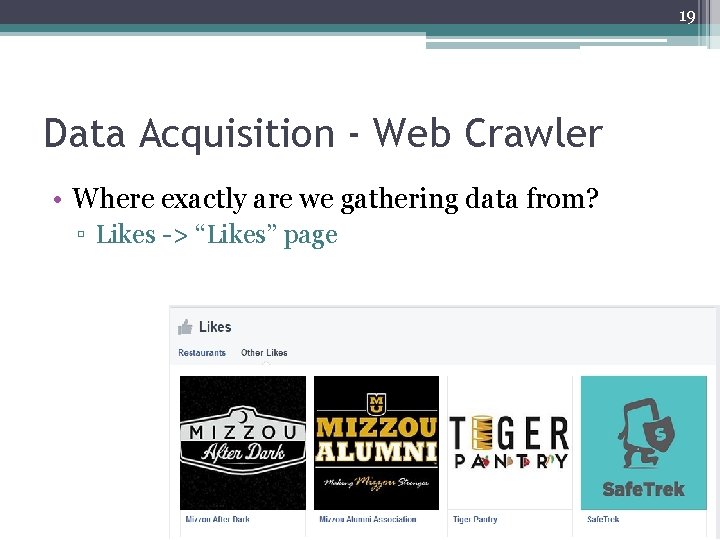
19 Data Acquisition - Web Crawler • Where exactly are we gathering data from? ▫ Likes -> “Likes” page
20 Data Acquisition - Web Crawler • Output of data in a text file: ▫ ▫ ▫ 0 2 3 7 8 (Node and friends) Male (Gender) Computer Science (Major) Cobden, IL (Hometown) Mizzou (Likes) • Able to change major to a college ▫ Computer Science -> College of Engineering
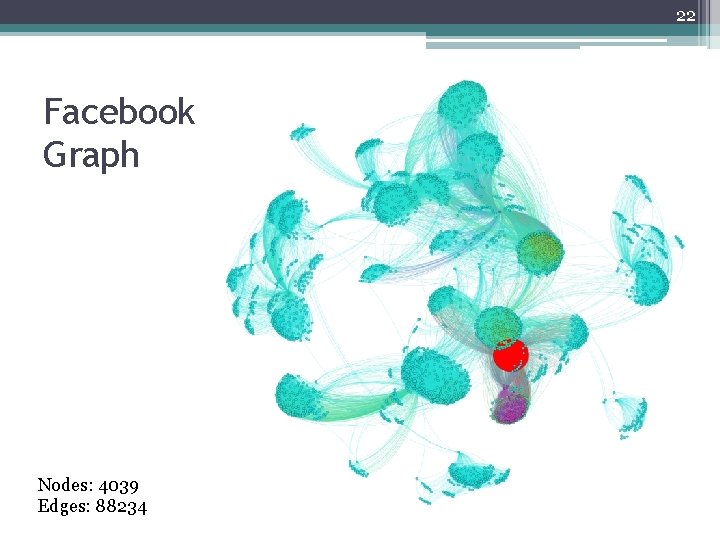
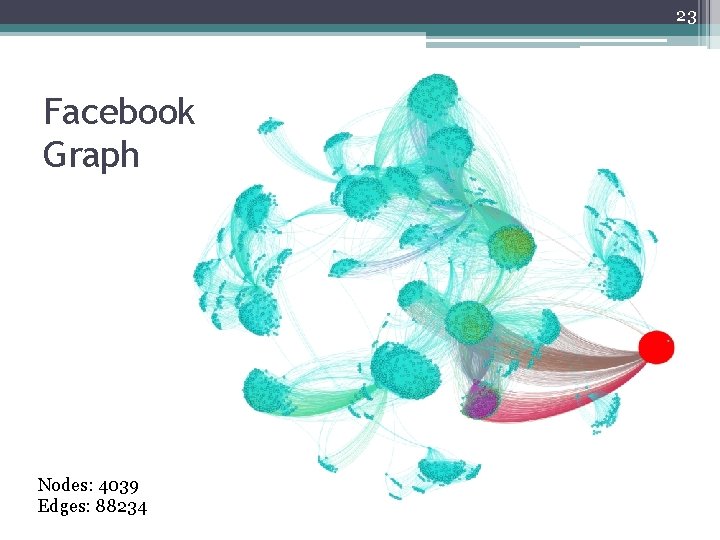
21 Tools for Analysis - Gephi • An interactive network visualization and exploration platform ▫ Able to change node size, color, and label ▫ Can easily import graphs • Also provides a graph analysis toolkit ▫ Provides centrality measure plugins �Can create our own plugin
22 Facebook Graph Nodes: 4039 Edges: 88234
23 Facebook Graph Nodes: 4039 Edges: 88234
24 Outline • Introduction ▫ Key terms ▫ The problem ▫ Project Goals • Related Work • Data Collection & Analysis ▫ Data Acquisition ▫ Tools for Analysis • Future Work
25 Future Work • • Crawl Facebook after receiving permission Build PCC Plugin for Gephi Formalize definition of social capital Define a method for scoring social capital ▫ Apply method to test data and analyze results
26 Thank you!
27 References • [1] M. U. Ilyas, H. Radha, “A KLT-inspired Node Centrality for Identifying Influential Neighborhoods in Graphs”, 2010 44 th Annual Conference on Information Sciences and Systems, IEEE, Princeton, NJ, March 2010, pp. 1 -7. • [2] M. U. Ilyas, H. Radha, “Identifying Influential Nodes in Online Social Networks Using Principal Component Centrality”, The 2011 IEEE International Conference on Communications , IEEE, Kyoto, June 2011, pp. 1 -5. • [3] J. Yang, J. Leskovec, “Defining and Evaluating Network Communities based on Ground -truth”, The 12 th IEEE International Conference on Data Mining , IEEE, Brussels, Dec. 2012, pp. 745 -754. • [4] Z. Xiao, B. Liu, H. Hu, T. Zhang , “Design and Implementation of Facebook Crawler Based on Interaction Simulation”, The 11 th IEEE International Conference On Trust, Security And Privacy In Computing And Communications , IEEE, Liverpool, June 2012, pp. 1109 -1112. • [5] N. Salamos, E. Voudigari, T. Papageorgiou, M. Vazirgianni, , “Design and Implementation of Facebook Crawler Based on Interaction Simulation”, 2012 IEEE International Conference on Green Computing and Communications, IEEE, Athens, Nov. 2012, pp. 368 -371.