
A Set of Measures of Centrality Based on
A Set of Measures of Centrality Based on Betweenness Linton C. Freeman, 1977 Advisor : Professor Frank Y. S. Lin Presented by: Tuan-Chun Chen Presentation date: Mar. 13,
Agenda �Introduction �Measuring point centrality �Measuring graph centrality �Applications
Agenda �Introduction �Measuring point centrality �Measuring graph centrality �Applications
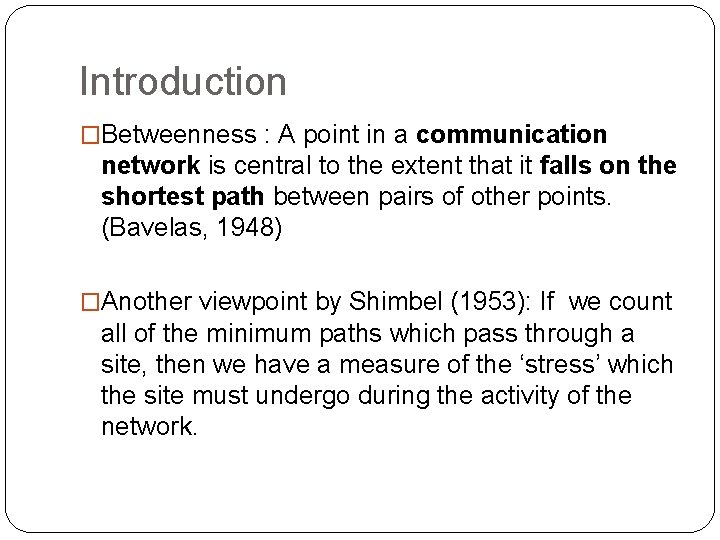
Introduction �Betweenness : A point in a communication network is central to the extent that it falls on the shortest path between pairs of other points. (Bavelas, 1948) �Another viewpoint by Shimbel (1953): If we count all of the minimum paths which pass through a site, then we have a measure of the ‘stress’ which the site must undergo during the activity of the network.
Agenda �Introduction �Measuring point centrality �Measuring graph centrality �Applications

Measuring Point Centrality �Shaw (1954) �Unordered pair of points {pi, pj} �{pi, pj} are Unreachable or there are one or more paths between them. pk pi pj
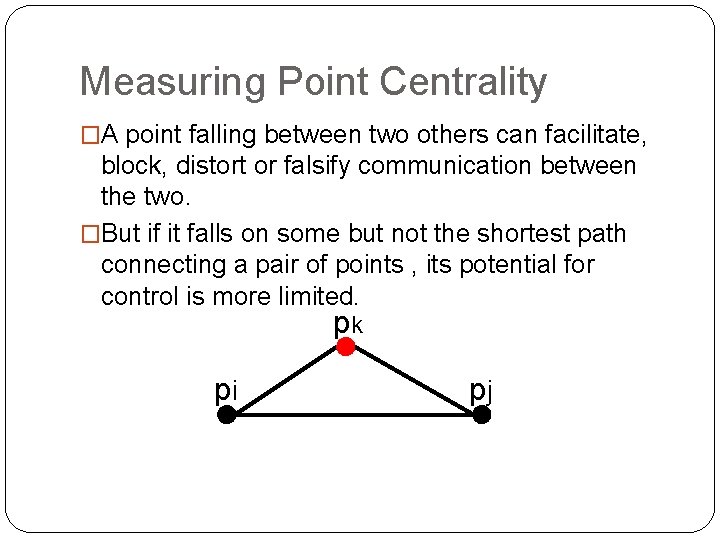
Measuring Point Centrality �A point falling between two others can facilitate, block, distort or falsify communication between the two. �But if it falls on some but not the shortest path connecting a pair of points , its potential for control is more limited. pk pi pj
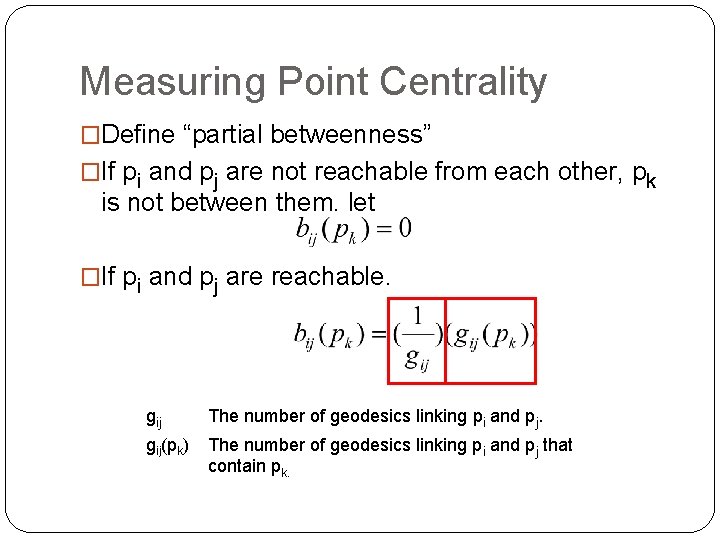
Measuring Point Centrality �Define “partial betweenness” �If pi and pj are not reachable from each other, pk is not between them. let �If pi and pj are reachable. gij The number of geodesics linking pi and pj. gij(pk) The number of geodesics linking pi and pj that contain pk.
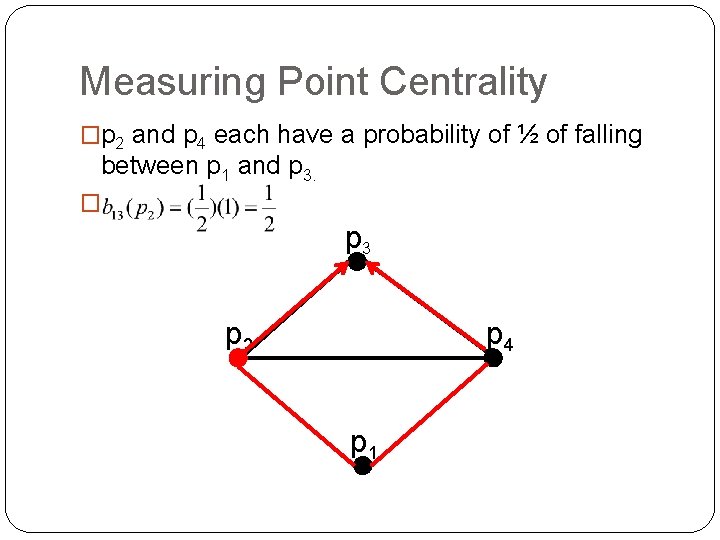
Measuring Point Centrality �p 2 and p 4 each have a probability of ½ of falling between p 1 and p 3. � p 3 p 2 p 4 p 1
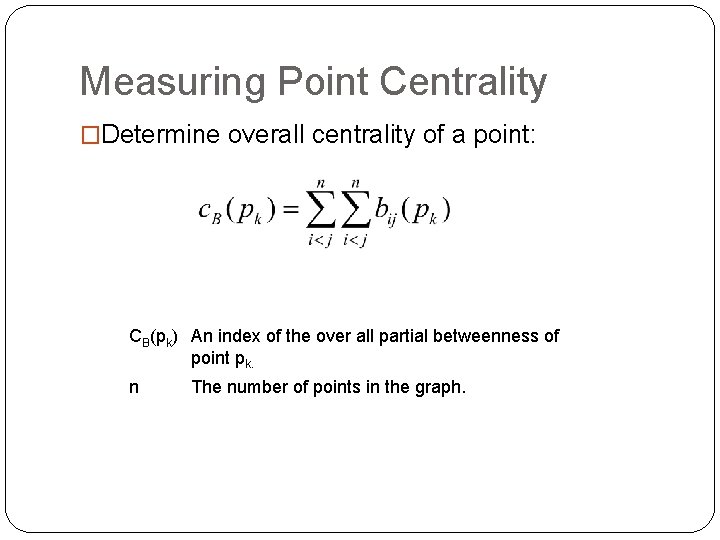
Measuring Point Centrality �Determine overall centrality of a point: CB(pk) An index of the over all partial betweenness of point pk. n The number of points in the graph.
Measuring Point Centrality �Its magnitude depends upon two factors: � 1) the arrangement of edges in the graph that define the location of pk with respect to geodesics linking pairs of points. � 2) the number of points in the graph.

Measuring Point Centrality �Problem ! ? �Example: � A graph containing 5 points, CB(pi)=6. A graph containing 25 points, CB(pj)=6. �They have the same potential for control in absolute terms, but differ markedly in their relative potential for control.
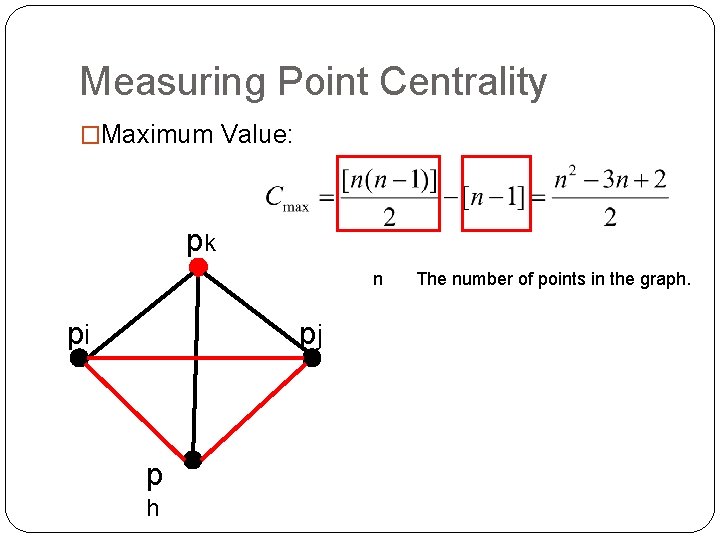
Measuring Point Centrality �Maximum Value: pk n pi pj p h The number of points in the graph.
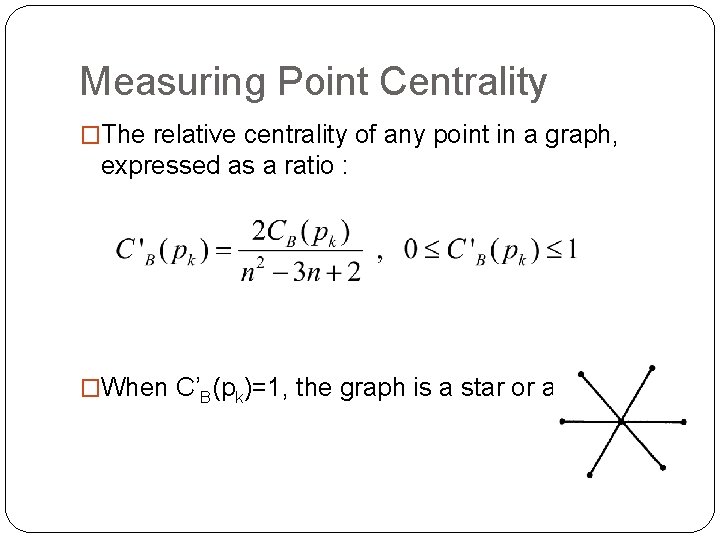
Measuring Point Centrality �The relative centrality of any point in a graph, expressed as a ratio : �When C’B(pk)=1, the graph is a star or a wheel.
Agenda �Introduction �Measuring point centrality �Measuring graph centrality �Applications
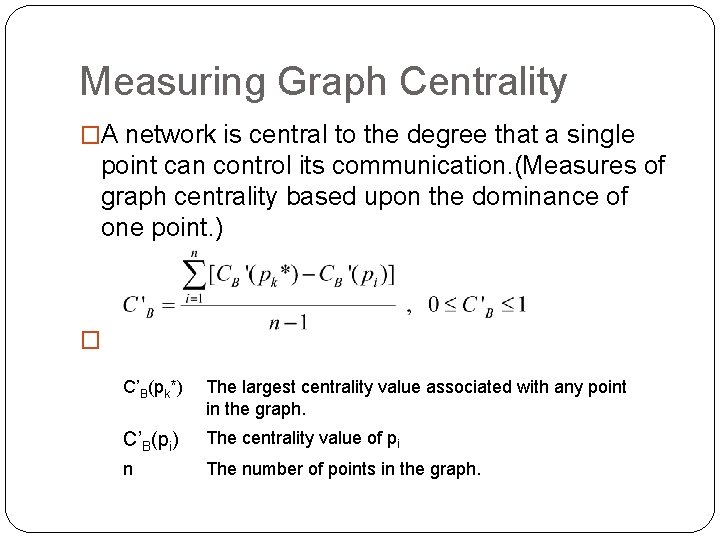
Measuring Graph Centrality �A network is central to the degree that a single point can control its communication. (Measures of graph centrality based upon the dominance of one point. ) � C’B(pk*) The largest centrality value associated with any point in the graph. C’B(pi) The centrality value of pi n The number of points in the graph.
Agenda �Introduction �Measuring point centrality �Measuring graph centrality �Applications
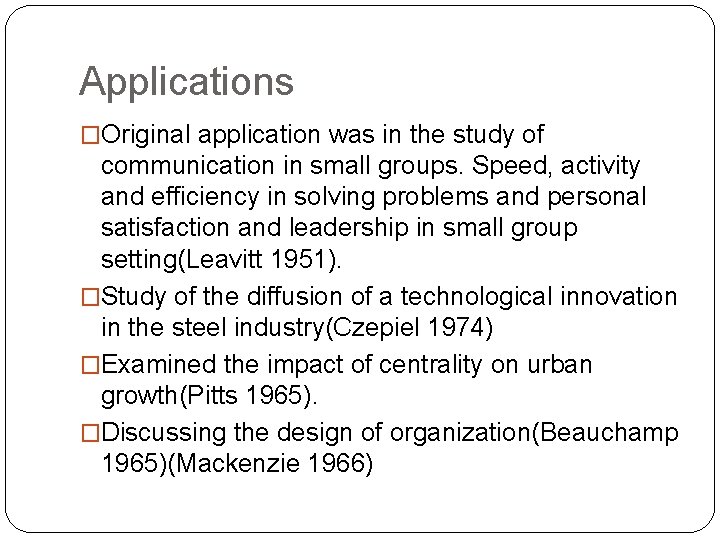
Applications �Original application was in the study of communication in small groups. Speed, activity and efficiency in solving problems and personal satisfaction and leadership in small group setting(Leavitt 1951). �Study of the diffusion of a technological innovation in the steel industry(Czepiel 1974) �Examined the impact of centrality on urban growth(Pitts 1965). �Discussing the design of organization(Beauchamp 1965)(Mackenzie 1966)
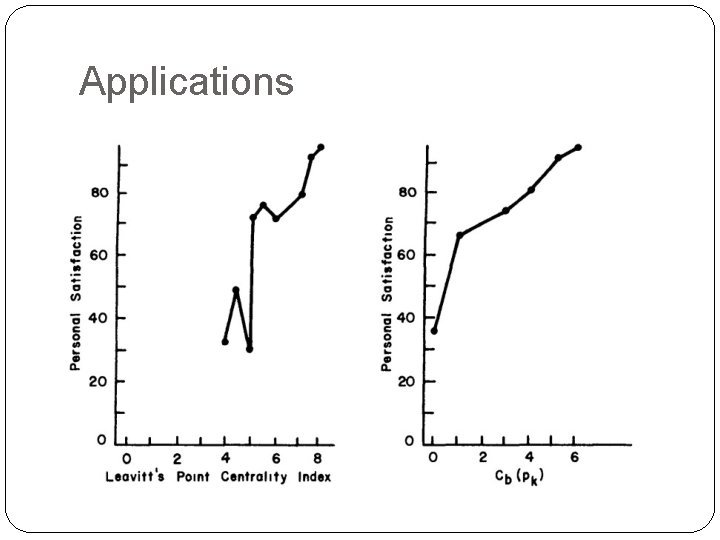
Applications �Consider the relationship between point centrality and personal satisfaction in Leavitt’s(1951) study of small group problem solving. �Each participant had a piece of information necessary for the solution of a problem. Each could communicate only with designated others. �Leavitt measured point centrality as a function of the lengths of paths or the distance between points.
Applications

Thanks for your attention!
- Slides: 21