
Topic 4 Abstract Syntax Symbol Tables COS 320
Topic 4: Abstract Syntax Symbol Tables COS 320 Compiling Techniques Princeton University Spring 2016 Lennart Beringer 1
Abstract Syntax 2
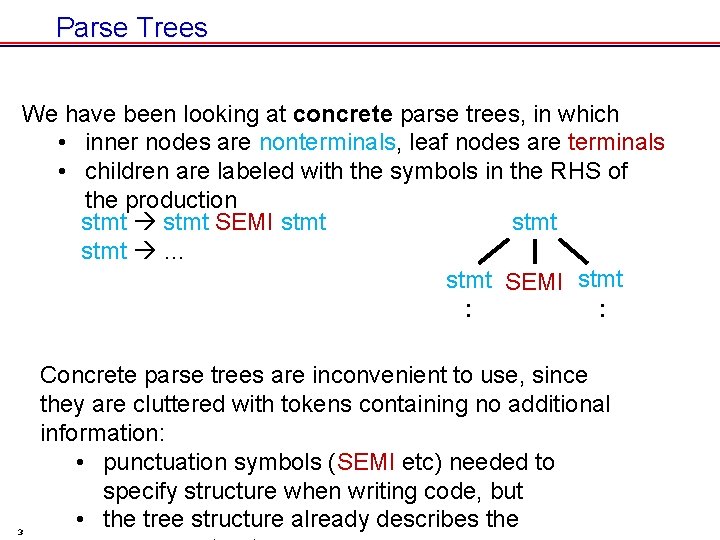
Parse Trees We have been looking at concrete parse trees, in which • inner nodes are nonterminals, leaf nodes are terminals • children are labeled with the symbols in the RHS of the production stmt SEMI stmt … stmt SEMI stmt : : 3 Concrete parse trees are inconvenient to use, since they are cluttered with tokens containing no additional information: • punctuation symbols (SEMI etc) needed to specify structure when writing code, but • the tree structure already describes the
Parse Tree Example 4
Abstract parse trees (aka abstract syntac tree – AST) • like concrete parse trees (e. g. inductive datatype, generated as semantic action by YACC) • each syntactic category (expressions, statements, . . ) is represented as a separate datatype, with one constructor for each formation • redundant punctuation symbols are left out 5
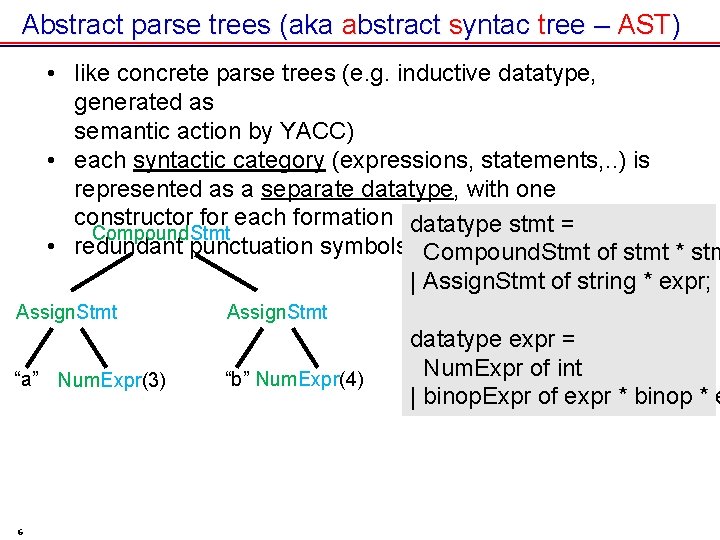
Abstract parse trees (aka abstract syntac tree – AST) • like concrete parse trees (e. g. inductive datatype, generated as semantic action by YACC) • each syntactic category (expressions, statements, . . ) is represented as a separate datatype, with one constructor for each formation datatype stmt = Compound. Stmt • redundant punctuation symbols are left out Compound. Stmt of stmt * stm | Assign. Stmt of string * expr; Assign. Stmt “a” Num. Expr(3) 6 Assign. Stmt “b” Num. Expr(4) datatype expr = Num. Expr of int | binop. Expr of expr * binop * e
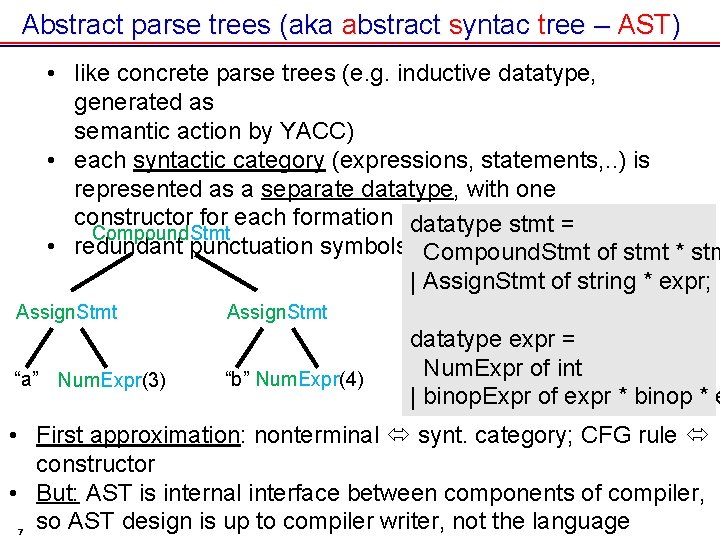
Abstract parse trees (aka abstract syntac tree – AST) • like concrete parse trees (e. g. inductive datatype, generated as semantic action by YACC) • each syntactic category (expressions, statements, . . ) is represented as a separate datatype, with one constructor for each formation datatype stmt = Compound. Stmt • redundant punctuation symbols are left out Compound. Stmt of stmt * stm | Assign. Stmt of string * expr; Assign. Stmt “a” Num. Expr(3) Assign. Stmt “b” Num. Expr(4) datatype expr = Num. Expr of int | binop. Expr of expr * binop * e • First approximation: nonterminal synt. category; CFG rule constructor • But: AST is internal interface between components of compiler, so AST design is up to compiler writer, not the language 7
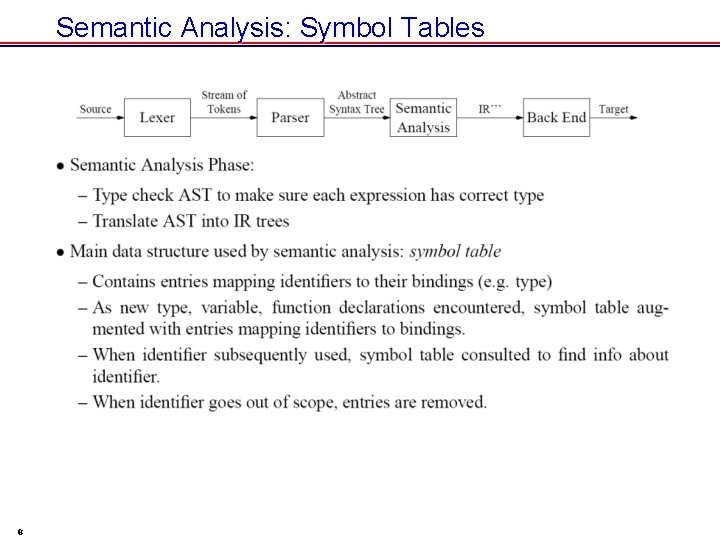
Semantic Analysis: Symbol Tables 8
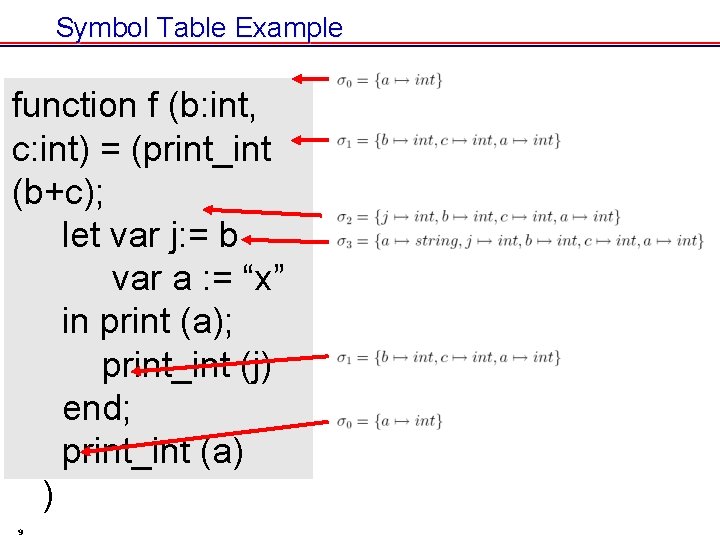
Symbol Table Example function f (b: int, c: int) = (print_int (b+c); let var j: = b var a : = “x” in print (a); print_int (j) end; print_int (a) ) 9
Symbol Table Implementation 10
Imperative Symbol Tables 11
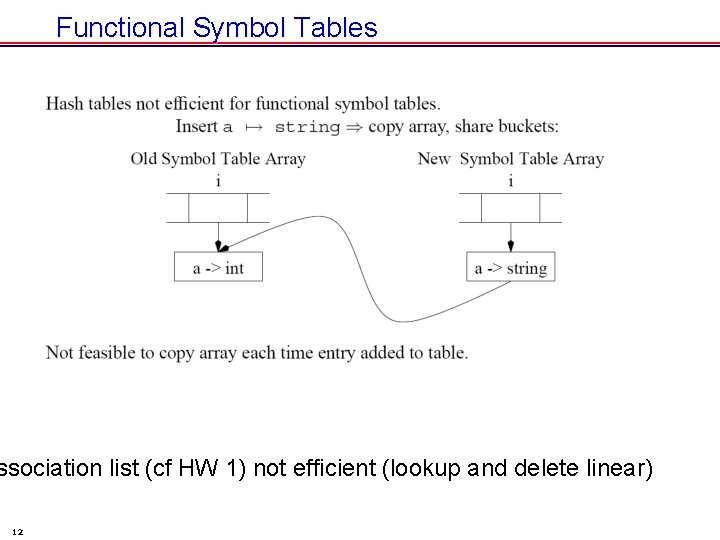
Functional Symbol Tables ssociation list (cf HW 1) not efficient (lookup and delete linear) 12
Functional Symbol Tables 13
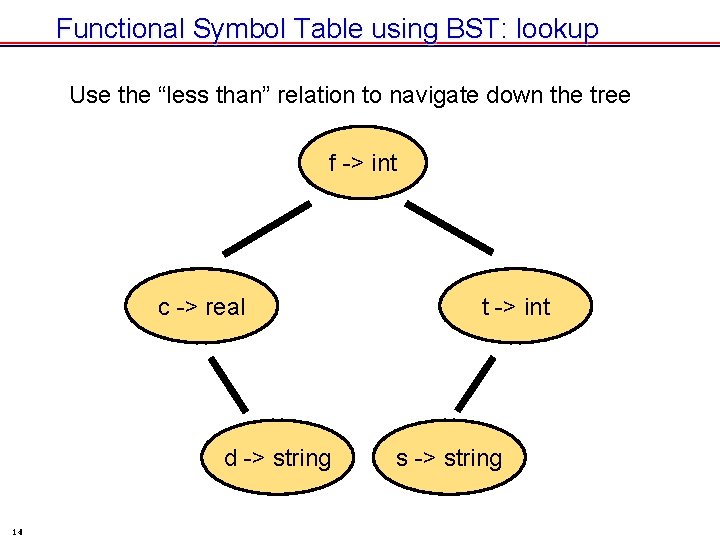
Functional Symbol Table using BST: lookup Use the “less than” relation to navigate down the tree f -> int c -> real d -> string 14 t -> int s -> string
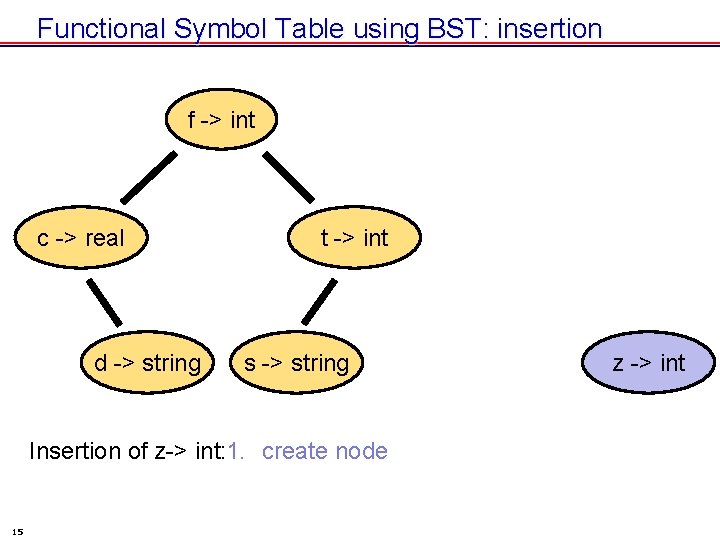
Functional Symbol Table using BST: insertion f -> int c -> real d -> string t -> int s -> string Insertion of z-> int: 1. create node 15 z -> int
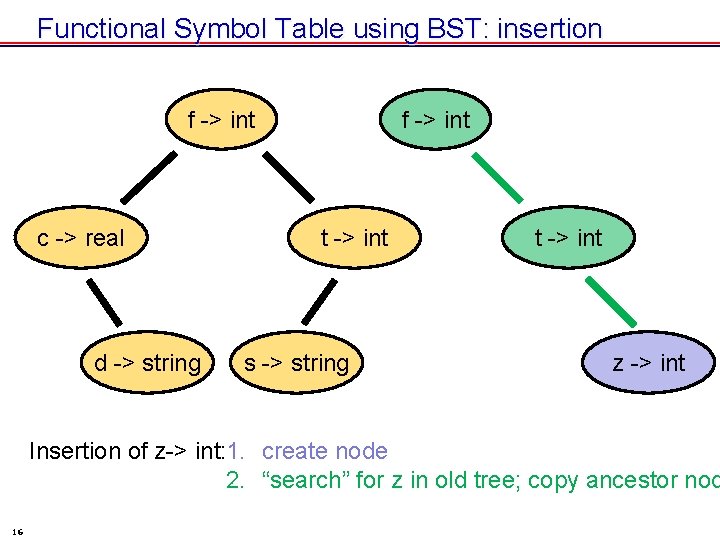
Functional Symbol Table using BST: insertion f -> int c -> real d -> string f -> int t -> int s -> string t -> int z -> int Insertion of z-> int: 1. create node 2. “search” for z in old tree; copy ancestor nod 16
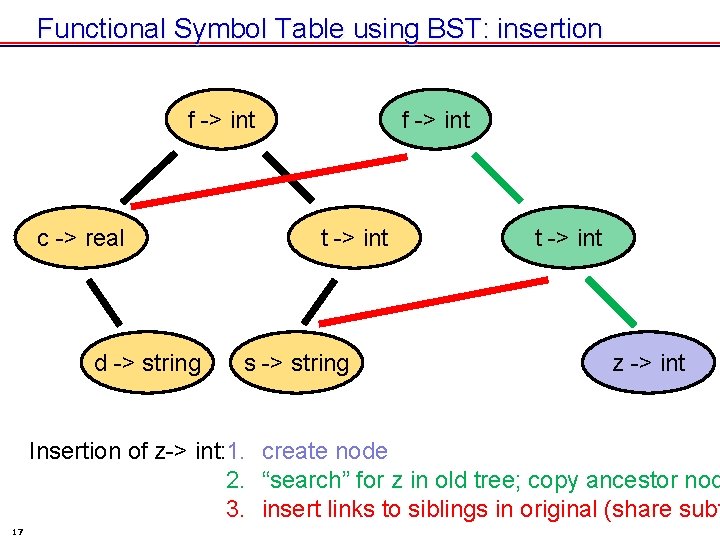
Functional Symbol Table using BST: insertion f -> int c -> real d -> string f -> int t -> int s -> string t -> int z -> int Insertion of z-> int: 1. create node 2. “search” for z in old tree; copy ancestor nod 3. insert links to siblings in original (share subt 17
- Slides: 17