
Hantao Ji Princeton Plasma Physics Laboratory Experimentalist Laboratory
Hantao Ji Princeton Plasma Physics Laboratory • Experimentalist • Laboratory astrophysics – Reconnection, angular momentum transport, dynamo effect… – Center for Magnetic Self-organization (CMSO, a NSF Physics Frontier Center) • Current main research projects (>~10%) – – – – Magnetic Reconnection Experiment (MRX) Magnetorotational Instability (MRI) liquid gallium experiment Plasma MRI experiment Free-surface liquid gallium experiment Madison Symmetric Torus (MST) experiment Field Reversed Configuration (FRC) experiment National Spherical Torus experiment (NSTX) • Interests: – Collisionless shocks 1
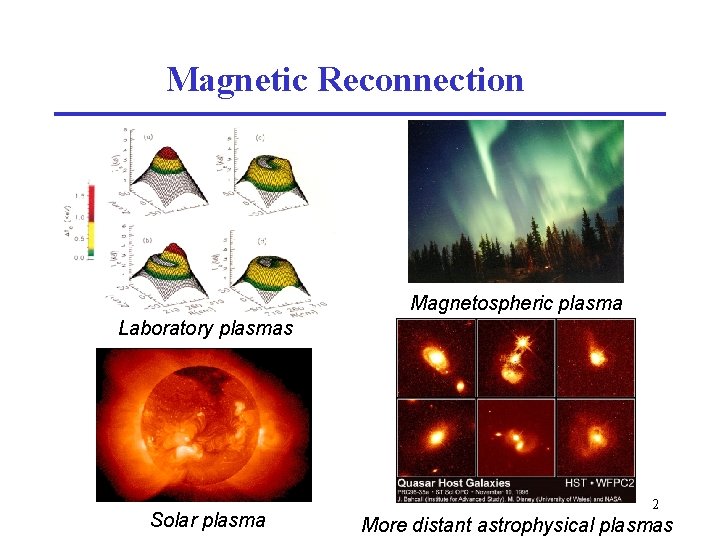
Magnetic Reconnection Magnetospheric plasma Laboratory plasmas Solar plasma 2 More distant astrophysical plasmas
Fundamental Physics Questions for Magnetic Reconnection • How does reconnection start? (The trigger problem) • Why reconnection is fast compared to classical theory? • How ions and electrons are heated or accelerated? • How to apply local reconnection physics to a large system? • … 3
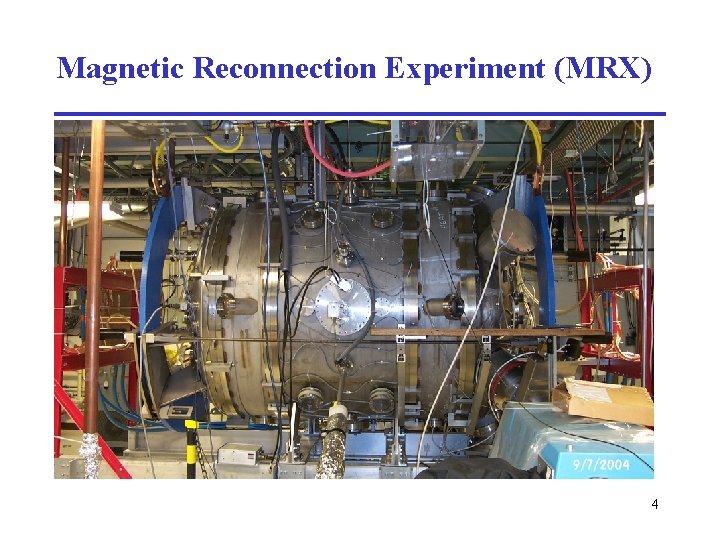
Magnetic Reconnection Experiment (MRX) 4
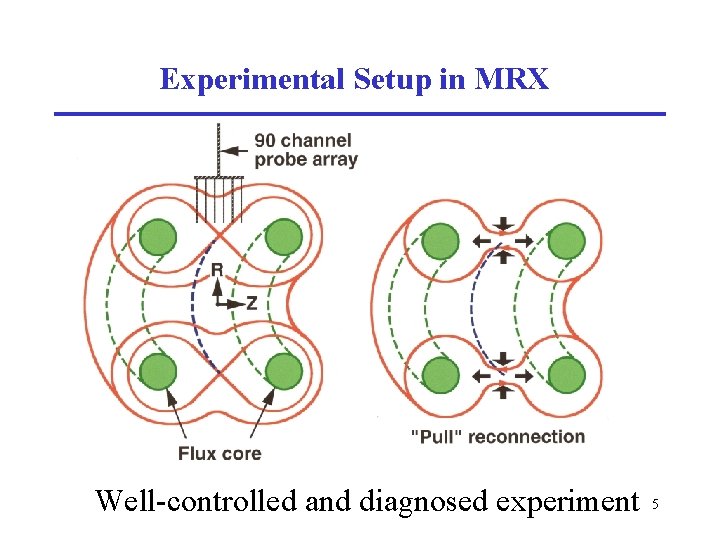
Experimental Setup in MRX Well-controlled and diagnosed experiment 5
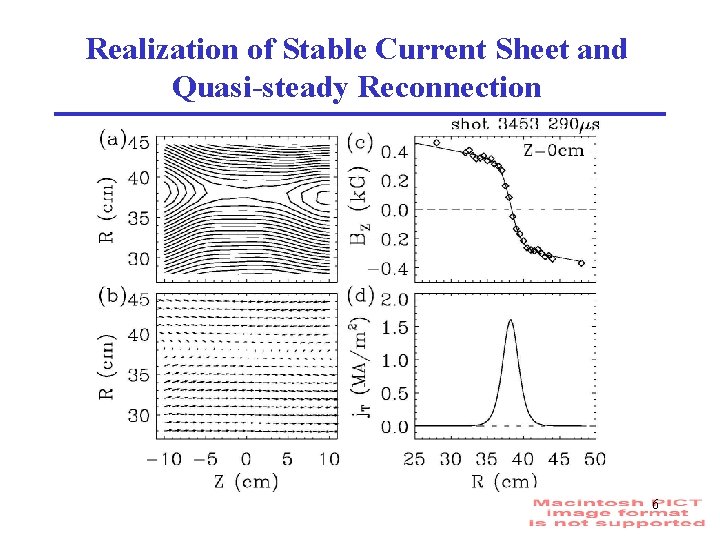
Realization of Stable Current Sheet and Quasi-steady Reconnection 6
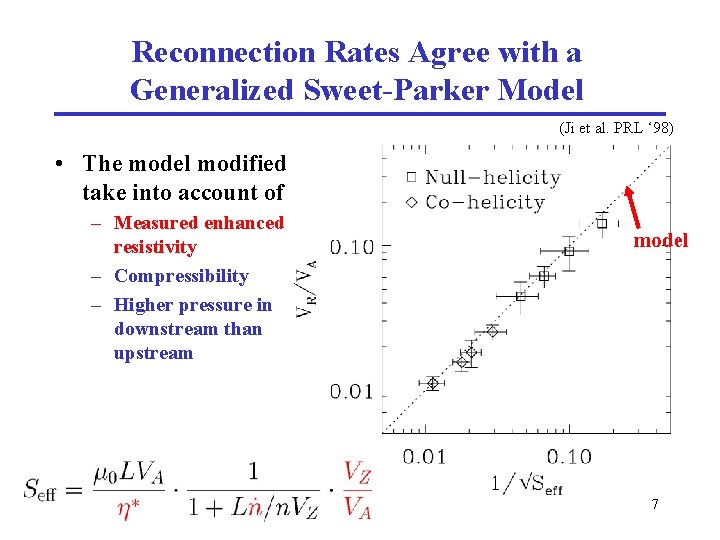
Reconnection Rates Agree with a Generalized Sweet-Parker Model (Ji et al. PRL ‘ 98) • The model modified to take into account of – Measured enhanced resistivity – Compressibility – Higher pressure in downstream than upstream model 7
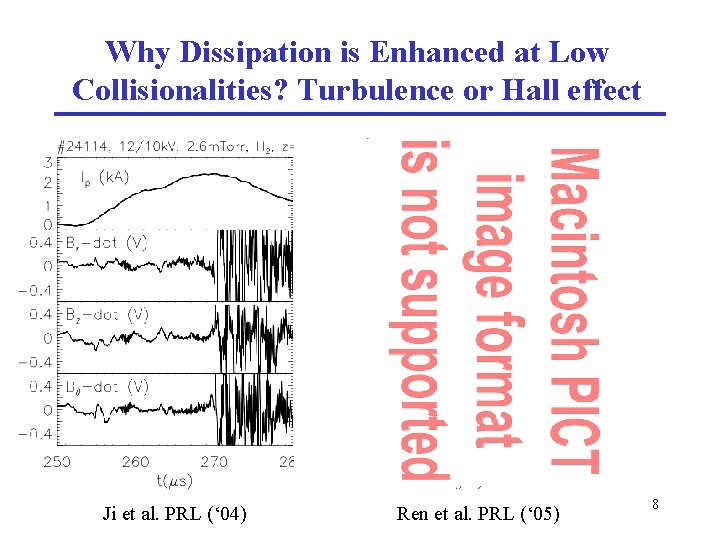
Why Dissipation is Enhanced at Low Collisionalities? Turbulence or Hall effect Ji et al. PRL (‘ 04) Ren et al. PRL (‘ 05) 8
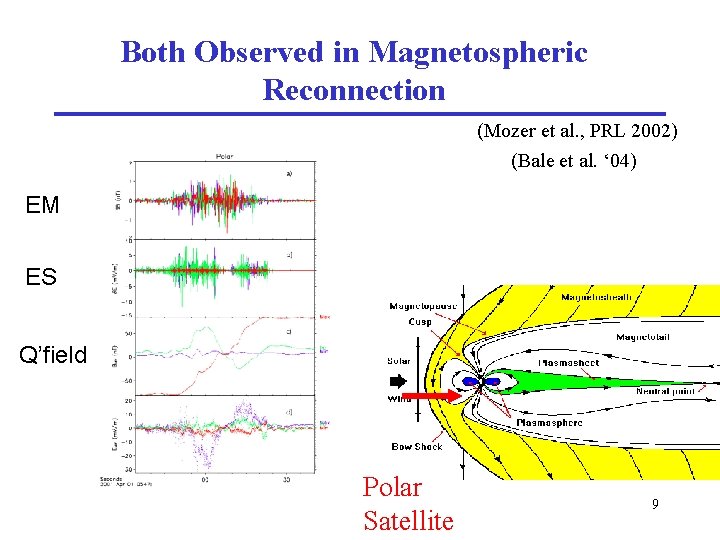
Both Observed in Magnetospheric Reconnection (Mozer et al. , PRL 2002) (Bale et al. ‘ 04) EM ES Q’field Polar Satellite 9
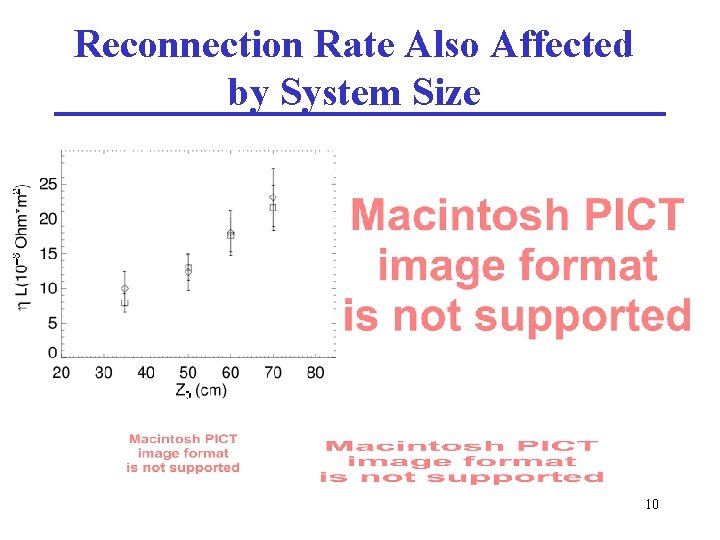
Reconnection Rate Also Affected by System Size 10
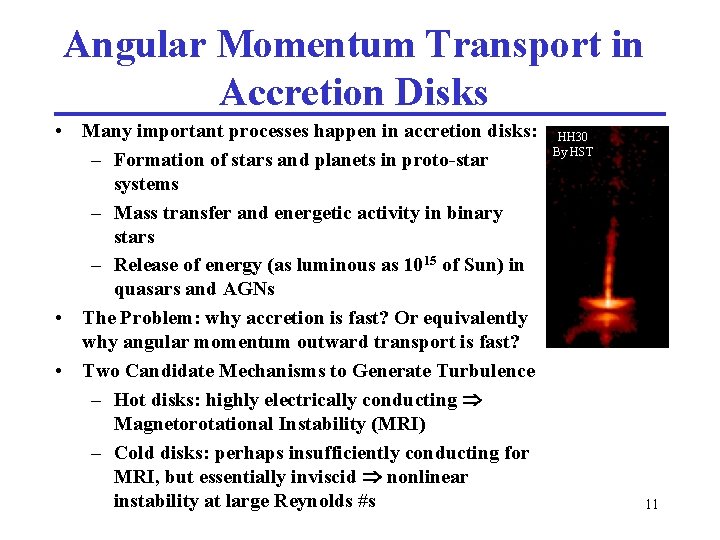
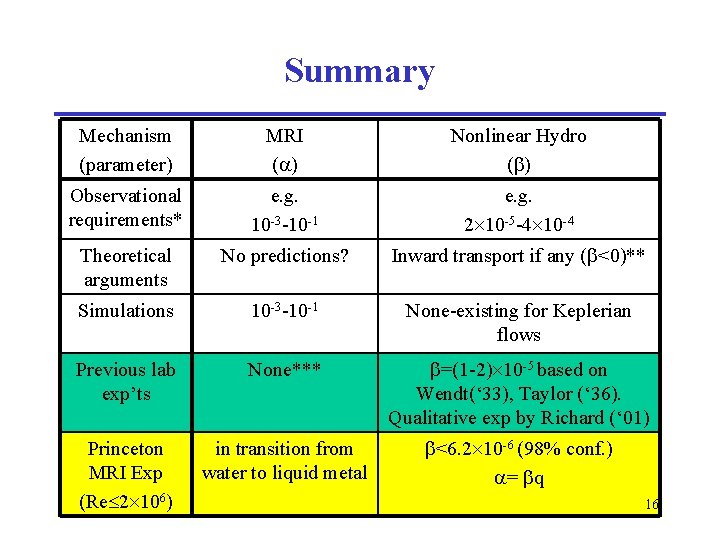
Angular Momentum Transport in Accretion Disks • Many important processes happen in accretion disks: – Formation of stars and planets in proto-star systems – Mass transfer and energetic activity in binary stars – Release of energy (as luminous as 1015 of Sun) in quasars and AGNs • The Problem: why accretion is fast? Or equivalently why angular momentum outward transport is fast? • Two Candidate Mechanisms to Generate Turbulence – Hot disks: highly electrically conducting Magnetorotational Instability (MRI) – Cold disks: perhaps insufficiently conducting for MRI, but essentially inviscid nonlinear instability at large Reynolds #s HH 30 By HST 11
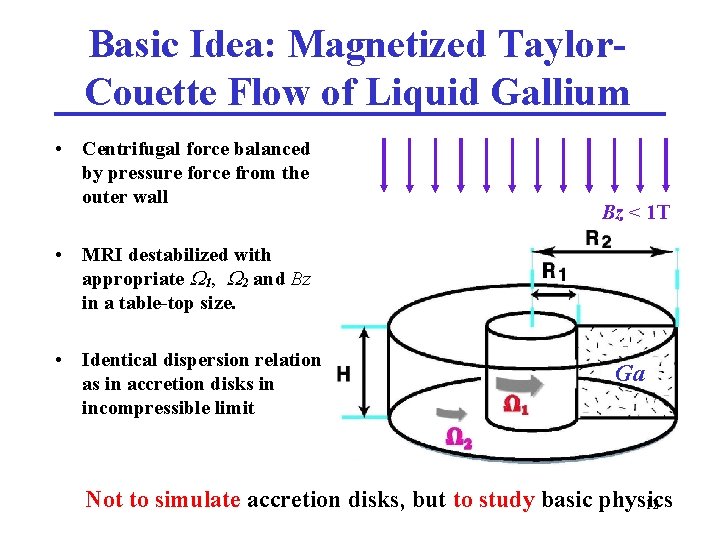
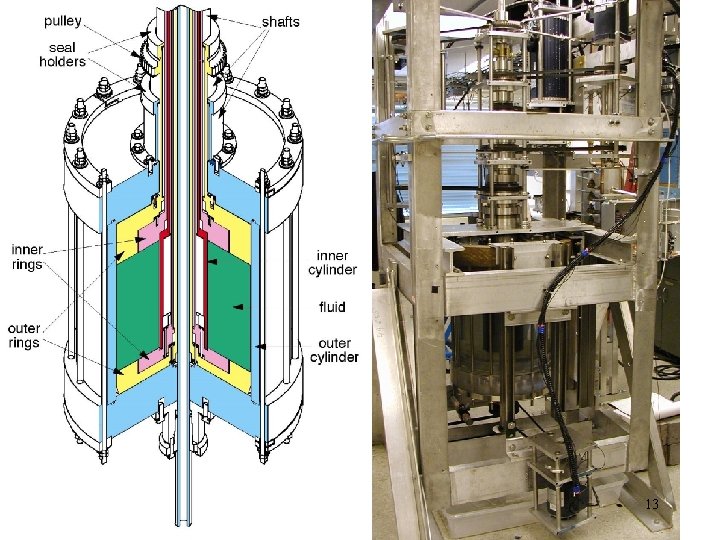
Basic Idea: Magnetized Taylor. Couette Flow of Liquid Gallium • Centrifugal force balanced by pressure force from the outer wall Bz < 1 T • MRI destabilized with appropriate 1, 2 and Bz in a table-top size. • Identical dispersion relation as in accretion disks in incompressible limit Ga Not to simulate accretion disks, but to study basic physics 12
13
Re based on inner cylinder Water Results: Negligible Transport Found in Quasi-Keplerian Flows 14 Re based on outer cylinder
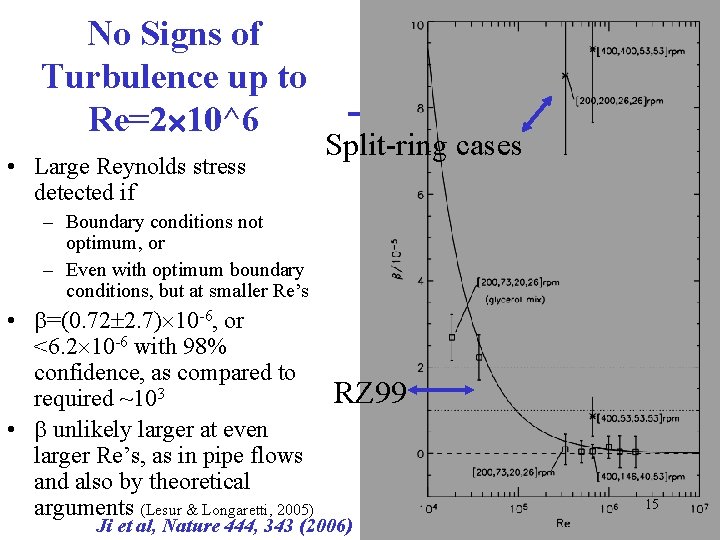
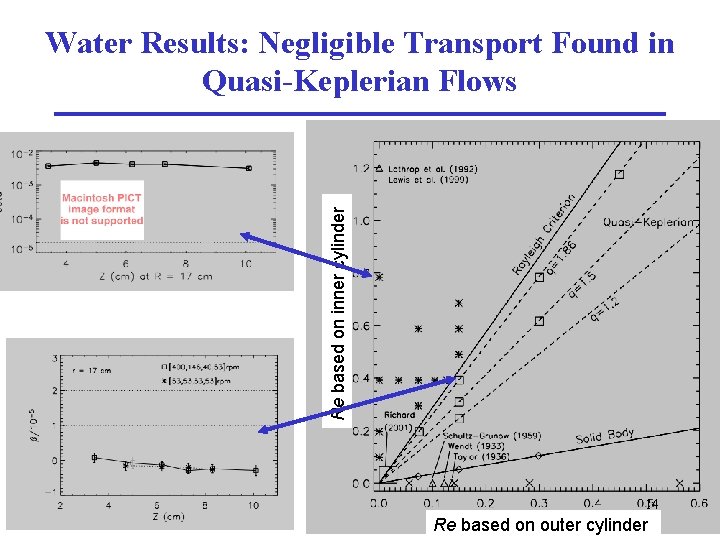
No Signs of Turbulence up to Re=2 10^6 • Large Reynolds stress detected if Split-ring cases – Boundary conditions not optimum, or – Even with optimum boundary conditions, but at smaller Re’s • =(0. 72 2. 7) 10 -6, or <6. 2 10 -6 with 98% confidence, as compared to required ~103 • unlikely larger at even larger Re’s, as in pipe flows and also by theoretical arguments (Lesur & Longaretti, 2005) RZ 99 Ji et al, Nature 444, 343 (2006) 15
Summary Mechanism (parameter) MRI ( ) Nonlinear Hydro ( ) Observational requirements* e. g. 10 -3 -10 -1 e. g. 2 10 -5 -4 10 -4 Theoretical arguments No predictions? Inward transport if any ( <0)** Simulations 10 -3 -10 -1 None-existing for Keplerian flows Previous lab exp’ts None*** =(1 -2) 10 -5 based on Wendt(‘ 33), Taylor (‘ 36). Qualitative exp by Richard (‘ 01) Princeton MRI Exp (Re 2 106) in transition from water to liquid metal <6. 2 10 -6 (98% conf. ) = q 16
- Slides: 16