Higgs Factories Present and Future Chris Tully Princeton
- Slides: 24
Higgs Factories: Present and Future Chris Tully Princeton Higgs Physics Beyond Discovery April 26, 2013 1
Higgs Physics in the Big Picture • Will the detailed properties of the Higgs boson tell us more about the laws of physics? – What is the nature of dark matter? • Does dark matter interact with the Higgs boson? – Why is there a large-scale universe? • Are there symmetries or properties of space-time that made this possible and will such properties be discovered through the detailed study of the Higgs boson? • Why weren’t the elementary particles given heavy masses – this in itself is partly responsible for the large discrepancy in the strength of gravity relative to electroweak interactions? The universe is not a small dot – but seems like it should be. 2
Major Challenges for Higgs Physics • The LHC at 14 Te. V will probe new physics at and above the Te. V scale in a broad sweep – Beyond further discoveries at the LHC, the most promising avenue for future exploration is via the Higgs boson properties through high precision measurement. • What constitutes a high precision test capable of exploring more physics than a broadband discovery machine like the LHC? • Higher precision in the Higgs sector alone is likely to be insufficient, a comprehensive program of order of magnitude improvements in all electroweak observable, the W boson and top quark mass are needed. • The Higgs boson and the top quark were guaranteed discoveries based on exactly this strategy – The basis for the high precision measurements came from the Z factories (over 106 Z bosons produced on resonance and studied with polarized beams with ~105 Z bosons). 3
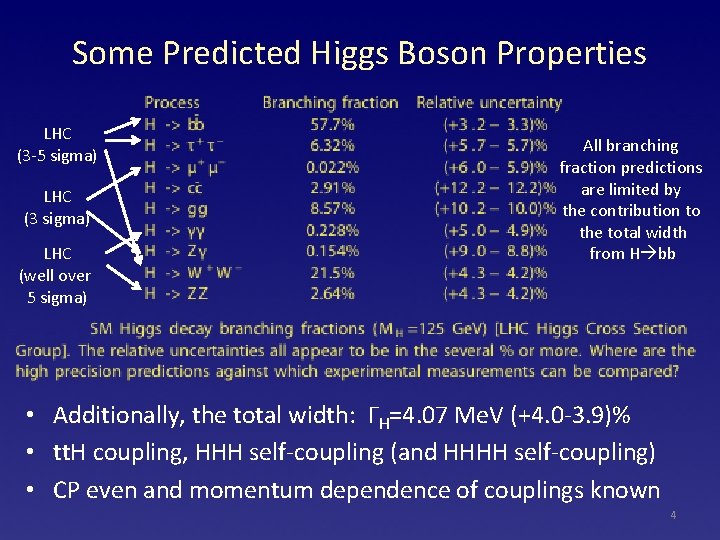
Some Predicted Higgs Boson Properties LHC (3 -5 sigma) LHC (3 sigma) LHC (well over 5 sigma) All branching fraction predictions are limited by the contribution to the total width from H bb • Additionally, the total width: ΓH=4. 07 Me. V (+4. 0 -3. 9)% • tt. H coupling, HHH self-coupling (and HHHH self-coupling) • CP even and momentum dependence of couplings known 4
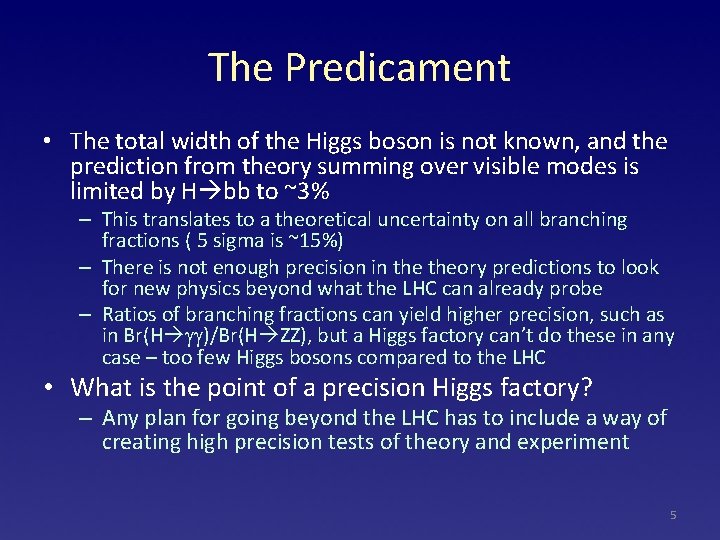
The Predicament • The total width of the Higgs boson is not known, and the prediction from theory summing over visible modes is limited by H bb to ~3% – This translates to a theoretical uncertainty on all branching fractions ( 5 sigma is ~15%) – There is not enough precision in theory predictions to look for new physics beyond what the LHC can already probe – Ratios of branching fractions can yield higher precision, such as in Br(H gg)/Br(H ZZ), but a Higgs factory can’t do these in any case – too few Higgs bosons compared to the LHC • What is the point of a precision Higgs factory? – Any plan for going beyond the LHC has to include a way of creating high precision tests of theory and experiment 5
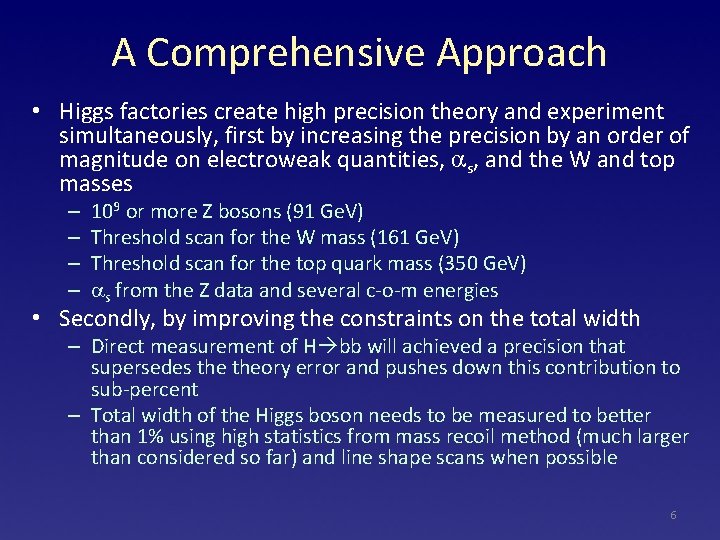
A Comprehensive Approach • Higgs factories create high precision theory and experiment simultaneously, first by increasing the precision by an order of magnitude on electroweak quantities, and the W and top masses – – 109 or more Z bosons (91 Ge. V) Threshold scan for the W mass (161 Ge. V) Threshold scan for the top quark mass (350 Ge. V) as from the Z data and several c-o-m energies • Secondly, by improving the constraints on the total width – Direct measurement of H bb will achieved a precision that supersedes theory error and pushes down this contribution to sub-percent – Total width of the Higgs boson needs to be measured to better than 1% using high statistics from mass recoil method (much larger than considered so far) and line shape scans when possible 6
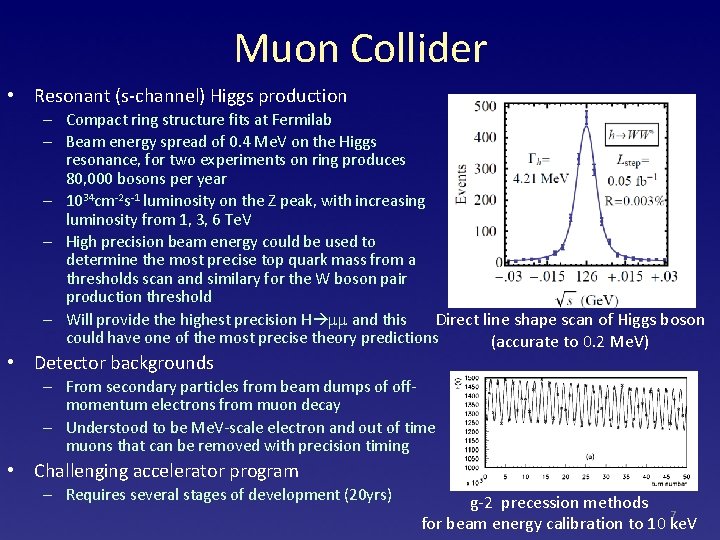
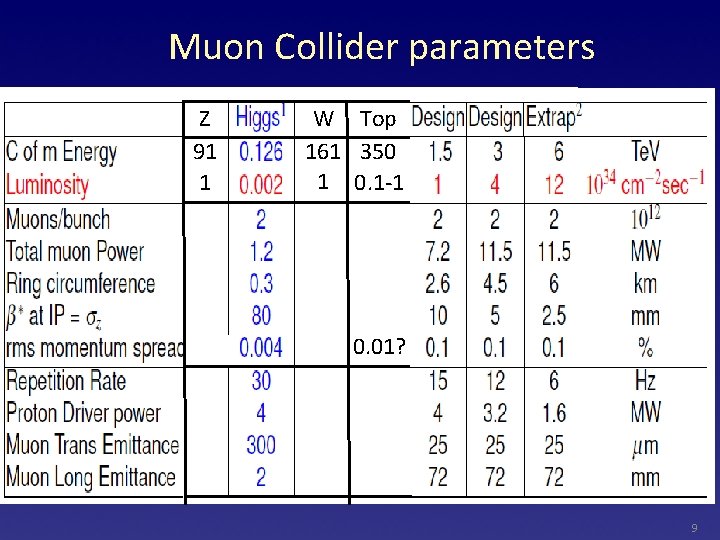
Muon Collider • Resonant (s-channel) Higgs production – Compact ring structure fits at Fermilab – Beam energy spread of 0. 4 Me. V on the Higgs resonance, for two experiments on ring produces 80, 000 bosons per year – 1034 cm-2 s-1 luminosity on the Z peak, with increasing luminosity from 1, 3, 6 Te. V – High precision beam energy could be used to determine the most precise top quark mass from a thresholds scan and similary for the W boson pair production threshold – Will provide the highest precision H mm and this Direct line shape scan of Higgs boson could have one of the most precise theory predictions (accurate to 0. 2 Me. V) • Detector backgrounds – From secondary particles from beam dumps of offmomentum electrons from muon decay – Understood to be Me. V-scale electron and out of time muons that can be removed with precision timing • Challenging accelerator program – Requires several stages of development (20 yrs) g-2 precession methods 7 for beam energy calibration to 10 ke. V
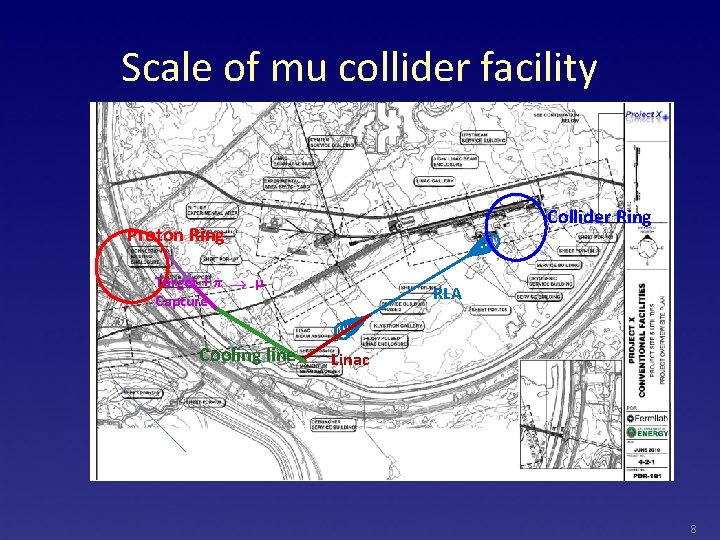
Scale of mu collider facility Collider Ring Proton Ring Target + π Capture μ Cooling line RLA Linac 8
Muon Collider parameters Z 91 1 W Top 161 350 1 0. 1 -1 0. 01? 9
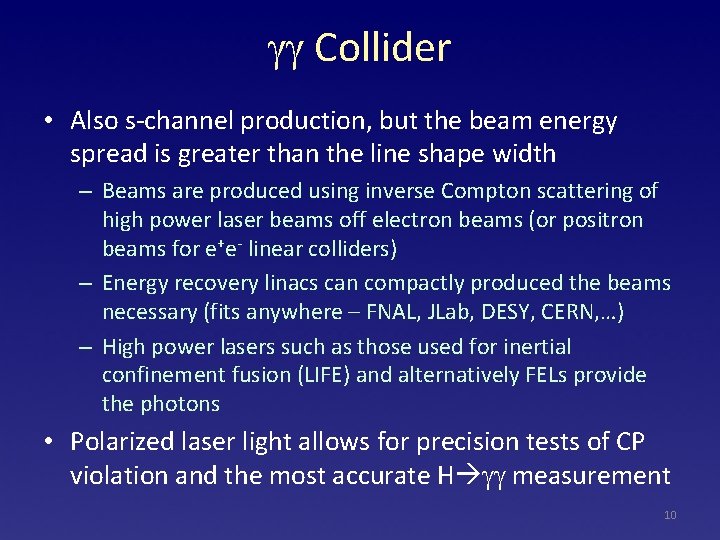
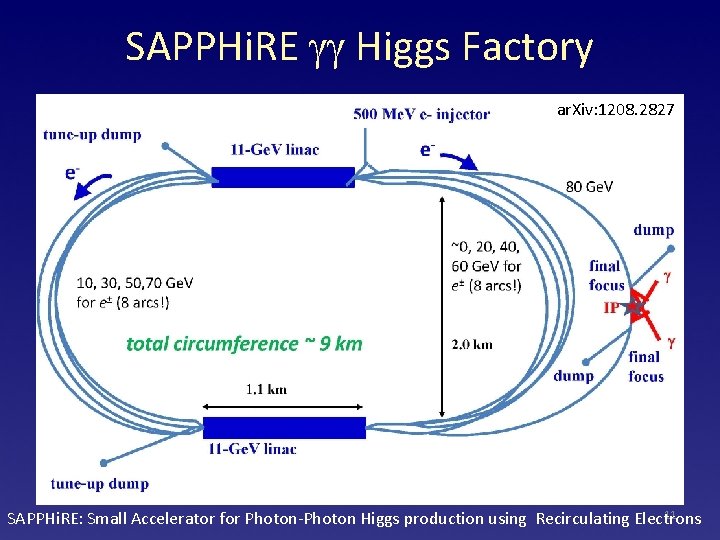
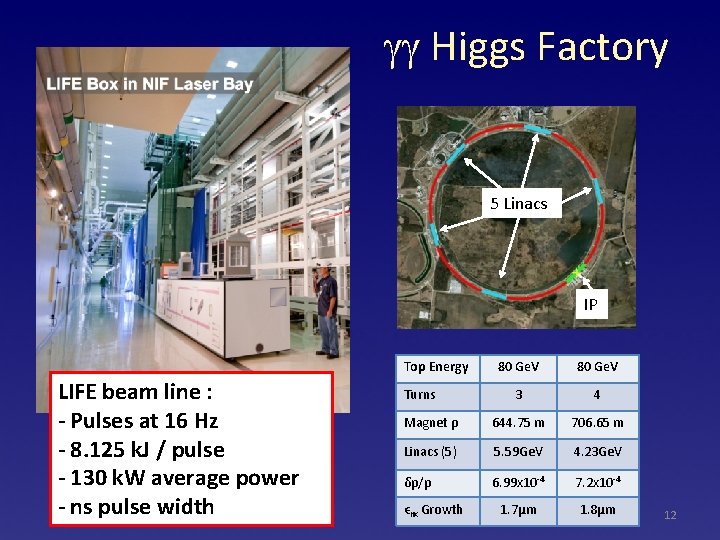
gg Collider • Also s-channel production, but the beam energy spread is greater than the line shape width – Beams are produced using inverse Compton scattering of high power laser beams off electron beams (or positron beams for e+e- linear colliders) – Energy recovery linacs can compactly produced the beams necessary (fits anywhere – FNAL, JLab, DESY, CERN, …) – High power lasers such as those used for inertial confinement fusion (LIFE) and alternatively FELs provide the photons • Polarized laser light allows for precision tests of CP violation and the most accurate H gg measurement 10
SAPPHi. RE gg Higgs Factory ar. Xiv: 1208. 2827 11 SAPPHi. RE: Small Accelerator for Photon-Photon Higgs production using Recirculating Electrons
gg Higgs Factory 5 Linacs IP Top Energy LIFE beam line : - Pulses at 16 Hz - 8. 125 k. J / pulse - 130 k. W average power - ns pulse width 80 Ge. V 3 4 Magnet ρ 644. 75 m 706. 65 m Linacs (5) 5. 59 Ge. V 4. 23 Ge. V δp/p 6. 99 x 10 -4 7. 2 x 10 -4 1. 7μm 1. 8μm Turns ϵnx Growth 12
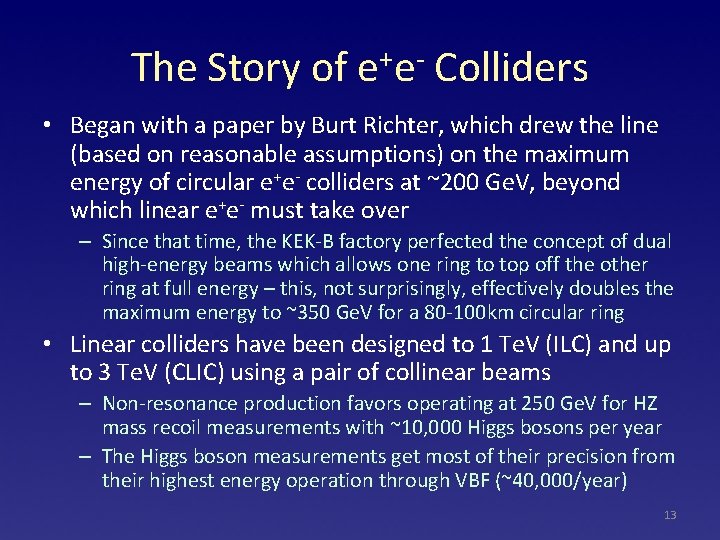
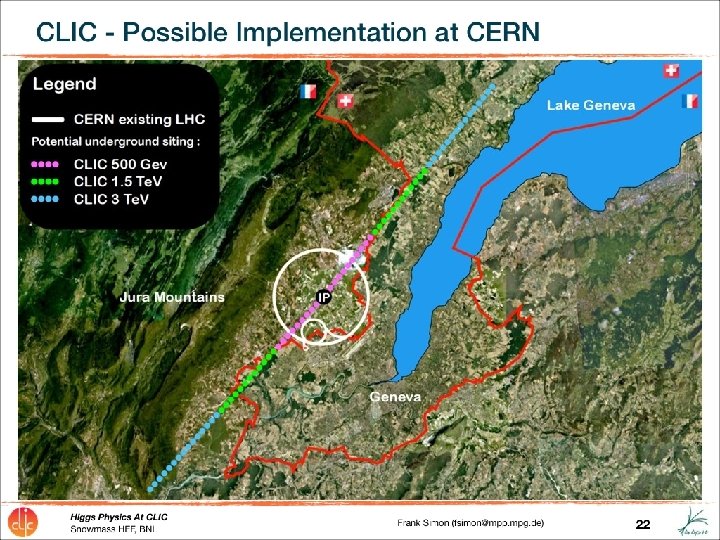
The Story of e+e- Colliders • Began with a paper by Burt Richter, which drew the line (based on reasonable assumptions) on the maximum energy of circular e+e- colliders at ~200 Ge. V, beyond which linear e+e- must take over – Since that time, the KEK-B factory perfected the concept of dual high-energy beams which allows one ring to top off the other ring at full energy – this, not surprisingly, effectively doubles the maximum energy to ~350 Ge. V for a 80 -100 km circular ring • Linear colliders have been designed to 1 Te. V (ILC) and up to 3 Te. V (CLIC) using a pair of collinear beams – Non-resonance production favors operating at 250 Ge. V for HZ mass recoil measurements with ~10, 000 Higgs bosons per year – The Higgs boson measurements get most of their precision from their highest energy operation through VBF (~40, 000/year) 13
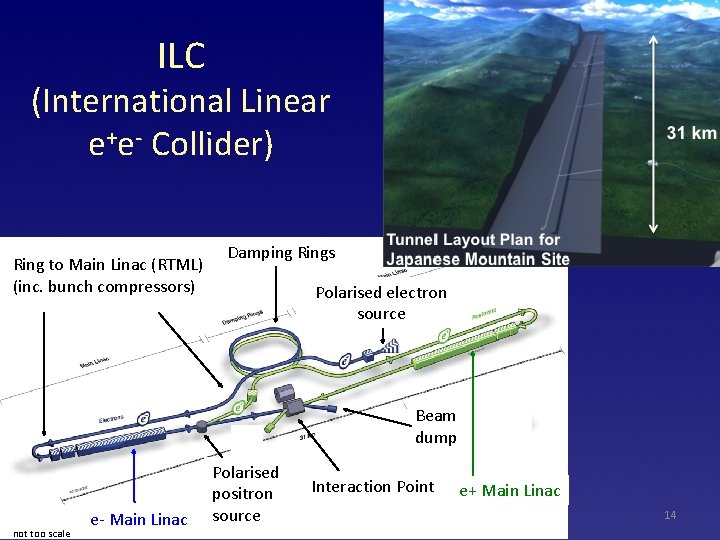
ILC (International Linear e+e- Collider) Ring to Main Linac (RTML) (inc. bunch compressors) Damping Rings Polarised electron source Beam dump not too scale e- Main Linac Polarised positron source Interaction Point e+ Main Linac 14
15
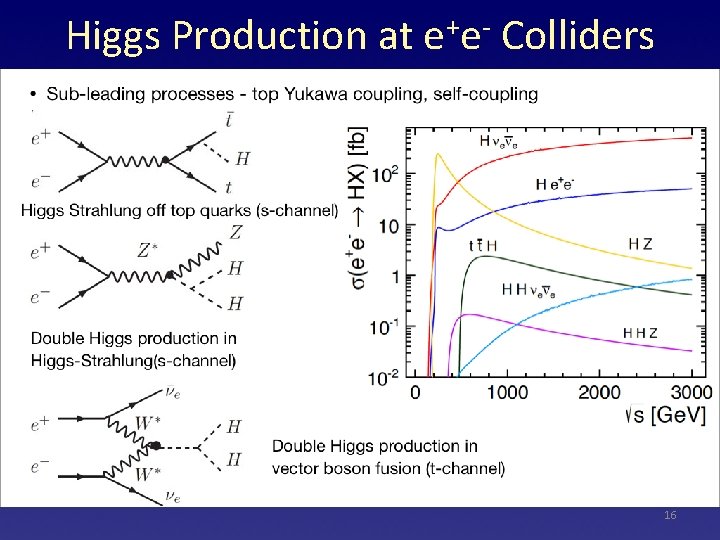
Higgs Production at e+e- Colliders 16
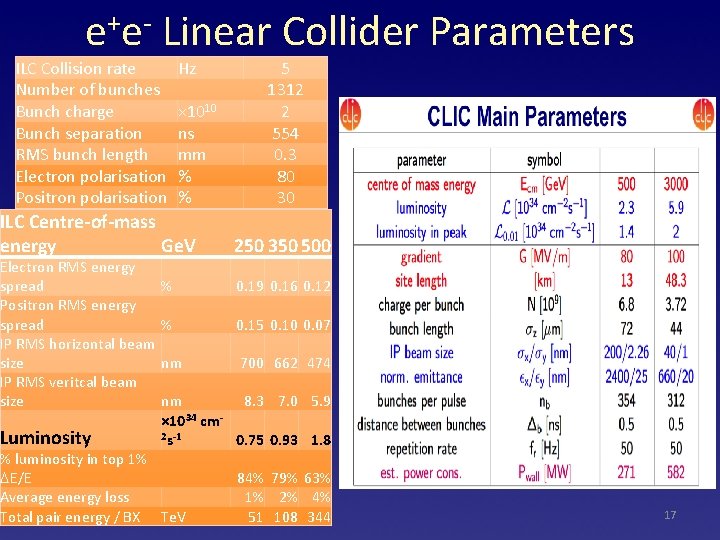
e+e- Linear Collider Parameters ILC Collision rate Number of bunches Bunch charge Bunch separation RMS bunch length Electron polarisation Positron polarisation Hz × 1010 ns mm % % ILC Centre-of-mass energy Ge. V Electron RMS energy spread Positron RMS energy spread IP RMS horizontal beam size IP RMS veritcal beam size Luminosity 5 1312 2 554 0. 3 80 30 250 350 500 % 0. 19 0. 16 0. 12 % 0. 15 0. 10 0. 07 nm 700 662 474 nm 8. 3 7. 0 5. 9 × 1034 cm 2 s-1 0. 75 0. 93 1. 8 % luminosity in top 1% DE/E Average energy loss Total pair energy / BX Te. V 84% 79% 63% 1% 2% 4% 51 108 344 17
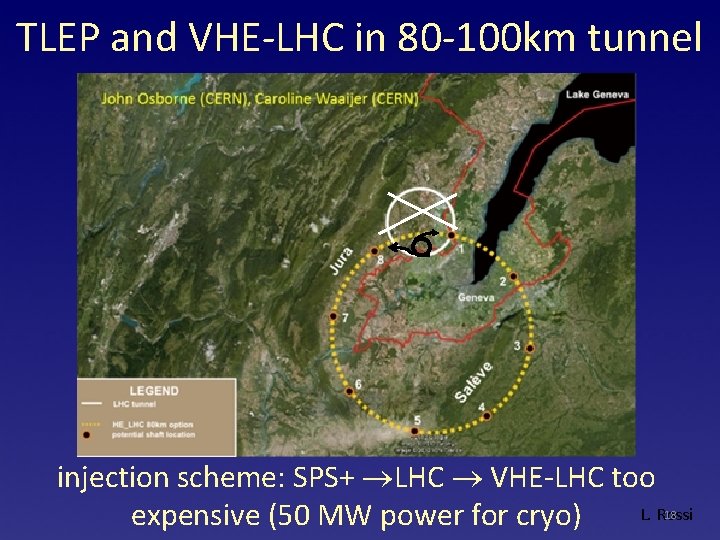
TLEP and VHE-LHC in 80 -100 km tunnel injection scheme: SPS+ LHC VHE-LHC too L. Rossi expensive (50 MW power for cryo) 18
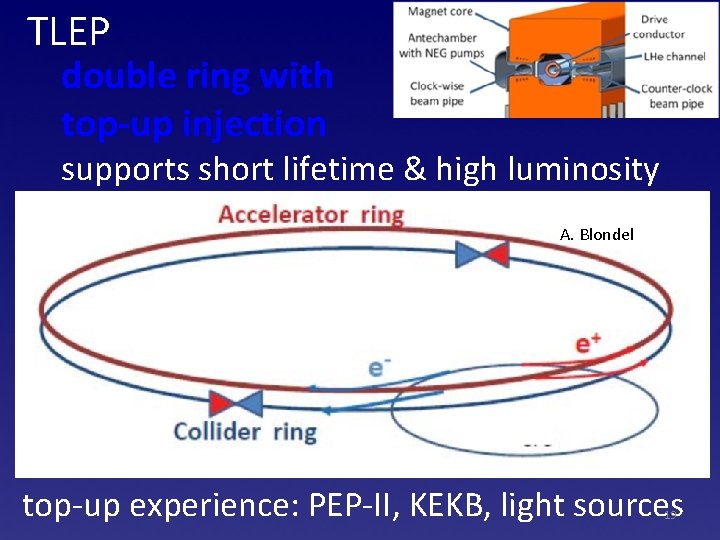
TLEP double ring with top-up injection supports short lifetime & high luminosity A. Blondel top-up experience: PEP-II, KEKB, light sources 19
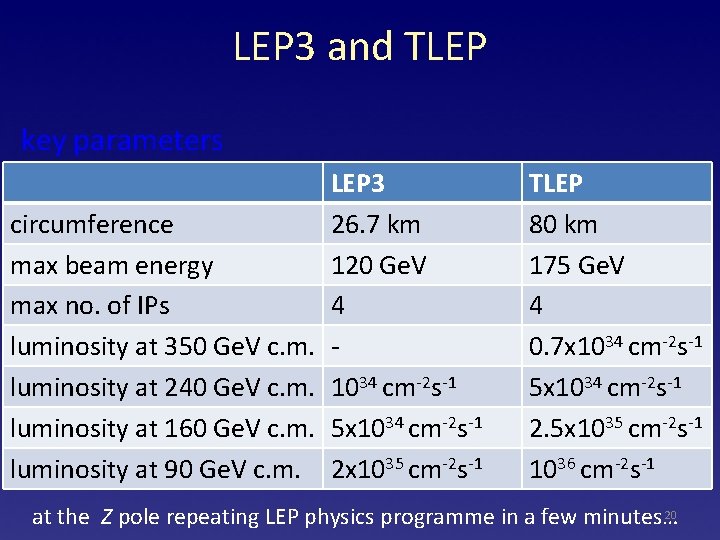
LEP 3 and TLEP key parameters LEP 3 circumference 26. 7 km max beam energy 120 Ge. V max no. of IPs 4 luminosity at 350 Ge. V c. m. luminosity at 240 Ge. V c. m. 1034 cm-2 s-1 luminosity at 160 Ge. V c. m. 5 x 1034 cm-2 s-1 luminosity at 90 Ge. V c. m. 2 x 1035 cm-2 s-1 TLEP 80 km 175 Ge. V 4 0. 7 x 1034 cm-2 s-1 5 x 1034 cm-2 s-1 2. 5 x 1035 cm-2 s-1 1036 cm-2 s-1 20 at the Z pole repeating LEP physics programme in a few minutes…
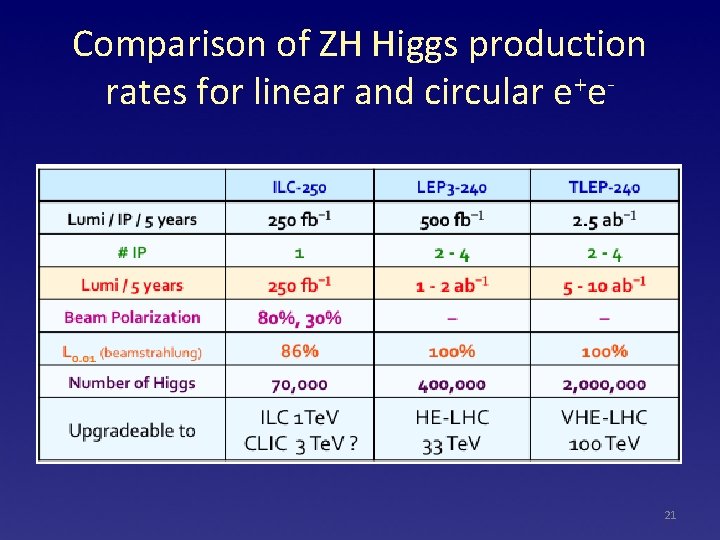
Comparison of ZH Higgs production rates for linear and circular e+e- 21
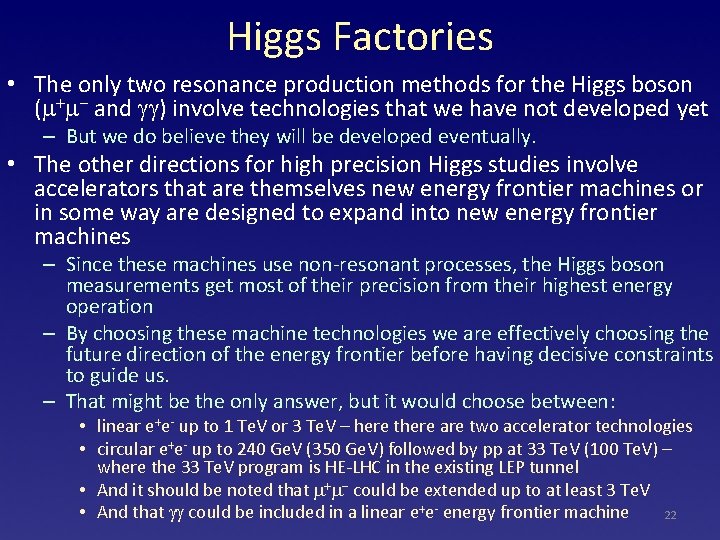
Higgs Factories • The only two resonance production methods for the Higgs boson (m+m- and gg) involve technologies that we have not developed yet – But we do believe they will be developed eventually. • The other directions for high precision Higgs studies involve accelerators that are themselves new energy frontier machines or in some way are designed to expand into new energy frontier machines – Since these machines use non-resonant processes, the Higgs boson measurements get most of their precision from their highest energy operation – By choosing these machine technologies we are effectively choosing the future direction of the energy frontier before having decisive constraints to guide us. – That might be the only answer, but it would choose between: • linear e+e- up to 1 Te. V or 3 Te. V – here there are two accelerator technologies • circular e+e- up to 240 Ge. V (350 Ge. V) followed by pp at 33 Te. V (100 Te. V) – where the 33 Te. V program is HE-LHC in the existing LEP tunnel • And it should be noted that m+m- could be extended up to at least 3 Te. V • And that gg could be included in a linear e+e- energy frontier machine 22
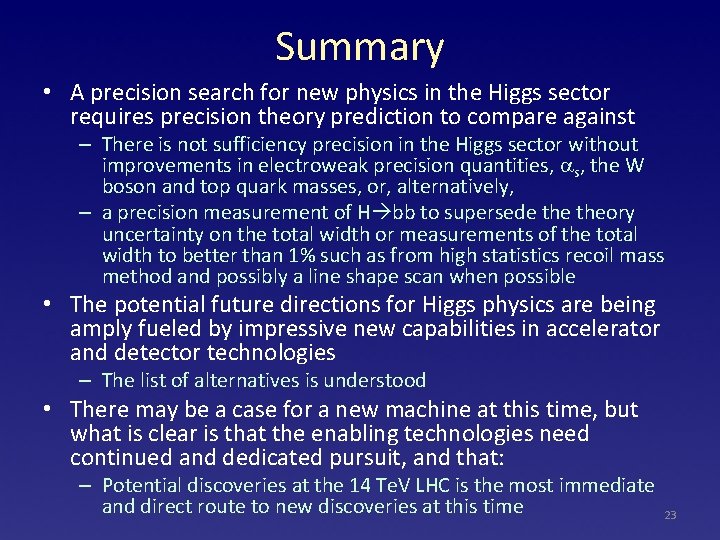
Summary • A precision search for new physics in the Higgs sector requires precision theory prediction to compare against – There is not sufficiency precision in the Higgs sector without improvements in electroweak precision quantities, as, the W boson and top quark masses, or, alternatively, – a precision measurement of H bb to supersede theory uncertainty on the total width or measurements of the total width to better than 1% such as from high statistics recoil mass method and possibly a line shape scan when possible • The potential future directions for Higgs physics are being amply fueled by impressive new capabilities in accelerator and detector technologies – The list of alternatives is understood • There may be a case for a new machine at this time, but what is clear is that the enabling technologies need continued and dedicated pursuit, and that: – Potential discoveries at the 14 Te. V LHC is the most immediate and direct route to new discoveries at this time 23
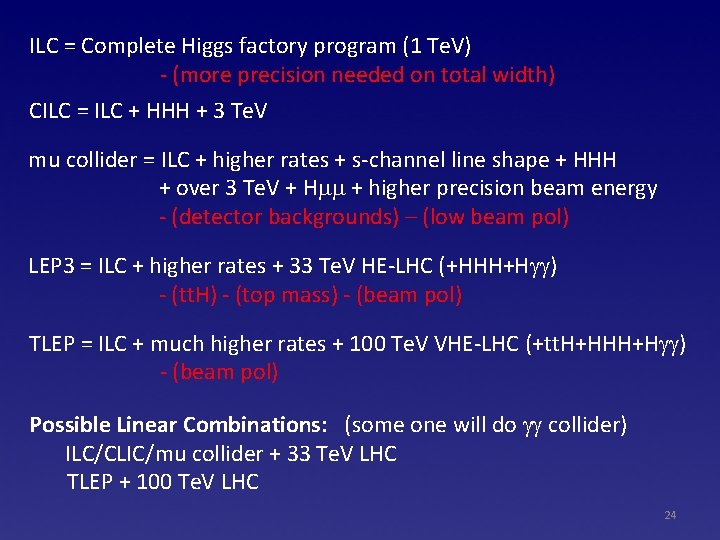
ILC = Complete Higgs factory program (1 Te. V) - (more precision needed on total width) CILC = ILC + HHH + 3 Te. V mu collider = ILC + higher rates + s-channel line shape + HHH + over 3 Te. V + Hmm + higher precision beam energy - (detector backgrounds) – (low beam pol) LEP 3 = ILC + higher rates + 33 Te. V HE-LHC (+HHH+Hgg) - (tt. H) - (top mass) - (beam pol) TLEP = ILC + much higher rates + 100 Te. V VHE-LHC (+tt. H+HHH+Hgg) - (beam pol) Possible Linear Combinations: (some one will do gg collider) ILC/CLIC/mu collider + 33 Te. V LHC TLEP + 100 Te. V LHC 24