
Large Hadron Collider at CERN Steve Playfer University
- Slides: 22
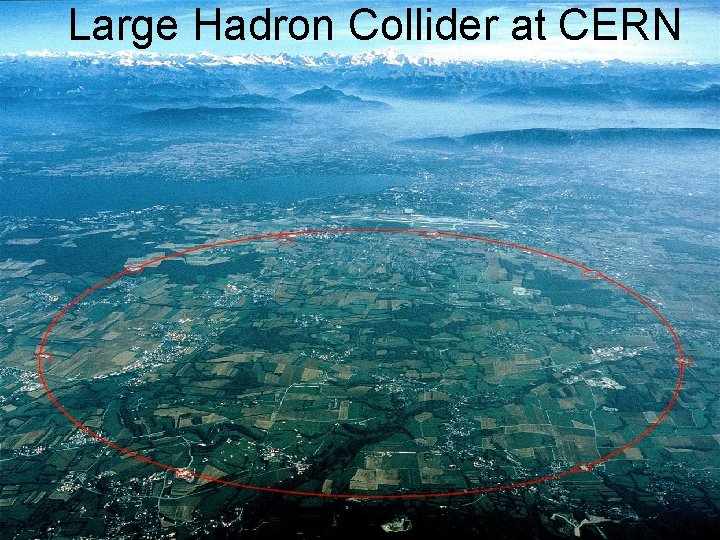
Large Hadron Collider at CERN Steve Playfer University of Edinburgh 15 th Novemebr 2008
LHC vital statistics • Ring is 27 km in circumference and between 50 and 200 m underground • Will collide two 7 Te. V proton beams with beam currents of 600 m. A Using E=mc 2 we get 14 Te. V=>0. 15 g (a fly) Total energy stored in each beam is 350 MJ • 1232 superconducting Nb. Ti dipole magnets to bend beams round the ring • Beam pipe has vacuum of 10 -13 atmospheres • Total power required to run LHC is 120 MW • Total cost to construct LHC was 3 Billion Euros More details at http: //lhc. web. cern. ch/lhc/
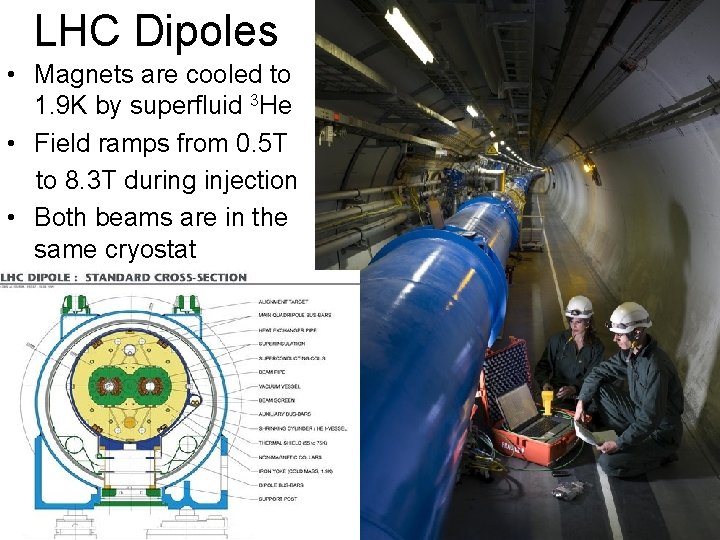
LHC Dipoles • Magnets are cooled to 1. 9 K by superfluid 3 He • Field ramps from 0. 5 T to 8. 3 T during injection • Both beams are in the same cryostat
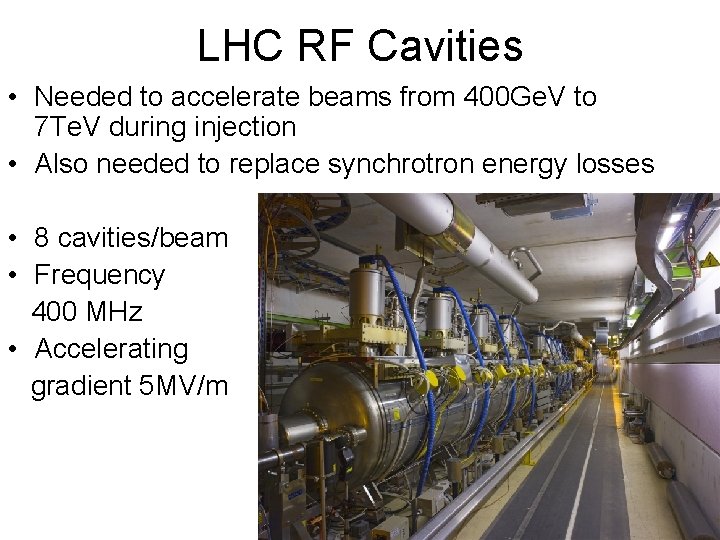
LHC RF Cavities • Needed to accelerate beams from 400 Ge. V to 7 Te. V during injection • Also needed to replace synchrotron energy losses • 8 cavities/beam • Frequency 400 MHz • Accelerating gradient 5 MV/m
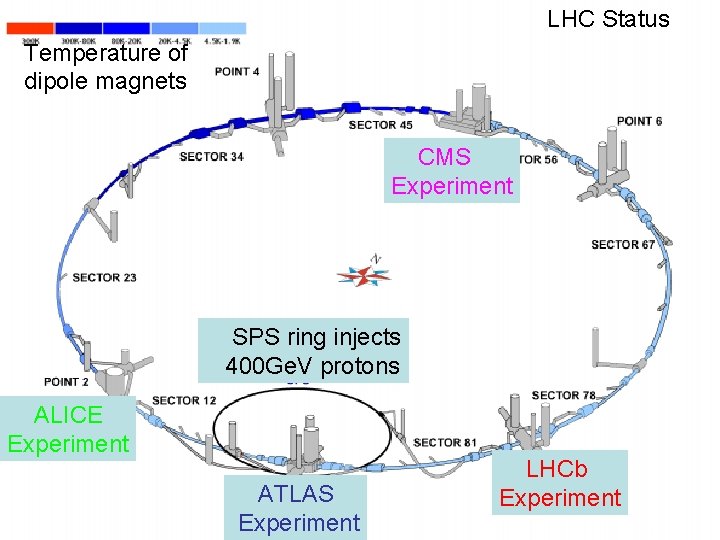
LHC Status Temperature of dipole magnets CMS Experiment SPS ring injects 400 Ge. V protons ALICE Experiment ATLAS Experiment LHCb Experiment
LHC Operation • Proton beams are injected from the SPS at 400 Ge. V and then accelerated to 7 Te. V. This is known as a “fill”. • The lifetime of the stored beams is ~10 hours. • There will be 2808 bunches of protons in each direction. Each bunch contains 1011 protons and travels round the ring in 0. 9 ms. • The bunch spacing is ~7 m or 25 ns, the bunch length is 7. 5 cm, and the crossing rate is 40 MHz at each of the four interaction points. • There are several interactions during a bunch crossing. • The expected data rate is 100 MB/s per experiment or ~10 Peta. Bytes/year!
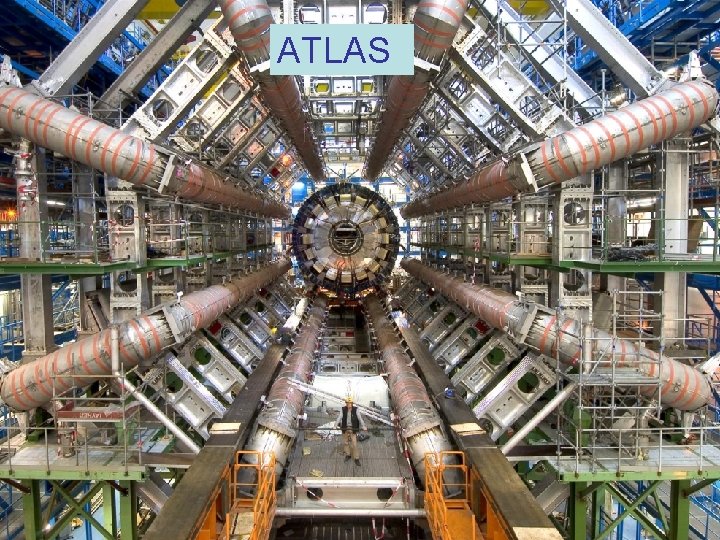
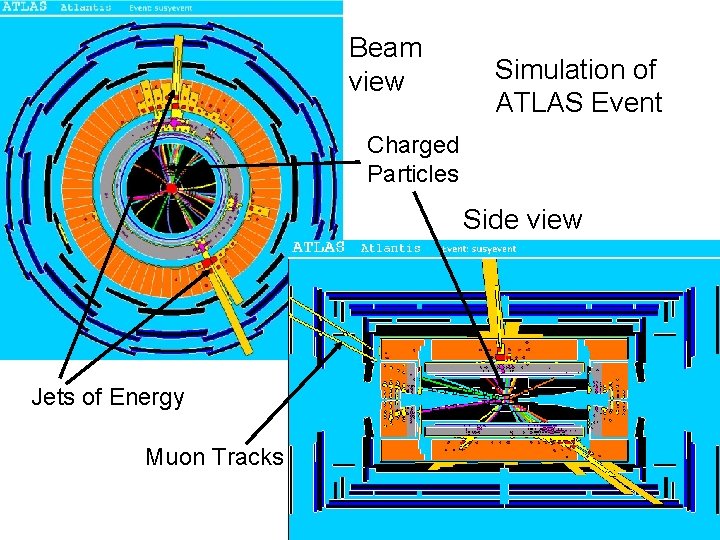
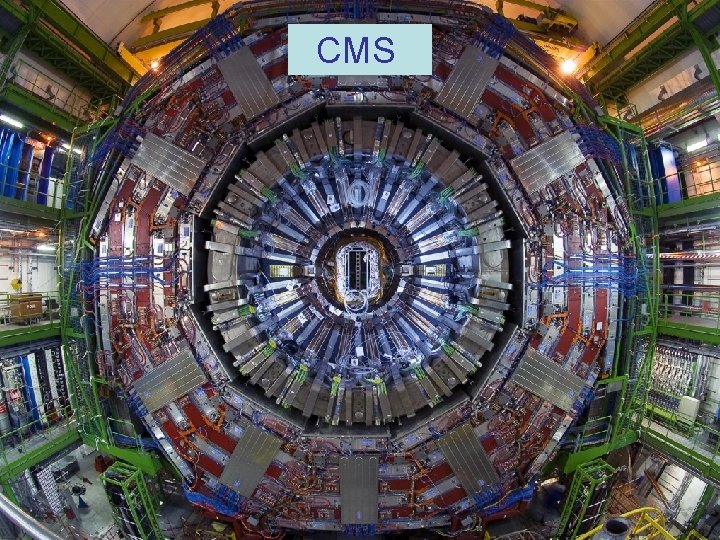
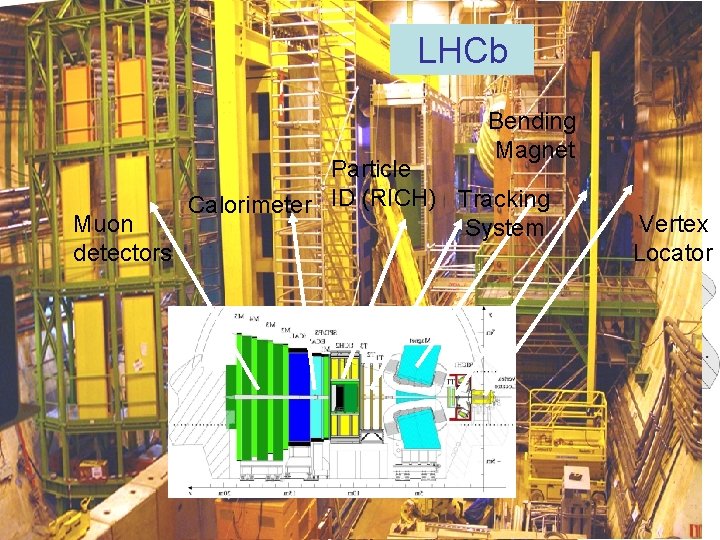
LHC Detectors • ATLAS is a general purpose detector (GPD) 46 mx 25 m, 7000 Tonnes, central magnetic solenoid 2 T and muon toroids 4 T • CMS is another GPD, 21 mx 15 m, 12500 Tonnes, central magnetic solenoid 4 T – GPDs look for new heavy particles – Each collaboration has 2000 physicists (10% from UK) • LHCb is a forward spectrometer with a dipole bending magnet (4 Tm) – Designed to study b quarks – Collaboration has 650 physicists (20% from UK) • ALICE is designed to look at heavy ion collisions
ATLAS
Beam view Simulation of ATLAS Event Charged Particles Side view Jets of Energy Muon Tracks
CMS
LHCb Bending Magnet Muon detectors Particle Calorimeter ID (RICH) Tracking System Vertex Locator Décembre 2005
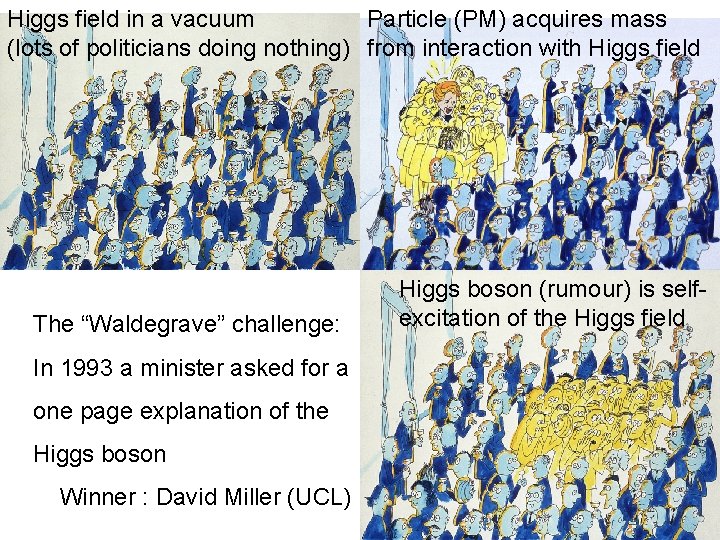
Higgs field in a vacuum Particle (PM) acquires mass (lots of politicians doing nothing) from interaction with Higgs field The “Waldegrave” challenge: In 1993 a minister asked for a one page explanation of the Higgs boson Winner : David Miller (UCL) Higgs boson (rumour) is selfexcitation of the Higgs field
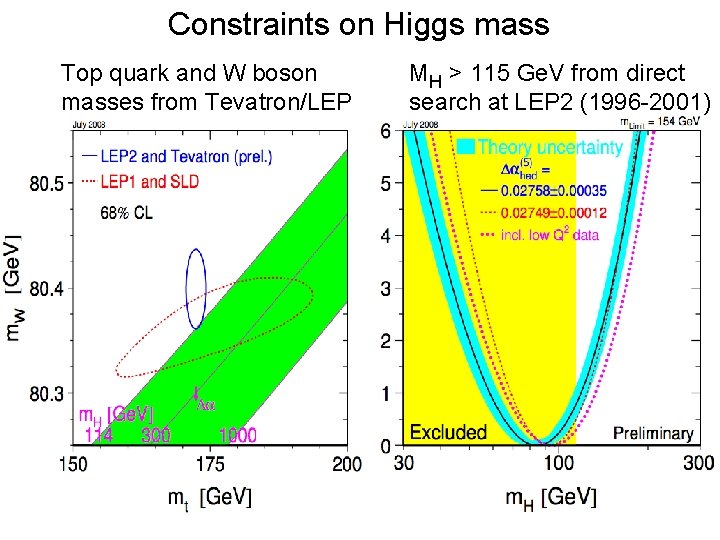
Constraints on Higgs mass Top quark and W boson masses from Tevatron/LEP MH > 115 Ge. V from direct search at LEP 2 (1996 -2001)
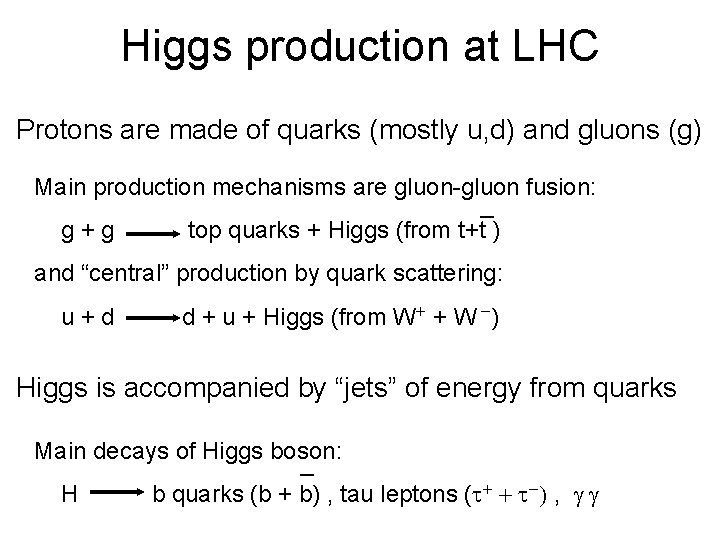
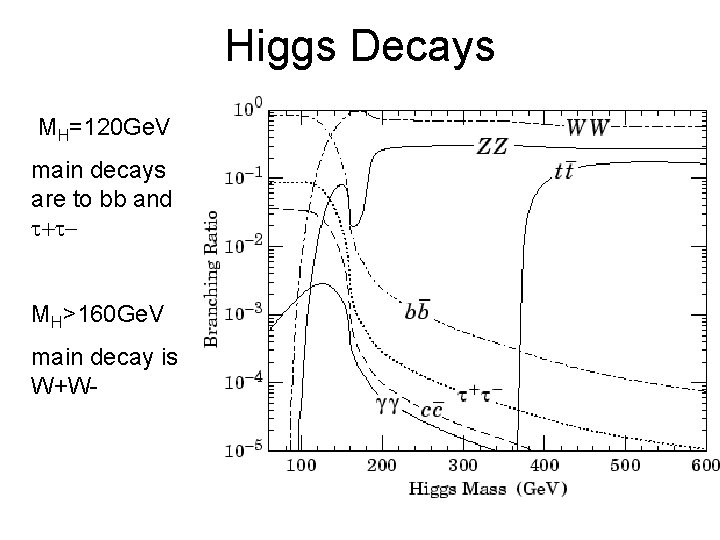
Higgs production at LHC Protons are made of quarks (mostly u, d) and gluons (g) Main production mechanisms are gluon-gluon fusion: _ g+g top quarks + Higgs (from t+t ) and “central” production by quark scattering: u+d d + u + Higgs (from W + W ) Higgs is accompanied by “jets” of energy from quarks Main decays of Higgs boson: _ H b quarks (b + b) , tau leptons ( ,
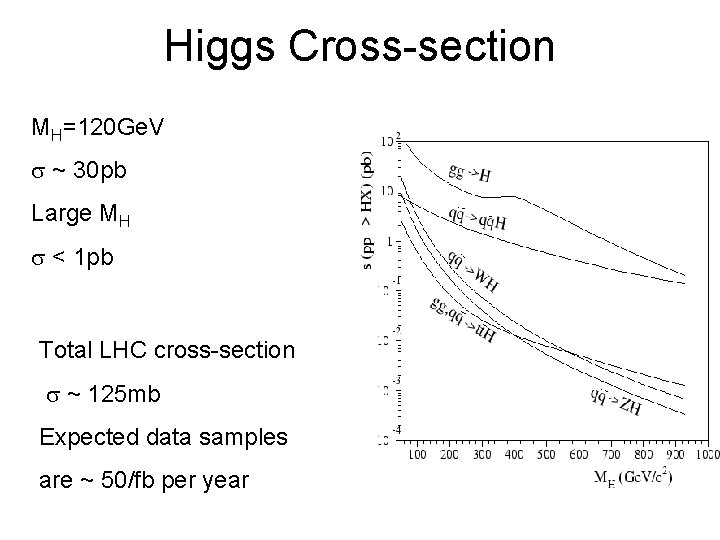
Higgs Cross-section MH=120 Ge. V ~ 30 pb Large MH < 1 pb Total LHC cross-section ~ 125 mb Expected data samples are ~ 50/fb per year
Higgs Decays MH=120 Ge. V main decays are to bb and MH>160 Ge. V main decay is W+W-
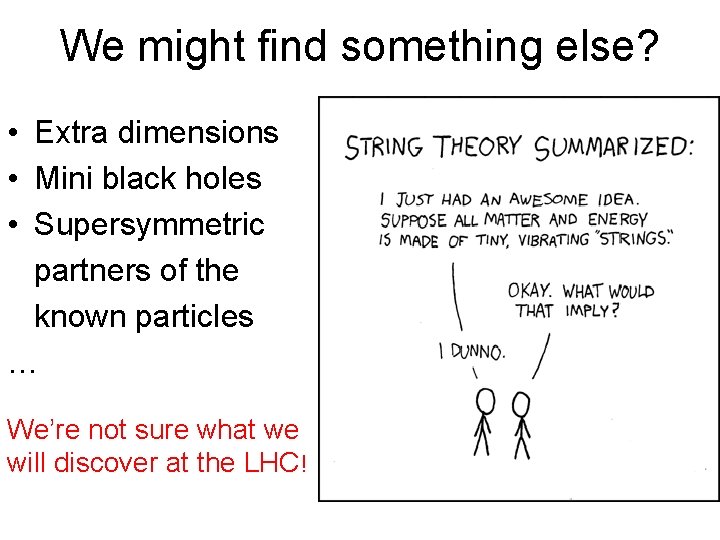
We might find something else? • Extra dimensions • Mini black holes • Supersymmetric partners of the known particles … We’re not sure what we will discover at the LHC!
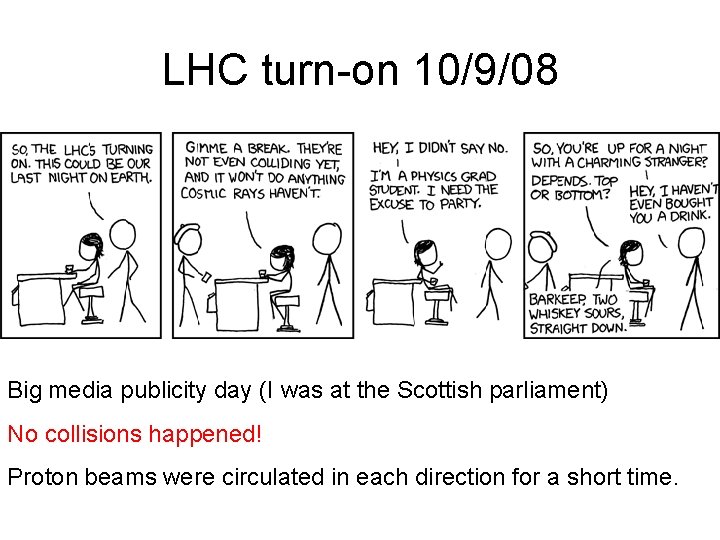
LHC turn-on 10/9/08 Big media publicity day (I was at the Scottish parliament) No collisions happened! Proton beams were circulated in each direction for a short time.
Why the LHC won’t destroy the world Centre of mass energy of proton-proton collisions ECM=14 Te. V Can be achieved by colliding a high energy proton with a proton at rest ECM = sqrt(2 Epmp) with Ep ~105 Te. V Primary cosmic rays (protons) interact with the Earth’s upper atmosphere. Highest observed energy cosmic rays are Ep ~108 Te. V which gives ECM>>14 Te. V. There are even more energetic collisions in the centres of galaxies, black holes etc. LHC collisions are the highest energy in a laboratory
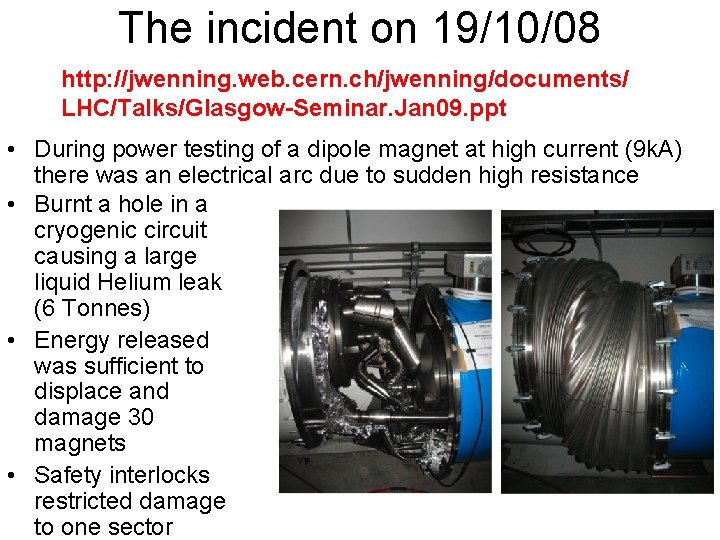
The incident on 19/10/08 http: //jwenning. web. cern. ch/jwenning/documents/ LHC/Talks/Glasgow-Seminar. Jan 09. ppt • During power testing of a dipole magnet at high current (9 k. A) there was an electrical arc due to sudden high resistance • Burnt a hole in a cryogenic circuit causing a large liquid Helium leak (6 Tonnes) • Energy released was sufficient to displace and damage 30 magnets • Safety interlocks restricted damage to one sector
LHC Schedule is being revised • Official CERN statements – Installation/repair of magnets by March 2009 – Interconnections & installation of improved safety systems by May 2009 – Machine cold by end of June 2009 – Injection & commissioning July-Sept. 2009 – First collisions for Physics at 10 Te. V in Oct. -Nov. 2009 • My optimistic projections after that – Collisions at 14 Te. V in June-Nov. 2010 Luminosity ~1033 cm-2 s-1, Data sample ~3/fb – Design goals for 1 year reached in 2012 Luminosity 1034 cm-2 s-1, Data sample 50/fb • Prove existence of Higgs Boson (or not? ) by 2012 • Upgrades of detectors (and LHC) in 2014 & 2018