The Role of Traditional Medicine TM and Complementary


- Slides: 37
The Role of Traditional Medicine (TM) and Complementary and Alternative Medicine (CAM) to Health Care Professor LIU Liang The School of Chinese Medicine Hong Kong Baptist University
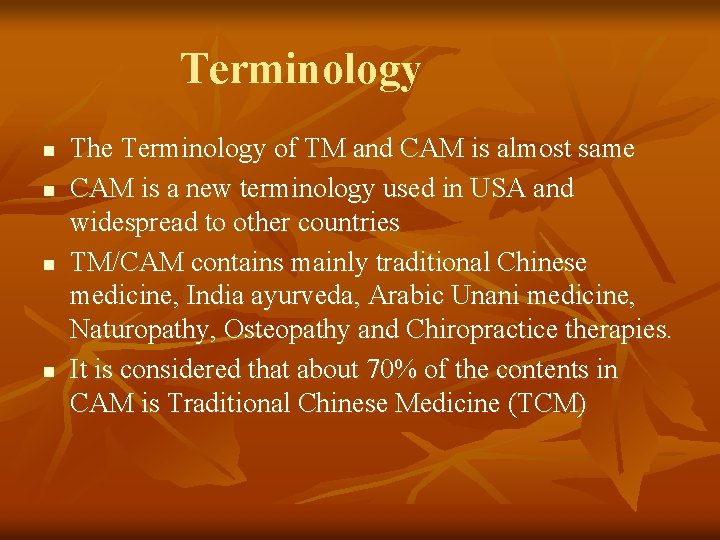
Terminology n n The Terminology of TM and CAM is almost same CAM is a new terminology used in USA and widespread to other countries TM/CAM contains mainly traditional Chinese medicine, India ayurveda, Arabic Unani medicine, Naturopathy, Osteopathy and Chiropractice therapies. It is considered that about 70% of the contents in CAM is Traditional Chinese Medicine (TCM)
What is Traditional Chinese Medicine (TCM) n n n A highly developed system, well documented and with its own body of theory A kind of most popular traditional medicine in the world Being highly acceptable by Chinese population, exported to neighbouring countries such as Japan, Korea and Vietnam, and widespread in North America, Europe and Australia
n TCM is an integral part of the Chinese culture and has been well developed based on its indigenous theories, ancient phylosophies, beliefs and experiences as well as evidence in clinical practice.
n TCM practices with a holistic approach of medication therapy of herbal medicines (usually using formula) and non-medication therapies such as acupunture and manual therapy.
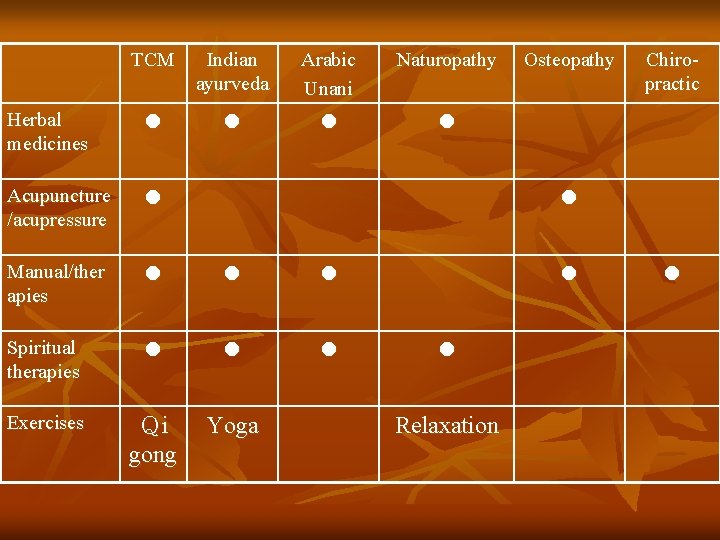
Treatment techniques of TCM comparing with otherapies of traditional medicines
TCM Indian ayurveda Arabic Unani Naturopathy Herbal medicines Acupuncture /acupressure Manual/ther apies Spiritual therapies Exercises Qi gong Yoga Osteopathy Chiropractic Relaxation
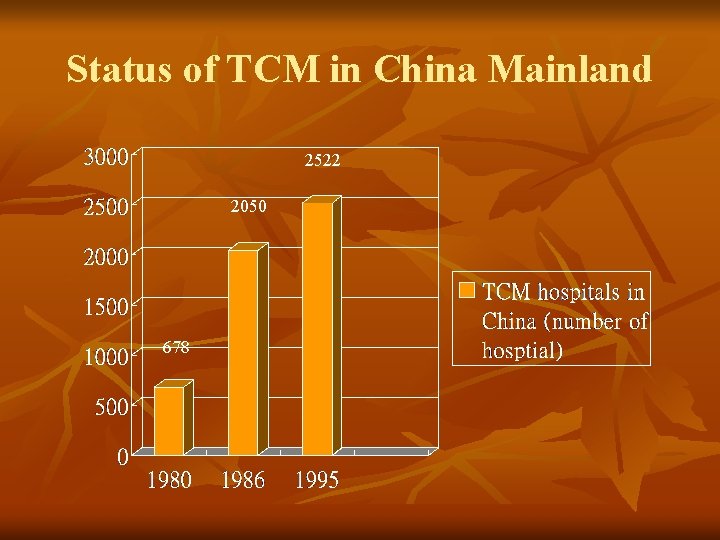
Status of TCM in China Mainland 2522 2050 678
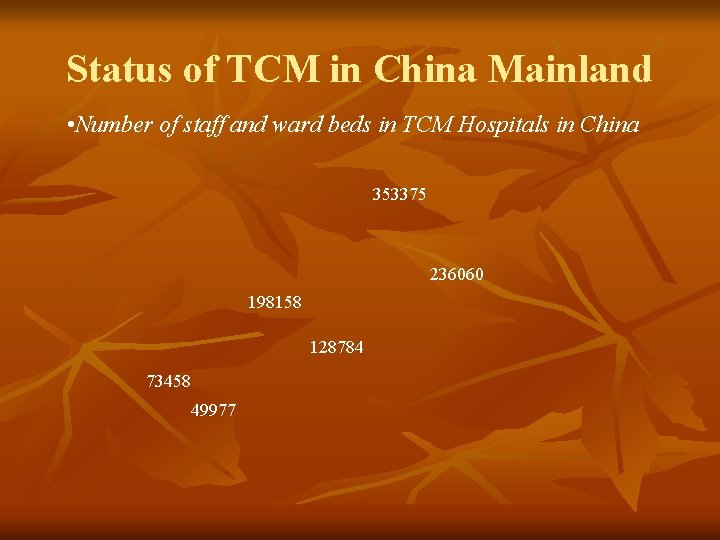
Status of TCM in China Mainland • Number of staff and ward beds in TCM Hospitals in China 353375 236060 198158 128784 73458 49977
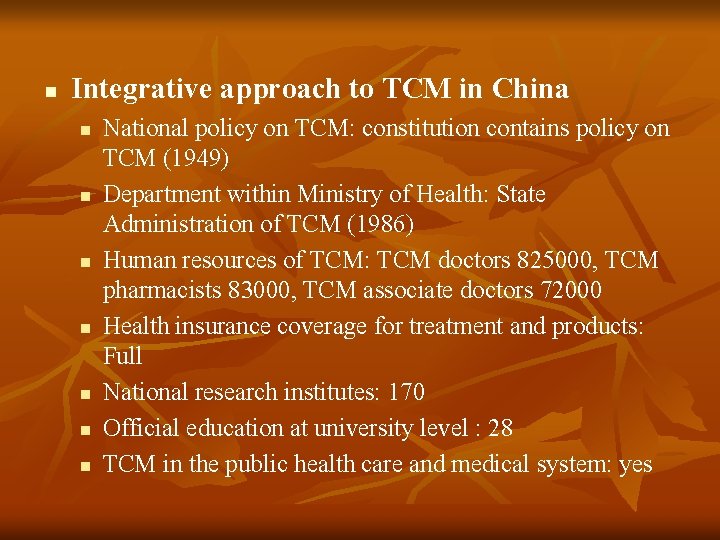
n Integrative approach to TCM in China n n n n National policy on TCM: constitution contains policy on TCM (1949) Department within Ministry of Health: State Administration of TCM (1986) Human resources of TCM: TCM doctors 825000, TCM pharmacists 83000, TCM associate doctors 72000 Health insurance coverage for treatment and products: Full National research institutes: 170 Official education at university level : 28 TCM in the public health care and medical system: yes
Status of TCM in Hong Kong n n n TCM has been used in the community for hundreds of years At present, about 22% of the medical consultations in Hong Kong are currently provided by Chinese medicine practitioners Starting from the 80’s, society’s concern towards TCM grows and the Hong Kong Government approached to review and regulate the practice and use of TCM in Hong Kong
n Government policy on TCM since 1997 n Article 138 of the Basic Law of the Hong Kong Special Administrative Region: “the Government of the Hong Kong Special Administrative Region shall, on its own, formulate policies to develop western and traditional Chinese Medicine and to improve medical and health services. Community organizations and individuals may provide various medical and health services in accordance with law. ”
n n n To establish a statutory framework to recognize the professional status of TCM practitioners; To regulate the use, manufacture and sale of Chinese medicines; To develop Hong Kong over time into an international centre for manufacture and trading of chinese medicine, for research, information and training in the use of Chinese medicine, and for the promotion of this approach in medical care.
n Advancement of TCM in Hong Kong in the recent years n n n Chinese Medicine Ordinance was passed in July of 1999 by the Legislative Council Chinese Medicine Council of Hong Kong was established in September 1999 A registration system for Chinese medicine practitioners has been adopted since year 2000.
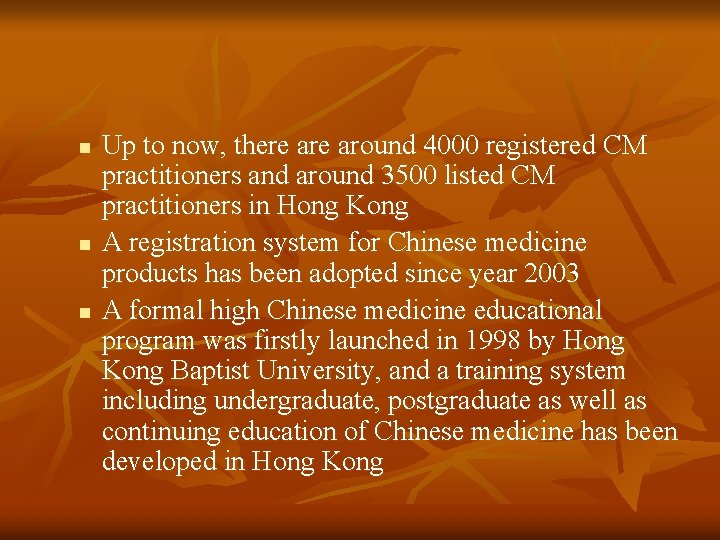
n n n Up to now, there around 4000 registered CM practitioners and around 3500 listed CM practitioners in Hong Kong A registration system for Chinese medicine products has been adopted since year 2003 A formal high Chinese medicine educational program was firstly launched in 1998 by Hong Kong Baptist University, and a training system including undergraduate, postgraduate as well as continuing education of Chinese medicine has been developed in Hong Kong
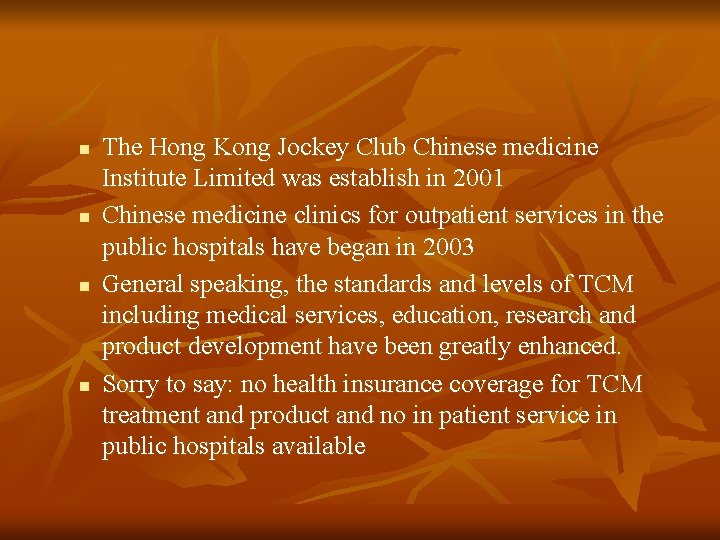
n n The Hong Kong Jockey Club Chinese medicine Institute Limited was establish in 2001 Chinese medicine clinics for outpatient services in the public hospitals have began in 2003 General speaking, the standards and levels of TCM including medical services, education, research and product development have been greatly enhanced. Sorry to say: no health insurance coverage for TCM treatment and product and no in patient service in public hospitals available
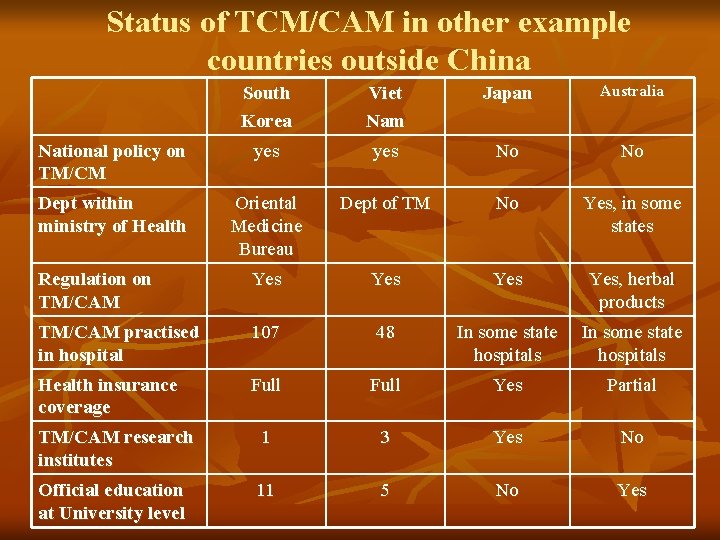
Status of TCM/CAM in other example countries outside China South Korea Viet Nam Japan Australia National policy on TM/CM yes No No Dept within ministry of Health Oriental Medicine Bureau Dept of TM No Yes, in some states Regulation on TM/CAM Yes Yes, herbal products TM/CAM practised in hospital 107 48 In some state hospitals Health insurance coverage Full Yes Partial TM/CAM research institutes 1 3 Yes No Official education at University level 11 5 No Yes
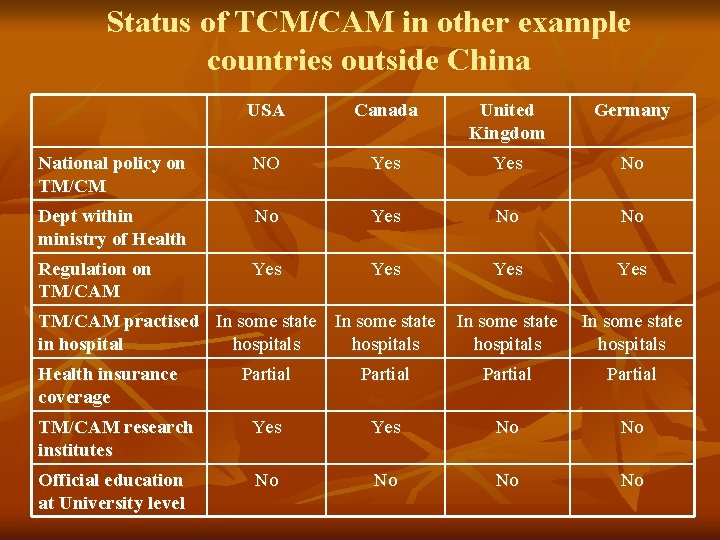
Status of TCM/CAM in other example countries outside China USA Canada United Kingdom Germany National policy on TM/CM NO Yes No Dept within ministry of Health No Yes No No Regulation on TM/CAM Yes Yes In some state hospitals TM/CAM practised In some state in hospitals Health insurance coverage Partial TM/CAM research institutes Yes No No Official education at University level No No
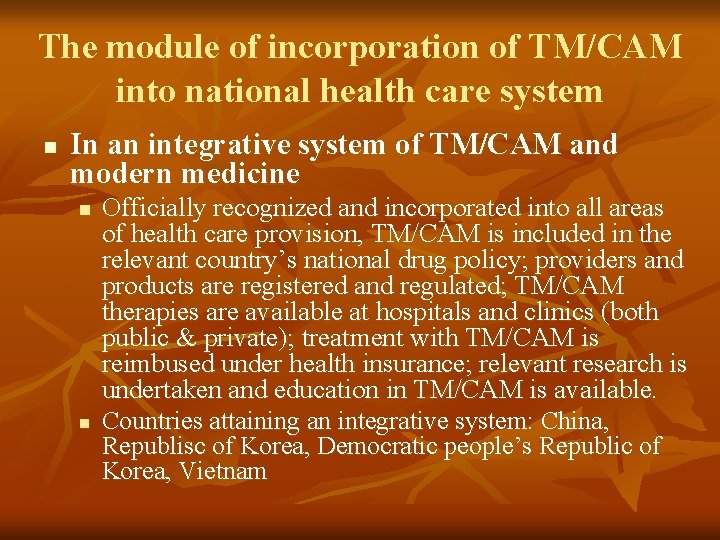
The module of incorporation of TM/CAM into national health care system n In an integrative system of TM/CAM and modern medicine n n Officially recognized and incorporated into all areas of health care provision, TM/CAM is included in the relevant country’s national drug policy; providers and products are registered and regulated; TM/CAM therapies are available at hospitals and clinics (both public & private); treatment with TM/CAM is reimbused under health insurance; relevant research is undertaken and education in TM/CAM is available. Countries attaining an integrative system: China, Republisc of Korea, Democratic people’s Republic of Korea, Vietnam
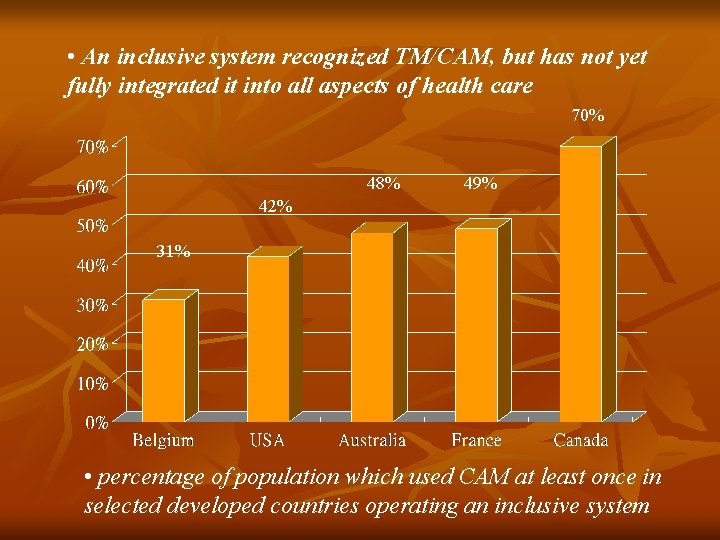
• An inclusive system recognized TM/CAM, but has not yet fully integrated it into all aspects of health care 70% 48% 49% 42% 31% • percentage of population which used CAM at least once in selected developed countries operating an inclusive system
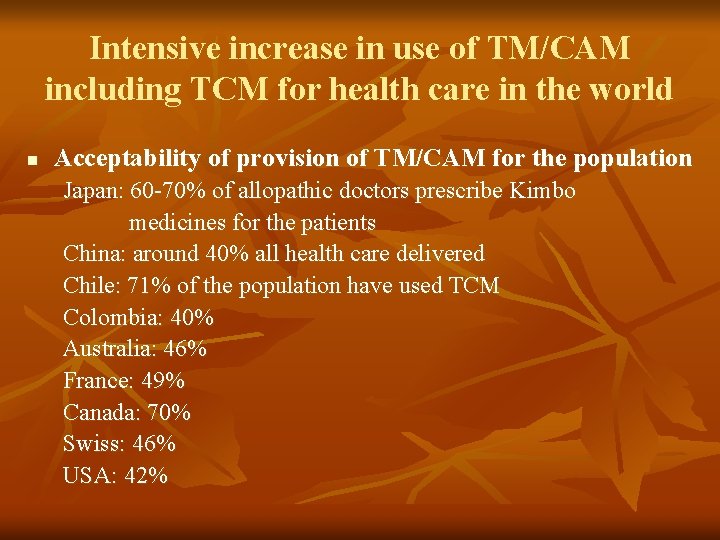
Intensive increase in use of TM/CAM including TCM for health care in the world n Acceptability of provision of TM/CAM for the population Japan: 60 -70% of allopathic doctors prescribe Kimbo medicines for the patients China: around 40% all health care delivered Chile: 71% of the population have used TCM Colombia: 40% Australia: 46% France: 49% Canada: 70% Swiss: 46% USA: 42%
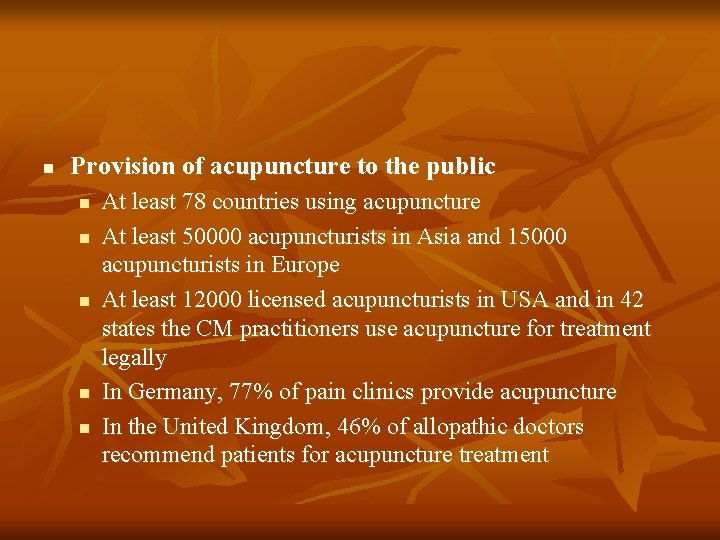
n Provision of acupuncture to the public n n n At least 78 countries using acupuncture At least 50000 acupuncturists in Asia and 15000 acupuncturists in Europe At least 12000 licensed acupuncturists in USA and in 42 states the CM practitioners use acupuncture for treatment legally In Germany, 77% of pain clinics provide acupuncture In the United Kingdom, 46% of allopathic doctors recommend patients for acupuncture treatment
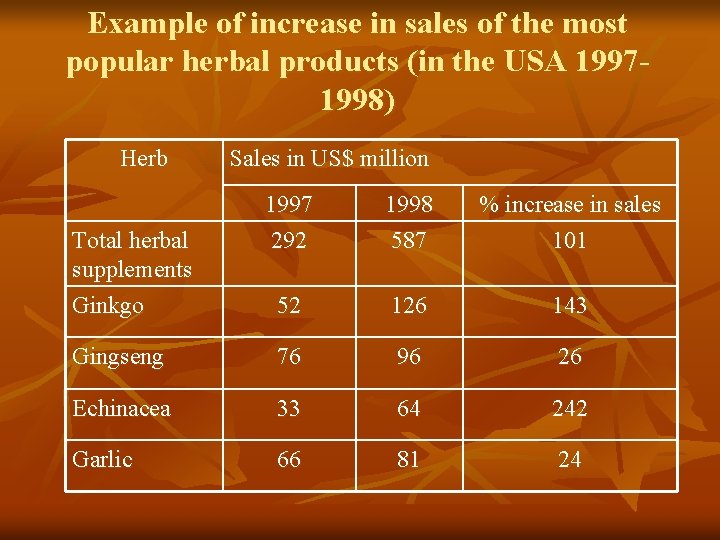
Example of increase in sales of the most popular herbal products (in the USA 19971998) Herb Sales in US$ million 1997 292 1998 587 % increase in sales 101 52 126 143 Gingseng 76 96 26 Echinacea 33 64 242 Garlic 66 81 24 Total herbal supplements Ginkgo
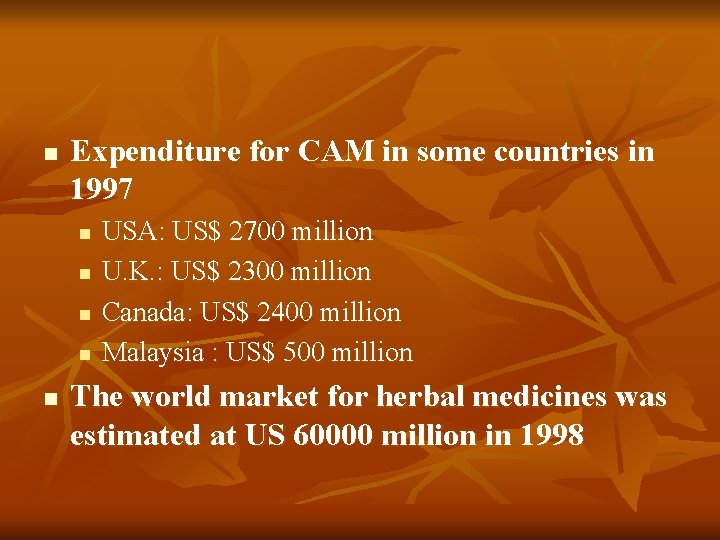
n Expenditure for CAM in some countries in 1997 n n n USA: US$ 2700 million U. K. : US$ 2300 million Canada: US$ 2400 million Malaysia : US$ 500 million The world market for herbal medicines was estimated at US 60000 million in 1998
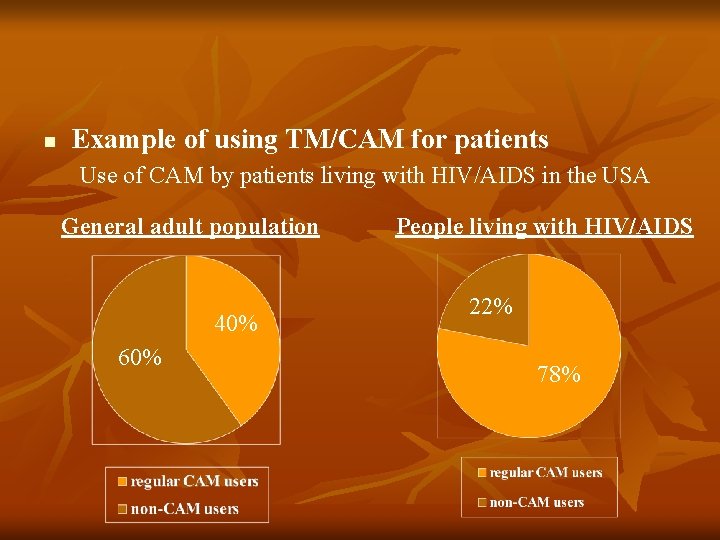
n Example of using TM/CAM for patients Use of CAM by patients living with HIV/AIDS in the USA General adult population 40% 60% People living with HIV/AIDS 22% 78%
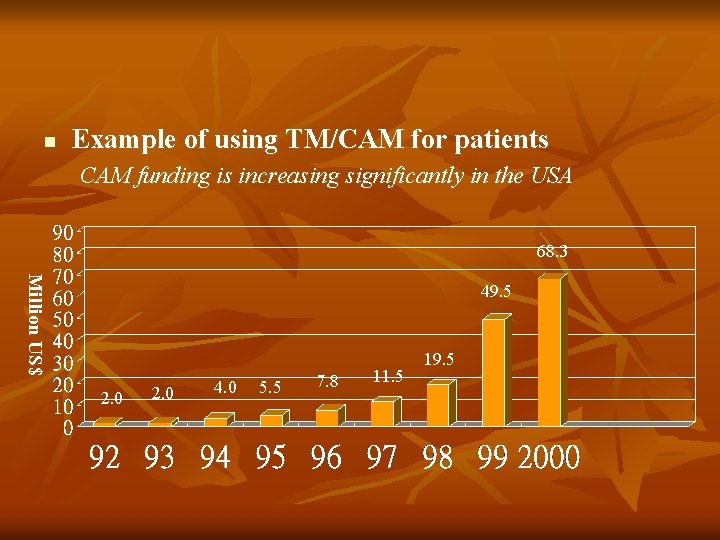
n Example of using TM/CAM for patients CAM funding is increasing significantly in the USA 68. 3 Million US$ 49. 5 2. 0 4. 0 5. 5 7. 8 11. 5 19. 5
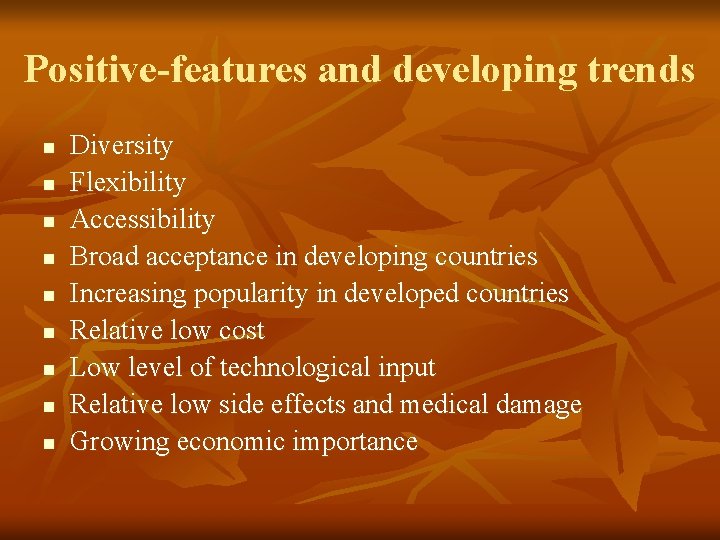
Positive-features and developing trends n n n n n Diversity Flexibility Accessibility Broad acceptance in developing countries Increasing popularity in developed countries Relative low cost Low level of technological input Relative low side effects and medical damage Growing economic importance
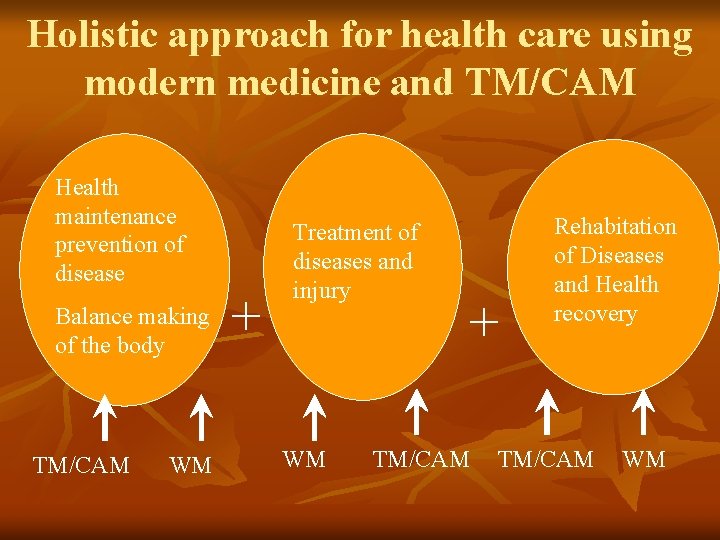
Holistic approach for health care using modern medicine and TM/CAM Health maintenance prevention of disease Balance making of the body TM/CAM WM + Treatment of diseases and injury WM + TM/CAM Rehabitation of Diseases and Health recovery TM/CAM WM
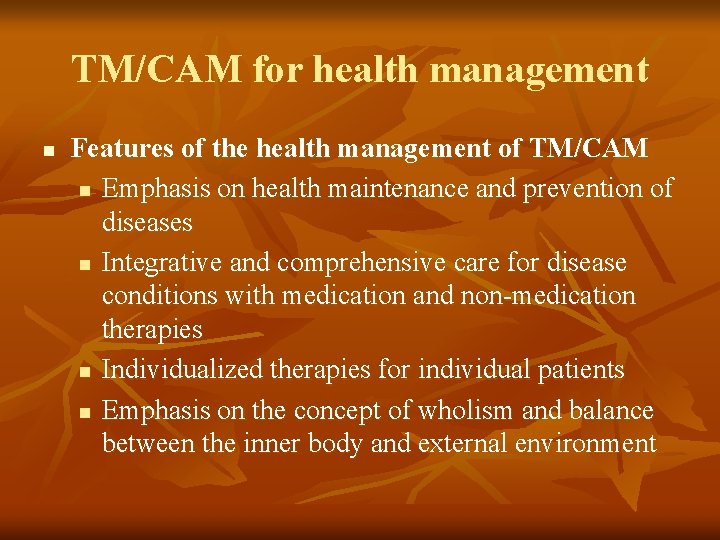
TM/CAM for health management n Features of the health management of TM/CAM n Emphasis on health maintenance and prevention of diseases n Integrative and comprehensive care for disease conditions with medication and non-medication therapies n Individualized therapies for individual patients n Emphasis on the concept of wholism and balance between the inner body and external environment
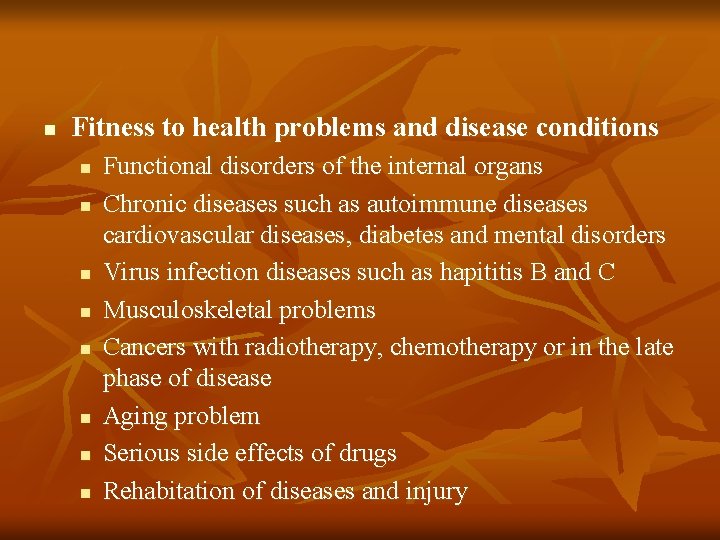
n Fitness to health problems and disease conditions n n n n Functional disorders of the internal organs Chronic diseases such as autoimmune diseases cardiovascular diseases, diabetes and mental disorders Virus infection diseases such as hapititis B and C Musculoskeletal problems Cancers with radiotherapy, chemotherapy or in the late phase of disease Aging problem Serious side effects of drugs Rehabitation of diseases and injury
TM/CAM : What needs to be done? n n n National policy and regulatory frameworks Safety, efficacy and quality Rational Use
n National policy and regulatory frameworks n Lack of official recognition of TM/CAM providers in some countries n TM/CAM not integrated into public health care system in most of countries and areas including HK n Lack of regulatory and legal mechanisms n Inadequate allocation of resources for TM/CAM development and capacity building
n Safety, efficacy and quality n n n Lack of research methodology Inadequate evidence-based for TM/CAM therapies and products Lack of international and national standards for ensuring safety, efficacy and quality control of TM/CAM therapies and products Lack of adequate regulation and registration of herbal medicine Lack of registration of TM/CAM providers Inadequate support of research
n Rational Use n n n Lack of training for TM/CAM providers and on TM/CAM for allopathic practitioners Lack of communication between TM/CAM and allopathic practitioners and consumers Lack of information for public on rational use of TM/CAM
n Key elements for improvement of TM/CAM practice n n Definition of government’s role in developing TM/CAM Provision for creation or expansion of regulation of herbal medicines Provision for safety and quality assurance of TM/CAM therapies and products including setting up a series of international and national standards Provision formal education and training of TM/CAM providers
n n n Provision for promotion of proper use of TM/CAM Provision for capacity building of TM/CAM human resources, including allocation of financial resources Provision for coverage by state health insurance Support for evidence-base clinical research into use of TM/CAM Development of national standards, technical guidelines and methodology for evaluating safety, efficacy and quality of TM/CAM Identification of the advantages and shortages of TM/CAM for retional use of TM/CAM
Thank you!