The Complexity of Differential Privacy Salil Vadhan Harvard
- Slides: 27
The Complexity of Differential Privacy Salil Vadhan Harvard University
Thank you Shafi & Silvio For. . . inspiring us with beautiful science challenging us to believe in the “impossible” guiding us towards our own journeys And Oded for organizing this wonderful celebration enabling our individual & collective development
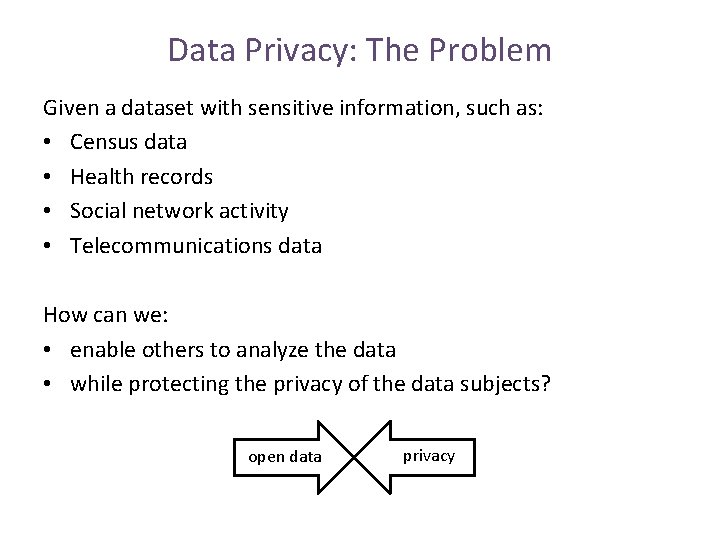
Data Privacy: The Problem Given a dataset with sensitive information, such as: • Census data • Health records • Social network activity • Telecommunications data How can we: • enable others to analyze the data • while protecting the privacy of the data subjects? open data privacy
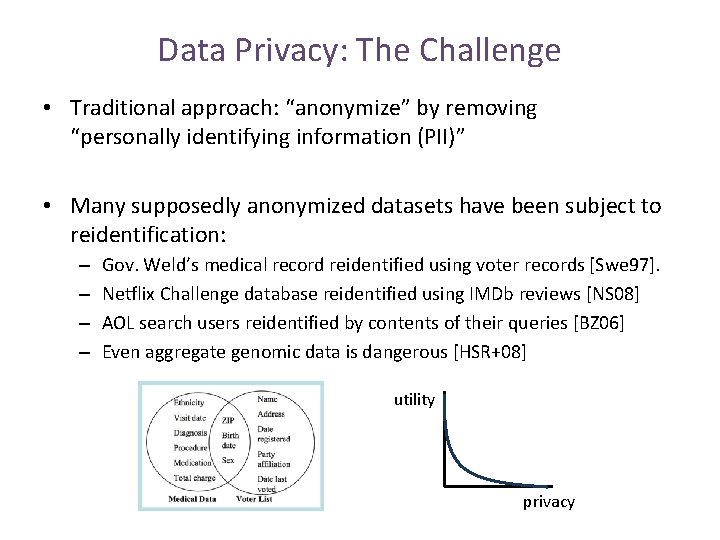
Data Privacy: The Challenge • Traditional approach: “anonymize” by removing “personally identifying information (PII)” • Many supposedly anonymized datasets have been subject to reidentification: – – Gov. Weld’s medical record reidentified using voter records [Swe 97]. Netflix Challenge database reidentified using IMDb reviews [NS 08] AOL search users reidentified by contents of their queries [BZ 06] Even aggregate genomic data is dangerous [HSR+08] utility privacy
Differential Privacy A strong notion of privacy that: • Is robust to auxiliary information possessed by an adversary • Degrades gracefully under repetition/composition • Allows for many useful computations Emerged from a series of papers in theoretical CS: [Dinur-Nissim `03 (+Dwork), Dwork-Nissim `04, Blum-Dwork. Mc. Sherry-Nissim `05, Dwork-Mc. Sherry-Nissim-Smith `06]
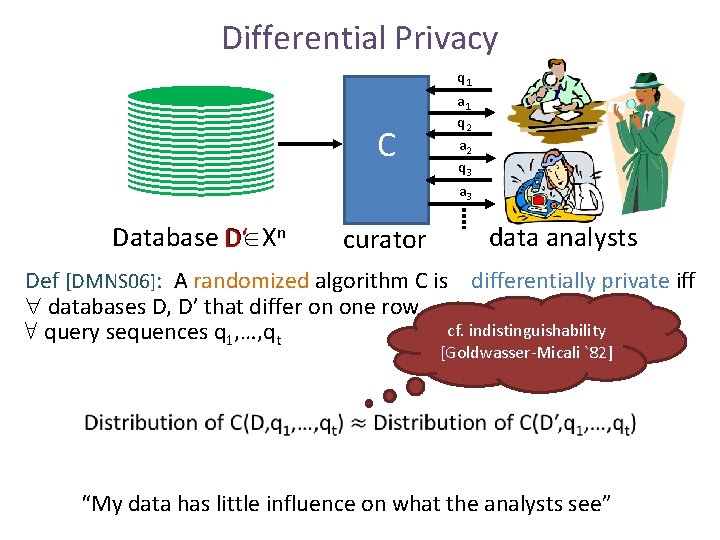
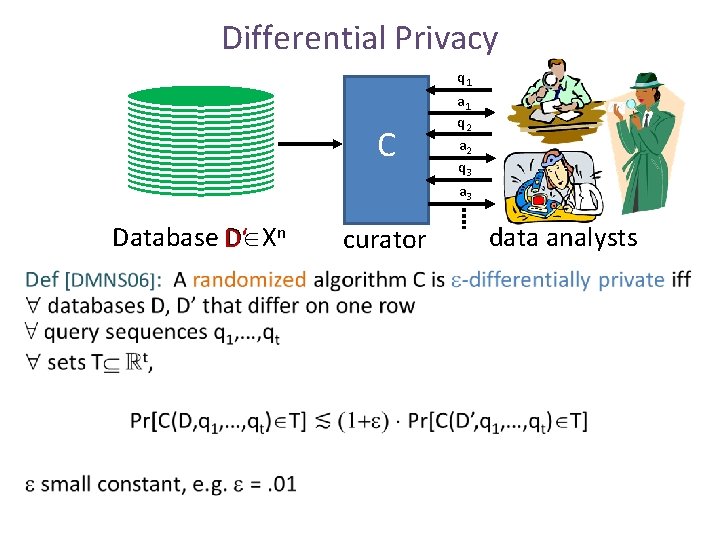
Differential Privacy C Database D X D‘ n curator q 1 a 1 q 2 a 2 q 3 a 3 data analysts Def [DMNS 06]: A randomized algorithm C is -differentially private iff databases D, D’ that differ on one row cf. indistinguishability 8 query sequences q 1, …, qt [Goldwasser-Micali `82] sets T Rt, Pr[C(D, q 1, …, qt) T] e Pr[C(D’, q 1, …, qt) T] + d (1+ ) Pr[C(D’, q 1, …, qt) T] small constant, e. g. =. 01, d cryptographically small, e. g. d = 2 -60 “My data has little influence on what the analysts see”
Differential Privacy C Database D X D‘ n • curator q 1 a 1 q 2 a 2 q 3 a 3 data analysts
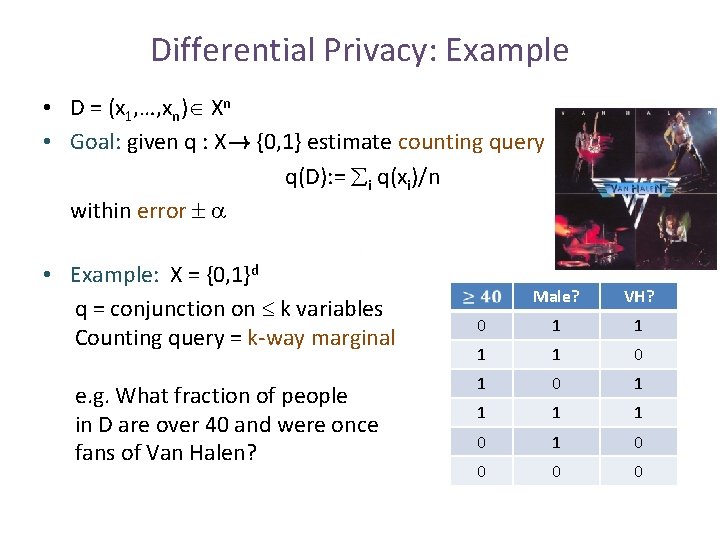
Differential Privacy: Example • D = (x 1, …, xn) Xn • Goal: given q : X! {0, 1} estimate counting query q(D): = i q(xi)/n within error • Example: X = {0, 1}d q = conjunction on k variables Counting query = k-way marginal e. g. What fraction of people in D are over 40 and were once fans of Van Halen? Male? VH? 0 1 1 1 1 0 1 0 0
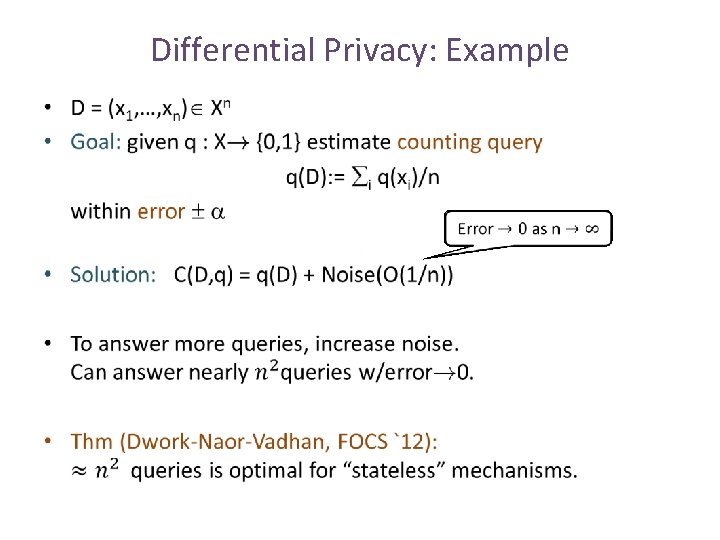
Differential Privacy: Example •
Other Differentially Private Algorithms • • • histograms [DMNS 06] contingency tables [BCDKMT 07, GHRU 11], machine learning [BDMN 05, KLNRS 08], logistic regression & statistical estimation [CMS 11, KST 11, ST 12] clustering [BDMN 05, NRS 07] social network analysis [HLMJ 09, GRU 11, KRSY 11, KNRS 13, BBDS 13] approximation algorithms [GLMRT 10] singular value decomposition [HR 13] streaming algorithms [DNRY 10, DNPR 10, MMNW 11] mechanism design [MT 07, NST 10, X 11, NOS 12, CCKMV 12, HK 12, KPRU 12] …
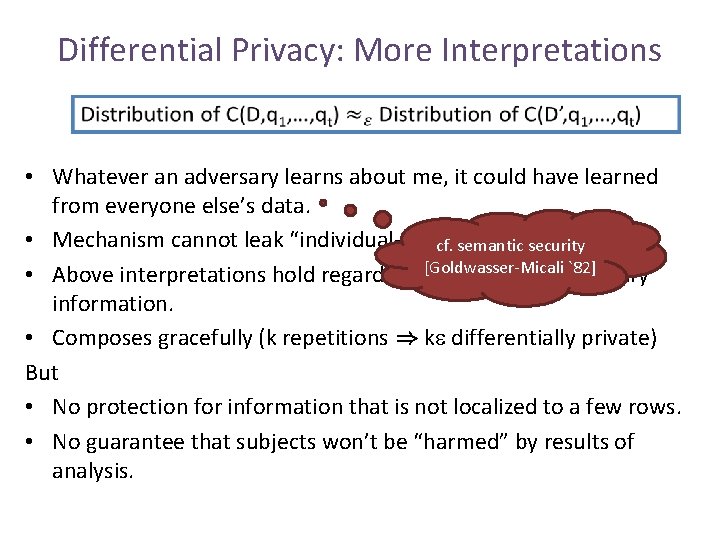
Differential Privacy: More Interpretations • Whatever an adversary learns about me, it could have learned from everyone else’s data. • Mechanism cannot leak “individual-specific” information. cf. semantic security [Goldwasser-Micali `82] • Above interpretations hold regardless of adversary’s auxiliary information. • Composes gracefully (k repetitions ) k differentially private) But • No protection for information that is not localized to a few rows. • No guarantee that subjects won’t be “harmed” by results of analysis.
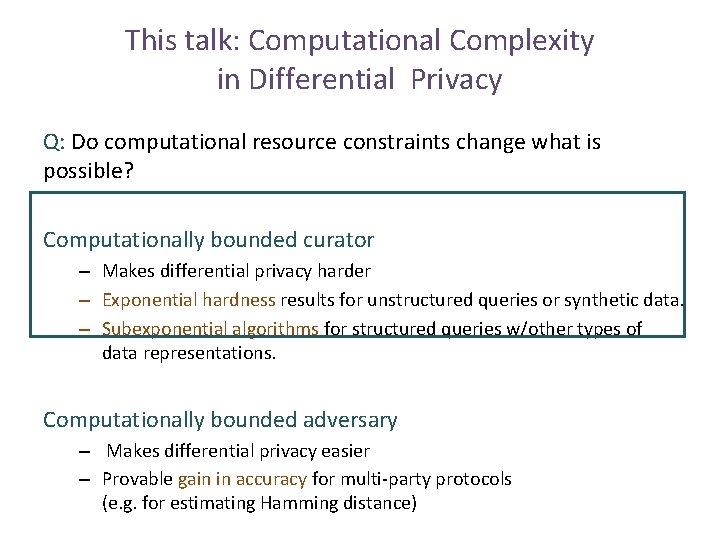
This talk: Computational Complexity in Differential Privacy Q: Do computational resource constraints change what is possible? Computationally bounded curator – Makes differential privacy harder – Exponential hardness results for unstructured queries or synthetic data. – Subexponential algorithms for structured queries w/other types of data representations. Computationally bounded adversary – Makes differential privacy easier – Provable gain in accuracy for multi-party protocols (e. g. for estimating Hamming distance)
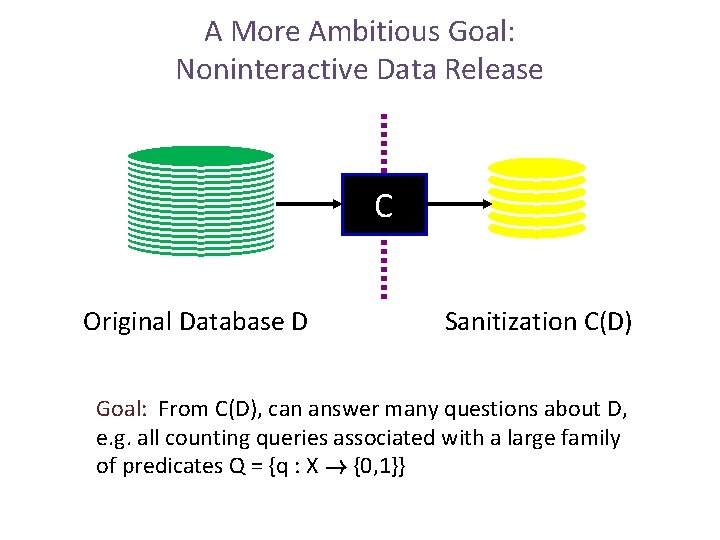
A More Ambitious Goal: Noninteractive Data Release C Original Database D Sanitization C(D) Goal: From C(D), can answer many questions about D, e. g. all counting queries associated with a large family of predicates Q = {q : X ! {0, 1}}
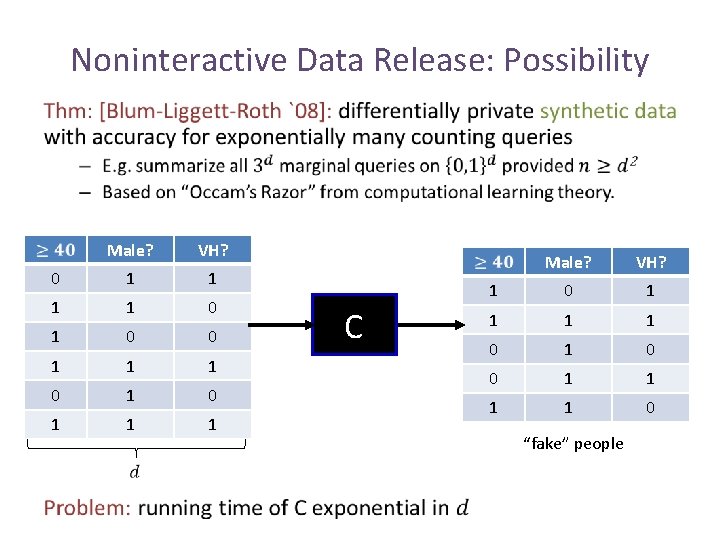
Noninteractive Data Release: Possibility • Male? VH? 0 1 1 0 1 0 0 1 1 1 C Male? VH? 1 0 1 0 0 1 1 0 “fake” people
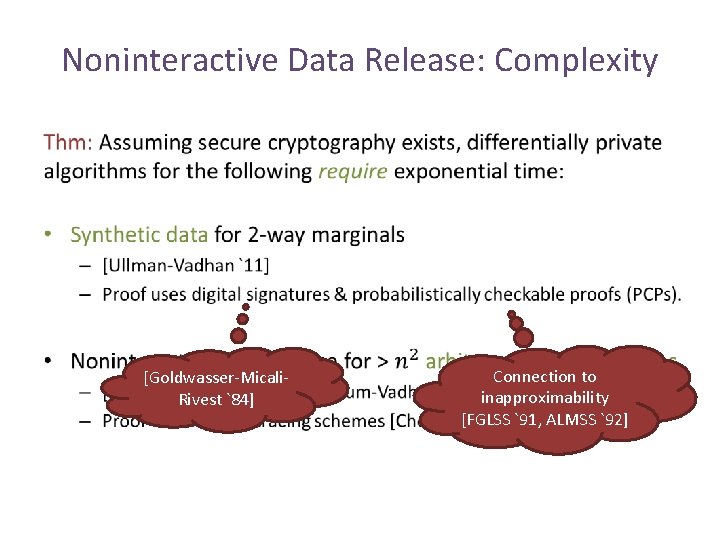
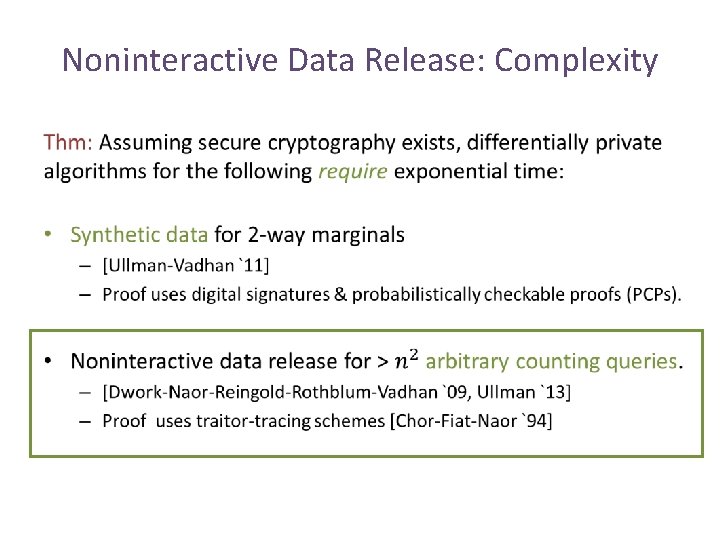
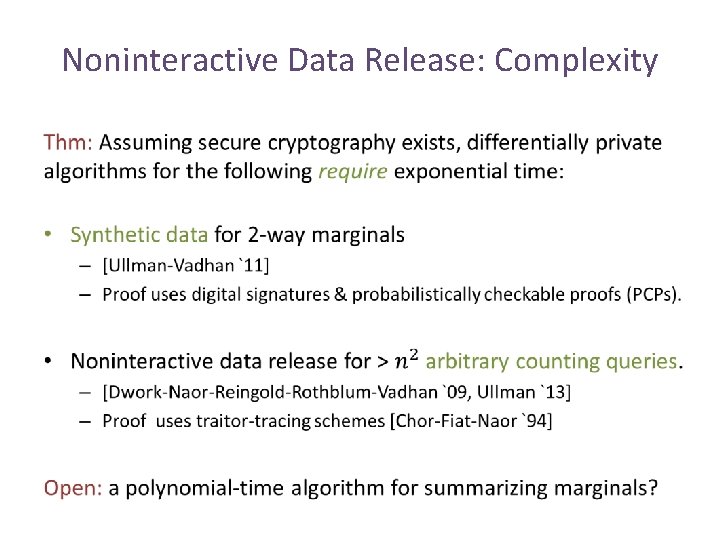
Noninteractive Data Release: Complexity • [Goldwasser-Micali. Rivest `84] Connection to inapproximability [FGLSS `91, ALMSS `92]
Noninteractive Data Release: Complexity •
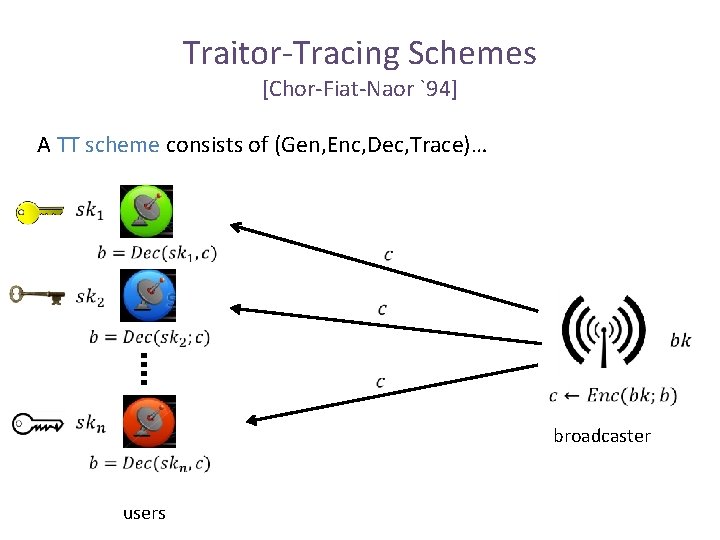
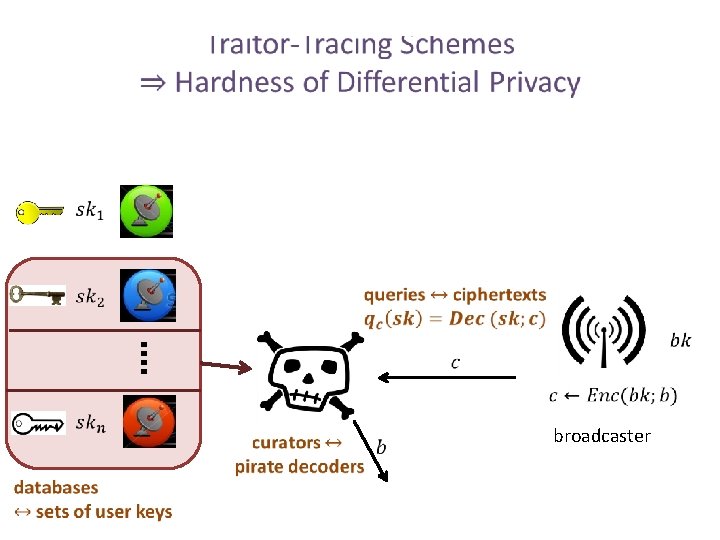
Traitor-Tracing Schemes [Chor-Fiat-Naor `94] A TT scheme consists of (Gen, Enc, Dec, Trace)… broadcaster users
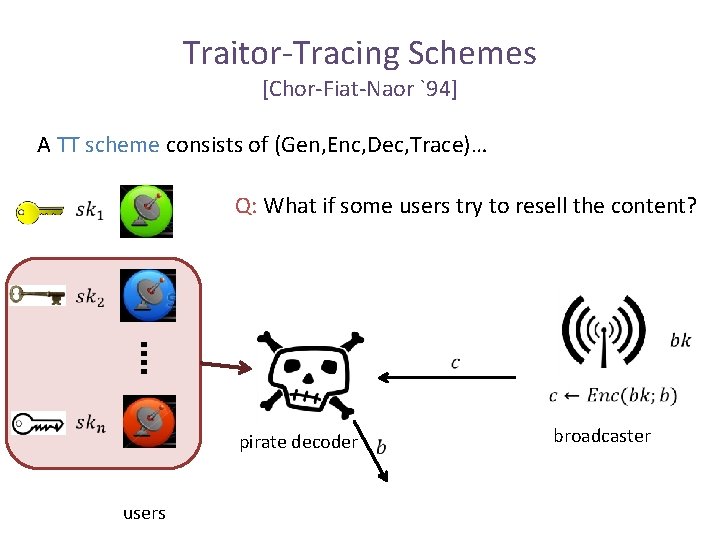
Traitor-Tracing Schemes [Chor-Fiat-Naor `94] A TT scheme consists of (Gen, Enc, Dec, Trace)… Q: What if some users try to resell the content? pirate decoder users broadcaster
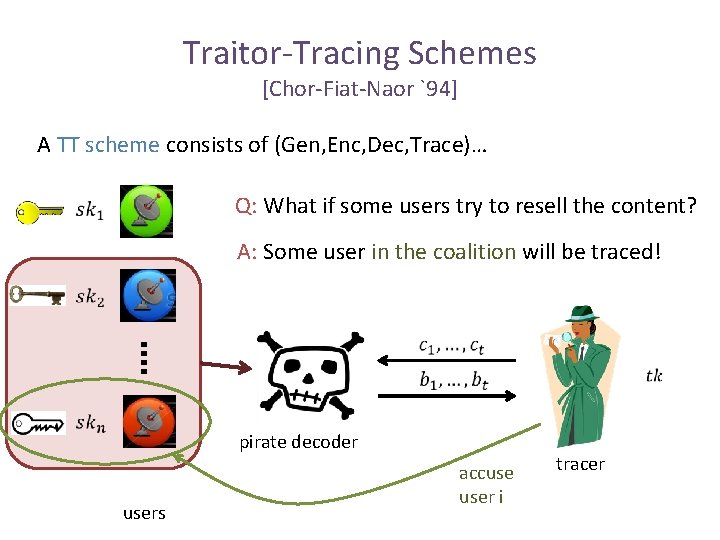
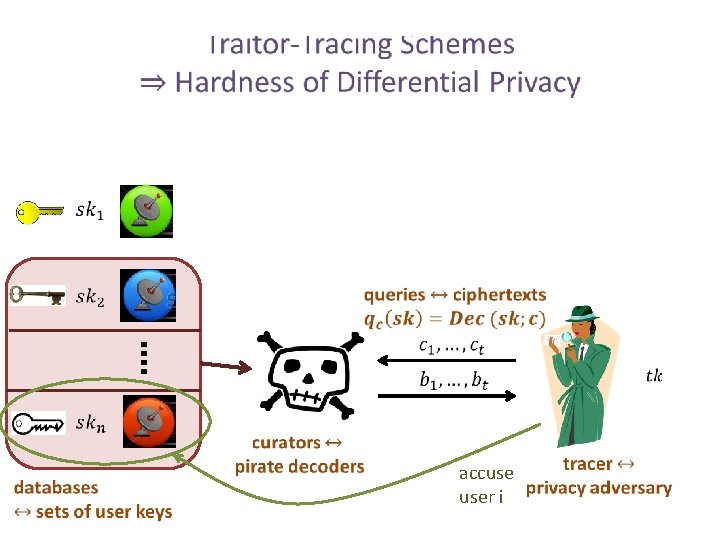
Traitor-Tracing Schemes [Chor-Fiat-Naor `94] A TT scheme consists of (Gen, Enc, Dec, Trace)… Q: What if some users try to resell the content? A: Some user in the coalition will be traced! pirate decoder users accuse user i tracer
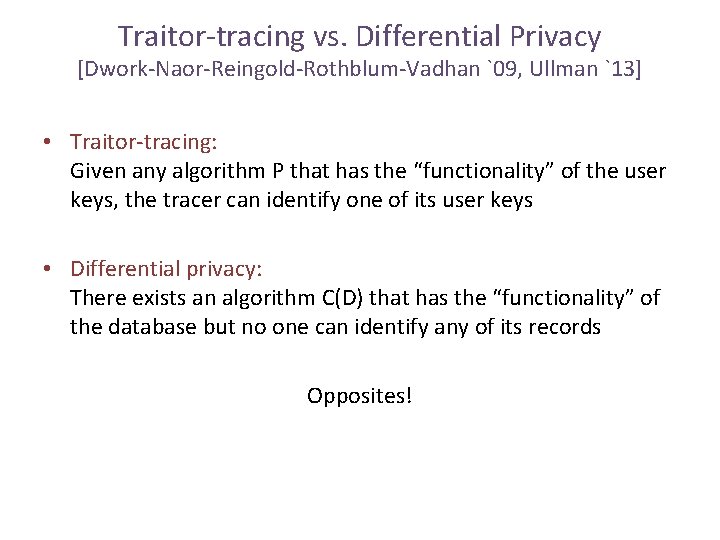
Traitor-tracing vs. Differential Privacy [Dwork-Naor-Reingold-Rothblum-Vadhan `09, Ullman `13] • Traitor-tracing: Given any algorithm P that has the “functionality” of the user keys, the tracer can identify one of its user keys • Differential privacy: There exists an algorithm C(D) that has the “functionality” of the database but no one can identify any of its records Opposites!
broadcaster
accuse user i
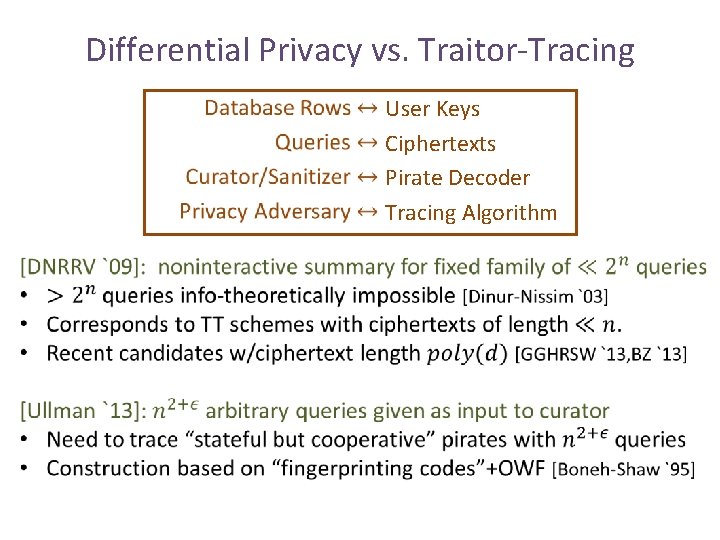
Differential Privacy vs. Traitor-Tracing • User Keys Ciphertexts Pirate Decoder Tracing Algorithm
Noninteractive Data Release: Complexity •
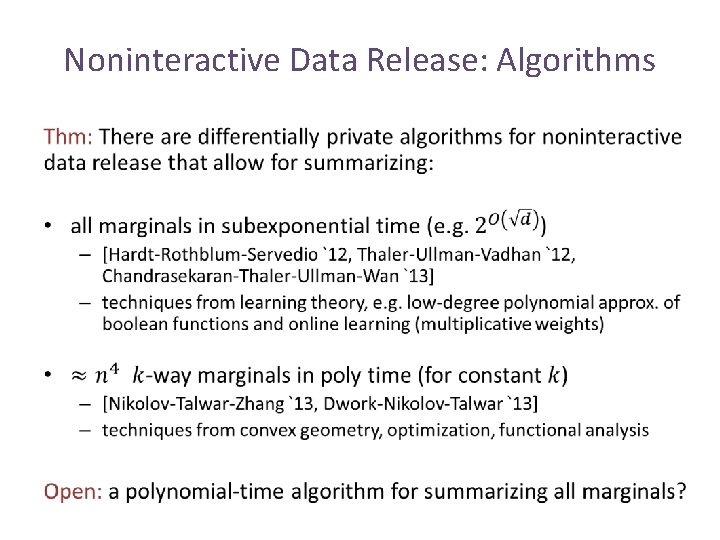
Noninteractive Data Release: Algorithms •
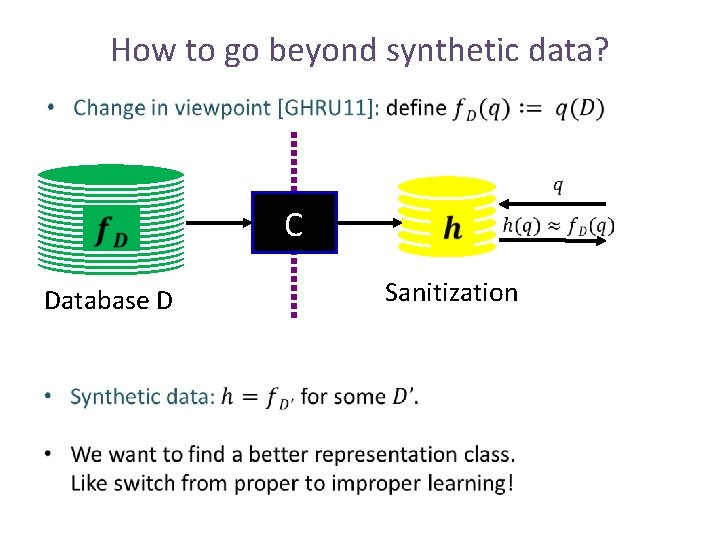
How to go beyond synthetic data? Database D C Sanitization
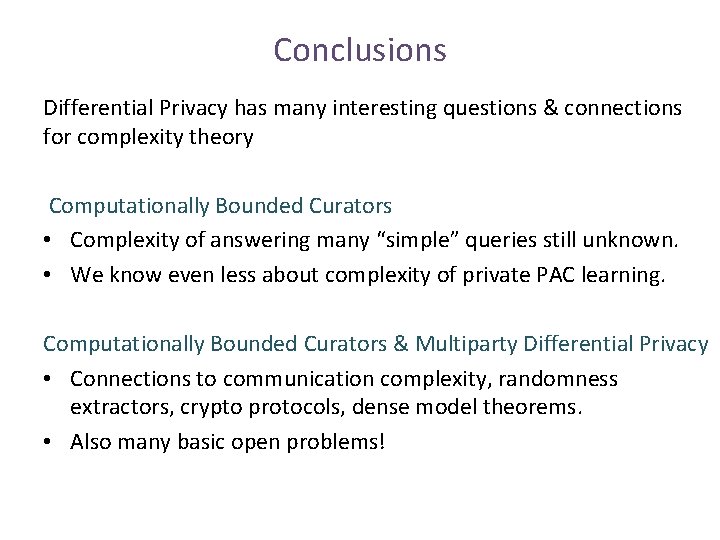
Conclusions Differential Privacy has many interesting questions & connections for complexity theory Computationally Bounded Curators • Complexity of answering many “simple” queries still unknown. • We know even less about complexity of private PAC learning. Computationally Bounded Curators & Multiparty Differential Privacy • Connections to communication complexity, randomness extractors, crypto protocols, dense model theorems. • Also many basic open problems!