The Atmosphere The atmosphere is a layer of








- Slides: 36
The Atmosphere
The atmosphere is a layer of gases around the earth. These gases are collectively known as air.
Gases in atmosphere Oxygen 21% Nitrogen 78% Argon, Carbon Dioxide, Water vapour 1%
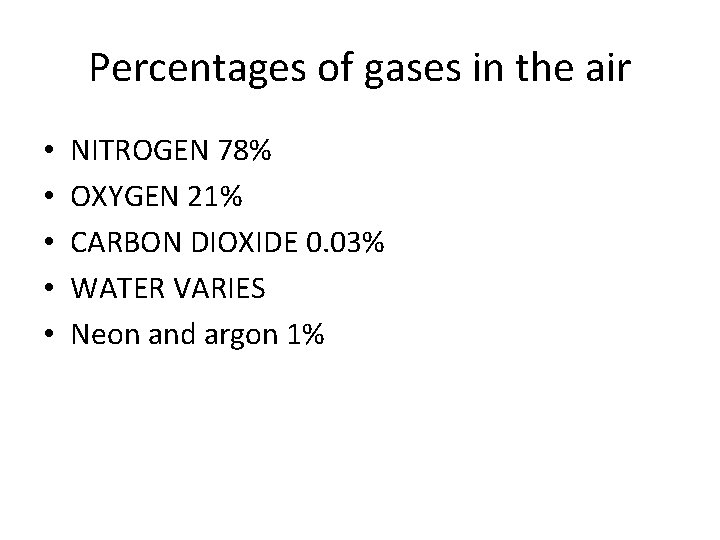
Percentages of gases in the air • • • NITROGEN 78% OXYGEN 21% CARBON DIOXIDE 0. 03% WATER VARIES Neon and argon 1%
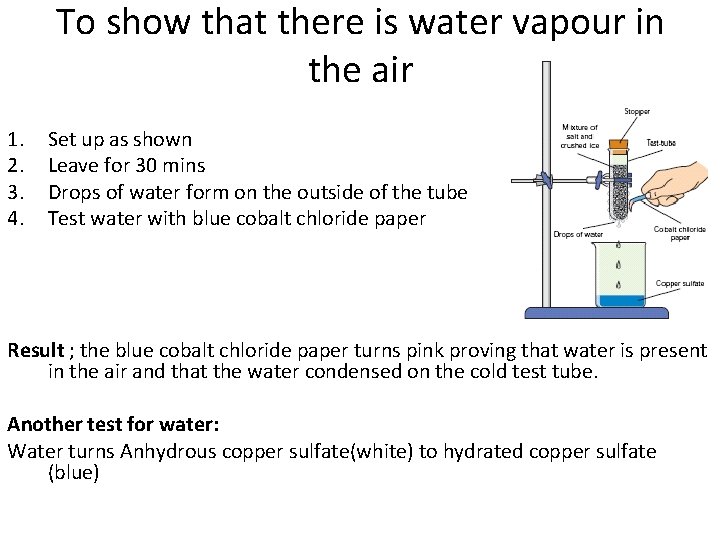
To show that there is water vapour in the air 1. 2. 3. 4. Set up as shown Leave for 30 mins Drops of water form on the outside of the tube Test water with blue cobalt chloride paper Result ; the blue cobalt chloride paper turns pink proving that water is present in the air and that the water condensed on the cold test tube. Another test for water: Water turns Anhydrous copper sulfate(white) to hydrated copper sulfate (blue)
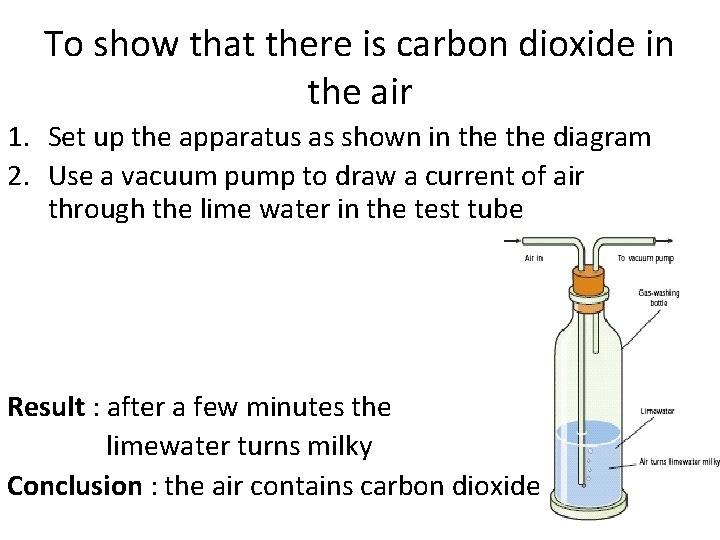
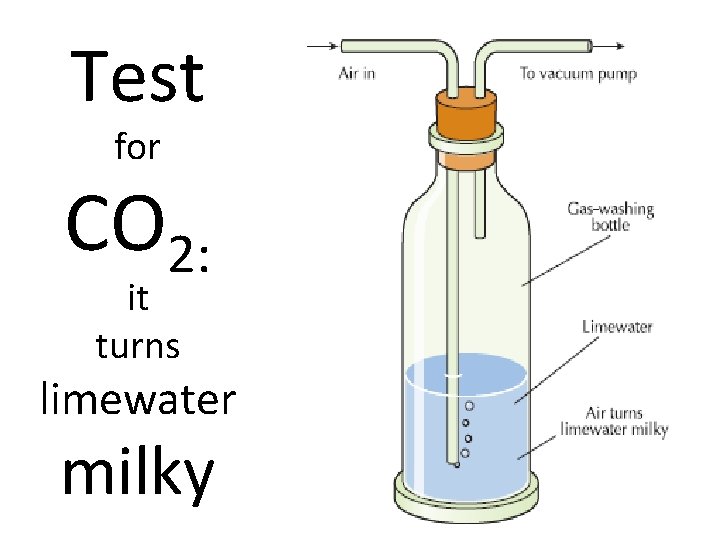
To show that there is carbon dioxide in the air 1. Set up the apparatus as shown in the diagram 2. Use a vacuum pump to draw a current of air through the lime water in the test tube Result : after a few minutes the limewater turns milky Conclusion : the air contains carbon dioxide
To show that approx one fifth of air is Oxygen • Three different experiments
1. To show one fifth of air is oxygen 1. 2. 3. 4. 5. Pack steel wool in bottom of a graduated cylinder Invert cylinder in basin of water Mark level of water on the cylinder Leave for one week Measure height that the water rises up the cylinder
Result: • When iron rusts it uses up oxygen. When there is sufficient iron and water present, rusting will continue until all of the oxygen is used up.
2. To show one fifth of air is oxygen
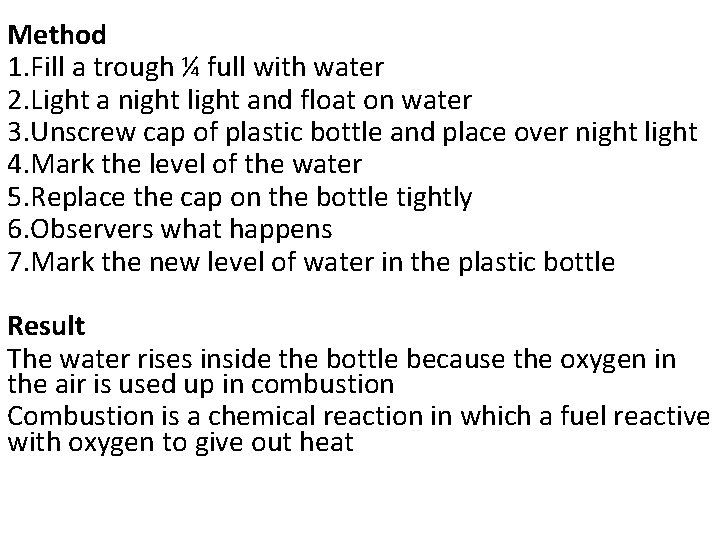
Method 1. Fill a trough ¼ full with water 2. Light a night light and float on water 3. Unscrew cap of plastic bottle and place over night light 4. Mark the level of the water 5. Replace the cap on the bottle tightly 6. Observers what happens 7. Mark the new level of water in the plastic bottle Result The water rises inside the bottle because the oxygen in the air is used up in combustion Combustion is a chemical reaction in which a fuel reactive with oxygen to give out heat
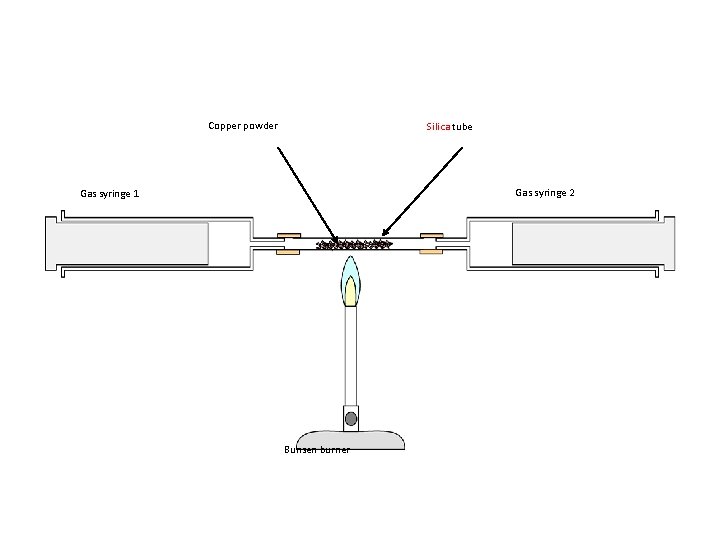
3. To show one fifth of air is oxygen • Set up apparatus • Before heating, ensure one syringe contains 100 cm 3 of air and other is closed • Heat copper turnings and slowly pass the 100 cm 3 from one syringe to the other • Continue until the volume does not change • Cool down apparatus and record volume.
Copper powder Silica tube Gas syringe 2 Gas syringe 1 Bunsen burner
• Result: • Volume will go down to approx 80 cm 3 and the copper turnings turn a grey/black in colour. This is because the copper reacts with the oxygen present forming copper oxide. The oxygen is used up in this process to make the oxide and therefore the volume of oxygen in the air goes down.
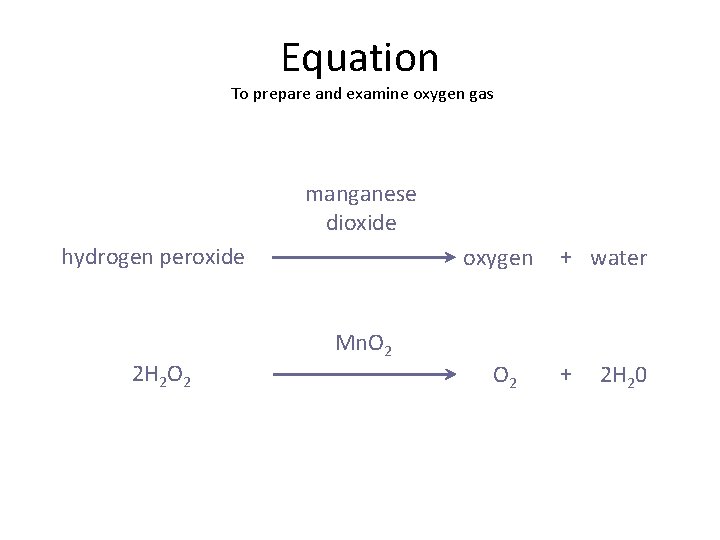
Preparation of oxygen • Oxygen is prepared by the chemical breakdown of hydrogen peroxide H 2 O 2 using manganese dioxide Mn. O 2 as a catalyst • A catalyst is a substance that speeds up a chemical reactions but are not used up in the reaction.
Equation To prepare and examine oxygen gas manganese dioxide hydrogen peroxide 2 H 2 O 2 oxygen Mn. O 2 + water + 2 H 20
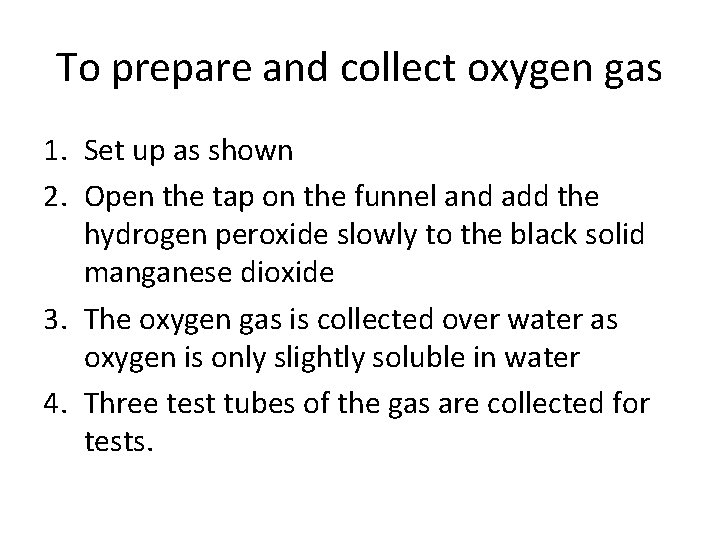
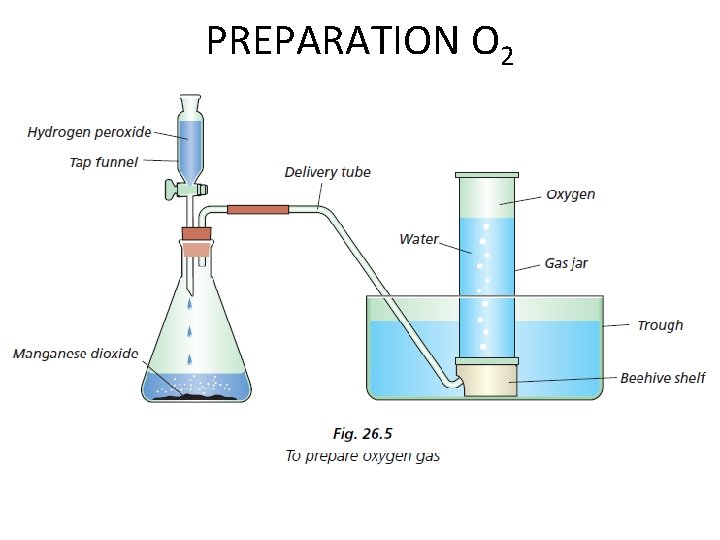
To prepare and collect oxygen gas 1. Set up as shown 2. Open the tap on the funnel and add the hydrogen peroxide slowly to the black solid manganese dioxide 3. The oxygen gas is collected over water as oxygen is only slightly soluble in water 4. Three test tubes of the gas are collected for tests.
PREPARATION O 2
Properties of Oxygen 1. Note colour and smell 2. Test p. H
3. Place a glowing splint into jar of O 2
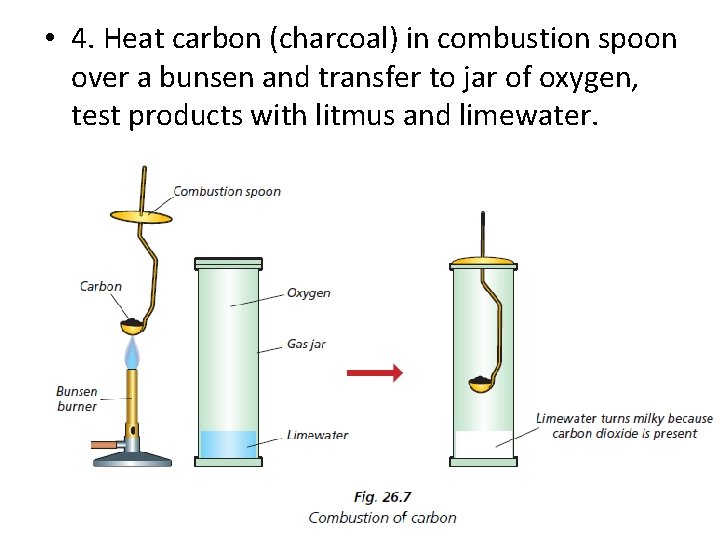
• 4. Heat carbon (charcoal) in combustion spoon over a bunsen and transfer to jar of oxygen, test products with litmus and limewater.
To burn carbon and magnesium in oxygen and test the products using moist litmus paper • When an element is burned in air, a compound called an oxide is formed. • Magnesium + Oxygen Magnesium oxide • Carbon + Oxygen Carbon dioxide • Care: Magnesium ribbon burns with an intense white light that can be damaging to the retina.
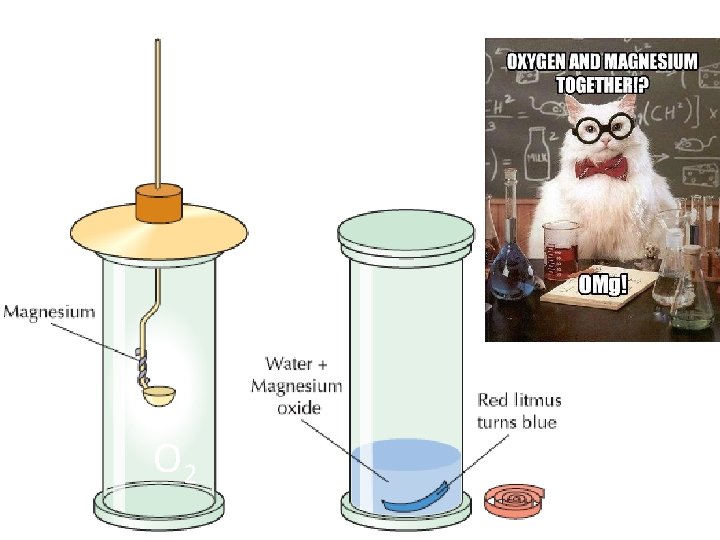
Procedure: magnesium • Get a piece of magnesium ribbon • Using a tongs, hold the magnesium in the flame of the Bunsen burner until it catches fire. • Put the burning magnesium in the test tube of oxygen. Observe what happens. • Result: A white powder magnesium oxide is formed. When water is added the magnesium oxide forms a base called magnesium hydroxide. Magnesium hydroxide is a base and it is used to neutralise stomach acid and it is found in Milk of Magnesia.
Combustion spoon O 2
Properties of oxygen • Physical properties 1. Colourless 2. Odourless 3. Tasteless 4. Slightly heavier than air 5. Slightly soluble in water Chemical properties 1. Supports combustion 2. Neutral substance – neither acid or base, no effect on litmus
Uses of oxygen • • Burning Welding Breathing Metals and non metals burn in oxygen to produce oxides
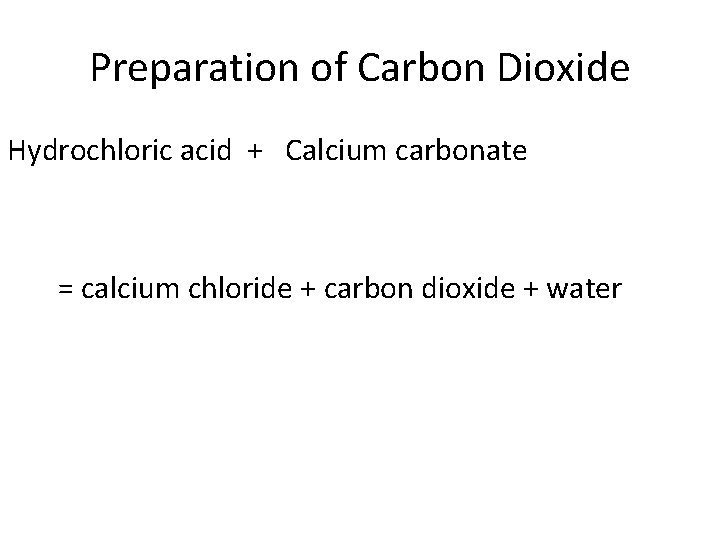
Preparation of Carbon Dioxide Hydrochloric acid + Calcium carbonate = calcium chloride + carbon dioxide + water
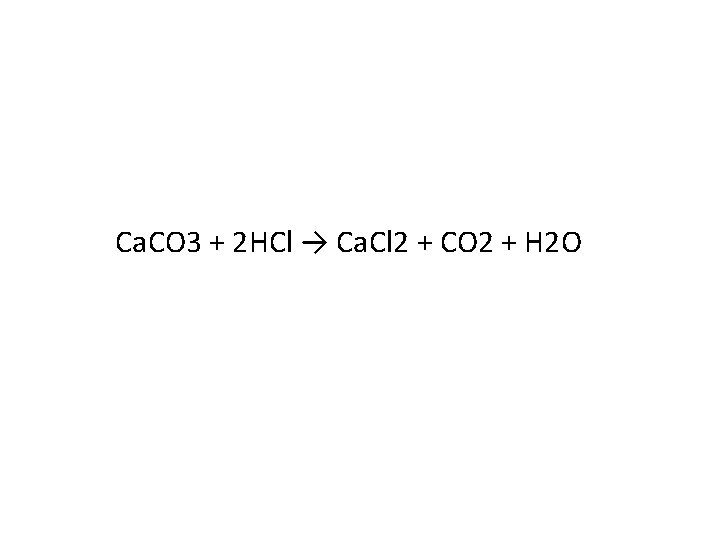
Ca. CO 3 + 2 HCl → Ca. Cl 2 + CO 2 + H 2 O
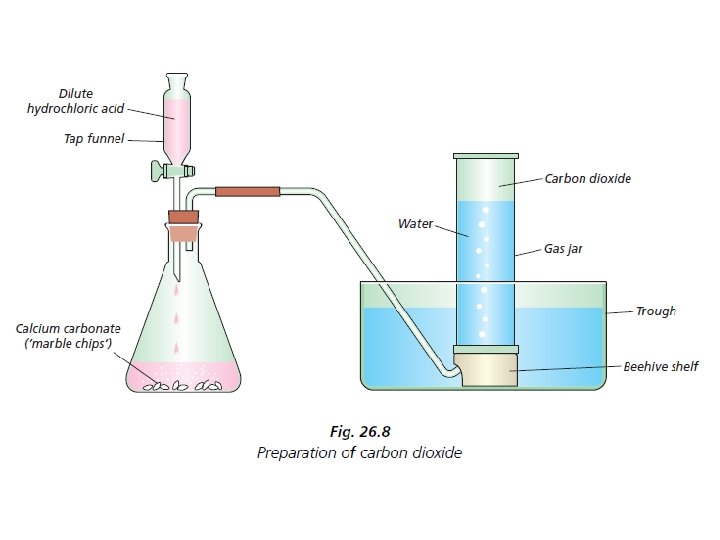
To prepare CO 2
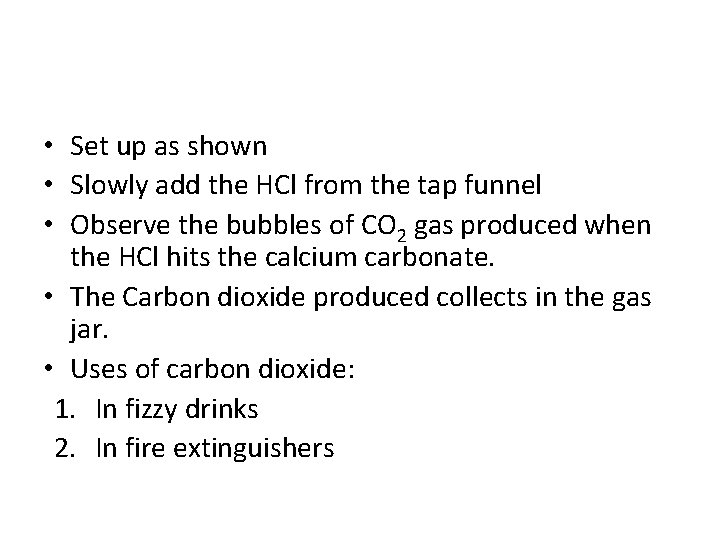
• Set up as shown • Slowly add the HCl from the tap funnel • Observe the bubbles of CO 2 gas produced when the HCl hits the calcium carbonate. • The Carbon dioxide produced collects in the gas jar. • Uses of carbon dioxide: 1. In fizzy drinks 2. In fire extinguishers
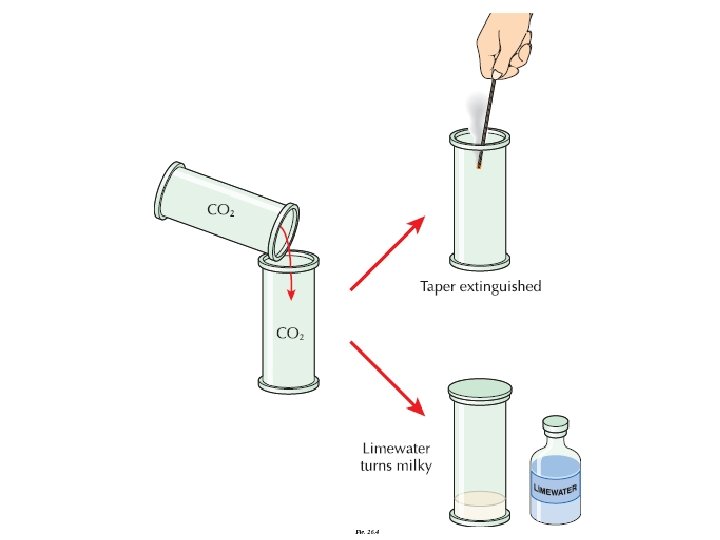
1. 2. 3. 4. Note colour and smell p. H Limewater test Test if supports combustion
Test for CO 2: it turns limewater milky
CO 2 is heavier than air CO 2 does not support combustion
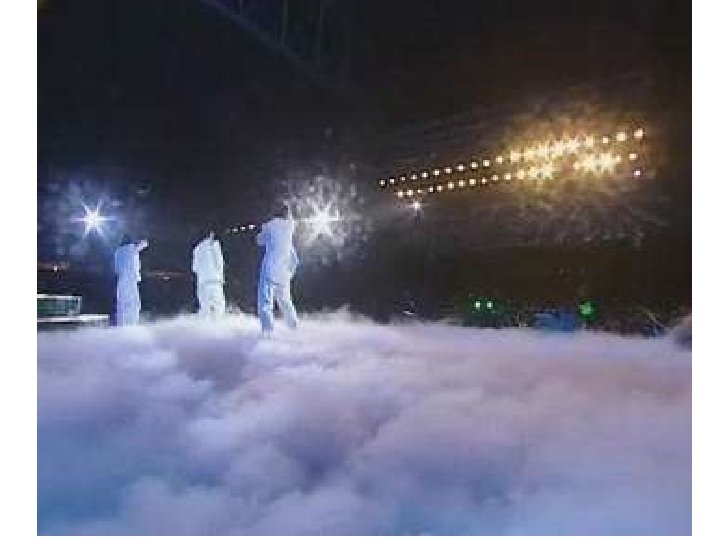
Main Uses of Carbon Dioxide CO 2 • Fizzy Drinks – All fizzy drinks contain CO 2 under pressure • Fire Extinguishers – CO 2 is denser than air and does not support combustion • Refrigeration – CO 2 under pressure can be converted into a solid: Dry Ice. It is much colder than ice – 78 o. C • Dry Ice- Special Effects on Stage – Lumps of dry Ice are put into warm water and wet CO 2 carries clouds of water vapour with it. Mist Effect