Technical Operational Aspects of Interconnection Trevor Jordan 61
- Slides: 82
Technical & Operational Aspects of Interconnection Trevor Jordan +61 413 880 220 tjordan@kpmg. com. au Interconnection 1 T Jordan 2001
Introduction • My background – 25 years in telecommunications in a wide variety of roles – 10 years spent on interconnect from the beginning of competition in Australia – Worked for new carriers, incumbent carriers, and government regulators over the last ten years Interconnection 2 T Jordan 2001
Questions • Please ask questions at any time – If I have not explained something properly, then it needs to be clarified before we go any further – My knowledge of China is limited; if the material does not match the Chinese context, then let me know so that I can adapt it • Questions by email after the workshop Interconnection 3 T Jordan 2001
Interconnection Objectives • There is no simple answer for interconnection • It depends on where you start and where you want to finish – Level of national infrastructure – National capacity – Development aspirations Interconnection 4 T Jordan 2001
Interconnection Techniques • No single solution – a toolbox of techniques to be applied appropriately • Every regulatory requirement has a primary and a secondary effect – Efforts to encourage long-distance operators will have the effect of discouraging local access operators Interconnection 5 T Jordan 2001
Interconnection Conundrum • Retail transactions are asymmetrical – the customer pays the carrier • Interconnection transactions are symmetrical – each carrier pays to terminate its calls but is paid for calls that it terminates • In an open market it may be difficult to distinguish the carriers from the customers Interconnection 6 T Jordan 2001
Interconnection in Context • Simple Resale – Product unaltered • Value Added Resale – Product altered • Interconnection of Services – Products linked to others • Access to Infrastructure – New products created Interconnection 7 T Jordan 2001
Simple Resale • Carrier (network operator) sells access services and/or calls to service provider • Service provider sells those services to endcustomer • Service provider bills and supports endcustomer • Allows service provider to offer a complete range of services to compete against carriers Interconnection 8 T Jordan 2001
Value Added Resale • Carrier sells product to service provider • Service provider transforms those products into different products • Service provider sells those new products to end-customers • A service provider could purchase transmission services and combine them with switches or routers to create calls Interconnection 9 T Jordan 2001
Reasons for Interconnection • To enable calls between networks – Long established practice – The reason for the creation of the ITU – Not entirely devoid of competition issues • To enable competition between services – Intended to provide for the rapid introduction competitive services, particularly long-distance – Principally a competition issue Interconnection 10 T Jordan 2001
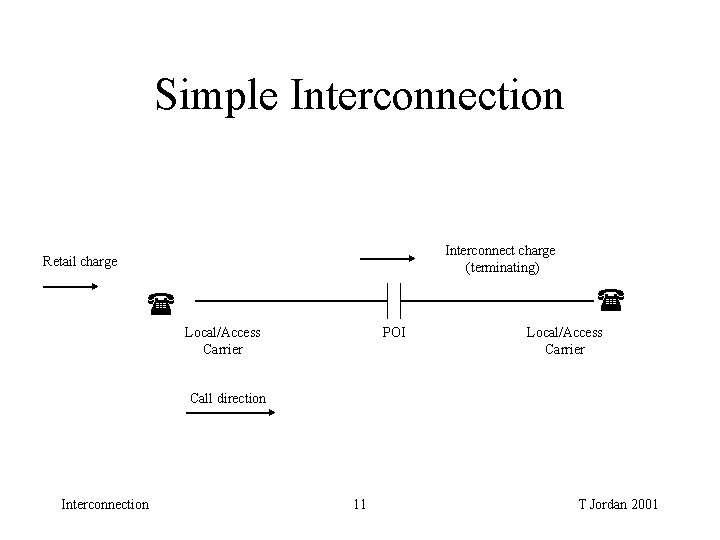
Simple Interconnection Interconnect charge (terminating) Retail charge Local/Access Carrier POI Local/Access Carrier Call direction Interconnection 11 T Jordan 2001
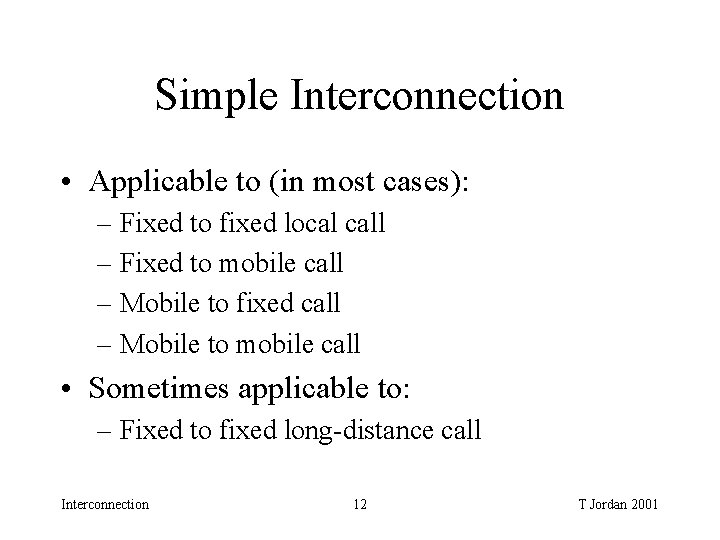
Simple Interconnection • Applicable to (in most cases): – Fixed to fixed local call – Fixed to mobile call – Mobile to fixed call – Mobile to mobile call • Sometimes applicable to: – Fixed to fixed long-distance call Interconnection 12 T Jordan 2001
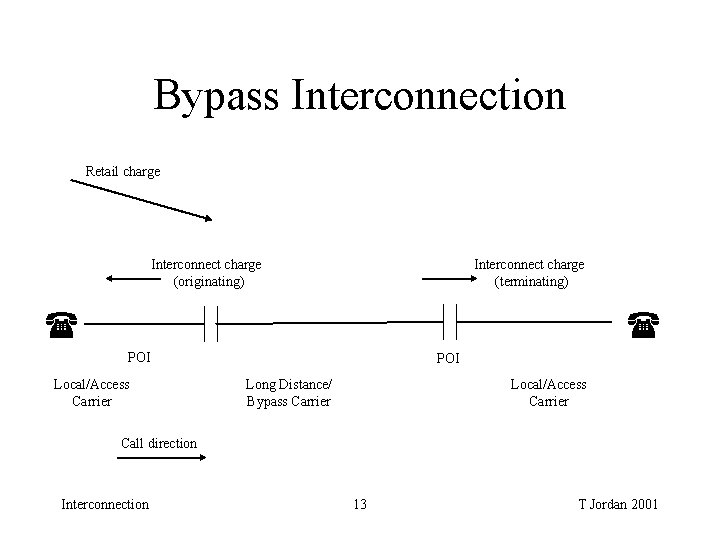
Bypass Interconnection Retail charge Interconnect charge (originating) Interconnect charge (terminating) POI Local/Access Carrier POI Long Distance/ Bypass Carrier Local/Access Carrier Call direction Interconnection 13 T Jordan 2001
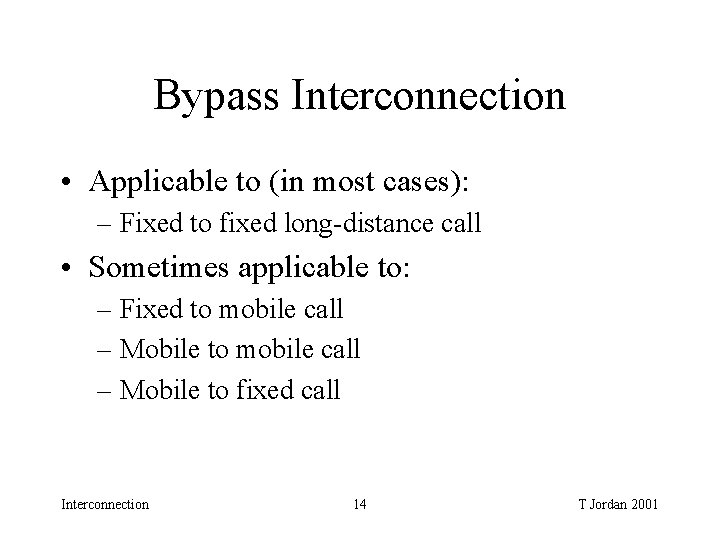
Bypass Interconnection • Applicable to (in most cases): – Fixed to fixed long-distance call • Sometimes applicable to: – Fixed to mobile call – Mobile to fixed call Interconnection 14 T Jordan 2001
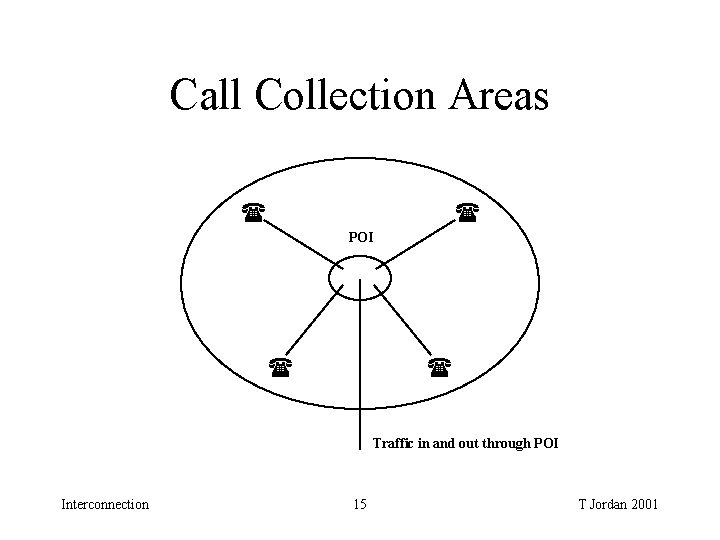
Call Collection Areas POI Traffic in and out through POI Interconnection 15 T Jordan 2001
Call Collection Areas • Interconnection charges depend on nature of Call Collection Area – City – Urban – Rural – Remote • Average of A$0. 015 per minute – Varies with time of day and location Interconnection 16 T Jordan 2001
Call Collection Areas • Australia has 66 Call Collection areas – Suits long-distance bypass traffic • Further subdivision for local calls – Probably around 250 POIs connection to other Local Access Carriers • POI may service a larger area: province or country Interconnection 17 T Jordan 2001
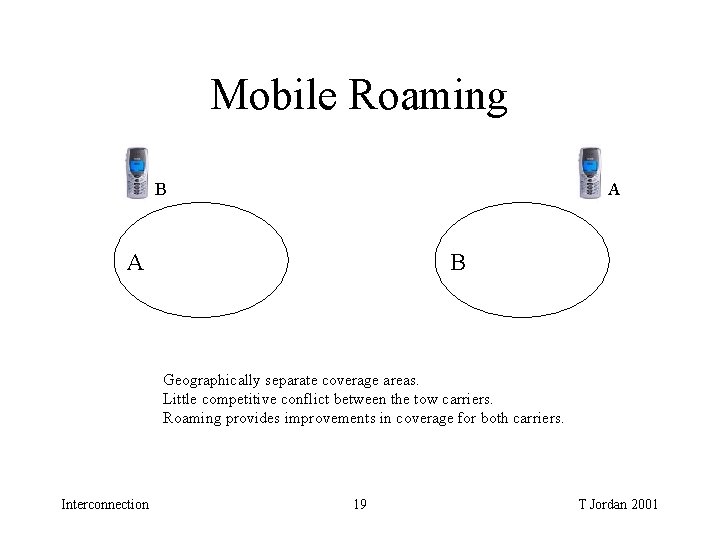
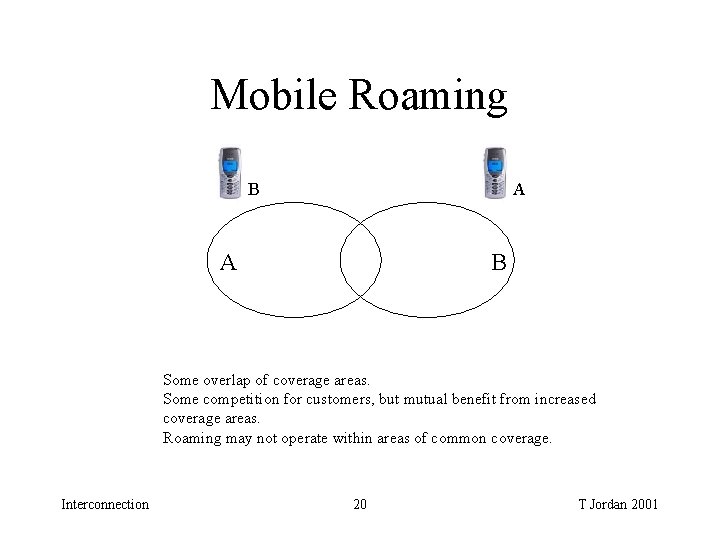
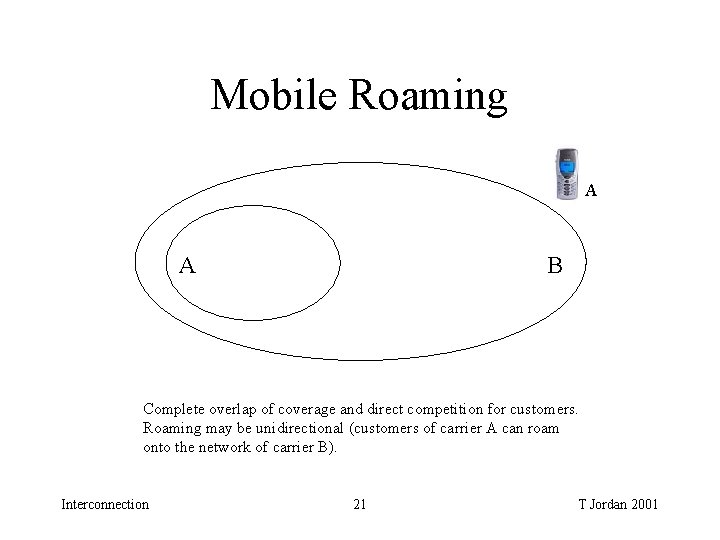
Mobile Roaming • A form of airtime resale • Provides greater coverage for one or both carriers • Competition issues depend on – No coverage overlap – Some coverage overlap – Complete coverage overlap Interconnection 18 T Jordan 2001
Mobile Roaming B A A B Geographically separate coverage areas. Little competitive conflict between the tow carriers. Roaming provides improvements in coverage for both carriers. Interconnection 19 T Jordan 2001
Mobile Roaming B A A B Some overlap of coverage areas. Some competition for customers, but mutual benefit from increased coverage areas. Roaming may not operate within areas of common coverage. Interconnection 20 T Jordan 2001
Mobile Roaming A A B Complete overlap of coverage and direct competition for customers. Roaming may be unidirectional (customers of carrier A can roam onto the network of carrier B). Interconnection 21 T Jordan 2001
Mobile Roaming Charges • Depends on the purpose and level of competition • May be very low if there is mutual benefit for separate geographic regions • May be very high if there is substantial extension to coverage for one carrier • May be higher than retail charges Interconnection 22 T Jordan 2001
Transit Carriage – 1 Carrier Without No interconnection Interconnection No interconnection 23 T Jordan 2001
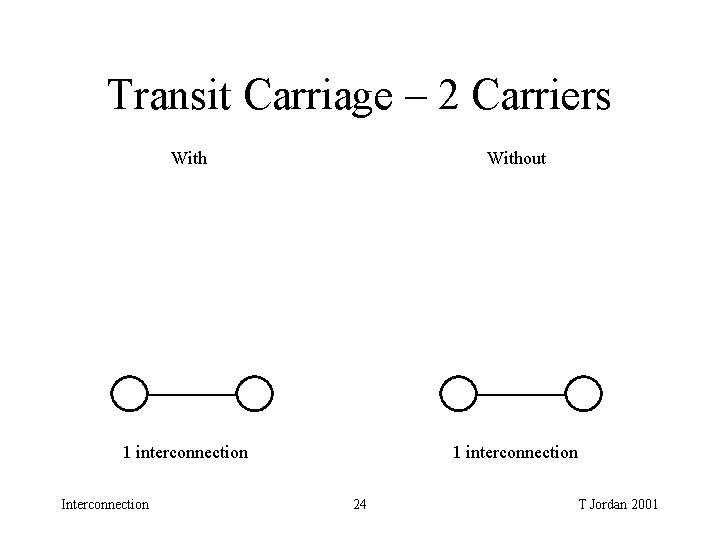
Transit Carriage – 2 Carriers Without 1 interconnection Interconnection 24 T Jordan 2001
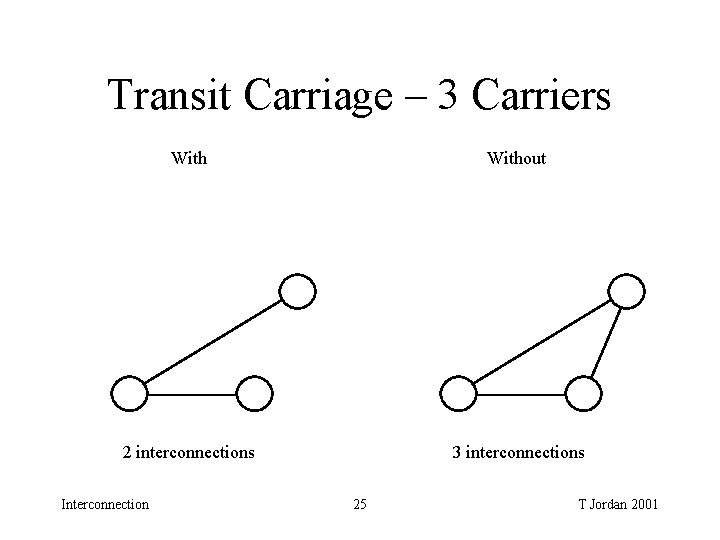
Transit Carriage – 3 Carriers Without 2 interconnections 3 interconnections Interconnection 25 T Jordan 2001
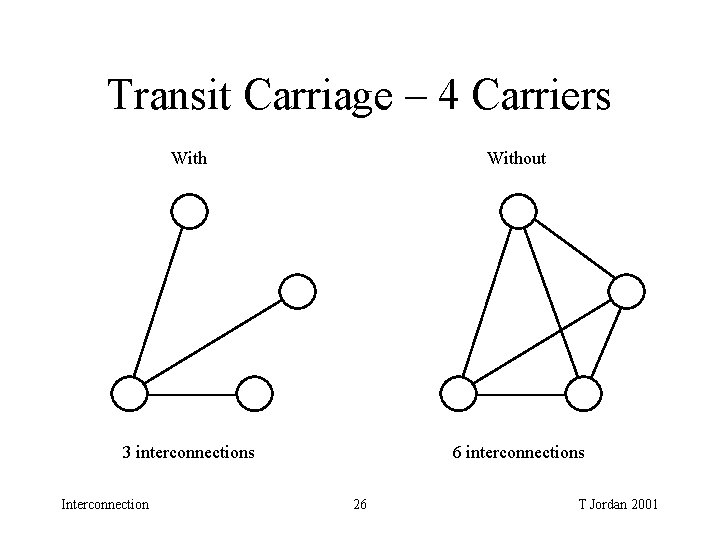
Transit Carriage – 4 Carriers Without 3 interconnections 6 interconnections Interconnection 26 T Jordan 2001
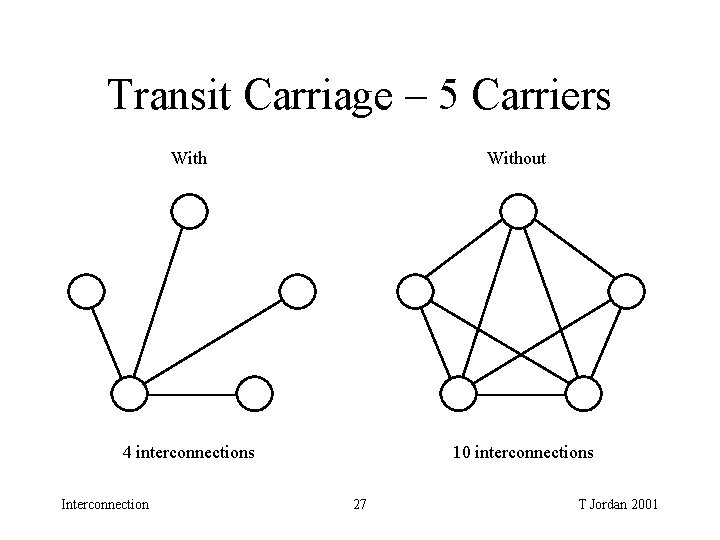
Transit Carriage – 5 Carriers Without 4 interconnections Interconnection 10 interconnections 27 T Jordan 2001
Transit Carrier • Needed to avoid delay and high cost of market entry – network efficiency • Typically the incumbent carrier • May need regulatory requirement • May not be needed in the long-term and the market develops Interconnection 28 T Jordan 2001
New Entrant Delay and Complexity • A new carrier entering a market with five existing carriers would need to establish a separate interconnection arrangement with each of those carriers, even though the total traffic volume may be very small • The alternative is to establish a single connection to an established transit carrier Interconnection 29 T Jordan 2001
New Entrant Delay and Complexity • Direct connections between other carriers can be established later when they are economically justified • Refusal by the incumbent carrier to provide transit services or demands for excessive interconnect charges may be intended to impede the operation of new carriers Interconnection 30 T Jordan 2001
Points of Interconnection • An economic more than a technical issue • There are technical limitations on interconnection, but there are numerous places in a network where interconnection can take place – Local exchanges – Trunk exchanges – International exchanges Interconnection 31 T Jordan 2001
Points of interconnection • Number and location of POIs is a balance of fixed and variable costs • The larger the number of POIs, the closer the interconnecting carrier can get to the call destination and the lower the per minute charge (variable cost) • Each POI has a cost associated with its establishment and operation (fixed cost) Interconnection 32 T Jordan 2001
Points of Interconnection • There is a trade-off between the cost of POIs and the amount of traffic carried • A provider of local call services might want POIs at each local telephone exchange • A provider of international service might want a POI at one point in the country or a limited number of high traffic points • The optimal number and location of POIs may change as traffic volume increases Interconnection 33 T Jordan 2001
POI Technology • In some jurisdictions it is simply a joint in a cable connecting the two networks • In others it is a test/disconnection point in the building of one of the two carriers • One party (the incumbent carrier) is usually in a better position to provide the interconnecting link Interconnection 34 T Jordan 2001
POI Technology • Incumbent carrier generally sets standards • Normally simple, stable technology because multiple vendors are involved • Standard transmission links are used to interconnect carriers – Multiples of 2 Mbit/s or 1. 5 Mbit/s – Voice channel structure – STM may be used in future Interconnection 35 T Jordan 2001
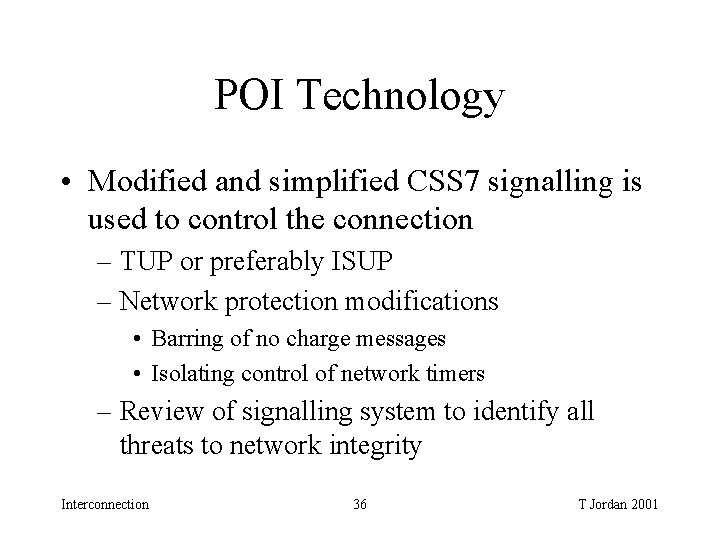
POI Technology • Modified and simplified CSS 7 signalling is used to control the connection – TUP or preferably ISUP – Network protection modifications • Barring of no charge messages • Isolating control of network timers – Review of signalling system to identify all threats to network integrity Interconnection 36 T Jordan 2001
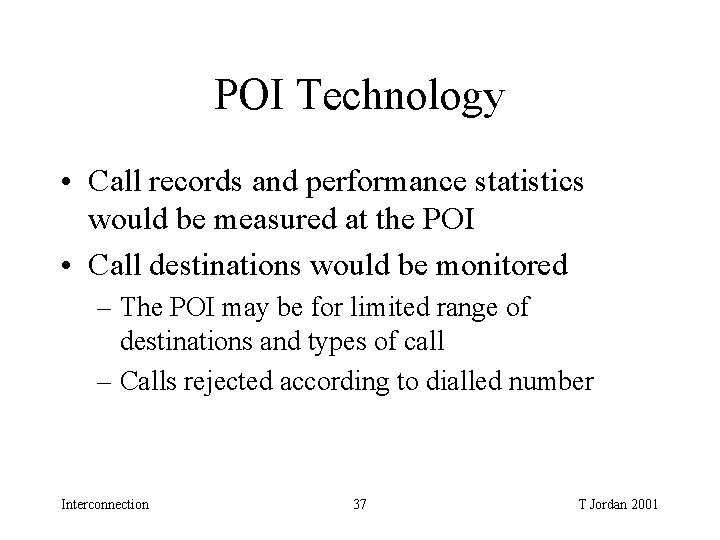
POI Technology • Call records and performance statistics would be measured at the POI • Call destinations would be monitored – The POI may be for limited range of destinations and types of call – Calls rejected according to dialled number Interconnection 37 T Jordan 2001
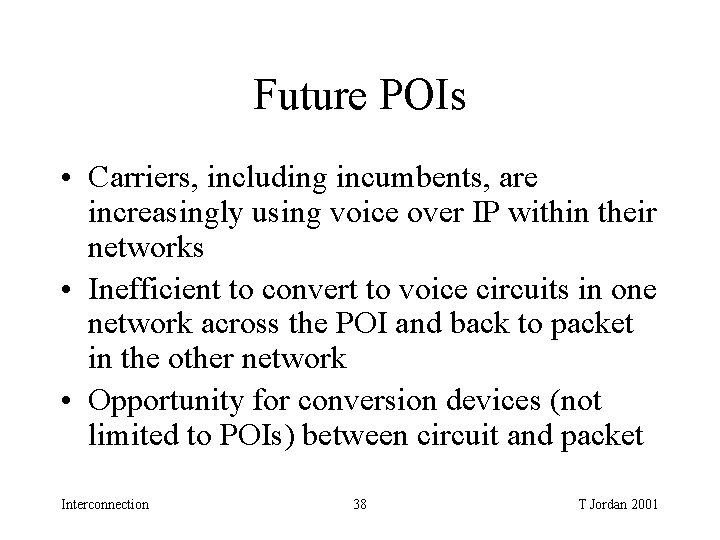
Future POIs • Carriers, including incumbents, are increasingly using voice over IP within their networks • Inefficient to convert to voice circuits in one network across the POI and back to packet in the other network • Opportunity for conversion devices (not limited to POIs) between circuit and packet Interconnection 38 T Jordan 2001
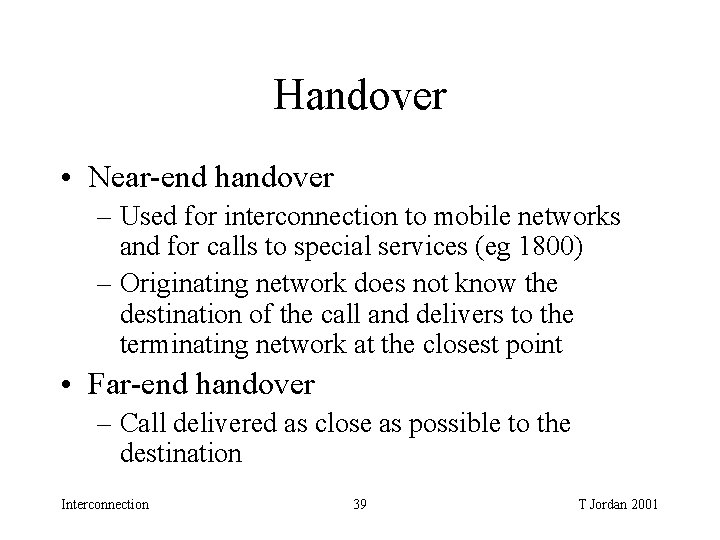
Handover • Near-end handover – Used for interconnection to mobile networks and for calls to special services (eg 1800) – Originating network does not know the destination of the call and delivers to the terminating network at the closest point • Far-end handover – Call delivered as close as possible to the destination Interconnection 39 T Jordan 2001
Interconnect Billing Systems • Depend on the complexity of the commercial arrangements – More focussed on costs than retail charges • Generally simpler retail billing – May not provide retail level of call detail • Records will be kept on both sides of the POI and there will have to be a reconciliation process Interconnection 40 T Jordan 2001
Bill and Keep • Simplified approach to billing for certain types of interconnection • No interconnect billing system – each carrier keeps its full retail revenue and carries the interconnected traffic for free • Traffic must be reasonably symmetrical (not long-distance bypass) Interconnection 41 T Jordan 2001
Bill and Keep • Induces strange behaviour – No carrier wants incoming traffic such as call centres and internet service providers as it generates no revenue • Works with the interconnection of free local calls • Useful in the short-term because it is simple to implement Interconnection 42 T Jordan 2001
Interconnect Billing • Typical Parameters – Call count • May include unsuccessful calls (call attempts) – Call minutes – Call records • May be collected for analysis and fault finding purposes – Data volume in the future? Interconnection 43 T Jordan 2001
Interconnection Agreements • Substantial long-term relationship • Subject to regular review (possibly as a result of regulator intervention) • Complex range of products and issues • Not like most commercial agreements, the other party may be reluctant (particularly the incumbent carrier) Interconnection 44 T Jordan 2001
Carrier Relationships • Regular (possibly continuous) need to negotiate extensions (new products/technologies) and reviews of agreements • Regular contact for routine activities • Need for regular review meetings to assess progress and improve processes (one to two months) • Formal escalation process to handle disputes Interconnection 45 T Jordan 2001
Carrier Relationships • Four major issues – Ordering and provisioning of services – Operations and maintenance issues – Billing and settlement issues • May also include access to facilities Interconnection 46 T Jordan 2001
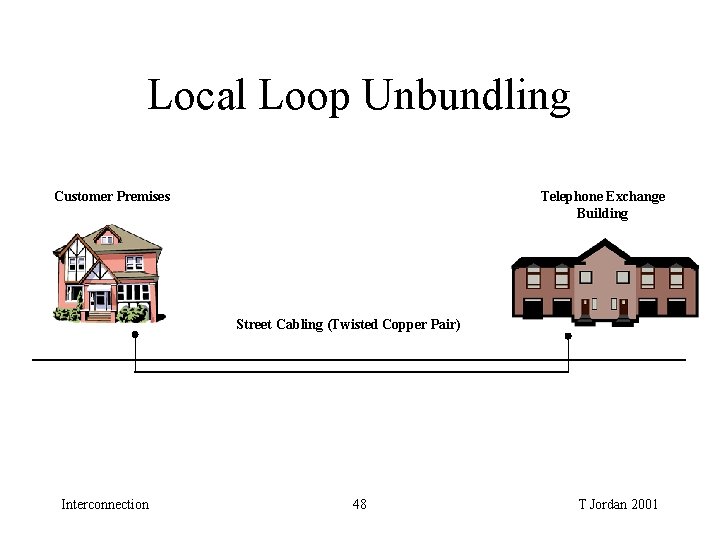
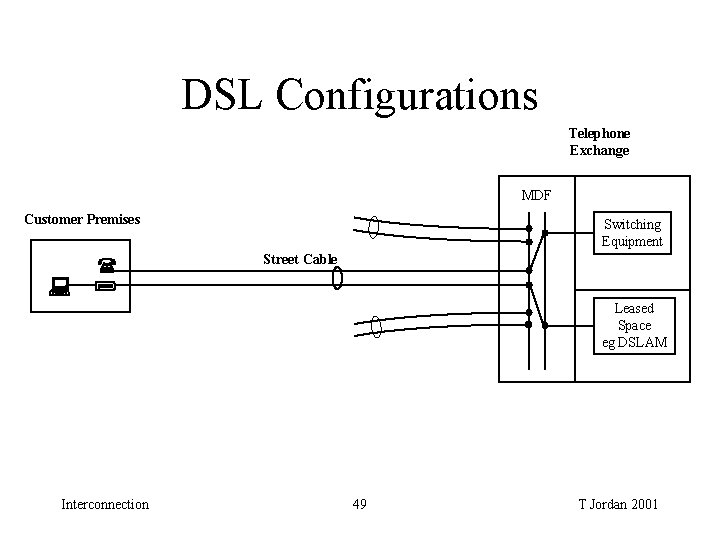
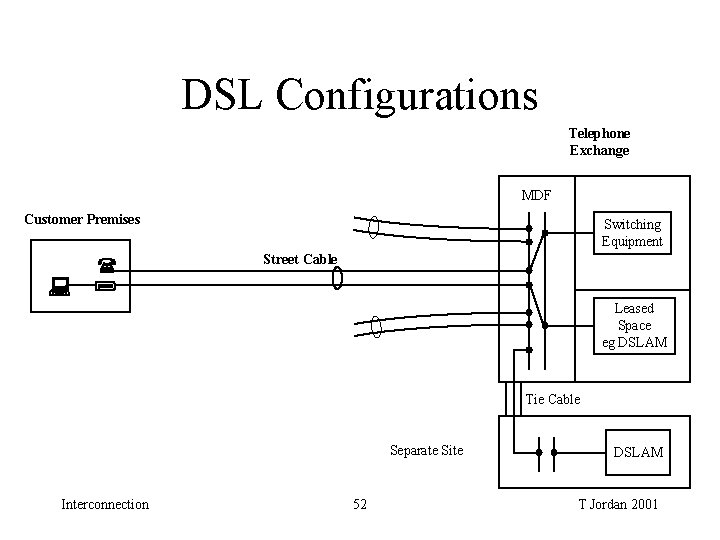
Local Loop Unbundling • Copper pair between end-user and telephone exchange building – Direct access to twisted copper pair • Widest variety of services, but greatest technical complexity – Provision of managed services (principally DSL) by incumbent local access carrier • Less technical complexity, but less variety – Both Interconnection 47 T Jordan 2001
Local Loop Unbundling Customer Premises Telephone Exchange Building Street Cabling (Twisted Copper Pair) Interconnection 48 T Jordan 2001
DSL Configurations Telephone Exchange MDF Customer Premises Switching Equipment Street Cable Leased Space eg DSLAM Interconnection 49 T Jordan 2001
Local Loop Issues • Cost determination – May be greater than retail • Shared use – Difficult co-ordination, but lower cost • Life-line telecommunications – Limits use of voice over internet – Need to retain standard telephone service Interconnection 50 T Jordan 2001
Local Loop Structure – Modern equipment requires less space and buildings can accommodate other carrier’s equipment • Access seeker equipment may be housed on the premises of the access provider • Tie cable between access seeker and access provider – To internal or external equipment space Interconnection 51 T Jordan 2001
DSL Configurations Telephone Exchange MDF Customer Premises Switching Equipment Street Cable Leased Space eg DSLAM Tie Cable Separate Site Interconnection 52 DSLAM T Jordan 2001
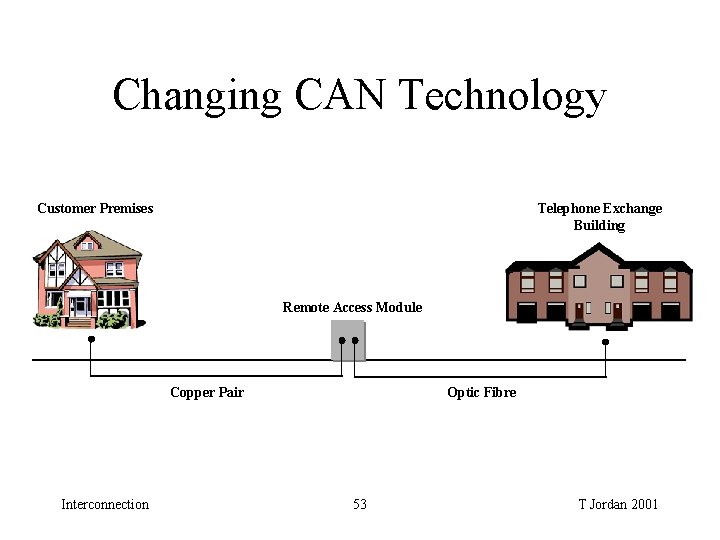
Changing CAN Technology Customer Premises Telephone Exchange Building Remote Access Module Copper Pair Interconnection Optic Fibre 53 T Jordan 2001
Changing CAN Technology • Increasing use of optic fibre in Customer Access Network (CAN) – Optic fibre to the curb, copper pair to the house • Existing copper cable may be retained and the optic fibre used for expansion – Continuous copper still available but may be interference problems between services Interconnection 54 T Jordan 2001
Changing CAN Technology • Need for greater number of DSLAMs – One per cable rather than one per exchange • Larger number of customers needed to justify cost – Market of 500 per cable compared with 20, 000 per exchange • Shorter copper pair and faster service – 52 Mbit/s Interconnection 55 T Jordan 2001
Infrastructure Sharing • Numerous opportunities • Mobile sites • Mobile towers – May require larger tower and create operational issues – Need to disable lower antennae to service higher antennae Interconnection 56 T Jordan 2001
Infrastructure Sharing • Mobile networks – (mobile roaming) • Spectrum sharing – Shared mobile network • Trenches or ducts • Building space Interconnection 57 T Jordan 2001
Mobiles • Two distinct configurations of mobile service • City Licence (North America, Hong Kong) – Similar to wireless local loop – Local number; local charging • Regional Licence (Europe, Australia) – Regional/national number; national charging Interconnection 58 T Jordan 2001
Mobiles – City Licence • Mobile number indistinguishable from local number – (216) 457 3158 – (216) 543 7429 – Not widely published • Fixed network caller pays normal local or long-distance charges Interconnection 59 T Jordan 2001
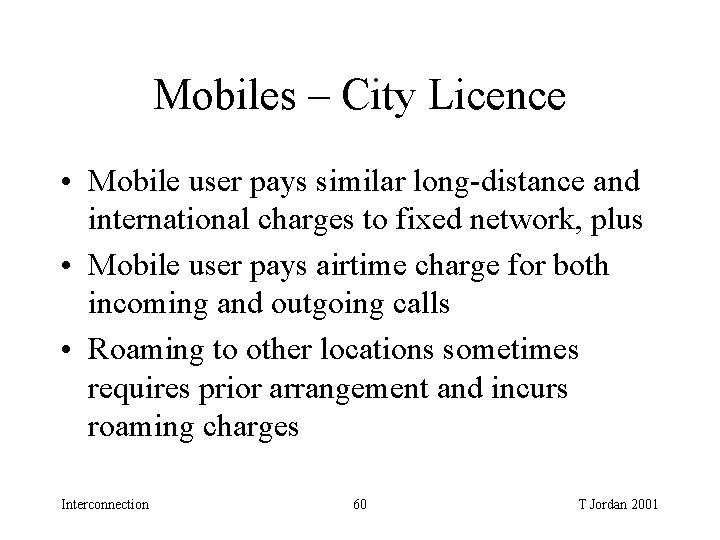
Mobiles – City Licence • Mobile user pays similar long-distance and international charges to fixed network, plus • Mobile user pays airtime charge for both incoming and outgoing calls • Roaming to other locations sometimes requires prior arrangement and incurs roaming charges Interconnection 60 T Jordan 2001
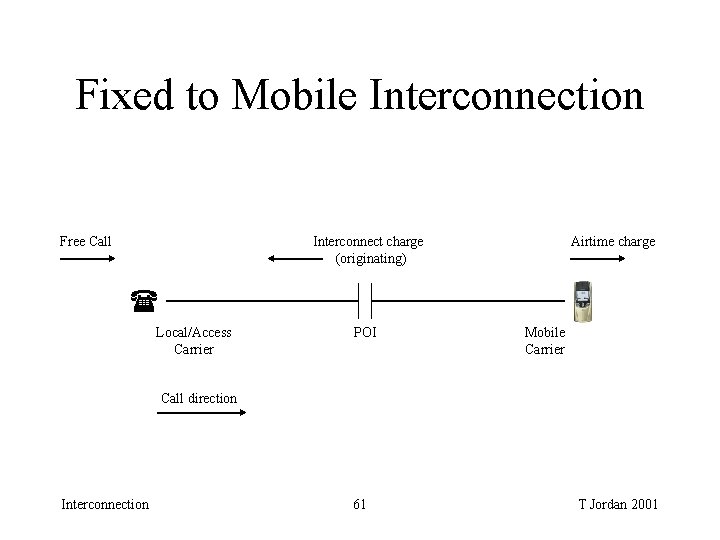
Fixed to Mobile Interconnection Free Call Interconnect charge (originating) Airtime charge Local/Access Carrier POI Mobile Carrier Call direction Interconnection 61 T Jordan 2001
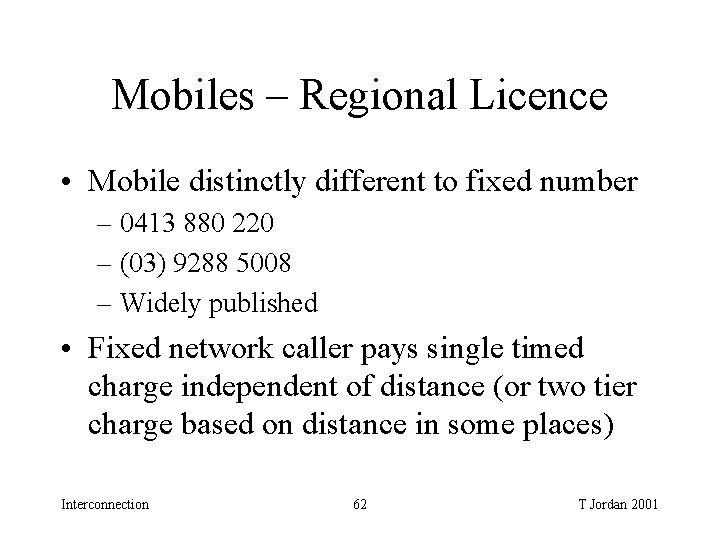
Mobiles – Regional Licence • Mobile distinctly different to fixed number – 0413 880 220 – (03) 9288 5008 – Widely published • Fixed network caller pays single timed charge independent of distance (or two tier charge based on distance in some places) Interconnection 62 T Jordan 2001
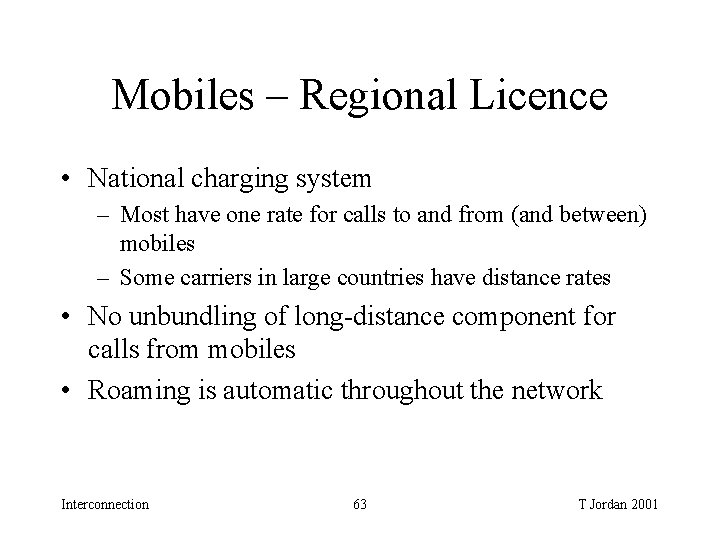
Mobiles – Regional Licence • National charging system – Most have one rate for calls to and from (and between) mobiles – Some carriers in large countries have distance rates • No unbundling of long-distance component for calls from mobiles • Roaming is automatic throughout the network Interconnection 63 T Jordan 2001
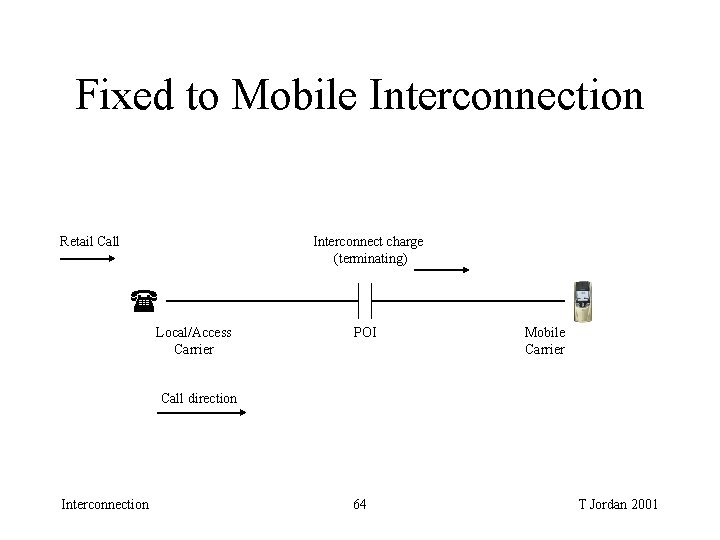
Fixed to Mobile Interconnection Retail Call Interconnect charge (terminating) Local/Access Carrier POI Mobile Carrier Call direction Interconnection 64 T Jordan 2001
Mobiles Interconnection • Mobile networks tend to be highly centralized and less distributed than fixed networks • Typically one or more switches in a large population centre with extensive transmission to base stations in the surrounding area • Interconnection is highly centralized Interconnection 65 T Jordan 2001
Mobiles Interconnection • Interconnection rates of about 30% of retail are typical in Australia • Comparison is difficult because of the complex retail tariffing – Retail charges vary by a factor of 4: 1 – Retail charges include a component for mobile handset subsidy Interconnection 66 T Jordan 2001
Mobiles Interconnection • Terminating carrier provides the longdistance component, but more than 80% of traffic is switched locally Interconnection 67 T Jordan 2001
Equal Access - Preselection • Automatic selection of long-distance operator without extra dialled digits • Normal number dialled (local, national or international format) • Selected types of calls are automatically routed to a selected long-distance carrier • Mostly used by small/single line customers • Can be overridden by dial code Interconnection 68 T Jordan 2001
Equal Access - Dial Code • Long-distance carrier is selected for each call using additional dialled digits before national or international number • Code can be dialled before any number the user chooses (including inappropriate numbers) – Sometimes the code will be ignored – emergency number – Sometimes the call will fail – local calls and carrier specific numbers Interconnection 69 T Jordan 2001
Equal Access – Dial Code • Managed by customers • No records kept by carriers • Used by large customers with PBX least cost routing systems • Less convenient for small customers who forget to dial additional digits or do not understand when to do so Interconnection 70 T Jordan 2001
Equal Access - Issues • Industry agreement required on technical and administrative operation • All carrier networks must operate the same way • Difficult for niche carriers that handle particular types of call and do not want all preselectable calls – International traffic to specific locations Interconnection 71 T Jordan 2001
Equal Access - Issues • Which calls should be be preselected – National long distance – International – Mobile (more later) • Multiple baskets – Independent selection of carrier for each class of call – Number of baskets, combination of call types Interconnection 72 T Jordan 2001
Equal Access - Issues • Major issues are administrative rather than technical • Initial arrangements – Ballot – Default • Authoritative record of preselection • Slamming Interconnection 73 T Jordan 2001
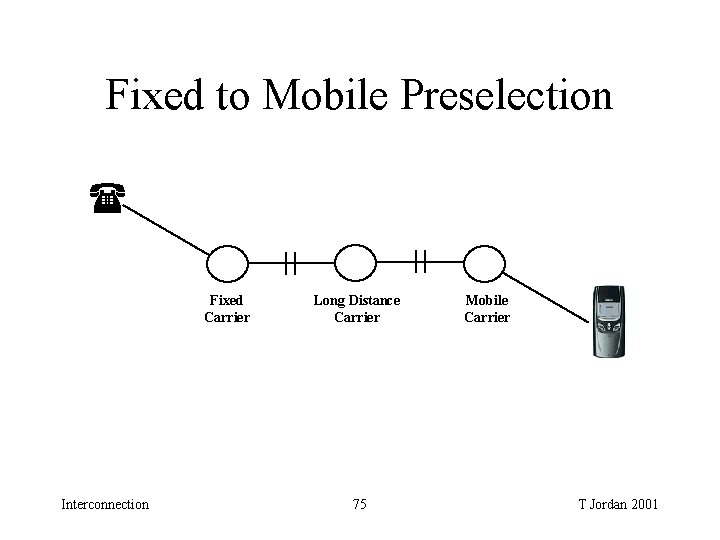
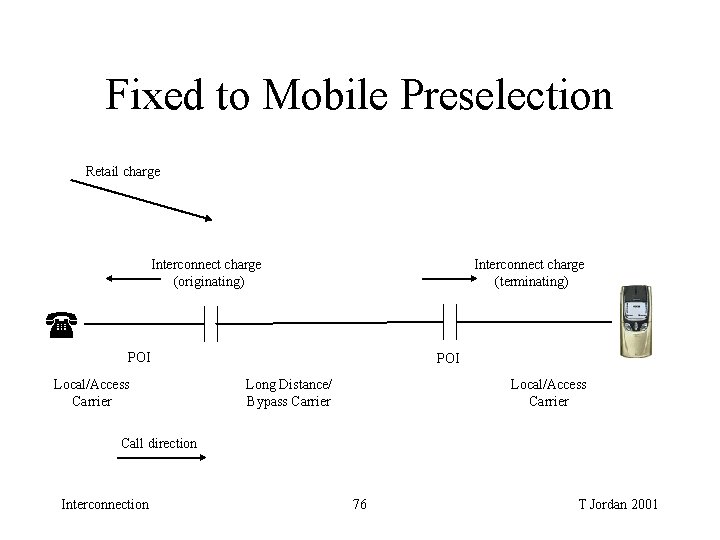
Mobiles Preselection • Fixed to mobile preselection – Opens fixed to mobile charges to increased competition – Fixed to mobiles traffic rivals long-distance revenue – Call passes straight through the bypass carrier and on to terminating mobile carrier, with the bypass carrier contributing nothing to the carriage of the call Interconnection 74 T Jordan 2001
Fixed to Mobile Preselection Fixed Carrier Interconnection Long Distance Carrier 75 Mobile Carrier T Jordan 2001
Fixed to Mobile Preselection Retail charge Interconnect charge (originating) Interconnect charge (terminating) POI Local/Access Carrier POI Long Distance/ Bypass Carrier Local/Access Carrier Call direction Interconnection 76 T Jordan 2001
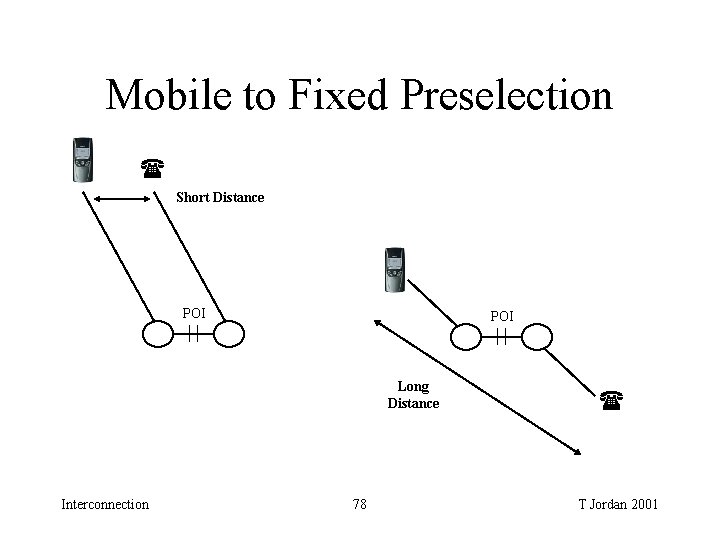
Mobiles Preselection • Mobile to fixed preselection – Difficult to implement – Generally no preselection on mobile networks – No concept of a distinct long-distance call within the mobile coverage area (would work with international calls) – Same charges for short and long-distances Interconnection 77 T Jordan 2001
Mobile to Fixed Preselection Short Distance POI Long Distance Interconnection 78 T Jordan 2001
Quality of Service • Major performance issues for voice telephony is congestion • Digital networks ensure that most performance requirements are maintained across interconnect boundary • Need for national standard for transmission level and a national number plan Interconnection 79 T Jordan 2001
Quality of Service • The carrier providing the traffic is responsible for ensuring that there are sufficient circuits to terminate the traffic that it expects to send to that other carrier • The carrier originating the traffic determines it s own fate through forecasting and paying for sufficient circuits Interconnection 80 T Jordan 2001
Issues - ISP Traffic • Very long held calls from Local Access Carrier to Internet Service Provider • Little or no traffic in the opposite direction • Free or fixed price local calls • Very large flow of revenue to ISP – Cap termination charges (fixed price) – Reverse interconnection charge Interconnection 81 T Jordan 2001
Issues - ISP Traffic • Dial up traffic may diminish with increasing use of DSL to provide permanent broadband connections • South Korea currently has more than 50% permanent broadband internet connections Interconnection 82 T Jordan 2001