
Results of the follow up questionnaire Trevor Boal
Results of the follow up questionnaire Trevor Boal
Contents • RER 9136 • Questionnaire – 2014 • Follow-up Questionnaire - 2017 • Radon Policies and Strategies • Radon in Civil Engineering • Measurement of Radon • Radon Surveys • Radon Awareness • Education
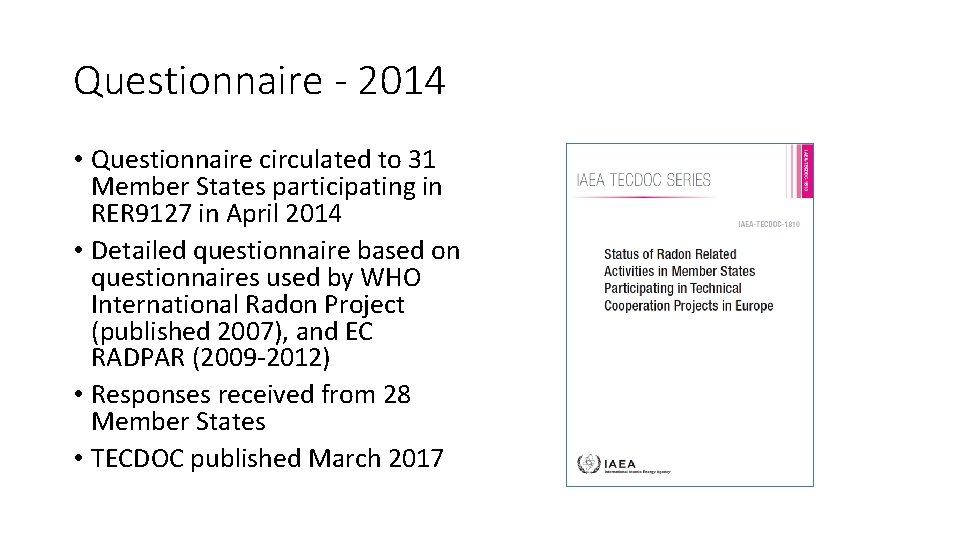
Questionnaire - 2014 • Questionnaire circulated to 31 Member States participating in RER 9127 in April 2014 • Detailed questionnaire based on questionnaires used by WHO International Radon Project (published 2007), and EC RADPAR (2009 -2012) • Responses received from 28 Member States • TECDOC published March 2017
Follow-up Questionnaire – 2017 • Questionnaire, based on the 2014 questionnaire • Fewer questions • Questionnaire sent to 31 Member States • Responses received from 27 Member States • c. f. 2014: no response from Poland Kyrgyzstan • c. f. 2014, response from Uzbekistan • Preliminary Analysis
Topics • Key topics in developing a national radon action plan / national strategy • • • Radon Policies and Strategies Radon in Civil Engineering Measurement of Radon Surveys Radon Awareness Education
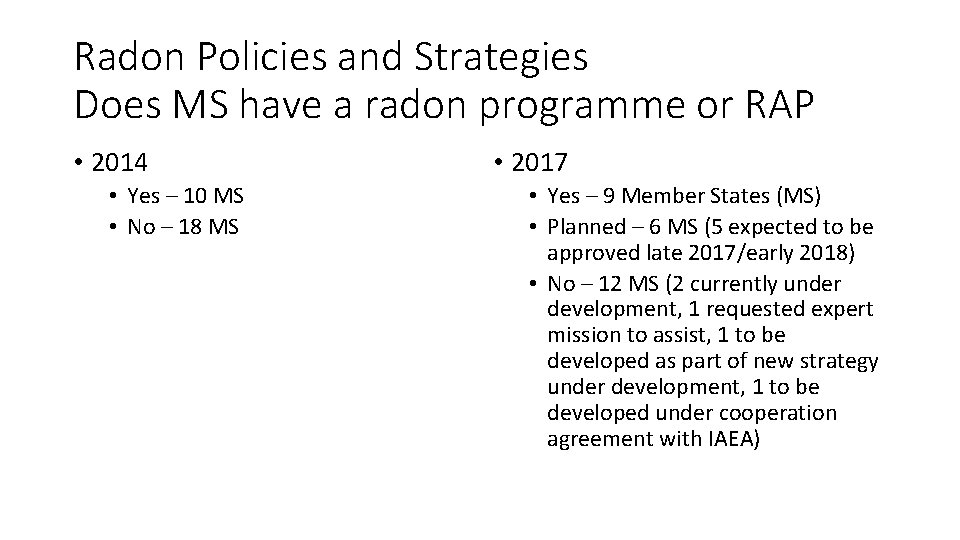
Radon Policies and Strategies Does MS have a radon programme or RAP • 2014 • Yes – 10 MS • No – 18 MS • 2017 • Yes – 9 Member States (MS) • Planned – 6 MS (5 expected to be approved late 2017/early 2018) • No – 12 MS (2 currently under development, 1 requested expert mission to assist, 1 to be developed as part of new strategy under development, 1 to be developed under cooperation agreement with IAEA)
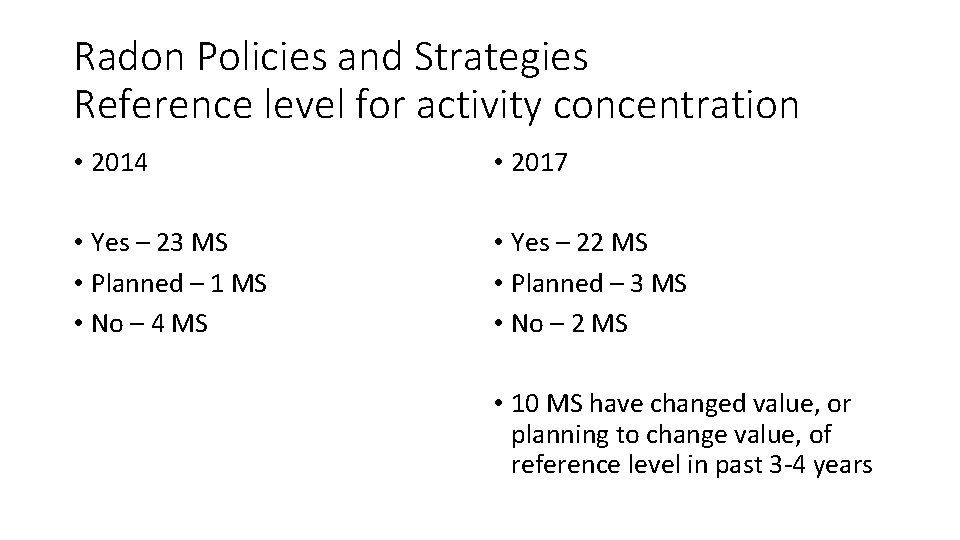
Radon Policies and Strategies Reference level for activity concentration • 2014 • 2017 • Yes – 23 MS • Planned – 1 MS • No – 4 MS • Yes – 22 MS • Planned – 3 MS • No – 2 MS • 10 MS have changed value, or planning to change value, of reference level in past 3 -4 years
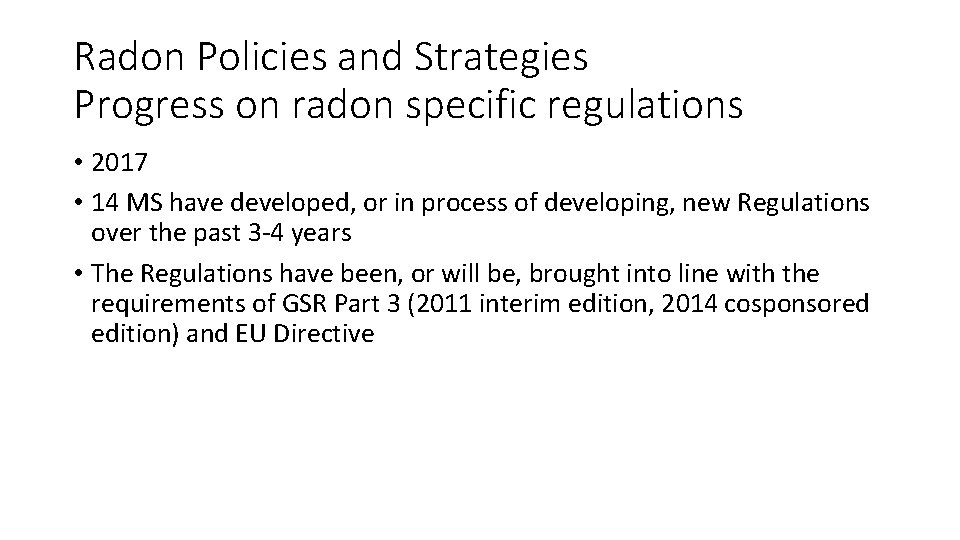
Radon Policies and Strategies Progress on radon specific regulations • 2017 • 14 MS have developed, or in process of developing, new Regulations over the past 3 -4 years • The Regulations have been, or will be, brought into line with the requirements of GSR Part 3 (2011 interim edition, 2014 cosponsored edition) and EU Directive
Radon Policies and Strategies Radon prone area specified • 2014 • Yes – 8 MS • Planned – 1 MS • No – 19 MS • 2017 • Yes – 4 MS • Planned / under discussion – 6 MS • No – 17 MS • It appears that the development of new regulations has lead to some MS changing definition of “radon prone area”, and that decision still to be made in some MS.
Radon in Civil Engineering Are any radon related actions in civil engineering carried out in your country • 2014 • Yes – 8 MS • Planned – 2 MS • No – 17 MS • 2017 • Yes – 10 MS • Planned – 3 MS • No – 14 MS
Radon in Civil Engineering Member States with building codes / standard • 5 MS • • • Belarus Czech Republic Estonia Russian Federation Slovenia • 8 MS • • Belarus Czech Republic Estonia Kazakhstan Lithuania Russian Federation Slovakia Slovenia
Measurement of Radon Measurement devices, Metrology • 2017 • Passive detectors routinely available: • Cr-39, LR 115, SSNTD; activity conc. ; closed chambers – 18 MS • Charcoal canisters; activity conc. ; closed chambers – 1 MS • No detectors routinely available – 8 MS • How are measurements results used: • • • Mapping – 22 MS Communication campaigns – 12 MS Verification of corrective actions / preventive measures – 6 MS Scientific research – 2 MS Specification of radon prone area – 1 MS No information provided – 3 MS
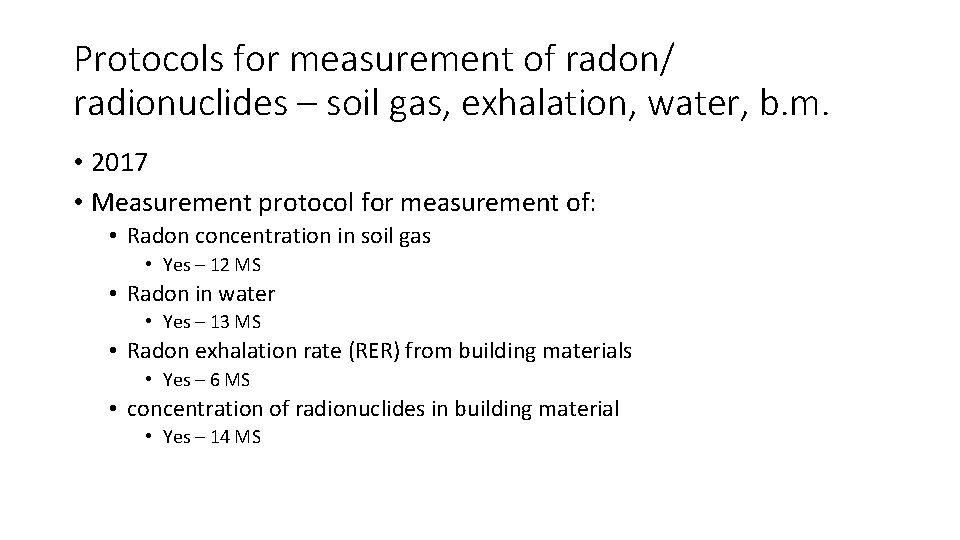
Protocols for measurement of radon/ radionuclides – soil gas, exhalation, water, b. m. • 2017 • Measurement protocol for measurement of: • Radon concentration in soil gas • Yes – 12 MS • Radon in water • Yes – 13 MS • Radon exhalation rate (RER) from building materials • Yes – 6 MS • concentration of radionuclides in building material • Yes – 14 MS
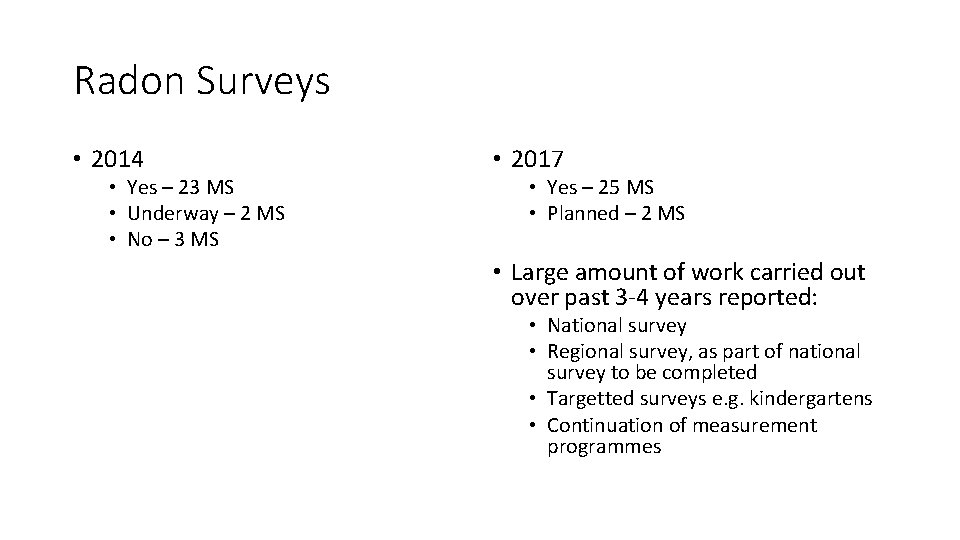
Radon Surveys • 2014 • Yes – 23 MS • Underway – 2 MS • No – 3 MS • 2017 • Yes – 25 MS • Planned – 2 MS • Large amount of work carried out over past 3 -4 years reported: • National survey • Regional survey, as part of national survey to be completed • Targetted surveys e. g. kindergartens • Continuation of measurement programmes
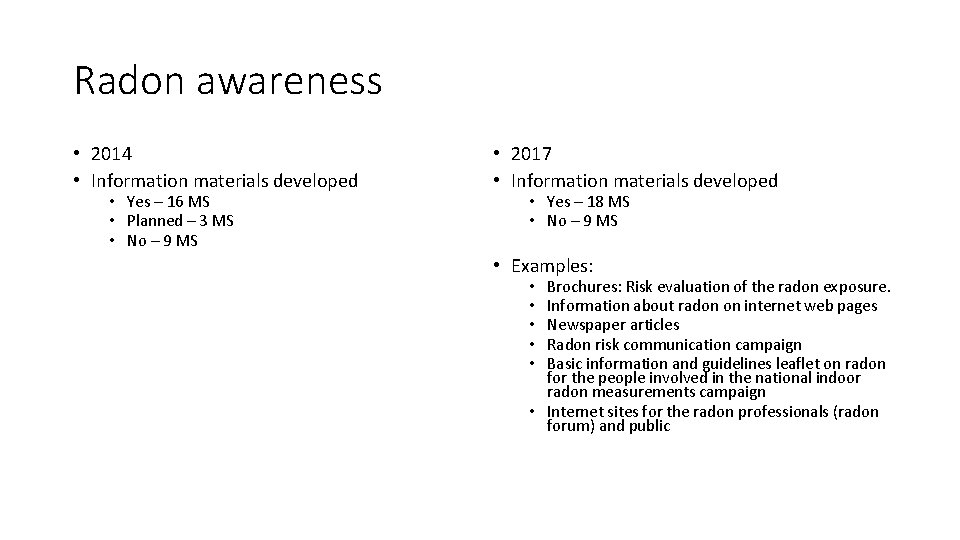
Radon awareness • 2014 • Information materials developed • Yes – 16 MS • Planned – 3 MS • No – 9 MS • 2017 • Information materials developed • Yes – 18 MS • No – 9 MS • Examples: Brochures: Risk evaluation of the radon exposure. Information about radon on internet web pages Newspaper articles Radon risk communication campaign Basic information and guidelines leaflet on radon for the people involved in the national indoor radon measurements campaign • Internet sites for the radon professionals (radon forum) and public • • •
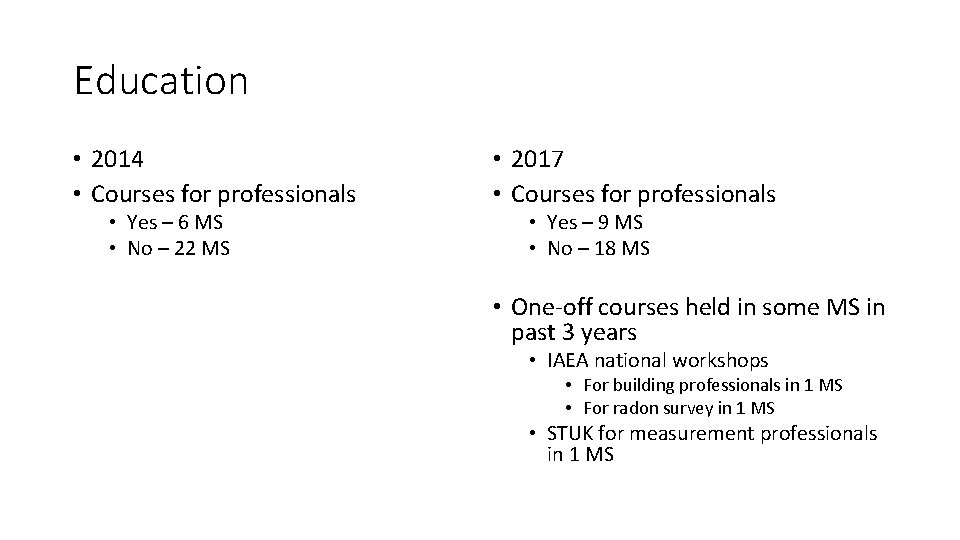
Education • 2014 • Courses for professionals • Yes – 6 MS • No – 22 MS • 2017 • Courses for professionals • Yes – 9 MS • No – 18 MS • One-off courses held in some MS in past 3 years • IAEA national workshops • For building professionals in 1 MS • For radon survey in 1 MS • STUK for measurement professionals in 1 MS
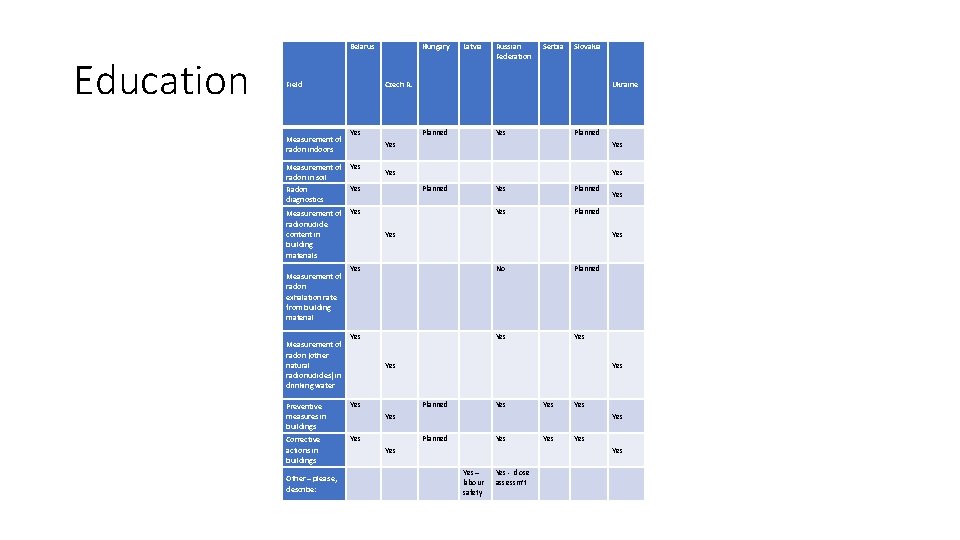
Belarus Education Field Measurement of radon indoors Yes Serbia Slovakia Ukraine Planned Yes Planned Yes Yes No Corrective actions in buildings Yes Yes Yes Planned Yes Yes Yes Planned Yes Yes Preventive measures in buildings Other – please, describe: Russian Federation Yes radionuclide content in building materials Measurement of radon (other natural radionuclides) in drinking water Latvia Czech R. Measurement of Yes radon in soil Yes Radon diagnostics Measurement of Yes Measurement of radon exhalation rate from building material Hungary Yes – labour safety Yes - dose assessm’t
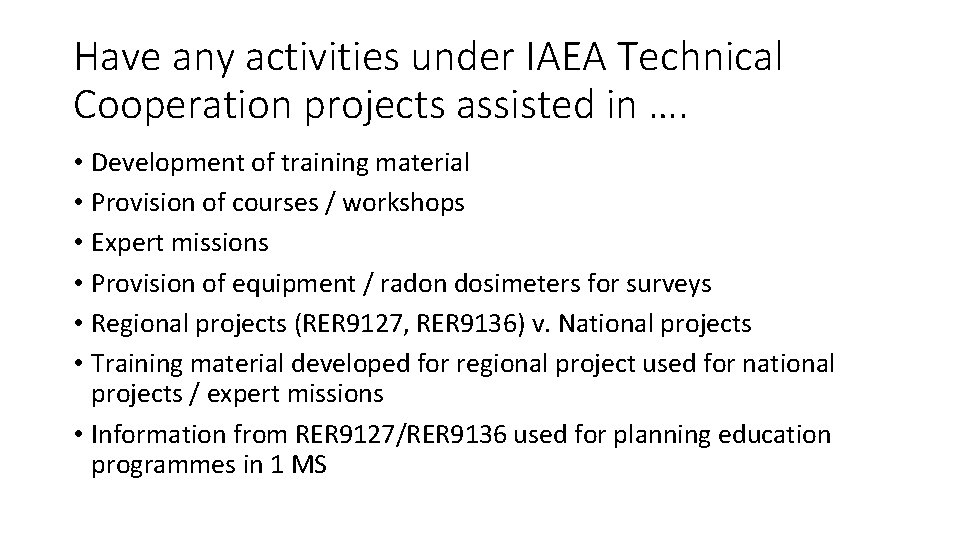
Have any activities under IAEA Technical Cooperation projects assisted in …. • Development of training material • Provision of courses / workshops • Expert missions • Provision of equipment / radon dosimeters for surveys • Regional projects (RER 9127, RER 9136) v. National projects • Training material developed for regional project used for national projects / expert missions • Information from RER 9127/RER 9136 used for planning education programmes in 1 MS
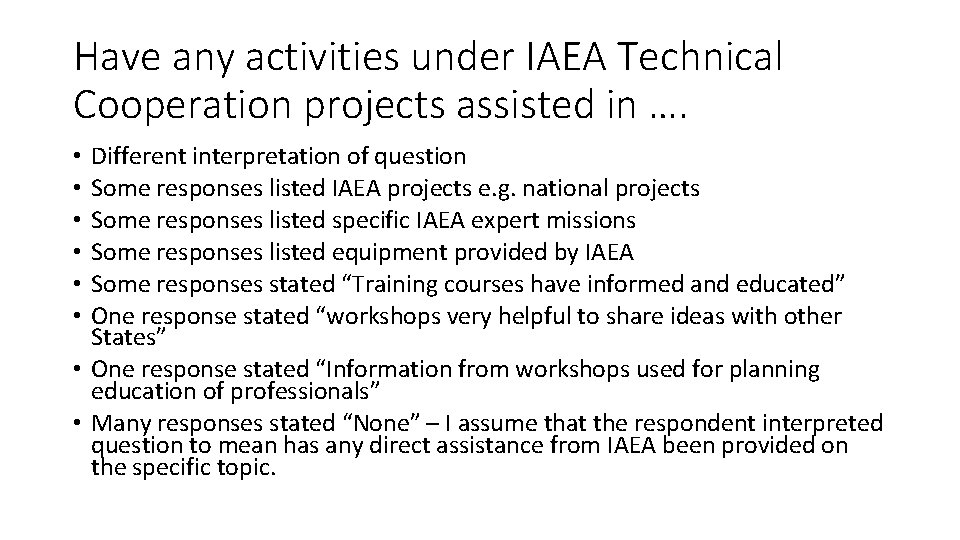
Have any activities under IAEA Technical Cooperation projects assisted in …. Different interpretation of question Some responses listed IAEA projects e. g. national projects Some responses listed specific IAEA expert missions Some responses listed equipment provided by IAEA Some responses stated “Training courses have informed and educated” One response stated “workshops very helpful to share ideas with other States” • One response stated “Information from workshops used for planning education of professionals” • Many responses stated “None” – I assume that the respondent interpreted question to mean has any direct assistance from IAEA been provided on the specific topic. • • •
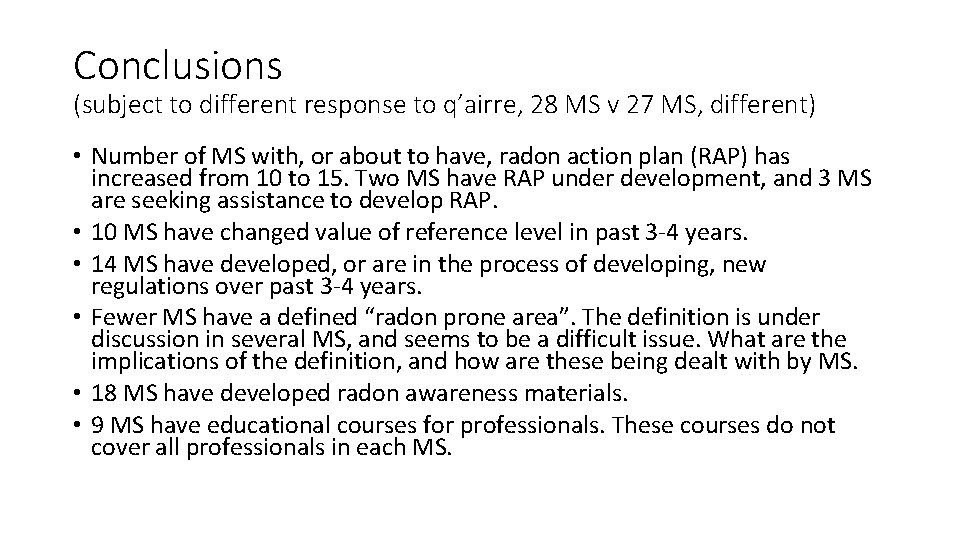
Conclusions (subject to different response to q’airre, 28 MS v 27 MS, different) • Number of MS with, or about to have, radon action plan (RAP) has increased from 10 to 15. Two MS have RAP under development, and 3 MS are seeking assistance to develop RAP. • 10 MS have changed value of reference level in past 3 -4 years. • 14 MS have developed, or are in the process of developing, new regulations over past 3 -4 years. • Fewer MS have a defined “radon prone area”. The definition is under discussion in several MS, and seems to be a difficult issue. What are the implications of the definition, and how are these being dealt with by MS. • 18 MS have developed radon awareness materials. • 9 MS have educational courses for professionals. These courses do not cover all professionals in each MS.
Issues for consideration • 15 MS have, or are about to have, a radon action plan • BUT • Radon related activities in civil engineering carried out in 10 MS, and are planned in 3 MS. Only 8 MS have radon in building codes. How are civil engineering issues addressed in the radon action plan. • Education of professionals carried out in 9 MS. How is the issue of training and competence of measurement professionals and building professionals addressed in the radon action plan?
Next steps • Trevor Boal to finalise analysis of questionnaires and prepare first draft of report. I wish to clarify issues with participants this week. I still need to develop text for each topic and I would appreciate the views of the participants this week, particularly to issues identified. • Olga German to review draft report • Olga to circulate draft to national experts for comment • Olga to review comments and finalise report

• Thank you
- Slides: 23