
DTE Energy Cost and Affordability Trevor F Lauer
DTE Energy Cost and Affordability Trevor F. Lauer Marketing Executive Council
Cost and Affordability Customer Satisfaction Countermeasures Conclusion 2
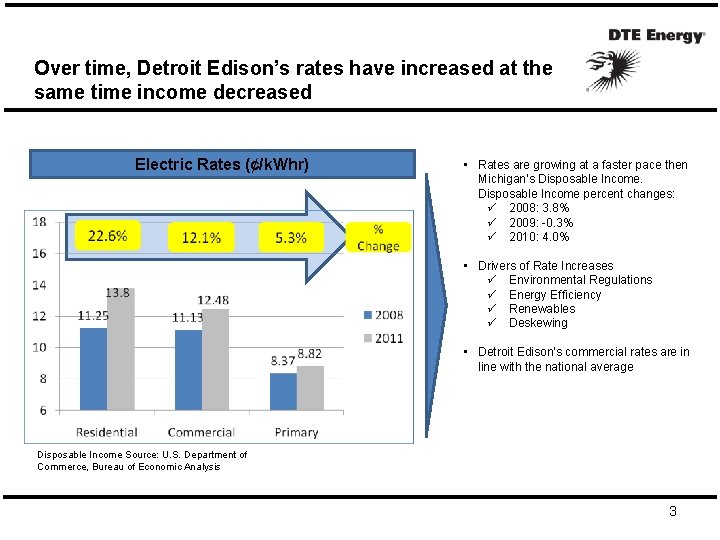
Over time, Detroit Edison’s rates have increased at the same time income decreased Electric Rates (¢/k. Whr) • Rates are growing at a faster pace then Michigan’s Disposable Income percent changes: ü 2008: 3. 8% ü 2009: -0. 3% ü 2010: 4. 0% • Drivers of Rate Increases ü Environmental Regulations ü Energy Efficiency ü Renewables ü Deskewing • Detroit Edison’s commercial rates are in line with the national average Disposable Income Source: U. S. Department of Commerce, Bureau of Economic Analysis 3
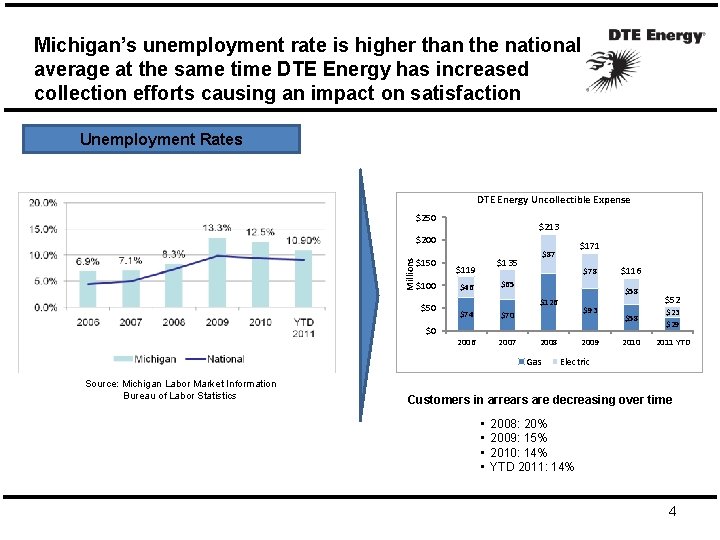
Michigan’s unemployment rate is higher than the national average at the same time DTE Energy has increased collection efforts causing an impact on satisfaction Unemployment Rates DTE Energy Uncollectible Expense $250 $213 Millions $200 $150 $100 $50 $0 $135 $119 $78 $65 $46 $74 $70 2006 2007 $116 $58 $126 $93 2008 Gas Source: Michigan Labor Market Information Bureau of Labor Statistics $171 $87 2009 $52 $58 $23 $29 2010 2011 YTD Electric Customers in arrears are decreasing over time • • 2008: 20% 2009: 15% 2010: 14% YTD 2011: 14% 4
Cost and Affordability Customer Satisfaction Countermeasures Conclusion 5
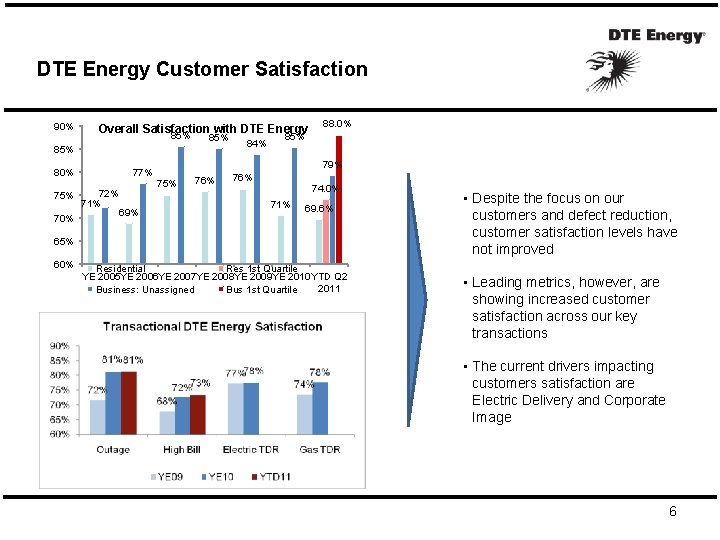
DTE Energy Customer Satisfaction 90% Overall Satisfaction with DTE Energy 85% 85% 80% 75% 70% 77% 72% 71% 69% 84% 88. 0% 85% 79% 75% 76% 74. 0% 71% 69. 6% 65% 60% Residential Res 1 st Quartile YE 2005 YE 2006 YE 2007 YE 2008 YE 2009 YE 2010 YTD Q 2 2011 Business: Unassigned Bus 1 st Quartile • Despite the focus on our customers and defect reduction, customer satisfaction levels have not improved • Leading metrics, however, are showing increased customer satisfaction across our key transactions • The current drivers impacting customers satisfaction are Electric Delivery and Corporate Image 6
Cost and Affordability Customer Satisfaction Countermeasures Conclusion 7
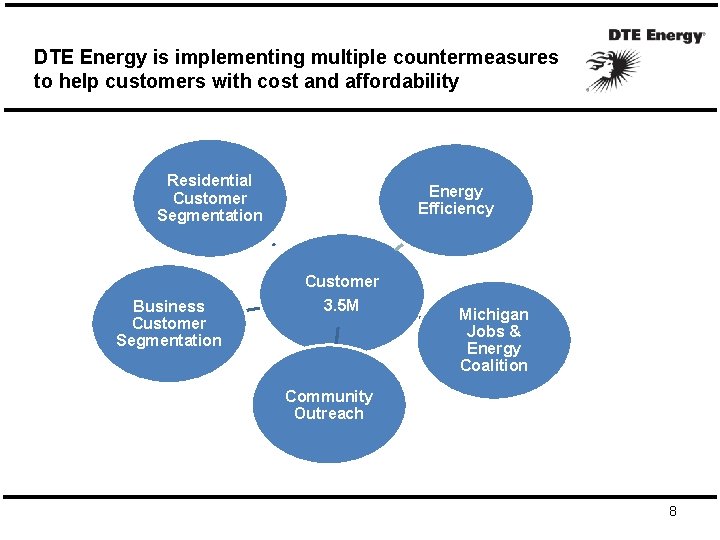
DTE Energy is implementing multiple countermeasures to help customers with cost and affordability Residential Customer Segmentation Business Customer Segmentation Energy Efficiency Customer 3. 5 M Michigan Jobs & Energy Coalition Community Outreach 8
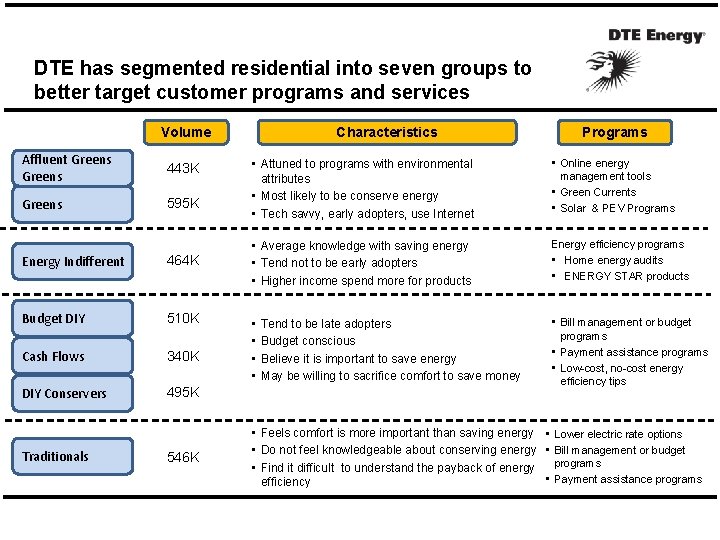
DTE has segmented residential into seven groups to better target customer programs and services Volume Affluent Greens 443 K Greens 595 K Energy Indifferent 464 K Budget DIY 510 K Cash Flows 340 K DIY Conservers 495 K Traditionals 546 K Characteristics Programs • Attuned to programs with environmental attributes • Most likely to be conserve energy • Tech savvy, early adopters, use Internet • Online energy management tools • Green Currents • Solar & PEV Programs • Average knowledge with saving energy • Tend not to be early adopters • Higher income spend more for products Energy efficiency programs • Home energy audits • ENERGY STAR products • • • Bill management or budget programs • Payment assistance programs • Low-cost, no-cost energy efficiency tips Tend to be late adopters Budget conscious Believe it is important to save energy May be willing to sacrifice comfort to save money • Feels comfort is more important than saving energy • Lower electric rate options • Do not feel knowledgeable about conserving energy • Bill management or budget programs • Find it difficult to understand the payback of energy • Payment assistance programs efficiency
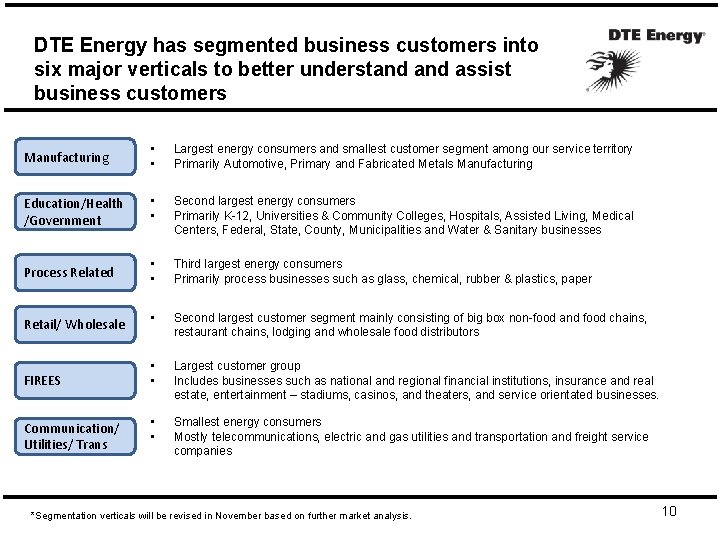
DTE Energy has segmented business customers into six major verticals to better understand assist business customers Manufacturing • • Largest energy consumers and smallest customer segment among our service territory Primarily Automotive, Primary and Fabricated Metals Manufacturing Education/Health /Government • • Second largest energy consumers Primarily K-12, Universities & Community Colleges, Hospitals, Assisted Living, Medical Centers, Federal, State, County, Municipalities and Water & Sanitary businesses Process Related • • Third largest energy consumers Primarily process businesses such as glass, chemical, rubber & plastics, paper • Second largest customer segment mainly consisting of big box non-food and food chains, restaurant chains, lodging and wholesale food distributors • • Largest customer group Includes businesses such as national and regional financial institutions, insurance and real estate, entertainment – stadiums, casinos, and theaters, and service orientated businesses. • • Smallest energy consumers Mostly telecommunications, electric and gas utilities and transportation and freight service companies Retail/ Wholesale FIREES Communication/ Utilities/ Trans *Segmentation verticals will be revised in November based on further market analysis. 10
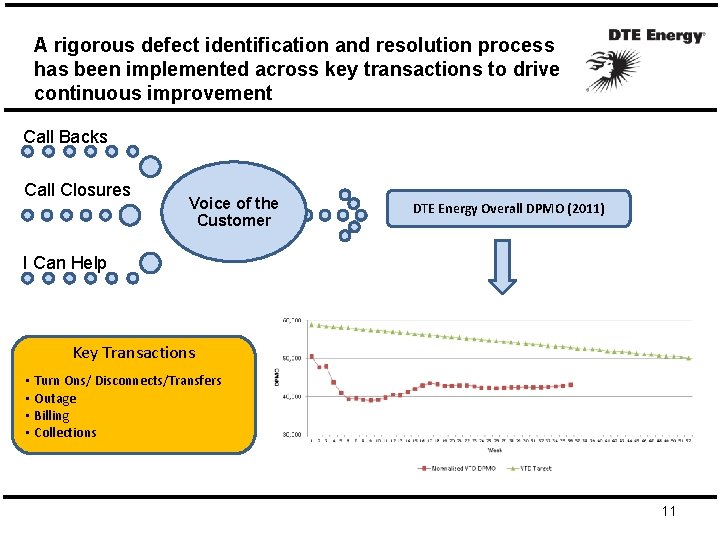
A rigorous defect identification and resolution process has been implemented across key transactions to drive continuous improvement Call Backs Call Closures Voice of the Customer DTE Energy Overall DPMO (2011) I Can Help Key Transactions • Turn Ons/ Disconnects/Transfers • Outage • Billing • Collections 11
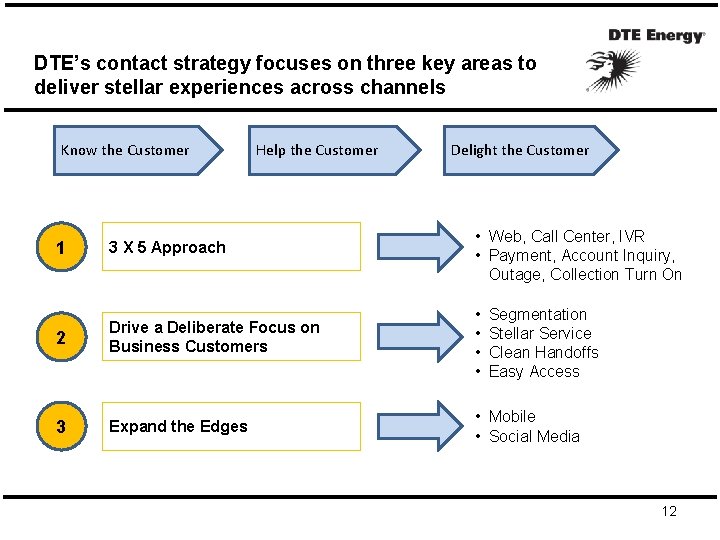
DTE’s contact strategy focuses on three key areas to deliver stellar experiences across channels Know the Customer 1 Help the Customer 3 X 5 Approach Delight the Customer • Web, Call Center, IVR • Payment, Account Inquiry, Outage, Collection Turn On 2 Drive a Deliberate Focus on Business Customers • • 3 Expand the Edges • Mobile • Social Media Segmentation Stellar Service Clean Handoffs Easy Access 12
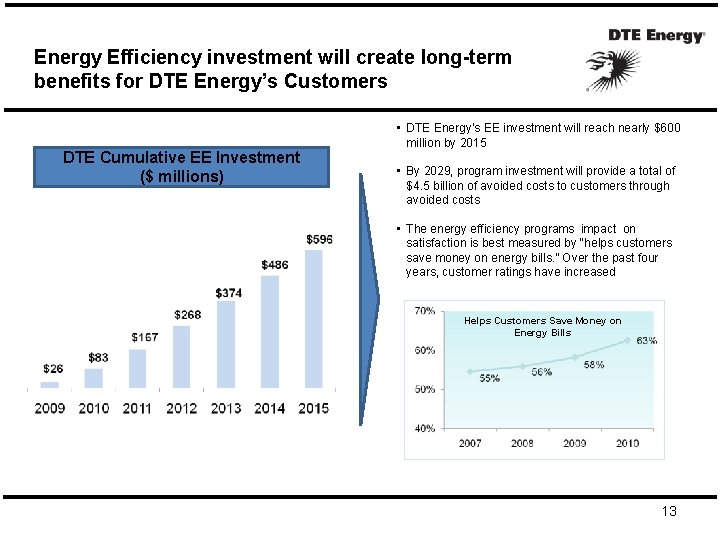
Energy Efficiency investment will create long-term benefits for DTE Energy’s Customers DTE Cumulative EE Investment ($ millions) • DTE Energy’s EE investment will reach nearly $600 million by 2015 • By 2029, program investment will provide a total of $4. 5 billion of avoided costs to customers through avoided costs • The energy efficiency programs impact on satisfaction is best measured by “helps customers save money on energy bills. ” Over the past four years, customer ratings have increased Helps Customers Save Money on Energy Bills 13
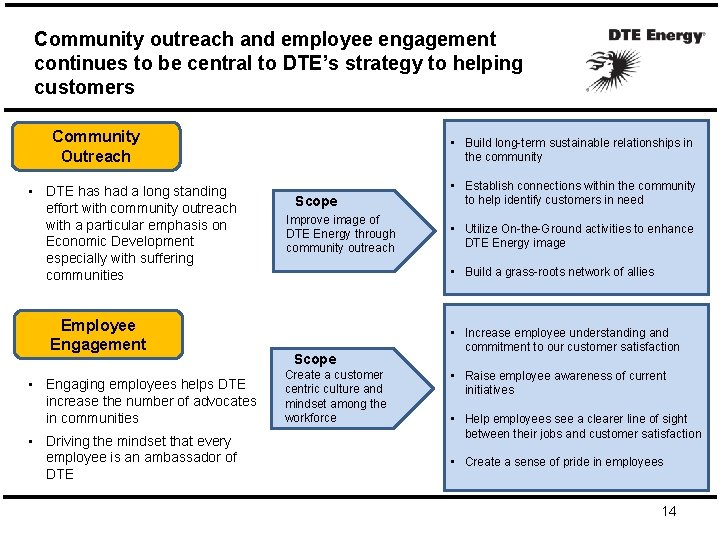
Community outreach and employee engagement continues to be central to DTE’s strategy to helping customers Community Outreach • DTE has had a long standing effort with community outreach with a particular emphasis on Economic Development especially with suffering communities Employee Engagement • Engaging employees helps DTE increase the number of advocates in communities • Driving the mindset that every employee is an ambassador of DTE • Build long-term sustainable relationships in the community Scope Improve image of DTE Energy through community outreach • Establish connections within the community to help identify customers in need • Utilize On-the-Ground activities to enhance DTE Energy image • Build a grass-roots network of allies Scope Create a customer centric culture and mindset among the workforce • Increase employee understanding and commitment to our customer satisfaction • Raise employee awareness of current initiatives • Help employees see a clearer line of sight between their jobs and customer satisfaction • Create a sense of pride in employees 14
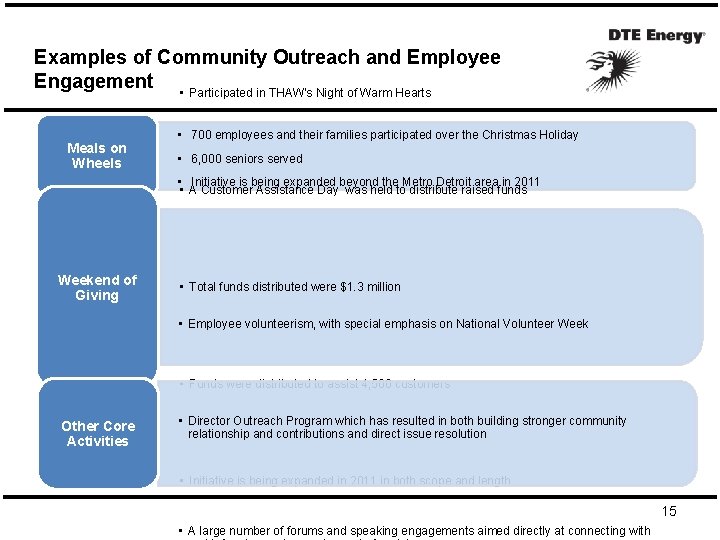
Examples of Community Outreach and Employee Engagement • Participated in THAW's Night of Warm Hearts Meals on Wheels • 700 employees and their families participated over the Christmas Holiday • 6, 000 seniors served • Initiative is being expanded beyond the Metro Detroit area in 2011 • A Customer Assistance Day was held to distribute raised funds Weekend of Giving • Total funds distributed were $1. 3 million • Employee volunteerism, with special emphasis on National Volunteer Week • Funds were distributed to assist 4, 500 customers Other Core Activities • Director Outreach Program which has resulted in both building stronger community relationship and contributions and direct issue resolution • Initiative is being expanded in 2011 in both scope and length 15 • A large number of forums and speaking engagements aimed directly at connecting with
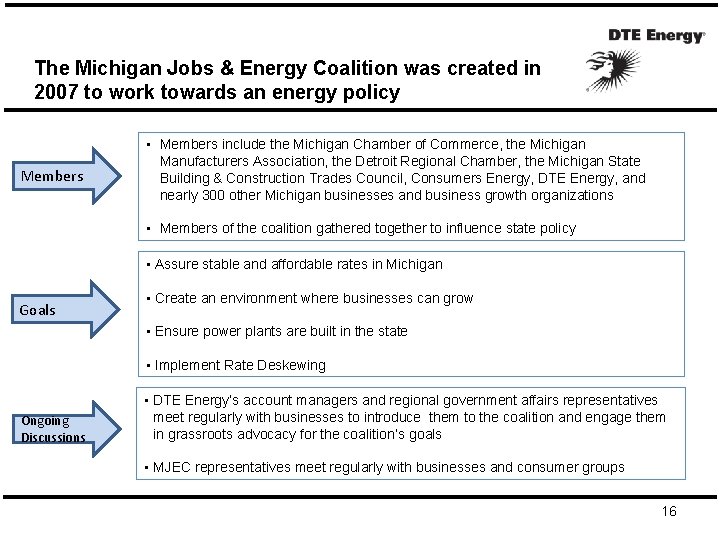
The Michigan Jobs & Energy Coalition was created in 2007 to work towards an energy policy Members • Members include the Michigan Chamber of Commerce, the Michigan Manufacturers Association, the Detroit Regional Chamber, the Michigan State Building & Construction Trades Council, Consumers Energy, DTE Energy, and nearly 300 other Michigan businesses and business growth organizations • Members of the coalition gathered together to influence state policy • Assure stable and affordable rates in Michigan Goals • Create an environment where businesses can grow • Ensure power plants are built in the state • Implement Rate Deskewing Ongoing Discussions • DTE Energy’s account managers and regional government affairs representatives meet regularly with businesses to introduce them to the coalition and engage them in grassroots advocacy for the coalition’s goals • MJEC representatives meet regularly with businesses and consumer groups 16
Cost and Affordability Customer Satisfaction Countermeasures Conclusion 17
Conclusion • Affordability continues to be a challenge in Michigan • DTE is committed to customer satisfaction by improving customer experiences through channel management and defect reduction • Continued focus on becoming the best operating utility across North America 18
- Slides: 18