
Intelligent Buildings Council IBC Chair Trevor Nightingale National

Intelligent Buildings Council (IBC) Chair: Trevor Nightingale (National Research Council) Vice-Chair: Robert Lane (Robert H. Lane and Associates Inc. ) Vice-Chair: Bob Allan (The Siemon Company) Vice-Chair: Harsha Chandrashekar (Honeywell International Inc) Feb 13, 2018
Agenda Greg Walker (CABA) 1. Agenda 2. Call to Order, Welcome, Introductions 3. Administrative 4. “Tax Incentives for Green Buildings” (30 min) 5. Research Update 6. White Paper Sub-Committee Update 7. Intelligent vs Conventional Building Cost Calculator Task Force 8. New Business 9. Announcements 10. Adjournment CABA Intelligent Buildings Council (IBC)
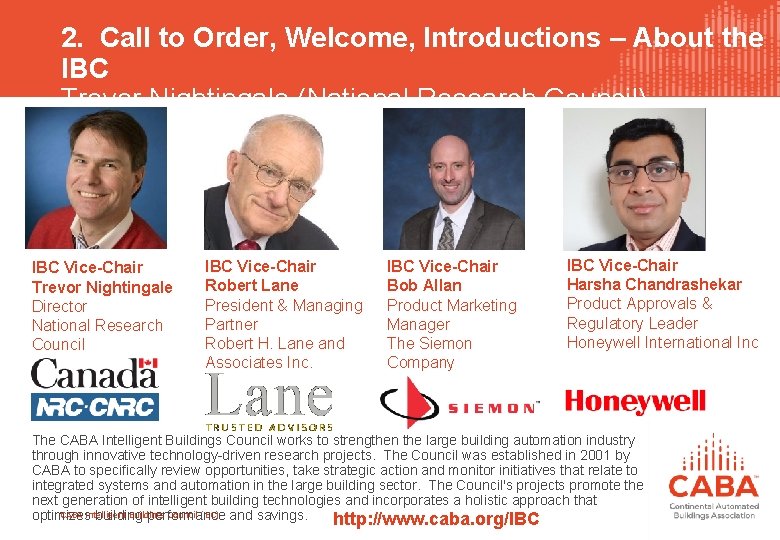
2. Call to Order, Welcome, Introductions – About the IBC Trevor Nightingale (National Research Council) IBC Vice-Chair Trevor Nightingale Director National Research Council IBC Vice-Chair Robert Lane President & Managing Partner Robert H. Lane and Associates Inc. IBC Vice-Chair Bob Allan Product Marketing Manager The Siemon Company IBC Vice-Chair Harsha Chandrashekar Product Approvals & Regulatory Leader Honeywell International Inc The CABA Intelligent Buildings Council works to strengthen the large building automation industry through innovative technology-driven research projects. The Council was established in 2001 by CABA to specifically review opportunities, take strategic action and monitor initiatives that relate to integrated systems and automation in the large building sector. The Council's projects promote the next generation of intelligent building technologies and incorporates a holistic approach that CABA Intelligent Buildings Council (IBC) optimizes building performance and savings. http: //www. caba. org/IBC
3. Administrative Trevor Nightingale (National Research Council) 3. 1 Motion to approve past IBC Minutes: www. caba. org/IBC CABA Intelligent Buildings Council (IBC)
4. “Tax Incentives for Green Buildings” (30 min) CABA Intelligent Buildings Council (IBC)
Tax Incentives for Green Buildings © MS Consultants, LLC 2018
Energy Efficiency Tax Incentives What is § 179 D? • A tax deduction for energy-efficient expenditures made to depreciable commercial, government/municipal, or large (3+ stories) residential buildings that reduce energy use by 50% compared with similar structure built to ASHRAE/IES Standard 90. 1 -2001. • NOTE: Beginning in 2016 a taxpayer must utilize ASHRAE/IES Standard 90. 1 -2007. • Maximum deduction: $1. 80/SF Ø Partial deductions allowable of $0. 60/SF for buildings that do not meet overall threshold but have systems which are individually energy efficient © MS Consultants, LLC 2018
Energy Efficiency Tax Incentives § 179 D – A Brief History • The Energy Policy Act of 2005 (EPAct) established § 179 D • Notice 2006 -52 established the ground rules: Ømethods of modeling, simulation, and calculation of savings ØRequirements for certification and certifiers • Notice 2008 -40 refined rules, introduced alternative percentages for partial calculations, and introduced special rule for government buildings • Notice 2012 -22 established further changes to partial © MS Consultants, LLC 2018 qualifications
Energy Efficiency Tax Incentives What qualifies under § 179 D? • Buildings constructed or improved between January 1, 2006 and December 31, 2016 are eligible for deductions – Tax Extender is in legislation currently, watch for a February 2018 passage for projects completed in 2017 and 2018 • Owner of a building, or lessee who installs energyefficient systems Ø If multiple taxpayers install energy-efficient systems in the same building, the deduction may be split between them, as long as the total deduction does not exceed the maximum $1. 80/SF © MS Consultants, LLC 2018
Energy Efficiency Tax Incentives Who is eligible for the deduction? • For government-owned buildings, the deduction may be taken by the designer of the building or system qualifying for the deduction • NOTE-IRS Code Section 501(C)(3) organizations are not eligible. This means tax-exempt or non-profits do not qualify. © MS Consultants, LLC 2018
Energy Efficiency Tax Incentives Energy Efficient Systems • Three building systems are scrutinized under § 179 D: – Building envelope (exterior walls, insulation, roof, windows, doors, foundation, slab, and more) – Building HVAC (heating, venting, and air conditioning) and hot water systems – Building interior lighting systems © MS Consultants, LLC 2018
Energy Efficiency Tax Incentives Certification Process • Plans and technical documentation are examined, and a site visit must be conducted to verify accuracy • Models are created using IRS-approved software: Ø The actual building, including full details on construction, mechanical systems, and lighting Ø A similar reference building built to ASHRAE/IES Standard 90. 1 -2007 Ø If the overall building does not meet the 50% energy reduction threshold, three more models are created isolating the building envelope, HVAC systems, and lighting systems respectively, and compared against the reference building to determine partial qualification © MS Consultants, LLC 2018
Energy Efficiency Tax Incentives Certification Process • Once the models are created, full-year simulations are run to test the design, the installed systems, and the resultant energy use • The simulations include climate variations, hourly variations in occupancy (and corresponding variations in lighting and HVAC energy use), thermal mass effects, and more © MS Consultants, LLC 2018
Energy Efficiency Tax Incentives Partially Qualifying Systems • If the overall 50% target is not met, the three individual systems are tested against different percentages depending on when the building was constructed or improved • The IRS has adjusted the individual percentages based on feedback—for instance, over time it has lowered the target for building envelope (as that has been the most difficult to qualify) while raising the target for lighting (as that has been the easiest) © MS Consultants, LLC 2018
Energy Efficiency Tax Incentives So many options There are eleven different ways to take advantage of § 179 D: 1: Fully-qualifying property with 50% energy efficiency 2 -10: Nine different ways to achieve partial qualifications by systems (depending on efficiency and year placed in service) 11: Interim lighting rule – allows for measurement of lighting power density (watts/SF) © MS Consultants, LLC 2018
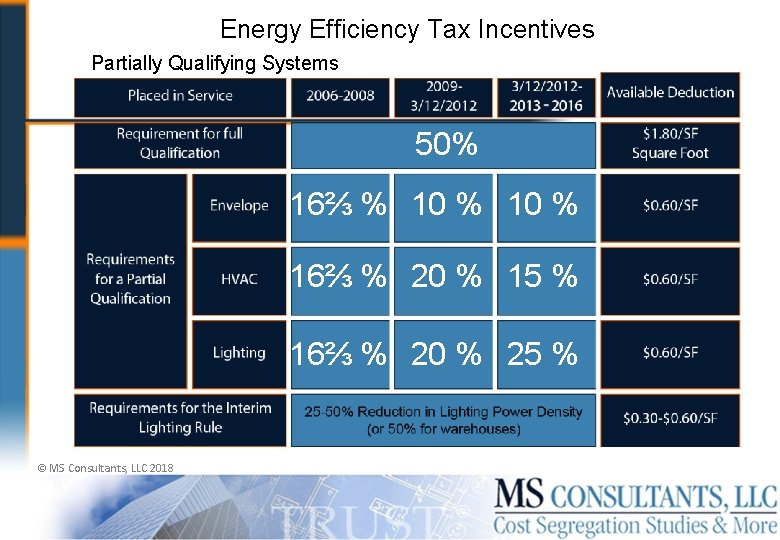
Energy Efficiency Tax Incentives Partially Qualifying Systems 50% 16⅔ % 10 % 16⅔ % 20 % 15 % 16⅔ % 20 % 25 % © MS Consultants, LLC 2018
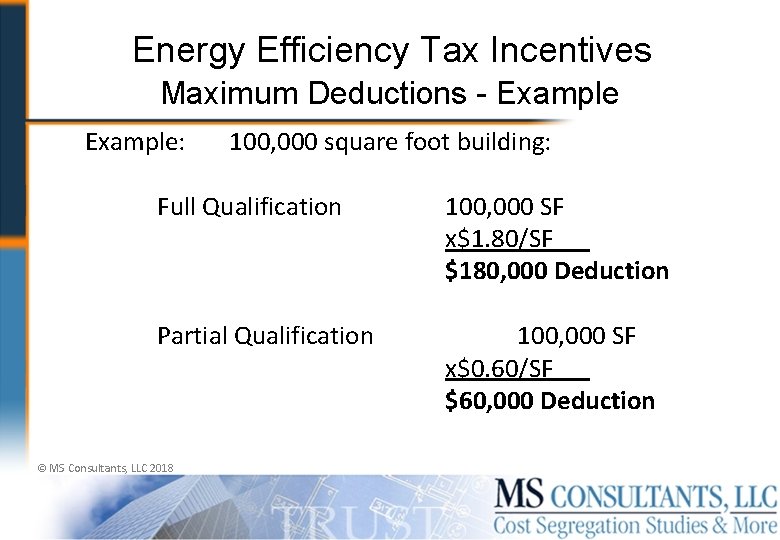
Energy Efficiency Tax Incentives Maximum Deductions - Example: 100, 000 square foot building: Full Qualification . 100, 000 SF x$1. 80/SF . $180, 000 Deduction Partial Qualification . 100, 000 SF x$0. 60/SF . $60, 000 Deduction © MS Consultants, LLC 2018
Energy Efficiency Tax Incentives § 179 D for Architects & Designers • With Notice 2008 -40, the IRS solidified its rules allowing architects, designers, and builders to take advantage of § 179 D for government-owned buildings. Because of this, we’ve seen a large influx of these projects. • Any project built since 2006 could potentially qualify, and most modern buildings qualify for at least one of the three systems © MS Consultants, LLC 2018
Energy Efficiency Tax Incentives § 45 L: Energy Efficient Residences • Established under the Energy Policy Act (EPAct) of 2005 • Extended four times, most recently through the PATH Act of 2015 – with a sunset of 12/31/16 but watch for the extender through 12/31/18 • While § 179 D is a deduction, § 45 L offers a credit • Available for any dwelling (residential unit) of 3 stories or less – houses, duplexes, apartment buildings, senior housing, etc. • Applicable for open tax years – unfortunately cannot use a form 3115 to go further back © MS Consultants, LLC 2018
Energy Efficiency Tax Incentives § 45 L: Energy Efficient Residences • Like § 179 D, § 45 L requires units to achieve 50% energy savings. ØHowever, savings are compared against 2006 IECC standards rather than 2007 ASHRAE/IES (2012 change, previously 2003 IECC standards) ØAdditionally, § 45 L requires 10% savings from the building shell as well—having super-efficient lighting and HVAC systems alone are not enough © MS Consultants, LLC 2018
Tax Cuts & Jobs Act Expansion of § 179 Expensing • The new tax law increases the maximum amount a taxpayer may expense under § 179 to $1 million and increases the phase-out threshold amount to $2. 5 million (previously was $500, 000 with a phase-out at $2. 0 million) • The $1 million and $2. 5 million amounts will be indexed for inflation for taxable years beginning after 2018 • Starting in 2018, § 179 can be used for qualified property including HVAC systems © MS Consultants, LLC 2018
Tax Cuts & Jobs Act Bonus Depreciation • Taxpayers are able to expense 100% of the cost of qualified property acquired and placed in service after September 27, 2017 and before January 1, 2023. – After that it decreases by 20% per year resulting in no bonus in 2027…Or at least not yet • Provision expands the property eligible for immediate expensing to include used property • Like the prior law, asset class life must be 20 years or less © MS Consultants, LLC 2018
Tax Cuts & Jobs Act Bonus Depreciation • Acquired property: – No Bonus allowed prior to 9/27/17 – Bonus allowed after 9/27/17 – Bonus can be taken at 50% or 100% between 9/28/17 and 12/31/17 © MS Consultants, LLC 2018
Tax Cuts & Jobs Act Bonus Depreciation • Why is this important to you? – Let’s go through an example of a building acquired in 2017 with a depreciable basis of $5, 000 © MS Consultants, LLC 2018
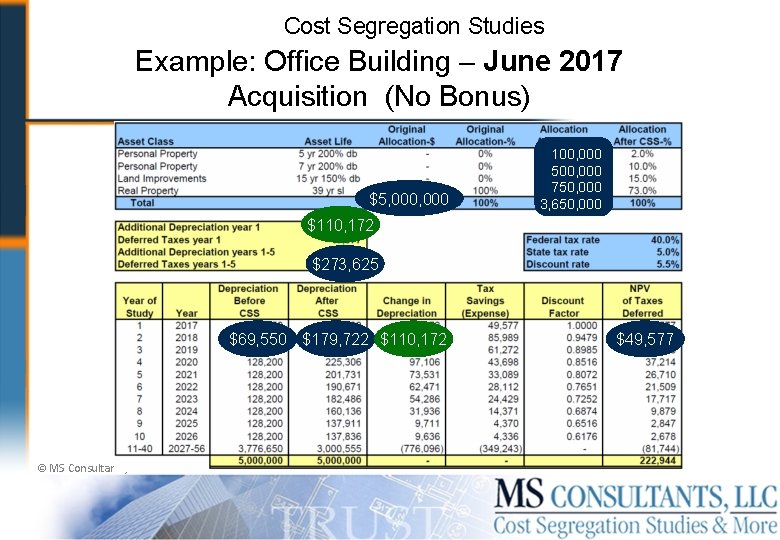
Cost Segregation Studies Example: Office Building – June 2017 Acquisition (No Bonus) $5, 000 100, 000 500, 000 750, 000 3, 650, 000 $110, 172 $273, 625 $69, 550 $179, 722 $110, 172 © MS Consultants, LLC 2018 $49, 577
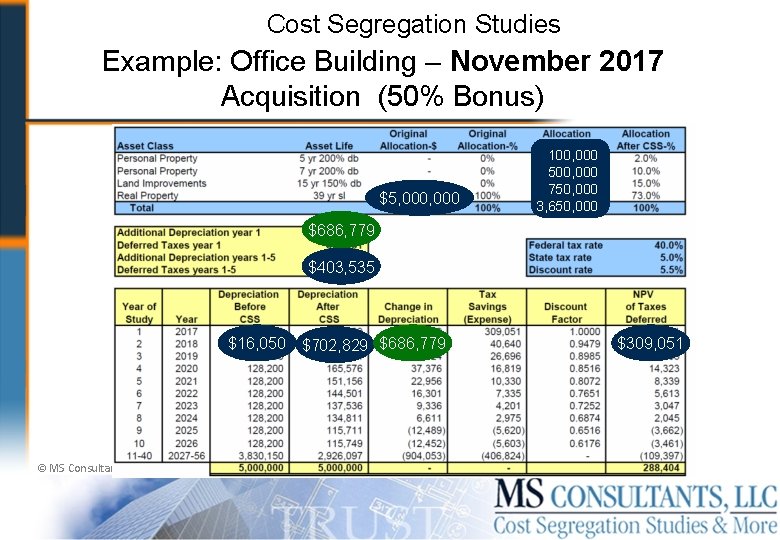
Cost Segregation Studies Example: Office Building – November 2017 Acquisition (50% Bonus) $5, 000, 000 100, 000 500, 000 750, 000 3, 650, 000 $686, 779 $403, 535 $16, 050 $702, 829 $686, 779 © MS Consultants, LLC 2018 $309, 051
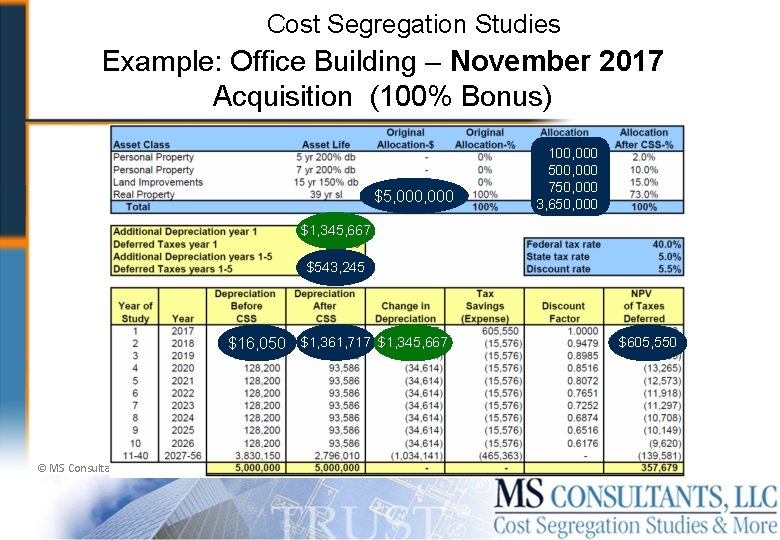
Cost Segregation Studies Example: Office Building – November 2017 Acquisition (100% Bonus) $5, 000 100, 000 500, 000 750, 000 3, 650, 000 $1, 345, 667 $543, 245 $16, 050 $1, 361, 717 $1, 345, 667 © MS Consultants, LLC 2018 $605, 550
Thank you for listening! Questions? David A. Fabian MS Consultants LLC Philip A. Mann Managing Director MS Consultants LLC Kyle R. Young MS Consultants LLC dfabian@costsegs. com pmann@costsegs. com kyoung@costsegs. com Office: 716 -580 -1561 Cell: 716 -573 -9378 Office: 716 -580 -1553 Cell : 716 -308 -4868 Office: 716 -580 -1592 Cell: 716 -560 -8235 © MS Consultants, LLC 2018
5. Research Update Harsha Chandrashekar (Honeywell International Inc. ) 5. 1 “Intelligent Building Design & Implementation” www. caba. org/Research CABA Intelligent Buildings Council (IBC)
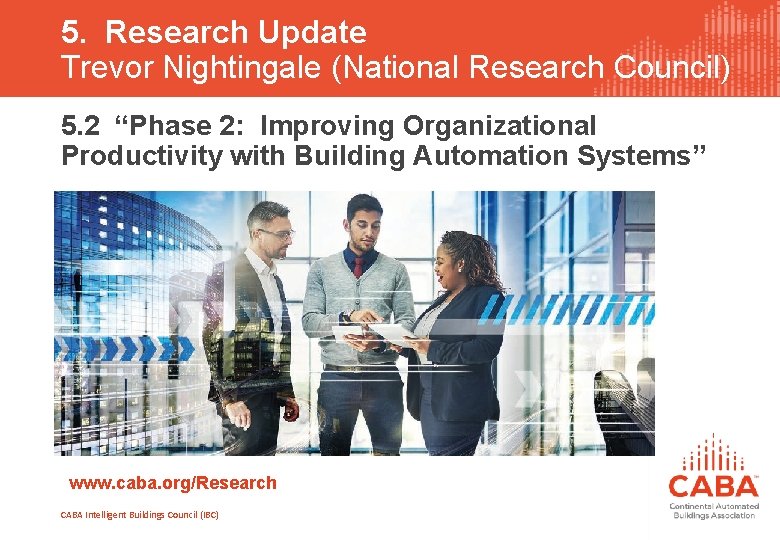
5. Research Update Trevor Nightingale (National Research Council) 5. 2 “Phase 2: Improving Organizational Productivity with Building Automation Systems” www. caba. org/Research CABA Intelligent Buildings Council (IBC)
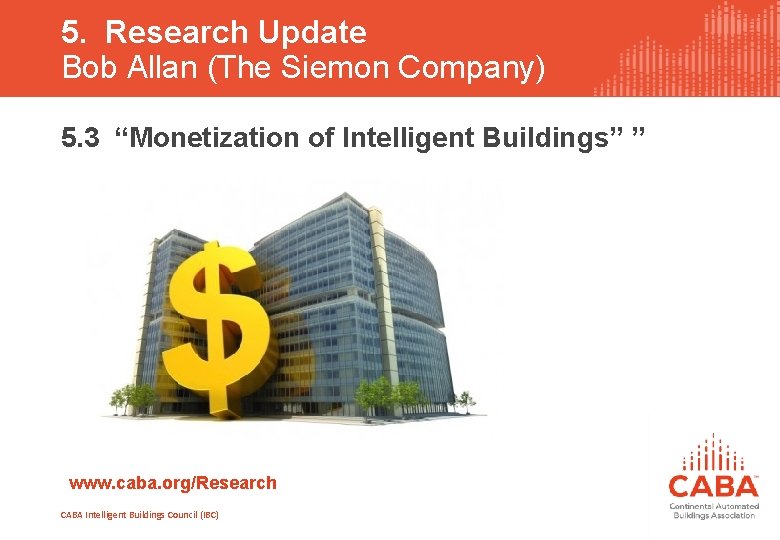
5. Research Update Bob Allan (The Siemon Company) 5. 3 “Monetization of Intelligent Buildings” ” www. caba. org/Research CABA Intelligent Buildings Council (IBC)
6. White Paper Sub-Committee Update Ken Wacks (Ken Wacks Associates) 6. 1 Recently Completed: “The Road to Smart Cities” Electro-Federation Canada Consultant (Former Manitoba Hydro) Frost & Sullivan Consumer Technology Association (CTA) ABB CSA Group AHAM (Association of Home Appliance Manufacturers) Ernst & Young LLP Bristol City Council Etron Energy Corp. Canadian Advanced Technology Alliance (CATA) Information Technology Association of Canada Canadian Automated Vehicles Centre of Excellence (CAVCOE) JLL Canadian Chamber of Commerce National Research Council of Canada Canadian Electricity Association Navigant Research Canadian Open Data Exchange (ODX) Ontario Ministry of Research and Innovation Canadian Urban Institute Retail Council of Canada Canadian Water Quality Association Robert H. Lane and Associates Inc. City of Atlanta Smart Cities Council City of Edmonton Smart Cities Management Consultant City of Toronto Sustainable Resources Management Inc. City of Vaughan TM Forum CABA Intelligent Buildings Council (IBC) Unmanned Systems Canada
6. White Paper Sub-Committee Update Ken Wacks (Ken Wacks Associates) 6. 2 Recently Completed: “Development and Training of a Knowledge-based Workforce for the Intelligent Buildings and Connected Bedrock Inc. Home. Learning, Industries” ESPA (The Electronic Systems Professional Alliance) Texas A&M University Wharton County Junior College Algonquin College Automation Federation British Columbia Institute of Technology CEES-Advisors College of Du. Page Complete Learning Solutions ETA International George Brown College CABA Intelligent Buildings Council (IBC) Heartland Community College Irvine Valley College Lambton College Laney College - BEST Center Lon. Mark International QUEST Rio Hondo Community College District Robert H. Lane and Associates Inc. Seneca College Siemens Industry, Inc. Sustainable Resources Management
6. White Paper Sub-Committee Update Ken Wacks (Ken Wacks Associates) 6. 3 Recently Completed: “A New Deal for Buildings”Modelling Bandwidth Demand Generated by Intelligent Buildings” Cimetrics, Inc. Fulham Honeywell International Inc. Johnson Controls Inc. Lon. Mark International Sky. Foundry, LLC Sustainable Resources Management Inc. Yorkland Controls Limited CABA Intelligent Buildings Council (IBC)
6. White Paper Sub-Committee Update Ken Wacks (Ken Wacks Associates) 6. 4 In Progress: “Elevator Systems for Future Intelligent Buildings - Part 1, 2, and 3” – 3 papers International Association of Elevator Engineers The University of Northampton CABA Intelligent Buildings Council (IBC)
6. White Paper Sub-Committee Update Ken Wacks (Ken Wacks Associates) 6. 5 In Progress: “Modelling Bandwidth Demand Generated by Intelligent Buildings” Nordicity Group Limited PLC Multipoint, Inc. Beta. Rover Inc Sustainable Resources Management Brookfield Global Integrated Solutions Inc. Mecho. Systems, Inc. Mircom Open Connectivity Foundation Paremus CABA Intelligent Buildings Council (IBC) Syska Hennessy Group, Inc. Texas A&M University The Siemon Company Western University
6. White Paper Sub-Committee Update Ken Wacks (Ken Wacks Associates) 6. 3 In Progress: “Impacts of Automated Shading in Building Projects” Somfy Systems, Inc. Lawrence Berkeley National Laboratory Mecho. Systems, Inc. NYSERDA PLC Multipoint, Inc. Siemens Industry, Inc. Sustainable Resources Management TRC Energy Services Vistar Energy Consulting Window Products Management CABA Intelligent Buildings Council (IBC)
6. White Paper Sub-Committee Update Ken Wacks (Ken Wacks Associates) All proposals and previously completed IBC White Papers can be downloaded at: www. caba. org/White-Papers CABA Intelligent Buildings Council (IBC)
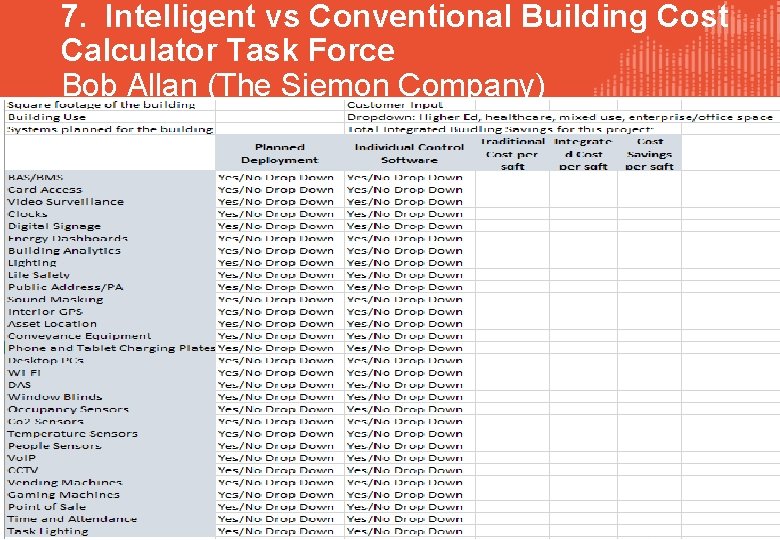
7. Intelligent vs Conventional Building Cost Calculator Task Force Bob Allan (The Siemon Company) CABA Intelligent Buildings Council (IBC)
8. New Business Trevor Nightingale (National Research Council) 8. 1 CABA decision on BIQ 8. 2 New IBC business? CABA Intelligent Buildings Council (IBC)
9. Announcements Ron Zimmer (CABA), Greg Walker (CABA) 9. 1 Past Event Overview: AHR EXPO, Jan 22 -24, 2018, Chicago, IL Distribu. TECH, Jan 23 -25, 2018, San Antonio, TX CABA Intelligent Buildings Council (IBC)
9. Announcements Ron Zimmer (CABA), Greg Walker (CABA) 9. 2 Upcoming events: Strategies in Light / The LED Show, Feb 13 -15, Long Beach, CA LIGHTFAIR International, May 6 -7, Chicago, IL Innovative Cities Summit 2018, May 9 -10, Riyadh, Kingdom of Saudi Arabia TM FORUM LIVE!, May 14 -16, Nice, France IBcon 2018 – Realcomm, June 6 -7, Las Vegas, NV Light + Building, March 18 -23, 2018, Frankfurt, Germany Next IBC Meeting, May 2018 CABA Intelligent Buildings Council (IBC)
10. Adjournment Trevor Nightingale (National Research Council) Continental Automated Buildings Association (CABA) 613. 686. 1814 Toll free: 888. 798. CABA (2222) caba@caba. org www. CABA. org www. caba. org/IBC Connect to what’s next™ CABA Intelligent Buildings Council (IBC)
- Slides: 43