Stoichiometry Additional Examples EXAMPLE What mass of H

- Slides: 64
Stoichiometry Additional Examples
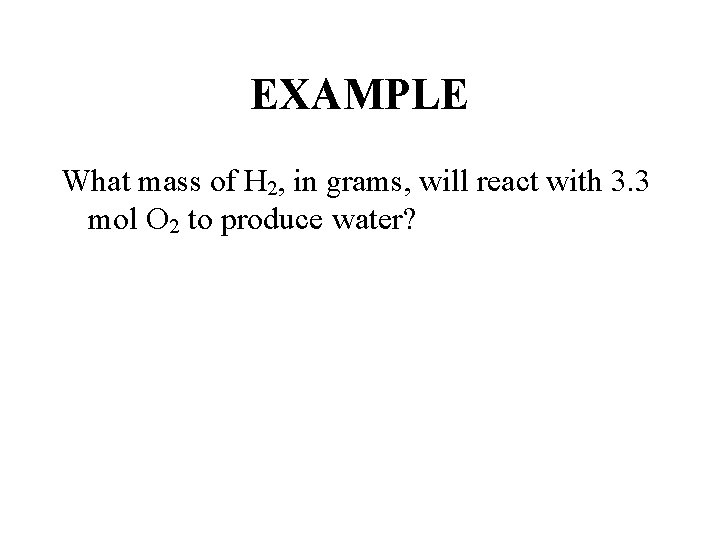
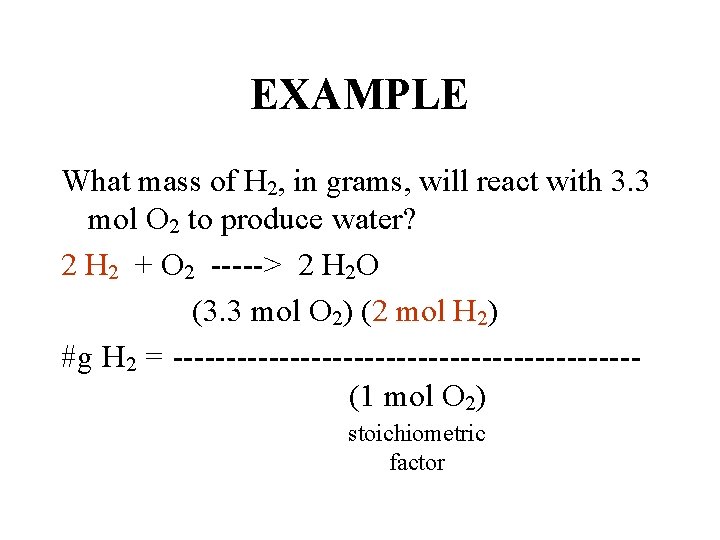
EXAMPLE What mass of H 2, in grams, will react with 3. 3 mol O 2 to produce water?
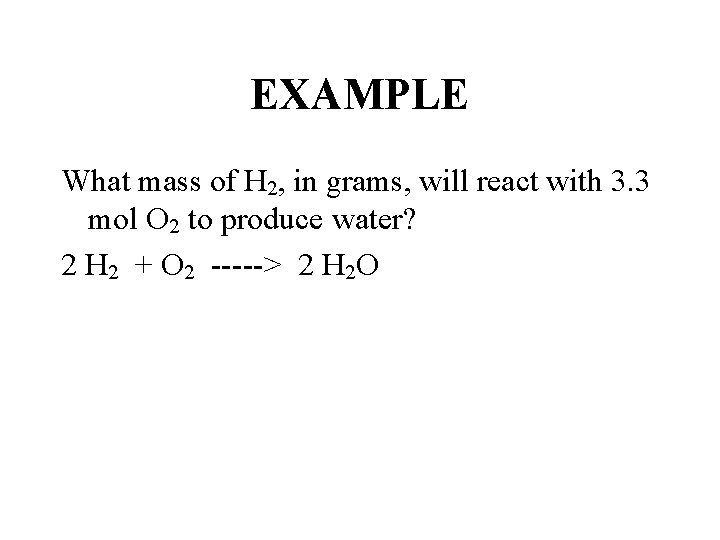
EXAMPLE What mass of H 2, in grams, will react with 3. 3 mol O 2 to produce water? 2 H 2 + O 2 -----> 2 H 2 O
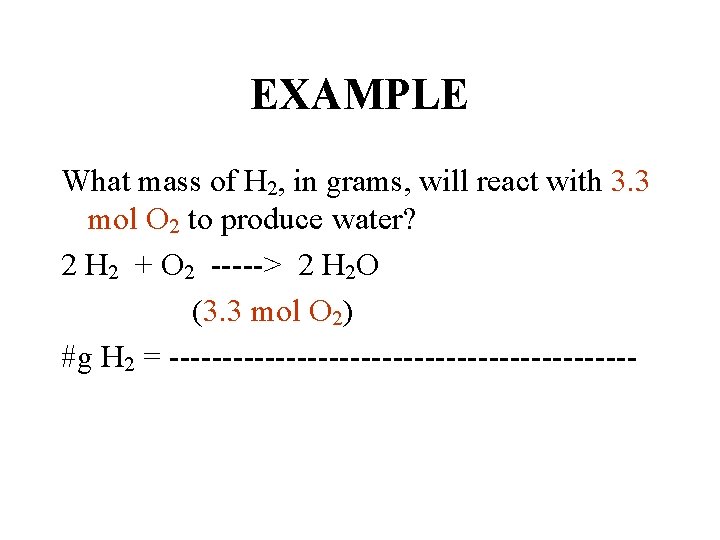
EXAMPLE What mass of H 2, in grams, will react with 3. 3 mol O 2 to produce water? 2 H 2 + O 2 -----> 2 H 2 O (3. 3 mol O 2) #g H 2 = ----------------------
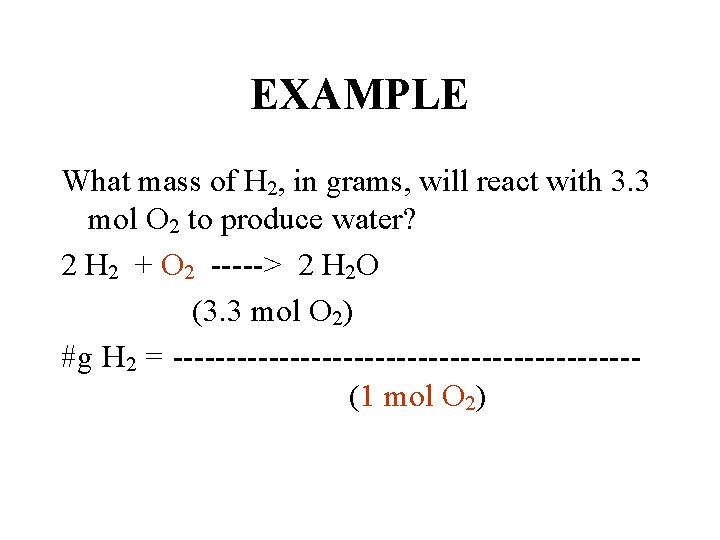
EXAMPLE What mass of H 2, in grams, will react with 3. 3 mol O 2 to produce water? 2 H 2 + O 2 -----> 2 H 2 O (3. 3 mol O 2) #g H 2 = ----------------------(1 mol O 2)
EXAMPLE What mass of H 2, in grams, will react with 3. 3 mol O 2 to produce water? 2 H 2 + O 2 -----> 2 H 2 O (3. 3 mol O 2) (2 mol H 2) #g H 2 = ----------------------(1 mol O 2) stoichiometric factor
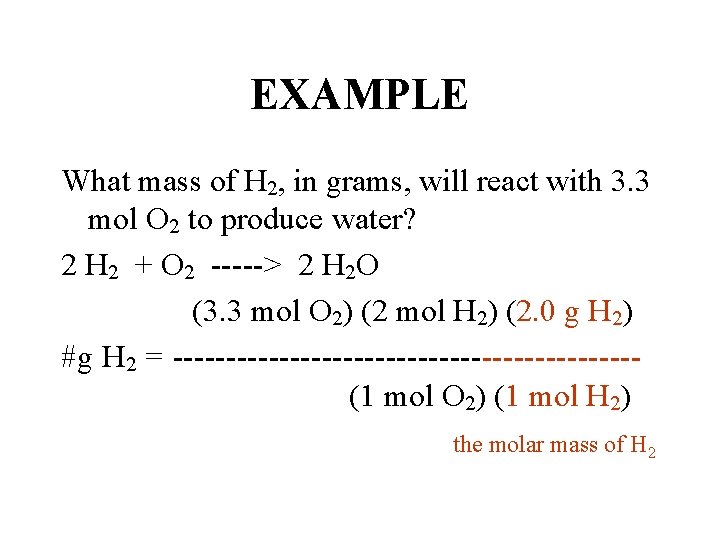
EXAMPLE What mass of H 2, in grams, will react with 3. 3 mol O 2 to produce water? 2 H 2 + O 2 -----> 2 H 2 O (3. 3 mol O 2) (2 mol H 2) (2. 0 g H 2) #g H 2 = ----------------------(1 mol O 2) (1 mol H 2) the molar mass of H 2
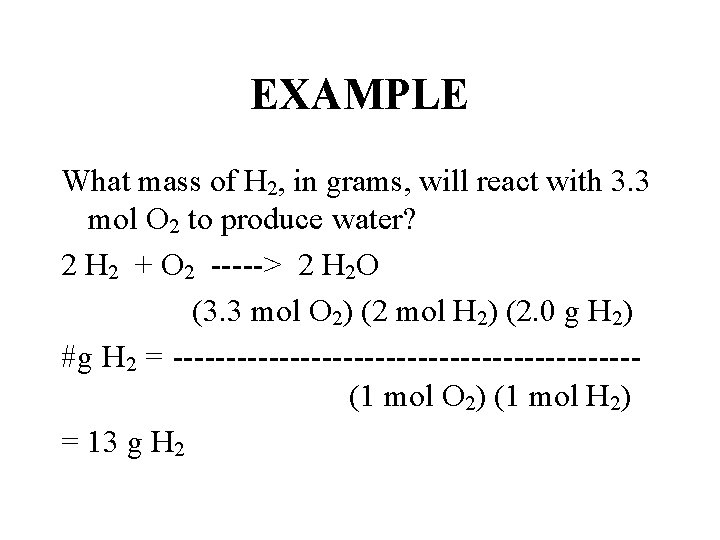
EXAMPLE What mass of H 2, in grams, will react with 3. 3 mol O 2 to produce water? 2 H 2 + O 2 -----> 2 H 2 O (3. 3 mol O 2) (2 mol H 2) (2. 0 g H 2) #g H 2 = ----------------------(1 mol O 2) (1 mol H 2) = 13 g H 2
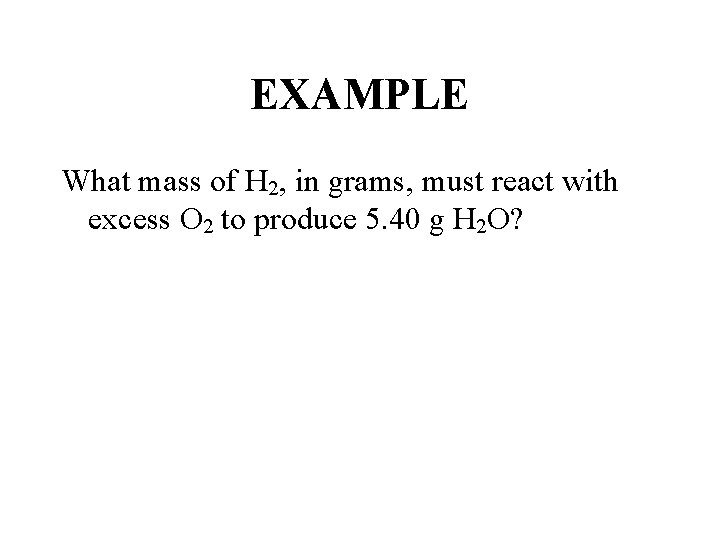
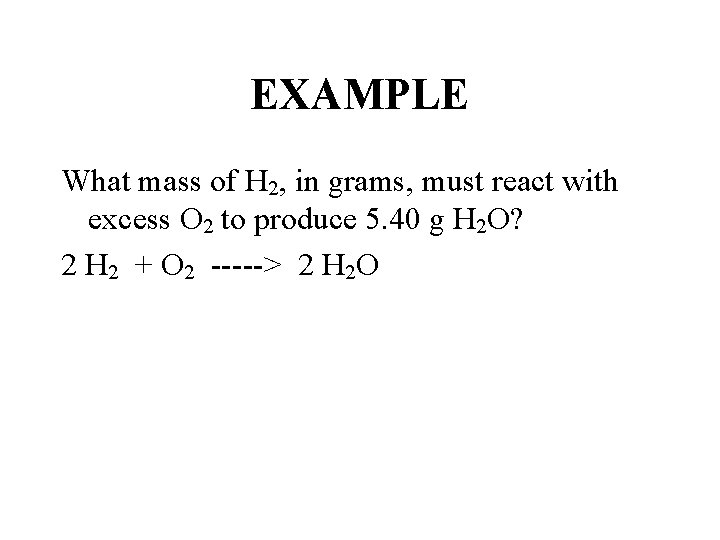
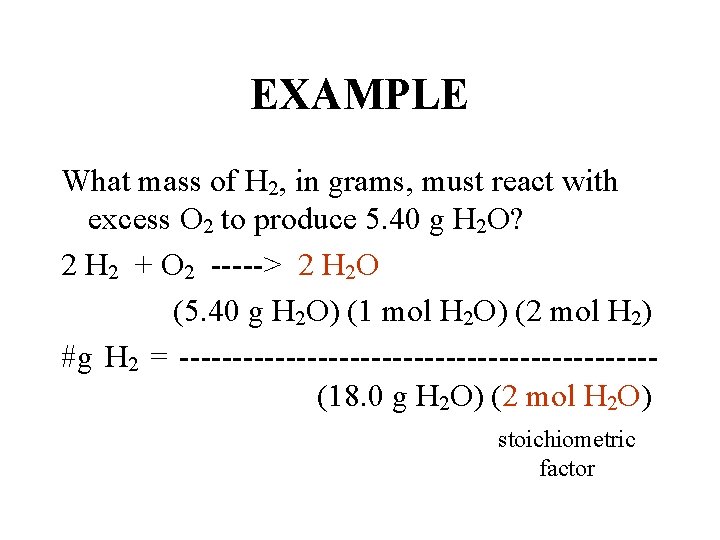
EXAMPLE What mass of H 2, in grams, must react with excess O 2 to produce 5. 40 g H 2 O?
EXAMPLE What mass of H 2, in grams, must react with excess O 2 to produce 5. 40 g H 2 O? 2 H 2 + O 2 -----> 2 H 2 O
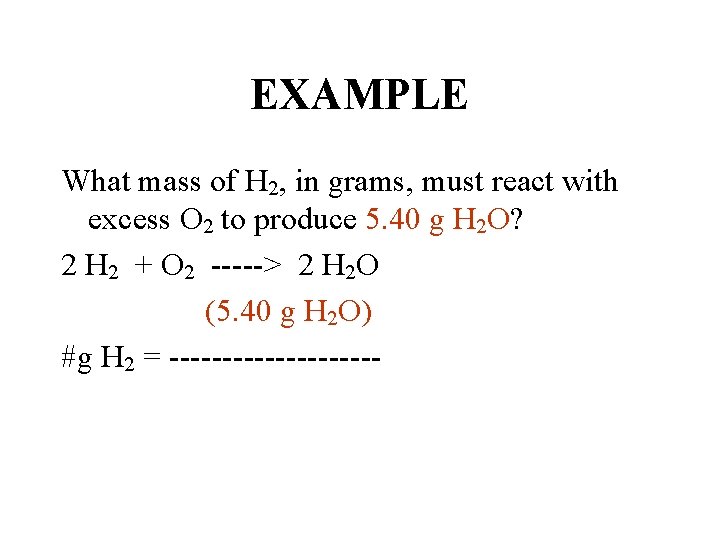
EXAMPLE What mass of H 2, in grams, must react with excess O 2 to produce 5. 40 g H 2 O? 2 H 2 + O 2 -----> 2 H 2 O (5. 40 g H 2 O) #g H 2 = ----------
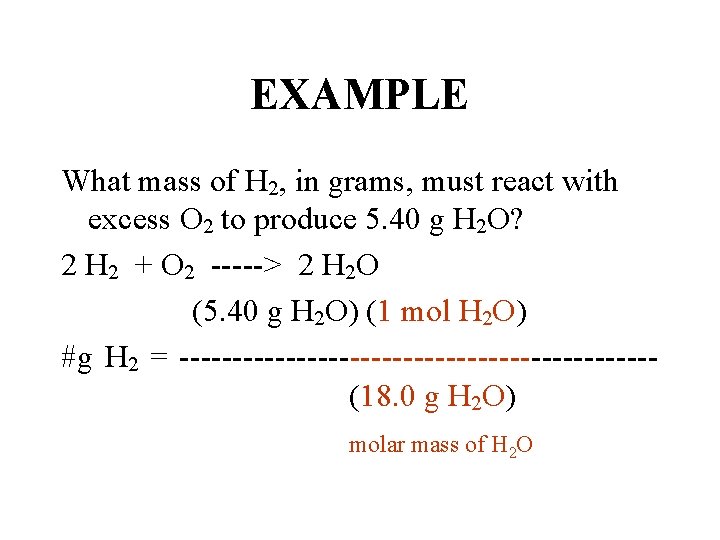
EXAMPLE What mass of H 2, in grams, must react with excess O 2 to produce 5. 40 g H 2 O? 2 H 2 + O 2 -----> 2 H 2 O (5. 40 g H 2 O) (1 mol H 2 O) #g H 2 = ----------------------(18. 0 g H 2 O) molar mass of H 2 O
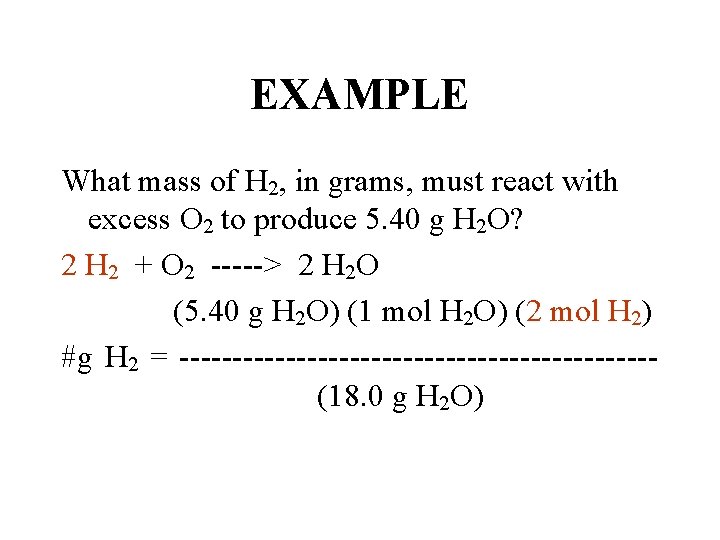
EXAMPLE What mass of H 2, in grams, must react with excess O 2 to produce 5. 40 g H 2 O? 2 H 2 + O 2 -----> 2 H 2 O (5. 40 g H 2 O) (1 mol H 2 O) (2 mol H 2) #g H 2 = ----------------------(18. 0 g H 2 O)
EXAMPLE What mass of H 2, in grams, must react with excess O 2 to produce 5. 40 g H 2 O? 2 H 2 + O 2 -----> 2 H 2 O (5. 40 g H 2 O) (1 mol H 2 O) (2 mol H 2) #g H 2 = ----------------------(18. 0 g H 2 O) (2 mol H 2 O) stoichiometric factor
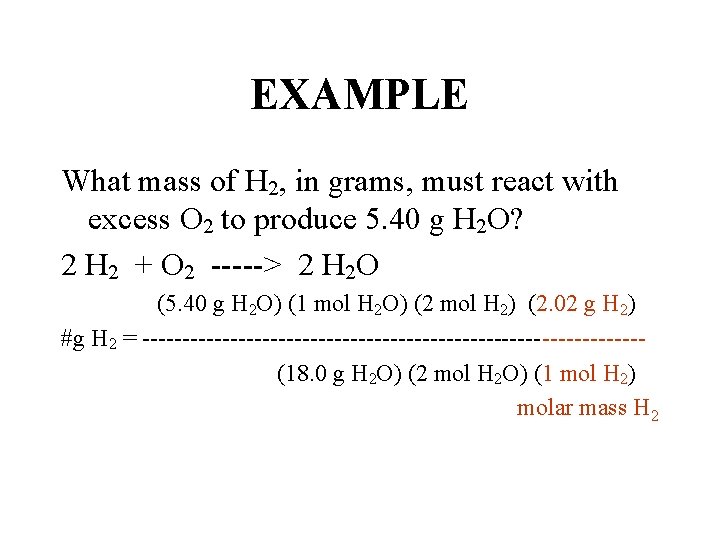
EXAMPLE What mass of H 2, in grams, must react with excess O 2 to produce 5. 40 g H 2 O? 2 H 2 + O 2 -----> 2 H 2 O (5. 40 g H 2 O) (1 mol H 2 O) (2 mol H 2) (2. 02 g H 2) #g H 2 = -------------------------------(18. 0 g H 2 O) (2 mol H 2 O) (1 mol H 2) molar mass H 2
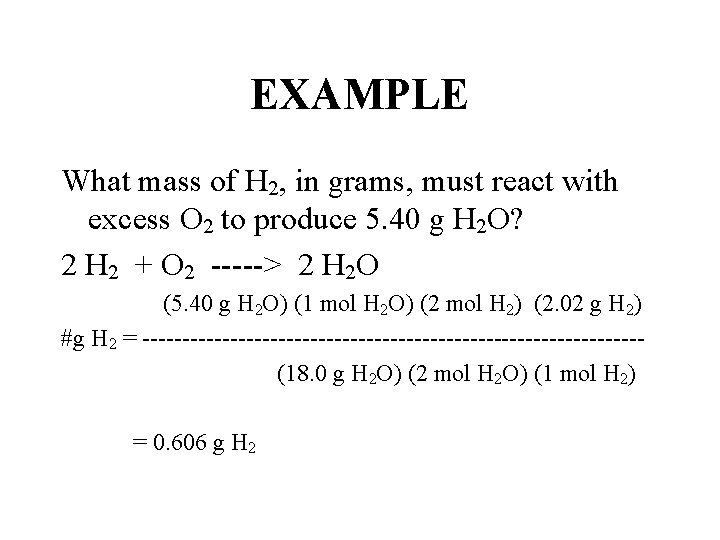
EXAMPLE What mass of H 2, in grams, must react with excess O 2 to produce 5. 40 g H 2 O? 2 H 2 + O 2 -----> 2 H 2 O (5. 40 g H 2 O) (1 mol H 2 O) (2 mol H 2) (2. 02 g H 2) #g H 2 = -------------------------------(18. 0 g H 2 O) (2 mol H 2 O) (1 mol H 2) = 0. 606 g H 2
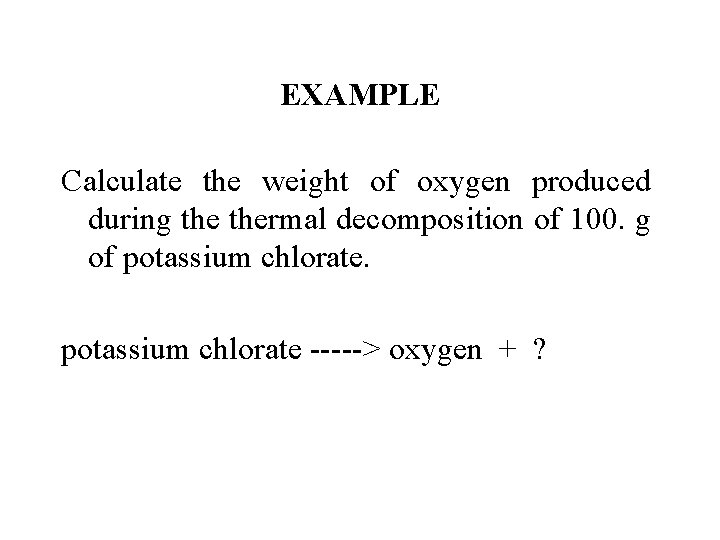
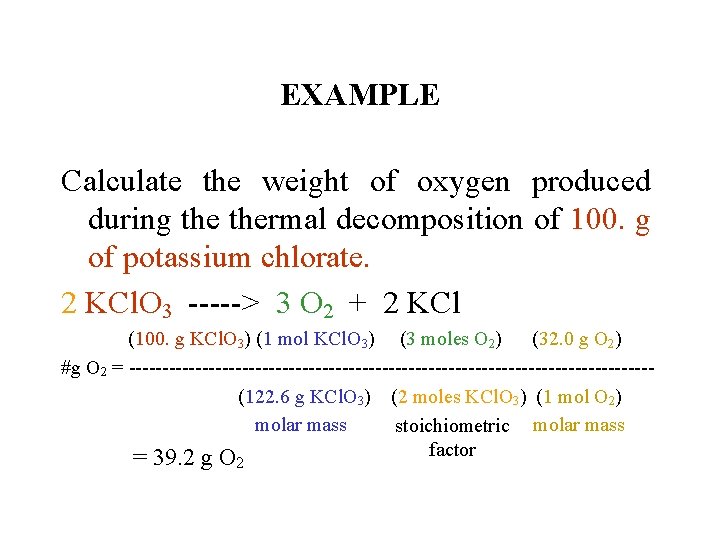
EXAMPLE Calculate the weight of oxygen produced during thermal decomposition of 100. g of potassium chlorate.
EXAMPLE Calculate the weight of oxygen produced during thermal decomposition of 100. g of potassium chlorate -----> oxygen + ?
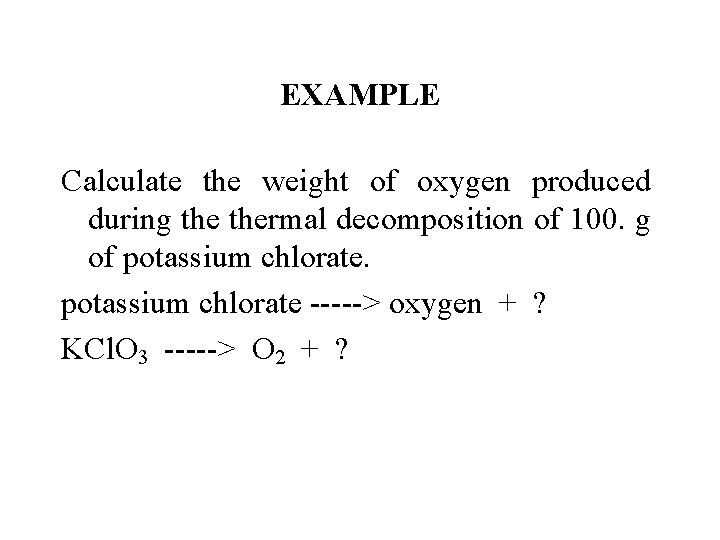
EXAMPLE Calculate the weight of oxygen produced during thermal decomposition of 100. g of potassium chlorate -----> oxygen + ? KCl. O 3 -----> O 2 + ?
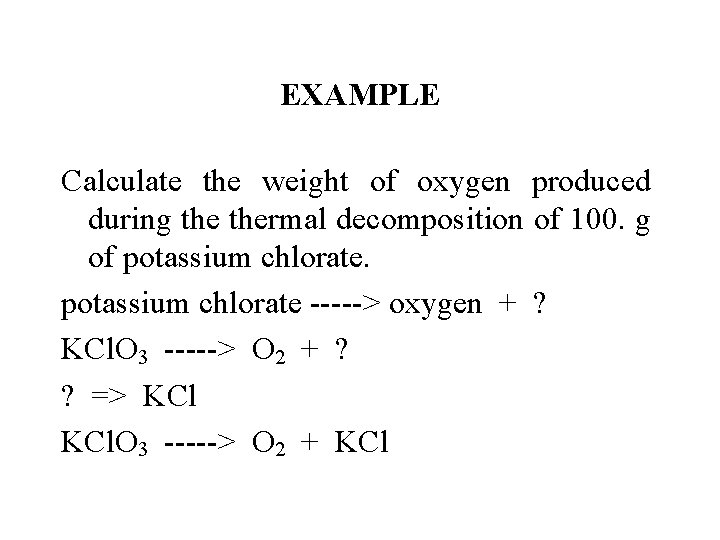
EXAMPLE Calculate the weight of oxygen produced during thermal decomposition of 100. g of potassium chlorate -----> oxygen + ? KCl. O 3 -----> O 2 + ? ? => KCl. O 3 -----> O 2 + KCl
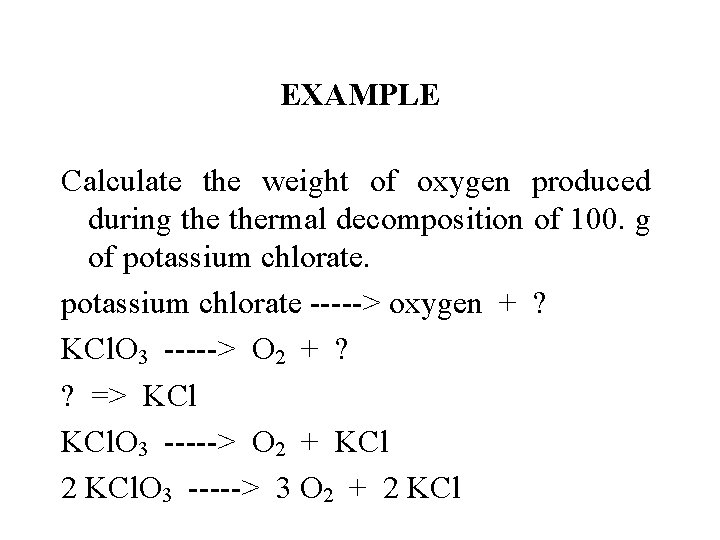
EXAMPLE Calculate the weight of oxygen produced during thermal decomposition of 100. g of potassium chlorate -----> oxygen + ? KCl. O 3 -----> O 2 + ? ? => KCl. O 3 -----> O 2 + KCl 2 KCl. O 3 -----> 3 O 2 + 2 KCl
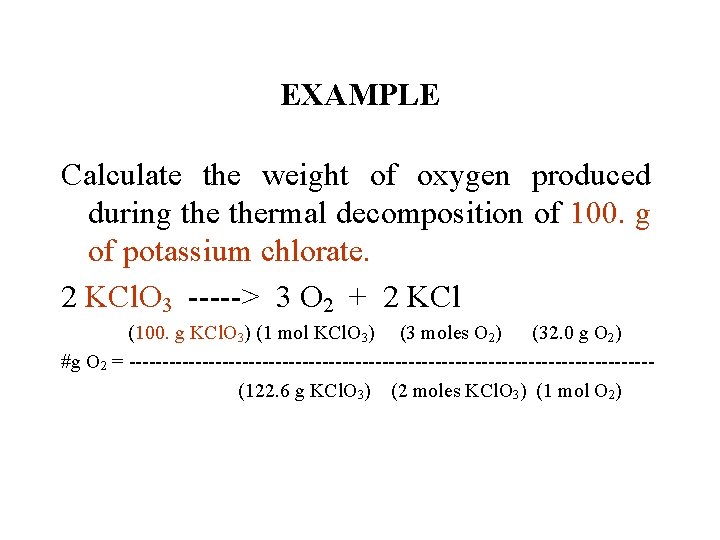
EXAMPLE Calculate the weight of oxygen produced during thermal decomposition of 100. g of potassium chlorate. 2 KCl. O 3 -----> 3 O 2 + 2 KCl (100. g KCl. O 3) (1 mol KCl. O 3) (3 moles O 2) (32. 0 g O 2) #g O 2 = ---------------------------------------(122. 6 g KCl. O 3) (2 moles KCl. O 3) (1 mol O 2)
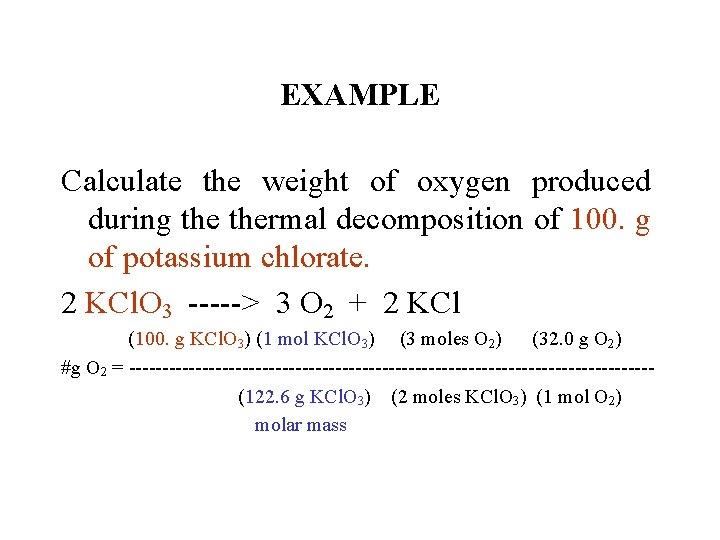
EXAMPLE Calculate the weight of oxygen produced during thermal decomposition of 100. g of potassium chlorate. 2 KCl. O 3 -----> 3 O 2 + 2 KCl (100. g KCl. O 3) (1 mol KCl. O 3) (3 moles O 2) (32. 0 g O 2) #g O 2 = ---------------------------------------(122. 6 g KCl. O 3) (2 moles KCl. O 3) (1 mol O 2) molar mass
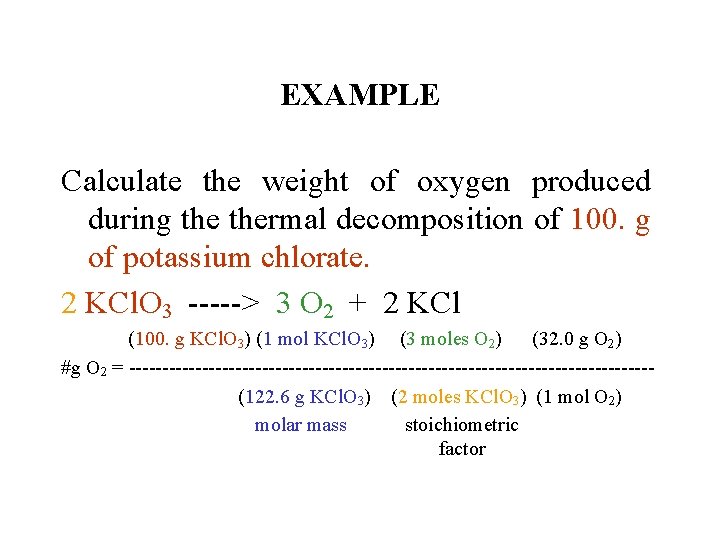
EXAMPLE Calculate the weight of oxygen produced during thermal decomposition of 100. g of potassium chlorate. 2 KCl. O 3 -----> 3 O 2 + 2 KCl (100. g KCl. O 3) (1 mol KCl. O 3) (3 moles O 2) (32. 0 g O 2) #g O 2 = ---------------------------------------(122. 6 g KCl. O 3) (2 moles KCl. O 3) (1 mol O 2) stoichiometric molar mass factor
EXAMPLE Calculate the weight of oxygen produced during thermal decomposition of 100. g of potassium chlorate. 2 KCl. O 3 -----> 3 O 2 + 2 KCl (100. g KCl. O 3) (1 mol KCl. O 3) (3 moles O 2) (32. 0 g O 2) #g O 2 = ---------------------------------------(122. 6 g KCl. O 3) (2 moles KCl. O 3) (1 mol O 2) stoichiometric molar mass factor
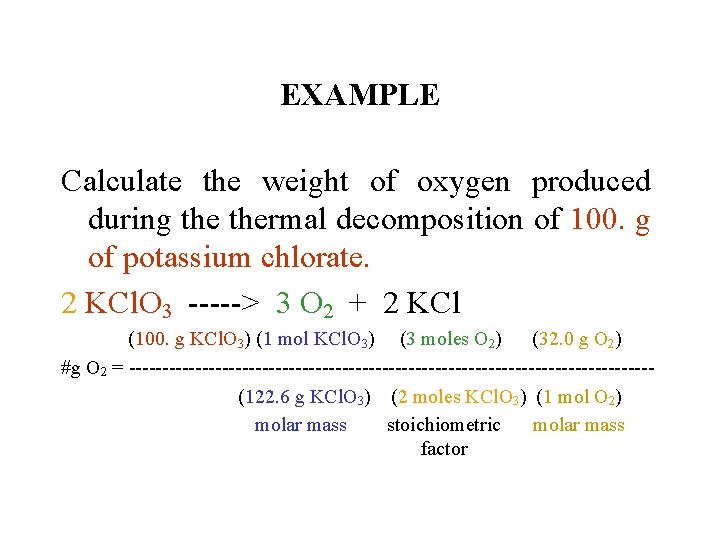
EXAMPLE Calculate the weight of oxygen produced during thermal decomposition of 100. g of potassium chlorate. 2 KCl. O 3 -----> 3 O 2 + 2 KCl (100. g KCl. O 3) (1 mol KCl. O 3) (3 moles O 2) (32. 0 g O 2) #g O 2 = ---------------------------------------(122. 6 g KCl. O 3) (2 moles KCl. O 3) (1 mol O 2) molar mass stoichiometric molar mass factor = 39. 2 g O 2
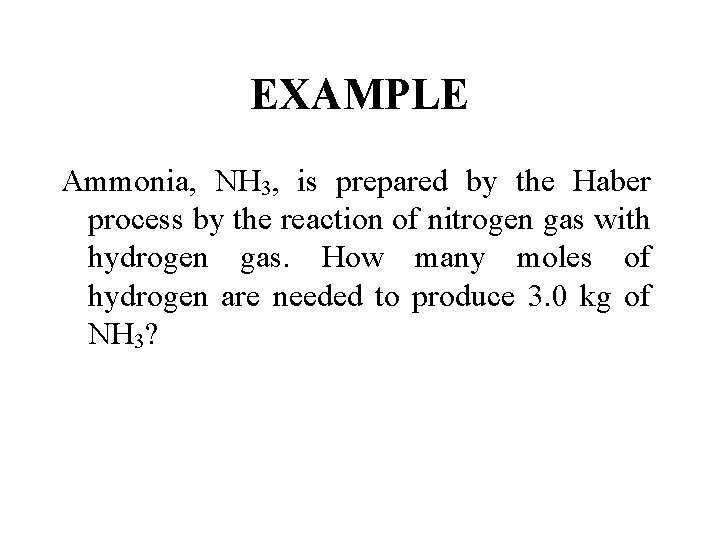
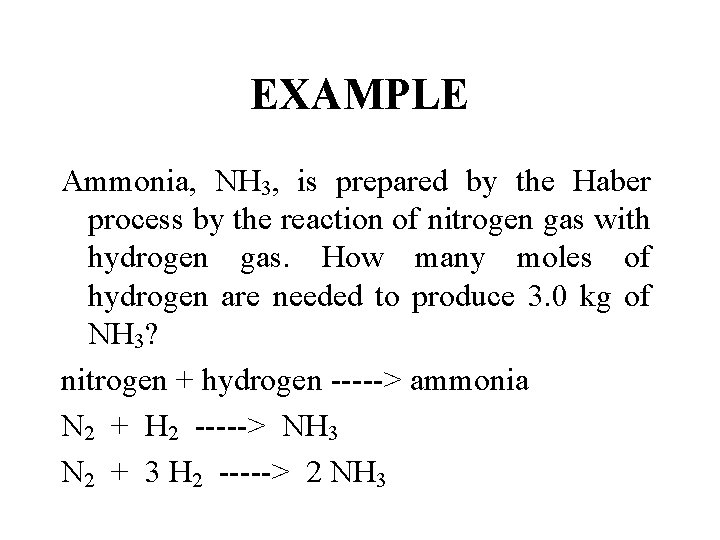
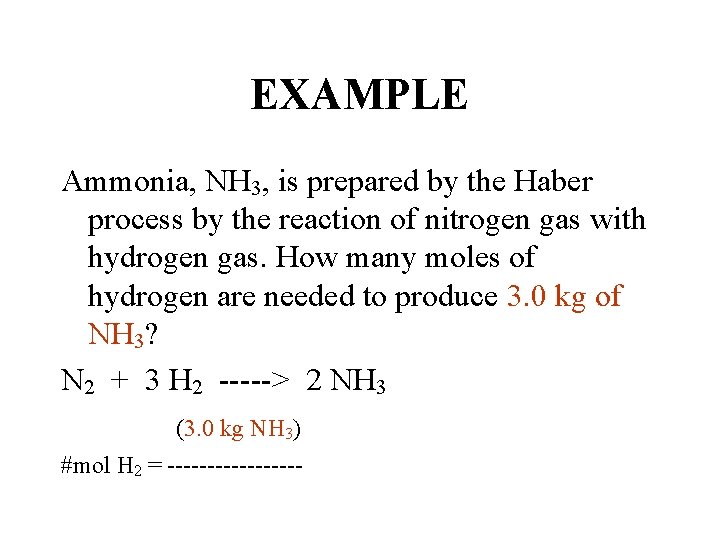
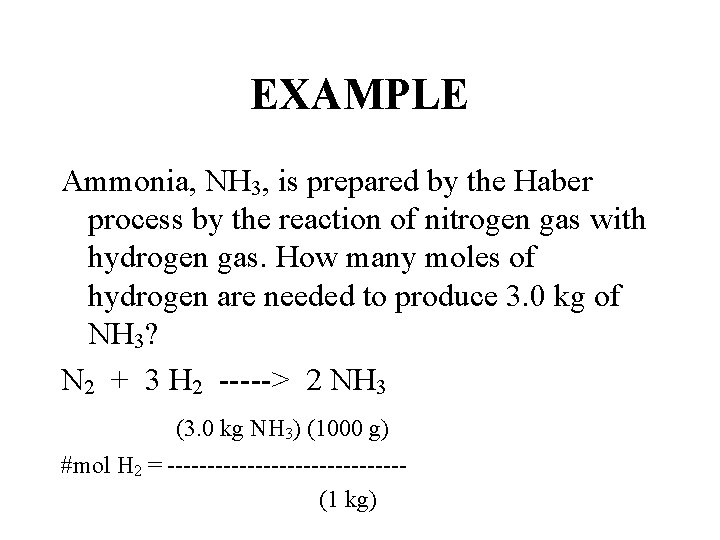
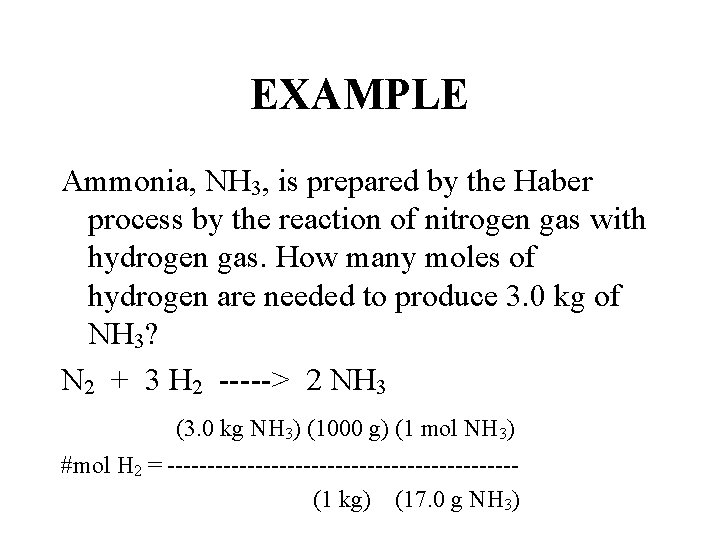
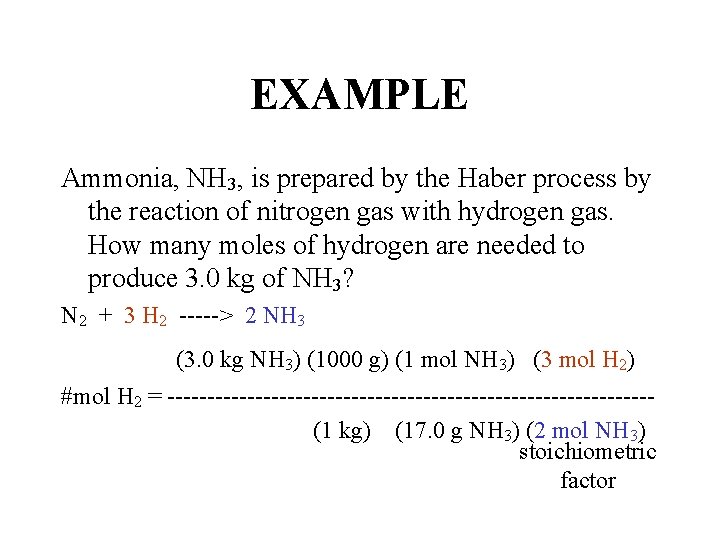
EXAMPLE Ammonia, NH 3, is prepared by the Haber process by the reaction of nitrogen gas with hydrogen gas. How many moles of hydrogen are needed to produce 3. 0 kg of NH 3?
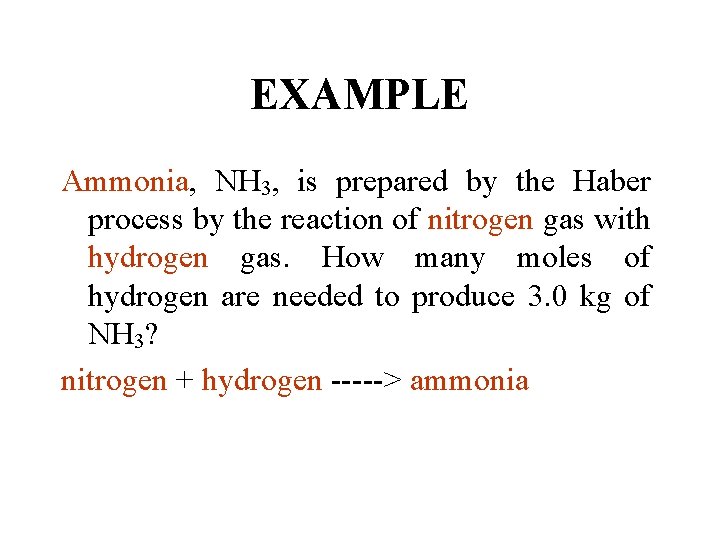
EXAMPLE Ammonia, NH 3, is prepared by the Haber process by the reaction of nitrogen gas with hydrogen gas. How many moles of hydrogen are needed to produce 3. 0 kg of NH 3? nitrogen + hydrogen -----> ammonia
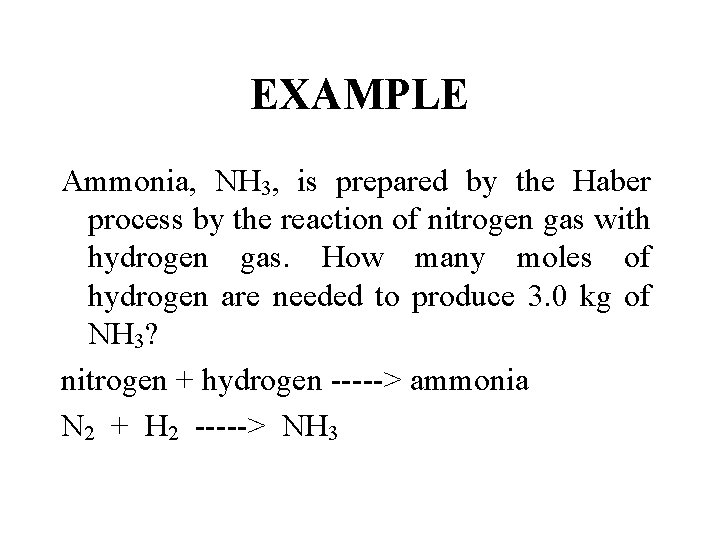
EXAMPLE Ammonia, NH 3, is prepared by the Haber process by the reaction of nitrogen gas with hydrogen gas. How many moles of hydrogen are needed to produce 3. 0 kg of NH 3? nitrogen + hydrogen -----> ammonia N 2 + H 2 -----> NH 3
EXAMPLE Ammonia, NH 3, is prepared by the Haber process by the reaction of nitrogen gas with hydrogen gas. How many moles of hydrogen are needed to produce 3. 0 kg of NH 3? nitrogen + hydrogen -----> ammonia N 2 + H 2 -----> NH 3 N 2 + 3 H 2 -----> 2 NH 3
EXAMPLE Ammonia, NH 3, is prepared by the Haber process by the reaction of nitrogen gas with hydrogen gas. How many moles of hydrogen are needed to produce 3. 0 kg of NH 3? N 2 + 3 H 2 -----> 2 NH 3 (3. 0 kg NH 3) #mol H 2 = ---------
EXAMPLE Ammonia, NH 3, is prepared by the Haber process by the reaction of nitrogen gas with hydrogen gas. How many moles of hydrogen are needed to produce 3. 0 kg of NH 3? N 2 + 3 H 2 -----> 2 NH 3 (3. 0 kg NH 3) (1000 g) #mol H 2 = ---------------(1 kg)
EXAMPLE Ammonia, NH 3, is prepared by the Haber process by the reaction of nitrogen gas with hydrogen gas. How many moles of hydrogen are needed to produce 3. 0 kg of NH 3? N 2 + 3 H 2 -----> 2 NH 3 (3. 0 kg NH 3) (1000 g) (1 mol NH 3) #mol H 2 = ----------------------(1 kg) (17. 0 g NH 3)
EXAMPLE Ammonia, NH 3, is prepared by the Haber process by the reaction of nitrogen gas with hydrogen gas. How many moles of hydrogen are needed to produce 3. 0 kg of NH 3? N 2 + 3 H 2 -----> 2 NH 3 (3. 0 kg NH 3) (1000 g) (1 mol NH 3) (3 mol H 2) #mol H 2 = ------------------------------(1 kg) (17. 0 g NH 3) (2 mol NH 3) stoichiometric factor
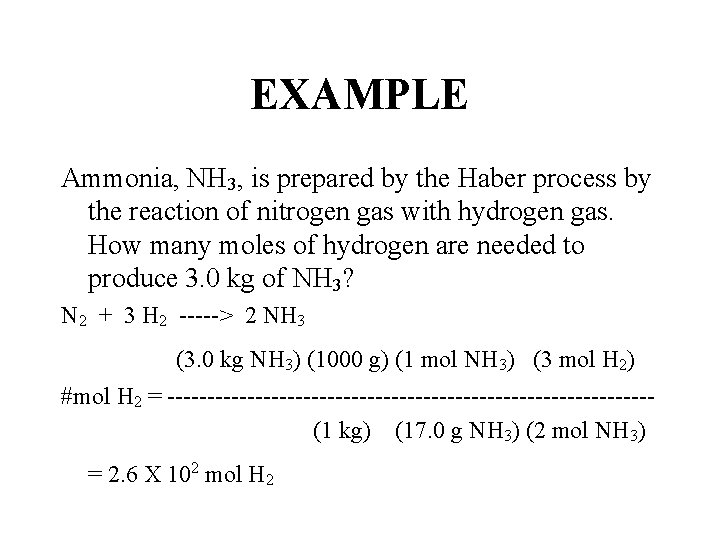
EXAMPLE Ammonia, NH 3, is prepared by the Haber process by the reaction of nitrogen gas with hydrogen gas. How many moles of hydrogen are needed to produce 3. 0 kg of NH 3? N 2 + 3 H 2 -----> 2 NH 3 (3. 0 kg NH 3) (1000 g) (1 mol NH 3) (3 mol H 2) #mol H 2 = ------------------------------(1 kg) (17. 0 g NH 3) (2 mol NH 3) = 2. 6 X 10² mol H 2
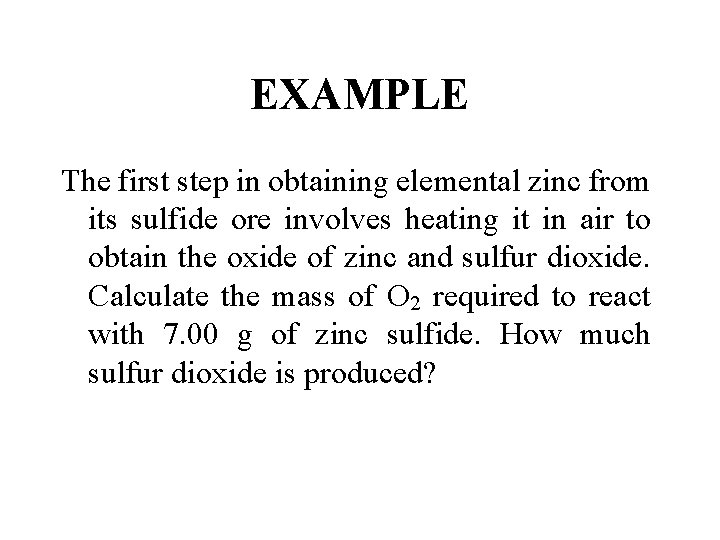
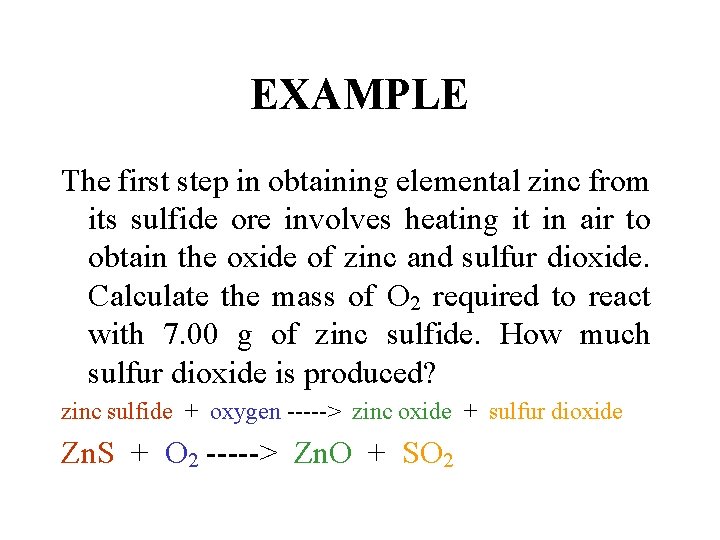
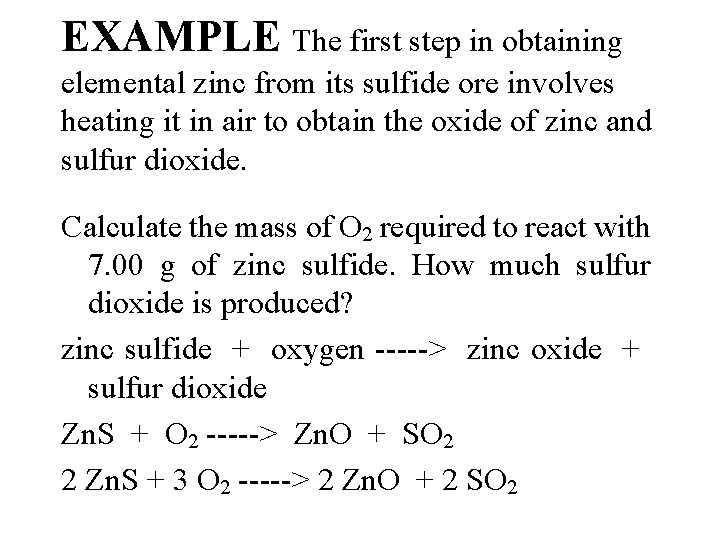
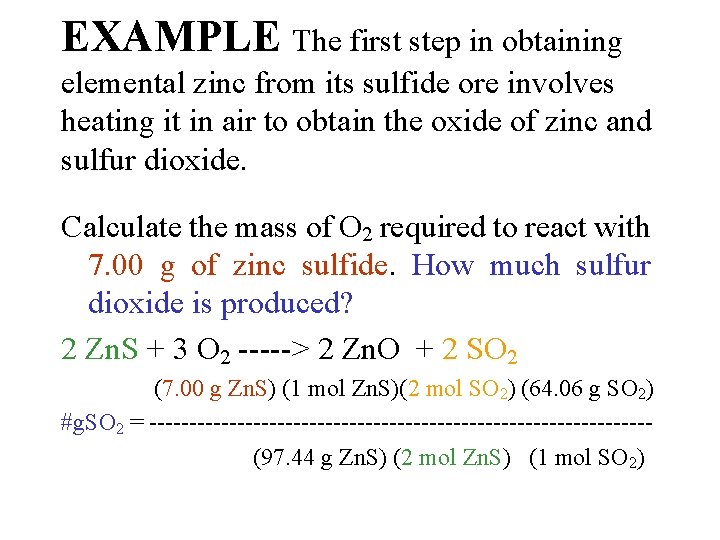
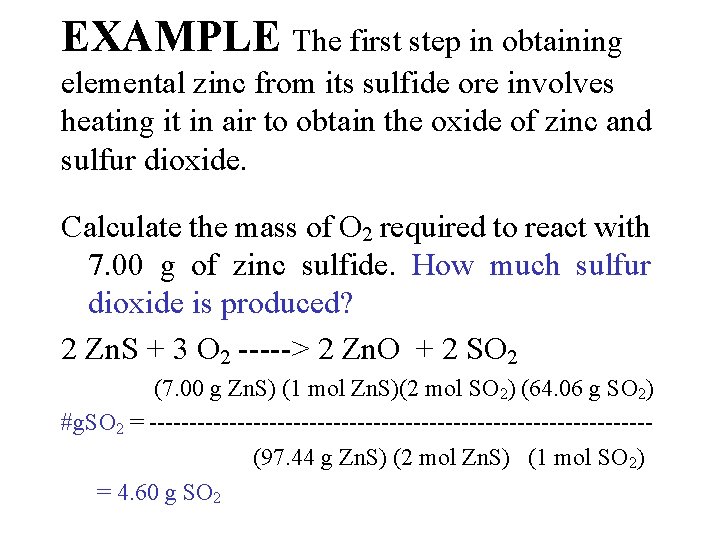
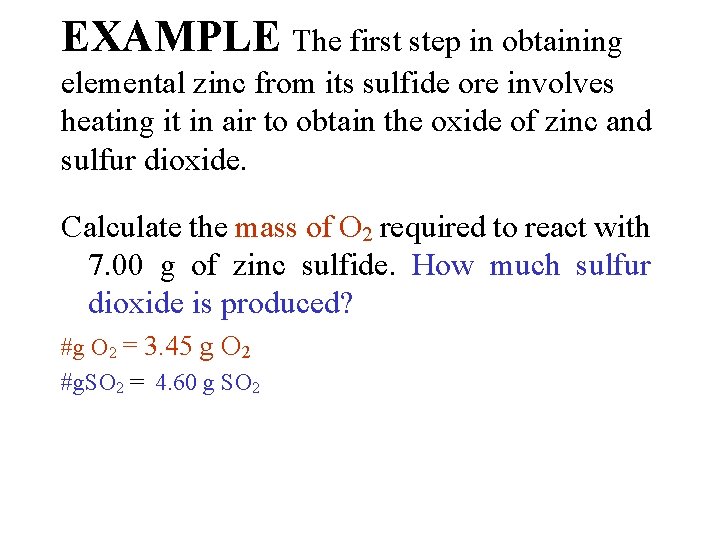
EXAMPLE The first step in obtaining elemental zinc from its sulfide ore involves heating it in air to obtain the oxide of zinc and sulfur dioxide. Calculate the mass of O 2 required to react with 7. 00 g of zinc sulfide. How much sulfur dioxide is produced?
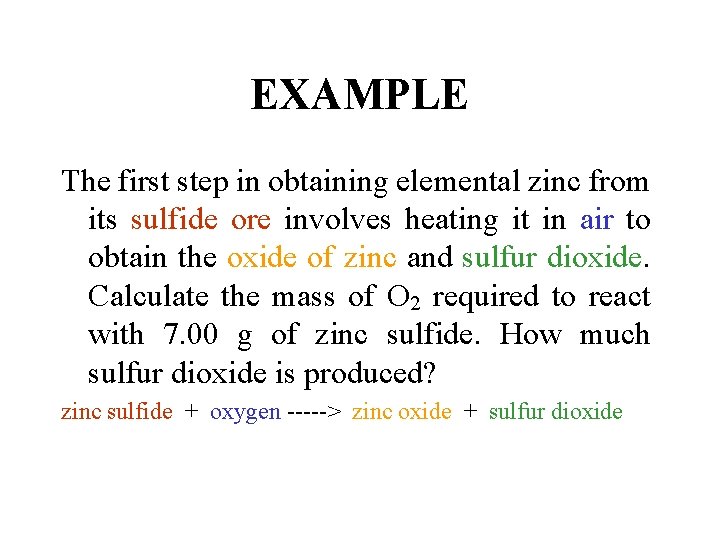
EXAMPLE The first step in obtaining elemental zinc from its sulfide ore involves heating it in air to obtain the oxide of zinc and sulfur dioxide. Calculate the mass of O 2 required to react with 7. 00 g of zinc sulfide. How much sulfur dioxide is produced? zinc sulfide + oxygen -----> zinc oxide + sulfur dioxide
EXAMPLE The first step in obtaining elemental zinc from its sulfide ore involves heating it in air to obtain the oxide of zinc and sulfur dioxide. Calculate the mass of O 2 required to react with 7. 00 g of zinc sulfide. How much sulfur dioxide is produced? zinc sulfide + oxygen -----> zinc oxide + sulfur dioxide Zn. S + O 2 -----> Zn. O + SO 2
EXAMPLE The first step in obtaining elemental zinc from its sulfide ore involves heating it in air to obtain the oxide of zinc and sulfur dioxide. Calculate the mass of O 2 required to react with 7. 00 g of zinc sulfide. How much sulfur dioxide is produced? zinc sulfide + oxygen -----> zinc oxide + sulfur dioxide Zn. S + O 2 -----> Zn. O + SO 2 2 Zn. S + 3 O 2 -----> 2 Zn. O + 2 SO 2
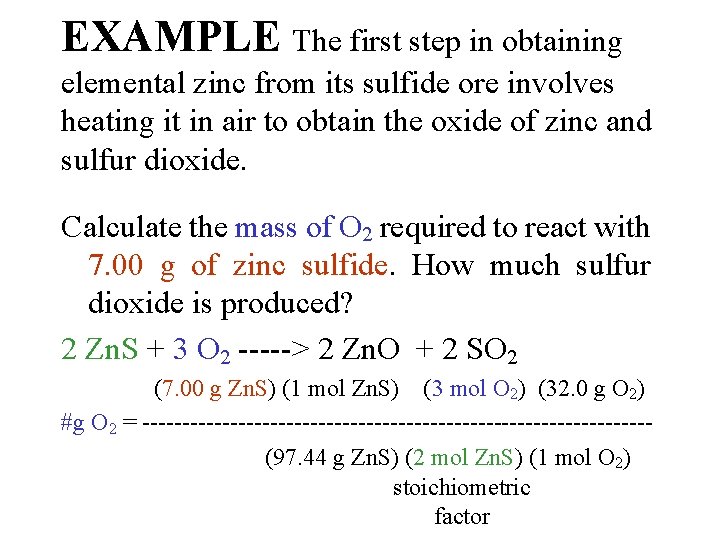
EXAMPLE The first step in obtaining elemental zinc from its sulfide ore involves heating it in air to obtain the oxide of zinc and sulfur dioxide. Calculate the mass of O 2 required to react with 7. 00 g of zinc sulfide. How much sulfur dioxide is produced? 2 Zn. S + 3 O 2 -----> 2 Zn. O + 2 SO 2 (7. 00 g Zn. S) (1 mol Zn. S) (3 mol O 2) (32. 0 g O 2) #g O 2 = --------------------------------(97. 44 g Zn. S) (2 mol Zn. S) (1 mol O 2) stoichiometric factor
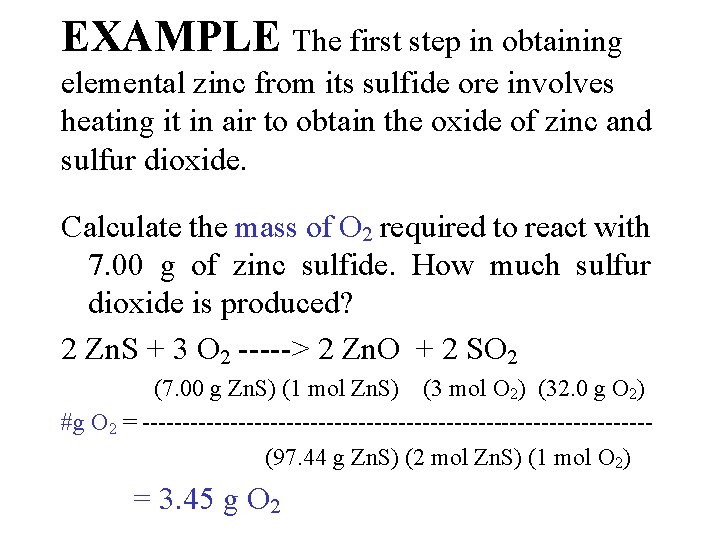
EXAMPLE The first step in obtaining elemental zinc from its sulfide ore involves heating it in air to obtain the oxide of zinc and sulfur dioxide. Calculate the mass of O 2 required to react with 7. 00 g of zinc sulfide. How much sulfur dioxide is produced? 2 Zn. S + 3 O 2 -----> 2 Zn. O + 2 SO 2 (7. 00 g Zn. S) (1 mol Zn. S) (3 mol O 2) (32. 0 g O 2) #g O 2 = --------------------------------(97. 44 g Zn. S) (2 mol Zn. S) (1 mol O 2) = 3. 45 g O 2
EXAMPLE The first step in obtaining elemental zinc from its sulfide ore involves heating it in air to obtain the oxide of zinc and sulfur dioxide. Calculate the mass of O 2 required to react with 7. 00 g of zinc sulfide. How much sulfur dioxide is produced? 2 Zn. S + 3 O 2 -----> 2 Zn. O + 2 SO 2 (7. 00 g Zn. S) (1 mol Zn. S)(2 mol SO 2) (64. 06 g SO 2) #g. SO 2 = -------------------------------(97. 44 g Zn. S) (2 mol Zn. S) (1 mol SO 2)
EXAMPLE The first step in obtaining elemental zinc from its sulfide ore involves heating it in air to obtain the oxide of zinc and sulfur dioxide. Calculate the mass of O 2 required to react with 7. 00 g of zinc sulfide. How much sulfur dioxide is produced? 2 Zn. S + 3 O 2 -----> 2 Zn. O + 2 SO 2 (7. 00 g Zn. S) (1 mol Zn. S)(2 mol SO 2) (64. 06 g SO 2) #g. SO 2 = -------------------------------(97. 44 g Zn. S) (2 mol Zn. S) (1 mol SO 2) = 4. 60 g SO 2
EXAMPLE The first step in obtaining elemental zinc from its sulfide ore involves heating it in air to obtain the oxide of zinc and sulfur dioxide. Calculate the mass of O 2 required to react with 7. 00 g of zinc sulfide. How much sulfur dioxide is produced? #g O 2 = 3. 45 g O 2 #g. SO 2 = 4. 60 g SO 2
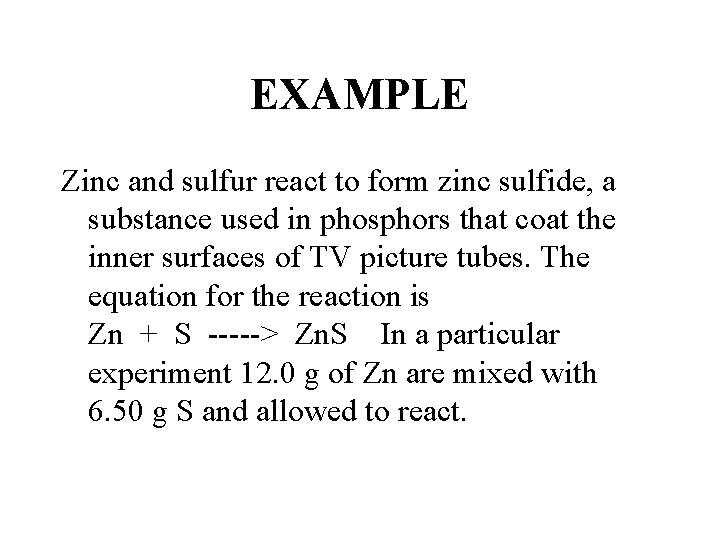
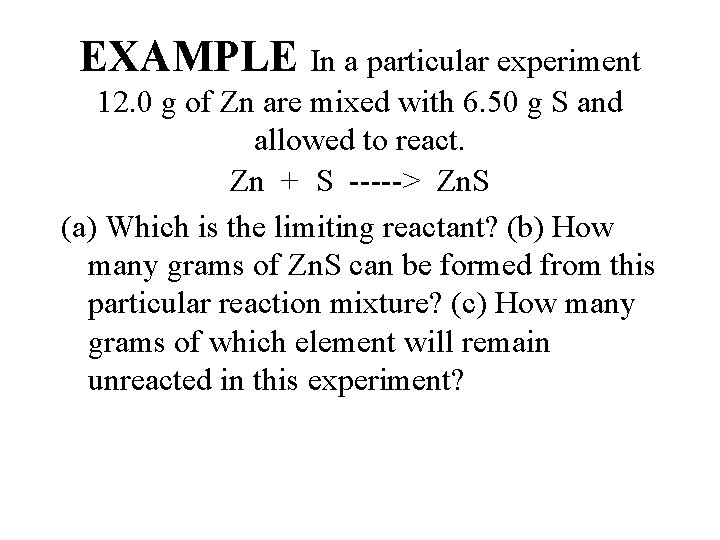
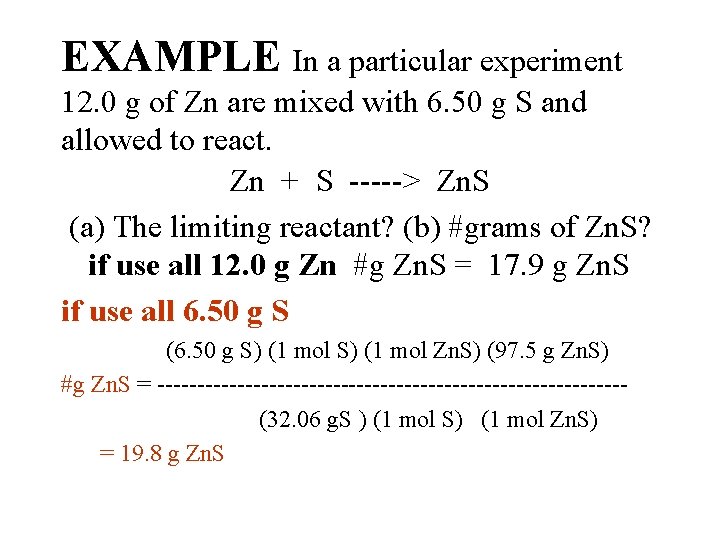
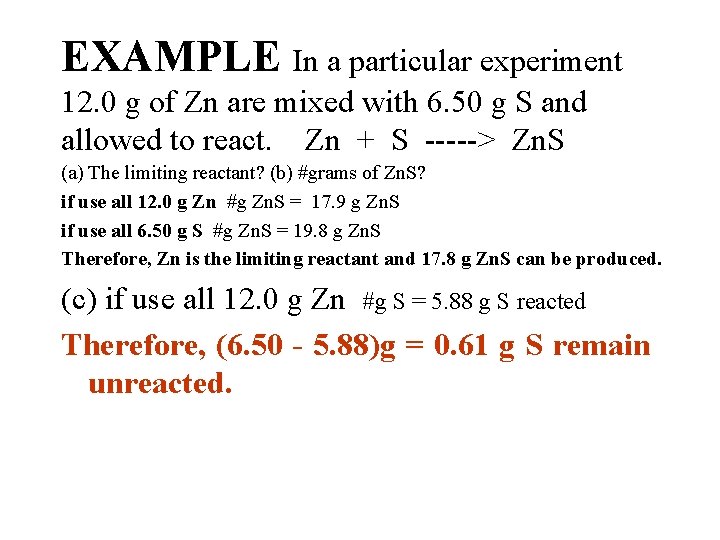
EXAMPLE Zinc and sulfur react to form zinc sulfide, a substance used in phosphors that coat the inner surfaces of TV picture tubes. The equation for the reaction is Zn + S -----> Zn. S In a particular experiment 12. 0 g of Zn are mixed with 6. 50 g S and allowed to react.
EXAMPLE In a particular experiment 12. 0 g of Zn are mixed with 6. 50 g S and allowed to react. Zn + S -----> Zn. S (a) Which is the limiting reactant? (b) How many grams of Zn. S can be formed from this particular reaction mixture? (c) How many grams of which element will remain unreacted in this experiment?
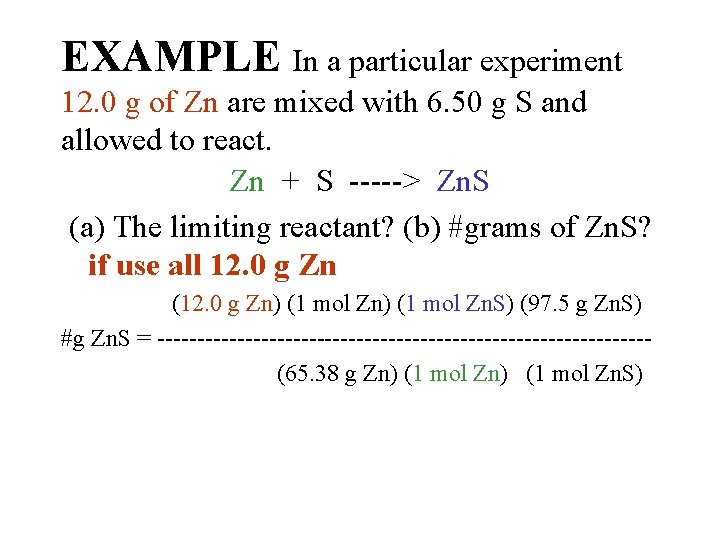
EXAMPLE In a particular experiment 12. 0 g of Zn are mixed with 6. 50 g S and allowed to react. Zn + S -----> Zn. S (a) The limiting reactant? (b) #grams of Zn. S? if use all 12. 0 g Zn (12. 0 g Zn) (1 mol Zn. S) (97. 5 g Zn. S) #g Zn. S = -------------------------------(65. 38 g Zn) (1 mol Zn. S)
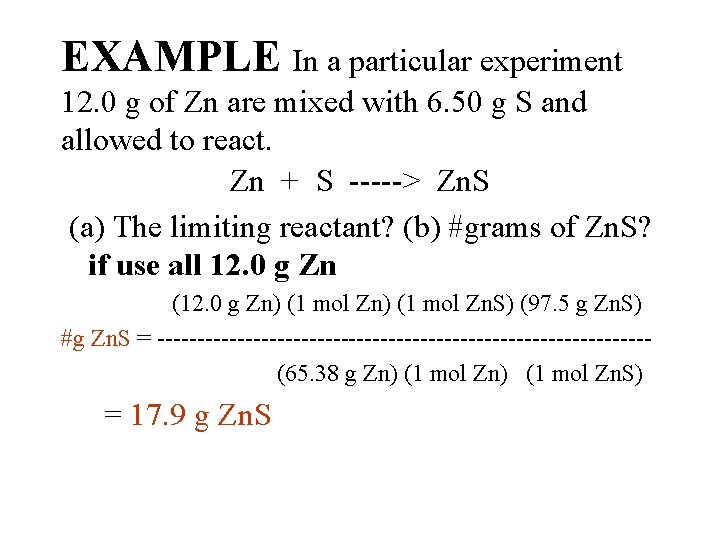
EXAMPLE In a particular experiment 12. 0 g of Zn are mixed with 6. 50 g S and allowed to react. Zn + S -----> Zn. S (a) The limiting reactant? (b) #grams of Zn. S? if use all 12. 0 g Zn (12. 0 g Zn) (1 mol Zn. S) (97. 5 g Zn. S) #g Zn. S = -------------------------------(65. 38 g Zn) (1 mol Zn. S) = 17. 9 g Zn. S
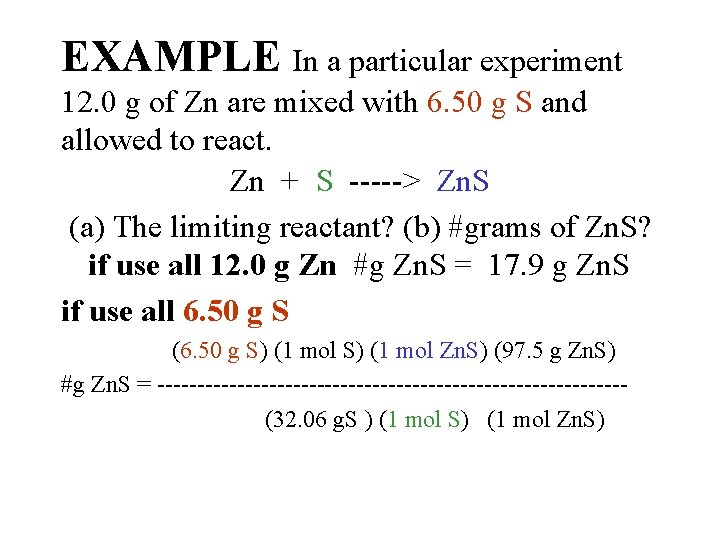
EXAMPLE In a particular experiment 12. 0 g of Zn are mixed with 6. 50 g S and allowed to react. Zn + S -----> Zn. S (a) The limiting reactant? (b) #grams of Zn. S? if use all 12. 0 g Zn #g Zn. S = 17. 9 g Zn. S if use all 6. 50 g S (6. 50 g S) (1 mol Zn. S) (97. 5 g Zn. S) #g Zn. S = -----------------------------(32. 06 g. S ) (1 mol S) (1 mol Zn. S)
EXAMPLE In a particular experiment 12. 0 g of Zn are mixed with 6. 50 g S and allowed to react. Zn + S -----> Zn. S (a) The limiting reactant? (b) #grams of Zn. S? if use all 12. 0 g Zn #g Zn. S = 17. 9 g Zn. S if use all 6. 50 g S (6. 50 g S) (1 mol Zn. S) (97. 5 g Zn. S) #g Zn. S = -----------------------------(32. 06 g. S ) (1 mol S) (1 mol Zn. S) = 19. 8 g Zn. S
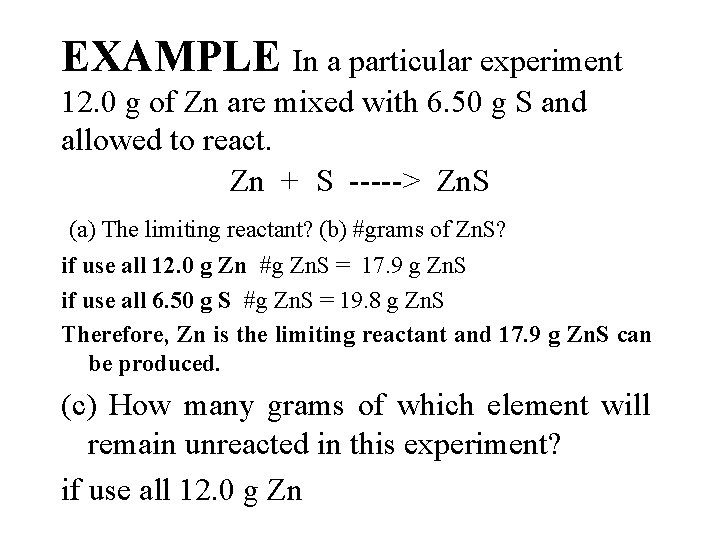
EXAMPLE In a particular experiment 12. 0 g of Zn are mixed with 6. 50 g S and allowed to react. Zn + S -----> Zn. S (a) The limiting reactant? (b) #grams of Zn. S? if use all 12. 0 g Zn #g Zn. S = 17. 9 g Zn. S if use all 6. 50 g S #g Zn. S = 19. 8 g Zn. S Therefore, Zn is the limiting reactant and 17. 9 g Zn. S can be produced.
EXAMPLE In a particular experiment 12. 0 g of Zn are mixed with 6. 50 g S and allowed to react. Zn + S -----> Zn. S (a) The limiting reactant? (b) #grams of Zn. S? if use all 12. 0 g Zn #g Zn. S = 17. 9 g Zn. S if use all 6. 50 g S #g Zn. S = 19. 8 g Zn. S Therefore, Zn is the limiting reactant and 17. 9 g Zn. S can be produced. (c) How many grams of which element will remain unreacted in this experiment? if use all 12. 0 g Zn
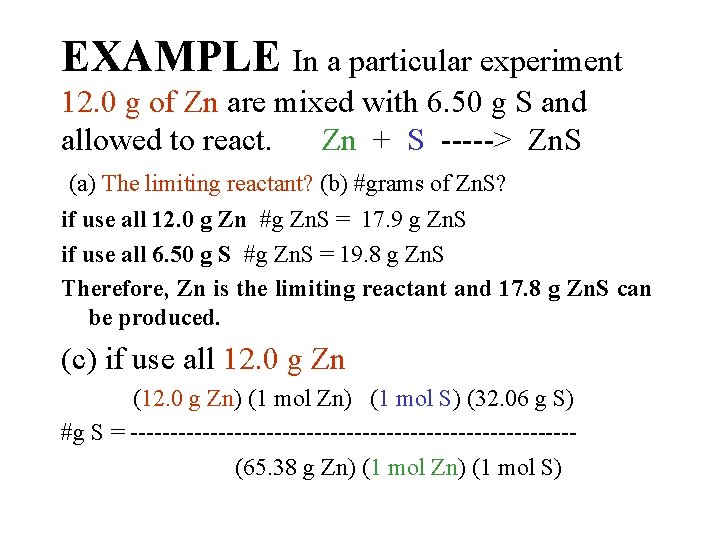
EXAMPLE In a particular experiment 12. 0 g of Zn are mixed with 6. 50 g S and allowed to react. Zn + S -----> Zn. S (a) The limiting reactant? (b) #grams of Zn. S? if use all 12. 0 g Zn #g Zn. S = 17. 9 g Zn. S if use all 6. 50 g S #g Zn. S = 19. 8 g Zn. S Therefore, Zn is the limiting reactant and 17. 8 g Zn. S can be produced. (c) if use all 12. 0 g Zn (12. 0 g Zn) (1 mol S) (32. 06 g S) #g S = ----------------------------(65. 38 g Zn) (1 mol S)
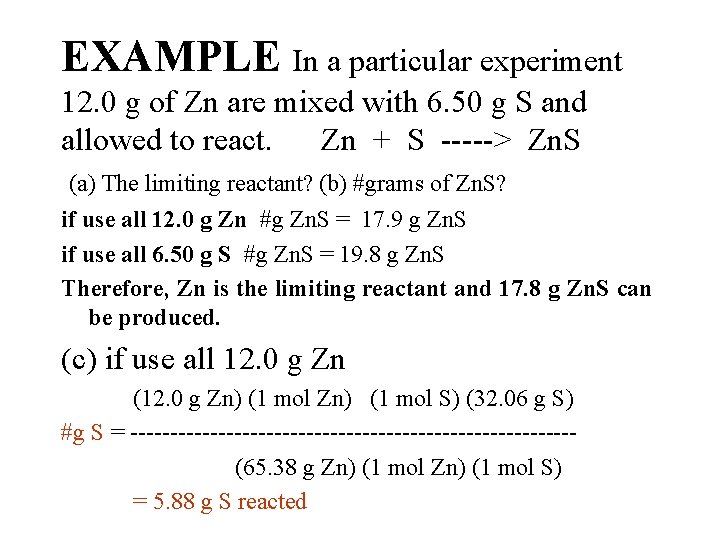
EXAMPLE In a particular experiment 12. 0 g of Zn are mixed with 6. 50 g S and allowed to react. Zn + S -----> Zn. S (a) The limiting reactant? (b) #grams of Zn. S? if use all 12. 0 g Zn #g Zn. S = 17. 9 g Zn. S if use all 6. 50 g S #g Zn. S = 19. 8 g Zn. S Therefore, Zn is the limiting reactant and 17. 8 g Zn. S can be produced. (c) if use all 12. 0 g Zn (12. 0 g Zn) (1 mol S) (32. 06 g S) #g S = ----------------------------(65. 38 g Zn) (1 mol S) = 5. 88 g S reacted
EXAMPLE In a particular experiment 12. 0 g of Zn are mixed with 6. 50 g S and allowed to react. Zn + S -----> Zn. S (a) The limiting reactant? (b) #grams of Zn. S? if use all 12. 0 g Zn #g Zn. S = 17. 9 g Zn. S if use all 6. 50 g S #g Zn. S = 19. 8 g Zn. S Therefore, Zn is the limiting reactant and 17. 8 g Zn. S can be produced. (c) if use all 12. 0 g Zn #g S = 5. 88 g S reacted Therefore, (6. 50 - 5. 88)g = 0. 61 g S remain unreacted.
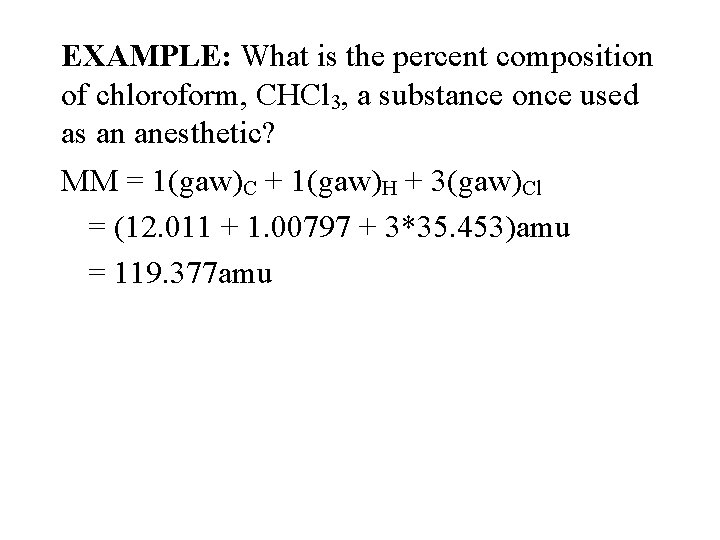
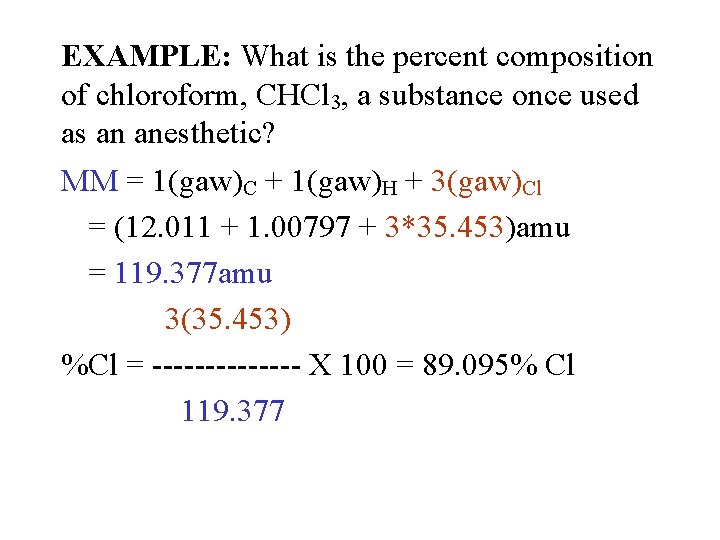
EXAMPLE: What is the percent composition of chloroform, CHCl 3, a substance once used as an anesthetic?
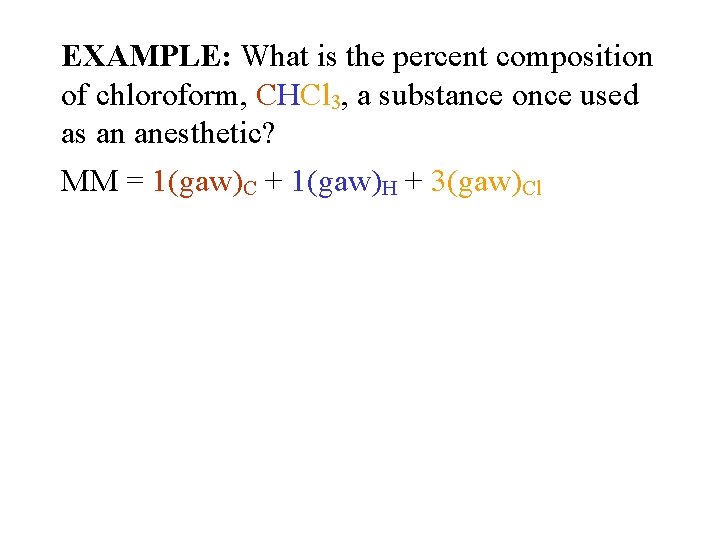
EXAMPLE: What is the percent composition of chloroform, CHCl 3, a substance once used as an anesthetic? MM = 1(gaw)C + 1(gaw)H + 3(gaw)Cl
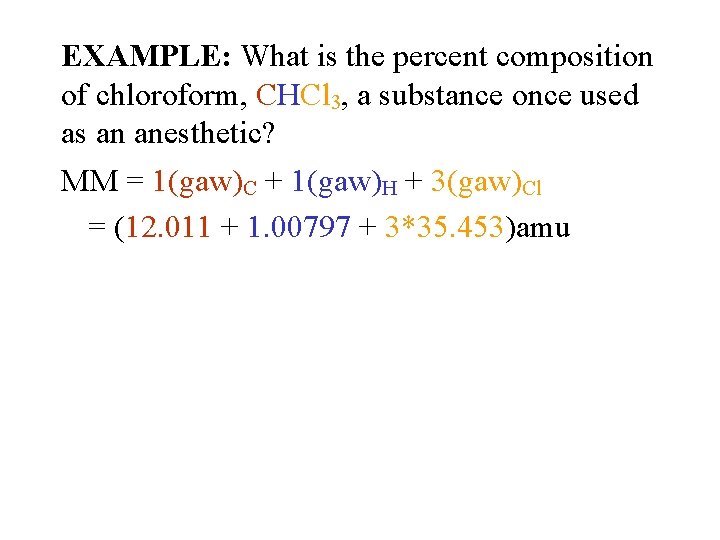
EXAMPLE: What is the percent composition of chloroform, CHCl 3, a substance once used as an anesthetic? MM = 1(gaw)C + 1(gaw)H + 3(gaw)Cl = (12. 011 + 1. 00797 + 3*35. 453)amu
EXAMPLE: What is the percent composition of chloroform, CHCl 3, a substance once used as an anesthetic? MM = 1(gaw)C + 1(gaw)H + 3(gaw)Cl = (12. 011 + 1. 00797 + 3*35. 453)amu = 119. 377 amu
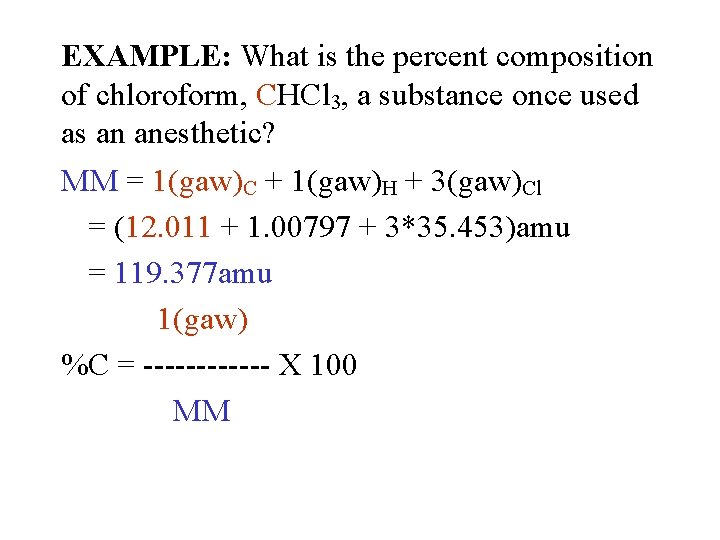
EXAMPLE: What is the percent composition of chloroform, CHCl 3, a substance once used as an anesthetic? MM = 1(gaw)C + 1(gaw)H + 3(gaw)Cl = (12. 011 + 1. 00797 + 3*35. 453)amu = 119. 377 amu 1(gaw) %C = ------ X 100 MM
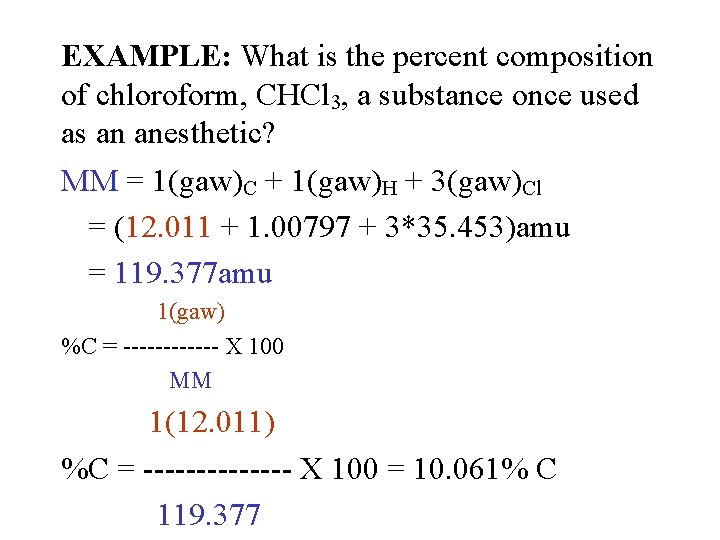
EXAMPLE: What is the percent composition of chloroform, CHCl 3, a substance once used as an anesthetic? MM = 1(gaw)C + 1(gaw)H + 3(gaw)Cl = (12. 011 + 1. 00797 + 3*35. 453)amu = 119. 377 amu 1(gaw) %C = ------ X 100 MM 1(12. 011) %C = ------- X 100 = 10. 061% C 119. 377
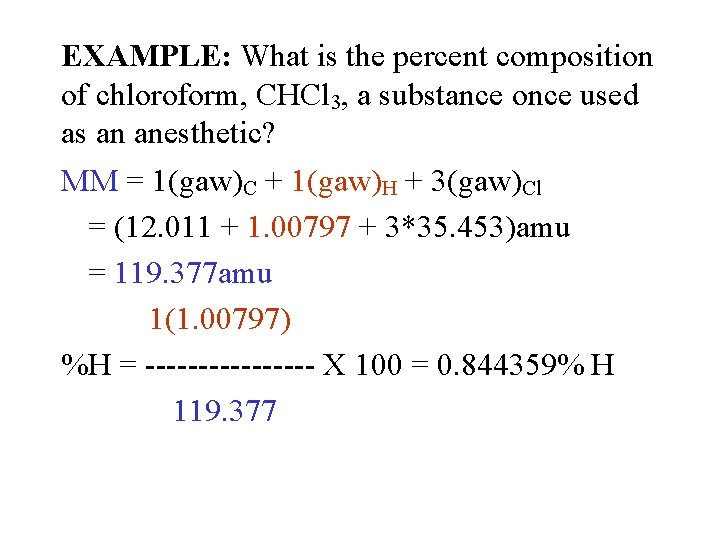
EXAMPLE: What is the percent composition of chloroform, CHCl 3, a substance once used as an anesthetic? MM = 1(gaw)C + 1(gaw)H + 3(gaw)Cl = (12. 011 + 1. 00797 + 3*35. 453)amu = 119. 377 amu 1(1. 00797) %H = -------- X 100 = 0. 844359% H 119. 377
EXAMPLE: What is the percent composition of chloroform, CHCl 3, a substance once used as an anesthetic? MM = 1(gaw)C + 1(gaw)H + 3(gaw)Cl = (12. 011 + 1. 00797 + 3*35. 453)amu = 119. 377 amu 3(35. 453) %Cl = ------- X 100 = 89. 095% Cl 119. 377
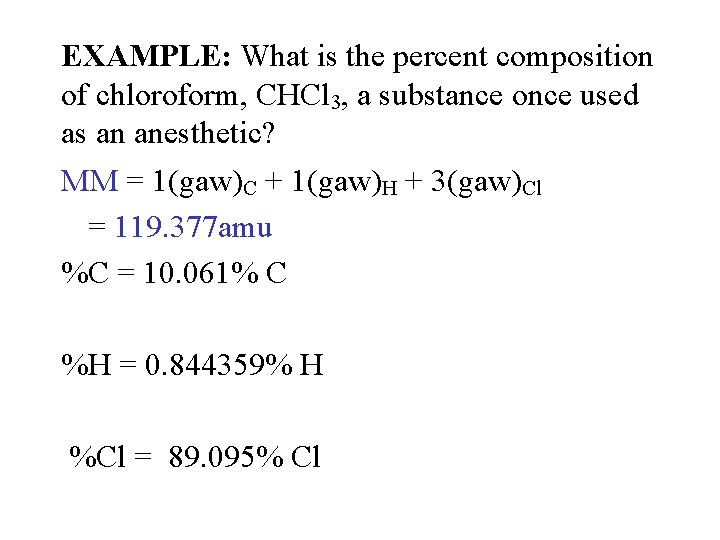
EXAMPLE: What is the percent composition of chloroform, CHCl 3, a substance once used as an anesthetic? MM = 1(gaw)C + 1(gaw)H + 3(gaw)Cl = 119. 377 amu %C = 10. 061% C %H = 0. 844359% H %Cl = 89. 095% Cl