
Stoichiometry Mass Changes in Chemical Reactions Limiting reactants
- Slides: 22
Stoichiometry Mass Changes in Chemical Reactions Limiting reactants Percentage yield
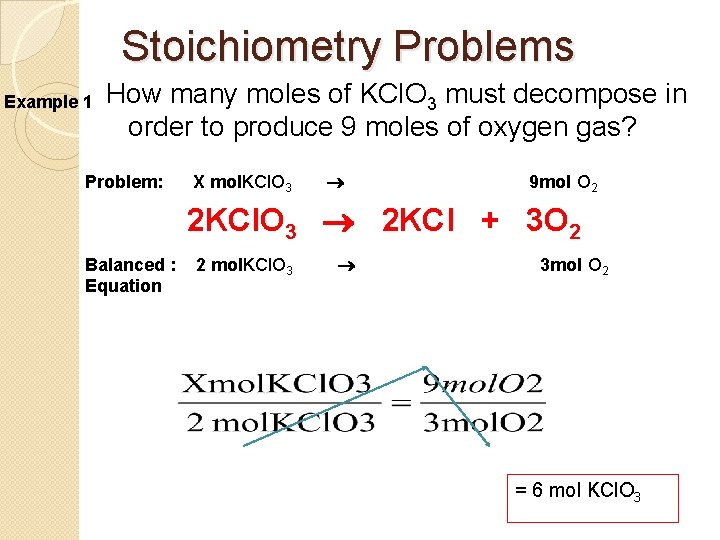
Stoichiometry Problems Example 1 How many moles of KCl. O 3 must decompose in order to produce 9 moles of oxygen gas? Problem: X mol. KCl. O 3 9 mol O 2 2 KCl. O 3 2 KCl + 3 O 2 Balanced : Equation 2 mol. KCl. O 3 3 mol O 2 = 6 mol KCl. O 3
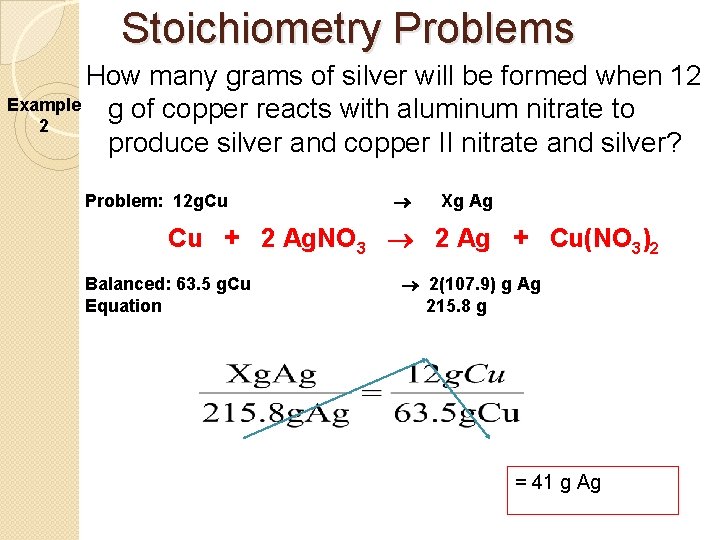
Stoichiometry Problems How many grams of silver will be formed when 12 Example g of copper reacts with aluminum nitrate to 2 produce silver and copper II nitrate and silver? Problem: 12 g. Cu Xg Ag Cu + 2 Ag. NO 3 2 Ag + Cu(NO 3)2 Balanced: 63. 5 g. Cu Equation 2(107. 9) g Ag 215. 8 g = 41 g Ag
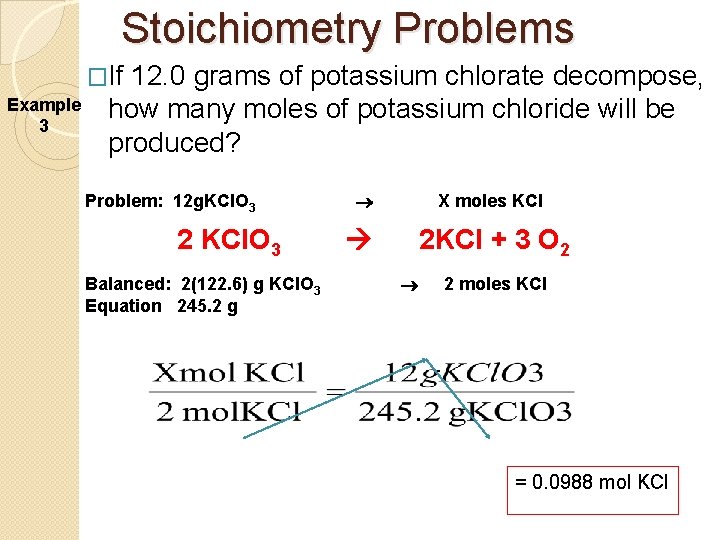
Stoichiometry Problems �If Example 3 12. 0 grams of potassium chlorate decompose, how many moles of potassium chloride will be produced? Problem: 12 g. KCl. O 3 2 KCl. O 3 Balanced: 2(122. 6) g KCl. O 3 Equation 245. 2 g X moles KCl 2 KCl + 3 O 2 2 moles KCl = 0. 0988 mol KCl
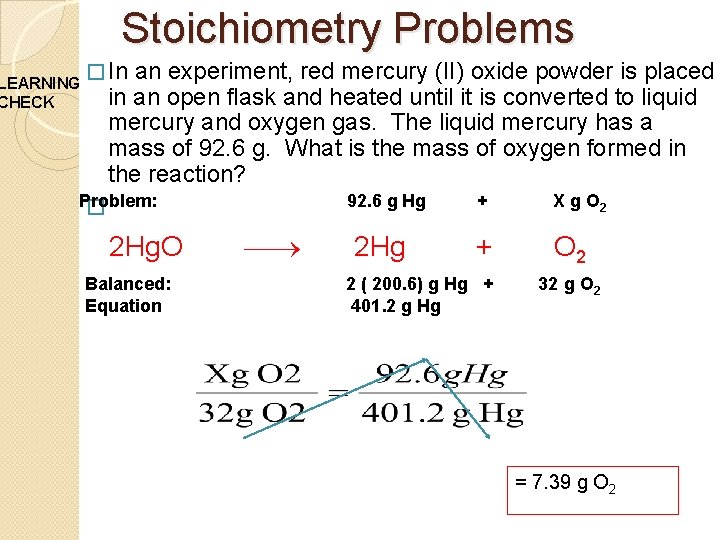
Stoichiometry Problems LEARNING CHECK � In an experiment, red mercury (II) oxide powder is placed in an open flask and heated until it is converted to liquid mercury and oxygen gas. The liquid mercury has a mass of 92. 6 g. What is the mass of oxygen formed in the reaction? Problem: � 2 Hg. O Balanced: Equation 92. 6 g Hg 2 Hg + X g O 2 + O 2 2 ( 200. 6) g Hg + 401. 2 g Hg 32 g O 2 = 7. 39 g O 2
Limiting Reactant
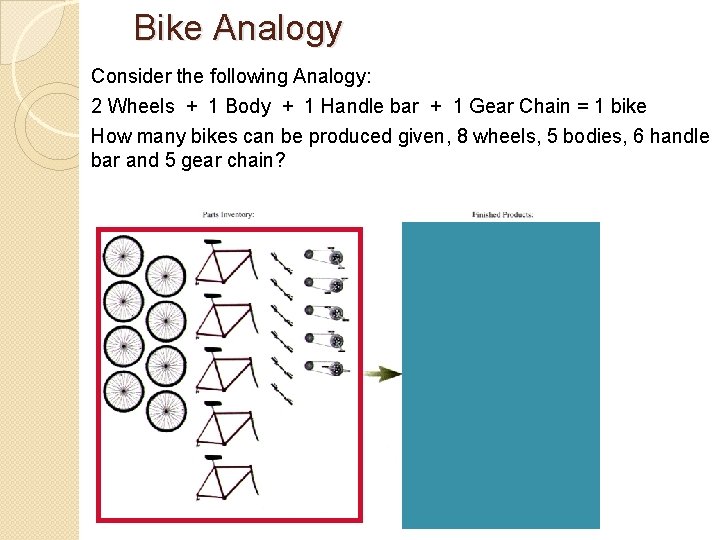
Bike Analogy Consider the following Analogy: 2 Wheels + 1 Body + 1 Handle bar + 1 Gear Chain = 1 bike How many bikes can be produced given, 8 wheels, 5 bodies, 6 handle bar and 5 gear chain?
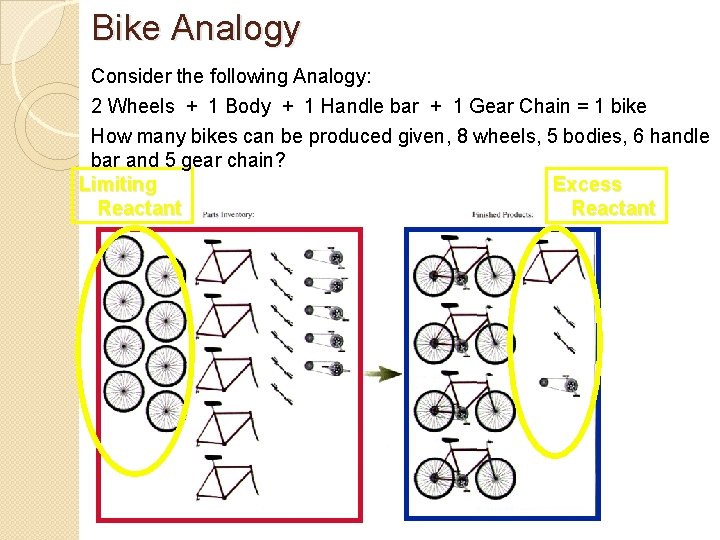
Bike Analogy Consider the following Analogy: 2 Wheels + 1 Body + 1 Handle bar + 1 Gear Chain = 1 bike How many bikes can be produced given, 8 wheels, 5 bodies, 6 handle bar and 5 gear chain? Limiting Excess Reactant
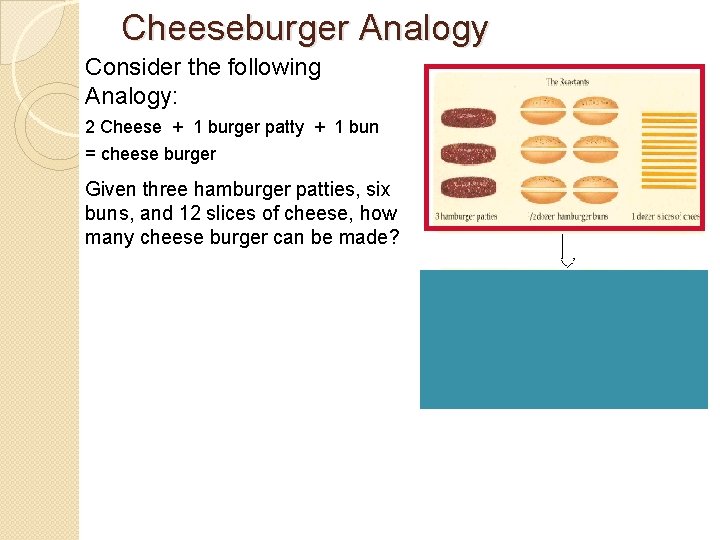
Cheeseburger Analogy Consider the following Analogy: 2 Cheese + 1 burger patty + 1 bun = cheese burger Given three hamburger patties, six buns, and 12 slices of cheese, how many cheese burger can be made?
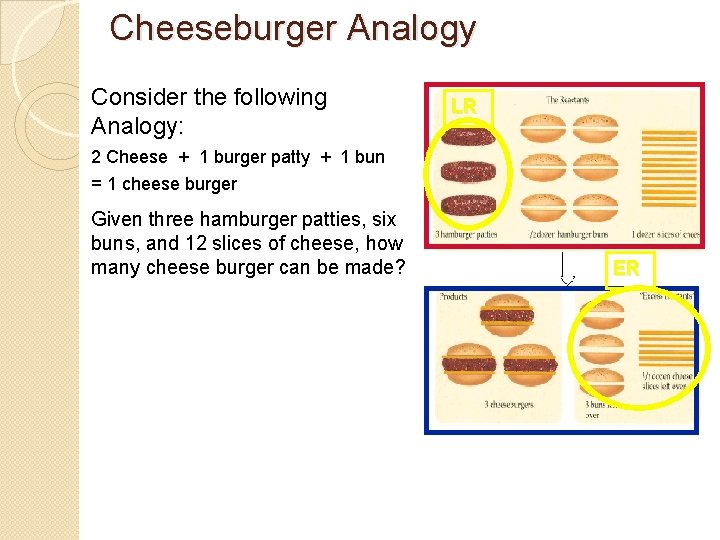
Cheeseburger Analogy Consider the following Analogy: LR 2 Cheese + 1 burger patty + 1 bun = 1 cheese burger Given three hamburger patties, six buns, and 12 slices of cheese, how many cheese burger can be made? ER
Limiting Reactant vs. Excess Reactants – Limiting reactant is the reactant that runs out first In our examples, the limiting reactants will be the wheels in the bicycle analogy and the burger patty in our hamburger analogy – When the limiting reactant is exhausted, then the reaction stops
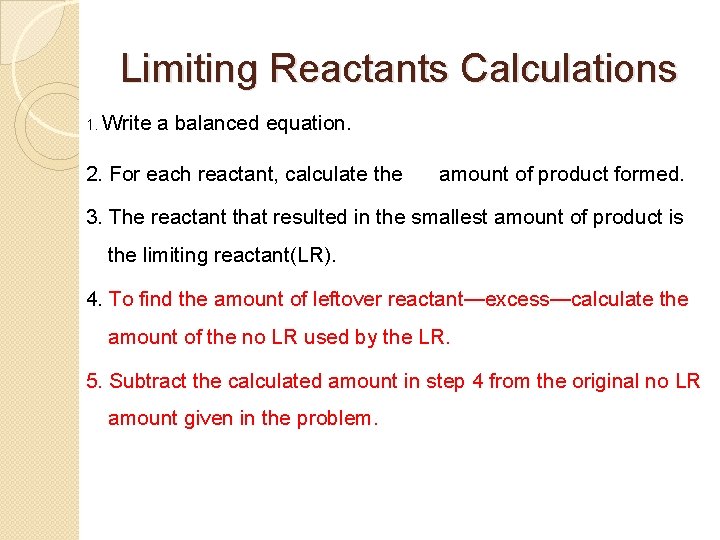
Limiting Reactants Calculations 1. Write a balanced equation. 2. For each reactant, calculate the amount of product formed. 3. The reactant that resulted in the smallest amount of product is the limiting reactant(LR). 4. To find the amount of leftover reactant—excess—calculate the amount of the no LR used by the LR. 5. Subtract the calculated amount in step 4 from the original no LR amount given in the problem.
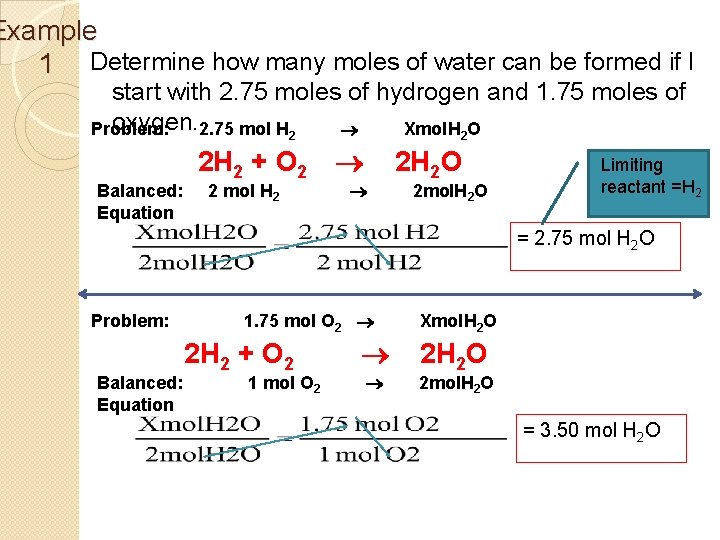
Example 1 Determine how many moles of water can be formed if I start with 2. 75 moles of hydrogen and 1. 75 moles of oxygen. 2. 75 mol H 2 Problem: Xmol. H 2 O Balanced: Equation 2 H 2 + O 2 2 mol H 2 2 H 2 O 2 mol. H 2 O Limiting reactant =H 2 = 2. 75 mol H 2 O Problem: Balanced: Equation 1. 75 mol O 2 2 H 2 + O 2 1 mol O 2 Xmol. H 2 O 2 mol. H 2 O = 3. 50 mol H 2 O
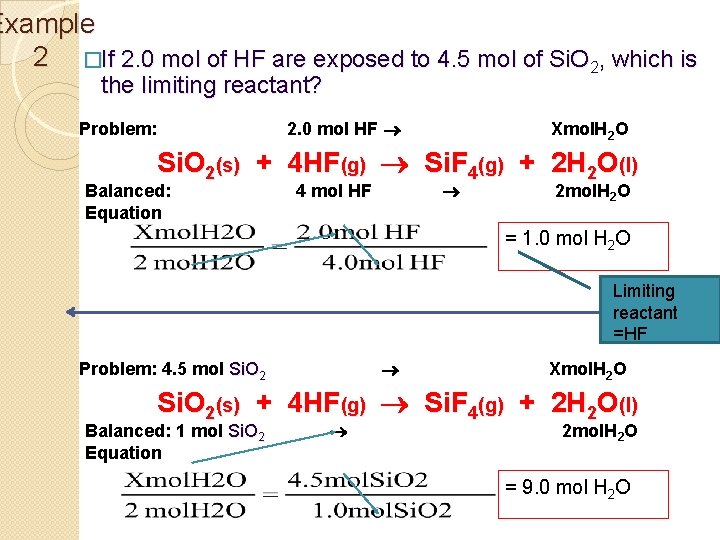
Example 2 �If 2. 0 mol of HF are exposed to 4. 5 mol of Si. O 2, which is the limiting reactant? 2. 0 mol HF Problem: Xmol. H 2 O Si. O 2(s) + 4 HF(g) Si. F 4(g) + 2 H 2 O(l) Balanced: Equation 4 mol HF 2 mol. H 2 O = 1. 0 mol H 2 O Limiting reactant =HF Problem: 4. 5 mol Si. O 2 Xmol. H 2 O Si. O 2(s) + 4 HF(g) Si. F 4(g) + 2 H 2 O(l) Balanced: 1 mol Si. O 2 Equation 2 mol. H 2 O = 9. 0 mol H 2 O
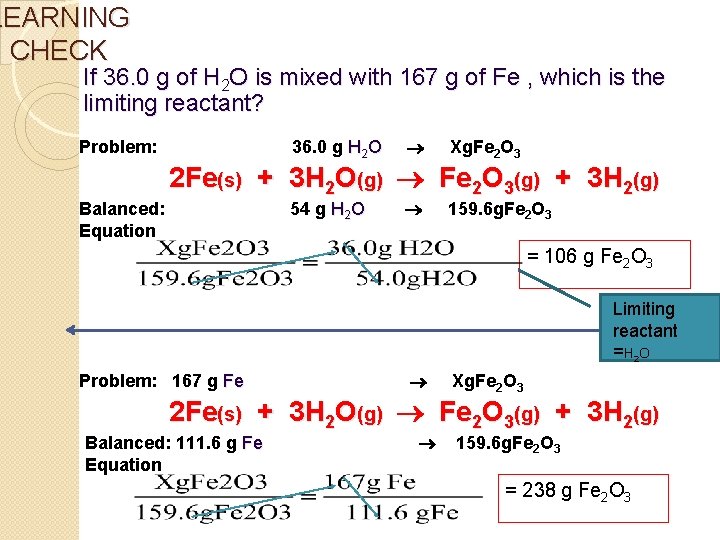
LEARNING CHECK If 36. 0 g of H 2 O is mixed with 167 g of Fe , which is the limiting reactant? Problem: 36. 0 g H 2 O 54 g H 2 O Xg. Fe 2 O 3 2 Fe(s) + 3 H 2 O(g) Fe 2 O 3(g) + 3 H 2(g) Balanced: Equation 159. 6 g. Fe 2 O 3 = 106 g Fe 2 O 3 Limiting reactant =H 2 O Problem: 167 g Fe Xg. Fe 2 O 3 2 Fe(s) + 3 H 2 O(g) Fe 2 O 3(g) + 3 H 2(g) Balanced: 111. 6 g Fe Equation 159. 6 g. Fe 2 O 3 = 238 g Fe 2 O 3
Limiting Reactants Calculations 1. Write a balanced equation. 2. For each reactant, calculate the amount of product formed. 3. The reactant that resulted in the smallest amount of product is the limiting reactant(LR). 4. To find the amount of leftover reactant—excess—calculate the amount of the no LR used by the LR. 5. Subtract the calculated amount in step 4 from the original no LR amount given in the problem.
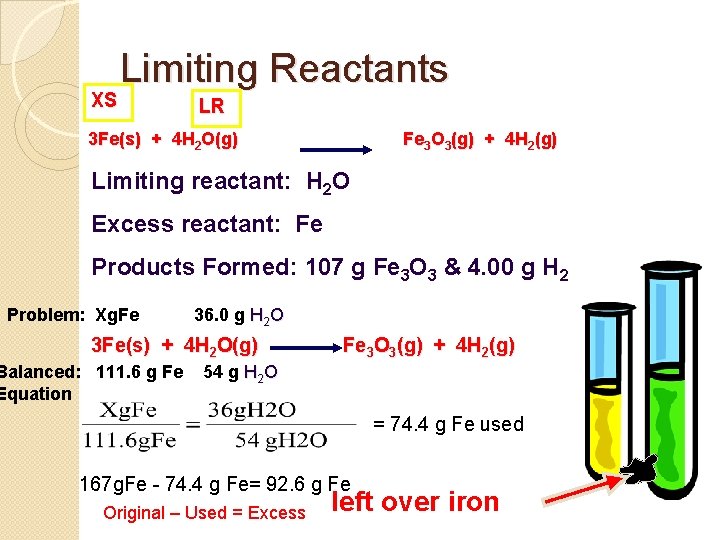
XS Limiting Reactants LR 3 Fe(s) + 4 H 2 O(g) Fe 3 O 3(g) + 4 H 2(g) Limiting reactant: H 2 O Excess reactant: Fe Products Formed: 107 g Fe 3 O 3 & 4. 00 g H 2 Problem: Xg. Fe 36. 0 g H 2 O 3 Fe(s) + 4 H 2 O(g) Balanced: 111. 6 g Fe Equation Fe 3 O 3(g) + 4 H 2(g) 54 g H 2 O = 74. 4 g Fe used 167 g. Fe - 74. 4 g Fe= 92. 6 g Fe Original – Used = Excess left over iron
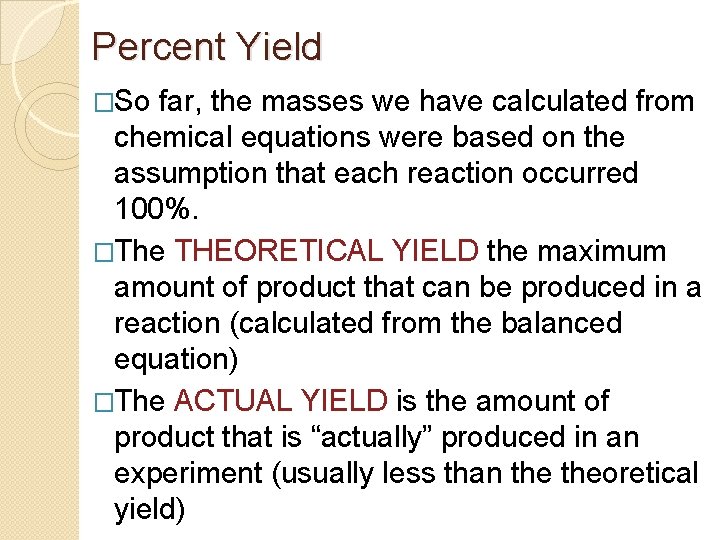
Percent Yield �So far, the masses we have calculated from chemical equations were based on the assumption that each reaction occurred 100%. �The THEORETICAL YIELD the maximum amount of product that can be produced in a reaction (calculated from the balanced equation) �The ACTUAL YIELD is the amount of product that is “actually” produced in an experiment (usually less than theoretical yield)
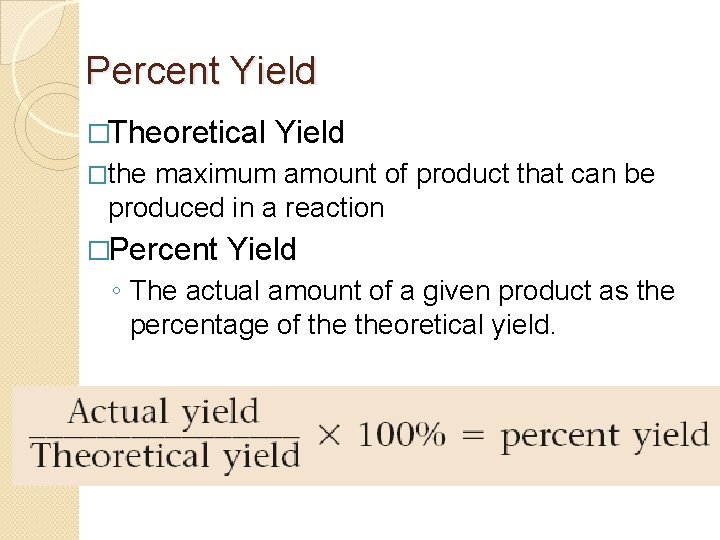
Percent Yield �Theoretical Yield �the maximum amount of product that can be produced in a reaction �Percent Yield ◦ The actual amount of a given product as the percentage of theoretical yield.
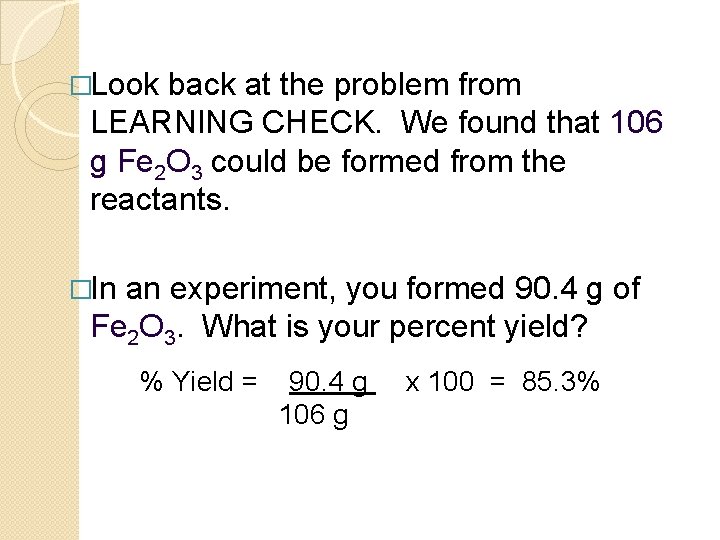
�Look back at the problem from LEARNING CHECK. We found that 106 g Fe 2 O 3 could be formed from the reactants. �In an experiment, you formed 90. 4 g of Fe 2 O 3. What is your percent yield? % Yield = 90. 4 g 106 g x 100 = 85. 3%
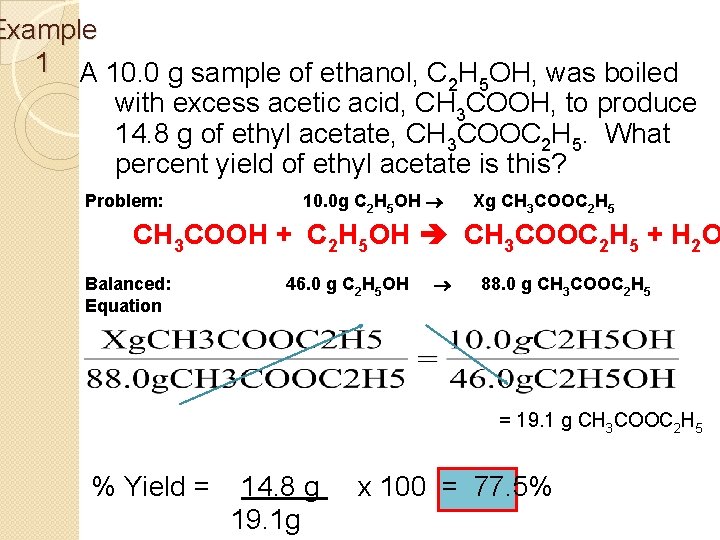
Example 1 A 10. 0 g sample of ethanol, C H OH, was boiled 2 5 with excess acetic acid, CH 3 COOH, to produce 14. 8 g of ethyl acetate, CH 3 COOC 2 H 5. What percent yield of ethyl acetate is this? Problem: 10. 0 g C 2 H 5 OH Xg CH 3 COOC 2 H 5 CH 3 COOH + C 2 H 5 OH CH 3 COOC 2 H 5 + H 2 O Balanced: Equation 46. 0 g C 2 H 5 OH 88. 0 g CH 3 COOC 2 H 5 = 19. 1 g CH 3 COOC 2 H 5 % Yield = 14. 8 g 19. 1 g x 100 = 77. 5%
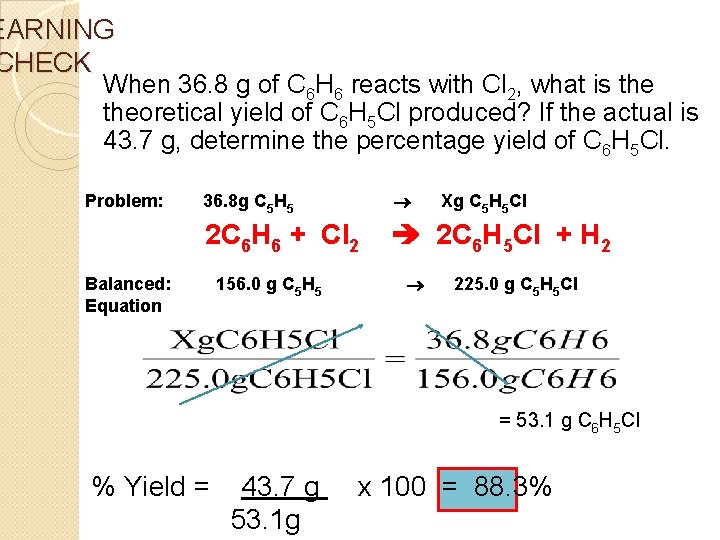
EARNING CHECK When 36. 8 g of C 6 H 6 reacts with Cl 2, what is theoretical yield of C 6 H 5 Cl produced? If the actual is 43. 7 g, determine the percentage yield of C 6 H 5 Cl. Problem: 36. 8 g C 5 H 5 2 C 6 H 6 + Cl 2 2 C 6 H 5 Cl + H 2 Balanced: Equation 156. 0 g C 5 H 5 Xg C 5 H 5 Cl 225. 0 g C 5 H 5 Cl = 53. 1 g C 6 H 5 Cl % Yield = 43. 7 g 53. 1 g x 100 = 88. 3%